Best Sales Presentation Templates: 3 Editable AI-Ready Decks
Updated October 15, 2026 | Original editable examples and source notes
Use a first-call template to understand the buyer, a proposal to define the agreed solution, and a QBR to review what has actually happened. The best sales presentation template changes as the relationship moves from discovery to commitment to adoption. These three editable files keep the buyer's decision central instead of using the same generic pitch at every stage.
Choose the sales deck by stage
| Template | Best moment | The buyer should be able to | Evidence you need |
|---|---|---|---|
| First call | Before the problem and process are fully qualified | Confirm priorities and agree a useful next conversation | Approved discovery questions and relevant proof. |
| Proposal | After the need and scope are understood | Evaluate scope, assumptions, terms and next steps | Buyer-approved requirements and a reviewed business case. |
| QBR | During an ongoing customer relationship | Assess adoption, gaps and joint actions | Defined outcomes, usage period and customer context. |
Three editable sales presentation templates
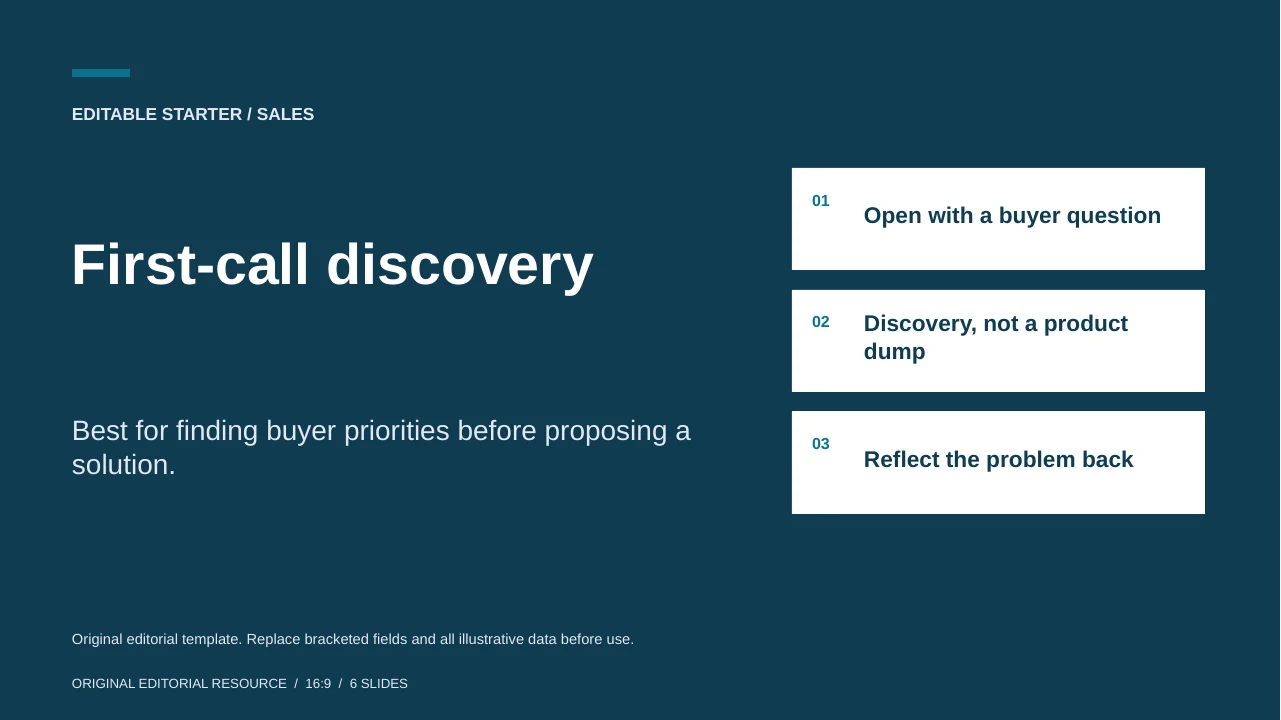
First-call discovery
Best for finding buyer priorities before proposing a solution.
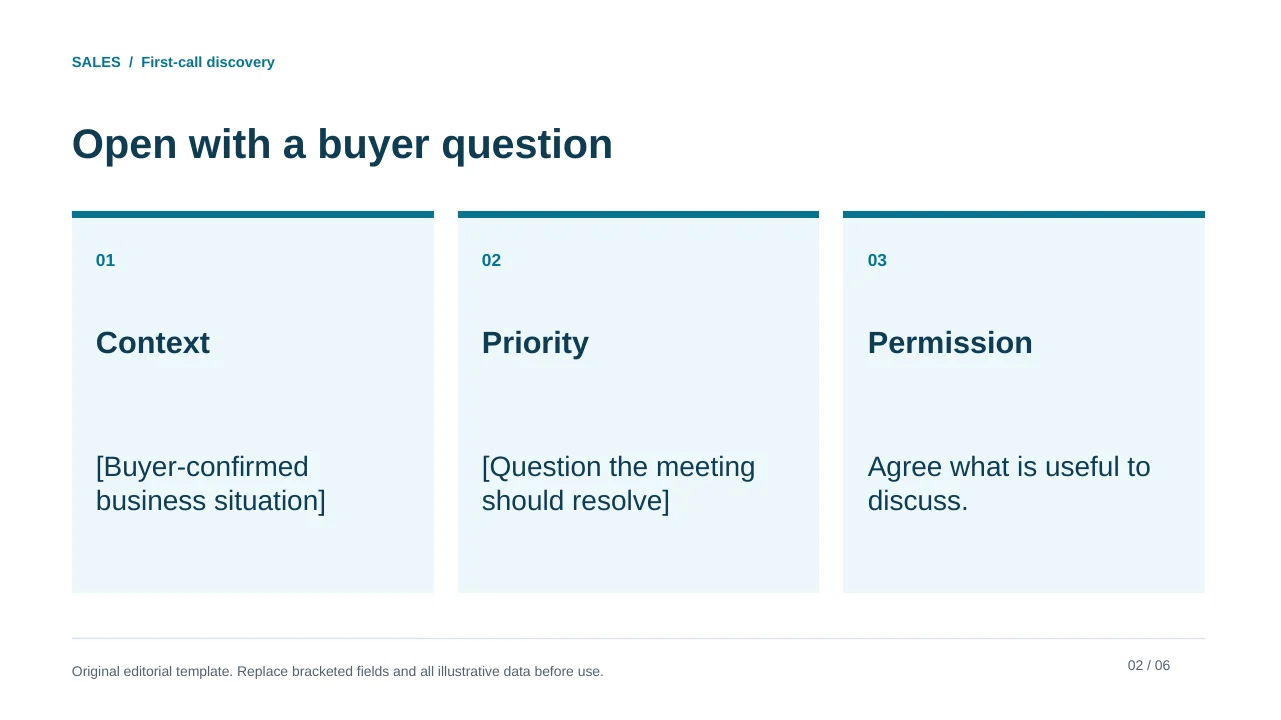
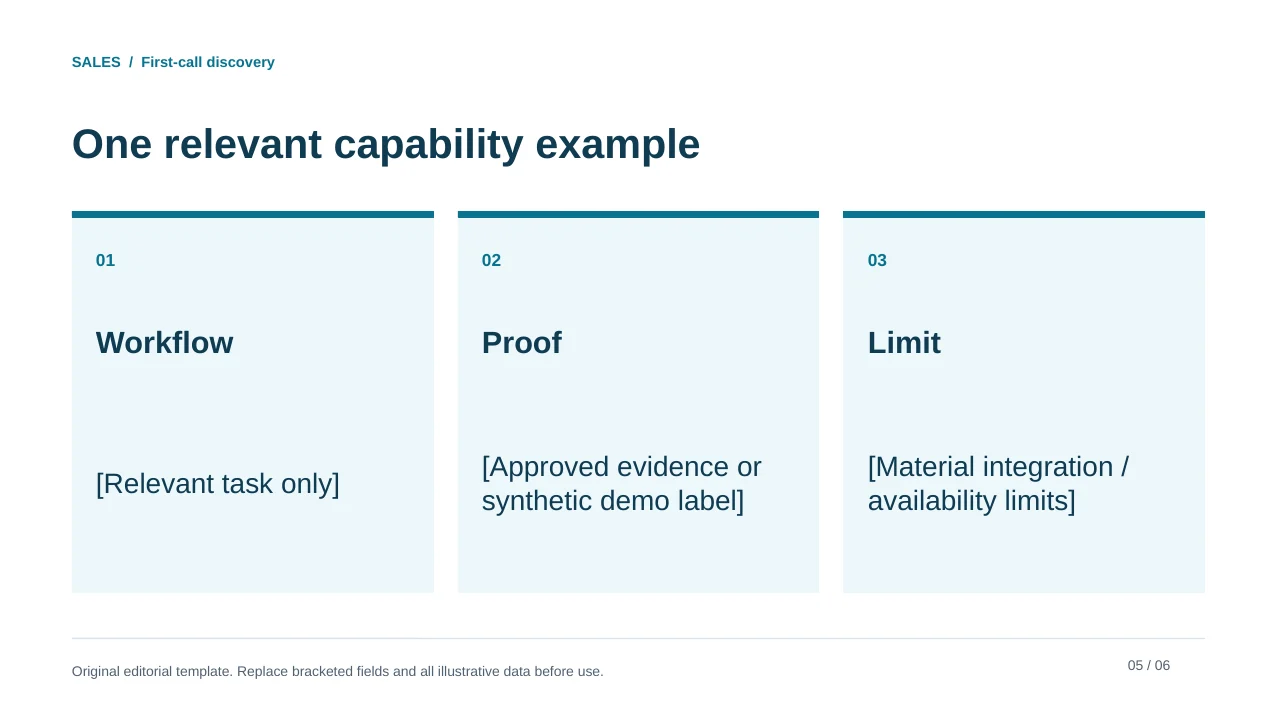
This file makes room for discovery and mutual fit rather than immediately asserting that the product solves every problem. Keep questions open until the buyer supplies context. Replace generic proof with approved, relevant evidence.
Original editorial template. Replace bracketed fields and all illustrative data before use.
See the complete slide sequence
- First-call discovery
- Open with a buyer question
- Discovery, not a product dump
- Reflect the problem back
- One relevant capability example
- Earn a useful next step
Buyer proposal
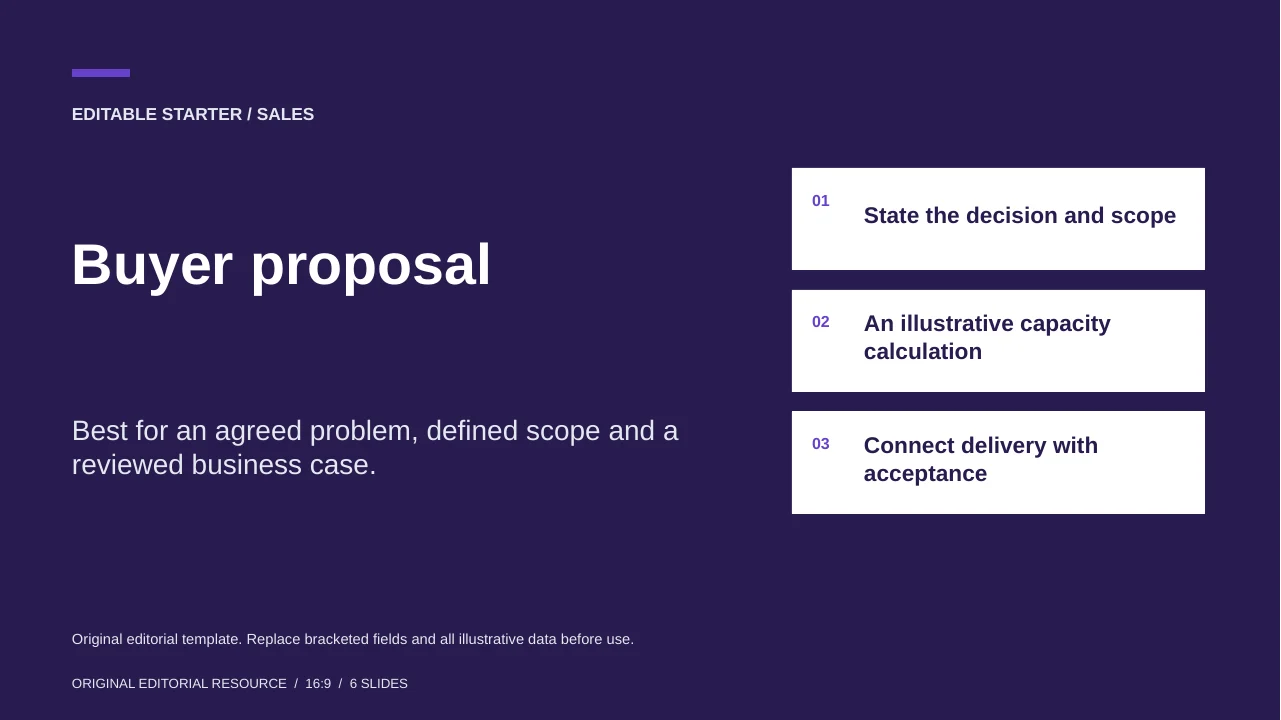
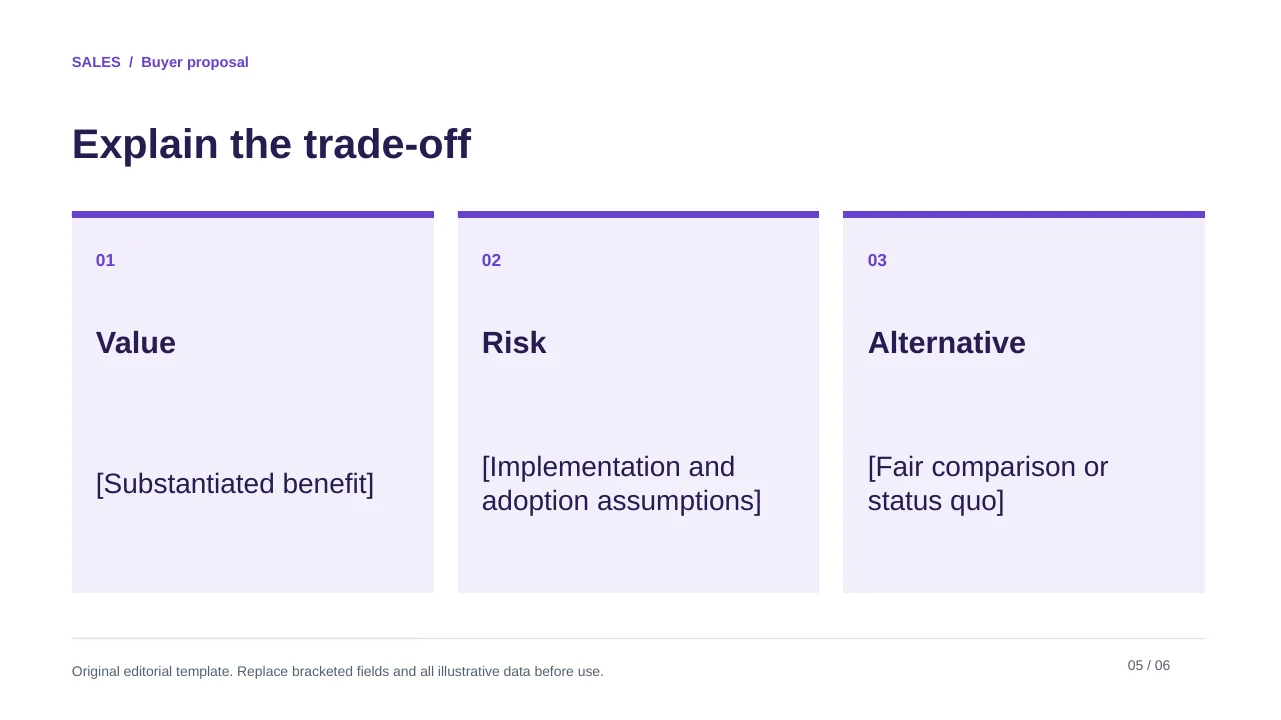
Best for an agreed problem, defined scope and a reviewed business case.
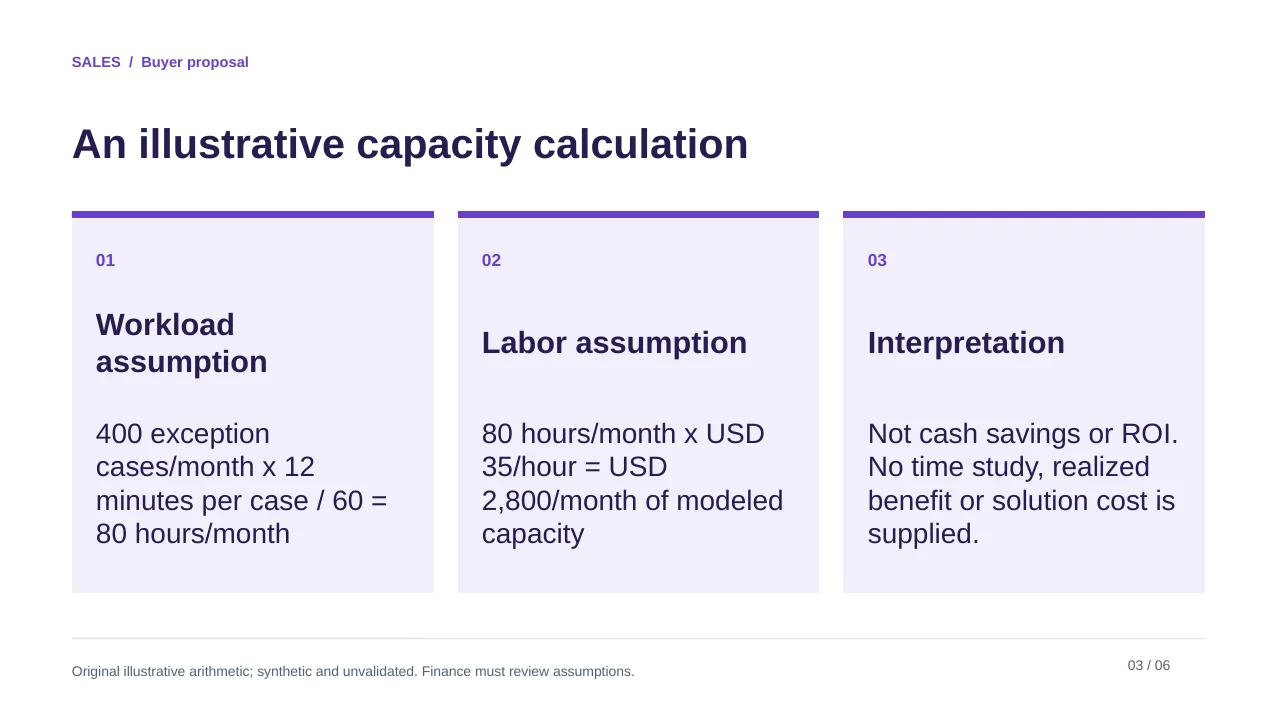
The proposal ties the buyer's problem to scope, a transparent capacity calculation and a decision. Its economic example preserves the original article's assumptions; it does not claim that the seller has delivered those savings.
Original editorial template. Replace bracketed fields and all illustrative data before use.
See the complete slide sequence
- Buyer proposal
- State the decision and scope
- An illustrative capacity calculation
- Connect delivery with acceptance
- Explain the trade-off
- Commercial handoff
Customer quarterly review
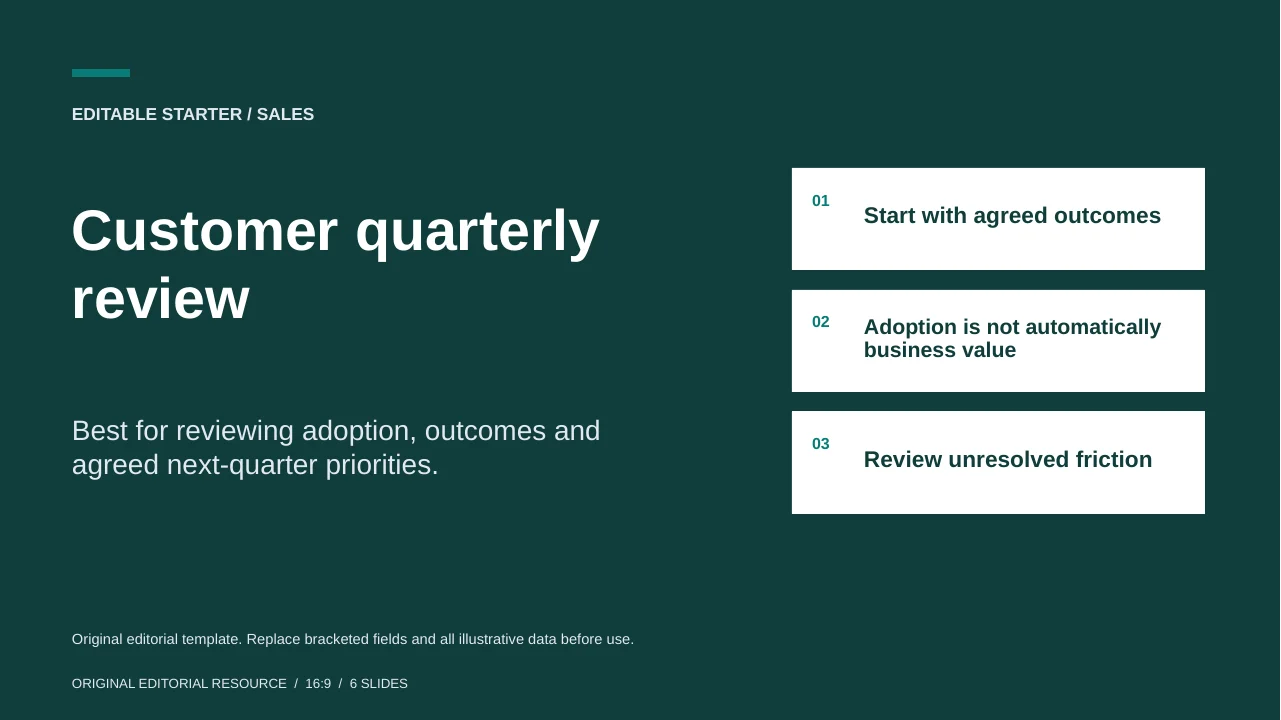
Best for reviewing adoption, outcomes and agreed next-quarter priorities.
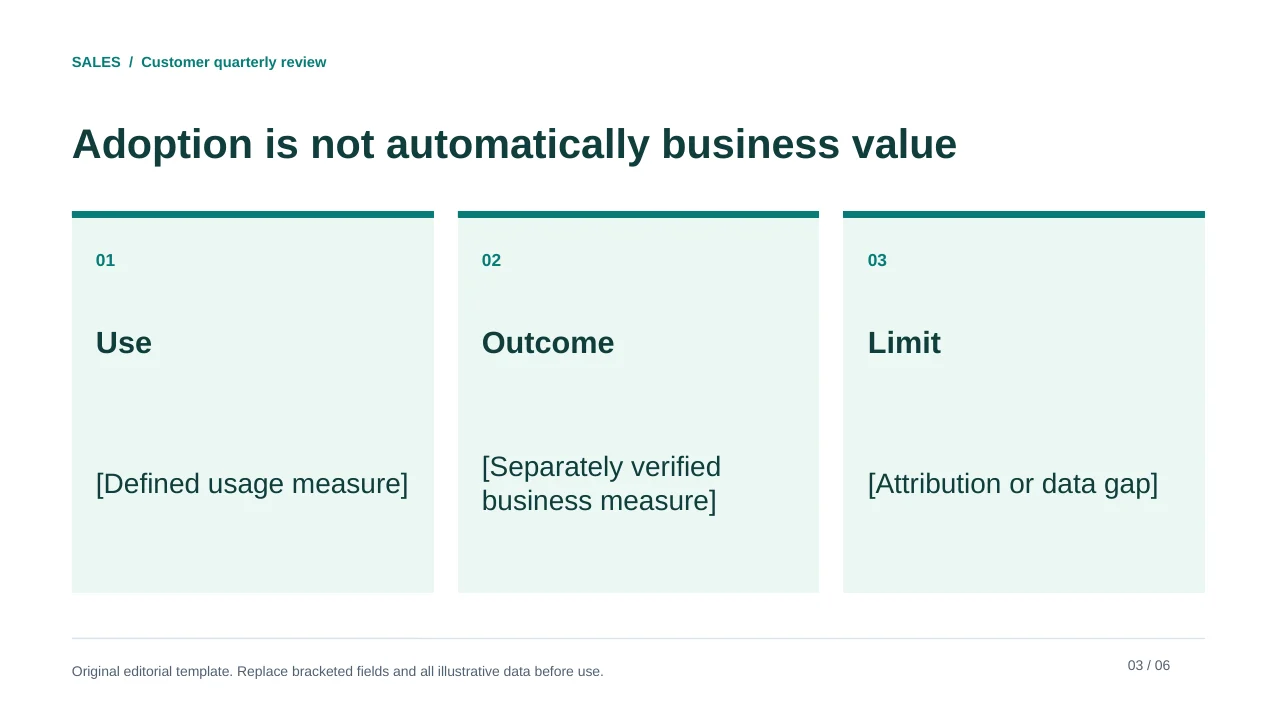
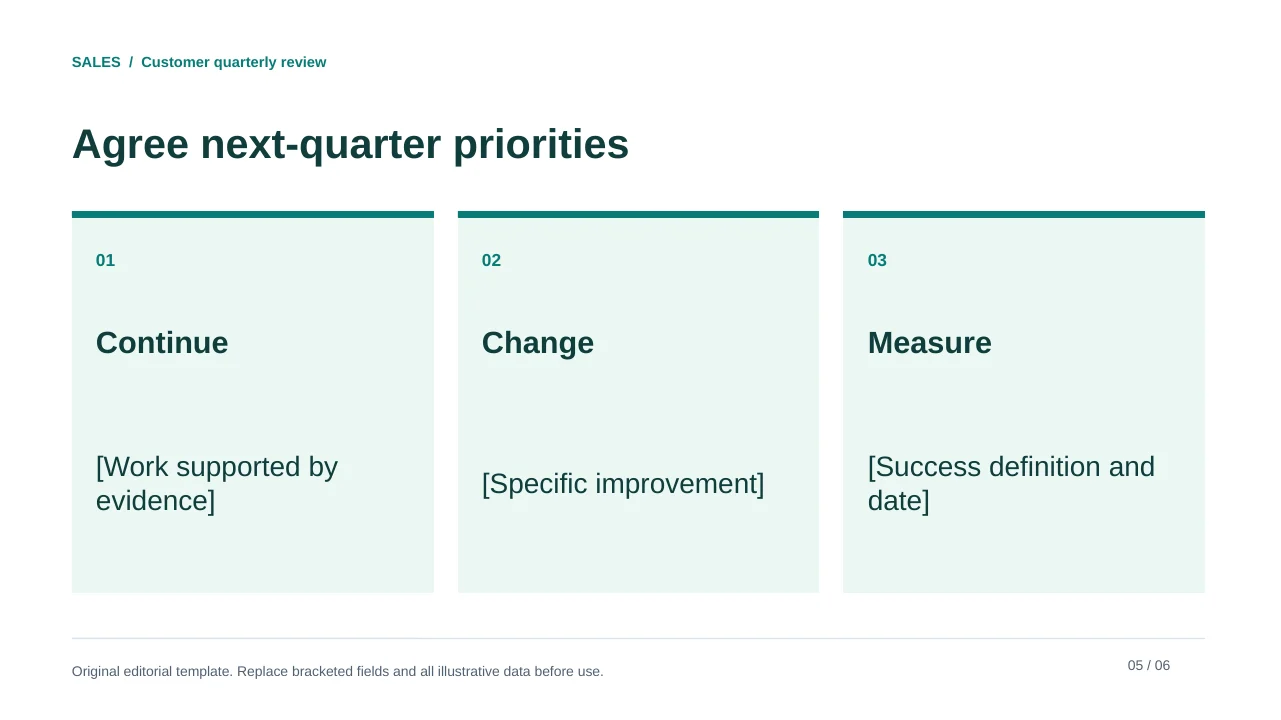
The QBR starts from the agreed goal and the reporting period. Use it to compare evidence, discuss unresolved gaps and record joint actions. An expansion request should follow the customer's need, not replace the review.
Original editorial template. Replace bracketed fields and all illustrative data before use.
See the complete slide sequence
- Customer quarterly review
- Start with agreed outcomes
- Adoption is not automatically business value
- Review unresolved friction
- Agree next-quarter priorities
- Close with a joint plan
Keep the original capacity example honest
The illustrative business case assumes 400 exception cases per month, with 12 minutes of manual review per case. That is 400 x 12 / 60 = 80 hours per month. At an assumed loaded labor rate of USD 35 per hour, the model values that capacity at USD 2,800 per month. No time study or realized benefit has been supplied.
This is modeled capacity, not automatic cash savings. A team may redeploy time rather than reduce payroll, and the proposed solution may add implementation or operating costs. Because those costs and realized benefits are absent, the example cannot establish an ROI percentage. Ask the buyer and finance owner to validate the workload, timing, utilization and cost basis.
| Business-case input | Supplied example | Validation needed |
|---|---|---|
| Workload | 400 cases/month | Dated buyer process log. |
| Time per case | 12 minutes | Observed method and representative sample. |
| Labor value | USD 35/hour | Approved loaded-rate definition. |
| Realized benefit | Not supplied | Post-change measurement and adoption context. |
| Solution cost | Not supplied | Implementation and ongoing cost basis. |
Customize the file to the buyer's decision
For a full drafting workflow beyond template choice, use the sales presentation how-to guide. For a consulting statement of work, use the consulting proposal collection. These pages serve different decisions rather than repeating one generalized sales tutorial.
PopAi's documented presentation workflow supports source-led drafting and editing. It does not validate an account's business case or make an unapproved offer binding. Inspect the final exported pages with the account owner before distribution.
Sources and example provenance
The files and preview layouts on this page were created for this editorial resource. External references support the specific guidance linked in the text; they do not endorse the templates. Source links checked on October 15, 2026.
Frequently Asked Questions
Which sales template should I use for a first meeting?
Use the first-call file when discovery and mutual fit are still open. A detailed proposal is premature without agreed needs and scope.
Does the example prove USD 2,800 of monthly savings?
No. It models capacity using 400 cases, 12 minutes and USD 35 per hour. It does not establish realized cash savings, ROI or an actual time study.
Can I reuse the same deck for a QBR?
Use the QBR structure instead. An existing customer needs a review of agreed goals, evidence, gaps and joint actions, not a repeated prospecting pitch.
Can AI supply missing customer proof?
No. Insert only authorized, accurate customer evidence and supported capabilities. Keep missing proof visible to the account owner.
Create your presentation with one click now
Turn your sales brief or approved source material into a structured presentation, then review and refine it for your next customer conversation.
Create your presentation