A consulting pitch should win agreement on a client engagement, not sell shares in a company. Start with the client's problem, show a bounded recommendation, and end with the scope and approval needed. The 60-day knowledge-search case below is a fictional proposal example; its outputs and decision gates are not a delivery guarantee.
The 60-Day Consulting Pilot: Scope, Gates and Approval
The same fictional knowledge-search engagement runs through all three pages. The timeline comes from the original case; commercial conditions are clearly illustrative and require agreement, not AI approval.
Open full-size examples and editable HTML layouts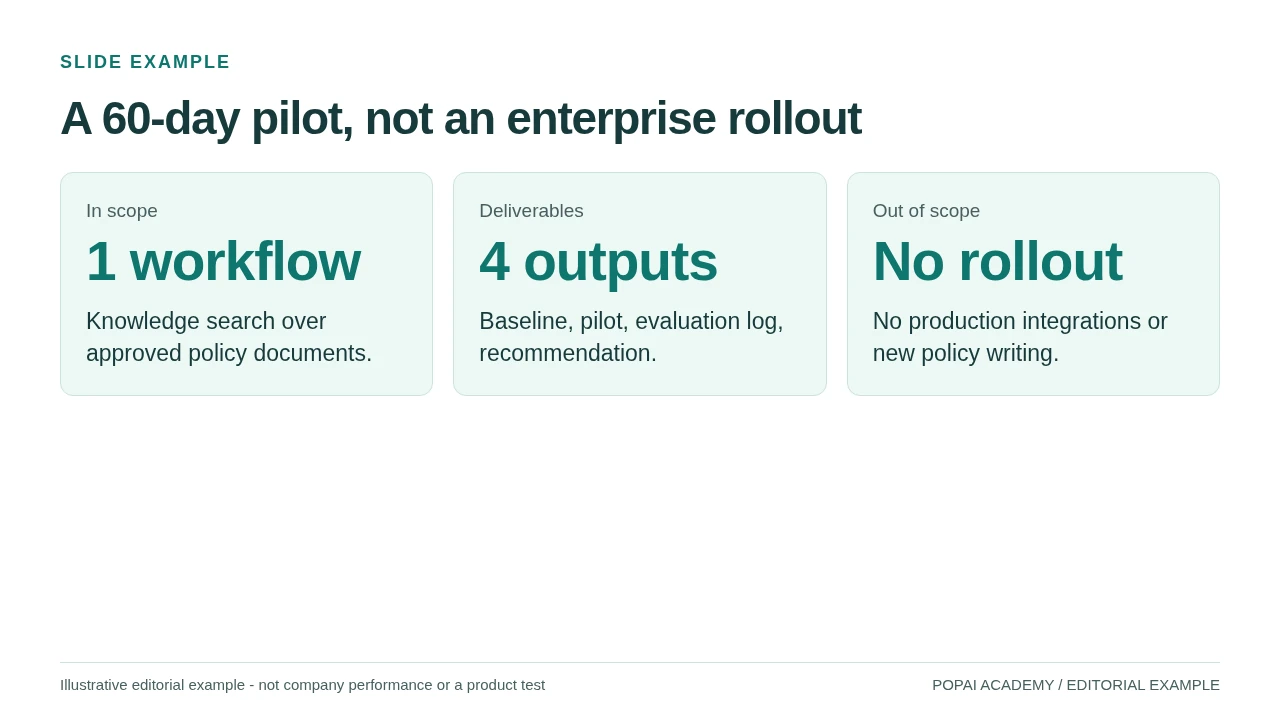
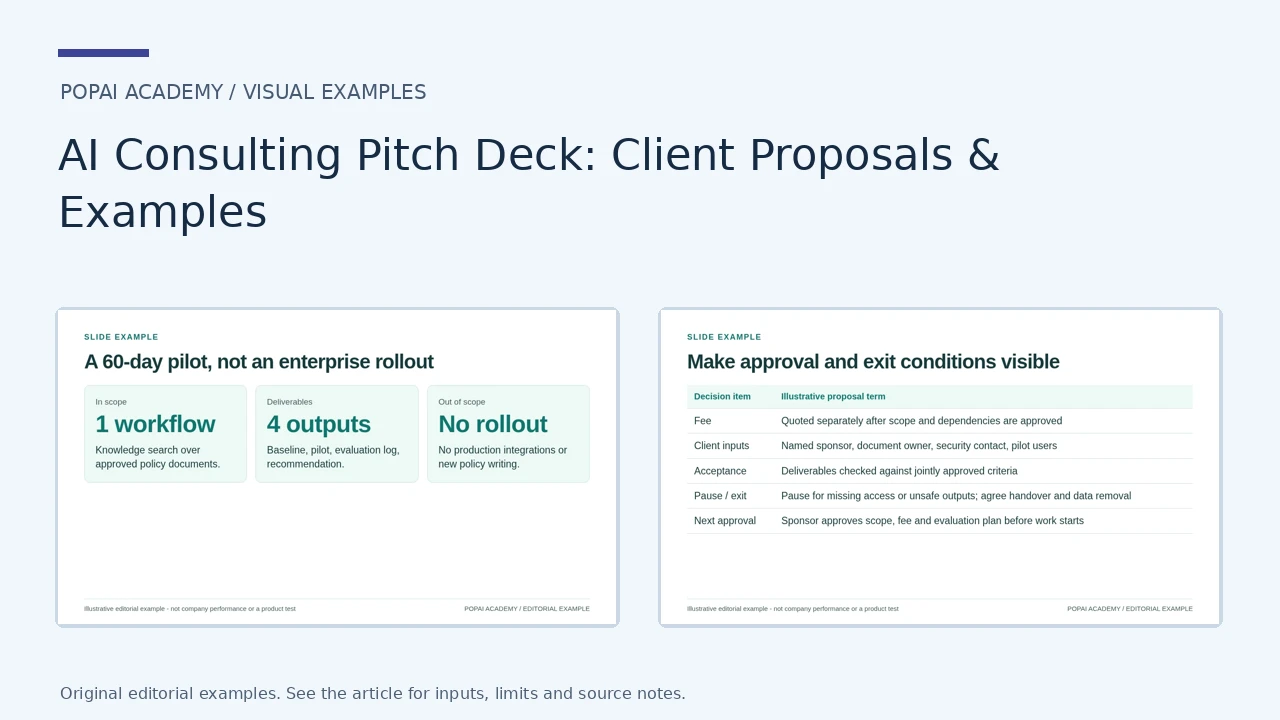
Bounded scope for the original fictional knowledge-search consulting case.
Read or copy the slide content
In scope
1 workflow
Knowledge search over approved policy documents.
Deliverables
4 outputs
Baseline, pilot, evaluation log, recommendation.
Out of scope
No rollout
No production integrations or new policy writing.
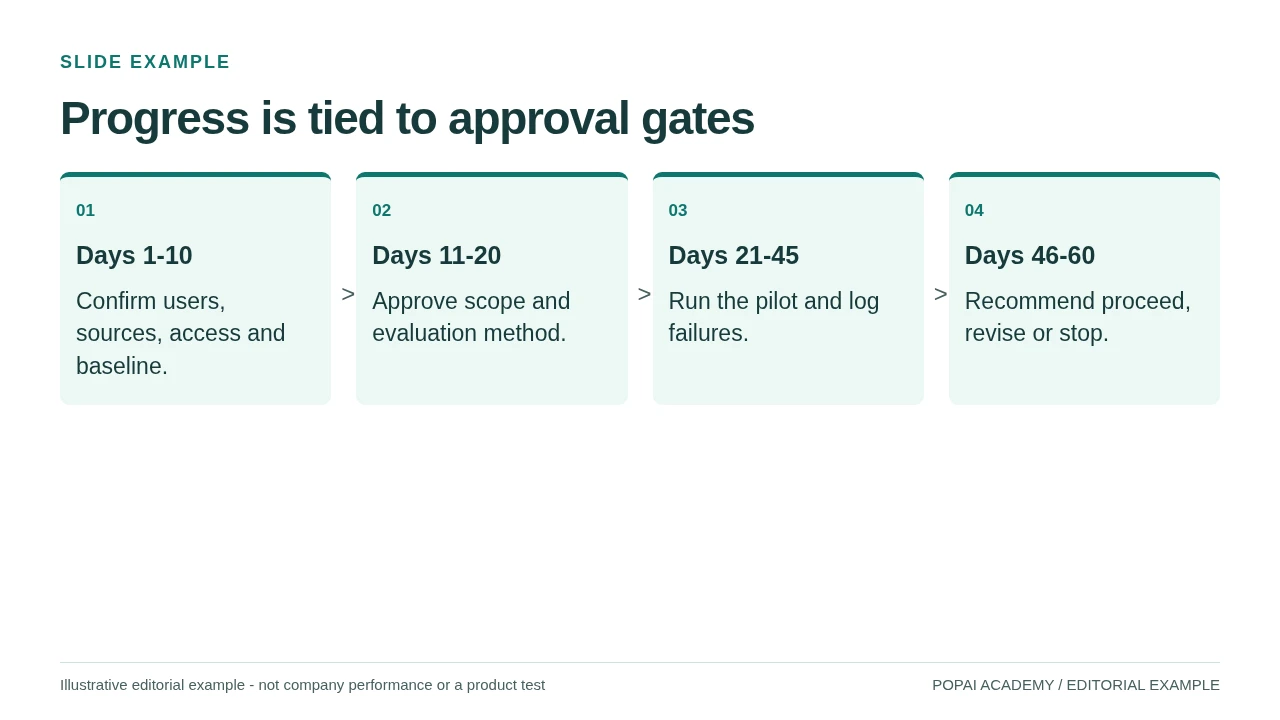
The timeline follows the four phases already used in the worked example.
Read or copy the slide content
01
Days 1-10
Confirm users, sources, access and baseline.
02
Days 11-20
Approve scope and evaluation method.
03
Days 21-45
Run the pilot and log failures.
04
Days 46-60
Recommend proceed, revise or stop.
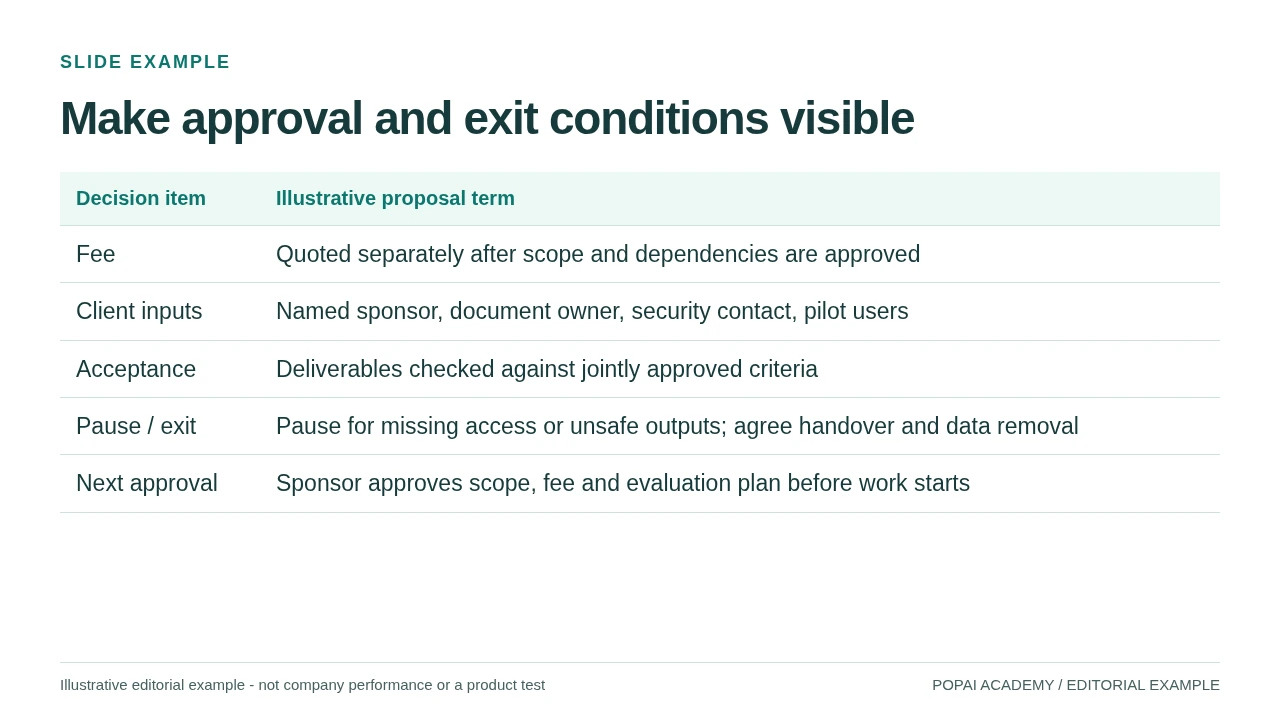
Commercial and exit conditions are example drafting terms, not a contract or delivery guarantee.
Read or copy the slide content
Decision item
Illustrative proposal term
Fee
Quoted separately after scope and dependencies are approved
Client inputs
Named sponsor, document owner, security contact, pilot users
Acceptance
Deliverables checked against jointly approved criteria
Pause / exit
Pause for missing access or unsafe outputs; agree handover and data removal
Next approval
Sponsor approves scope, fee and evaluation plan before work starts
Prompt for this example set
Create a client-ready consulting scope slide for the 60-day knowledge-search pilot. Separate in-scope deliverables, client dependencies and exclusions. Use no investor claims.
AI Consulting Pitch Deck vs. Investor Pitch Deck
Choose the deck type by the decision-maker’s next decision—not by the word “pitch.”
A consulting pitch deck sells a defined service to a prospective client. It should show that you understand the client’s situation, have a relevant approach, can deliver within clear boundaries, and will measure whether the work is useful. An investor deck makes the case for funding a company, so it usually centers on market opportunity, product, business model, traction, team, and financing needs.
| Decision-maker question | Consulting pitch | Investor pitch |
|---|---|---|
| What problem is being solved? | What is this client’s operational or strategic need? | What market problem does the company address? |
| What is being offered? | A scoped service, deliverables, and an engagement plan. | A product, business model, and growth opportunity. |
| What proves credibility? | Relevant expertise, permissioned case evidence, and a practical method. | Traction, market evidence, product progress, and team capability. |
| What is the next decision? | Agree to discovery, approve a pilot, or select a vendor. | Consider an investment and begin due diligence. |
The same AI use case needs different emphasis for different audiences. An operations leader may need a workflow map, staff impact, and a pilot decision; an IT or security reviewer needs data flows, access controls, and escalation ownership. In a first meeting, ask for agreement on a discovery session. In a formal RFP, map the response to the stated requirements and move detailed compliance evidence to an appendix. For a broader comparison of tools used to build decks, see this guide to AI presentation makers.
For a client, the central question is “Should we authorize this team to do this work under these conditions?” For an investor, it is “Should we fund this company?” Build the slides around the decision you are actually asking for.
A Practical AI Consulting Pitch Deck Structure
Treat the outline as a decision sequence: diagnose, recommend, define the work, then ask for approval.
As an editorial rule of thumb, 8–12 slides suit many focused proposals. A first-meeting deck can be shorter; a formal proposal may need more slides or an appendix for technical, security, and commercial detail. Add slides only when they answer a decision-maker’s question—not to make the deck feel substantial.
- Cover and requested decision: state the engagement and the decision sought. Example headline: “Approve a 60-day pilot to test internal knowledge search.”
- Client situation: distinguish confirmed facts from open questions. Example: “Three teams rely on separate policy repositories; access and usage patterns need validation.”
- Problem and impact: connect the workflow issue to a business consequence. Show the source and definition for any baseline metric.
- Recommendation: explain the proposed intervention and why it fits. Example: “Test search on approved support content before connecting additional systems.”
- Method and workstreams: show discovery, design, pilot, and evaluation as distinct stages, with a decision gate between them.
- Deliverables, roles, and timeline: name what the client receives, who supplies inputs, and when reviews happen.
- Evidence and team: use relevant, permissioned case evidence and accurate credentials. Move full case details or biographies to the appendix.
- Measures, risks, and governance: summarize success measures, key dependencies, and who owns risk decisions. Put detailed controls and technical diagrams in the appendix.
- Investment and next step: show fees or the pricing basis, exclusions, assumptions, and the specific action needed to begin.
For AI work, map the specifics to those slides: data and system dependencies belong in the method and scope; security review and human oversight belong in governance; adoption and training belong in the delivery plan; and evaluation belongs in the measures slide. The main deck should make the decision legible, while the appendix carries detail that reviewers may need to verify.
AI Consulting Pitch Deck Example: A 60-Day Pilot
The fictional example below turns a knowledge-search idea into a scoped proposal with decision gates, responsibilities, and a stop option.
Assume a mid-sized service organization wants staff to find approved answers across internal policies. The proposal does not claim that AI will save a particular amount of time. It offers a bounded test using a small set of approved documents and a defined user group; the client can proceed, revise, or stop after reviewing the evidence.
Sample slide headlines: “Staff search across several repositories to answer recurring policy questions”; “Start with approved content and one support workflow”; “The pilot will test usefulness and review effort—not promise enterprise-wide savings.” Each statement should be backed by a client source or marked as a hypothesis to validate.
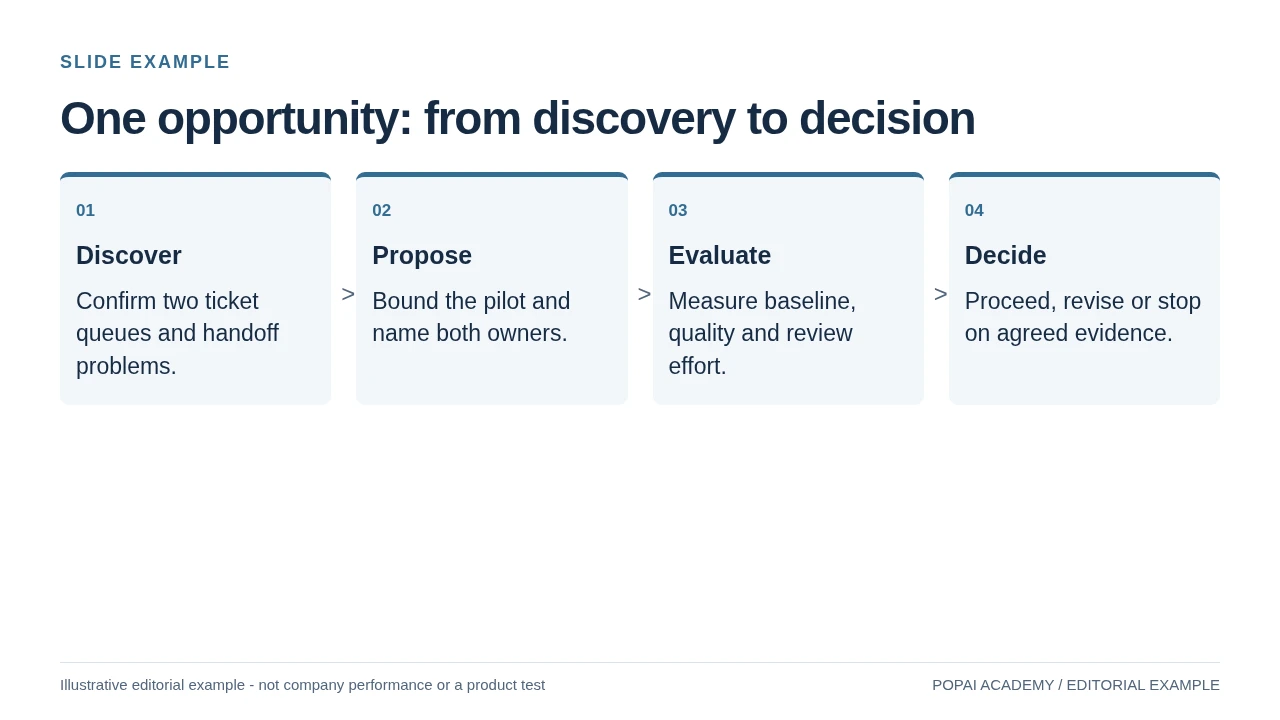
Illustrative 60-day plan: Days 1–10, confirm the workflow, users, document owners, baseline method, and access approvals. Days 11–20, select the bounded use case, assess source quality, and agree evaluation criteria. Days 21–45, configure and test the pilot with a small user group, review answers, and log failure types. Days 46–60, evaluate results, document risks and operating requirements, and present a proceed/revise/stop recommendation. These are example phases, not a delivery commitment.
Hypothetical measurement example: Before the pilot, the client might sample 30 representative questions and record task completion time, whether an answer was found, and how often staff asked a subject-matter expert for help. During the pilot, the same questions could be tested against the tool and reviewed by a designated content owner. The sample size and results here are illustrative; the client must agree the method and collect its own baseline before claiming improvement.
Decision criteria and contingencies: Proceed only if the content owner approves the source set, security review is complete, and reviewers judge answers sufficiently useful for the intended workflow. If documents are incomplete, pause to remediate or narrow the source set. If adoption is low, interview users and revise the workflow before expanding. Stop if access controls, answer quality, or review effort cannot meet the agreed requirements.
Proposed responsibilities: the consultant leads workflow mapping, pilot configuration, evaluation, and a recommendation report; the client names a sponsor, document owner, IT/security contact, and pilot users. Client inputs include approved documents, access decisions, user time, and timely review. The proposal should exclude production integration, new content creation, and organization-wide rollout unless separately scoped.
How to Build an AI Consulting Pitch Deck with AI
Use AI for synthesis and drafting; keep source control, confidentiality, and commercial judgment with the proposal team.
Prepare a brief before opening a tool: the desired decision, audience, confirmed client context, proposed service, and permitted source materials. Avoid pasting identifiable or confidential content unless the client agreement and the tool’s data-handling terms permit it. Check retention and training settings, remove personal or regulated data where possible, and follow your organization’s approved-tool policy. If the material is restricted, use a sanitized summary or work offline.
- Set the decision and audience: say who will review the deck and whether the goal is discovery, pilot approval, vendor selection, or implementation approval.
- Prepare source notes: label each fact with its source, date, and owner. Separate client-provided information from your analysis and assumptions.
- Ask for gaps before slides: have the AI identify missing inputs and questions; resolve the important gaps or mark them as open.
- Approve the outline: review the narrative and scope before asking for slide copy. This prevents a polished draft from locking in an unapproved recommendation.
- Draft, trace, and edit: request concise headlines, visual suggestions, and notes, then verify each factual claim against the supplied source.
- Review the rendered deck: check chart labels, layout, export, and whether the final file preserves confidentiality and accessibility requirements.
PopAi’s PopAi AI Presentation can be one option for turning a prompt or source material into a draft presentation. Treat any generated outline or slide as an editable starting point: compare the result with your brief, inspect how tables and figures render, and confirm available export options in the product before relying on them for a client deadline.
For traceability, keep a separate claim log rather than relying on AI-generated citations. Record the slide, exact claim, source location, source date, reviewer, and status. AI may summarize supplied material, but a source note is useful only if a person can open the source and confirm that it supports the claim.
Copyable Prompt for a Client-Specific Consulting Pitch
Run the prompt in stages so you can correct the brief before the model writes the deck.
Replace the brackets with information you are authorized to share. First use the prompt to surface gaps; after answering, approve the outline; only then request slide copy. This reduces the chance of getting a long, polished deck built on missing assumptions.
Prompt: “Act as a consulting proposal editor. Create an 8–12 slide client-facing pitch deck for [client and industry], for an audience of [decision-makers]. The proposed engagement is [service or AI initiative] over [proposed period]. The confirmed business problem is [facts and source]; the desired decision is [decision]. Our verified capabilities and relevant case evidence are [approved details].
Stage 1: Do not draft slides yet. List critical missing information, identify contradictions, and ask me the questions needed to build a credible proposal. Do not invent client facts, statistics, citations, credentials, case results, fees, or technical capabilities. Mark statements VERIFIED, ASSUMPTION, or TO CONFIRM, and identify the supplied source for each verified claim. If a claim has no evidence, suggest neutral wording.
Stage 2, after I answer: propose a slide-by-slide outline with one takeaway headline and purpose per slide. Include diagnosis, recommendation, workstreams, deliverables, client and consultant roles, dependencies, timeline, measures, data/security/governance, risks, exclusions, pricing assumptions, and next step. Ask me to approve the outline before drafting.
Stage 3, after approval: draft concise on-slide copy, a visual or chart suggestion, speaker notes, source notes pointing only to supplied materials, and open questions for each slide. End with likely client objections and evidence-based responses. If no supplied source supports a statement, keep it labeled ASSUMPTION or TO CONFIRM.”
A short example of the labels: VERIFIED—“The client provided three policy repositories” (source: discovery notes, 12 May); ASSUMPTION—“A single search interface may reduce switching between repositories”; TO CONFIRM—“Current average time to find an answer.” Check that every source note points to an actual file, page, or meeting record—not a citation generated by the model.
For a discovery proposal, emphasize questions, diagnostic outputs, and a fixed-fee or time-boxed scope. For an implementation proposal, add architecture, integration dependencies, ownership, and acceptance criteria. For an RFP response, mirror the buyer’s requirements and provide compliance evidence in the appendix rather than forcing every response into a sales narrative.
Proof, Scope, and Design: Quality Checks Before Sending
Review evidence, delivery boundaries, and readability separately so a strong-looking deck does not hide a weak offer.
Evidence and claims
Review the claim log before polishing visuals. For each number or client-specific statement, record the source, date, definition, owner, and status. Distinguish an observed baseline from an estimate and a proposed target; disclose assumptions behind forecasts. If a claim cannot be substantiated, remove it or label it for validation.
Example claim-log entry: “Average answer-finding time: 7 minutes” should not appear as a verified baseline unless the source, sampling period, task definition, and data owner are recorded. If it comes from an informal interview, call it a client-reported estimate and propose a measured baseline during discovery instead.
Make uncertainty useful: “Client-reported estimate; validate in week one” is more credible than an unsupported precise figure—and tells the buyer what the first phase will resolve.
Scope, ownership, and commercial terms
Check that the proposal names deliverables, client responsibilities, access needs, review points, exclusions, fee basis, and change-control conditions. For AI engagements, assign an owner for data approval, security review, answer-quality review, and escalation. State who can pause the pilot and what evidence is needed to move from pilot to a larger phase.
Slide and final-file review
Give each slide one main idea and use a headline that states the takeaway, not a generic label such as “Analysis.” Cite data near the chart, check units and labels, and move supporting detail into notes or an appendix. Before sending, verify that the exported file opens correctly, confidential information is absent, and the final slide asks for one specific next action. Rehearse likely questions about feasibility, adoption, risk, timing, and value.
Use This Tutorial and the Template Library for Different Jobs
Use this guide to turn discovery into a client-specific scope, deliverables, milestones, fees and approval request. Use the consulting pitch deck template collection when the message is approved and you need a starting layout. Neither resource proves results for a client.