For B2B sales teams, the common AI-deck failure is not an ugly slide—it is a polished story built around a problem the buyer never confirmed. Start with the buyer’s decision and verified account facts, then use AI to speed up drafting.
For example, change a generic headline like “An easier way to manage support” to “Reduce repeat ticket handoffs without adding another queue”—but only if discovery notes support that issue. The goal is not to automate sales judgment. Use AI to organize notes and draft slide options, then apply your product knowledge and account context. PopAi AI Presentation is one option for starting a presentation from a prompt or source material; whatever tool you use, review the result against the buyer’s needs and your approved evidence.
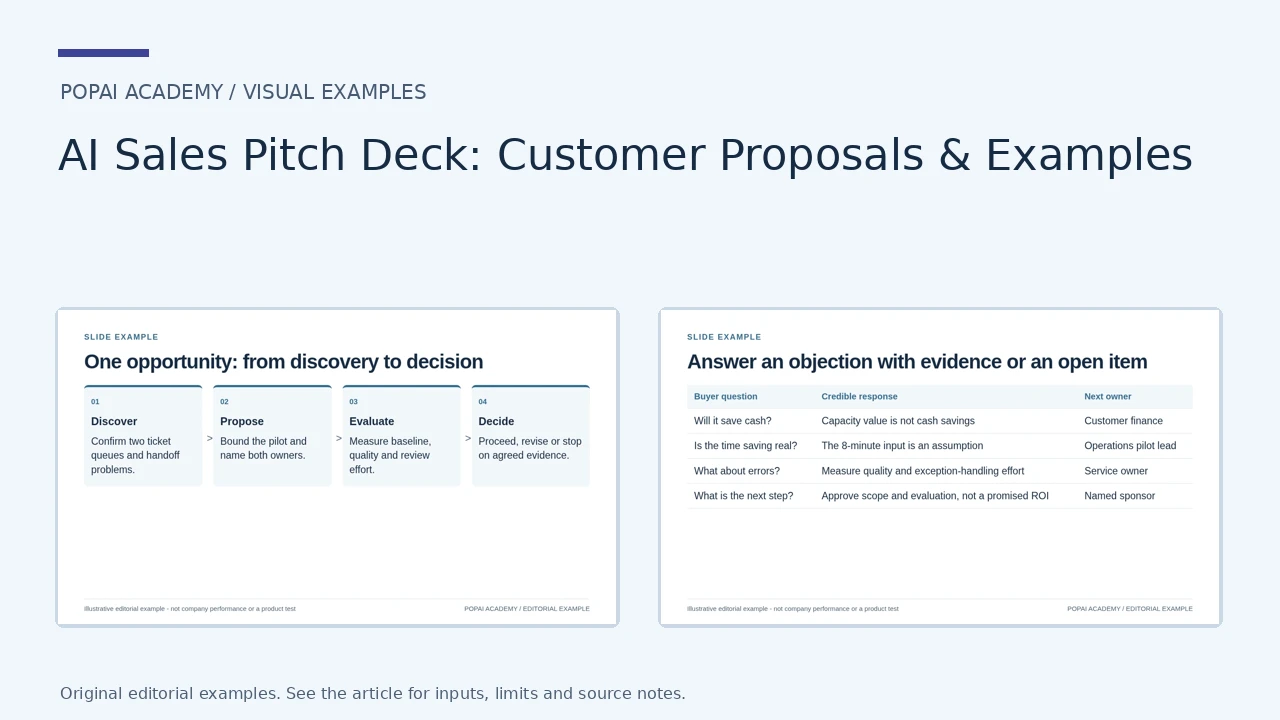
One Sales Opportunity from Discovery to Decision
The example uses 40 agents, an assumed eight minutes saved per workday, 220 workdays and a $38 hourly labor-cost estimate. No time saving, realized ROI or reduction in payroll has been measured.
Open full-size examples and editable HTML layouts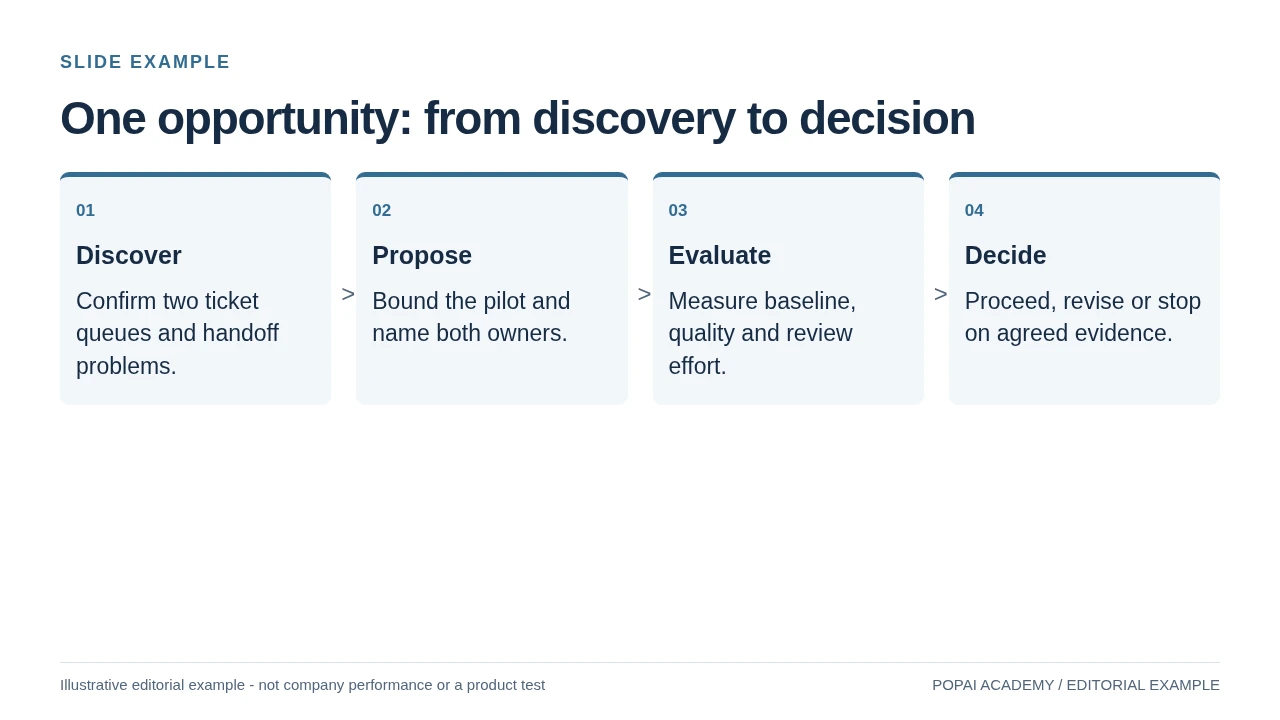
Fictional 40-agent support opportunity with no invented customer results.
Read or copy the slide content
01
Discover
Confirm two ticket queues and handoff problems.
02
Propose
Bound the pilot and name both owners.
03
Evaluate
Measure baseline, quality and review effort.
04
Decide
Proceed, revise or stop on agreed evidence.
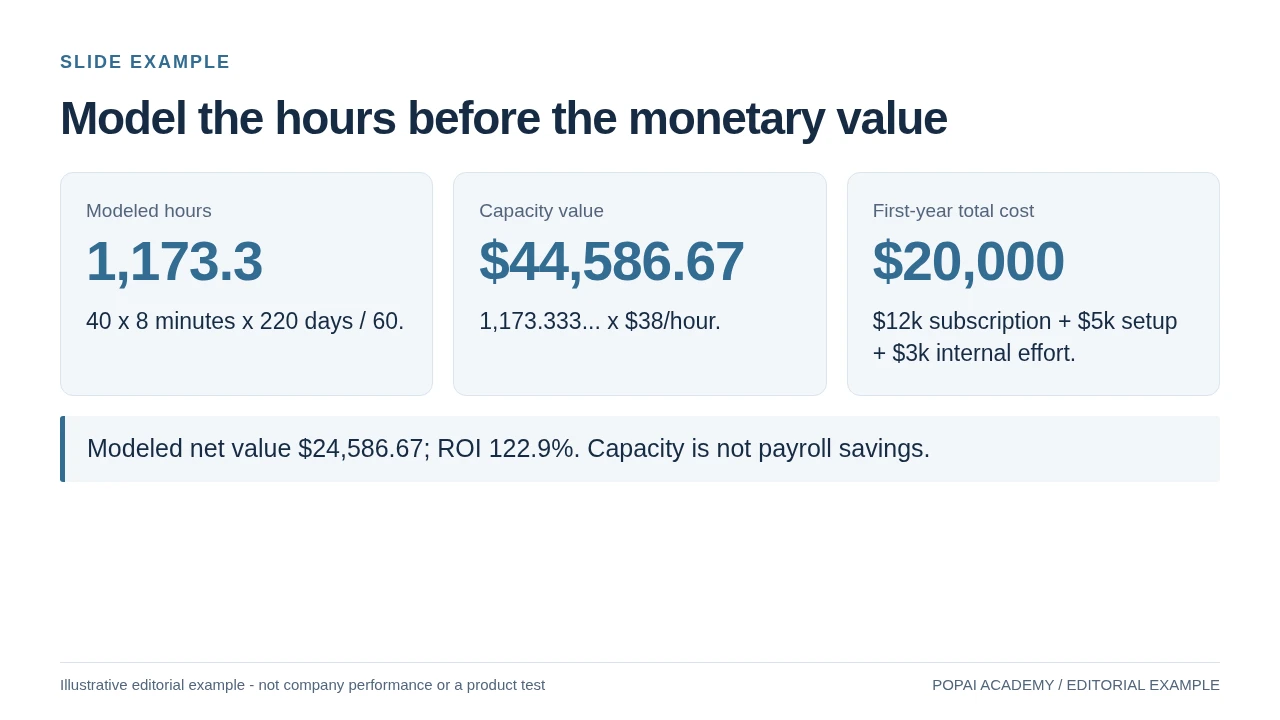
Fictional capacity-value example, calculated from the stated $38/hour assumption; no measured ROI is claimed.
Read or copy the slide content
Modeled hours
1,173.3
40 x 8 minutes x 220 days / 60.
Capacity value
$44,586.67
1,173.333... x $38/hour.
First-year total cost
$20,000
$12k subscription + $5k setup + $3k internal effort.
Modeled net value $24,586.67; ROI 122.9%. Capacity is not payroll savings.
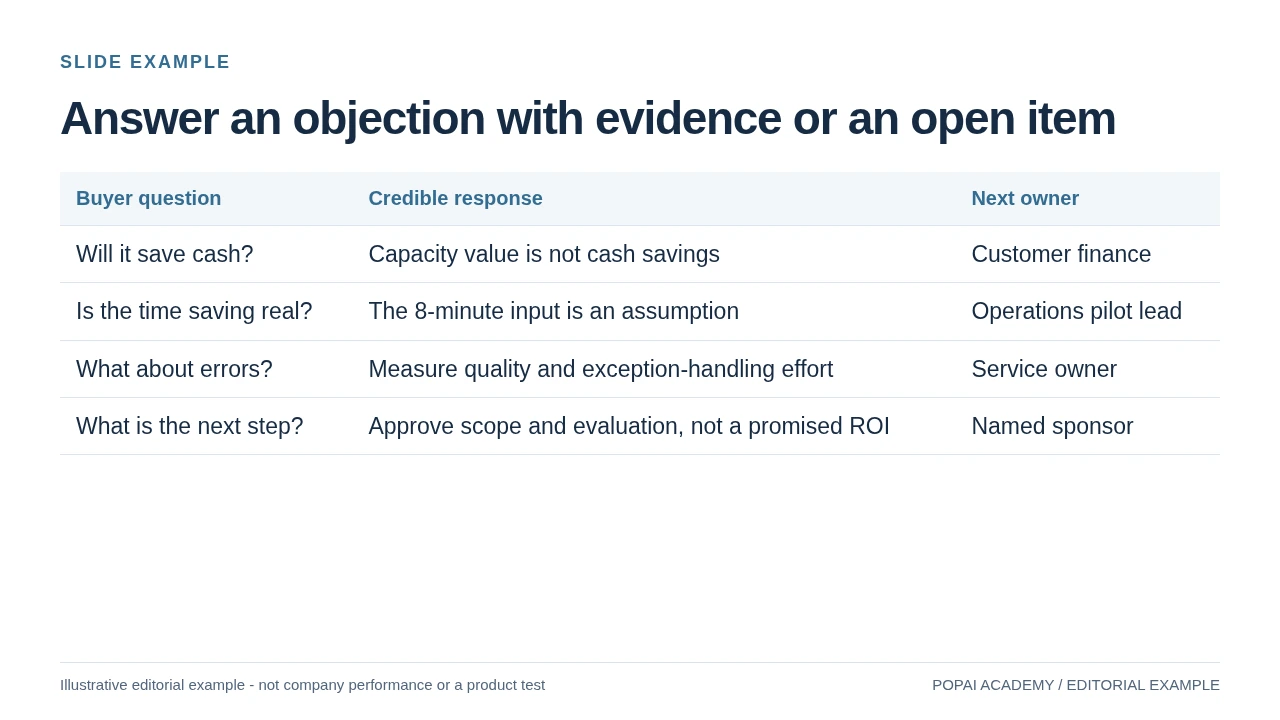
Sales decision page: retain objections instead of hiding uncertainty behind the design.
Read or copy the slide content
Buyer question
Credible response
Next owner
Will it save cash?
Capacity value is not cash savings
Customer finance
Is the time saving real?
The 8-minute input is an assumption
Operations pilot lead
What about errors?
Measure quality and exception-handling effort
Service owner
What is the next step?
Approve scope and evaluation, not a promised ROI
Named sponsor
Prompt for this example set
Create a slide with the purpose "Answer an objection with evidence or an open item". Use these approved source fields or replace the illustrative inputs before use: Buyer question Credible response Next owner Will it save cash? Capacity value is not cash savings Customer finance Is the time saving real? The 8-minute input is an assumption Operations pilot lead What about errors? Measure quality and exception-handling effort Service owner What is the next step? Approve scope and evaluation, not a promised ROI Named sponsor. Preserve labels, units, source notes and any uncertainty. Do not add results, claims, customers or capabilities. Suggest a readable layout and keep the output editable in the chosen tool.
AI sales pitch deck structure that follows the buyer
Organize the deck around the prospect’s decision, not your company’s history or full feature list.
Consider a fictional B2B SaaS company selling customer-support software to a 40-agent team. The buyer has mentioned repeat handoffs, but has not yet confirmed the cost or frequency. A first-meeting sequence could look like this:
- 1. Meeting objective: “Today: confirm where support handoffs slow resolution.” Answers: Why are we here?
- 2. Your understanding: “You mentioned repeat transfers between billing and technical support.” Answers: Did we hear the problem correctly? Mark this as a discussion summary, not a verified metric.
- 3. Discovery questions: “Which ticket types move most often, and how do you track them?” Answers: What do we still need to learn?
- 4. Relevant workflow: show how a ticket is routed and where the product could help. Answers: What might change?
- 5. Proof and next step: use an approved, relevant example—or propose a workflow review if no suitable proof exists. Answers: What evidence or action comes next?
For a proposal, add the agreed scope, implementation responsibilities, commercial terms, and an evidence-based business case. For a technical evaluation, move architecture, security, integrations, and detailed requirements into the main narrative only if they are central to the decision; otherwise, keep them in an appendix. A discovery-led meeting may need only a few orientation slides—or no presentation at all if discussion is the better use of the time.
There is no universal ideal slide count. As an editorial planning heuristic, draft only enough slides to support the meeting objective: a short discovery conversation may need 3–5, while a proposal with multiple decision-makers may require more. Meeting length, discussion time, and the amount of evidence matter more than hitting a target. Build the outline first, then remove any slide that does not answer a buyer question.
Make each slide answer one buyer question. If it contains several unrelated takeaways, split it—or decide whether all of them belong in this meeting.
Sales decks and investor decks have different jobs. Investors assess the company and its growth case; buyers assess fit, risk, value, and the path to adoption. Borrow clear storytelling techniques from fundraising materials, but make the buyer’s decision the organizing principle.
Examples for first meetings, proposals, and follow-ups
Keep the account facts consistent, but change what you emphasize as the buyer moves from discovery to decision.
First meeting: test the problem before pitching the solution
Hypothetical slide: “Where are support tickets handed off today?” On-slide copy: “Billing → support → technical team” and “Which transfer creates the most delay?” The arrows are a discussion hypothesis, not a claim about the prospect’s actual process. Confirm the workflow with the buyer before turning it into a recommendation; leave product comparisons and unvalidated savings out of this meeting.
Proposal: tie the recommendation to agreed requirements
Hypothetical slide: “Recommended pilot: route two high-volume ticket types with clear ownership.” On-slide copy: “Scope: two queues”; “Customer owner: confirm routing rules”; “Vendor owner: configure and test”; “Success measure: compare transfer rate with the agreed baseline.” Evidence needed: signed-off requirements, a documented baseline, and a named owner for each task. If the baseline is missing, show it as an open item—not a projected result.
Competitive evaluation: compare against the buyer’s criteria
Hypothetical slide: “Evaluate each option against routing control, reporting, and rollout effort.” Use a simple matrix with the buyer’s criteria in the rows and verified responses in the columns. Cite the source for claims about your own product, and use public documentation or buyer-provided information for competitor details. Note trade-offs—for example, “requires a workflow change”—rather than presenting an unsupported “best-in-class” claim.
Follow-up: make the next decision easy
Hypothetical follow-up slide: “Three items to confirm before scoping the pilot.” List the buyer’s open questions, the evidence or owner needed for each, and an agreed date. For example: “Confirm baseline transfer rate — customer operations lead — Friday.” Keep the meeting summary separate from conclusions the buyer has not endorsed.
These scenarios are fictional teaching examples, not customer results. For teams comparing workflows and capabilities, this overview of AI presentation makers can help clarify which creation and editing features matter to your process.
A reusable AI prompt for a sales pitch deck
Give the model a specific task, a bounded set of approved inputs, and a clear instruction to expose gaps rather than fill them.
Before generating slides, collect the meeting stage, audience roles, buyer-confirmed needs, decision criteria, relevant product facts, and approved proof. Label each item as confirmed, unconfirmed, or an assumption. If source documents conflict, do not ask AI to choose which is correct: flag the discrepancy and have the account owner resolve it first.
Create a [number]-slide proposal outline for [buyer roles] at [account]. The decision to support is [decision]. Confirmed requirements: [list]. Unconfirmed items: [list]. Approved product facts: [list with source names]. Approved evidence: [list with source names]. For each slide, provide a buyer-question headline, one takeaway, concise on-slide copy, a suggested visual, and the source for each factual claim. Label assumptions and missing evidence. Do not invent customer names, results, statistics, ROI, pricing, or product capabilities. End with the next decision and its owner.
Use separate prompts for revision and review
- Adapt for an executive: “Rewrite this outline for an economic buyer. Lead with the decision, business impact, cost, and risk. Keep every claim and source unchanged; flag any missing evidence instead of adding a number.”
- Check claims: “Compare each factual statement in these slides with the supplied sources. Return a table with the slide, claim, supporting source, whether the source directly supports it, and the reviewer needed. Do not use outside knowledge to fill gaps.”
- Turn notes into a follow-up: “Using these reviewed meeting notes, draft a concise follow-up with confirmed decisions, open questions, owners, and dates. Separate direct quotes from summaries. Do not infer agreement where the notes do not record it.”
Example input and review: A rep provides cleaned notes saying, “The support director reports frequent transfers; no baseline was shared,” plus an approved routing overview. If the draft says “Transfers cost 12 hours each week,” reject that number: it is unsupported. Replace it with “Confirm weekly transfer volume and handling time” and assign the question to the next discovery meeting. This is a better draft because it makes the missing input visible.
Use only information you are authorized to share with the tool. Remove personal data and confidential account details unless your organization has approved the tool and data-handling process for them. Keep source names and versions with the working draft so a reviewer can trace claims without relying on the model’s explanation.
AI can help turn a brief or approved source material into a starting outline, but generated slides still need a sales owner’s review. Product interfaces and supported formats can change, so check the tool’s current documentation before relying on a specific upload, editing, or export capability.
Show ROI and proof without overclaiming
A credible business case shows the baseline, calculation, costs, time horizon, and uncertainty—not just a headline savings figure.
Trace each claim to evidence
A capability claim and an outcome claim require different proof. Product documentation may establish that a feature exists; it does not prove that a customer will achieve a particular result. Record the source, date, owner, and status of each material claim, and have finance review calculations and product, legal, or security reviewers check claims within their areas.
- Mark each number as measured, calculated from stated inputs, or an unverified assumption.
- Document the baseline, population, units, measurement period, and relevant exclusions.
- Confirm permission for customer names, logos, quotes, and case-study results.
- Include subscription, implementation, internal labor, and ongoing costs relevant to the stated period.
- Keep a short appendix for the methodology and assumptions so buyers can challenge or update them.
AI can make a slide sound certain even when its source is uncertain. Treat fluent wording as a draft, not as proof.
Design, personalize, and quality-check the deck
Make the key point clear on the slide itself, then adjust detail for the audience without changing the evidence.
Use a takeaway headline and a visual that clarifies the relationship: a workflow for handoffs, a labeled chart for change over time, or a comparison table for options. Avoid decorative charts that imply precision without showing the source, units, period, or baseline. If the point is a single number, a plainly labeled number may be clearer than a chart.
For the same hypothetical support workflow, an executive version might headline “A pilot could release capacity if handoffs fall”; a user version might show the proposed routing steps; a technical version might show integrations and data flow. Keep the underlying outcome claim and evidence identical across versions. Change the level of detail, not the facts.
Before presenting or sending the deck, check that:
- The opening matches the buyer’s situation and the meeting’s purpose.
- Every factual claim has a source or is visibly labeled as an assumption.
- Charts show readable labels, units, time periods, and the underlying comparison.
- Text has sufficient contrast and readable type; meaning does not rely on color alone.
- Each slide has one clear takeaway and can be understood without a spoken explanation.
- The close asks for a specific next action, owner, and timing.
Review the exported or shared file, not just the editing canvas: check for clipped text, broken charts, unreadable footnotes, and missing fonts on a standard laptop screen. After the meeting, record which questions surfaced, what evidence was requested, and whether the next step was agreed. Track those outcomes alongside meeting stage and deck version; a high open rate alone does not show that the deck improved the buying conversation.
A repeatable workflow from brief to customer-ready slides
Assign an owner and a review gate to each stage so a fast draft does not become an unchecked customer claim.
- Collect — account owner: gather approved account notes, product material, and relevant evidence. Output: a source list with dates and access status.
- Brief — account owner: define audience, meeting goal, decision, confirmed facts, assumptions, and open questions. Output: a one-page brief and outline.
- Draft — sales rep: generate slide headlines and content from the brief. Output: an editable first draft with sources attached to factual claims.
- Verify — relevant reviewers: have the account owner check customer context; finance check material calculations; and product, legal, or security reviewers check claims in their areas. Gate: no unresolved material claim is presented as fact.
- Finalize — deck owner: simplify slides, check accessibility and the exported file, and save a dated, versioned customer copy. Record assumptions and approvals alongside it.
- Learn — account team: log buyer questions, requested evidence, next-step agreement, and outcome against the deck version. Use the notes to improve the next draft, not to claim causation from a single meeting.
Before sharing, ask whether a stakeholder who missed the meeting can understand the problem, recommendation, evidence, open assumptions, and requested action. If not, revise the story or add a concise explanation. AI can reduce blank-page work; account knowledge, traceable evidence, and clear review ownership make the deck useful and trustworthy.
Worked Example: Reconcile the Capacity-Value Arithmetic
For the source scenario, 40 agents x 8 minutes per day x 220 workdays / 60 = 1,173.33 modeled hours. At the stated $38 hourly cost, the modeled capacity value is $44,586.67. Keep the hourly rate, time estimate and cost scope together so a reviewer can reproduce the calculation.
| Minutes per agent / day | Modeled annual benefit | Total first-year cost | Modeled net value | ROI |
|---|---|---|---|---|
| 4 | $22,293.33 | $20,000 | $2,293.33 | 11.5% |
| 8 | $44,586.67 | $20,000 | $24,586.67 | 122.9% |
| 10 | $55,733.33 | $20,000 | $35,733.33 | 178.7% |
These are hypothetical, steady-state annual scenarios. They assume all stated days qualify, the full time saving is achieved, and released capacity can be used productively. They exclude ramp delays and any additional costs not listed. Capacity value is not automatically a cash saving; the buyer's finance and operations owners must approve the assumptions.