An AI investor pitch deck turns a company's evidence into an investment conversation. The appropriate document may be a live pitch, a self-explanatory pre-read, a focused investor update or a diligence appendix. Choose that job first; a single presentation does not serve all four equally well.
Use this structure guide to organize an investor document. For the numbers behind a specific round, use the fundraising plan guide. For an early AI startup's validation, data access and model costs, use the pre-seed and seed guide. Each guide covers a different decision.
Which Investor Document Do You Need?
| Type | When to use it | Information emphasis |
|---|---|---|
| Live pitch | You will present and answer questions | One clear argument, legible evidence and the next decision |
| Pre-read / send-ahead | The investor reads without the founder | Context, definitions, evidence status and source notes |
| Investor update | An existing relationship needs a progress view | Changes since the last period, risks, cash and asks |
| Diligence appendix | Specific claims are being verified | Detailed schedules and source references, not more marketing |
Investor Deck Examples: Versions, Market and Evidence
Choose a document version before choosing its length. The market and retention values are teaching examples: sound arithmetic alone does not validate the underlying buyer count, price or usage data.
Open full-size examples and editable HTML layouts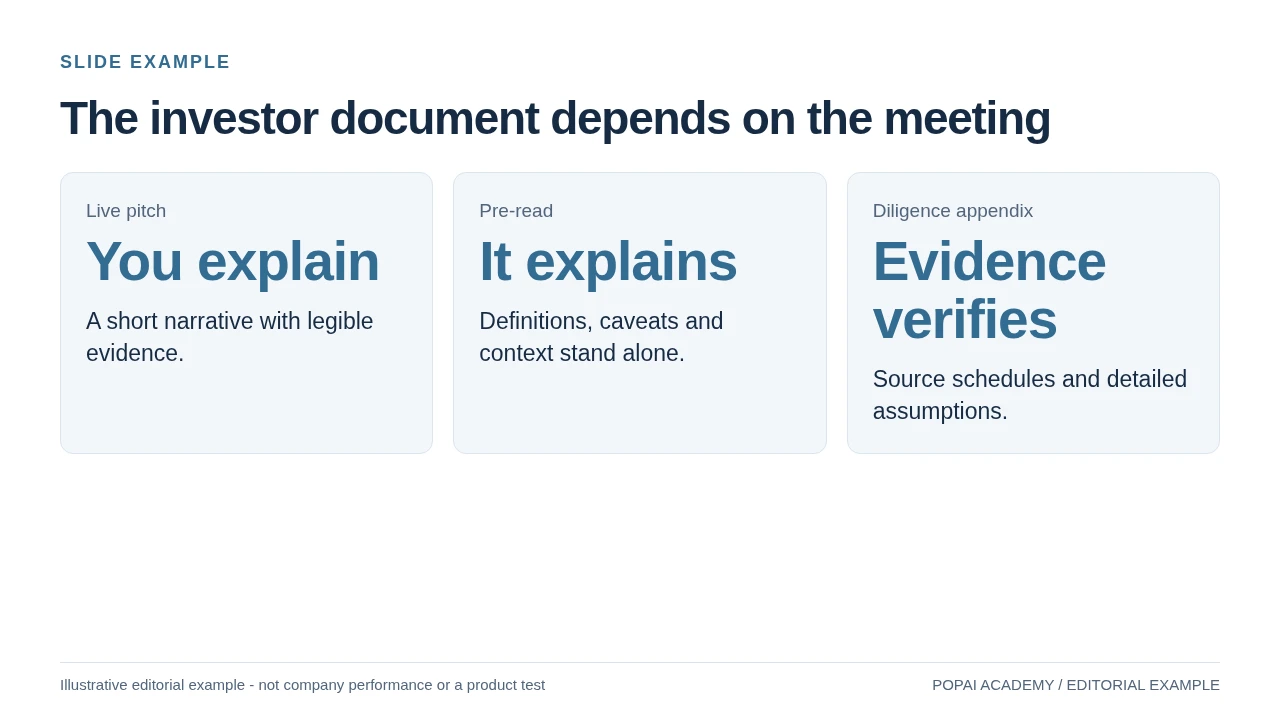
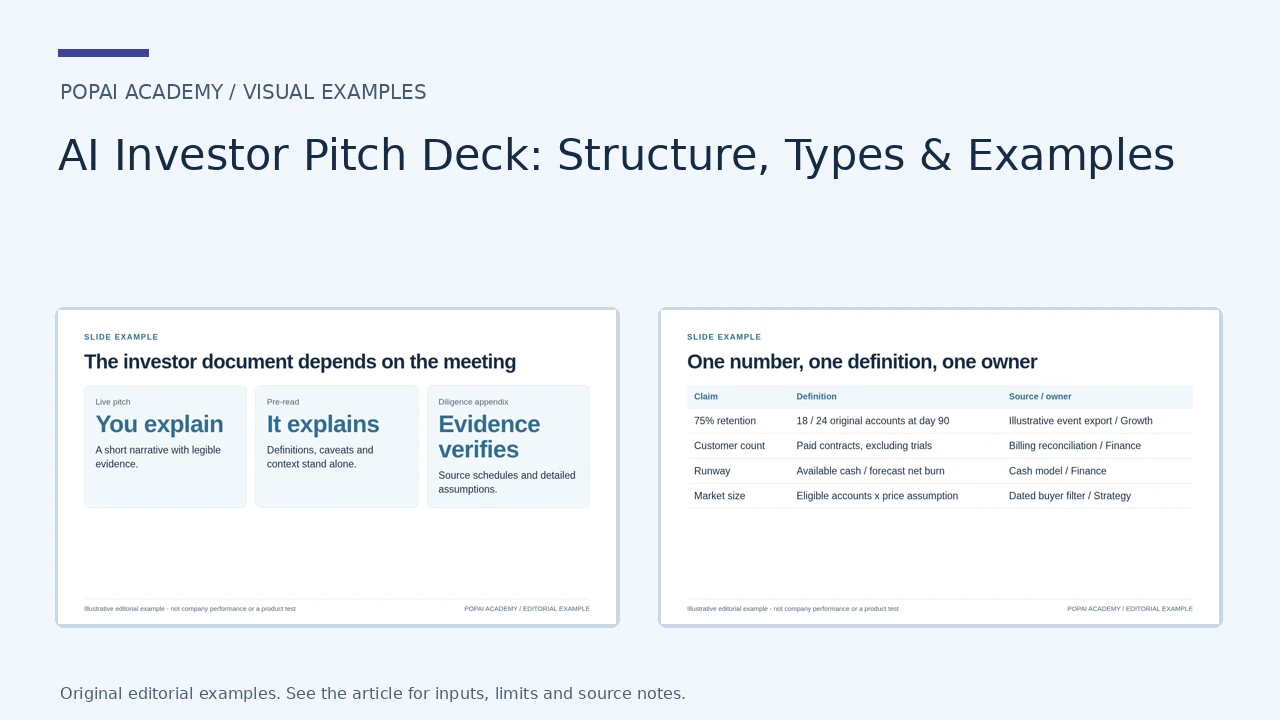
Three investor-document purposes; slide counts are editorial guidance rather than rules.
Read or copy the slide content
Live pitch
You explain
A short narrative with legible evidence.
Pre-read
It explains
Definitions, caveats and context stand alone.
Diligence appendix
Evidence verifies
Source schedules and detailed assumptions.
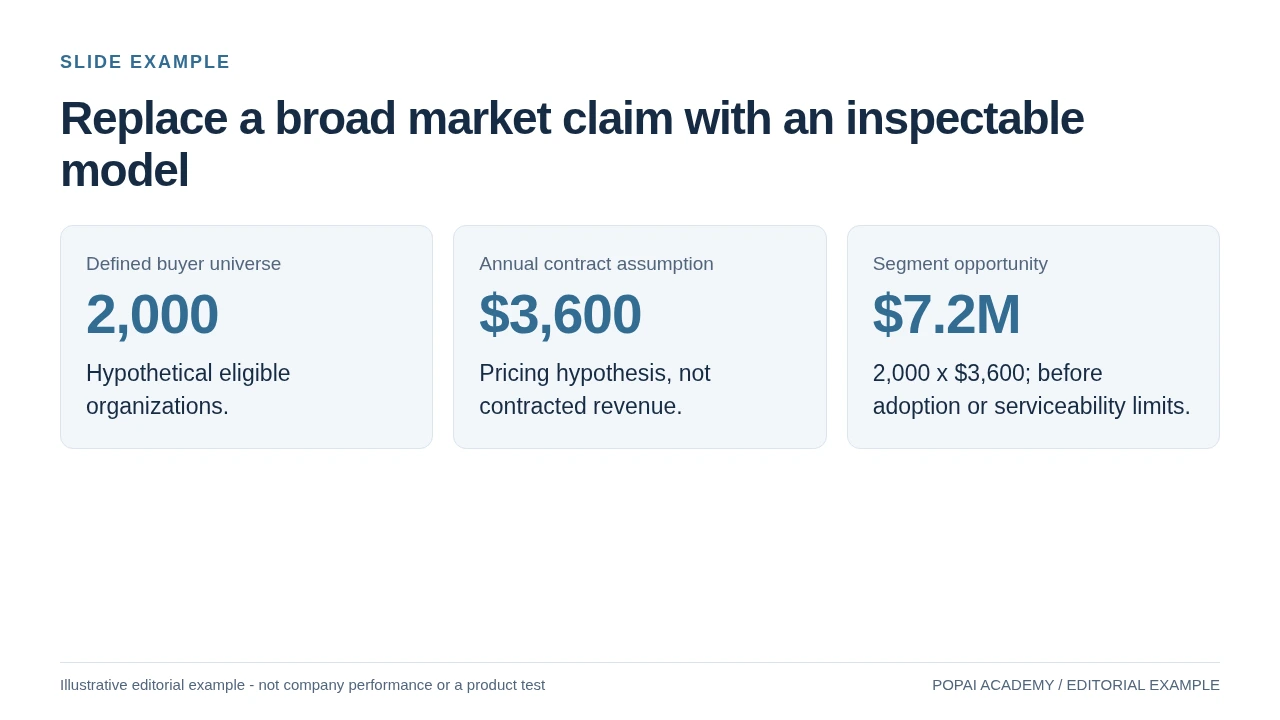
The arithmetic is an example, not a sourced estimate of an actual market.
Read or copy the slide content
Defined buyer universe
2,000
Hypothetical eligible organizations.
Annual contract assumption
$3,600
Pricing hypothesis, not contracted revenue.
Segment opportunity
$7.2M
2,000 x $3,600; before adoption or serviceability limits.
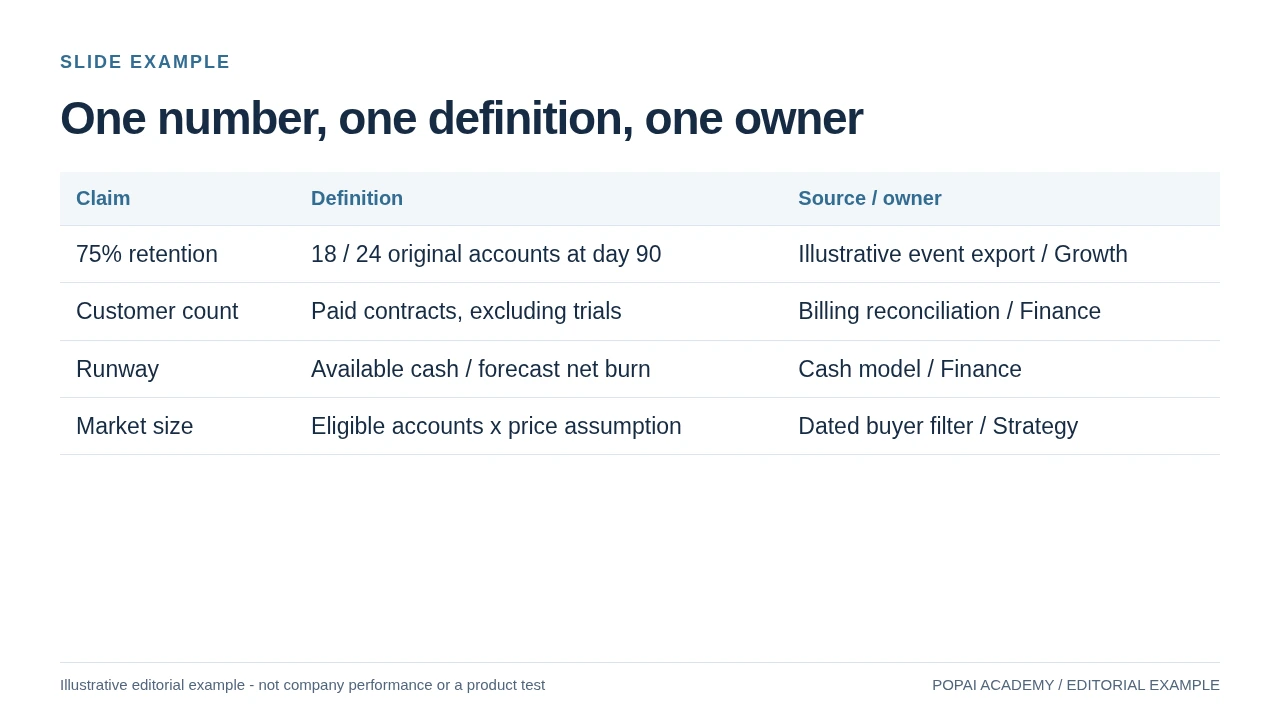
Use this register across the live pitch, pre-read and appendix; figures remain illustrative.
Read or copy the slide content
Claim
Definition
Source / owner
75% retention
18 / 24 original accounts at day 90
Illustrative event export / Growth
Customer count
Paid contracts, excluding trials
Billing reconciliation / Finance
Runway
Available cash / forecast net burn
Cash model / Finance
Market size
Eligible accounts x price assumption
Dated buyer filter / Strategy
Prompt for this example set
Create a slide with the purpose "One number, one definition, one owner". Use these approved source fields or replace the illustrative inputs before use: Claim Definition Source / owner 75% retention 18 / 24 original accounts at day 90 Illustrative event export / Growth Customer count Paid contracts, excluding trials Billing reconciliation / Finance Runway Available cash / forecast net burn Cash model / Finance Market size Eligible accounts x price assumption Dated buyer filter / Strategy. Preserve labels, units, source notes and any uncertainty. Do not add results, claims, customers or capabilities. Suggest a readable layout and keep the output editable in the chosen tool.
A 12-Slide Investor Structure, Adaptable to 10-15 Pages
Use these twelve topics as an editing plan rather than a universal rule. Combine topics when evidence is simple; add an appendix when the investor needs more detail. The slide count should follow the meeting and sector, not a template quota.
| Page | Investor question | Evidence to show |
|---|---|---|
| 1. Company and purpose | What does the company do? | A concise customer, task and product statement |
| 2. Problem | Whose problem is this? | Defined workflow and source-backed customer context |
| 3. Product | How does the product address it? | An observable workflow and current capability boundary |
| 4. Timing | Why now? | Dated evidence, not a generic AI trend claim |
| 5. Buyer and market | Who can buy and how many? | A filtered buyer universe and explicit pricing assumption |
| 6. Business model | How is revenue earned? | Pricing scope and actual / proposed contract terms |
| 7. Validation | What has been demonstrated? | Properly labeled interviews, trials, pilots and customers |
| 8. Acquisition | How are customers reached? | Observed channel learning and untested assumptions |
| 9. Alternatives | Why change from current practice? | Fair, source-backed comparison criteria |
| 10. Team | Who can execute? | Verified relevant roles and experience |
| 11. Economics and risks | What must work financially and operationally? | Cash, unit costs, constraints and principal uncertainties |
| 12. Decision / ask | What happens after the meeting? | The requested decision and a linked funding plan if relevant |
Turn a Broad Claim into an Inspectable Example
Suppose a fictional workflow company assumes that 2,000 eligible organizations could pay $3,600 per year. Multiplication gives $7.2 million, but the calculation does not establish a market. The organization count needs a dated source and inclusion rule; the price needs a stated basis. The result is a hypothetical segment opportunity before adoption and serviceability limits, not a revenue forecast.
The same discipline applies to traction. Eighteen retained accounts out of an original cohort of twenty-four equals 75%. A usable slide states the cohort start, the observation window, the definition of active and whether accounts are paid. It does not call a mixed trial cohort "paid-customer retention." Use one company definition and evidence set consistently throughout your own deck.
Keep a Claim Register Across Every Version
Record the slide claim, source location, date, metric definition, owner and caveat. When sources disagree, retain both figures and ask the owner to reconcile them. A generated citation is not proof: open the referenced document and confirm that it supports the wording.
For a pre-read, important caveats belong near the figure. Speaker notes may supplement a live presentation, but they do not help a reader who never sees them. A 30-40-word spoken slide is only an editing heuristic; evidence density and viewing conditions matter more than an arbitrary word limit.
Use AI for Structure Without Inventing Company Evidence
Prepare a sanitized source pack: approved product description, customer-research summary, metric definitions, business-model notes and the next decision. Ask for questions and an outline first. Remove invented market numbers, named customers, achievements or certifications before designing the slides.
Draft an investor deck outline for the stated document type: [live pitch / pre-read / update / diligence appendix]. Use only the approved source pack. For each page give the question it answers, the claim, evidence, status and unresolved input. Preserve metric definitions, customer stages and uncertainty. Do not invent market size, revenue, logos or funding terms. Ask me to approve the outline before drafting.
Once the outline is approved, refine each page for one message and verify the exported version. Creation software can help with a draft; it does not decide what an investor should believe or complete company diligence.
Use the More Specific Guide When the Task Changes
Use Fundraising Pitch for the ask, use of funds, runway and round milestones; Startup Pitch for pre-seed and seed evidence about an AI company; and Product Pitch for a customer-facing demo and product evaluation. The fundraising template collection provides visual starting files rather than a substitute for the underlying investment case.