In the digital age, content quality defines user experience and search visibility. These 10 powerful optimization tools streamline keyword research, enhance readability, and boost visual storytelling—empowering creators to drive sustainable growth and dominate search rankings in 2025.
Why Do You Need Content Optimization Tools?
In the era of information overload, content quality directly determines user experience and search engine rankings. High quality content not only keeps users engaged but also secures greater search visibility. However, relying solely on manual creation and optimization is inefficient and makes it difficult to achieve systematic, continuous improvement. Content optimization tools leverage automated analysis, intelligent recommendations, and integrated features to help creators efficiently address core challenges—such as keyword placement, readability enhancement, and visual support—truly enabling “content driven growth.”
What Are the Core Features of Content Optimization Tools?
An excellent content optimization tool typically offers the following capabilities:
l Intelligent Keyword Research: Extract high potential keywords from multiple platforms (e.g., Google, YouTube, Reddit).
l Content Quality Assessment: Use AI to analyze content structure, semantic relevance, and readability.
l Visual Support: Automatically convert text into visual elements like charts and mind maps.
l Real Time Optimization Suggestions: Provide revision advice during the creation process (e.g., simplifying sentence structures, adding technical terms).
l Cross Channel Adaptation: Support content optimization across multiple scenarios, including websites, social media, and e commerce platforms.
How to Choose the Right Content Optimization Tool for You?
When selecting a tool, consider the following factors comprehensively:
l Target Platform: For example, e commerce sellers should prioritize keyword tools tailored to platforms like Amazon or Etsy.
l Technical Threshold: Users without a technical background should first choose tools with a clean interface and intuitive operation.
l Integration Capabilities: Check if the tool can connect with your existing workflow (e.g., Content Management Systems (CMS), design software).
In Depth Analysis of 10 Content Optimization Tools
1. Popai: The New Benchmark for Intelligent Content Optimization
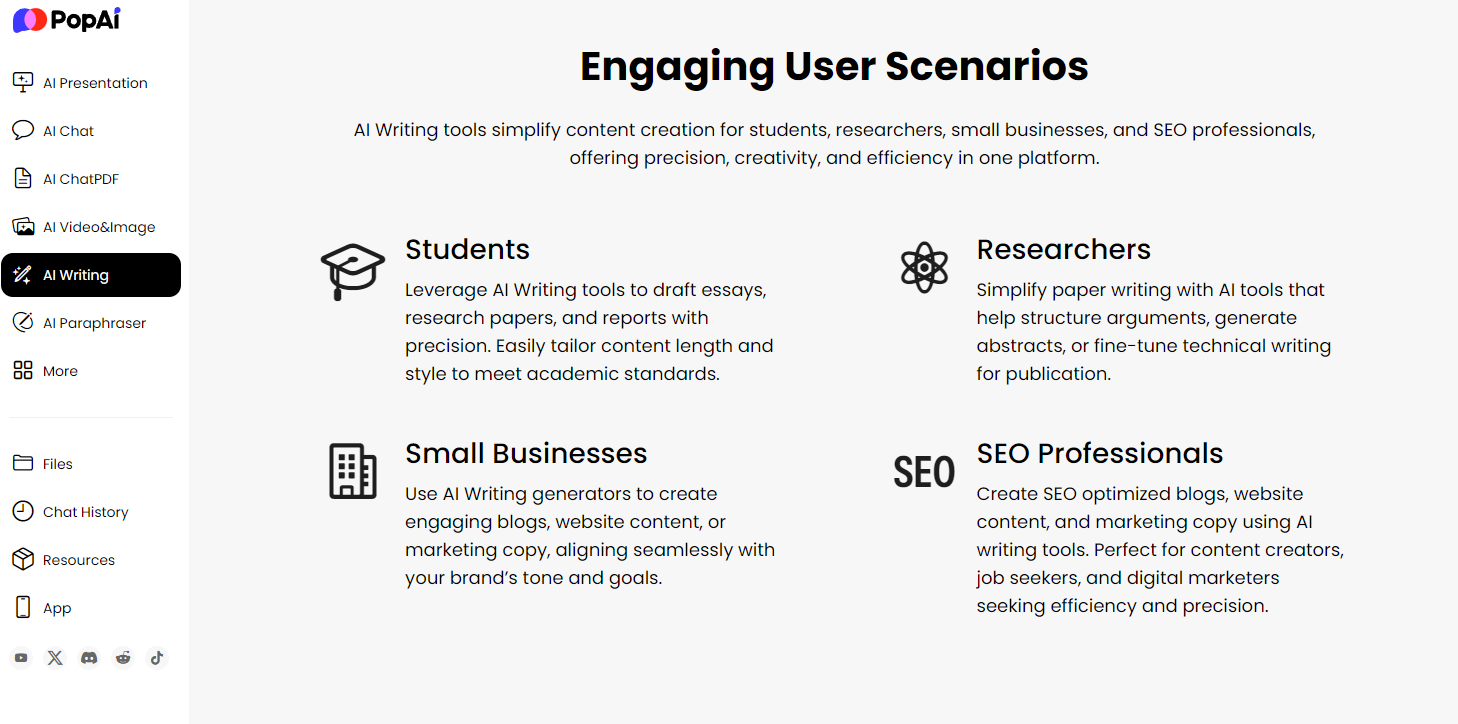
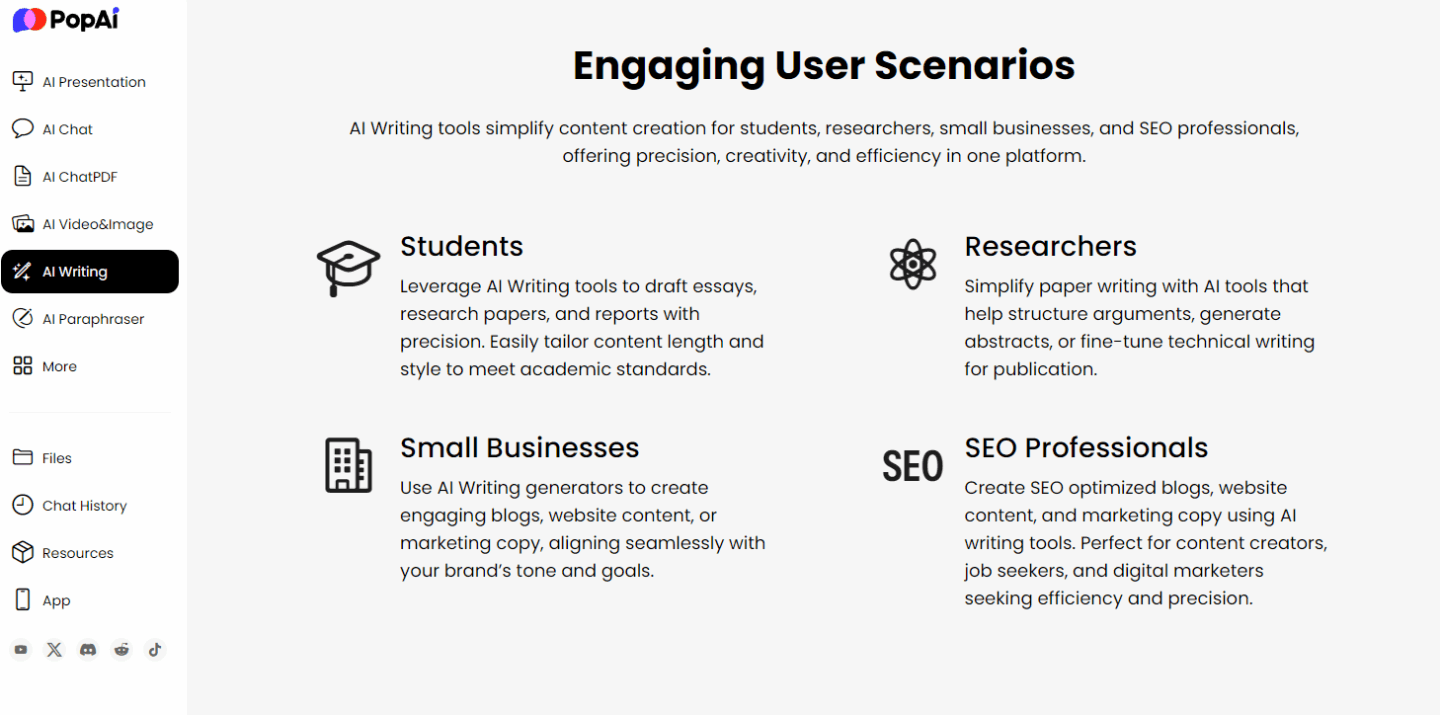
Popai’s core feature, the Smart Content Optimizer, redefines the content optimization process. It supports importing content directly from files, Google Docs, or URLs, and uses AI to enable automatic parsing, multilingual translation, and flowchart generation. For instance, after a user uploads a technical document, Popai can quickly extract key concepts, generate visual logic diagrams, and offer terminology annotation management—eliminating the hassle of manual tagging. Its “one click save” system also automatically categorizes documents to build a knowledge base, making it particularly suitable for teams implementing long term content strategies.
2. Small SEO Tools: A One Stop SEO Toolkit
As one of the most comprehensive free SEO tool collections online, Small SEO Tools offers over 120 practical tools covering all aspects of SEO optimization. Its keyword analysis tool provides detailed search volume data, competition analysis, and related keyword recommendations, helping users identify the most valuable target keywords. A standout feature of this platform is its user friendly interface design, allowing even SEO novices to get started quickly.
3. MarketMuse: AI Powered In Depth Content Analysis
MarketMuse uses advanced AI technology to analyze top ranking competing content and provide users with detailed content optimization suggestions. Its core advantage lies in its in depth content analysis capability—evaluating the gap between existing content and the “ideal content standard” and offering specific improvement directions. When using MarketMuse, users only need to input target keywords, and the tool generates a detailed content brief. Its real time editing feedback feature is particularly useful, providing instant advice during the writing process.
4. Canva: A Powerful Tool for Visual Content Optimization
Canva has evolved far beyond a basic graphic design tool into a comprehensive visual content optimization platform. Its robust design features allow users to create various types of visual content. A key highlight is its extensive template library, which offers tens of thousands of professional design templates covering diverse industries and scenarios. Its intelligent recommendation system suggests the most suitable templates and design elements based on the user’s design history and preferences. Additionally, its collaboration feature enables multiple users to edit the same design project simultaneously, making it ideal for team collaboration.
5. SparkToro: Audience Insights & Content Strategy Engine
By analyzing the social media behavior, subscribed channels, and interactive content of target groups, SparkToro uncovers users’ true interests. Focused on audience analysis and insights, SparkToro helps users gain a deep understanding of their target audience’s behavioral characteristics and preferences. It builds detailed audience personas by analyzing vast amounts of social media data, web browsing behavior, and other digital footprints. Users only need to input key characteristics of their target audience, and SparkToro delivers a detailed insight report.
6. Hemingway Editor: The Expert in Readability Enhancement
Hemingway Editor specializes in improving content readability and comprehensibility. It also provides a readability score, evaluating the overall readability of content based on factors like sentence length and vocabulary difficulty. This feature is particularly useful for professional content (e.g., technical documents, academic papers), ensuring complex information is accessible to general readers. Furthermore, the tool offers writing mode switching to support different writing style needs—such as blog posts, academic papers, and business documents.
7. Easy Peasy: Title Generation & Optimization Assistant
Easy Peasy addresses a key challenge in content creation: crafting engaging titles. Using advanced natural language processing (NLP) technology, it analyzes the patterns of millions of high performance titles to provide users with data driven title optimization suggestions. Users only need to input the content theme or keywords, and the tool generates multiple title variants—each with a predicted performance score. Its analysis system considers multiple influencing factors, including emotional tone, length appropriateness, keyword prominence, and use of numbers.
8. Napkin.ai: Zero Threshold Visual Content Generation
Napkin.ai innovatively combines natural language processing with visual design. Users simply describe the content they want to convey in text, and the tool automatically generates corresponding visual charts. Supported visual types include flowcharts, timelines, mind maps, comparison tables, and data graphs. This feature is ideal for users who need to quickly visualize complex information. The tool’s workflow is extremely simple: users input a text description (e.g., “Show the five steps of content optimization”), and the tool automatically generates a corresponding flowchart. All generated visual content can be directly embedded into webpages or documents, or exported in formats like PNG and PDF.
9. Keyword Tool Dominator: Multi Platform Long Tail Keyword Research
Keyword Tool Dominator is designed specifically to meet the needs of multi platform keyword research, supporting keyword data extraction from major platforms like Google and YouTube. Its core advantage is its ability to uncover overlooked long tail keywords—these keywords have lower search volume but typically higher conversion rates. Additionally, the tool offers a keyword grouping feature, automatically categorizing related keywords to help users build a systematic keyword strategy.
10. Keyworddit: Reddit Community Keyword Analysis
As the world’s largest collection of online communities, Reddit contains a wealth of authentic user discussions and interest expressions. Keyworddit specializes in mining this valuable data source, helping users discover trending topics and discussion keywords in various Reddit subreddits. Users only need to input the name of a relevant subreddit, and the tool extracts the community’s most frequently discussed topics, key concerns, and commonly used keywords. The data provided includes each keyword’s discussion frequency, related topics, and sentiment orientation. This information is highly valuable for content creation, enabling users to produce content that truly aligns with community interests.
Future Trends in Content Optimization Tools
Looking ahead to 2025 and beyond, content optimization tools will exhibit several clear development trends. First, there will be deeper integration of multimodal AI capabilities—tools will be able to process text, images, audio, and video content simultaneously, providing cross media optimization suggestions. Second, predictive analytics capabilities will be enhanced: tools will use historical data and trend forecasting to offer proactive content strategy advice (e.g., predicting the future popularity of a topic, recommending optimal content publication timing). Personalized recommendations will also become more precise, delivering customized optimization advice based on the user’s specific needs and historical performance.
Furthermore, integration and collaboration between tools will become tighter, forming a complete content optimization ecosystem. Users will be able to complete the entire workflow—from keyword research and content creation to optimization suggestions and performance monitoring—within a single platform, significantly improving work efficiency.
Conclusion
Content optimization is no longer about keyword stuffing or mechanical processes; it is about achieving human centric communication through intelligent tool assistance. The 10 tools introduced in this article cover all aspects of content optimization needs, providing comprehensive support for content creators. Making good use of these tools not only boosts search engine rankings but also ensures content truly reaches the target audience, driving sustainable growth.
Moreover, leveraging these tools can significantly reduce repetitive tasks and allow creators to focus more on strategic thinking and creativity. With continuous advancements in AI, content optimization tools are evolving into indispensable partners that enhance both efficiency and effectiveness in content strategy.
It is important to remember that tools are only auxiliary—truly high quality content still requires the creator’s expertise and dedication. It is hoped that through the rational use of these tools, content creators can improve work efficiency, produce more high quality content, and stand out in fierce competition.