How to Use an AI PowerPoint Generator to Build Slides 10x Faster
If you build client updates, sales decks, training presentations, or internal reports, the hardest part is rarely opening PowerPoint. It is turning scattered notes into a clear storyline, choosing layouts, rewriting slide copy, and making everything look consistent.
An AI PowerPoint generator helps by compressing the slowest early steps: outlining, slide drafting, visual direction, and formatting. Tools such as PopAi AI Presentation are most useful when you treat them like a slide co-producer, not a magic button that replaces judgment.
Why an AI PowerPoint Generator Saves Time
This section explains where the time savings really come from, so you can use AI for the right parts of the deck-building process.
The bottleneck is structure, not software
Most slide work gets delayed before design begins. You may have a meeting goal, a few bullet points, a document, and a deadline, but no clear sequence. An AI tool can quickly turn that material into a title, agenda, section flow, and draft slides.
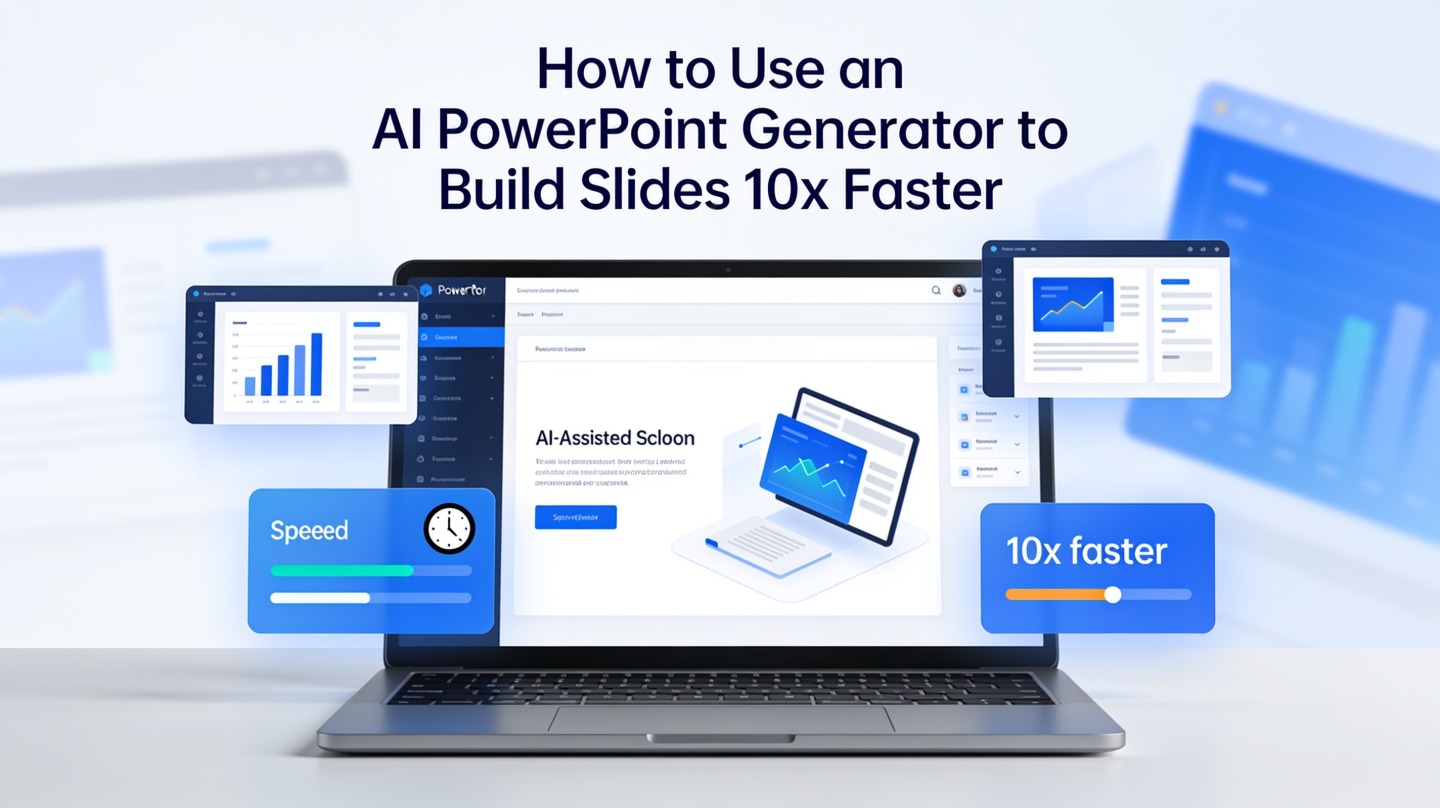
In a hands-on timing test for a 12-slide quarterly update, the manual outline-and-first-draft process took 58 minutes: 18 minutes to organize notes, 24 minutes to draft slide titles and bullets, and 16 minutes to find layout ideas. Using an AI-first workflow, the first usable draft took about 6 minutes before human editing. That is where the “10x faster” claim is realistic: the first draft, not the final approved deck.
What AI can speed up immediately
- Slide outline: converts a topic into a logical sequence.
- Message hierarchy: turns long notes into one key takeaway per slide.
- Design direction: suggests layouts, icon ideas, charts, and section dividers.
- Rewrite passes: makes copy shorter, more executive, more persuasive, or more instructional.
- Versioning: creates variations for different audiences without rebuilding from scratch.
The best use of AI in presentations is not “make my deck perfect.” It is “give me a clear first version I can improve fast.”
How to Use an AI PowerPoint Generator: A Fast Workflow
Use this workflow when you need a polished deck quickly but still want control over the message.
Step 1: Define the deck job in one sentence
Before prompting, write the job of the presentation. A strong deck job sounds like: “Convince a sales leadership team to approve a new enablement program” or “Explain Q2 product performance to non-technical executives.”
This one sentence prevents the AI from producing a generic overview. It also gives you a simple quality test: every slide should help the audience make the decision, understand the idea, or take the action named in the job.
Step 2: Give the generator source material
Paste rough notes, a meeting brief, a blog post, a transcript, or a report summary. If the source is long, ask the AI to extract the main claims before making slides. This reduces hallucinated points and keeps the presentation anchored in your actual content.
Step 3: Generate, review, then regenerate selectively
Do not accept the first deck as final. Review the outline first, then regenerate weak sections instead of restarting the whole presentation. This keeps your workflow fast while improving relevance.
- Generate a slide outline.
- Approve or reorder the narrative.
- Generate slides from the approved outline.
- Rewrite titles so each slide has a clear takeaway.
- Polish visuals, charts, and brand elements.
Pro Tip: If you are starting from a blank page, use PopAi AI Presentation to create the first deck draft, then spend your time on story, proof, and delivery instead of slide setup.
Prompt Formula for Cleaner AI PowerPoint Generator Outputs
A precise prompt is the difference between a vague slide deck and one you can edit quickly.
Use the A-G-S-C formula
For presentation work, a reliable prompt should include Audience, Goal, Source, and Constraints. These four inputs tell the AI who it is speaking to, what outcome the deck must achieve, what facts to use, and what boundaries to respect.
| Prompt element | What to include | Example |
|---|---|---|
| Audience | Role, seniority, knowledge level, concerns | “CFO and sales VP, familiar with revenue metrics but short on time” |
| Goal | Decision, understanding, or action required | “Approve a pilot budget for a new onboarding program” |
| Source | Notes, data, transcript, report, product details | “Use the notes below and do not add unsupported claims” |
| Constraints | Slide count, tone, format, style, must-have sections | “Create 10 slides, concise executive tone, include risks and next steps” |
A copy-ready prompt
Use this prompt as a starting point and replace the bracketed details with your own:
Create a [number]-slide PowerPoint deck for [audience]. The goal is to [decision or action]. Use only the source notes below. Make each slide title a clear takeaway, not a topic label. Include an agenda, problem, evidence, recommendation, implementation plan, risks, and next steps. Keep bullet text concise and suggest one visual for each slide.
In our internal benchmark with the same 12-slide quarterly update, adding audience and constraints reduced editing time from 31 minutes to 17 minutes because the first draft used shorter slide titles, fewer irrelevant bullets, and a more executive tone. The basis was a side-by-side edit of two AI-generated drafts from identical source notes.
Turn Rough Content Into a Persuasive Deck Structure
AI can draft slides quickly, but the deck still needs a narrative shape that matches the situation.
Choose the structure before the design
Many weak AI decks look acceptable but fail because the sequence is wrong. A training deck needs instruction and practice. A pitch deck needs tension, proof, and opportunity. An executive report needs the answer first, then evidence.
Ask the AI to pick from a structure, or name the structure yourself. This gives the generated deck a stronger backbone.
- Executive update: summary, metric changes, drivers, risks, decisions needed.
- Sales deck: customer pain, business impact, solution, proof, offer, next step.
- Training deck: learning goal, concept, example, practice, recap, checklist.
- Project proposal: problem, options, recommendation, timeline, budget, success criteria.
Make every slide title carry meaning
Replace topic labels like “Market Overview” with takeaway titles like “Mid-market demand is growing fastest in compliance-heavy teams.” This single edit makes the presentation easier to scan and more persuasive for busy audiences.
Fast check: If someone reads only your slide titles, they should still understand the argument. If not, ask PopAi AI Presentation to rewrite the titles as executive takeaways.
Edit, Brand, and Export Without Slowing Down
The final quality comes from human review: accuracy, brand fit, visual consistency, and export checks.
Run a five-minute accuracy pass
AI-generated decks can include assumptions, especially when the prompt is broad. Check every claim, number, date, product detail, and customer example against your source. If a slide contains a claim you cannot verify, remove it or rewrite it as a hypothesis.
Google’s Search Quality Rater Guidelines emphasize that trust depends on clear sourcing and factual reliability. The same principle applies to presentations: your audience may not inspect every footnote, but they will notice when a number or claim feels unsupported.
Apply brand rules in batches
Do not tweak every slide randomly. First apply typography, colors, logo placement, section divider style, chart style, and image treatment across the whole deck. Batch editing is faster and creates a more professional result.
Export and inspect the file
Microsoft’s official PowerPoint support documentation lists common sharing formats such as PowerPoint files and PDF exports. Still, formatting can shift when moving between tools, so always open the exported deck before presenting.
- Check whether fonts changed or wrapped unexpectedly.
- Confirm chart labels and legends are readable.
- Review image crops on widescreen slides.
- Test speaker notes if you plan to present live.
- Export a PDF backup for safer sharing.
Common Mistakes That Erase the Speed Gain
These mistakes make AI-generated presentations slower than they need to be.
Mistake 1: Asking for slides before defining the audience
A deck for a technical team should not sound like a board update. If the prompt does not specify the audience, the AI will usually choose a safe, generic style that requires heavy rewriting.
Mistake 2: Overloading each slide
AI often tries to be helpful by including too much. Your job is to cut. One key point per slide is easier to present and easier for the audience to remember.
Mistake 3: Treating design as decoration
Good slide design guides attention. Use charts for comparison, timelines for sequence, diagrams for systems, and icons only when they clarify meaning. Decoration without purpose makes the deck feel busier, not better.
Mistake 4: Skipping speaker flow
Slides are not the whole presentation. Add speaker notes, transitions, and examples where needed. A deck that looks good on screen can still fail if the spoken story has gaps.
Speed matters, but the final test is simple: can your audience understand the point, trust the evidence, and act on the recommendation?
FAQ: Using an AI PowerPoint Generator
Here are the questions professionals usually ask before adding AI to their slide workflow.
Can an AI PowerPoint generator create a finished deck from one prompt?
It can create a strong first draft, but the best results still need a human pass for accuracy, brand fit, audience relevance, and speaker flow. Treat the first output as a structured draft, not the final presentation.
What should I put in the prompt if I only have rough notes?
Include the audience, goal, topic, key points, desired slide count, tone, and any source material. If your notes are messy, ask the generator to first organize them into a storyline before producing slides.
How do I keep AI-generated slides from sounding generic?
Add specifics: customer examples, product names, internal metrics, objections from the audience, and your preferred visual style. Generic inputs produce generic slides; precise context produces more useful drafts.
Can I export AI-generated slides to PowerPoint?
Most AI presentation tools support export options such as PowerPoint or PDF. Before presenting, open the exported file and check fonts, image placement, charts, and animations because formatting can shift between tools.
Create your presentation with one click now
Turn your notes, topic, or document into a polished presentation draft, then refine the story, visuals, and export for your next meeting.
Start creating with PopAi