Foreword: The Digital Junkyard We All Live In
Let’s be honest. Your phone is a graveyard. It’s a digital mausoleum holding tens of thousands of photos—ghosts of moments past. That hilarious picture of your dog in a sweater from 2018? Buried. The video of your daughter’s first steps? Lost somewhere between 50 blurry concert photos and a hundred screenshots of memes you forgot to delete. We are all digital hoarders, sitting on mountains of data with the organizational skills of a squirrel in a hurricane.
We tell ourselves we’ll sort them “one day.” We’ll make albums, we’ll print them out, we’ll create that touching slideshow for a special occasion. But “one day” never comes. Instead, an event looms—a big birthday, an anniversary, a graduation—and that familiar dread creeps in. The pressure to perform digital archeology, to sift through a decade of chaos to produce a coherent, emotional tribute, is immense. It’s a task so daunting that most of us give up before we even start, opting for a store-bought card and a pang of guilt.
I was living in that exact state of digital paralysis. And then, an impending family milestone forced my hand and led me to an experience that completely shattered my understanding of AI and human memory.
The Ticking Clock: My Dad’s 70th and the Impending PPT Disaster
My dad’s 70th birthday was on the horizon. The family consensus was clear: a surprise party, a big cake, and the pièce de résistance—a “This Is Your Life” style slideshow. The honor, or rather the burden, of creating this masterpiece fell to me, the designated “tech-savvy” one.
I started with the best of intentions. I created a folder on my desktop: “Dad’s 70th.” I spent an entire Saturday afternoon just trying to consolidate photos. I had them on old laptops, external hard drives, various cloud services, my phone, my wife’s phone… it was a digital nightmare. The file names were a meaningless jumble: IMG_8245.JPG, DSC_0034.NEF, WhatsApp Image 2022-03-15 at 10.41.12.jpeg.
After six hours, I had a folder with about 900 photos. They were in no particular order. Some were duplicates. Many were terrible. I felt a wave of exhaustion wash over me. How was I supposed to turn this digital landfill into a heartfelt Birthday Memory Album PPT? I imagined spending the next three weeks of my evenings glued to PowerPoint, painstakingly dragging photos, cropping them, trying to remember the context of each image, and attempting to write captions that didn’t sound like a robot.
The joy was gone. The project felt like a chore, a testament to my own disorganization rather than a celebration of my father’s life. I was ready to wave the white flag. That’s when I stumbled upon a comment in a Reddit thread about productivity hacks. The commenter mentioned using an AI tool called PopAI to instantly create presentations from raw documents. I was skeptical, but I was also desperate.
A Skeptic’s Gamble: What is PopAI Anyway?
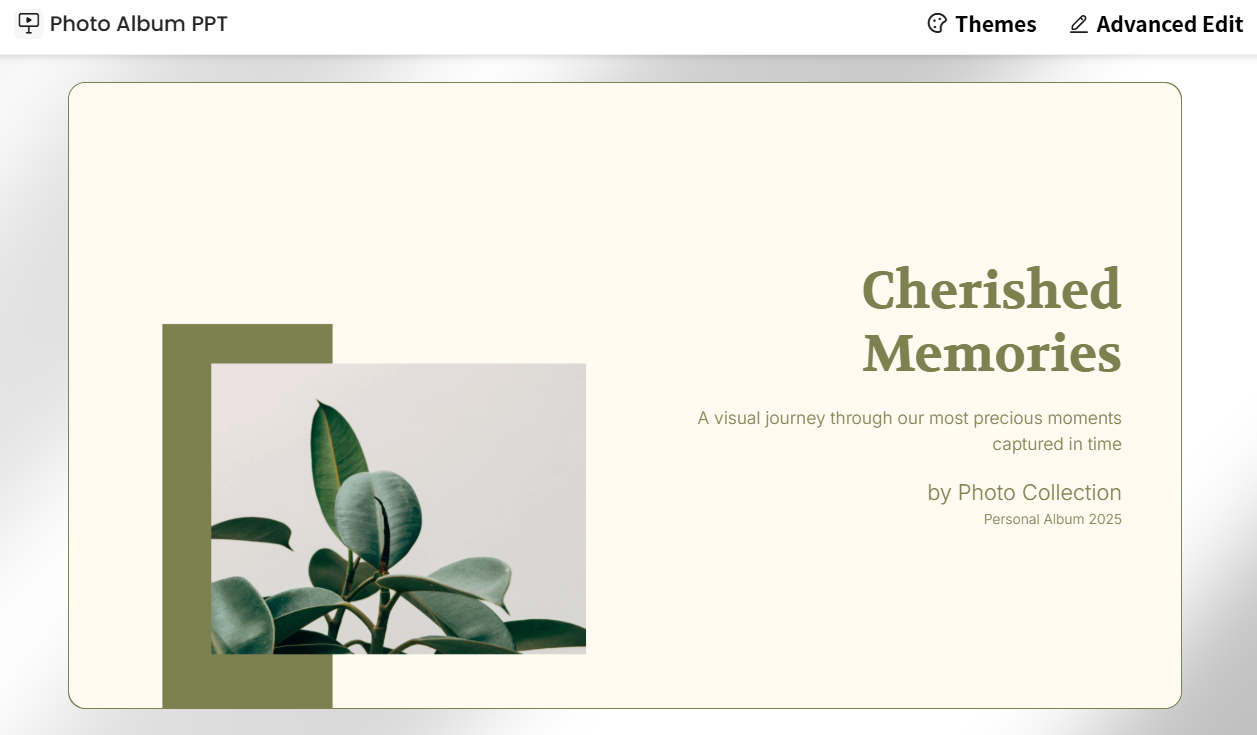
I’d heard of AI tools that write essays or generate surreal art, but one that could make sense of my chaotic personal history? It sounded like science fiction. I visited the PopAI site, half-expecting a gimmick.
What I found was a clean, powerful workspace that claimed to be an all-in-one AI powerhouse. It wasn’t just a chatbot; it was a system designed to interact with your files. It integrates some of the most advanced models on the planet, like GPT-4 and Claude 3 Opus, but its real magic lies in its ability to chat with documents, images, and data you upload. According to their documentation, it can process a staggering amount of information at once—up to 50 files in a single go, handling complex PDFs, data sets, and, most importantly for me, folders of images.
My skepticism remained. “Analyze these photos and create a presentation.” It seemed too simple. Too good to be true. But with my deadline looming and my patience shot, I decided to take the gamble. I zipped up my chaotic folder of 900 photos—all 4.7 GB of it—and braced myself for disappointment.
The Five-Minute Miracle: From Chaos to Coherence
What happened next is the reason I’m writing this. It wasn’t just fast; it was profoundly insightful.
Step 1: The Data Dump
I dragged the single .zip file into the PopAI chat window. No sorting, no renaming, no pre-selection. I just dumped a decade of my family’s visual history into its lap. It uploaded quickly, and a simple message appeared: “Your file is ready. What would you like to do?”
Step 2: The Magic Prompt
I took a deep breath and typed out a prompt, pouring my frazzled thoughts into the chat box. It went something like this:
“This is a collection of photos from roughly 2014 to 2024. They are for my dad’s 70th birthday. Your task is to create a heartfelt Birthday Memory Album PPT that is about 20 slides long. Please analyze all the images and group them into logical, thematic chapters of his life over the last 10 years. For example, ‘Family Vacations,’ ‘Holidays,’ ‘Moments with the Grandkids,’ ‘His Hobbies,’ etc. For each slide, select the best 1-3 representative photos and write a warm, nostalgic, and slightly humorous caption. The overall tone should be celebratory and deeply personal. Create a title slide ‘Happy 70th, Dad: The Best is Yet to Come’ and a final slide with a concluding message.”
I hit enter and watched the three little dots pulsate. I expected an error message, a nonsensical reply, or a long wait.
Step 3: The Big Reveal
Less than five minutes later, a file appeared in the chat window: Dad’s 70th Birthday Album.pptx.
My heart was pounding. I downloaded it and clicked it open. I was not prepared.
It wasn’t just a slideshow; it was a story. The AI had done it. It had looked into the chaotic mess of my digital life and found the narrative.
- Slide 1: The title I requested, set against a beautiful photo of my dad laughing on a beach that I’d completely forgotten existed.
- Slides 2-4: “The Grandkid Era.” PopAI had identified my niece and nephew from when they were toddlers to the present day. It had picked photos of my dad reading to them, pushing them on swings, and napping with them on the couch. The caption read: “From tiny hands to teenage plans, being ‘Grandpa’ has always been your favorite job.” I felt a lump form in my throat.
- Slides 5-7: “Adventures Abroad.” It grouped all our vacation photos. The trip to Italy in 2016, the cruise in 2019. It somehow knew which photos were from which trip and clustered them perfectly.
- Slide 8: “The Captain of the Grill.” A hilarious slide dedicated to my dad’s obsession with barbecue. It pulled every photo of him standing proudly by his grill, tongs in hand. The caption: “Master of the flame, king of the cookout. Some things never change.”
- Slides 9-12: “A Decade of Decembers.” It found every Christmas photo. It recognized the recurring ugly sweaters, the different decorations on the tree over the years. It saw the pattern, the tradition.
It went on like this, slide after slide. It found themes I never would have thought to look for. It noticed the progression of our family pets. It created a slide for my parents’ anniversary dinners. The captions were perfect—touching, funny, and eerily personal. It had captured his essence, his humor, his love for his family, from a folder of randomly named files.
And that’s when it broke me. I wasn’t crying because an AI made a PowerPoint. I was crying because this tool had resurrected memories I thought were lost. It had taken my digital junkyard and turned it into a museum of our love. It did in five minutes what would have taken me 20 agonizing hours, and it did it better.
Beyond the Slides: Is This Cheating or the Future?
After the initial shock wore off, a strange thought entered my mind: Did I cheat? Is it inauthentic to use an AI for something so deeply personal?
I’ve spent the days since thinking about this, and my conclusion is a resounding no. This isn’t cheating; it’s unlocking. PopAI didn’t create the emotions; it excavated them. It did the soul-crushing grunt work—the sorting, the categorizing, the theme-spotting—that stands between us and our own memories. It acted as the world’s most efficient photo archivist, allowing me to focus on the final, human touch.
I spent about 30 minutes fine-tuning the presentation, swapping a few photos, and adding a couple of specific inside jokes to the captions. The AI had done 95% of the work. My 5% was pure, joyful curation, not exhausting labor. It transformed a dreaded task into a beautiful walk down memory lane. This isn’t a replacement for human creativity; it’s a powerful catalyst for it.
Why This Changes Everything for Our Digital Legacy

This experience was about more than just a Birthday Memory Album PPT. It was a glimpse into the future of how we will interact with our own life’s data. The problem of digital hoarding is only going to get worse. We will accumulate millions of data points in our lifetimes—photos, documents, emails, notes.
Tools like PopAI represent a fundamental shift. They are the solution to our self-inflicted data overload. Think about the possibilities beyond a birthday slideshow:
- Your Professional Life: Instantly summarize dozens of market research reports to find key insights.
- Your Education: Upload a semester’s worth of lecture notes and textbooks and have an AI create study guides and flashcards.
- Your Health: Analyze your food logs and workout data to find patterns and suggest improvements.
This is why a tool like PopAI is more than just a novelty; it’s becoming an essential utility. It’s a second brain that can make sense of the chaos, find the signal in the noise, and give you back your most valuable resource: time. The ability to have a conversation with your own data is a superpower. It allows you to stop being a passive collector of information and become an active user of it.
Conclusion: Your Memories, Unleashed
At the party, we played the slideshow. There wasn’t a dry eye in the house. My dad was speechless. He hugged me and said it was the best gift he’d ever received. I just smiled and said, “I had a little help.”
I didn’t just create a presentation. I reclaimed a piece of my family’s history from the digital abyss. The guilt I felt over my messy digital life has been replaced by a sense of excitement. The thousands of photos on my phone no longer feel like a burden; they feel like a treasure chest, and I finally have the key.
Stop letting your memories gather digital dust. Stop letting the dread of a big project keep you from celebrating the people you love. Your life, your work, and your memories are already there, waiting in the folders and files.
What story is waiting to be told in your camera roll? Maybe it’s time you found out.