Create M&A Due Diligence Presentations with AI
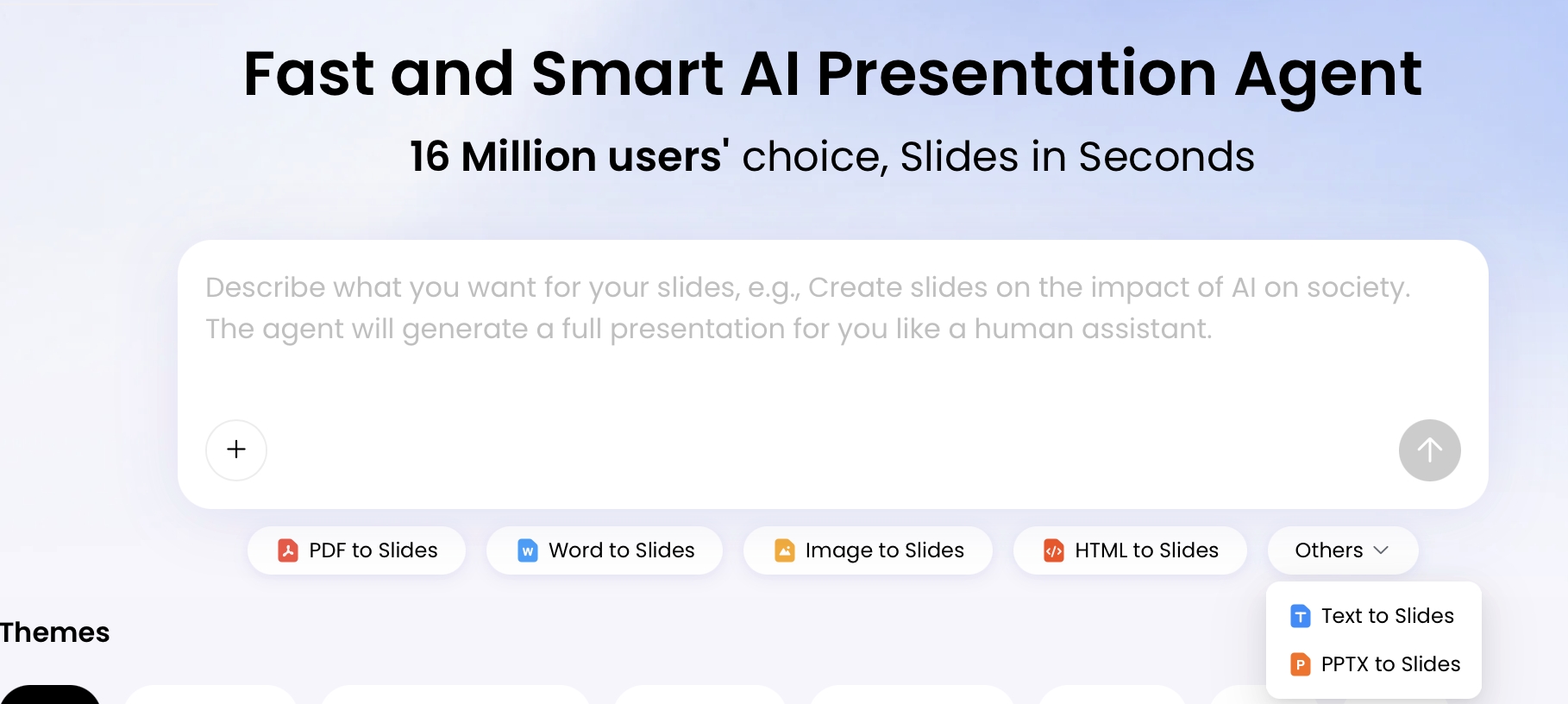
For most deal teams, creating M&A due diligence presentations with AI is a buy-side workflow problem before it is a slide-design problem. Picture a PE associate three days before IC: 1,200 VDR files, a draft QoE report, a customer revenue export, a legal red-flag memo, a synergy tracker, and a partner asking for a 10-slide recommendation by morning. The hard part is not making slides look polished; it is deciding which facts are reliable enough to put in front of an investment committee.
AI can compress the path from source materials to a structured M&A presentation, but only if the team uses a controlled workflow. A one-off prompt may summarize a contract; a diligence deck process must preserve sources, flag assumptions, separate facts from management claims, and shape the narrative for the right audience. Tools such as PopAi AI Presentation can support the presentation layer by turning prompts or uploaded diligence summaries into editable slide drafts, but the deal team still owns the analysis, review, and approval.
The goal of an AI diligence deck is not to replace deal judgment. It is to make the evidence easier to review, challenge, and communicate before a high-stakes decision.
Why M&A Due Diligence Presentations with AI Are Different
M&A diligence is a synthesis exercise across workstreams. Finance is testing revenue quality, EBITDA adjustments, net debt, and working capital. Commercial diligence is testing customer durability, pricing power, churn, and market assumptions. Legal is reviewing contracts, change-of-control rights, litigation, compliance, IP ownership, data privacy, and employment exposure. Operations and IT are checking whether the business can actually be integrated after close. AI changes the drafting workflow because it can classify documents, extract repeated terms, summarize issue lists, and propose deck logic quickly. It should not decide whether to proceed with the deal.
Use productivity claims carefully. AI can shorten parts of document review and deck drafting when the source pack is clean, searchable, and already permissioned, but diligence presentations are not the same as pitch books. Pitch materials optimize persuasion; diligence decks must withstand challenge from IC members, counsel, lenders, and operating partners. A realistic benefit is moving the first draft earlier in the process so senior reviewers spend more time challenging assumptions and less time waiting for slides to be assembled.
In an illustrative buy-side software acquisition, a team might use AI to extract 42 customer contract renewal dates, group EBITDA add-backs from a 95-page QoE report, summarize 18 legal issues into five board-level risks, and convert a 70-row diligence request list into an open-items slide. The useful output is not “the answer”; it is a structured issue log that lets finance, legal, commercial, and operating leads validate the same fact base.
Where AI adds the most value is in repeatable pattern recognition and first-pass structuring. It can help identify change-of-control language, indemnity clauses, customer concentration, payroll-to-P&L inconsistencies, synergy categories, and risk owners. A presentation workflow then converts those findings into slide-ready sections: deal rationale, value story, financial quality, red flags, integration readiness, open items, and appendix evidence. The deck is easier to audit only if source references, reviewer initials, and version dates are preserved.
Start with Source Traceability Before Drafting the Diligence Deck
The most valuable AI workflow in diligence is not prettier slides. It is a controlled source map that lets reviewers see what each claim depends on.
M&A diligence, clean-team rules, privilege, privacy law, antitrust analysis, and disclosure language are deal-, jurisdiction-, client-, and firm-policy-specific. Counsel, tax, accounting, finance, and deal leads should approve the final deck and any sharing process.
| Deck claim | Source file / data room path | Owner | Reviewer status | Risk if unchecked |
|---|---|---|---|---|
| Customer concentration increased in FY25 | VDR / Commercial / Revenue_by_customer.xlsx | Banking analyst | CFO review pending | May misstate revenue dependency. |
| Synergy case assumes 8% vendor savings | Management model v14; Procurement interview notes | Deal team | Needs operating-owner validation | Could overstate achievable savings. |
| Clean-team restriction applies to named customer list | Counsel memo / clean-team protocol | Legal counsel | Counsel approval required | Could breach deal protocol or policy. |
| PII appears in support-ticket export | Customer success export sample | Data owner | Privacy review required | Could violate privacy/security obligations. |
The VDR-to-Deck Workflow for M&A Due Diligence Presentations with AI
For a broader view of available tools, compare the latest AI presentation makers before choosing the workflow that best fits your team.
If your team is still choosing a tool stack, compare the latest AI presentation makers against your firm’s confidentiality, citation, export, and review requirements before using any of them on live deal materials.
The best workflow begins before slide generation. If you upload every document without structure, you risk producing a polished deck with weak provenance. Divide the work into six stages: intake, classification, extraction, validation, storyline, and expert review.
Prepare the approved source pack
Do not start with the entire VDR. Start with a permissioned source pack that has been approved for AI-assisted processing. A practical folder structure looks like this:
- FIN_QoE_2026-07-15.pdf: quality of earnings report, EBITDA adjustments, net debt, working capital notes.
- FIN_ModelExtract_LTM_Forecast.xlsx: selected model tabs only, with hidden assumptions removed if not needed.
- COMM_CustomerRevenue_Cohorts.csv: customer revenue by month, segment, cohort, and churn flag.
- LEGAL_RedFlagMemo_v3.docx: counsel-prepared issue list, not privileged legal analysis unless approved.
- OPS_IT_IntegrationReadiness.xlsx: TSA, systems, security, ERP, CRM, and infrastructure dependencies.
- PMO_OpenDiligenceRequests.xlsx: request ID, owner, status, materiality, decision impact, and due date.
For competitive acquisitions, clean team rules may restrict access to customer-level pricing, pipeline detail, employee compensation, or supplier terms. Those files should be excluded, anonymized, or processed only in an approved clean-team environment. For cross-border deals, check GDPR/PII rules before uploading HR records, customer contact data, or payroll extracts.
Extract and validate key fields
Use AI for extraction, not unchecked conclusion-writing. Typical fields include LTM revenue, adjusted EBITDA, non-recurring add-backs, customer concentration, renewal dates, termination rights, debt-like items, litigation exposure, headcount by function, TSA needs, and synergy assumptions. Then reconcile the outputs against original sources.
- Intake and permissions: Export or connect only approved VDR materials according to firm policy. Remove privileged, clean-team, or personal data unless the tool and user group are authorized.
- Document classification: Tag files by workstream: financial, commercial, legal, tax, HR, IT, ESG, operations, and integration.
- Extraction: Pull defined fields into tables, not loose prose. Require page, tab, or paragraph references.
- Validation: Reconcile extracted facts against source files. Check payroll against P&L, bank statements against management accounts, contract summaries against the actual agreement, and model outputs against the latest version.
- Storyline: Convert validated facts into decision logic: why the deal, what value is available, what risks impair value, and what mitigations are required before signing or close.
- Slide generation and review: Generate a draft, then route it to finance, legal, commercial, tax, HR, IT, and operating owners for sign-off.
Use a source-to-slide control table
The simplest way to prevent “mystery numbers” is to maintain a source-to-slide map. This can live in Excel, the diligence tracker, or the speaker notes of the deck.
| Slide | Claim | Source | Location | Calculation | Reviewer | Status |
|---|---|---|---|---|---|---|
| 4 | Adjusted EBITDA reduced by $4.2M after QoE review | FIN_QoE_2026-07-15.pdf | pp. 18-23 | Mgmt EBITDA less unsupported add-backs | Finance / QoE lead | Confirmed |
| 5 | Top 3 customers represent 38% of LTM revenue | COMM_CustomerRevenue_Cohorts.csv | Tab: LTM by customer | Top 3 revenue divided by total LTM revenue | Commercial lead | Confirmed |
| 6 | Two top-20 contracts require consent on change of control | LEGAL_RedFlagMemo_v3.docx | Issue IDs L-04, L-07 | No calculation | M&A counsel | Counsel review required |
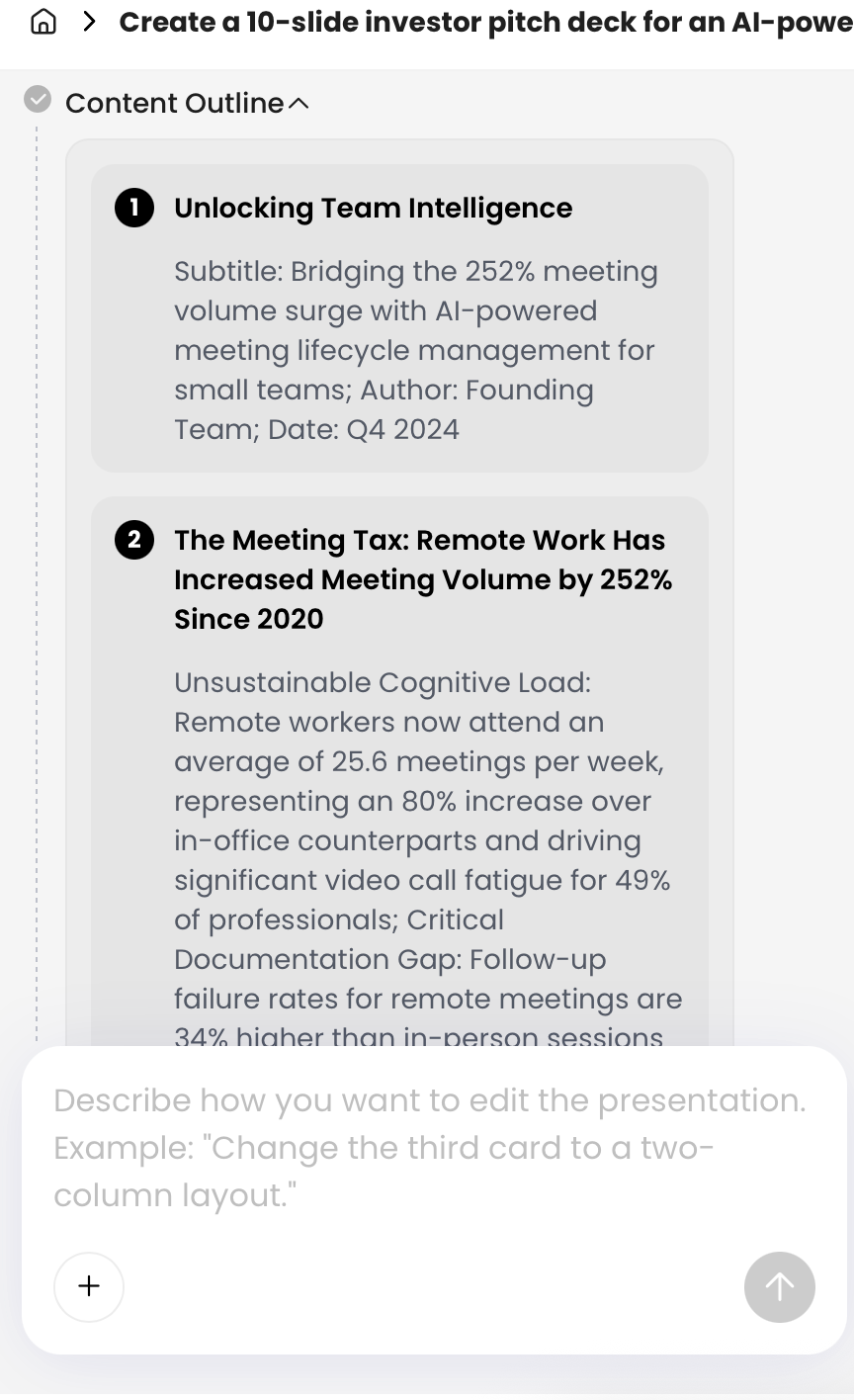
PopAi can support the last-mile presentation workflow when the source pack has already been prepared. Teams can start from a prompt or generate slides from approved materials such as PDFs, DOCX files, PPTX files, text files, images, audio, video, HTML, or Google Drive files. Before generating slides, inspect the outline or content plan and check whether the AI has understood the deal type, buyer perspective, required sections, and unresolved diligence items.
A 10-Slide M&A Due Diligence Deck Structure
Executives do not need every diligence detail in the main deck. They need a short decision path, clear assumptions, and a reliable appendix. The structure below works for a buy-side IC, board update, or buyer steering committee, with adjustments by audience.
Main deck structure
| Slide | Decision question and example title | Recommended visual | Evidence expected |
|---|---|---|---|
| 1. Executive decision summary | Question: Should we proceed, pause, or renegotiate? Example title: “Proceed to signing subject to customer consent plan and $4.2M EBITDA adjustment.” |
Decision dashboard with recommendation, price implication, red flags, and open approvals | IC memo, model summary, diligence tracker, latest partner comments |
| 2. Deal rationale | Question: Why does this asset matter to the buyer? Example title: “Target accelerates mid-market expansion but does not yet prove enterprise segment traction.” |
Strategic fit matrix by product, customer, geography, and capability | Management presentation, market study, buyer strategy plan |
| 3. Value creation story | Question: Where does the return case come from? Example title: “Base case depends on pricing uplift; synergy upside is secondary and timing-sensitive.” |
Value bridge, synergy timing chart, or returns sensitivity table | Model extract, synergy tracker, operating partner assumptions |
| 4. Financial quality of earnings | Question: Is reported EBITDA durable? Example title: “QoE reduces FY26 run-rate EBITDA by $4.2M, mainly from unsupported add-backs and deferred payroll costs.” |
EBITDA bridge with source and adjustment owner | QoE report, trial balance, bank statements, payroll reconciliation |
| 5. Commercial diligence | Question: Are growth and retention assumptions credible? Example title: “Customer concentration creates downside risk, but top-three renewals are addressable before close.” |
Ranked customer bar chart, cohort retention view, churn bridge | CRM export, customer list, cohort analysis, customer calls |
| 6. Legal and compliance red flags | Question: What could affect closing, price, or SPA protection? Example title: “Two material contracts require consent; SPA should include consent condition or purchase price protection.” |
Red-flag table with issue, impact, mitigation, owner, and SPA implication | Contracts, counsel issue list, compliance schedule |
| 7. Operational and integration readiness | Question: Can the buyer operate the business on day one? Example title: “Day-one operations are feasible if TSA covers ERP, payroll, and customer support for 120 days.” |
Integration timeline with critical dependencies | Operating model, IT inventory, TSA draft, org chart |
| 8. Risk heatmap | Question: Which risks change the decision? Example title: “Three risks require pre-signing action: contract consent, margin normalization, and sales leadership retention.” |
Impact/probability matrix with mitigation status | Risk register, workstream sign-offs, open issue log |
| 9. Open diligence requests | Question: What is still unknown and why does it matter? Example title: “Seven open items remain; three affect valuation and two affect SPA negotiation.” |
Issue tracker sorted by decision impact | Q&A log, VDR index, request list |
| 10. Recommendation and next steps | Question: What approval is being requested now? Example title: “Approve revised bid range with closing conditions tied to consents, QoE, and retention plan.” |
Action plan with owner, date, and required approval | Workplan, legal checklist, model sensitivities |
How to adapt the deck by audience
| Audience | Primary question | Emphasize | Compress | Evidence standard |
|---|---|---|---|---|
| Investment committee | Does the risk-adjusted return justify proceeding? | Valuation bridge, downside case, diligence red flags, open approvals | Long market background and operational detail | Model tie-outs, QoE support, workstream sign-off |
| Board | Is the deal strategically sound and governed appropriately? | Strategic rationale, capital at risk, key mitigations, decision ask | Technical diligence detail | Board-level risk summary, external advisor inputs, management recommendation |
| Lender | Can the business support debt through downside scenarios? | Cash flow durability, leverage, covenants, collateral, customer stability | Strategic synergies not relevant to debt service | QoE, cash conversion, monthly financials, covenant model |
| Legal counsel | What risks require drafting, conditions, or indemnity protection? | Clause-level issues, consent rights, liabilities, compliance exposure | High-level market story | Contract references, issue IDs, counsel notes |
| Integration team | Can the business be stabilized and integrated after close? | TSA, systems, org dependencies, day-one controls, synergy timing | Deal marketing language | Owner-confirmed integration plan, cost estimates, dependency log |
What belongs in the appendix
The appendix should carry the weight that the executive deck cannot. Include the EBITDA adjustment schedule, customer concentration detail, contract issue list, risk register, open request tracker, model sensitivities, synergy assumptions, TSA dependency list, and source-to-slide map. If a senior partner asks, “Where did this number come from?”, the answer should be in the appendix or speaker notes, not buried in an analyst’s desktop folder.
Reusable AI Prompts and Playbook for Diligence Slides
One-off prompts are useful for exploration, but M&A teams need reusable playbooks. The playbook should encode deal type, audience, source hierarchy, adjusted EBITDA definition, materiality thresholds, citation rules, uncertainty labels, and output format. A good prompt does not ask AI to “make a deck”; it asks AI to produce a controlled outline that a deal team can verify.
Master prompt structure
- Role: “Act as a diligence presentation analyst preparing a first draft for review by the deal team.”
- Audience: IC, board, lender, legal counsel, operating partner, or management steering committee.
- Deal context: Buy-side or sell-side, platform or add-on, carve-out or standalone, preliminary or confirmatory diligence.
- Source hierarchy: QoE report and signed contracts outrank management presentation claims; latest model version outranks prior extracts.
- Definitions: LTM, run-rate revenue, adjusted EBITDA, net debt, working capital, recurring revenue, churn.
- Materiality: Example: flag any EBITDA adjustment above $250k, customer above 5% of revenue, open issue affecting signing, or contract consent affecting top-20 customers.
- Output format: Slide title, three to five bullets, chart recommendation, source references, unresolved questions, and reviewer owner.
- Uncertainty labels: Confirmed, inferred, management claim, or unverified.
Prompt 1: Deal rationale slide
Using the approved source summaries below, draft a board-ready Deal Rationale slide for a proposed acquisition. Separate confirmed facts from management claims. Include three strategic reasons, two counterarguments, and source references for every factual claim. Use concise slide bullets, not memo prose.
Prompt 2: QoE and EBITDA adjustment slide
Build an EBITDA bridge slide from the QoE findings. Show reported EBITDA, each adjustment, diligence-adjusted EBITDA, and remaining open items. For every adjustment, include amount, reason, source page, reviewer owner, and status: confirmed, disputed, or pending. Do not net adjustments unless the source does so explicitly.
Prompt 3: Value story and synergy waterfall
Build a value creation slide outline showing revenue synergies, cost synergies, margin expansion, integration costs, and timing by year. Flag any assumption that lacks support. Recommend a waterfall or stacked timing visual with labels, units, and footnotes. Do not invent numbers; use “TBD” where source data is missing.
Prompt 4: Legal red-flag table
Convert the legal issue list into a red-flag slide for deal team review. Do not provide legal conclusions. For each issue, list contract or matter, clause or issue type, potential business impact, SPA implication, mitigation option, counsel owner, and source reference. Flag items requiring counsel interpretation.
Prompt 5: Risk map
Convert the diligence findings into a risk heatmap for an investment committee. Score each risk as low, medium, or high for probability and impact. Include owner, mitigation, source document, open question, and whether the risk affects price, SPA terms, closing conditions, financing, or post-close integration.
Prompt 6: Open diligence request tracker
Summarize the open diligence request list into an executive tracker. Group requests by decision impact: valuation, SPA, closing condition, financing, integration, or informational only. Include request ID, owner, age, expected response date, materiality, and whether the deck recommendation depends on resolution.
Data discipline matters. An AI model can produce confident language even when the source pack is incomplete. Require every output to label claims as “confirmed,” “inferred,” “management claim,” or “unverified.” For financial slides, separate source numbers from calculated numbers. If adjusted EBITDA uses add-backs, show the definition and identify who approved each adjustment. For legal slides, do not let AI convert clause extraction into legal advice; use it to prepare issue lists for counsel review.
Example EBITDA bridge logic: management reports $18.6M of LTM EBITDA. QoE supports $1.1M of one-time transaction expense add-back, rejects $2.7M of “strategic hiring” add-back as recurring, identifies $0.9M of deferred payroll cost, and adds $0.5M for a discontinued facility. Diligence-adjusted EBITDA becomes $16.6M before unresolved items. The slide title should not say “EBITDA is strong”; it should say, “QoE reduces LTM EBITDA by $2.0M before open payroll and revenue cutoff items.”
Charts, Source Traceability, and Evidence Design
The most effective due diligence slides reduce review friction. Instead of long bullet lists, use visuals that answer a decision question: EBITDA bridge, customer concentration bar chart, cohort retention view, risk heatmap, integration timeline, synergy timing chart, and open-issue tracker. AI can draft the structure, but the chart data must be reviewed like a model output.
Choose charts by decision question
| Diligence issue | Best visual | Decision it supports | Common chart mistake |
|---|---|---|---|
| EBITDA adjustments | Bridge or waterfall | Price, leverage, and return case | Mixing source EBITDA and calculated EBITDA without labels |
| Customer concentration | Ranked bar chart | Revenue durability and consent priorities | Using a pie chart with too many small customers |
| Cohort retention | Line chart or cohort heatmap | Growth quality and churn risk | Combining logo retention and revenue retention without definitions |
| Synergy timing | Stacked bar by year or value bridge | Integration cost and value timing | Showing gross synergies without implementation costs |
| Legal red flags | Issue table with SPA implication | Negotiation stance and closing conditions | Turning clause summaries into unsupported legal conclusions |
| Open diligence items | Tracker table sorted by decision impact | Whether to sign, delay, or condition approval | Listing all open items equally, including immaterial requests |
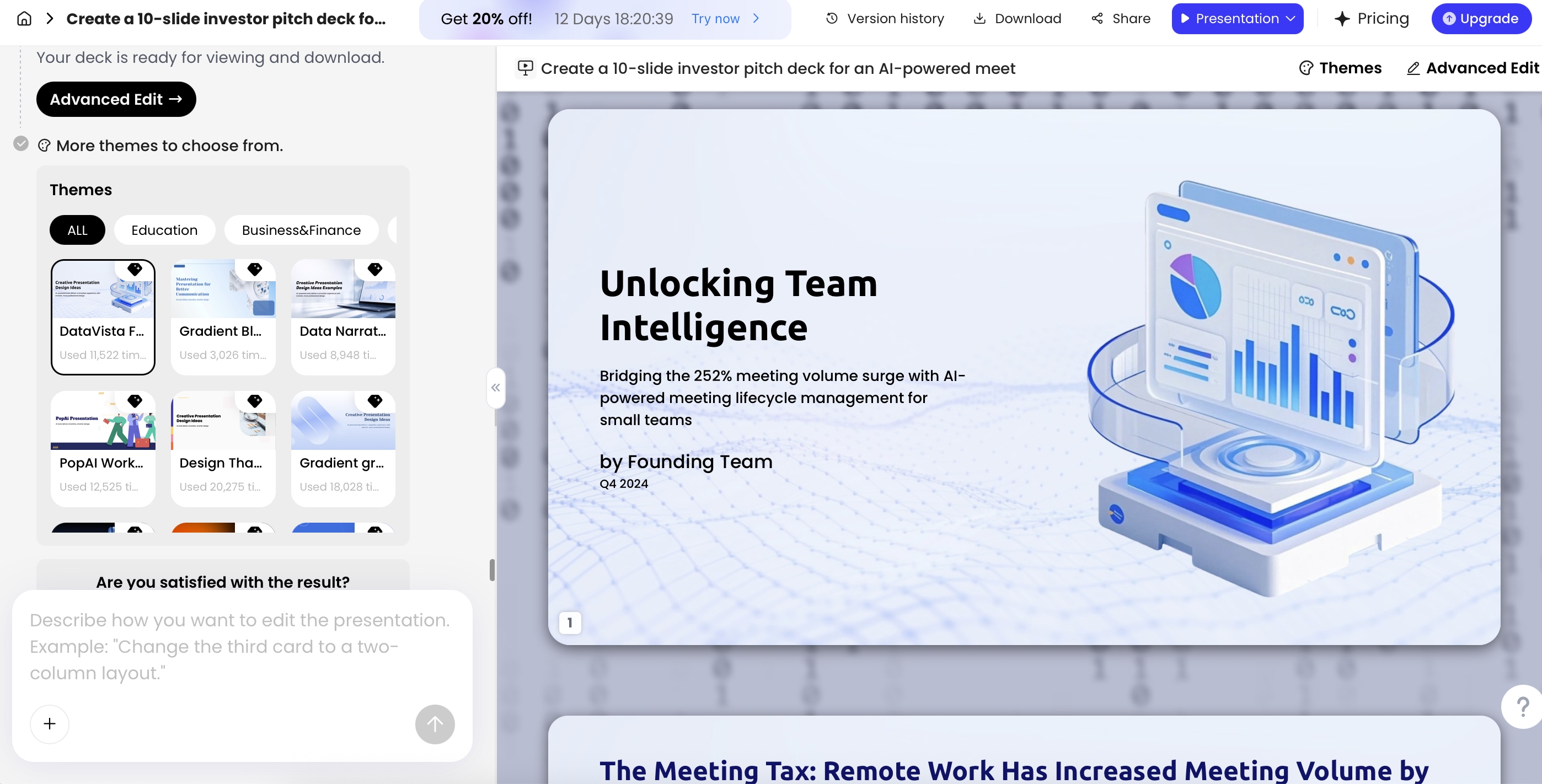
PopAi’s chart editing features are most useful after the draft deck exists. Teams can adjust chart type, edit the underlying data table, upload or download Excel files, change axes and units, add reference lines, and revise labels. For M&A work, use those controls to improve clarity and auditability: keep units consistent, show whether figures are source or calculated, and add short footnotes such as “Source: QoE report p. 21; reviewed by Finance, 2026-07-16.”
Design slides for traceability
For traceability, design each slide with three layers. The visible layer is the executive message: “Customer concentration is material but mitigable through contract renewal plan.” The speaker-note layer contains caveats, definitions, unresolved questions, and source IDs. The appendix layer contains source tables, document names, page references, calculation notes, and reviewer initials. This structure keeps the main deck readable while preserving enough evidence for challenge sessions.
Reviewer readiness test
A practical benchmark is whether a senior reviewer can pick any high-impact claim and answer four questions in under one minute: Where did this number come from? Who validated it? What assumption changes the conclusion? What decision does it affect?
If the deck cannot answer those questions, it is not ready for IC regardless of how polished it looks. This is especially important for calculated metrics such as adjusted EBITDA, net revenue retention, synergy value, customer concentration, and downside liquidity, where a small definition change can alter the recommendation.
Accuracy, Security, and Human Review Controls
Use current merger, privacy, and data-handling guidance that applies to the transaction. For U.S. antitrust context, see the DOJ/FTC Merger Guidelines. For EU personal-data issues, review the official GDPR text with counsel. These links do not replace deal-specific advice.
AI-generated diligence slides introduce three major risks: hallucinated content, misplaced confidence, and confidentiality leakage. Controls should be built into the workflow, not added at the end. Before using any AI system, confirm your organization’s rules on confidential deal documents, personal data, privilege, retention, model training, audit logs, web access, and user permissions.
Accuracy controls
- Maintain a source pack: Use document IDs, versions, extraction dates, and workstream owners.
- Keep an assumption log: Track valuation, synergy, tax, legal, working capital, and integration assumptions separately from source facts.
- Run contradiction checks: Flag conflicts between the management presentation, QoE report, model, and latest VDR uploads.
- Require page or tab references: Reject citations that point only to a file name when the claim is material.
- Separate source and calculated numbers: Label calculations such as concentration, churn, adjusted EBITDA, and run-rate revenue.
Confidentiality and access controls
- Use an approved AI environment: Confirm enterprise terms, encryption, access controls, retention, and whether uploaded content is used for training.
- Limit the source pack: Upload summaries and extracts where possible instead of the entire VDR.
- Protect privilege: Do not upload privileged legal advice unless counsel and firm policy approve the workflow.
- Respect clean team restrictions: Separate competitively sensitive pricing, customer-level pipeline, cost data, and supplier terms.
- Minimize PII: Anonymize employee, customer, payroll, and HR data when individual identity is not required for the slide.
- Disable unnecessary web search: Confidential deal drafting should not be blended with uncontrolled external browsing unless approved.
Human review by workstream
Create a red-flag review where each workstream lead confirms whether the slide language is fair, complete, and not overstated. Finance validates numbers and calculations. Legal validates clause interpretation and SPA implications. Commercial diligence validates market, customer, and pipeline claims. HR validates headcount, compensation, and retention issues. IT and operations validate integration feasibility, TSA needs, and cost timing.
- Never let AI finalize valuation judgment: It can summarize model drivers, but investment judgment stays with the deal team.
- Never let AI provide final legal conclusions: Use it to prepare review lists and first drafts for lawyers.
- Never present unsupported synergies: Label management estimates, diligence-adjusted estimates, and buyer-approved cases separately.
- Never hide open items: A clean slide that omits unresolved diligence can create false confidence.
- Never rely on hallucinated citations: If a page reference, tab name, or contract section cannot be found, mark the claim as unverified.
Human review is not a bottleneck; it is the control mechanism that makes the deck usable. AI handles bulk reading, first-draft synthesis, outline generation, and formatting. Bankers pressure-test the story and valuation implications. Lawyers review contractual and regulatory conclusions. Operators test feasibility of integration and synergies. Sponsors and executives decide risk appetite.
How to Build the Deck in PopAi AI Presentation
Once the source pack and workstream findings are ready, PopAi can help turn a diligence narrative into an editable deck draft. The safest approach is to upload approved summaries and extracts rather than raw VDR folders, then review the outline before generating slides.
Prepare the source pack
A realistic input pack for a buy-side IC deck might include a QoE report PDF, management presentation PDF, customer revenue Excel export, legal red-flag memo, synergy tracker, IT/TSA dependency list, and open diligence request tracker. Before upload, remove unnecessary personal data, exclude privileged legal advice unless approved, and confirm that the AI environment is permitted for confidential deal work.
| Input source | Deck section it supports | Review before accepting output |
|---|---|---|
| QoE report PDF | Financial quality, EBITDA bridge, net debt risks | Adjustment amounts, definitions, page references, unresolved items |
| Customer revenue Excel | Commercial diligence, concentration, cohort retention | Date range, customer grouping, churn definition, calculated percentages |
| Legal red-flag memo | Legal risks, SPA implications, closing conditions | Counsel ownership, issue severity, no unsupported legal conclusions |
| Synergy tracker | Value creation, integration costs, timing | Gross vs net synergies, timing, owner approval, implementation cost |
| Open request list | Open diligence requests and next steps | Decision impact, due date, workstream owner, materiality |
Generate and inspect the outline
- Prepare a sanitized input pack: Use approved summaries, risk registers, model extracts, and legal issue lists. Avoid uploading unnecessary sensitive documents.
- Write the presentation instruction: Specify audience, deal type, stage, page count, tone, required sections, source citation expectations, and uncertainty labels.
- Review the outline before generation: Check that the deck includes deal rationale, value story, financial quality, commercial findings, legal risks, integration readiness, open items, and appendix logic.
- Generate the full deck: Select a theme, template, ratio, or layout approach that fits your firm’s style, but prioritize clarity over decoration.
- Edit with natural language and chart tools: Shorten executive slides, rewrite titles as conclusions, add source footnotes, correct chart data, and move detailed evidence to the appendix.
- Export and route for review: Export to PPTX or PDF. PPTX files can be opened in Microsoft PowerPoint and text objects remain editable, which is useful for banker, counsel, and operating partner markups.
Use a controlled PopAi prompt
Create a 10-slide buy-side investment committee diligence deck for a proposed add-on acquisition. Use only the uploaded approved source pack. Include: executive recommendation, deal rationale, value creation, QoE/EBITDA bridge, commercial diligence, legal red flags, integration readiness, risk heatmap, open diligence requests, and next steps. For every material claim, add a short source reference in speaker notes. Label unsupported items as “unverified” and do not invent numbers.
For example, a team could upload a QoE PDF, a customer revenue Excel file, a legal red-flag memo, a synergy tracker, and an open request list. PopAi can organize the material into a draft deck where the QoE report feeds the EBITDA bridge, the customer file feeds concentration and cohort visuals, the legal memo becomes a red-flag table, and the request list becomes an open-items slide. The team should then compare each generated slide against the source pack before accepting the wording or chart data.
Review, export, and route for sign-off
- Numbers tied out: EBITDA, revenue, customer concentration, synergies, and integration costs match the approved source or calculation.
- Assumptions labeled: Management claims, buyer-adjusted cases, and unverified items are clearly separated.
- Risk owners assigned: Each material red flag has a workstream owner and mitigation plan.
- Speaker notes contain references: Material claims include source document, page, tab, or issue ID.
- Appendix contains backup: Detailed schedules support the main-deck conclusion.
- Version control is clear: File name, date, draft status, and reviewer comments are tracked before circulation.
The best final deck is usually not the longest one. A traditional 40-page diligence deck might become a 10-page executive deck plus a detailed appendix, or a 3-page IC pre-read supported by a source binder. AI helps produce those versions faster, but it does not replace approval. Before sending the deck, confirm sign-off from the deal lead, finance/QoE owner, legal counsel, commercial lead, and operating or integration owner.
FAQ: M&A Due Diligence Presentations with AI
Can AI create an M&A due diligence presentation from a VDR?
AI can help turn exported VDR materials, reports, contracts, financial summaries, and management notes into an outline and slide draft. Teams should still verify citations, reconcile financials, and obtain legal or specialist sign-off before using the deck for an IC or board meeting.
What should be included in an M&A due diligence deck?
A strong deck usually includes transaction context, deal rationale, value creation thesis, financial quality of earnings, customer and revenue concentration, legal and compliance findings, synergy plan, risk heatmap, decision asks, and a detailed appendix with source-backed evidence.
How do you keep AI-generated diligence slides accurate?
Use source citations, an assumption log, versioned data extracts, reconciliation checks, red-flag review, and human approval. Treat AI output as a first draft, not as the final authority for legal conclusions, valuation judgments, or negotiation strategy.
Is it safe to upload confidential deal documents into AI tools?
Only use approved enterprise settings and follow your firm’s confidentiality policy. Recommended safeguards include anonymization, permission controls, disabling training on uploaded data where available, limiting web access, keeping audit trails, and avoiding unnecessary uploads of highly sensitive personal or trade-secret data.
Create your presentation with one click now
Turn diligence summaries, reports, and structured findings into a clear, editable presentation for your next IC, board, or deal team review.
Create with PopAi