How to Create Innovation and Intrapreneurship Pitches with AI
If you are a product manager, transformation lead, corporate innovator, or intrapreneur trying to win leadership support, you probably face the same tension: your idea is promising, but your pitch still feels vague, too technical, or too risky for executives to approve. Creating innovation pitches with AI can help you move from messy notes to a persuasive internal pitch deck faster, but only if you guide the tool with customer evidence, business logic, and a concrete ask.
This guide shows a practical workflow for using AI to shape an internal innovation proposal, intrapreneurship pitch, pilot roadmap, or startup-style idea deck. You will learn how to brief the AI, structure the story, validate outputs, avoid generic buzzwords, and turn your deck into a leadership-ready conversation.
Why AI Helps Internal Innovation Pitches
The strongest innovation pitches do not merely describe a new feature or technology. They prove that a real problem exists, that the organization is uniquely positioned to solve it, and that the first investment can be contained, measured, and scaled. AI helps because it can organize scattered material quickly: interview notes, customer feedback, market scans, internal reports, competitor references, budget assumptions, and draft talking points.
Think of AI as a pitch co-producer, not a substitute for your judgment. It can summarize research, generate alternative storylines, convert a report into slides, polish executive language, and simulate skeptical questions. It cannot know which internal sponsor has political capital, which data is confidential, or which operational dependency will block implementation unless you tell it.
AI is most useful when your insight is real but your narrative is unfinished. It turns raw evidence into a structure you can challenge, revise, and defend.
A useful benchmark comes from creativity research: in one study involving more than 800 participants designing virtual cars, AI suggestions increased time spent, design quality, and engagement. That matters for corporate innovation because the first version of a pitch is often limited by the team’s existing framing. AI can widen the option space, then you can narrow it using customer proof, feasibility, and strategic fit.
Internal innovation pitch vs. startup pitch: what changes?
An intrapreneurship pitch and a startup pitch share a basic storyline: problem, solution, market or user need, advantage, model, proof, team, and ask. The difference is the decision environment. Investors ask, “Can this become a large, defensible company?” Executives ask, “Should we allocate people, budget, data access, and political attention to this now?”
| Pitch type | Primary decision | What the audience scrutinizes |
|---|---|---|
| Startup investor pitch | Invest capital for growth | Market size, traction, business model, moat, team, revenue path, fundraise use |
| Corporate innovation pitch | Approve exploration, pilot, or scale | Strategic fit, internal ROI, risk, resource demand, governance, integration, sponsor support |
| Healthcare or regulated AI pitch | Approve careful validation | Clinical or expert validation, explainability, privacy, compliance, cost efficiency, commercialization timeline |
Data also changes the story. A startup deck can often rely on public market signals, while internal pitches should include company-specific waste, missed revenue, support tickets, process cycle time, churn indicators, or employee productivity losses. If you only cite broad third-party market data, leadership may see your idea as interesting but not urgent.
Historical intrapreneurship examples such as Post-it, PlayStation, Gmail, and iPod are useful reminders that internal ventures often begin as side bets, prototypes, or protected experiments. At the same time, modern organizations expect clearer governance: who owns the pilot, how success is measured, what data is used, and when the project should stop.
From Idea to Pilot Approval: AI-Assisted Workflow
Use AI in stages rather than asking for a finished deck in one vague prompt. A staged workflow gives you checkpoints where you can correct assumptions before the deck becomes polished but wrong.
- Capture the idea: Write the problem, proposed solution, target users, strategic theme, and decision you need.
- Upload or paste evidence: Add interview notes, survey summaries, meeting transcripts, process metrics, support tickets, or existing strategy documents.
- Ask for a pitch outline: Request a slide-by-slide structure with decision-maker concerns included.
- Generate the first deck: Use an AI presentation tool to turn the outline into slides, visuals, and speaker notes.
- Pressure-test the business case: Ask AI to challenge assumptions as a CFO, CTO, legal leader, customer, or operations owner.
- Revise for credibility: Add sources, remove inflated claims, simplify technical language, and define the pilot ask.
- Rehearse the Q&A: Generate likely objections and prepare concise answers.
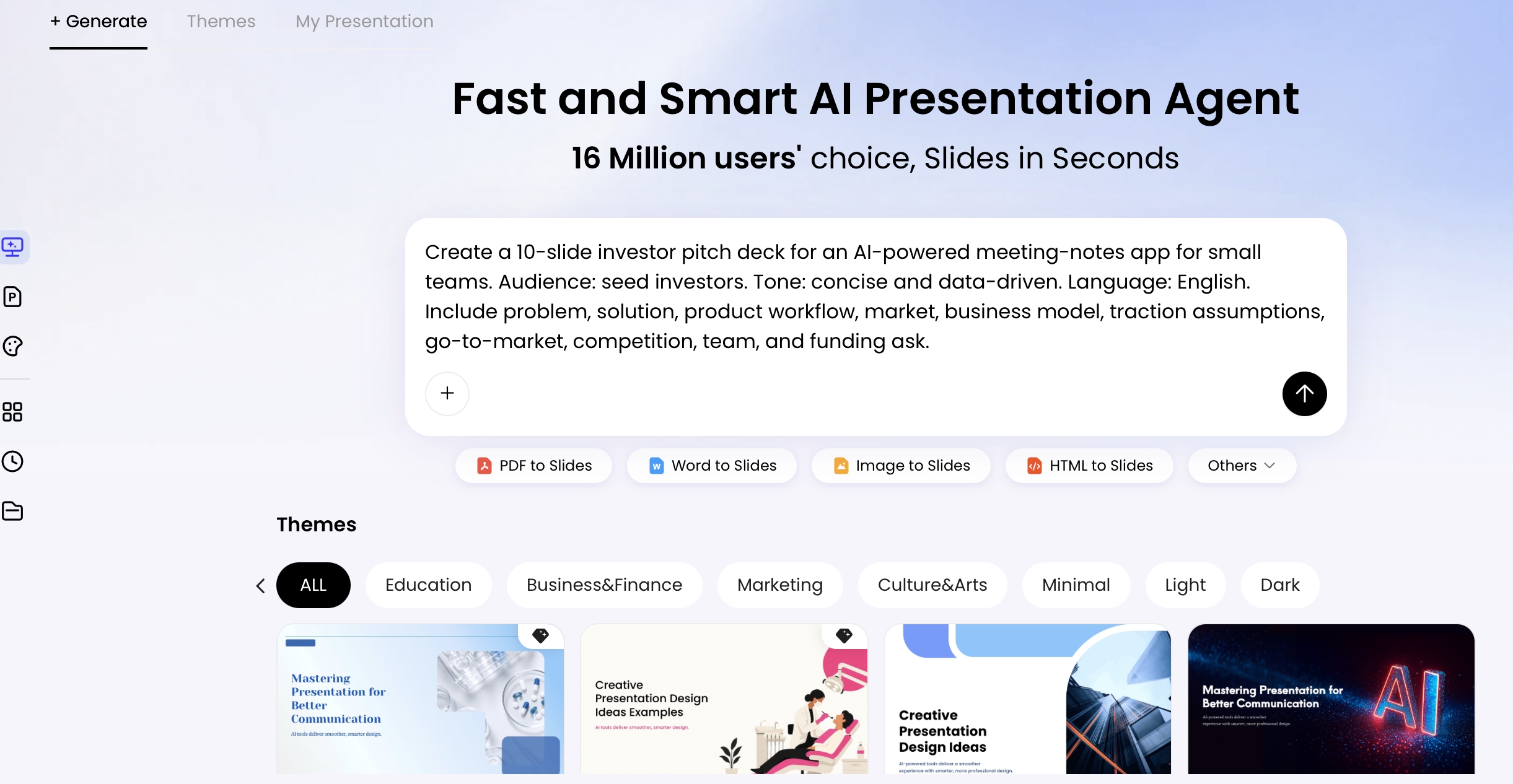
In PopAi AI Presentation, this workflow maps naturally to the product: start from a topic or prompt, specify audience, tone, language, slide count, and required sections, then review the generated content plan before producing the full deck. You can also upload existing materials such as PDF, Word, Text, HTML, PPTX, images, audio, video, or a YouTube URL when your pitch is based on prior research or meeting recordings.
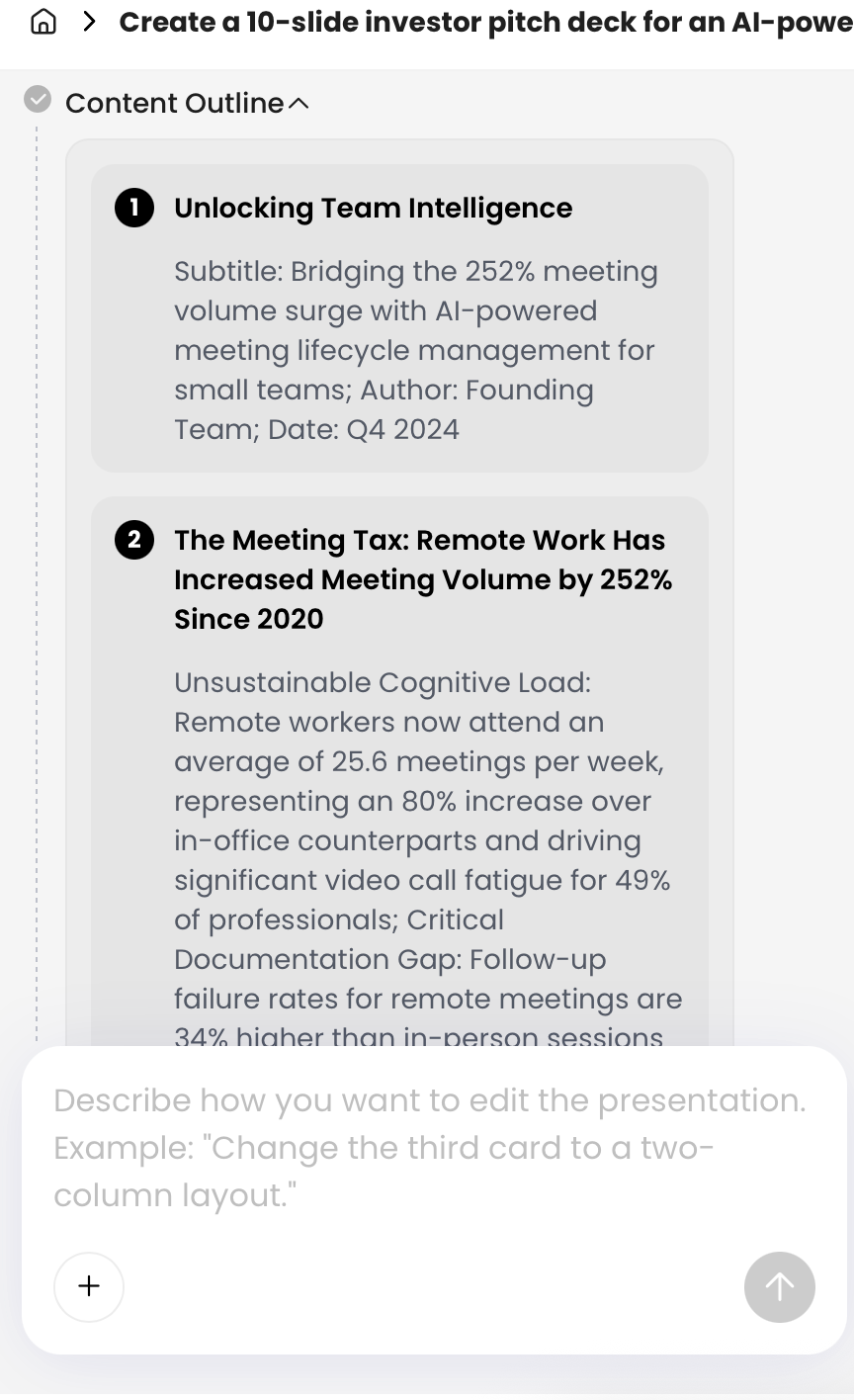
Compared with general AI presentation makers, the most important criterion for innovation work is not just attractive slide design. You need a tool that supports the full delivery chain: input materials, content organization, deck generation, natural-language revision, advanced editing, charts, icons, layout adjustments, and export to PPTX or PDF for stakeholder review.
Prompt Templates for an Intrapreneurship Deck
A strong prompt gives AI the same context you would give a strategy consultant or pitch coach. Include the audience, the decision, known evidence, constraints, and required output. Below are templates you can adapt.
1-minute elevator pitch prompt
Internal pitch deck prompt
Leadership objection prompt
These prompts are intentionally specific. “Make it innovative” produces generic slides. “Help a CFO approve a 60-day pilot with a capped budget, measurable productivity KPI, data governance plan, and stop/go criteria” produces a pitch that executives can actually evaluate.
Specificity is the antidote to AI sameness. The more concrete your constraints, the more useful the generated pitch becomes.
Build the Internal Business Case
A leadership-ready innovation deck should be short enough to discuss, but complete enough to de-risk the decision. For most internal pitches, aim for 8 to 12 slides. If you are pitching a regulated AI project or a larger investment, add appendix slides for governance, technical architecture, and financial detail.
- Title and decision: State the idea and the approval requested.
- Executive summary: One slide with problem, solution, value, risk, and ask.
- Problem evidence: Use customer, employee, operational, or financial proof.
- Proposed solution: Explain what changes for the user, not just the technology.
- Strategic fit: Connect the idea to company priorities, OKRs, or transformation themes.
- Business case: Show cost, upside, expected ROI range, and assumptions.
- Pilot roadmap: Define milestones, owners, validation methods, and stop/go criteria.
- Risks and mitigations: Include privacy, bias, compliance, integration, and adoption risk.
- Team and sponsor model: Name the cross-functional roles required.
- Ask and next step: Make the decision easy to say yes to.

For startup-style AI ideas, add slides on market size, pricing, defensibility, proprietary data, revenue model, and competitive landscape. For healthcare or regulated AI, add validation approach, explainability, regulatory path, model monitoring, privacy controls, and clinical or expert review. AI can draft all of these, but you should verify every claim and add source notes before presenting.
Corporate Pilot Example: Problem to Approval Ask
A strong intrapreneurship pitch does not just say the idea is exciting. It shows why the pilot is worth approving now and how the organization will learn safely.
| Slide / decision point | What the pilot example should show | AI prompt direction |
|---|---|---|
| Problem | Support teams lose time manually routing customer escalation notes. | Summarize the operational pain in one sentence and identify who feels it. |
| Evidence | Last month, 38% of escalations required manual triage and two handoffs. | Turn verified metrics into a concise evidence slide; mark missing data as questions. |
| Strategic fit | The pilot supports the company goal of faster enterprise onboarding. | Connect the idea to one named strategic priority, not a generic innovation theme. |
| Pilot scope | Run a 6-week test with two customer-success pods and one workflow template. | Define scope, exclusions, owner, timeline, and success threshold. |
| KPI | Reduce triage time by 20%, cut handoff errors, and capture qualitative CS feedback. | Separate measurable KPIs from learning questions. |
| Risk | Workflow automation may create wrong routing if categories are poorly labeled. | List risks with mitigation and the person responsible for review. |
| Ask | Approve pilot access, one operations owner, and limited CRM sandbox use. | State the specific decision needed from leadership. |
AI can make the business case clearer, but the sponsor must own the evidence, strategic fit, risk language, and pilot ask. Do not let the deck imply budget, data access, or executive approval before those owners agree.
How to validate and polish innovation pitches with AI
The fastest way to lose trust is to present a polished deck with weak facts. AI can hallucinate statistics, overstate market size, invent competitors, or make a pilot sound simpler than it is. Build a validation pass into your workflow before design polish.
Use a credibility checklist
- Problem clarity: Is the pain specific, costly, and tied to a real audience?
- Customer evidence: Do you have quotes, interviews, tickets, usage data, or survey findings?
- Financial logic: Are assumptions visible and conservative enough for a CFO?
- Feasibility: Have you named systems, data sources, integrations, and owners?
- Data advantage: If AI is involved, what data makes this defensible or valuable?
- Governance: Have you addressed privacy, bias, IP, security, and model oversight?
- Organizational support: Do you have a sponsor, pilot users, and cross-functional roles?
One useful analysis step is to ask AI to mark each slide as “evidence-backed,” “assumption,” or “claim needing source.” This converts the deck from a persuasion artifact into a decision document. Executives are more willing to fund experiments when uncertainties are named rather than hidden.
Another analysis step is scenario modeling. Instead of presenting one confident ROI number, show a conservative, expected, and upside case. For example, an internal training program case reported 1,100 IT employees participating, 95% satisfaction, 12 teams entering an accelerator, 6 teams funded, and a 10:1 investment return within a year. Whether or not your context is similar, the lesson is to connect engagement, funded pilots, and measurable returns rather than relying on enthusiasm alone.
PopAi can help polish the deck after validation. You can revise slides with natural language, use Advanced Edit for layout changes, switch themes, adjust icons and charts, and export to PPTX or PDF. When your business case includes metrics, PopAi’s chart tools can support common chart types such as bar, line, area, pie, donut, radar, scatter, bubble, and dual-axis charts, with editable data tables and Excel upload or download for chart data.
Common mistakes when using AI for innovation pitch decks
AI makes it easier to create slides, which also makes it easier to create impressive but unconvincing slides. Watch for these frequent mistakes.
- Over-explaining the technology: Leadership usually wants business impact first and technical depth second. Put architecture in the appendix unless it is the decision.
- Using buzzwords instead of proof: “GenAI agent transformation” is not a business case. Name the workflow, user, cost, risk, and metric.
- Skipping customer validation: A pitch without interviews, usage data, or internal demand signals feels speculative.
- Ignoring resource tradeoffs: Internal funding is not only money. It includes engineers, data access, legal review, operations time, and executive attention.
- Hiding risk: Strong pitches include risk controls, not risk denial.
- Entering sensitive data carelessly: Do not paste confidential customer data, unreleased financials, legal documents, or trade secrets into tools unless approved by your organization.
A final mistake is stopping at the deck. The pitch is a conversation. Use AI to rehearse: ask it to play a skeptical CFO, a technical architect, a regional operations leader, and an end user. Then score your responses for clarity, evidence, brevity, and confidence.
Before-and-after example: from vague idea to fundable pilot
Imagine your starting idea is: “Use AI to improve customer onboarding.” That is too broad for an approval meeting. With AI, you can turn it into a sharper pitch:
The improved version names the workflow, user, metric, pilot duration, and risk control. It also narrows the ask. Instead of requesting broad innovation funding, the team asks for a contained experiment with measurable outcomes. That is the difference between an idea presentation and an intrapreneurship pitch.
You can then ask AI to generate three versions: one for the CFO emphasizing cost and ROI, one for customer success emphasizing adoption and retention, and one for technology leadership emphasizing integration and security. This audience-specific rewriting is where AI becomes especially powerful for internal innovation teams.
FAQ: creating innovation pitches with AI
Can AI create a complete innovation pitch deck for leadership?
Yes. AI can turn a structured brief, research notes, customer evidence, and financial assumptions into a first complete deck. The best results come when you supply the audience, decision criteria, constraints, pilot plan, risks, and the exact ask.
How is an intrapreneurship pitch different from a startup investor pitch?
A startup pitch focuses on venture scale, market opportunity, business model, team, traction, and funding. An intrapreneurship pitch must also prove strategic fit, internal sponsor support, resource impact, governance, risk controls, and a realistic path from pilot to operating model.
What should I never put into an AI tool when building an internal pitch?
Avoid entering confidential customer data, unreleased financials, trade secrets, employee personal data, or legal material unless your organization has approved the tool and usage policy. Use anonymized summaries when in doubt.
How do I make an AI-generated pitch sound less generic?
Add original customer quotes, internal metrics, named stakeholder concerns, specific budget ranges, your company’s language, and a point of view. Then ask the AI to rewrite for your audience while preserving those facts.
Create your presentation with one click now
Turn your innovation brief, research notes, or pilot plan into a persuasive presentation that executives can review and discuss.
Create a pitch deck with PopAi