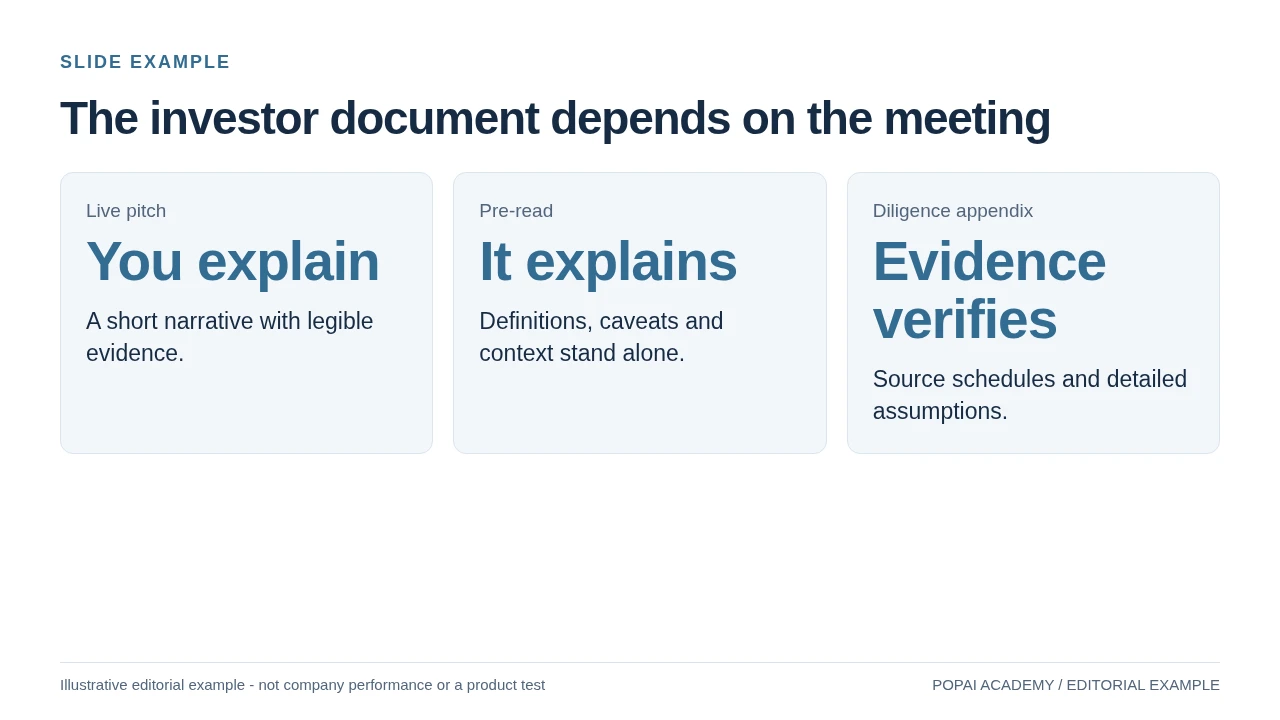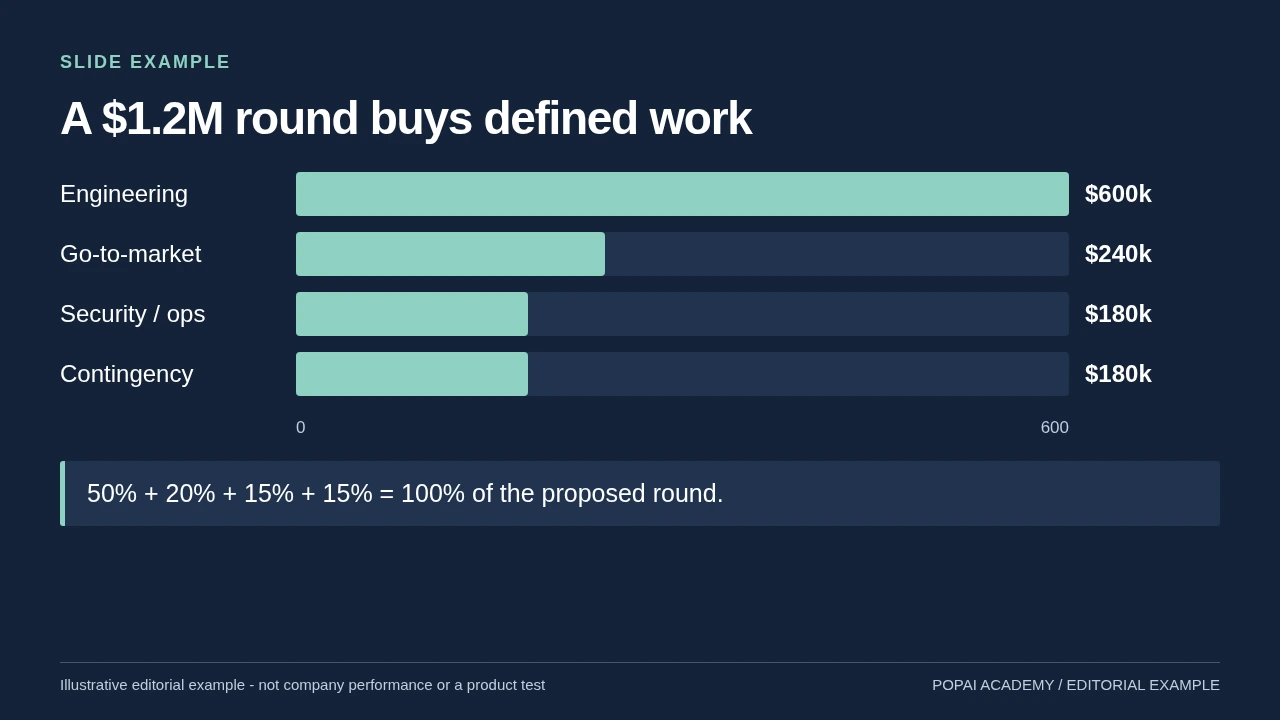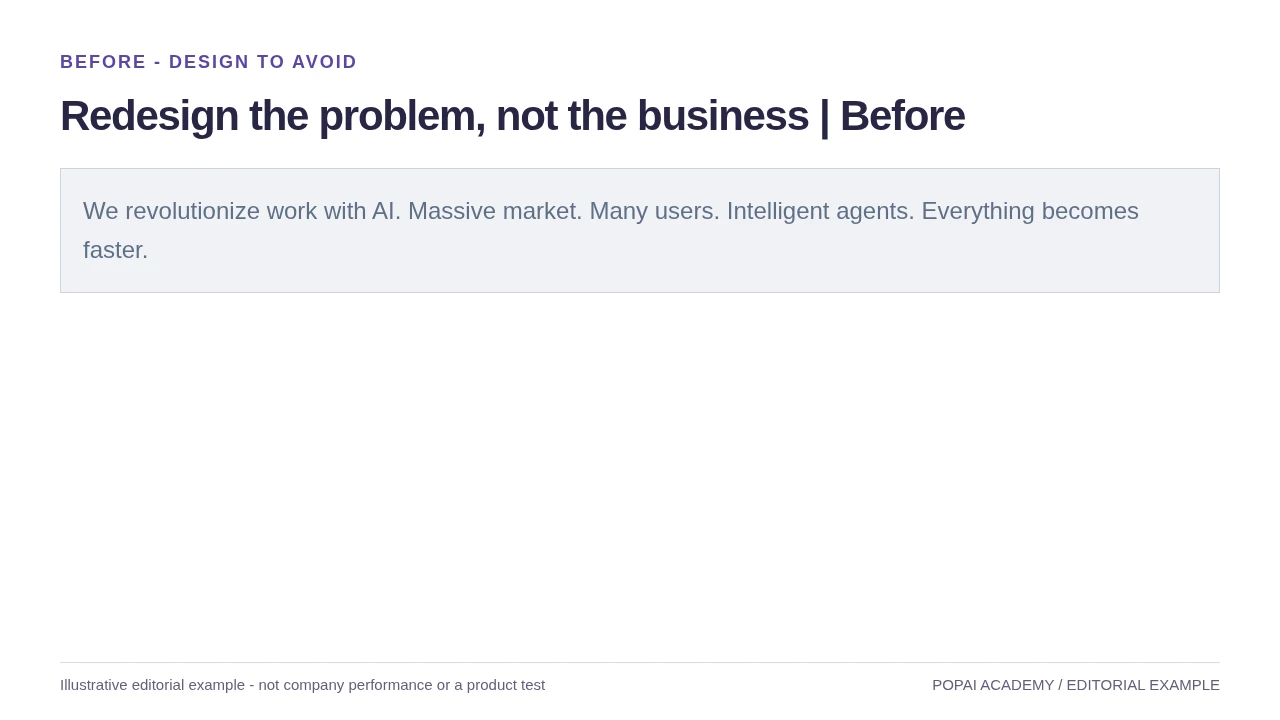
An early AI startup pitch should explain what is known, what remains uncertain and which next experiment would change the company's prospects. At pre-seed or seed, an honest account of users, evaluations, data access and delivery cost is stronger than a generic AI market story.
This page focuses on early AI companies. Use the investor pitch pillar for general document structure and the fundraising guide for a round-specific ask, runway and use of funds. Design changes to an existing pitch are covered in the startup design guide.
Pre-Seed and Seed Need Different Evidence
| Question | Pre-seed emphasis | Seed emphasis |
|---|---|---|
| Is the problem real? | Defined interviews and observed workflow | Repeated demand within a stated segment |
| Does the product work? | Bounded prototype and failure cases | Evaluation on representative tasks |
| Will anyone pay? | Pricing questions and willingness-to-pay evidence | Paid pilots or contracts with their status clear |
| Can it be delivered? | Review needs and key dependencies | Repeatable deployment and actual delivery effort |
| Is the data usable? | Permission and access assumptions | Reviewed rights, operating controls and dependency plan |
| What should the next capital buy? | An evidence milestone | A repeatability milestone, linked to the round model |
Early AI Startup Evidence: Validation, Cost and Data
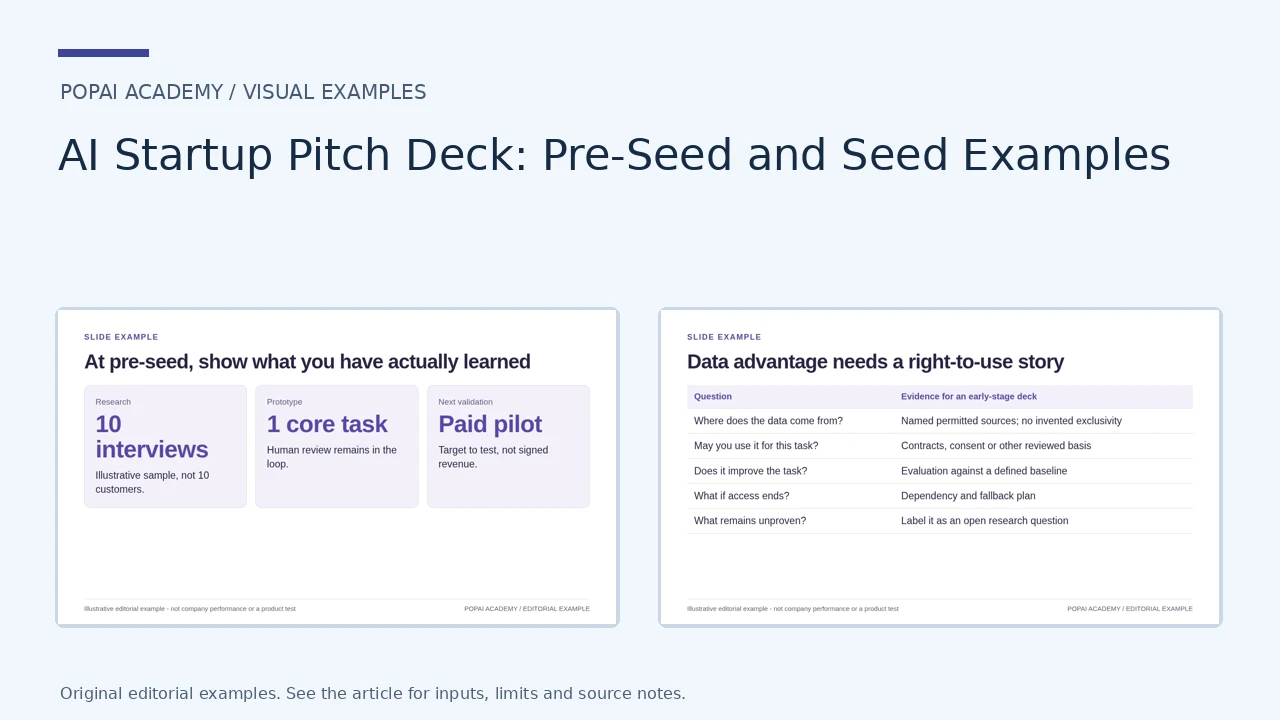
These examples address uncertainty at pre-seed and seed: interviews are not customers, accepted outputs need a definition, and a data advantage requires permission plus demonstrated usefulness.
Open full-size examples and editable HTML layouts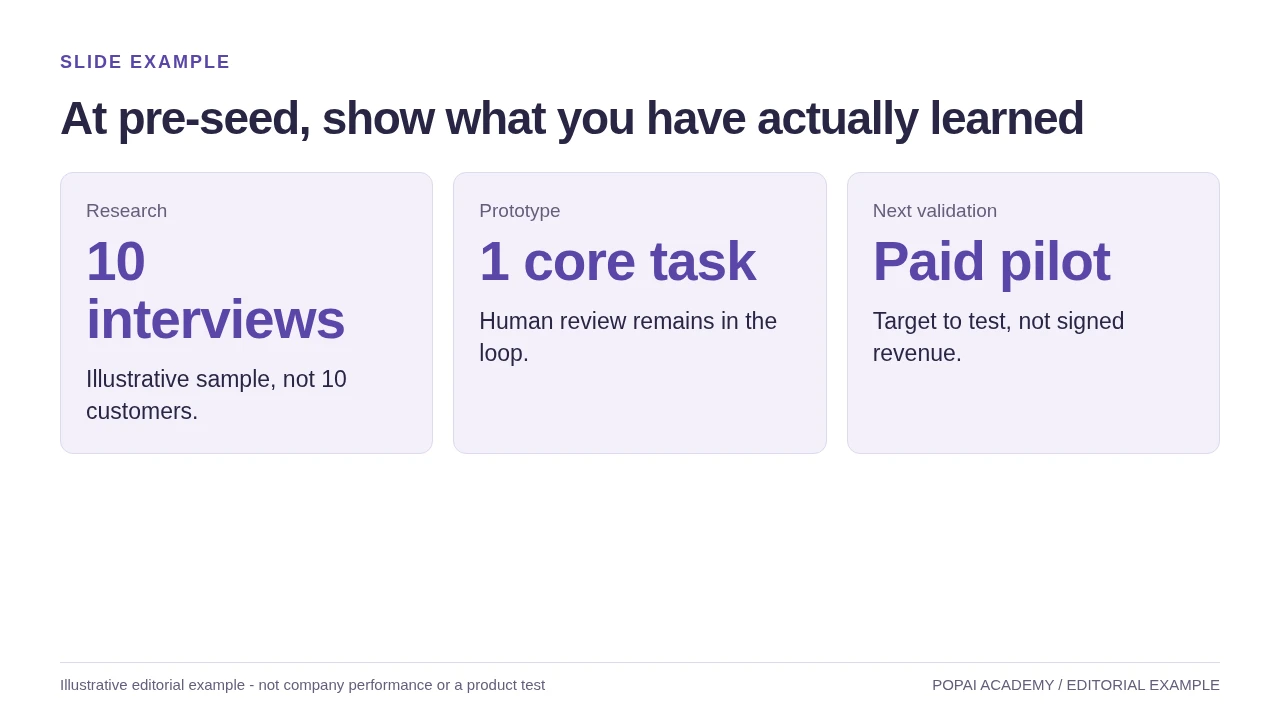
An early AI startup example; do not present planned validation as traction.
Read or copy the slide content
Research
10 interviews
Illustrative sample, not 10 customers.
Prototype
1 core task
Human review remains in the loop.
Next validation
Paid pilot
Target to test, not signed revenue.
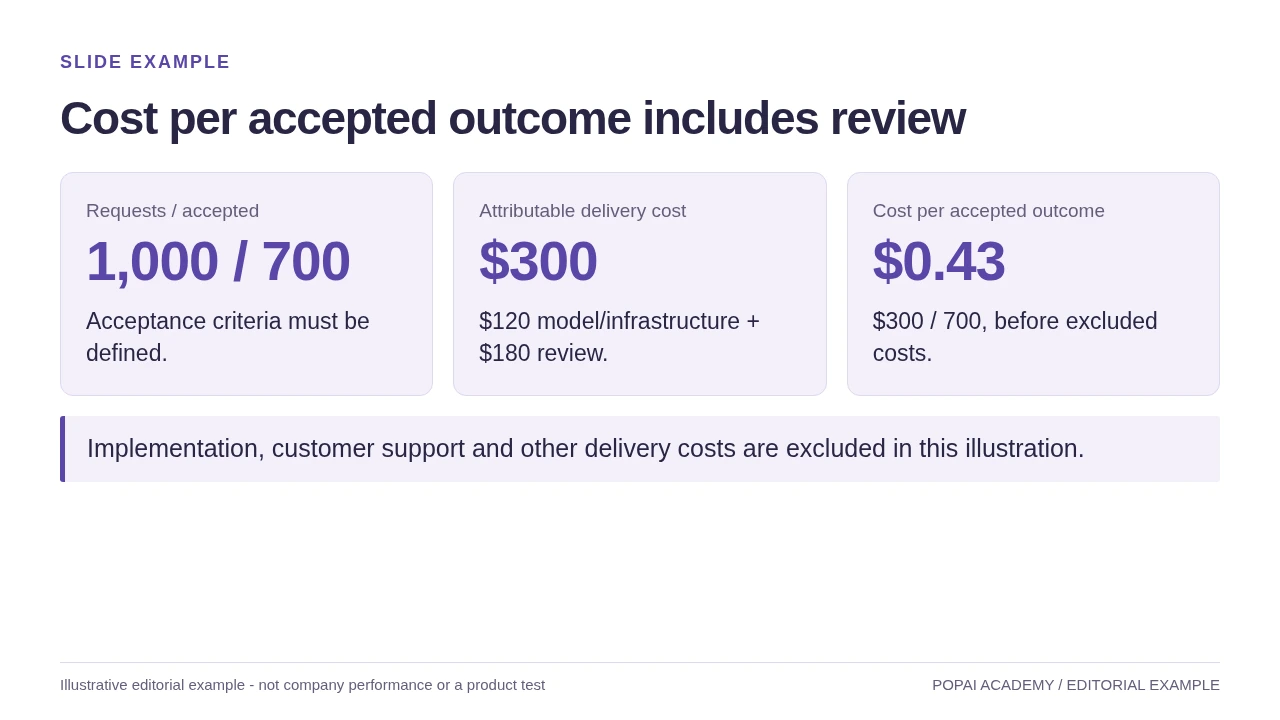
The worked example's unit-economics example is retained with its exclusions.
Read or copy the slide content
Requests / accepted
1,000 / 700
Acceptance criteria must be defined.
Attributable delivery cost
$300
$120 model/infrastructure + $180 review.
Cost per accepted outcome
$0.43
$300 / 700, before excluded costs.
Implementation, customer support and other delivery costs are excluded in this illustration.
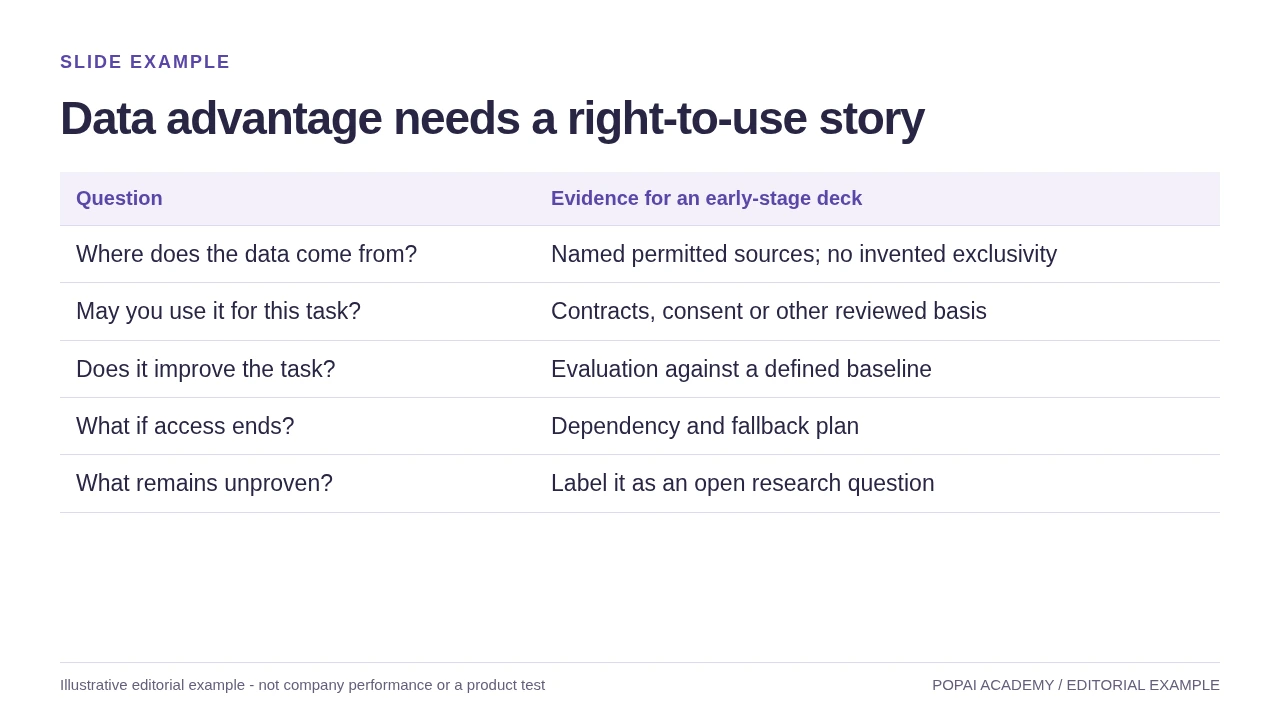
Not a legal opinion or a claim that a fictional startup owns a defensible data moat.
Read or copy the slide content
Question
Evidence for an early-stage deck
Where does the data come from?
Named permitted sources; no invented exclusivity
May you use it for this task?
Contracts, consent or other reviewed basis
Does it improve the task?
Evaluation against a defined baseline
What if access ends?
Dependency and fallback plan
What remains unproven?
Label it as an open research question
Prompt for this example set
Create a slide with the purpose "Data advantage needs a right-to-use story". Use these approved source fields or replace the illustrative inputs before use: Question Evidence for an early-stage deck Where does the data come from? Named permitted sources; no invented exclusivity May you use it for this task? Contracts, consent or other reviewed basis Does it improve the task? Evaluation against a defined baseline What if access ends? Dependency and fallback plan What remains unproven? Label it as an open research question. Preserve labels, units, source notes and any uncertainty. Do not add results, claims, customers or capabilities. Suggest a readable layout and keep the output editable in the chosen tool.
Keep Interviews, Trials, Pilots and Customers Separate
The fictional example has ten interviews, a prototype for one support task and a proposed paid pilot. It has not demonstrated ten customers or recurring revenue. If an interviewee agrees to try a product, record that status rather than turning interest into a contract.
Define an outcome before quoting an automation rate. Drafts generated, suggestions accepted and tickets resolved without intervention are different measures. When reviewers check every output, disclose that work; do not describe the process as autonomous because text was generated automatically.
Use one small evaluation table: task set, inclusion rules, acceptance criteria, baseline, review effort, errors and unresolved cases. The table does not need a dramatic percentage to be useful. It needs enough detail for an investor to ask a meaningful next question.
Explain Data Advantage Without Inventing a Moat
A data story has two separate questions: may the company use the material for this purpose, and does it demonstrably improve the target task? A large file collection answers neither on its own. Distinguish licensed inputs, customer-provided material, public data and the company's own observations.
Do not claim exclusivity, ownership or permission merely because a model can access the material. Document the permitted use, relevant restrictions and what happens if an important source or provider becomes unavailable. Qualified legal and technical reviewers must evaluate the real records.
Calculate Cost per Accepted Outcome, Not Just per Call
The source illustration uses 1,000 requests, 700 accepted outcomes, $120 of model/infrastructure charges and $180 of attributable human review. The resulting $300 divided by 700 is approximately $0.43 per accepted outcome. State what accepted means and why 300 requests did not qualify.
This is not a full gross-margin calculation. It excludes implementation, customer support and any other delivery costs not listed. Show model choice, retries, long inputs, exceptional cases and review needs when those affect actual service cost. A cheaper call can still produce a more expensive accepted outcome if it creates more failures or review work.
If an early product uses an expensive model or human assistance to meet a quality threshold, disclose that. Do not label a future automation assumption as current unit economics.
A Short Early-Stage Pitch Sequence
Begin with the user and task, then the prototype workflow, early evidence, alternatives, business-model assumptions, data rights, evaluations, delivery cost, team and the next evidence milestone. Keep the general company story short; use the appendix for source definitions and failure details. A live deck might use roughly ten pages, but this is an editing plan rather than a required investor format.
For a beachhead calculation, the original hypothetical 600 reachable support organizations x $24,000 annual contract assumption equals $14.4 million. The buyer count needs a documented scope and the contract value needs a basis. It is an illustrative serviceable segment, not expected revenue.
Prompts That Preserve the Early-Stage Evidence
Create a pre-seed or seed AI startup pitch from this approved source pack. Keep interviews, trials, pilots, paid contracts and recurring customers distinct. Include one task, its acceptance definition, evaluation limitations, data-use questions, model and review cost, provider dependencies and the next evidence milestone. Mark assumptions and open questions. Do not invent customer logos, market proof, results or a data moat.
Critique this early-stage deck. For every quality, autonomy, revenue or cost claim, show the supplied source and definition. Flag missing denominators, unequal observation windows, hidden human review and costs excluded from unit economics. Return questions for the founder; do not silently repair missing company evidence.
End with the Next Evidence Milestone
The final page should say what the company intends to learn or establish next and what resources that requires. A planned pilot, evaluation or deployment milestone is not a promised commercial outcome. Link financial details to the fundraising model and use the startup template collection for visual starting designs, not as evidence of product-market fit.