An AI fundraising pitch deck should make one round understandable: how much you are asking for, what that capital will fund, how long the cash lasts under stated assumptions and what evidence the company expects to earn before the next financing decision. The business story matters, but it should not bury the round plan.
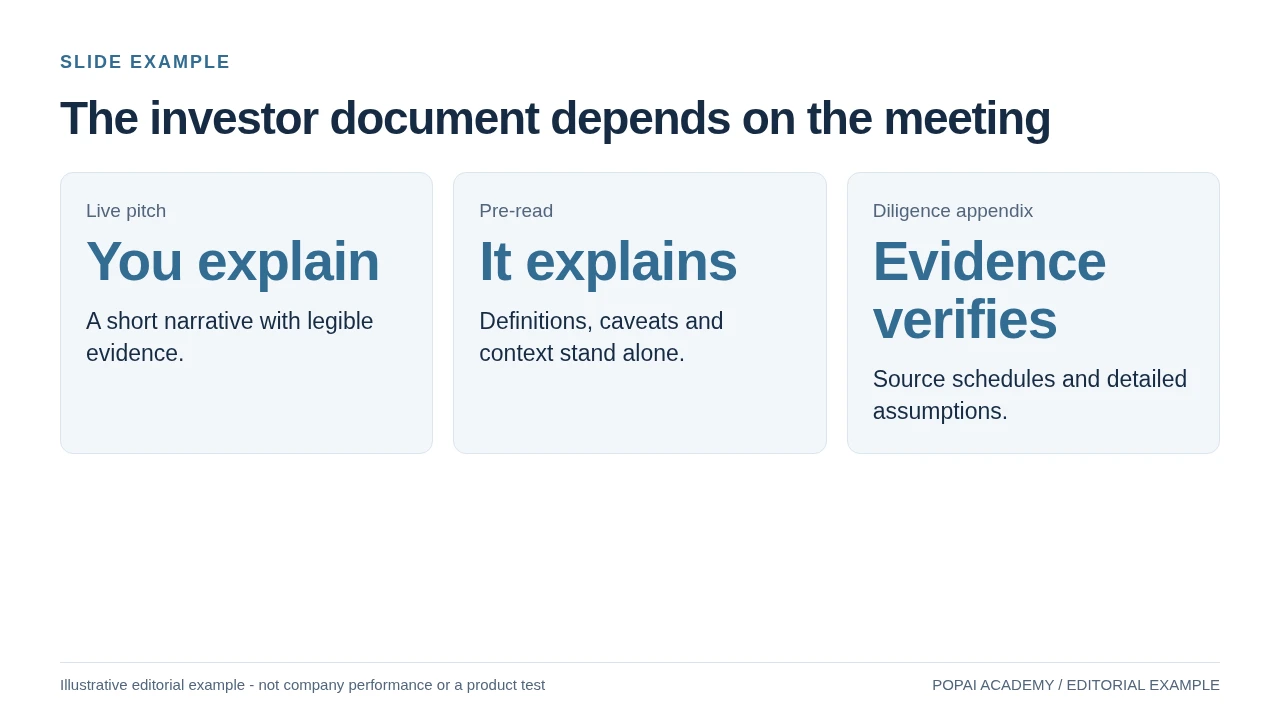
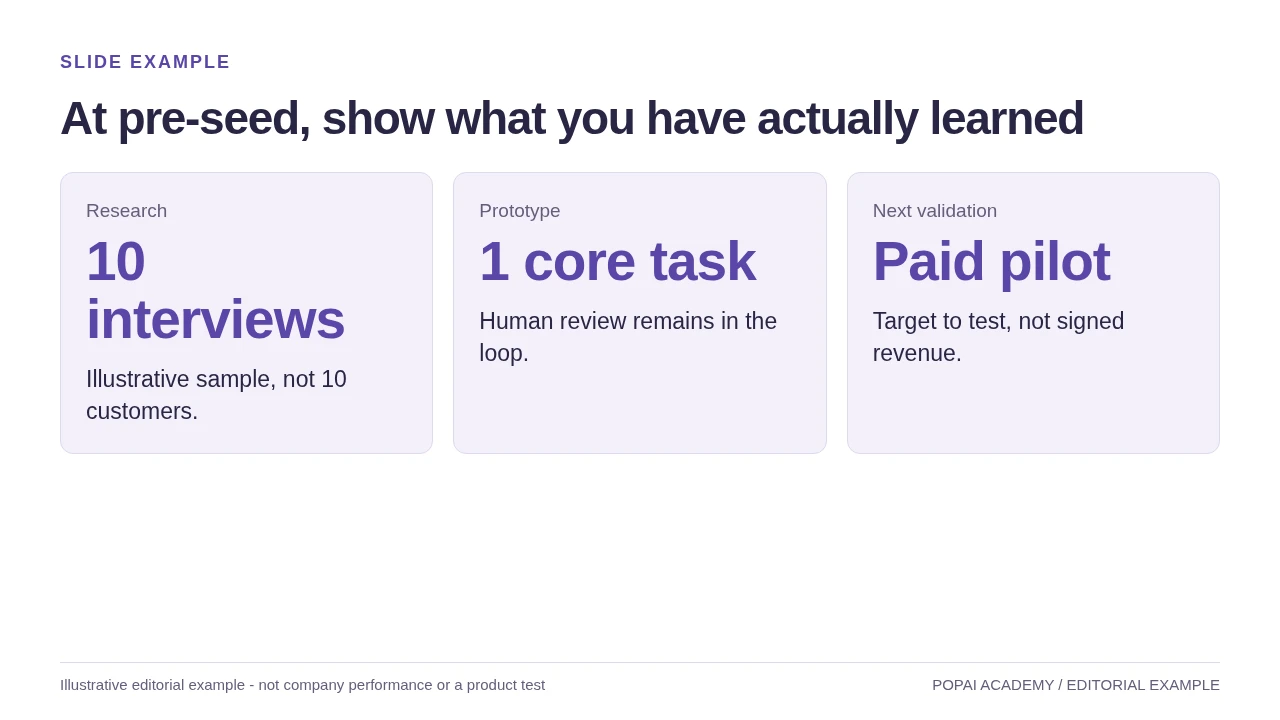
Use this page for the funding plan. For a general live pitch or investor pre-read, start with the investor pitch structure. For pre-seed or seed evidence about an AI product, use the startup pitch guide. The examples here are financial-planning illustrations, not investment advice or fundraising results.
Start with a One-Round Brief
| Field | What belongs in the deck | What not to infer |
|---|---|---|
| Ask | Proposed amount, currency, instrument and scope where approved | That the round is committed or will close |
| Starting position | Available cash, dated balance and existing obligations | That restricted or reserved cash is spendable |
| Use of funds | Reconciled categories with owner and timing | A generic growth percentage with no operating plan |
| Runway | Monthly cash plan and stated downside case | A guaranteed survival date |
| Milestones | Observable deliverables tied to the financing plan | Revenue or regulatory outcomes the company cannot promise |
| Diligence | Sources, assumptions and unresolved requests | That a polished deck completes diligence |
Round Planning Example: Ask, Runway and Milestones
This model illustrates one proposed round. It assumes no opening cash, constant monthly net burn and a protected contingency reserve. A real fundraising deck needs a monthly cash forecast and evidence for each input.
Open full-size examples and editable HTML layouts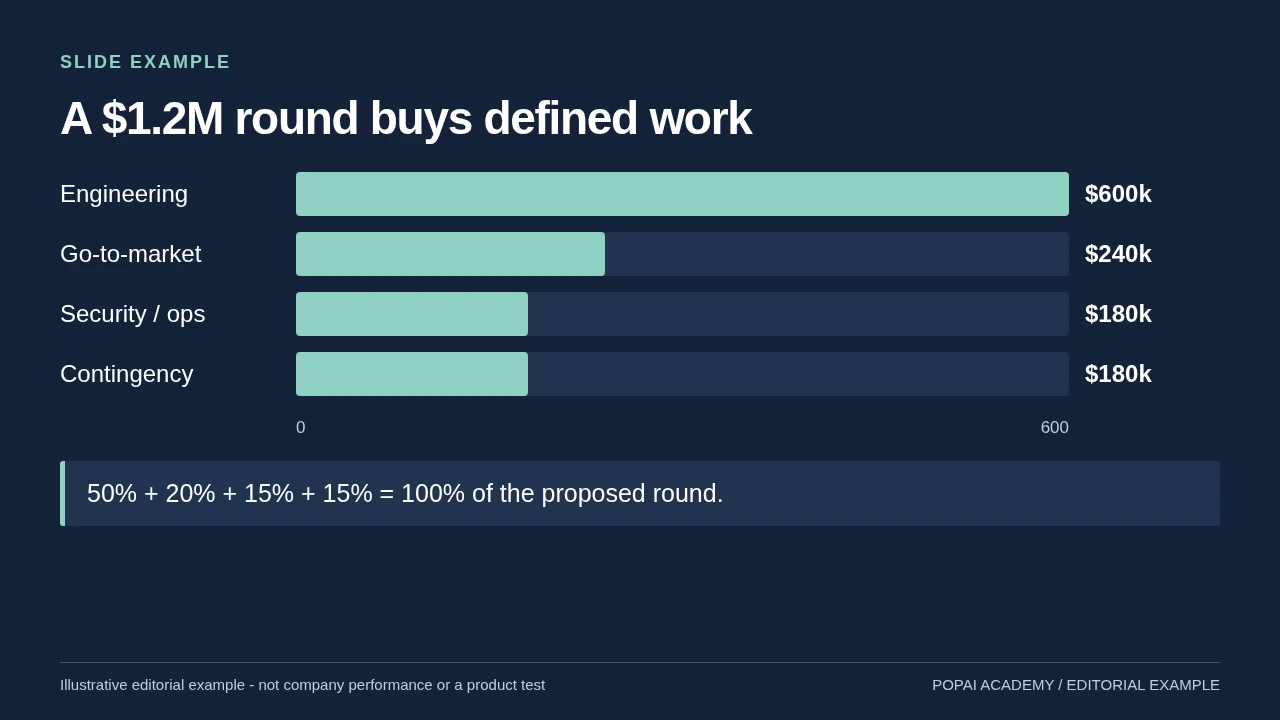
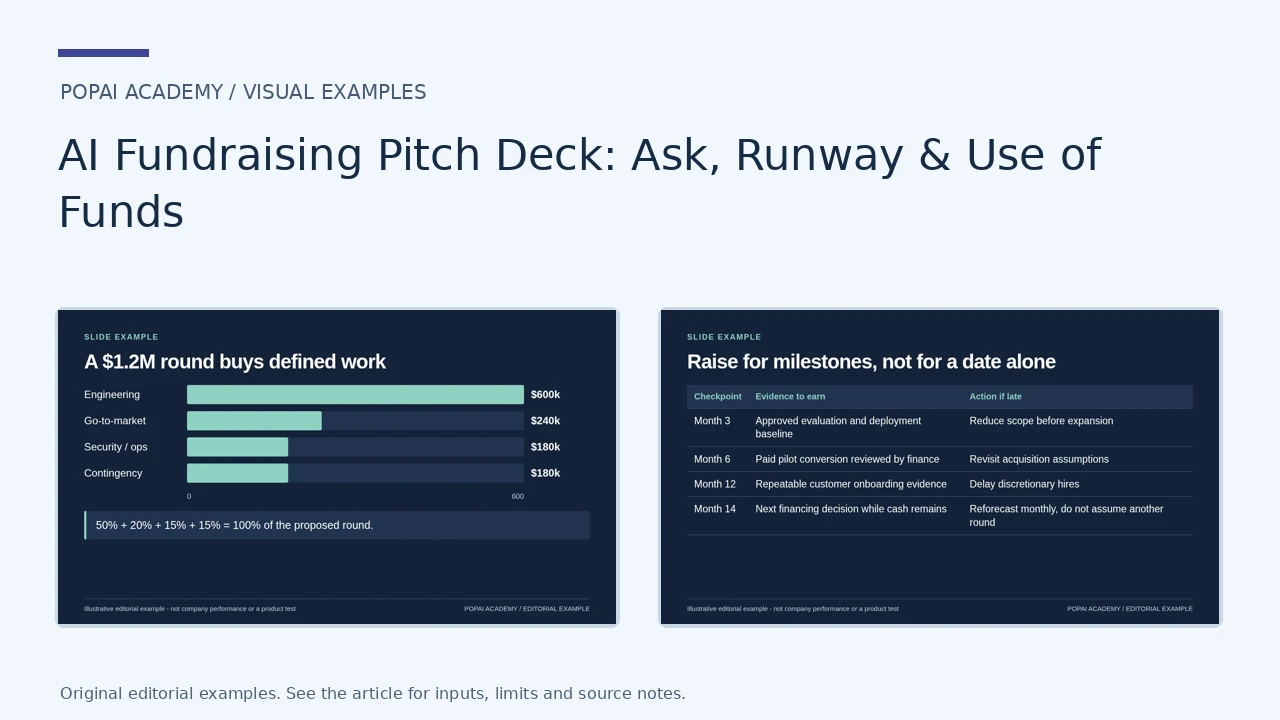
Fictional budget allocations; the full scenario excludes existing cash and uses constant burn.
Read or copy the slide content
Engineering
$600k
Go-to-market
$240k
Security / ops
$180k
Contingency
$180k
0
600
50% + 20% + 15% + 15% = 100% of the proposed round.
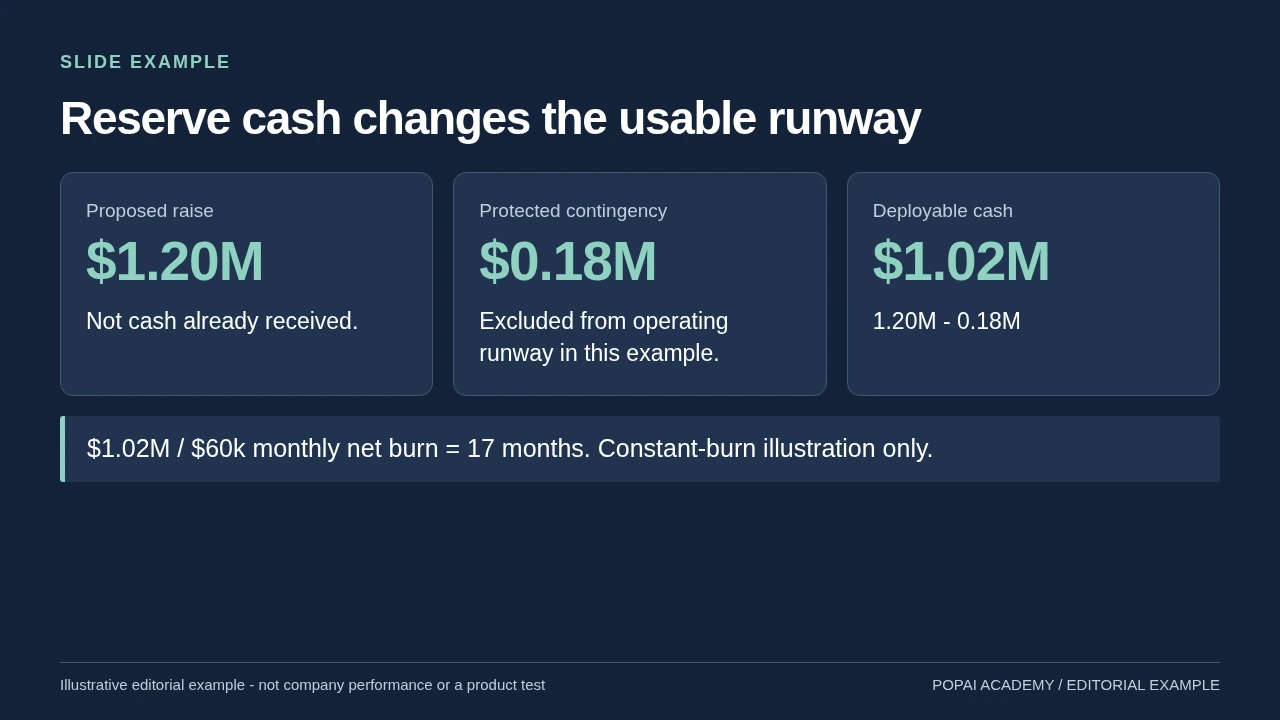
A conservative runway convention; do not count the reserve twice.
Read or copy the slide content
Proposed raise
$1.20M
Not cash already received.
Protected contingency
$0.18M
Excluded from operating runway in this example.
Deployable cash
$1.02M
1.20M - 0.18M
$1.02M / $60k monthly net burn = 17 months. Constant-burn illustration only.
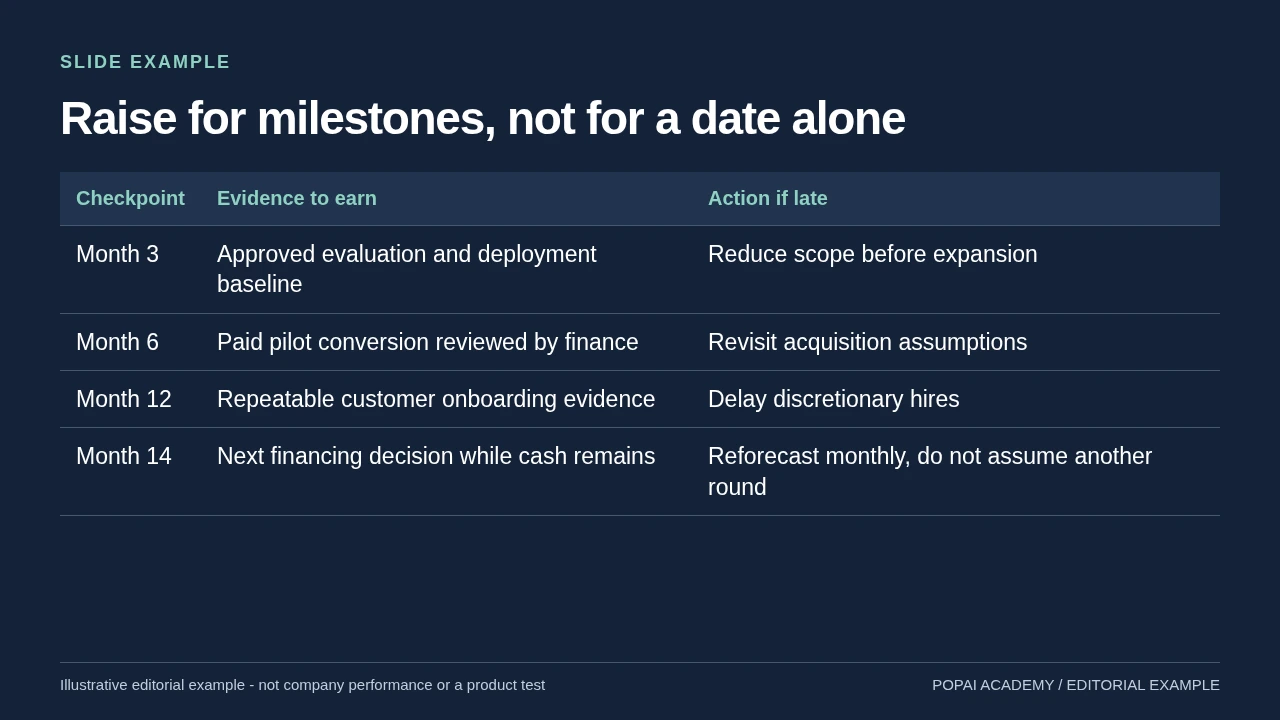
Fictional milestones are planning gates, not promised outcomes.
Read or copy the slide content
Checkpoint
Evidence to earn
Action if late
Month 3
Approved evaluation and deployment baseline
Reduce scope before expansion
Month 6
Paid pilot conversion reviewed by finance
Revisit acquisition assumptions
Month 12
Repeatable customer onboarding evidence
Delay discretionary hires
Month 14
Next financing decision while cash remains
Reforecast monthly, do not assume another round
Prompt for this example set
Create a slide with the purpose "Raise for milestones, not for a date alone". Use these approved source fields or replace the illustrative inputs before use: Checkpoint Evidence to earn Action if late Month 3 Approved evaluation and deployment baseline Reduce scope before expansion Month 6 Paid pilot conversion reviewed by finance Revisit acquisition assumptions Month 12 Repeatable customer onboarding evidence Delay discretionary hires Month 14 Next financing decision while cash remains Reforecast monthly, do not assume another round. Preserve labels, units, source notes and any uncertainty. Do not add results, claims, customers or capabilities. Suggest a readable layout and keep the output editable in the chosen tool.
Work the Ask, Reserve and Runway Together
In the fictional example, the proposed raise is $1.2 million. Engineering receives $600,000, go-to-market $240,000, security and operations $180,000, and contingency $180,000. The four allocations reconcile to the requested amount. They are a planning convention, not evidence that the money has been raised or spent.
For the runway illustration, the contingency is protected rather than treated as normal operating cash. Deployable cash is therefore $1.02 million. At constant monthly net burn of $60,000, that is 17 months. At $75,000 it is 13.6 months; at $90,000 it is about 11.3 months. This simplified division excludes opening cash, closing costs and changes in burn. Do not combine it with another cash convention without reconciling the model.
| Net monthly burn assumption | Deployable cash | Illustrative runway |
|---|---|---|
| $60,000 | $1,020,000 | 17.0 months |
| $75,000 | $1,020,000 | 13.6 months |
| $90,000 | $1,020,000 | 11.3 months |
A real plan should use monthly collections, payroll, supplier payments, taxes, one-off spend and any restricted funds. Month-end cash is more informative than a single runway quotient when hiring or receipts change. Keep the source workbook authoritative; AI may explain the bridge but should not silently alter it.
Tie Spending to Evidence Milestones
A milestone should be observable and have an owner. Instead of "scale AI," name the approved evaluation to complete, the deployment workflow to validate or the customer decision to earn. Distinguish deliverables within the team's control from commercial outcomes that remain uncertain.
The example uses checkpoints in months 3, 6, 12 and 14. Those dates illustrate a review rhythm, not an investor standard. If the month-6 pilot conversion is late, show which discretionary spend would pause and which assumption needs revision. Do not leave the next-round date unchanged merely because it makes a slide look tidy.
Make Live and Diligence Versions Consistent
A live meeting may show one ask page, one use-of-funds page and one milestone/runway page. The pre-read adds the source date, cash convention and principal assumptions. The appendix contains the monthly model, hiring schedule and supporting documents the company is authorized to share. Keep all versions on one dated source model.
| Diligence request | Source to prepare | Responsible review |
|---|---|---|
| Cash and burn | Dated cash forecast and opening balance | Finance owner |
| Use of funds | Cost schedule, quotes and hiring plan | Budget owners |
| Commercial assumptions | Pipeline stages and contract status | Commercial lead |
| Product milestones | Evaluation and deployment plan | Product / engineering |
| Rights and controls | Approved contractual and technical records | Appropriate legal / security reviewer |
Prompts for a Source-Led Fundraising Deck
Create a fundraising plan section for one proposed round. Use only the supplied cash model, budget and milestone schedule. Show ask, allocations, reserve convention, monthly cash assumptions and decision gates. Reconcile totals. Distinguish raised cash from requested cash, actuals from forecasts and contingent milestones from commitments. Report conflicts instead of resolving them silently. Return the outline before drafting slides.
Compare every dollar amount and date in this draft with the supplied financing model. Return the original input, formula, computed value and any mismatch. Do not certify the model or invent an investment recommendation. Mark unresolved data for the finance owner.
Final Review Before Sending the Round Plan
Check that the ask equals the allocation total; the reserve is counted only once; the runway uses the stated cash and burn definitions; and each milestone matches the operating plan. Show downside assumptions without presenting them as predictions. Confirm disclosure permissions and let the accountable finance and company owners approve the numbers.
For a visual starting point after the plan is settled, use the fundraising template collection. This guide owns the round logic; the collection owns template selection and downloads.