A customer-facing AI product pitch deck should show how a product helps with a specific task, what a buyer can observe in a demo and what still needs to be evaluated. The next step is usually a product conversation, evaluation or adoption decision, not a financing ask.
Use this format for a product explanation, customer demo and evaluation decision. For an investment case, use the investor pitch deck guide. For a specific sales opportunity and commercial proposal, use the sales pitch guide.
A Ten-Page Product Pitch Structure
| Page | Buyer question | What to put on the slide |
|---|---|---|
| 1. Product promise | Which task does it address? | A narrow, current product statement |
| 2. User context | Is this our workflow? | Verified role, task and constraint |
| 3. Existing approach | What changes? | A fair description of current steps |
| 4. Product workflow | How does it work? | Input, action, output and human decision |
| 5. Demo | Can we see the task happen? | Representative input and observable output |
| 6. Evidence | What supports the claim? | Evaluation definition, sources and limits |
| 7. Differentiation | Why this option? | Buyer-relevant criteria with support |
| 8. Adoption | What is required? | Data, integration, training and ownership |
| 9. Commercial / risk context | What must be approved? | Approved scope, costs and unresolved requirements |
| 10. Next decision | What should we do next? | Evaluation task, owner, evidence and review meeting |
Four Pages for a Customer-Facing Product Pitch
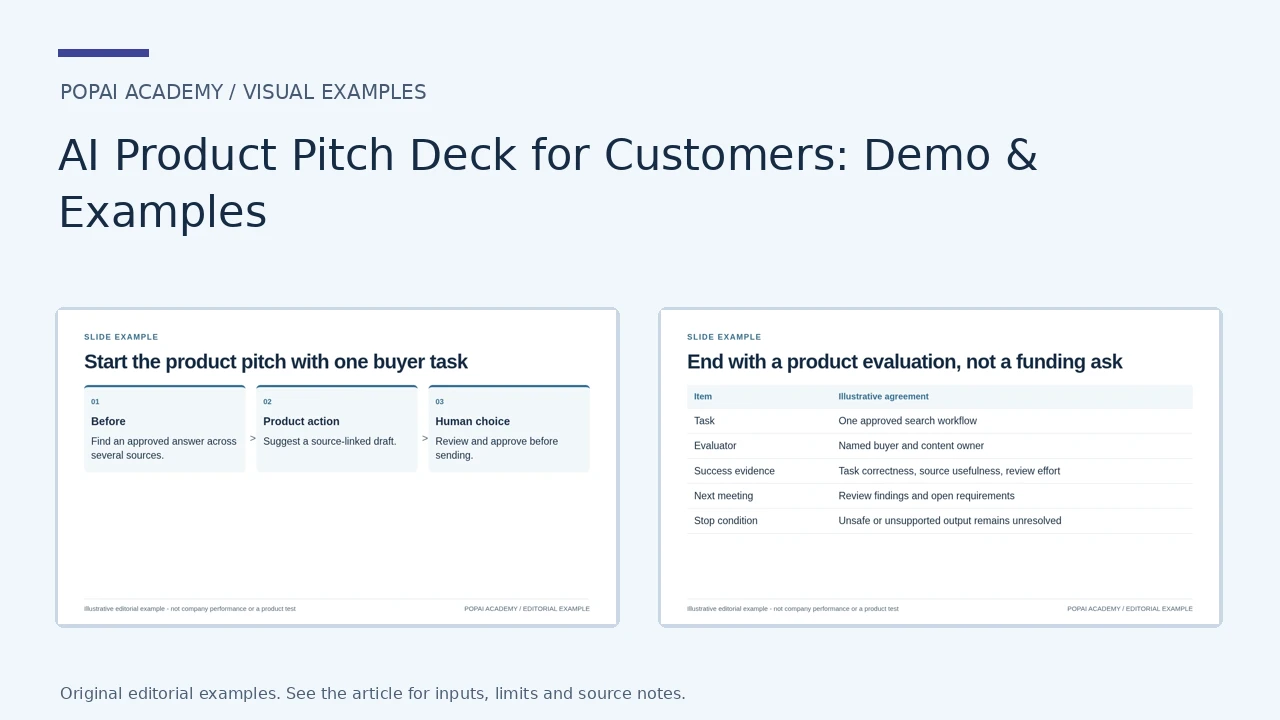
The example asks a potential customer to evaluate a product, not an investor to fund a company. The workflow is fictional and is not a claim that PopAi implements the illustrated knowledge-assistant functionality.
Open full-size examples and editable HTML layouts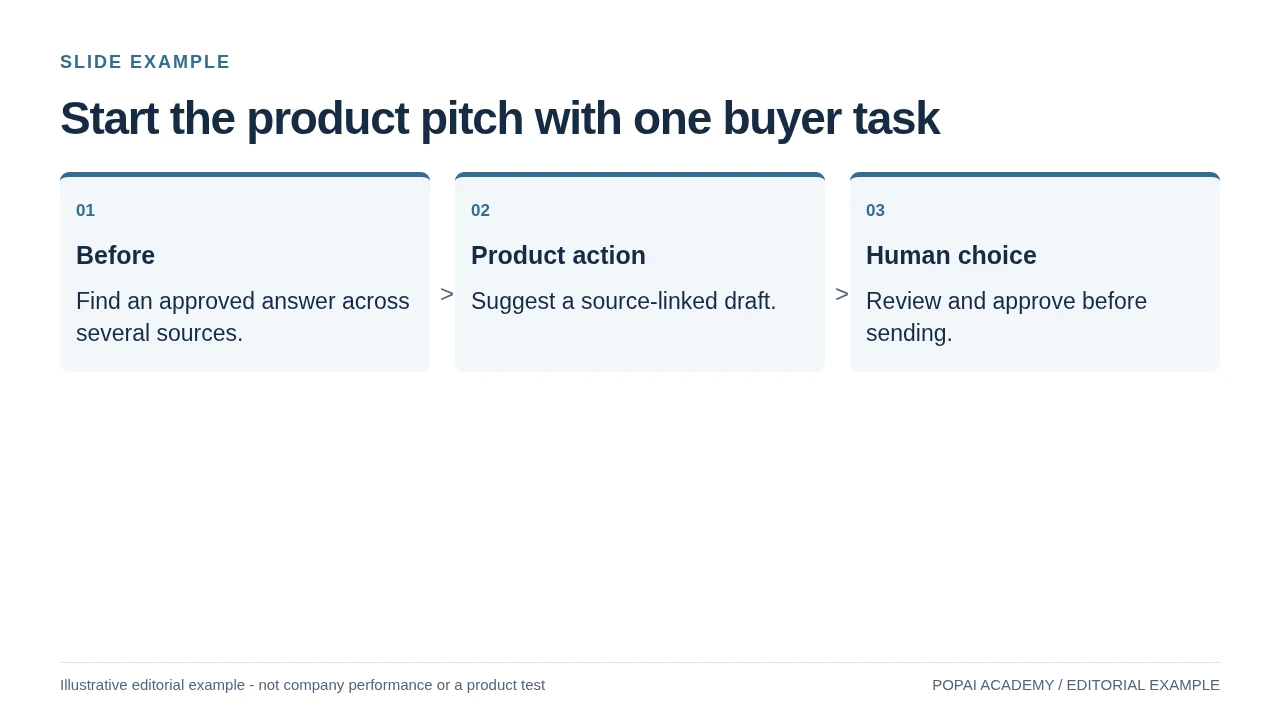
A fictional knowledge-assistant workflow; not a screenshot or a capability claim about PopAi.
Read or copy the slide content
01
Before
Find an approved answer across several sources.
02
Product action
Suggest a source-linked draft.
03
Human choice
Review and approve before sending.
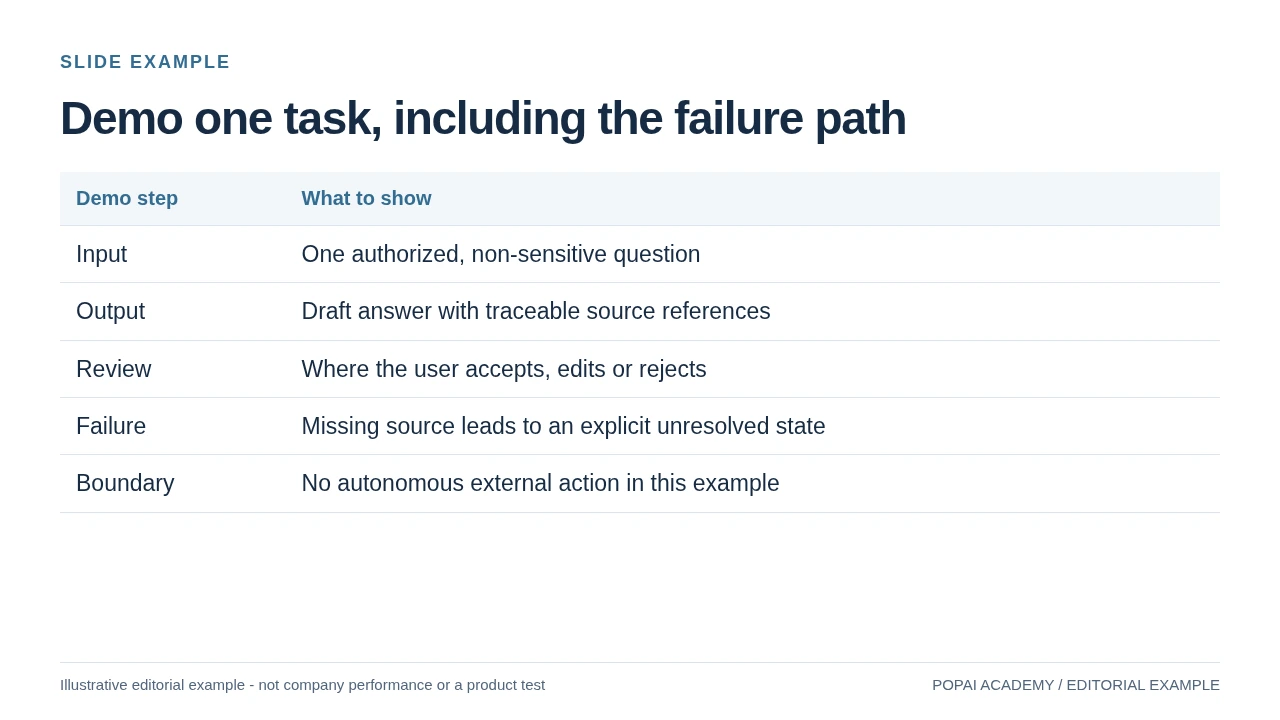
An observable demo sequence is different from an investor story.
Read or copy the slide content
Demo step
What to show
Input
One authorized, non-sensitive question
Output
Draft answer with traceable source references
Review
Where the user accepts, edits or rejects
Failure
Missing source leads to an explicit unresolved state
Boundary
No autonomous external action in this example
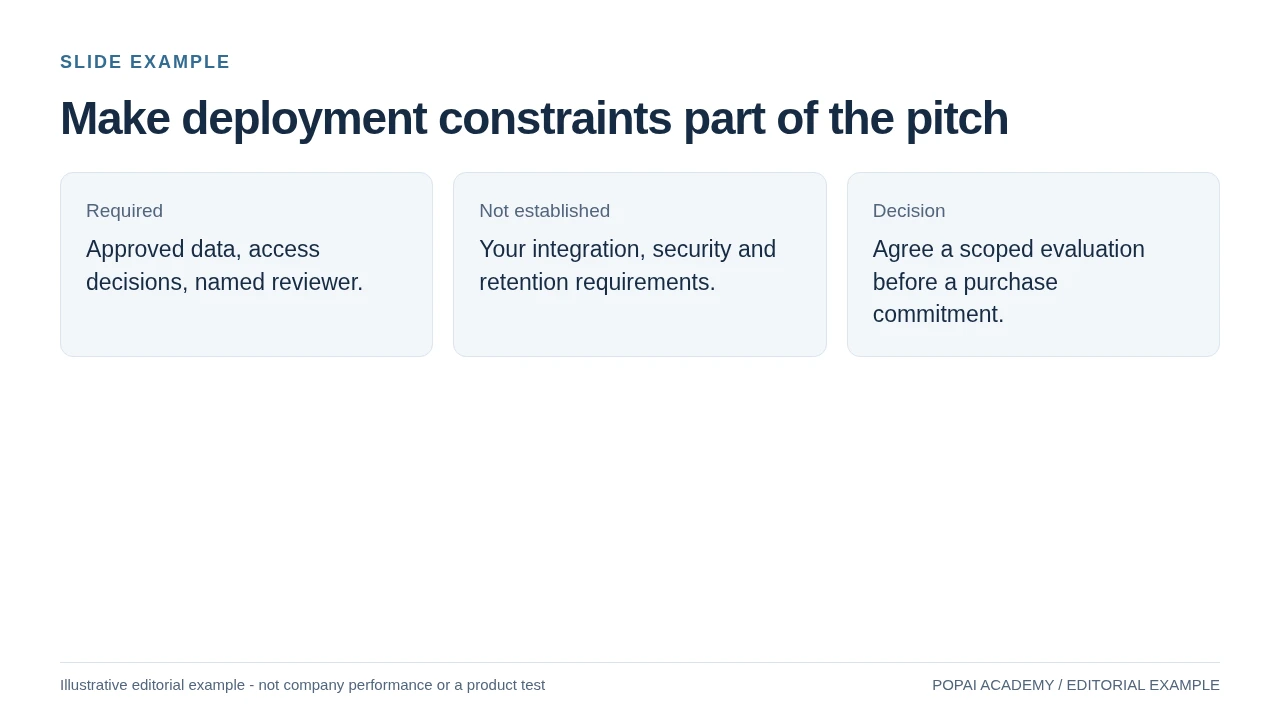
Expose the implementation questions; do not assert unverified integrations or certification.
Read or copy the slide content
Required
Approved data, access decisions, named reviewer.
Not established
Your integration, security and retention requirements.
Decision
Agree a scoped evaluation before a purchase commitment.
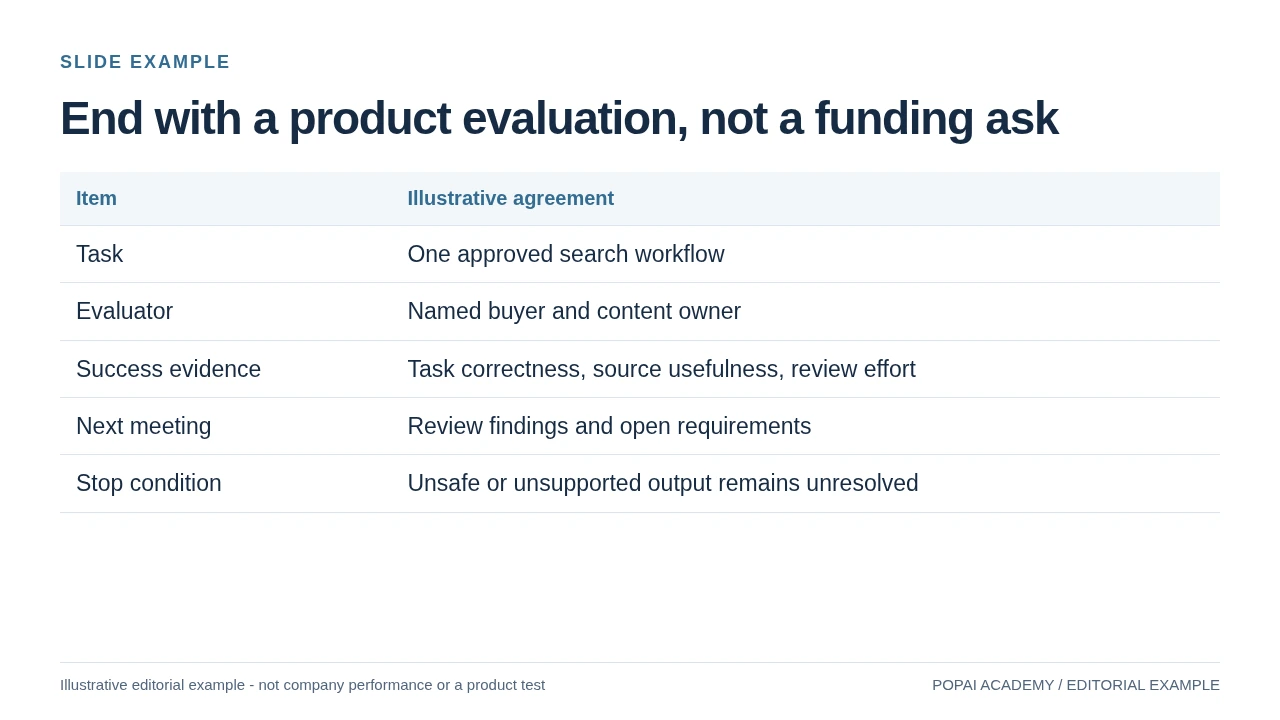
This product-pitch example asks for evaluation; commercial opportunity planning belongs in Sales Pitch.
Read or copy the slide content
Item
Illustrative agreement
Task
One approved search workflow
Evaluator
Named buyer and content owner
Success evidence
Task correctness, source usefulness, review effort
Next meeting
Review findings and open requirements
Stop condition
Unsafe or unsupported output remains unresolved
Prompt for this example set
Create a slide with the purpose "End with a product evaluation, not a funding ask". Use these approved source fields or replace the illustrative inputs before use: Item Illustrative agreement Task One approved search workflow Evaluator Named buyer and content owner Success evidence Task correctness, source usefulness, review effort Next meeting Review findings and open requirements Stop condition Unsafe or unsupported output remains unresolved. Preserve labels, units, source notes and any uncertainty. Do not add results, claims, customers or capabilities. Suggest a readable layout and keep the output editable in the chosen tool.
A Fictional Product Demo: One Question, One Review
Imagine a knowledge assistant for policy questions. The buyer task is to locate an approved answer, not to produce an impressive paragraph. Use a sanitized question, show the sources considered and demonstrate where a human accepts, edits or rejects the draft. If no reliable source is available, show an unresolved state rather than letting the product invent an answer.
The example is not a claim about a real product or a PopAi feature. Its purpose is to demonstrate a pitch sequence. Replace it with the actual product interface and authorized source material when preparing a commercial deck. An illustration of a workflow is not proof that the workflow exists.
Show Evidence at the Same Level as the Product Claim
| Claim type | Evidence needed | Safer wording when missing |
|---|---|---|
| Task success | Defined task set, acceptance rule and failure accounting | We plan to evaluate this task with your team |
| Time reduction | Comparable workflow timing including review and exceptions | Review effort has not yet been measured |
| Integration | Current supported route and tested deployment conditions | Integration requirements need technical review |
| Security / privacy | Approved current documentation and contractual scope | The buyer's requirements remain open |
| Differentiation | Matched criteria and dated source evidence | Compare the alternatives against these requirements |
Do not use a broad score to hide the conditions of a task. A polished demo can omit difficult inputs, review effort or failed cases. State what is included in the demonstration and what remains outside it.
Make Adoption and Failure Handling Visible
Give the buyer a concrete account of permitted inputs, configuration ownership, review responsibilities and handoff. Keep unknown integration or data-handling requirements as open items. Do not claim compliance, certification or a deployment guarantee because a template contains a security badge.
A useful product pitch makes a failure path discussable. Name the condition that should trigger human escalation, the person who resolves it and the evidence that will be reviewed. Those are proposed evaluation questions until the actual product and customer process support them.
Prompts for a Product Pitch and Demo
Create a customer-facing product pitch outline using the approved product description, actual workflow and source evidence. Do not create an investor fundraising deck. Include task, current approach, product steps, representative demo, evidence, adoption requirements, limits and one evaluation decision. Distinguish shipped, beta, planned and unsupported capabilities. Ask for missing evidence before drafting.
Rewrite the demo slide so the audience can follow input, product action, human review and failure handling. Use only supplied screenshots or accurately labeled conceptual diagrams. Do not invent UI controls, integrations, customer results, pricing or certification.
Before Presenting the Product Deck
Check the demo against the current build, use authorized screenshots, label any mockup and make unsupported claims visible. Confirm which features and commercial terms apply to the offered product. End with a next task and owner rather than a vague request for enthusiasm.
For additional product-demo formats, see Pitch's product presentation collection. Choose a buyer-facing example when the purpose is product evaluation rather than fundraising.