This is a real estate investment pitch guide for investment-property sponsors, lenders and capital partners. Its evidence includes the rent roll, trailing operating statement, net operating income (NOI) and financing assumptions. For a homeowner listing or agent CMA deck, use the real estate presentation template collection instead.
This guide is for sponsors and deal teams preparing a single-asset acquisition pitch for prospective equity investors, with notes on adapting it for lenders, buyers, and developers. You’ll get a practical slide sequence, a fictional multifamily example, prompts that preserve source references, and a review workflow for the numbers before a deck goes out.
AI can organize source material, draft slide copy, and suggest visual structure. It cannot establish that a rent roll is current, that a comparable is relevant, or that an underwriting assumption is reasonable. Treat the generated deck as a draft whose claims must be tied back to the deal’s records.
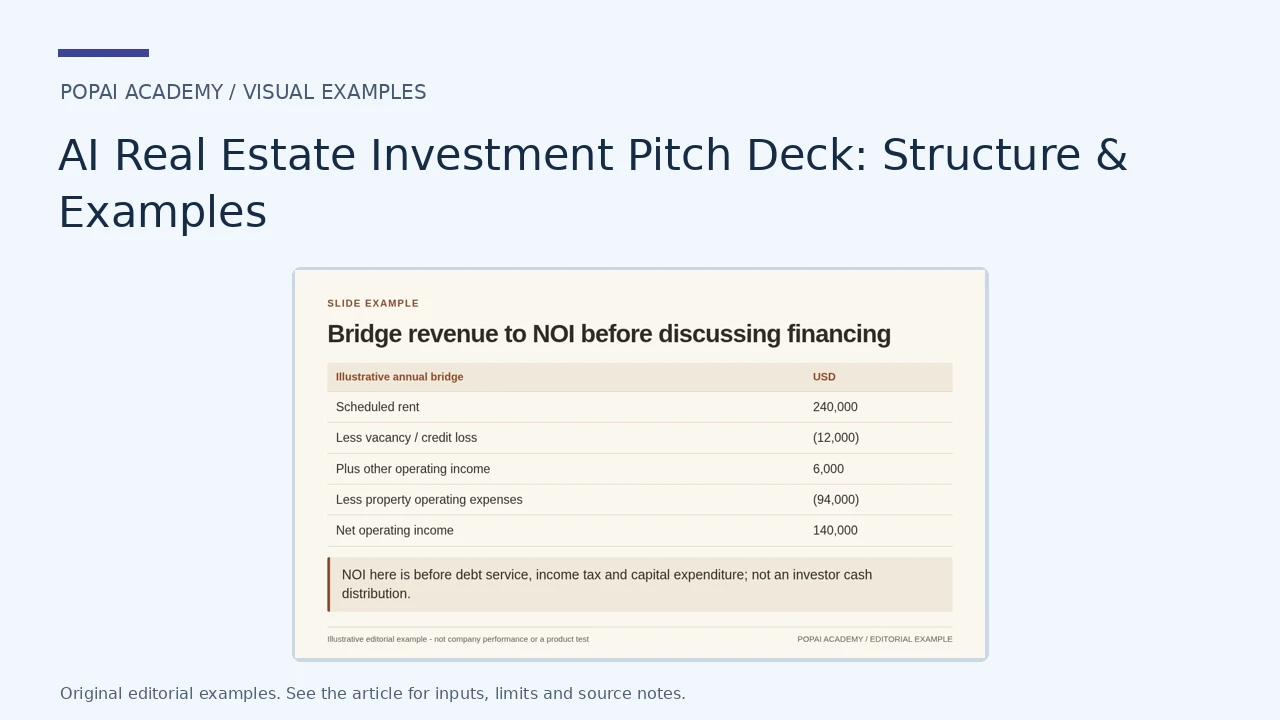
A Single-Asset NOI Bridge: A Worked Visual Example
The figures are a synthetic annual single-asset example. NOI is defined here before debt service, income tax and capital expenditure. It is not cash distributed to an investor or evidence of property value.
Open full-size examples and editable HTML layouts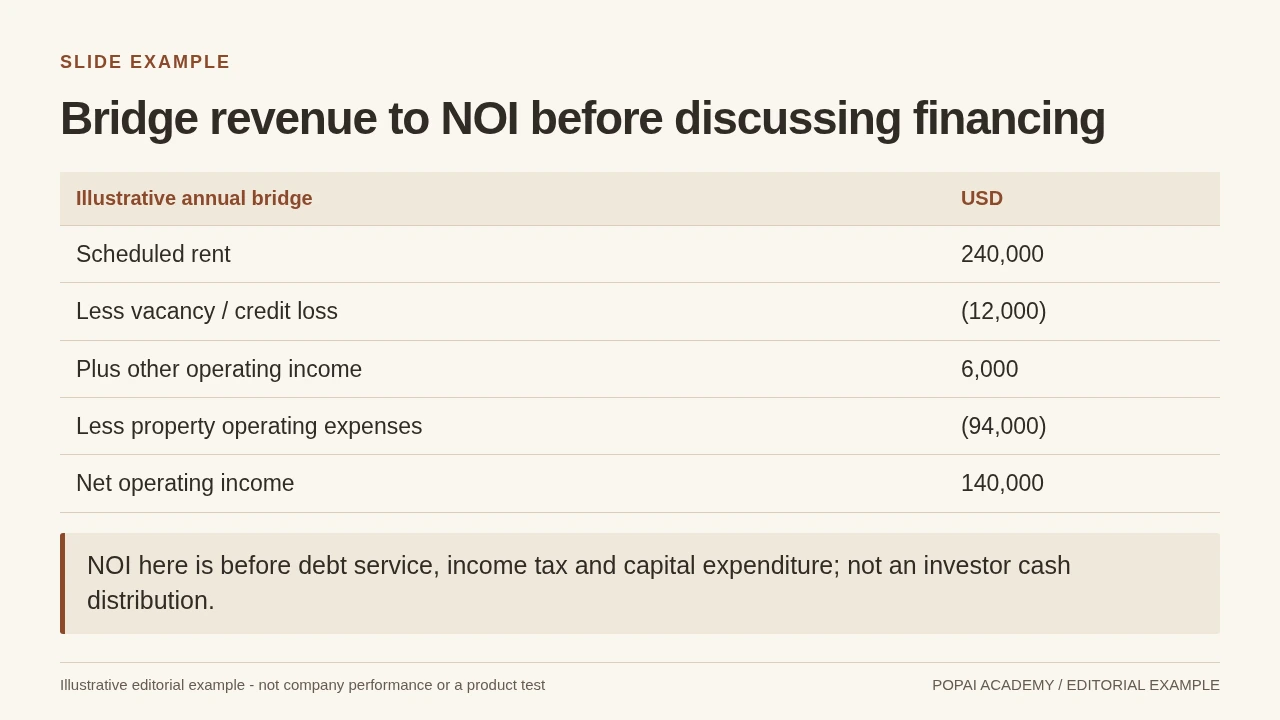
Single-asset investment illustration; no cap-rate, valuation or return guarantee.
Read or copy the slide content
Illustrative annual bridge
USD
Scheduled rent
240,000
Less vacancy / credit loss
(12,000)
Plus other operating income
6,000
Less property operating expenses
(94,000)
Net operating income
140,000
NOI here is before debt service, income tax and capital expenditure; not an investor cash distribution.
Prompt for this example set
Create a slide with the purpose "Bridge revenue to NOI before discussing financing". Use these approved source fields or replace the illustrative inputs before use: Illustrative annual bridge USD Scheduled rent 240,000 Less vacancy / credit loss (12,000) Plus other operating income 6,000 Less property operating expenses (94,000) Net operating income 140,000 NOI here is before debt service, income tax and capital expenditure; not an investor cash distribution.. Preserve labels, units, source notes and any uncertainty. Do not add results, claims, customers or capabilities. Suggest a readable layout and keep the output editable in the chosen tool.
AI Real Estate Pitch Deck Structure: Start With the Decision
Sequence the slides around the reader’s decision: whether the opportunity, plan, and proposed terms merit a next step.
Before drafting, specify the audience, meeting context, and requested action. An LP considering a fund needs different detail from an investor evaluating one asset, a lender sizing debt, or a buyer reviewing a sale. The outline below is a practical convention for a first-pass single-asset equity pitch—not a research-backed slide-count rule.
Illustrative sequence for a single-asset acquisition
Fictional example: A sponsor is seeking $6 million of equity for the acquisition and renovation of “Maple Court,” a 120-unit multifamily property. The figures below illustrate deck logic only; they are not market data or investment advice.
- Cover and thesis: “Maple Court: renovate 120 units and improve operations.” Name the location, strategy, and proposed investment at a glance.
- Decision summary and ask: State the $6 million equity request, proposed hold period, key terms, and the next action requested. Show whether the ask is a target, commitment, or amount still being raised.
- Asset today: Summarize unit mix, occupancy as of a stated date, physical condition, and current operations. Use a dated rent-roll summary, not an unqualified headline.
- Why this market: Present only relevant, sourced demand and supply evidence, with dates and geography.
- Business plan: Link each planned renovation or operating change to a timeline, cost, and measurable outcome.
- Comparable evidence: Show selected rent and sale comps, their dates, relevant differences, and why each is included.
- Underwriting: Explain the base case and the assumptions that drive it; show downside and upside cases without hiding what changes.
- Capital structure and returns: State sources and uses, debt assumptions, equity terms, and how distributions are calculated. Define return metrics and label them gross or net.
- Risks, team, and next step: Pair material risks with specific mitigations and accountable parties; include relevant experience and the requested follow-up.
For an initial meeting, prioritize the thesis, asset, plan, ask, and principal risks. Move detailed model outputs, full comp records, legal documents, and diligence schedules to an appendix or separate data room. A concise 10–15-slide main deck may be a useful working target for some investor pitches, but complexity and meeting purpose should determine length—not a fixed rule.
Sample slide takeaway: “The renovation plan depends on achieving the modeled rent premium; current asking rents alone do not prove that premium.” Put the proposed rent, the relevant signed or leased comps, their dates, and the renovation cost on the slide—or identify the evidence still needed.
Prepare Property Data Before Using an AI Pitch Deck Generator
Create a dated source of truth before asking AI to summarize a deal; unresolved conflicts should remain visible, not disappear into polished copy.
Collect the records that explain current operations and the proposed plan. Use a consistent file-naming convention such as MapleCourt_RentRoll_2026-09-30_v03.xlsx, keep an approved-model copy separate from working drafts, and maintain a source log. Record the owner of each file and mark stale or missing documents rather than implying they are current.
- Operations: rent roll, occupancy or lease status, concessions, and trailing 12-month operating statement (T-12).
- Capital and costs: acquisition basis, debt terms, renovation or development budget, reserves, and timing assumptions.
- Market evidence: dated research, relevant leasing and sales comps, supply pipeline, and local demand indicators.
- Underwriting: rent growth, expenses, vacancy, debt service, hold period, exit cap rate, and base, upside, and downside cases.
- Fundraising: target amount, proposed structure, uses of proceeds, fees, and distribution waterfall, if applicable.
Source-log example: For a material metric, record the metric, value, source and page or cell, reporting date, actual/assumption status, and owner. For example: “Occupied units | 112/120 (93.3%) | Rent roll, tab ‘Unit Status,’ cell range B2:B121 | 2026-09-30 | Actual snapshot | Asset manager.” This makes it possible to trace a slide claim instead of relying on a file name alone.
Illustrative discrepancy: Suppose the rent roll implies monthly scheduled rent of $150,000, while the T-12 reports a different rental-income figure. Do not instruct AI to choose one. Ask the asset manager to reconcile timing, concessions, vacancy, bad debt, and income categories; document the agreed treatment in the source log, then update the model and brief. Until resolved, label the figure “under review” and keep it out of headline claims.
Metric conventions vary, so define them in the model and on the slide. Equity multiple is commonly expressed as total cash distributions divided by contributed equity; cash-on-cash return depends on which annual cash flow and equity denominator are used; and DSCR depends on the NOI and debt-service definitions and period. IRR is sensitive to the timing of cash flows. State the calculation basis, period, and whether returns are gross or net rather than presenting these labels as self-explanatory.
Analysis check: If occupancy is shown as 94%, give the measurement date and denominator. If projected NOI rises, identify the bridge—such as lease-up, rent changes, or expense reductions—and distinguish contractual facts from sponsor assumptions.
Confidentiality: Remove tenant names, personal contact details, account numbers, and other data the deck does not need. Before uploading source files, check your organization’s data policy, tool settings, and any confidentiality agreements. If a record cannot be shared, provide a properly redacted summary and keep the original in the controlled deal file.
Copy-Ready Prompts for an AI Real Estate Pitch Deck
Ask for a source-mapped outline first; draft slides only after the outline exposes missing or conflicting evidence.
A practical sequence is brief → outline → sample slide → source check → revision. PopAi’s PopAi AI Presentation can be used to start from a prompt or source materials and develop an editable presentation; confirm the current interface and file options before relying on a particular workflow. You can also compare different AI presentation makers by testing how they handle source files, edits, and exports.
Master prompt: request an auditable outline
Replace the bracketed fields and provide a source list with stable file names. If page numbers or spreadsheet cell references are available, include them in the source list.
“Prepare a [number]-slide outline for [audience] about [asset and location]. The requested decision is [specific action or capital request]. Use only the supplied materials. For every factual claim or figure, add a source identifier and page, tab, or cell reference where available. Separate actual results, third-party data, and sponsor assumptions. If sources conflict, show both values with their source and date; do not select one or average them. If a claim has no support, mark it [VERIFY] and state what evidence is missing. Return a table with these columns: slide number, title, one-sentence takeaway, evidence or figures, source reference, suggested visual, and open question. Do not invent comps, returns, market statistics, team credentials, or terms. Include the investment thesis, asset, market, plan, comps, underwriting cases, capital structure, risks, team, and next step.”
Review the outline before generating slides. Resolve conflicts with the document owner, then revise the source log and prompt so the next draft uses the approved figure. For section-specific drafts, use prompts such as:
- Market and location: “Summarize only the supplied research for [submarket]. For each claim, include source and date; separate observation from interpretation. Flag missing or stale evidence.”
- Comparable properties: “Organize only the provided comps. Show location, asset type, distance, size, date, condition, concessions or transaction terms where provided, and rent or sale metric. Flag incomplete or mismatched records; do not add comps.”
- Cash flow and capital: “Explain the supplied model in plain language. Identify the assumptions that change between base, upside, and downside cases. Preserve the model’s metric definitions and source references. Do not calculate missing values.”
- Risk and request: “For each material risk, show evidence, potential impact, mitigation, accountable owner, and remaining uncertainty. State the exact funding request and terms from the supplied materials; mark any missing term [VERIFY].”
Worked prompt-to-slide example
For the fictional Maple Court deal, the outline might produce this slide entry: “Renovation supports the rent-growth case” | Evidence: proposed renovation budget and rent premium assumption | Source: approved underwriting model, “Unit Renovation” tab, dated 2026-10-01; rent comps file, rows 4–8 | Visual: current versus renovated rent range | Open question: confirm which comps are renovated and whether concessions are included. That is a useful draft because it exposes the assumption and the evidence still needed; it does not turn the projected rent into a proven fact.
If a first draft instead says, “Nearby renovated units achieve $250 more per month,” but provides no source reference, follow up: “Remove this claim unless a supplied source supports it. List the relevant comp rows, dates, condition, concessions, and unit comparability. If evidence is absent, replace the claim with [VERIFY] and state the exact data needed.”
Verify Comps, Returns, and Charts Before Sharing
Use a short audit trail for every decision-driving number: trace it to the model, confirm its input, record its source and date, and log any correction.
Assess comps beyond distance
Confirm each comparable against its source and assess transaction or lease date, submarket, asset type, size, condition, occupancy, concessions, and transaction terms. A nearby renovated building may be a poor benchmark for a dated property, while a farther property with similar vintage and tenant profile may be more informative. Record why a comp was included or excluded; do not let a map pin stand in for comparability.
Trace underwriting figures to the approved model
For each slide figure, compare the value with the approved model, confirm the relevant input and calculation, and record the model version and reviewer. Reconcile rent-roll income to the operating statement, T-12 expenses to the model, debt terms to debt service, and exit value to the exit-cap assumption. If the slide and model disagree, stop and identify whether the cause is a stale model, a formula change, or a transcription error before revising the deck.
Illustrative sensitivity: If Maple Court has projected exit NOI of $1.2 million, a simple value calculation gives about $21.8 million at a 5.5% exit cap and $20.0 million at 6.0%—a difference of about $1.8 million before transaction costs, debt payoff, or other adjustments. These fictional figures show why the exit assumption matters; they are not a forecast. Label the model date, calculation basis, and relevant gross/net treatment beside any sensitivity shown.
Review record: A compact sign-off log can list slide, figure, model tab/cell, source date, reviewer, result, and resolution. For example: “Slide 7 exit NOI | Approved model, Exit tab, D12 | 2026-10-01 | Analyst | Pass | Matches base case.” An unresolved item should be marked open and assigned to an owner, not quietly removed from the review trail.
Where the current tool interface supports chart editing or spreadsheet-based data entry, use those controls for presentation—not as a data check. Inspect axis units, time periods, scenario labels, and whether a chart truncates the scale or hides a meaningful difference. Re-open the exported presentation and compare key values with the model; interface features and export behavior can change over time.
Release check: Label fictional, simulated, and preliminary information clearly. Confirm names, addresses, tenant and transaction details, permissions, and required disclosures. For securities, legal, tax, or investment questions, have the appropriate qualified professional review the materials for the relevant jurisdiction and offering.
Tailor the Deck to the Asset and Investor
Keep the deal facts and model consistent; change the evidence order to match the reader’s decision.
Change the emphasis by asset type
- Multifamily: occupancy, rent-roll quality, concessions, unit condition, and evidence for planned rent changes.
- Industrial: building specifications, access, tenant concentration, lease rollover, and the fit between the building and tenant demand.
- Retail: tenant mix, anchor exposure, lease terms, co-tenancy or vacancy concerns, and relevant trade-area evidence.
- Hotel: operating performance, seasonality, renovation needs, and the assumptions behind the operating forecast.
- Development: approvals, schedule, construction budget, contingencies, financing milestones, and leasing or sales evidence.
Reorder for the reader and meeting
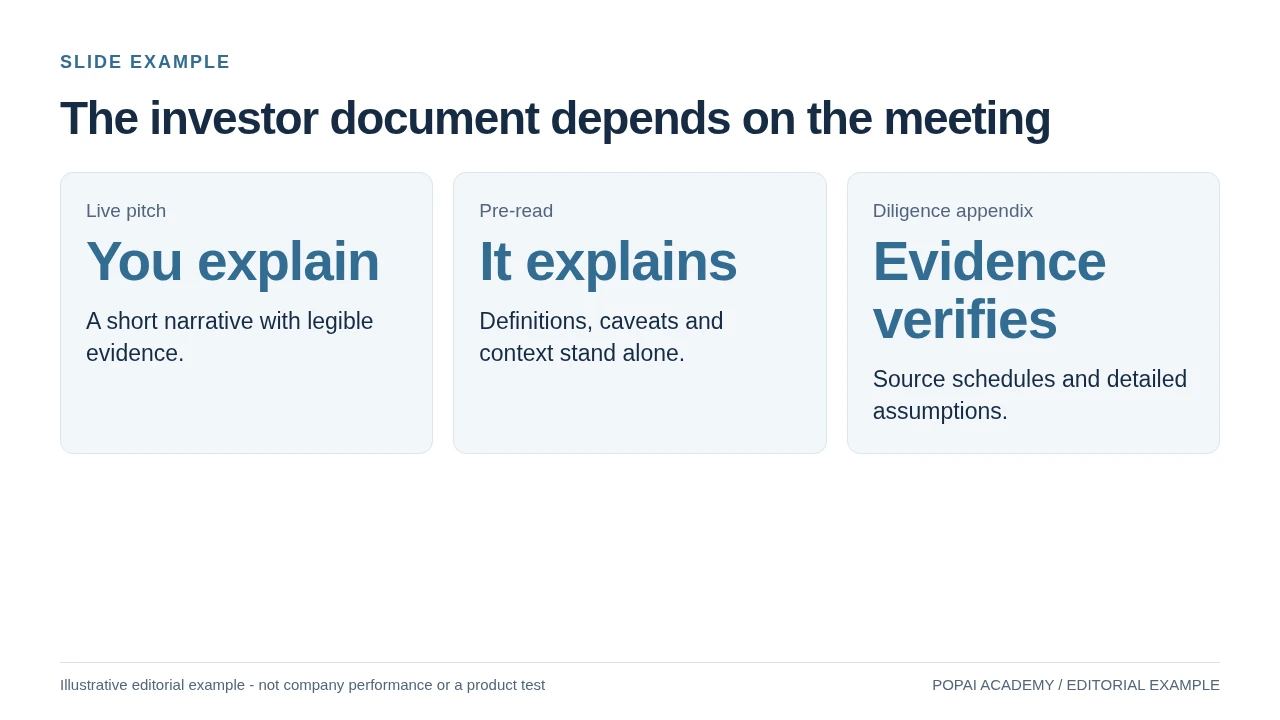
The same Maple Court facts can be reordered without changing them. An LP-facing pitch might open with the thesis, sponsor alignment, equity terms, and downside case. A lender presentation should foreground collateral, debt service, guarantees, and repayment capacity. A buyer presentation may lead with condition, operating history, and transaction process. A live pitch needs legible takeaways; an investment committee or diligence review needs fuller assumptions and source references, usually in an appendix or companion materials.
For PopAi or another presentation tool, first confirm which file types and export formats the current version supports, then test with a non-sensitive sample. Review the outline before polishing slide copy, and inspect the exported PPTX or PDF for broken layouts, missing footnotes, and altered chart labels. Keep the approved model and source log outside the presentation tool as the deal’s record of truth.
Final Quality Checklist for Your Real Estate Pitch Deck
Assign the checks to named owners and treat unresolved material items as a stop, not a cosmetic edit.
- Data validation — model owner: Confirm rent roll, T-12, debt terms, and slide figures against dated source files and the approved model. Pass when material figures reconcile or differences are explicitly disclosed and resolved.
- Investment logic — deal lead: Confirm the thesis, plan, capital ask, and terms are consistent. Pass when each projected improvement is linked to an assumption, cost, timing, and supporting evidence.
- Comps and risks — analyst or asset manager: Confirm comp relevance and record why key comps were selected. Replace vague mitigations with actions and owners—for example, “Construction costs may exceed budget” is stronger when paired with a named contingency, bid status, and person responsible for monitoring change orders.
- Compliance and confidentiality — appropriate reviewer: Remove unnecessary personal or sensitive data; check permissions, disclaimers, and applicable distribution requirements with qualified counsel where needed.
- Final file — presentation owner: Review the exported deck, check footnotes and chart labels, record the final file name and version date, and confirm that the requested next action is explicit.
The useful output is not simply a polished deck. It is a concise decision document whose material claims can be traced, whose assumptions are visible, and whose unresolved questions have an owner and a next step.
Investment Pitch, Listing Deck and CMA: Keep the Tasks Apart
This page uses an investment-property operating model. The example NOI of $140,000 comes from $240,000 scheduled rent minus $12,000 vacancy/credit loss plus $6,000 other operating income minus $94,000 operating expenses. Debt service, income tax and capital expenditure are excluded under the stated convention. A real underwriting file must specify its own classifications and source dates; this illustration is not a valuation, tax analysis or investment recommendation.