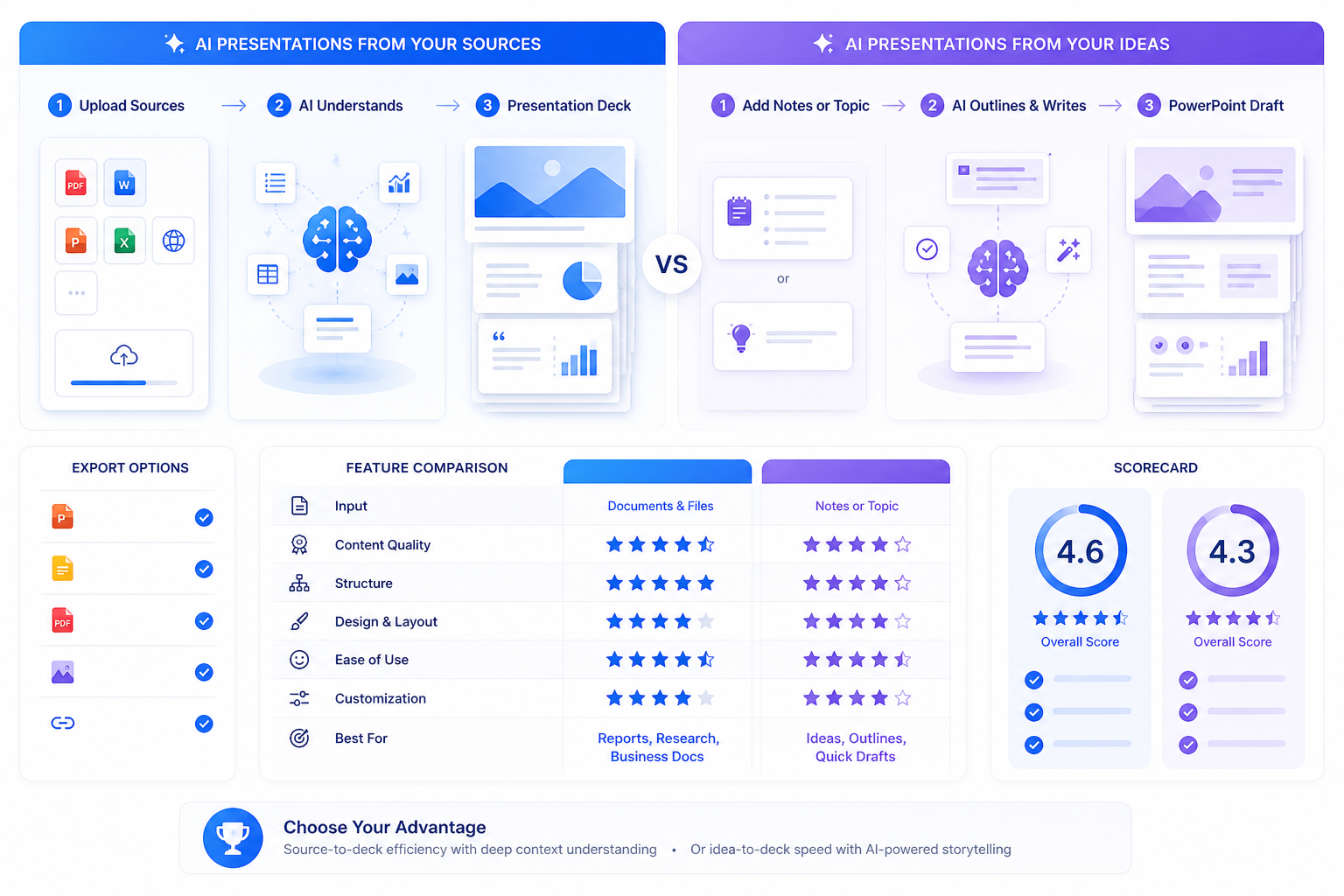
The lowest subscription price is not necessarily the lowest cost per usable presentation. For recurring work, compare the license, any required host software, AI capacity, and the time it takes to turn the draft into an acceptable deliverable.
Public product information checked September 17, 2026. Availability, regional pricing, and account-level limits can change. These are documentation checks, not hands-on performance measurements.
Standard workload: One creator producing five decks per month, ten slides each. Labor figures below are editable planning assumptions, not measured product results. Prices exclude tax and regional adjustments; annual equivalents are not monthly cash payments.

Use a total-cost formula with an explicit workload
Monthly TCO = presentation subscription + required host software + AI overages/add-ons + (5 decks * rework minutes per deck / 60 * hourly labor cost).
Cost per accepted deck = Monthly TCO / number of accepted decks.
For annual billing, show both annual upfront payment and annual price / 12.
Count only accepted decks in the denominator. A failed generation still consumes time or credits but is not an additional finished deliverable. Include image licensing or required compliance services when they are truly incremental to this workflow; do not double-count a host license the organization already budgets elsewhere.
Record the requirement before choosing a plan: editable PowerPoint, a web link, an unbranded PDF, file uploads or team approvals. Two plans with different required capabilities are not substitutes merely because both say AI presentations.
Documented subscription inputs for the same planning model
Comparison table: scroll horizontally to see all columns.
| Example plan | Monthly payment option | Annual cash commitment / monthly equivalent | AI capacity caveat | Output / host caveat | Official source | Checked |
|---|---|---|---|---|---|---|
| Gamma Plus | Not used in this table | US$108/year / US$9 equivalent | 1,000 monthly credits; confirm that generations and revisions cover 5 decks. | Unbranding listed; test required export fidelity. | Gamma pricing and plan limits | 2026-09-17 |
| Plus AI Basic | US$15/month | US$120/year / US$10 equivalent | 1,500 monthly credits; usage varies by task. | Native editor workflow; account for PowerPoint/Google Slides access. File upload is a higher-plan feature. | Plus AI pricing and plan features | 2026-09-17 |
| Plus AI Pro | US$25/month | US$240/year / US$20 equivalent | 3,000 monthly credits; no fixed accepted-deck guarantee. | Adds document upload; host-app costs may be separate. | Plus AI pricing and plan features | 2026-09-17 |
| Beautiful.ai Pro | US$45 monthly option | US$174/year / US$14.50 equivalent | Check applicable generation and fair-use limits. | PPTX/PDF listed; do not assume every object stays native. | Beautiful.ai pricing and support | 2026-09-17 |
| Canva Pro | Not used in this table | US$144/year / US$12 equivalent | Shared AI allowance; task complexity changes consumption. | Individual plan; team approval requirements may need another plan. | Canva pricing and feature comparison | 2026-09-17 |
| GenPPT | US$19/month | US$99/year / US$8.25 equivalent | 20 decks/month listed; paid trial is separate. | Full-slide image deck workflow; inspect object editability, not only PPTX availability. | GenPPT pricing | 2026-09-17 |
| PopAi Plus | Numeric price not confirmed in reviewed pricing text | Obtain the actual checkout quote; not ranked on unverified price. | 10,000 monthly credits advertised; verify your workload. | Full PPTX/PDF export listed with Plus. | PopAi pricing | 2026-09-17 |
The annual equivalent for US$99 is US$8.25, calculated as 99 / 12; a rounded marketing label is not the cash billing schedule. Do not mix an annual-equivalent competitor price with a monthly-billed price and call the result a fair price ranking.
A plan that has enough headline credits may still need more after several revisions. Log actual credit consumption during a small pilot. Credit units are not interchangeable across vendors.
See how rework changes the comparison
Comparison table: scroll horizontally to see all columns.
| Illustrative scenario, not a tool result | License / month | Rework per deck | Labor at US$30/hour | TCO for 5 decks | Cost per accepted deck |
|---|---|---|---|---|---|
| Lower license, more repair | US$10 | 30 minutes | US$75 | US$85 | US$17 |
| Higher license, less repair | US$20 | 10 minutes | US$25 | US$45 | US$9 |
This example demonstrates the formula only. It does not establish that any named product saves twenty minutes or produces better exports. Substitute your own measured revision time and wage assumption before making a decision.
The license difference is US$10 per month. At US$30 per hour, saving twenty minutes across the whole month offsets that difference. Whether a paid feature achieves the saving needs observation, not a vendor slogan.
Collect a useful one-month cost record
| Record | What to capture |
|---|---|
| Usage | Decks started, accepted decks, regenerations and credit-consuming edits. |
| Repair | Minutes spent correcting source errors, formatting, exports and handoff issues. |
| Subscriptions | Actual charge, currency, tax, seats, billing term and host license. |
| Extras | AI top-ups, approved image costs, onboarding or required support. |
| Acceptance | Whether each deck meets the same agreed quality floor. |
If work is seasonal, compare the annual commitment with the months you actually need the tool. A lower monthly equivalent can cost more overall when a one-month project leaves eleven months unused. Consider cancellation, renewal and data-export obligations before switching.
Use cost per accepted deck, not a universal value winner
Pick the lowest total cost among the plans that meet your requirements and quality floor. Do not award a value-for-money winner when a material price is unconfirmed or when no actual repair-time data exists.
This article owns the recurring TCO question. The free-tier comparison covers zero-cost entitlements, while the premium-feature guide explains what additional capabilities may justify payment. Keeping these decisions separate makes the comparison easier to audit.
Publisher disclosure: PopAi publishes this guide and is one of the products discussed. Product descriptions come from the linked official pages. They are not independent test results or proof that PopAi outperforms another tool.