Best Fundraising Pitch Deck Templates: 3 Editable AI-Ready Files
Updated October 15, 2026 | Original editable examples and source notes
Choose a fundraising deck by the evidence your company can defend, not just the name of the round. The pre-seed template is strongest for problem and validation plans, the seed file for early adoption and go-to-market learning, and the Series A file for repeatability, economics and a scaling plan. Each is a complete investor-oriented PPTX, not only a list of suggested slide titles.
Which fundraising pitch deck template should you use?
| Template | Length | Recommended evidence emphasis | Not a claim of |
|---|---|---|---|
| Pre-seed | 10 slides | Problem, insight, proposed product and validation plan | Customers or revenue not yet observed. |
| Seed | 11 slides | Adoption, retention learning, market approach and use of funds | Universal stage thresholds or fundraising readiness. |
| Series A | 12 slides | Repeatability, economics, cohorts, organization and growth assumptions | Guaranteed scale, returns or investor approval. |
These stage labels are editorial selection aids, not financing eligibility rules. For a general startup visual style, use the startup template directory. For writing a first draft from founder notes, use the startup prompt-to-draft tutorial.
Three complete editable investor decks
Pre-seed investor narrative
Best for a first investor discussion built around problem evidence and learning.
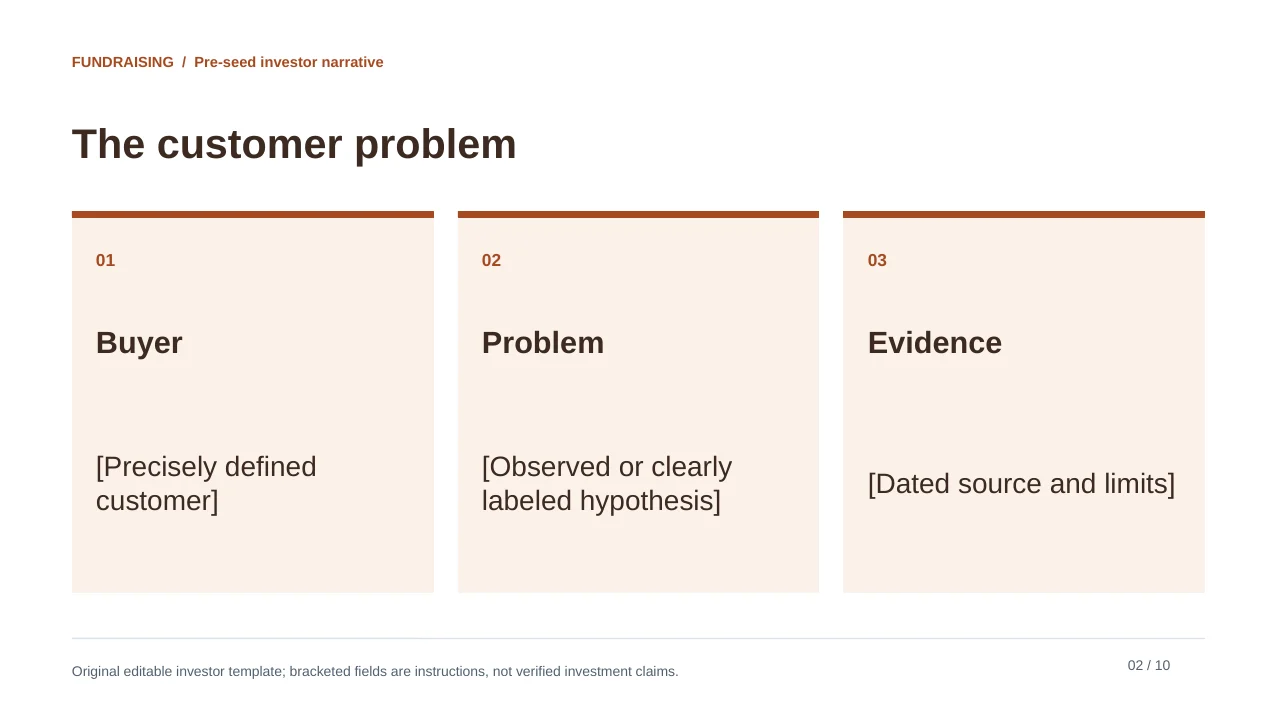
This 10-slide file starts with the problem and the team's insight, then separates the proposed solution from the plan to validate it. Keep unknown demand, market inputs and economics as questions until evidence exists.
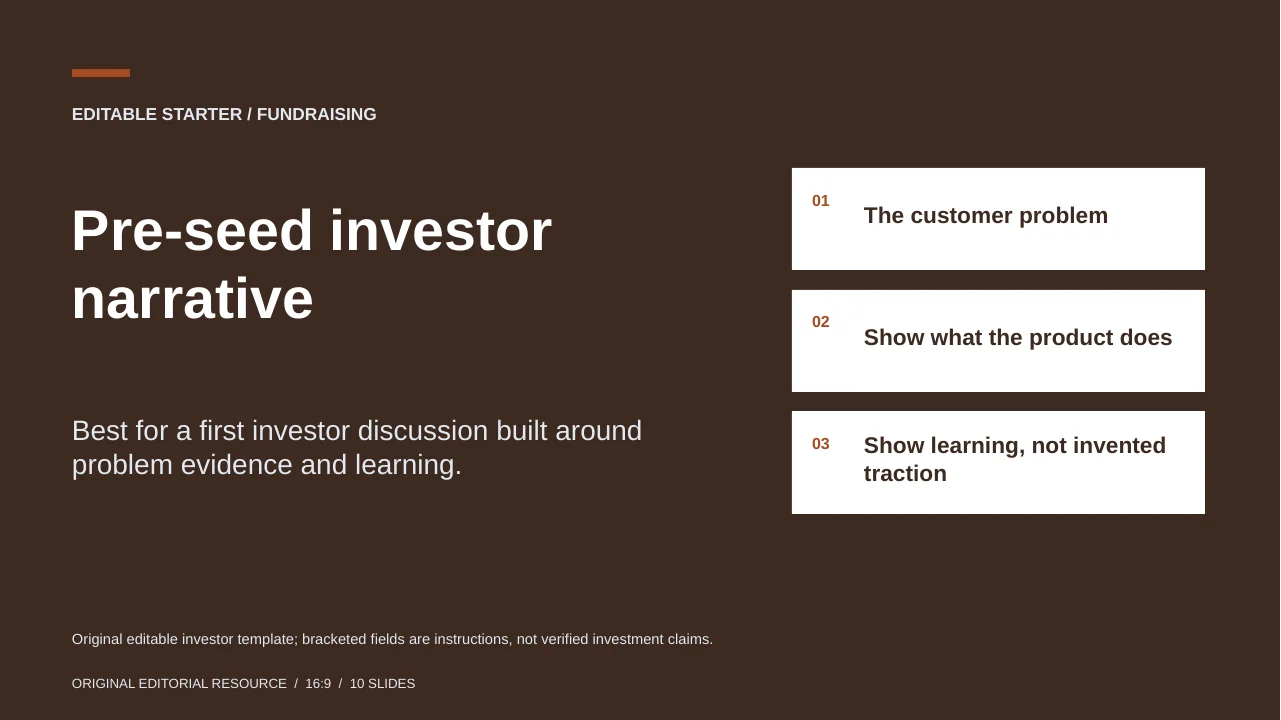
Original editable investor template; bracketed fields are instructions, not verified investment claims.
See the complete slide sequence
- Pre-seed investor narrative
- The customer problem
- Show what the product does
- Show learning, not invented traction
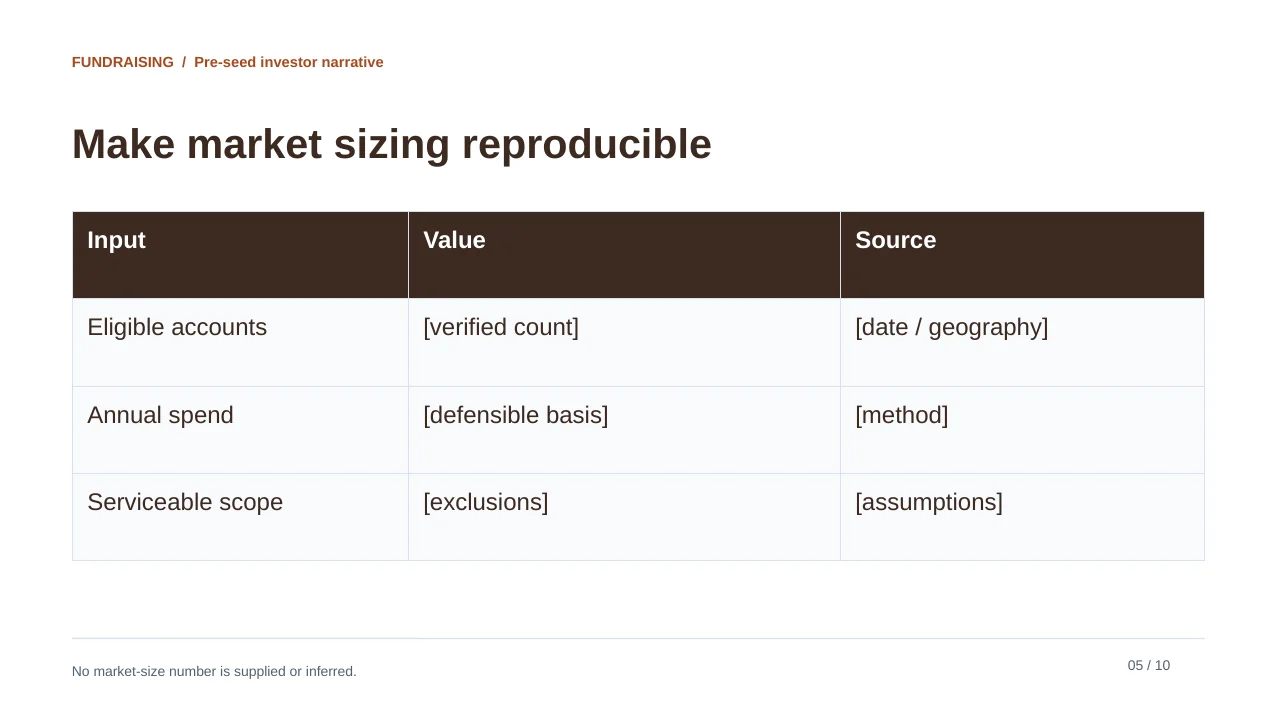
- Make market sizing reproducible
- Business model and assumptions
- Use only verified team credentials
- Define the next learning milestones
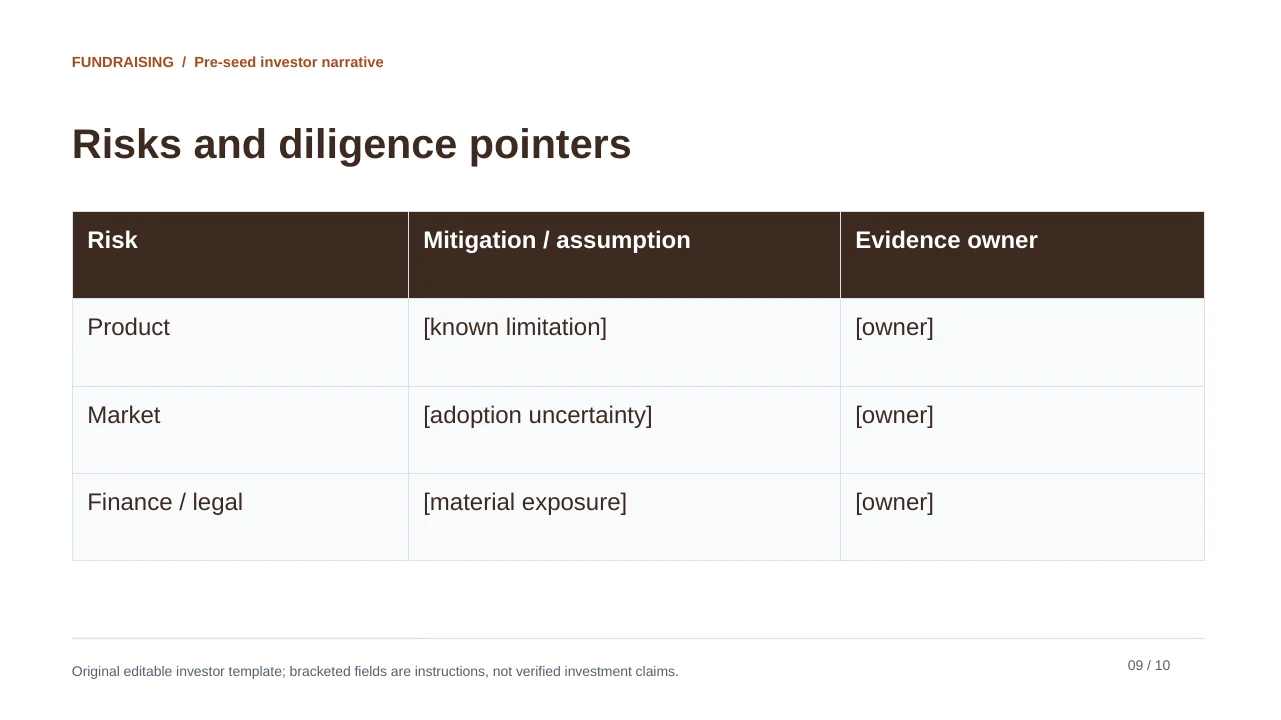
- Risks and diligence pointers
- Tie the financing ask to milestones
Seed evidence deck
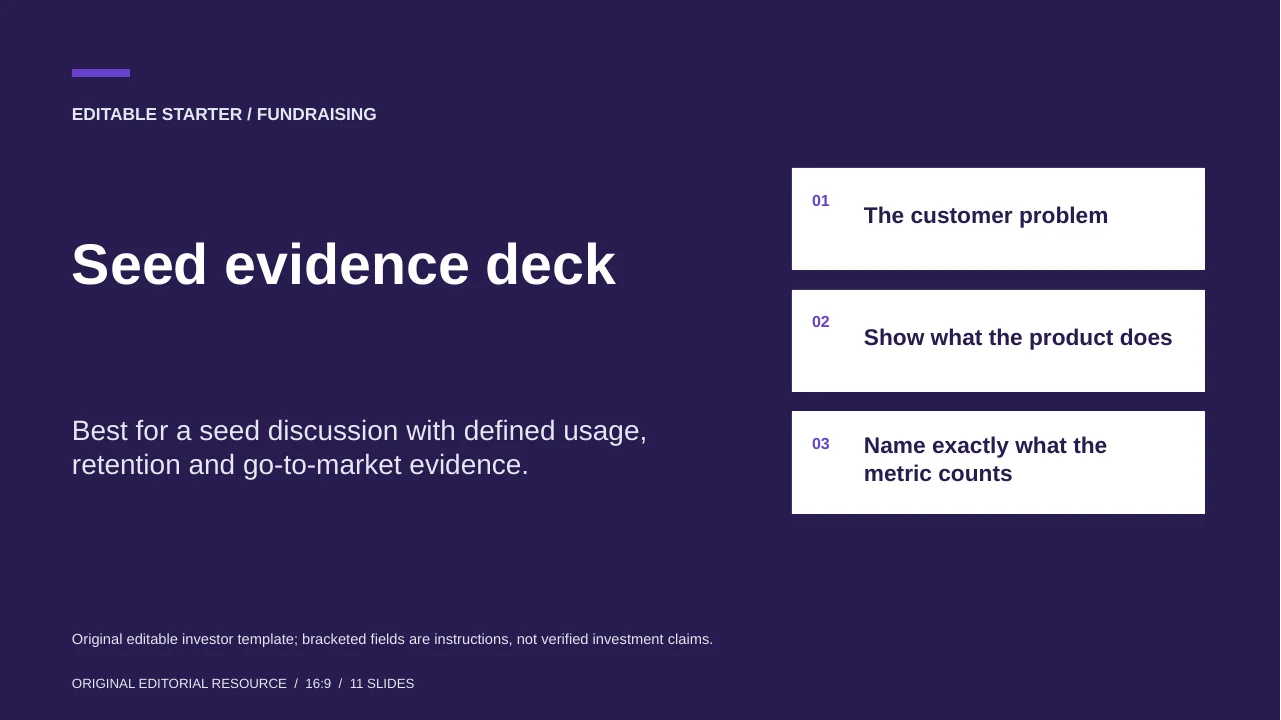
Best for a seed discussion with defined usage, retention and go-to-market evidence.
This 11-slide file gives early traction and go-to-market learning more space. Use actual cohort definitions and the reporting date. A logo, pilot or pipeline item must not be presented as booked recurring revenue without a valid basis.
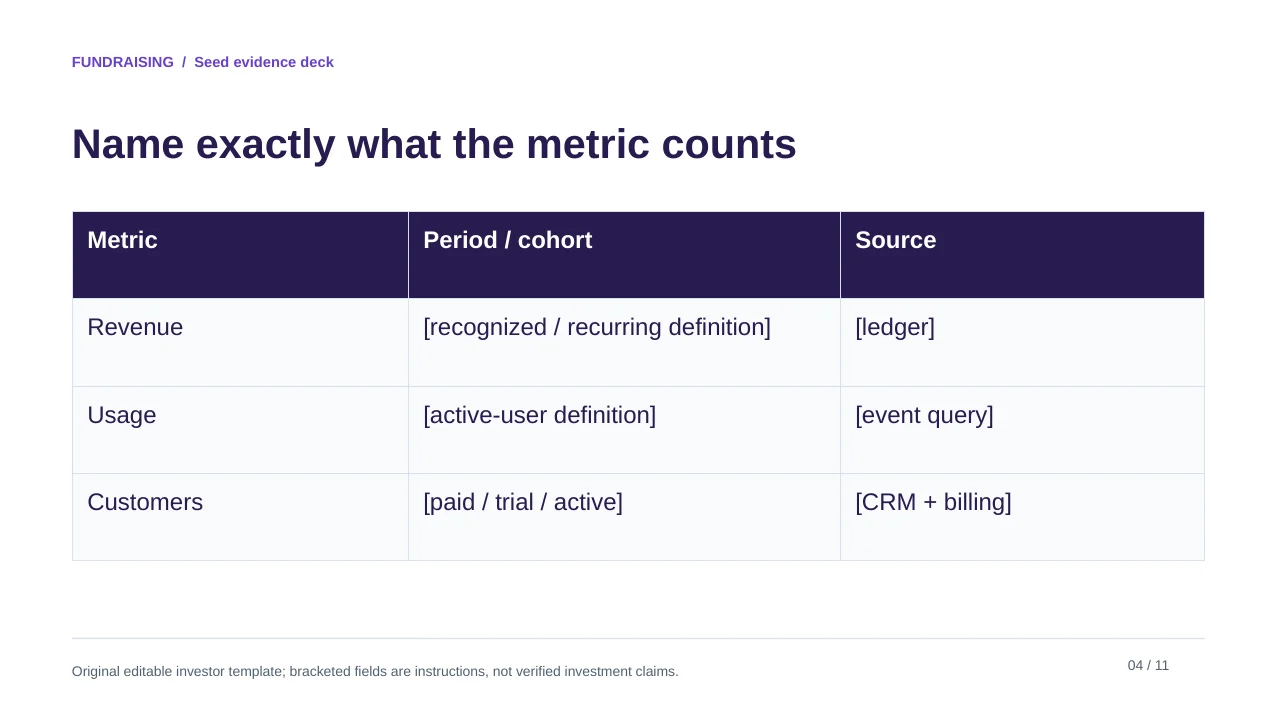
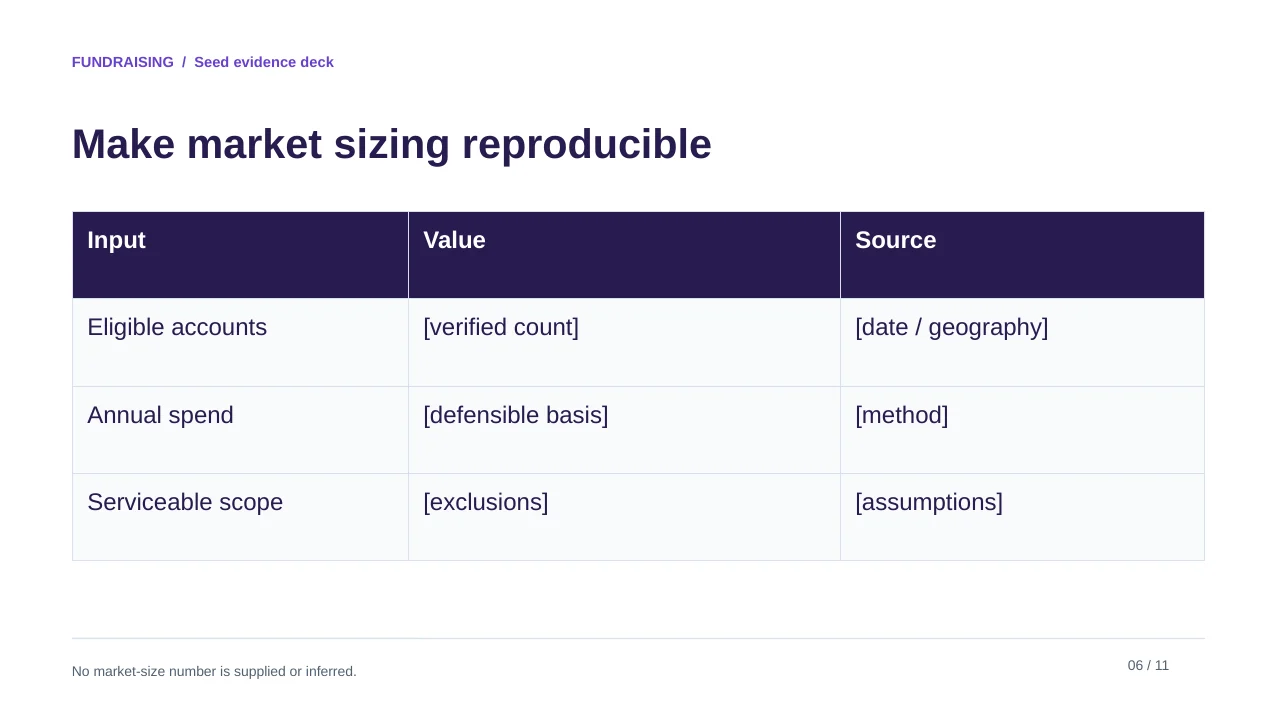
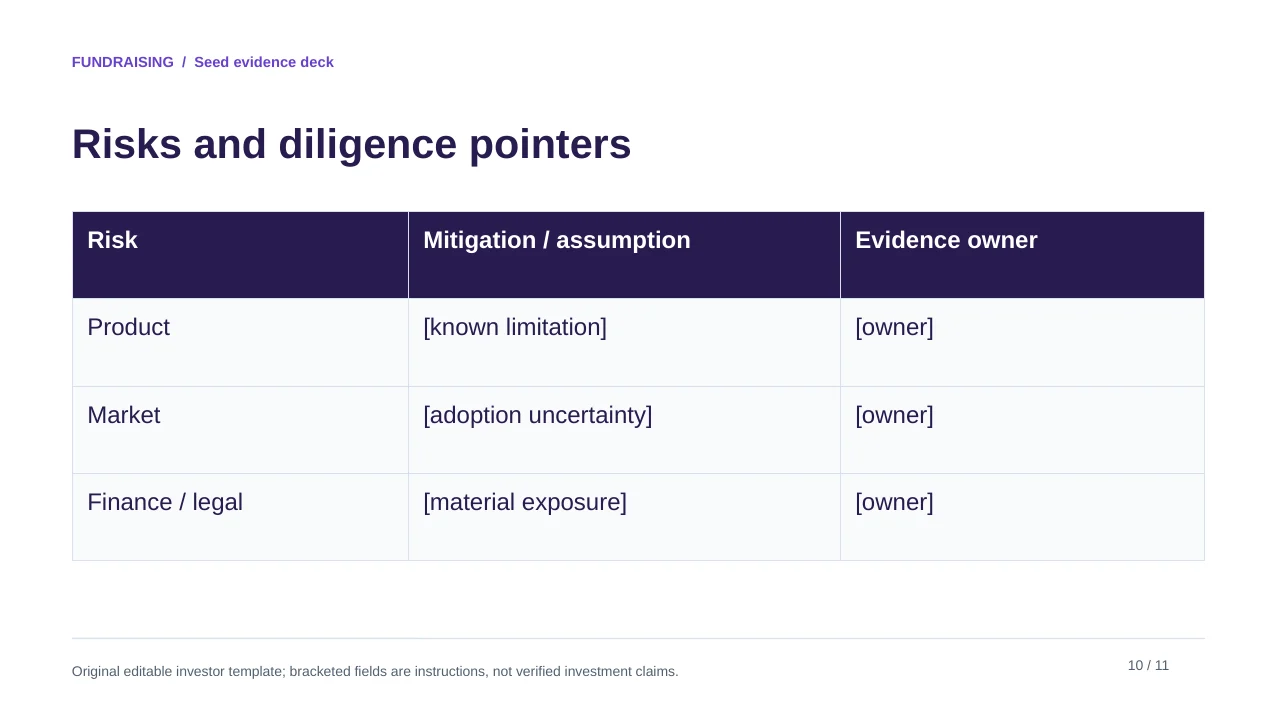
Original editable investor template; bracketed fields are instructions, not verified investment claims.
See the complete slide sequence
- Seed evidence deck
- The customer problem
- Show what the product does
- Name exactly what the metric counts
- Retention needs a cohort and horizon
- Make market sizing reproducible
- Business model and assumptions
- Describe a repeatable acquisition motion
- Use only verified team credentials
- Risks and diligence pointers
- Tie the financing ask to milestones
Series A scale case
Best for discussing repeatability, unit economics and a costed scaling plan.
This 12-slide file makes repeatability and scaling assumptions central. It separates acquisition, retention, unit economics and the operating plan rather than squeezing every financial claim into a single growth graph.
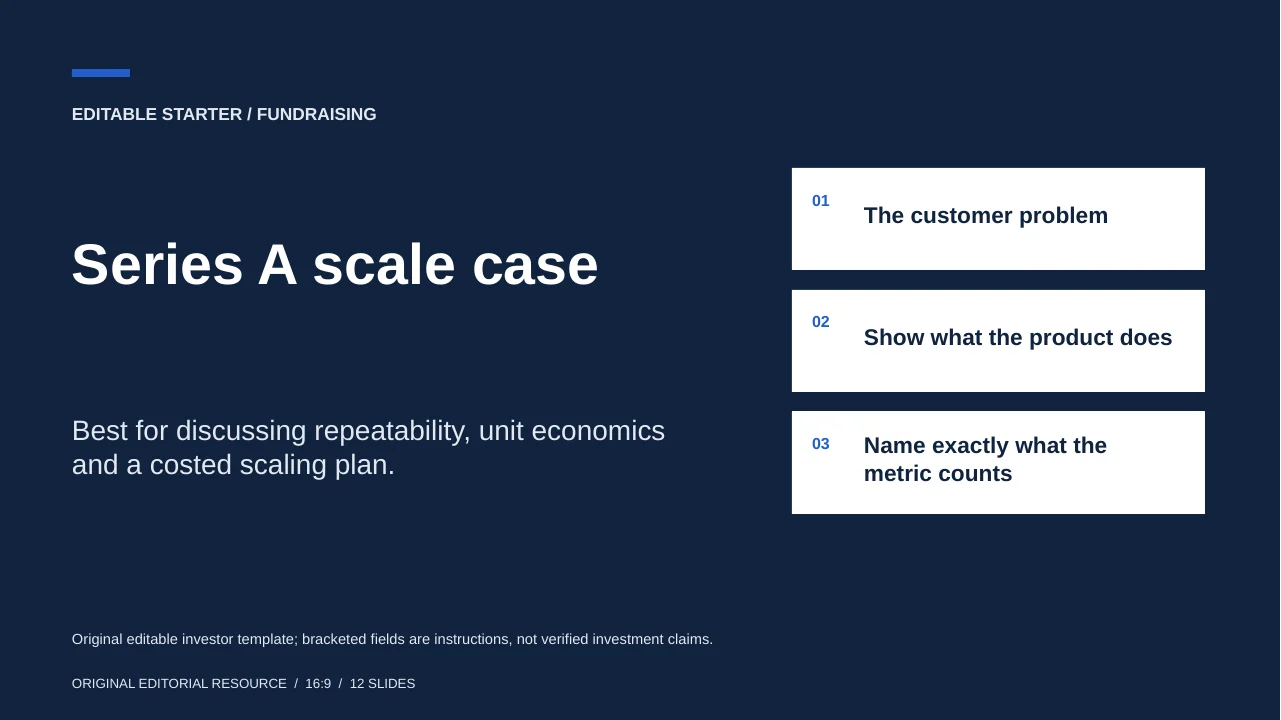
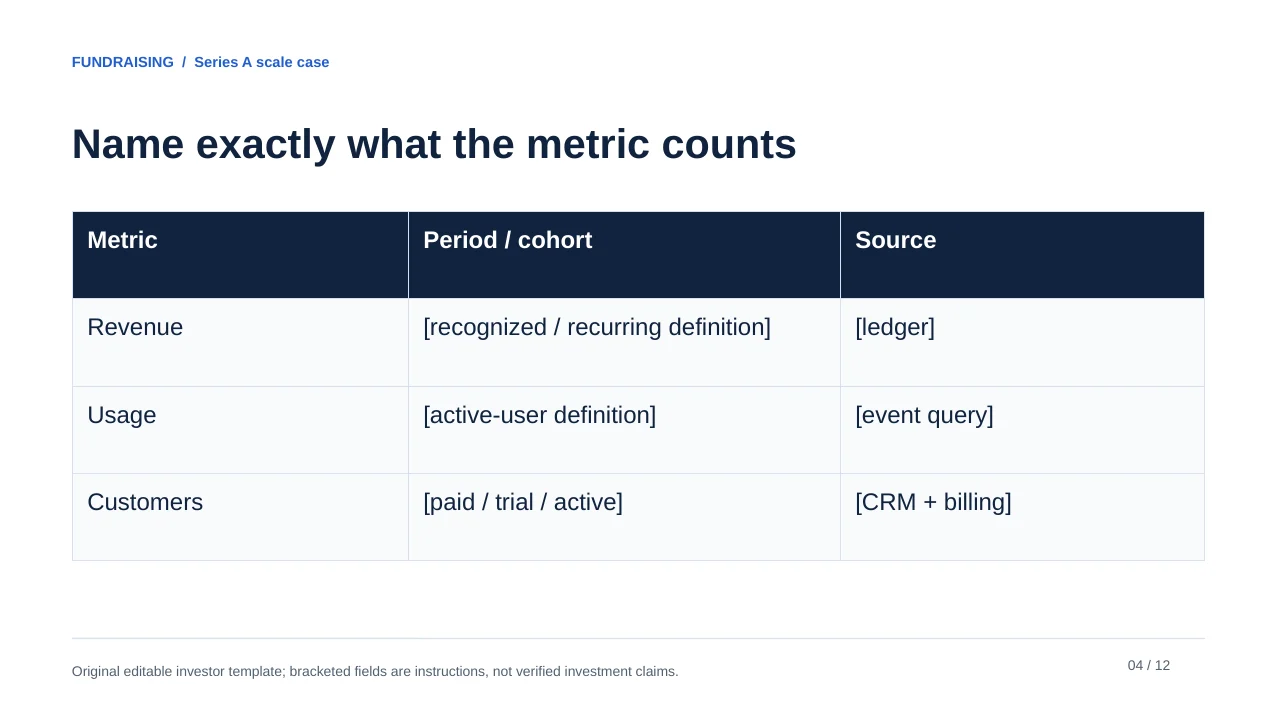
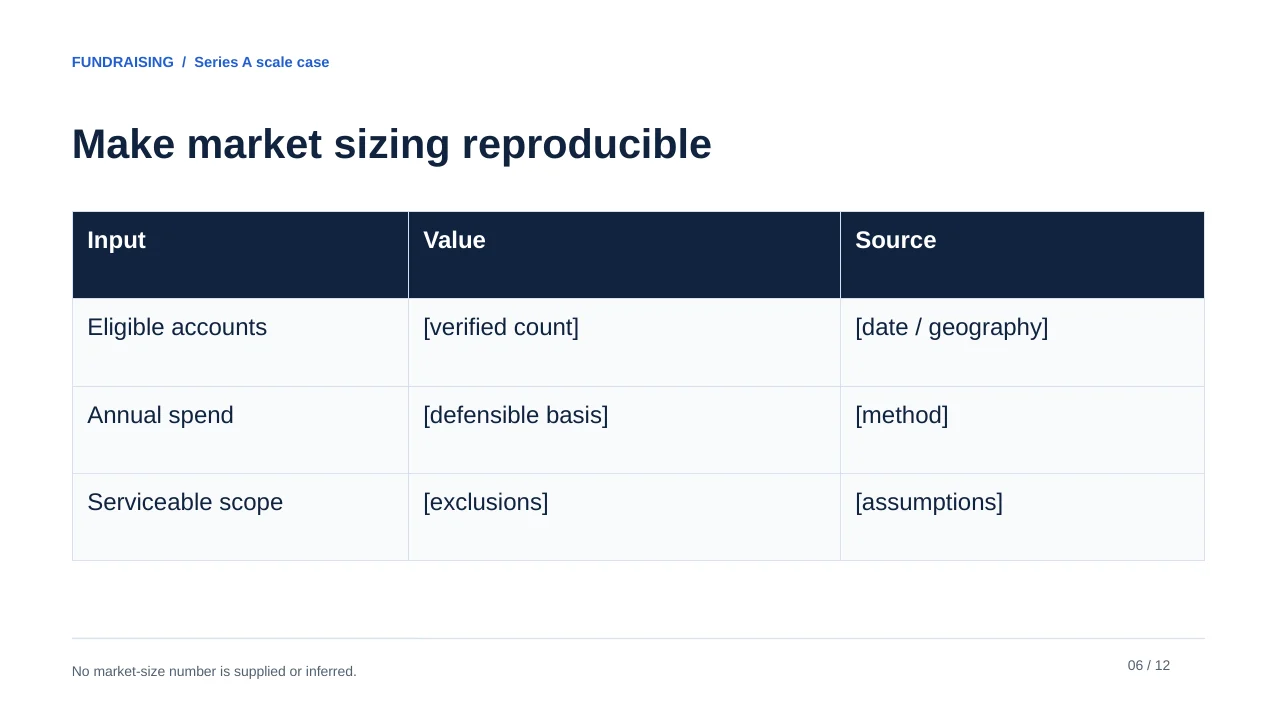
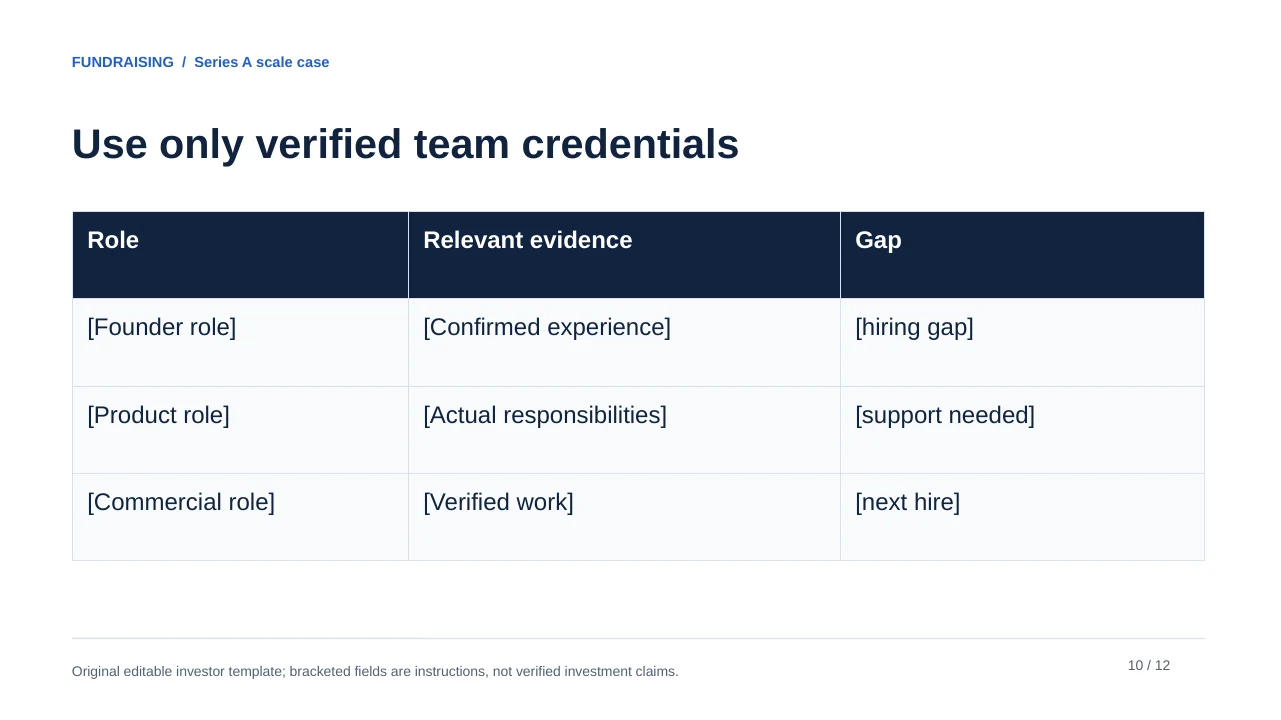
Original editable investor template; bracketed fields are instructions, not verified investment claims.
See the complete slide sequence
- Series A scale case
- The customer problem
- Show what the product does
- Name exactly what the metric counts
- Retention needs a cohort and horizon
- Make market sizing reproducible
- Business model and assumptions
- Describe a repeatable acquisition motion
- Do not hide the cost basis
- Use only verified team credentials
- Risks and diligence pointers
- Tie the financing ask to milestones
Prepare an investor claim register
Create one source entry for each material statement before importing it into an AI tool. For example, an ARR figure needs its definition and period; a market estimate needs the method and inputs; a customer quote needs the exact source and permission. Put sensitive supporting materials behind the appropriate access controls rather than attaching the entire data room to a generic drafting service.
| Claim type | Keep beside the claim | Do not substitute |
|---|---|---|
| Traction | Metric definition, time window and source | Pipeline for signed business. |
| Market size | Method, segment and assumptions | An unrelated global estimate. |
| Customer proof | Exact authorized statement and date | An invented testimonial. |
| Forecast | Driver assumptions and scenario label | A forecast presented as realized performance. |
| Funding ask | Amount, use, milestones and actual terms | An unapproved allocation or return promise. |
Customize without making the story less honest
Move evidence earlier when it is stronger than the standard sequence. Remove a page that does not answer an investor question, but keep a supporting appendix for definitions and caveats. The files are editable starting structures, not a requirement to show a fixed slide count at every meeting.
In the United States, the SEC explains that securities offerings must be registered or qualify for an exemption. This general presentation resource does not determine an exemption or approve solicitation, disclosure or investment terms. The issuer and qualified advisers must assess their jurisdiction and circumstances.
Sources and example provenance
The files and preview layouts on this page were created for this editorial resource. External references support the specific guidance linked in the text; they do not endorse the templates. Source links checked on October 15, 2026.
Frequently Asked Questions
Are the pre-seed, seed and Series A files complete?
Yes. They contain 10, 11 and 12 editable slides respectively, with actual previews and an outline. Company-specific evidence and approved terms must still be inserted.
Do these templates guarantee funding?
No. They organize an investor conversation. They cannot validate a company, establish investor suitability or promise a financing outcome.
Should I use the Series A deck because it looks more advanced?
No. Choose the structure that matches your evidence and meeting purpose. A larger claim requires stronger support, not a more elaborate slide.
Are these fundraising or general startup design templates?
These files focus on investor evidence and the funding decision. The companion startup directory focuses on shorter visual systems; the tutorial focuses on prompting.
Create your presentation with one click now
Turn your pitch outline or source materials into an editable first draft, then refine the narrative, charts, and design for your investors.
Create your presentation