This guide is for seed- to Series A-stage founders building digital health, clinical AI, diagnostics, or healthcare operations products. It focuses on an investor deck—not a clinical dossier or regulatory submission—and gives you a slide sequence, worked fictional examples, and prompts you can adapt. The goal is to make the product, evidence, buyer, and next financing milestones legible without presenting plans as results.
Four Healthcare Pitch Pages with Evidence Boundaries
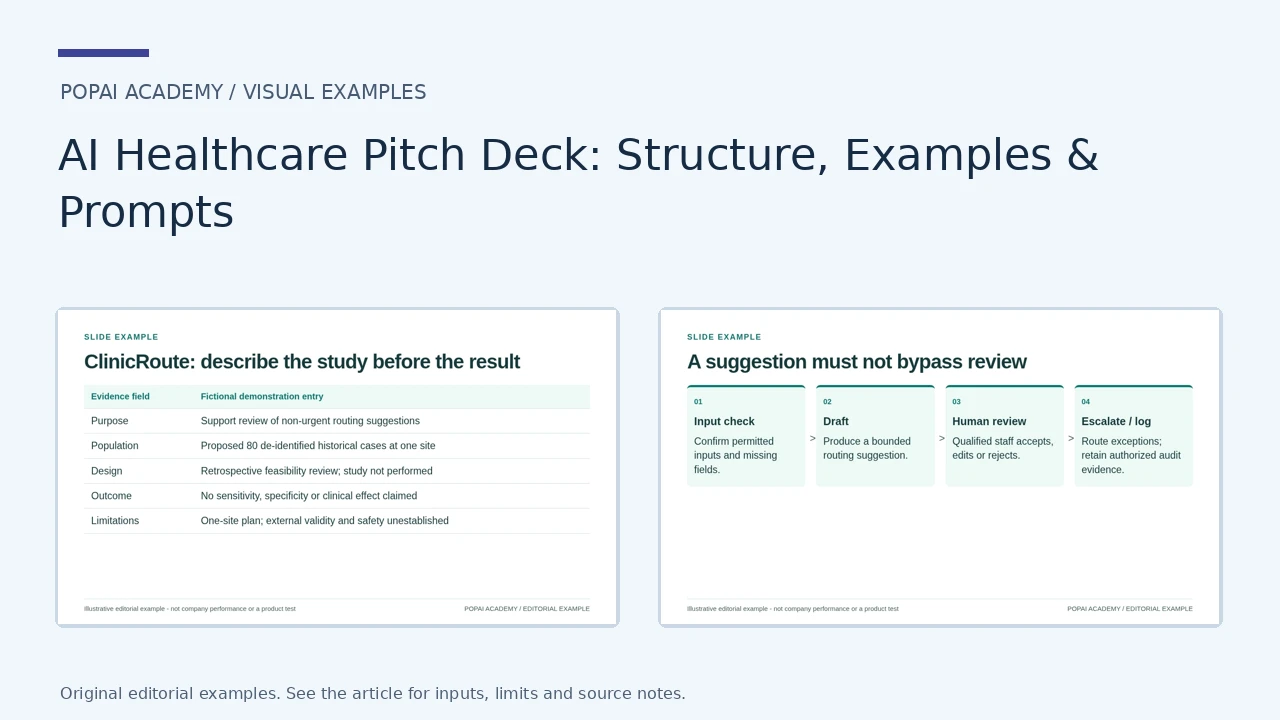
ClinicRoute is fictional. Every study field is a proposed plan, not a trial result. The status page explicitly avoids implying FDA clearance or approval, and the safety workflow is conceptual rather than a tested product feature.
Open full-size examples and editable HTML layoutsClinicRoute: describe the study before the result
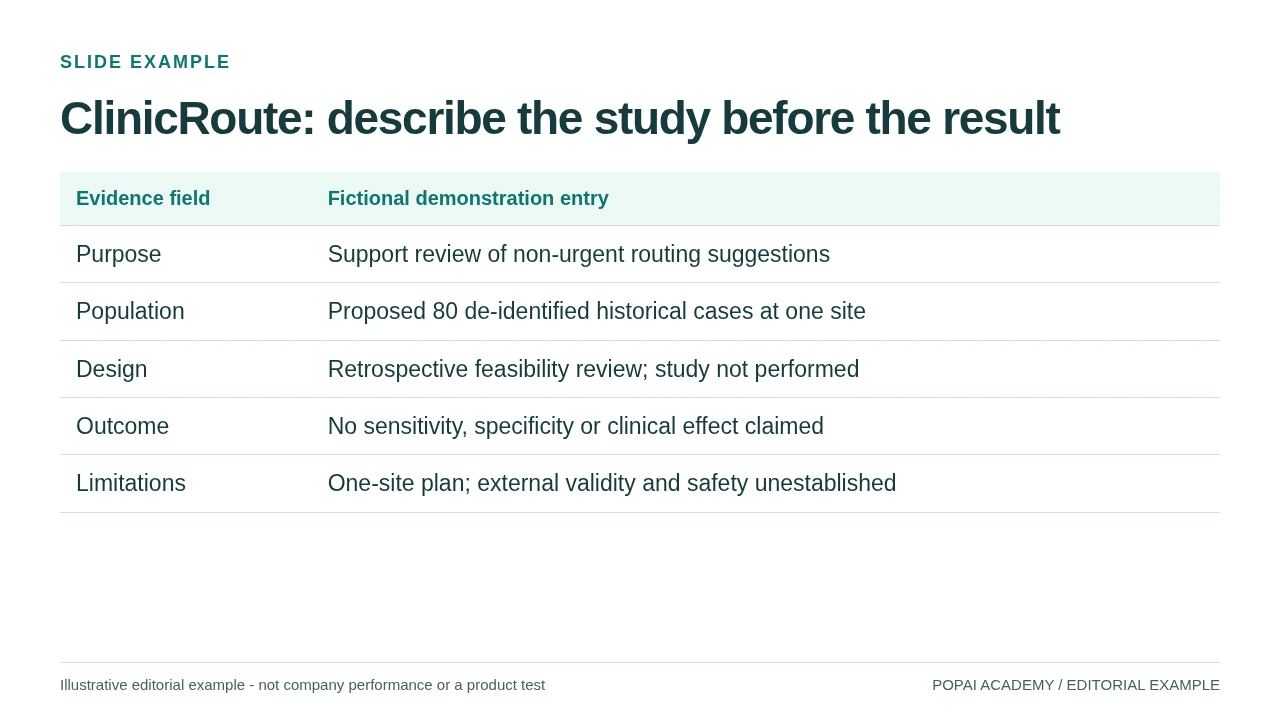
A proposed evidence table, not fabricated trial findings or clinical advice.
Read or copy the slide content
Evidence field
Fictional demonstration entry
Purpose
Support review of non-urgent routing suggestions
Population
Proposed 80 de-identified historical cases at one site
Design
Retrospective feasibility review; study not performed
Outcome
No sensitivity, specificity or clinical effect claimed
Limitations
One-site plan; external validity and safety unestablished
Prompt for ClinicRoute: describe the study before the result
Create four healthcare AI investor examples for fictional ClinicRoute: evidence plan, regulatory status, buyer/payment and safety workflow. Do not imply FDA clearance or validated clinical outcomes.
Regulatory status is an evidence field
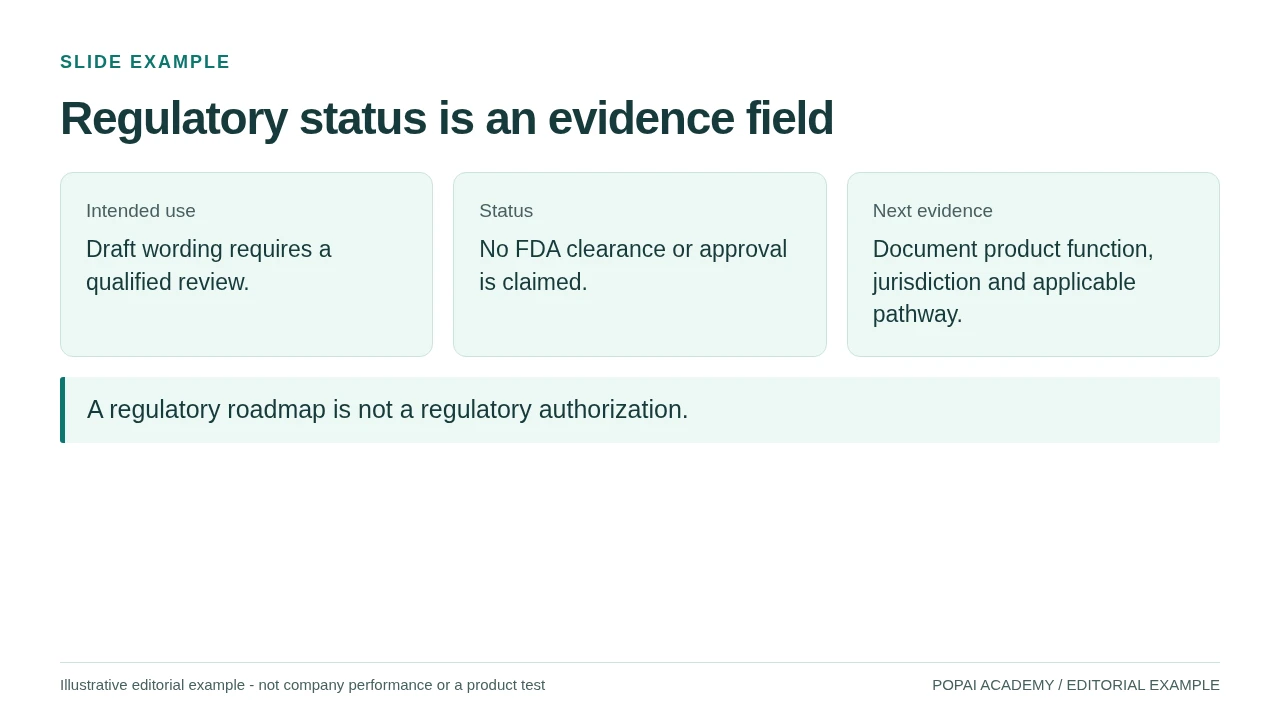
Fictional product status; the example does not determine device classification.
Read or copy the slide content
Intended use
Draft wording requires a qualified review.
Status
No FDA clearance or approval is claimed.
Next evidence
Document product function, jurisdiction and applicable pathway.
A regulatory roadmap is not a regulatory authorization.
Prompt for Regulatory status is an evidence field
Create a slide with the purpose "Regulatory status is an evidence field". Use these approved source fields or replace the illustrative inputs before use: Intended use Draft wording requires a qualified review. Status No FDA clearance or approval is claimed. Next evidence Document product function, jurisdiction and applicable pathway. A regulatory roadmap is not a regulatory authorization.. Preserve labels, units, source notes and any uncertainty. Do not add results, claims, customers or capabilities. Suggest a readable layout and keep the output editable in the chosen tool.
Separate user, buyer and payment assumptions
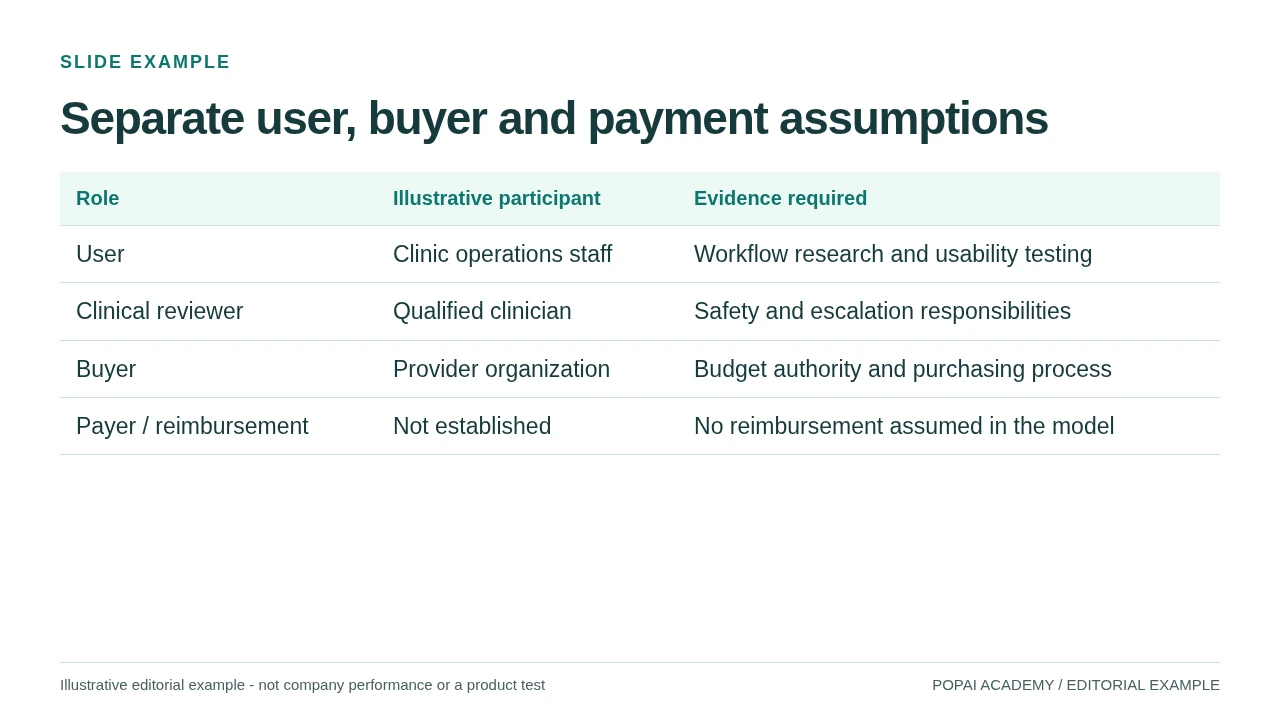
A market-access map avoids treating every user as a customer or payer.
Read or copy the slide content
Role
Illustrative participant
Evidence required
User
Clinic operations staff
Workflow research and usability testing
Clinical reviewer
Qualified clinician
Safety and escalation responsibilities
Buyer
Provider organization
Budget authority and purchasing process
Payer / reimbursement
Not established
No reimbursement assumed in the model
Prompt for Separate user, buyer and payment assumptions
Create a slide with the purpose "Separate user, buyer and payment assumptions". Use these approved source fields or replace the illustrative inputs before use: Role Illustrative participant Evidence required User Clinic operations staff Workflow research and usability testing Clinical reviewer Qualified clinician Safety and escalation responsibilities Buyer Provider organization Budget authority and purchasing process Payer / reimbursement Not established No reimbursement assumed in the model. Preserve labels, units, source notes and any uncertainty. Do not add results, claims, customers or capabilities. Suggest a readable layout and keep the output editable in the chosen tool.
A suggestion must not bypass review
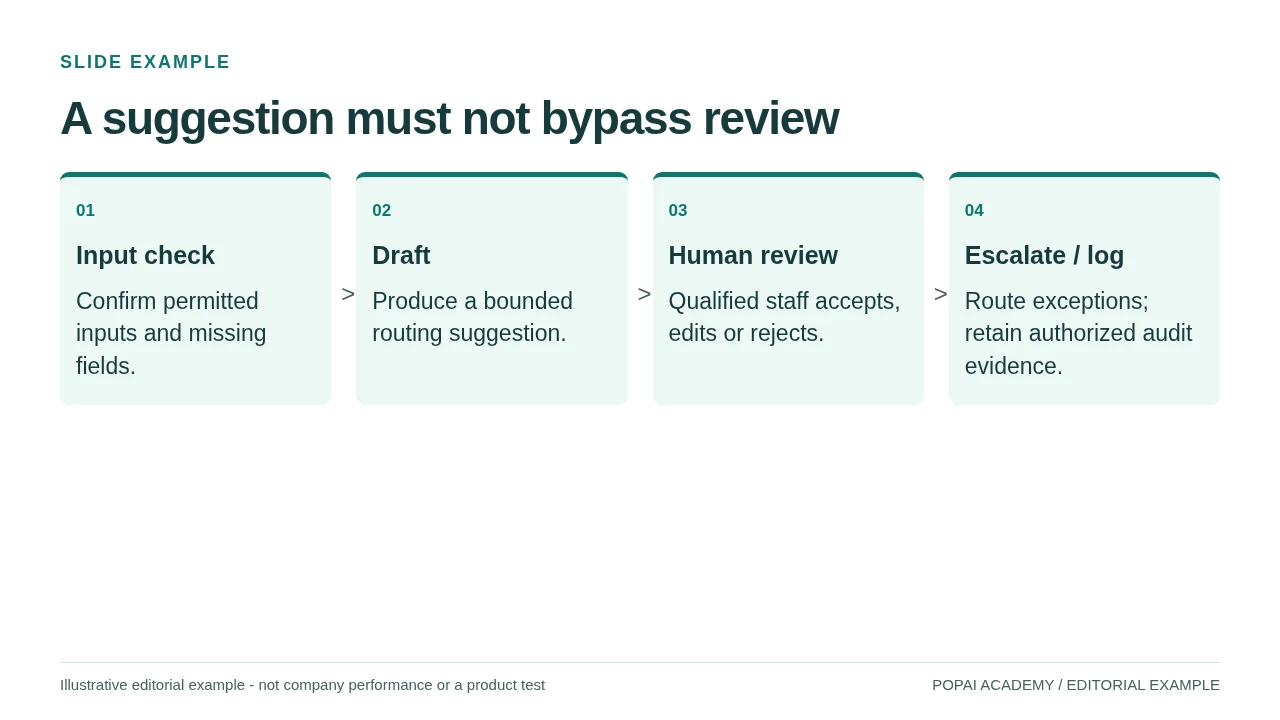
Conceptual safety workflow only; not proof that a real product implements these controls.
Read or copy the slide content
01
Input check
Confirm permitted inputs and missing fields.
02
Draft
Produce a bounded routing suggestion.
03
Human review
Qualified staff accepts, edits or rejects.
04
Escalate / log
Route exceptions; retain authorized audit evidence.
Prompt for A suggestion must not bypass review
Create a slide with the purpose "A suggestion must not bypass review". Use these approved source fields or replace the illustrative inputs before use: 01 Input check Confirm permitted inputs and missing fields. 02 Draft Produce a bounded routing suggestion. 03 Human review Qualified staff accepts, edits or rejects. 04 Escalate / log Route exceptions; retain authorized audit evidence.. Preserve labels, units, source notes and any uncertainty. Do not add results, claims, customers or capabilities. Suggest a readable layout and keep the output editable in the chosen tool.
AI healthcare pitch deck structure: the essential slides
Build the story in this order: need, product, proof, adoption, and the milestones your financing will fund. Deck length is a working choice, not a rule: a short first-meeting deck can leave detail for an appendix, while a diligence deck may need more. The sequence below is a practical 14-slide starting point; combine slides when the story is simple, and move technical detail into an appendix.
| Slide | Question it answers | Useful evidence or content |
|---|---|---|
| 1. Thesis | What changes, for whom, and why now? | One-sentence value proposition; intended user and setting. |
| 2. Problem | Which costly or consequential workflow is not working? | Population, current process, and a sourced baseline or local discovery. |
| 3. Current alternatives | What do users do today? | Existing tools, manual steps, workarounds, and their limitations. |
| 4. Product workflow | Where does the product fit, and who acts on its output? | Before-and-after workflow; human review and exception handling. |
| 5. AI and product advantage | What does the model do that enables the workflow? | Inputs, outputs, model role, data rights, and what is not automated. |
| 6. Evidence | What has been demonstrated so far? | Study or pilot design, population, comparator, endpoint, result, and limitation. |
| 7. Safety and governance | How are foreseeable risks managed? | Relevant controls, oversight, monitoring, privacy, and open questions. |
| 8. Market | How large is the reachable opportunity? | Bottom-up customer count × plausible contract value, with assumptions shown. |
| 9. Competition | Why will a buyer choose this over alternatives? | Comparison by workflow, evidence, integration, and buyer—not a feature-only grid. |
| 10. Buyer and business model | Who approves, pays, and owns the value? | Budget line, pricing logic, purchasing route, and payer role if relevant. |
| 11. Go-to-market and traction | Can adoption become repeatable? | Pipeline stages, paid versus unpaid activity, deployment effort, and retention where available. |
| 12. Team | Can this team execute in this setting? | Relevant clinical, technical, security, commercial, and implementation experience. |
| 13. Financing request | What does this round make possible? | Amount sought, runway assumptions, and allocation by workstream. |
| 14. Milestones | What will be true at the next financing or decision point? | Owners, dates, measurable evidence and commercial milestones, plus dependencies. |
Stage changes the proof, not just the wording. A seed deck may center on a well-defined problem, a credible prototype, discovery with users, and a funded plan to test the riskiest assumptions. A Series A deck usually needs stronger evidence of repeatable deployment and a commercial motion, while making clear which outcomes remain unproven. Clinical AI should give more space to intended use, validation, and oversight; administrative AI should make workflow time, implementation, and budget impact visible; a diagnostic or medical product may need a more explicit regulatory and clinical-development plan.
Close the narrative loop: the financing request should pay for named milestones, and those milestones should reduce the risks raised earlier in the deck. For example, if adoption depends on integration, budget for the integration work and define what successful deployment means.
Investor takeaway: “This is a consequential healthcare problem, and the team knows what must be proven before the solution can be adopted safely.”
Build the AI healthcare pitch deck around evidence
Make each evidence slide answer one question and show enough context for a reader to judge the result. Separate product usage (such as active users), operational outcomes (such as time to complete a task), and clinical outcomes; one does not establish the other. Label evidence as retrospective, prospective, internal, independently assessed, peer-reviewed, or planned where applicable. For reporting guidance, see the CONSORT-AI extension for clinical trials involving AI and DECIDE-AI for early-stage clinical evaluation. These are reporting resources, not substitutes for a study design or regulatory advice.
Report the study, not just the metric
- State the setting, dates, intended-use population, inclusion criteria, and sample size. Give the denominator for every rate.
- Name the comparator and endpoint, and explain how each was measured. A “time saved” result needs a defined baseline and measurement window.
- Show uncertainty when appropriate: confidence intervals or another suitable measure, not only a point estimate. Avoid implying a small or imprecise difference is definitive.
- Disclose whether testing was retrospective or prospective, internal or external, and whether assessment was independent. Explain how you guarded against data leakage, such as patient overlap between training and test sets.
- Report relevant subgroup performance and limitations when the sample permits. If it does not, say that subgroup performance is not yet established.
- Separate observed results from hypotheses and planned validation. Put methods and fuller tables in the appendix, with a source or study reference on the slide.
Worked evidence slide: fictional example
Illustrative only—these figures are fictional and must not be used as real-world benchmarks. A hypothetical ambient documentation company tests its draft-note workflow in one outpatient clinic: 24 clinicians use the tool for two weeks, with 240 eligible visits compared against each clinician’s prior two-week baseline. The slide headline could read: “In a small single-site workflow test, median note completion time fell from 18 to 14 minutes.” A paired dot plot would show clinician-level changes; the footnote would define “completion time,” identify the dates and data source, and state that no clinical outcome was measured.
The cautious takeaway is that this test supports further workflow evaluation—not that the product improves care or will produce the same result elsewhere. The comparison is not randomized, the sample is small, and clinician selection or changes in workload could affect the result. A next step might be a prospective multi-site study with a prespecified endpoint and an independent analysis.
Explain regulation, privacy, and patient safety responsibly
Start with intended use and actual data flows; labels alone do not establish compliance or product classification. The same underlying model can raise different questions depending on whether it drafts administrative text, supports a clinician’s decision, produces a diagnosis, or gives advice directly to a patient. Describe the product’s intended user, claims, setting, and level of human oversight, then identify which questions remain open for qualified review.
Distinguish the frameworks you name
These terms serve different purposes. HIPAA is a U.S. federal privacy and security law that applies to covered entities and business associates in defined circumstances; it is not a general certification for every health app. SOC 2 is an attestation about controls within a defined scope, not a product approval. CE marking relates to conformity requirements for products placed on the European market. FDA pathways such as 510(k), De Novo, or PMA are U.S. medical-device routes with different criteria; mentioning a pathway does not establish that it applies. See the HHS HIPAA resources and the FDA’s Clinical Decision Support Software guidance as starting points, and seek jurisdiction-specific advice.
Show separate workstreams for data, safety, and deployment
On a pitch slide, describe only controls that are implemented and scoped: for example, access permissions, audit logs, retention and deletion rules, vendor review, or human review. Privacy, security, clinical safety, and regulatory assessment overlap, but none proves the others. A product that sends identifiable data to a third-party service, for instance, should explain the relevant data flow and controls rather than relying on a broad “HIPAA-compliant” claim.
Prompt for a cautious regulatory and safety review
“Using only the supplied materials, summarize the product’s intended use, users, workflow, data types, and safeguards. Do not assign a regulatory classification. Separate confirmed facts, assumptions, and open questions; identify the source for each statement. Flag possible safety risks, privacy or security gaps, and questions that require review by a qualified regulatory, clinical, or legal professional.”
Use the output as a gap list, not a determination. If intended use, clinical claims, or data handling is unsettled, keep it marked as an open question in the working deck.
Map the healthcare buyer, workflow, and payment path
Show how a user’s interest becomes an approved, funded, and deployed purchase. “Hospitals are the customer” hides the people and dependencies that determine adoption. Identify the user, champion, economic buyer, reviewers, implementation owner, and any payer or reimbursement stakeholder that matters to your model.
| Role | What the deck should clarify |
|---|---|
| User | Who uses the product, where in the workflow, and what task changes? |
| Clinical or operational champion | Who validates usefulness and helps lead adoption? |
| Economic buyer | Which budget pays, and what measurable value supports purchase? |
| Procurement and reviewers | What security, integration, legal, and purchasing steps are required? |
| Implementation owner | Who handles configuration, training, support, and ongoing workflow changes? |
| Payer or reimbursement stakeholder | Is reimbursement central to revenue, and which coding or coverage assumptions remain open? |
Worked buyer path: fictional clinic documentation product
Illustrative case, not a universal procurement timeline: A clinic’s medical director champions a documentation assistant after clinicians report a workflow burden. The operations lead tests whether it fits the visit process; IT and security review data flows and integration; a privacy or legal reviewer checks contracts and data handling; the clinic manager confirms who owns training and support; and the finance lead decides whether the expense fits an operating budget. The deck should name the actual steps completed, expected next decisions, and dependencies rather than promise a generic “fast sales cycle.” Estimate timing from dated stages in your own pipeline, and label the estimate as an assumption until you have enough comparable deals.
Connect the value claim to a budget line and a measurable outcome. For example, if the buyer pays from an operations budget, show how the proposed product could affect a defined operational measure and what implementation costs—such as integration, training, or support—are excluded from the initial calculation. Do not treat clinician enthusiasm, an unpaid pilot, or a letter of interest as proof of budget approval.
Example slide messages that make the story concrete
Use a takeaway headline, a visual suited to the evidence, and a visible source or limitation. The examples below are fictional; every number is illustrative and should be replaced with verified company data.
Worked problem slide: make the local gap testable
Headline: “At this clinic, clinicians spend a median 18 minutes completing notes after visits.” Support it with a simple horizontal bar or distribution plot from a documented, local time study—not a broad industry statistic unless its source and population fit the claim. Add a source note such as “Clinic workflow observation, 24 clinicians, 10 business days; method in appendix.” The limitation might say that this single-site observation is a baseline, not evidence that a product will reduce the time.
Worked product and evidence slide: show the handoff
Headline: “The assistant drafts; the clinician reviews and signs.” Use a three-step workflow diagram: visit audio or approved inputs → draft note → clinician edits and signs. Place the human decision point visibly in the diagram. A separate evidence callout could show a fictional pilot result only with its sample, comparator, endpoint, dates, and limitation—for example, the 24-clinician, 240-visit time comparison described above. Cite the internal analysis and mark it preliminary; do not convert a workflow metric into a claim about clinical quality.
A weak chart title is “Pilot results.” A stronger one says what was measured and where: “Median note completion time was lower in a two-week, single-clinic workflow test.” Include units, baseline, time period, denominator, and source. If the analysis cannot support that title, use a neutral title and describe the evidence gap instead.
For the financing slide, make the chain explicit: amount raised → funded work → measurable milestone → next decision. For instance, a company might allocate funds to multi-site validation, integration work, and commercial hiring; the milestones should state the planned sites, completion criteria, and responsible owner. Present these as plans, not achieved traction.
Copy-ready prompts and a safer drafting workflow
Use AI for bounded drafting tasks, then trace every claim back to a source. A broad “make me a deck” prompt can produce a crowded, generic narrative. Start with an outline, then draft evidence, buyer, and market slides separately. If comparing tools for this workflow, see this overview of AI presentation makers.
Prepare inputs without exposing sensitive information
Before uploading material, check your organization’s confidentiality, security, and vendor policies. Do not place patient-identifiable information, confidential customer data, or proprietary material into a tool unless its use is authorized and the applicable privacy and contractual requirements have been reviewed. Use de-identified or synthetic examples where possible. Create a source pack with approved company facts, dates, definitions, study summaries, market assumptions, and a claim owner; exclude documents the team is not permitted to share.
Prompts for specific deck tasks
Outline prompt: “Draft a 12–14 slide outline for [company], an AI product for [workflow and user], raising [stage] from [investor audience]. Use only the supplied facts. For each slide, give its question, one-sentence takeaway, required evidence, and unresolved assumption. Include market, alternatives, buyer, implementation, funding request, and milestones. Do not invent claims; mark gaps [SOURCE NEEDED].”
Evidence-slide prompt: “Using only [study/report name], draft one evidence slide. State design, setting, dates, population, sample size, comparator, endpoint, result, uncertainty measure if reported, and limitations. Distinguish observed results from interpretation. Do not infer causality or clinical benefit. Cite the page, table, or section for each factual statement; flag missing information.”
Buyer-map prompt: “From these interview notes and pipeline records, map the user, champion, budget owner, reviewers, implementation owner, purchasing steps, and payment source. Separate confirmed steps from assumptions. Do not estimate conversion rates or procurement timelines unless the supplied data supports them.”
Claim-audit prompt: “Review this draft slide text against the source pack. Return each factual claim, its source and location, whether the source supports the wording, and any mismatch in population, dates, denominator, or certainty. Flag unsupported numbers, citations, customer names, regulatory statements, and clinical outcomes. Do not rewrite a claim as stronger than its evidence.”
Review the outline, draft, and verify
Review the outline before generating slides: remove redundant pages and ensure the financing request follows from the stated milestones. Draft slide text from the approved source pack, then use a claim log with four columns—claim, source and location, owner, and status (verified, assumption, or planned). A presentation tool such as PopAi AI Presentation can help turn a reviewed outline or source material into a draft; available features and file support may change, so check the current product workflow before relying on them. Do not treat generated citations, charts, or calculations as verified.
Final review before investor circulation
- Recalculate figures from the underlying data and confirm units, denominators, dates, and chart labels.
- Open each cited source and verify that it supports the exact claim and population shown.
- Have clinical, regulatory, privacy, and security reviewers check the statements in their areas.
- Reconcile pipeline status, financial assumptions, and funding milestones with the operating team.
- Mark assumptions and planned work distinctly from completed results; move methods and references into a findable appendix.
Common pitch deck mistakes to avoid
Run a red-flag review before polishing the design; fix credibility risks before cosmetic issues. Start with errors that can change an investor’s interpretation, then address clarity and presentation.
- Fix first—unsupported or overstated claims: an accuracy figure without a test population, a pilot described as clinical validation, or a generated citation that does not support the sentence. Verify or remove it.
- Fix first—unclear commercial ownership: a named user but no champion, budget owner, purchasing route, or implementation plan. Show the handoffs and unresolved dependencies.
- Fix first—unsubstantiated defensibility: calling a model or data asset a moat without explaining rights, performance, workflow adoption, or another durable advantage.
- Fix next—unconnected ask and milestones: financing that is not tied to named work, owners, timing, and measurable decision points.
- Polish last—overloaded slides and vague titles: reduce detail, use a takeaway headline, and put methods in the appendix without hiding key limitations.
Use AI to organize and edit supplied material, not to supply clinical facts. Any generated number, named customer, citation, efficacy statement, or regulatory conclusion remains unverified until checked against an appropriate source and reviewed by the responsible person.
Keep Product Status Separate from a Regulatory Roadmap
The sample makes no claim of clinical validation, FDA authorization or reimbursement. The FDA Clinical Decision Support Software guidance is a reference for qualified review, not an approval of this fictional workflow. The official page reviewed on 19 October 2026 identifies a January 2026 guidance. Product function, intended use and jurisdiction still need their own assessment.