Founders building education products often know the classroom problem firsthand but struggle to turn it into a concise, evidence-led investor story. A useful AI education pitch deck connects a specific learning need to a product mechanism, credible evidence, and a business that can reach its buyers.
This guide focuses primarily on investor decks; a district sales presentation should give more space to implementation, security, procurement, and support. To make the examples concrete, imagine a fictional company, Northstar Reading, offering short, teacher-assigned reading practice for grade 4 students. Its sample pilot figures below are illustrative—not research findings or benchmarks. Use AI to organize and draft the story, not to supply market facts or proof of efficacy. You can create a first draft with PopAi AI Presentation, then verify every claim against your own records.
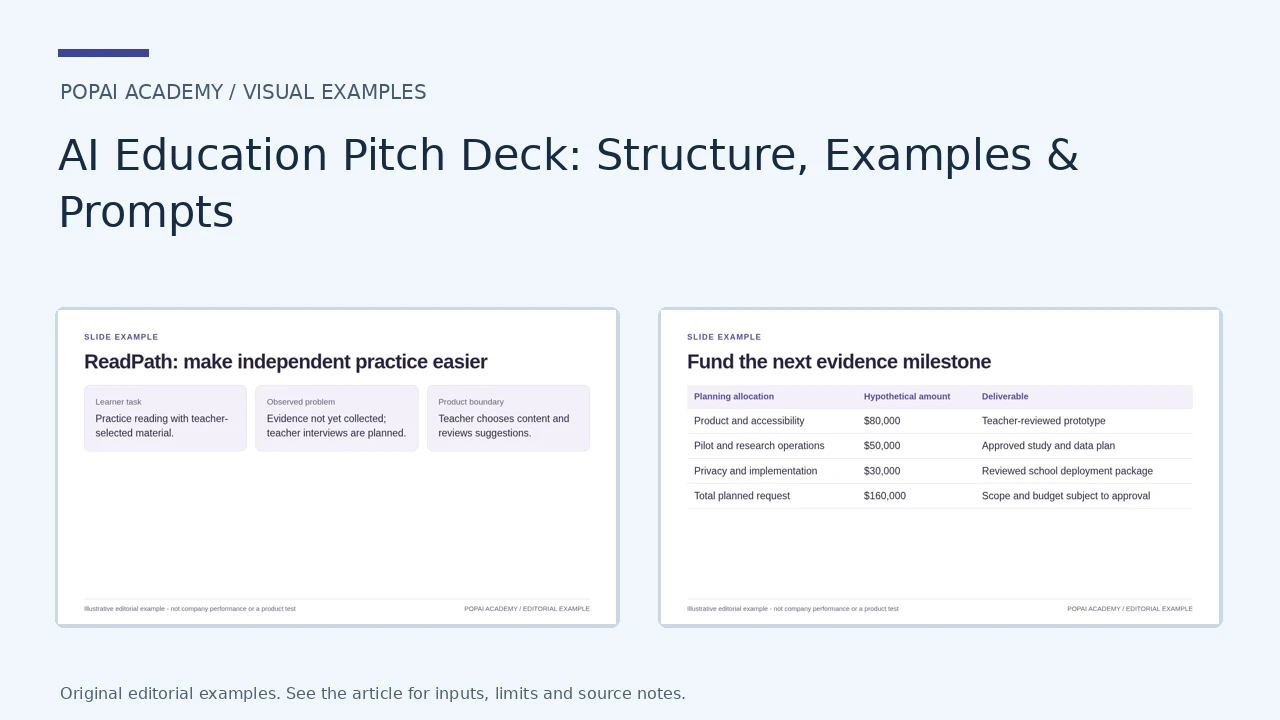
Five Connected Education Pitch Examples
ReadPath is a fictional product used consistently across all five pages. The proposed sample of 60 learners is a study-plan illustration: nobody was recruited and no learning effect was measured.
Open full-size examples and editable HTML layouts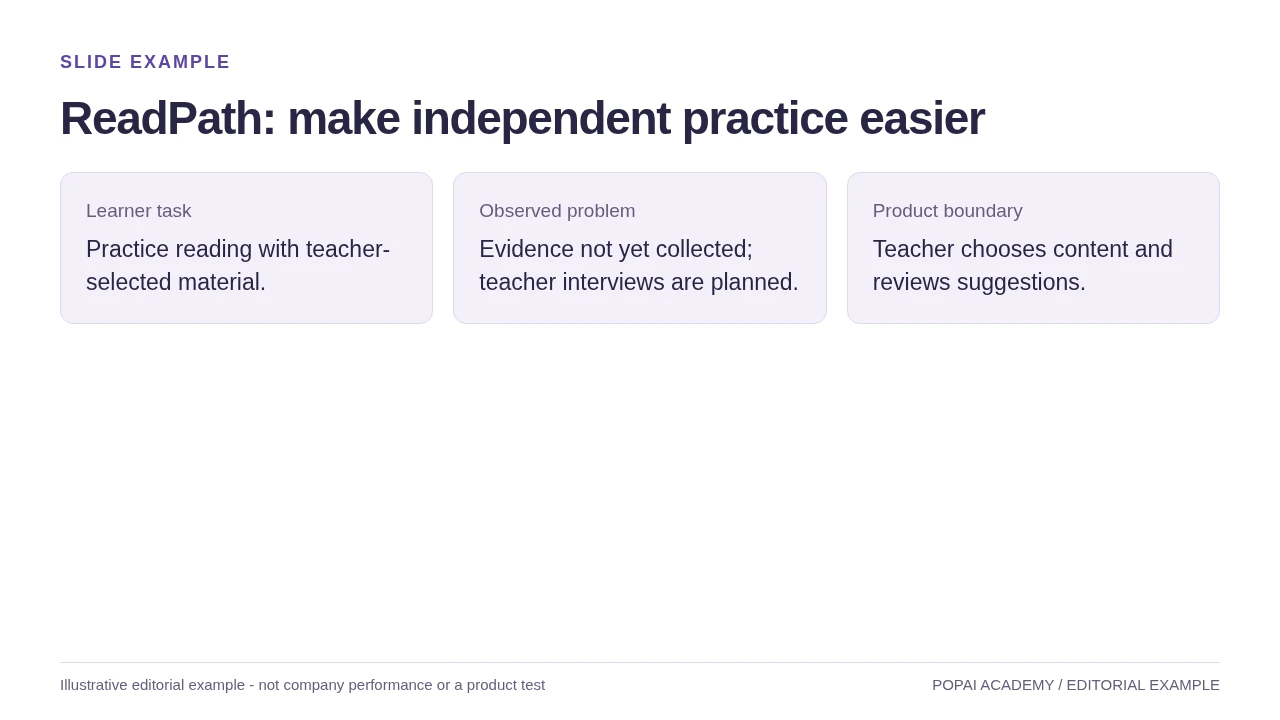
ReadPath is a fictional education product; this is the problem hypothesis, not proven demand.
Read or copy the slide content
Learner task
Practice reading with teacher-selected material.
Observed problem
Evidence not yet collected; teacher interviews are planned.
Product boundary
Teacher chooses content and reviews suggestions.
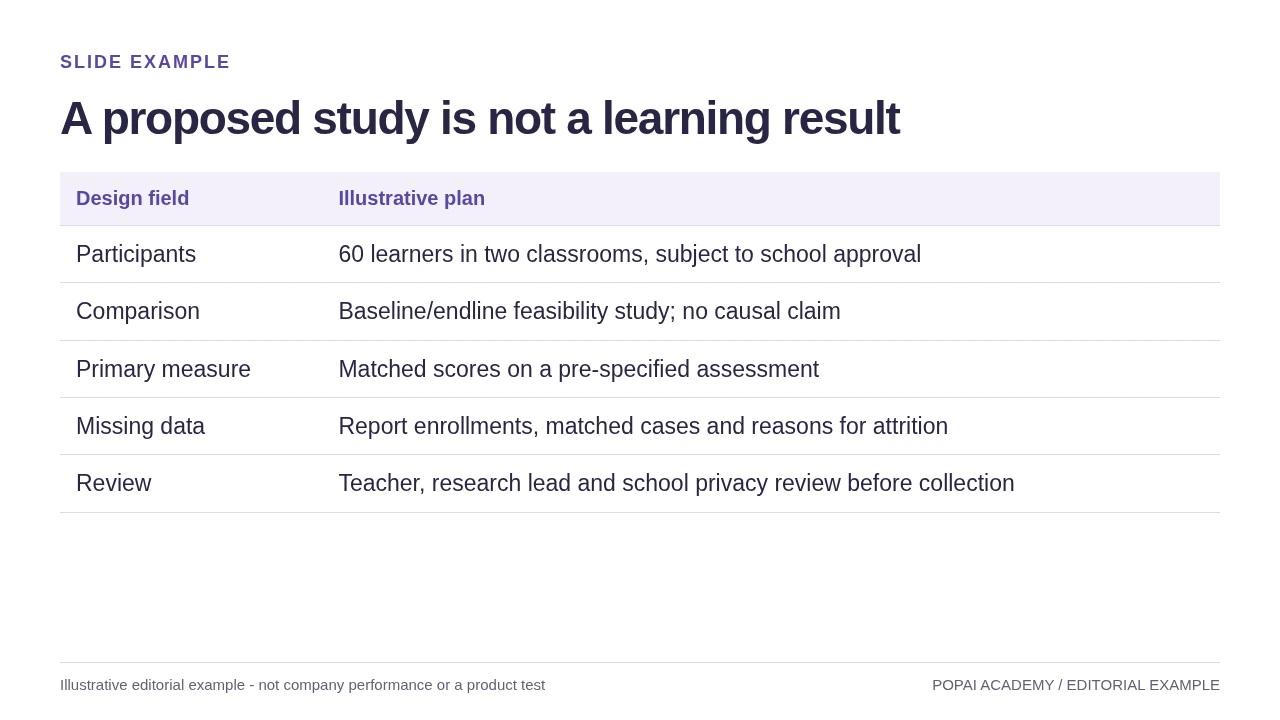
No students were recruited and no study was conducted for this editorial example.
Read or copy the slide content
Design field
Illustrative plan
Participants
60 learners in two classrooms, subject to school approval
Comparison
Baseline/endline feasibility study; no causal claim
Primary measure
Matched scores on a pre-specified assessment
Missing data
Report enrollments, matched cases and reasons for attrition
Review
Teacher, research lead and school privacy review before collection
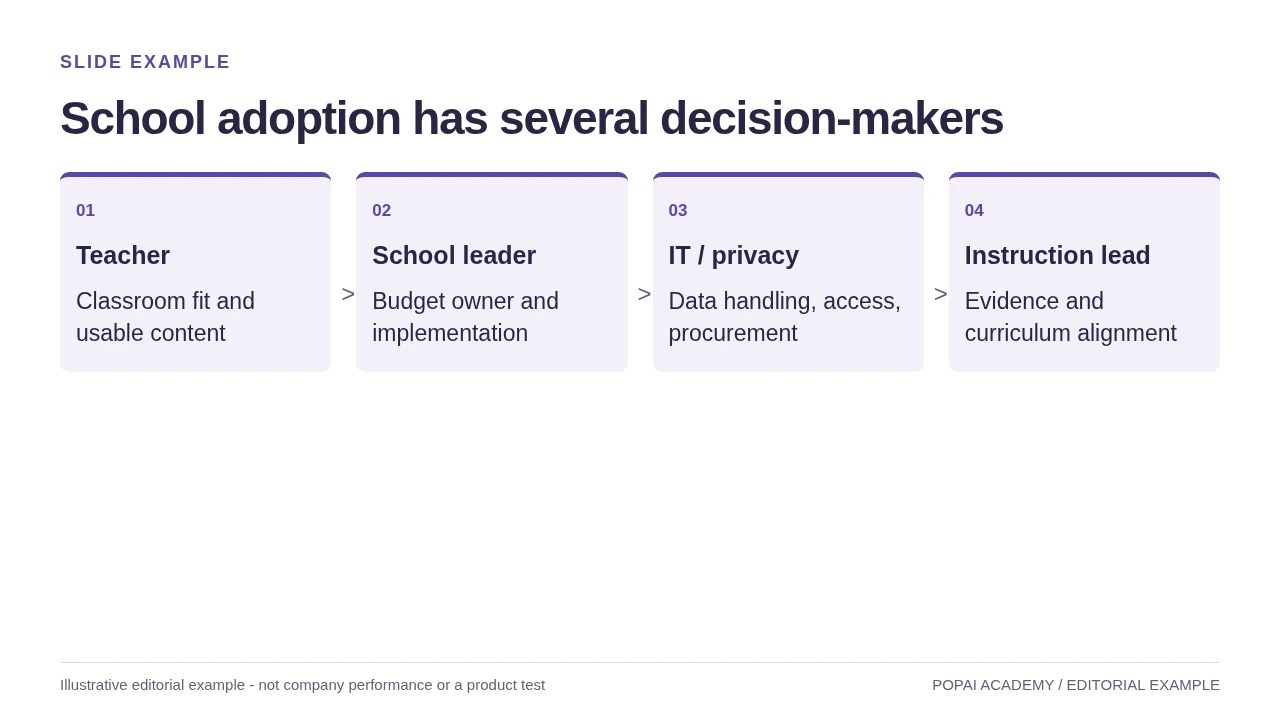
Illustrative purchasing roles, not a universal school procurement process.
Read or copy the slide content
01
Teacher
Classroom fit and usable content
02
School leader
Budget owner and implementation
03
IT / privacy
Data handling, access, procurement
04
Instruction lead
Evidence and curriculum alignment
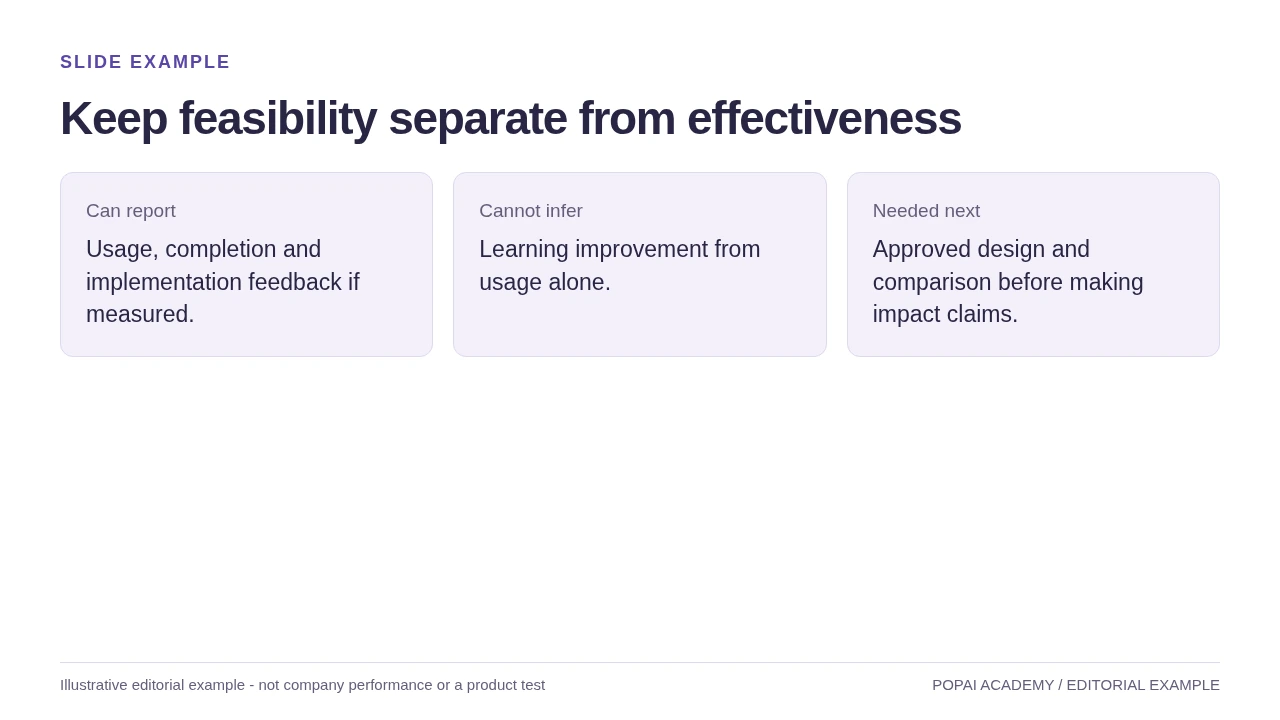
An evidence-boundary slide prevents a usage pilot from becoming an efficacy claim.
Read or copy the slide content
Can report
Usage, completion and implementation feedback if measured.
Cannot infer
Learning improvement from usage alone.
Needed next
Approved design and comparison before making impact claims.
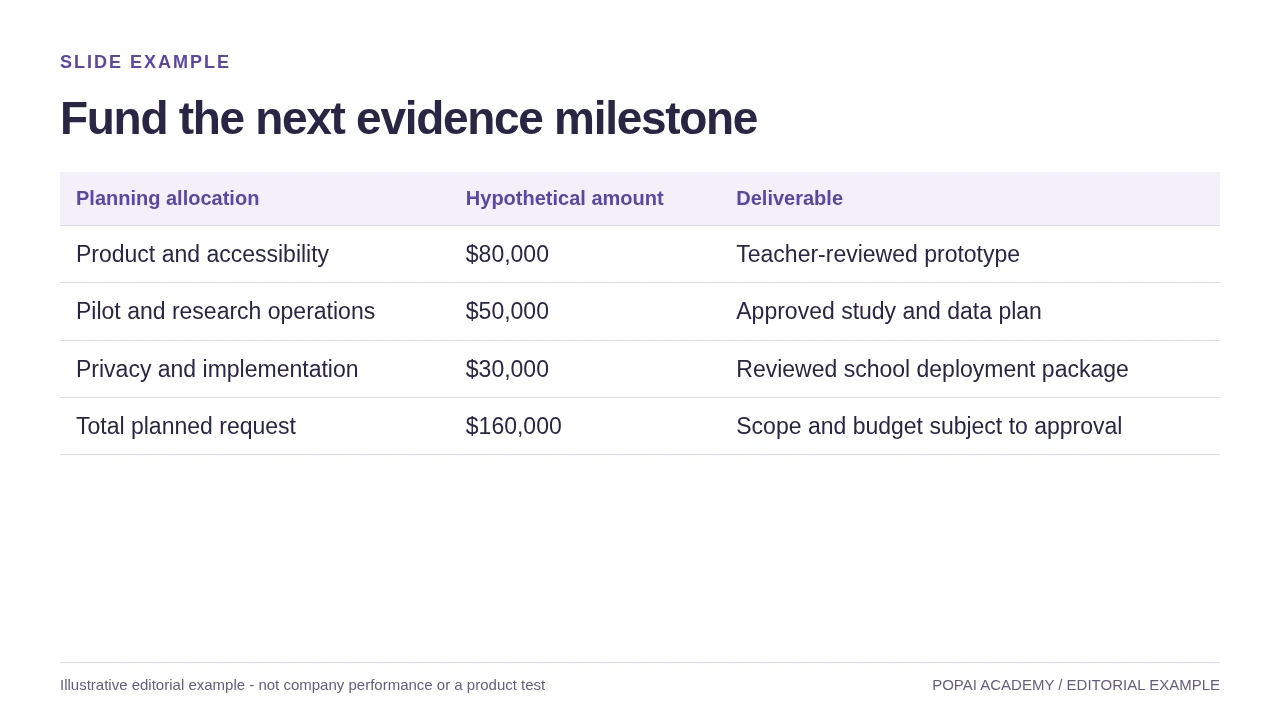
Fictional use-of-funds example; no funding commitment or school endorsement.
Read or copy the slide content
Planning allocation
Hypothetical amount
Deliverable
Product and accessibility
$80,000
Teacher-reviewed prototype
Pilot and research operations
$50,000
Approved study and data plan
Privacy and implementation
$30,000
Reviewed school deployment package
Total planned request
$160,000
Scope and budget subject to approval
Prompt for this example set
Create five education investor slides for fictional ReadPath: problem, proposed study, procurement chain, evidence limits and use of funds. Distinguish research plans from results.
Choose the audience and funding story first
A convincing education pitch begins with who uses the product, who pays, and what decision you want from the room.
Before drafting, write down the audience, fundraising stage, presentation setting, and precise ask. An early-stage investor wants to understand what you have learned and what milestone funding will unlock. A district buyer wants to know how the product fits into instruction, who will implement it, what data it uses, and how procurement works. The same product needs a different emphasis for each conversation.
- K–12, school-funded: separate the student or teacher user from the administrator, district leader, and procurement team. Be ready to discuss pilot ownership, integration, security review, and the buying calendar.
- Family-funded learning: explain why parents pay, how learners return, and what it costs to acquire and retain a household.
- Higher education: identify whether the buyer is a department, institution, instructor, or learner; address adoption and integration with existing systems.
- Workforce learning: connect learner progress to completion, demonstrated skills, or an employer’s training objective.
Same product, different story: Northstar Reading could tell investors, “We are raising $1.2 million to test whether district pilots convert to paid contracts and improve a defined reading measure.” A district presentation would instead lead with teacher setup time, curriculum fit, student-data handling, pilot responsibilities, and the decision date. The amounts and milestones here are illustrative; founders should use their actual financing plan and customer evidence.
Keep current traction separate from the next segment you hope to enter. One school pilot is a useful learning opportunity, but it does not establish district-wide demand or a repeatable sales cycle.
Investor narrative: “We serve [specific learner] through [buyer or channel], address [measurable learning or workflow problem], and are raising [amount] to reach [verifiable milestone].”
AI education pitch deck structure: a practical 12-slide flow
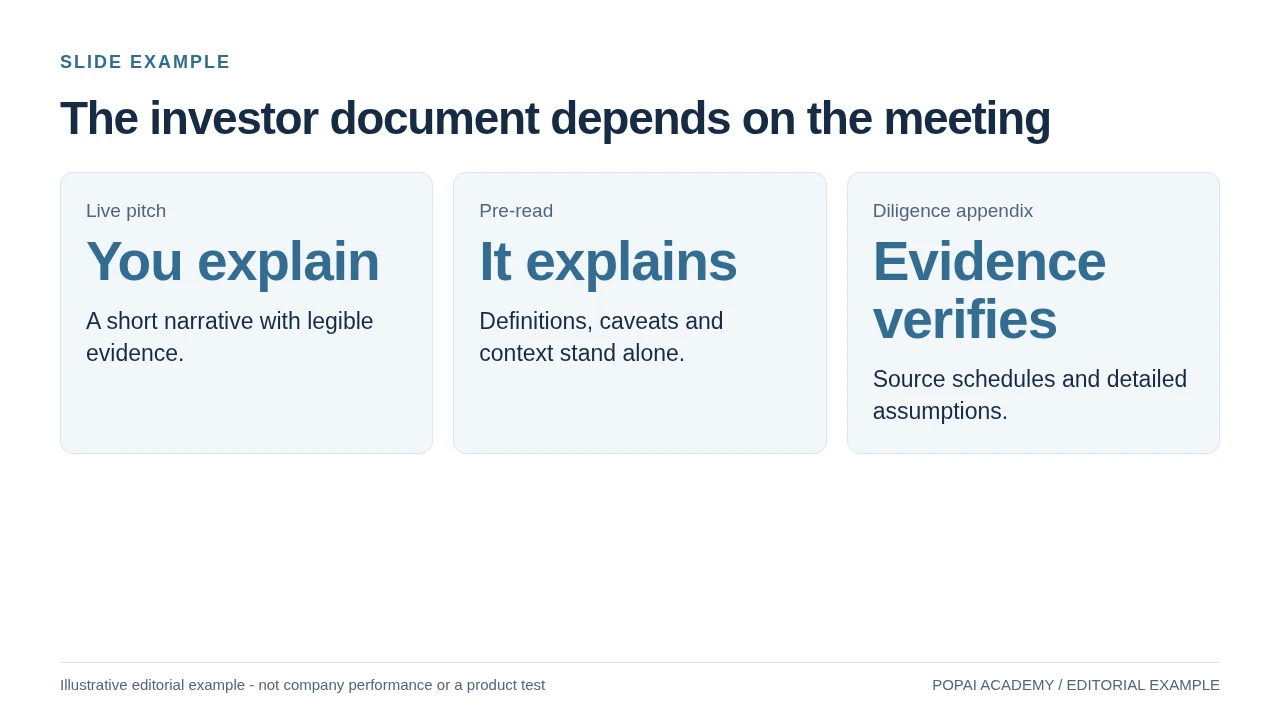
Use 12 slides to move from the learner problem to evidence, commercial viability, execution risks, and a specific funding ask.
This is a working investor-deck outline, not a mandatory format. For a short live pitch, combine slides or cut supporting detail; for an email deck, include enough context to stand alone. Each slide below has a sample headline and a useful evidence or visual cue. Northstar Reading examples are fictional.
- Cover and thesis: State who the product serves and what it changes. Example: “Short, teacher-assigned practice helps grade 4 readers build fluency.” Visual: one product image, not a collage of features.
- Learning problem: Name the learner, setting, and current consequence. Example: “Teachers need a practical way to assign targeted practice between reading groups.” Support it with interviews, workflow observations, or a documented local need—not a broad claim about all schools.
- Solution: Show how the product addresses that problem and who uses it. Include the buyer’s role where relevant; avoid presenting a feature list as the solution.
- Product and learning mechanism: Walk through one learner or educator journey. Explain the instructional rationale—such as guided practice and feedback—and show where a teacher remains involved.
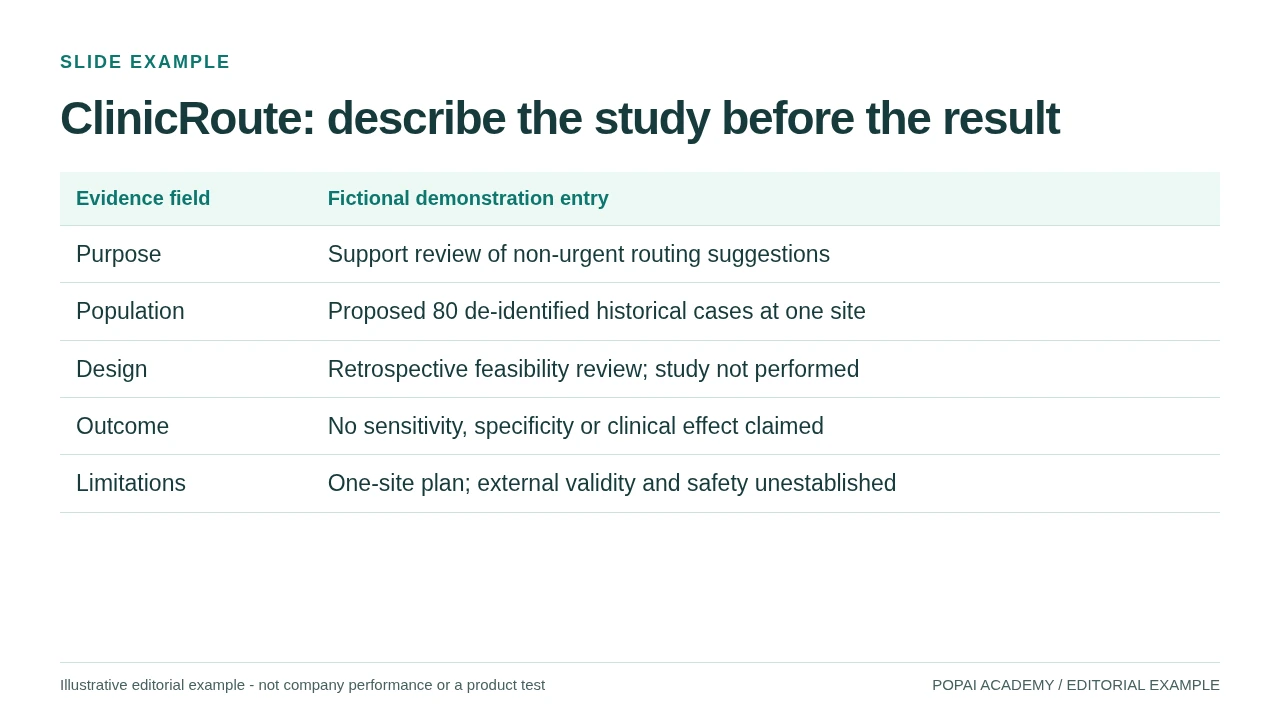
- Evidence and limitations: Report the pilot design, cohort, measure, dates, and result. Pair the result with its limitation rather than implying proof the study did not establish.
- Market entry: Define the first reachable segment and show the calculation. For example: eligible schools × plausible annual contract value, with the source and assumptions for both inputs.
- Business model: Identify the payer, pricing basis, contract model, and delivery costs. Label untested prices and margin projections as assumptions.
- Go-to-market: Map how leads become pilots, paid contracts, and renewals. Include observed sales-cycle length and implementation ownership when available.
- Alternatives: Compare direct products and current workarounds on criteria buyers care about, such as teacher setup, curriculum fit, evidence, and cost.
- Traction and operating economics: Show paid seats, retention, renewal, implementation cost, or other relevant commercial signals. Distinguish paid use from free pilots and contracted revenue from projections.
- Team and execution plan: Connect relevant experience to the next milestones. Show who owns product, instruction, sales, and implementation, and what must be learned next.
- Risks and funding ask: Name the most material unresolved risks, then state the amount sought, planned use of funds, and measurable milestones it is intended to support.
For an email deck, include sources and definitions in slide footnotes or speaker notes; a live version can use fewer words and a stronger visual explanation. If you are comparing workflows or tools, this guide to AI presentation makers can help you assess how different creation approaches fit your process.
Show learning evidence without overstating it
For every result, show what changed, for whom, over what period, how it was measured, and what the study cannot establish.
Separate learning, engagement, and business signals
Choose metrics that match the product’s intended outcome. Assessment change or skill transfer may be relevant to a tutoring product; repeat practice is an engagement signal, not a learning outcome. For a teacher workflow tool, time saved may matter, but explain how it was measured. Pilot conversion, renewal, and willingness to pay speak to commercial viability—not student learning.
- Learning outcomes: report the assessment or task, scoring method, baseline, follow-up, cohort, and time window.
- Leading indicators: define activation, frequency, completion, or retention and state the denominator and observation period.
- Commercial outcomes: distinguish free pilots, paid contracts, renewals, and signed but not yet implemented agreements.
- Educator value: show the baseline and collection method for claims such as time saved or reduced administrative work.
Make the method and limitations visible
Illustrative worked example: Suppose Northstar Reading enrolled 24 classrooms in a six-week pilot, and 18 completed the program. The slide could say, “18 of 24 enrolled classrooms completed six weeks; completion means at least one assigned activity in five of six weeks.” The source is the product activity log, and the cohort is all 24 classrooms enrolled at launch. This is an engagement result, not evidence of improved reading or paid demand. If participating teachers opted in, their classrooms may also differ from those that did not participate.
For learning measures, disclose how many students had matched baseline and follow-up results, whether students were missing from either test, and whether the assessment is appropriate for the skill claimed. A small pilot can help test feasibility and refine a measure, but it usually cannot establish a reliable effect across different settings. Without a comparison group, report a pre/post observation; stronger causal language requires a design that can address alternative explanations, such as an appropriate comparison group and a credible assignment or matching method. If results are mixed, show the full relevant result and explain the variation rather than selecting only the favorable subgroup.
For a methodology reference, the U.S. Department of Education’s What Works Clearinghouse study design standards explain how research design affects the strength of an evidence claim. A pitch deck is not a substitute for a full study report; link or footnote the underlying method when making a material efficacy claim.
“Students’ scores rose during the pilot” describes an observation. “The product caused scores to rise” requires evidence that can rule out plausible alternative explanations.
AI education pitch deck prompt template
Use a sequence of prompts to outline, draft, and check the deck; provide source material and explicit rules for uncertainty.
Keep a source sheet with each fact, its date, owner, and source file. When documents conflict, ask the model to flag the discrepancy rather than choose a convenient number. Remove student names, identifiable records, and confidential customer information unless your organization has approved the tool and its data-handling terms for that use.
1. Build the investor outline
2. Draft a specific slide
3. Check claims against sources
4. Adapt the narrative for a buyer
For Northstar Reading, a useful draft headline might be “18 of 24 pilot classrooms completed six weeks of assigned practice.” The model should also flag that this is an engagement measure, not a reading outcome. Treat generated wording as a draft: a founder or research lead must check every number, source, and claim before presenting it.
Turn the outline into an editable deck
Separate source preparation, outline review, slide production, and final quality checks so errors are caught before design polish.
Use a source-to-slide workflow
As a practical example, a founder might assemble a business plan, de-identified pilot summary, product screenshots, market research, and a financial model, then generate and review the outline before creating slides. PopAi’s prompt-entry screen above illustrates the first step; its presentation workflow can be used to organize supplied content into an outline and draft slides. Available inputs and editing behavior can change, so confirm current product options in the interface. The tool can help arrange material; it cannot validate the underlying research or business assumptions.
- Prepare sources: label verified results, estimates, hypotheses, and material that must not appear in the deck. Use de-identified summaries rather than student-level records.
- Review the outline: check the audience, narrative sequence, missing evidence, and whether every slide supports the ask before generating polished layouts.
- Edit slide content: verify each number against its source, ensure chart labels match the underlying data, and add definitions or caveats where needed.
- Check consistency: compare slide text with speaker notes, totals across slides, dates, pricing, and use-of-funds figures.
- Export and test: open the exported PPTX or PDF in the environment you will use. Check font substitution, chart readability, links, contrast, reading order, and whether slides still make sense without narration.
- Control versions: date the final file, retain the source sheet, and keep a record of who approved research, financial, and privacy claims.
Before using any AI tool, review its current data-handling terms and your organization’s policy. Do not upload identifiable student information, confidential customer material, or sensitive security details unless the use is approved and appropriate safeguards are in place. A draft may save organization time, but the founder or research lead remains responsible for accuracy, accessibility, and final slide quality.
Pitfalls: market claims, privacy, and implementation
Show investors that you understand the risks specific to your product and have owners and processes to manage them.
Market and procurement assumptions
Estimate the market from a reachable initial segment rather than an unsupported top-down total. Show how you counted eligible buyers, what pricing assumption you used, and what portion you can realistically serve. A family subscription app and a district analytics product have different sales channels, budgets, and buying processes; do not use one pilot to imply demand across both. Label forecasts as forecasts and state who must validate the assumptions.
Student data, safety, and security
A tutoring chatbot and a school analytics tool create different risks. A tutoring chatbot may need age-appropriate response boundaries, human escalation, and clear handling of conversations; an analytics tool may need to explain which student records it uses, who can see them, and how recommendations are reviewed. Investors may reasonably ask for data minimization, access controls, retention and deletion practices, vendor review, and an incident-response owner. The deck can summarize the approach, but a bullet is not a substitute for technical or legal review.
Requirements depend on where you operate, the users’ ages, the buyer, and the data involved. In the United States, for example, school relationships may raise FERPA considerations, while services directed to children under 13 may raise COPPA considerations; other jurisdictions have their own rules. Consult qualified counsel about the product’s actual data flows and obligations rather than treating a general checklist as legal advice.
Accessibility, bias, and classroom adoption
Explain how the product is tested with learners who have different access needs, devices, language backgrounds, and levels of connectivity. For AI-generated feedback or recommendations, describe how errors and potential disparities are monitored and how educators can intervene. Also name the implementation owner: a product that requires teacher training, roster setup, or curriculum mapping needs time and support beyond software development.
- Student data: state what is collected, why it is needed, who can access it, and how long it is retained.
- Minors and safety: identify age-appropriate safeguards, escalation paths, and human oversight.
- Accessibility and bias: describe testing practices and how concerns are investigated and addressed.
- Academic integrity: clarify the product’s intended role and how educators or learners remain accountable for submitted work.
- Adoption reality: address onboarding, curriculum fit, integration, procurement, ongoing support, and implementation ownership.
Final fact-check: trace every chart, customer logo, learning claim, and forecast to a source. Mark assumptions, disclose study limitations, and remove unsupported claims rather than asking AI to make them sound more certain.
Use the Education Samples Without Implying a Trial
The sample product and all proposed numbers are fictional. A baseline/endline feasibility exercise does not, by itself, establish that the product caused learning improvement. Preserve enrollment counts, attrition and matched observations, and review the study design before collection. Use the investor structure guide for the general document sequence; keep school procurement and learning evidence specific on this page.