This guide is for biotech teams preparing an early institutional fundraising deck, especially therapeutics companies that need to connect biological rationale to investable milestones.
A pre-seed therapeutics deck may center on target validation and a credible path to a first decision point; a clinical-stage company needs to explain patient selection, endpoints, safety, and trial design. Diagnostics teams must also show workflow fit, reimbursement, and adoption, while platform companies need evidence that the platform can produce repeatable, valuable programs—not just one promising result. In every case, investors need to see how evidence maturity, remaining risk, and use of proceeds fit together. Use AI to organize and communicate the story, not to invent evidence or make regulatory decisions. When comparing broader AI presentation makers, assess source handling, editing, and export—not just the first draft.
AI biotech pitch deck structure investors can follow
Build the deck around the investor’s decision: what is proven, what remains uncertain, and what the next financing will resolve.
A 10–14-slide core deck can be a useful planning range, not an investor rule or a substitute for judgment. A short first-meeting deck can omit detail that belongs in a diligence appendix; a financing deck should make its next decision gates and funding logic explicit. Give each slide a job:
- Thesis and program: What are you developing, for whom, and what is the investable insight? Name the modality, indication, and development stage.
- Unmet need and current practice: Which patient or workflow is underserved, and what limits the current standard of care? Use a defined population or workflow, not an unqualified “large unmet need.”
- Product and mechanism: What does the product do, and what evidence supports the proposed mechanism? Separate biological rationale from demonstrated activity.
- Evidence and differentiation: What has been measured, in which model or population, against what comparator? Explain why the result matters relative to alternatives.
- Development plan and decision gates: What experiment, study, or operational milestone comes next, and what result would change the plan?
- Execution risks: For therapeutics, address relevant CMC, manufacturing, IP, and freedom-to-operate questions. For clinical programs, show patient selection, endpoints, and trial assumptions. For diagnostics, include workflow integration, validation, reimbursement, and adoption barriers.
- Market and business model: Show how the addressable population or customer base leads to a plausible path to adoption and revenue. State the assumptions behind the calculation.
- Team, financing, and use of proceeds: Why can this team execute the next plan? Tie the amount raised to specific work packages, milestones, and decision points.
“We will complete the next study” is an activity. “We will test whether biomarker-defined samples respond at the prespecified threshold, then decide whether to advance the lead” is a milestone investors can evaluate.
Adapt the proof to the business model: A preclinical therapeutics company may need to make target biology and model relevance legible before discussing clinical potential. A clinical-stage company should foreground human evidence and trial design. A diagnostics company should demonstrate analytical and clinical validation separately, then show how the test fits a real care pathway. A platform company should show repeatability across programs and explain which assets or partnerships create value.
For regulatory context, use primary sources rather than letting a deck template supply assumptions. The FDA’s overview of clinical research is a starting point, not a substitute for program-specific regulatory advice. Put detailed protocols, full datasets, and IP opinions in diligence materials where appropriate.
Build evidence-led slides with concrete examples
A useful evidence slide states the finding, shows how it was measured, and marks the boundary of what it supports.
Separate observed results from interpretation and projections. For each plotted result, preserve the model or population, endpoint, units, sample size, comparator, time point, and source. If a result is preliminary, negative, or inconclusive, show that plainly; selectively omitting an important limitation can make a polished slide less credible in diligence.
Worked example: a preclinical result, clearly labeled hypothetical
Illustrative slide headline: “Candidate X reduced assay signal in a preclinical cell model; effect varies by donor line.” The following numbers are fictional and demonstrate slide structure only—not company results or an efficacy claim:
- Endpoint: normalized assay signal at 48 hours, with vehicle control set to 100.
- Illustrative result: Candidate X, 68; vehicle, 100. Show the individual observations and the summary statistic, rather than a bar alone.
- Context: n=6 independent donor-derived cell lines; report the concentration, assay method, variability, and whether the analysis was prespecified.
- Source note: “Illustrative synthetic data; not company data. Replace with approved study report, figure/table identifier, assay version, and analysis date.”
- Limitation beside the chart: “In vitro assay result; does not establish selectivity, in-vivo activity, safety, or clinical benefit.”
This example supports only a narrow technical observation if the underlying study actually shows it. It does not establish that the target is clinically relevant or that the candidate will work in patients. For a clinical-stage slide, replace the cell-model context with the trial population, enrollment and analysis set, endpoint definition, follow-up, comparator, and confidence interval or other appropriate uncertainty measure. A result that misses its endpoint should be shown with the same clarity as a positive one, followed by what the team learned and how the plan changes.
Worked example: turn a development activity into a financing milestone
Illustrative, hypothetical milestone: “Within 12 months, complete a dose-ranging study and select a lead candidate based on a prespecified exposure and activity threshold.” A useful slide connects that decision to the financing plan: budget the study and analytical work, identify dependencies such as assay readiness and material supply, and define what happens if the threshold is missed. For example, the contingency might be to test a backup candidate or stop the program—not simply extend the timeline. Dates and costs should come from the company’s own plan, not AI-generated estimates.
Use a source note someone else can follow: document title or study ID, figure/table number, data cutoff, and whether the values are raw, analyzed, or projected.
Keep biological rationale, technical feasibility, and clinical potential as distinct claims when they rest on different evidence. A scientific reviewer should confirm the figure against the underlying report; a regulatory or clinical reviewer should check that development language does not imply an agreed pathway when none exists.
Write a precise prompt for an AI biotech pitch deck
Use separate prompts for structuring, translating evidence into slides, and finding claims that need review.
Prepare a source packet with dated, clearly named documents and a short glossary. Mark each fact as observed, planned, or projected; identify the approved version of any figure; and list unresolved discrepancies rather than silently choosing one source. Ask the tool to preserve units, labels, caveats, and citations verbatim where needed.
Outline prompt: “Propose a 10–14-slide core fundraising deck for a [stage] [therapeutics/diagnostics/platform] company developing [product] for [indication or workflow]. Audience: life-sciences investors. For each slide, state the investor question it answers, the evidence needed, a conclusion-led headline, and likely appendix material. Use only the supplied facts. Mark missing inputs as [NEEDS SOURCE]; do not fill them with assumptions.”
Evidence-to-slide prompt: “Turn the supplied study summary into one draft slide. Preserve model/population, sample size, endpoint, units, comparator, time point, uncertainty, and source citation exactly. Separate the observed result from interpretation. If a field is absent or sources conflict, flag it and do not infer a value. Add a one-sentence limitation.”
Red-team prompt: “Review this draft as a skeptical biotech investor. List every claim that exceeds its cited evidence, every unexplained market or timeline assumption, and every phrase that could be read as a clinical or regulatory conclusion. Quote the slide text, identify the missing source or caveat, and suggest a narrower wording without adding facts.”
Run a simple review loop: generate the outline, compare it with the fundraising objective, draft one evidence slide, check every value against its source, then revise the prompt or source packet where the tool found gaps. If source files disagree, retain both versions and ask the responsible owner to resolve the conflict. Before uploading unpublished data, patient information, or commercially sensitive material, review the tool’s current data-handling terms and your organization’s policies. If those terms are unsuitable or unclear, use sanitized or public materials instead.
Draft and refine an AI biotech pitch deck with PopAi
Use the software for structure and presentation work; keep scientific interpretation and approval with the people accountable for the data.
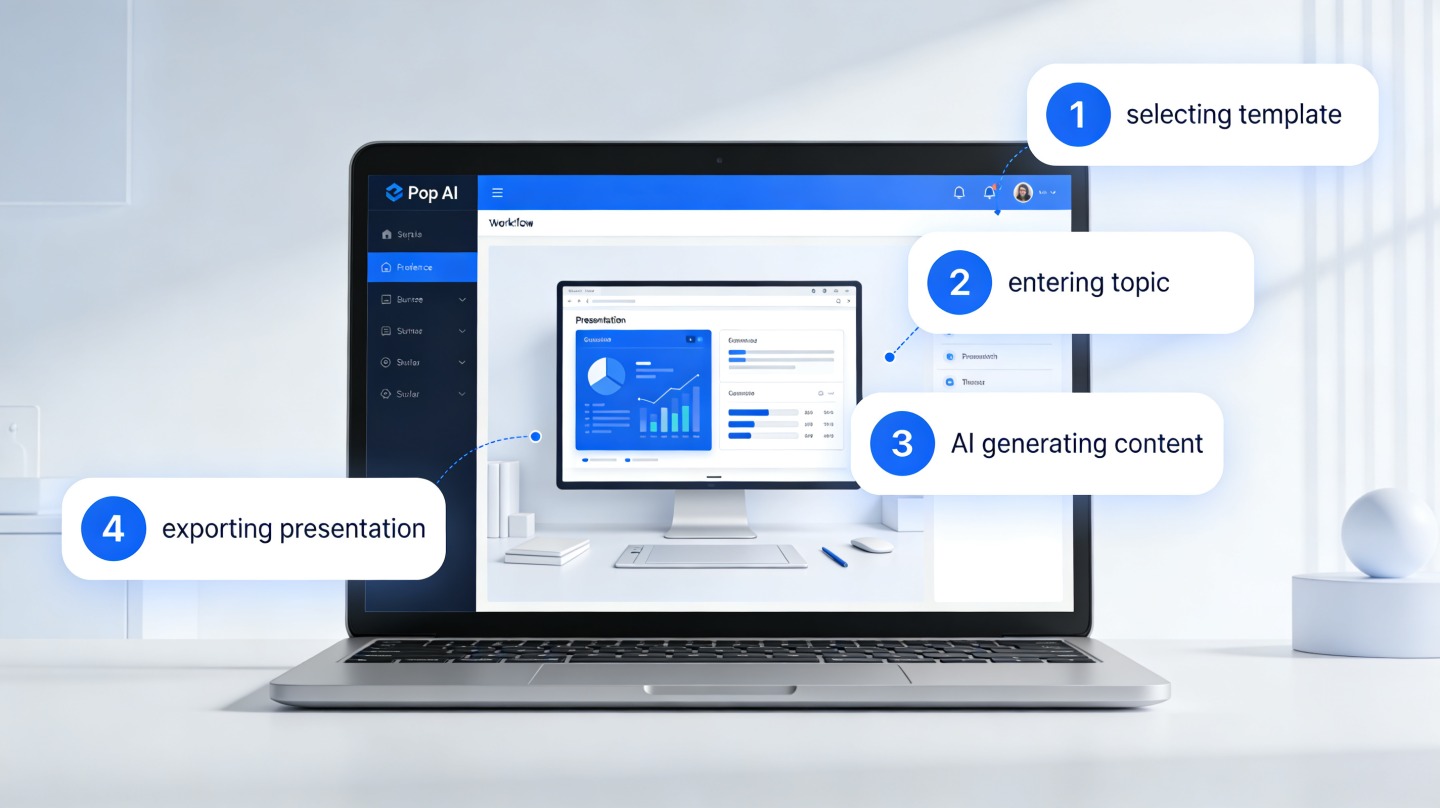
You can create a presentation with PopAi AI Presentation from a prompt or supporting materials. For a research-heavy deck, begin with an outline rather than generating every slide at once. Check whether the proposed sequence gives enough space to the strongest evidence, key risks, and financing milestones before moving into slide design.
1. Prepare and review the source packet
Start with a concise company brief and the approved versions of relevant study summaries, market assumptions, and development plans. Remove information you are not authorized to upload. Keep a source list outside the deck so a reviewer can trace slide claims to original reports; importing a document does not by itself verify its contents or citations.

2. Generate the outline, then one test slide
Review the outline for missing investor questions before generating the full deck. Test a single evidence slide first: compare its headline, chart labels, source note, and caveat with the source document. Inspect scientific terms, abbreviations, units, and any table or chart the tool has reformatted; correct these against the original rather than assuming imported content stayed unchanged.
- For an editable investor deck: An element-level editing workflow is useful when the team expects to revise text, labels, or figures frequently.
- For a conventional PPTX handoff: Choose the PowerPoint-oriented workflow when collaborators need to continue editing in PowerPoint, then inspect the exported file for font, layout, and object changes.
- For a visual concept draft: A whole-slide visual workflow can help explore composition, but may be less convenient when individual scientific labels or chart elements need precise edits.
PopAi’s available modes and editing behavior may change, so check the current product interface before choosing a workflow. Do not assume a generated chart preserves the source data, statistical treatment, or citation simply because the visual looks plausible.

3. Run scientific QA before visual polish
Have the data owner compare every plotted value and caption with the source report, then ask the clinical, regulatory, or commercial owner to review the claims in their area. After that, refine layout and export a test copy. Inspect the exported slides page by page for altered line breaks, missing labels, unreadable footnotes, and objects that are no longer editable as expected.
Avoid common biotech investor-deck pitfalls
Use a diagnostic question and a concrete repair for each common weakness.
- Science overload: Can a reader state the slide’s conclusion in one sentence? Move protocol detail and secondary results to the appendix; keep the decisive evidence in the main deck.
- Evidence-stage blur: Could a reader mistake an animal result for human evidence? Label in-vitro, animal, and clinical findings directly on the slide, and mark planned work as planned.
- Unauditable market sizing: Can someone reproduce the estimate? Show the population or customer count, eligibility assumptions, price or revenue basis, and source. Separate total market from the realistically reachable segment.
- Feature-only competition slide: Does the matrix explain why an alternative wins or loses in the target use case? Compare relevant mechanisms, evidence, patient segment, workflow, and development stage; cite the basis and acknowledge indirect competitors.
- Milestones that are only dates: Does each milestone have a deliverable, a decision threshold, dependencies, and a contingency? Replace “advance development” with the specific result that triggers the next investment decision.
- Overclaiming: Replace “best-in-class” or “clinically validated” with the measurable evidence and comparison that support the wording—or remove the claim.
For a fast outside-reader test, give someone unfamiliar with the program five minutes with the deck, then ask them to write down the product, strongest evidence, largest unresolved risk, next milestone, and what the raise funds. Compare their answers with the intended story. Disagreement points to a missing explanation or an overly broad claim; it is not a substitute for expert review.
Review checklist before sharing the deck
Use separate review passes with named owners, and treat unresolved factual errors as blockers to external sharing.
- Scientific/data owner — must fix: Match every figure, number, label, and source note to the approved report; confirm units, analysis population, and evidence-stage labels.
- Clinical/regulatory owner — must fix: Check endpoint, patient, trial, and regulatory language for accuracy; distinguish a company assumption from agency feedback or an established requirement.
- Finance/commercial owner — must fix: Recalculate market and financing assumptions; connect use of proceeds to costed work, dependencies, milestones, and decision gates.
- Leadership/legal/IP reviewers — must fix where applicable: Confirm approved claims, confidentiality, ownership, and the wording of IP or freedom-to-operate statements.
- Presentation owner — final pass: Check readability, chart labels, source-note size, slide order, and the exported file. Correct layout defects before sending.
Keep detailed protocols, full study reports, and supporting diligence documents available separately. A deck summarizes the case for a meeting; it should not imply that its abbreviated figures replace the underlying evidence.