
Presentation Summary
Explore the rich history, strategic framework, and modern achievements of UCLA Women's Basketball, a premier collegiate program with a legacy of championships and a bright future.
Full Presentation Transcript
Slide 1: UCLA Women's Basketball: Premier Collegiate Program Excellence
A Comprehensive Overview of History, Talent, and Championship Pathway
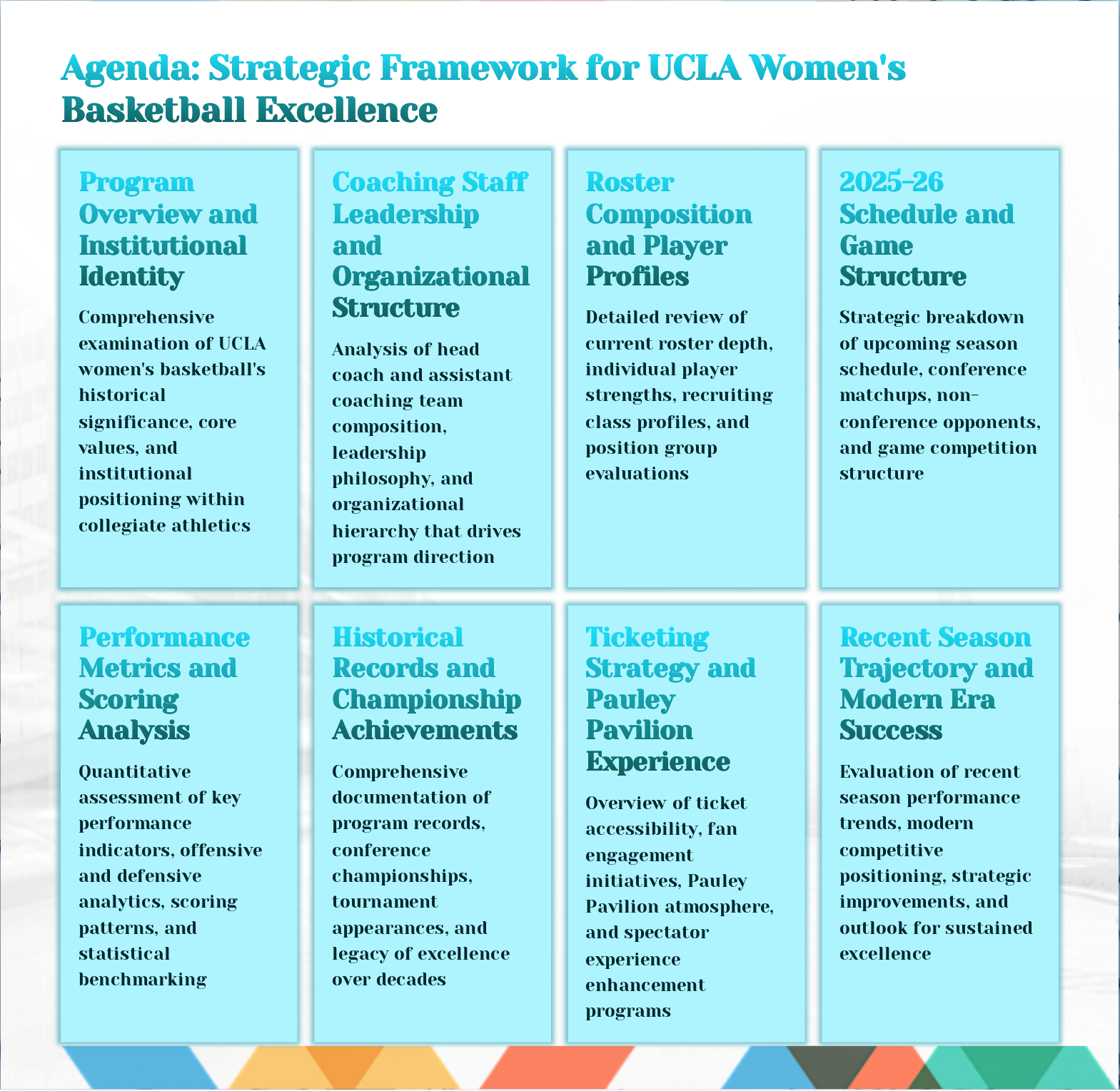
Slide 2: Agenda: Strategic Framework for UCLA Women's Basketball Excellence
- Program Overview and Institutional Identity: Comprehensive examination of UCLA women's basketball's historical significance, core values, and institutional positioning within collegiate athletics
- Coaching Staff Leadership and Organizational Structure: Analysis of head coach and assistant coaching team composition, leadership philosophy, and organizational hierarchy that drives program direction
- Roster Composition and Player Profiles: Detailed review of current roster depth, individual player strengths, recruiting class profiles, and position group evaluations
- 2025-26 Schedule and Game Structure: Strategic breakdown of upcoming season schedule, conference matchups, non-conference opponents, and game competition structure
- Performance Metrics and Scoring Analysis: Quantitative assessment of key performance indicators, offensive and defensive analytics, scoring patterns, and statistical benchmarking
- Historical Records and Championship Achievements: Comprehensive documentation of program records, conference championships, tournament appearances, and legacy of excellence over decades
- Ticketing Strategy and Pauley Pavilion Experience: Overview of ticket accessibility, fan engagement initiatives, Pauley Pavilion atmosphere, and spectator experience enhancement programs
- Recent Season Trajectory and Modern Era Success: Evaluation of recent season performance trends, modern competitive positioning, strategic improvements, and outlook for sustained excellence
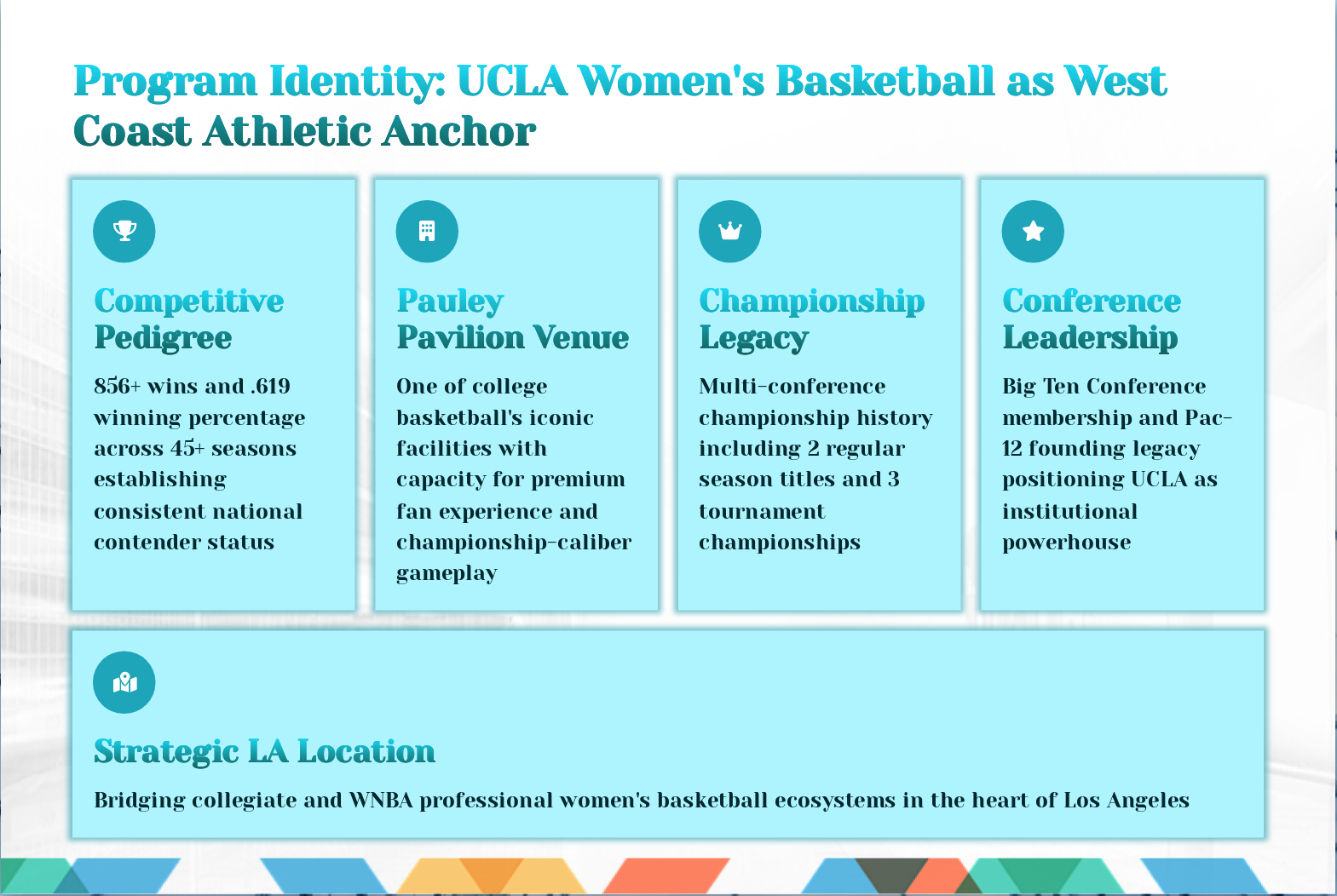
Slide 3: Program Identity: UCLA Women's Basketball as West Coast Athletic Anchor
- Competitive Pedigree: 856+ wins and .619 winning percentage across 45+ seasons establishing consistent national contender status
- Pauley Pavilion Venue: One of college basketball's iconic facilities with capacity for premium fan experience and championship-caliber gameplay
- Championship Legacy: Multi-conference championship history including 2 regular season titles and 3 tournament championships
- Conference Leadership: Big Ten Conference membership and Pac-12 founding legacy positioning UCLA as institutional powerhouse
- Strategic LA Location: Bridging collegiate and WNBA professional women's basketball ecosystems in the heart of Los Angeles
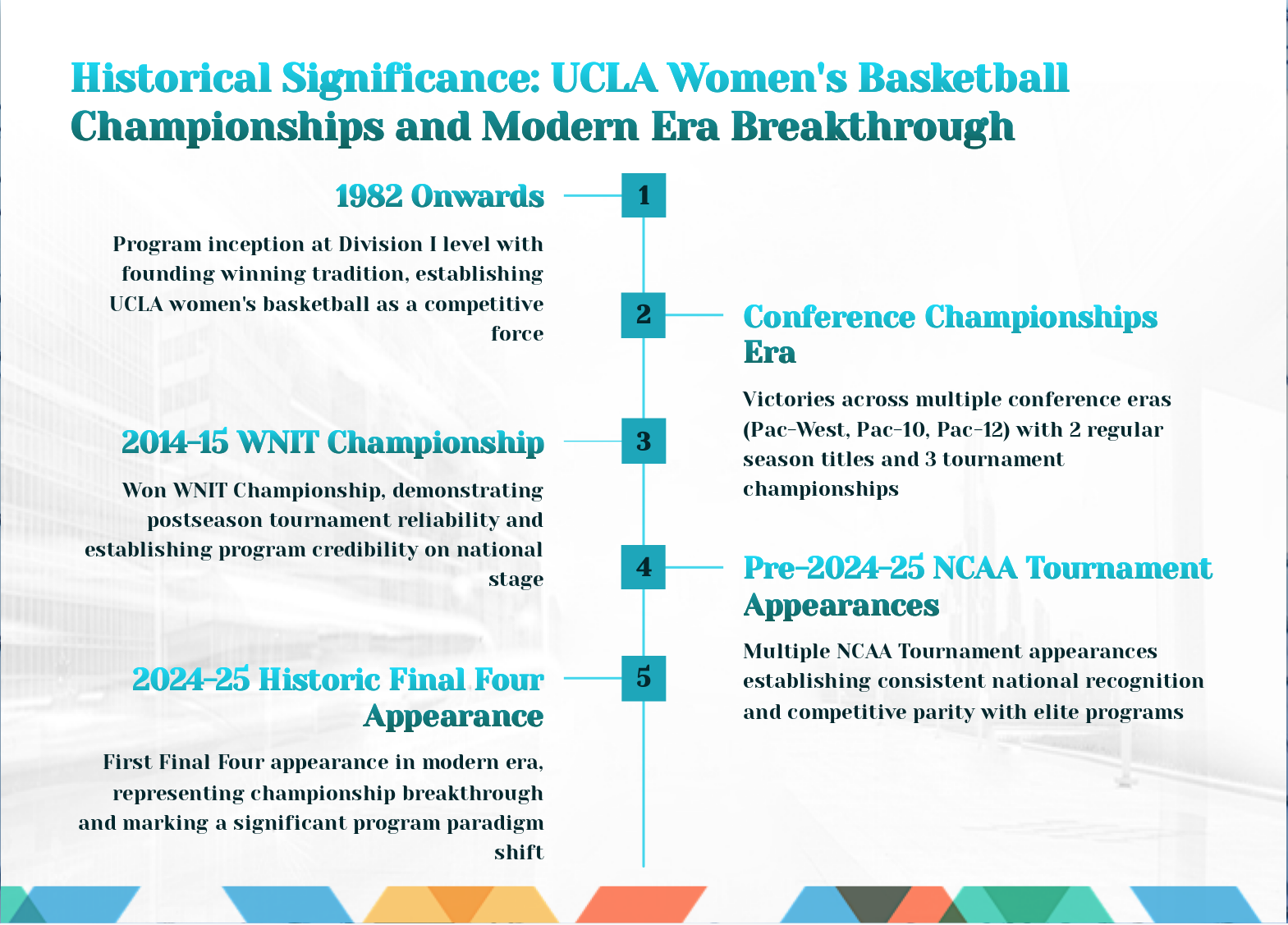
Slide 4: Historical Significance: UCLA Women's Basketball Championships and Modern Era Breakthrough
- 1982 Onwards: Program inception at Division I level with founding winning tradition, establishing UCLA women's basketball as a competitive force
- Conference Championships Era: Victories across multiple conference eras (Pac-West, Pac-10, Pac-12) with 2 regular season titles and 3 tournament championships
- 2014-15 WNIT Championship: Won WNIT Championship, demonstrating postseason tournament reliability and establishing program credibility on national stage
- Pre-2024-25 NCAA Tournament Appearances: Multiple NCAA Tournament appearances establishing consistent national recognition and competitive parity with elite programs
- 2024-25 Historic Final Four Appearance: First Final Four appearance in modern era, representing championship breakthrough and marking a significant program paradigm shift
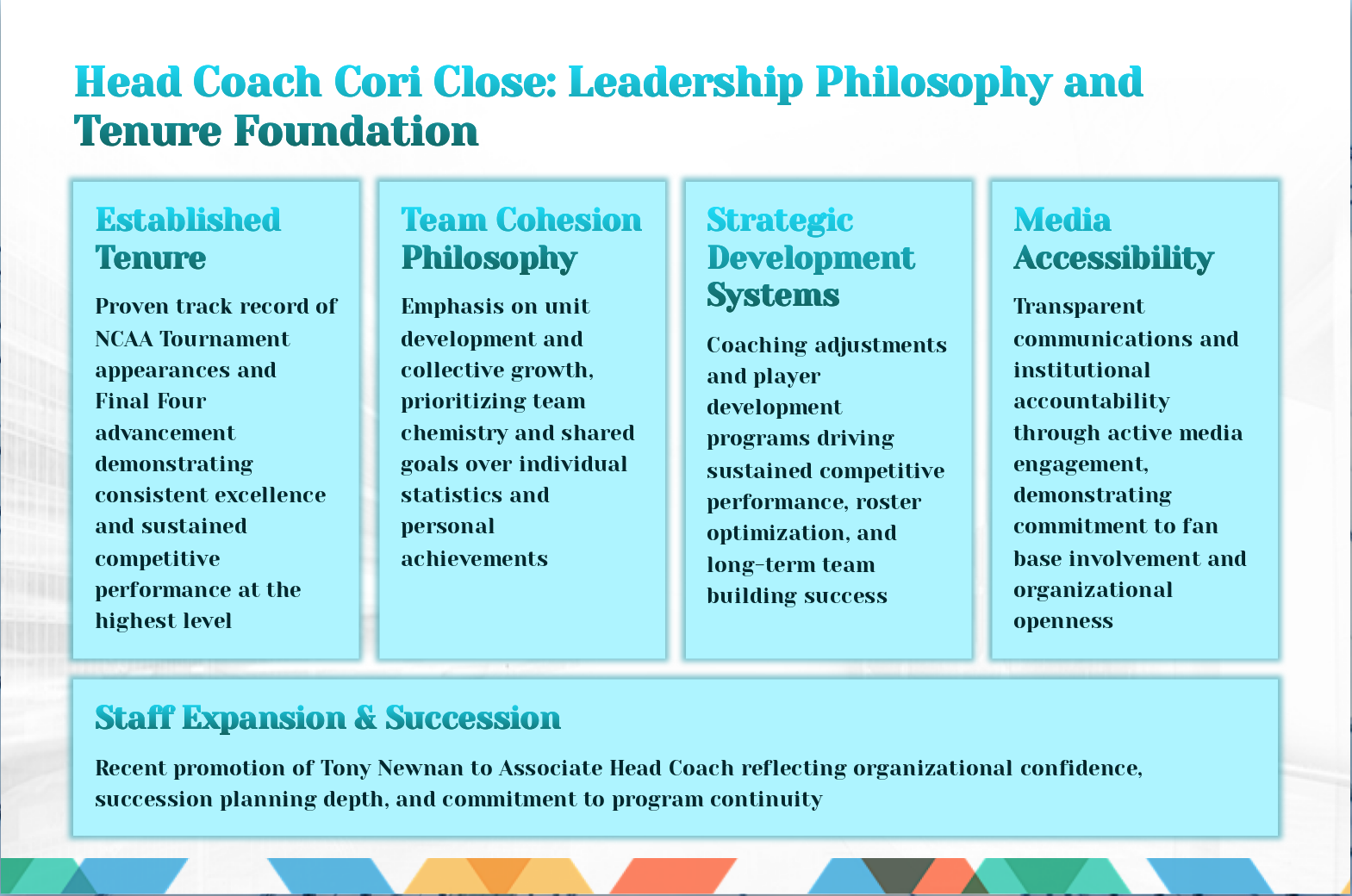
Slide 5: Head Coach Cori Close: Leadership Philosophy and Tenure Foundation
- Established Tenure: Proven track record of NCAA Tournament appearances and Final Four advancement demonstrating consistent excellence and sustained competitive performance at the highest level
- Team Cohesion Philosophy: Emphasis on unit development and collective growth, prioritizing team chemistry and shared goals over individual statistics and personal achievements
- Strategic Development Systems: Coaching adjustments and player development programs driving sustained competitive performance, roster optimization, and long-term team building success
- Media Accessibility: Transparent communications and institutional accountability through active media engagement, demonstrating commitment to fan base involvement and organizational openness
- Staff Expansion & Succession: Recent promotion of Tony Newnan to Associate Head Coach reflecting organizational confidence, succession planning depth, and commitment to program continuity
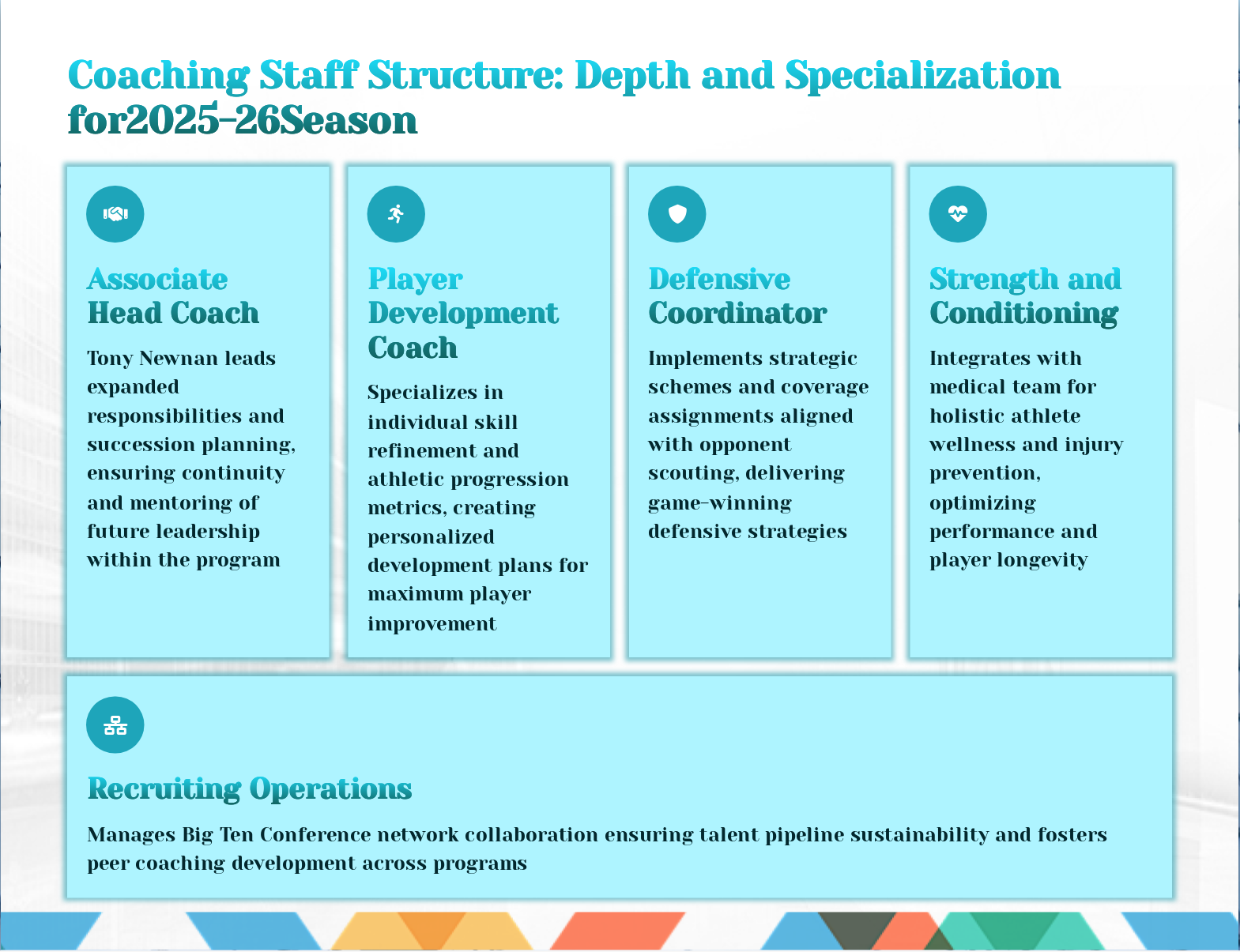
Slide 6: Coaching Staff Structure: Depth and Specialization for2025-26Season
- Associate Head Coach: Tony Newnan leads expanded responsibilities and succession planning, ensuring continuity and mentoring of future leadership within the program
- Player Development Coach: Specializes in individual skill refinement and athletic progression metrics, creating personalized development plans for maximum player improvement
- Defensive Coordinator: Implements strategic schemes and coverage assignments aligned with opponent scouting, delivering game-winning defensive strategies
- Strength and Conditioning: Integrates with medical team for holistic athlete wellness and injury prevention, optimizing performance and player longevity
- Recruiting Operations: Manages Big Ten Conference network collaboration ensuring talent pipeline sustainability and fosters peer coaching development across programs
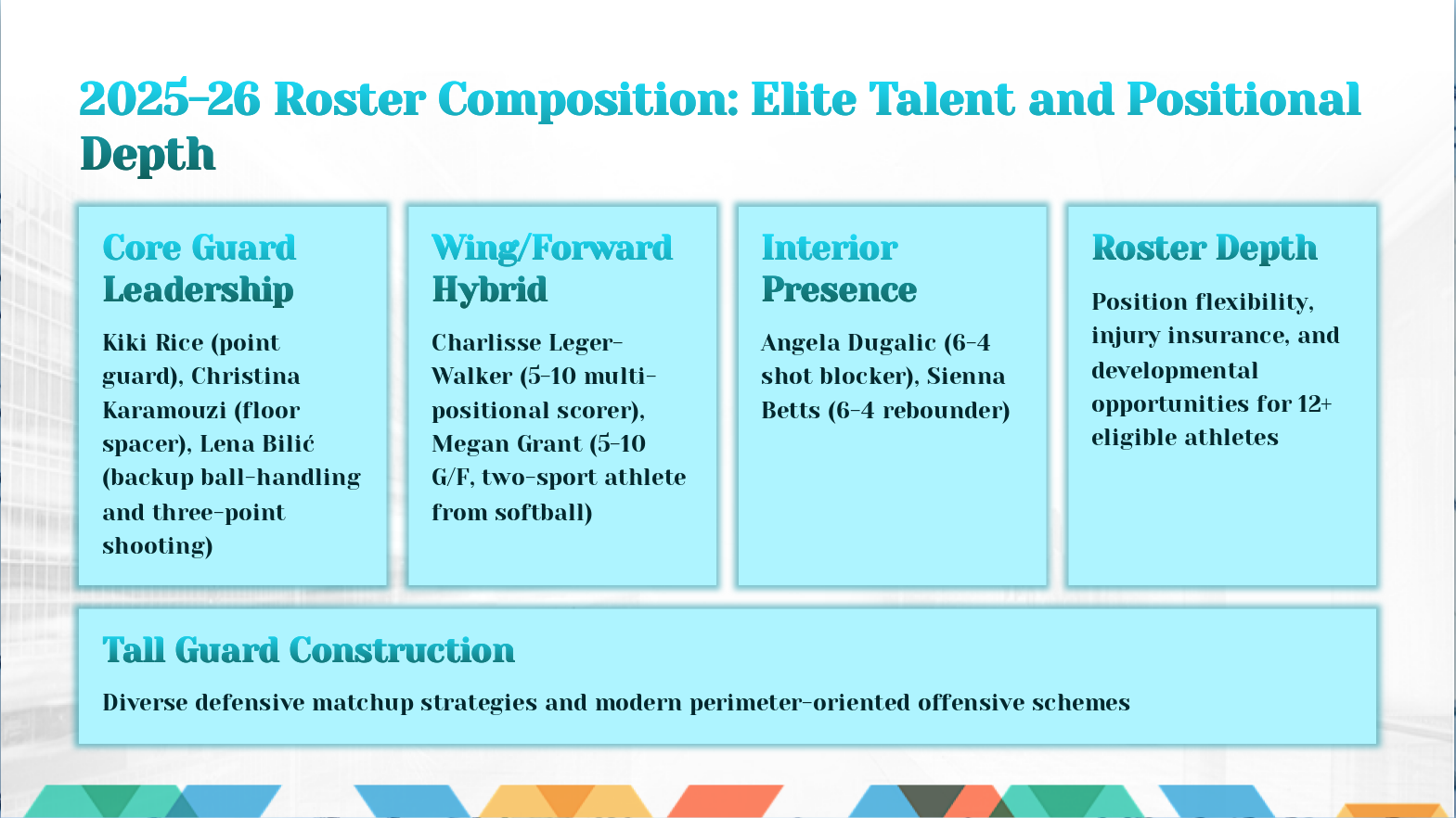
Slide 7: 2025-26 Roster Composition: Elite Talent and Positional Depth
- Core Guard Leadership: Kiki Rice (point guard), Christina Karamouzi (floor spacer), Lena Bilić (backup ball-handling and three-point shooting)
- Wing/Forward Hybrid: Charlisse Leger-Walker (5-10 multi-positional scorer), Megan Grant (5-10 G/F, two-sport athlete from softball)
- Interior Presence: Angela Dugalic (6-4 shot blocker), Sienna Betts (6-4 rebounder)
- Roster Depth: Position flexibility, injury insurance, and developmental opportunities for 12+ eligible athletes
- Tall Guard Construction: Diverse defensive matchup strategies and modern perimeter-oriented offensive schemes
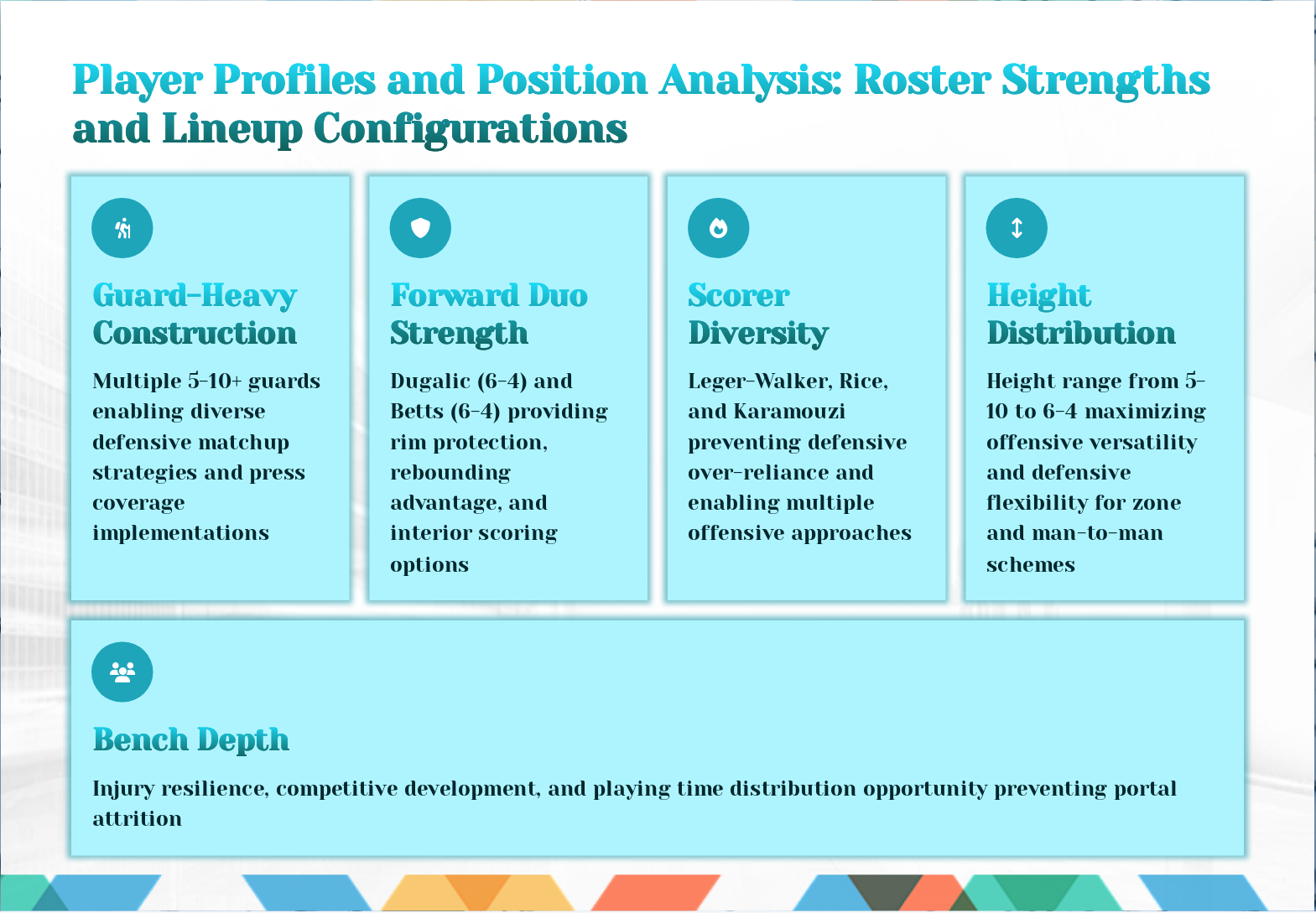
Slide 8: Player Profiles and Position Analysis: Roster Strengths and Lineup Configurations
- Guard-Heavy Construction: Multiple 5-10+ guards enabling diverse defensive matchup strategies and press coverage implementations
- Forward Duo Strength: Dugalic (6-4) and Betts (6-4) providing rim protection, rebounding advantage, and interior scoring options
- Scorer Diversity: Leger-Walker, Rice, and Karamouzi preventing defensive over-reliance and enabling multiple offensive approaches
- Height Distribution: Height range from 5-10 to 6-4 maximizing offensive versatility and defensive flexibility for zone and man-to-man schemes
- Bench Depth: Injury resilience, competitive development, and playing time distribution opportunity preventing portal attrition
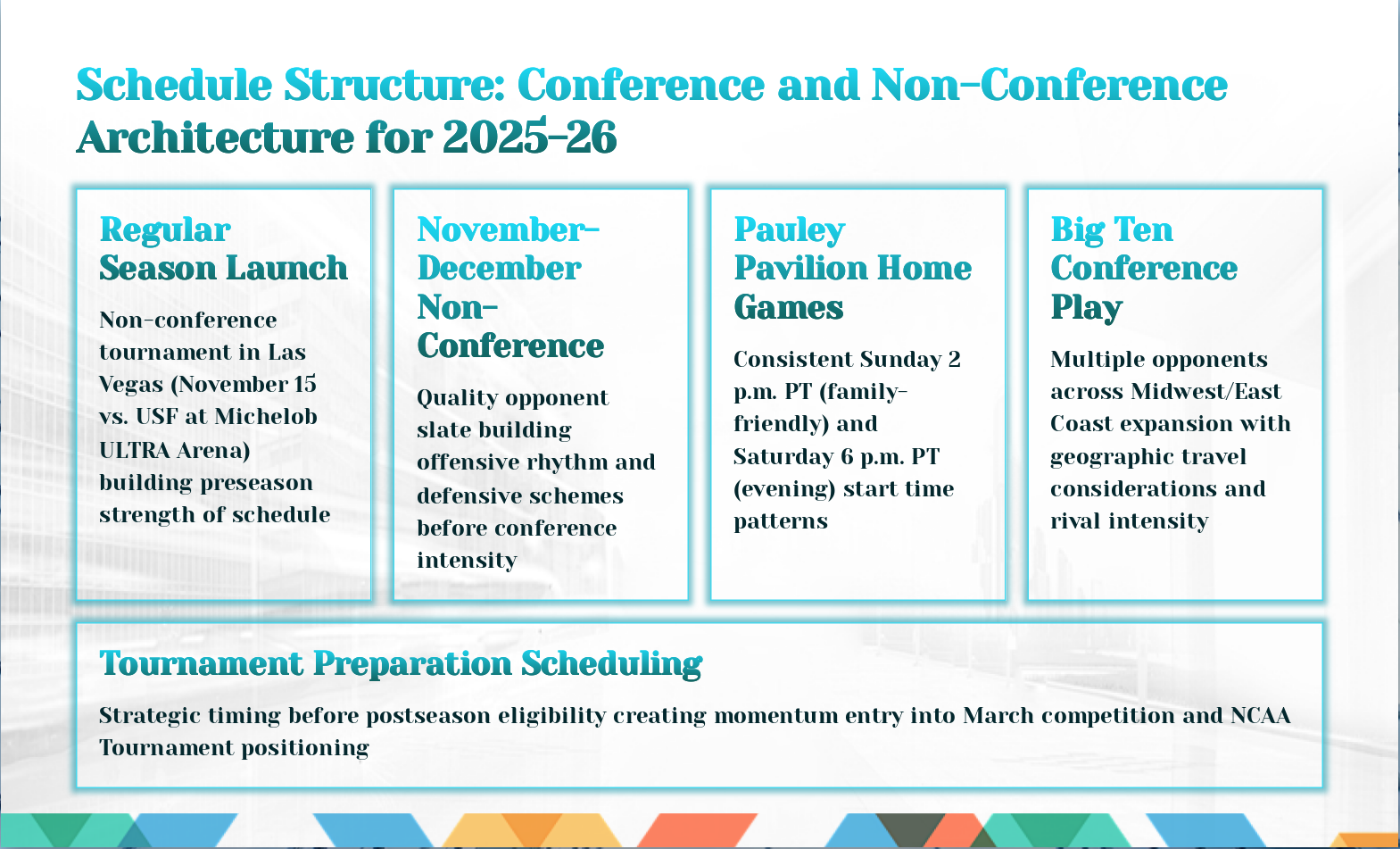
Slide 9: Schedule Structure: Conference and Non-Conference Architecture for 2025-26
- Regular Season Launch: Non-conference tournament in Las Vegas (November 15 vs. USF at Michelob ULTRA Arena) building preseason strength of schedule
- November-December Non-Conference: Quality opponent slate building offensive rhythm and defensive schemes before conference intensity
- Pauley Pavilion Home Games: Consistent Sunday 2 p.m. PT (family-friendly) and Saturday 6 p.m. PT (evening) start time patterns
- Big Ten Conference Play: Multiple opponents across Midwest/East Coast expansion with geographic travel considerations and rival intensity
- Tournament Preparation Scheduling: Strategic timing before postseason eligibility creating momentum entry into March competition and NCAA Tournament positioning
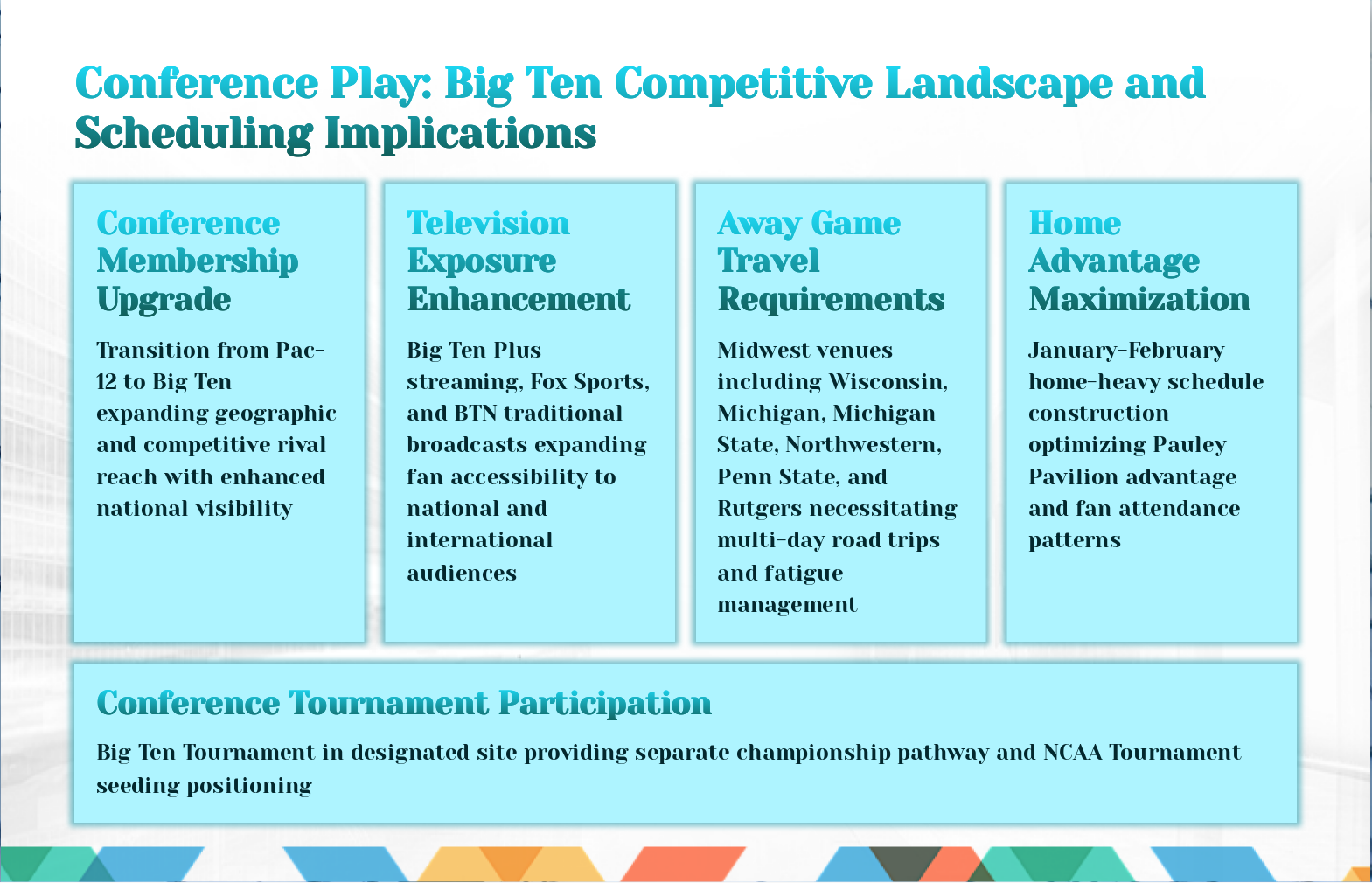
Slide 10: Conference Play: Big Ten Competitive Landscape and Scheduling Implications
- Conference Membership Upgrade: Transition from Pac-12 to Big Ten expanding geographic and competitive rival reach with enhanced national visibility
- Television Exposure Enhancement: Big Ten Plus streaming, Fox Sports, and BTN traditional broadcasts expanding fan accessibility to national and international audiences
- Away Game Travel Requirements: Midwest venues including Wisconsin, Michigan, Michigan State, Northwestern, Penn State, and Rutgers necessitating multi-day road trips and fatigue management
- Home Advantage Maximization: January-February home-heavy schedule construction optimizing Pauley Pavilion advantage and fan attendance patterns
- Conference Tournament Participation: Big Ten Tournament in designated site providing separate championship pathway and NCAA Tournament seeding positioning
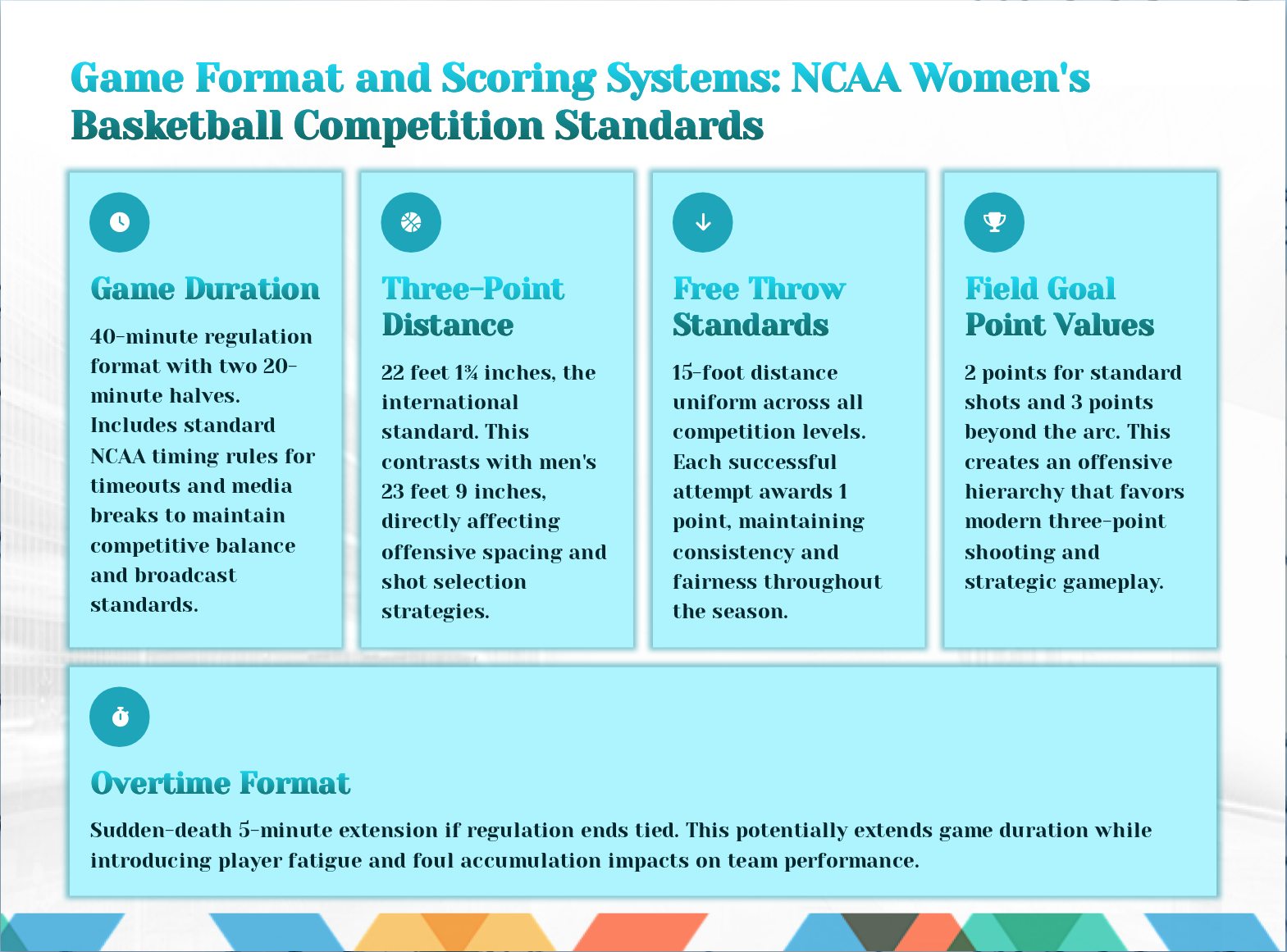
Slide 11: Game Format and Scoring Systems: NCAA Women's Basketball Competition Standards
- Game Duration: 40-minute regulation format with two 20-minute halves. Includes standard NCAA timing rules for timeouts and media breaks to maintain competitive balance and broadcast standards.
- Three-Point Distance: 22 feet 1¾ inches, the international standard. This contrasts with men's 23 feet 9 inches, directly affecting offensive spacing and shot selection strategies.
- Free Throw Standards: 15-foot distance uniform across all competition levels. Each successful attempt awards 1 point, maintaining consistency and fairness throughout the season.
- Field Goal Point Values: 2 points for standard shots and 3 points beyond the arc. This creates an offensive hierarchy that favors modern three-point shooting and strategic gameplay.
- Overtime Format: Sudden-death 5-minute extension if regulation ends tied. This potentially extends game duration while introducing player fatigue and foul accumulation impacts on team performance.
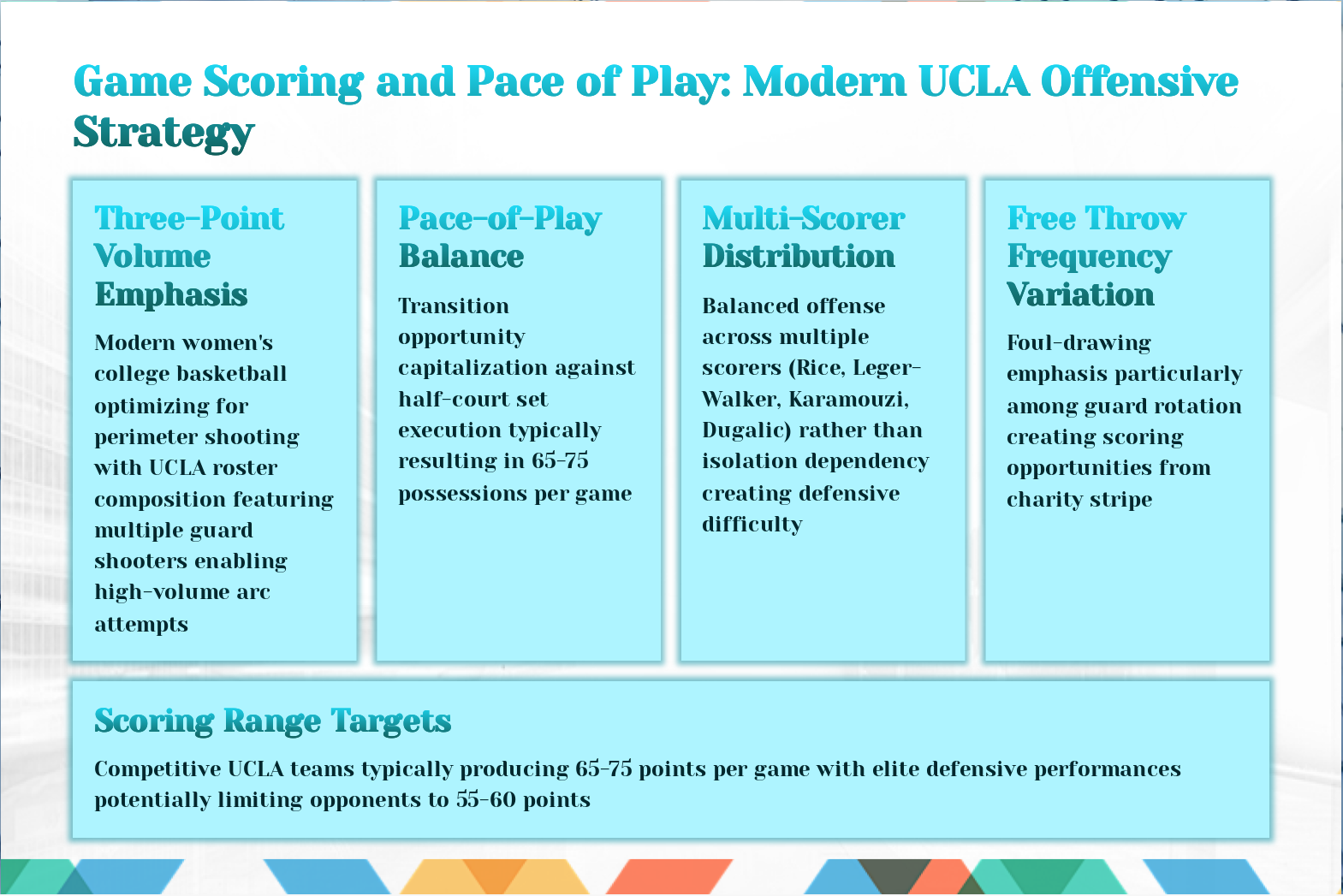
Slide 12: Game Scoring and Pace of Play: Modern UCLA Offensive Strategy
- Three-Point Volume Emphasis: Modern women's college basketball optimizing for perimeter shooting with UCLA roster composition featuring multiple guard shooters enabling high-volume arc attempts
- Pace-of-Play Balance: Transition opportunity capitalization against half-court set execution typically resulting in 65-75 possessions per game
- Multi-Scorer Distribution: Balanced offense across multiple scorers (Rice, Leger-Walker, Karamouzi, Dugalic) rather than isolation dependency creating defensive difficulty
- Free Throw Frequency Variation: Foul-drawing emphasis particularly among guard rotation creating scoring opportunities from charity stripe
- Scoring Range Targets: Competitive UCLA teams typically producing 65-75 points per game with elite defensive performances potentially limiting opponents to 55-60 points
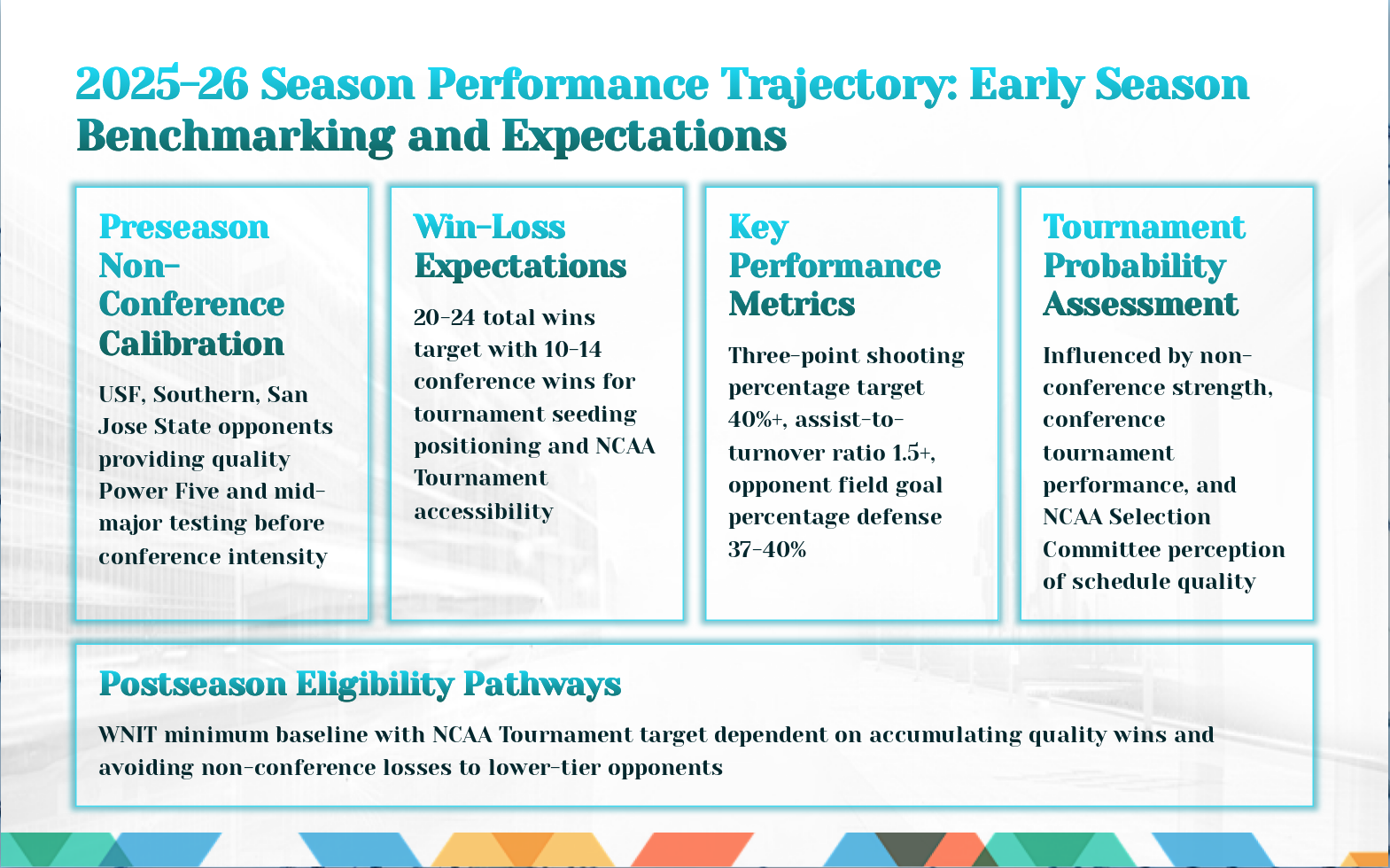
Slide 13: 2025-26 Season Performance Trajectory: Early Season Benchmarking and Expectations
- Preseason Non-Conference Calibration: USF, Southern, San Jose State opponents providing quality Power Five and mid-major testing before conference intensity
- Win-Loss Expectations: 20-24 total wins target with 10-14 conference wins for tournament seeding positioning and NCAA Tournament accessibility
- Key Performance Metrics: Three-point shooting percentage target 40%+, assist-to-turnover ratio 1.5+, opponent field goal percentage defense 37-40%
- Tournament Probability Assessment: Influenced by non-conference strength, conference tournament performance, and NCAA Selection Committee perception of schedule quality
- Postseason Eligibility Pathways: WNIT minimum baseline with NCAA Tournament target dependent on accumulating quality wins and avoiding non-conference losses to lower-tier opponents
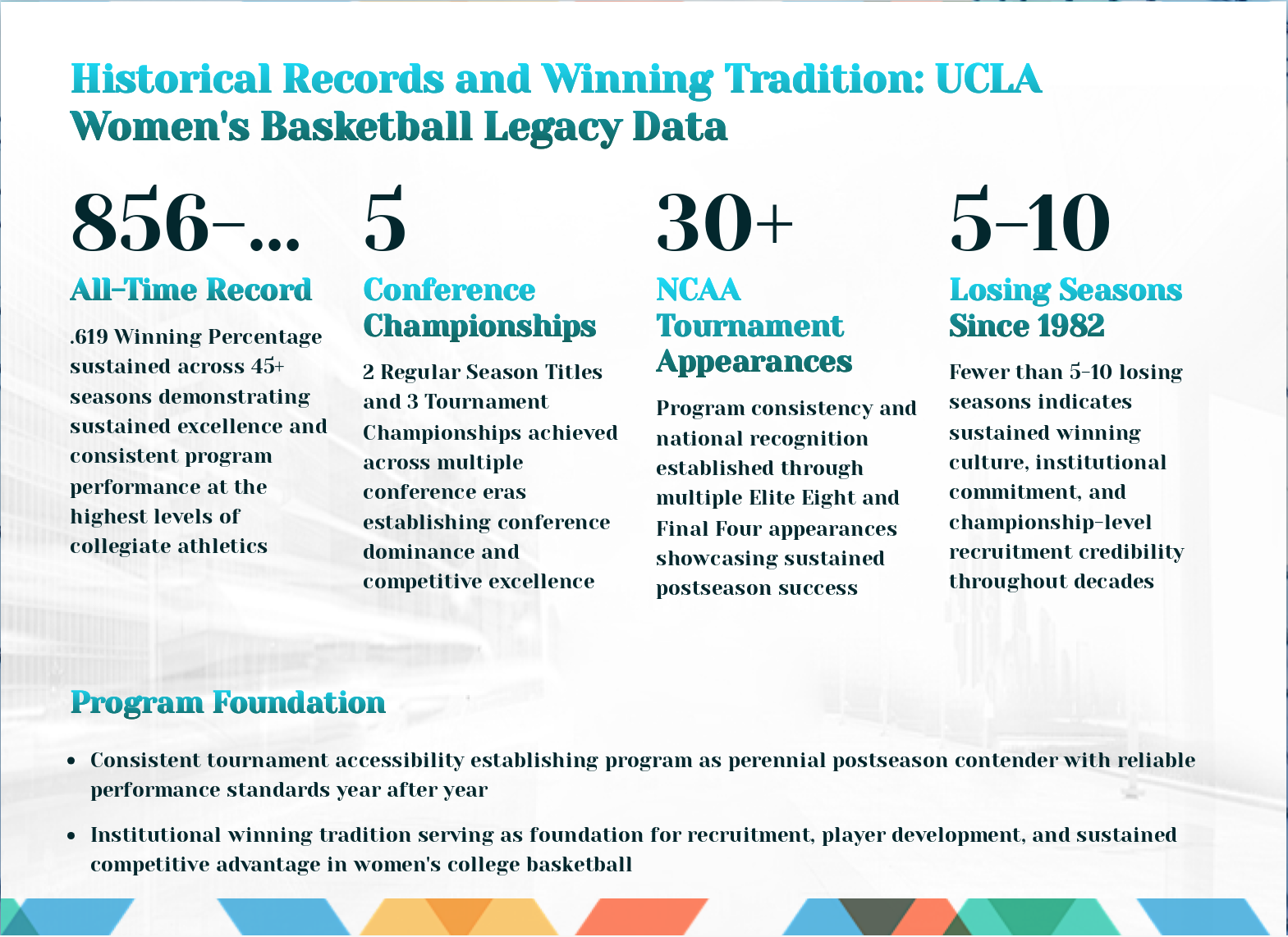
Slide 14: Historical Records and Winning Tradition: UCLA Women's Basketball Legacy Data
- 856-527 — All-Time Record
- 5 — Conference Championships
- 30+ — NCAA Tournament Appearances
- 5-10 — Losing Seasons Since 1982
Consistent tournament accessibility establishing program as perennial postseason contender with reliable performance standards year after year
Institutional winning tradition serving as foundation for recruitment, player development, and sustained competitive advantage in women's college basketball
- Consistent tournament accessibility establishing program as perennial postseason contender with reliable performance standards year after year
- Institutional winning tradition serving as foundation for recruitment, player development, and sustained competitive advantage in women's college basketball
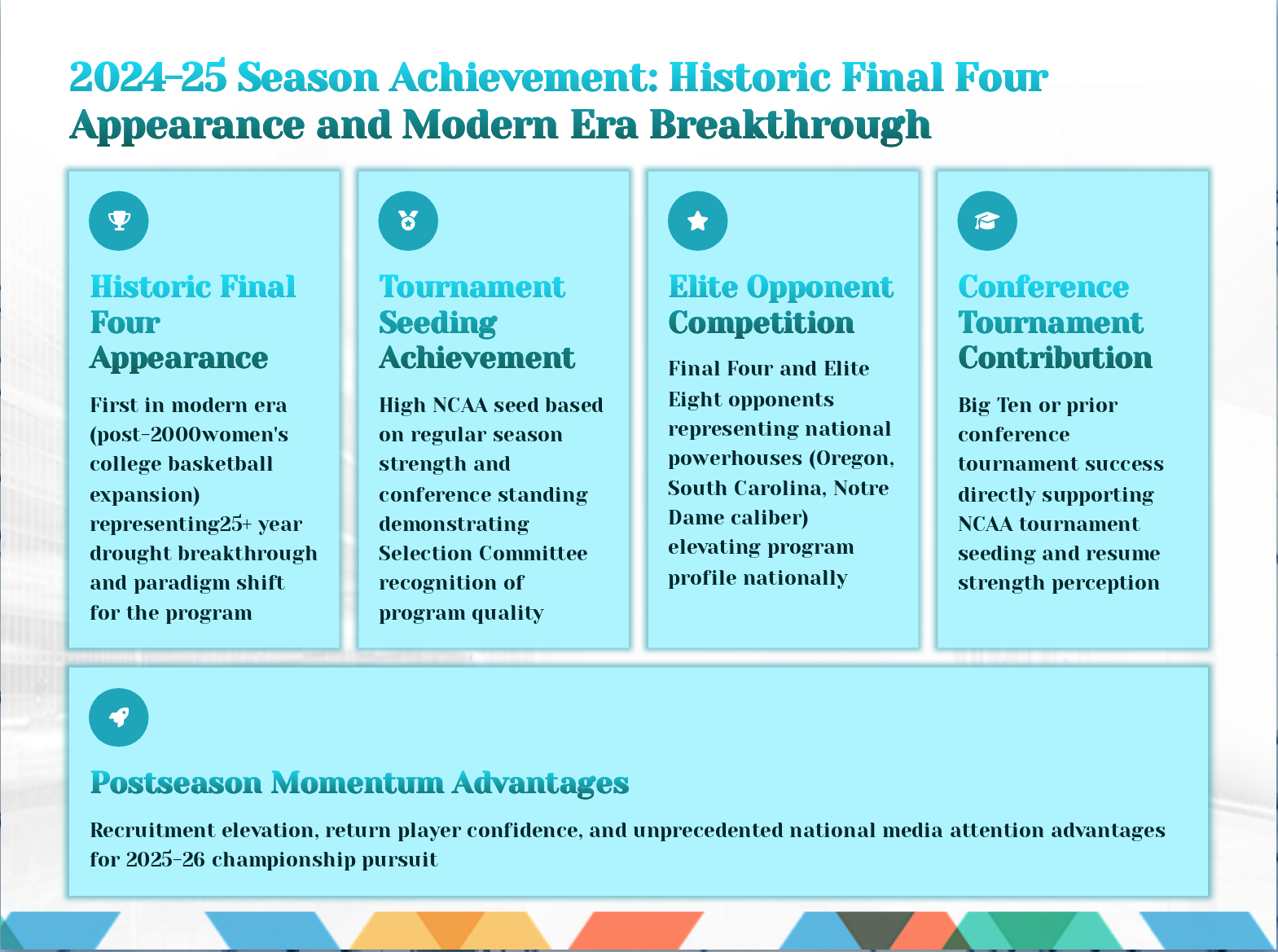
Slide 15: 2024-25 Season Achievement: Historic Final Four Appearance and Modern Era Breakthrough
- Historic Final Four Appearance: First in modern era (post-2000women's college basketball expansion) representing25+ year drought breakthrough and paradigm shift for the program
- Tournament Seeding Achievement: High NCAA seed based on regular season strength and conference standing demonstrating Selection Committee recognition of program quality
- Elite Opponent Competition: Final Four and Elite Eight opponents representing national powerhouses (Oregon, South Carolina, Notre Dame caliber) elevating program profile nationally
- Conference Tournament Contribution: Big Ten or prior conference tournament success directly supporting NCAA tournament seeding and resume strength perception
- Postseason Momentum Advantages: Recruitment elevation, return player confidence, and unprecedented national media attention advantages for 2025-26 championship pursuit
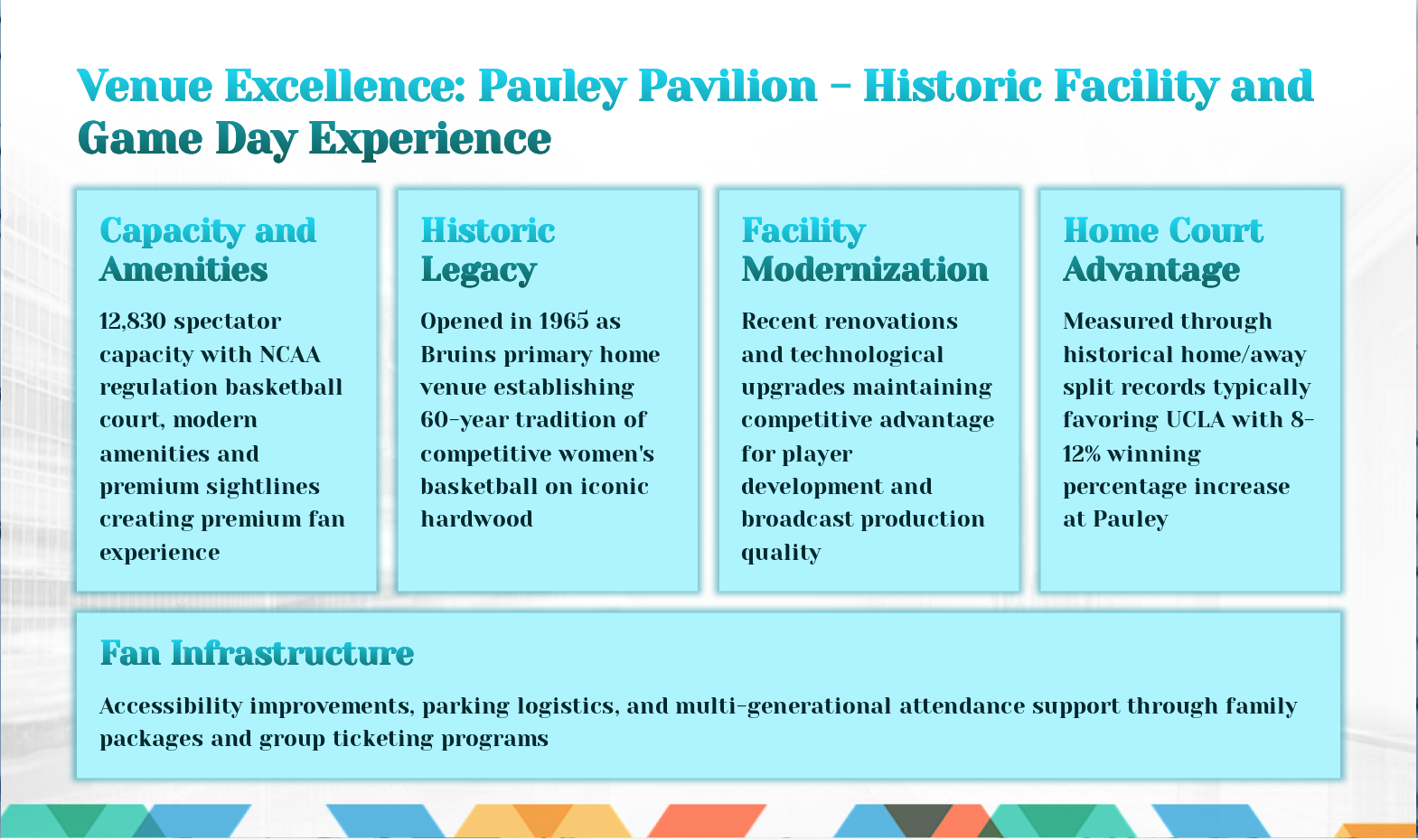
Slide 16: Venue Excellence: Pauley Pavilion - Historic Facility and Game Day Experience
- Capacity and Amenities: 12,830 spectator capacity with NCAA regulation basketball court, modern amenities and premium sightlines creating premium fan experience
- Historic Legacy: Opened in 1965 as Bruins primary home venue establishing 60-year tradition of competitive women's basketball on iconic hardwood
- Facility Modernization: Recent renovations and technological upgrades maintaining competitive advantage for player development and broadcast production quality
- Home Court Advantage: Measured through historical home/away split records typically favoring UCLA with 8-12% winning percentage increase at Pauley
- Fan Infrastructure: Accessibility improvements, parking logistics, and multi-generational attendance support through family packages and group ticketing programs
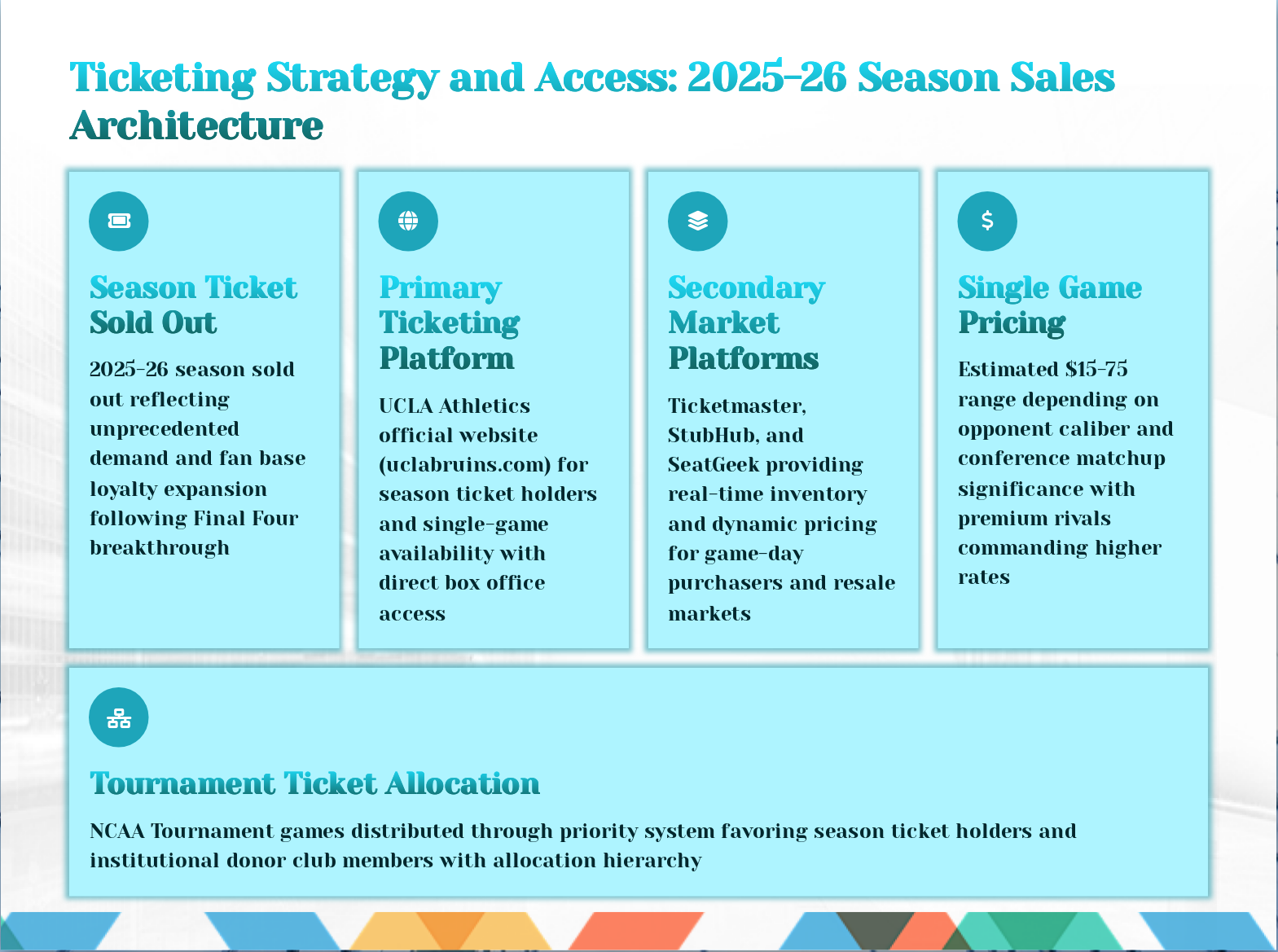
Slide 17: Ticketing Strategy and Access: 2025-26 Season Sales Architecture
- Season Ticket Sold Out: 2025-26 season sold out reflecting unprecedented demand and fan base loyalty expansion following Final Four breakthrough
- Primary Ticketing Platform: UCLA Athletics official website (uclabruins.com) for season ticket holders and single-game availability with direct box office access
- Secondary Market Platforms: Ticketmaster, StubHub, and SeatGeek providing real-time inventory and dynamic pricing for game-day purchasers and resale markets
- Single Game Pricing: Estimated $15-75 range depending on opponent caliber and conference matchup significance with premium rivals commanding higher rates
- Tournament Ticket Allocation: NCAA Tournament games distributed through priority system favoring season ticket holders and institutional donor club members with allocation hierarchy
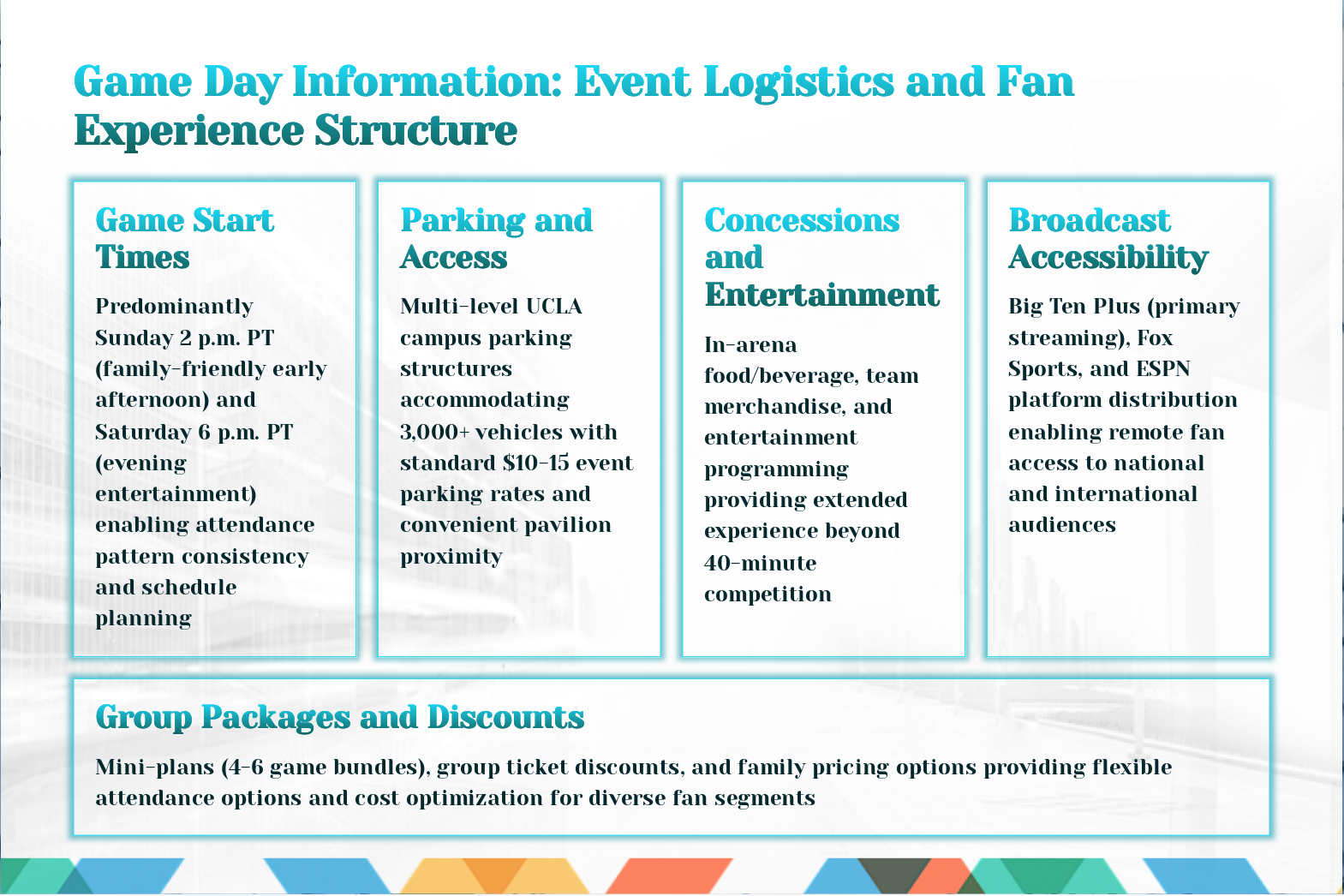
Slide 18: Game Day Information: Event Logistics and Fan Experience Structure
- Game Start Times: Predominantly Sunday 2 p.m. PT (family-friendly early afternoon) and Saturday 6 p.m. PT (evening entertainment) enabling attendance pattern consistency and schedule planning
- Parking and Access: Multi-level UCLA campus parking structures accommodating 3,000+ vehicles with standard $10-15 event parking rates and convenient pavilion proximity
- Concessions and Entertainment: In-arena food/beverage, team merchandise, and entertainment programming providing extended experience beyond 40-minute competition
- Broadcast Accessibility: Big Ten Plus (primary streaming), Fox Sports, and ESPN platform distribution enabling remote fan access to national and international audiences
- Group Packages and Discounts: Mini-plans (4-6 game bundles), group ticket discounts, and family pricing options providing flexible attendance options and cost optimization for diverse fan segments
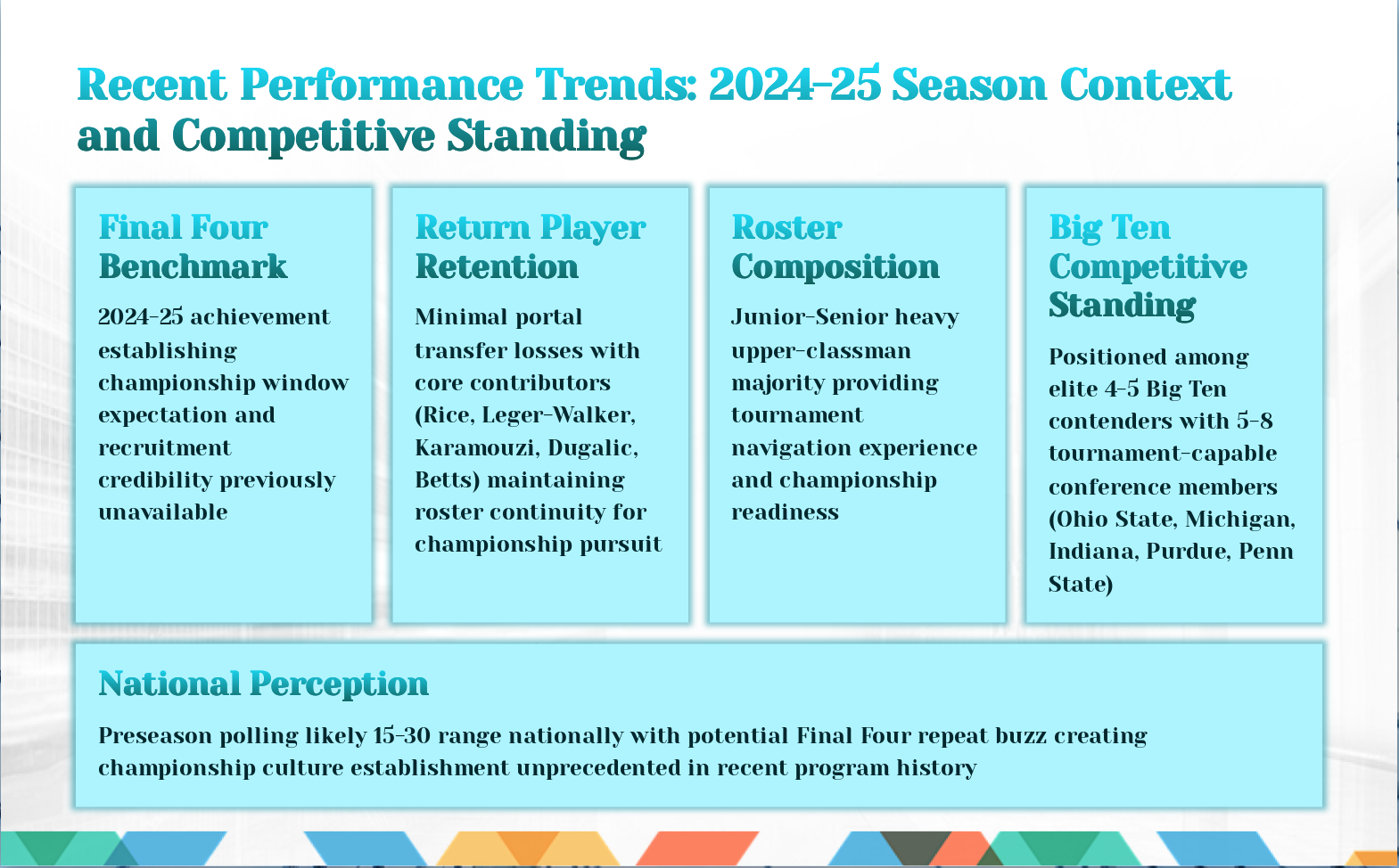
Slide 19: Recent Performance Trends: 2024-25 Season Context and Competitive Standing
- Final Four Benchmark: 2024-25 achievement establishing championship window expectation and recruitment credibility previously unavailable
- Return Player Retention: Minimal portal transfer losses with core contributors (Rice, Leger-Walker, Karamouzi, Dugalic, Betts) maintaining roster continuity for championship pursuit
- Roster Composition: Junior-Senior heavy upper-classman majority providing tournament navigation experience and championship readiness
- Big Ten Competitive Standing: Positioned among elite 4-5 Big Ten contenders with 5-8 tournament-capable conference members (Ohio State, Michigan, Indiana, Purdue, Penn State)
- National Perception: Preseason polling likely 15-30 range nationally with potential Final Four repeat buzz creating championship culture establishment unprecedented in recent program history
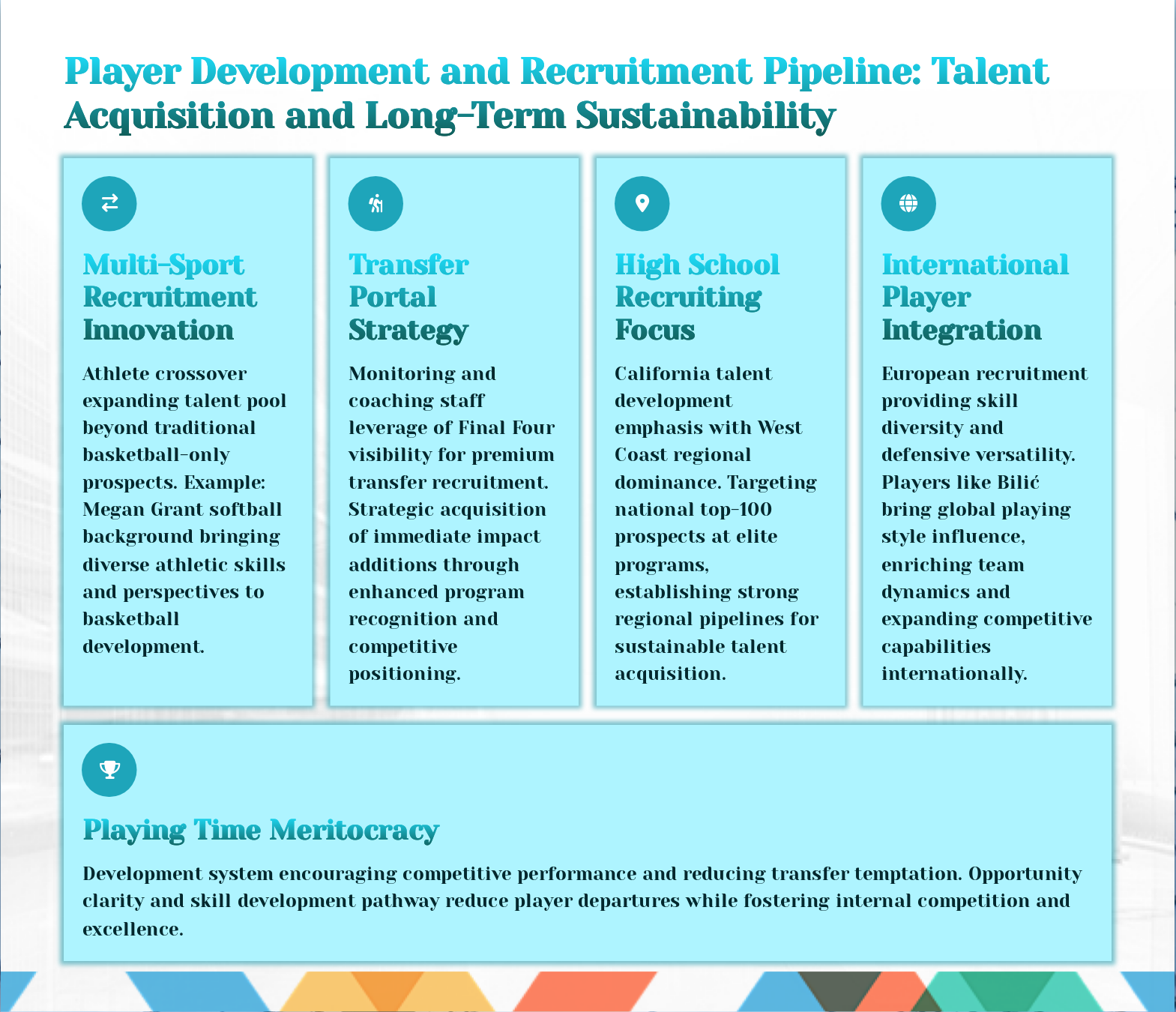
Slide 20: Player Development and Recruitment Pipeline: Talent Acquisition and Long-Term Sustainability
- Multi-Sport Recruitment Innovation: Athlete crossover expanding talent pool beyond traditional basketball-only prospects. Example: Megan Grant softball background bringing diverse athletic skills and perspectives to basketball development.
- Transfer Portal Strategy: Monitoring and coaching staff leverage of Final Four visibility for premium transfer recruitment. Strategic acquisition of immediate impact additions through enhanced program recognition and competitive positioning.
- High School Recruiting Focus: California talent development emphasis with West Coast regional dominance. Targeting national top-100 prospects at elite programs, establishing strong regional pipelines for sustainable talent acquisition.
- International Player Integration: European recruitment providing skill diversity and defensive versatility. Players like Bilić bring global playing style influence, enriching team dynamics and expanding competitive capabilities internationally.
- Playing Time Meritocracy: Development system encouraging competitive performance and reducing transfer temptation. Opportunity clarity and skill development pathway reduce player departures while fostering internal competition and excellence.
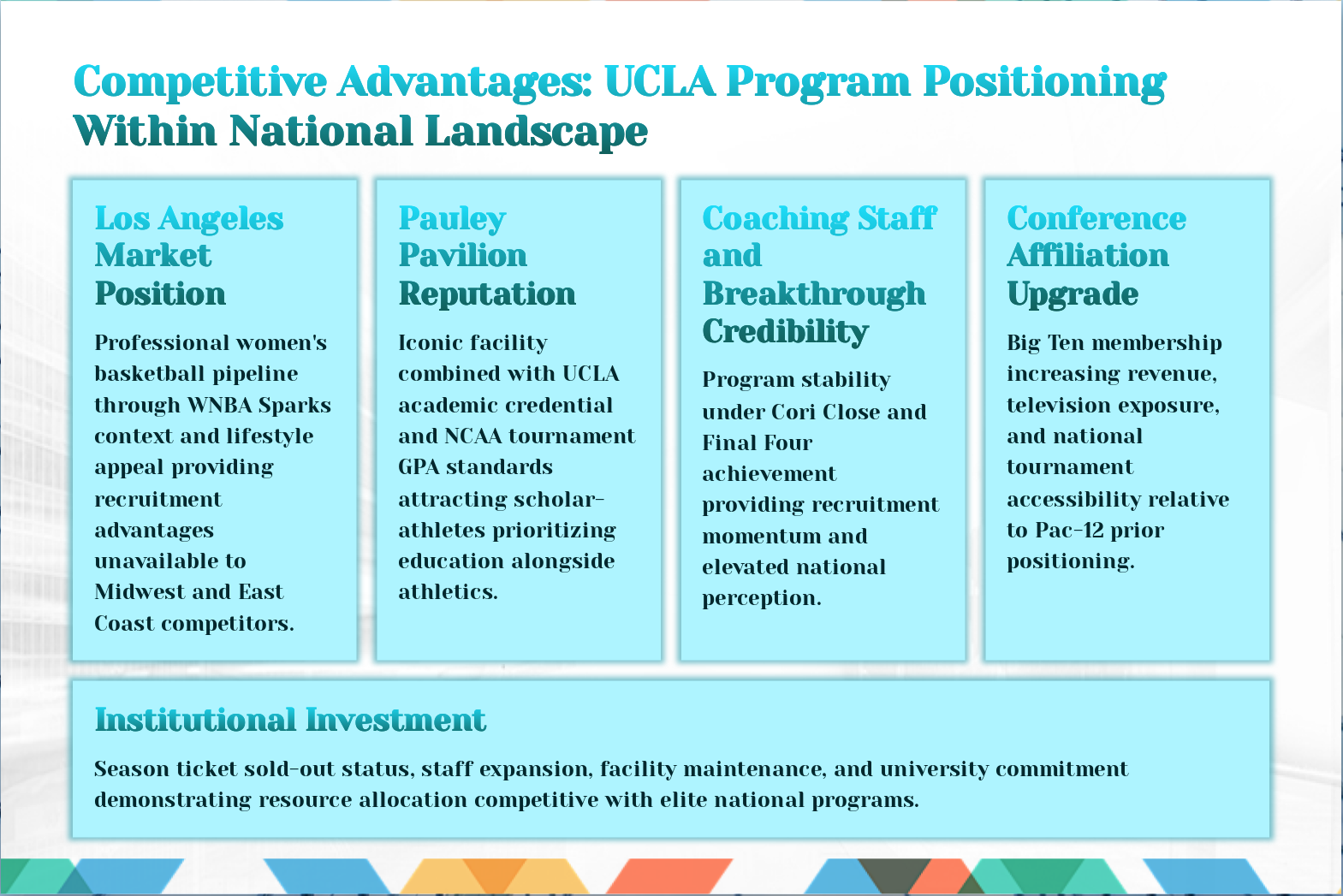
Slide 21: Competitive Advantages: UCLA Program Positioning Within National Landscape
- Los Angeles Market Position: Professional women's basketball pipeline through WNBA Sparks context and lifestyle appeal providing recruitment advantages unavailable to Midwest and East Coast competitors.
- Pauley Pavilion Reputation: Iconic facility combined with UCLA academic credential and NCAA tournament GPA standards attracting scholar-athletes prioritizing education alongside athletics.
- Coaching Staff and Breakthrough Credibility: Program stability under Cori Close and Final Four achievement providing recruitment momentum and elevated national perception.
- Conference Affiliation Upgrade: Big Ten membership increasing revenue, television exposure, and national tournament accessibility relative to Pac-12 prior positioning.
- Institutional Investment: Season ticket sold-out status, staff expansion, facility maintenance, and university commitment demonstrating resource allocation competitive with elite national programs.
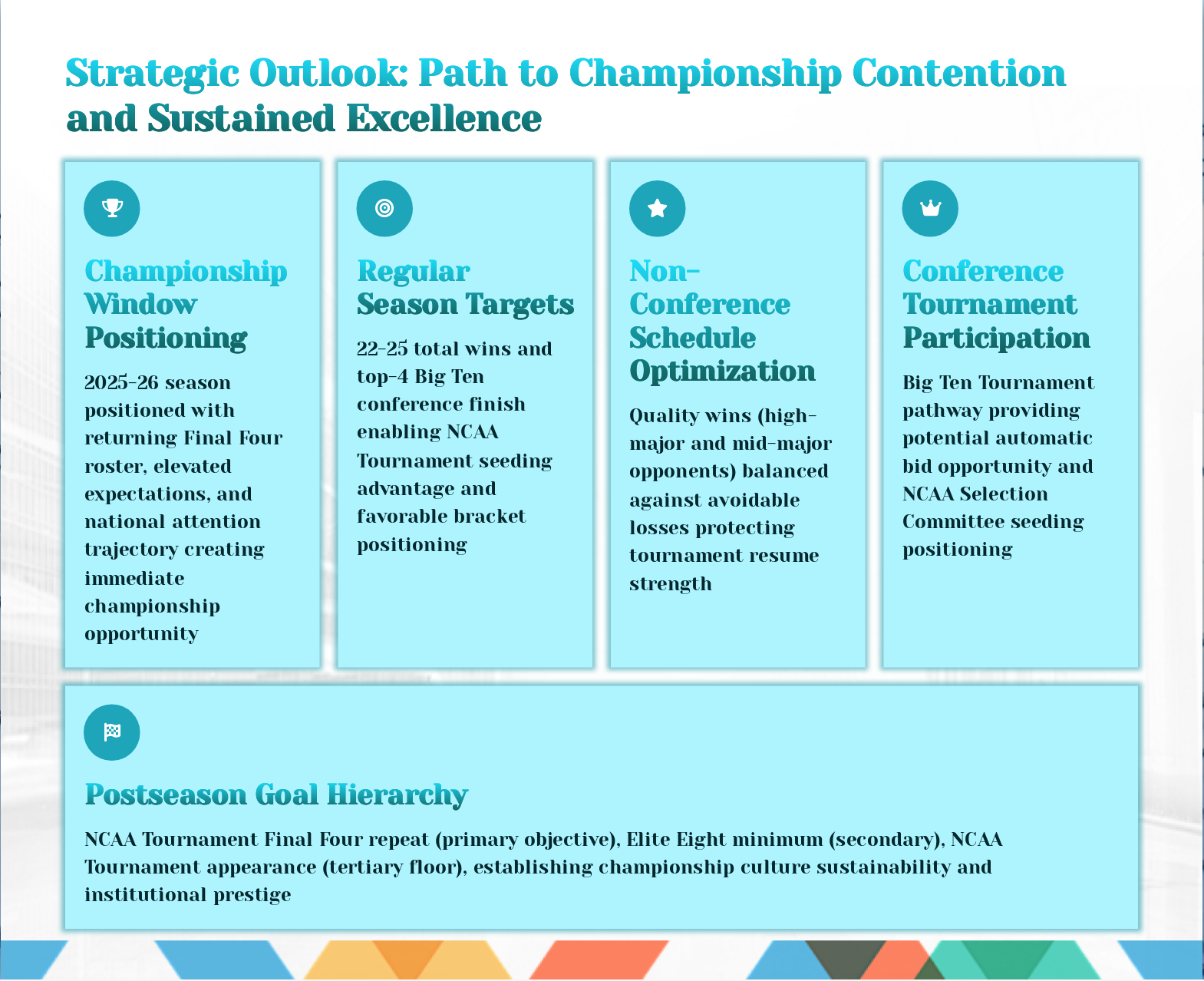
Slide 22: Strategic Outlook: Path to Championship Contention and Sustained Excellence
- Championship Window Positioning: 2025-26 season positioned with returning Final Four roster, elevated expectations, and national attention trajectory creating immediate championship opportunity
- Regular Season Targets: 22-25 total wins and top-4 Big Ten conference finish enabling NCAA Tournament seeding advantage and favorable bracket positioning
- Non-Conference Schedule Optimization: Quality wins (high-major and mid-major opponents) balanced against avoidable losses protecting tournament resume strength
- Conference Tournament Participation: Big Ten Tournament pathway providing potential automatic bid opportunity and NCAA Selection Committee seeding positioning
- Postseason Goal Hierarchy: NCAA Tournament Final Four repeat (primary objective), Elite Eight minimum (secondary), NCAA Tournament appearance (tertiary floor), establishing championship culture sustainability and institutional prestige
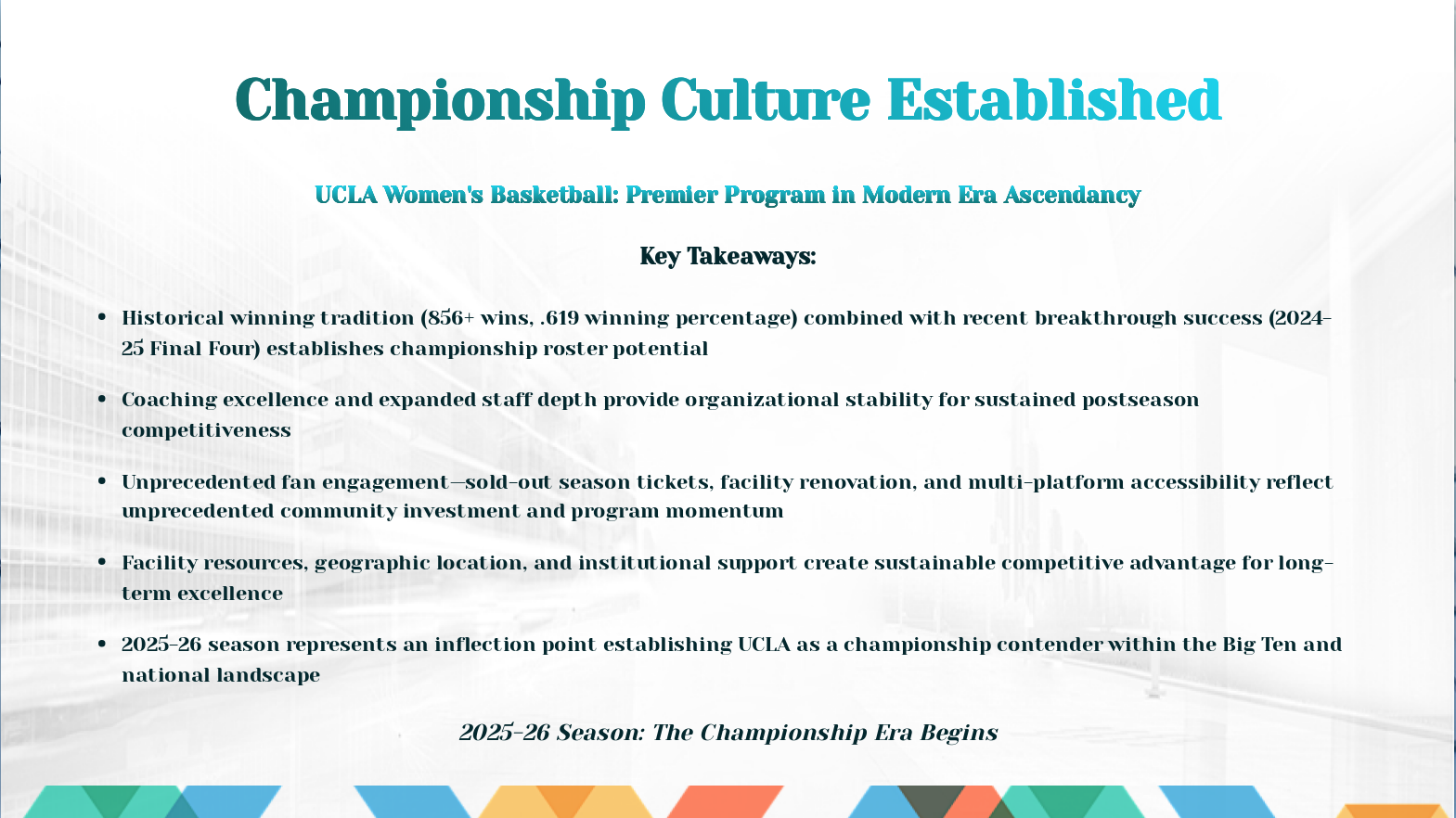
Slide 23: Championship Culture Established
Key Takeaways:
Historical winning tradition (856+ wins, .619 winning percentage) combined with recent breakthrough success (2024-25 Final Four) establishes championship roster potential
Coaching excellence and expanded staff depth provide organizational stability for sustained postseason competitiveness
Unprecedented fan engagement—sold-out season tickets, facility renovation, and multi-platform accessibility reflect unprecedented community investment and program momentum
Facility resources, geographic location, and institutional support create sustainable competitive advantage for long-term excellence
2025-26 season represents an inflection point establishing UCLA as a championship contender within the Big Ten and national landscape
2025-26 Season: The Championship Era Begins
- Historical winning tradition (856+ wins, .619 winning percentage) combined with recent breakthrough success (2024-25 Final Four) establishes championship roster potential
- Coaching excellence and expanded staff depth provide organizational stability for sustained postseason competitiveness
- Unprecedented fan engagement—sold-out season tickets, facility renovation, and multi-platform accessibility reflect unprecedented community investment and program momentum
- Facility resources, geographic location, and institutional support create sustainable competitive advantage for long-term excellence
- 2025-26 season represents an inflection point establishing UCLA as a championship contender within the Big Ten and national landscape