Presentation Summary
Analyzing the March 2026 Restructuring: Scale, Impact, and Strategic Implications Scale and Strategic Context Oracle's AI Race and Competitive Pressures Financial Impact Across Regions Employee Categories
Full Presentation Transcript
Slide 1: Oracle's Largest Workforce Reduction: 18% Global Layoffs to Fund $50B AI Infrastructure Expansion
Analyzing the March 2026 Restructuring: Scale, Impact, and Strategic Implications
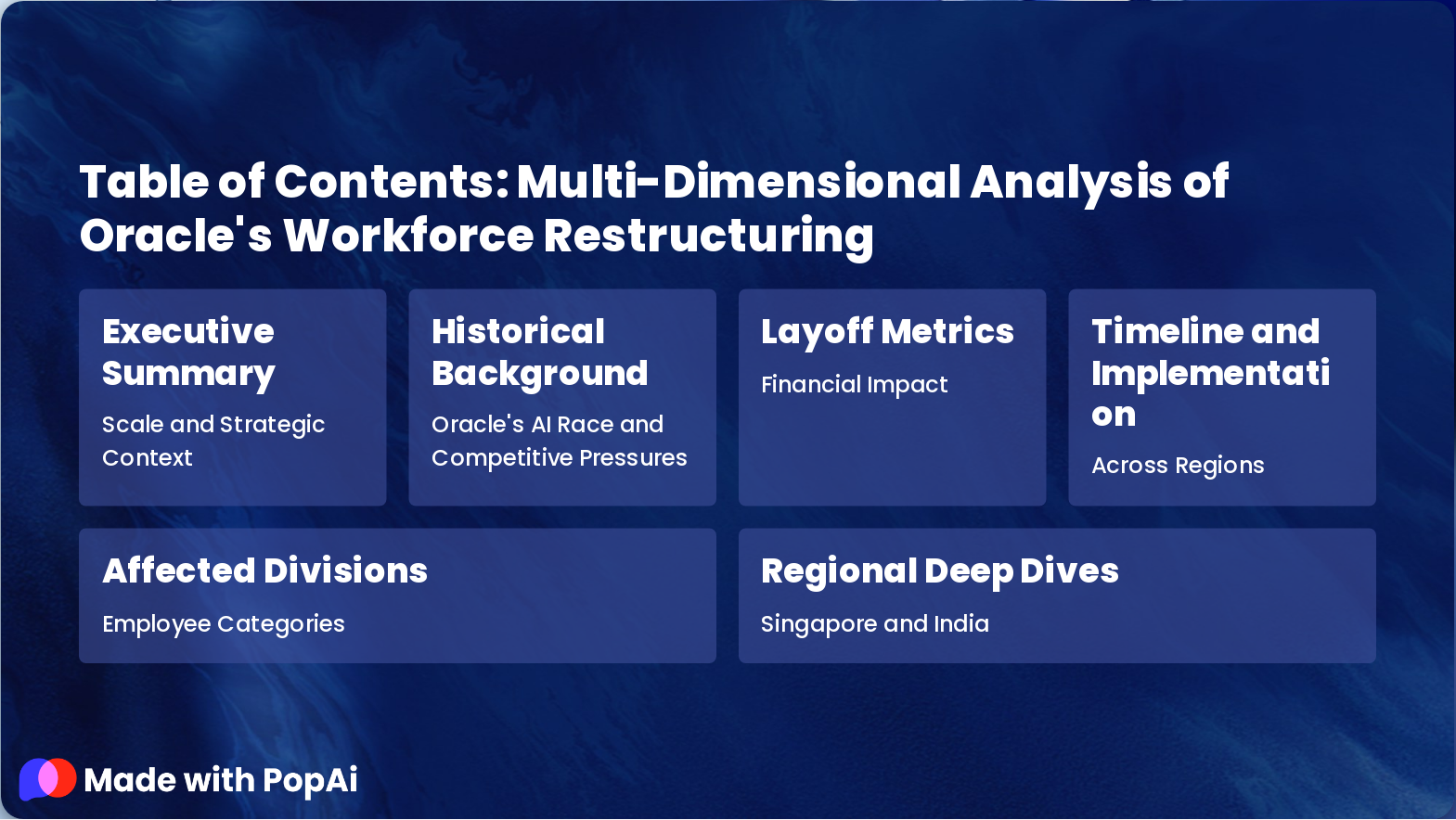
Slide 2: Table of Contents: Multi-Dimensional Analysis of Oracle's Workforce Restructuring
- Executive Summary: Scale and Strategic Context
- Historical Background: Oracle's AI Race and Competitive Pressures
- Layoff Metrics: Financial Impact
- Timeline and Implementation: Across Regions
- Affected Divisions: Employee Categories
- Regional Deep Dives: Singapore and India
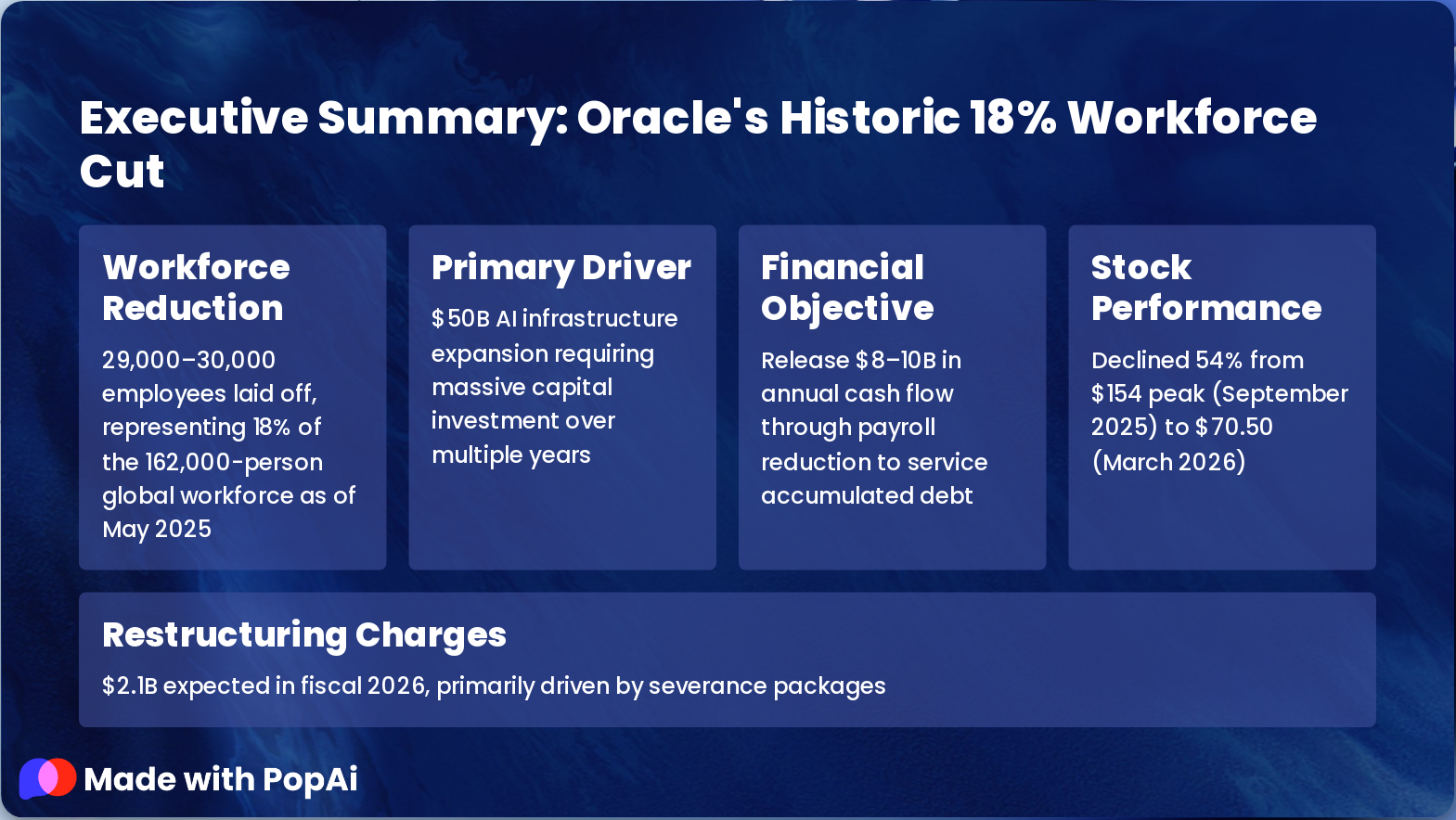
Slide 3: Executive Summary: Oracle's Historic 18% Workforce Cut
- Workforce Reduction: 29,000–30,000 employees laid off, representing 18% of the 162,000-person global workforce as of May 2025
- Primary Driver: $50B AI infrastructure expansion requiring massive capital investment over multiple years
- Financial Objective: Release $8–10B in annual cash flow through payroll reduction to service accumulated debt
- Stock Performance: Declined 54% from $154 peak (September 2025) to $70.50 (March 2026)
- Restructuring Charges: $2.1B expected in fiscal 2026, primarily driven by severance packages
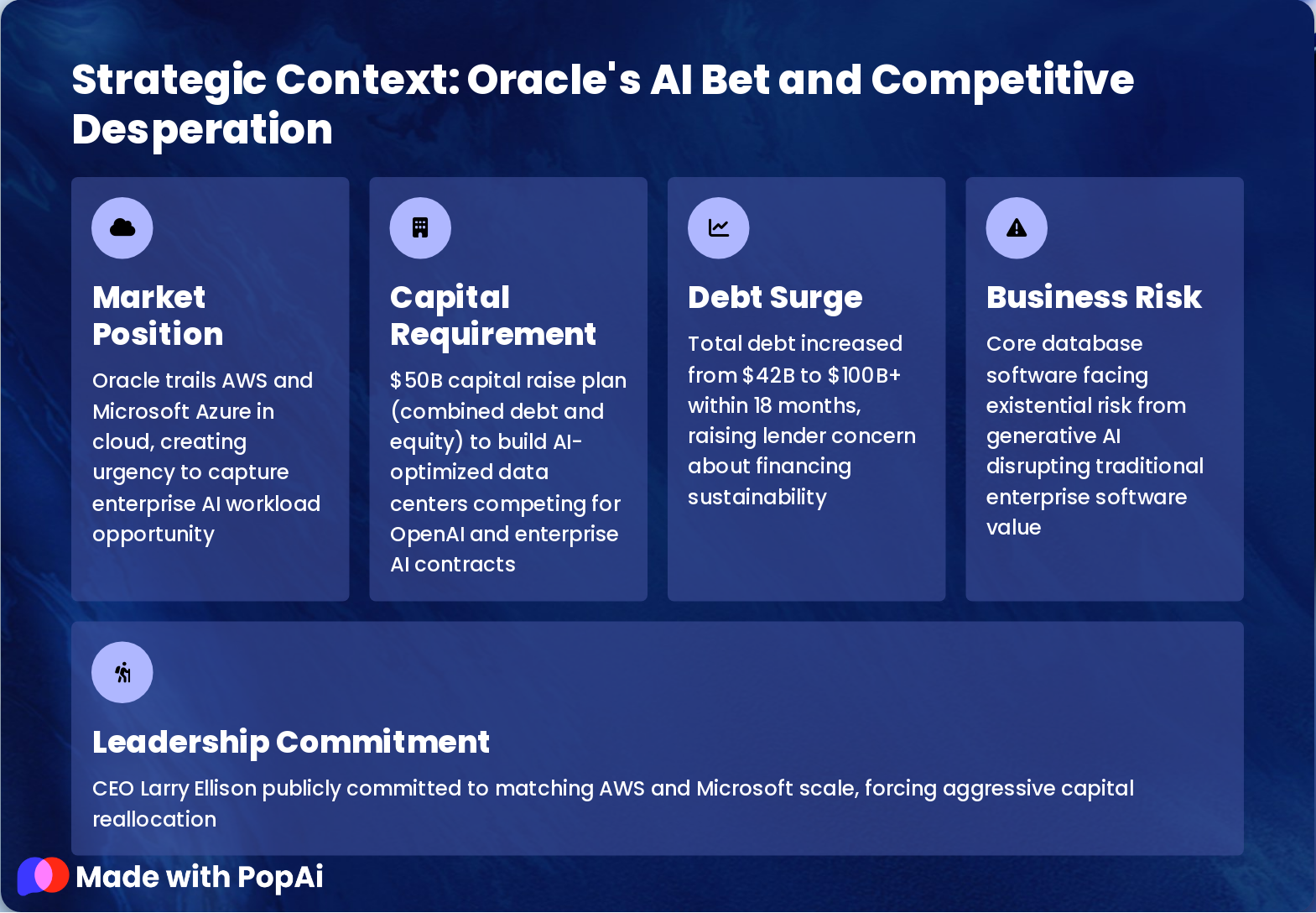
Slide 4: Strategic Context: Oracle's AI Bet and Competitive Desperation
- Market Position: Oracle trails AWS and Microsoft Azure in cloud, creating urgency to capture enterprise AI workload opportunity
- Capital Requirement: $50B capital raise plan (combined debt and equity) to build AI-optimized data centers competing for OpenAI and enterprise AI contracts
- Debt Surge: Total debt increased from $42B to $100B+ within 18 months, raising lender concern about financing sustainability
- Business Risk: Core database software facing existential risk from generative AI disrupting traditional enterprise software value
- Leadership Commitment: CEO Larry Ellison publicly committed to matching AWS and Microsoft scale, forcing aggressive capital reallocation
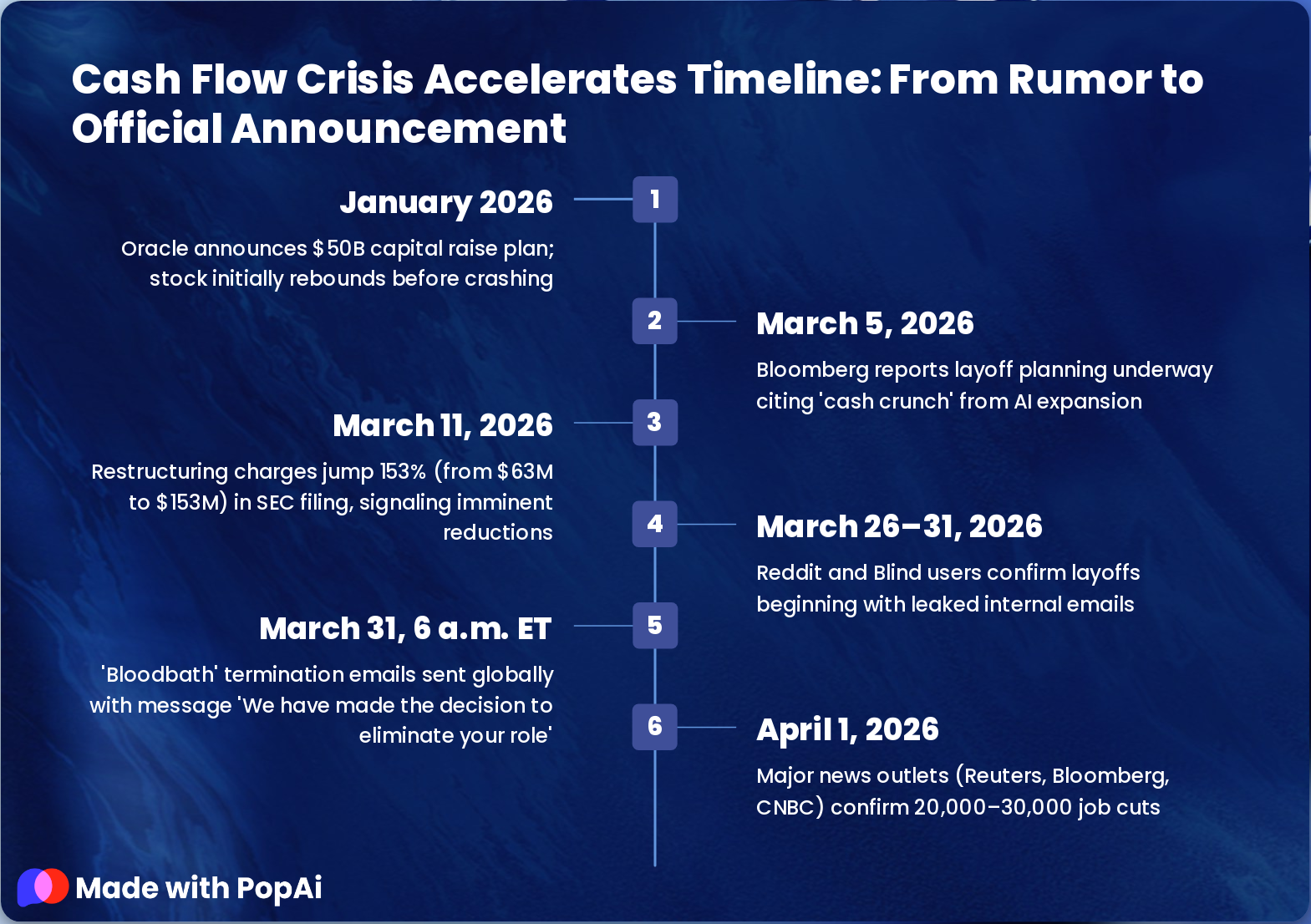
Slide 5: Cash Flow Crisis Accelerates Timeline: From Rumor to Official Announcement
- January 2026: Oracle announces $50B capital raise plan; stock initially rebounds before crashing
- March 5, 2026: Bloomberg reports layoff planning underway citing 'cash crunch' from AI expansion
- March 11, 2026: Restructuring charges jump 153% (from $63M to $153M) in SEC filing, signaling imminent reductions
- March 26–31, 2026: Reddit and Blind users confirm layoffs beginning with leaked internal emails
- March 31, 6 a.m. ET: 'Bloodbath' termination emails sent globally with message 'We have made the decision to eliminate your role'
- April 1, 2026: Major news outlets (Reuters, Bloomberg, CNBC) confirm 20,000–30,000 job cuts
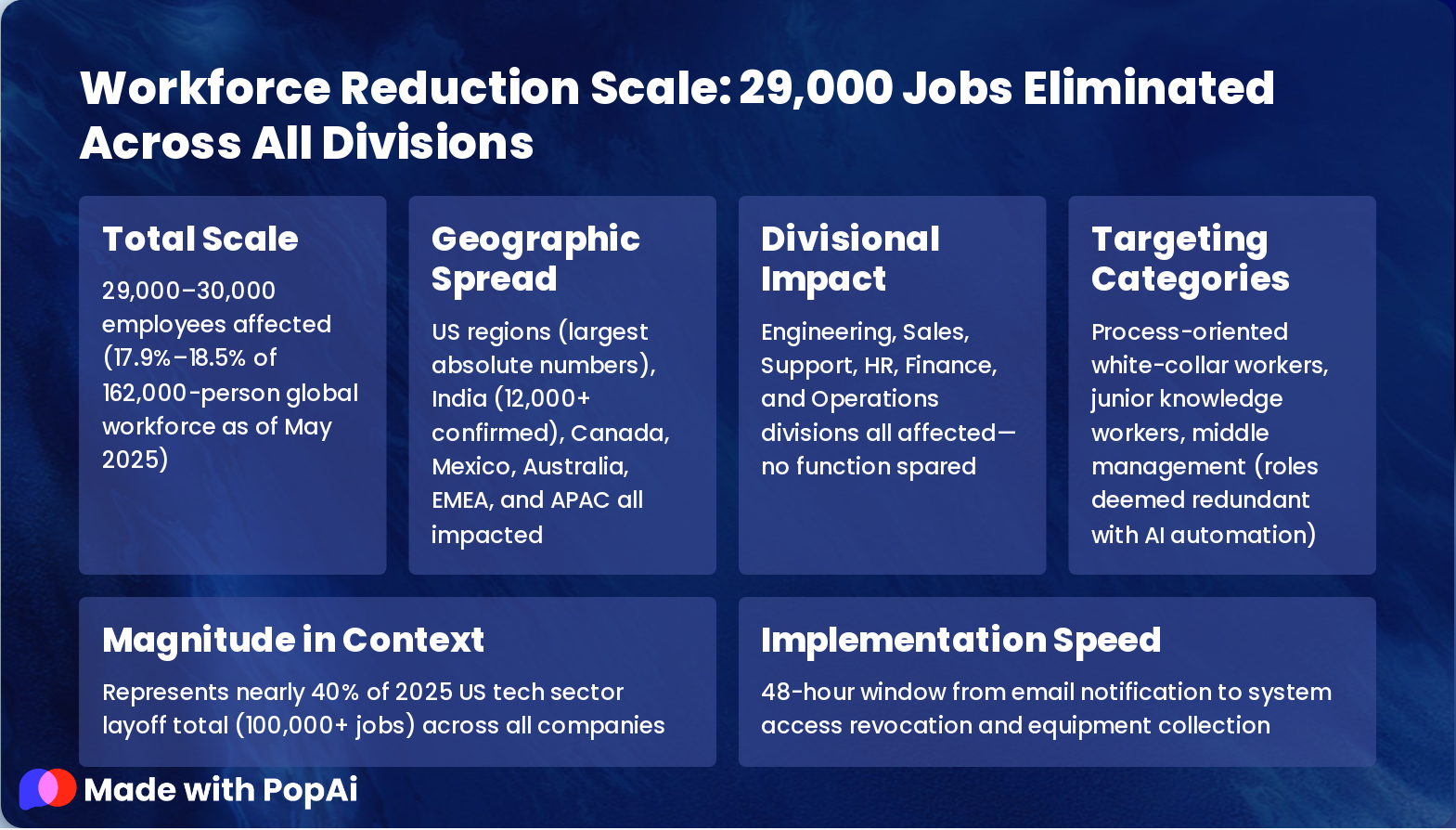
Slide 6: Workforce Reduction Scale: 29,000 Jobs Eliminated Across All Divisions
- Total Scale: 29,000–30,000 employees affected (17.9%–18.5% of 162,000-person global workforce as of May 2025)
- Geographic Spread: US regions (largest absolute numbers), India (12,000+ confirmed), Canada, Mexico, Australia, EMEA, and APAC all impacted
- Divisional Impact: Engineering, Sales, Support, HR, Finance, and Operations divisions all affected—no function spared
- Targeting Categories: Process-oriented white-collar workers, junior knowledge workers, middle management (roles deemed redundant with AI automation)
- Magnitude in Context: Represents nearly 40% of 2025 US tech sector layoff total (100,000+ jobs) across all companies
- Implementation Speed: 48-hour window from email notification to system access revocation and equipment collection
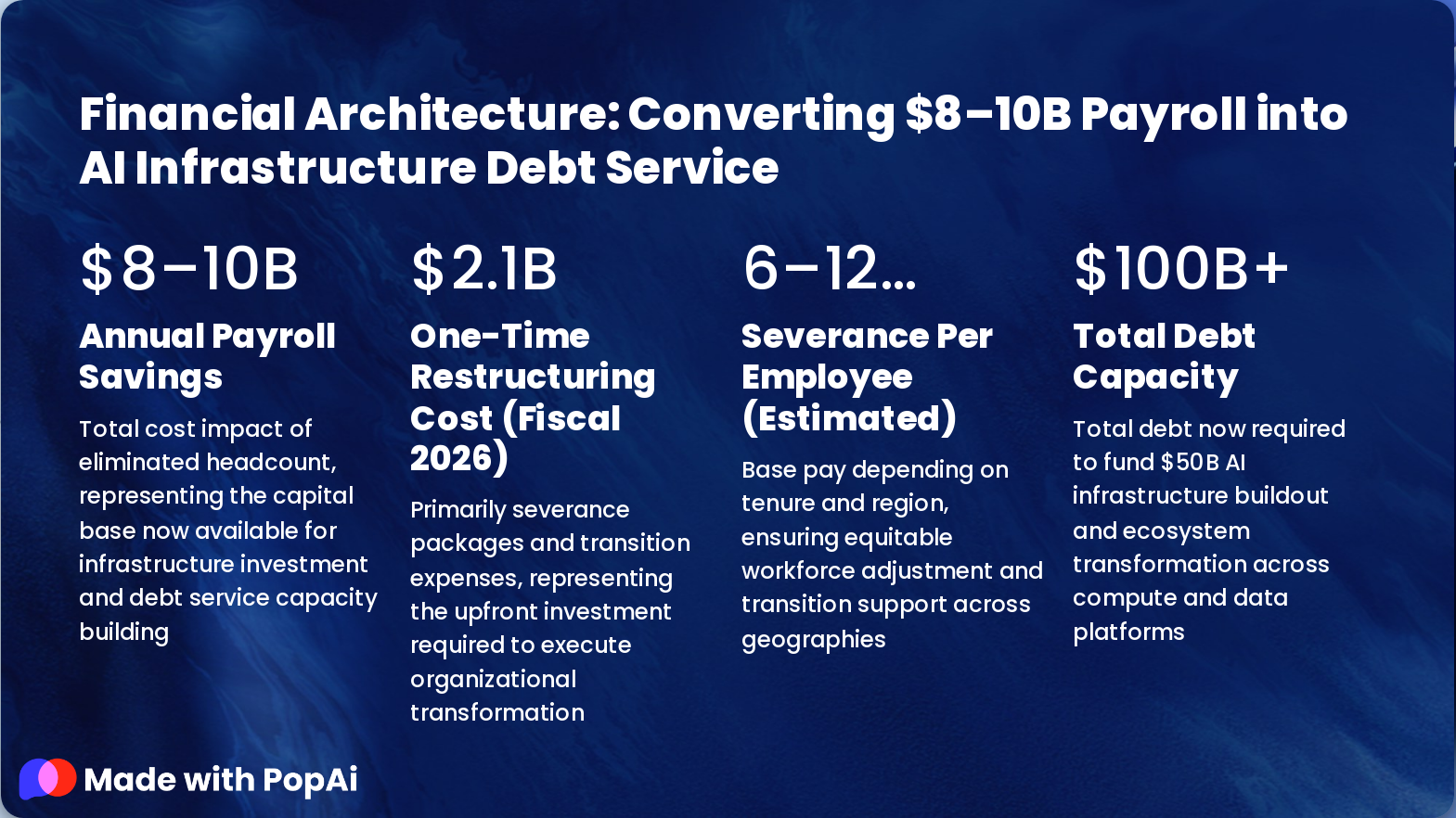
Slide 7: Financial Architecture: Converting $8–10B Payroll into AI Infrastructure Debt Service
- $8–10B — Annual Payroll Savings
- $2.1B — One-Time Restructuring Cost (Fiscal 2026)
- 6–12 months — Severance Per Employee (Estimated)
- $100B+ — Total Debt Capacity
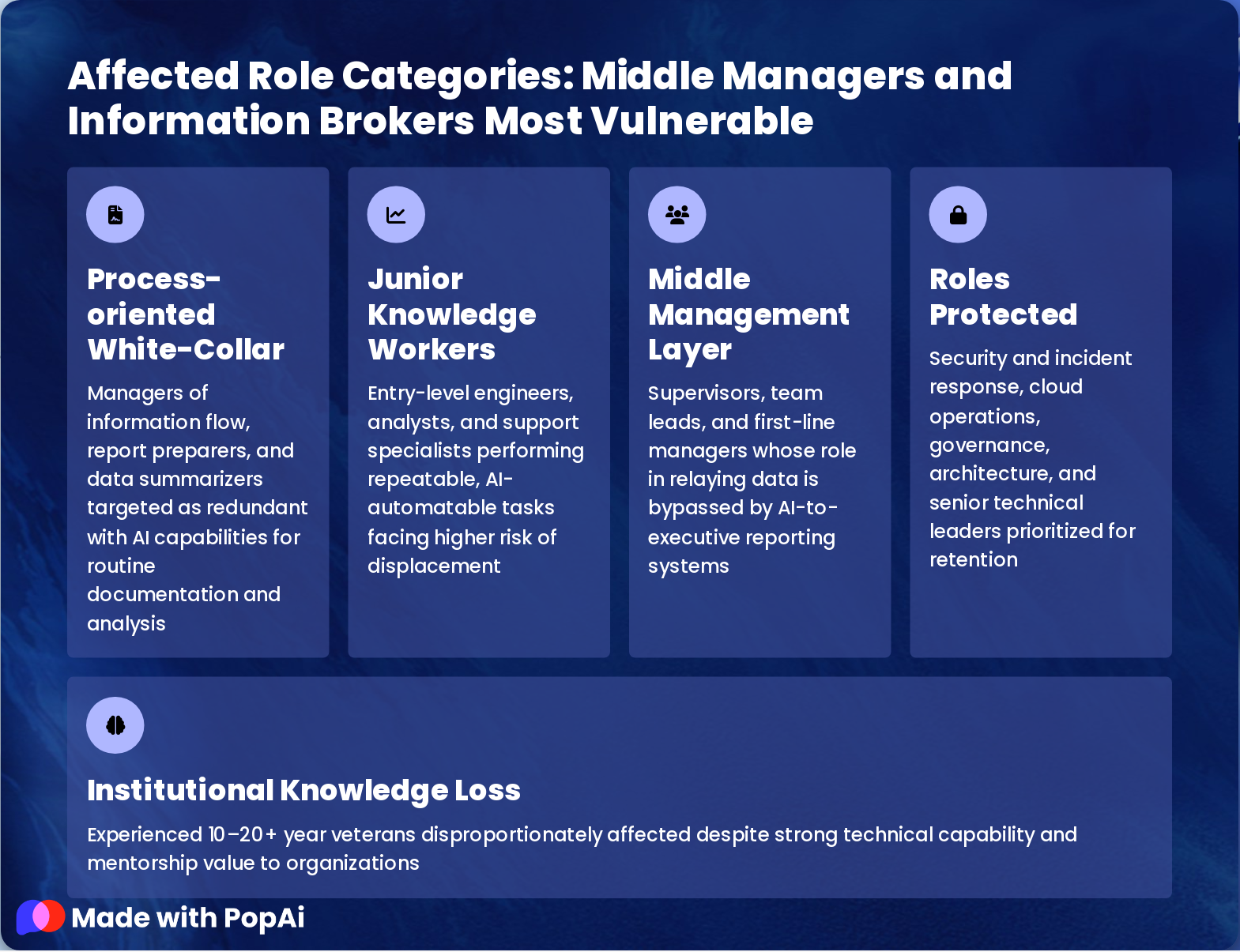
Slide 8: Affected Role Categories: Middle Managers and Information Brokers Most Vulnerable
- Process-oriented White-Collar: Managers of information flow, report preparers, and data summarizers targeted as redundant with AI capabilities for routine documentation and analysis
- Junior Knowledge Workers: Entry-level engineers, analysts, and support specialists performing repeatable, AI-automatable tasks facing higher risk of displacement
- Middle Management Layer: Supervisors, team leads, and first-line managers whose role in relaying data is bypassed by AI-to-executive reporting systems
- Roles Protected: Security and incident response, cloud operations, governance, architecture, and senior technical leaders prioritized for retention
- Institutional Knowledge Loss: Experienced 10–20+ year veterans disproportionately affected despite strong technical capability and mentorship value to organizations
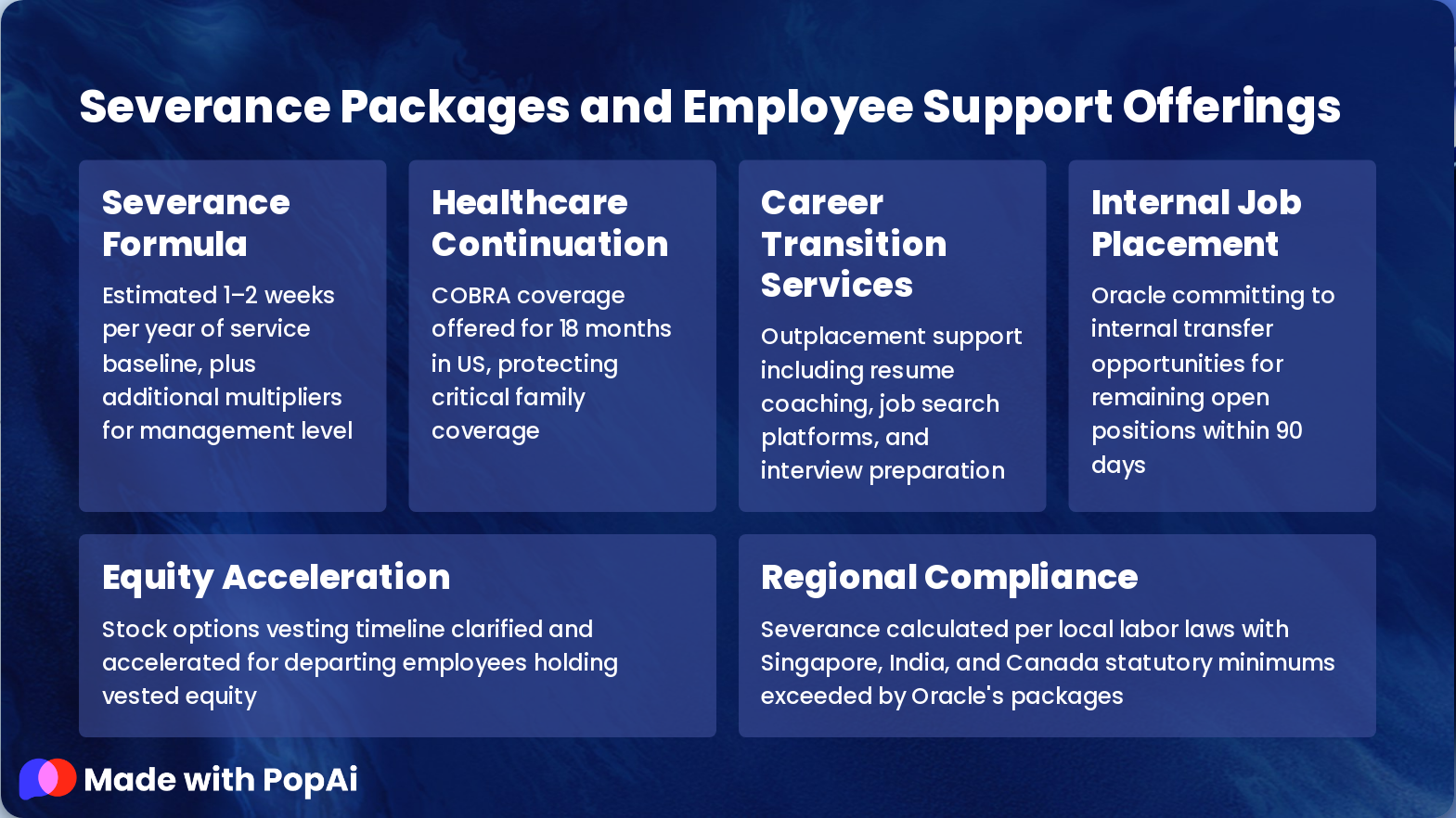
Slide 9: Severance Packages and Employee Support Offerings
- Severance Formula: Estimated 1–2 weeks per year of service baseline, plus additional multipliers for management level
- Healthcare Continuation: COBRA coverage offered for 18 months in US, protecting critical family coverage
- Career Transition Services: Outplacement support including resume coaching, job search platforms, and interview preparation
- Internal Job Placement: Oracle committing to internal transfer opportunities for remaining open positions within 90 days
- Equity Acceleration: Stock options vesting timeline clarified and accelerated for departing employees holding vested equity
- Regional Compliance: Severance calculated per local labor laws with Singapore, India, and Canada statutory minimums exceeded by Oracle's packages
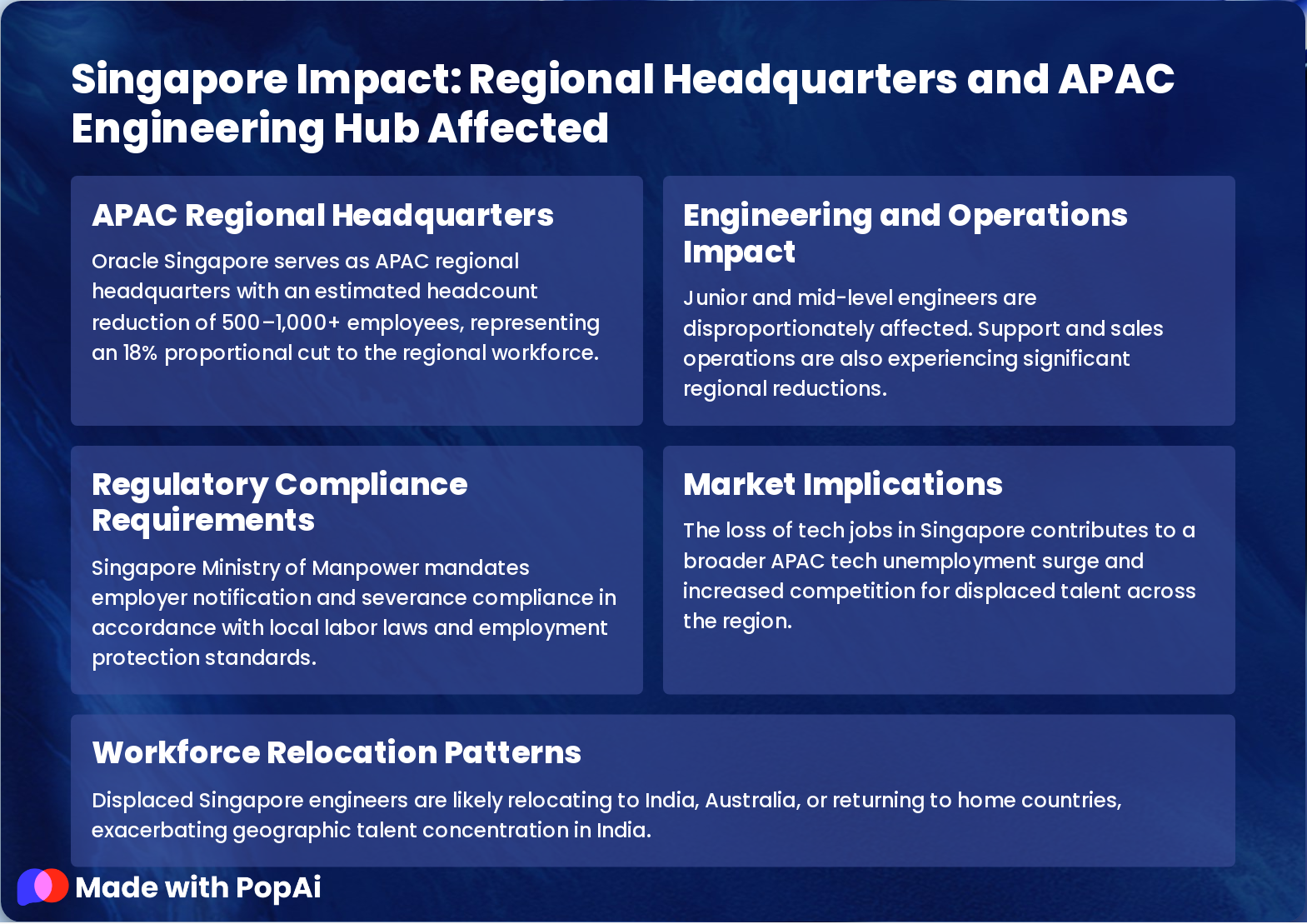
Slide 10: Singapore Impact: Regional Headquarters and APAC Engineering Hub Affected
- APAC Regional Headquarters: Oracle Singapore serves as APAC regional headquarters with an estimated headcount reduction of 500–1,000+ employees, representing an 18% proportional cut to the regional workforce.
- Engineering and Operations Impact: Junior and mid-level engineers are disproportionately affected. Support and sales operations are also experiencing significant regional reductions.
- Regulatory Compliance Requirements: Singapore Ministry of Manpower mandates employer notification and severance compliance in accordance with local labor laws and employment protection standards.
- Market Implications: The loss of tech jobs in Singapore contributes to a broader APAC tech unemployment surge and increased competition for displaced talent across the region.
- Workforce Relocation Patterns: Displaced Singapore engineers are likely relocating to India, Australia, or returning to home countries, exacerbating geographic talent concentration in India.
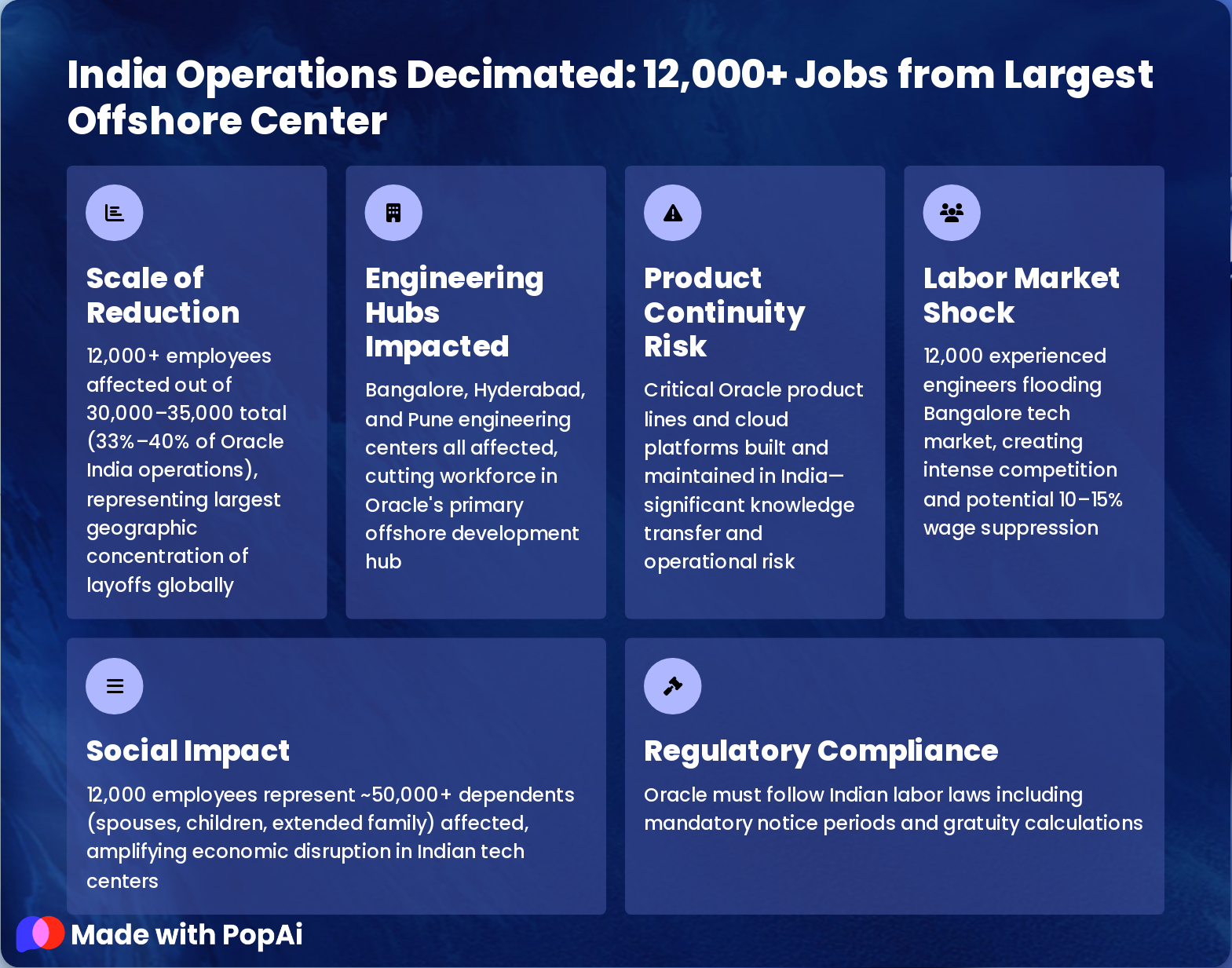
Slide 11: India Operations Decimated: 12,000+ Jobs from Largest Offshore Center
- Scale of Reduction: 12,000+ employees affected out of 30,000–35,000 total (33%–40% of Oracle India operations), representing largest geographic concentration of layoffs globally
- Engineering Hubs Impacted: Bangalore, Hyderabad, and Pune engineering centers all affected, cutting workforce in Oracle's primary offshore development hub
- Product Continuity Risk: Critical Oracle product lines and cloud platforms built and maintained in India—significant knowledge transfer and operational risk
- Labor Market Shock: 12,000 experienced engineers flooding Bangalore tech market, creating intense competition and potential 10–15% wage suppression
- Social Impact: 12,000 employees represent ~50,000+ dependents (spouses, children, extended family) affected, amplifying economic disruption in Indian tech centers
- Regulatory Compliance: Oracle must follow Indian labor laws including mandatory notice periods and gratuity calculations
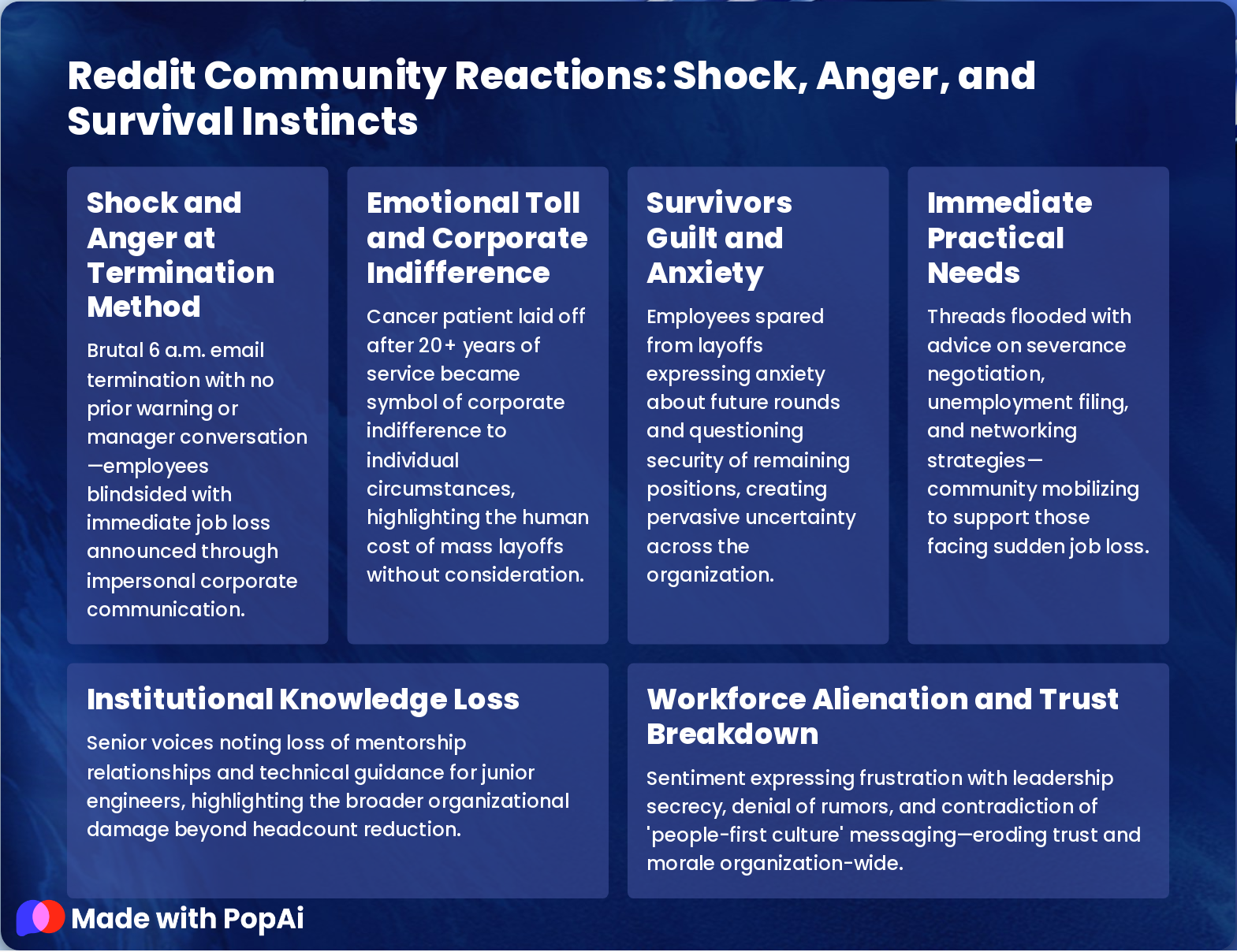
Slide 12: Reddit Community Reactions: Shock, Anger, and Survival Instincts
- Shock and Anger at Termination Method: Brutal 6 a.m. email termination with no prior warning or manager conversation—employees blindsided with immediate job loss announced through impersonal corporate communication.
- Emotional Toll and Corporate Indifference: Cancer patient laid off after 20+ years of service became symbol of corporate indifference to individual circumstances, highlighting the human cost of mass layoffs without consideration.
- Survivors Guilt and Anxiety: Employees spared from layoffs expressing anxiety about future rounds and questioning security of remaining positions, creating pervasive uncertainty across the organization.
- Immediate Practical Needs: Threads flooded with advice on severance negotiation, unemployment filing, and networking strategies—community mobilizing to support those facing sudden job loss.
- Institutional Knowledge Loss: Senior voices noting loss of mentorship relationships and technical guidance for junior engineers, highlighting the broader organizational damage beyond headcount reduction.
- Workforce Alienation and Trust Breakdown: Sentiment expressing frustration with leadership secrecy, denial of rumors, and contradiction of 'people-first culture' messaging—eroding trust and morale organization-wide.
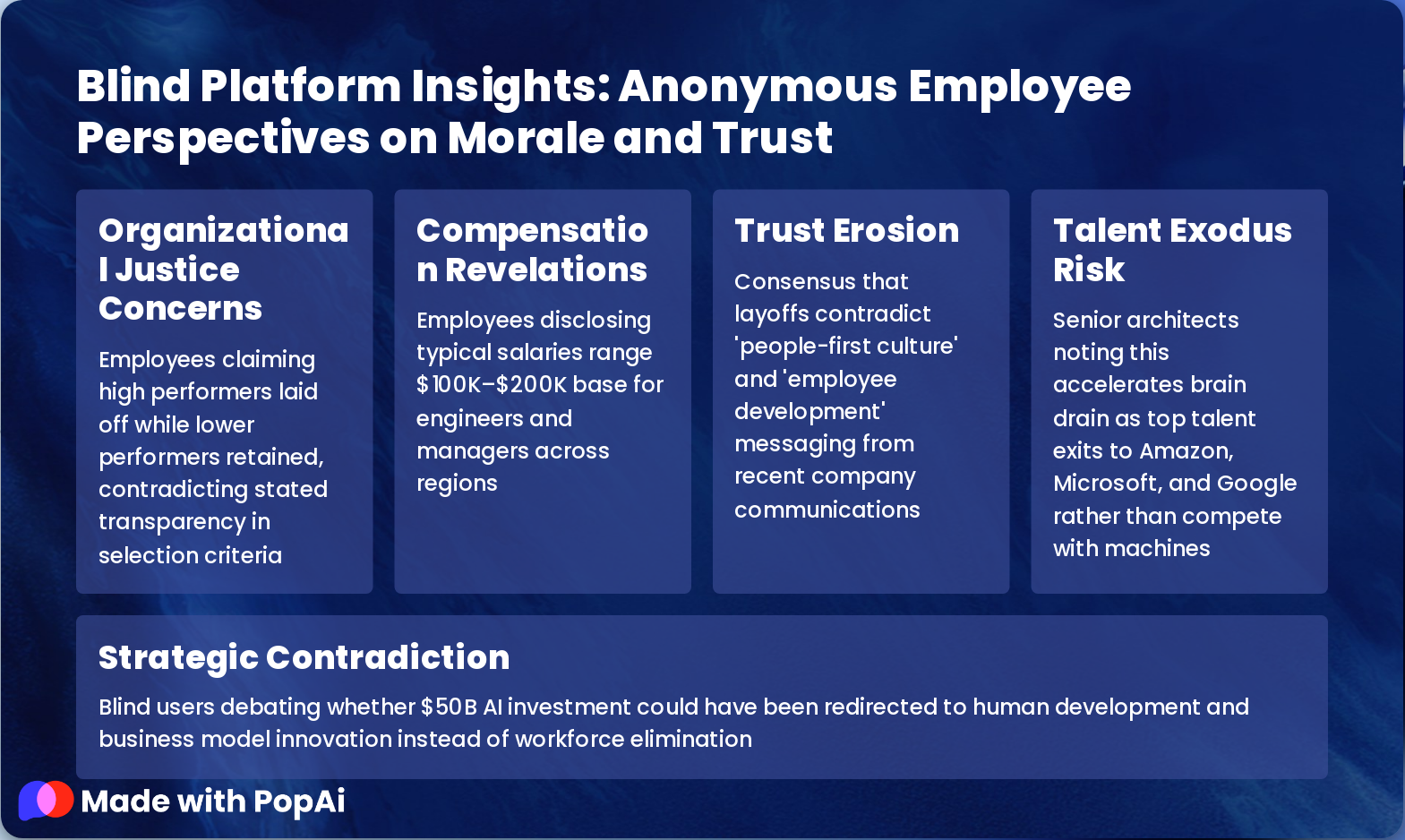
Slide 13: Blind Platform Insights: Anonymous Employee Perspectives on Morale and Trust
- Organizational Justice Concerns: Employees claiming high performers laid off while lower performers retained, contradicting stated transparency in selection criteria
- Compensation Revelations: Employees disclosing typical salaries range $100K–$200K base for engineers and managers across regions
- Trust Erosion: Consensus that layoffs contradict 'people-first culture' and 'employee development' messaging from recent company communications
- Talent Exodus Risk: Senior architects noting this accelerates brain drain as top talent exits to Amazon, Microsoft, and Google rather than compete with machines
- Strategic Contradiction: Blind users debating whether $50B AI investment could have been redirected to human development and business model innovation instead of workforce elimination
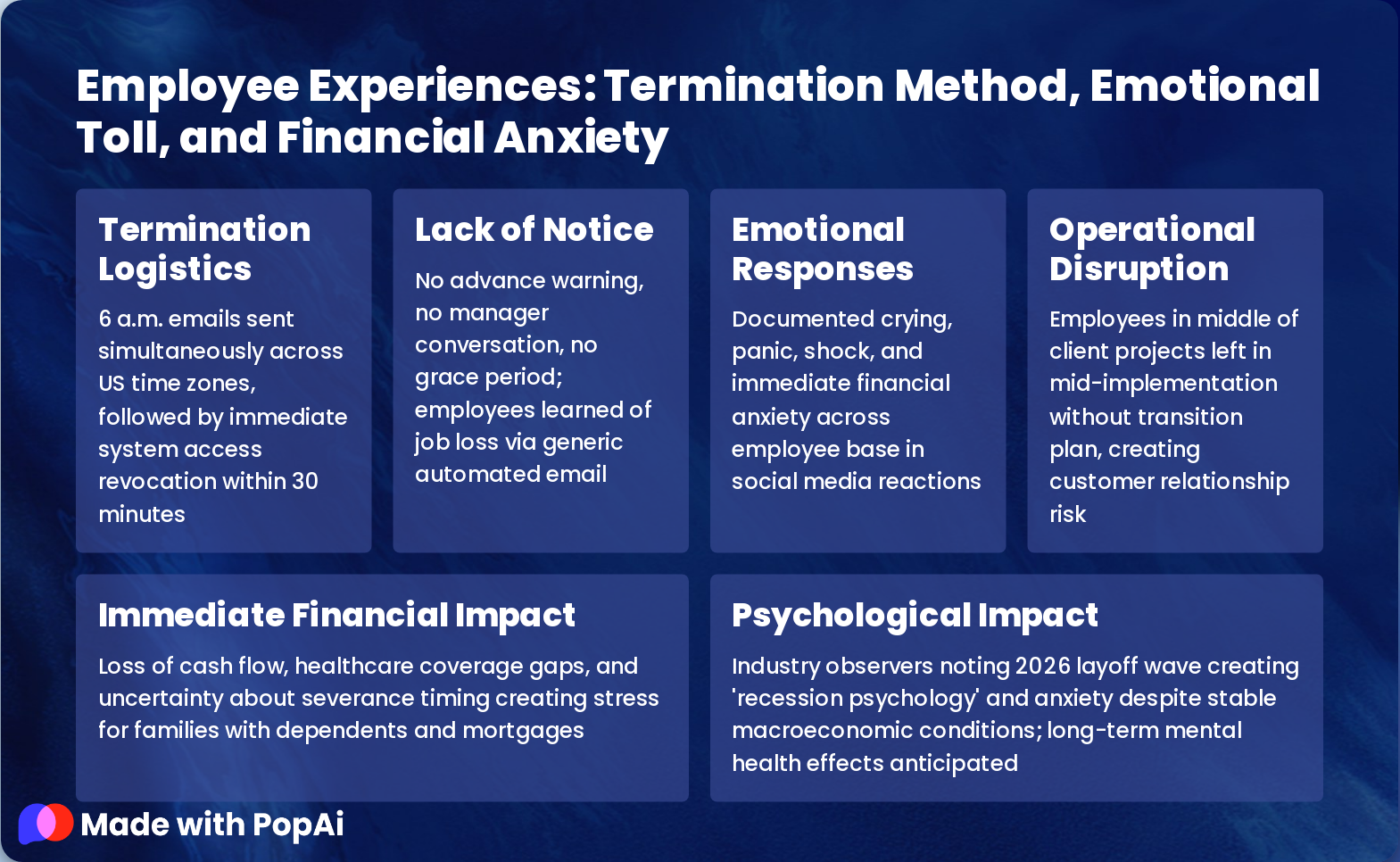
Slide 14: Employee Experiences: Termination Method, Emotional Toll, and Financial Anxiety
- Termination Logistics: 6 a.m. emails sent simultaneously across US time zones, followed by immediate system access revocation within 30 minutes
- Lack of Notice: No advance warning, no manager conversation, no grace period; employees learned of job loss via generic automated email
- Emotional Responses: Documented crying, panic, shock, and immediate financial anxiety across employee base in social media reactions
- Operational Disruption: Employees in middle of client projects left in mid-implementation without transition plan, creating customer relationship risk
- Immediate Financial Impact: Loss of cash flow, healthcare coverage gaps, and uncertainty about severance timing creating stress for families with dependents and mortgages
- Psychological Impact: Industry observers noting 2026 layoff wave creating 'recession psychology' and anxiety despite stable macroeconomic conditions; long-term mental health effects anticipated
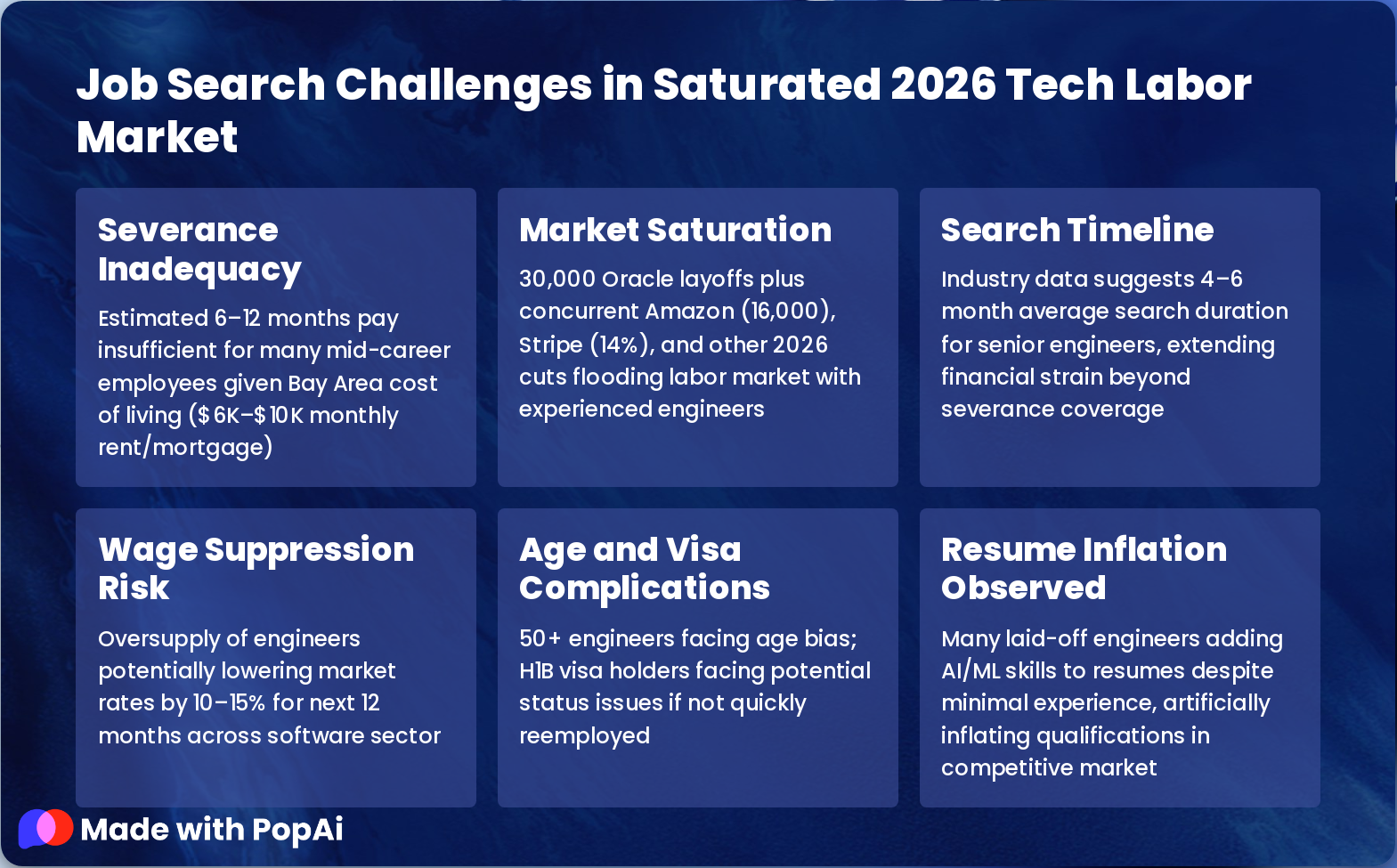
Slide 15: Job Search Challenges in Saturated 2026 Tech Labor Market
- Severance Inadequacy: Estimated 6–12 months pay insufficient for many mid-career employees given Bay Area cost of living ($6K–$10K monthly rent/mortgage)
- Market Saturation: 30,000 Oracle layoffs plus concurrent Amazon (16,000), Stripe (14%), and other 2026 cuts flooding labor market with experienced engineers
- Search Timeline: Industry data suggests 4–6 month average search duration for senior engineers, extending financial strain beyond severance coverage
- Wage Suppression Risk: Oversupply of engineers potentially lowering market rates by 10–15% for next 12 months across software sector
- Age and Visa Complications: 50+ engineers facing age bias; H1B visa holders facing potential status issues if not quickly reemployed
- Resume Inflation Observed: Many laid-off engineers adding AI/ML skills to resumes despite minimal experience, artificially inflating qualifications in competitive market
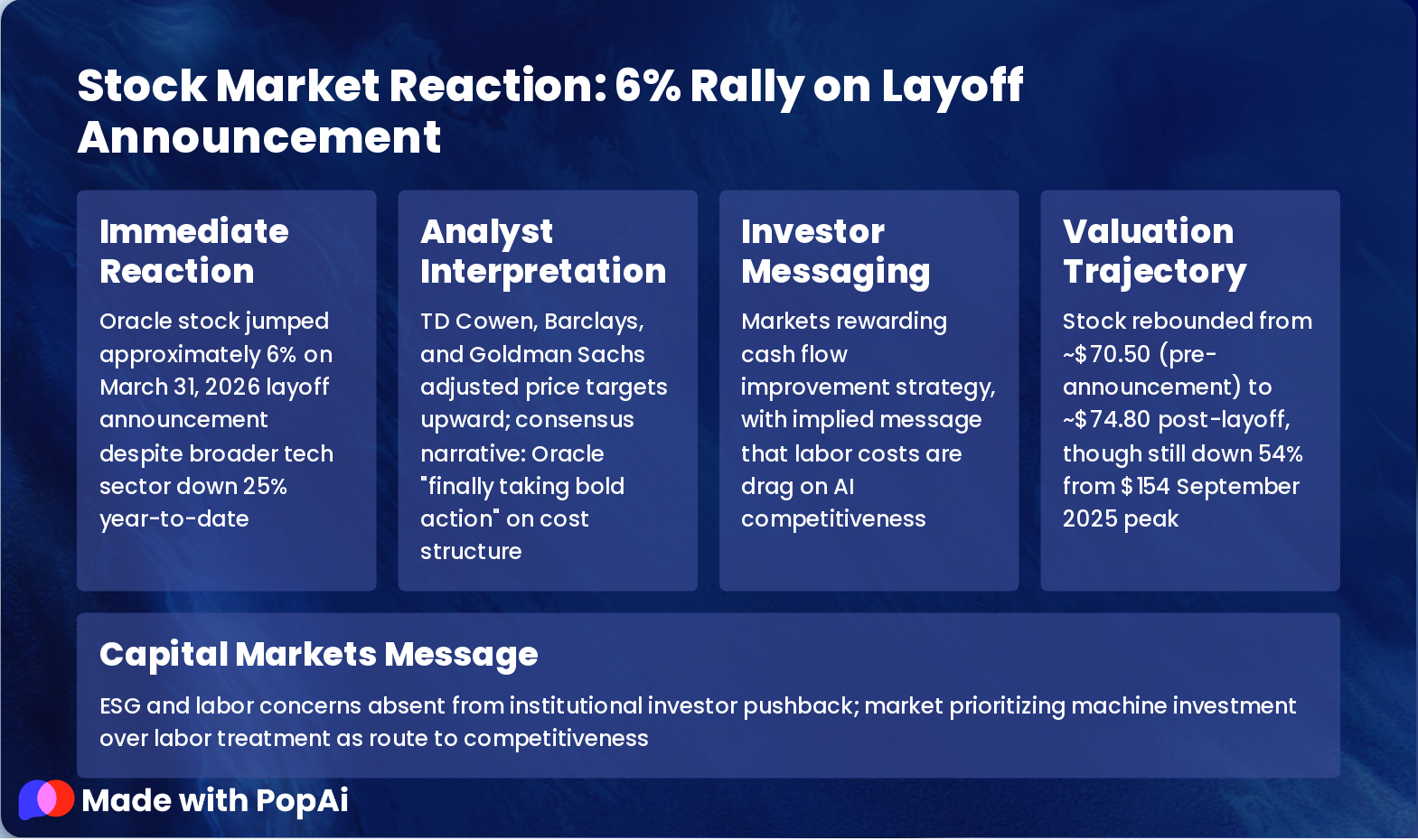
Slide 16: Stock Market Reaction: 6% Rally on Layoff Announcement
- Immediate Reaction: Oracle stock jumped approximately 6% on March 31, 2026 layoff announcement despite broader tech sector down 25% year-to-date
- Analyst Interpretation: TD Cowen, Barclays, and Goldman Sachs adjusted price targets upward; consensus narrative: Oracle "finally taking bold action" on cost structure
- Investor Messaging: Markets rewarding cash flow improvement strategy, with implied message that labor costs are drag on AI competitiveness
- Valuation Trajectory: Stock rebounded from ~$70.50 (pre-announcement) to ~$74.80 post-layoff, though still down 54% from $154 September 2025 peak
- Capital Markets Message: ESG and labor concerns absent from institutional investor pushback; market prioritizing machine investment over labor treatment as route to competitiveness
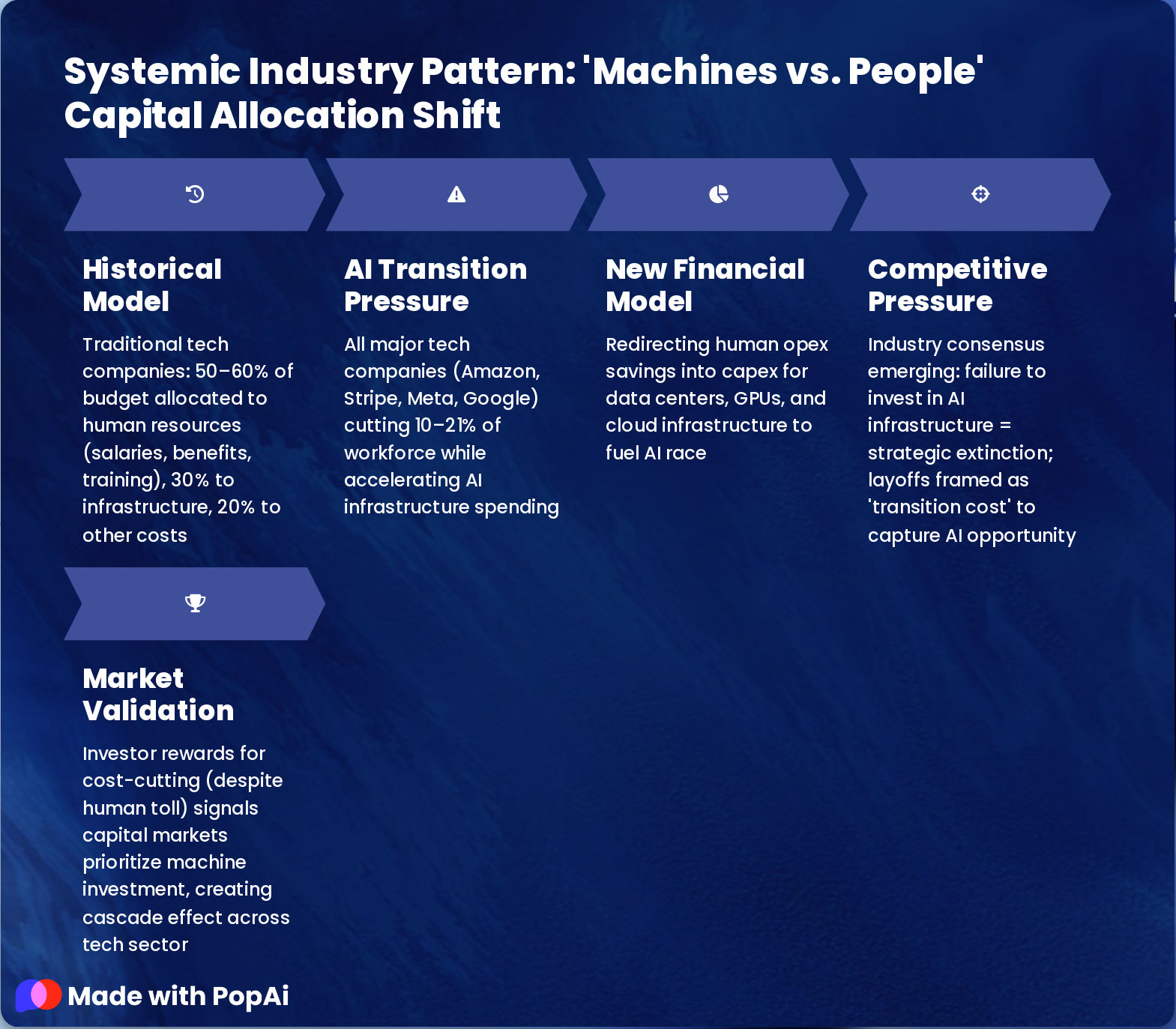
Slide 17: Systemic Industry Pattern: 'Machines vs. People' Capital Allocation Shift
- Historical Model: Traditional tech companies: 50–60% of budget allocated to human resources (salaries, benefits, training), 30% to infrastructure, 20% to other costs
- AI Transition Pressure: All major tech companies (Amazon, Stripe, Meta, Google) cutting 10–21% of workforce while accelerating AI infrastructure spending
- New Financial Model: Redirecting human opex savings into capex for data centers, GPUs, and cloud infrastructure to fuel AI race
- Competitive Pressure: Industry consensus emerging: failure to invest in AI infrastructure = strategic extinction; layoffs framed as 'transition cost' to capture AI opportunity
- Market Validation: Investor rewards for cost-cutting (despite human toll) signals capital markets prioritize machine investment, creating cascade effect across tech sector
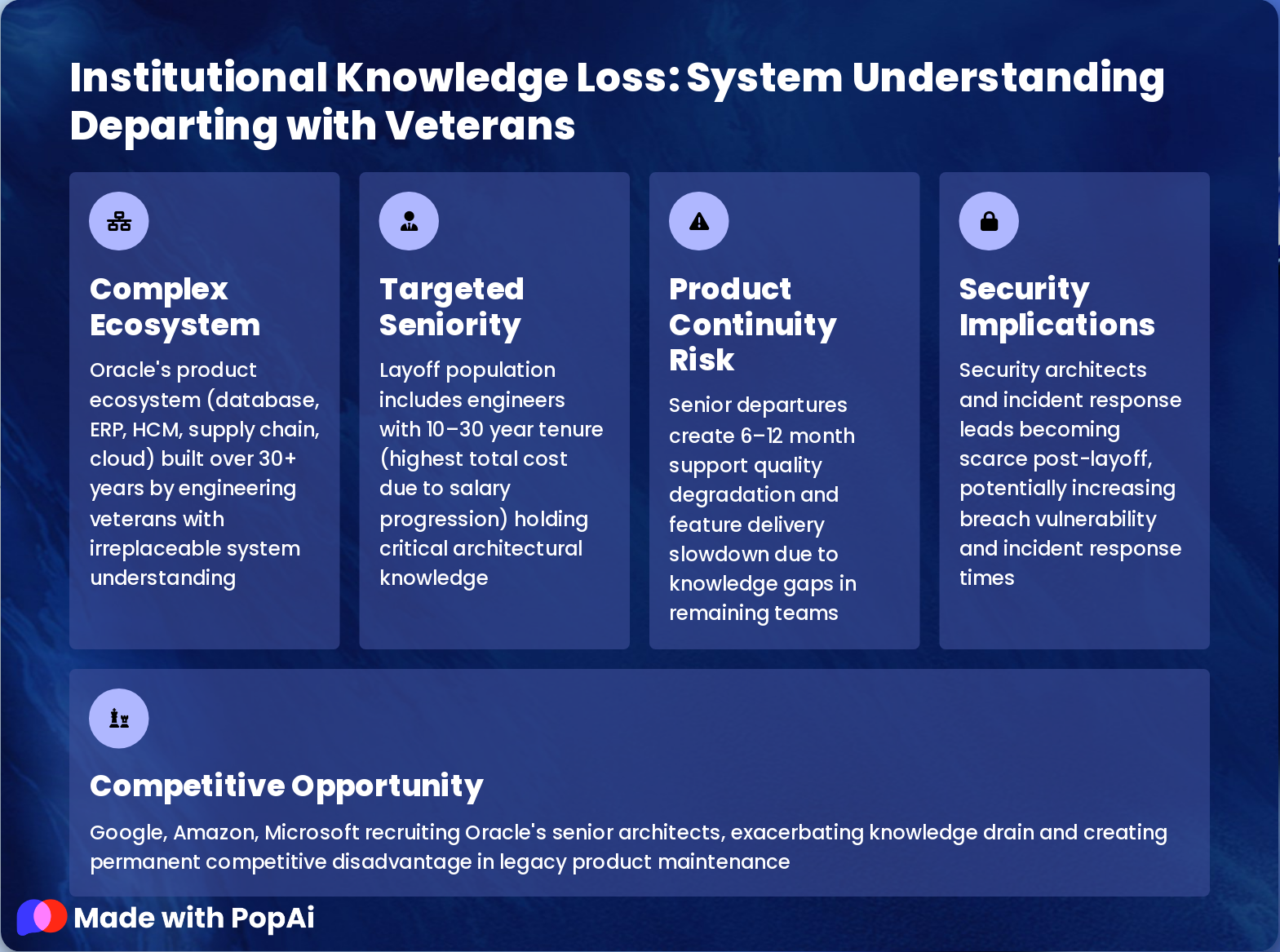
Slide 18: Institutional Knowledge Loss: System Understanding Departing with Veterans
- Complex Ecosystem: Oracle's product ecosystem (database, ERP, HCM, supply chain, cloud) built over 30+ years by engineering veterans with irreplaceable system understanding
- Targeted Seniority: Layoff population includes engineers with 10–30 year tenure (highest total cost due to salary progression) holding critical architectural knowledge
- Product Continuity Risk: Senior departures create 6–12 month support quality degradation and feature delivery slowdown due to knowledge gaps in remaining teams
- Security Implications: Security architects and incident response leads becoming scarce post-layoff, potentially increasing breach vulnerability and incident response times
- Competitive Opportunity: Google, Amazon, Microsoft recruiting Oracle's senior architects, exacerbating knowledge drain and creating permanent competitive disadvantage in legacy product maintenance
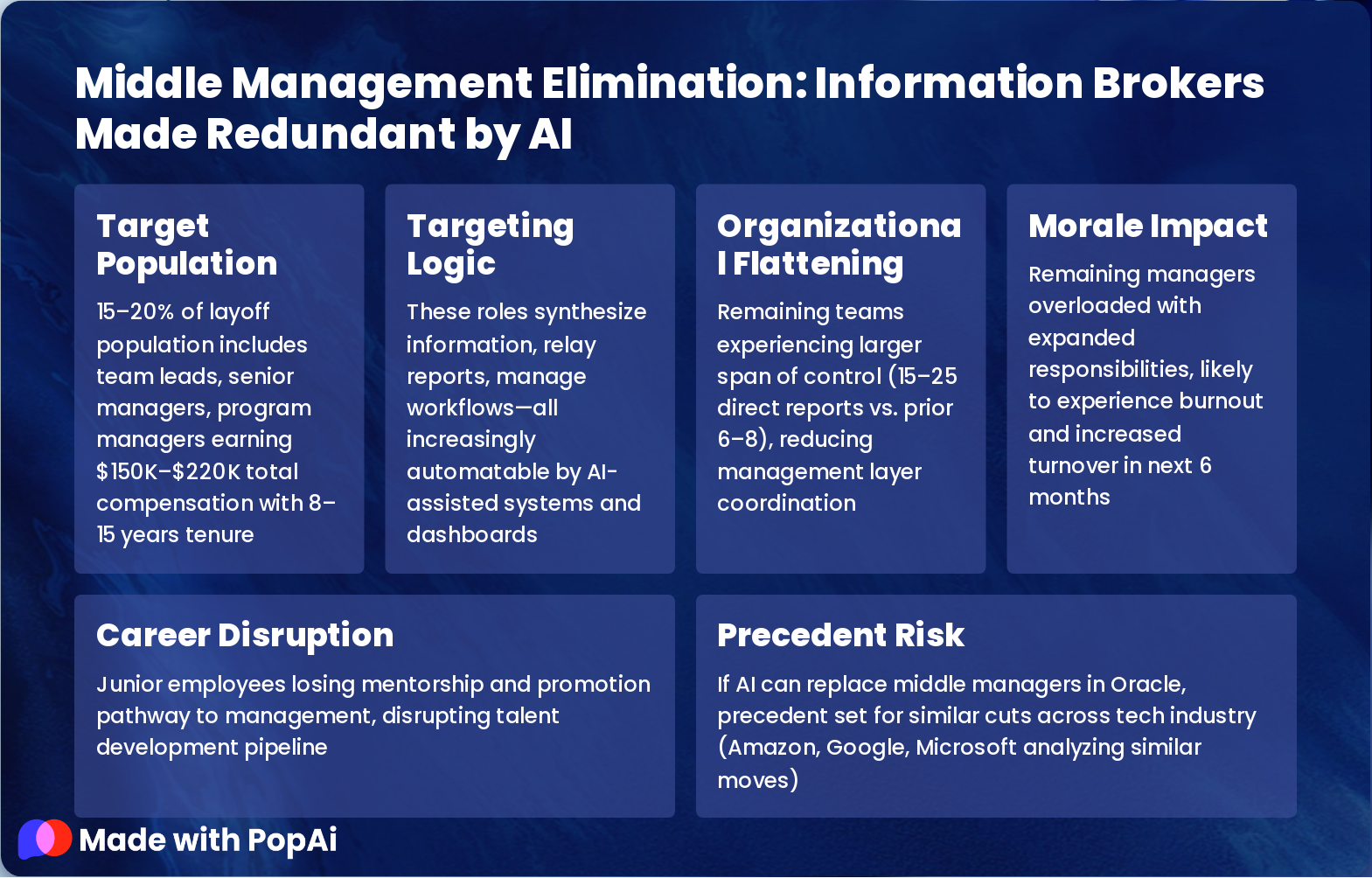
Slide 19: Middle Management Elimination: Information Brokers Made Redundant by AI
- Target Population: 15–20% of layoff population includes team leads, senior managers, program managers earning $150K–$220K total compensation with 8–15 years tenure
- Targeting Logic: These roles synthesize information, relay reports, manage workflows—all increasingly automatable by AI-assisted systems and dashboards
- Organizational Flattening: Remaining teams experiencing larger span of control (15–25 direct reports vs. prior 6–8), reducing management layer coordination
- Morale Impact: Remaining managers overloaded with expanded responsibilities, likely to experience burnout and increased turnover in next 6 months
- Career Disruption: Junior employees losing mentorship and promotion pathway to management, disrupting talent development pipeline
- Precedent Risk: If AI can replace middle managers in Oracle, precedent set for similar cuts across tech industry (Amazon, Google, Microsoft analyzing similar moves)
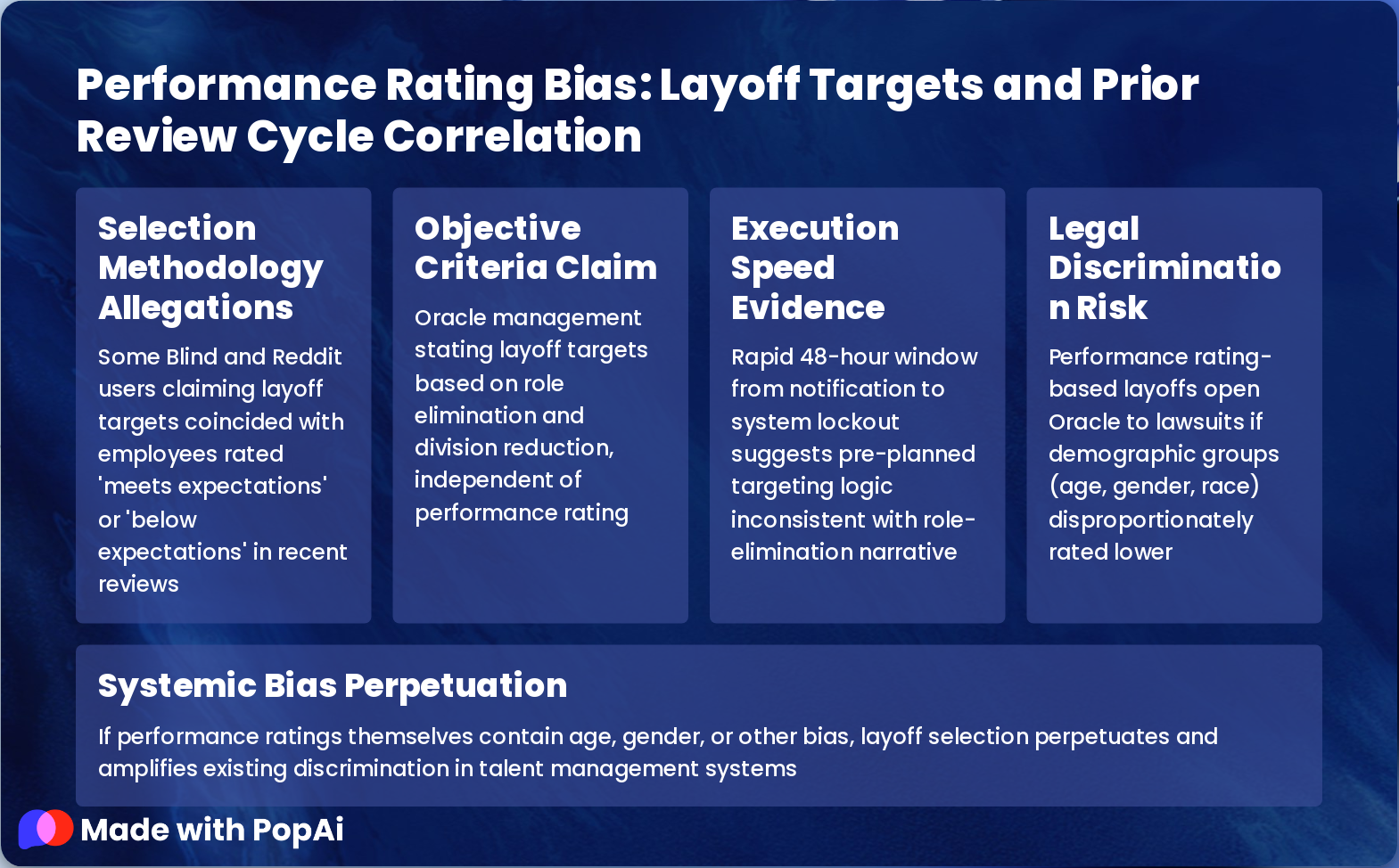
Slide 20: Performance Rating Bias: Layoff Targets and Prior Review Cycle Correlation
- Selection Methodology Allegations: Some Blind and Reddit users claiming layoff targets coincided with employees rated 'meets expectations' or 'below expectations' in recent reviews
- Objective Criteria Claim: Oracle management stating layoff targets based on role elimination and division reduction, independent of performance rating
- Execution Speed Evidence: Rapid 48-hour window from notification to system lockout suggests pre-planned targeting logic inconsistent with role-elimination narrative
- Legal Discrimination Risk: Performance rating-based layoffs open Oracle to lawsuits if demographic groups (age, gender, race) disproportionately rated lower
- Systemic Bias Perpetuation: If performance ratings themselves contain age, gender, or other bias, layoff selection perpetuates and amplifies existing discrimination in talent management systems
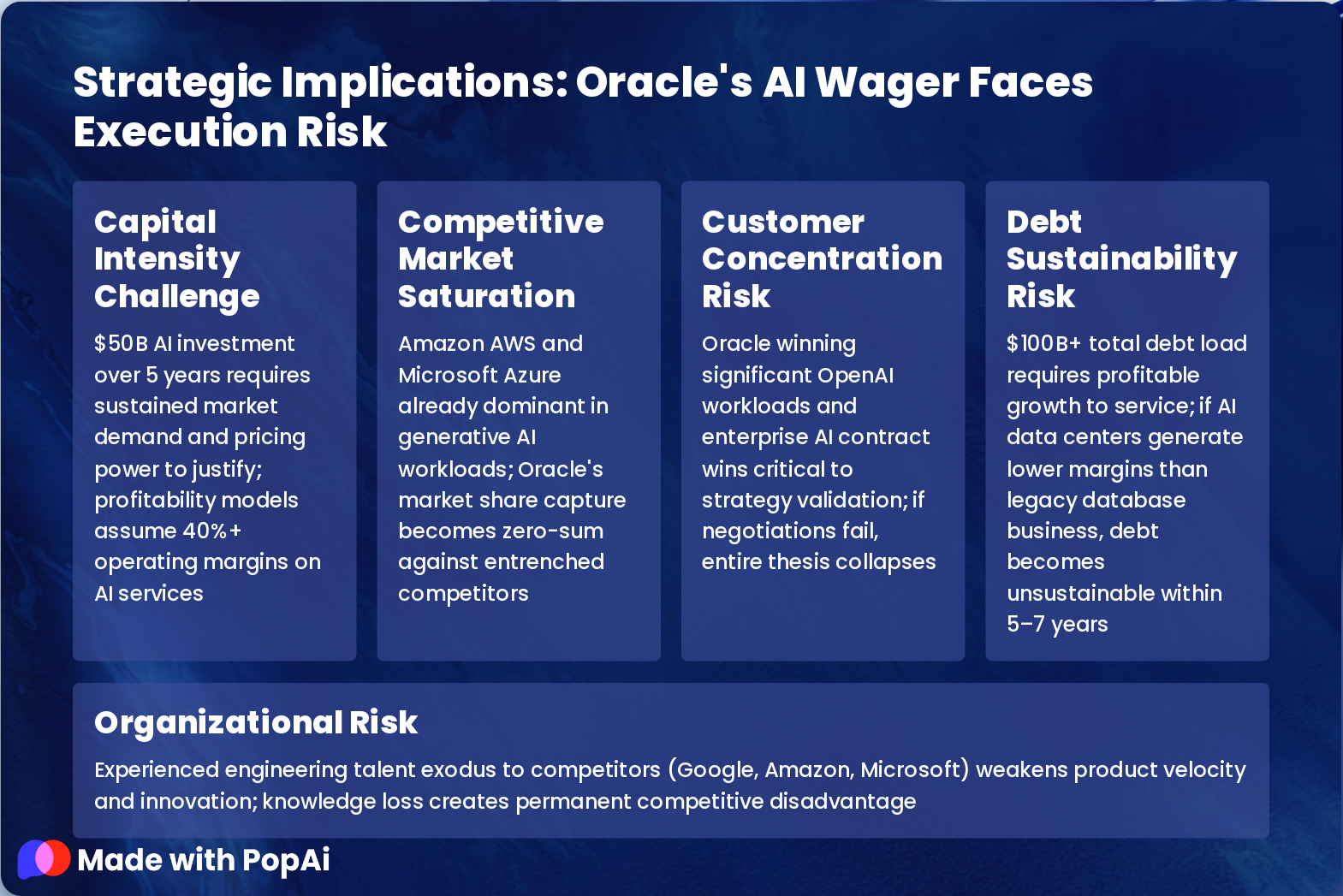
Slide 21: Strategic Implications: Oracle's AI Wager Faces Execution Risk
- Capital Intensity Challenge: $50B AI investment over 5 years requires sustained market demand and pricing power to justify; profitability models assume 40%+ operating margins on AI services
- Competitive Market Saturation: Amazon AWS and Microsoft Azure already dominant in generative AI workloads; Oracle's market share capture becomes zero-sum against entrenched competitors
- Customer Concentration Risk: Oracle winning significant OpenAI workloads and enterprise AI contract wins critical to strategy validation; if negotiations fail, entire thesis collapses
- Debt Sustainability Risk: $100B+ total debt load requires profitable growth to service; if AI data centers generate lower margins than legacy database business, debt becomes unsustainable within 5–7 years
- Organizational Risk: Experienced engineering talent exodus to competitors (Google, Amazon, Microsoft) weakens product velocity and innovation; knowledge loss creates permanent competitive disadvantage
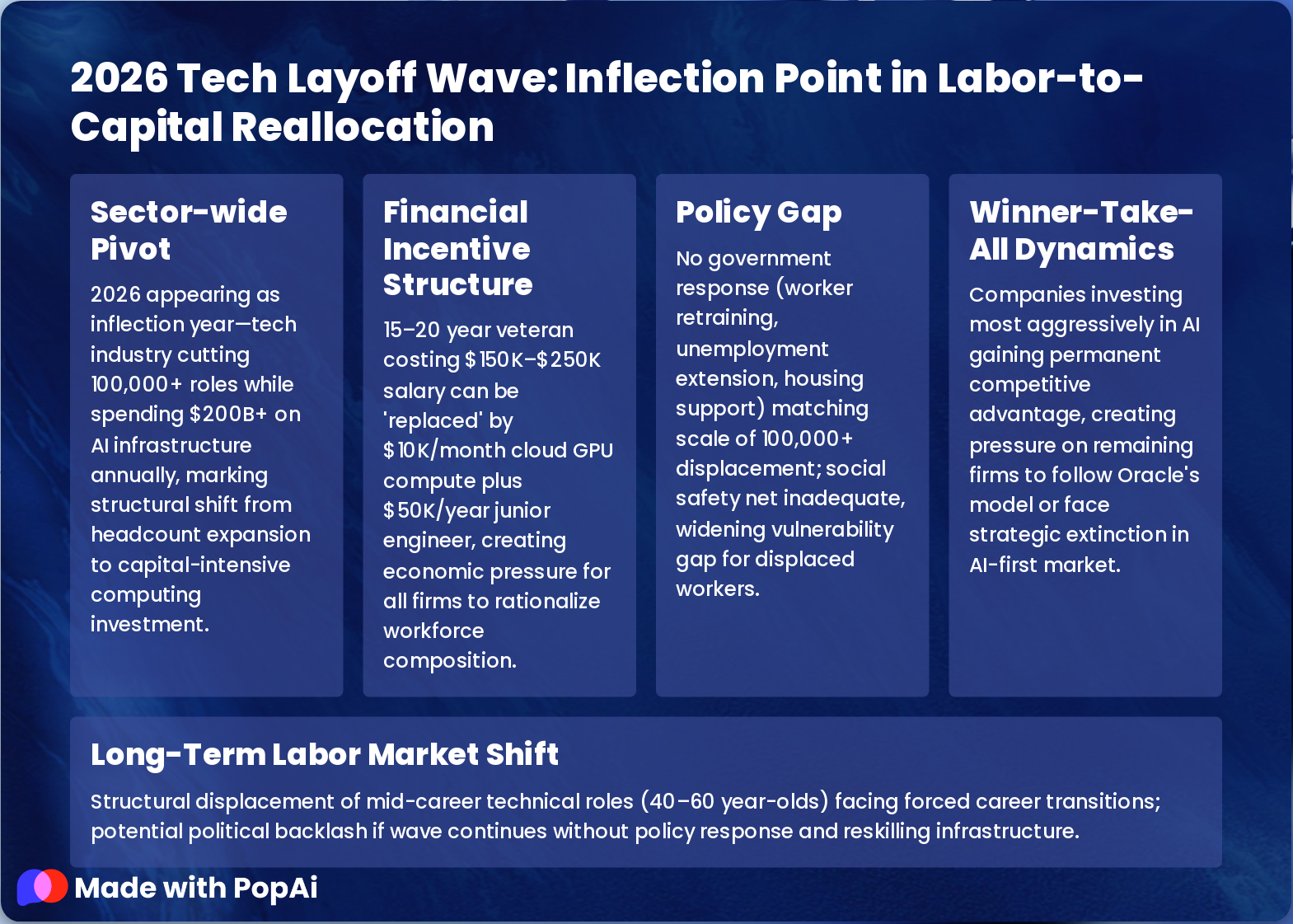
Slide 22: 2026 Tech Layoff Wave: Inflection Point in Labor-to-Capital Reallocation
- Sector-wide Pivot: 2026 appearing as inflection year—tech industry cutting 100,000+ roles while spending $200B+ on AI infrastructure annually, marking structural shift from headcount expansion to capital-intensive computing investment.
- Financial Incentive Structure: 15–20 year veteran costing $150K–$250K salary can be 'replaced' by $10K/month cloud GPU compute plus $50K/year junior engineer, creating economic pressure for all firms to rationalize workforce composition.
- Policy Gap: No government response (worker retraining, unemployment extension, housing support) matching scale of 100,000+ displacement; social safety net inadequate, widening vulnerability gap for displaced workers.
- Winner-Take-All Dynamics: Companies investing most aggressively in AI gaining permanent competitive advantage, creating pressure on remaining firms to follow Oracle's model or face strategic extinction in AI-first market.
- Long-Term Labor Market Shift: Structural displacement of mid-career technical roles (40–60 year-olds) facing forced career transitions; potential political backlash if wave continues without policy response and reskilling infrastructure.
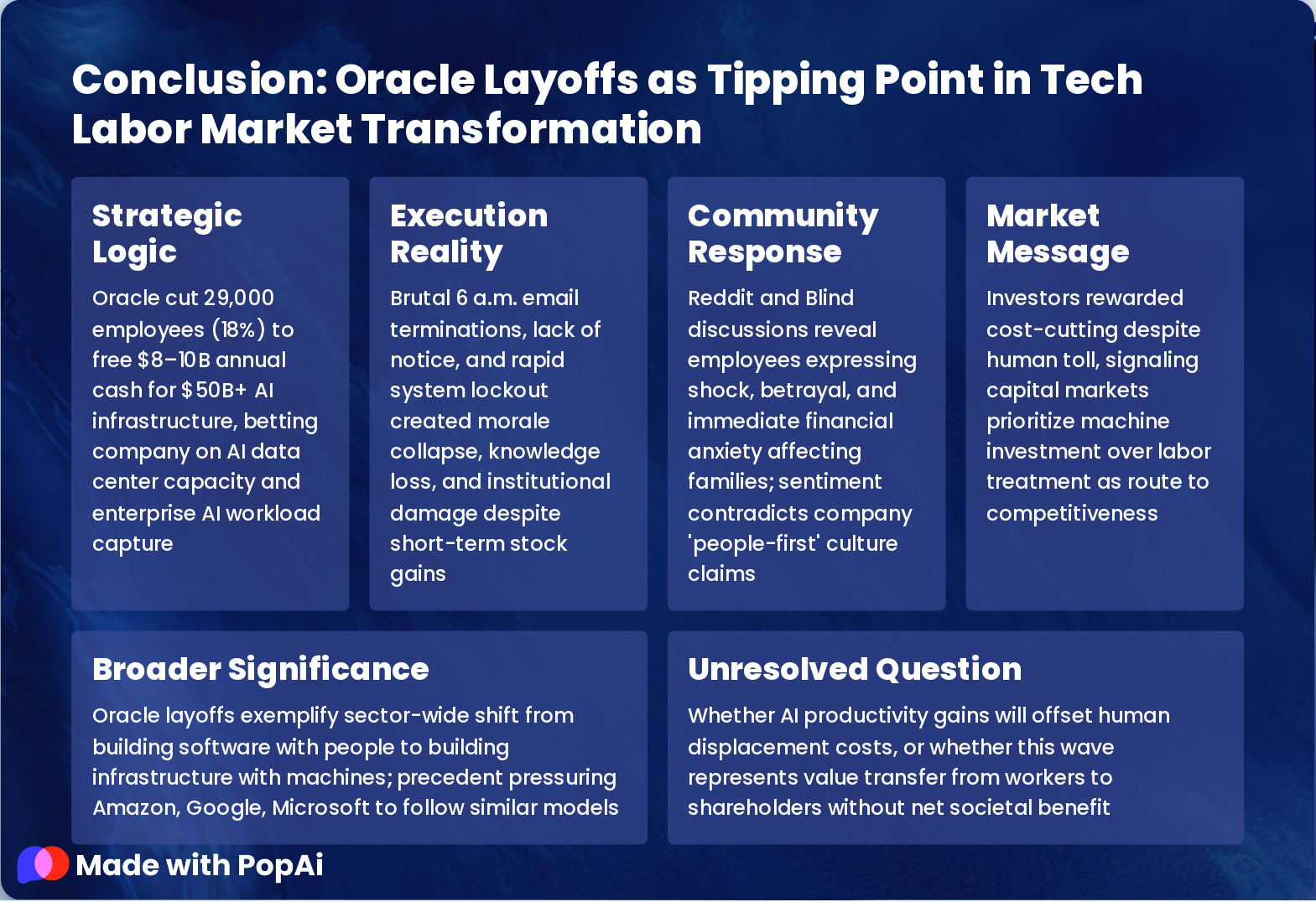
Slide 23: Conclusion: Oracle Layoffs as Tipping Point in Tech Labor Market Transformation
- Strategic Logic: Oracle cut 29,000 employees (18%) to free $8–10B annual cash for $50B+ AI infrastructure, betting company on AI data center capacity and enterprise AI workload capture
- Execution Reality: Brutal 6 a.m. email terminations, lack of notice, and rapid system lockout created morale collapse, knowledge loss, and institutional damage despite short-term stock gains
- Community Response: Reddit and Blind discussions reveal employees expressing shock, betrayal, and immediate financial anxiety affecting families; sentiment contradicts company 'people-first' culture claims
- Market Message: Investors rewarded cost-cutting despite human toll, signaling capital markets prioritize machine investment over labor treatment as route to competitiveness
- Broader Significance: Oracle layoffs exemplify sector-wide shift from building software with people to building infrastructure with machines; precedent pressuring Amazon, Google, Microsoft to follow similar models
- Unresolved Question: Whether AI productivity gains will offset human displacement costs, or whether this wave represents value transfer from workers to shareholders without net societal benefit