Presentation Summary
Discover the Duffer Brothers' post-Stranger Things horror series, Something Very Bad Is Going to Happen, a psychological thriller that explores love, dread, and the fear of marrying the wrong person.
Full Presentation Transcript
Slide 1: Something Very Bad Is Going to Happen: Netflix's Landmark Horror Miniseries
A comprehensive analysis of the Duffer Brothers' groundbreaking post-Stranger Things project created by Haley Z. Boston
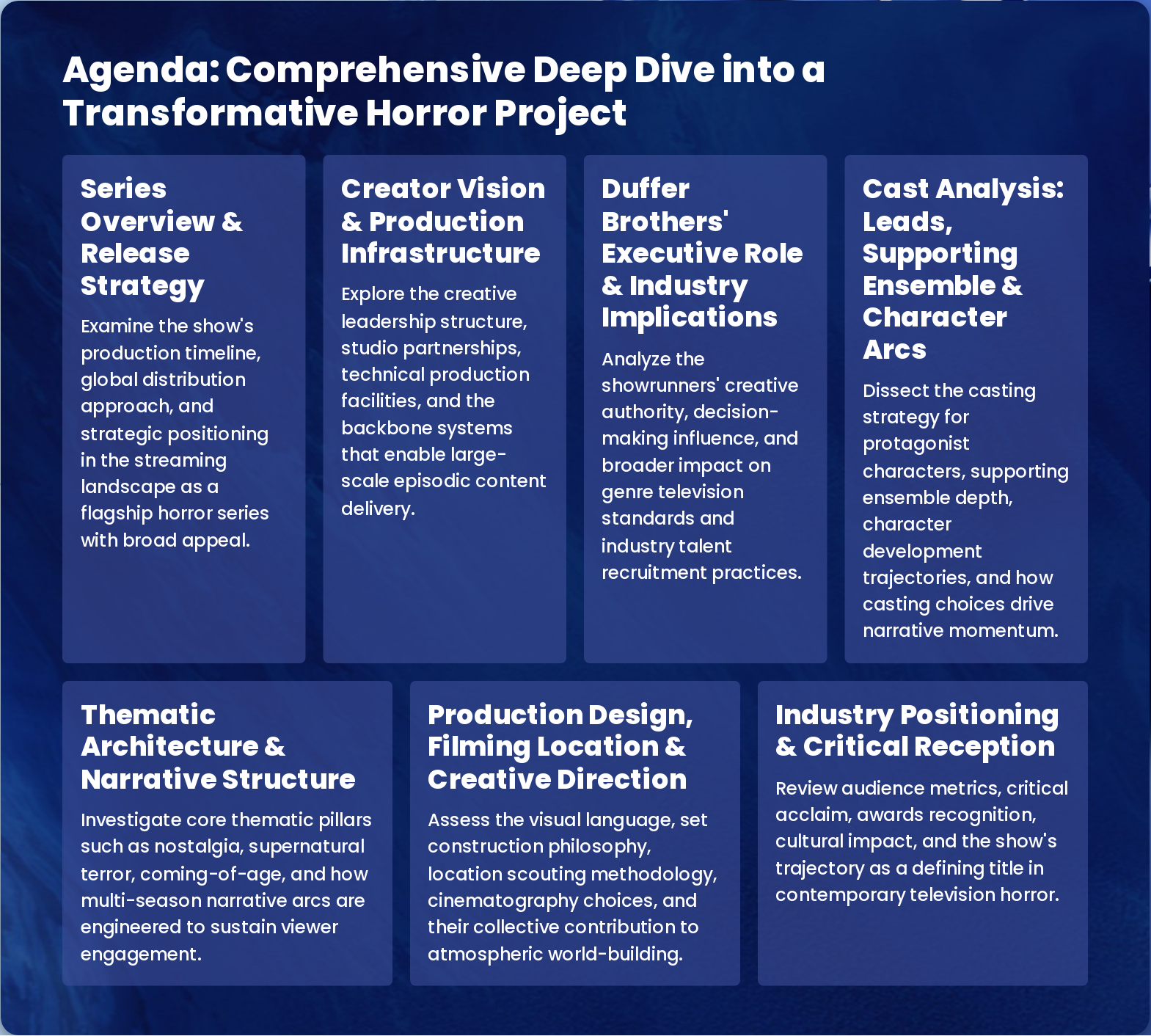
Slide 2: Agenda: Comprehensive Deep Dive into a Transformative Horror Project
- Series Overview & Release Strategy: Examine the show's production timeline, global distribution approach, and strategic positioning in the streaming landscape as a flagship horror series with broad appeal.
- Creator Vision & Production Infrastructure: Explore the creative leadership structure, studio partnerships, technical production facilities, and the backbone systems that enable large-scale episodic content delivery.
- Duffer Brothers' Executive Role & Industry Implications: Analyze the showrunners' creative authority, decision-making influence, and broader impact on genre television standards and industry talent recruitment practices.
- Cast Analysis: Leads, Supporting Ensemble & Character Arcs: Dissect the casting strategy for protagonist characters, supporting ensemble depth, character development trajectories, and how casting choices drive narrative momentum.
- Thematic Architecture & Narrative Structure: Investigate core thematic pillars such as nostalgia, supernatural terror, coming-of-age, and how multi-season narrative arcs are engineered to sustain viewer engagement.
- Production Design, Filming Location & Creative Direction: Assess the visual language, set construction philosophy, location scouting methodology, cinematography choices, and their collective contribution to atmospheric world-building.
- Industry Positioning & Critical Reception: Review audience metrics, critical acclaim, awards recognition, cultural impact, and the show's trajectory as a defining title in contemporary television horror.
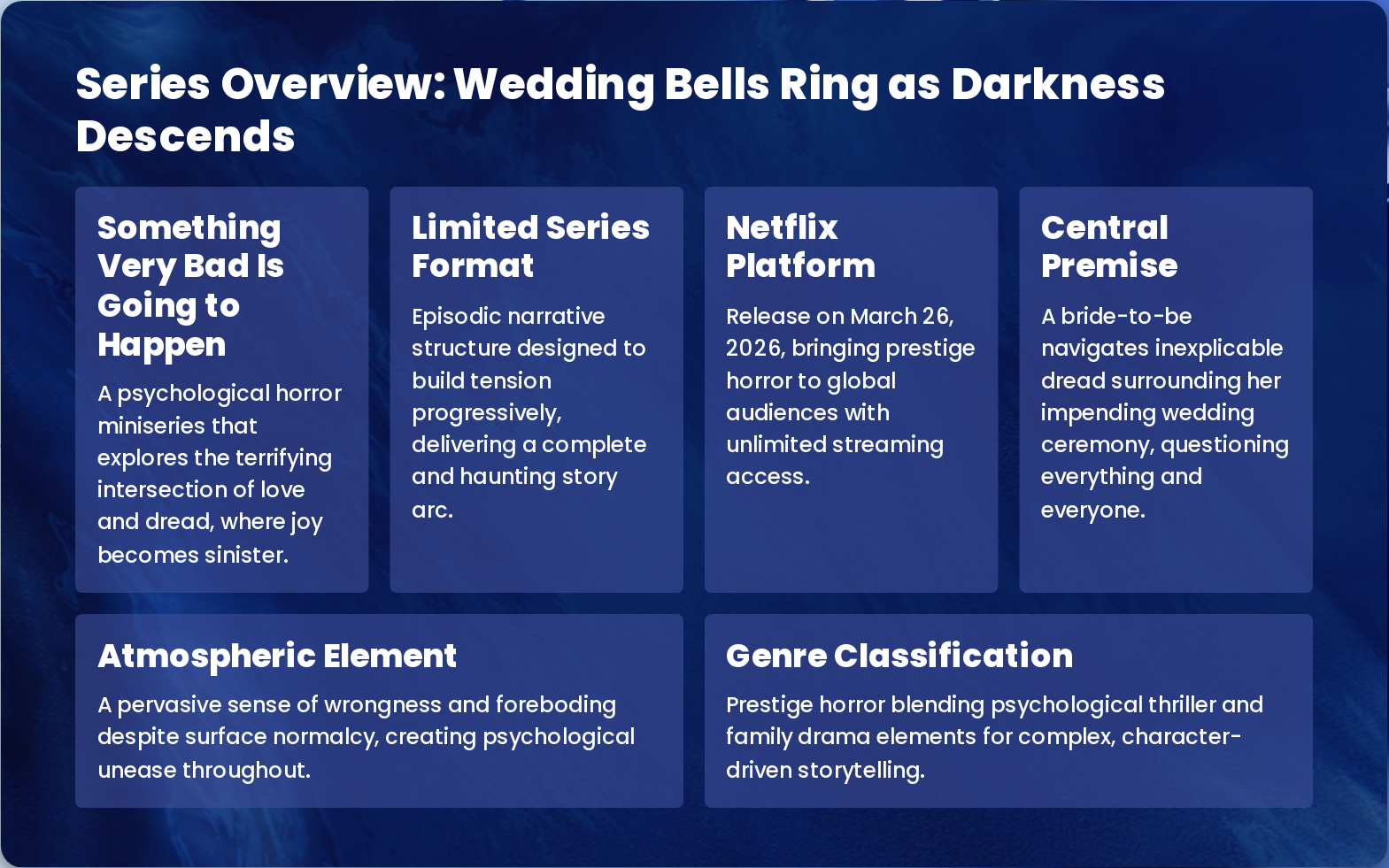
Slide 3: Series Overview: Wedding Bells Ring as Darkness Descends
- Something Very Bad Is Going to Happen: A psychological horror miniseries that explores the terrifying intersection of love and dread, where joy becomes sinister.
- Limited Series Format: Episodic narrative structure designed to build tension progressively, delivering a complete and haunting story arc.
- Netflix Platform: Release on March 26, 2026, bringing prestige horror to global audiences with unlimited streaming access.
- Central Premise: A bride-to-be navigates inexplicable dread surrounding her impending wedding ceremony, questioning everything and everyone.
- Atmospheric Element: A pervasive sense of wrongness and foreboding despite surface normalcy, creating psychological unease throughout.
- Genre Classification: Prestige horror blending psychological thriller and family drama elements for complex, character-driven storytelling.
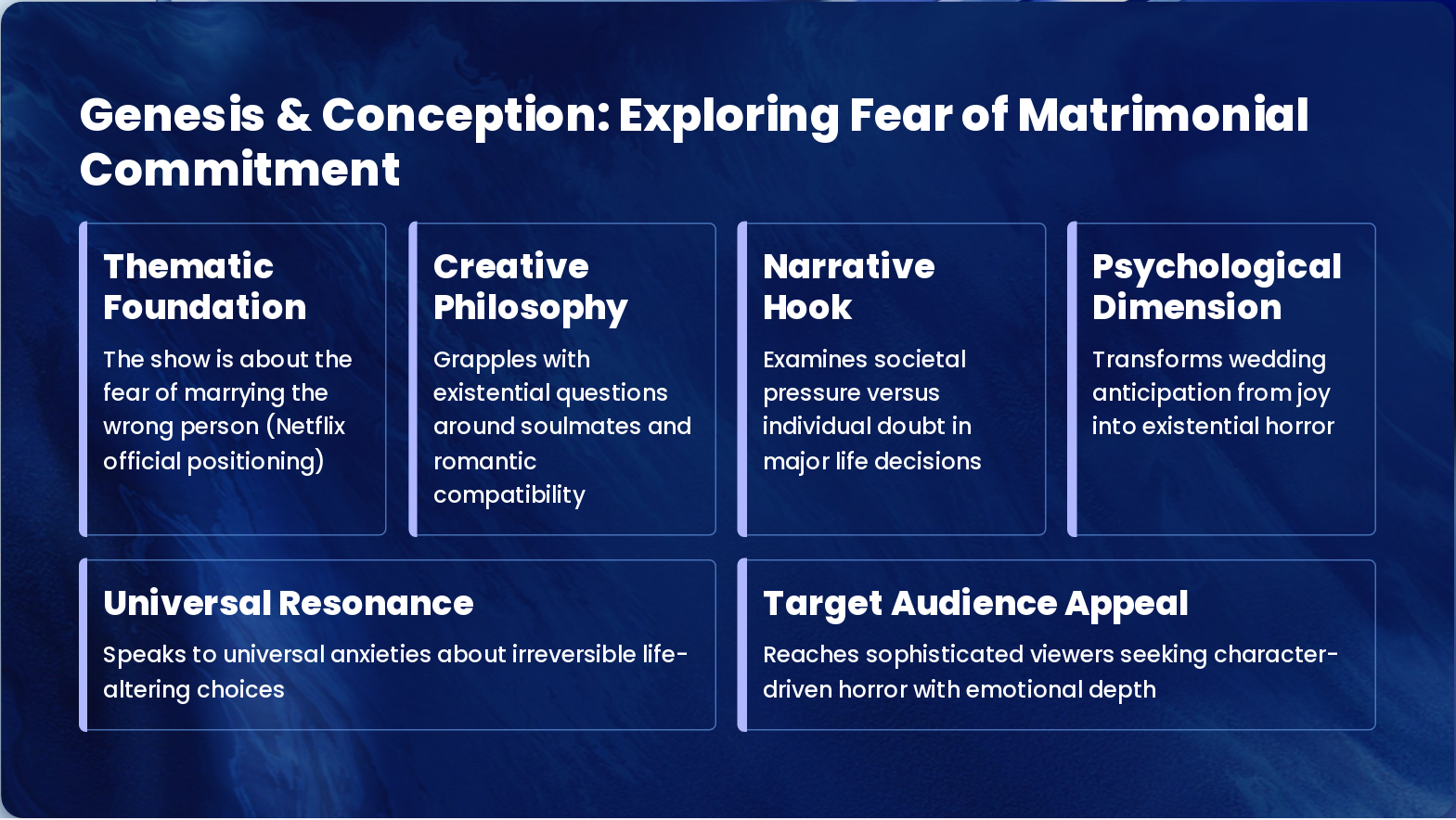
Slide 4: Genesis & Conception: Exploring Fear of Matrimonial Commitment
- Thematic Foundation: The show is about the fear of marrying the wrong person (Netflix official positioning)
- Creative Philosophy: Grapples with existential questions around soulmates and romantic compatibility
- Narrative Hook: Examines societal pressure versus individual doubt in major life decisions
- Psychological Dimension: Transforms wedding anticipation from joy into existential horror
- Universal Resonance: Speaks to universal anxieties about irreversible life-altering choices
- Target Audience Appeal: Reaches sophisticated viewers seeking character-driven horror with emotional depth
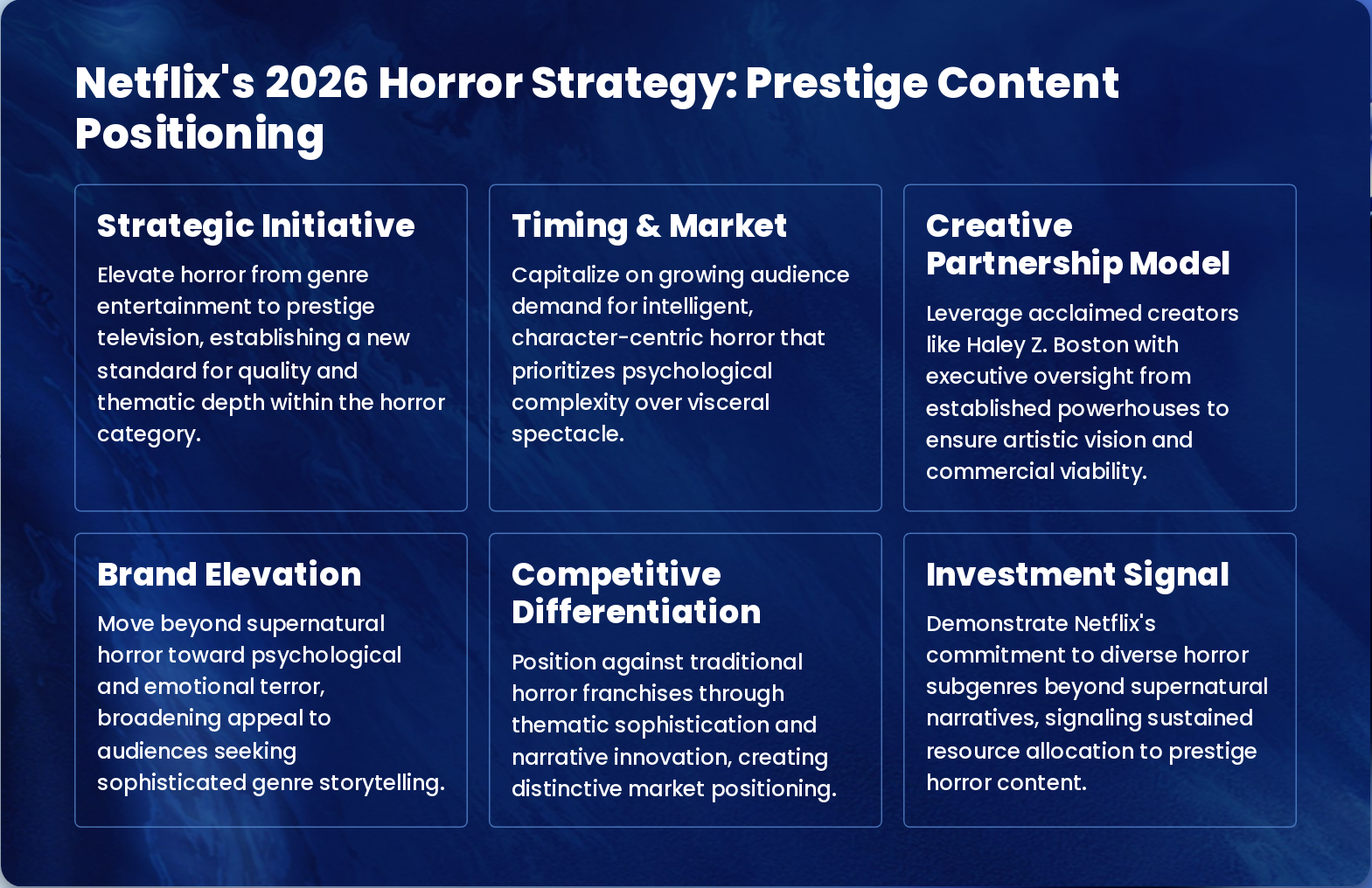
Slide 5: Netflix's 2026 Horror Strategy: Prestige Content Positioning
- Strategic Initiative: Elevate horror from genre entertainment to prestige television, establishing a new standard for quality and thematic depth within the horror category.
- Timing & Market: Capitalize on growing audience demand for intelligent, character-centric horror that prioritizes psychological complexity over visceral spectacle.
- Creative Partnership Model: Leverage acclaimed creators like Haley Z. Boston with executive oversight from established powerhouses to ensure artistic vision and commercial viability.
- Brand Elevation: Move beyond supernatural horror toward psychological and emotional terror, broadening appeal to audiences seeking sophisticated genre storytelling.
- Competitive Differentiation: Position against traditional horror franchises through thematic sophistication and narrative innovation, creating distinctive market positioning.
- Investment Signal: Demonstrate Netflix's commitment to diverse horror subgenres beyond supernatural narratives, signaling sustained resource allocation to prestige horror content.
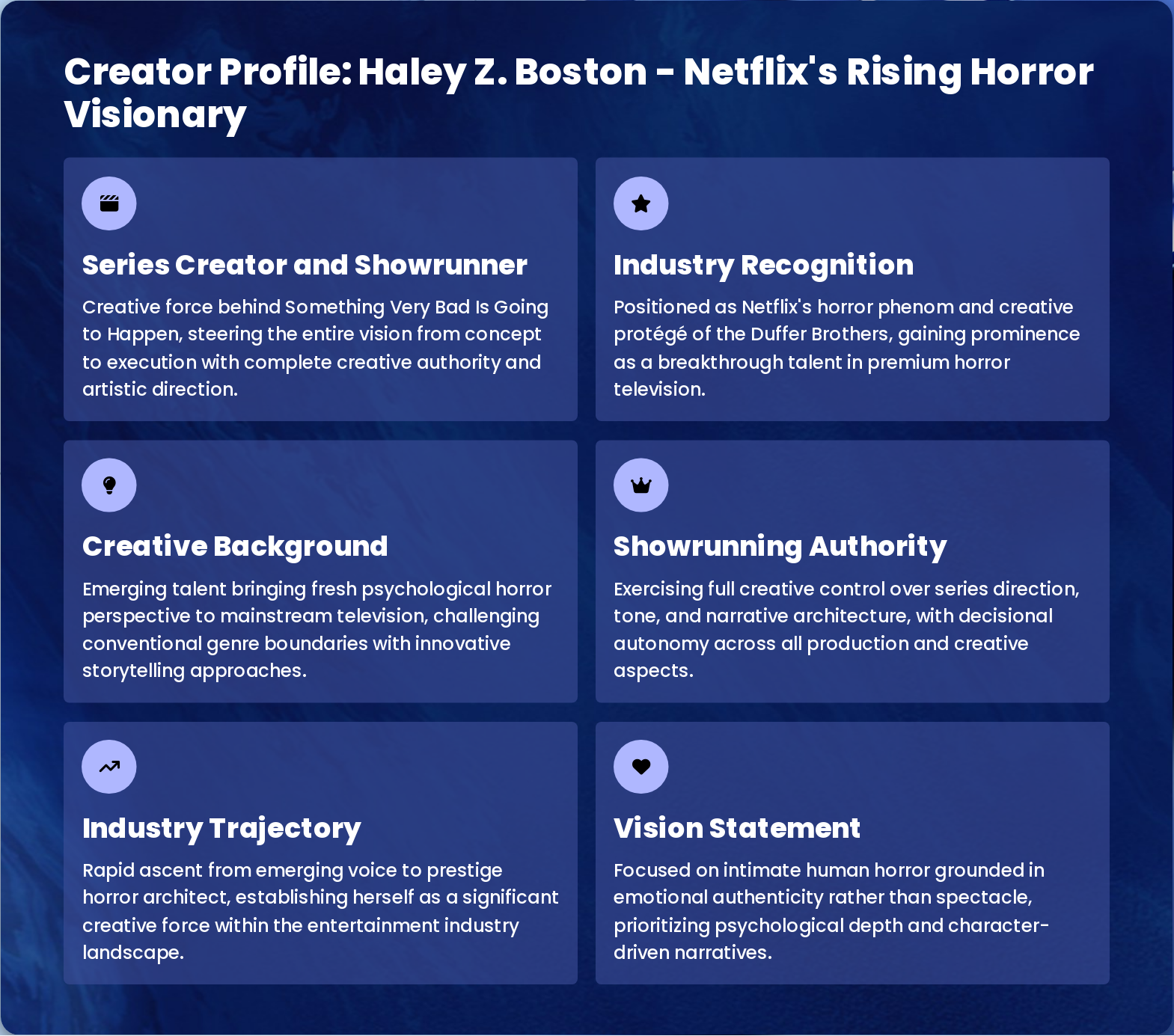
Slide 6: Creator Profile: Haley Z. Boston - Netflix's Rising Horror Visionary
- Series Creator and Showrunner: Creative force behind Something Very Bad Is Going to Happen, steering the entire vision from concept to execution with complete creative authority and artistic direction.
- Industry Recognition: Positioned as Netflix's horror phenom and creative protégé of the Duffer Brothers, gaining prominence as a breakthrough talent in premium horror television.
- Creative Background: Emerging talent bringing fresh psychological horror perspective to mainstream television, challenging conventional genre boundaries with innovative storytelling approaches.
- Showrunning Authority: Exercising full creative control over series direction, tone, and narrative architecture, with decisional autonomy across all production and creative aspects.
- Industry Trajectory: Rapid ascent from emerging voice to prestige horror architect, establishing herself as a significant creative force within the entertainment industry landscape.
- Vision Statement: Focused on intimate human horror grounded in emotional authenticity rather than spectacle, prioritizing psychological depth and character-driven narratives.
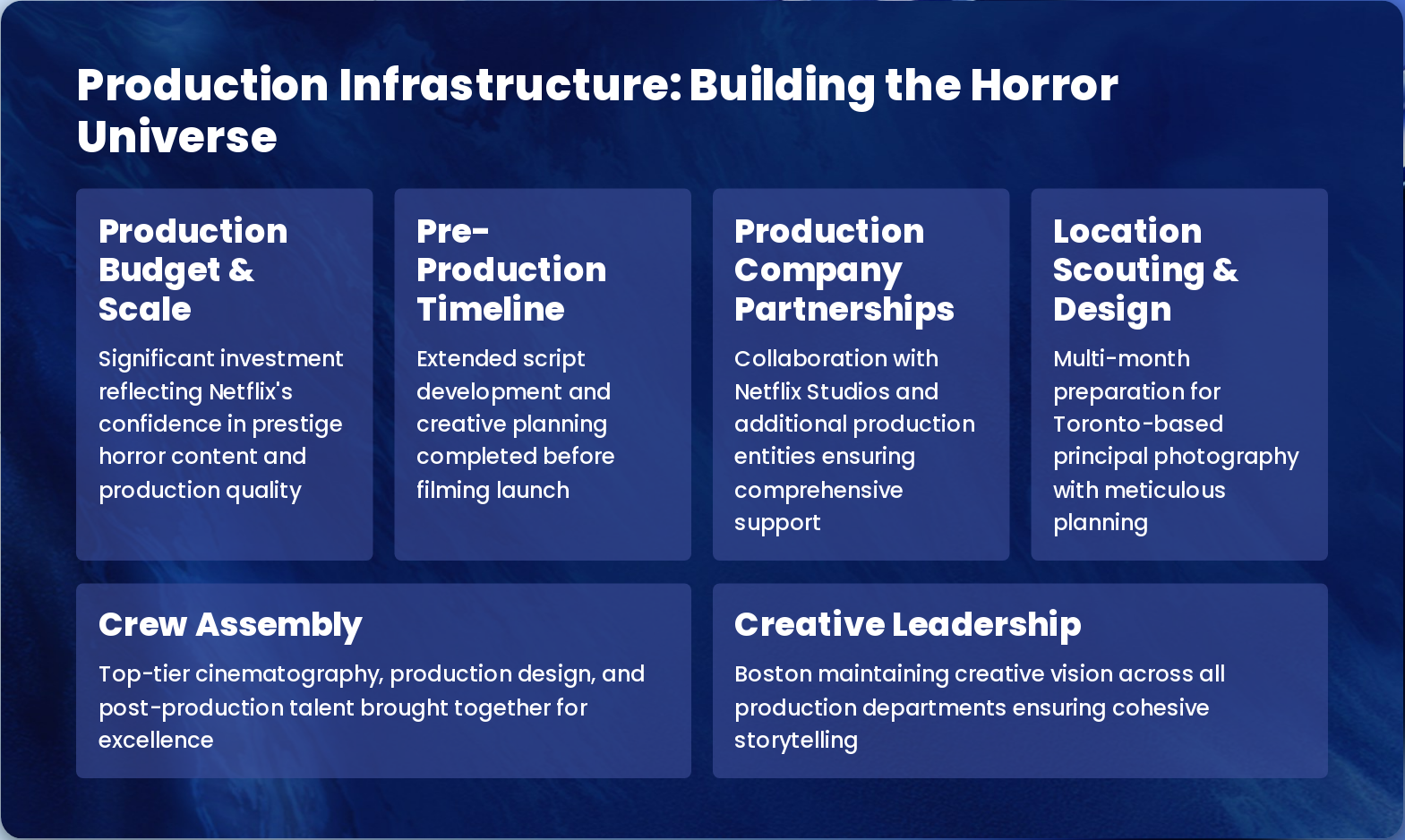
Slide 7: Production Infrastructure: Building the Horror Universe
- Production Budget & Scale: Significant investment reflecting Netflix's confidence in prestige horror content and production quality
- Pre-Production Timeline: Extended script development and creative planning completed before filming launch
- Production Company Partnerships: Collaboration with Netflix Studios and additional production entities ensuring comprehensive support
- Location Scouting & Design: Multi-month preparation for Toronto-based principal photography with meticulous planning
- Crew Assembly: Top-tier cinematography, production design, and post-production talent brought together for excellence
- Creative Leadership: Boston maintaining creative vision across all production departments ensuring cohesive storytelling
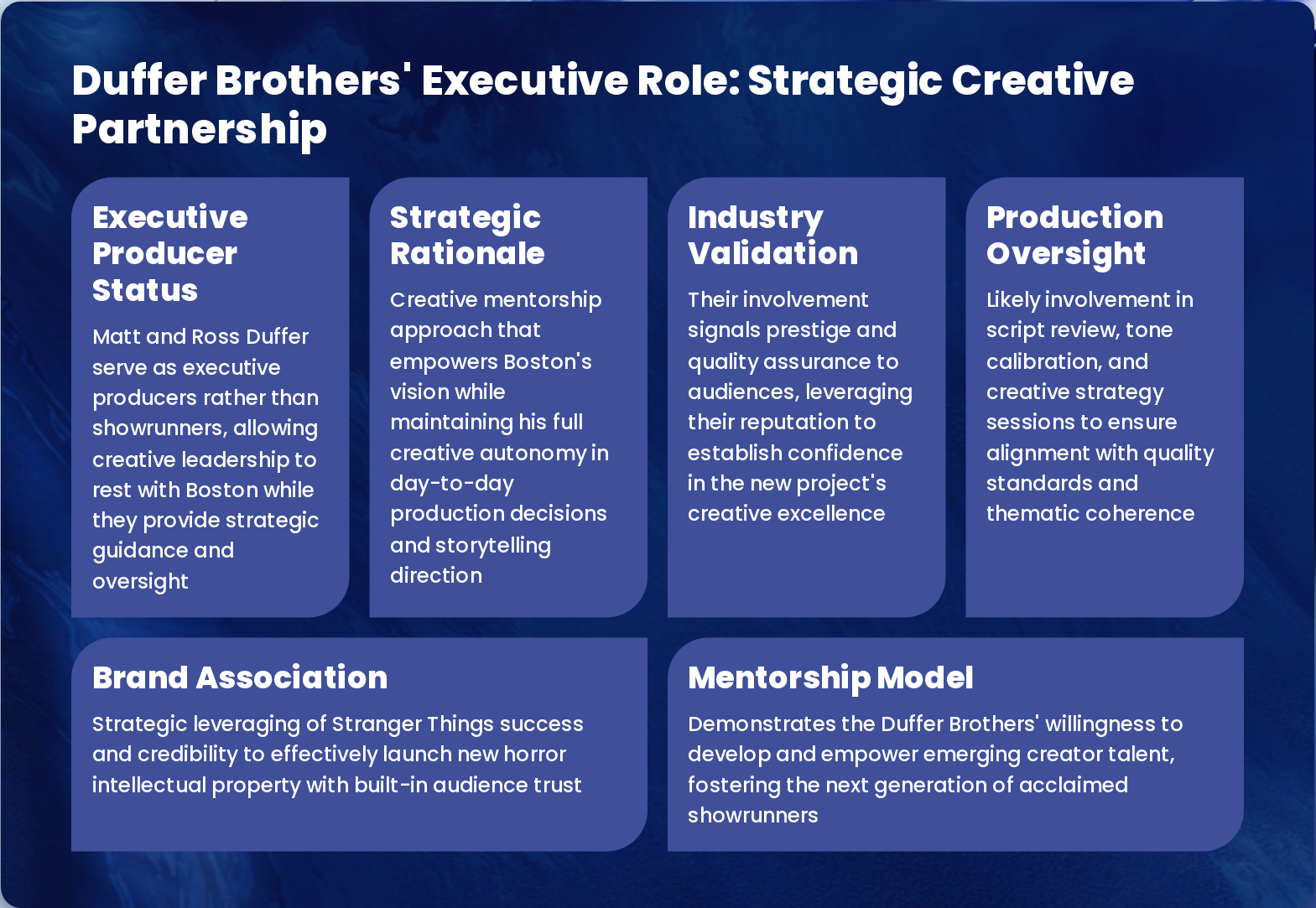
Slide 8: Duffer Brothers' Executive Role: Strategic Creative Partnership
- Executive Producer Status: Matt and Ross Duffer serve as executive producers rather than showrunners, allowing creative leadership to rest with Boston while they provide strategic guidance and oversight
- Strategic Rationale: Creative mentorship approach that empowers Boston's vision while maintaining his full creative autonomy in day-to-day production decisions and storytelling direction
- Industry Validation: Their involvement signals prestige and quality assurance to audiences, leveraging their reputation to establish confidence in the new project's creative excellence
- Production Oversight: Likely involvement in script review, tone calibration, and creative strategy sessions to ensure alignment with quality standards and thematic coherence
- Brand Association: Strategic leveraging of Stranger Things success and credibility to effectively launch new horror intellectual property with built-in audience trust
- Mentorship Model: Demonstrates the Duffer Brothers' willingness to develop and empower emerging creator talent, fostering the next generation of acclaimed showrunners
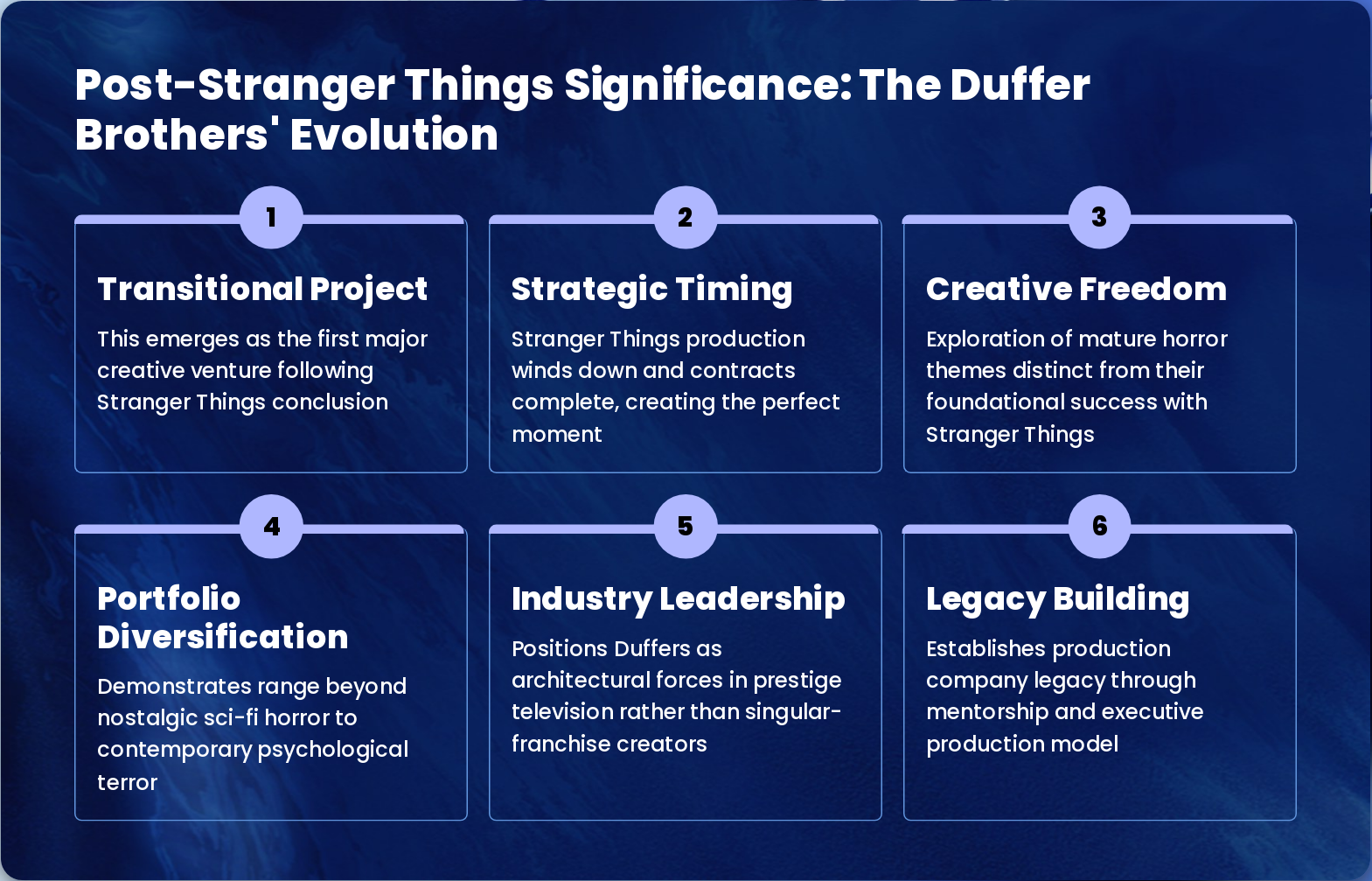
Slide 9: Post-Stranger Things Significance: The Duffer Brothers' Evolution
- Transitional Project: This emerges as the first major creative venture following Stranger Things conclusion
- Strategic Timing: Stranger Things production winds down and contracts complete, creating the perfect moment
- Creative Freedom: Exploration of mature horror themes distinct from their foundational success with Stranger Things
- Portfolio Diversification: Demonstrates range beyond nostalgic sci-fi horror to contemporary psychological terror
- Industry Leadership: Positions Duffers as architectural forces in prestige television rather than singular-franchise creators
- Legacy Building: Establishes production company legacy through mentorship and executive production model
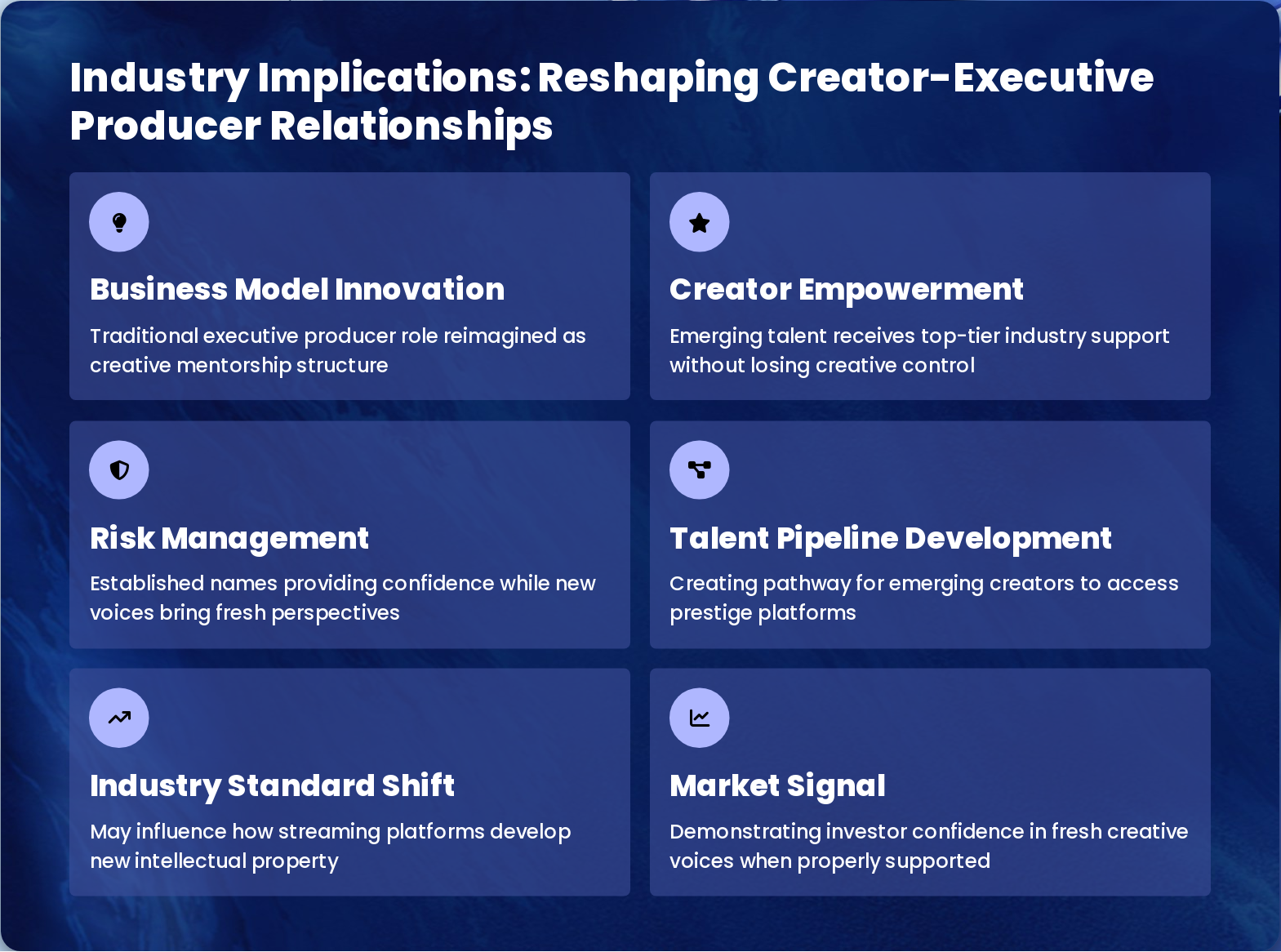
Slide 10: Industry Implications: Reshaping Creator-Executive Producer Relationships
- Business Model Innovation: Traditional executive producer role reimagined as creative mentorship structure
- Creator Empowerment: Emerging talent receives top-tier industry support without losing creative control
- Risk Management: Established names providing confidence while new voices bring fresh perspectives
- Talent Pipeline Development: Creating pathway for emerging creators to access prestige platforms
- Industry Standard Shift: May influence how streaming platforms develop new intellectual property
- Market Signal: Demonstrating investor confidence in fresh creative voices when properly supported
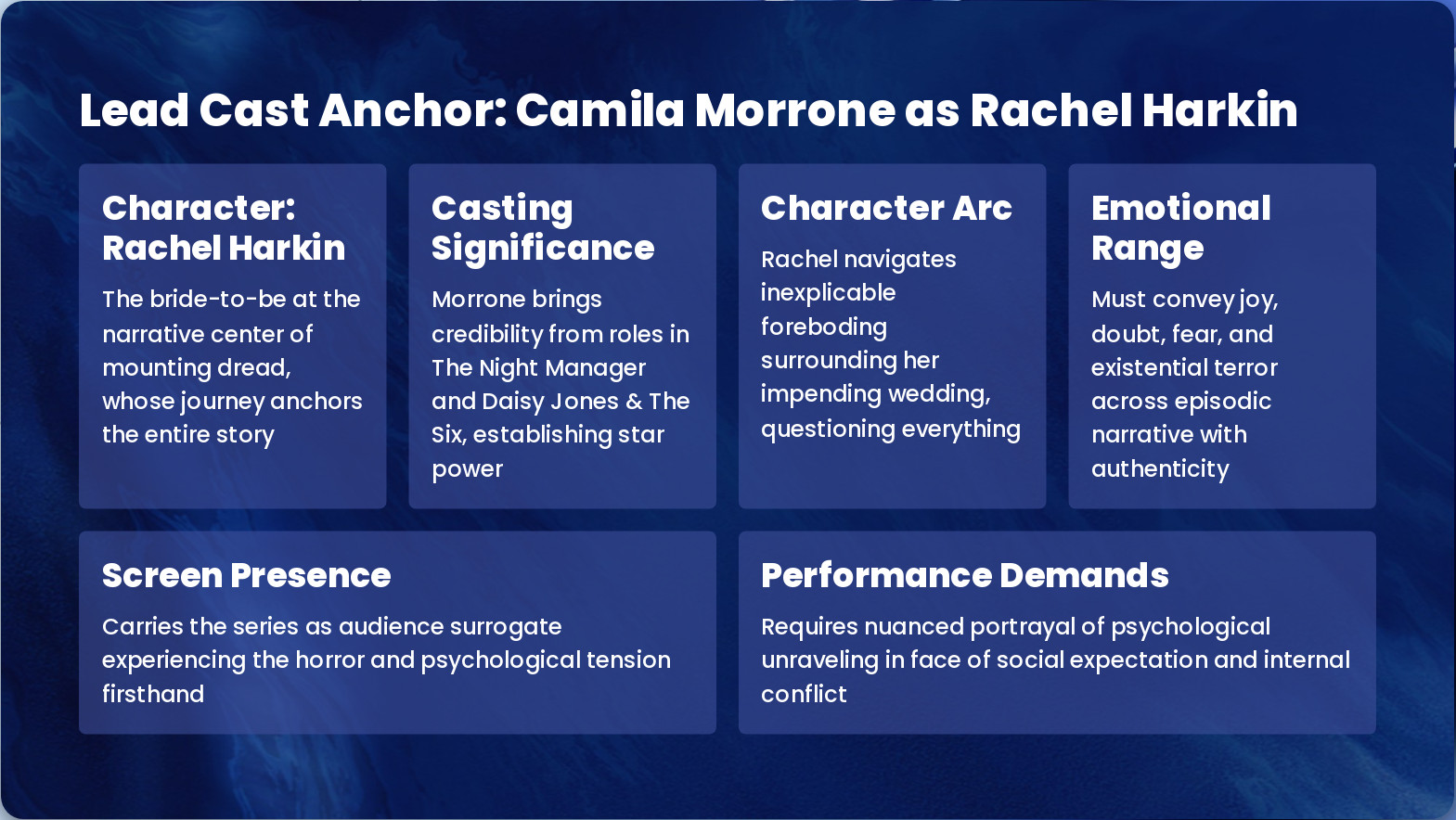
Slide 11: Lead Cast Anchor: Camila Morrone as Rachel Harkin
- Character: Rachel Harkin: The bride-to-be at the narrative center of mounting dread, whose journey anchors the entire story
- Casting Significance: Morrone brings credibility from roles in The Night Manager and Daisy Jones & The Six, establishing star power
- Character Arc: Rachel navigates inexplicable foreboding surrounding her impending wedding, questioning everything
- Emotional Range: Must convey joy, doubt, fear, and existential terror across episodic narrative with authenticity
- Screen Presence: Carries the series as audience surrogate experiencing the horror and psychological tension firsthand
- Performance Demands: Requires nuanced portrayal of psychological unraveling in face of social expectation and internal conflict
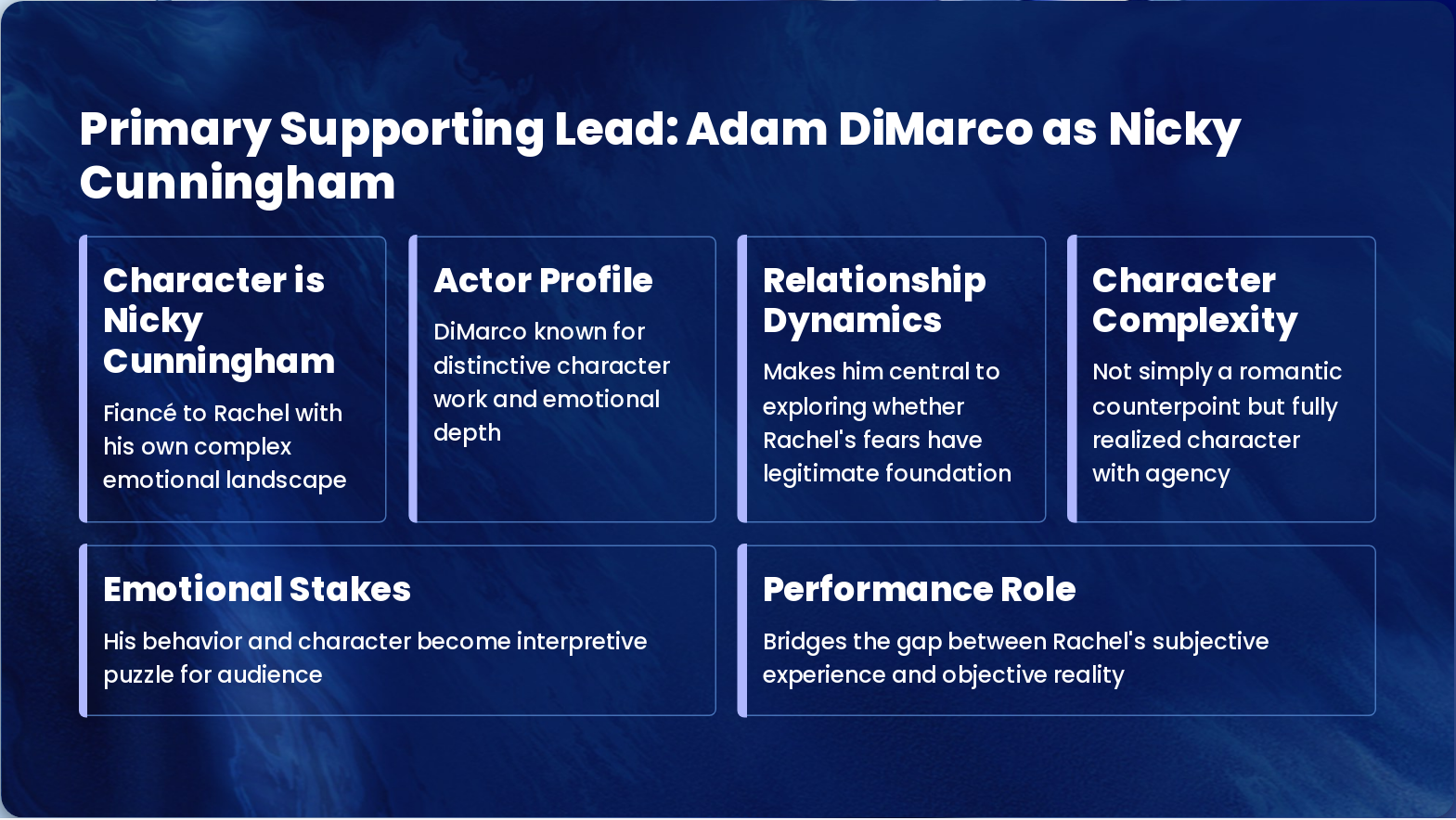
Slide 12: Primary Supporting Lead: Adam DiMarco as Nicky Cunningham
- Character is Nicky Cunningham: Fiancé to Rachel with his own complex emotional landscape
- Actor Profile: DiMarco known for distinctive character work and emotional depth
- Relationship Dynamics: Makes him central to exploring whether Rachel's fears have legitimate foundation
- Character Complexity: Not simply a romantic counterpoint but fully realized character with agency
- Emotional Stakes: His behavior and character become interpretive puzzle for audience
- Performance Role: Bridges the gap between Rachel's subjective experience and objective reality
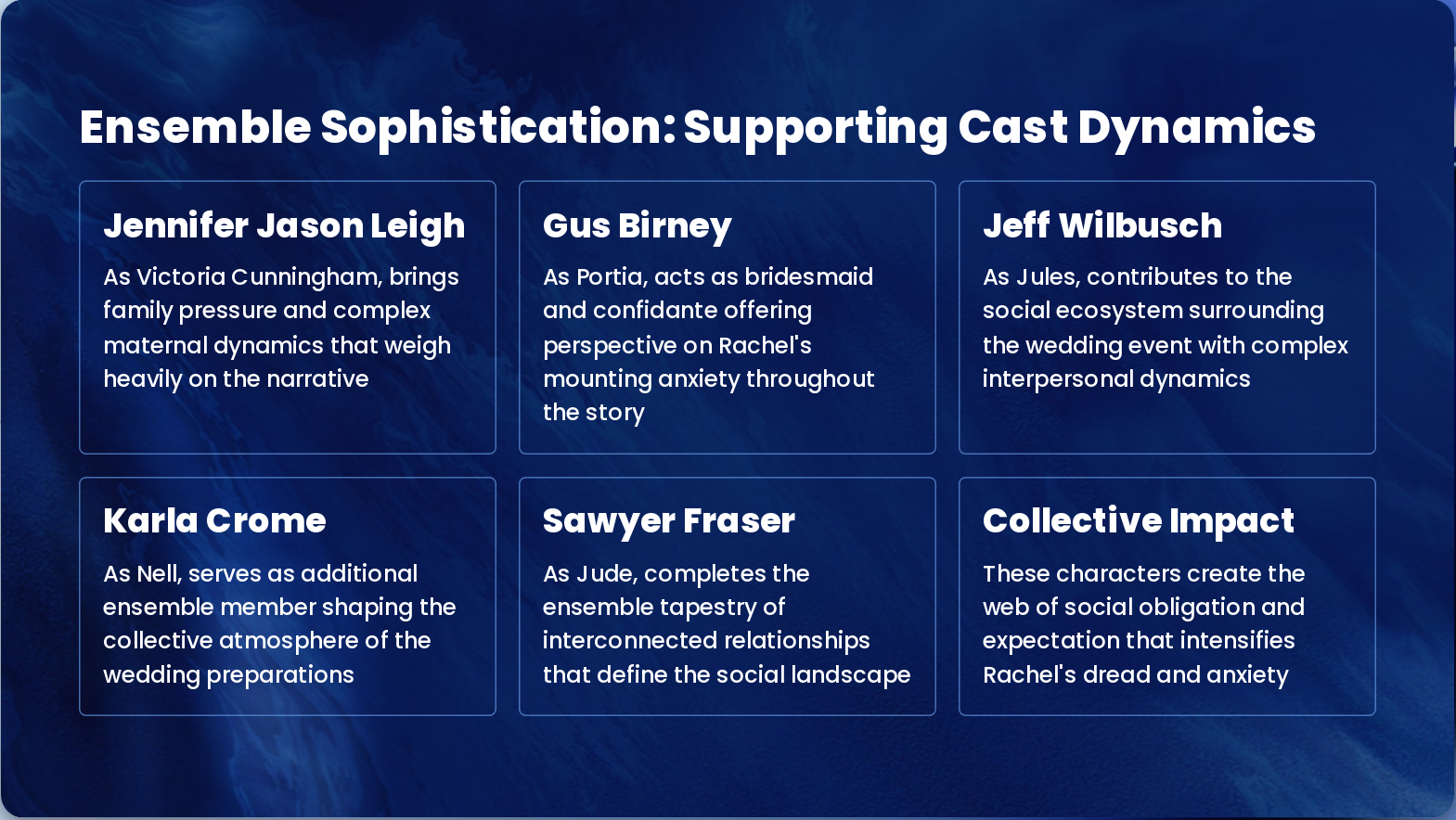
Slide 13: Ensemble Sophistication: Supporting Cast Dynamics
- Jennifer Jason Leigh: As Victoria Cunningham, brings family pressure and complex maternal dynamics that weigh heavily on the narrative
- Gus Birney: As Portia, acts as bridesmaid and confidante offering perspective on Rachel's mounting anxiety throughout the story
- Jeff Wilbusch: As Jules, contributes to the social ecosystem surrounding the wedding event with complex interpersonal dynamics
- Karla Crome: As Nell, serves as additional ensemble member shaping the collective atmosphere of the wedding preparations
- Sawyer Fraser: As Jude, completes the ensemble tapestry of interconnected relationships that define the social landscape
- Collective Impact: These characters create the web of social obligation and expectation that intensifies Rachel's dread and anxiety
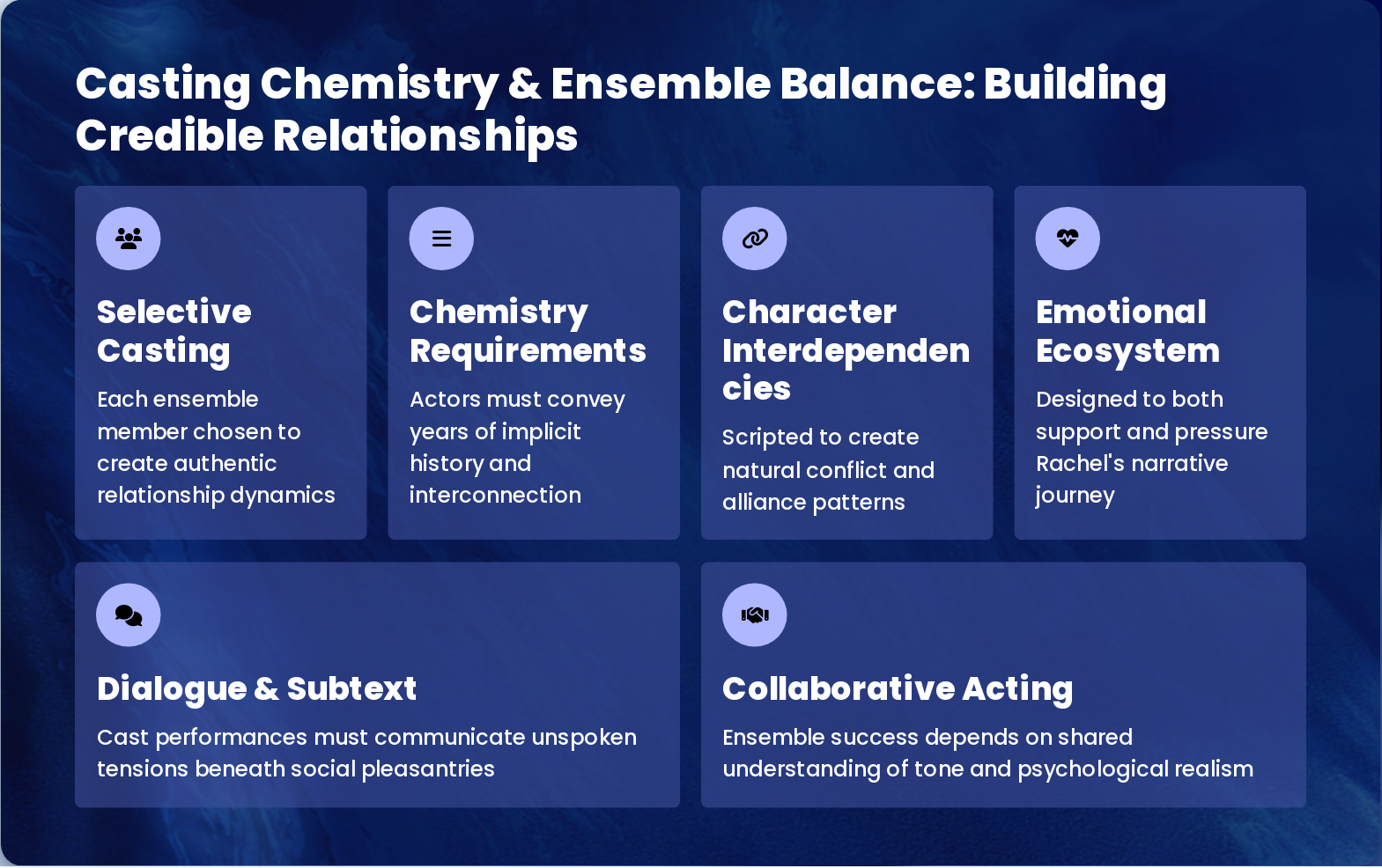
Slide 14: Casting Chemistry & Ensemble Balance: Building Credible Relationships
- Selective Casting: Each ensemble member chosen to create authentic relationship dynamics
- Chemistry Requirements: Actors must convey years of implicit history and interconnection
- Character Interdependencies: Scripted to create natural conflict and alliance patterns
- Emotional Ecosystem: Designed to both support and pressure Rachel's narrative journey
- Dialogue & Subtext: Cast performances must communicate unspoken tensions beneath social pleasantries
- Collaborative Acting: Ensemble success depends on shared understanding of tone and psychological realism
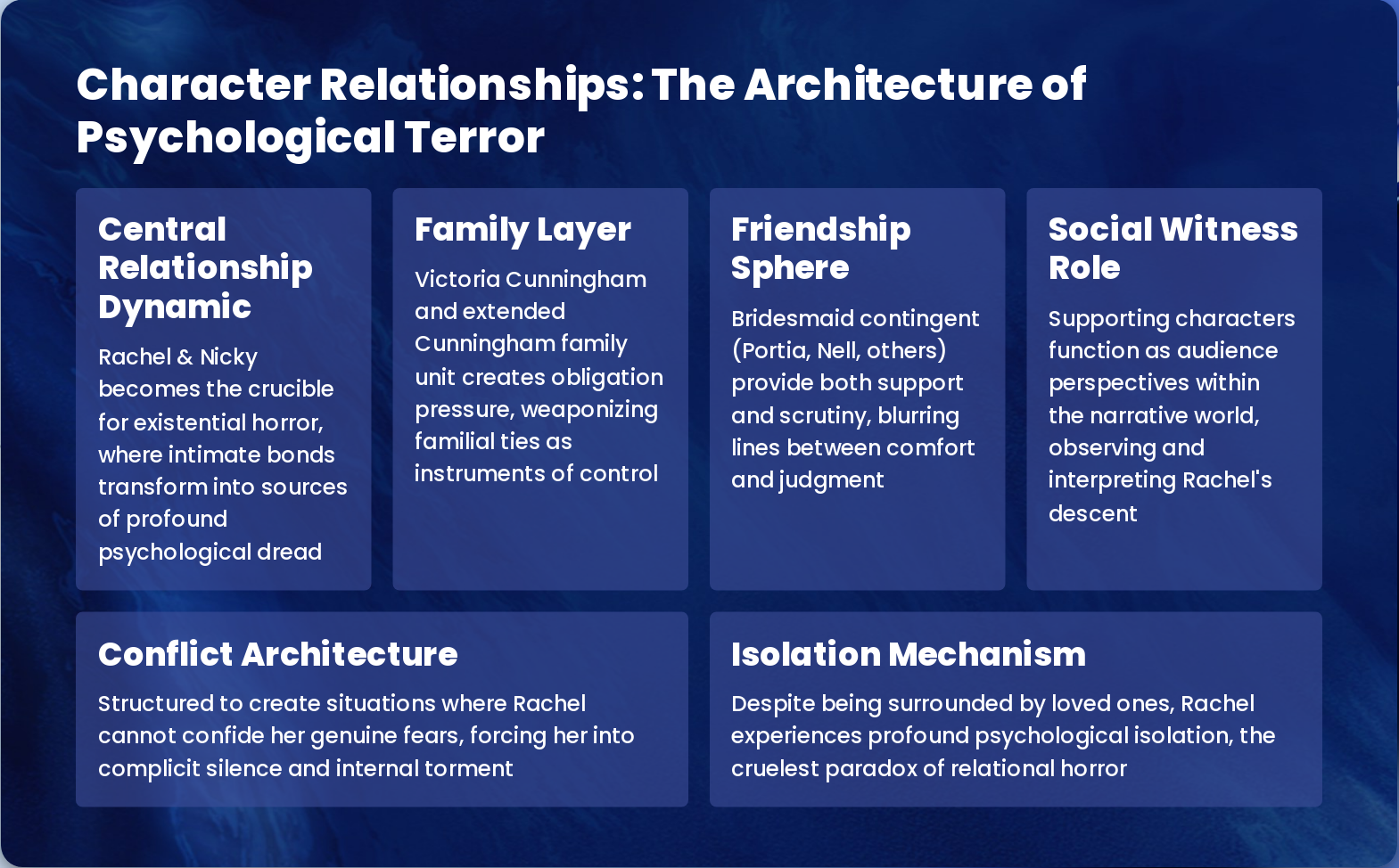
Slide 15: Character Relationships: The Architecture of Psychological Terror
- Central Relationship Dynamic: Rachel & Nicky becomes the crucible for existential horror, where intimate bonds transform into sources of profound psychological dread
- Family Layer: Victoria Cunningham and extended Cunningham family unit creates obligation pressure, weaponizing familial ties as instruments of control
- Friendship Sphere: Bridesmaid contingent (Portia, Nell, others) provide both support and scrutiny, blurring lines between comfort and judgment
- Social Witness Role: Supporting characters function as audience perspectives within the narrative world, observing and interpreting Rachel's descent
- Conflict Architecture: Structured to create situations where Rachel cannot confide her genuine fears, forcing her into complicit silence and internal torment
- Isolation Mechanism: Despite being surrounded by loved ones, Rachel experiences profound psychological isolation, the cruelest paradox of relational horror
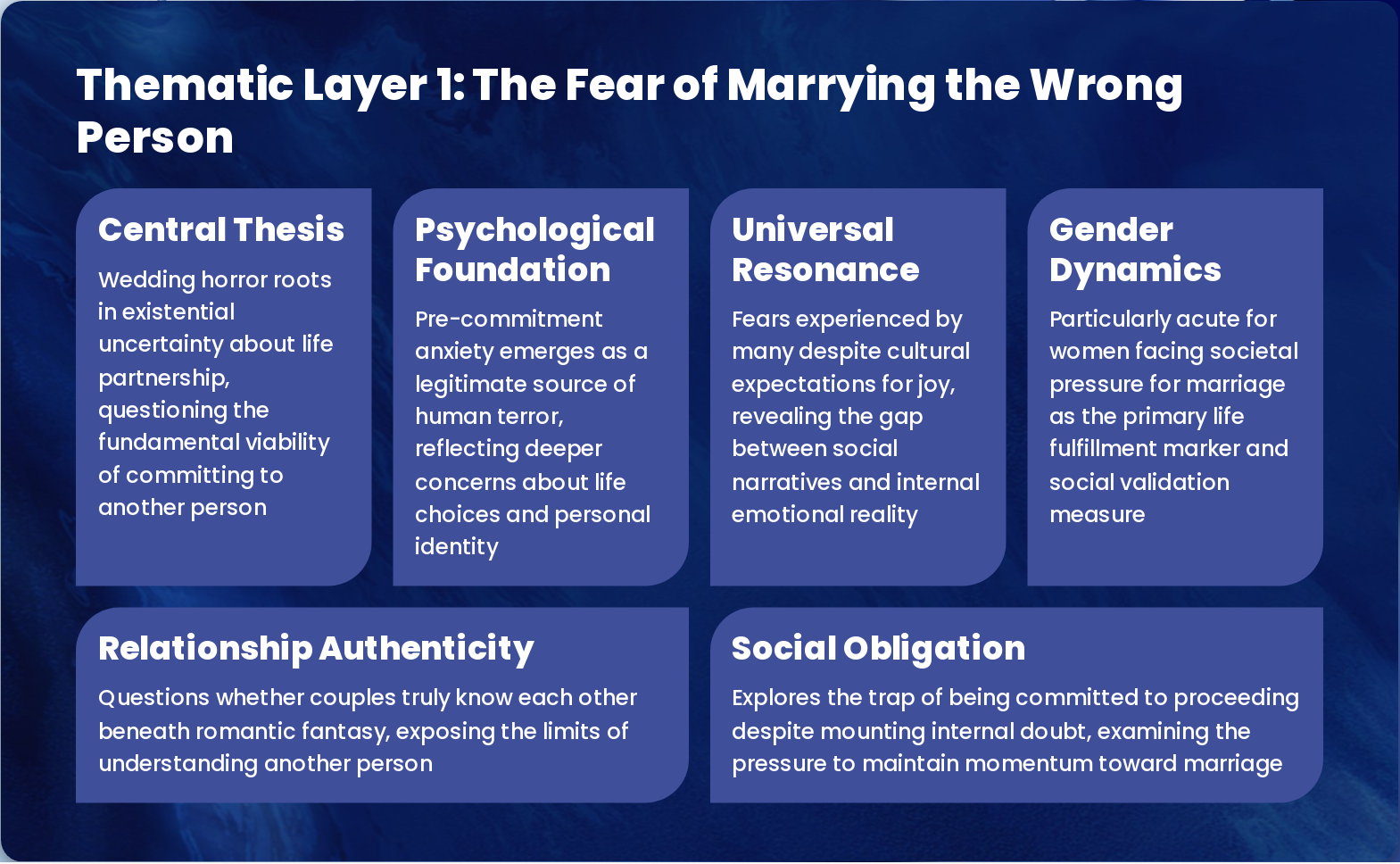
Slide 16: Thematic Layer 1: The Fear of Marrying the Wrong Person
- Central Thesis: Wedding horror roots in existential uncertainty about life partnership, questioning the fundamental viability of committing to another person
- Psychological Foundation: Pre-commitment anxiety emerges as a legitimate source of human terror, reflecting deeper concerns about life choices and personal identity
- Universal Resonance: Fears experienced by many despite cultural expectations for joy, revealing the gap between social narratives and internal emotional reality
- Gender Dynamics: Particularly acute for women facing societal pressure for marriage as the primary life fulfillment marker and social validation measure
- Relationship Authenticity: Questions whether couples truly know each other beneath romantic fantasy, exposing the limits of understanding another person
- Social Obligation: Explores the trap of being committed to proceeding despite mounting internal doubt, examining the pressure to maintain momentum toward marriage
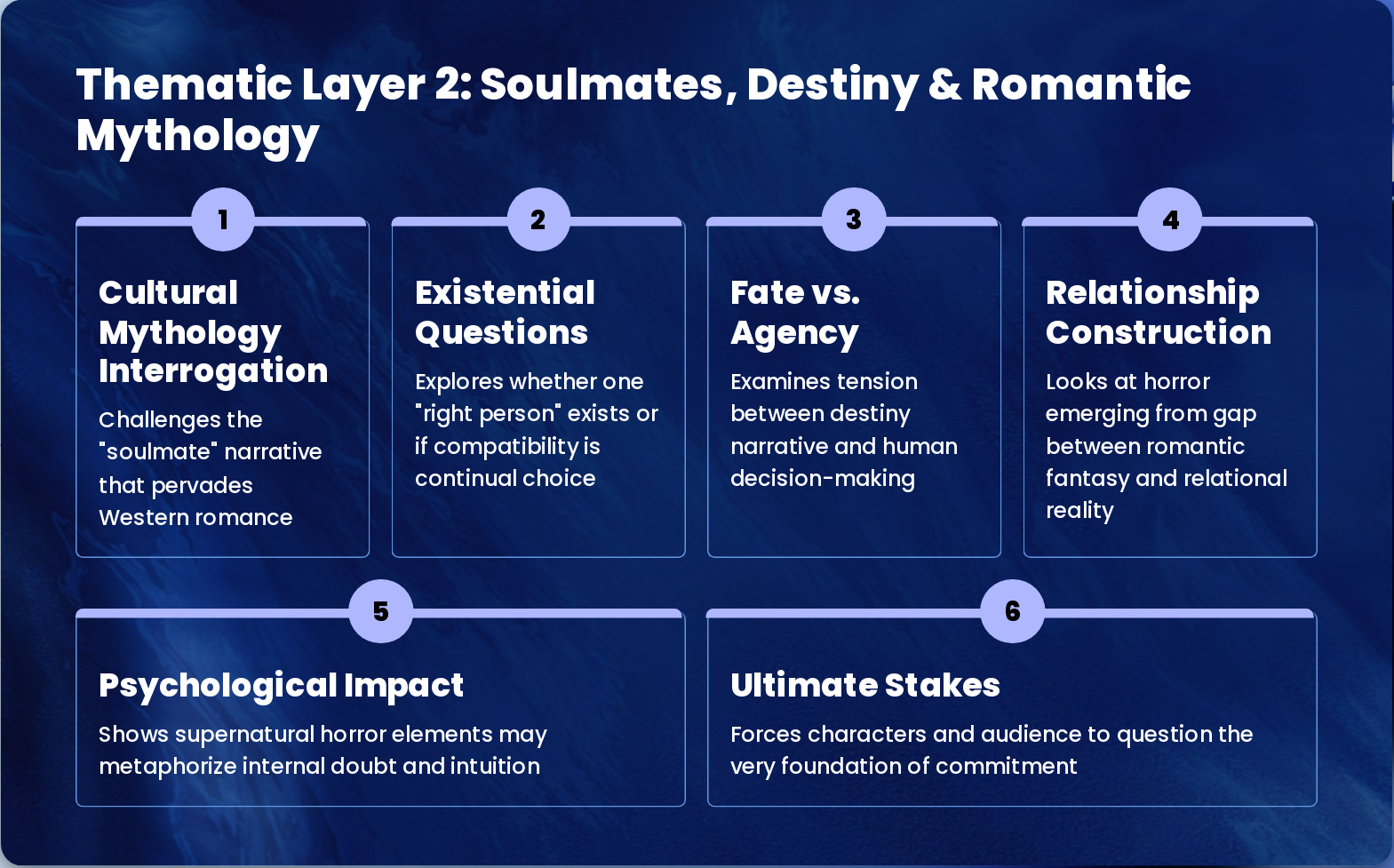
Slide 17: Thematic Layer 2: Soulmates, Destiny & Romantic Mythology
- Cultural Mythology Interrogation: Challenges the "soulmate" narrative that pervades Western romance
- Existential Questions: Explores whether one "right person" exists or if compatibility is continual choice
- Fate vs. Agency: Examines tension between destiny narrative and human decision-making
- Relationship Construction: Looks at horror emerging from gap between romantic fantasy and relational reality
- Psychological Impact: Shows supernatural horror elements may metaphorize internal doubt and intuition
- Ultimate Stakes: Forces characters and audience to question the very foundation of commitment
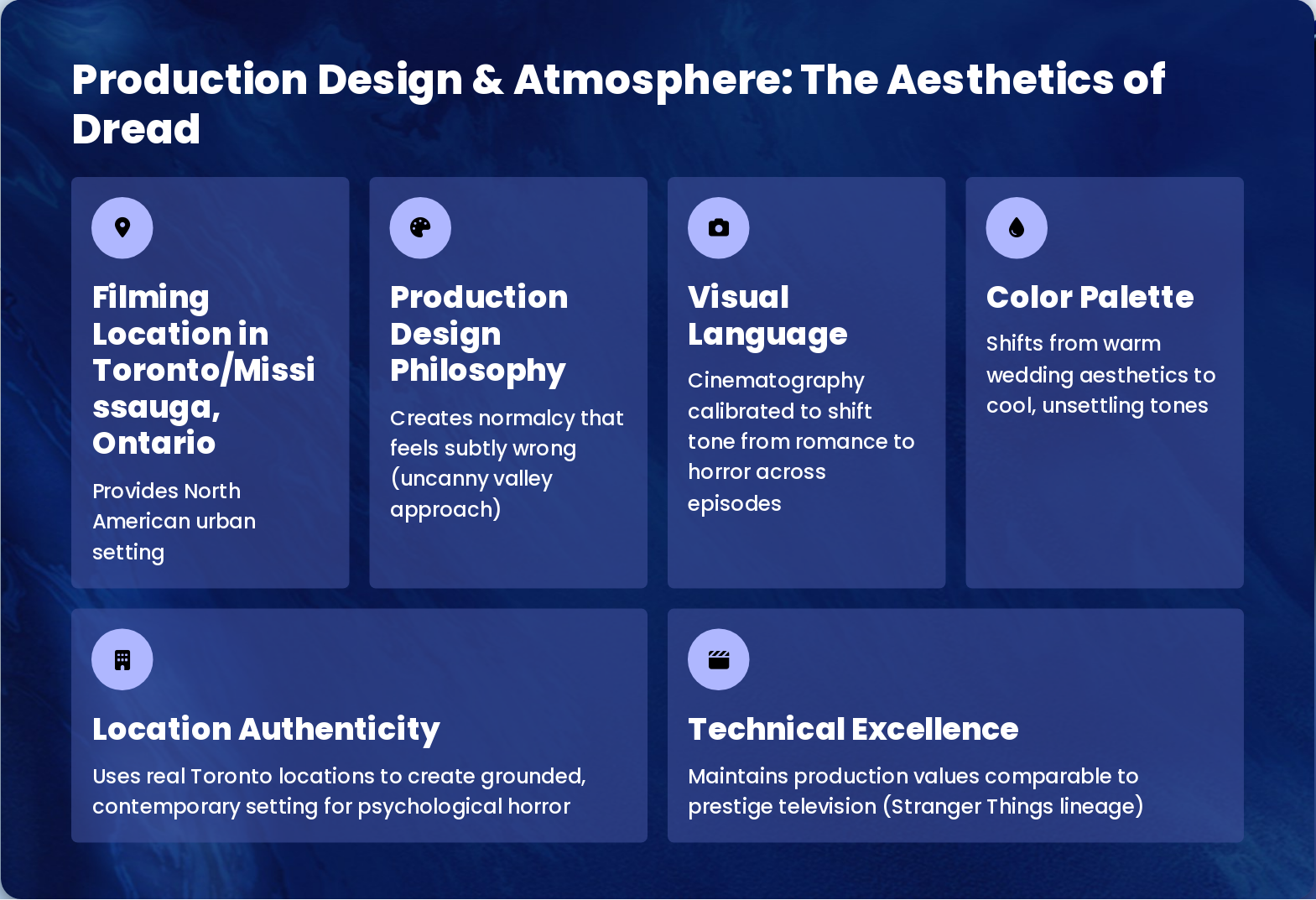
Slide 18: Production Design & Atmosphere: The Aesthetics of Dread
- Filming Location in Toronto/Mississauga, Ontario: Provides North American urban setting
- Production Design Philosophy: Creates normalcy that feels subtly wrong (uncanny valley approach)
- Visual Language: Cinematography calibrated to shift tone from romance to horror across episodes
- Color Palette: Shifts from warm wedding aesthetics to cool, unsettling tones
- Location Authenticity: Uses real Toronto locations to create grounded, contemporary setting for psychological horror
- Technical Excellence: Maintains production values comparable to prestige television (Stranger Things lineage)
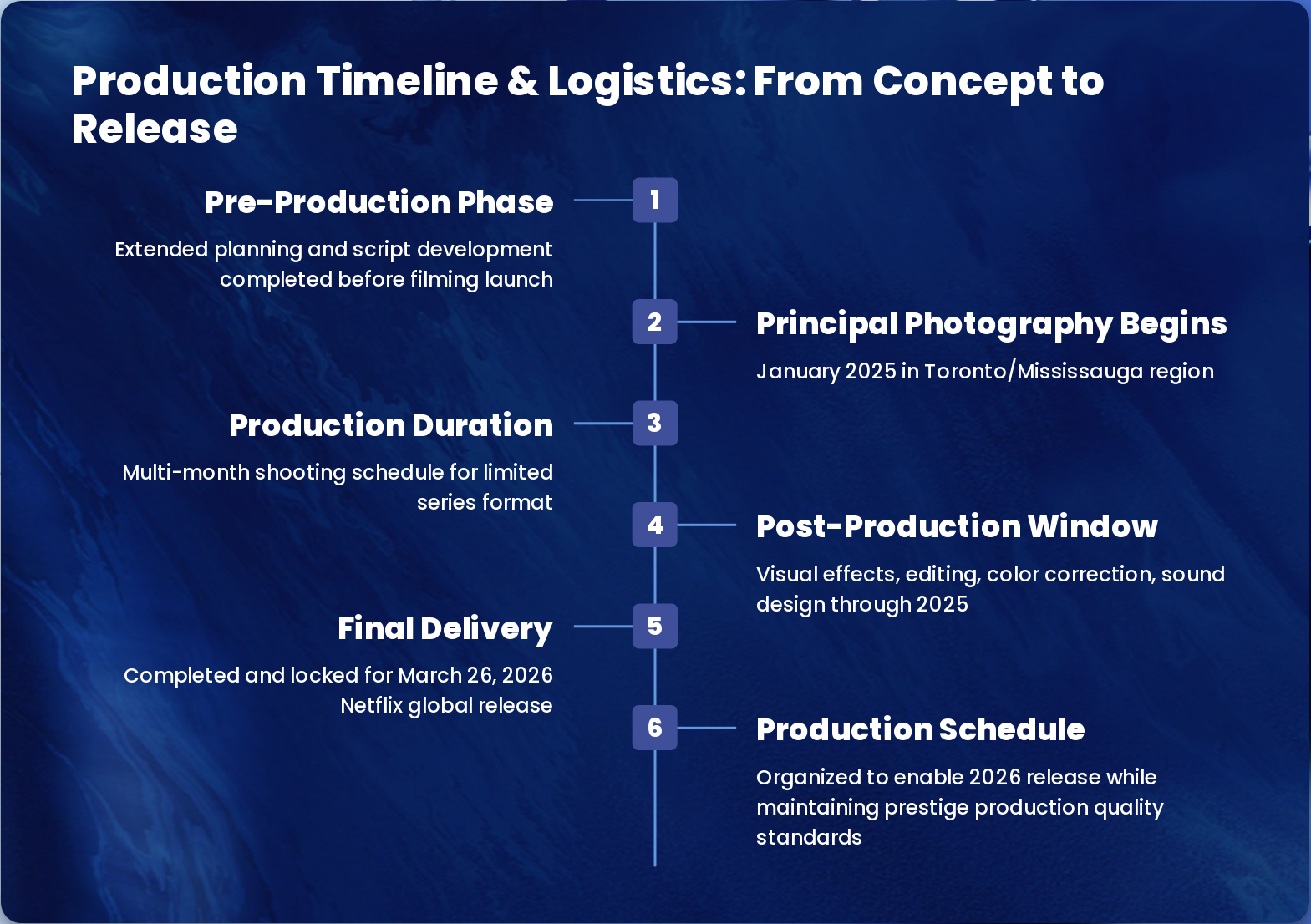
Slide 19: Production Timeline & Logistics: From Concept to Release
- Pre-Production Phase: Extended planning and script development completed before filming launch
- Principal Photography Begins: January 2025 in Toronto/Mississauga region
- Production Duration: Multi-month shooting schedule for limited series format
- Post-Production Window: Visual effects, editing, color correction, sound design through 2025
- Final Delivery: Completed and locked for March 26, 2026 Netflix global release
- Production Schedule: Organized to enable 2026 release while maintaining prestige production quality standards
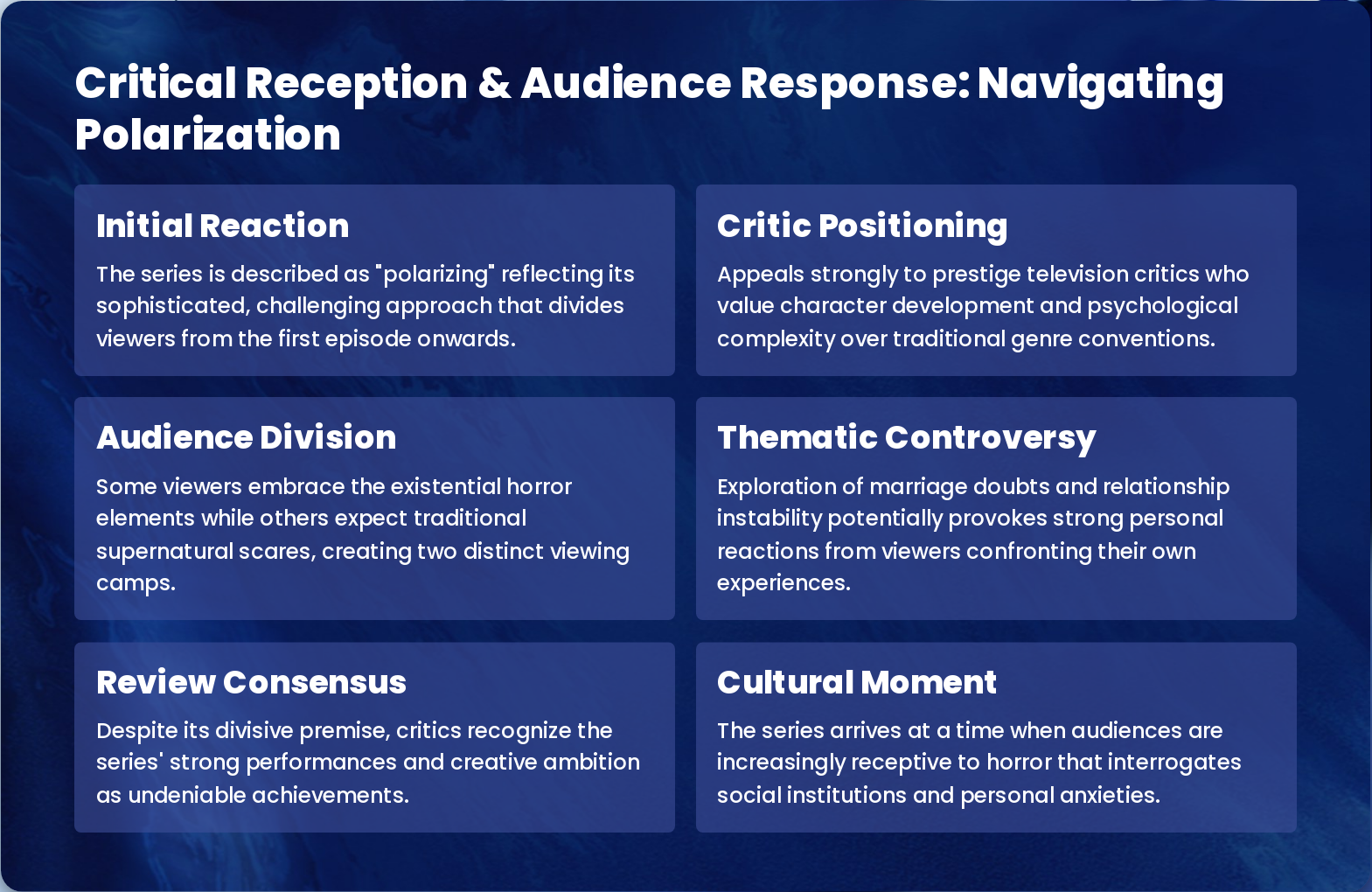
Slide 20: Critical Reception & Audience Response: Navigating Polarization
- Initial Reaction: The series is described as "polarizing" reflecting its sophisticated, challenging approach that divides viewers from the first episode onwards.
- Critic Positioning: Appeals strongly to prestige television critics who value character development and psychological complexity over traditional genre conventions.
- Audience Division: Some viewers embrace the existential horror elements while others expect traditional supernatural scares, creating two distinct viewing camps.
- Thematic Controversy: Exploration of marriage doubts and relationship instability potentially provokes strong personal reactions from viewers confronting their own experiences.
- Review Consensus: Despite its divisive premise, critics recognize the series' strong performances and creative ambition as undeniable achievements.
- Cultural Moment: The series arrives at a time when audiences are increasingly receptive to horror that interrogates social institutions and personal anxieties.
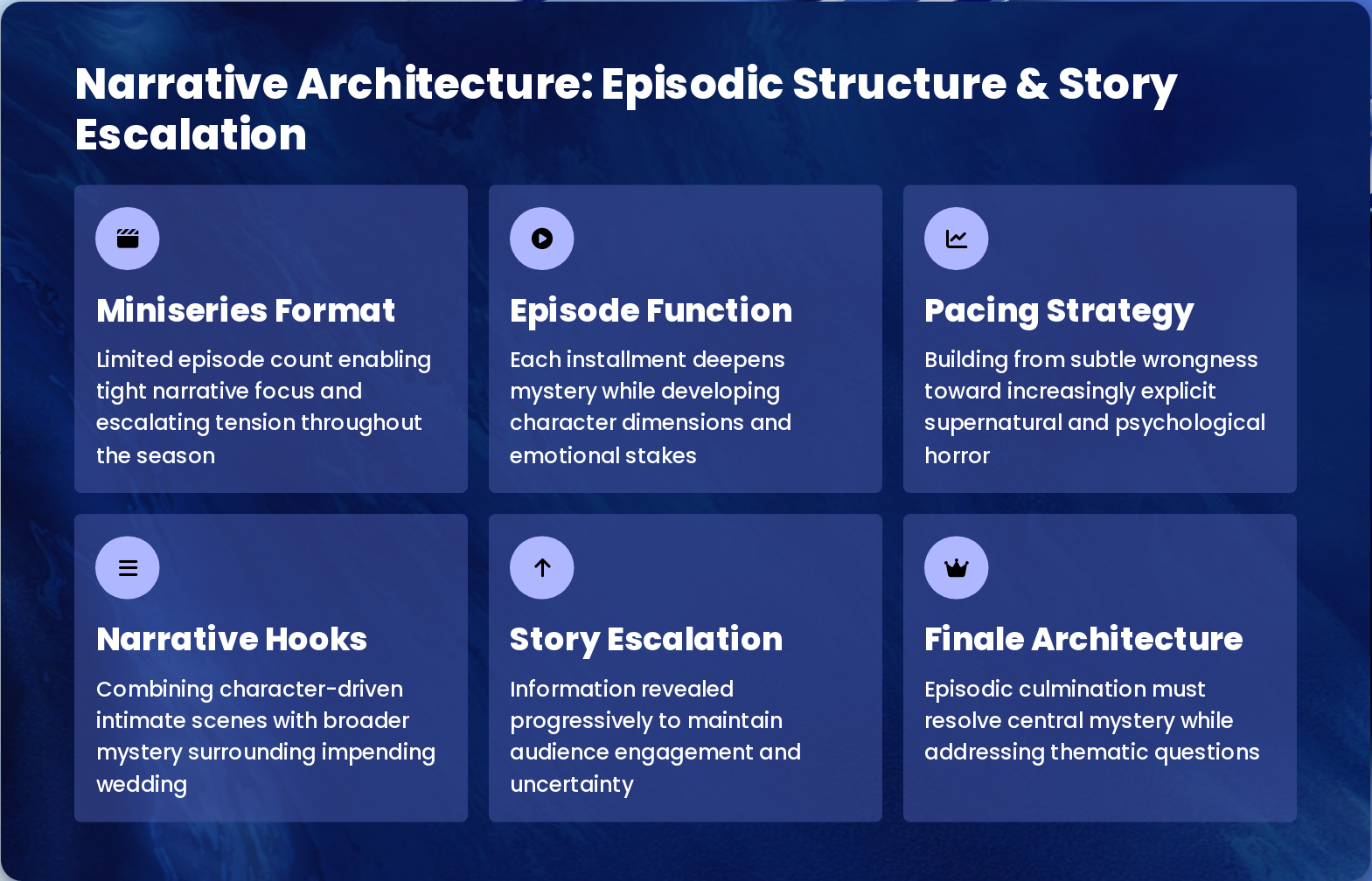
Slide 21: Narrative Architecture: Episodic Structure & Story Escalation
- Miniseries Format: Limited episode count enabling tight narrative focus and escalating tension throughout the season
- Episode Function: Each installment deepens mystery while developing character dimensions and emotional stakes
- Pacing Strategy: Building from subtle wrongness toward increasingly explicit supernatural and psychological horror
- Narrative Hooks: Combining character-driven intimate scenes with broader mystery surrounding impending wedding
- Story Escalation: Information revealed progressively to maintain audience engagement and uncertainty
- Finale Architecture: Episodic culmination must resolve central mystery while addressing thematic questions
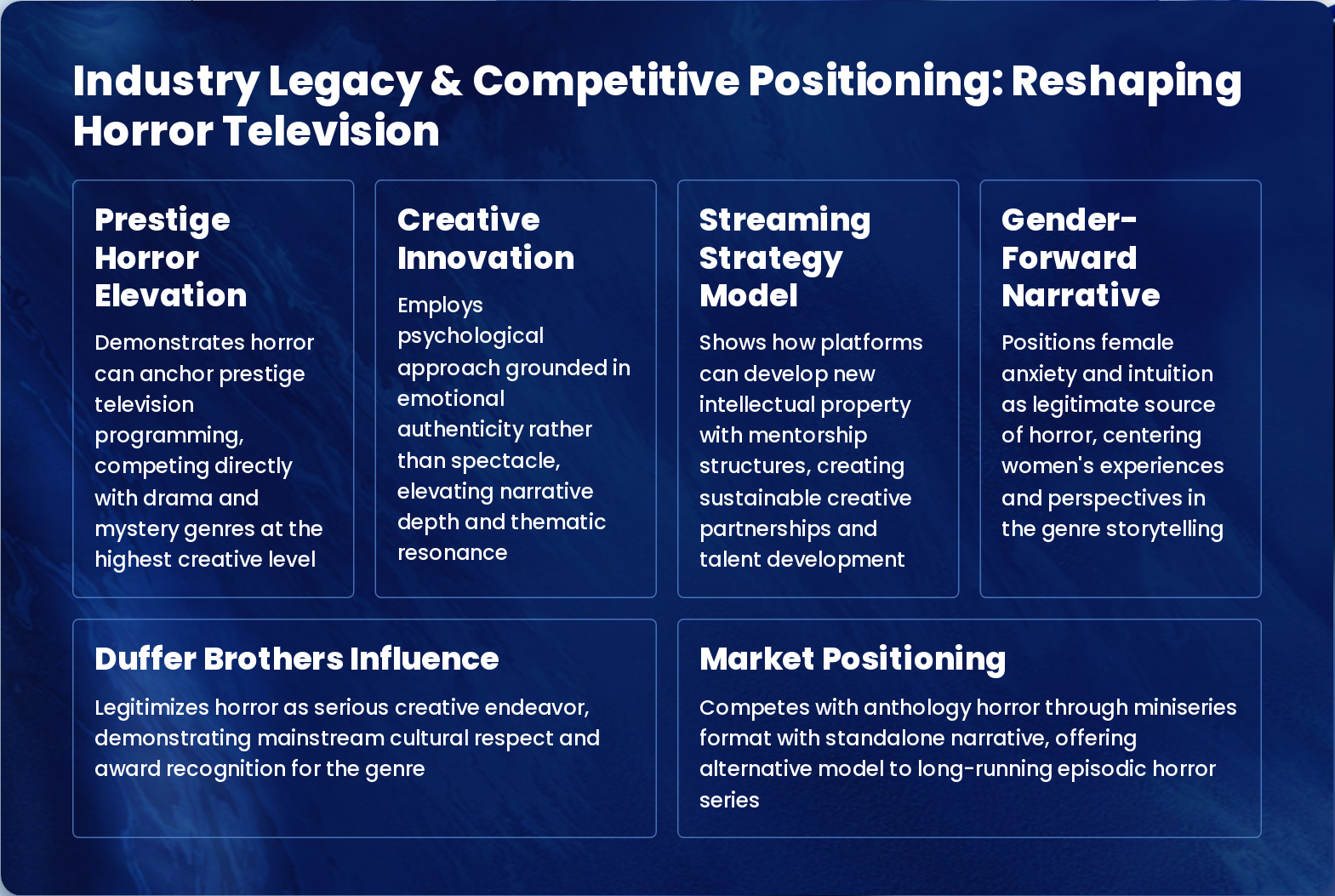
Slide 22: Industry Legacy & Competitive Positioning: Reshaping Horror Television
- Prestige Horror Elevation: Demonstrates horror can anchor prestige television programming, competing directly with drama and mystery genres at the highest creative level
- Creative Innovation: Employs psychological approach grounded in emotional authenticity rather than spectacle, elevating narrative depth and thematic resonance
- Streaming Strategy Model: Shows how platforms can develop new intellectual property with mentorship structures, creating sustainable creative partnerships and talent development
- Gender-Forward Narrative: Positions female anxiety and intuition as legitimate source of horror, centering women's experiences and perspectives in the genre storytelling
- Duffer Brothers Influence: Legitimizes horror as serious creative endeavor, demonstrating mainstream cultural respect and award recognition for the genre
- Market Positioning: Competes with anthology horror through miniseries format with standalone narrative, offering alternative model to long-running episodic horror series
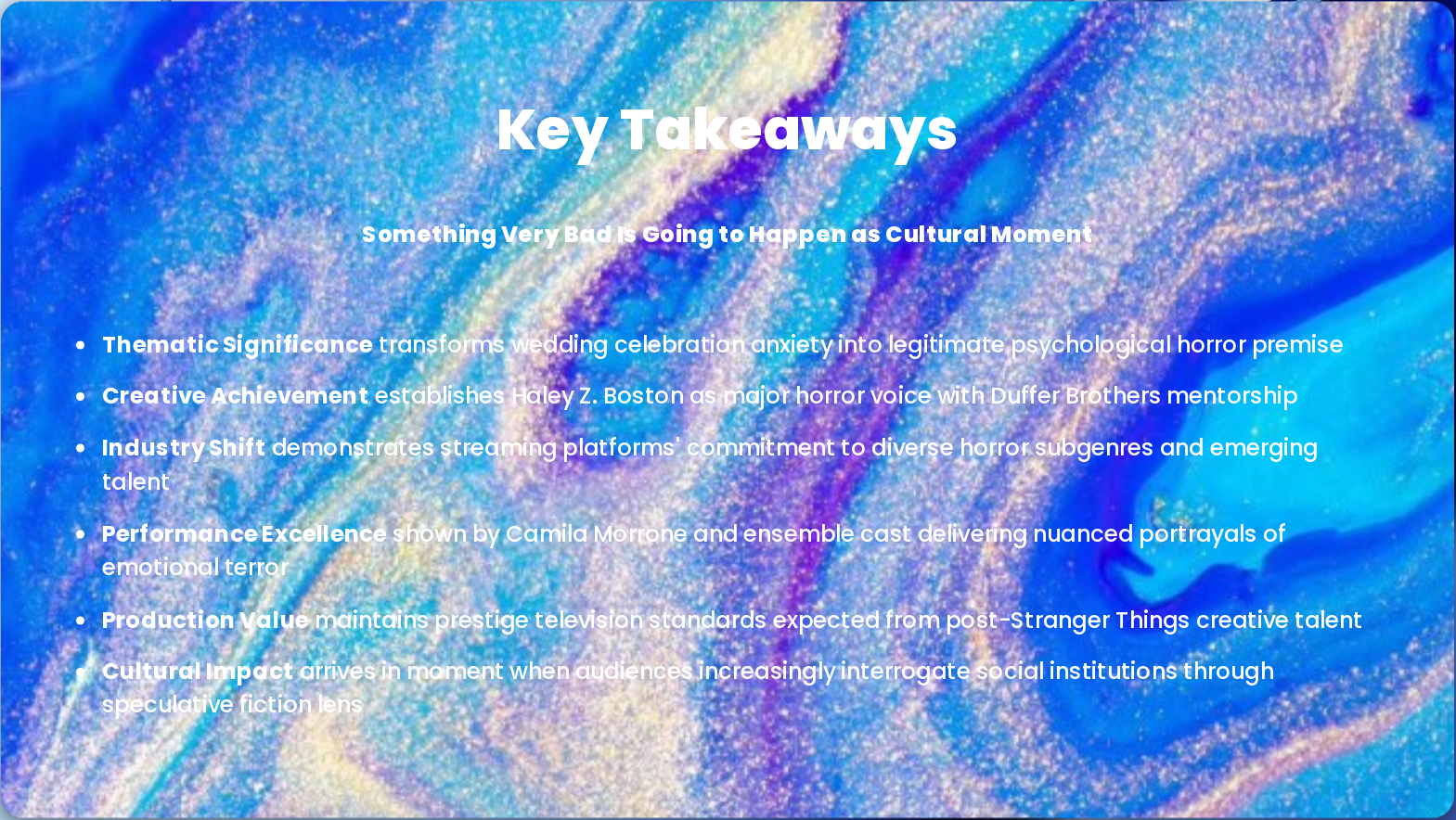
Slide 23: Key Takeaways
Thematic Significance transforms wedding celebration anxiety into legitimate psychological horror premise
Creative Achievement establishes Haley Z. Boston as major horror voice with Duffer Brothers mentorship
Industry Shift demonstrates streaming platforms' commitment to diverse horror subgenres and emerging talent
Performance Excellence shown by Camila Morrone and ensemble cast delivering nuanced portrayals of emotional terror
Production Value maintains prestige television standards expected from post-Stranger Things creative talent
Cultural Impact arrives in moment when audiences increasingly interrogate social institutions through speculative fiction lens
- Thematic Significance transforms wedding celebration anxiety into legitimate psychological horror premise
- Creative Achievement establishes Haley Z. Boston as major horror voice with Duffer Brothers mentorship
- Industry Shift demonstrates streaming platforms' commitment to diverse horror subgenres and emerging talent
- Performance Excellence shown by Camila Morrone and ensemble cast delivering nuanced portrayals of emotional terror
- Production Value maintains prestige television standards expected from post-Stranger Things creative talent
- Cultural Impact arrives in moment when audiences increasingly interrogate social institutions through speculative fiction lens