
Presentation Summary
Explore the historical significance of the moon landing, from Apollo 11 in 1969 to the upcoming Artemis Program. Learn about the technology, astronauts, and the debunking of conspiracy theories.
Full Presentation Transcript
Slide 1: Moon Landing: Humanity's Greatest Leap Beyond Earth
From Apollo 11 (1969) to Artemis Program (2026+): The Complete Story of Lunar Exploration
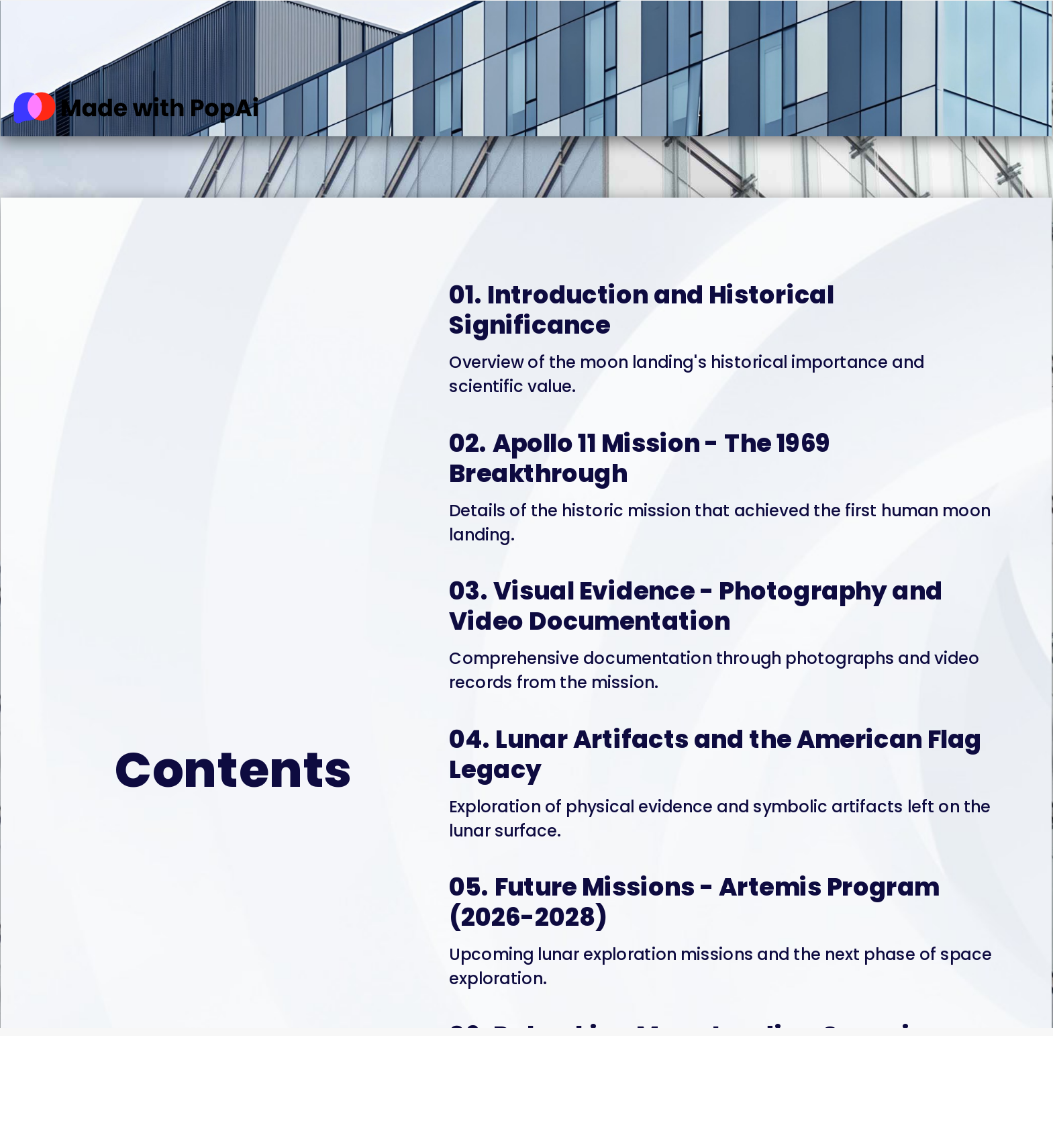
Slide 2: Contents
- Introduction and Historical Significance: Overview of the moon landing's historical importance and scientific value.
- Apollo 11 Mission - The 1969 Breakthrough: Details of the historic mission that achieved the first human moon landing.
- Visual Evidence - Photography and Video Documentation: Comprehensive documentation through photographs and video records from the mission.
- Lunar Artifacts and the American Flag Legacy: Exploration of physical evidence and symbolic artifacts left on the lunar surface.
- Future Missions - Artemis Program (2026-2028): Upcoming lunar exploration missions and the next phase of space exploration.
- Debunking Moon Landing Conspiracy Theories: Scientific analysis and factual refutation of common conspiracy claims.
- Real-World Impact and Conclusion: Long-term effects of moon landing achievements and final thoughts.
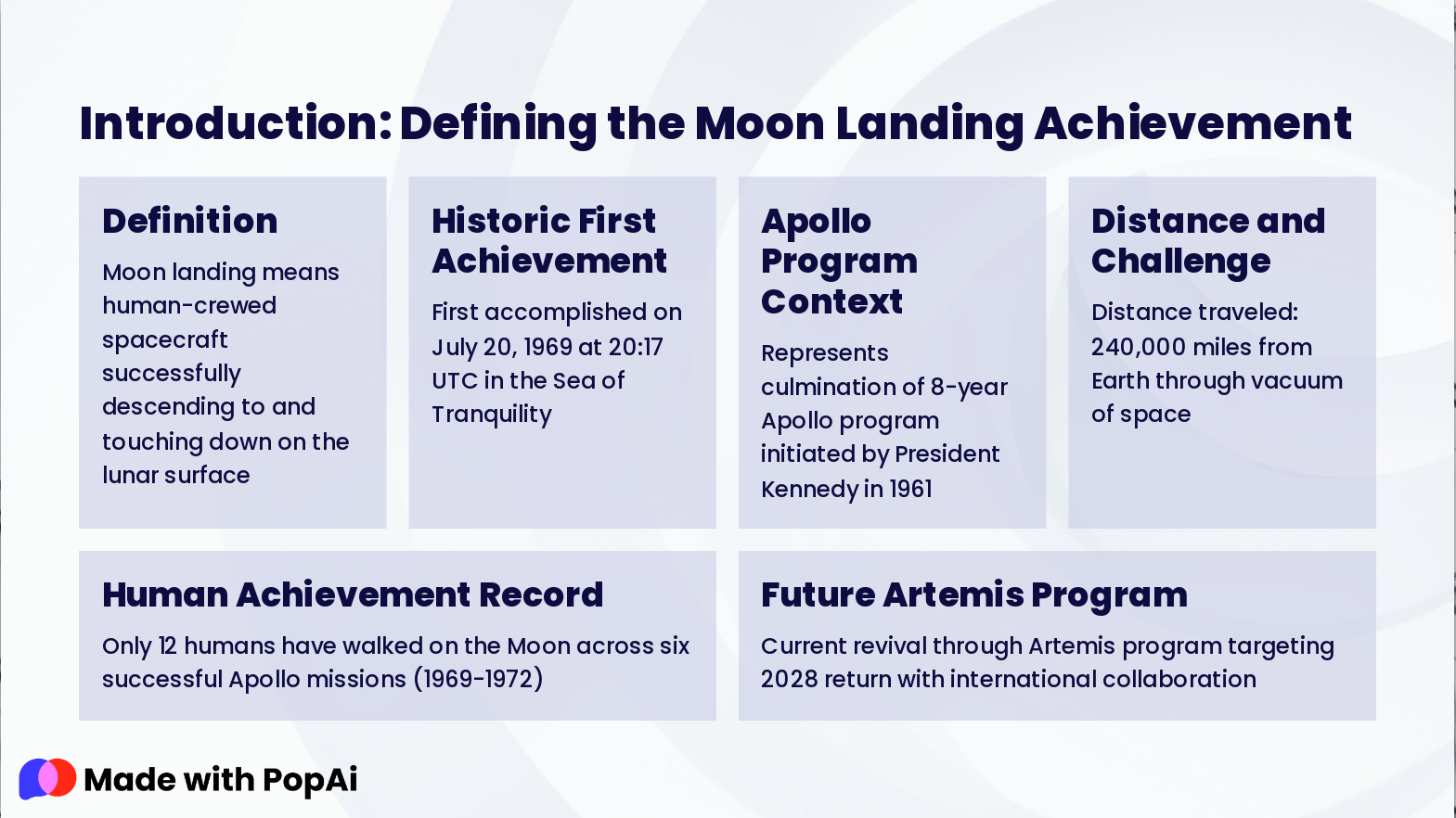
Slide 3: Introduction: Defining the Moon Landing Achievement
- Definition: Moon landing means human-crewed spacecraft successfully descending to and touching down on the lunar surface
- Historic First Achievement: First accomplished on July 20, 1969 at 20:17 UTC in the Sea of Tranquility
- Apollo Program Context: Represents culmination of 8-year Apollo program initiated by President Kennedy in 1961
- Distance and Challenge: Distance traveled: 240,000 miles from Earth through vacuum of space
- Human Achievement Record: Only 12 humans have walked on the Moon across six successful Apollo missions (1969-1972)
- Future Artemis Program: Current revival through Artemis program targeting 2028 return with international collaboration
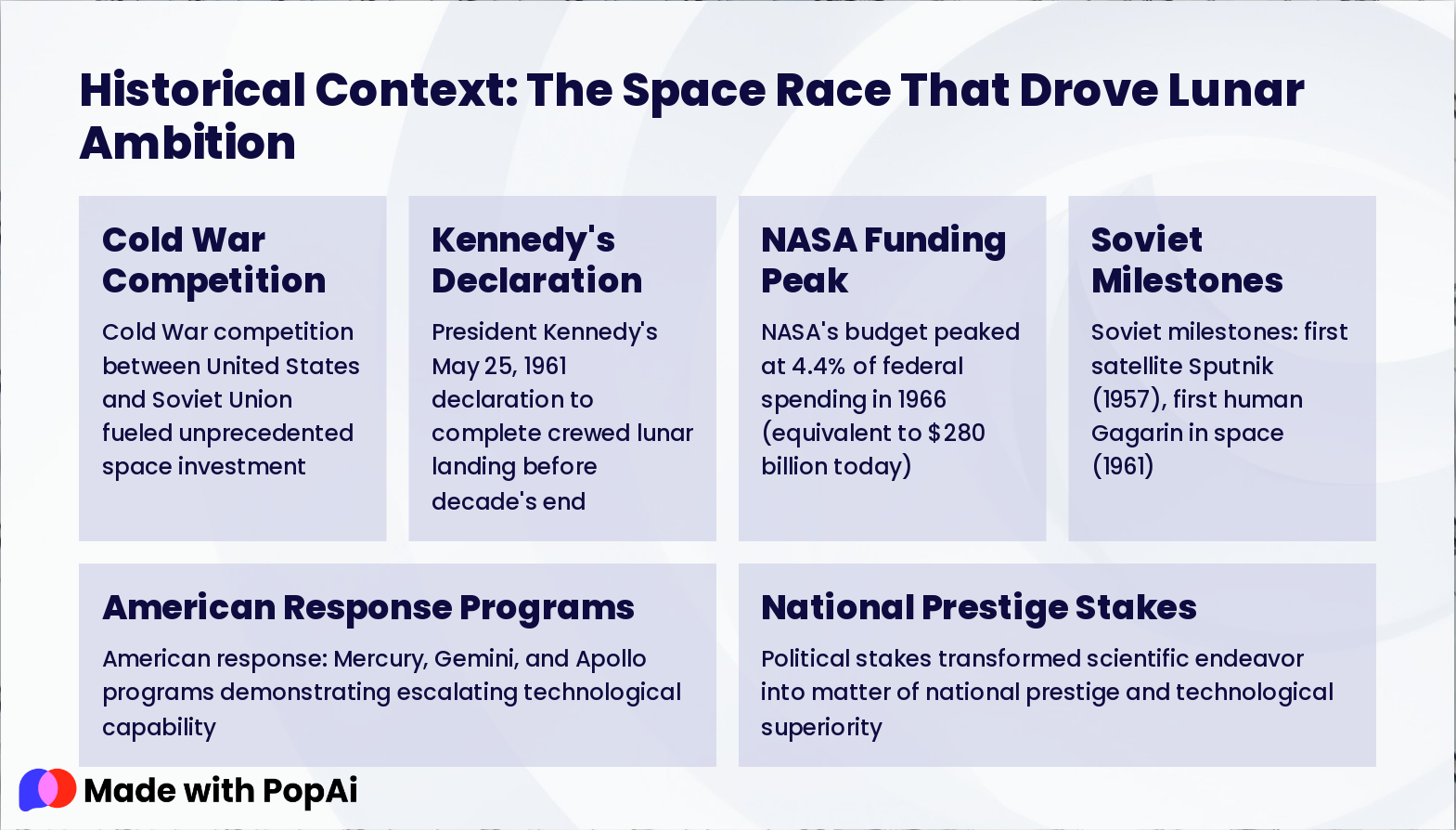
Slide 4: Historical Context: The Space Race That Drove Lunar Ambition
- Cold War Competition: Cold War competition between United States and Soviet Union fueled unprecedented space investment
- Kennedy's Declaration: President Kennedy's May 25, 1961 declaration to complete crewed lunar landing before decade's end
- NASA Funding Peak: NASA's budget peaked at 4.4% of federal spending in 1966 (equivalent to $280 billion today)
- Soviet Milestones: Soviet milestones: first satellite Sputnik (1957), first human Gagarin in space (1961)
- American Response Programs: American response: Mercury, Gemini, and Apollo programs demonstrating escalating technological capability
- National Prestige Stakes: Political stakes transformed scientific endeavor into matter of national prestige and technological superiority
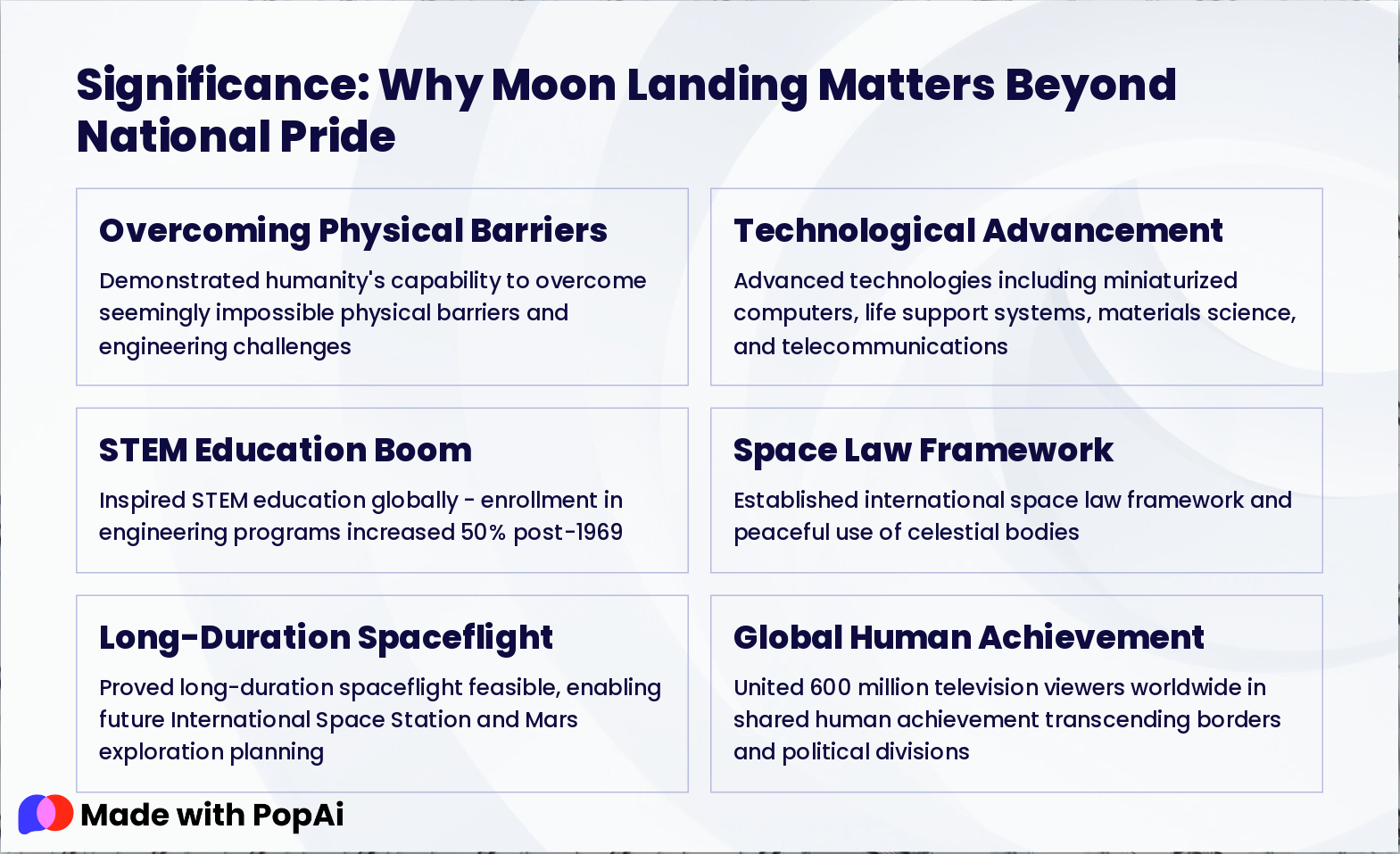
Slide 5: Significance: Why Moon Landing Matters Beyond National Pride
- Overcoming Physical Barriers: Demonstrated humanity's capability to overcome seemingly impossible physical barriers and engineering challenges
- Technological Advancement: Advanced technologies including miniaturized computers, life support systems, materials science, and telecommunications
- STEM Education Boom: Inspired STEM education globally - enrollment in engineering programs increased 50% post-1969
- Space Law Framework: Established international space law framework and peaceful use of celestial bodies
- Long-Duration Spaceflight: Proved long-duration spaceflight feasible, enabling future International Space Station and Mars exploration planning
- Global Human Achievement: United 600 million television viewers worldwide in shared human achievement transcending borders and political divisions
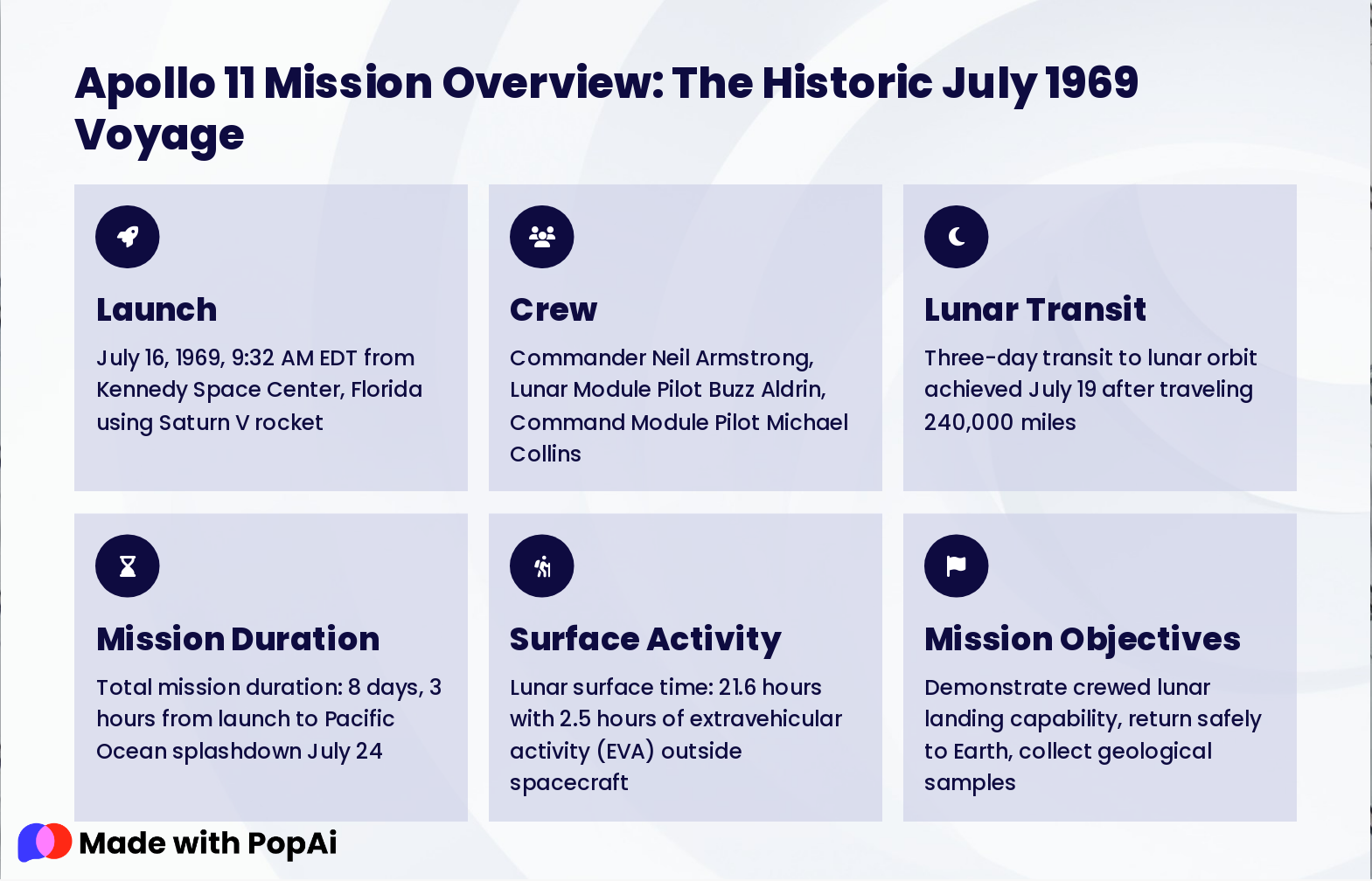
Slide 6: Apollo 11 Mission Overview: The Historic July 1969 Voyage
- Launch: July 16, 1969, 9:32 AM EDT from Kennedy Space Center, Florida using Saturn V rocket
- Crew: Commander Neil Armstrong, Lunar Module Pilot Buzz Aldrin, Command Module Pilot Michael Collins
- Lunar Transit: Three-day transit to lunar orbit achieved July 19 after traveling 240,000 miles
- Mission Duration: Total mission duration: 8 days, 3 hours from launch to Pacific Ocean splashdown July 24
- Surface Activity: Lunar surface time: 21.6 hours with 2.5 hours of extravehicular activity (EVA) outside spacecraft
- Mission Objectives: Demonstrate crewed lunar landing capability, return safely to Earth, collect geological samples
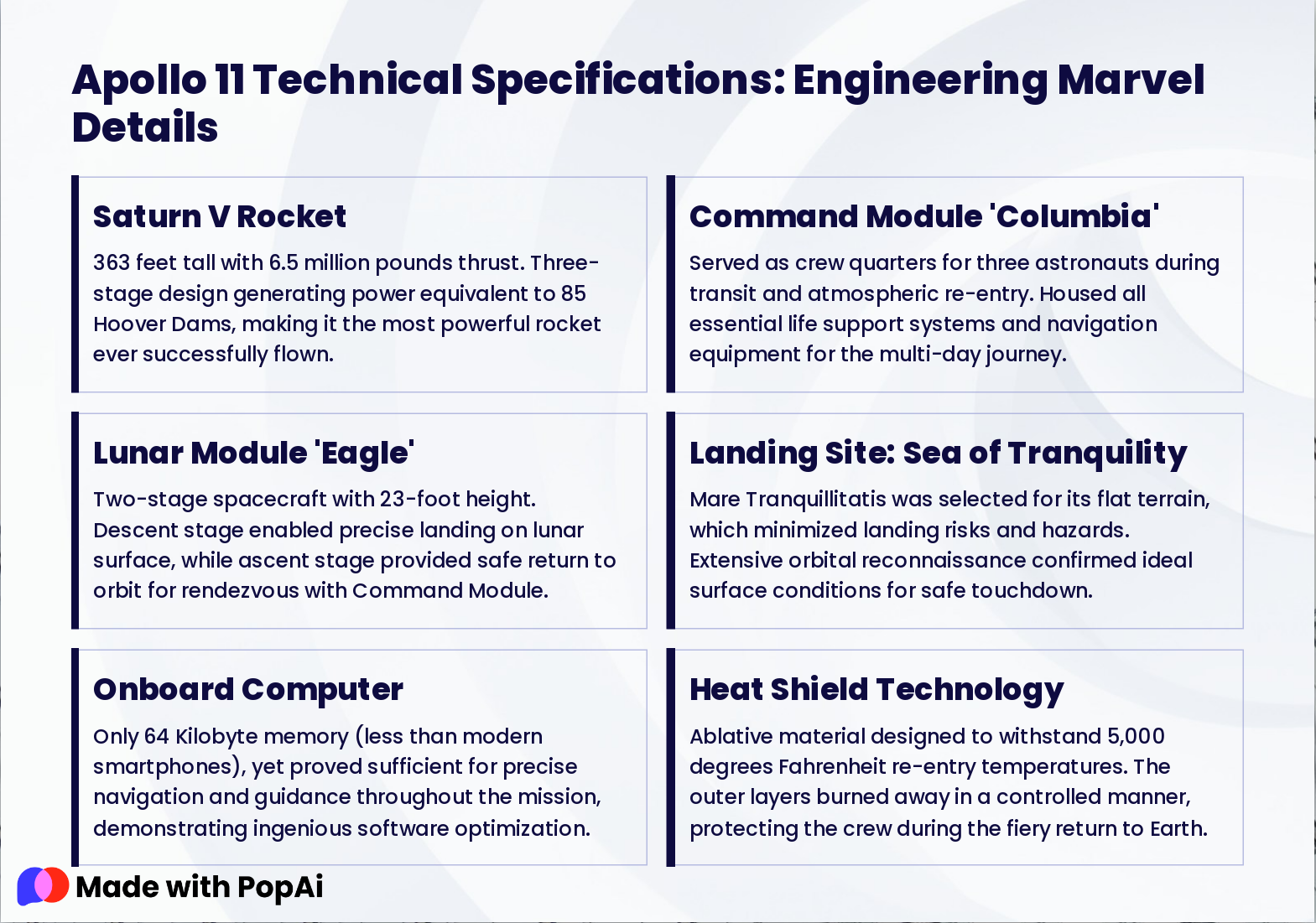
Slide 7: Apollo 11 Technical Specifications: Engineering Marvel Details
- Saturn V Rocket: 363 feet tall with 6.5 million pounds thrust. Three-stage design generating power equivalent to 85 Hoover Dams, making it the most powerful rocket ever successfully flown.
- Command Module 'Columbia': Served as crew quarters for three astronauts during transit and atmospheric re-entry. Housed all essential life support systems and navigation equipment for the multi-day journey.
- Lunar Module 'Eagle': Two-stage spacecraft with 23-foot height. Descent stage enabled precise landing on lunar surface, while ascent stage provided safe return to orbit for rendezvous with Command Module.
- Landing Site: Sea of Tranquility: Mare Tranquillitatis was selected for its flat terrain, which minimized landing risks and hazards. Extensive orbital reconnaissance confirmed ideal surface conditions for safe touchdown.
- Onboard Computer: Only 64 Kilobyte memory (less than modern smartphones), yet proved sufficient for precise navigation and guidance throughout the mission, demonstrating ingenious software optimization.
- Heat Shield Technology: Ablative material designed to withstand 5,000 degrees Fahrenheit re-entry temperatures. The outer layers burned away in a controlled manner, protecting the crew during the fiery return to Earth.
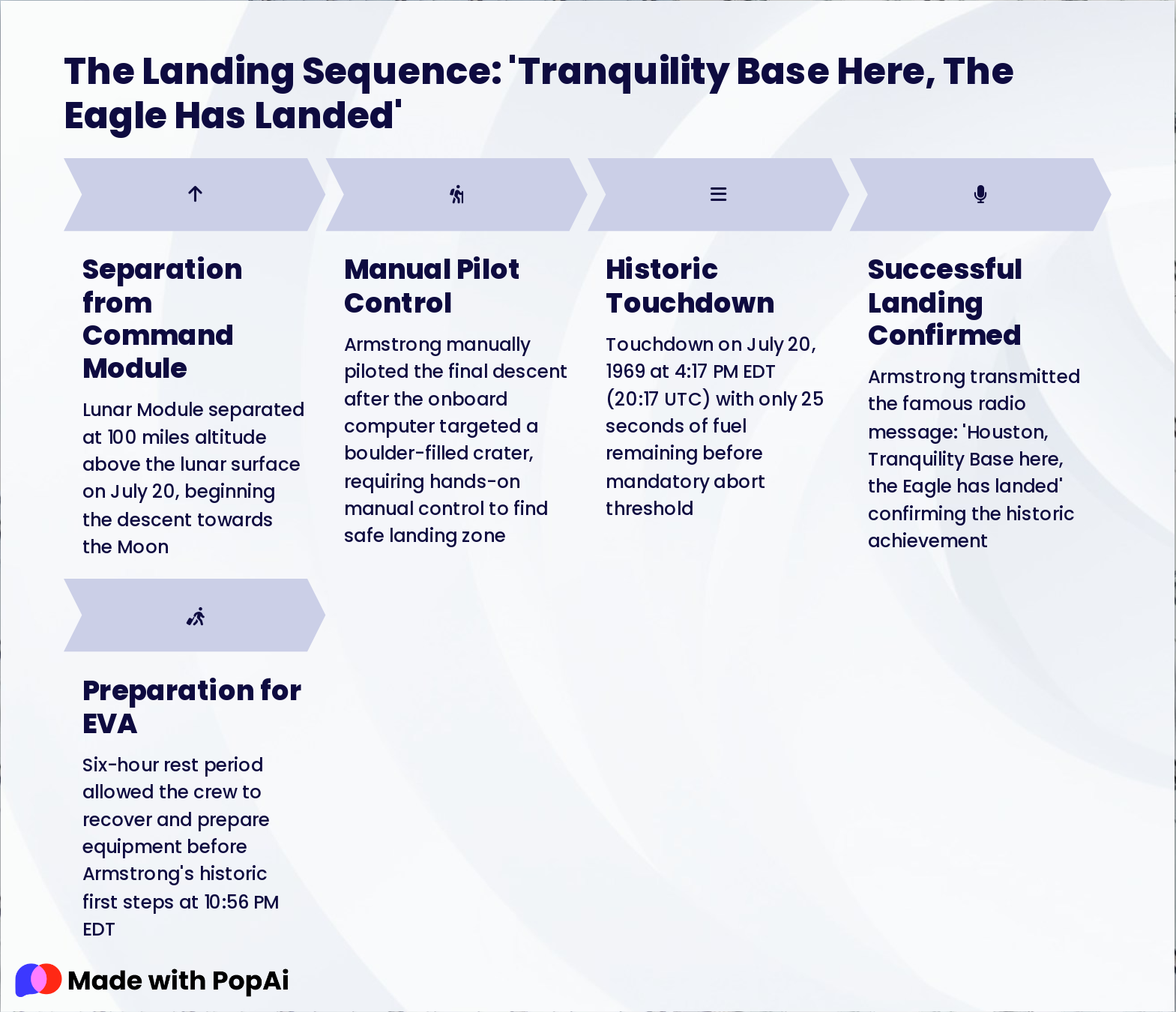
Slide 8: The Landing Sequence: 'Tranquility Base Here, The Eagle Has Landed'
- Separation from Command Module: Lunar Module separated at 100 miles altitude above the lunar surface on July 20, beginning the descent towards the Moon
- Manual Pilot Control: Armstrong manually piloted the final descent after the onboard computer targeted a boulder-filled crater, requiring hands-on manual control to find safe landing zone
- Historic Touchdown: Touchdown on July 20, 1969 at 4:17 PM EDT (20:17 UTC) with only 25 seconds of fuel remaining before mandatory abort threshold
- Successful Landing Confirmed: Armstrong transmitted the famous radio message: 'Houston, Tranquility Base here, the Eagle has landed' confirming the historic achievement
- Preparation for EVA: Six-hour rest period allowed the crew to recover and prepare equipment before Armstrong's historic first steps at 10:56 PM EDT
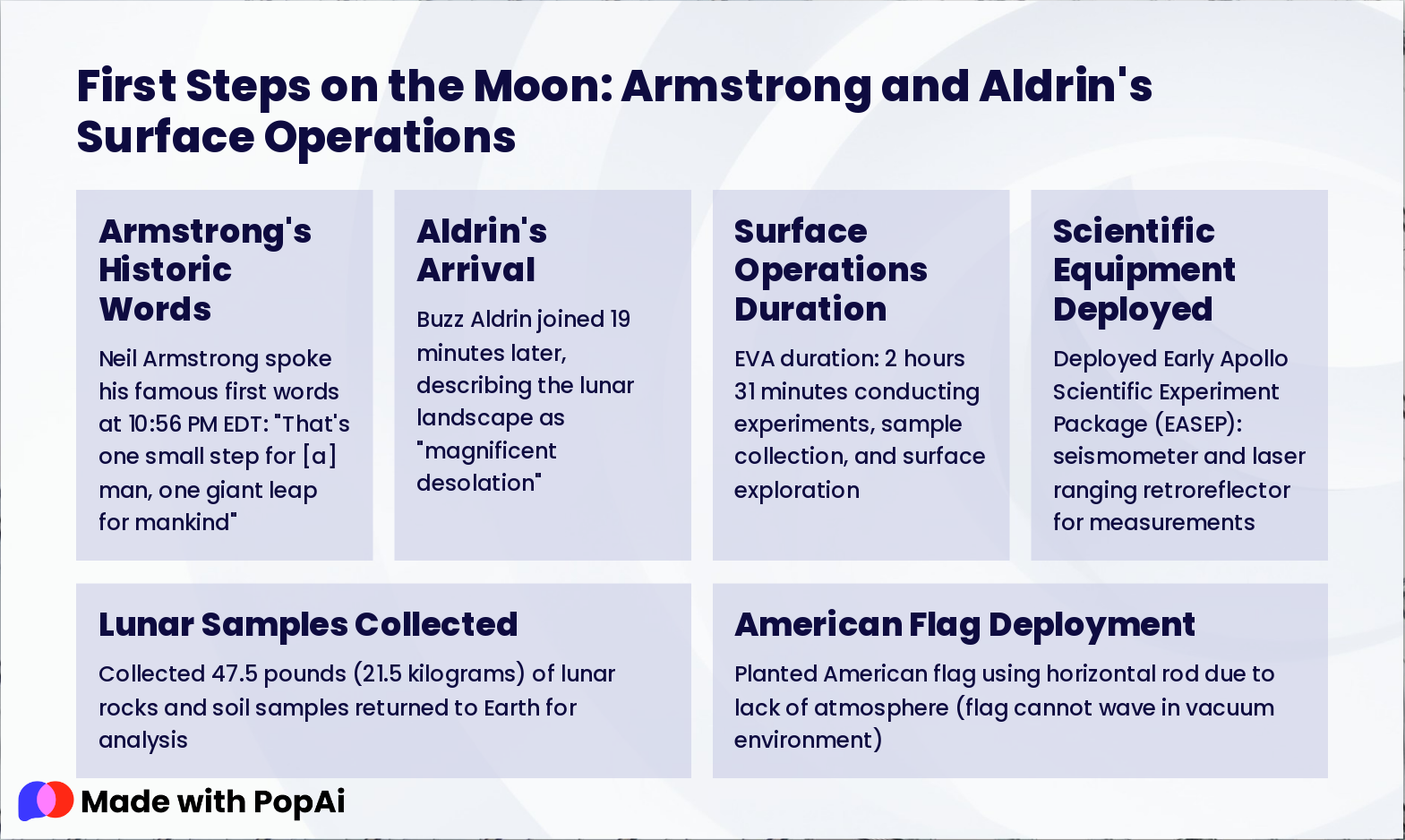
Slide 9: First Steps on the Moon: Armstrong and Aldrin's Surface Operations
- Armstrong's Historic Words: Neil Armstrong spoke his famous first words at 10:56 PM EDT: "That's one small step for [a] man, one giant leap for mankind"
- Aldrin's Arrival: Buzz Aldrin joined 19 minutes later, describing the lunar landscape as "magnificent desolation"
- Surface Operations Duration: EVA duration: 2 hours 31 minutes conducting experiments, sample collection, and surface exploration
- Scientific Equipment Deployed: Deployed Early Apollo Scientific Experiment Package (EASEP): seismometer and laser ranging retroreflector for measurements
- Lunar Samples Collected: Collected 47.5 pounds (21.5 kilograms) of lunar rocks and soil samples returned to Earth for analysis
- American Flag Deployment: Planted American flag using horizontal rod due to lack of atmosphere (flag cannot wave in vacuum environment)
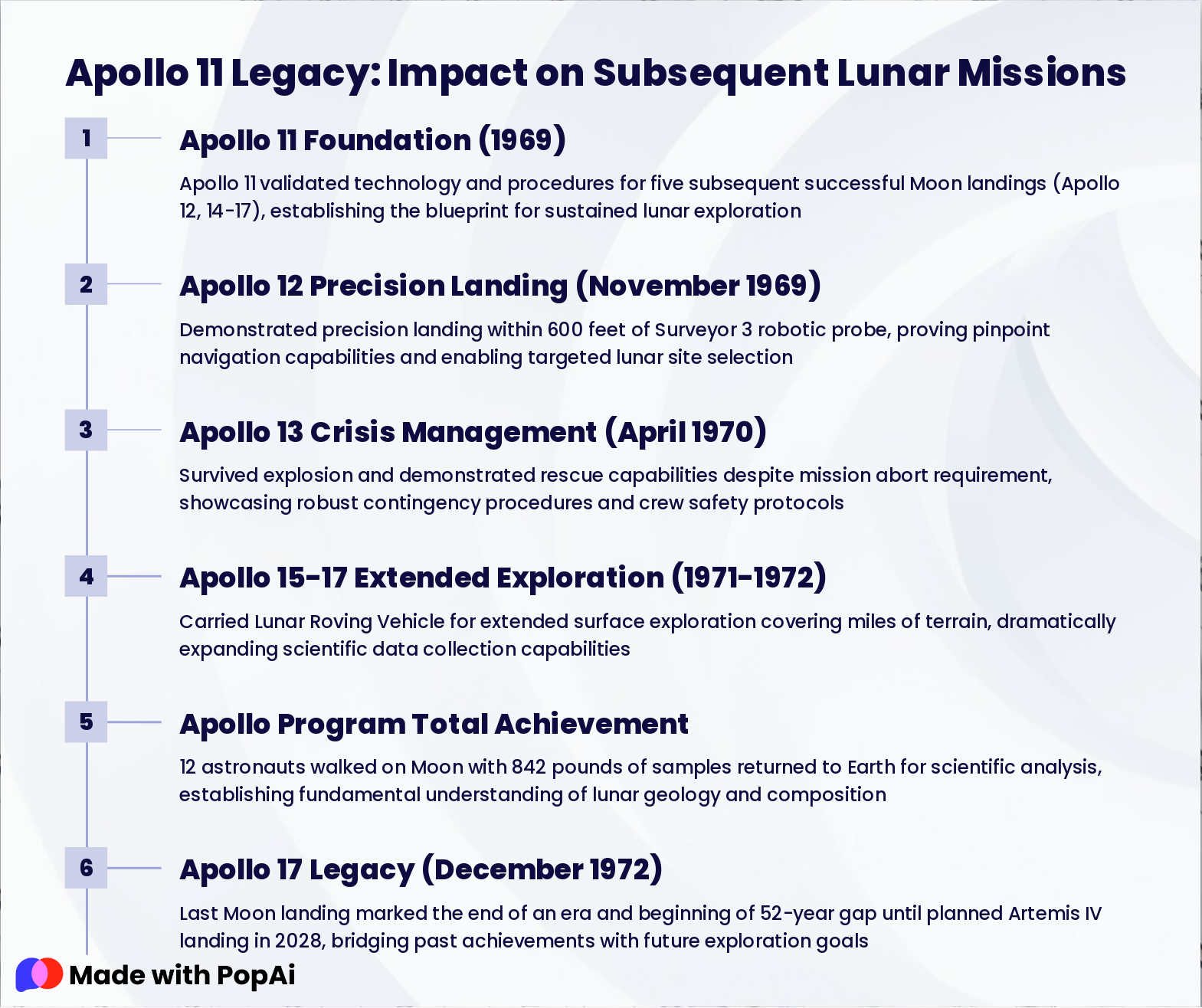
Slide 10: Apollo 11 Legacy: Impact on Subsequent Lunar Missions
- Apollo 11 Foundation (1969): Apollo 11 validated technology and procedures for five subsequent successful Moon landings (Apollo 12, 14-17), establishing the blueprint for sustained lunar exploration
- Apollo 12 Precision Landing (November 1969): Demonstrated precision landing within 600 feet of Surveyor 3 robotic probe, proving pinpoint navigation capabilities and enabling targeted lunar site selection
- Apollo 13 Crisis Management (April 1970): Survived explosion and demonstrated rescue capabilities despite mission abort requirement, showcasing robust contingency procedures and crew safety protocols
- Apollo 15-17 Extended Exploration (1971-1972): Carried Lunar Roving Vehicle for extended surface exploration covering miles of terrain, dramatically expanding scientific data collection capabilities
- Apollo Program Total Achievement: 12 astronauts walked on Moon with 842 pounds of samples returned to Earth for scientific analysis, establishing fundamental understanding of lunar geology and composition
- Apollo 17 Legacy (December 1972): Last Moon landing marked the end of an era and beginning of 52-year gap until planned Artemis IV landing in 2028, bridging past achievements with future exploration goals
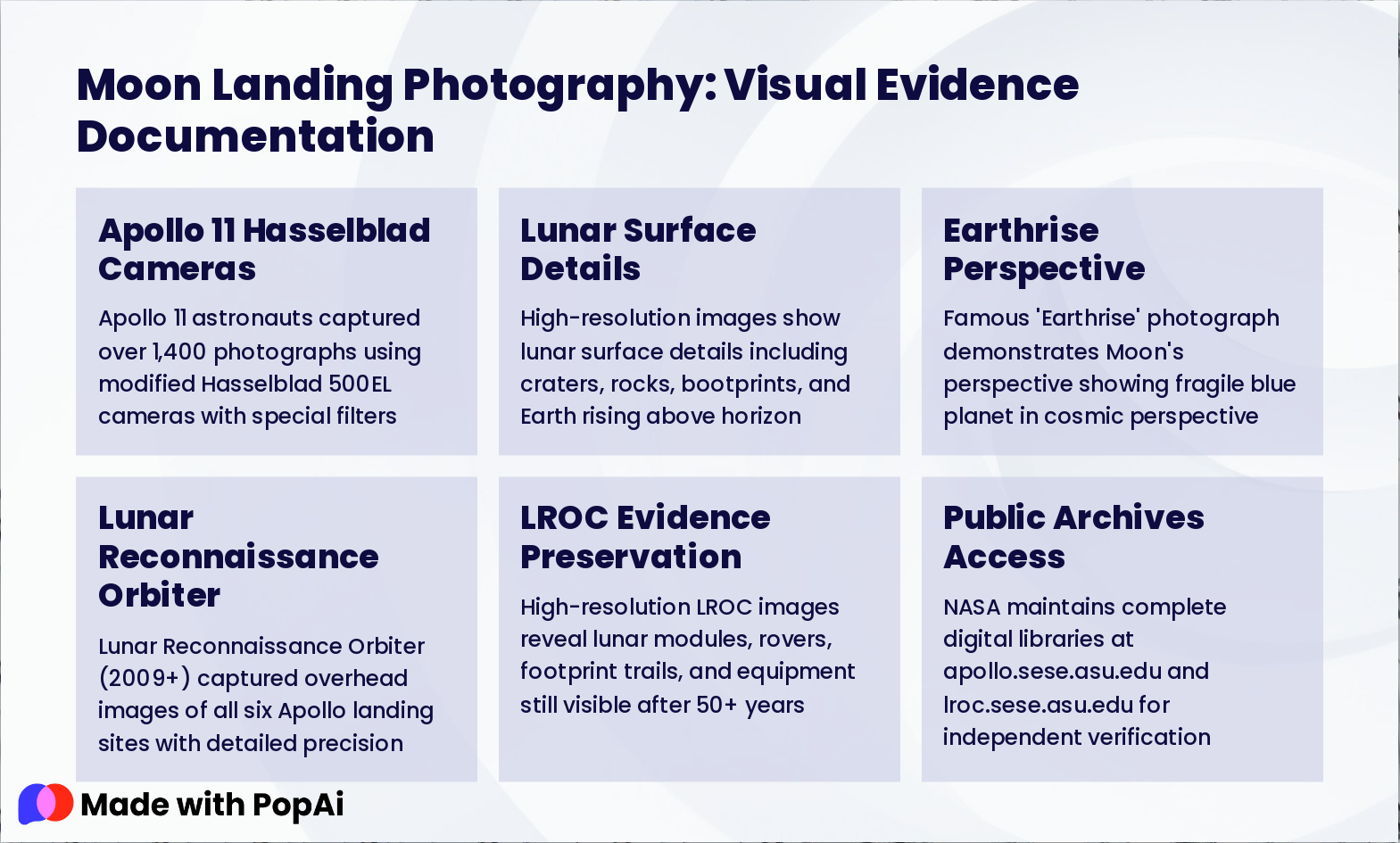
Slide 11: Moon Landing Photography: Visual Evidence Documentation
- Apollo 11 Hasselblad Cameras: Apollo 11 astronauts captured over 1,400 photographs using modified Hasselblad 500EL cameras with special filters
- Lunar Surface Details: High-resolution images show lunar surface details including craters, rocks, bootprints, and Earth rising above horizon
- Earthrise Perspective: Famous 'Earthrise' photograph demonstrates Moon's perspective showing fragile blue planet in cosmic perspective
- Lunar Reconnaissance Orbiter: Lunar Reconnaissance Orbiter (2009+) captured overhead images of all six Apollo landing sites with detailed precision
- LROC Evidence Preservation: High-resolution LROC images reveal lunar modules, rovers, footprint trails, and equipment still visible after 50+ years
- Public Archives Access: NASA maintains complete digital libraries at apollo.sese.asu.edu and lroc.sese.asu.edu for independent verification
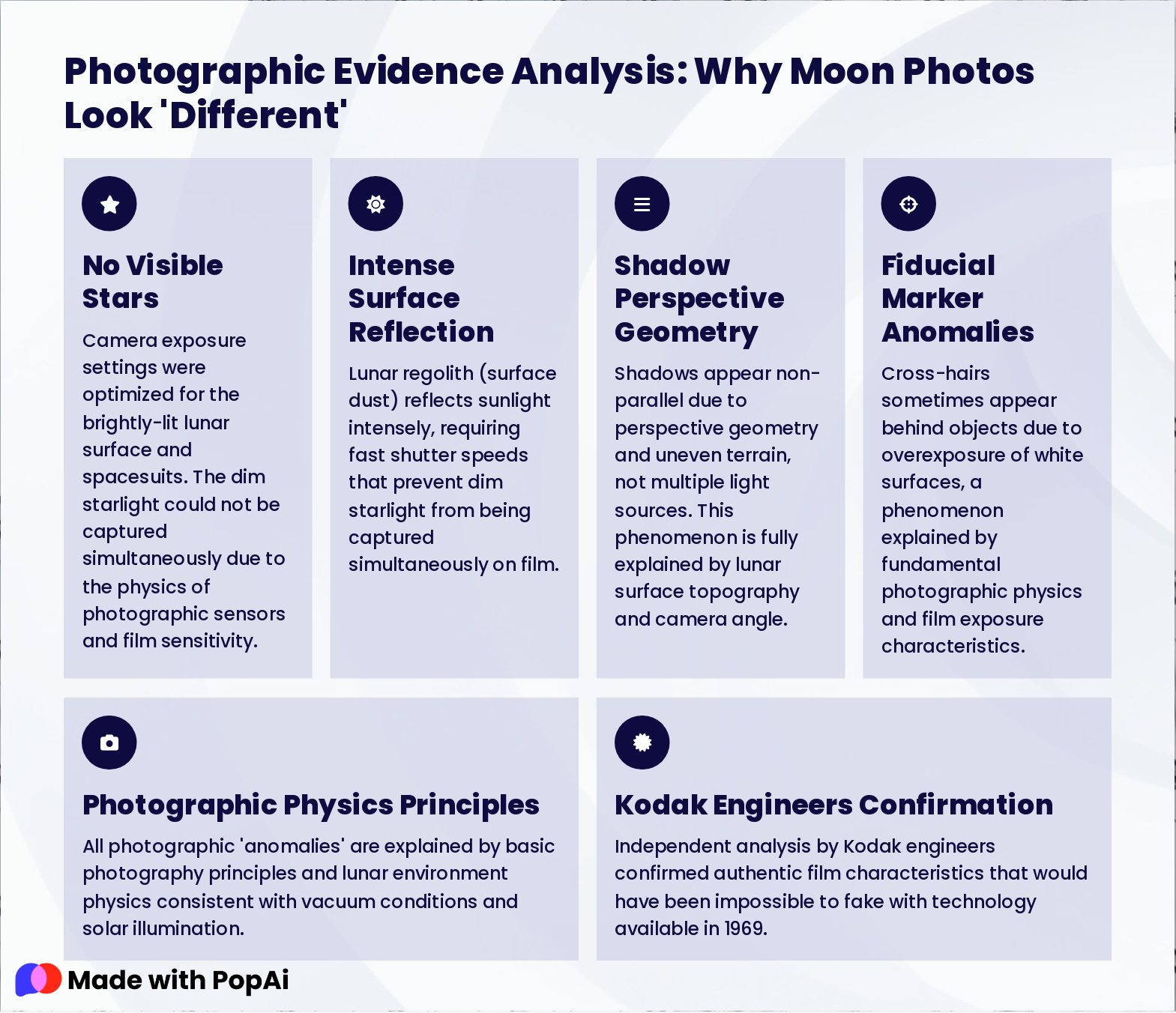
Slide 12: Photographic Evidence Analysis: Why Moon Photos Look 'Different'
- No Visible Stars: Camera exposure settings were optimized for the brightly-lit lunar surface and spacesuits. The dim starlight could not be captured simultaneously due to the physics of photographic sensors and film sensitivity.
- Intense Surface Reflection: Lunar regolith (surface dust) reflects sunlight intensely, requiring fast shutter speeds that prevent dim starlight from being captured simultaneously on film.
- Shadow Perspective Geometry: Shadows appear non-parallel due to perspective geometry and uneven terrain, not multiple light sources. This phenomenon is fully explained by lunar surface topography and camera angle.
- Fiducial Marker Anomalies: Cross-hairs sometimes appear behind objects due to overexposure of white surfaces, a phenomenon explained by fundamental photographic physics and film exposure characteristics.
- Photographic Physics Principles: All photographic 'anomalies' are explained by basic photography principles and lunar environment physics consistent with vacuum conditions and solar illumination.
- Kodak Engineers Confirmation: Independent analysis by Kodak engineers confirmed authentic film characteristics that would have been impossible to fake with technology available in 1969.
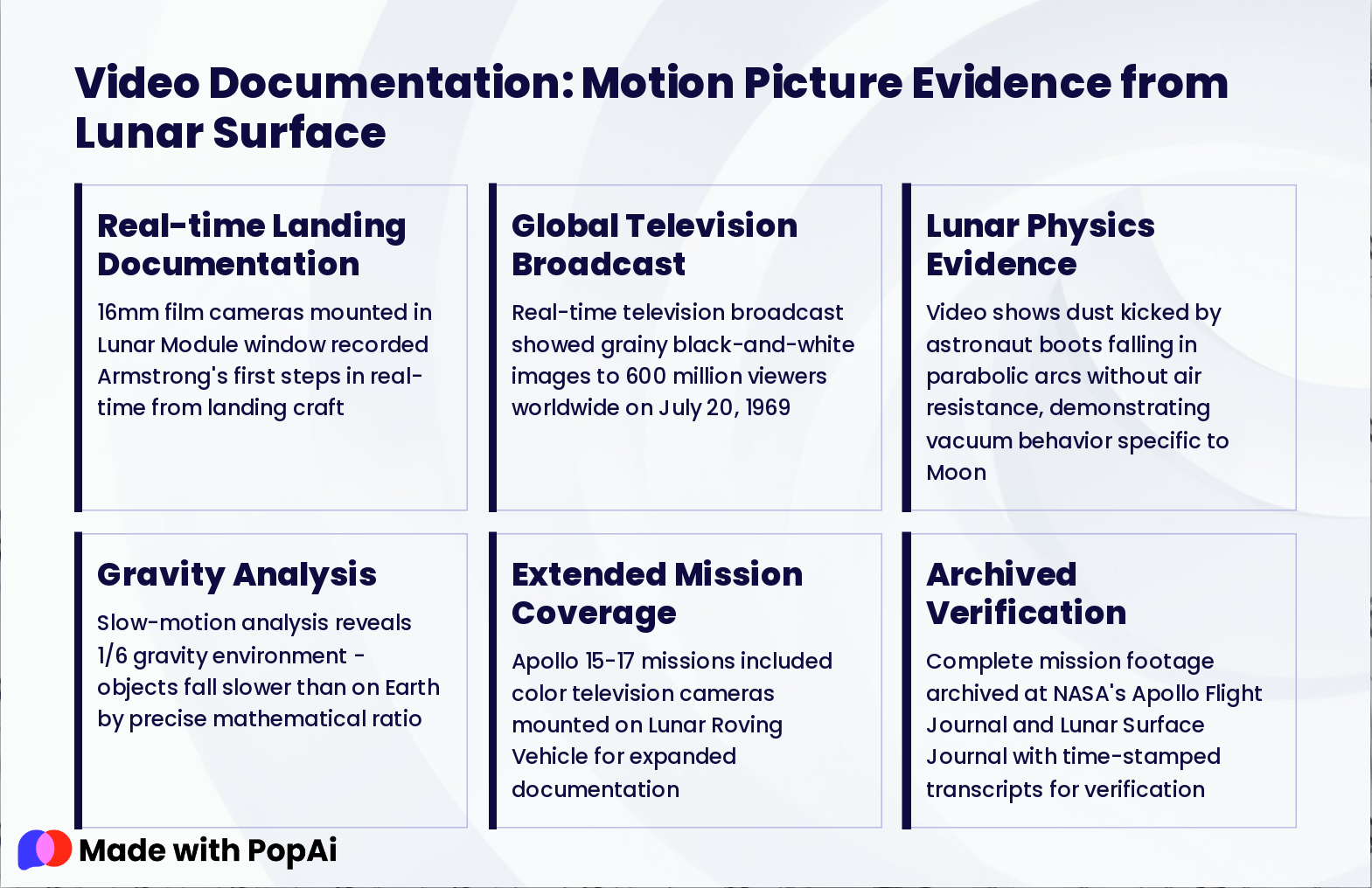
Slide 13: Video Documentation: Motion Picture Evidence from Lunar Surface
- Real-time Landing Documentation: 16mm film cameras mounted in Lunar Module window recorded Armstrong's first steps in real-time from landing craft
- Global Television Broadcast: Real-time television broadcast showed grainy black-and-white images to 600 million viewers worldwide on July 20, 1969
- Lunar Physics Evidence: Video shows dust kicked by astronaut boots falling in parabolic arcs without air resistance, demonstrating vacuum behavior specific to Moon
- Gravity Analysis: Slow-motion analysis reveals 1/6 gravity environment - objects fall slower than on Earth by precise mathematical ratio
- Extended Mission Coverage: Apollo 15-17 missions included color television cameras mounted on Lunar Roving Vehicle for expanded documentation
- Archived Verification: Complete mission footage archived at NASA's Apollo Flight Journal and Lunar Surface Journal with time-stamped transcripts for verification
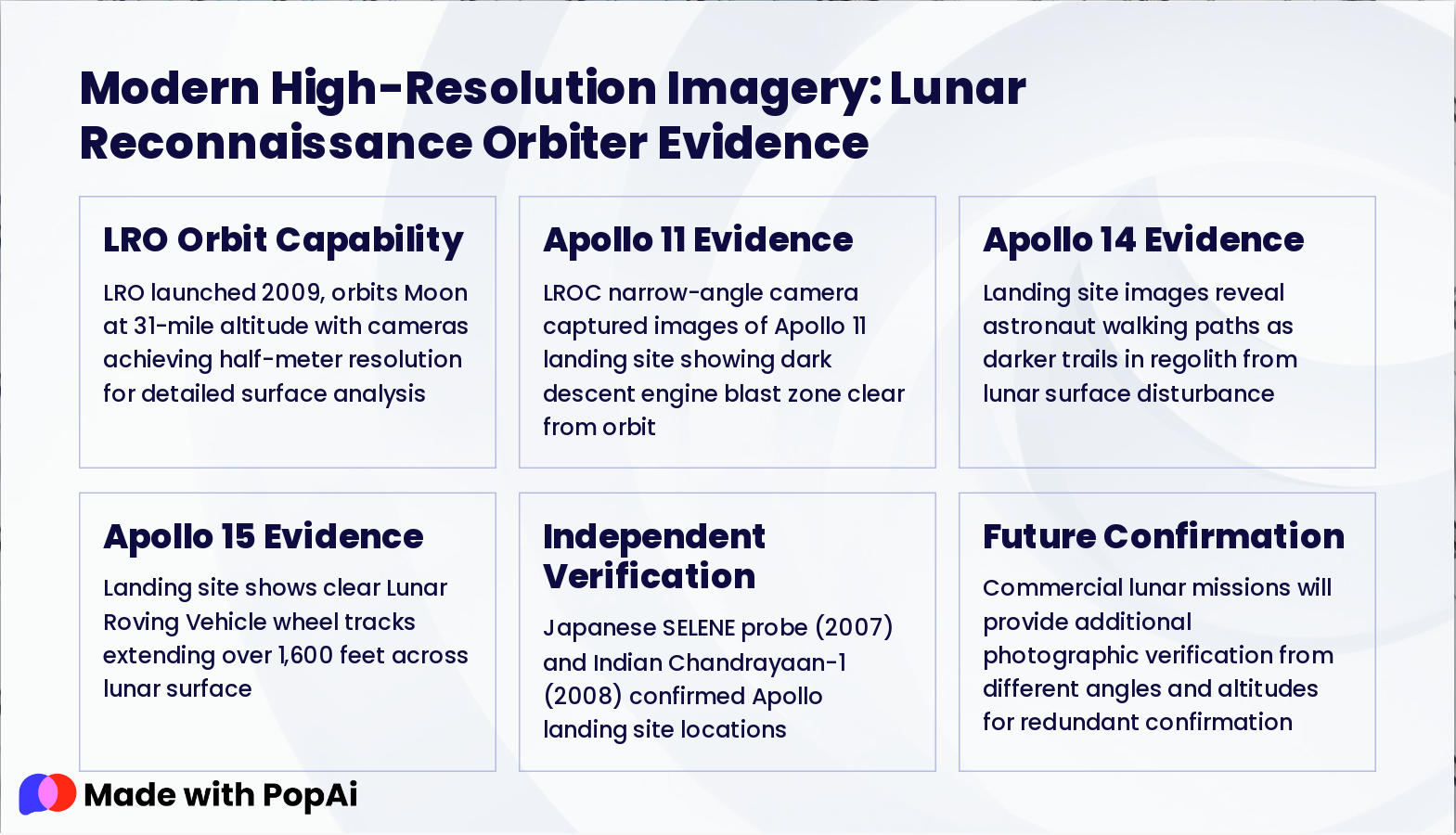
Slide 14: Modern High-Resolution Imagery: Lunar Reconnaissance Orbiter Evidence
- LRO Orbit Capability: LRO launched 2009, orbits Moon at 31-mile altitude with cameras achieving half-meter resolution for detailed surface analysis
- Apollo 11 Evidence: LROC narrow-angle camera captured images of Apollo 11 landing site showing dark descent engine blast zone clear from orbit
- Apollo 14 Evidence: Landing site images reveal astronaut walking paths as darker trails in regolith from lunar surface disturbance
- Apollo 15 Evidence: Landing site shows clear Lunar Roving Vehicle wheel tracks extending over 1,600 feet across lunar surface
- Independent Verification: Japanese SELENE probe (2007) and Indian Chandrayaan-1 (2008) confirmed Apollo landing site locations
- Future Confirmation: Commercial lunar missions will provide additional photographic verification from different angles and altitudes for redundant confirmation
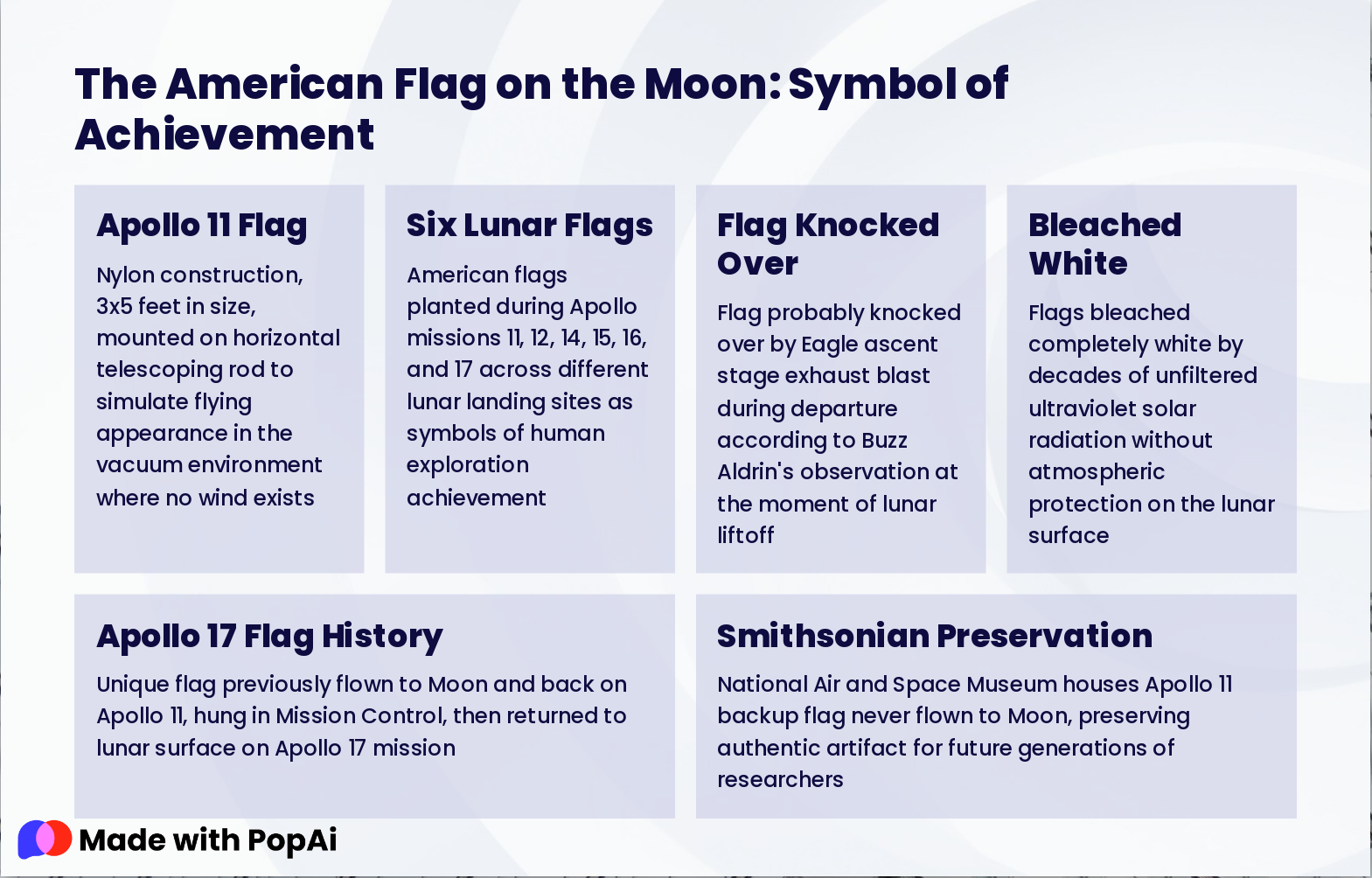
Slide 15: The American Flag on the Moon: Symbol of Achievement
- Apollo 11 Flag: Nylon construction, 3x5 feet in size, mounted on horizontal telescoping rod to simulate flying appearance in the vacuum environment where no wind exists
- Six Lunar Flags: American flags planted during Apollo missions 11, 12, 14, 15, 16, and 17 across different lunar landing sites as symbols of human exploration achievement
- Flag Knocked Over: Flag probably knocked over by Eagle ascent stage exhaust blast during departure according to Buzz Aldrin's observation at the moment of lunar liftoff
- Bleached White: Flags bleached completely white by decades of unfiltered ultraviolet solar radiation without atmospheric protection on the lunar surface
- Apollo 17 Flag History: Unique flag previously flown to Moon and back on Apollo 11, hung in Mission Control, then returned to lunar surface on Apollo 17 mission
- Smithsonian Preservation: National Air and Space Museum houses Apollo 11 backup flag never flown to Moon, preserving authentic artifact for future generations of researchers
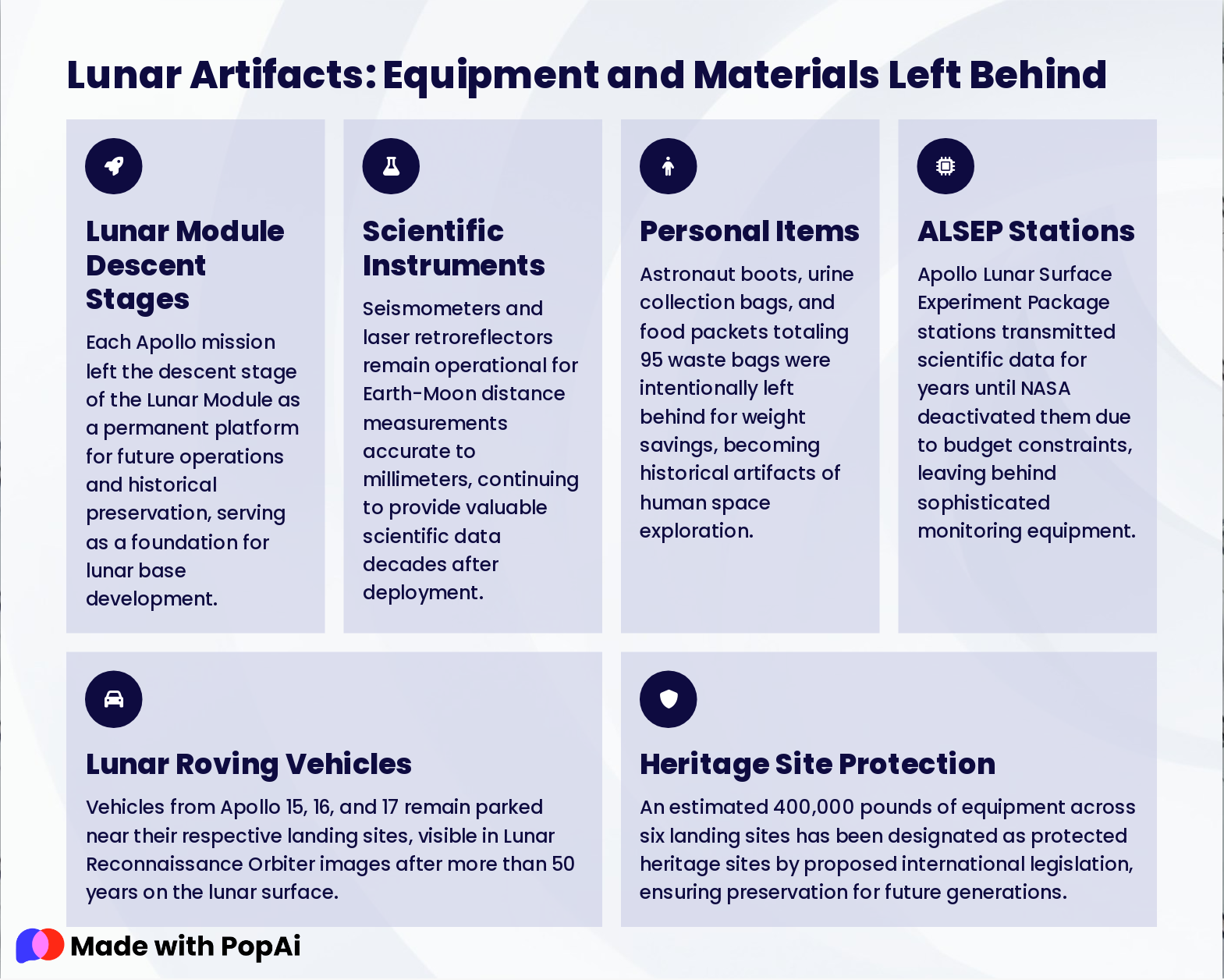
Slide 16: Lunar Artifacts: Equipment and Materials Left Behind
- Lunar Module Descent Stages: Each Apollo mission left the descent stage of the Lunar Module as a permanent platform for future operations and historical preservation, serving as a foundation for lunar base development.
- Scientific Instruments: Seismometers and laser retroreflectors remain operational for Earth-Moon distance measurements accurate to millimeters, continuing to provide valuable scientific data decades after deployment.
- Personal Items: Astronaut boots, urine collection bags, and food packets totaling 95 waste bags were intentionally left behind for weight savings, becoming historical artifacts of human space exploration.
- ALSEP Stations: Apollo Lunar Surface Experiment Package stations transmitted scientific data for years until NASA deactivated them due to budget constraints, leaving behind sophisticated monitoring equipment.
- Lunar Roving Vehicles: Vehicles from Apollo 15, 16, and 17 remain parked near their respective landing sites, visible in Lunar Reconnaissance Orbiter images after more than 50 years on the lunar surface.
- Heritage Site Protection: An estimated 400,000 pounds of equipment across six landing sites has been designated as protected heritage sites by proposed international legislation, ensuring preservation for future generations.
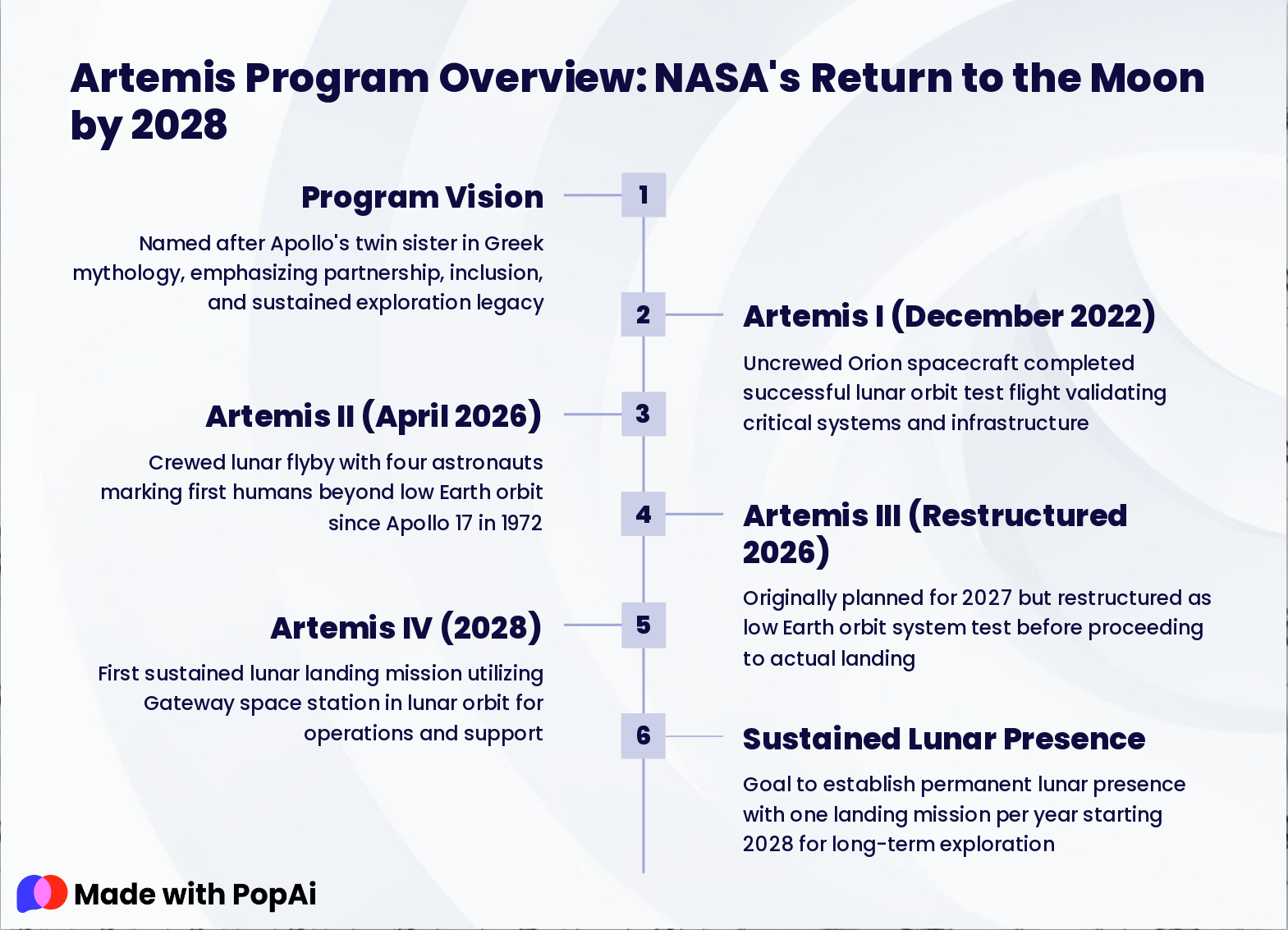
Slide 17: Artemis Program Overview: NASA's Return to the Moon by 2028
- Program Vision: Named after Apollo's twin sister in Greek mythology, emphasizing partnership, inclusion, and sustained exploration legacy
- Artemis I (December 2022): Uncrewed Orion spacecraft completed successful lunar orbit test flight validating critical systems and infrastructure
- Artemis II (April 2026): Crewed lunar flyby with four astronauts marking first humans beyond low Earth orbit since Apollo 17 in 1972
- Artemis III (Restructured 2026): Originally planned for 2027 but restructured as low Earth orbit system test before proceeding to actual landing
- Artemis IV (2028): First sustained lunar landing mission utilizing Gateway space station in lunar orbit for operations and support
- Sustained Lunar Presence: Goal to establish permanent lunar presence with one landing mission per year starting 2028 for long-term exploration
Slide 18: Artemis Technical Advancement: Modern vs. Apollo Era Technology
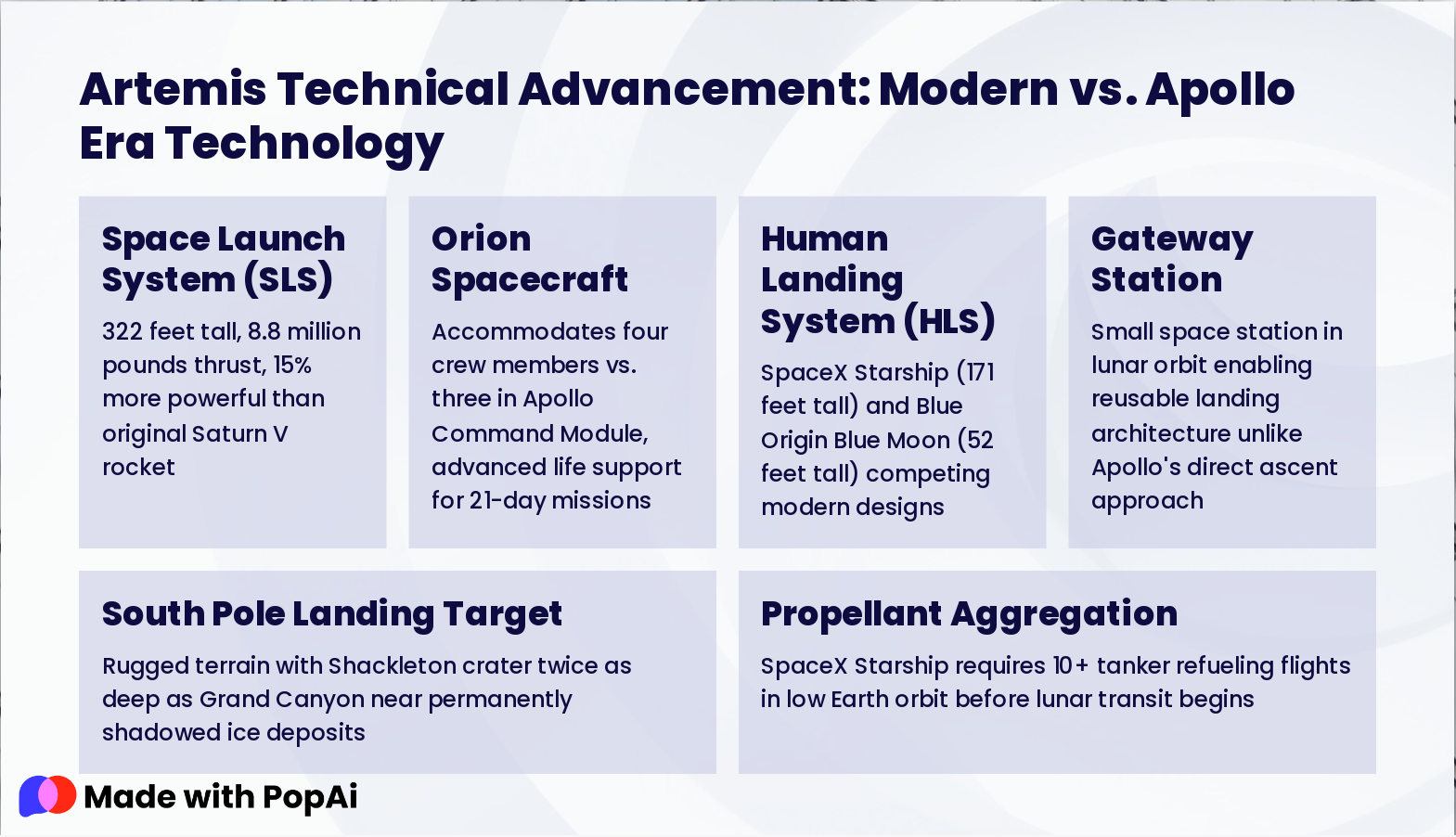
- Space Launch System (SLS): 322 feet tall, 8.8 million pounds thrust, 15% more powerful than original Saturn V rocket
- Orion Spacecraft: Accommodates four crew members vs. three in Apollo Command Module, advanced life support for 21-day missions
- Human Landing System (HLS): SpaceX Starship (171 feet tall) and Blue Origin Blue Moon (52 feet tall) competing modern designs
- Gateway Station: Small space station in lunar orbit enabling reusable landing architecture unlike Apollo's direct ascent approach
- South Pole Landing Target: Rugged terrain with Shackleton crater twice as deep as Grand Canyon near permanently shadowed ice deposits
- Propellant Aggregation: SpaceX Starship requires 10+ tanker refueling flights in low Earth orbit before lunar transit begins
Slide 19: International Collaboration: Global Partnership in Lunar Exploration
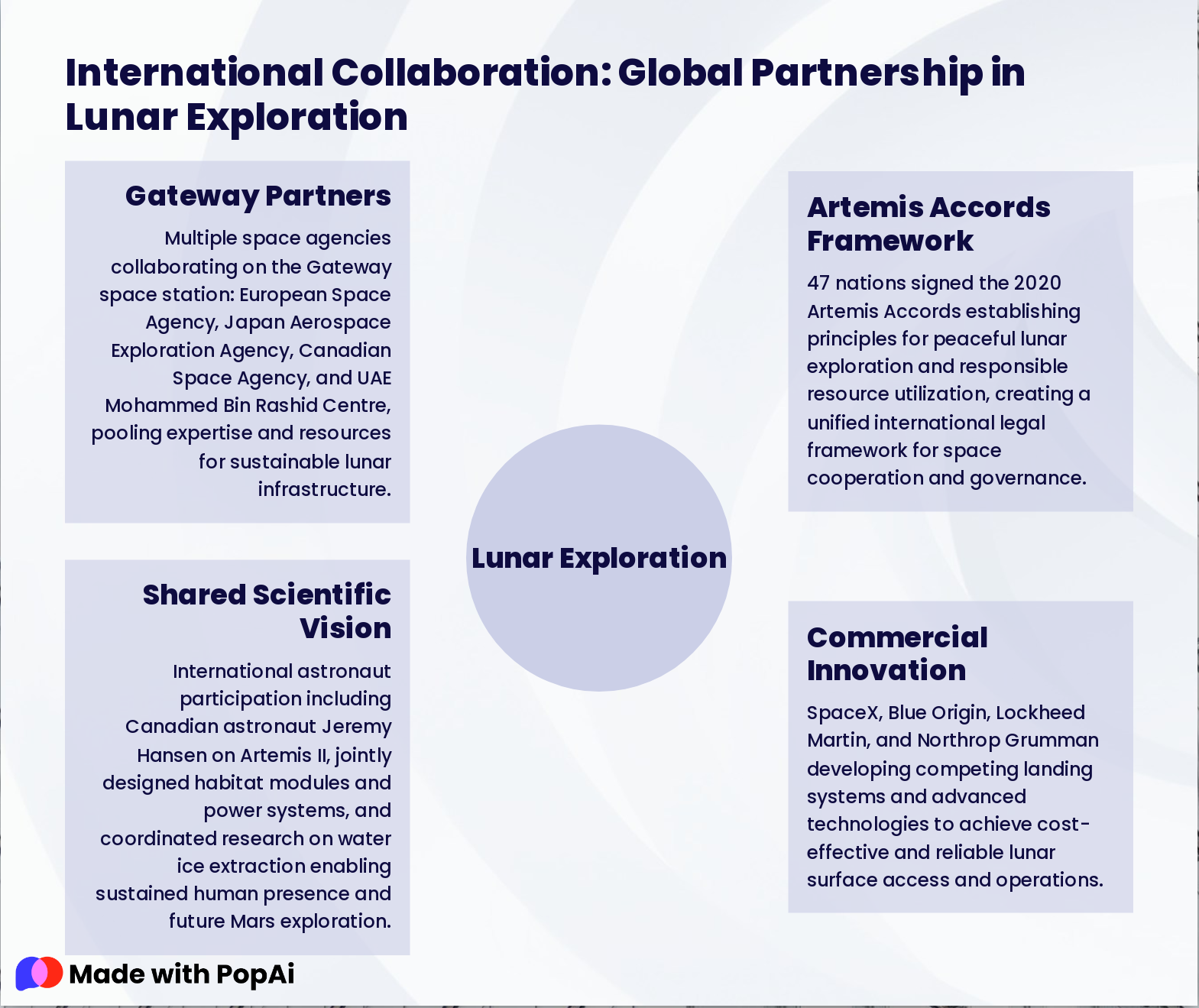
- Gateway Partners: Multiple space agencies collaborating on the Gateway space station: European Space Agency, Japan Aerospace Exploration Agency, Canadian Space Agency, and UAE Mohammed Bin Rashid Centre, pooling expertise and resources for sustainable lunar infrastructure.
- Artemis Accords Framework: 47 nations signed the 2020 Artemis Accords establishing principles for peaceful lunar exploration and responsible resource utilization, creating a unified international legal framework for space cooperation and governance.
- Commercial Innovation: SpaceX, Blue Origin, Lockheed Martin, and Northrop Grumman developing competing landing systems and advanced technologies to achieve cost-effective and reliable lunar surface access and operations.
- Shared Scientific Vision: International astronaut participation including Canadian astronaut Jeremy Hansen on Artemis II, jointly designed habitat modules and power systems, and coordinated research on water ice extraction enabling sustained human presence and future Mars exploration.
Slide 20: Debunking Conspiracy Theory 1: Shadows and Lighting 'Anomalies'
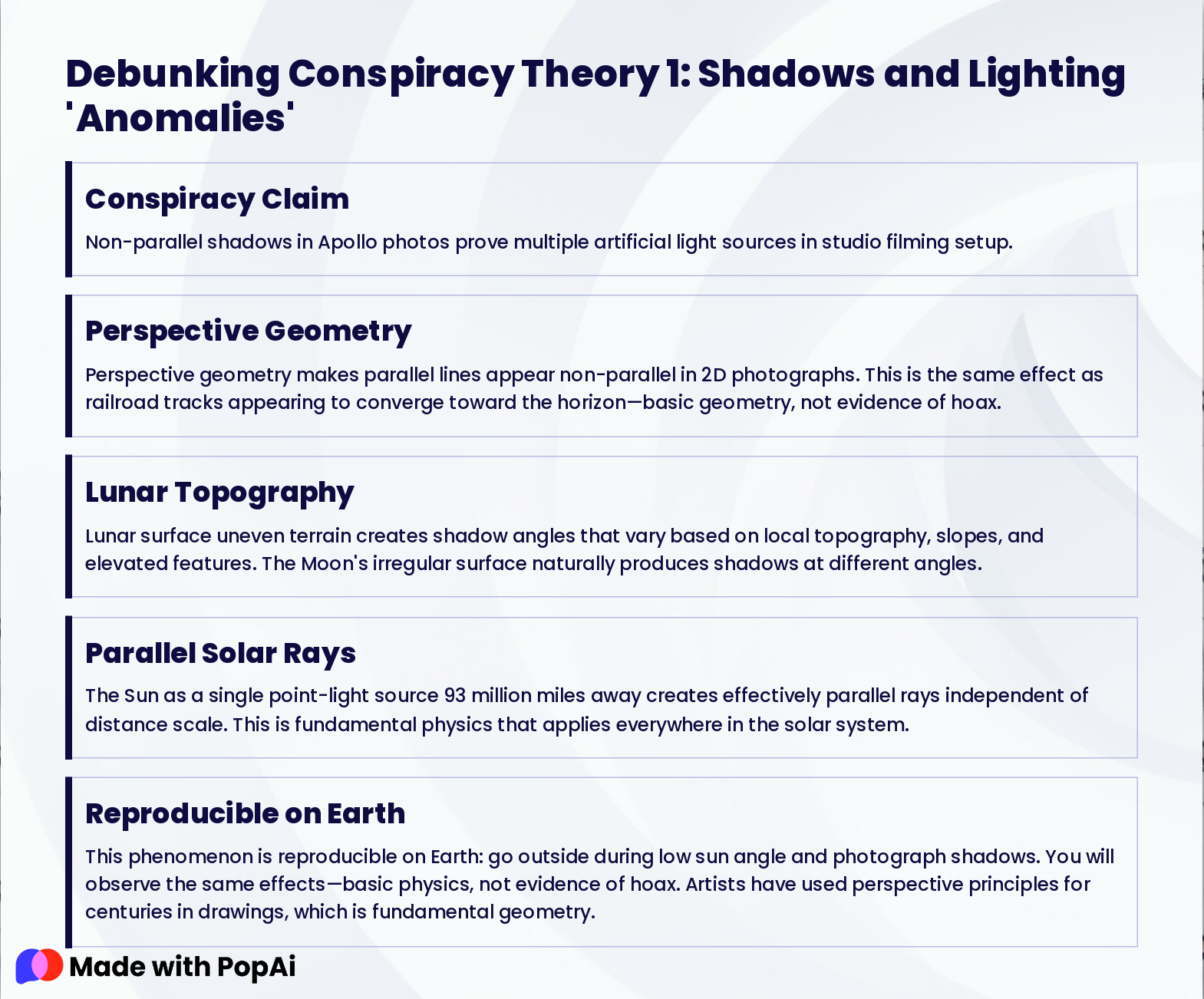
- Conspiracy Claim: Non-parallel shadows in Apollo photos prove multiple artificial light sources in studio filming setup.
- Perspective Geometry: Perspective geometry makes parallel lines appear non-parallel in 2D photographs. This is the same effect as railroad tracks appearing to converge toward the horizon—basic geometry, not evidence of hoax.
- Lunar Topography: Lunar surface uneven terrain creates shadow angles that vary based on local topography, slopes, and elevated features. The Moon's irregular surface naturally produces shadows at different angles.
- Parallel Solar Rays: The Sun as a single point-light source 93 million miles away creates effectively parallel rays independent of distance scale. This is fundamental physics that applies everywhere in the solar system.
- Reproducible on Earth: This phenomenon is reproducible on Earth: go outside during low sun angle and photograph shadows. You will observe the same effects—basic physics, not evidence of hoax. Artists have used perspective principles for centuries in drawings, which is fundamental geometry.
Slide 21: Debunking Conspiracy Theory 2: Van Allen Radiation Belt 'Impossibility'
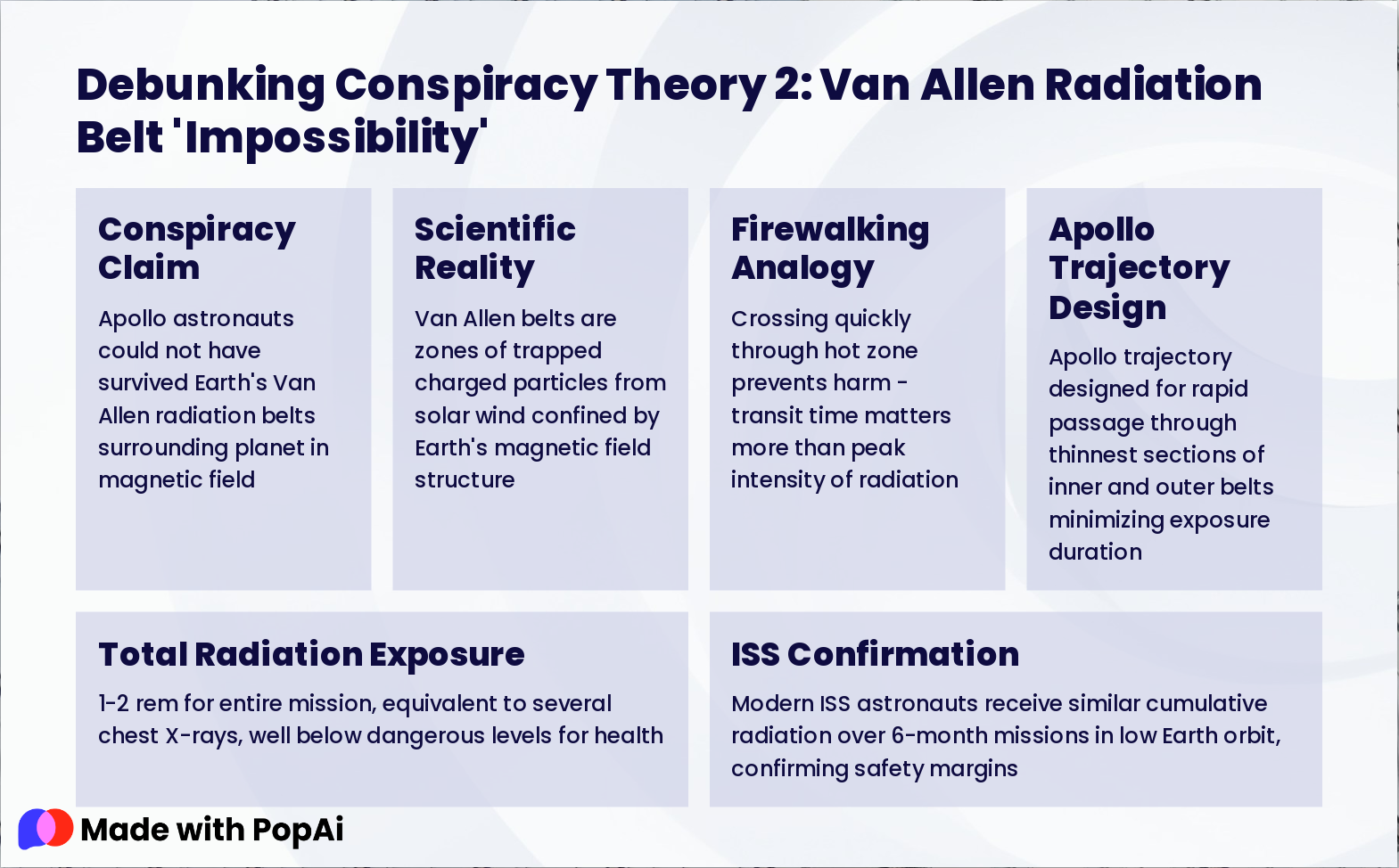
- Conspiracy Claim: Apollo astronauts could not have survived Earth's Van Allen radiation belts surrounding planet in magnetic field
- Scientific Reality: Van Allen belts are zones of trapped charged particles from solar wind confined by Earth's magnetic field structure
- Firewalking Analogy: Crossing quickly through hot zone prevents harm - transit time matters more than peak intensity of radiation
- Apollo Trajectory Design: Apollo trajectory designed for rapid passage through thinnest sections of inner and outer belts minimizing exposure duration
- Total Radiation Exposure: 1-2 rem for entire mission, equivalent to several chest X-rays, well below dangerous levels for health
- ISS Confirmation: Modern ISS astronauts receive similar cumulative radiation over 6-month missions in low Earth orbit, confirming safety margins
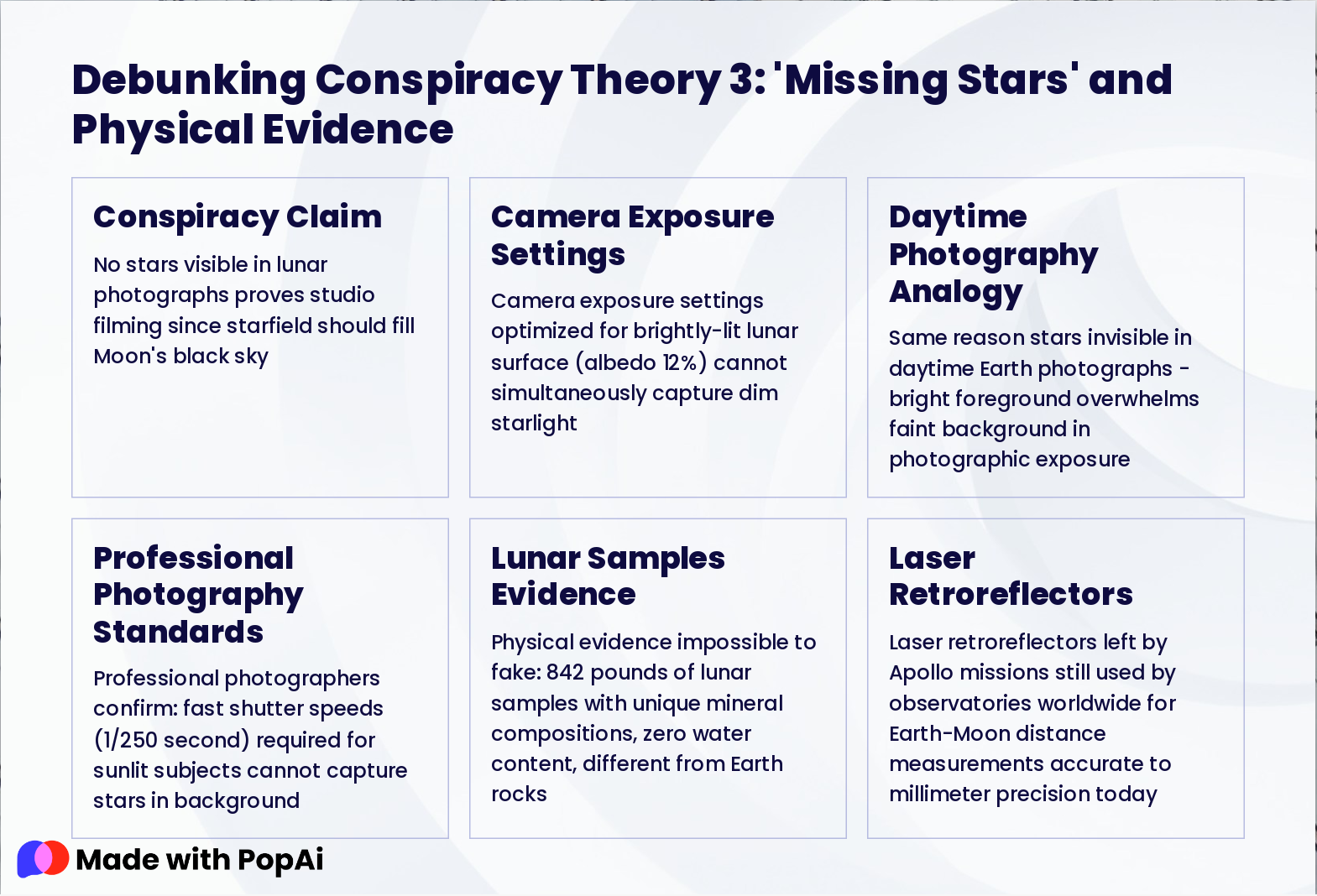
Slide 22: Debunking Conspiracy Theory 3: 'Missing Stars' and Physical Evidence
- Conspiracy Claim: No stars visible in lunar photographs proves studio filming since starfield should fill Moon's black sky
- Camera Exposure Settings: Camera exposure settings optimized for brightly-lit lunar surface (albedo 12%) cannot simultaneously capture dim starlight
- Daytime Photography Analogy: Same reason stars invisible in daytime Earth photographs - bright foreground overwhelms faint background in photographic exposure
- Professional Photography Standards: Professional photographers confirm: fast shutter speeds (1/250 second) required for sunlit subjects cannot capture stars in background
- Lunar Samples Evidence: Physical evidence impossible to fake: 842 pounds of lunar samples with unique mineral compositions, zero water content, different from Earth rocks
- Laser Retroreflectors: Laser retroreflectors left by Apollo missions still used by observatories worldwide for Earth-Moon distance measurements accurate to millimeter precision today
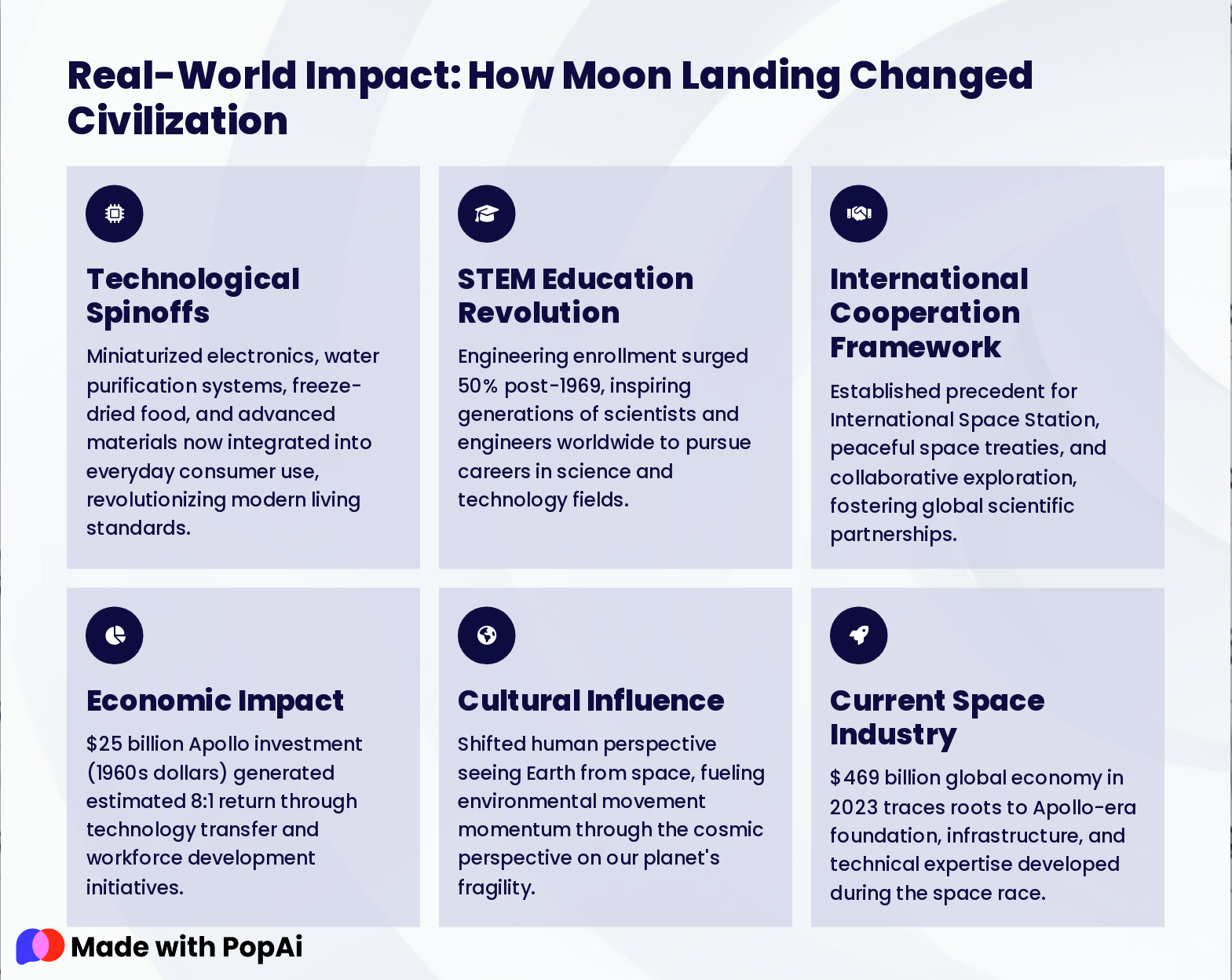
Slide 23: Real-World Impact: How Moon Landing Changed Civilization
- Technological Spinoffs: Miniaturized electronics, water purification systems, freeze-dried food, and advanced materials now integrated into everyday consumer use, revolutionizing modern living standards.
- STEM Education Revolution: Engineering enrollment surged 50% post-1969, inspiring generations of scientists and engineers worldwide to pursue careers in science and technology fields.
- International Cooperation Framework: Established precedent for International Space Station, peaceful space treaties, and collaborative exploration, fostering global scientific partnerships.
- Economic Impact: $25 billion Apollo investment (1960s dollars) generated estimated 8:1 return through technology transfer and workforce development initiatives.
- Cultural Influence: Shifted human perspective seeing Earth from space, fueling environmental movement momentum through the cosmic perspective on our planet's fragility.
- Current Space Industry: $469 billion global economy in 2023 traces roots to Apollo-era foundation, infrastructure, and technical expertise developed during the space race.
Slide 24: Conclusion: Moon Landing as Humanity's Defining Achievement
Apollo 11 (1969): Remains humanity's greatest technological and exploratory achievement demonstrating capability to overcome impossible barriers. Extensive Evidence: 842 pounds of samples, 1,400+ photographs, video documentation, laser retroreflectors, and independent international verification. Debunked Conspiracies: All conspiracy theories debunked by basic physics, photographic principles, and reproducible scientific experiments worldwide. Artemis Program (2026-2028): Represents the next chapter with sustainable lunar presence, international collaboration, and commercial partnerships. 52-Year Gap Ending: Planned 2028 Artemis IV landing to South Pole targeting water ice for sustained presence and resource extraction. Legacy Continues: Inspiring STEM education, advancing technology, and uniting humanity through shared exploration of the cosmos beyond Earth.