

Presentation Summary
Explore the 70-year legacy of James Bond, from Ian Fleming's 1953 creation to the future of the franchise. Discover the cultural impact and how each era's Bond reflects the geopolitical anxieties and evolving social values of the time.
Full Presentation Transcript
Slide 1: James Bond: The Legendary Spy Franchise That Defined Modern Cinema
A Comprehensive Analysis of 007's 70-Year Legacy, From Ian Fleming's 1953 Creation to 2025 Casting Speculation
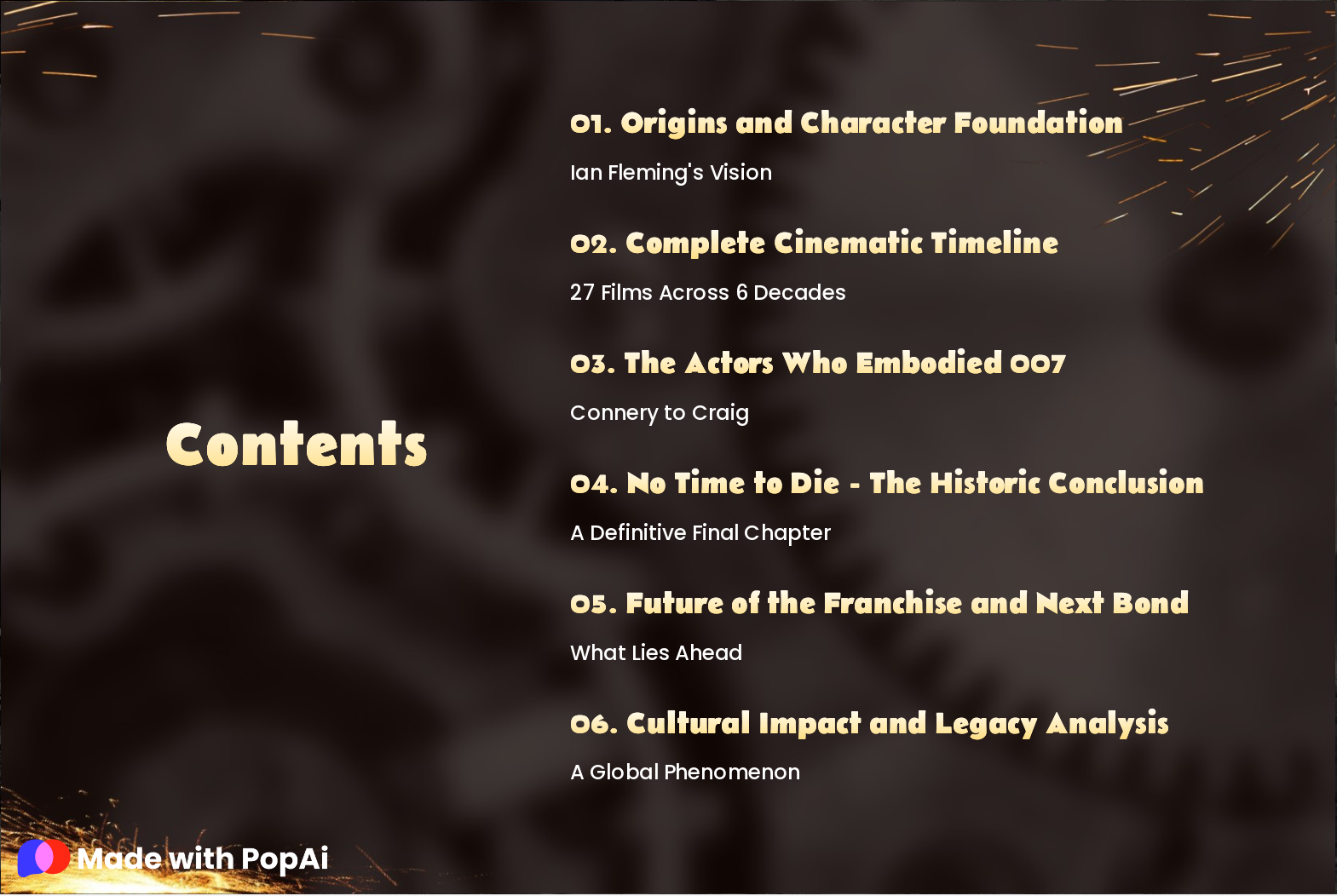
Slide 2: Contents
- Origins and Character Foundation: Ian Fleming's Vision
- Complete Cinematic Timeline: 27 Films Across 6 Decades
- The Actors Who Embodied 007: Connery to Craig
- No Time to Die - The Historic Conclusion: A Definitive Final Chapter
- Future of the Franchise and Next Bond: What Lies Ahead
- Cultural Impact and Legacy Analysis: A Global Phenomenon
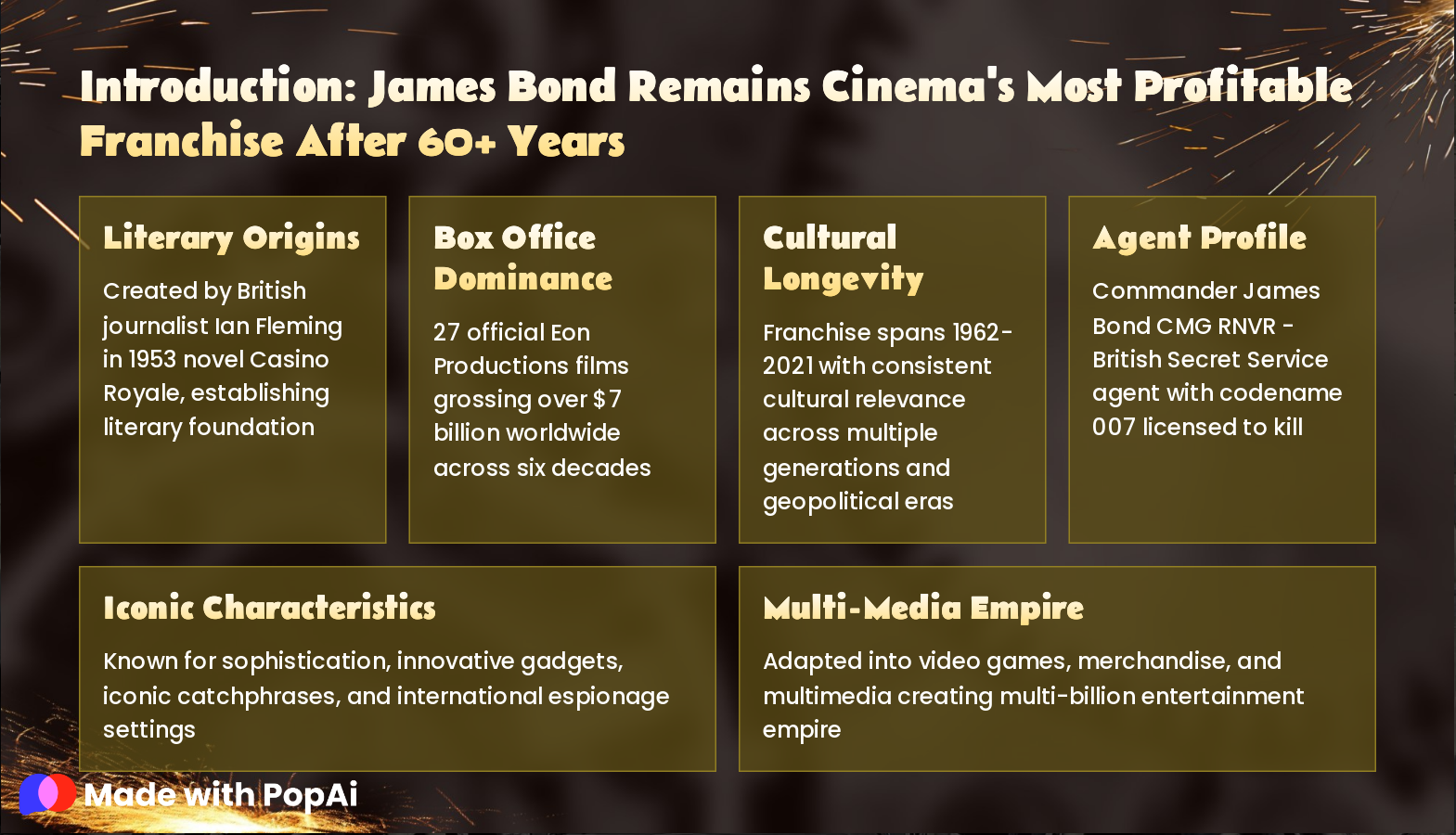
Slide 3: Introduction: James Bond Remains Cinema's Most Profitable Franchise After 60+ Years
- Literary Origins: Created by British journalist Ian Fleming in 1953 novel Casino Royale, establishing literary foundation
- Box Office Dominance: 27 official Eon Productions films grossing over $7 billion worldwide across six decades
- Cultural Longevity: Franchise spans 1962-2021 with consistent cultural relevance across multiple generations and geopolitical eras
- Agent Profile: Commander James Bond CMG RNVR - British Secret Service agent with codename 007 licensed to kill
- Iconic Characteristics: Known for sophistication, innovative gadgets, iconic catchphrases, and international espionage settings
- Multi-Media Empire: Adapted into video games, merchandise, and multimedia creating multi-billion entertainment empire
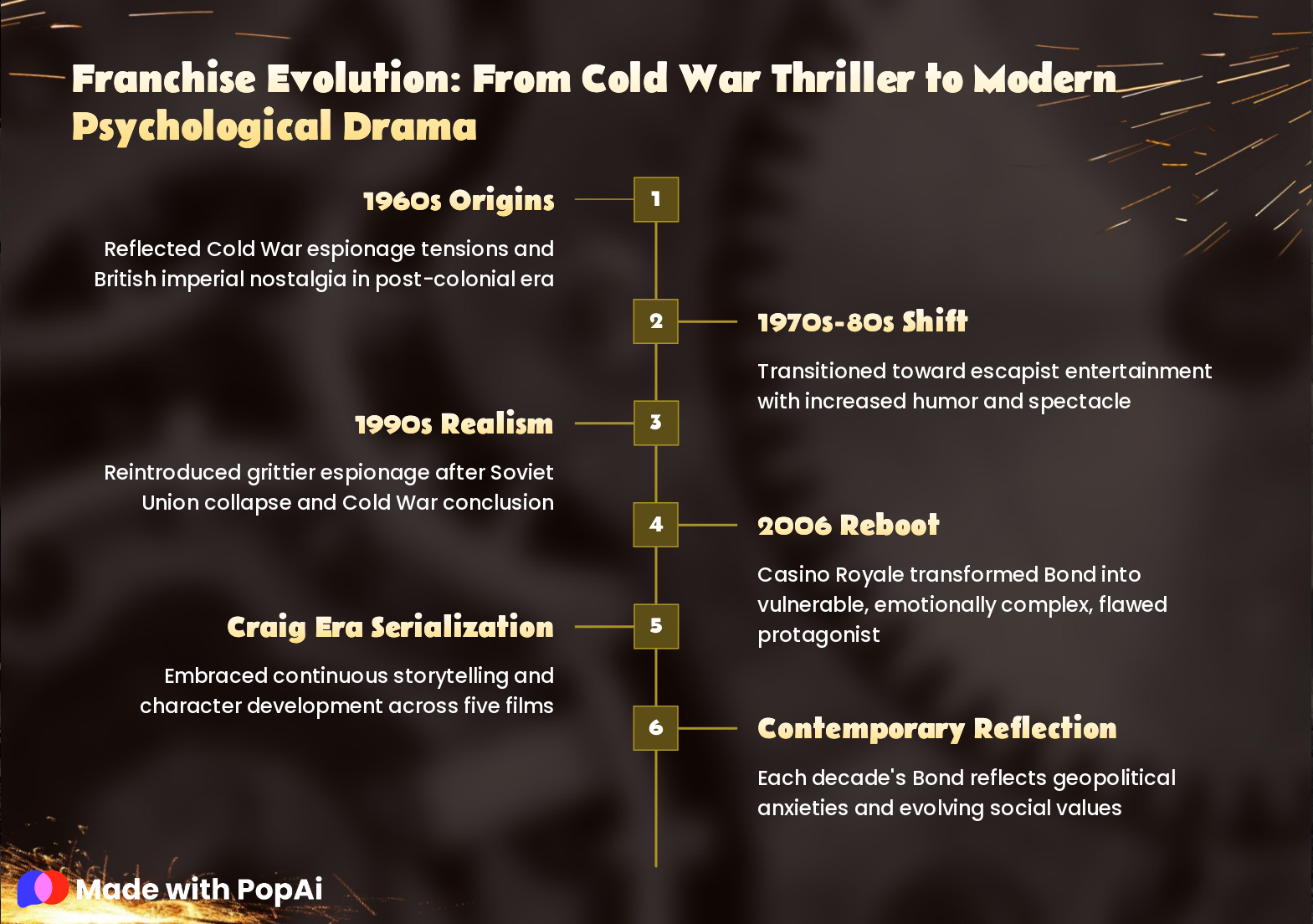
Slide 4: Franchise Evolution: From Cold War Thriller to Modern Psychological Drama
- 1960s Origins: Reflected Cold War espionage tensions and British imperial nostalgia in post-colonial era
- 1970s-80s Shift: Transitioned toward escapist entertainment with increased humor and spectacle
- 1990s Realism: Reintroduced grittier espionage after Soviet Union collapse and Cold War conclusion
- 2006 Reboot: Casino Royale transformed Bond into vulnerable, emotionally complex, flawed protagonist
- Craig Era Serialization: Embraced continuous storytelling and character development across five films
- Contemporary Reflection: Each decade's Bond reflects geopolitical anxieties and evolving social values
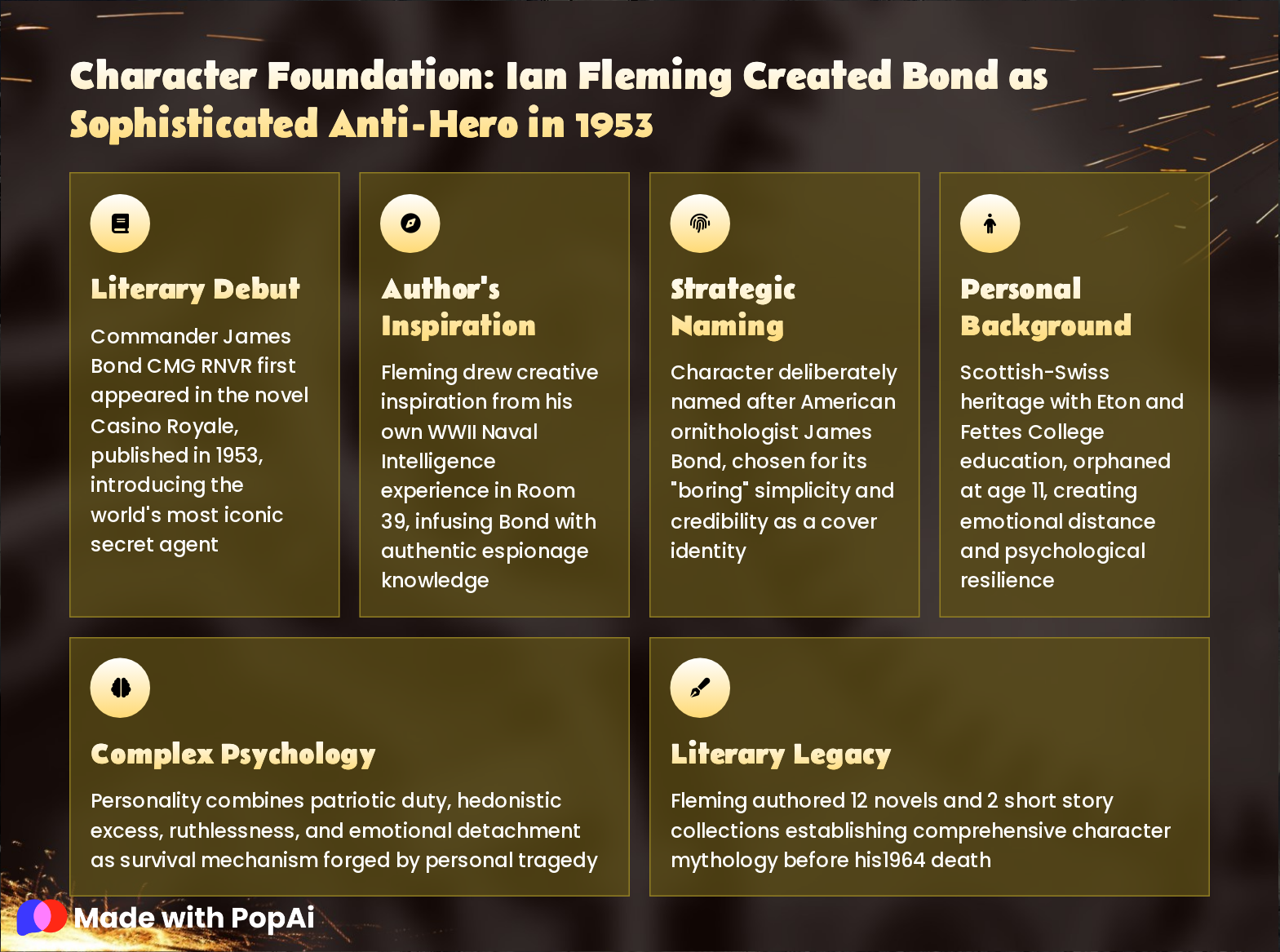
Slide 5: Character Foundation: Ian Fleming Created Bond as Sophisticated Anti-Hero in 1953
- Literary Debut: Commander James Bond CMG RNVR first appeared in the novel Casino Royale, published in 1953, introducing the world's most iconic secret agent
- Author's Inspiration: Fleming drew creative inspiration from his own WWII Naval Intelligence experience in Room 39, infusing Bond with authentic espionage knowledge
- Strategic Naming: Character deliberately named after American ornithologist James Bond, chosen for its "boring" simplicity and credibility as a cover identity
- Personal Background: Scottish-Swiss heritage with Eton and Fettes College education, orphaned at age 11, creating emotional distance and psychological resilience
- Complex Psychology: Personality combines patriotic duty, hedonistic excess, ruthlessness, and emotional detachment as survival mechanism forged by personal tragedy
- Literary Legacy: Fleming authored 12 novels and 2 short story collections establishing comprehensive character mythology before his1964 death
Slide 6: Literary Origins: Fleming's Novels Established Enduring Bond Mythology and Formula
- Casino Royale's Emotional Foundation: The1953 debut introduced the tragic Vesper Lynd romance, permanently shaping Bond's emotional armor and deepening his trust issues that would define the character across decades
- Recurring Character Archetypes: M as authoritative superior, Q as resourceful quartermaster, Moneypenny as witty secretary, and Felix Leiter as steadfast CIA ally—each serving crucial narrative roles
- Signature Narrative Elements: Exotic international locations, beautiful and complex women, diabolical villains with grandiose schemes, and innovative gadgets became Fleming's hallmark storytelling formula
- Post-War British Identity: Novels explored Britain's identity crisis and fading imperial power through the lens of a sophisticated spy protagonist navigating a rapidly changing geopolitical landscape
- Literary vs. Film Bond: Fleming's Bond was significantly more brutal, psychologically damaged, and introspective than his cinematic adaptations, revealing deeper internal complexity beneath the suave exterior
- Literary Influences: Fleming's writing drew inspiration from John Buchan's adventure novels, Eric Ambler's spy thrillers, and his own journalism background, creating a unique synthesis of genres
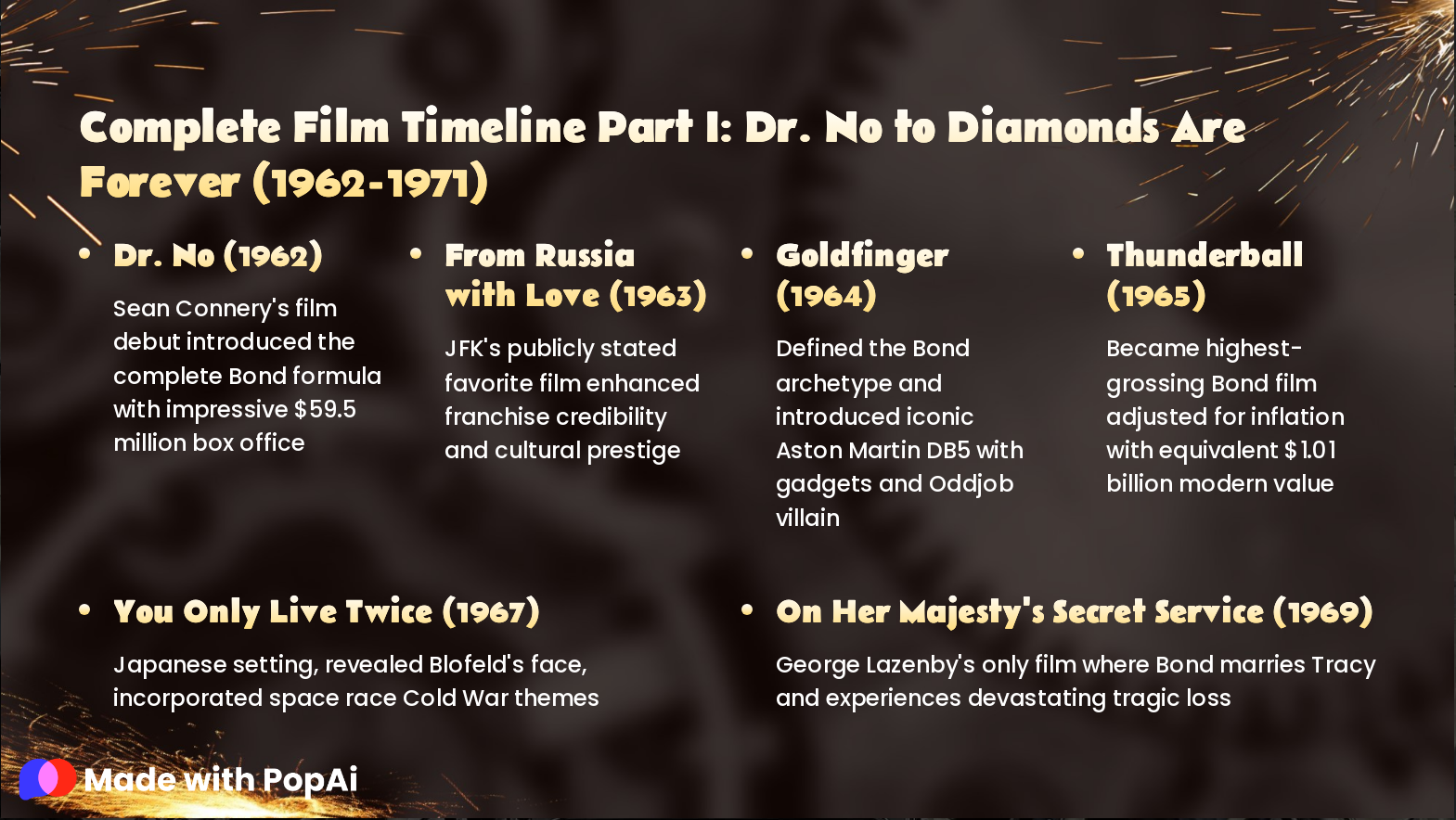
Slide 7: Complete Film Timeline Part I: Dr. No to Diamonds Are Forever (1962-1971)
- Dr. No (1962): Sean Connery's film debut introduced the complete Bond formula with impressive $59.5 million box office
- From Russia with Love (1963): JFK's publicly stated favorite film enhanced franchise credibility and cultural prestige
- Goldfinger (1964): Defined the Bond archetype and introduced iconic Aston Martin DB5 with gadgets and Oddjob villain
- Thunderball (1965): Became highest-grossing Bond film adjusted for inflation with equivalent $1.01 billion modern value
- You Only Live Twice (1967): Japanese setting, revealed Blofeld's face, incorporated space race Cold War themes
- On Her Majesty's Secret Service (1969): George Lazenby's only film where Bond marries Tracy and experiences devastating tragic loss
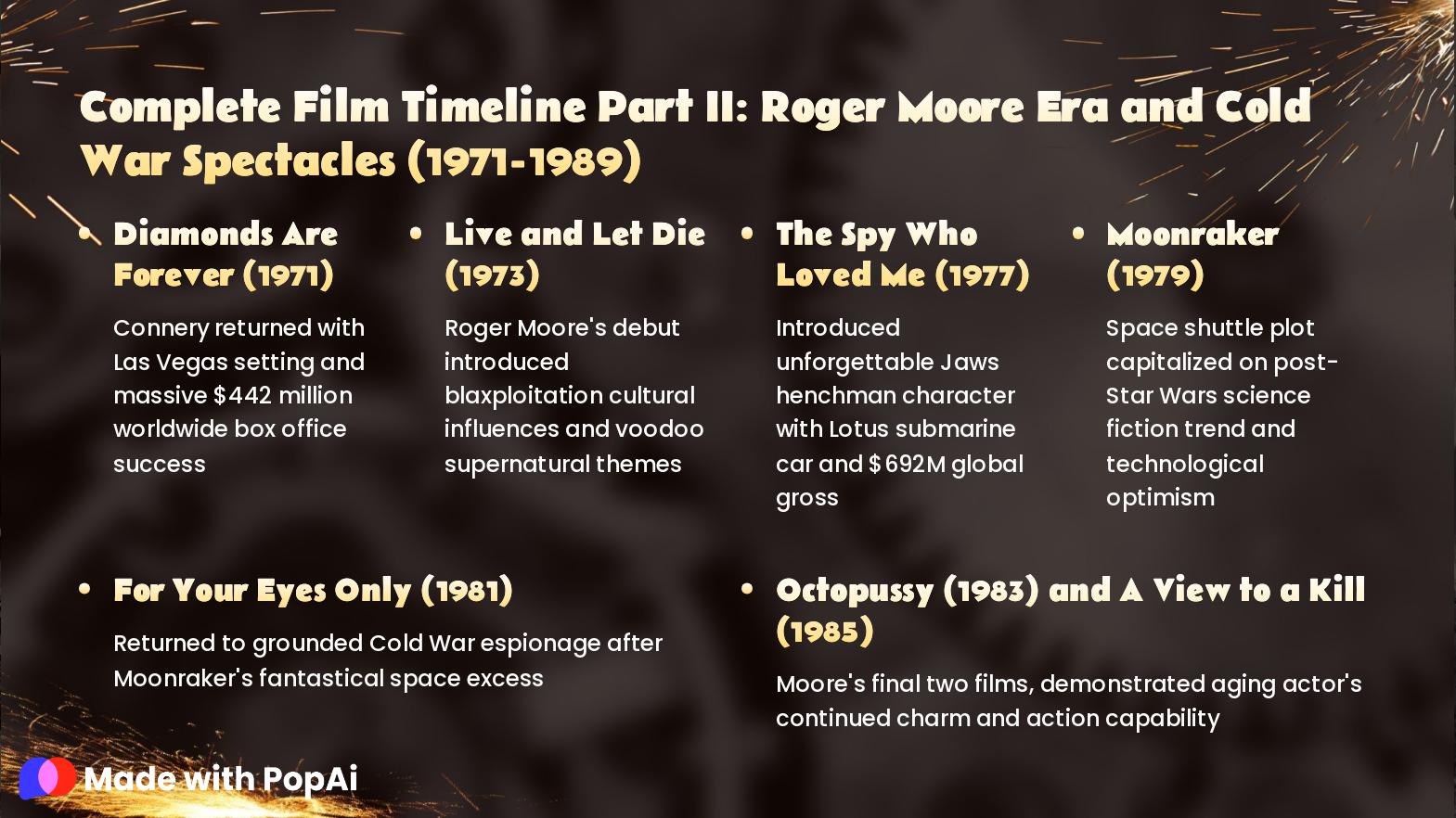
Slide 8: Complete Film Timeline Part II: Roger Moore Era and Cold War Spectacles (1971-1989)
- Diamonds Are Forever (1971): Connery returned with Las Vegas setting and massive $442 million worldwide box office success
- Live and Let Die (1973): Roger Moore's debut introduced blaxploitation cultural influences and voodoo supernatural themes
- The Spy Who Loved Me (1977): Introduced unforgettable Jaws henchman character with Lotus submarine car and $692M global gross
- Moonraker (1979): Space shuttle plot capitalized on post-Star Wars science fiction trend and technological optimism
- For Your Eyes Only (1981): Returned to grounded Cold War espionage after Moonraker's fantastical space excess
- Octopussy (1983) and A View to a Kill (1985): Moore's final two films, demonstrated aging actor's continued charm and action capability
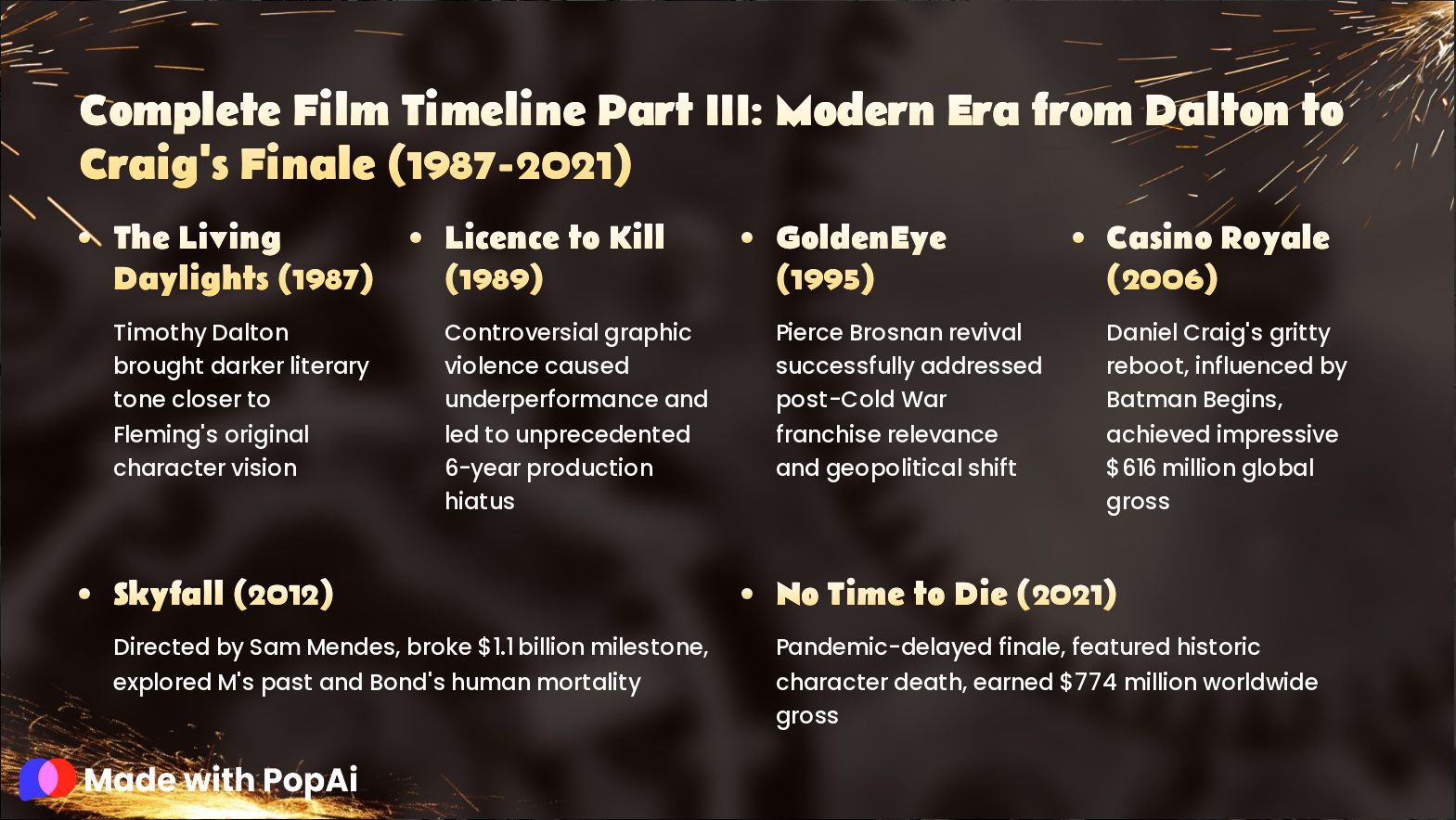
Slide 9: Complete Film Timeline Part III: Modern Era from Dalton to Craig's Finale (1987-2021)
- The Living Daylights (1987): Timothy Dalton brought darker literary tone closer to Fleming's original character vision
- Licence to Kill (1989): Controversial graphic violence caused underperformance and led to unprecedented 6-year production hiatus
- GoldenEye (1995): Pierce Brosnan revival successfully addressed post-Cold War franchise relevance and geopolitical shift
- Casino Royale (2006): Daniel Craig's gritty reboot, influenced by Batman Begins, achieved impressive $616 million global gross
- Skyfall (2012): Directed by Sam Mendes, broke $1.1 billion milestone, explored M's past and Bond's human mortality
- No Time to Die (2021): Pandemic-delayed finale, featured historic character death, earned $774 million worldwide gross
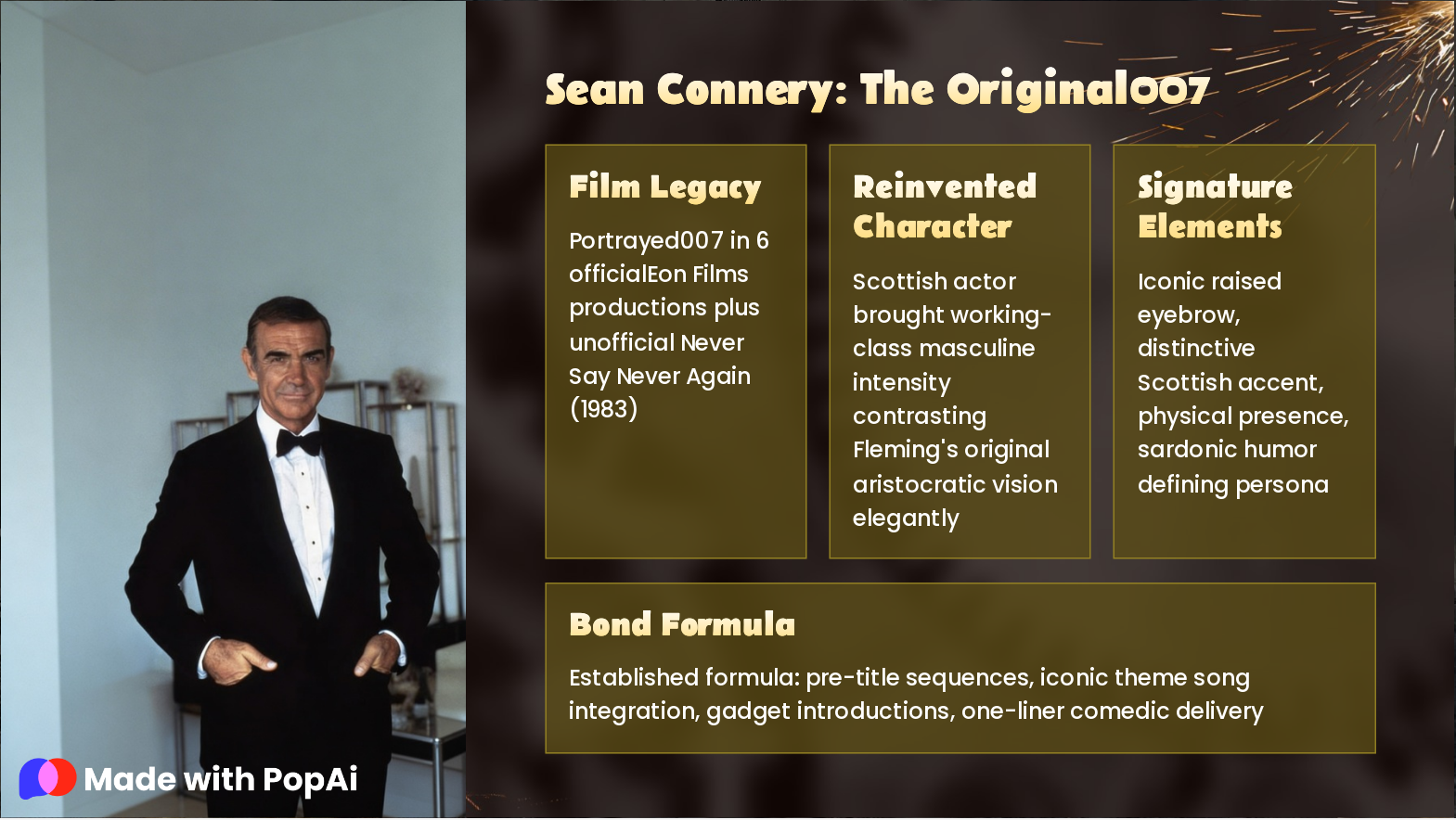
Slide 10: Sean Connery: The Original007
- Film Legacy: Portrayed007 in 6 officialEon Films productions plus unofficial Never Say Never Again (1983)
- Reinvented Character: Scottish actor brought working-class masculine intensity contrasting Fleming's original aristocratic vision elegantly
- Signature Elements: Iconic raised eyebrow, distinctive Scottish accent, physical presence, sardonic humor defining persona
- Bond Formula: Established formula: pre-title sequences, iconic theme song integration, gadget introductions, one-liner comedic delivery
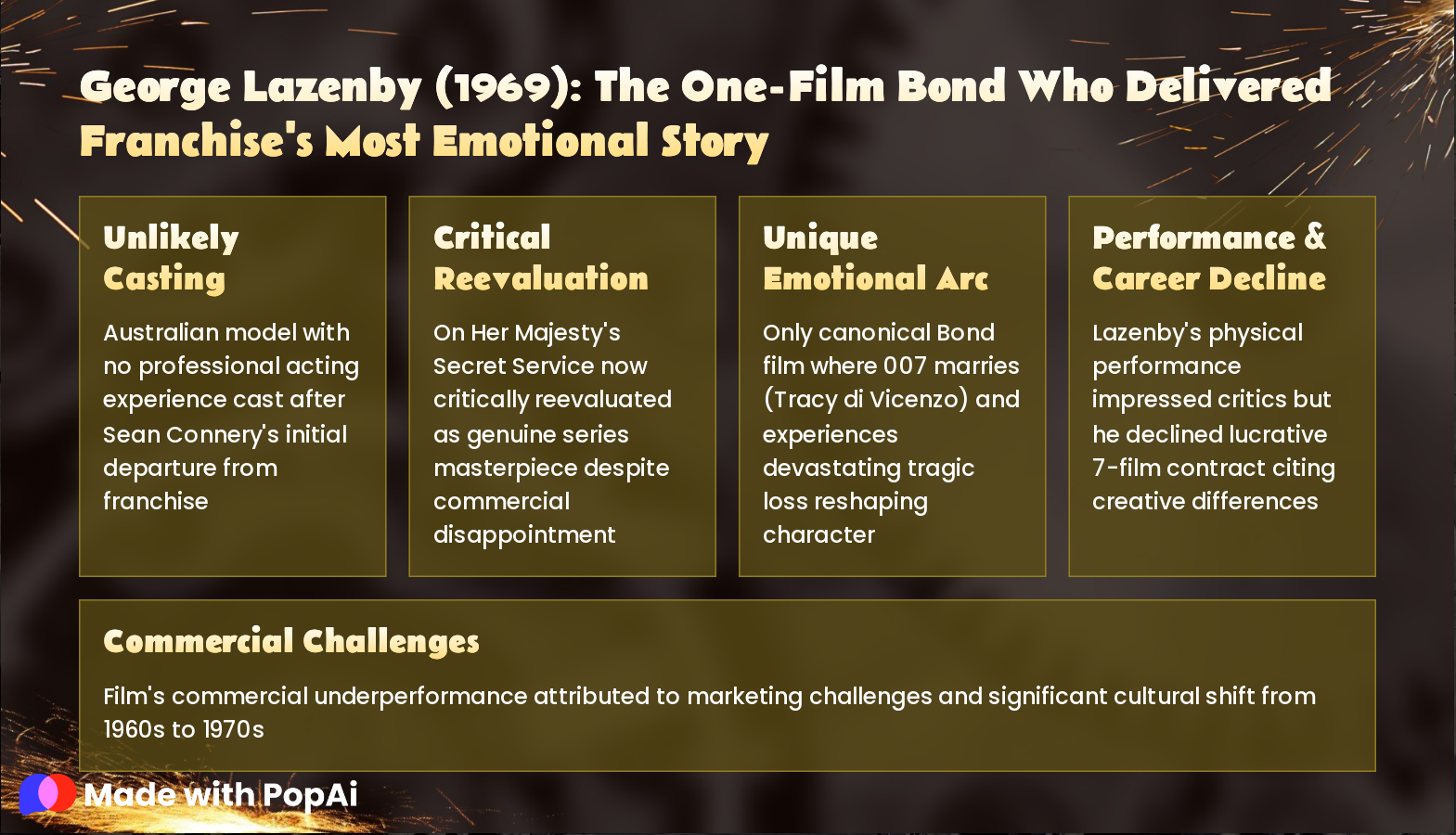
Slide 11: George Lazenby (1969): The One-Film Bond Who Delivered Franchise's Most Emotional Story
- Unlikely Casting: Australian model with no professional acting experience cast after Sean Connery's initial departure from franchise
- Critical Reevaluation: On Her Majesty's Secret Service now critically reevaluated as genuine series masterpiece despite commercial disappointment
- Unique Emotional Arc: Only canonical Bond film where 007 marries (Tracy di Vicenzo) and experiences devastating tragic loss reshaping character
- Performance & Career Decline: Lazenby's physical performance impressed critics but he declined lucrative 7-film contract citing creative differences
- Commercial Challenges: Film's commercial underperformance attributed to marketing challenges and significant cultural shift from 1960s to 1970s
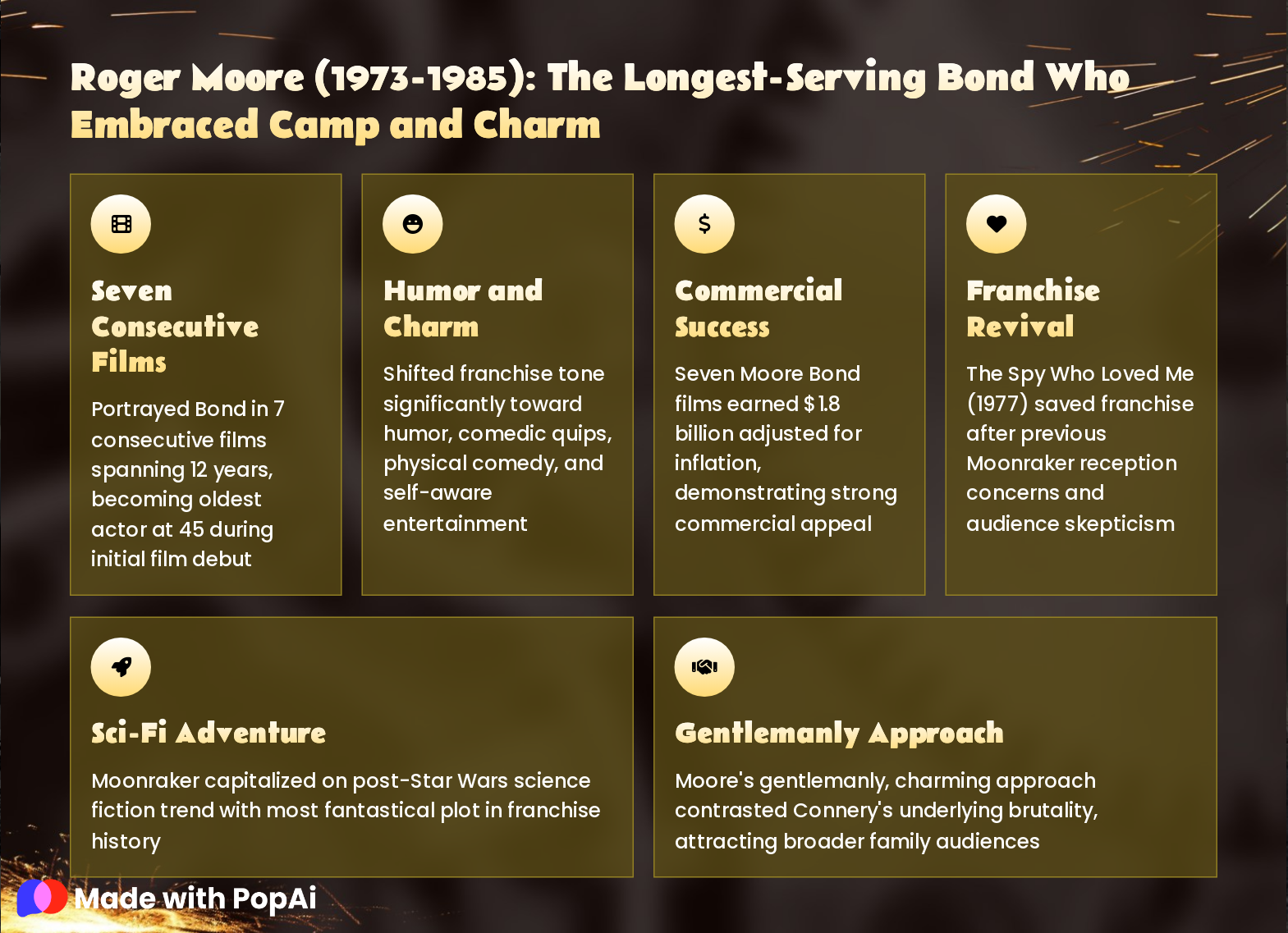
Slide 12: Roger Moore (1973-1985): The Longest-Serving Bond Who Embraced Camp and Charm
- Seven Consecutive Films: Portrayed Bond in 7 consecutive films spanning 12 years, becoming oldest actor at 45 during initial film debut
- Humor and Charm: Shifted franchise tone significantly toward humor, comedic quips, physical comedy, and self-aware entertainment
- Commercial Success: Seven Moore Bond films earned $1.8 billion adjusted for inflation, demonstrating strong commercial appeal
- Franchise Revival: The Spy Who Loved Me (1977) saved franchise after previous Moonraker reception concerns and audience skepticism
- Sci-Fi Adventure: Moonraker capitalized on post-Star Wars science fiction trend with most fantastical plot in franchise history
- Gentlemanly Approach: Moore's gentlemanly, charming approach contrasted Connery's underlying brutality, attracting broader family audiences
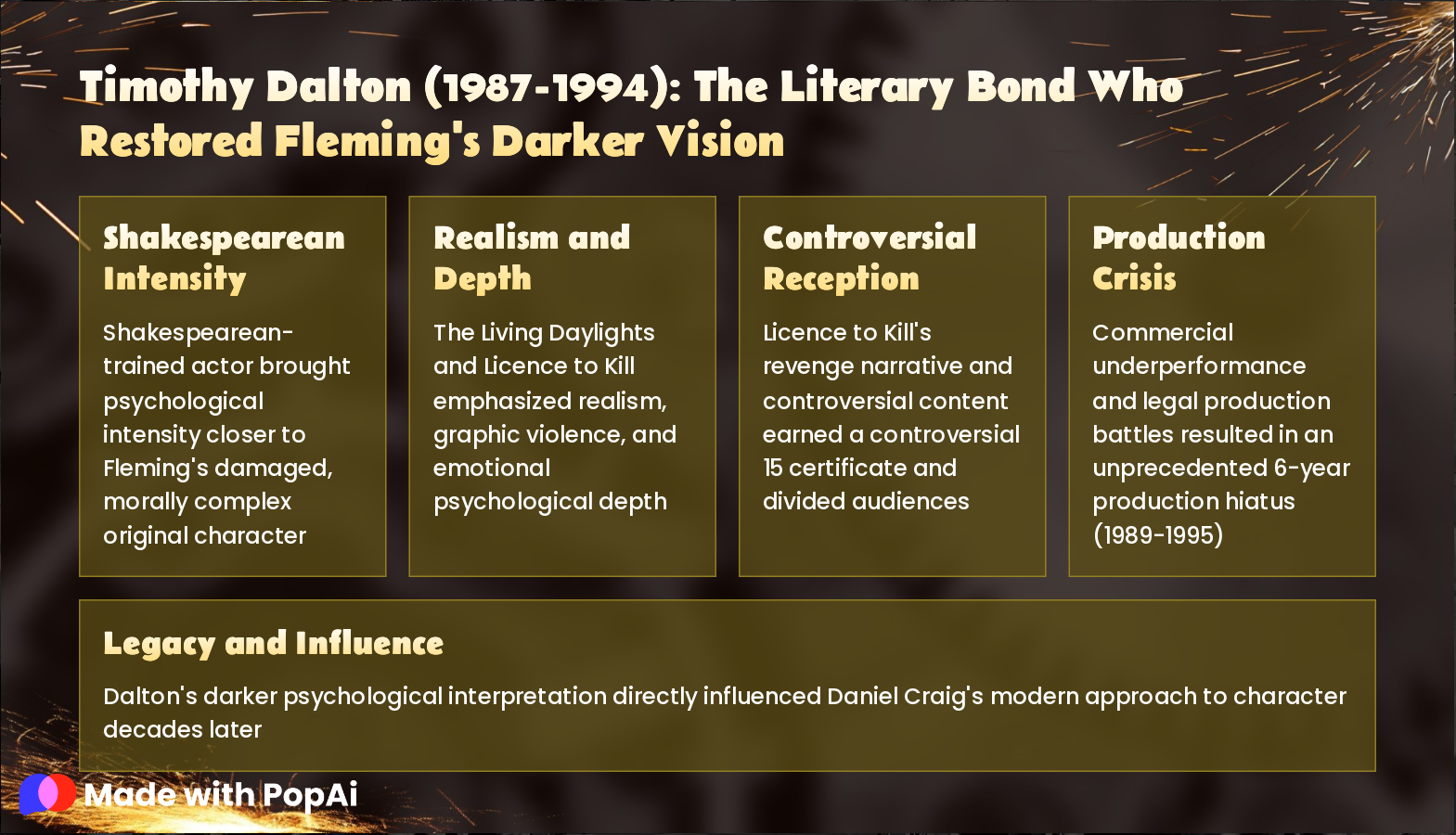
Slide 13: Timothy Dalton (1987-1994): The Literary Bond Who Restored Fleming's Darker Vision
- Shakespearean Intensity: Shakespearean-trained actor brought psychological intensity closer to Fleming's damaged, morally complex original character
- Realism and Depth: The Living Daylights and Licence to Kill emphasized realism, graphic violence, and emotional psychological depth
- Controversial Reception: Licence to Kill's revenge narrative and controversial content earned a controversial 15 certificate and divided audiences
- Production Crisis: Commercial underperformance and legal production battles resulted in an unprecedented 6-year production hiatus (1989-1995)
- Legacy and Influence: Dalton's darker psychological interpretation directly influenced Daniel Craig's modern approach to character decades later
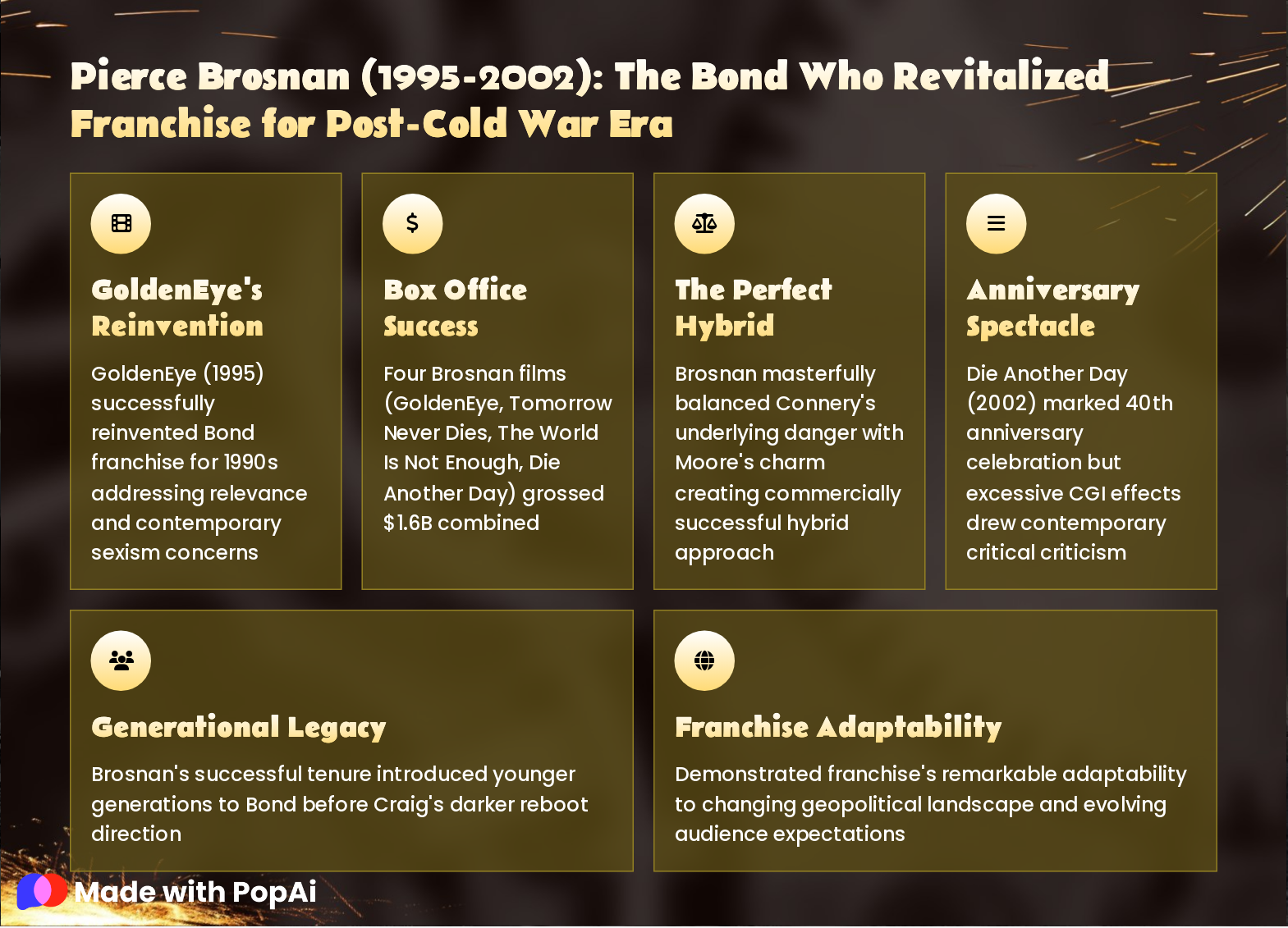
Slide 14: Pierce Brosnan (1995-2002): The Bond Who Revitalized Franchise for Post-Cold War Era
- GoldenEye's Reinvention: GoldenEye (1995) successfully reinvented Bond franchise for 1990s addressing relevance and contemporary sexism concerns
- Box Office Success: Four Brosnan films (GoldenEye, Tomorrow Never Dies, The World Is Not Enough, Die Another Day) grossed $1.6B combined
- The Perfect Hybrid: Brosnan masterfully balanced Connery's underlying danger with Moore's charm creating commercially successful hybrid approach
- Anniversary Spectacle: Die Another Day (2002) marked 40th anniversary celebration but excessive CGI effects drew contemporary critical criticism
- Generational Legacy: Brosnan's successful tenure introduced younger generations to Bond before Craig's darker reboot direction
- Franchise Adaptability: Demonstrated franchise's remarkable adaptability to changing geopolitical landscape and evolving audience expectations
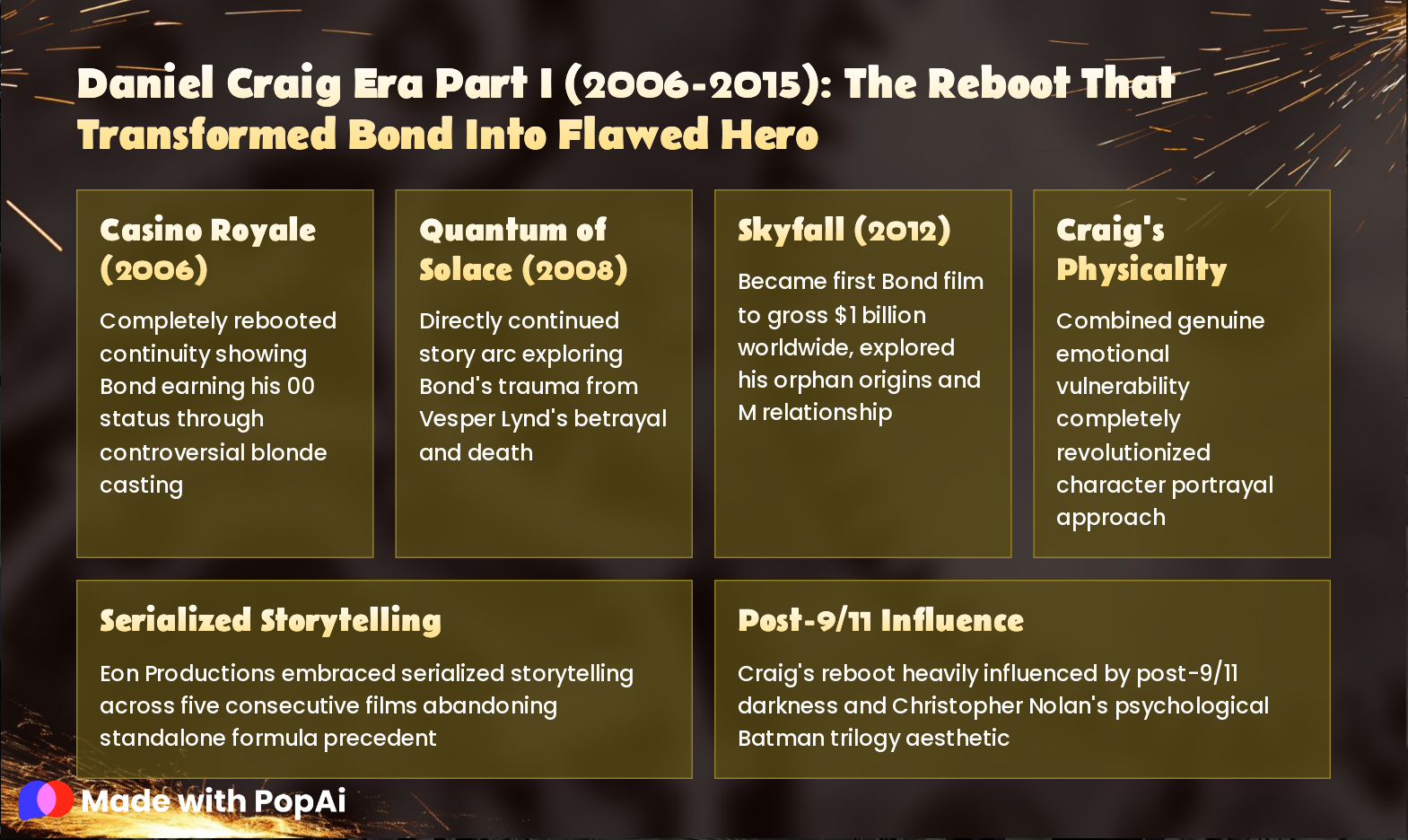
Slide 15: Daniel Craig Era Part I (2006-2015): The Reboot That Transformed Bond Into Flawed Hero
- Casino Royale (2006): Completely rebooted continuity showing Bond earning his 00 status through controversial blonde casting
- Quantum of Solace (2008): Directly continued story arc exploring Bond's trauma from Vesper Lynd's betrayal and death
- Skyfall (2012): Became first Bond film to gross $1 billion worldwide, explored his orphan origins and M relationship
- Craig's Physicality: Combined genuine emotional vulnerability completely revolutionized character portrayal approach
- Serialized Storytelling: Eon Productions embraced serialized storytelling across five consecutive films abandoning standalone formula precedent
- Post-9/11 Influence: Craig's reboot heavily influenced by post-9/11 darkness and Christopher Nolan's psychological Batman trilogy aesthetic
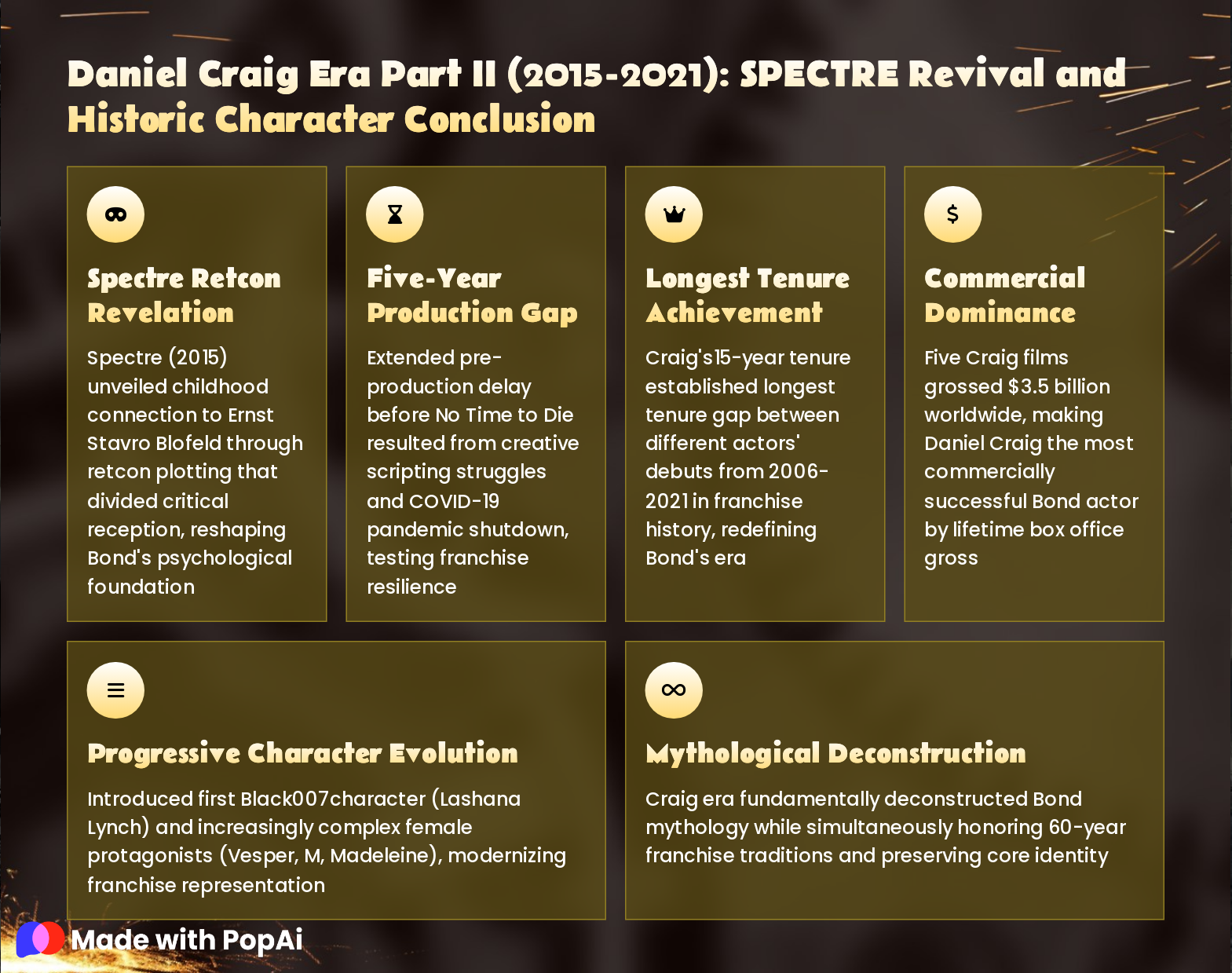
Slide 16: Daniel Craig Era Part II (2015-2021): SPECTRE Revival and Historic Character Conclusion
- Spectre Retcon Revelation: Spectre (2015) unveiled childhood connection to Ernst Stavro Blofeld through retcon plotting that divided critical reception, reshaping Bond's psychological foundation
- Five-Year Production Gap: Extended pre-production delay before No Time to Die resulted from creative scripting struggles and COVID-19 pandemic shutdown, testing franchise resilience
- Longest Tenure Achievement: Craig's15-year tenure established longest tenure gap between different actors' debuts from 2006-2021 in franchise history, redefining Bond's era
- Commercial Dominance: Five Craig films grossed $3.5 billion worldwide, making Daniel Craig the most commercially successful Bond actor by lifetime box office gross
- Progressive Character Evolution: Introduced first Black007character (Lashana Lynch) and increasingly complex female protagonists (Vesper, M, Madeleine), modernizing franchise representation
- Mythological Deconstruction: Craig era fundamentally deconstructed Bond mythology while simultaneously honoring 60-year franchise traditions and preserving core identity
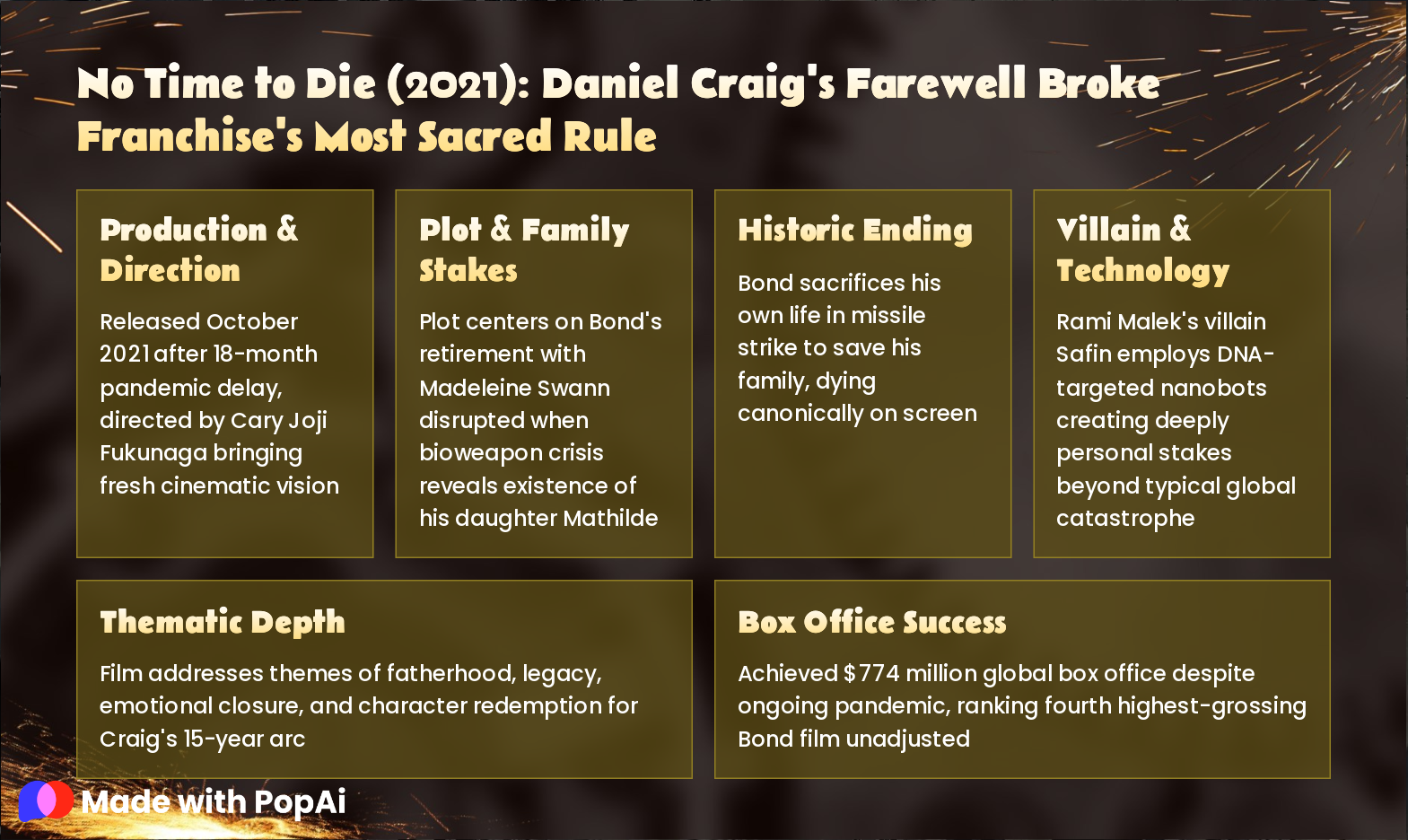
Slide 17: No Time to Die (2021): Daniel Craig's Farewell Broke Franchise's Most Sacred Rule
- Production & Direction: Released October 2021 after 18-month pandemic delay, directed by Cary Joji Fukunaga bringing fresh cinematic vision
- Plot & Family Stakes: Plot centers on Bond's retirement with Madeleine Swann disrupted when bioweapon crisis reveals existence of his daughter Mathilde
- Historic Ending: Bond sacrifices his own life in missile strike to save his family, dying canonically on screen
- Villain & Technology: Rami Malek's villain Safin employs DNA-targeted nanobots creating deeply personal stakes beyond typical global catastrophe
- Thematic Depth: Film addresses themes of fatherhood, legacy, emotional closure, and character redemption for Craig's 15-year arc
- Box Office Success: Achieved $774 million global box office despite ongoing pandemic, ranking fourth highest-grossing Bond film unadjusted
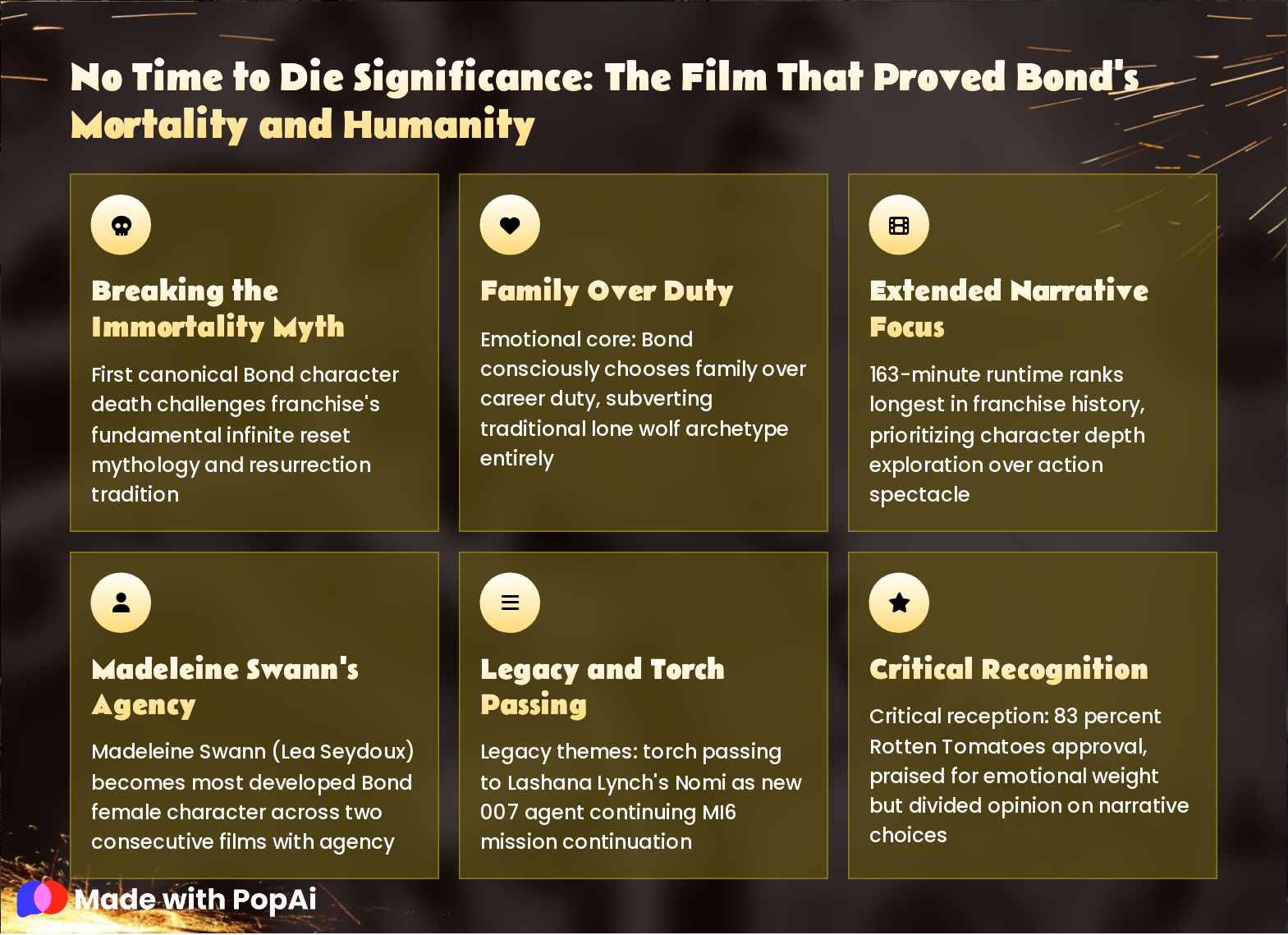
Slide 18: No Time to Die Significance: The Film That Proved Bond's Mortality and Humanity
- Breaking the Immortality Myth: First canonical Bond character death challenges franchise's fundamental infinite reset mythology and resurrection tradition
- Family Over Duty: Emotional core: Bond consciously chooses family over career duty, subverting traditional lone wolf archetype entirely
- Extended Narrative Focus: 163-minute runtime ranks longest in franchise history, prioritizing character depth exploration over action spectacle
- Madeleine Swann's Agency: Madeleine Swann (Lea Seydoux) becomes most developed Bond female character across two consecutive films with agency
- Legacy and Torch Passing: Legacy themes: torch passing to Lashana Lynch's Nomi as new 007 agent continuing MI6 mission continuation
- Critical Recognition: Critical reception: 83 percent Rotten Tomatoes approval, praised for emotional weight but divided opinion on narrative choices
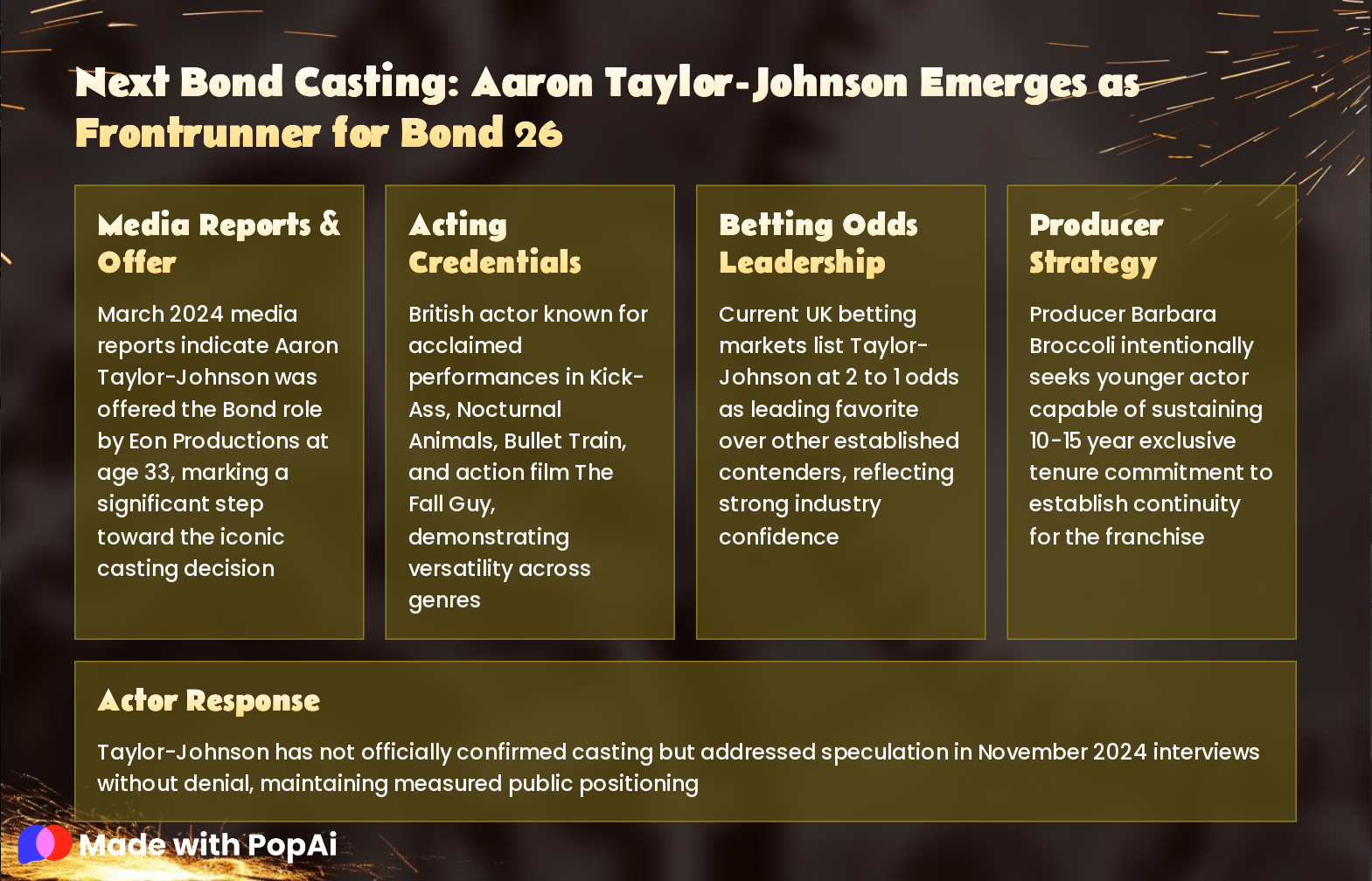
Slide 19: Next Bond Casting: Aaron Taylor-Johnson Emerges as Frontrunner for Bond 26
- Media Reports & Offer: March 2024 media reports indicate Aaron Taylor-Johnson was offered the Bond role by Eon Productions at age 33, marking a significant step toward the iconic casting decision
- Acting Credentials: British actor known for acclaimed performances in Kick-Ass, Nocturnal Animals, Bullet Train, and action film The Fall Guy, demonstrating versatility across genres
- Betting Odds Leadership: Current UK betting markets list Taylor-Johnson at 2 to 1 odds as leading favorite over other established contenders, reflecting strong industry confidence
- Producer Strategy: Producer Barbara Broccoli intentionally seeks younger actor capable of sustaining 10-15 year exclusive tenure commitment to establish continuity for the franchise
- Actor Response: Taylor-Johnson has not officially confirmed casting but addressed speculation in November 2024 interviews without denial, maintaining measured public positioning
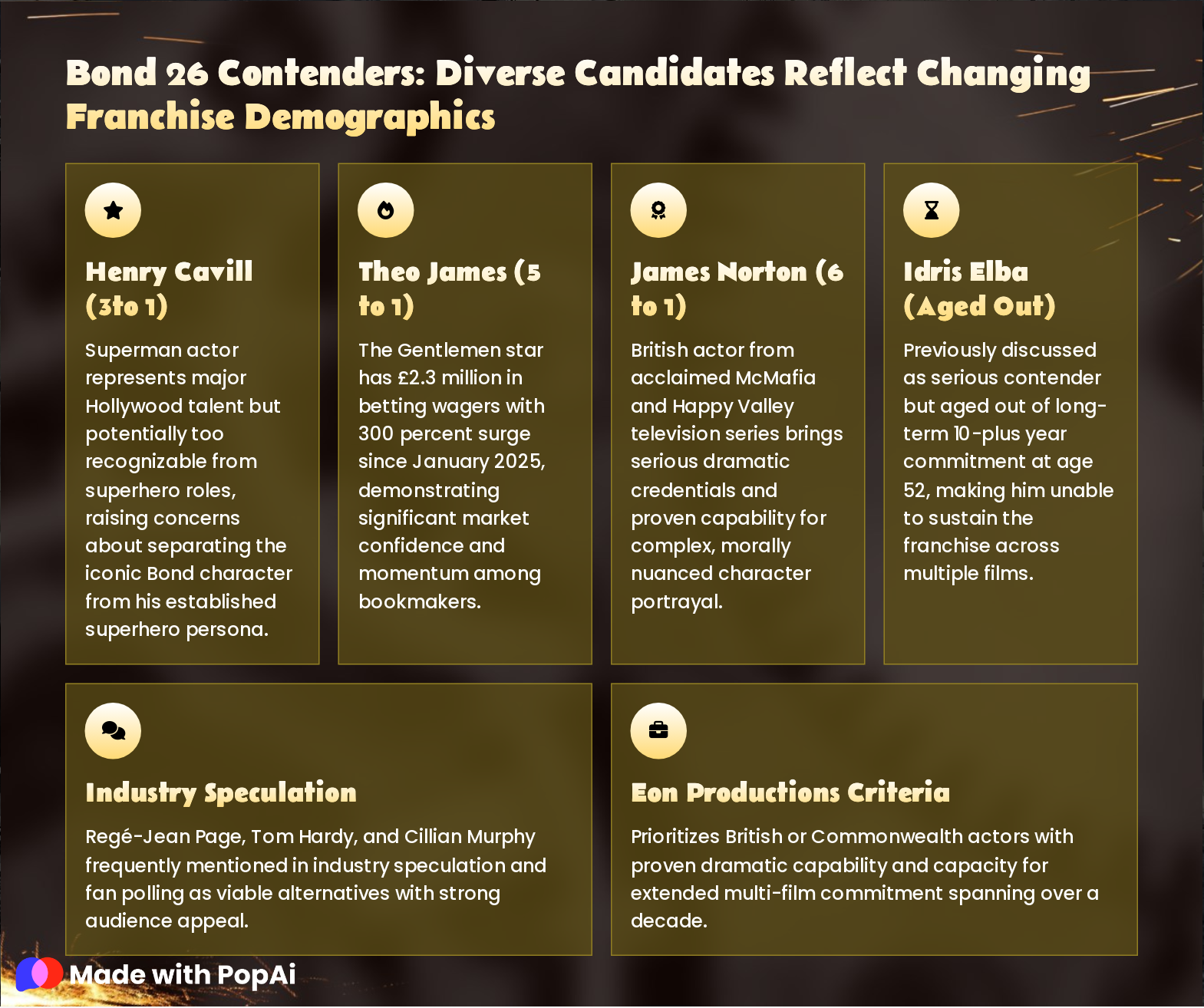
Slide 20: Bond 26 Contenders: Diverse Candidates Reflect Changing Franchise Demographics
- Henry Cavill (3to 1): Superman actor represents major Hollywood talent but potentially too recognizable from superhero roles, raising concerns about separating the iconic Bond character from his established superhero persona.
- Theo James (5 to 1): The Gentlemen star has £2.3 million in betting wagers with 300 percent surge since January 2025, demonstrating significant market confidence and momentum among bookmakers.
- James Norton (6 to 1): British actor from acclaimed McMafia and Happy Valley television series brings serious dramatic credentials and proven capability for complex, morally nuanced character portrayal.
- Idris Elba (Aged Out): Previously discussed as serious contender but aged out of long-term 10-plus year commitment at age 52, making him unable to sustain the franchise across multiple films.
- Industry Speculation: Regé-Jean Page, Tom Hardy, and Cillian Murphy frequently mentioned in industry speculation and fan polling as viable alternatives with strong audience appeal.
- Eon Productions Criteria: Prioritizes British or Commonwealth actors with proven dramatic capability and capacity for extended multi-film commitment spanning over a decade.
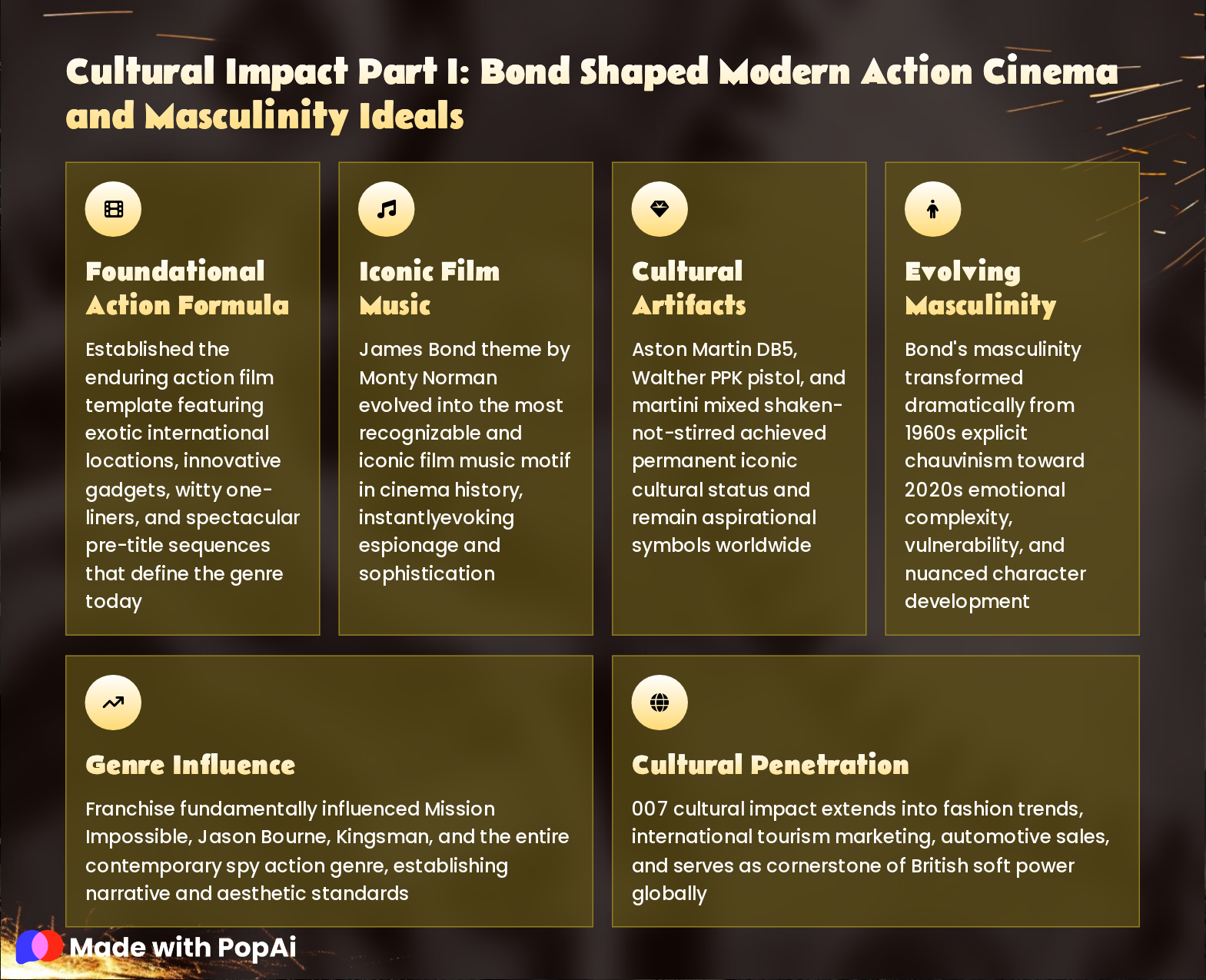
Slide 21: Cultural Impact Part I: Bond Shaped Modern Action Cinema and Masculinity Ideals
- Foundational Action Formula: Established the enduring action film template featuring exotic international locations, innovative gadgets, witty one-liners, and spectacular pre-title sequences that define the genre today
- Iconic Film Music: James Bond theme by Monty Norman evolved into the most recognizable and iconic film music motif in cinema history, instantlyevoking espionage and sophistication
- Cultural Artifacts: Aston Martin DB5, Walther PPK pistol, and martini mixed shaken-not-stirred achieved permanent iconic cultural status and remain aspirational symbols worldwide
- Evolving Masculinity: Bond's masculinity transformed dramatically from 1960s explicit chauvinism toward 2020s emotional complexity, vulnerability, and nuanced character development
- Genre Influence: Franchise fundamentally influenced Mission Impossible, Jason Bourne, Kingsman, and the entire contemporary spy action genre, establishing narrative and aesthetic standards
- Cultural Penetration: 007 cultural impact extends into fashion trends, international tourism marketing, automotive sales, and serves as cornerstone of British soft power globally
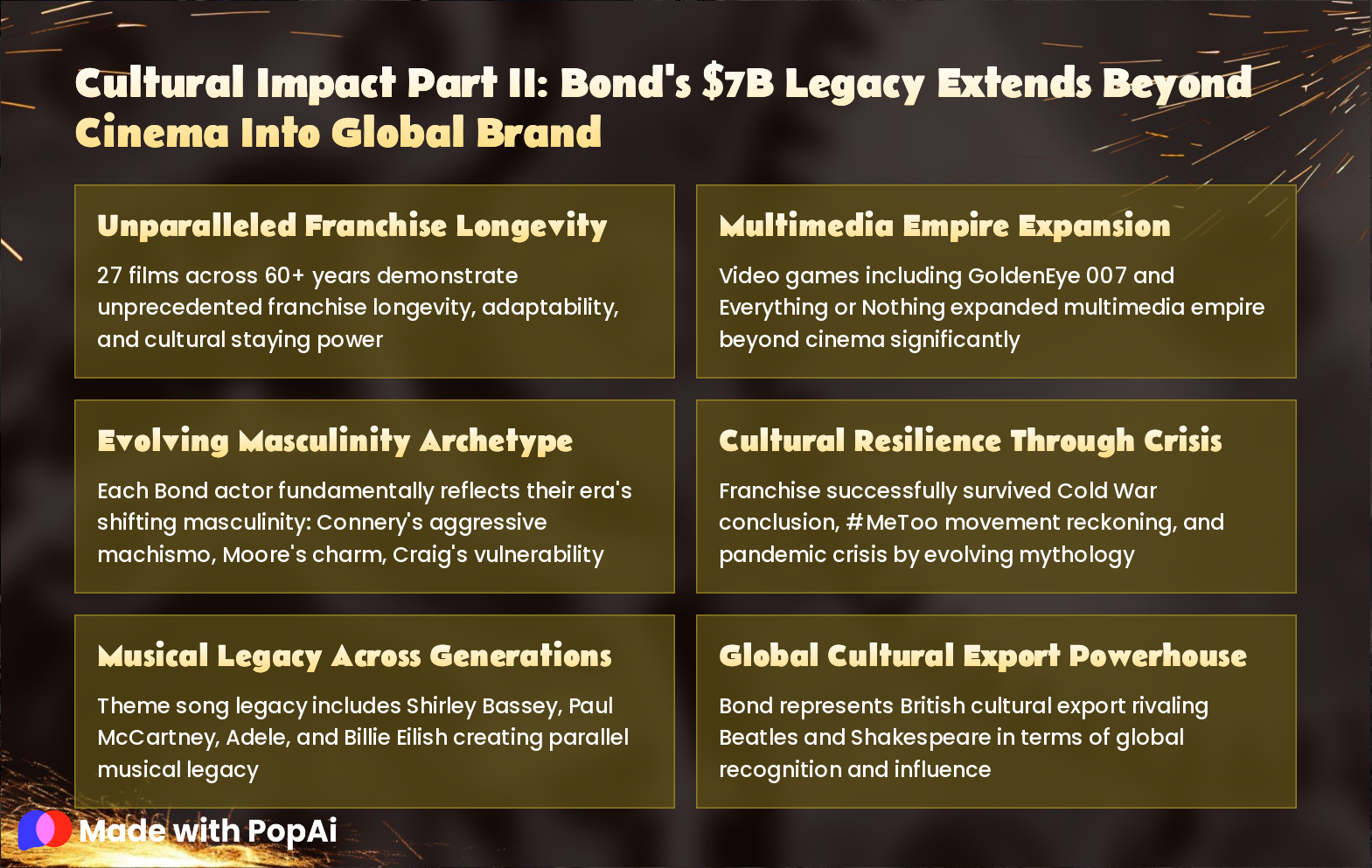
Slide 22: Cultural Impact Part II: Bond's $7B Legacy Extends Beyond Cinema Into Global Brand
- Unparalleled Franchise Longevity: 27 films across 60+ years demonstrate unprecedented franchise longevity, adaptability, and cultural staying power
- Multimedia Empire Expansion: Video games including GoldenEye 007 and Everything or Nothing expanded multimedia empire beyond cinema significantly
- Evolving Masculinity Archetype: Each Bond actor fundamentally reflects their era's shifting masculinity: Connery's aggressive machismo, Moore's charm, Craig's vulnerability
- Cultural Resilience Through Crisis: Franchise successfully survived Cold War conclusion, #MeToo movement reckoning, and pandemic crisis by evolving mythology
- Musical Legacy Across Generations: Theme song legacy includes Shirley Bassey, Paul McCartney, Adele, and Billie Eilish creating parallel musical legacy
- Global Cultural Export Powerhouse: Bond represents British cultural export rivaling Beatles and Shakespeare in terms of global recognition and influence
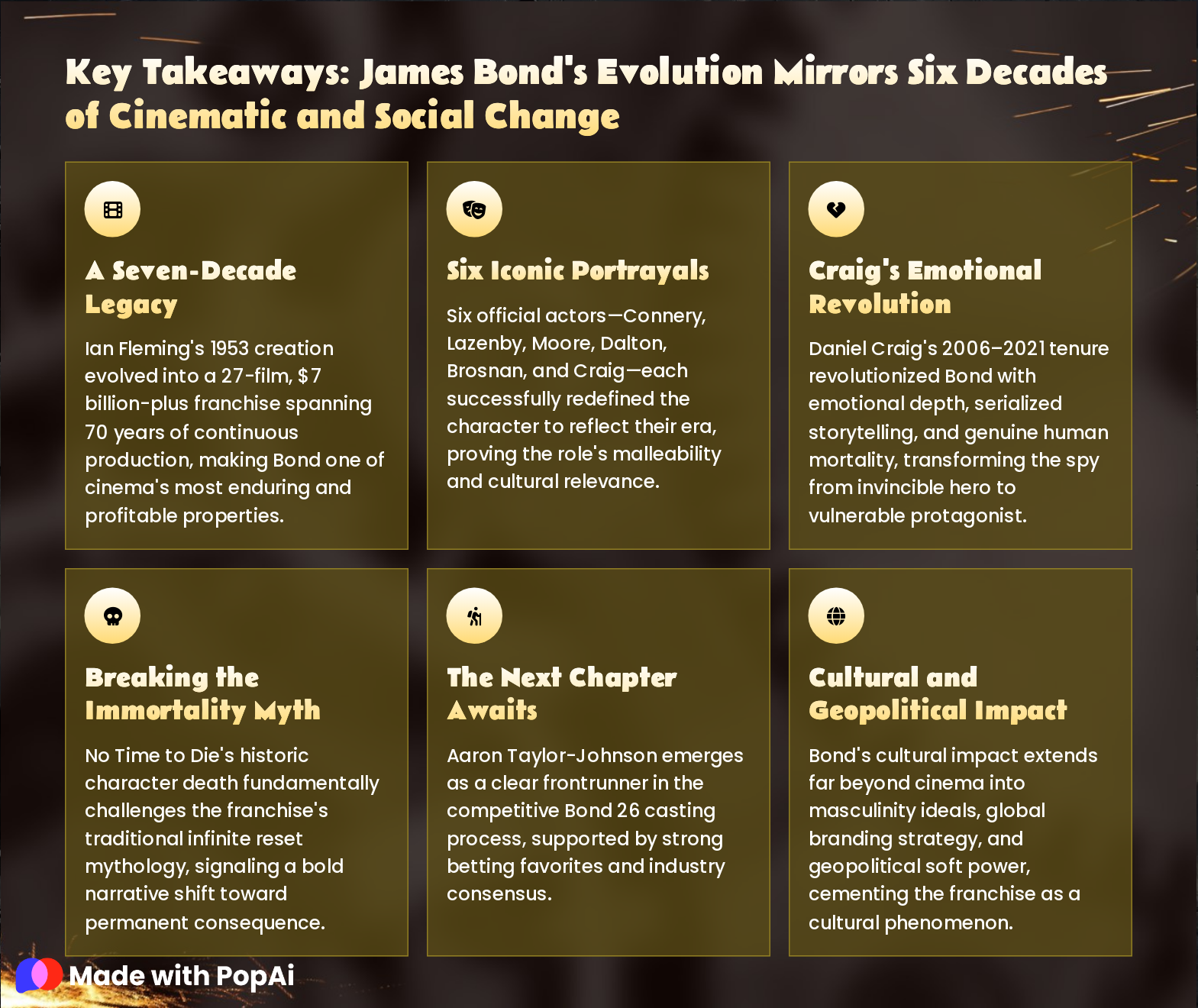
Slide 23: Key Takeaways: James Bond's Evolution Mirrors Six Decades of Cinematic and Social Change
- A Seven-Decade Legacy: Ian Fleming's 1953 creation evolved into a 27-film, $7 billion-plus franchise spanning 70 years of continuous production, making Bond one of cinema's most enduring and profitable properties.
- Six Iconic Portrayals: Six official actors—Connery, Lazenby, Moore, Dalton, Brosnan, and Craig—each successfully redefined the character to reflect their era, proving the role's malleability and cultural relevance.
- Craig's Emotional Revolution: Daniel Craig's 2006–2021 tenure revolutionized Bond with emotional depth, serialized storytelling, and genuine human mortality, transforming the spy from invincible hero to vulnerable protagonist.
- Breaking the Immortality Myth: No Time to Die's historic character death fundamentally challenges the franchise's traditional infinite reset mythology, signaling a bold narrative shift toward permanent consequence.
- The Next Chapter Awaits: Aaron Taylor-Johnson emerges as a clear frontrunner in the competitive Bond 26 casting process, supported by strong betting favorites and industry consensus.
- Cultural and Geopolitical Impact: Bond's cultural impact extends far beyond cinema into masculinity ideals, global branding strategy, and geopolitical soft power, cementing the franchise as a cultural phenomenon.
Slide 24: Conclusion: The James Bond Franchise Endures by Honoring Tradition While Embracing Reinvention
Conclusion: The James Bond Franchise Endures by Honoring Tradition While Embracing Reinvention 70-year success demonstrates adaptability to changing eras: from Cold War spy to post-9/11 psychological thriller. Each actor transition brings creative renewal while maintaining core mythology. No Time to...