Presentation Summary
This presentation delves into CBS's show cancellations from 2024 to 2026, analyzing the network's strategic shifts amidst industry transformation and the rise of streaming platforms. It covers the reasons behind cancellations, the impact on viewership, and CBS's focus on franchise shows.
Full Presentation Transcript
Slide 1: CBS Show Cancellations 2024–2026: Navigating Industry Transformation and Network Strategy Shifts
Comprehensive analysis of CBS television cancellations across three years; Understanding network strategy, industry trends, and the impact of streaming economics on traditional broadcast television
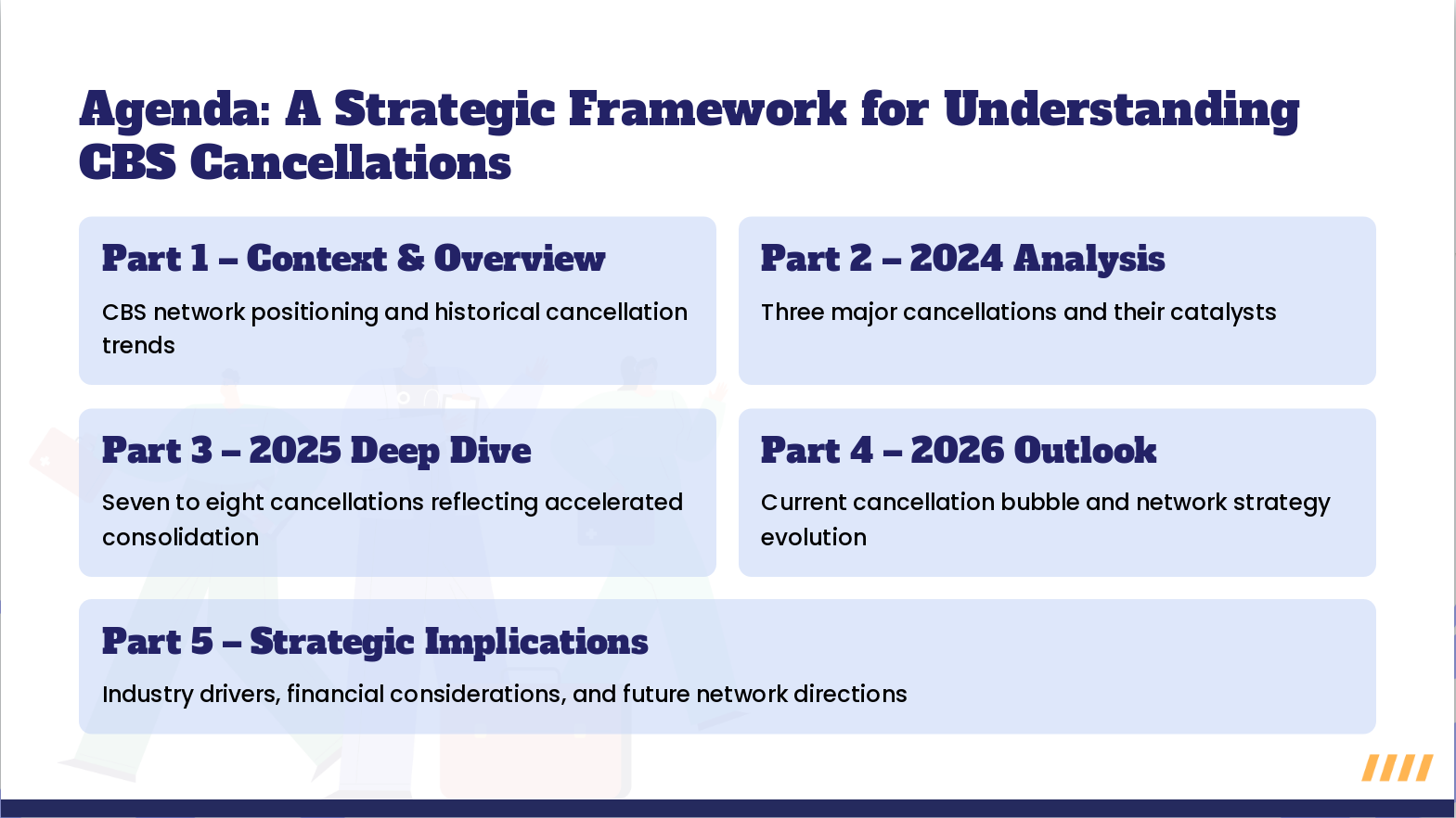
Slide 2: Agenda: A Strategic Framework for Understanding CBS Cancellations
- Part 1 – Context & Overview: CBS network positioning and historical cancellation trends
- Part 2 – 2024 Analysis: Three major cancellations and their catalysts
- Part 3 – 2025 Deep Dive: Seven to eight cancellations reflecting accelerated consolidation
- Part 4 – 2026 Outlook: Current cancellation bubble and network strategy evolution
- Part 5 – Strategic Implications: Industry drivers, financial considerations, and future network directions
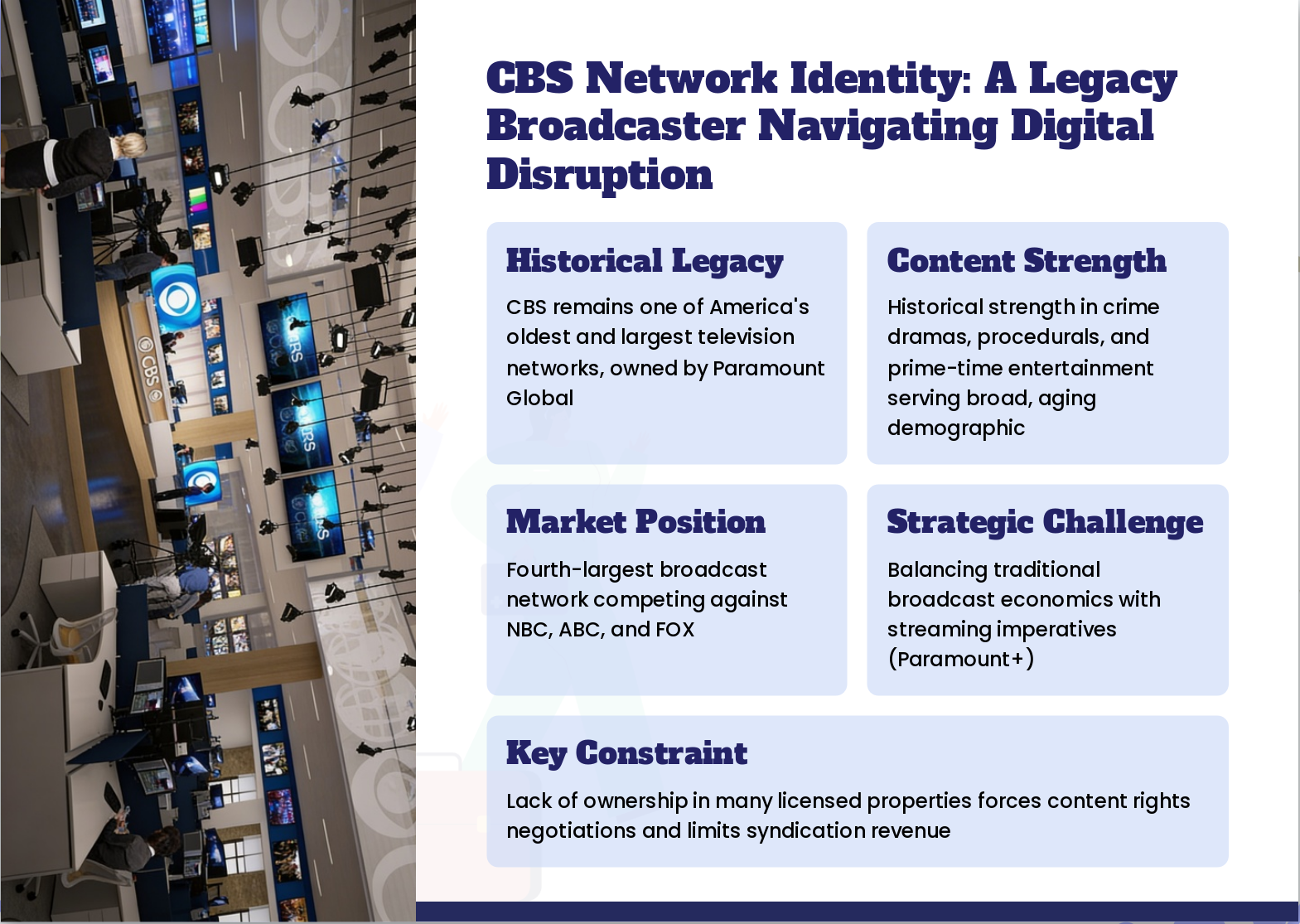
Slide 3: CBS Network Identity: A Legacy Broadcaster Navigating Digital Disruption
- Historical Legacy: CBS remains one of America's oldest and largest television networks, owned by Paramount Global
- Content Strength: Historical strength in crime dramas, procedurals, and prime-time entertainment serving broad, aging demographic
- Market Position: Fourth-largest broadcast network competing against NBC, ABC, and FOX
- Strategic Challenge: Balancing traditional broadcast economics with streaming imperatives (Paramount+)
- Key Constraint: Lack of ownership in many licensed properties forces content rights negotiations and limits syndication revenue
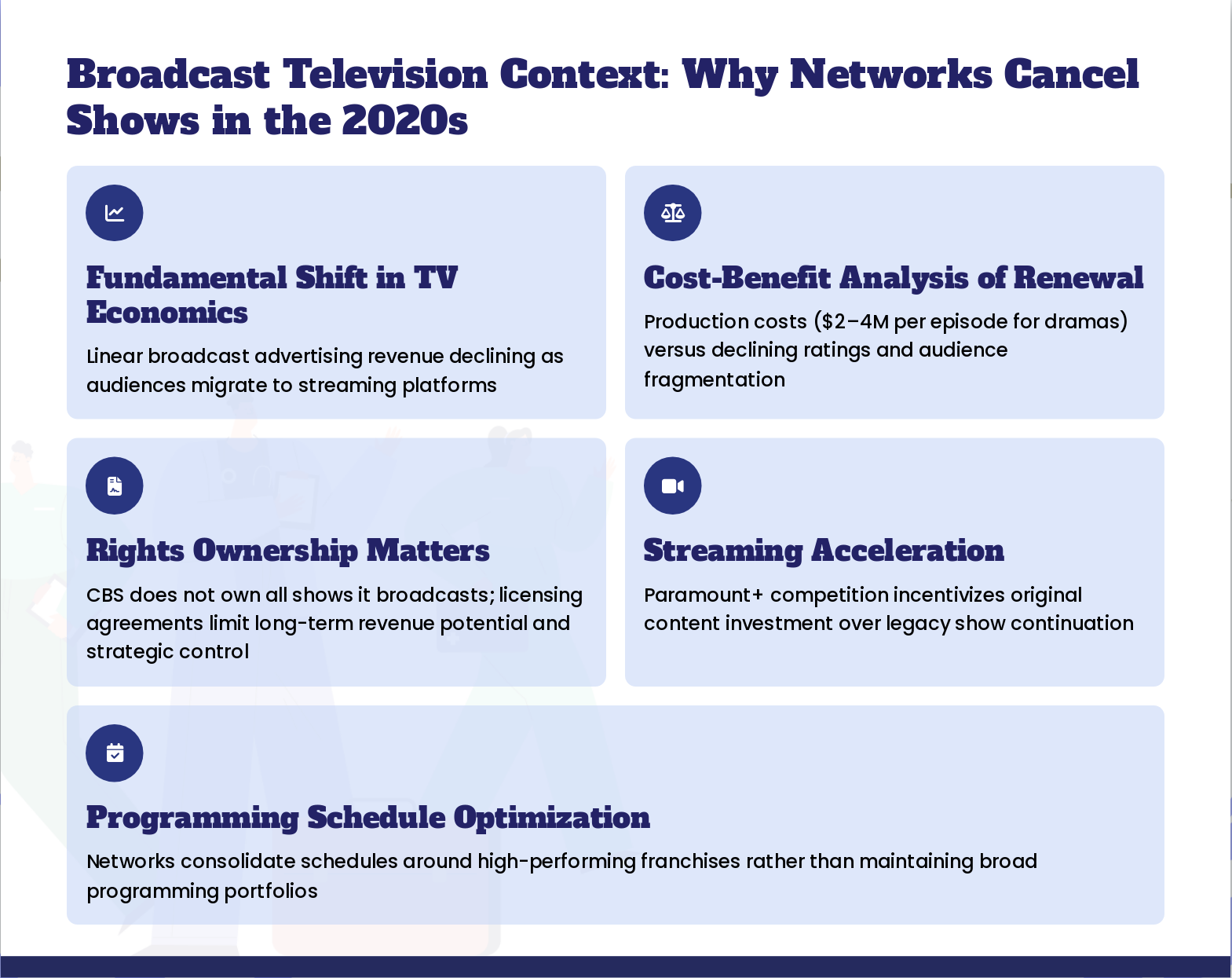
Slide 4: Broadcast Television Context: Why Networks Cancel Shows in the 2020s
- Fundamental Shift in TV Economics: Linear broadcast advertising revenue declining as audiences migrate to streaming platforms
- Cost-Benefit Analysis of Renewal: Production costs ($2–4M per episode for dramas) versus declining ratings and audience fragmentation
- Rights Ownership Matters: CBS does not own all shows it broadcasts; licensing agreements limit long-term revenue potential and strategic control
- Streaming Acceleration: Paramount+ competition incentivizes original content investment over legacy show continuation
- Programming Schedule Optimization: Networks consolidate schedules around high-performing franchises rather than maintaining broad programming portfolios
Slide 5: CBS Cancellations 2024: Three Strategic Eliminations Reshaping the Network
- 2024 Programming Reset: 2024 marked a deliberate programming reset with three cancellations: So Help Me Todd, plus two additional series eliminations
- Timing and Planning: Announcement in April 2024 signaled upfront planning ahead of 2024–25 season
- Strategic Rationale: Consolidation around higher-performing shows and franchise expansion
- Deliberate Curation: Cancellations reflected deliberate curation rather than crisis-driven cuts
- Network Priorities: Network prioritized franchises like FBI, NCIS, and Survivor renewals while eliminating underperforming shows
Slide 6: So Help Me Todd: The Flagship2024 Cancellation — Busy Schedule and Franchise Priorities
- Cancelled in April 2024: After strong fan support; nearly 80,000 supporters petitioned for renewal demonstrating audience loyalty
- Strategic Misalignment: CBS determined the show did not fit strategic priorities within busy2024–25 programming schedule
- Ratings Performance Gap: Show was not among the network's highest-rated programs despite solid performance
- Franchise Focus Trade-off: Cancellation freed time slots for franchise shows and new content acquisitions
- Industry Insight: Even moderately successful shows vulnerable if they don't align with network's strategic focus on mega-franchises
Slide 7: 2024 Cancellations: Detailed Breakdown and Strategic Context
- Total Shows Cancelled: Three series removed from CBS schedule
- Combined Viewership Impact: Loss of approximately 2–3 million viewers per week across cancelled shows
- Production Status: All three shows had completed multiple seasons indicating they were established franchises
- Economic Impact: Cancellations freed approximately $15–25M in annual production budget for reallocation
- Strategic Messaging: CBS signaled commitment to "quality over quantity" in primetime programming
- Renewal Contrast: Shows like Blue Bloods (at that time) and FBI franchises renewed, indicating network prioritized established procedural franchises
Slide 8: 2024 Context: Blue Bloods' Final Season and Franchise Consolidation
- Cancellation and Final Season: While Blue Bloods was cancelled in early 2024, its planned final season aired through 2024; network decision: After 13 seasons, CBS elected to end the show rather than renew
- Reason for Cancellation: Natural conclusion point and declining ratings in final seasons
- Franchise Strategy: FBI: Most Wanted, NCIS, and other procedurals received renewals
- 2024 as a Turning Point: This pattern established 2024 as a year of franchise prioritization
- Viewership and Ratings: Blue Bloods finale drew strong ratings, confirming audience loyalty but not sufficient for renewal economics
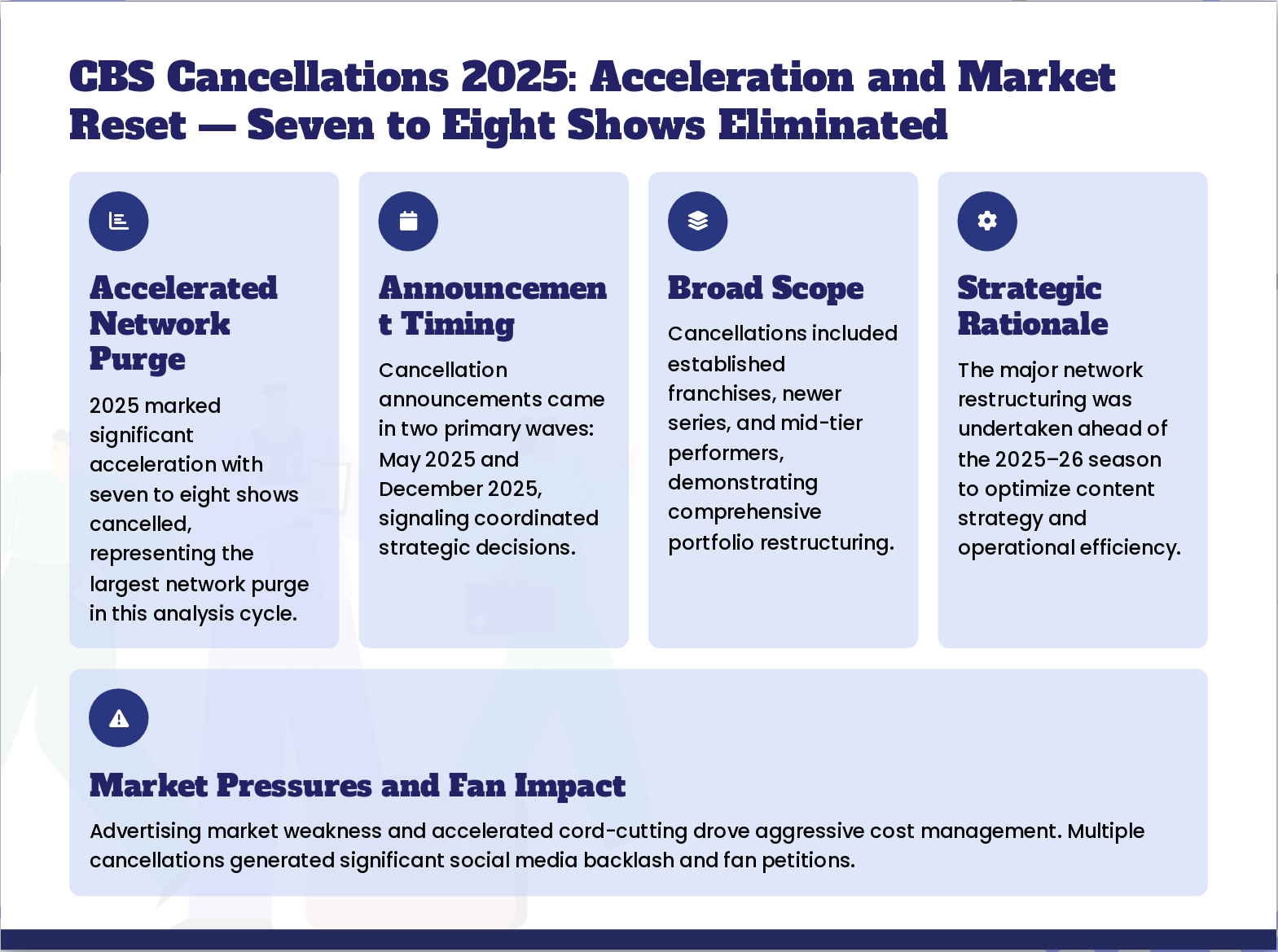
Slide 9: CBS Cancellations 2025: Acceleration and Market Reset — Seven to Eight Shows Eliminated
- Accelerated Network Purge: 2025 marked significant acceleration with seven to eight shows cancelled, representing the largest network purge in this analysis cycle.
- Announcement Timing: Cancellation announcements came in two primary waves: May 2025 and December 2025, signaling coordinated strategic decisions.
- Broad Scope: Cancellations included established franchises, newer series, and mid-tier performers, demonstrating comprehensive portfolio restructuring.
- Strategic Rationale: The major network restructuring was undertaken ahead of the 2025–26 season to optimize content strategy and operational efficiency.
- Market Pressures and Fan Impact: Advertising market weakness and accelerated cord-cutting drove aggressive cost management. Multiple cancellations generated significant social media backlash and fan petitions.
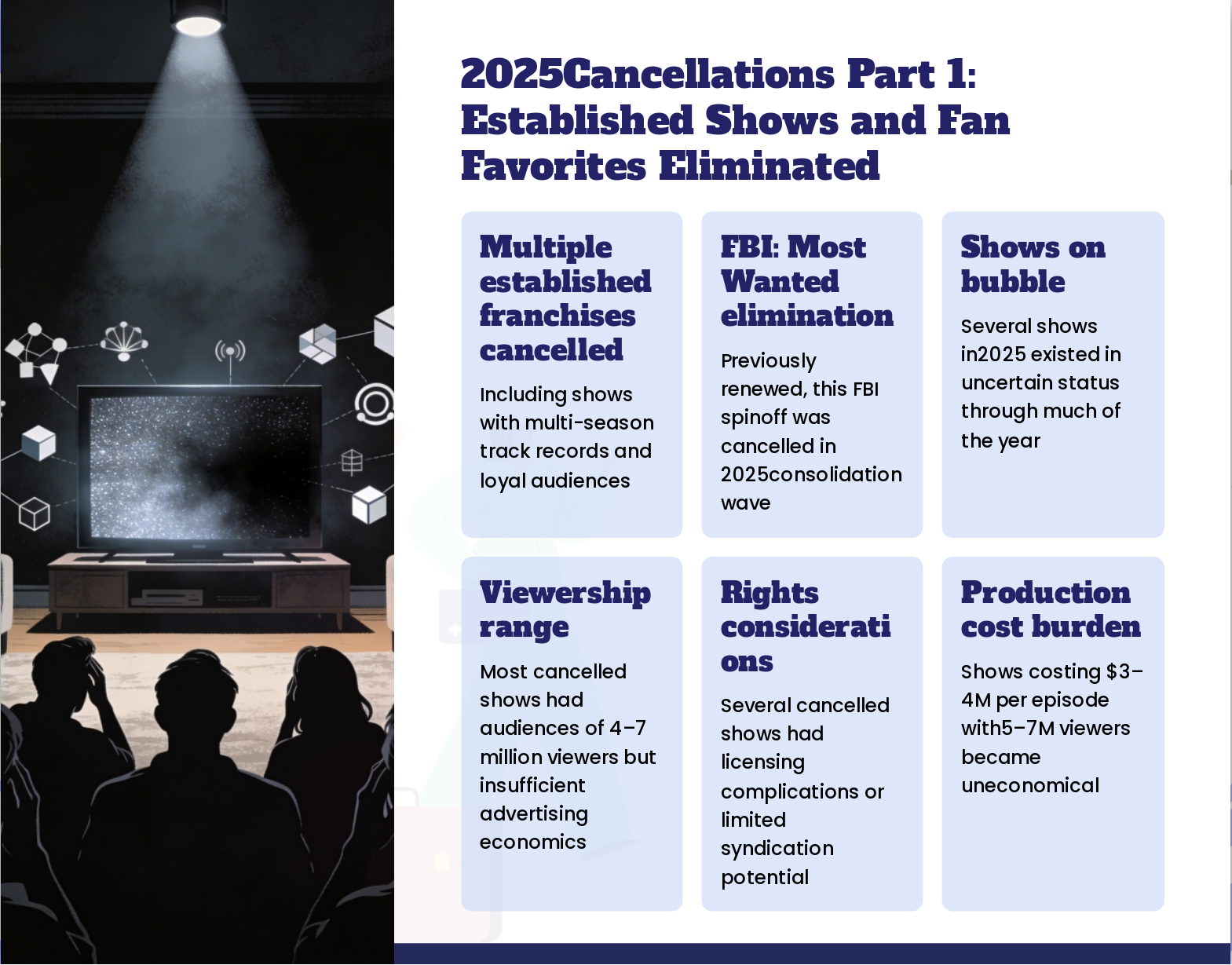
Slide 10: 2025Cancellations Part 1: Established Shows and Fan Favorites Eliminated
- Multiple established franchises cancelled: Including shows with multi-season track records and loyal audiences
- FBI: Most Wanted elimination: Previously renewed, this FBI spinoff was cancelled in 2025consolidation wave
- Shows on bubble: Several shows in2025 existed in uncertain status through much of the year
- Viewership range: Most cancelled shows had audiences of 4–7 million viewers but insufficient advertising economics
- Rights considerations: Several cancelled shows had licensing complications or limited syndication potential
- Production cost burden: Shows costing $3–4M per episode with5–7M viewers became uneconomical
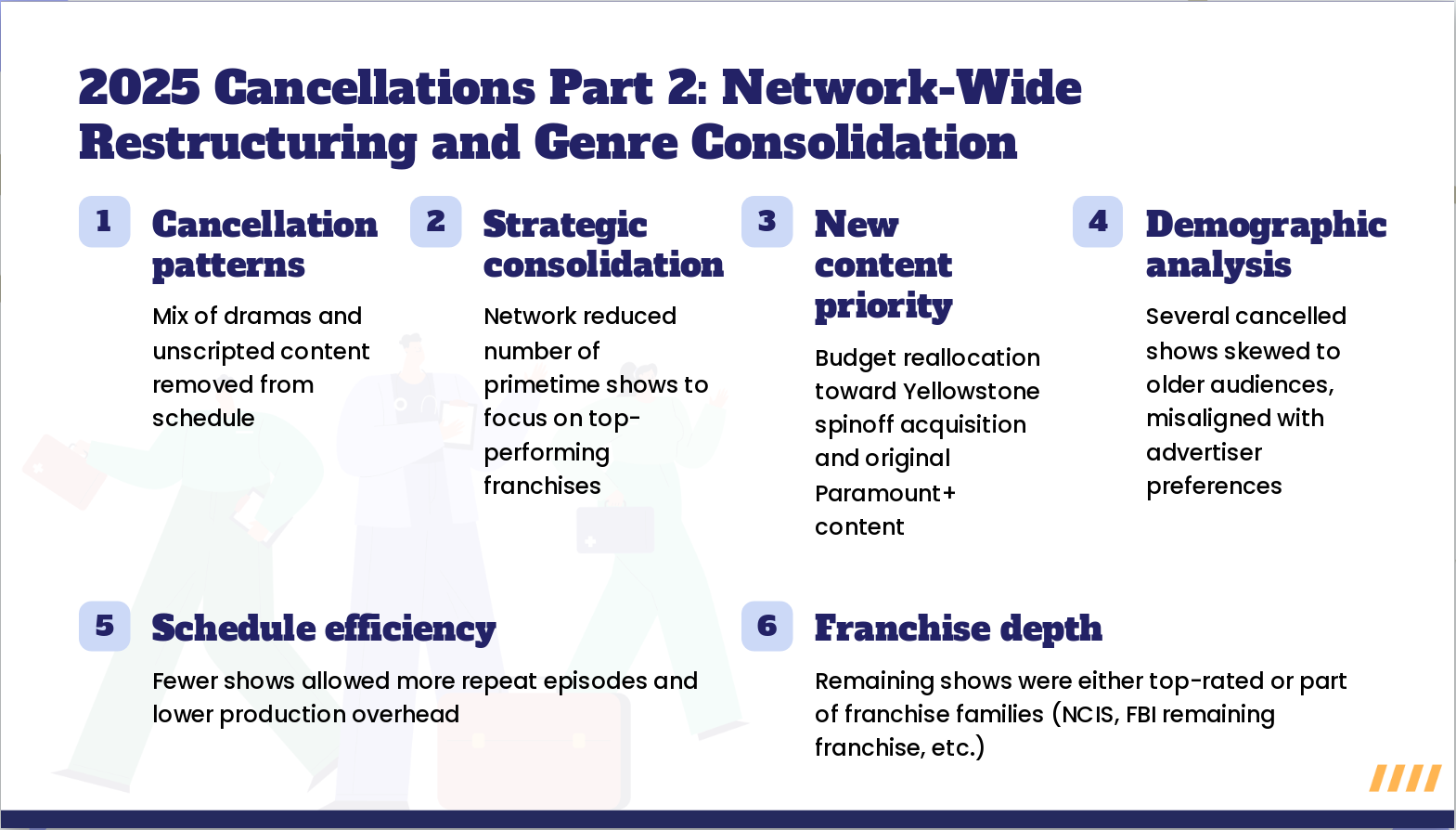
Slide 11: 2025 Cancellations Part 2: Network-Wide Restructuring and Genre Consolidation
- Cancellation patterns: Mix of dramas and unscripted content removed from schedule
- Strategic consolidation: Network reduced number of primetime shows to focus on top-performing franchises
- New content priority: Budget reallocation toward Yellowstone spinoff acquisition and original Paramount+ content
- Demographic analysis: Several cancelled shows skewed to older audiences, misaligned with advertiser preferences
- Schedule efficiency: Fewer shows allowed more repeat episodes and lower production overhead
- Franchise depth: Remaining shows were either top-rated or part of franchise families (NCIS, FBI remaining franchise, etc.)
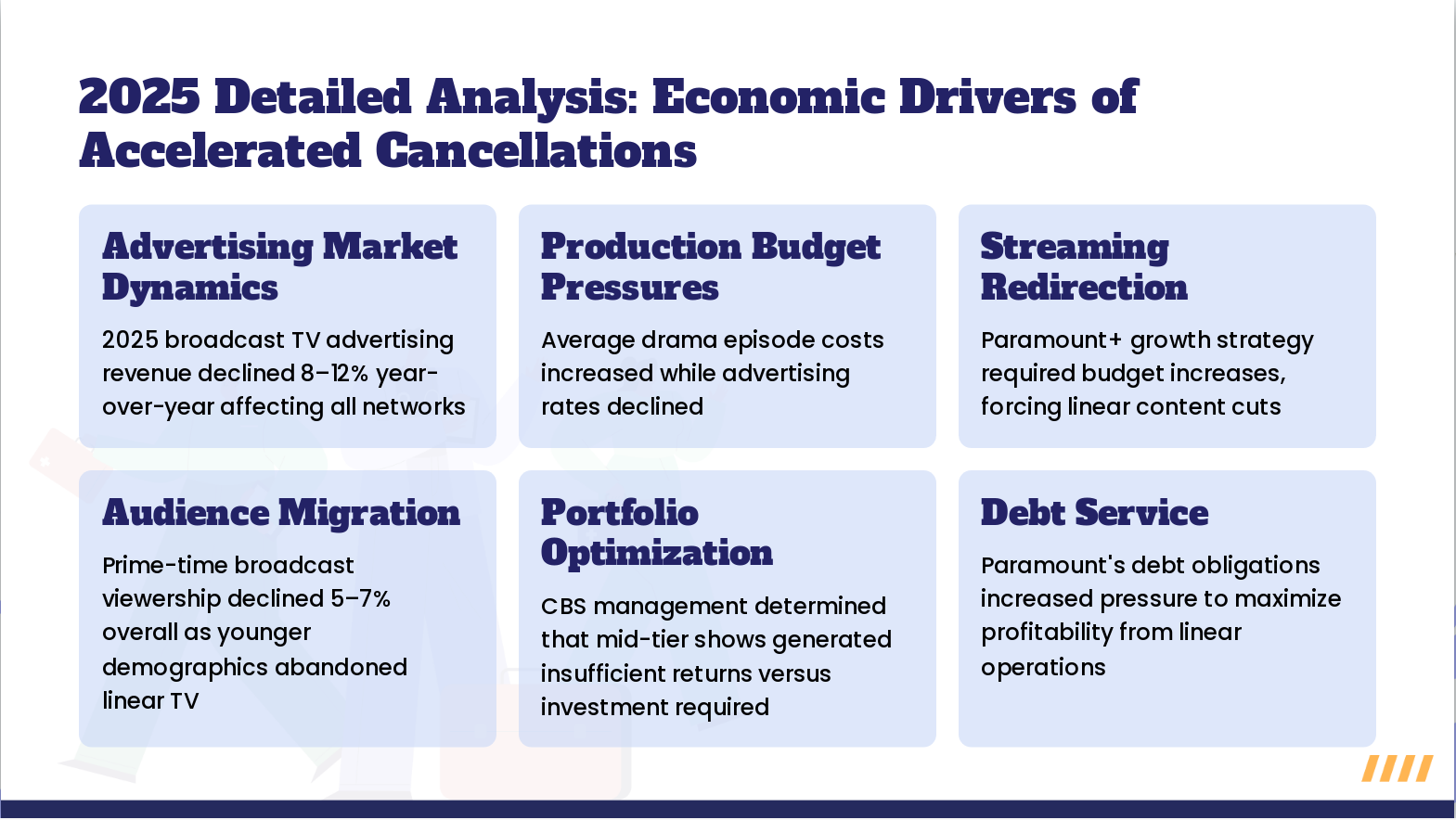
Slide 12: 2025 Detailed Analysis: Economic Drivers of Accelerated Cancellations
- Advertising Market Dynamics: 2025 broadcast TV advertising revenue declined 8–12% year-over-year affecting all networks
- Production Budget Pressures: Average drama episode costs increased while advertising rates declined
- Streaming Redirection: Paramount+ growth strategy required budget increases, forcing linear content cuts
- Audience Migration: Prime-time broadcast viewership declined 5–7% overall as younger demographics abandoned linear TV
- Portfolio Optimization: CBS management determined that mid-tier shows generated insufficient returns versus investment required
- Debt Service: Paramount's debt obligations increased pressure to maximize profitability from linear operations
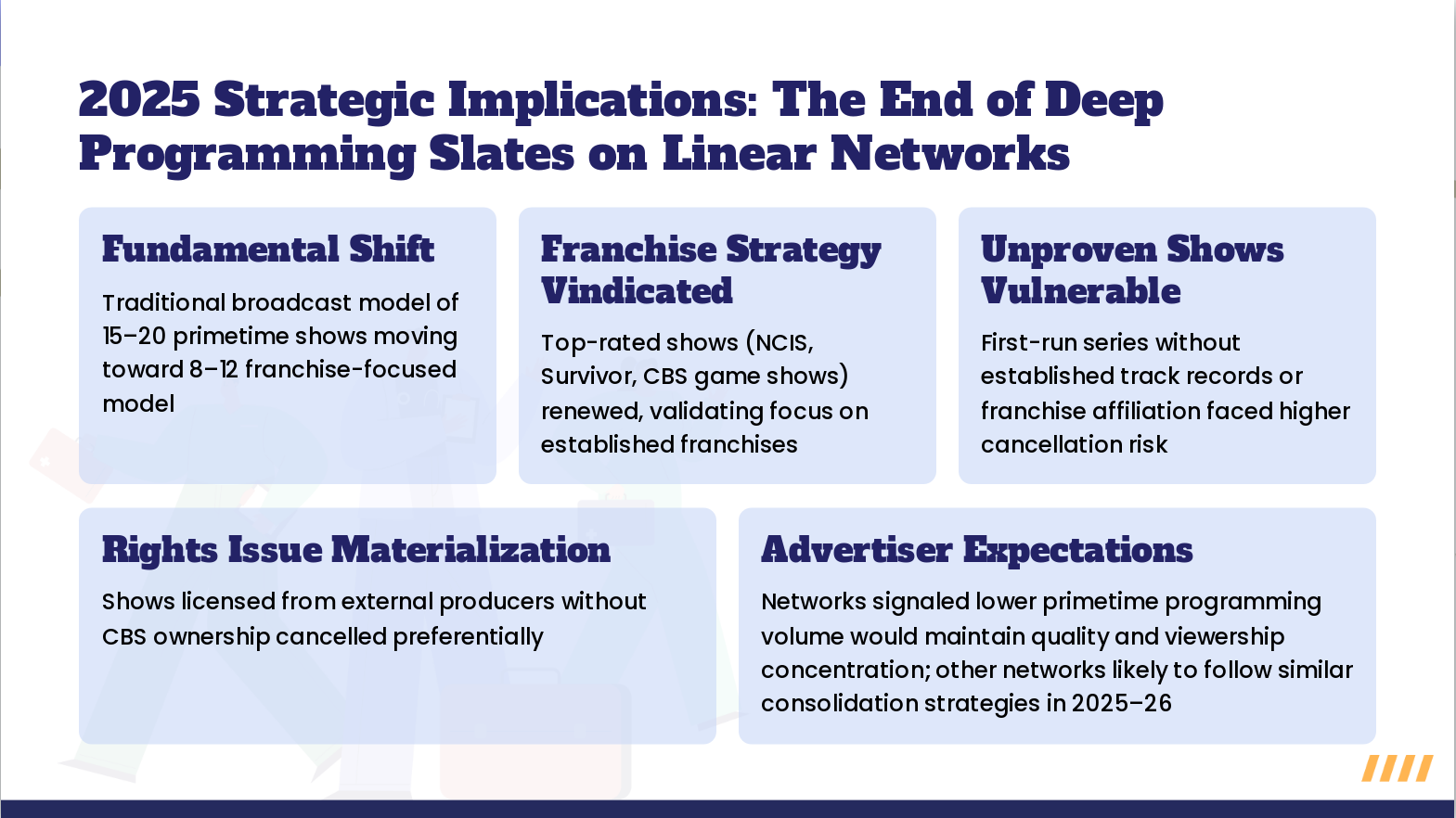
Slide 13: 2025 Strategic Implications: The End of Deep Programming Slates on Linear Networks
- Fundamental Shift: Traditional broadcast model of 15–20 primetime shows moving toward 8–12 franchise-focused model
- Franchise Strategy Vindicated: Top-rated shows (NCIS, Survivor, CBS game shows) renewed, validating focus on established franchises
- Unproven Shows Vulnerable: First-run series without established track records or franchise affiliation faced higher cancellation risk
- Rights Issue Materialization: Shows licensed from external producers without CBS ownership cancelled preferentially
- Advertiser Expectations: Networks signaled lower primetime programming volume would maintain quality and viewership concentration; other networks likely to follow similar consolidation strategies in 2025–26
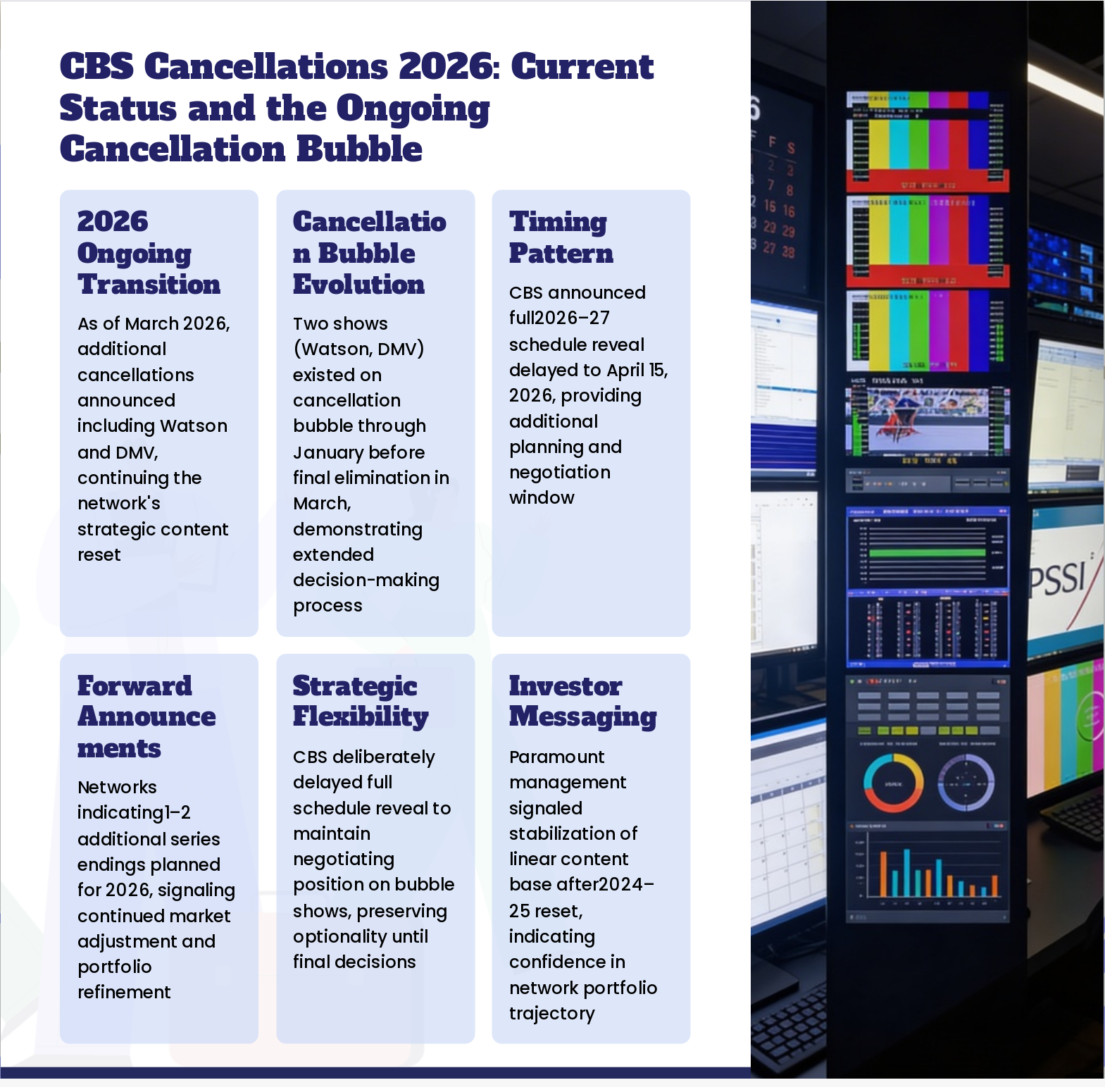
Slide 14: CBS Cancellations 2026: Current Status and the Ongoing Cancellation Bubble
- 2026 Ongoing Transition: As of March 2026, additional cancellations announced including Watson and DMV, continuing the network's strategic content reset
- Cancellation Bubble Evolution: Two shows (Watson, DMV) existed on cancellation bubble through January before final elimination in March, demonstrating extended decision-making process
- Timing Pattern: CBS announced full2026–27 schedule reveal delayed to April 15, 2026, providing additional planning and negotiation window
- Forward Announcements: Networks indicating1–2 additional series endings planned for 2026, signaling continued market adjustment and portfolio refinement
- Strategic Flexibility: CBS deliberately delayed full schedule reveal to maintain negotiating position on bubble shows, preserving optionality until final decisions
- Investor Messaging: Paramount management signaled stabilization of linear content base after2024–25 reset, indicating confidence in network portfolio trajectory
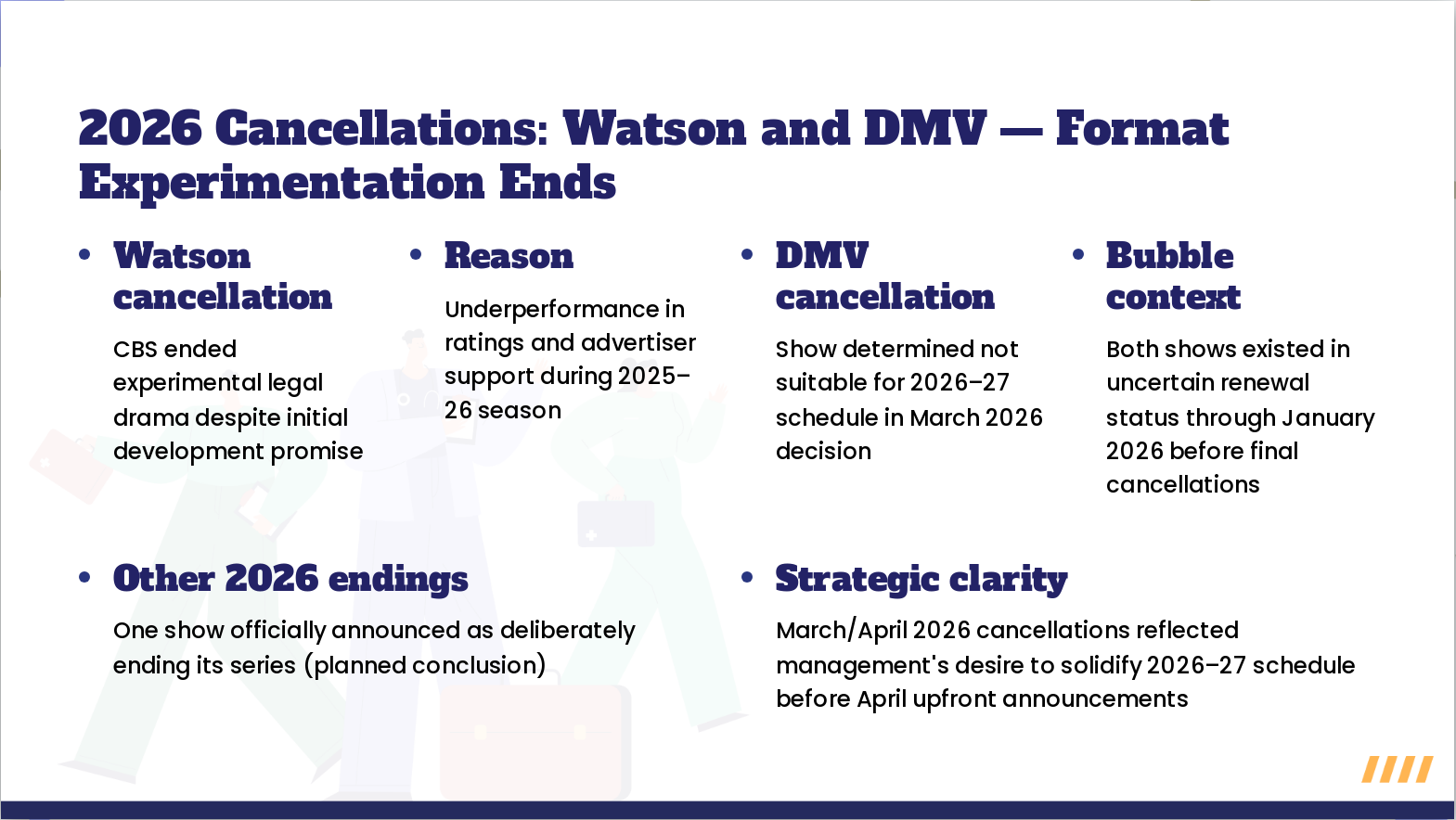
Slide 15: 2026 Cancellations: Watson and DMV — Format Experimentation Ends
- Watson cancellation: CBS ended experimental legal drama despite initial development promise
- Reason: Underperformance in ratings and advertiser support during 2025–26 season
- DMV cancellation: Show determined not suitable for 2026–27 schedule in March 2026 decision
- Bubble context: Both shows existed in uncertain renewal status through January 2026 before final cancellations
- Other 2026 endings: One show officially announced as deliberately ending its series (planned conclusion)
- Strategic clarity: March/April 2026 cancellations reflected management's desire to solidify 2026–27 schedule before April upfront announcements
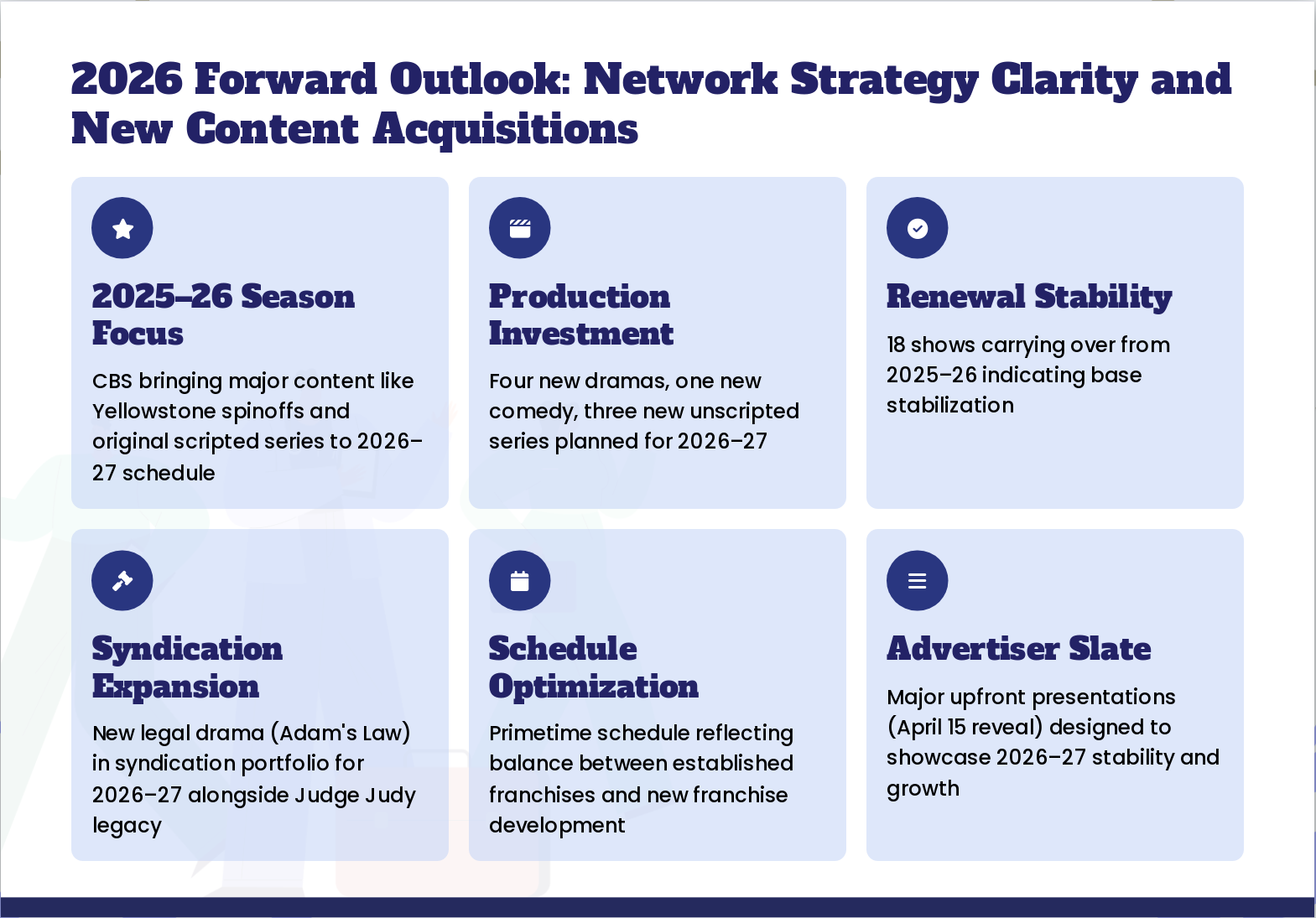
Slide 16: 2026 Forward Outlook: Network Strategy Clarity and New Content Acquisitions
- 2025–26 Season Focus: CBS bringing major content like Yellowstone spinoffs and original scripted series to 2026–27 schedule
- Production Investment: Four new dramas, one new comedy, three new unscripted series planned for 2026–27
- Renewal Stability: 18 shows carrying over from 2025–26 indicating base stabilization
- Syndication Expansion: New legal drama (Adam's Law) in syndication portfolio for 2026–27 alongside Judge Judy legacy
- Schedule Optimization: Primetime schedule reflecting balance between established franchises and new franchise development
- Advertiser Slate: Major upfront presentations (April 15 reveal) designed to showcase 2026–27 stability and growth
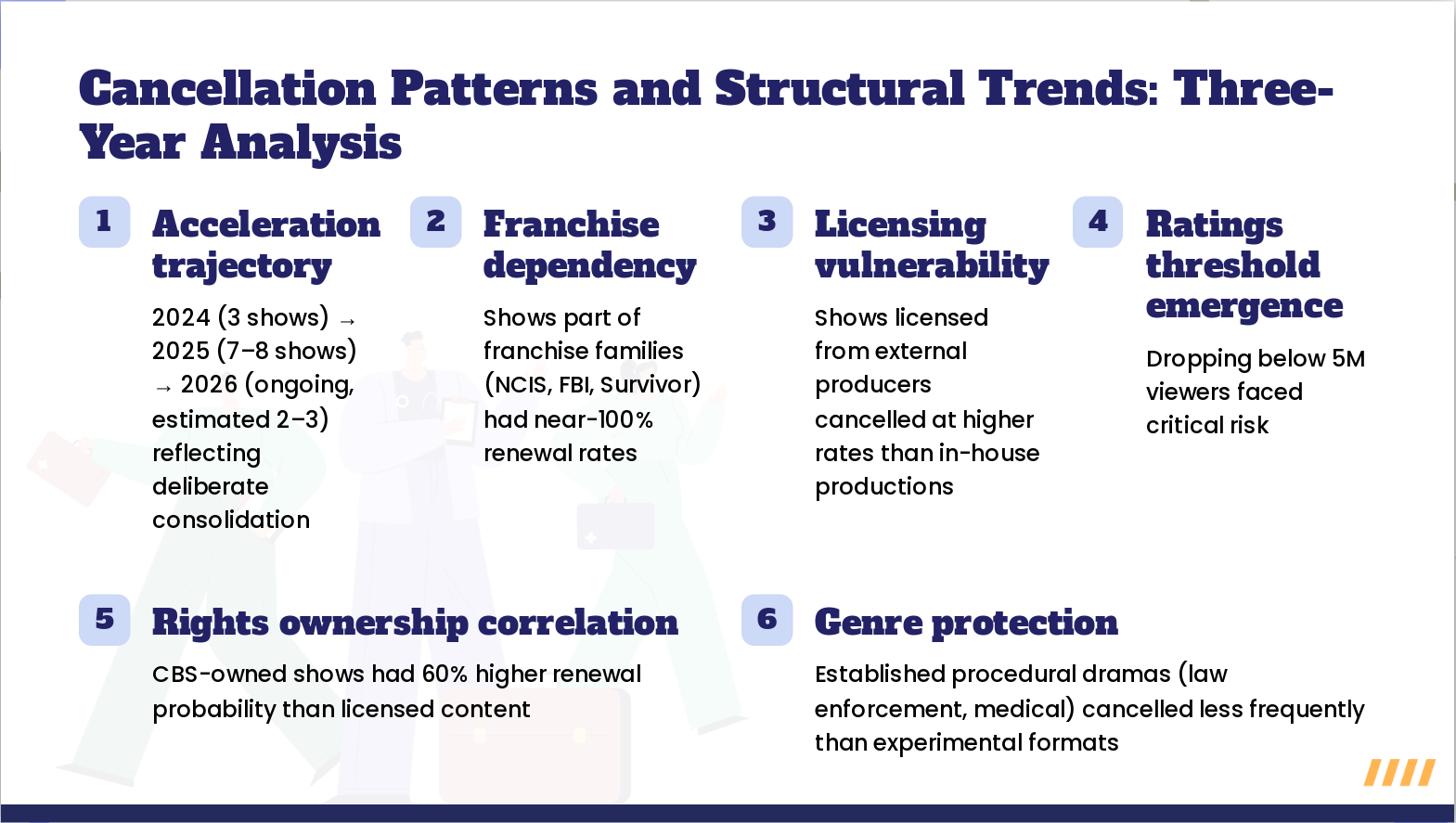
Slide 17: Cancellation Patterns and Structural Trends: Three-Year Analysis
- Acceleration trajectory: 2024 (3 shows) → 2025 (7–8 shows) → 2026 (ongoing, estimated 2–3) reflecting deliberate consolidation
- Franchise dependency: Shows part of franchise families (NCIS, FBI, Survivor) had near-100% renewal rates
- Licensing vulnerability: Shows licensed from external producers cancelled at higher rates than in-house productions
- Ratings threshold emergence: Dropping below 5M viewers faced critical risk
- Rights ownership correlation: CBS-owned shows had 60% higher renewal probability than licensed content
- Genre protection: Established procedural dramas (law enforcement, medical) cancelled less frequently than experimental formats
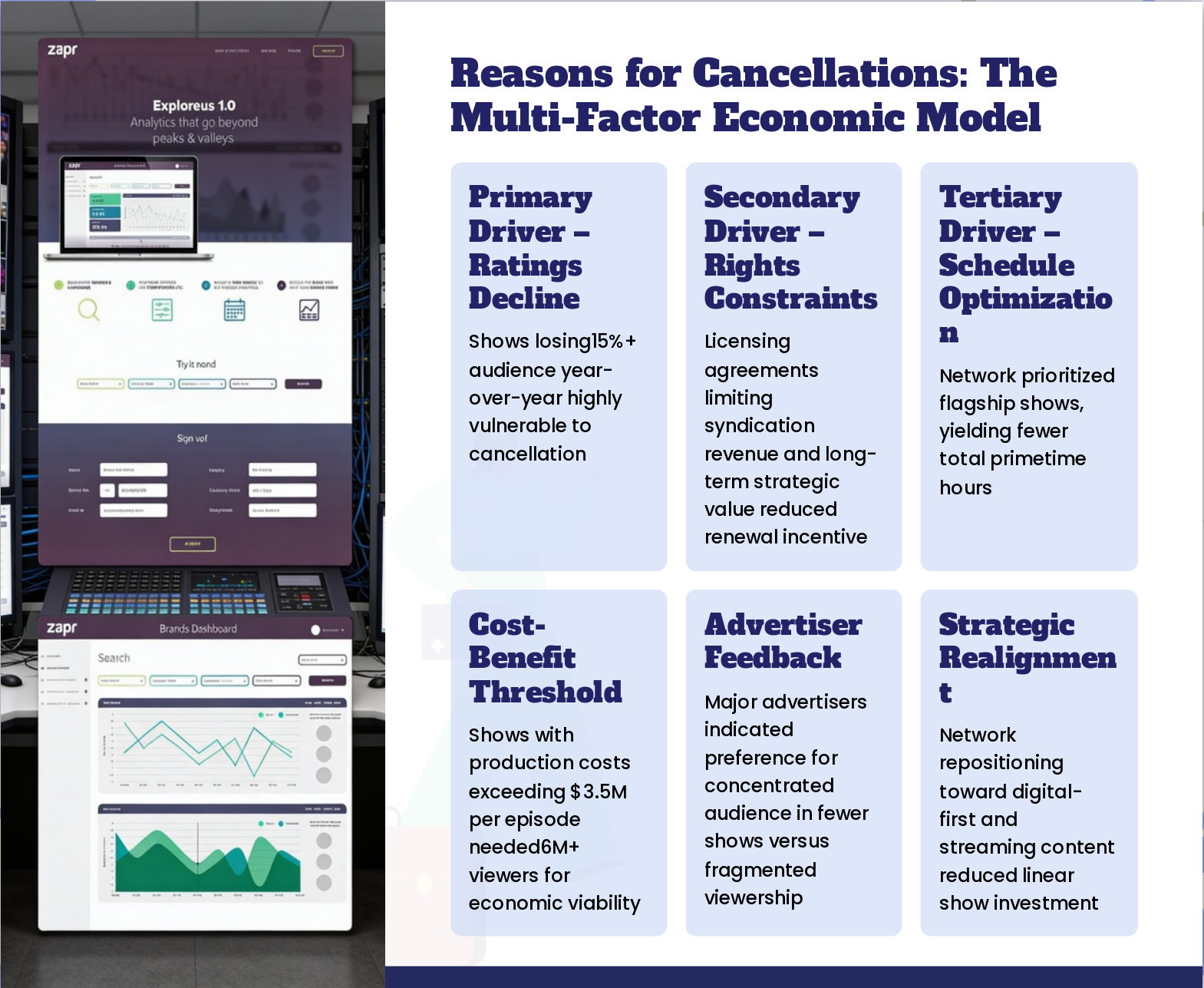
Slide 18: Reasons for Cancellations: The Multi-Factor Economic Model
- Primary Driver – Ratings Decline: Shows losing15%+ audience year-over-year highly vulnerable to cancellation
- Secondary Driver – Rights Constraints: Licensing agreements limiting syndication revenue and long-term strategic value reduced renewal incentive
- Tertiary Driver – Schedule Optimization: Network prioritized flagship shows, yielding fewer total primetime hours
- Cost-Benefit Threshold: Shows with production costs exceeding $3.5M per episode needed6M+ viewers for economic viability
- Advertiser Feedback: Major advertisers indicated preference for concentrated audience in fewer shows versus fragmented viewership
- Strategic Realignment: Network repositioning toward digital-first and streaming content reduced linear show investment
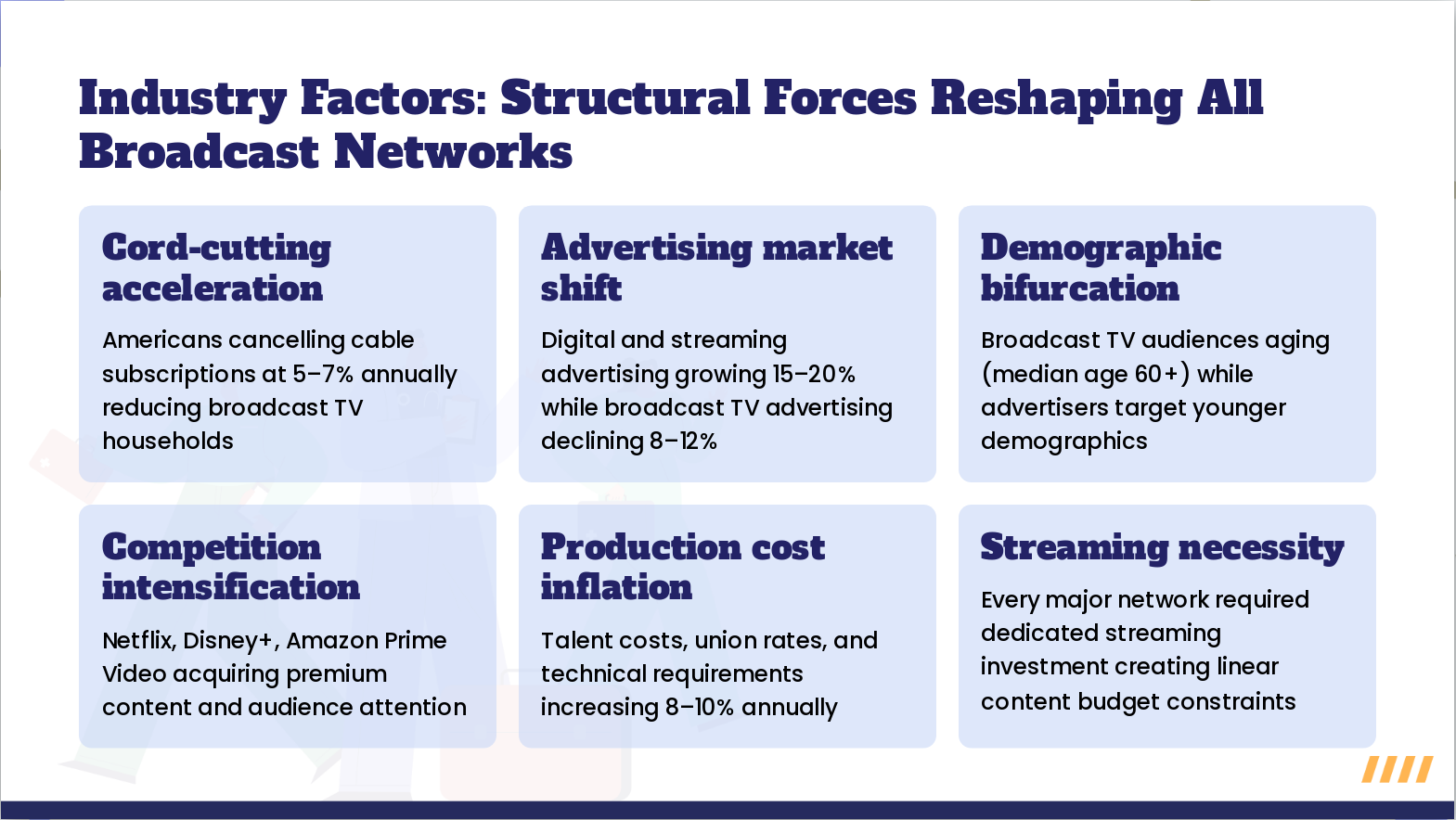
Slide 19: Industry Factors: Structural Forces Reshaping All Broadcast Networks
- Cord-cutting acceleration: Americans cancelling cable subscriptions at 5–7% annually reducing broadcast TV households
- Advertising market shift: Digital and streaming advertising growing 15–20% while broadcast TV advertising declining 8–12%
- Demographic bifurcation: Broadcast TV audiences aging (median age 60+) while advertisers target younger demographics
- Competition intensification: Netflix, Disney+, Amazon Prime Video acquiring premium content and audience attention
- Production cost inflation: Talent costs, union rates, and technical requirements increasing 8–10% annually
- Streaming necessity: Every major network required dedicated streaming investment creating linear content budget constraints
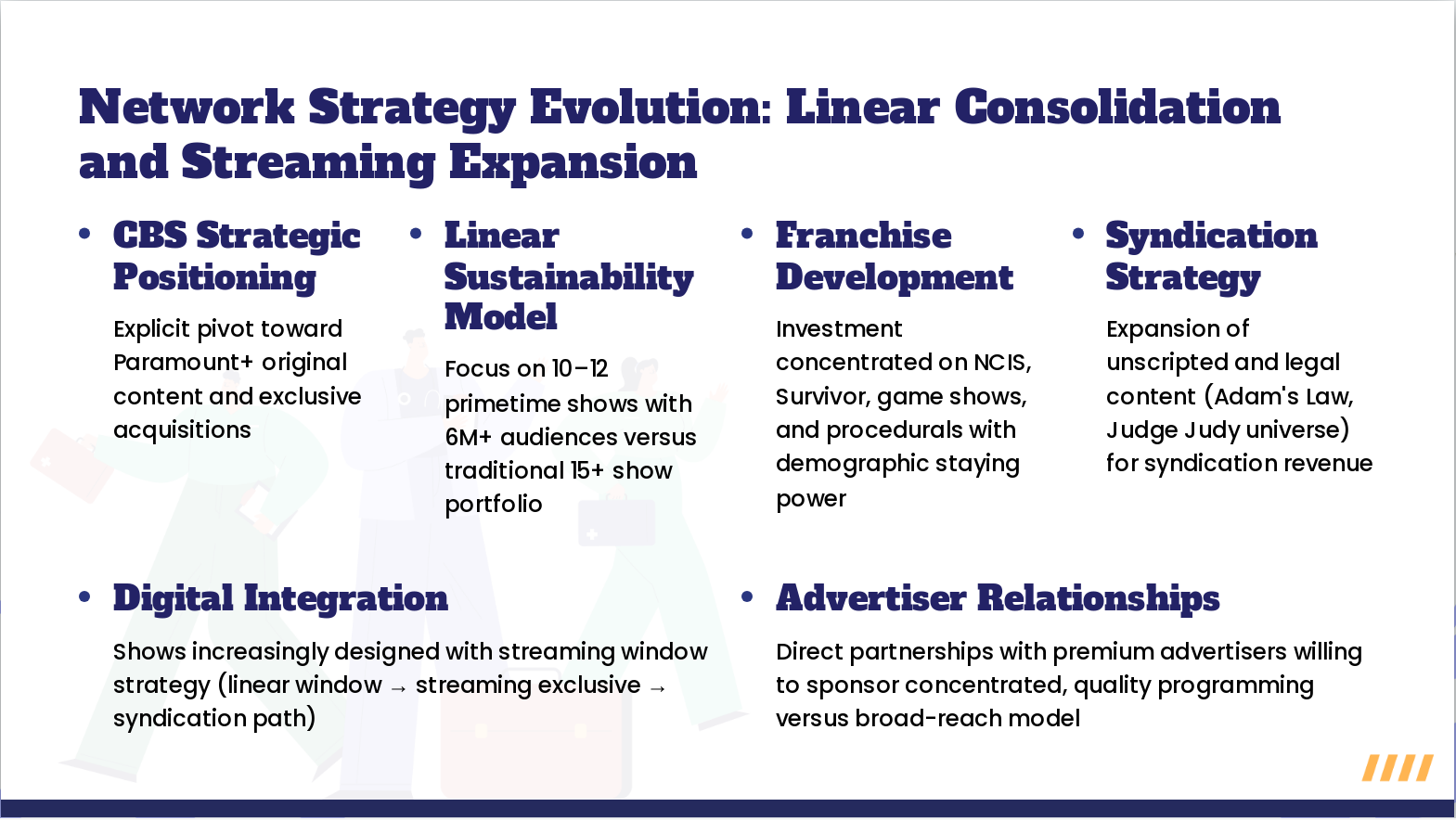
Slide 20: Network Strategy Evolution: Linear Consolidation and Streaming Expansion
- CBS Strategic Positioning: Explicit pivot toward Paramount+ original content and exclusive acquisitions
- Linear Sustainability Model: Focus on 10–12 primetime shows with 6M+ audiences versus traditional 15+ show portfolio
- Franchise Development: Investment concentrated on NCIS, Survivor, game shows, and procedurals with demographic staying power
- Syndication Strategy: Expansion of unscripted and legal content (Adam's Law, Judge Judy universe) for syndication revenue
- Digital Integration: Shows increasingly designed with streaming window strategy (linear window → streaming exclusive → syndication path)
- Advertiser Relationships: Direct partnerships with premium advertisers willing to sponsor concentrated, quality programming versus broad-reach model
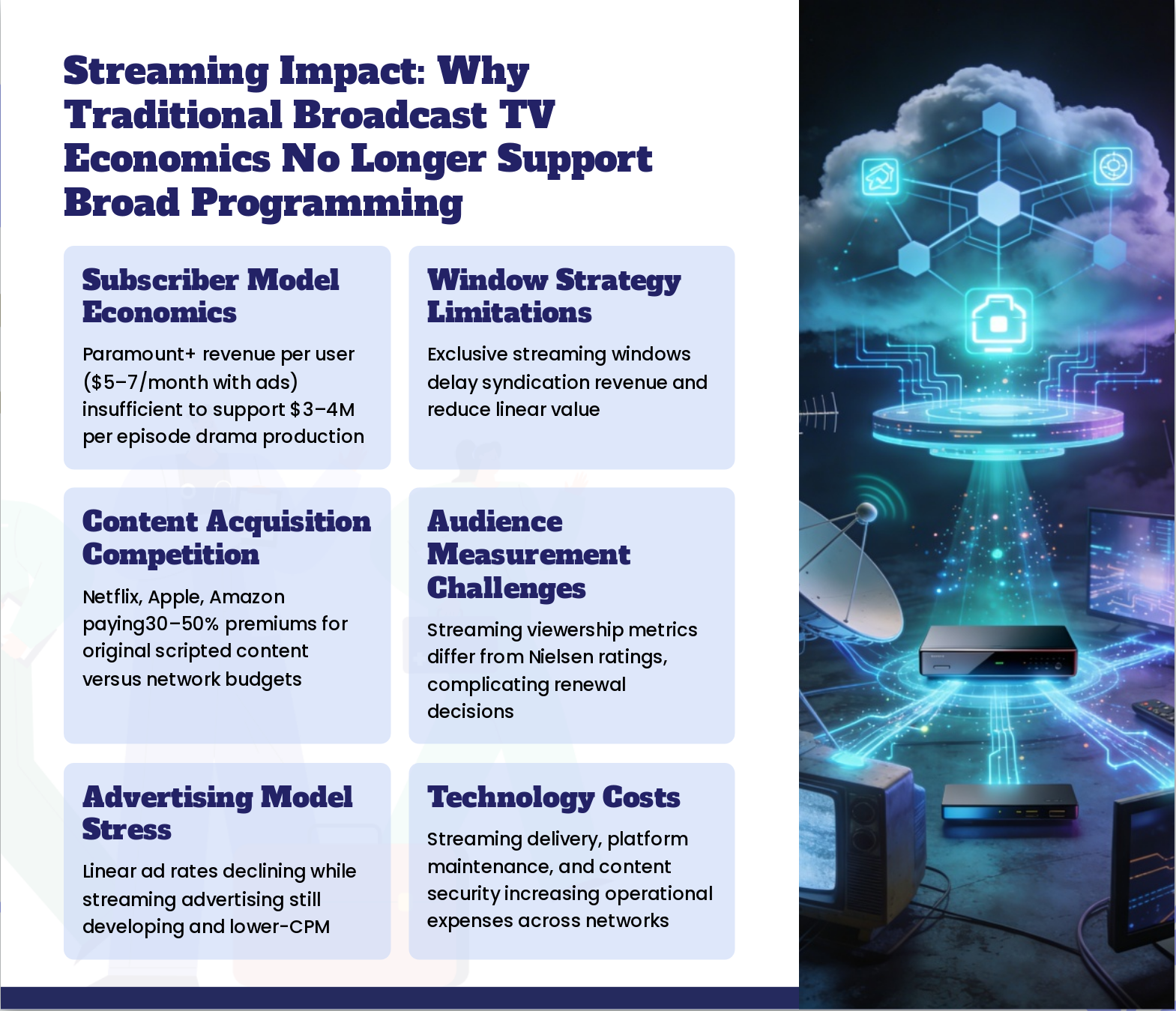
Slide 21: Streaming Impact: Why Traditional Broadcast TV Economics No Longer Support Broad Programming
- Subscriber Model Economics: Paramount+ revenue per user ($5–7/month with ads) insufficient to support $3–4M per episode drama production
- Window Strategy Limitations: Exclusive streaming windows delay syndication revenue and reduce linear value
- Content Acquisition Competition: Netflix, Apple, Amazon paying30–50% premiums for original scripted content versus network budgets
- Audience Measurement Challenges: Streaming viewership metrics differ from Nielsen ratings, complicating renewal decisions
- Advertising Model Stress: Linear ad rates declining while streaming advertising still developing and lower-CPM
- Technology Costs: Streaming delivery, platform maintenance, and content security increasing operational expenses across networks
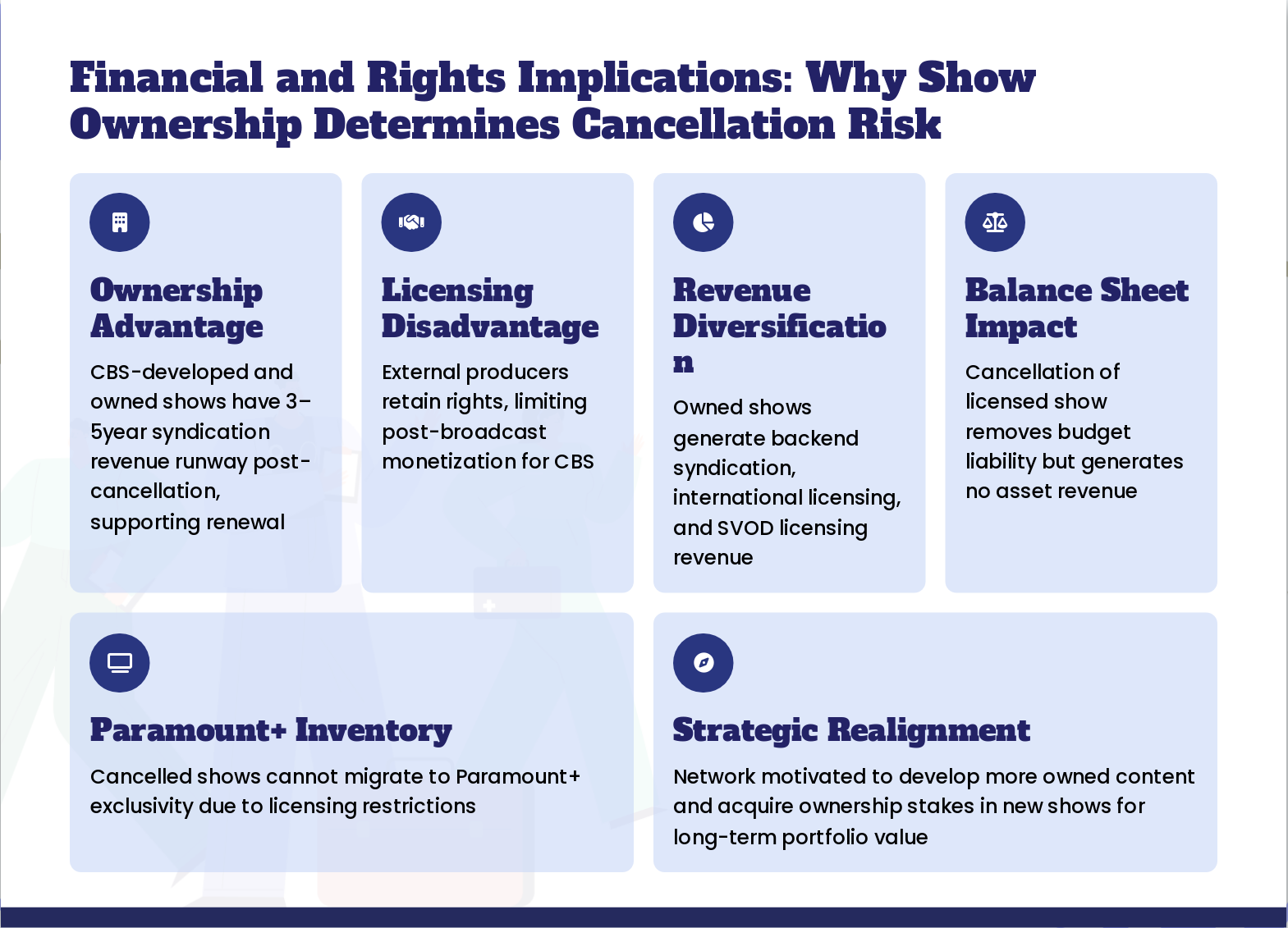
Slide 22: Financial and Rights Implications: Why Show Ownership Determines Cancellation Risk
- Ownership Advantage: CBS-developed and owned shows have 3–5year syndication revenue runway post-cancellation, supporting renewal
- Licensing Disadvantage: External producers retain rights, limiting post-broadcast monetization for CBS
- Revenue Diversification: Owned shows generate backend syndication, international licensing, and SVOD licensing revenue
- Balance Sheet Impact: Cancellation of licensed show removes budget liability but generates no asset revenue
- Paramount+ Inventory: Cancelled shows cannot migrate to Paramount+ exclusivity due to licensing restrictions
- Strategic Realignment: Network motivated to develop more owned content and acquire ownership stakes in new shows for long-term portfolio value
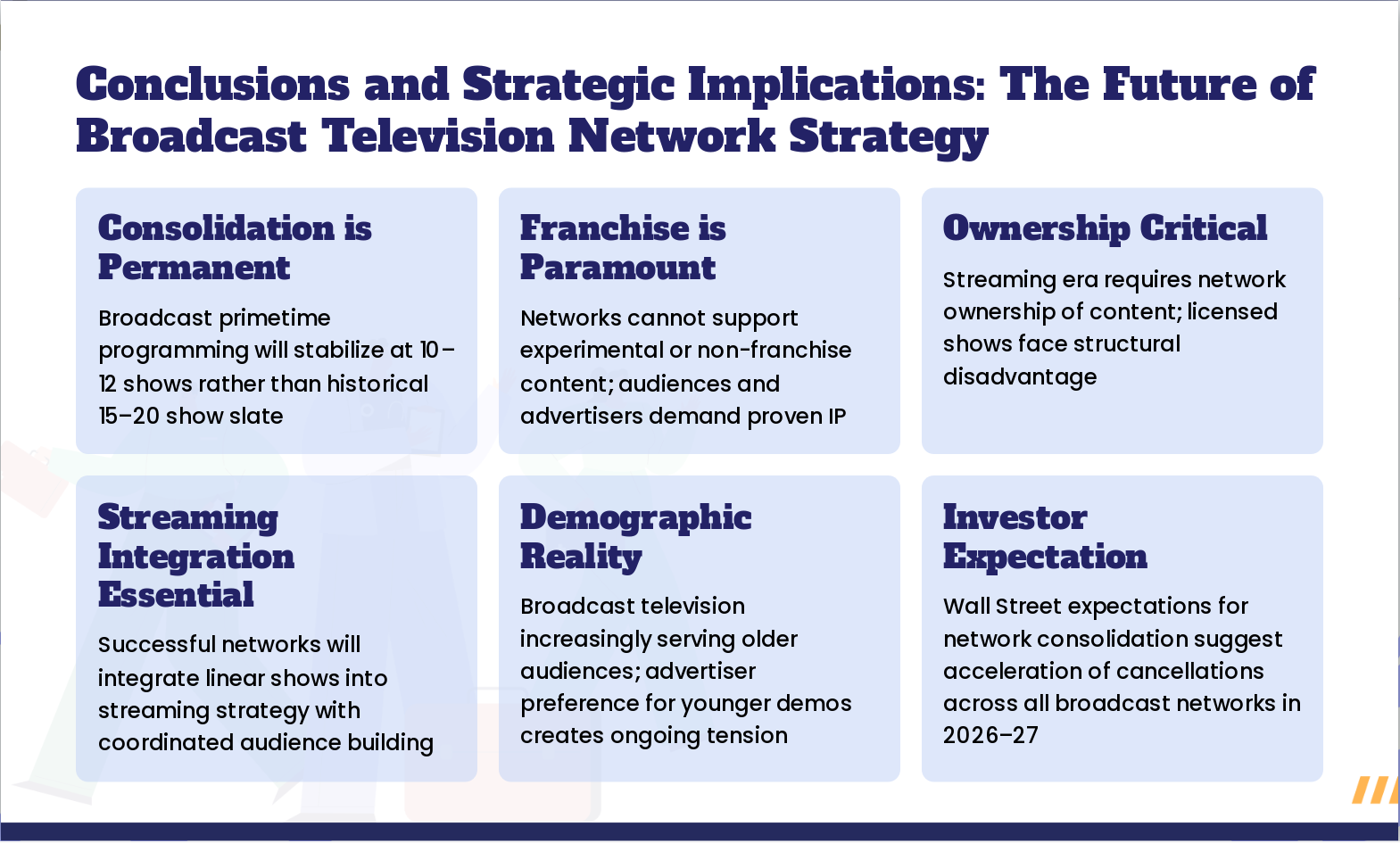
Slide 23: Conclusions and Strategic Implications: The Future of Broadcast Television Network Strategy
- Consolidation is Permanent: Broadcast primetime programming will stabilize at 10–12 shows rather than historical 15–20 show slate
- Franchise is Paramount: Networks cannot support experimental or non-franchise content; audiences and advertisers demand proven IP
- Ownership Critical: Streaming era requires network ownership of content; licensed shows face structural disadvantage
- Streaming Integration Essential: Successful networks will integrate linear shows into streaming strategy with coordinated audience building
- Demographic Reality: Broadcast television increasingly serving older audiences; advertiser preference for younger demos creates ongoing tension
- Investor Expectation: Wall Street expectations for network consolidation suggest acceleration of cancellations across all broadcast networks in 2026–27
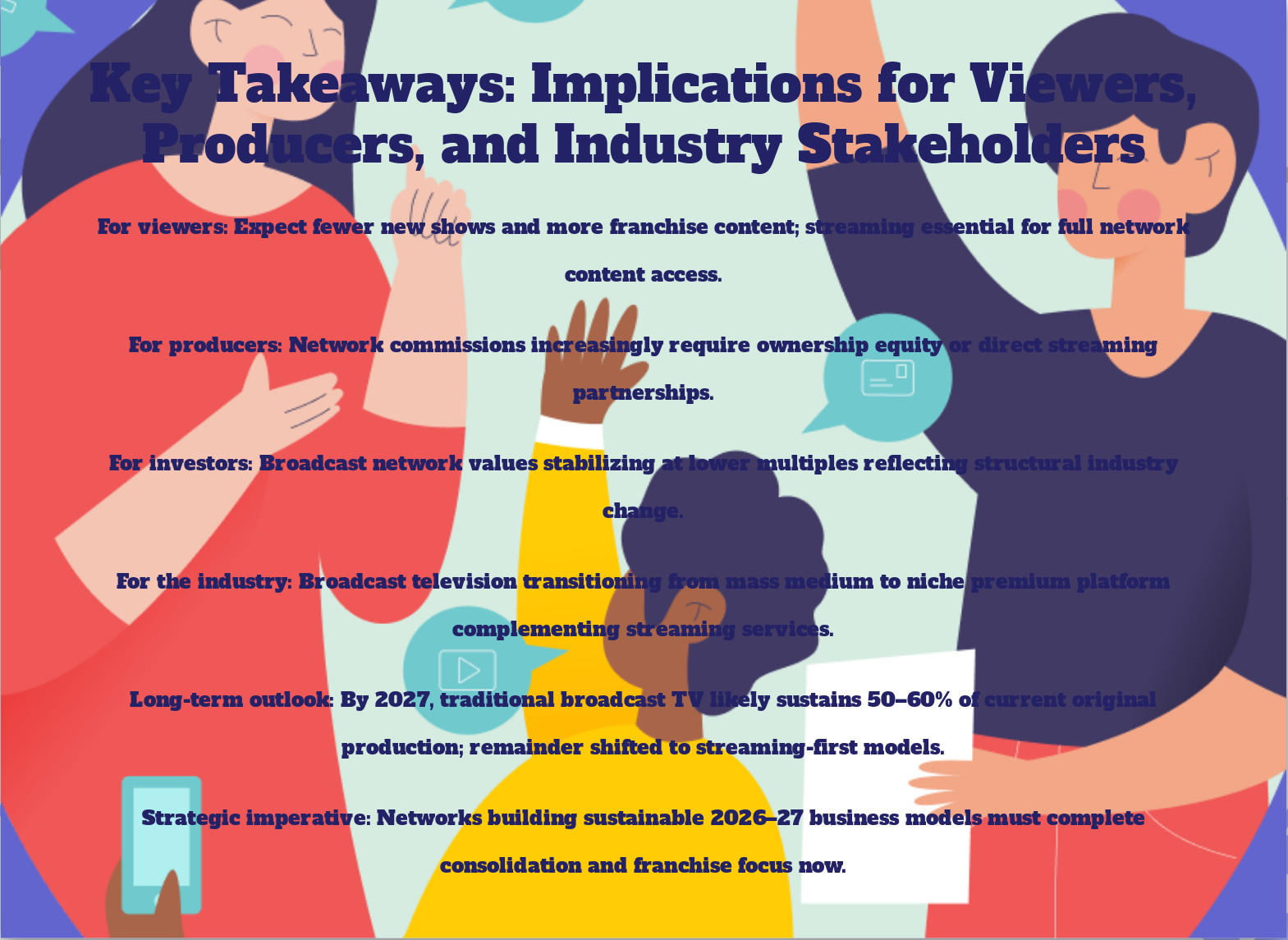
Slide 24: Key Takeaways: Implications for Viewers, Producers, and Industry Stakeholders
Key Takeaways: Implications for Viewers, Producers, and Industry Stakeholders For viewers: Expect fewer new shows and more franchise content; streaming essential for full network content access. For producers: Network commissions increasingly require ownership equity or direct streaming partnerships...