Best Healthcare Presentation Templates: 3 Editable AI-Ready Decks
Updated October 15, 2026 | Original editable examples and source notes
The best healthcare presentation template starts with the audience: clinicians reviewing research, patients preparing for a visit, or a service team reviewing operations. The three files below give each audience a different structure. They include visible citation and review fields; none is a substitute for clinical approval.
Pick a healthcare layout by audience
| Template | Audience | Best use | Release gate |
|---|---|---|---|
| Journal club | Clinical / research readers | Discuss one published study | Qualified clinical and statistical review. |
| Patient visit preparation | Adult patients; adapt locally | Prepare information and questions | Clinical, language and accessibility approval. |
| Service review | Operational service team | Compare defined aggregate measures | Privacy, denominator and interpretation checks. |
Need to turn approved material into a draft? Follow the healthcare source-to-slide tutorial. That page contains the detailed prompts and review sequence; this page is the downloadable template directory.
Three editable healthcare presentation templates
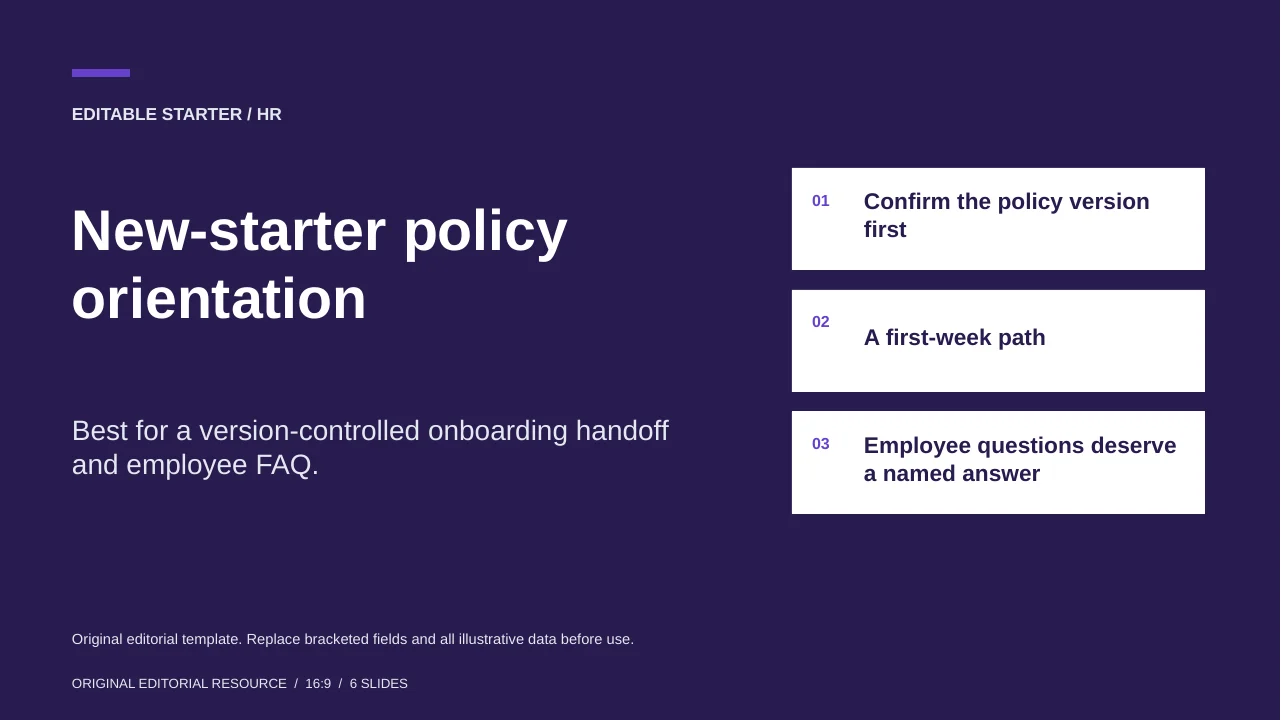
SPRINT: a journal-club readout
Best for separating a study finding from a clinical recommendation.
The example uses the 2015 SPRINT report as a dated journal-club reading. Its population, outcome rates and uncertainty remain attached to the source. Use the references page when replacing the paper, and remove any conclusions that do not belong to your selected study.
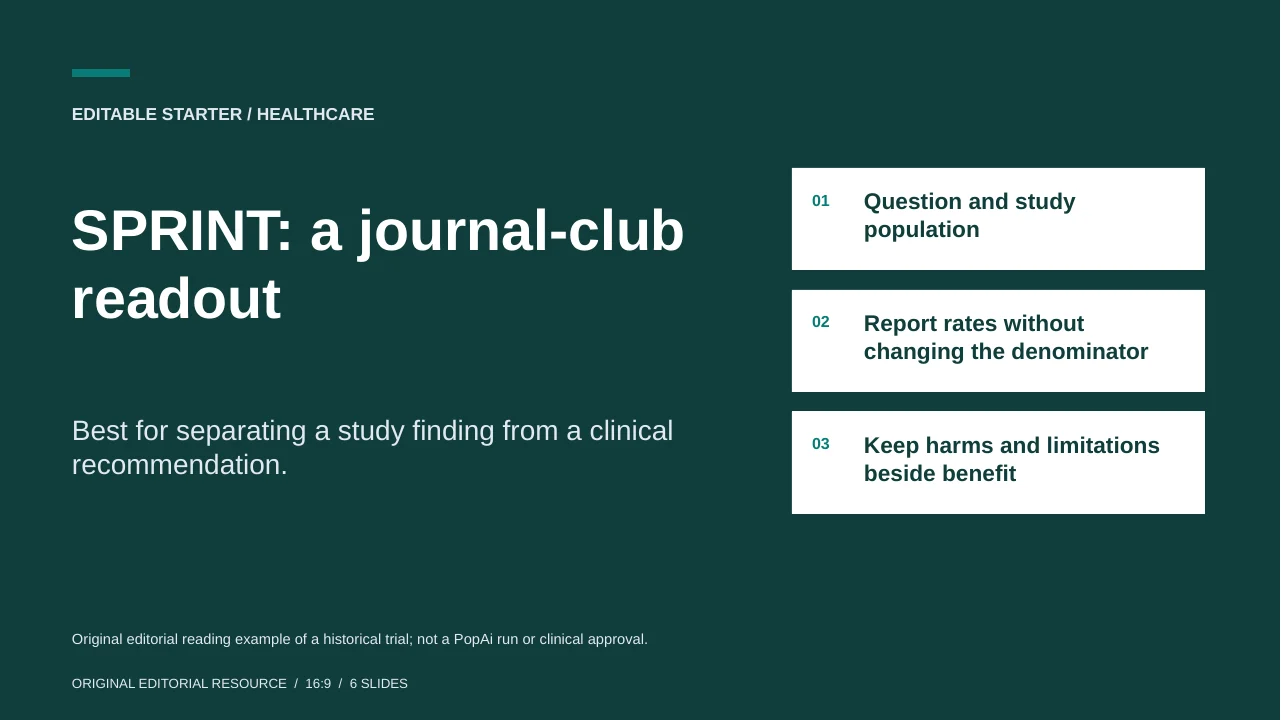
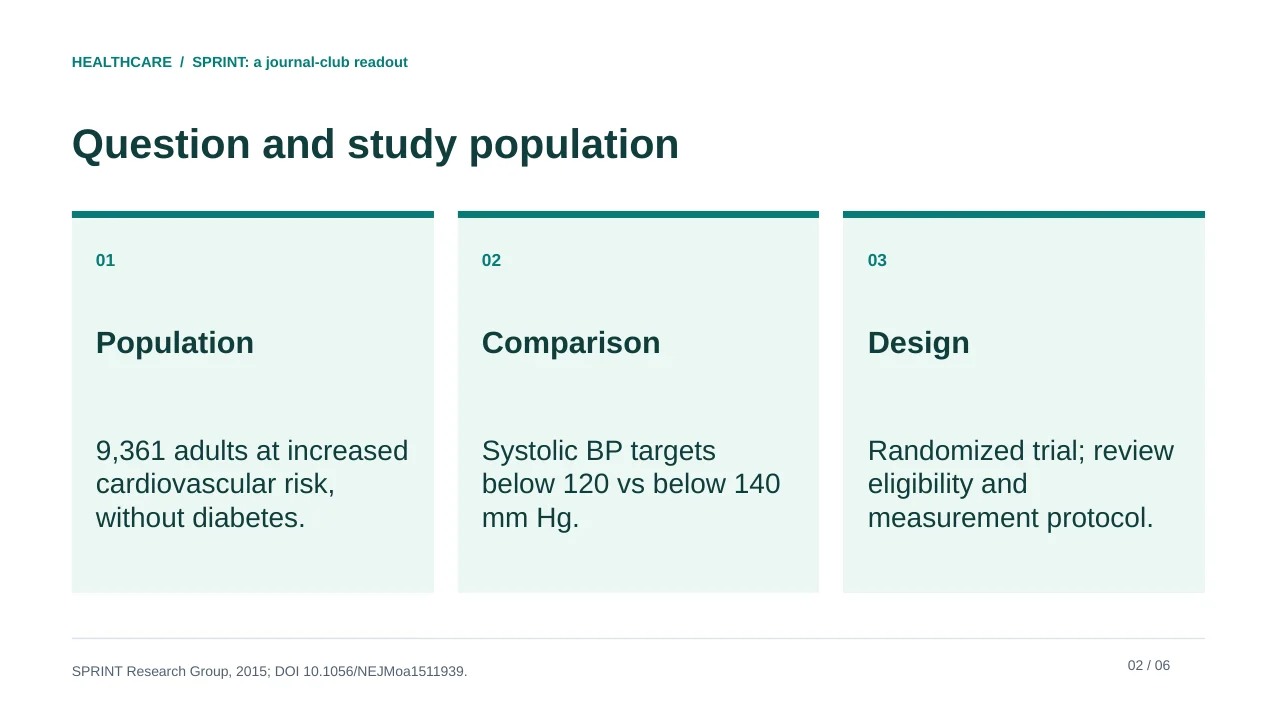
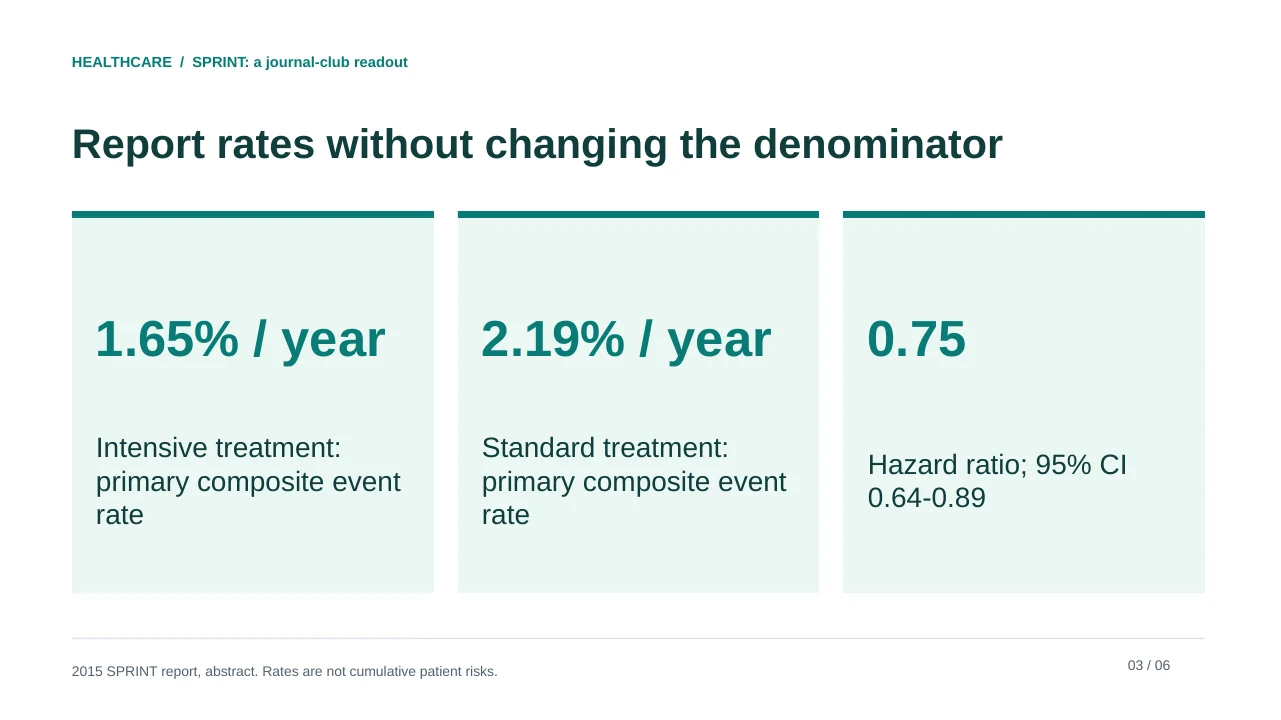
Original editorial reading example of a historical trial; not a PopAi run or clinical approval.
See the complete slide sequence
- SPRINT: a journal-club readout
- Question and study population
- Report rates without changing the denominator
- Keep harms and limitations beside benefit
- A source date is part of the claim
- Discussion, not a treatment instruction
Prepare for your care visit
Best for plain-language patient education about asking questions.
The patient file focuses on preparing for a care conversation, using AHRQ material. It contains editable questions and a local-review record, not treatment instructions. Replace any contact placeholder only with approved local details.
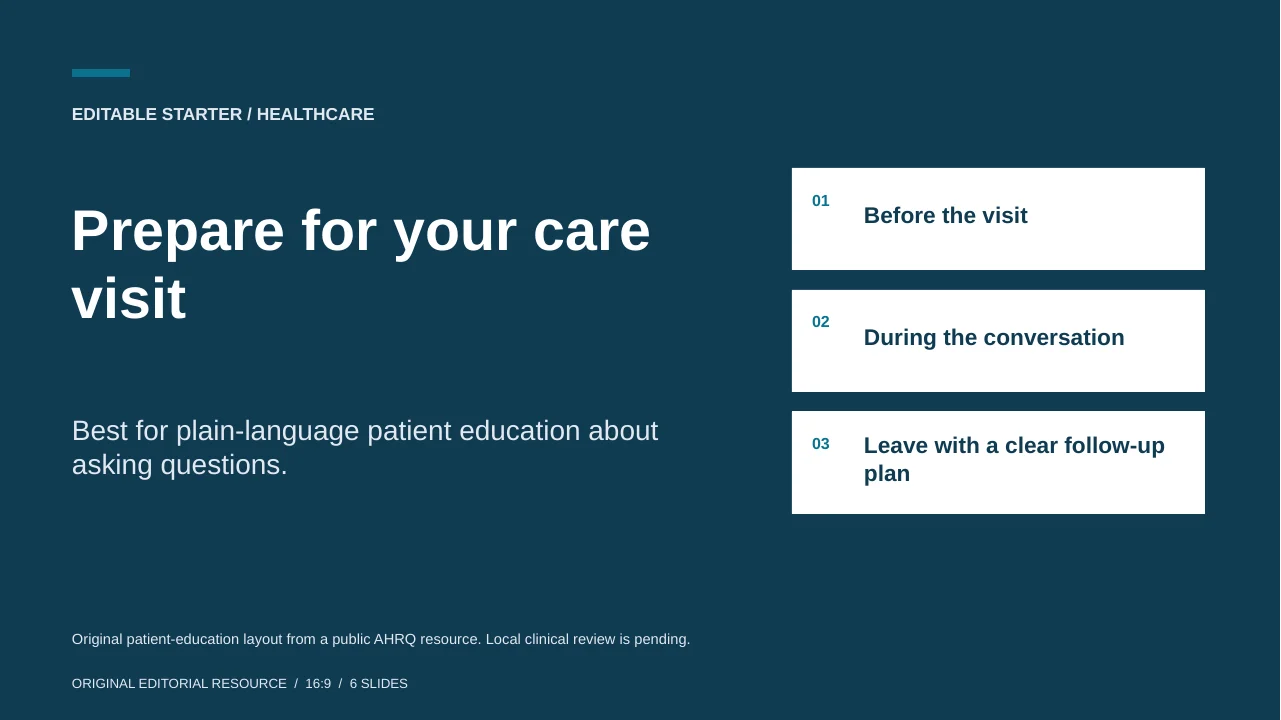
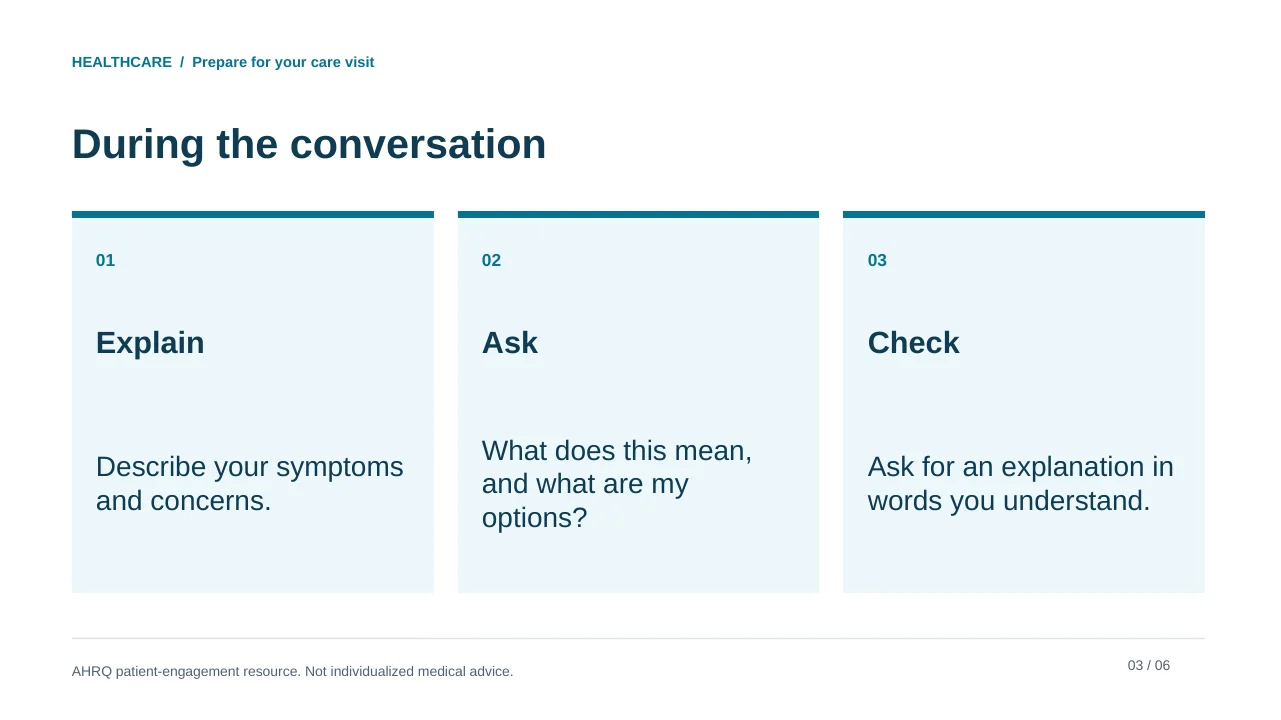
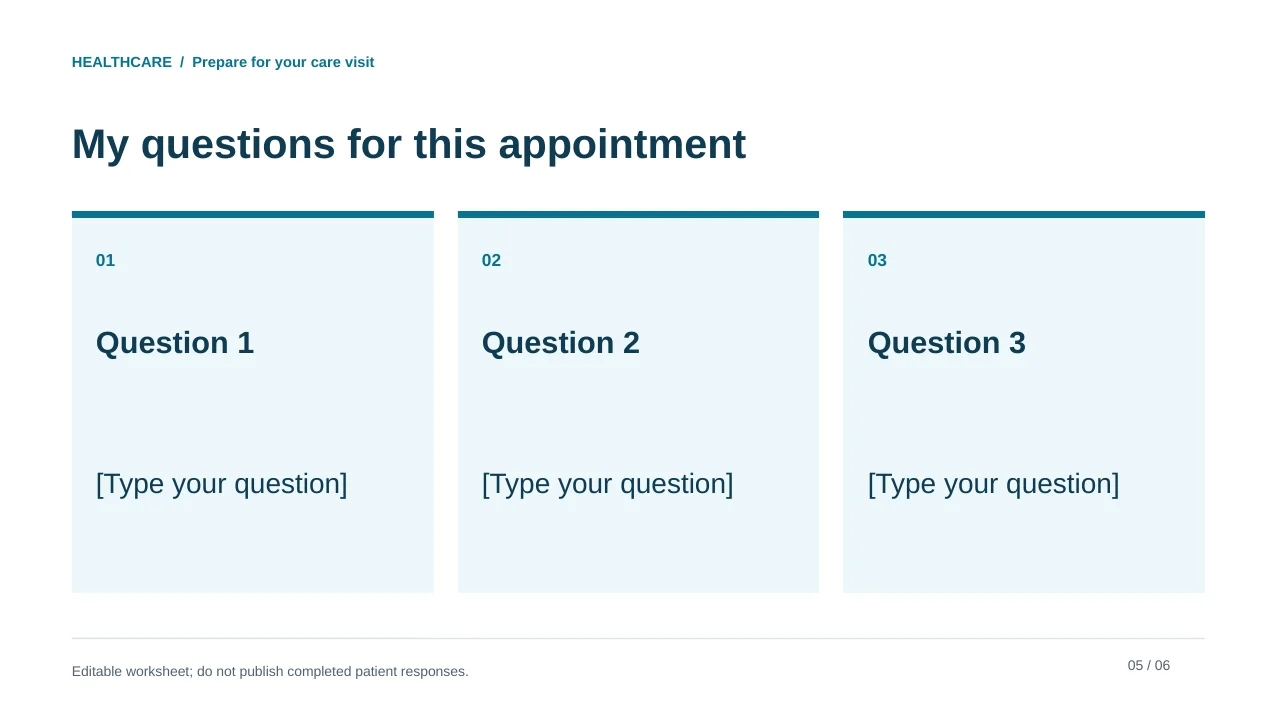
Original patient-education layout from a public AHRQ resource. Local clinical review is pending.
See the complete slide sequence
- Prepare for your care visit
- Before the visit
- During the conversation
- Leave with a clear follow-up plan
- My questions for this appointment
- Clinic review before distribution
Service quality review
Best for operational measures with visible denominators and review gates.
The operational example compares fictional missed visits: 18 of 120 in one month and 12 of 100 in another. That is 15% versus 12%. A three-percentage-point difference is not proof that an intervention worked; the denominator and context must stay visible.
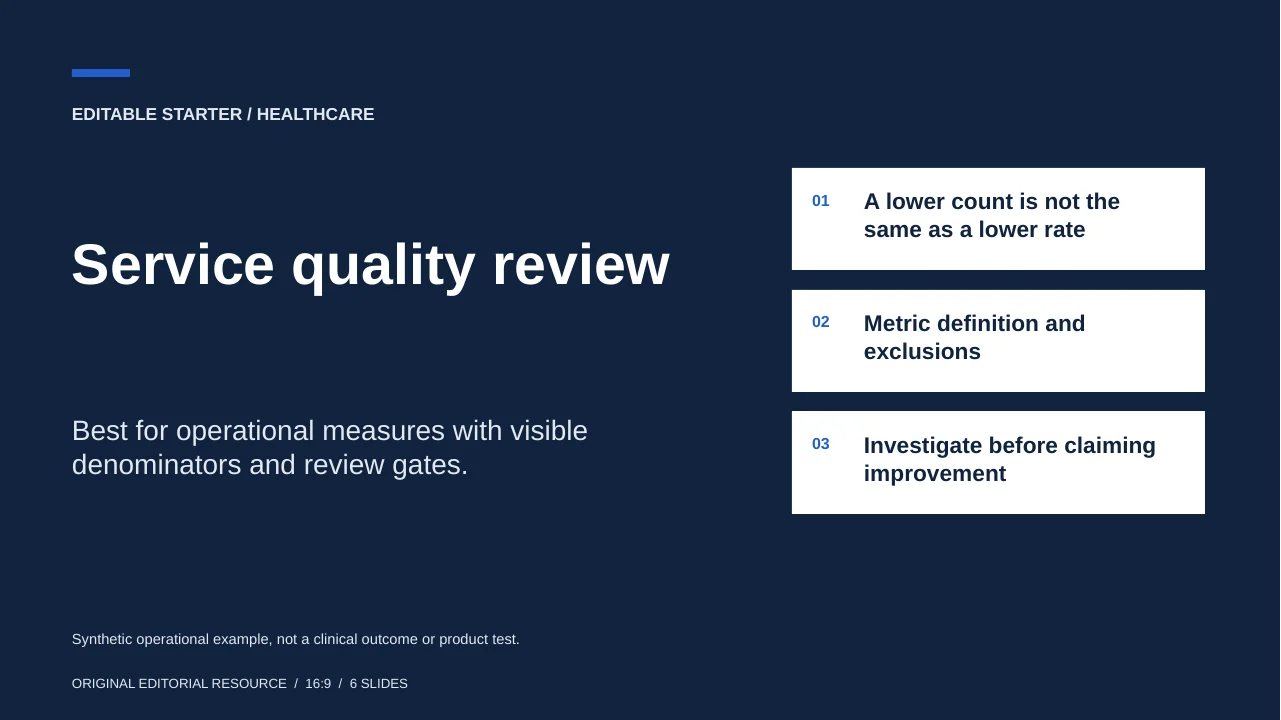
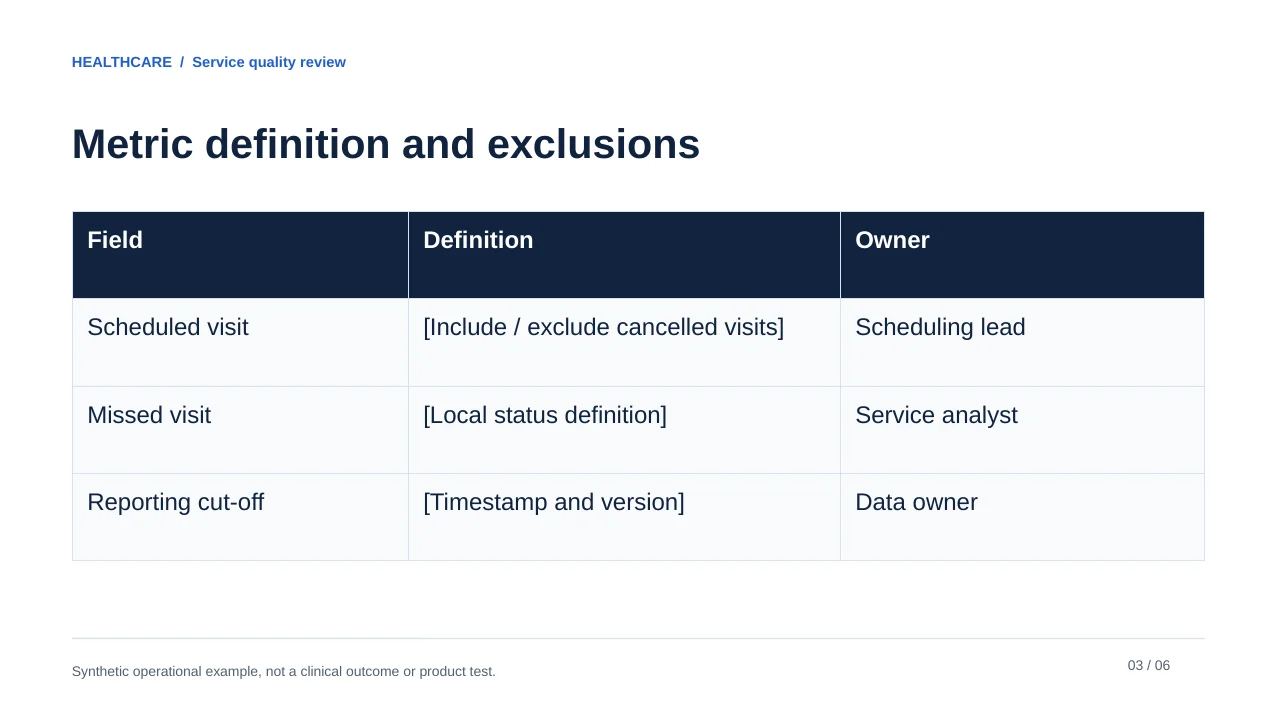
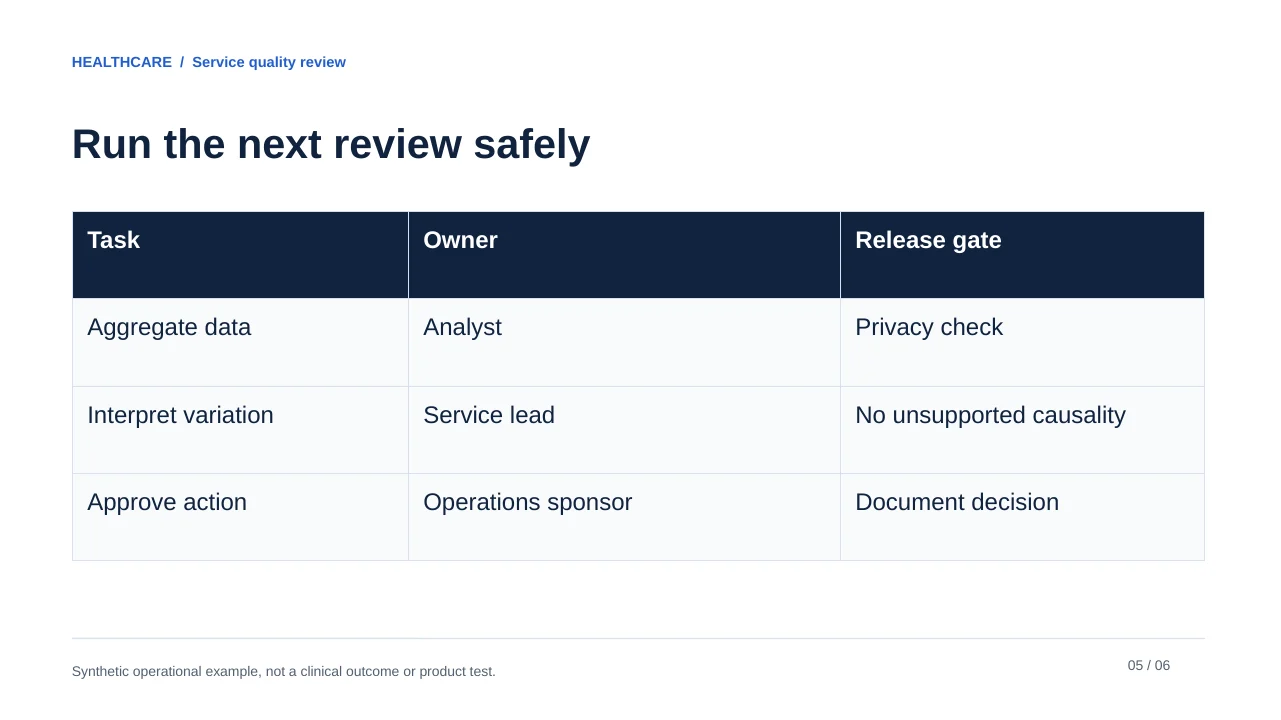
Synthetic operational example, not a clinical outcome or product test.
See the complete slide sequence
- Service quality review
- A lower count is not the same as a lower rate
- Metric definition and exclusions
- Investigate before claiming improvement
- Run the next review safely
- Sources and limits
Keep citations, charts and privacy in the layout
For a research deck, retain the study date and the specific source beside a number. For patient education, prefer a short, actionable question and a clear local contact process. For operations, retain the numerator, denominator, time period and definition on the chart or in an immediately accessible note.
The SPRINT paper and AHRQ patient resource support the respective worked examples. CONSORT reporting guidance is relevant to describing randomized trials; it does not clinically validate a slide deck. HHS de-identification guidance addresses a specific U.S. HIPAA context and is not a certificate of product compliance.
| Layout field | Why keep it | Before distribution |
|---|---|---|
| Source and date | Prevents a claim losing its provenance | Open the cited passage. |
| Rate definition | Prevents count/rate confusion | Recompute numerator and denominator. |
| Review status | Prevents a draft looking approved | Record the actual approver and date. |
| Privacy note | Flags data-handling constraints | Check approved service, access and content. |
Use a preview to choose; use review to approve
Download the PPTX to replace the example. The bar comparisons are native editable shapes, not automatically linked to clinical data. Check values, scales and source notes after editing. Keep identifiable information out of sample screenshots and do not use patient stories or photographs without the necessary authorization.
Sources and example provenance
The files and preview layouts on this page were created for this editorial resource. External references support the specific guidance linked in the text; they do not endorse the templates. Source links checked on October 15, 2026.
Frequently Asked Questions
Which healthcare template is best for patients?
The visit-preparation file uses a narrow patient task rather than a research presentation. It still requires local clinical, language and accessibility review.
Are the templates clinically approved?
No. They visibly retain pending review fields. Editorial rendering and file validation are not clinical sign-off.
Does the service chart use real patient data?
No. It uses fictional aggregate counts to demonstrate how to retain a denominator and avoid causal overclaiming.
Where are the healthcare drafting prompts?
Use the companion source-to-slide tutorial. The gallery focuses on selecting and downloading a suitable file.
Create your presentation with one click now
Turn a topic or reviewed source material into a first draft, then refine it for your audience.
Create your presentation