AI Healthcare Presentation: Source-to-Slide Examples and Prompts
Updated October 15, 2026 | Original editable examples and source notes
Use AI to move approved medical material into a draft that a qualified reviewer can trace back to its source. The two worked examples below serve different audiences: a journal club reviewing a published trial and patients preparing questions for a care visit. They show actual pages from downloadable editorial files, not a claim that a generator has validated medical content.
For layout selection rather than prompting, open the healthcare template gallery. The present tutorial owns the source-to-slide and review workflow; the gallery owns the choice among research, patient-education and service-review layouts.
1. Define the source and review boundary
| Audience | Source pack | Required review |
|---|---|---|
| Journal club | Original paper; supplement/protocol when used; publication date | Study methods, outcome definitions and interpretation. |
| Patient education | Approved patient resource and local contact instructions | Clinical wording, language, accessibility and local policy. |
| Operational review | Dated aggregate service data and definitions | Denominators, privacy and any causal claim. |
Record the exact source version, the audience, the date of the deck and the location supporting each material statement. CONSORT 2025 provides reporting guidance for randomized trials; a reporting checklist is not a quality score or a substitute for reading the paper.
2. Journal-club example: keep the study date and denominator
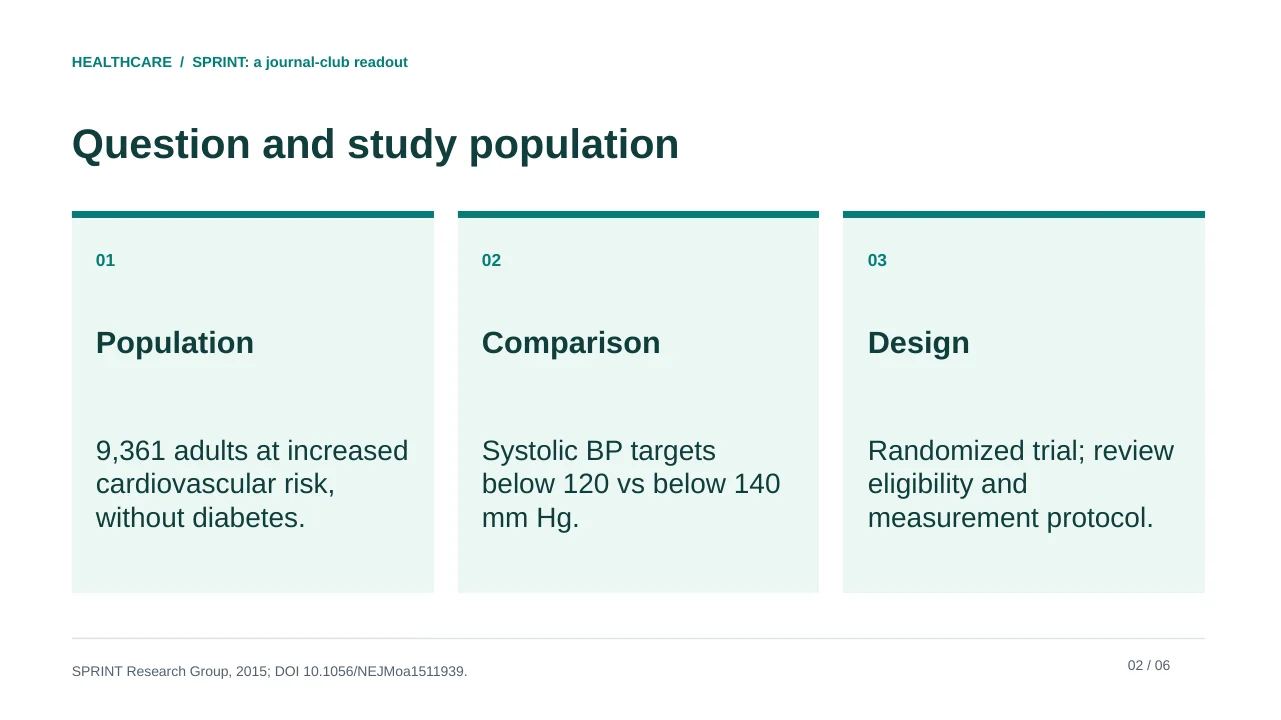
This example reads the 2015 SPRINT report as a historical paper, not current treatment guidance. The primary report describes 9,361 participants without diabetes and compares two systolic blood-pressure targets. Its primary-outcome rates and uncertainty belong to that study population and follow-up. The original report and the 2021 final report are separate sources; later results must not be silently substituted into a slide labeled 2015.
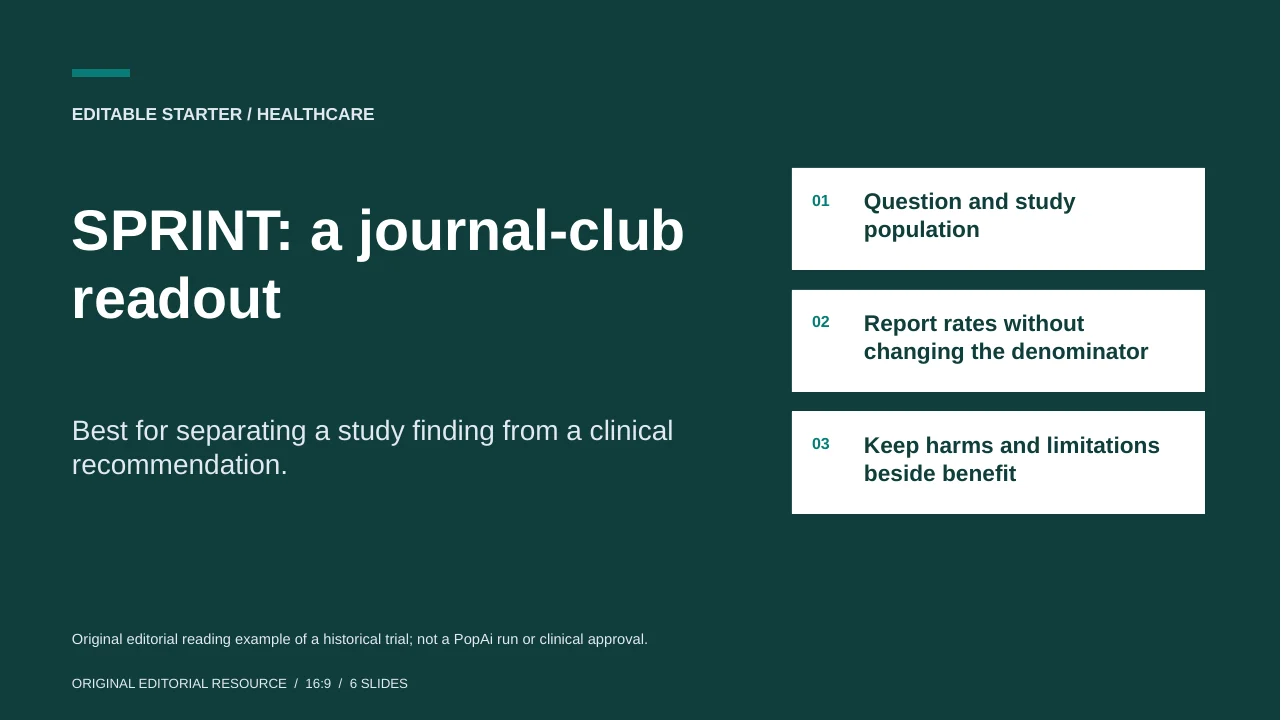
SPRINT: a journal-club readout
Best for separating a study finding from a clinical recommendation.
The preview puts the population, source date, event-rate denominator and review status on the slides. Clinical and statistical approval remain pending.
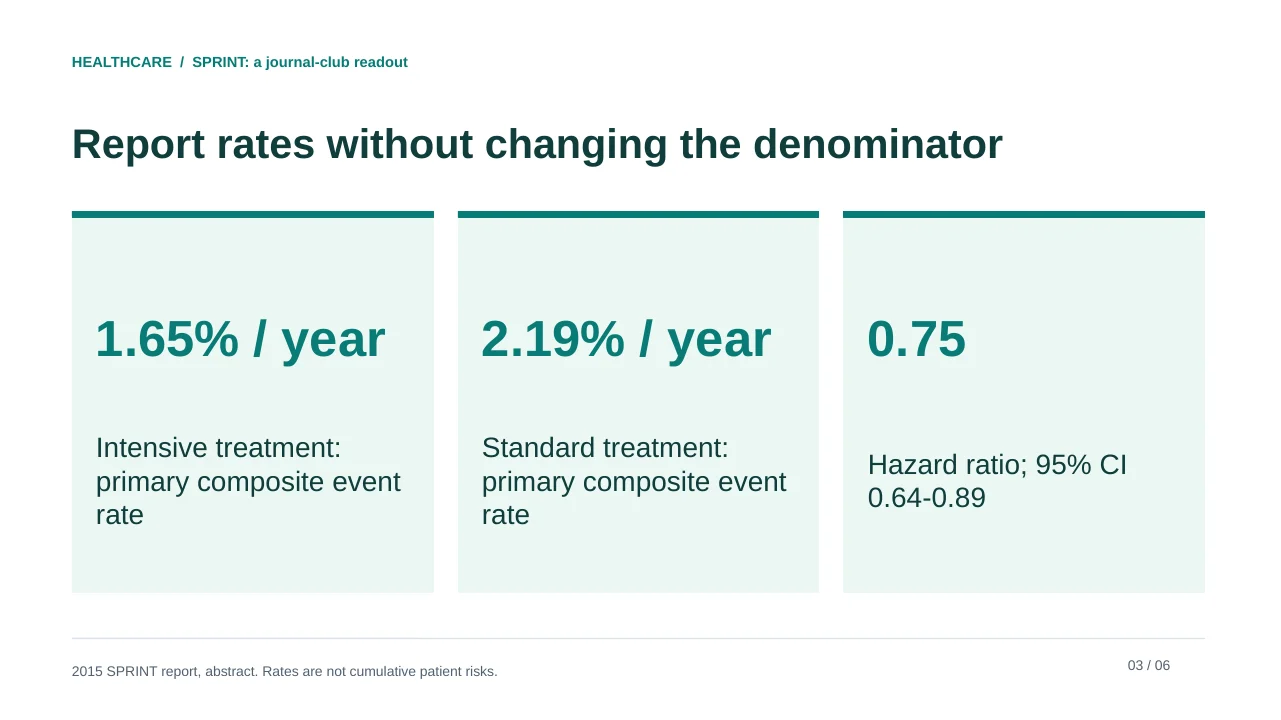
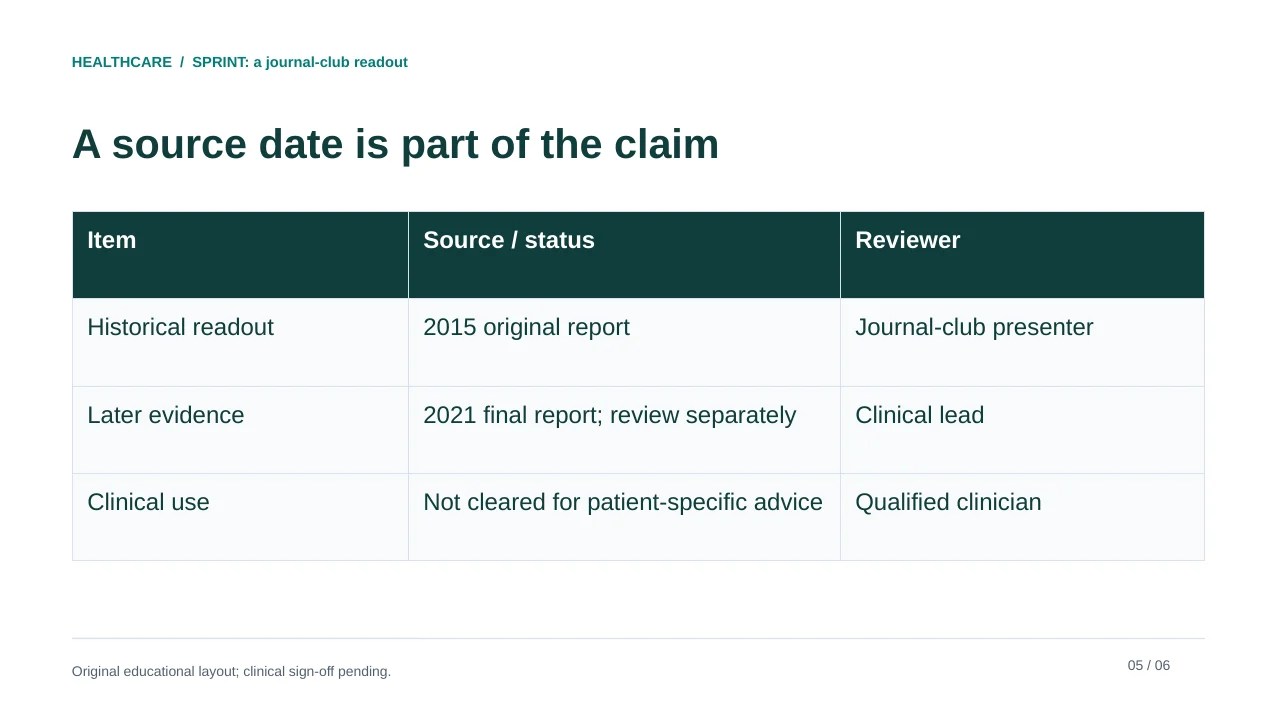
Original editorial reading example of a historical trial; not a PopAi run or clinical approval.
See the complete slide sequence
- SPRINT: a journal-club readout
- Question and study population
- Report rates without changing the denominator
- Keep harms and limitations beside benefit
- A source date is part of the claim
- Discussion, not a treatment instruction
Draft a six-slide journal-club reading of the supplied 2015 SPRINT report. Include the study question, population, comparison, primary outcome with the reported rate denominator and confidence interval, harms and limits, and discussion questions. Cite the source beside each numerical claim. Identify the 2021 final report as a separate follow-up reading; do not merge results. Do not turn trial targets into advice for an individual patient. Mark all clinical interpretation for a qualified reviewer.
3. Patient-education example: one practical visit task
The patient example uses AHRQ's appointment-preparation resource (reviewed November 2024). Its scope is preparing information, asking questions and clarifying follow-up. It deliberately contains no diagnosis, medication-change advice or invented clinic phone number.
Prepare for your care visit
Best for plain-language patient education about asking questions.
Each page has a source or review note. Before patient distribution, a local clinician and patient-education reviewer must approve the wording, audience fit and contact process.
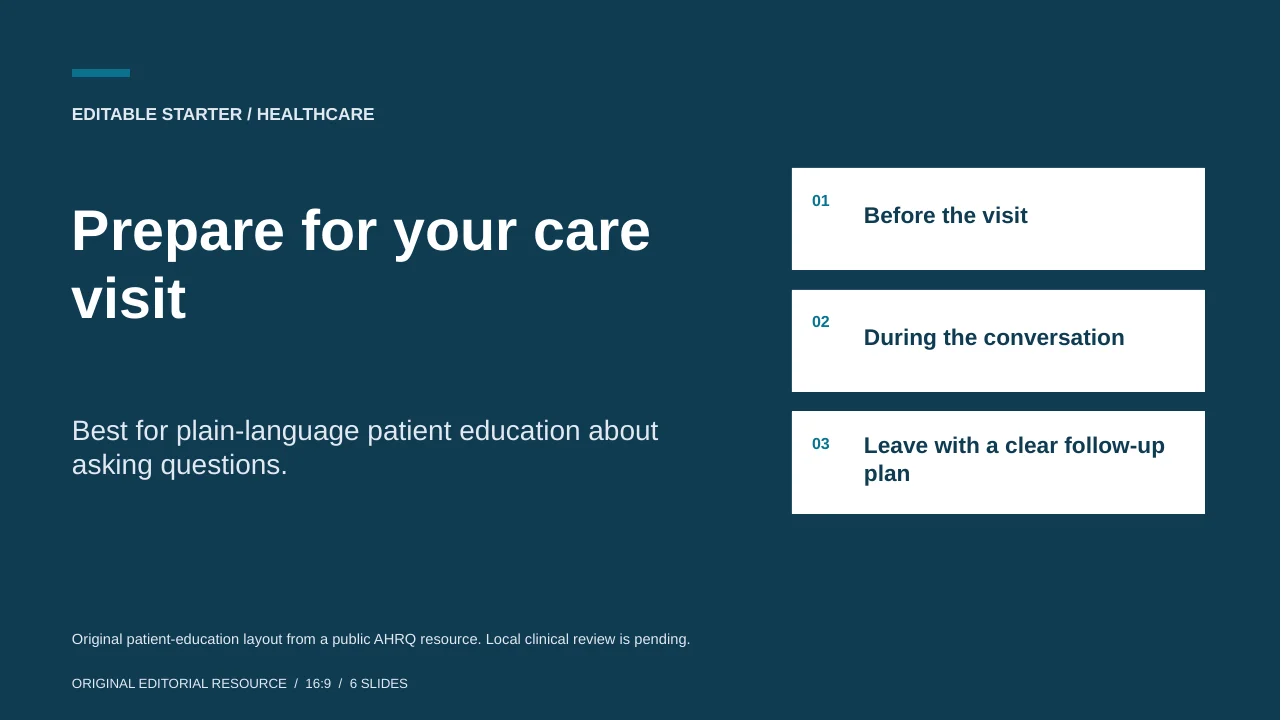
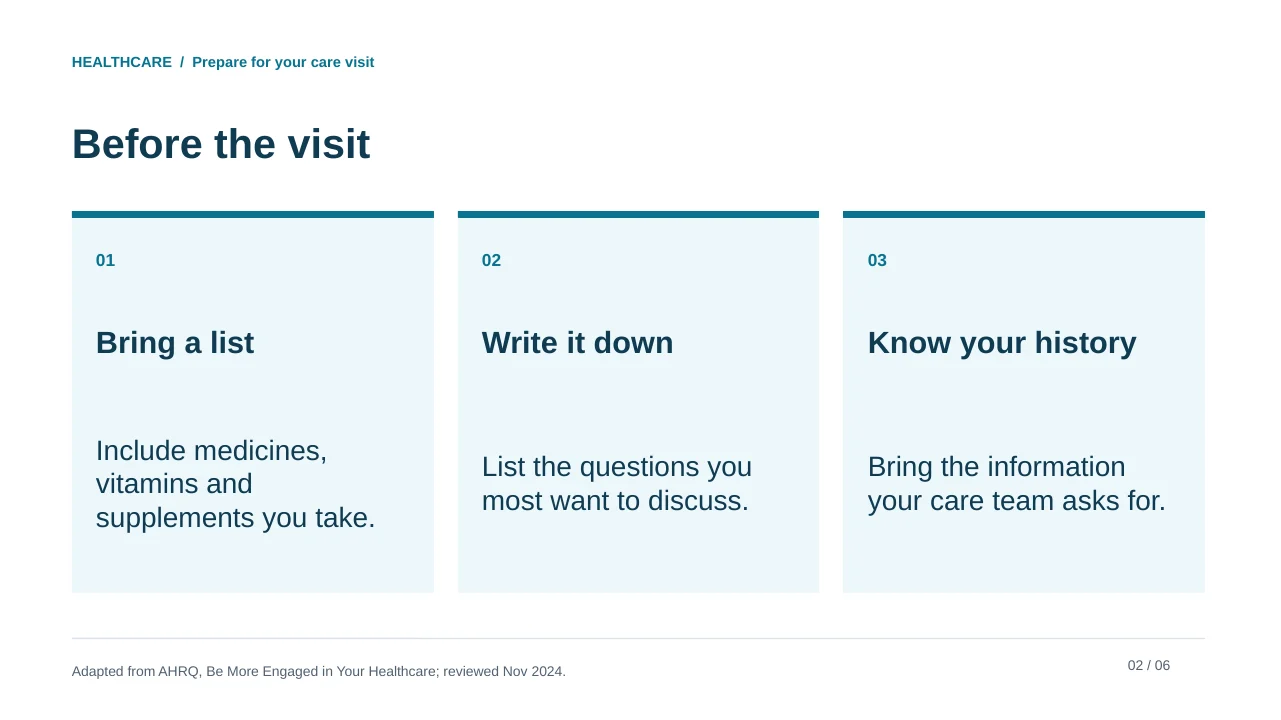
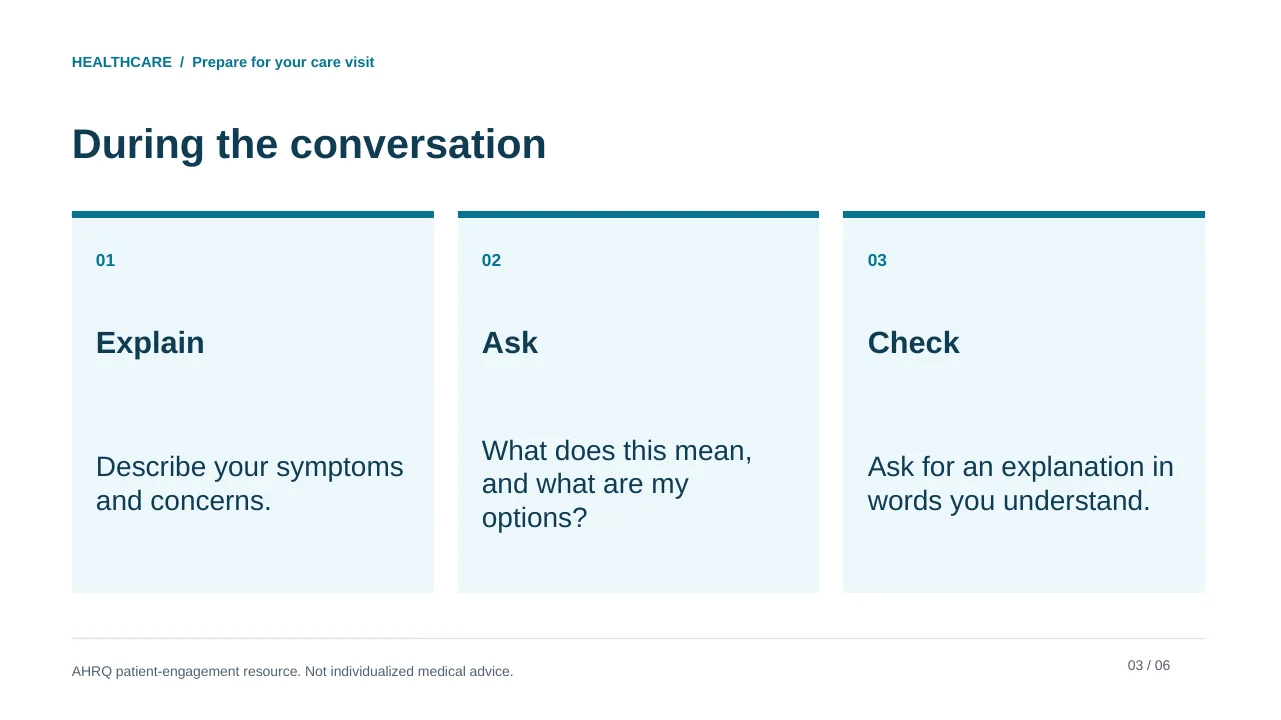
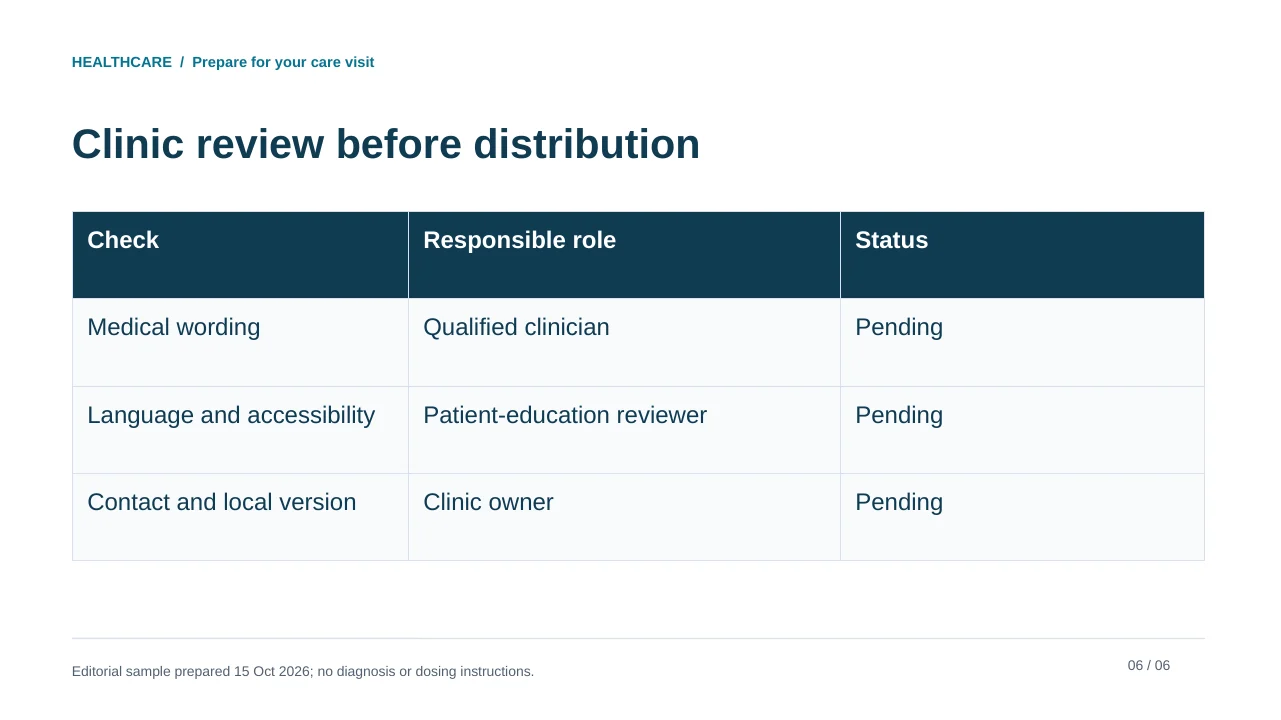
Original patient-education layout from a public AHRQ resource. Local clinical review is pending.
See the complete slide sequence
- Prepare for your care visit
- Before the visit
- During the conversation
- Leave with a clear follow-up plan
- My questions for this appointment
- Clinic review before distribution
Using only the supplied AHRQ appointment-preparation resource, draft six plain-language pages for adults attending a routine care visit: cover, before the visit, during the conversation, follow-up questions, a blank question worksheet, and a local review record. Keep the publication/review date. Do not invent clinical instructions, contacts, outcomes or endorsements. Flag the final version for clinical, language and accessibility review.
4. Release only a reviewed, source-matched version
Trace every claim to the cited passage and check that rates, counts and time horizons retain their meanings. If the deck includes patient information, assess whether the proposed service and account are authorized for that use before upload. Removing names is not, by itself, proof of de-identification. HHS's HIPAA de-identification guidance describes the U.S. covered-entity context and recognized methods; it does not certify an AI product or create a universal rule for other jurisdictions.
| Gate | Owner | Evidence to record |
|---|---|---|
| Source check | Presenter / clinical reviewer | Paper or resource version and claim locations. |
| Medical interpretation | Qualified clinician | Corrections, limits and approved audience. |
| Privacy | Authorized privacy owner | Data classification and permitted handling. |
| Distribution | Deck owner | Approval date, contact checks and accessible format. |
Sources and example provenance
The files and preview layouts on this page were created for this editorial resource. External references support the specific guidance linked in the text; they do not endorse the templates. Source links checked on October 15, 2026.
Frequently Asked Questions
Are these PopAi output screenshots?
No. They are original editorial PPTX examples rendered into previews. The source-to-slide prompts are provided, but a live product run is not claimed.
Are the medical examples ready to hand to patients?
No. Local clinical, language, privacy and accessibility review are still required and are marked as pending.
Why does the journal club use a 2015 study?
It demonstrates a source-dated historical reading. A separate link identifies the 2021 final report; neither is presented as current individual treatment guidance.
Where should I choose a layout?
Use the companion healthcare template gallery for research, patient education or operational reporting layouts, then apply this source-review workflow.
Create your presentation with one click now
Start from a topic or source document, shape the outline, and refine the slides with a human review.
Create your presentation