AI Tech Presentation: System Architecture Examples and Prompts
Updated October 19, 2026 | Architecture editing boundaries checked
This AI tech presentation guide focuses on a system-architecture decision. The worked case is a proposed support summarizer: sanitized input, approved-document context, a generated draft and mandatory human review. It is not a product-launch gallery or a broad AI-safety training course. No deployment or performance result is claimed.
1. Define the architecture decision and its evidence
Write the decision before writing the prompt: should the team authorize a scoped evaluation of this design? The source pack must identify components, interfaces, dependencies, access boundaries, failure paths and open questions. Keep a proposed component visibly different from a deployed one. A slide cannot establish that a service exists just because its name looks plausible.
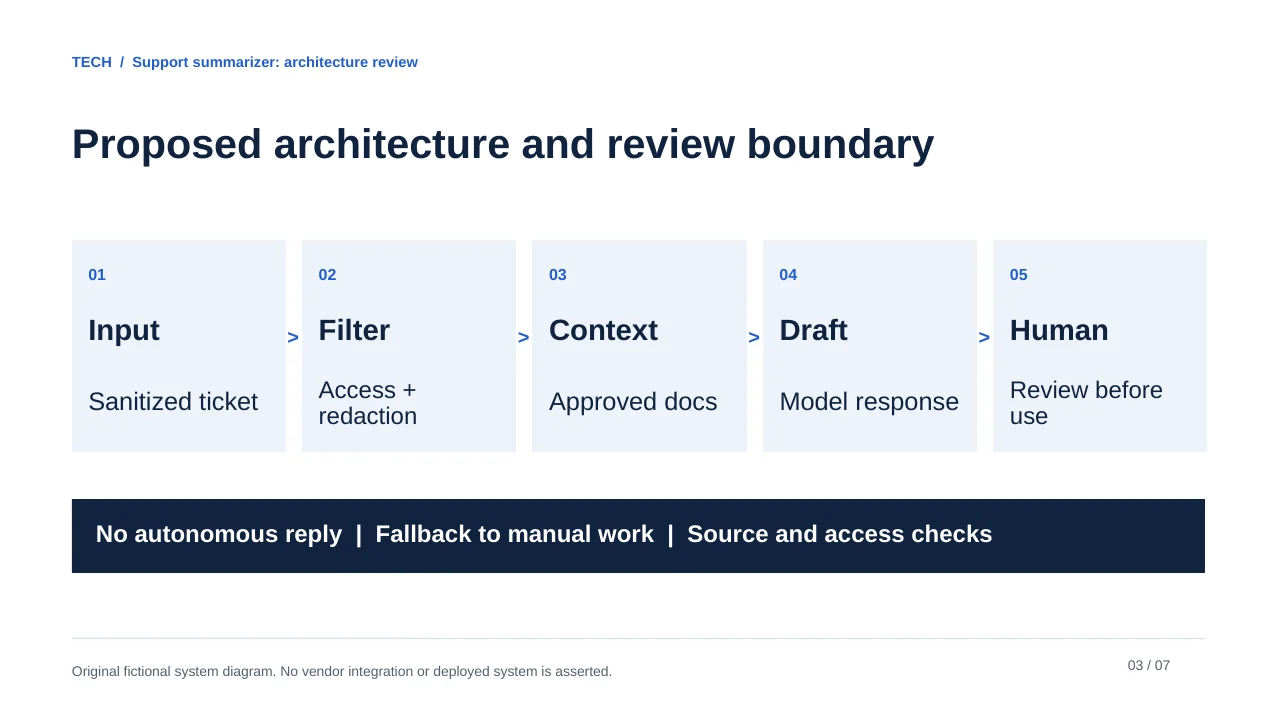
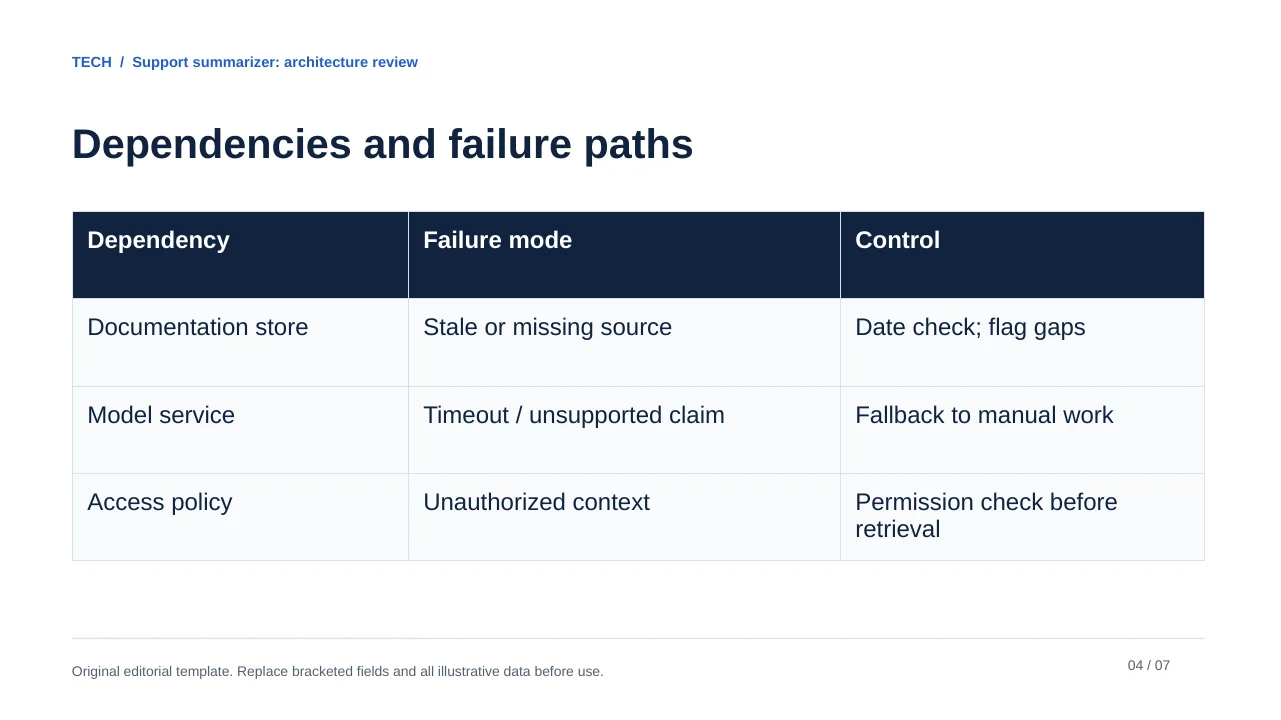
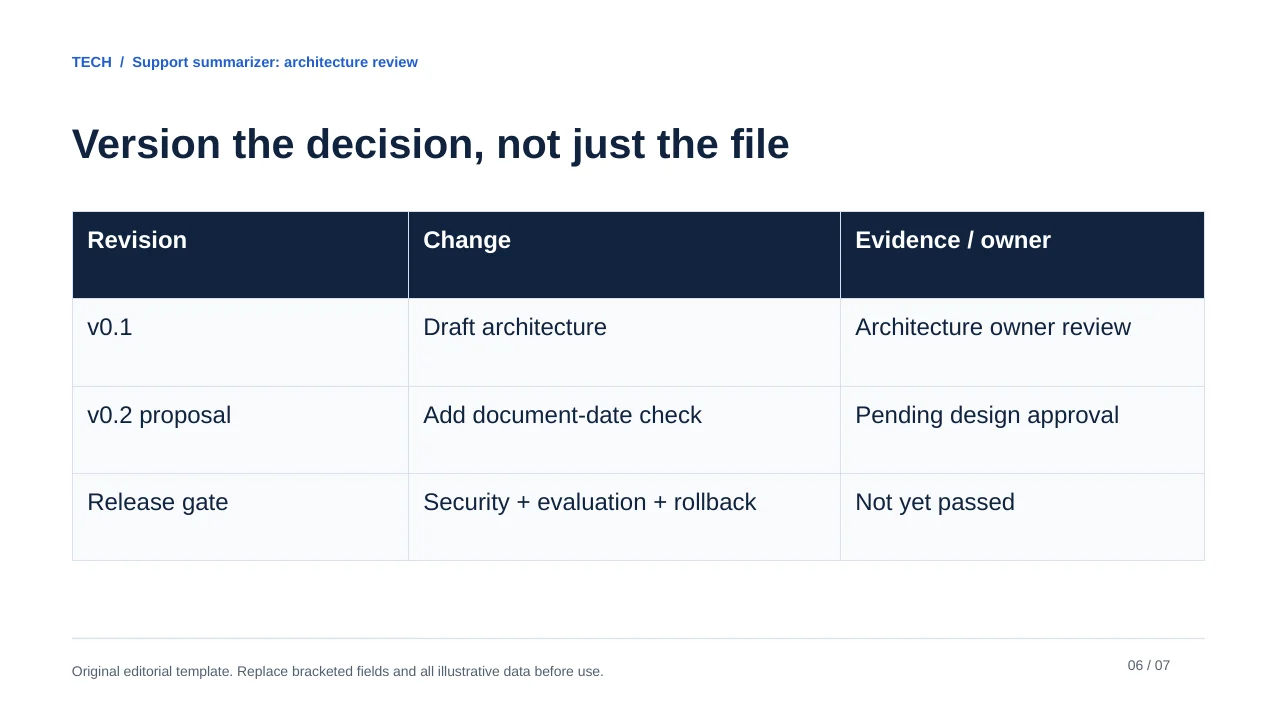
FICTIONAL TECHNICAL PROPOSAL v0.1: sanitized ticket -> permission/redaction filter -> approved-document context -> model draft -> mandatory human review. No autonomous reply or production deployment. Dependencies: documentation freshness, model service availability, access policy. No latency, quality, cost or load-test results exist. Proposed v0.2 adds a document-date check. Decision: authorize evaluation, not rollout.
2. Inspect the architecture, dependencies and release gates
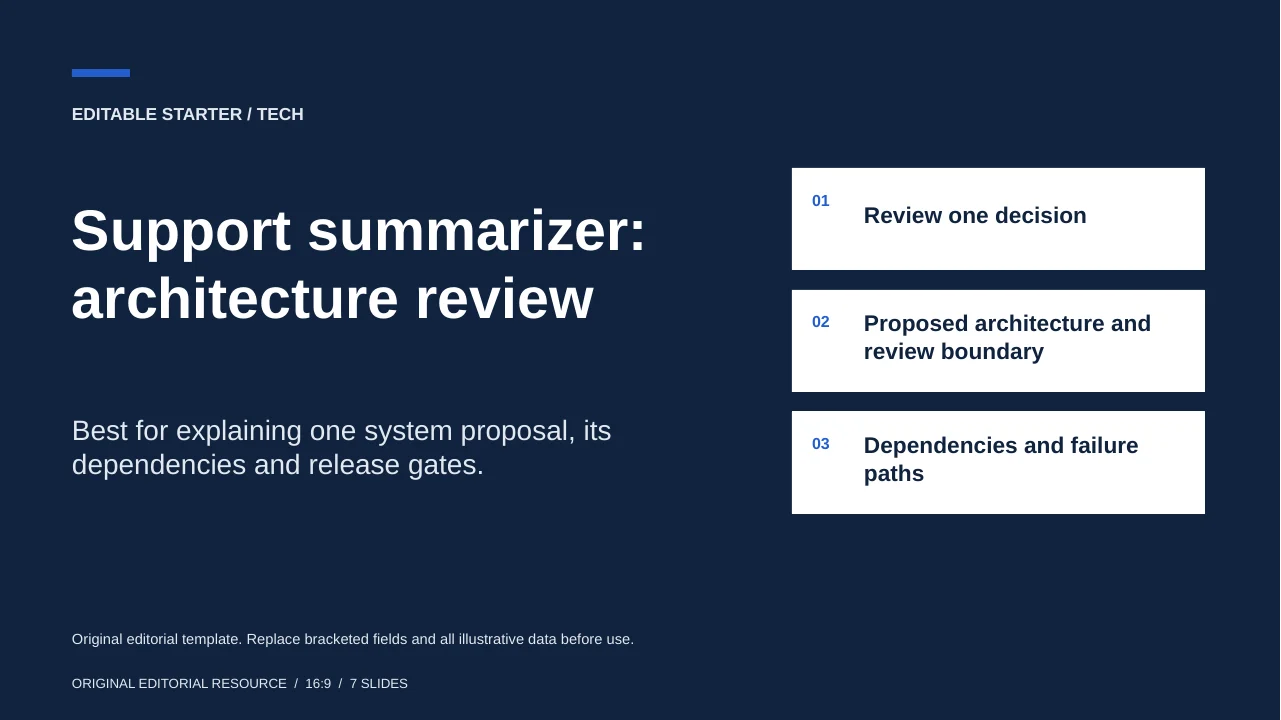
Support summarizer: architecture review
Best for explaining one system proposal, its dependencies and release gates.
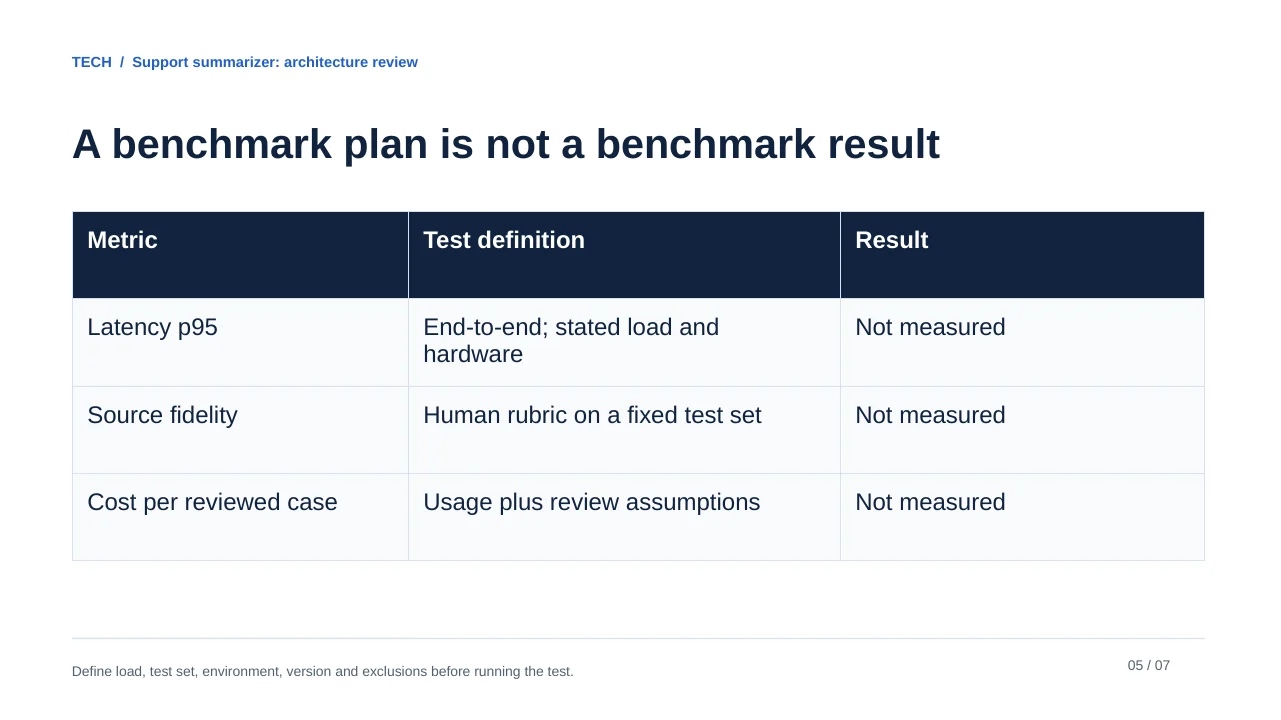
This seven-page technical example includes an editable system diagram, dependency table, benchmark plan, change record and decision gates. "Not measured" is intentional: no experiment has been run.
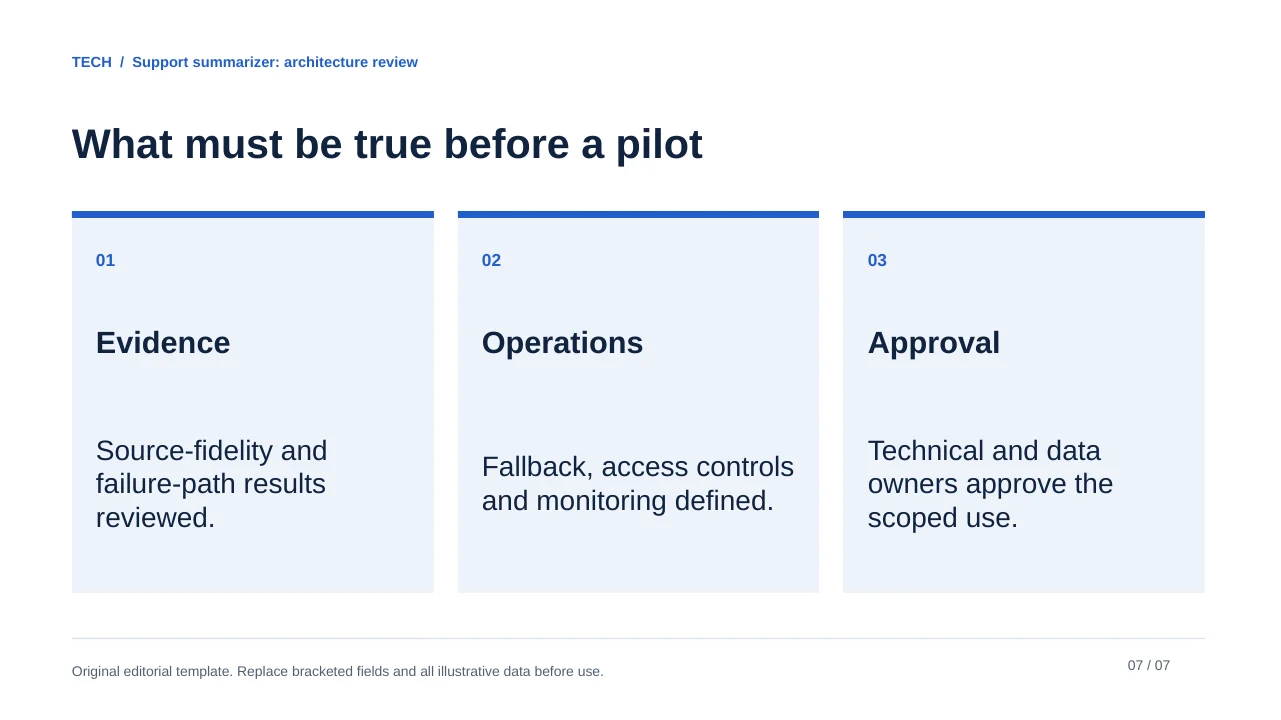
Original editorial template. Replace bracketed fields and all illustrative data before use.
See the complete slide sequence
- Support summarizer: architecture review
- Review one decision
- Proposed architecture and review boundary
- Dependencies and failure paths
- A benchmark plan is not a benchmark result
- Version the decision, not just the file
- What must be true before a pilot
Editing this diagram: its nodes, labels and direction markers are separate editable objects, not a flattened screenshot. The direction markers are text shapes, not attached connectors: if you move a node, reposition its marker manually. The dependency tables are native PowerPoint tables.
A latency claim is meaningless without the workload and environment. AWS's load-testing guidance recommends production-like conditions, defined scenarios and documented findings. Here it informs the test plan, not a claim that the fictional design passed a benchmark.
3. Prompt for a reviewable system description
Create a seven-slide system architecture review from the supplied fictional v0.1 brief. Include the decision, a labeled architecture diagram, dependencies and failure paths, a performance-evaluation plan, the proposed v0.2 change and release gates. Show access/redaction before retrieval and human review before output use. Do not invent APIs, deployed services, latency, accuracy, cost or test results. Every performance field remains Not measured until evidence is supplied. Label proposals and pending approvals.
4. Review diagram semantics, not just alignment
| Check | Required evidence | Common failure |
|---|---|---|
| Architecture | Each node and edge maps to the design brief. | A generated arrow invents a data path. |
| Permissions | Access rules precede use of restricted material. | A diagram omits the trust boundary. |
| Performance | Metric, load, hardware, version and test set are named. | A number is presented without a test. |
| Change | Version identifies what changed and who reviews it. | A proposed control is described as implemented. |
| Operations | Fallback and rollback responsibilities are defined. | A demo becomes a rollout commitment. |
After any generator or editor export, check that diagram labels remain readable and that the failure path has not disappeared. Use a brief demo or a recording only when the content is authorized; do not expose credentials or customer tickets. AI-safety training can use a different audience and learning structure, but it is no longer the primary example on this page.
Sources and example provenance
The files and preview layouts on this page were created for this editorial resource. External references support the specific guidance linked in the text; they do not endorse the templates. Source links checked on October 15, 2026.
Frequently Asked Questions
Was the support summarizer deployed or benchmarked?
No. It is a fictional architecture proposal. Performance fields are explicitly not measured and the release gates are pending.
What makes this a technical presentation rather than a product pitch?
It centers on architecture, dependencies, failure paths, evaluation conditions and a decision record instead of feature marketing.
Is the architecture diagram editable?
Yes. The supplied PPTX uses separate native shapes and text, not a single flattened diagram image.
Can I reuse the benchmark table as results?
Only after conducting and documenting the relevant tests. The supplied table is a plan with missing results, not evidence of performance.