Presentation Summary
The Supreme Court faces a constitutional crisis in Trump v. Barbara, challenging 160 years of citizenship law and the 14th Amendment's Citizenship Clause.
Full Presentation Transcript
Slide 1: Supreme Court Birthright Citizenship: Trump v. Barbara
A Constitutional Crisis Over the 14th Amendment's Citizenship Clause
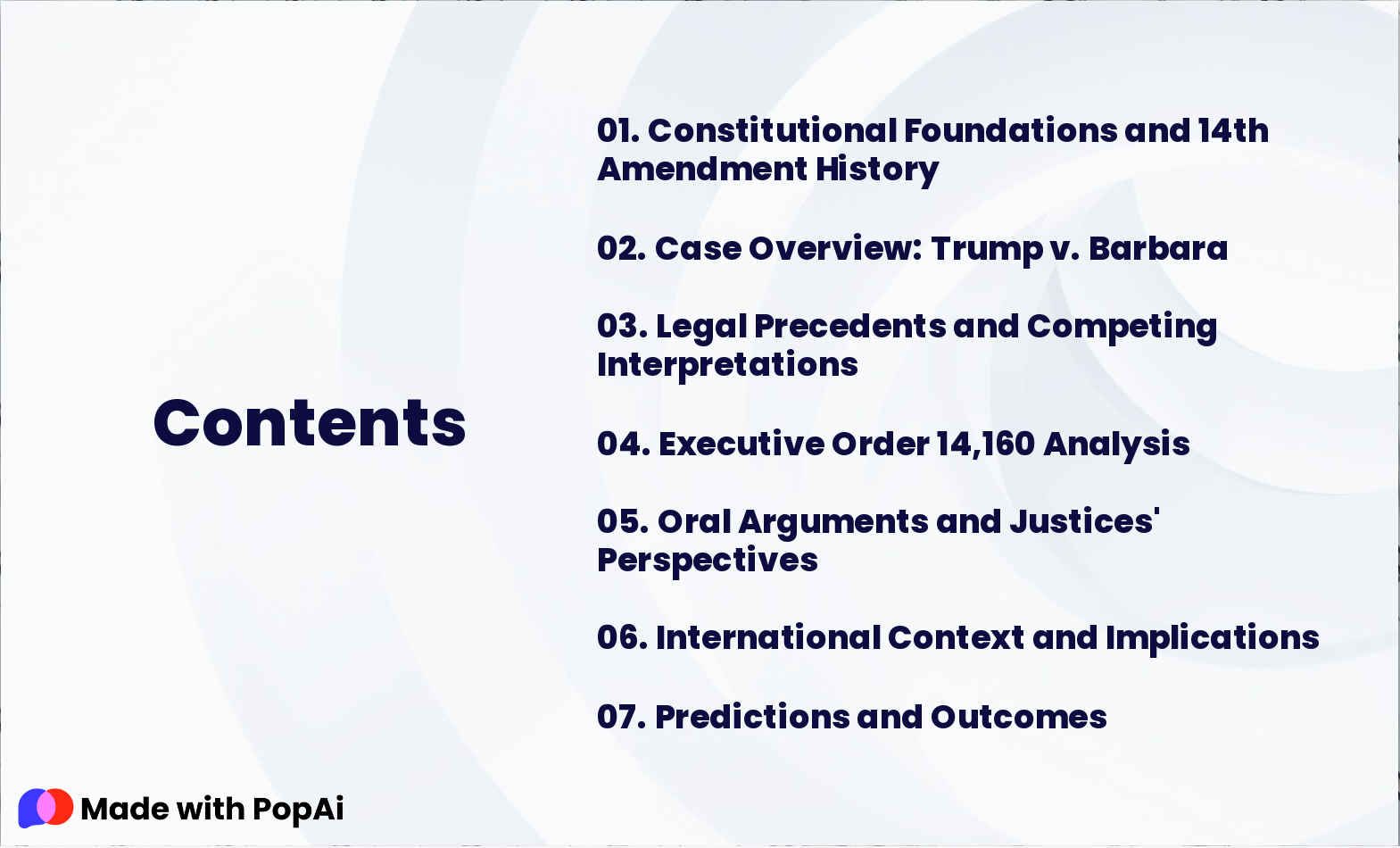
Slide 2: Contents
- Constitutional Foundations and 14th Amendment History
- Case Overview: Trump v. Barbara
- Legal Precedents and Competing Interpretations
- Executive Order 14,160 Analysis
- Oral Arguments and Justices' Perspectives
- International Context and Implications
- Predictions and Outcomes
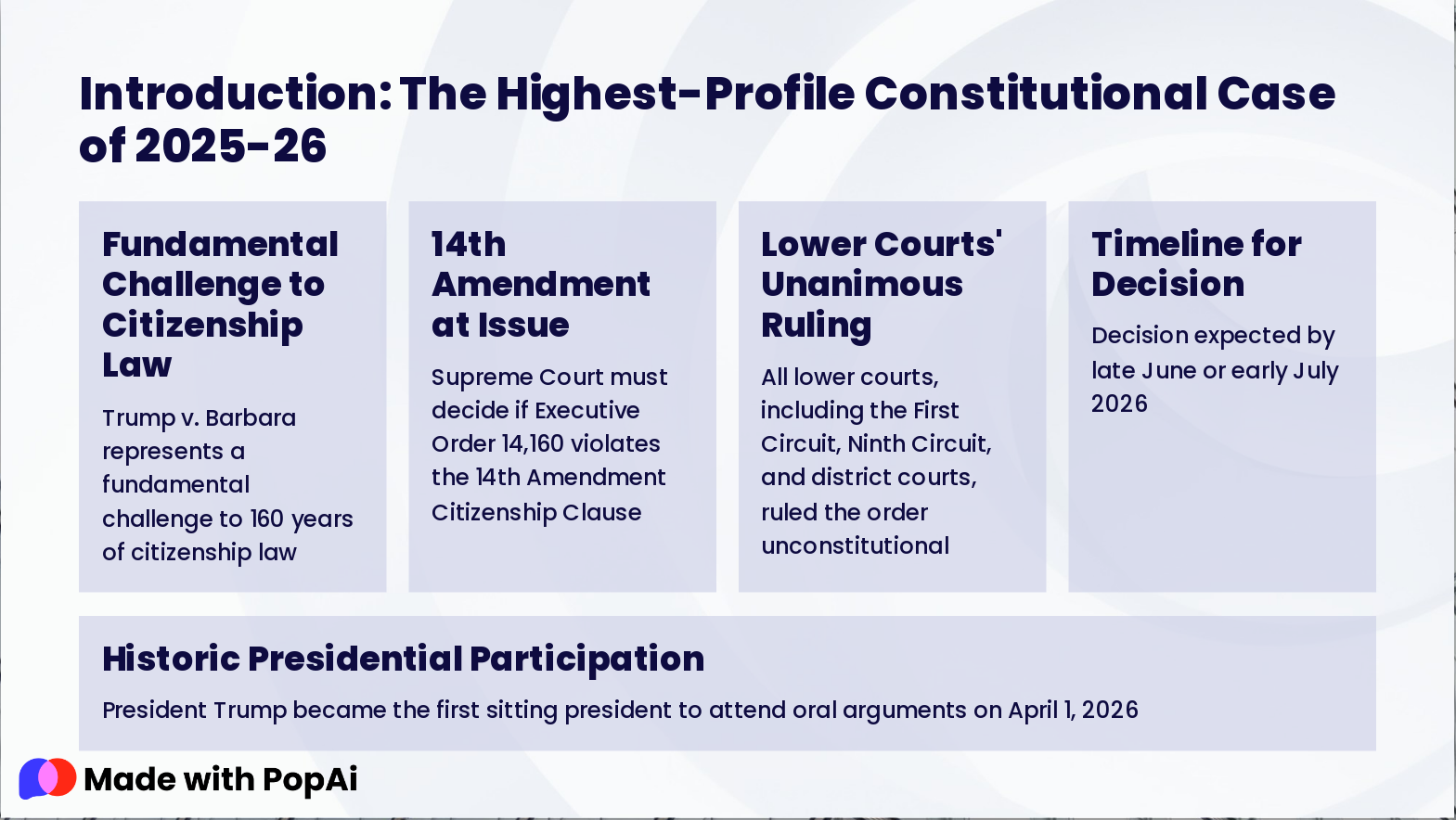
Slide 3: Introduction: The Highest-Profile Constitutional Case of 2025-26
- Fundamental Challenge to Citizenship Law: Trump v. Barbara represents a fundamental challenge to 160 years of citizenship law
- 14th Amendment at Issue: Supreme Court must decide if Executive Order 14,160 violates the 14th Amendment Citizenship Clause
- Lower Courts' Unanimous Ruling: All lower courts, including the First Circuit, Ninth Circuit, and district courts, ruled the order unconstitutional
- Timeline for Decision: Decision expected by late June or early July 2026
- Historic Presidential Participation: President Trump became the first sitting president to attend oral arguments on April 1, 2026
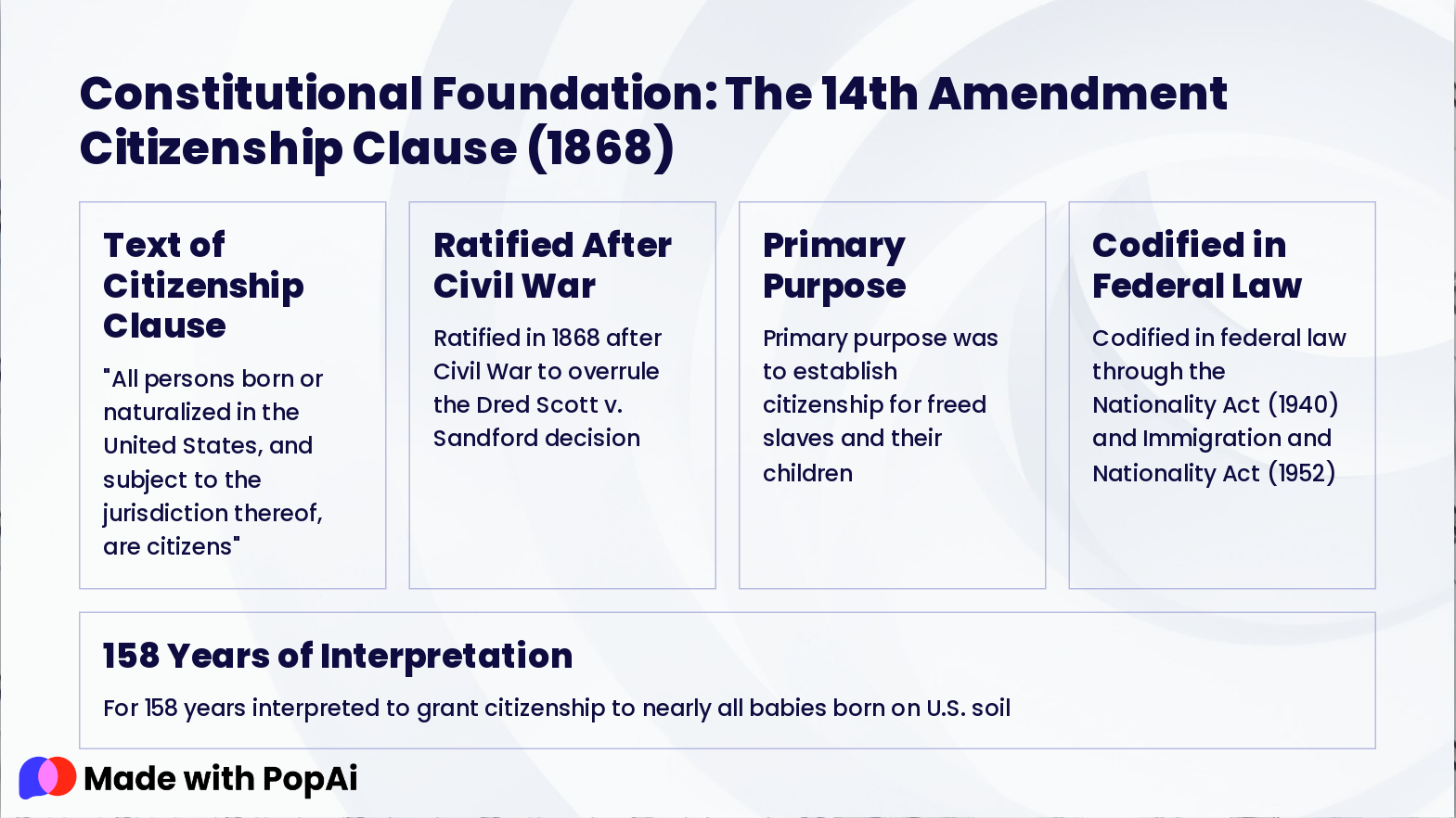
Slide 4: Constitutional Foundation: The 14th Amendment Citizenship Clause (1868)
- Text of Citizenship Clause: "All persons born or naturalized in the United States, and subject to the jurisdiction thereof, are citizens"
- Ratified After Civil War: Ratified in 1868 after Civil War to overrule the Dred Scott v. Sandford decision
- Primary Purpose: Primary purpose was to establish citizenship for freed slaves and their children
- Codified in Federal Law: Codified in federal law through the Nationality Act (1940) and Immigration and Nationality Act (1952)
- 158 Years of Interpretation: For 158 years interpreted to grant citizenship to nearly all babies born on U.S. soil
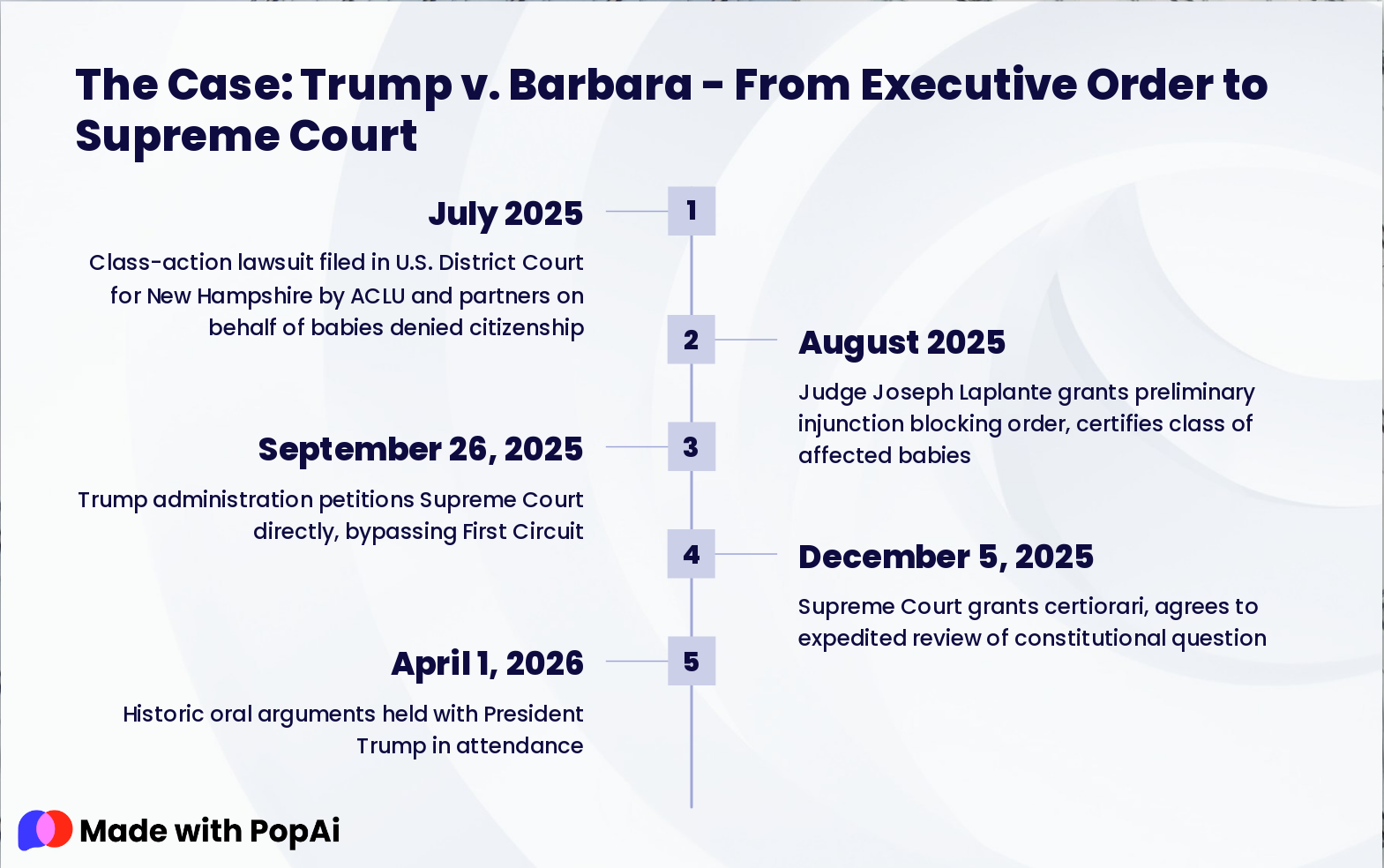
Slide 5: The Case: Trump v. Barbara - From Executive Order to Supreme Court
- July 2025: Class-action lawsuit filed in U.S. District Court for New Hampshire by ACLU and partners on behalf of babies denied citizenship
- August 2025: Judge Joseph Laplante grants preliminary injunction blocking order, certifies class of affected babies
- September 26, 2025: Trump administration petitions Supreme Court directly, bypassing First Circuit
- December 5, 2025: Supreme Court grants certiorari, agrees to expedited review of constitutional question
- April 1, 2026: Historic oral arguments held with President Trump in attendance
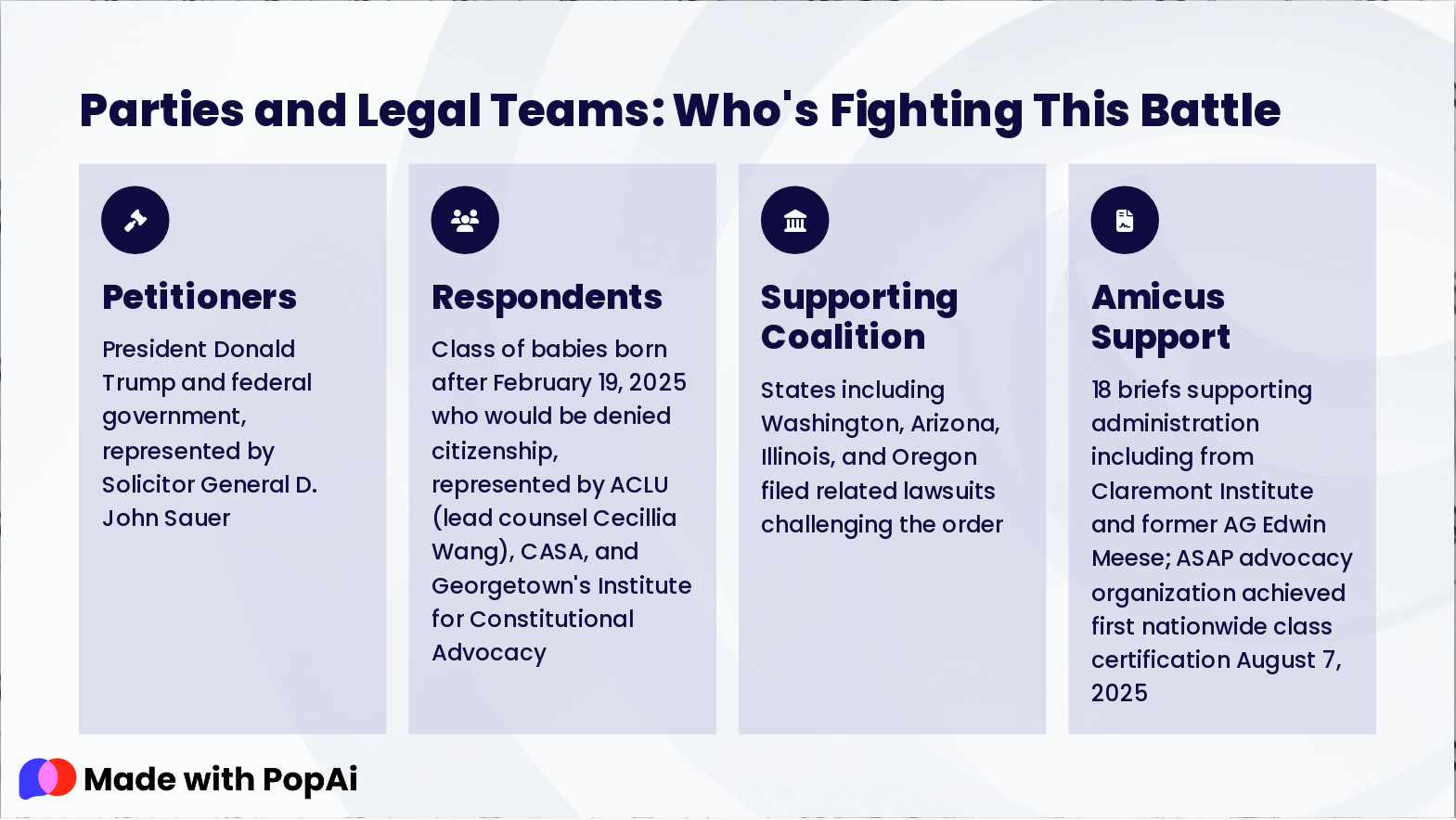
Slide 6: Parties and Legal Teams: Who's Fighting This Battle
- Petitioners: President Donald Trump and federal government, represented by Solicitor General D. John Sauer
- Respondents: Class of babies born after February 19, 2025 who would be denied citizenship, represented by ACLU (lead counsel Cecillia Wang), CASA, and Georgetown's Institute for Constitutional Advocacy
- Supporting Coalition: States including Washington, Arizona, Illinois, and Oregon filed related lawsuits challenging the order
- Amicus Support: 18 briefs supporting administration including from Claremont Institute and former AG Edwin Meese; ASAP advocacy organization achieved first nationwide class certification August 7, 2025
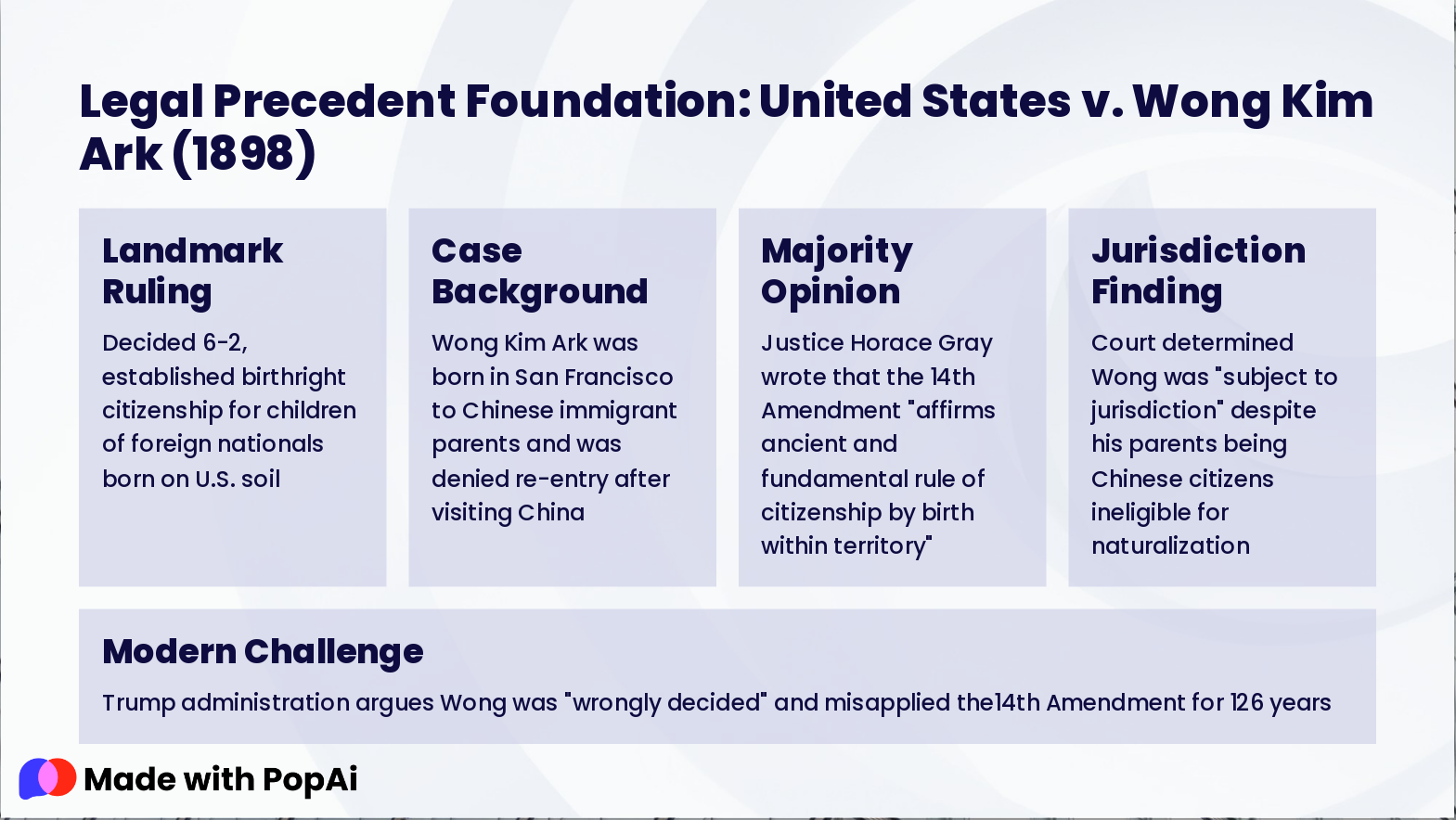
Slide 7: Legal Precedent Foundation: United States v. Wong Kim Ark (1898)
- Landmark Ruling: Decided 6-2, established birthright citizenship for children of foreign nationals born on U.S. soil
- Case Background: Wong Kim Ark was born in San Francisco to Chinese immigrant parents and was denied re-entry after visiting China
- Majority Opinion: Justice Horace Gray wrote that the 14th Amendment "affirms ancient and fundamental rule of citizenship by birth within territory"
- Jurisdiction Finding: Court determined Wong was "subject to jurisdiction" despite his parents being Chinese citizens ineligible for naturalization
- Modern Challenge: Trump administration argues Wong was "wrongly decided" and misapplied the14th Amendment for 126 years
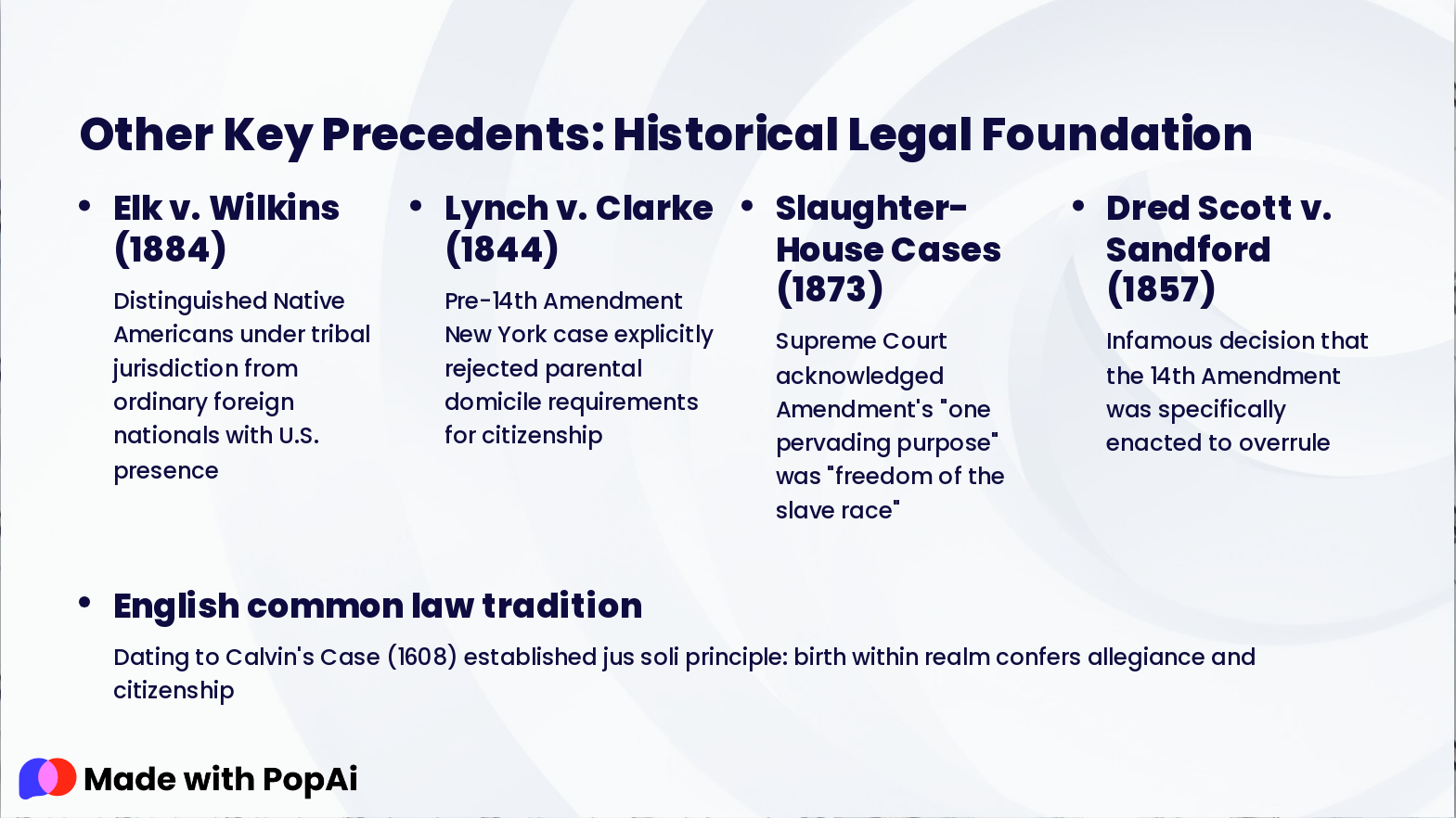
Slide 8: Other Key Precedents: Historical Legal Foundation
- Elk v. Wilkins (1884): Distinguished Native Americans under tribal jurisdiction from ordinary foreign nationals with U.S. presence
- Lynch v. Clarke (1844): Pre-14th Amendment New York case explicitly rejected parental domicile requirements for citizenship
- Slaughter-House Cases (1873): Supreme Court acknowledged Amendment's "one pervading purpose" was "freedom of the slave race"
- Dred Scott v. Sandford (1857): Infamous decision that the 14th Amendment was specifically enacted to overrule
- English common law tradition: Dating to Calvin's Case (1608) established jus soli principle: birth within realm confers allegiance and citizenship
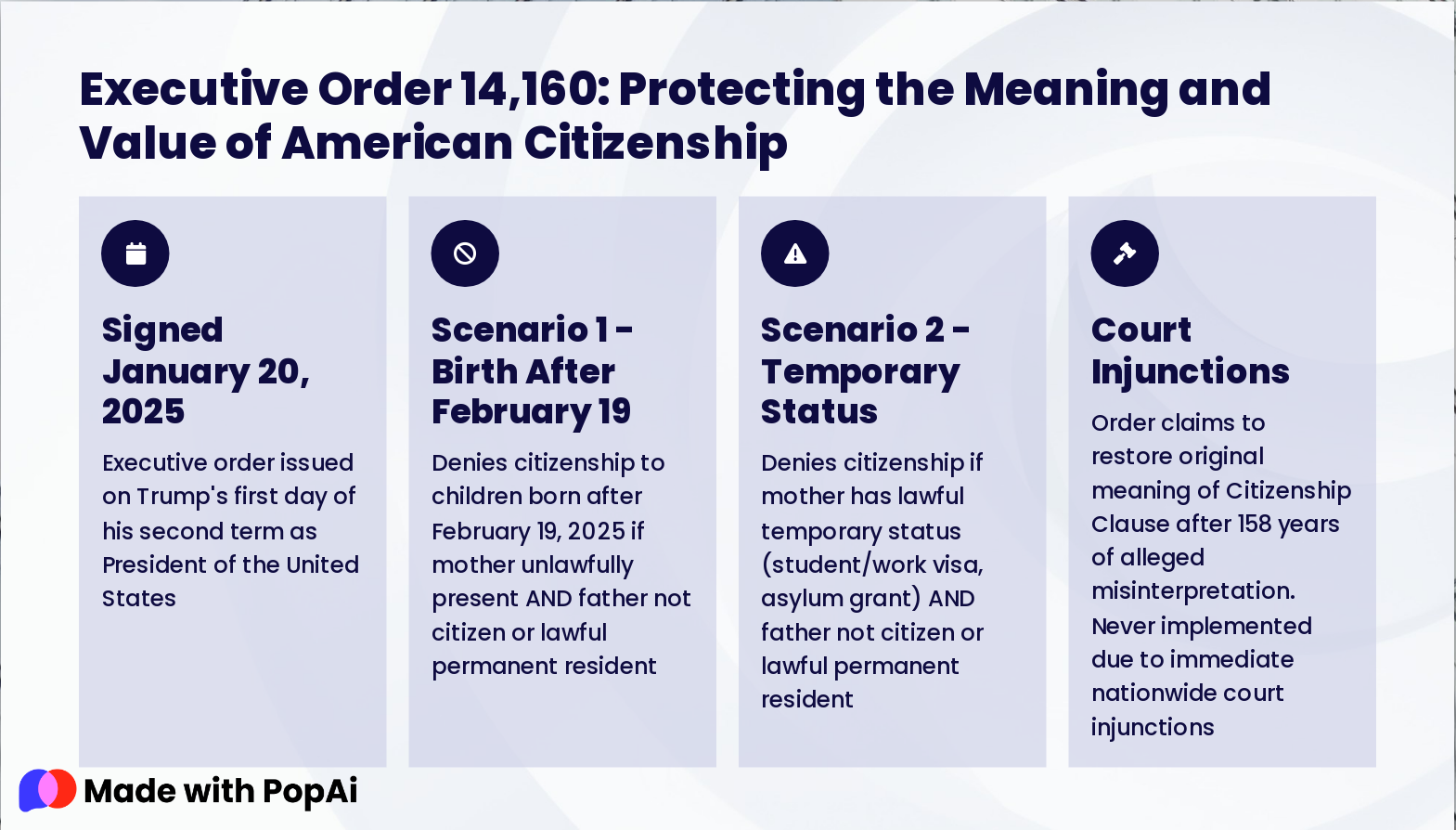
Slide 9: Executive Order 14,160: Protecting the Meaning and Value of American Citizenship
- Signed January 20, 2025: Executive order issued on Trump's first day of his second term as President of the United States
- Scenario 1 - Birth After February 19: Denies citizenship to children born after February 19, 2025 if mother unlawfully present AND father not citizen or lawful permanent resident
- Scenario 2 - Temporary Status: Denies citizenship if mother has lawful temporary status (student/work visa, asylum grant) AND father not citizen or lawful permanent resident
- Court Injunctions: Order claims to restore original meaning of Citizenship Clause after 158 years of alleged misinterpretation. Never implemented due to immediate nationwide court injunctions
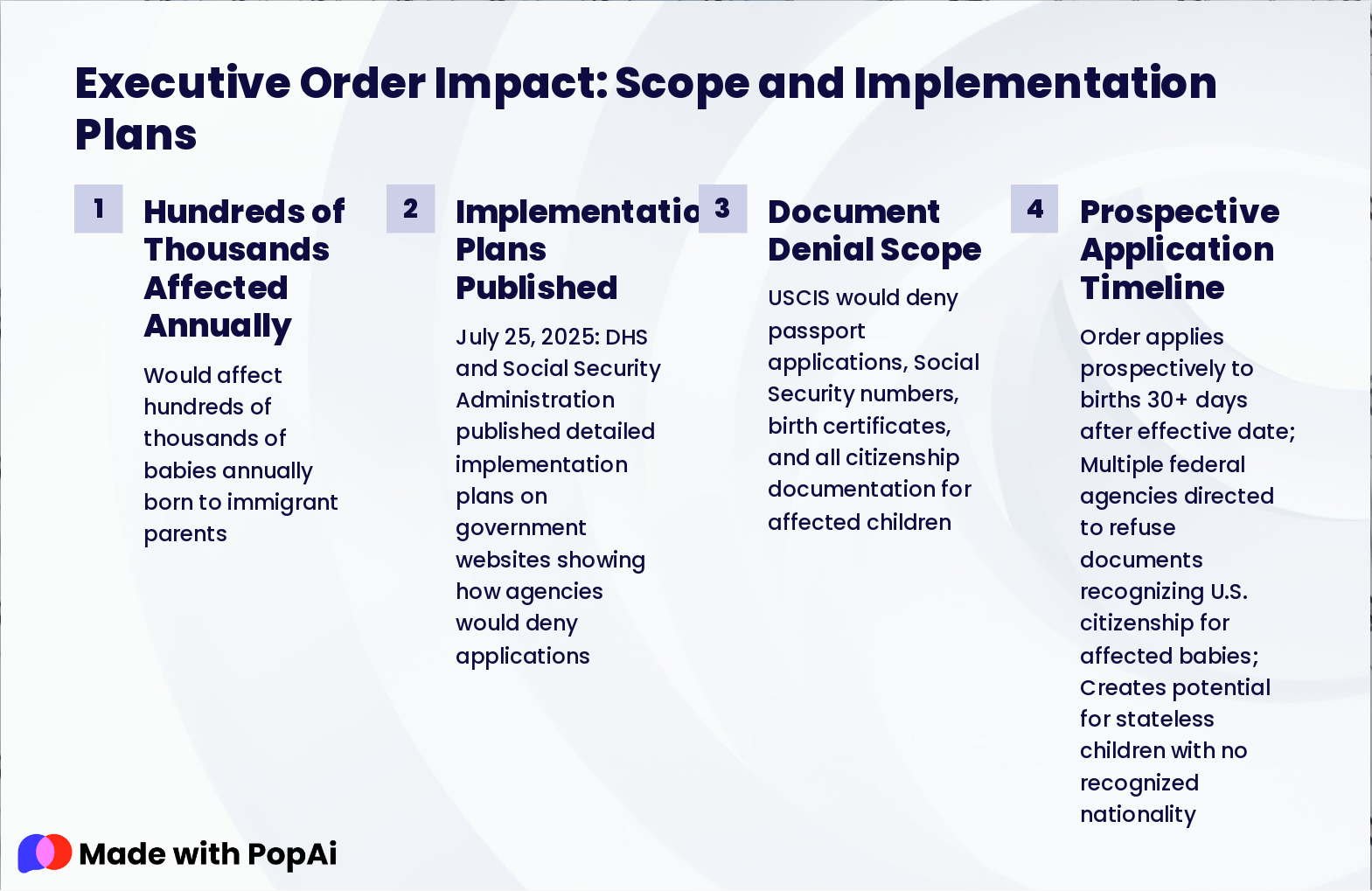
Slide 10: Executive Order Impact: Scope and Implementation Plans
- Hundreds of Thousands Affected Annually: Would affect hundreds of thousands of babies annually born to immigrant parents
- Implementation Plans Published: July 25, 2025: DHS and Social Security Administration published detailed implementation plans on government websites showing how agencies would deny applications
- Document Denial Scope: USCIS would deny passport applications, Social Security numbers, birth certificates, and all citizenship documentation for affected children
- Prospective Application Timeline: Order applies prospectively to births 30+ days after effective date; Multiple federal agencies directed to refuse documents recognizing U.S. citizenship for affected babies; Creates potential for stateless children with no recognized nationality
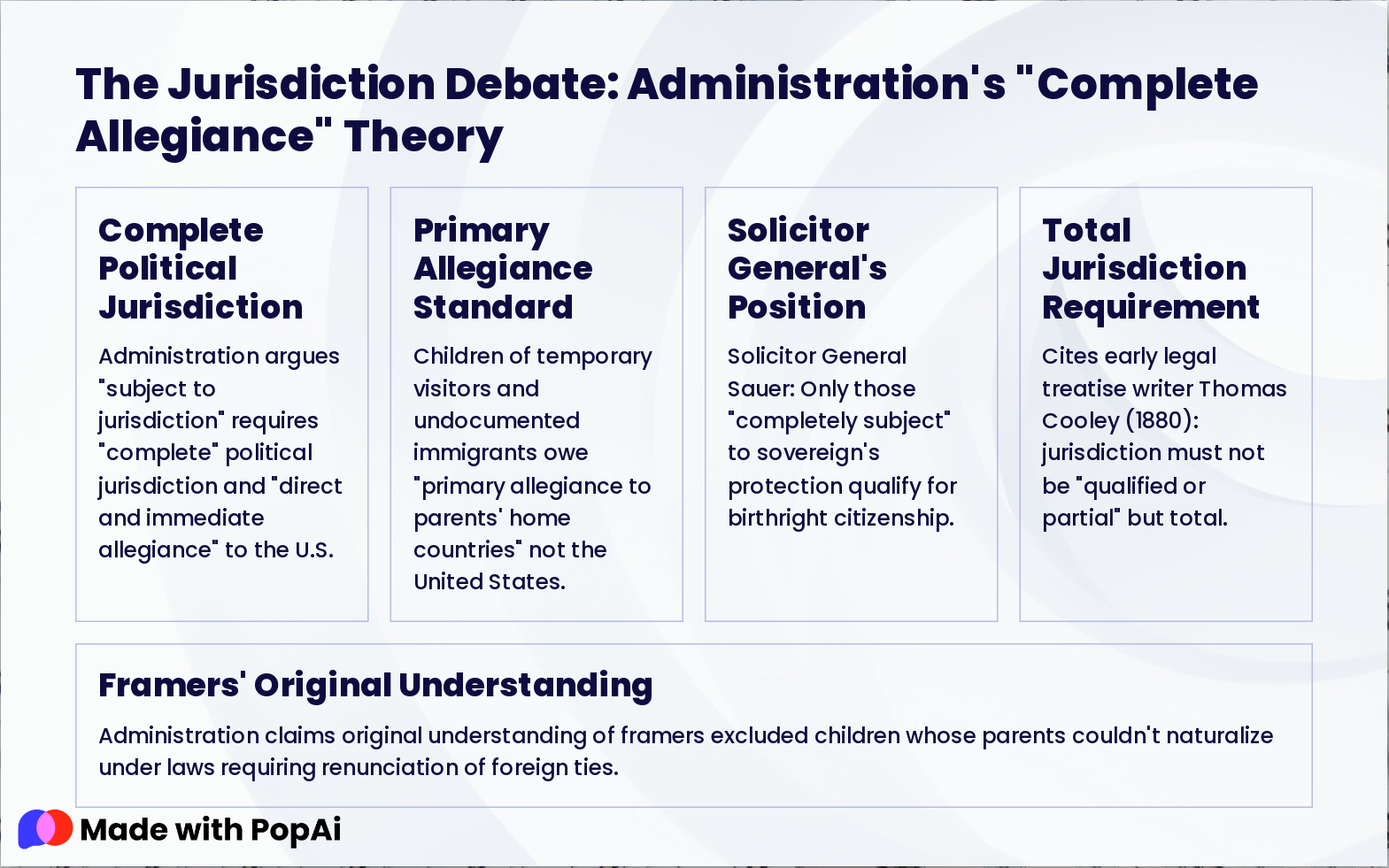
Slide 11: The Jurisdiction Debate: Administration's "Complete Allegiance" Theory
- Complete Political Jurisdiction: Administration argues "subject to jurisdiction" requires "complete" political jurisdiction and "direct and immediate allegiance" to the U.S.
- Primary Allegiance Standard: Children of temporary visitors and undocumented immigrants owe "primary allegiance to parents' home countries" not the United States.
- Solicitor General's Position: Solicitor General Sauer: Only those "completely subject" to sovereign's protection qualify for birthright citizenship.
- Total Jurisdiction Requirement: Cites early legal treatise writer Thomas Cooley (1880): jurisdiction must not be "qualified or partial" but total.
- Framers' Original Understanding: Administration claims original understanding of framers excluded children whose parents couldn't naturalize under laws requiring renunciation of foreign ties.
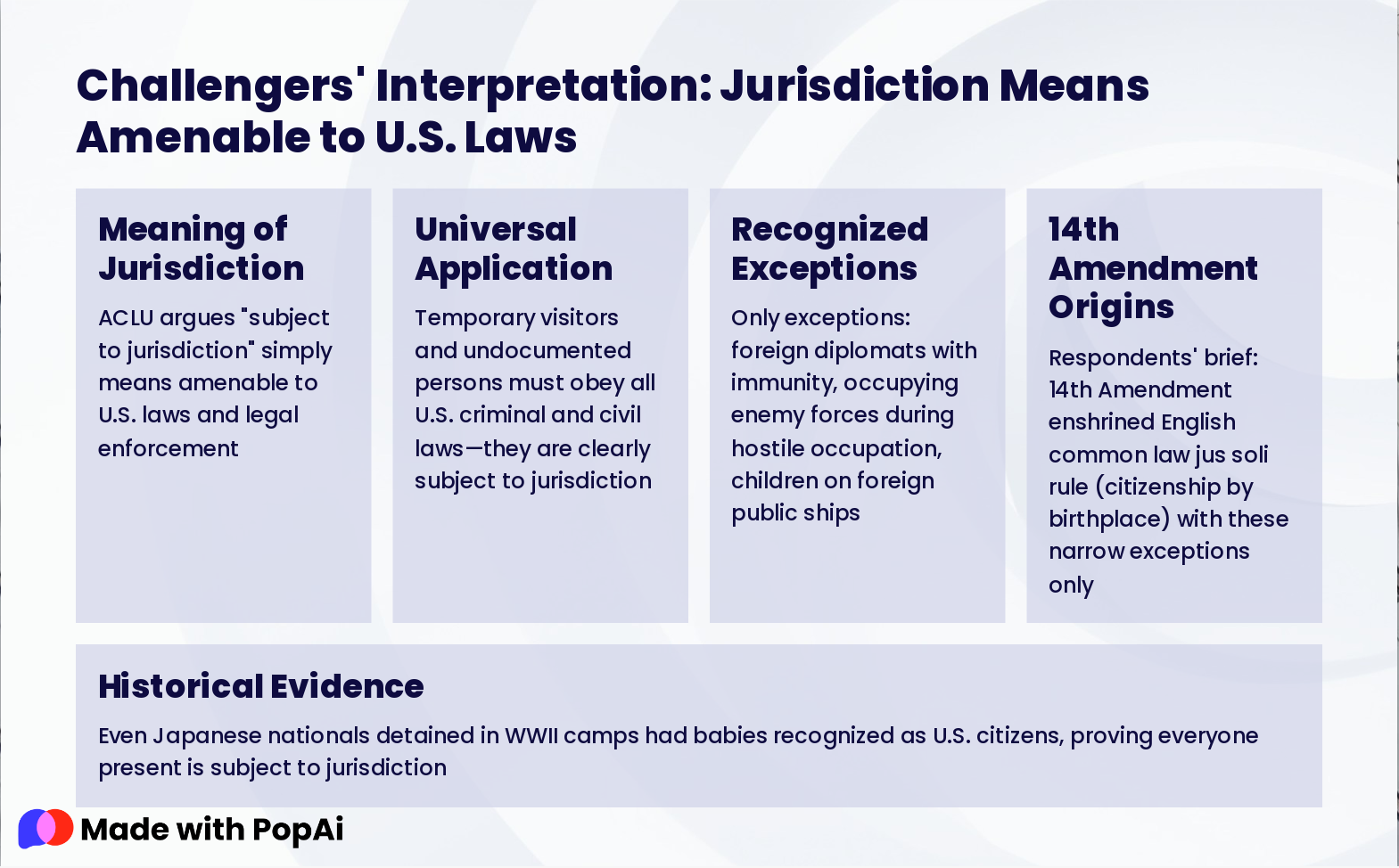
Slide 12: Challengers' Interpretation: Jurisdiction Means Amenable to U.S. Laws
- Meaning of Jurisdiction: ACLU argues "subject to jurisdiction" simply means amenable to U.S. laws and legal enforcement
- Universal Application: Temporary visitors and undocumented persons must obey all U.S. criminal and civil laws—they are clearly subject to jurisdiction
- Recognized Exceptions: Only exceptions: foreign diplomats with immunity, occupying enemy forces during hostile occupation, children on foreign public ships
- 14th Amendment Origins: Respondents' brief: 14th Amendment enshrined English common law jus soli rule (citizenship by birthplace) with these narrow exceptions only
- Historical Evidence: Even Japanese nationals detained in WWII camps had babies recognized as U.S. citizens, proving everyone present is subject to jurisdiction
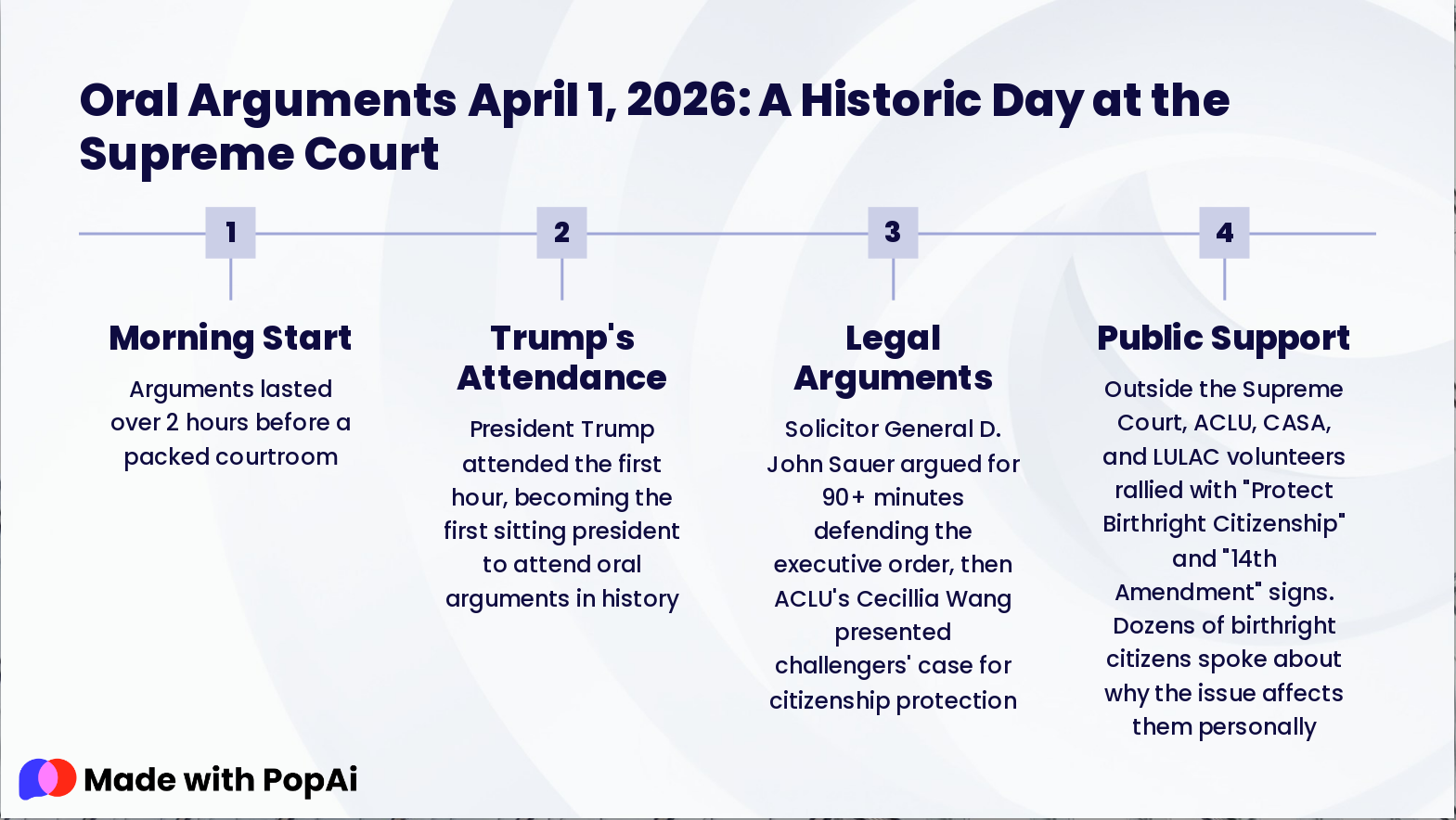
Slide 13: Oral Arguments April 1, 2026: A Historic Day at the Supreme Court
- Morning Start: Arguments lasted over 2 hours before a packed courtroom
- Trump's Attendance: President Trump attended the first hour, becoming the first sitting president to attend oral arguments in history
- Legal Arguments: Solicitor General D. John Sauer argued for 90+ minutes defending the executive order, then ACLU's Cecillia Wang presented challengers' case for citizenship protection
- Public Support: Outside the Supreme Court, ACLU, CASA, and LULAC volunteers rallied with "Protect Birthright Citizenship" and "14th Amendment" signs. Dozens of birthright citizens spoke about why the issue affects them personally
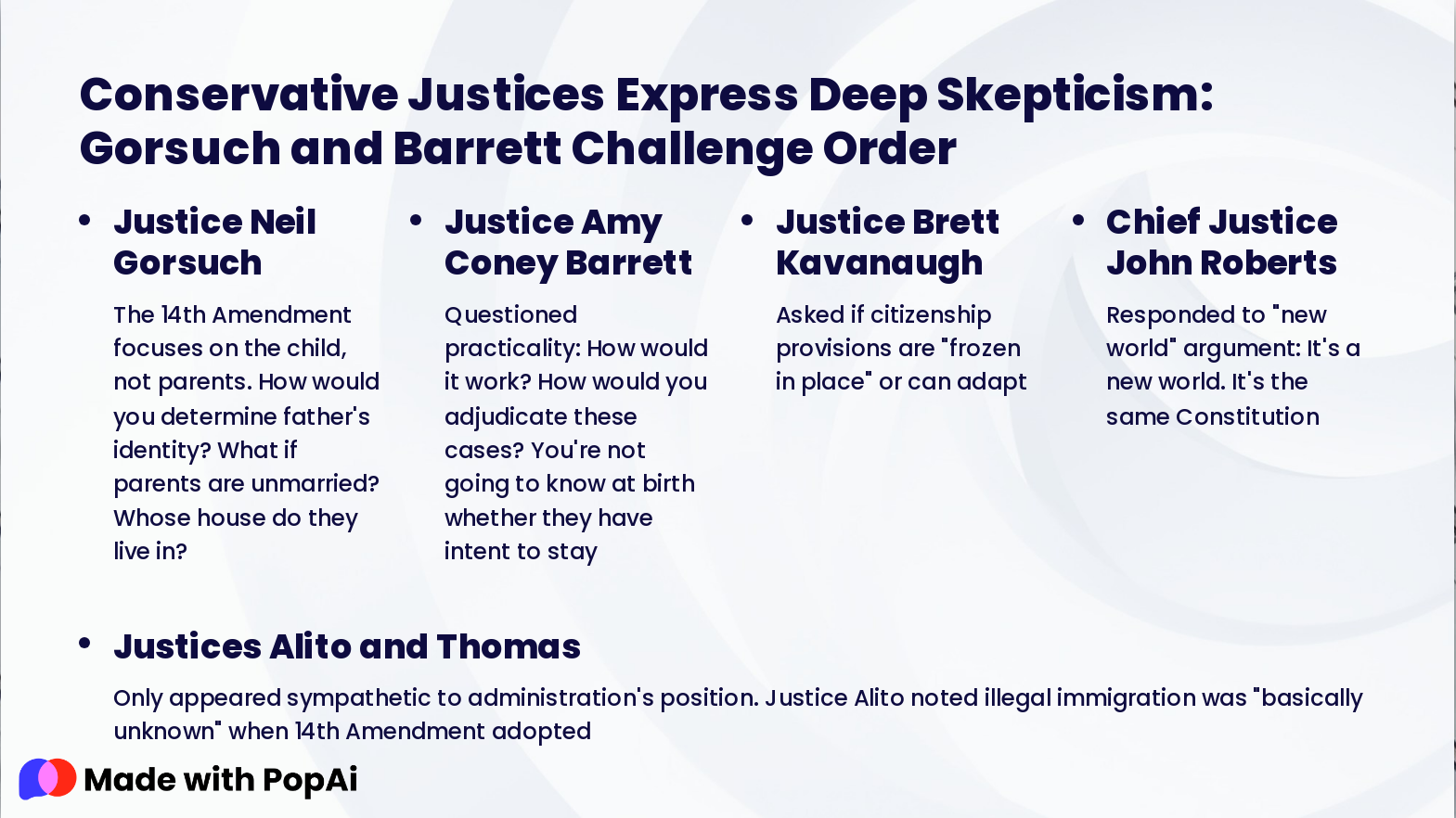
Slide 14: Conservative Justices Express Deep Skepticism: Gorsuch and Barrett Challenge Order
- Justice Neil Gorsuch: The 14th Amendment focuses on the child, not parents. How would you determine father's identity? What if parents are unmarried? Whose house do they live in?
- Justice Amy Coney Barrett: Questioned practicality: How would it work? How would you adjudicate these cases? You're not going to know at birth whether they have intent to stay
- Justice Brett Kavanaugh: Asked if citizenship provisions are "frozen in place" or can adapt
- Chief Justice John Roberts: Responded to "new world" argument: It's a new world. It's the same Constitution
- Justices Alito and Thomas: Only appeared sympathetic to administration's position. Justice Alito noted illegal immigration was "basically unknown" when 14th Amendment adopted
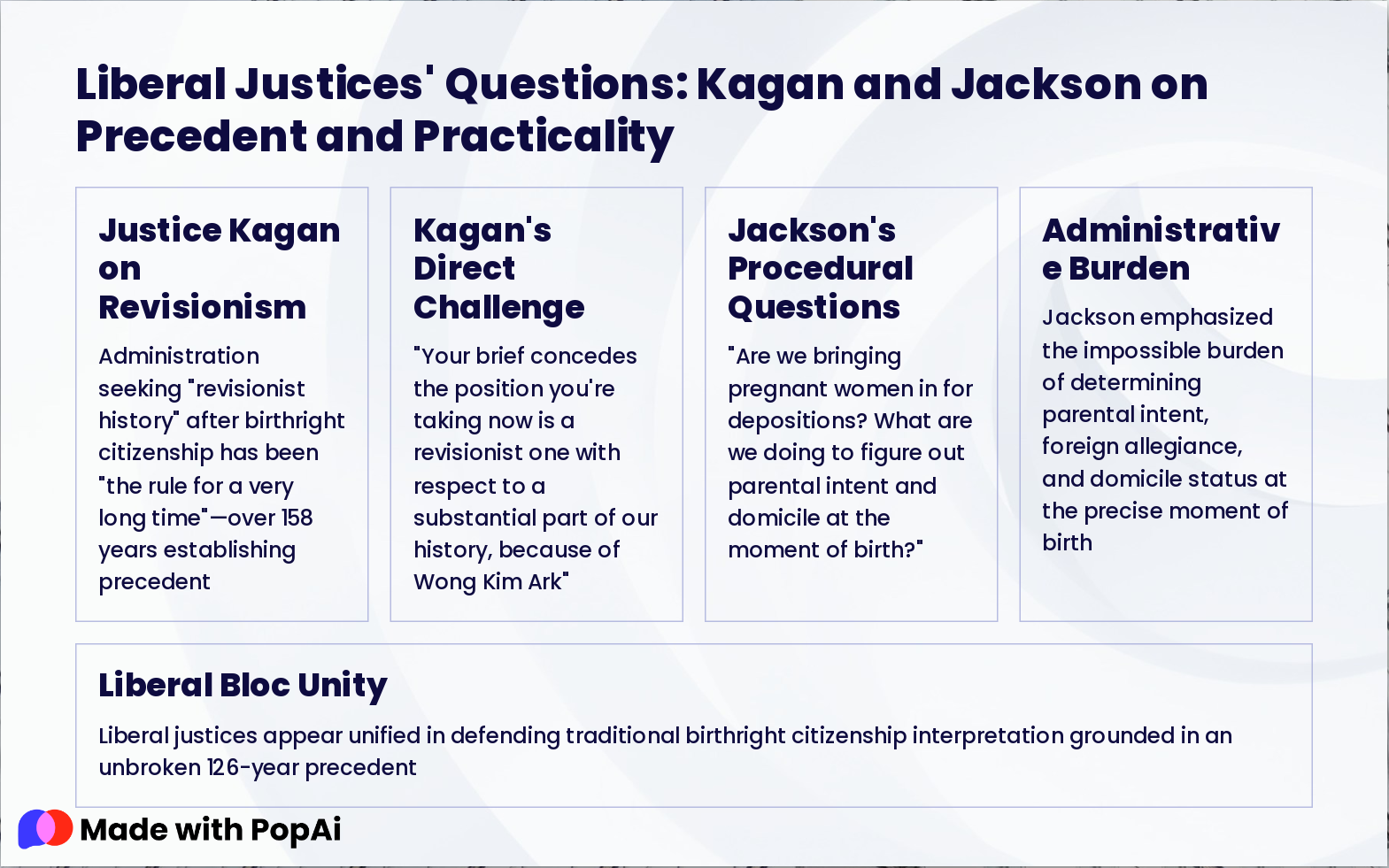
Slide 15: Liberal Justices' Questions: Kagan and Jackson on Precedent and Practicality
- Justice Kagan on Revisionism: Administration seeking "revisionist history" after birthright citizenship has been "the rule for a very long time"—over 158 years establishing precedent
- Kagan's Direct Challenge: "Your brief concedes the position you're taking now is a revisionist one with respect to a substantial part of our history, because of Wong Kim Ark"
- Jackson's Procedural Questions: "Are we bringing pregnant women in for depositions? What are we doing to figure out parental intent and domicile at the moment of birth?"
- Administrative Burden: Jackson emphasized the impossible burden of determining parental intent, foreign allegiance, and domicile status at the precise moment of birth
- Liberal Bloc Unity: Liberal justices appear unified in defending traditional birthright citizenship interpretation grounded in an unbroken 126-year precedent
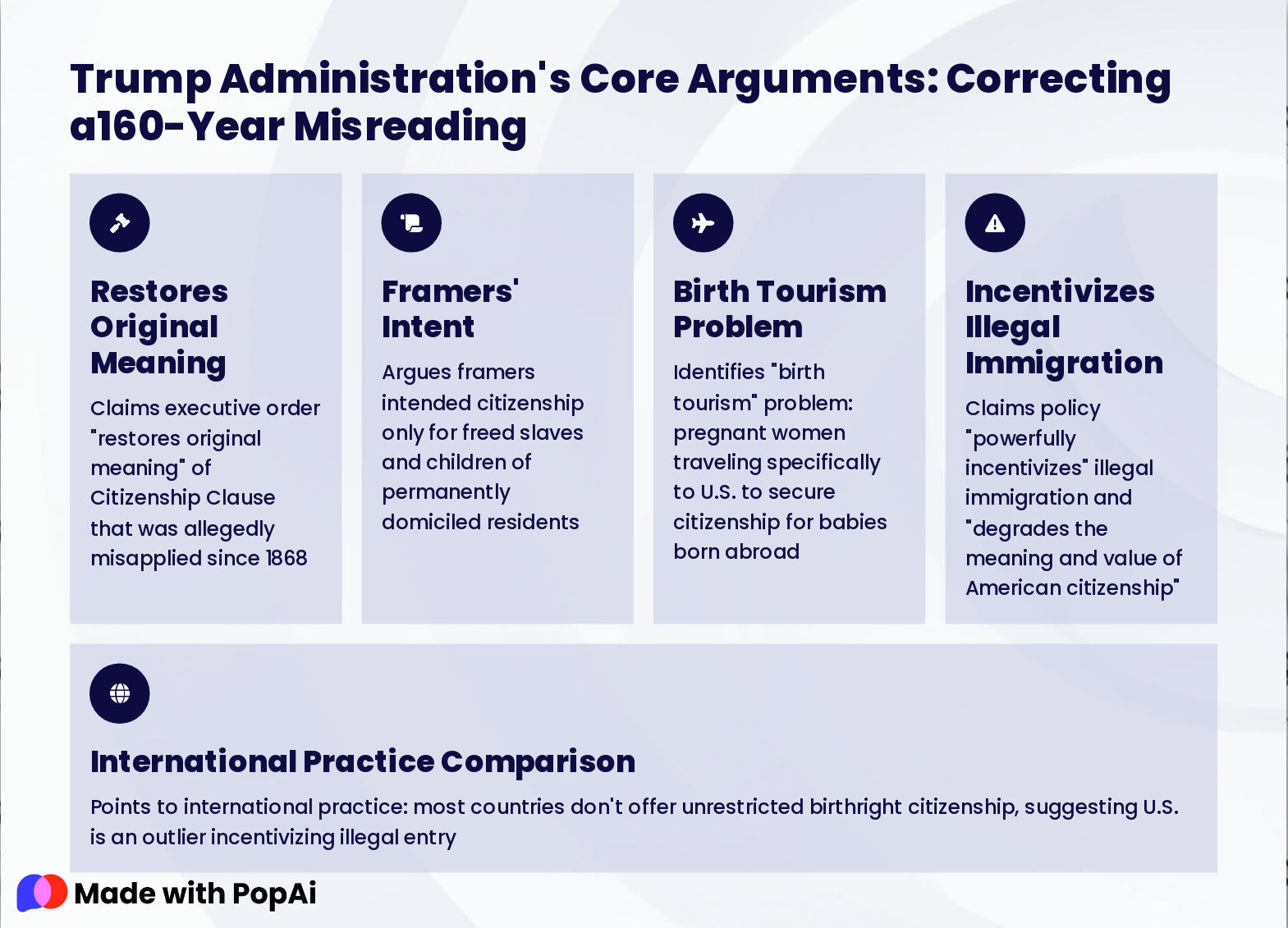
Slide 16: Trump Administration's Core Arguments: Correcting a160-Year Misreading
- Restores Original Meaning: Claims executive order "restores original meaning" of Citizenship Clause that was allegedly misapplied since 1868
- Framers' Intent: Argues framers intended citizenship only for freed slaves and children of permanently domiciled residents
- Birth Tourism Problem: Identifies "birth tourism" problem: pregnant women traveling specifically to U.S. to secure citizenship for babies born abroad
- Incentivizes Illegal Immigration: Claims policy "powerfully incentivizes" illegal immigration and "degrades the meaning and value of American citizenship"
- International Practice Comparison: Points to international practice: most countries don't offer unrestricted birthright citizenship, suggesting U.S. is an outlier incentivizing illegal entry
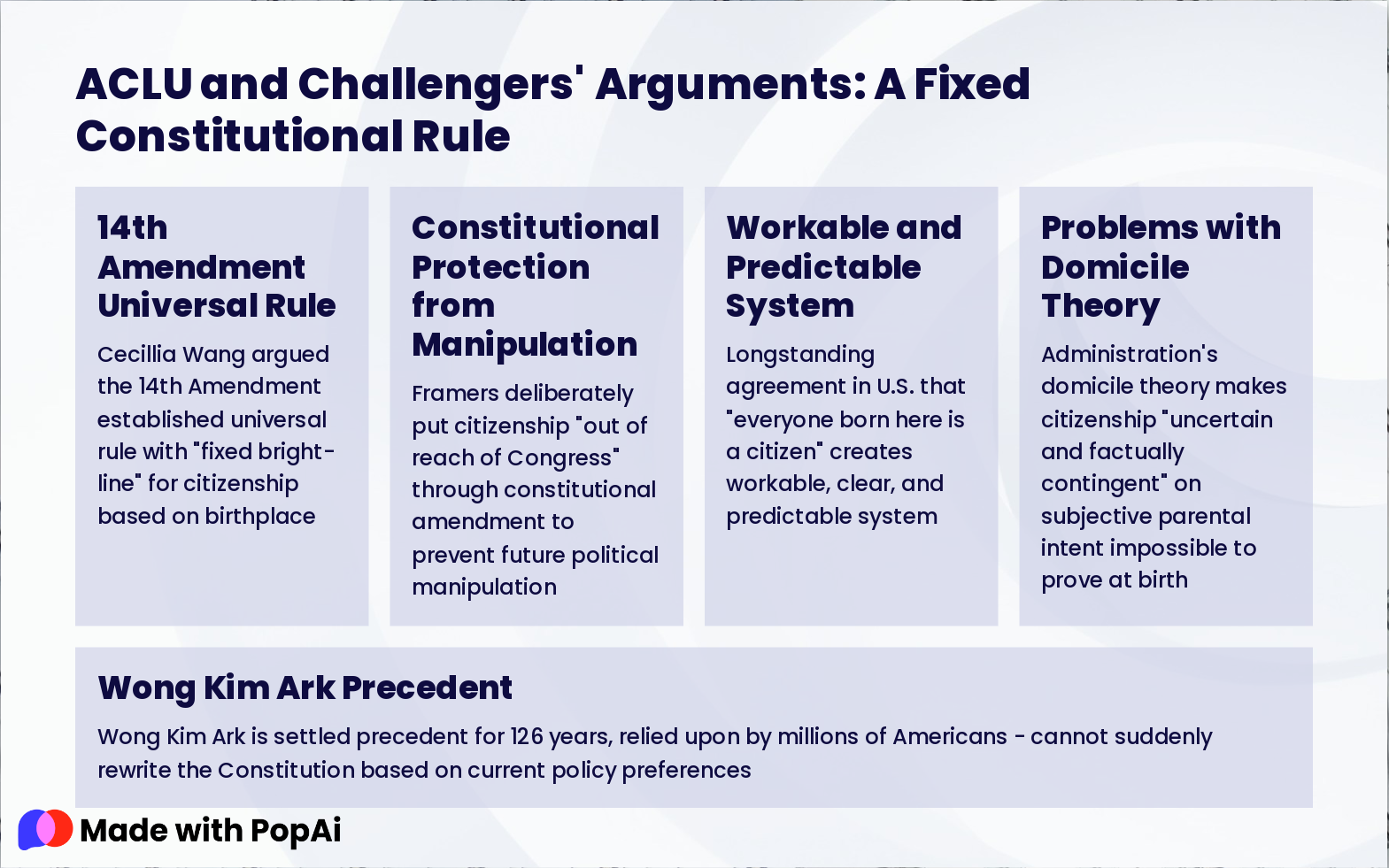
Slide 17: ACLU and Challengers' Arguments: A Fixed Constitutional Rule
- 14th Amendment Universal Rule: Cecillia Wang argued the 14th Amendment established universal rule with "fixed bright-line" for citizenship based on birthplace
- Constitutional Protection from Manipulation: Framers deliberately put citizenship "out of reach of Congress" through constitutional amendment to prevent future political manipulation
- Workable and Predictable System: Longstanding agreement in U.S. that "everyone born here is a citizen" creates workable, clear, and predictable system
- Problems with Domicile Theory: Administration's domicile theory makes citizenship "uncertain and factually contingent" on subjective parental intent impossible to prove at birth
- Wong Kim Ark Precedent: Wong Kim Ark is settled precedent for 126 years, relied upon by millions of Americans - cannot suddenly rewrite the Constitution based on current policy preferences
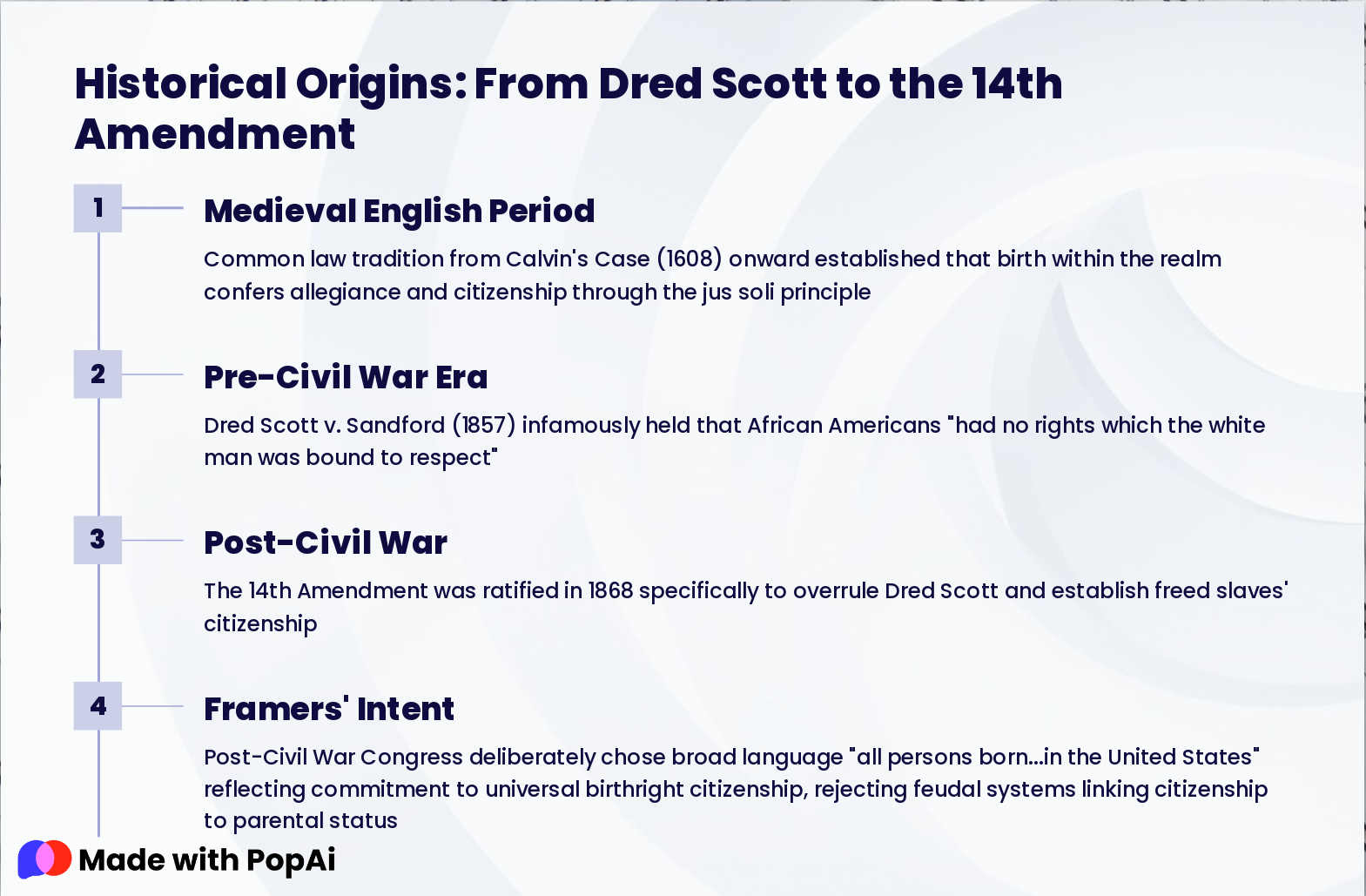
Slide 18: Historical Origins: From Dred Scott to the 14th Amendment
- Medieval English Period: Common law tradition from Calvin's Case (1608) onward established that birth within the realm confers allegiance and citizenship through the jus soli principle
- Pre-Civil War Era: Dred Scott v. Sandford (1857) infamously held that African Americans "had no rights which the white man was bound to respect"
- Post-Civil War: The 14th Amendment was ratified in 1868 specifically to overrule Dred Scott and establish freed slaves' citizenship
- Framers' Intent: Post-Civil War Congress deliberately chose broad language "all persons born...in the United States" reflecting commitment to universal birthright citizenship, rejecting feudal systems linking citizenship to parental status
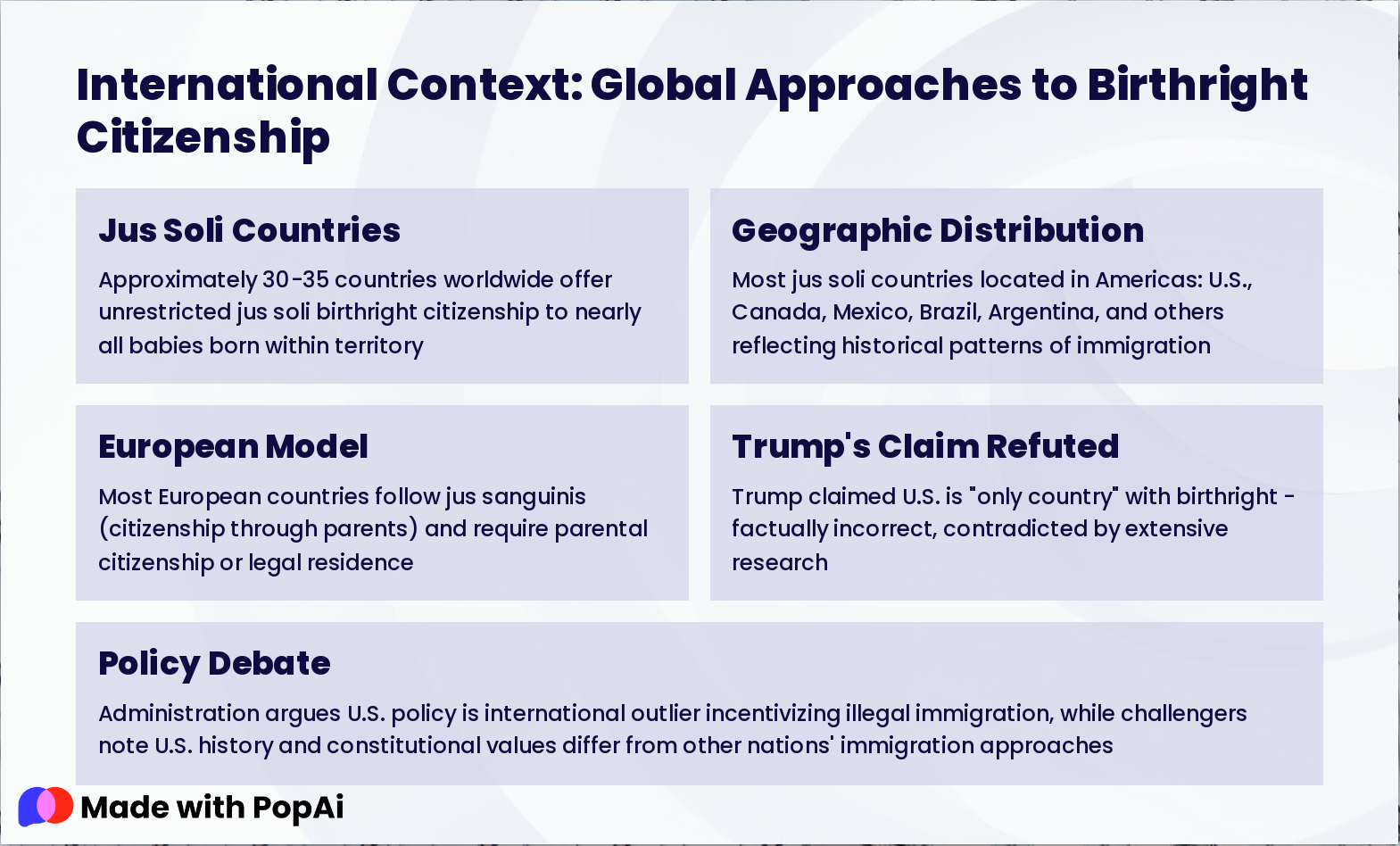
Slide 19: International Context: Global Approaches to Birthright Citizenship
- Jus Soli Countries: Approximately 30-35 countries worldwide offer unrestricted jus soli birthright citizenship to nearly all babies born within territory
- Geographic Distribution: Most jus soli countries located in Americas: U.S., Canada, Mexico, Brazil, Argentina, and others reflecting historical patterns of immigration
- European Model: Most European countries follow jus sanguinis (citizenship through parents) and require parental citizenship or legal residence
- Trump's Claim Refuted: Trump claimed U.S. is "only country" with birthright - factually incorrect, contradicted by extensive research
- Policy Debate: Administration argues U.S. policy is international outlier incentivizing illegal immigration, while challengers note U.S. history and constitutional values differ from other nations' immigration approaches
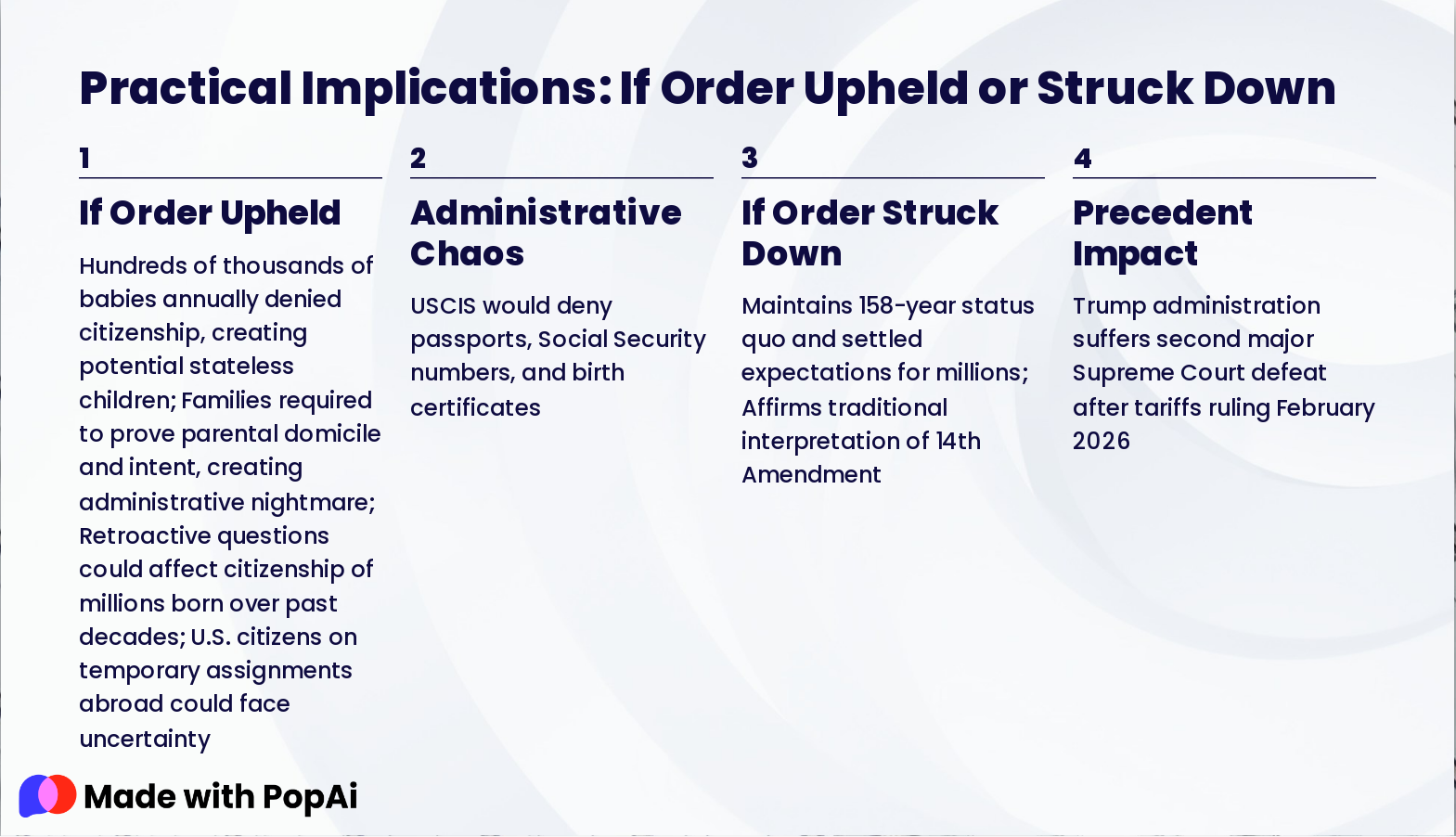
Slide 20: Practical Implications: If Order Upheld or Struck Down
- If Order Upheld: Hundreds of thousands of babies annually denied citizenship, creating potential stateless children; Families required to prove parental domicile and intent, creating administrative nightmare; Retroactive questions could affect citizenship of millions born over past decades; U.S. citizens on temporary assignments abroad could face uncertainty
- Administrative Chaos: USCIS would deny passports, Social Security numbers, and birth certificates
- If Order Struck Down: Maintains 158-year status quo and settled expectations for millions; Affirms traditional interpretation of 14th Amendment
- Precedent Impact: Trump administration suffers second major Supreme Court defeat after tariffs ruling February 2026
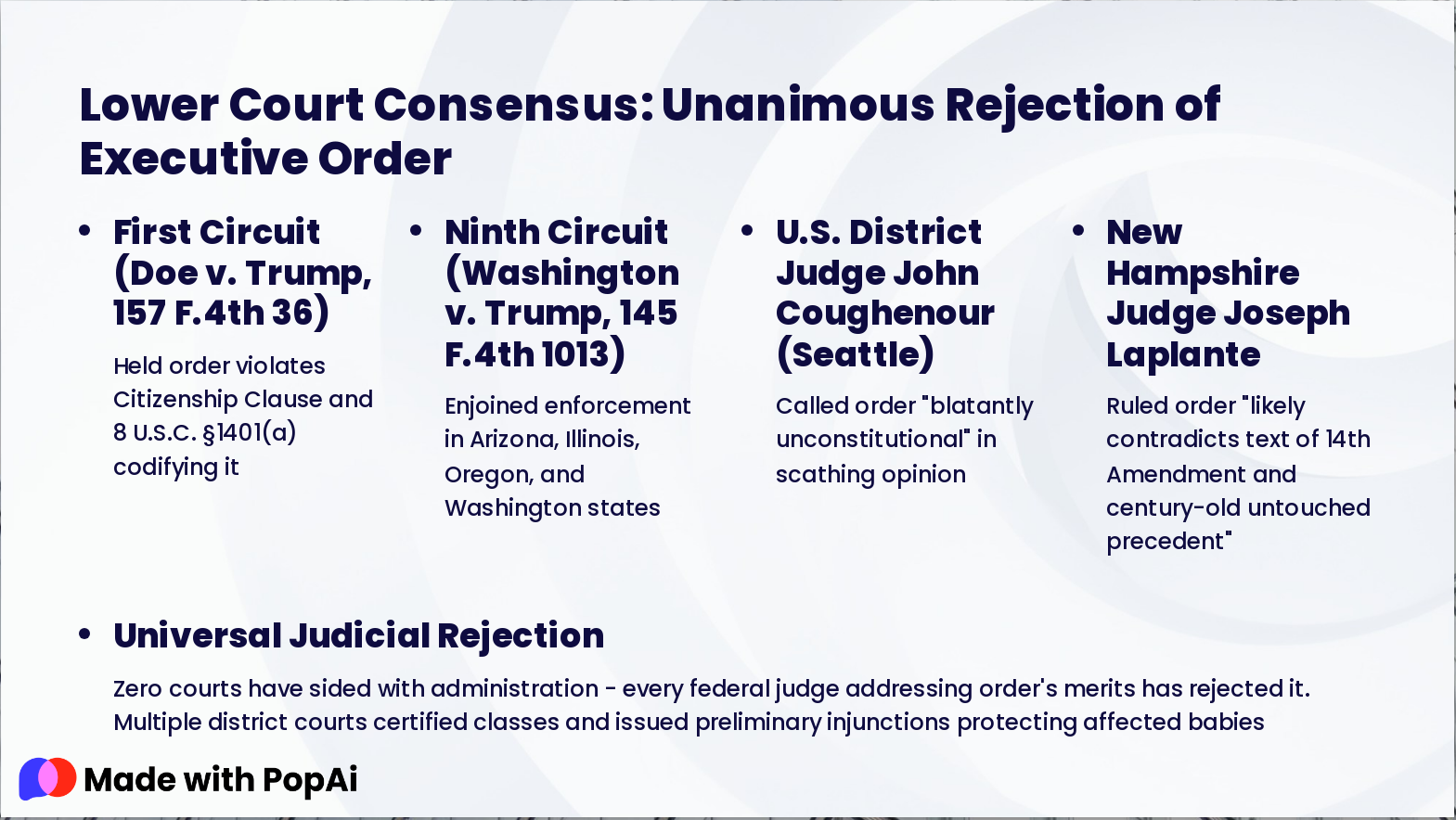
Slide 21: Lower Court Consensus: Unanimous Rejection of Executive Order
- First Circuit (Doe v. Trump, 157 F.4th 36): Held order violates Citizenship Clause and 8 U.S.C. §1401(a) codifying it
- Ninth Circuit (Washington v. Trump, 145 F.4th 1013): Enjoined enforcement in Arizona, Illinois, Oregon, and Washington states
- U.S. District Judge John Coughenour (Seattle): Called order "blatantly unconstitutional" in scathing opinion
- New Hampshire Judge Joseph Laplante: Ruled order "likely contradicts text of 14th Amendment and century-old untouched precedent"
- Universal Judicial Rejection: Zero courts have sided with administration - every federal judge addressing order's merits has rejected it. Multiple district courts certified classes and issued preliminary injunctions protecting affected babies
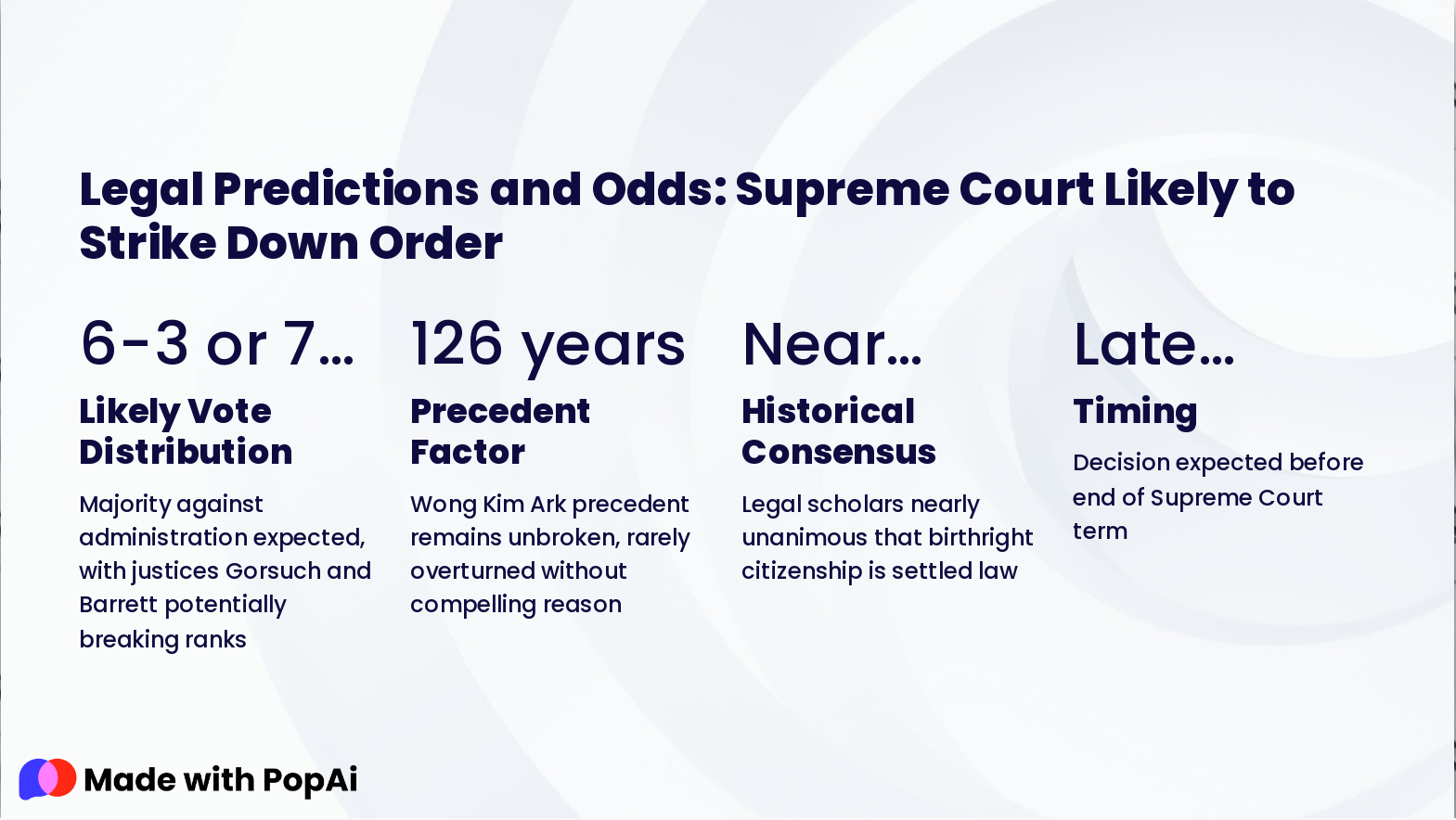
Slide 22: Legal Predictions and Odds: Supreme Court Likely to Strike Down Order
- 6-3 or 7-2 — Likely Vote Distribution
- 126 years — Precedent Factor
- Near Unanimous — Historical Consensus
- Late June–July 2026 — Timing
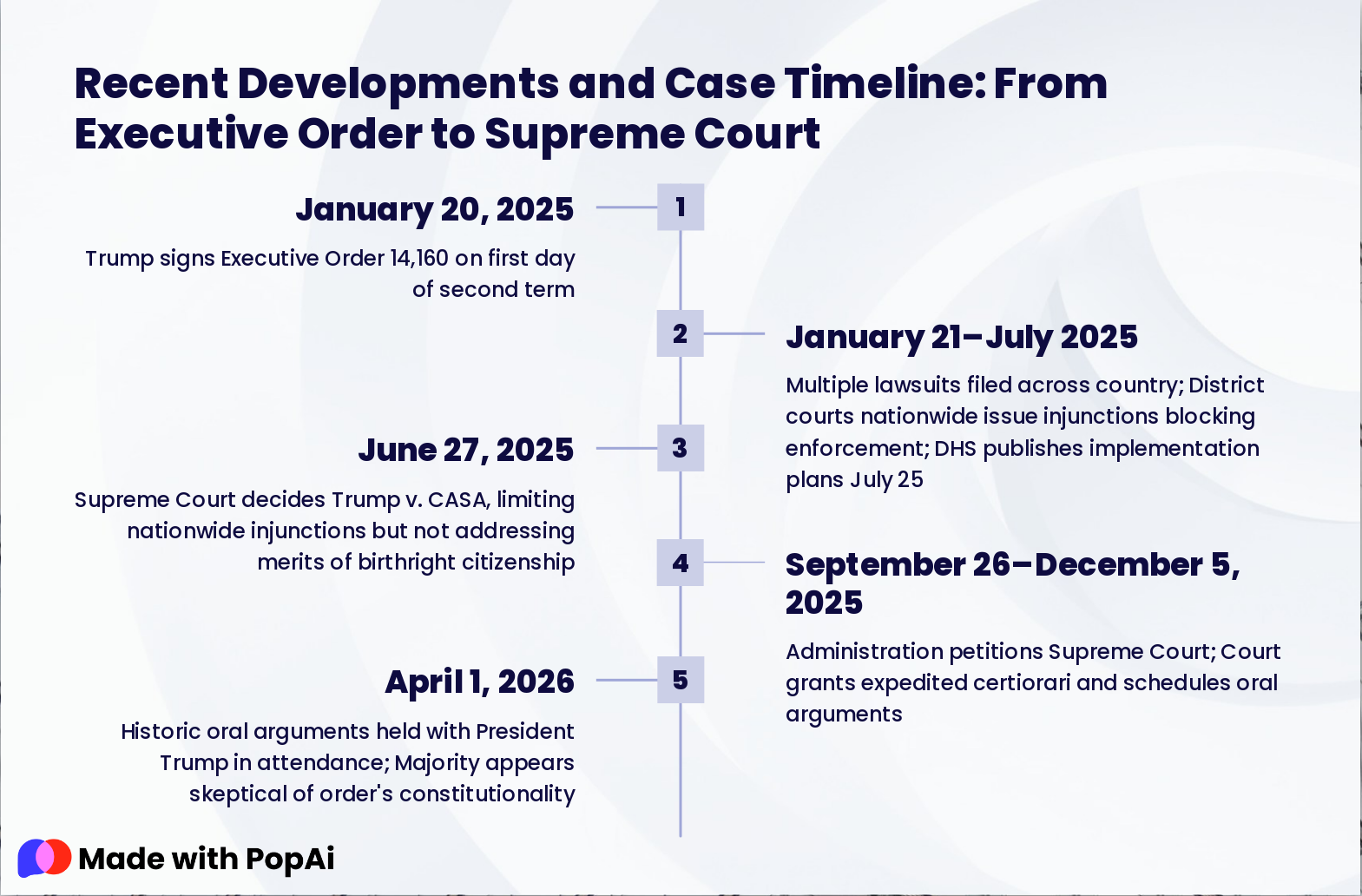
Slide 23: Recent Developments and Case Timeline: From Executive Order to Supreme Court
- January 20, 2025: Trump signs Executive Order 14,160 on first day of second term
- January 21–July 2025: Multiple lawsuits filed across country; District courts nationwide issue injunctions blocking enforcement; DHS publishes implementation plans July 25
- June 27, 2025: Supreme Court decides Trump v. CASA, limiting nationwide injunctions but not addressing merits of birthright citizenship
- September 26–December 5, 2025: Administration petitions Supreme Court; Court grants expedited certiorari and schedules oral arguments
- April 1, 2026: Historic oral arguments held with President Trump in attendance; Majority appears skeptical of order's constitutionality
Slide 24: Constitutional Conclusion: The Future of American Citizenship
The Supreme Court faces fundamental test of 14th Amendment's meaning and presidential power limits
Oral arguments reveal majority skepticism toward rewriting 158 years of settled citizenship law
Decision will affect millions of families and determine who is considered American
Broader implications: Can presidents unilaterally redefine constitutional provisions?
Ruling expected summer 2026 likely to affirm traditional birthright citizenship interpretation
Expected outcome: Second major legal defeat for Trump administration in 2026 term
- The Supreme Court faces fundamental test of 14th Amendment's meaning and presidential power limits
- Oral arguments reveal majority skepticism toward rewriting 158 years of settled citizenship law
- Decision will affect millions of families and determine who is considered American
- Broader implications: Can presidents unilaterally redefine constitutional provisions?
- Ruling expected summer 2026 likely to affirm traditional birthright citizenship interpretation
- Expected outcome: Second major legal defeat for Trump administration in 2026 term