Presentation Summary
Discover SpaceX's Starlink, a revolutionary satellite internet service providing global broadband coverage. Learn about its technology, performance, applications, and vision for universal connectivity.
Full Presentation Transcript
Slide 1: Starlink: Revolutionizing Global Satellite Internet
Comprehensive Overview of SpaceX's Constellation-Based Broadband Solution
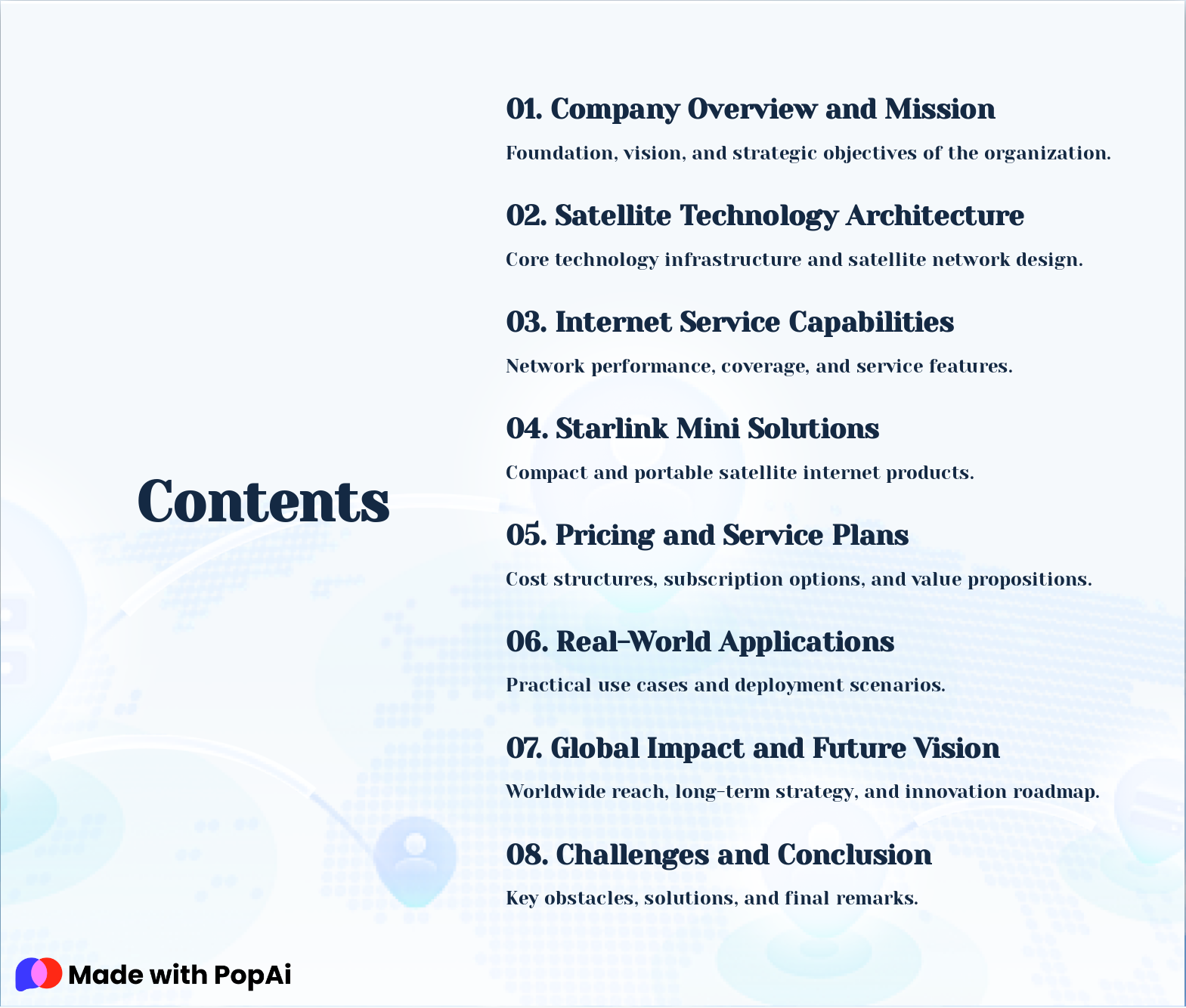
Slide 2: Contents
- Company Overview and Mission: Foundation, vision, and strategic objectives of the organization.
- Satellite Technology Architecture: Core technology infrastructure and satellite network design.
- Internet Service Capabilities: Network performance, coverage, and service features.
- Starlink Mini Solutions: Compact and portable satellite internet products.
- Pricing and Service Plans: Cost structures, subscription options, and value propositions.
- Real-World Applications: Practical use cases and deployment scenarios.
- Global Impact and Future Vision: Worldwide reach, long-term strategy, and innovation roadmap.
- Challenges and Conclusion: Key obstacles, solutions, and final remarks.
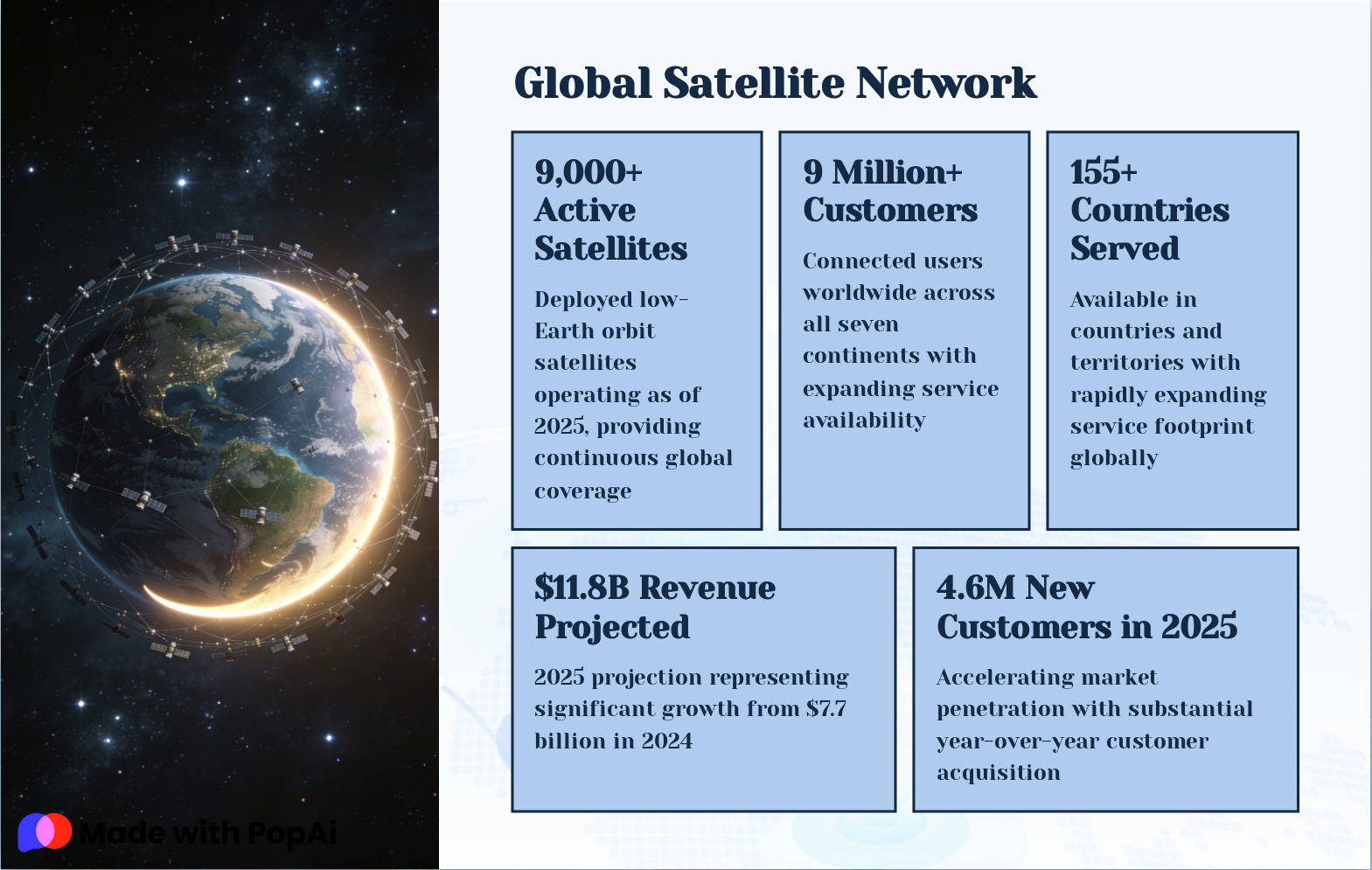
Slide 3: Global Satellite Network
- 9,000+ Active Satellites: Deployed low-Earth orbit satellites operating as of 2025, providing continuous global coverage
- 9 Million+ Customers: Connected users worldwide across all seven continents with expanding service availability
- 155+ Countries Served: Available in countries and territories with rapidly expanding service footprint globally
- $11.8B Revenue Projected: 2025 projection representing significant growth from $7.7 billion in 2024
- 6M New Customers in 2025: Accelerating market penetration with substantial year-over-year customer acquisition
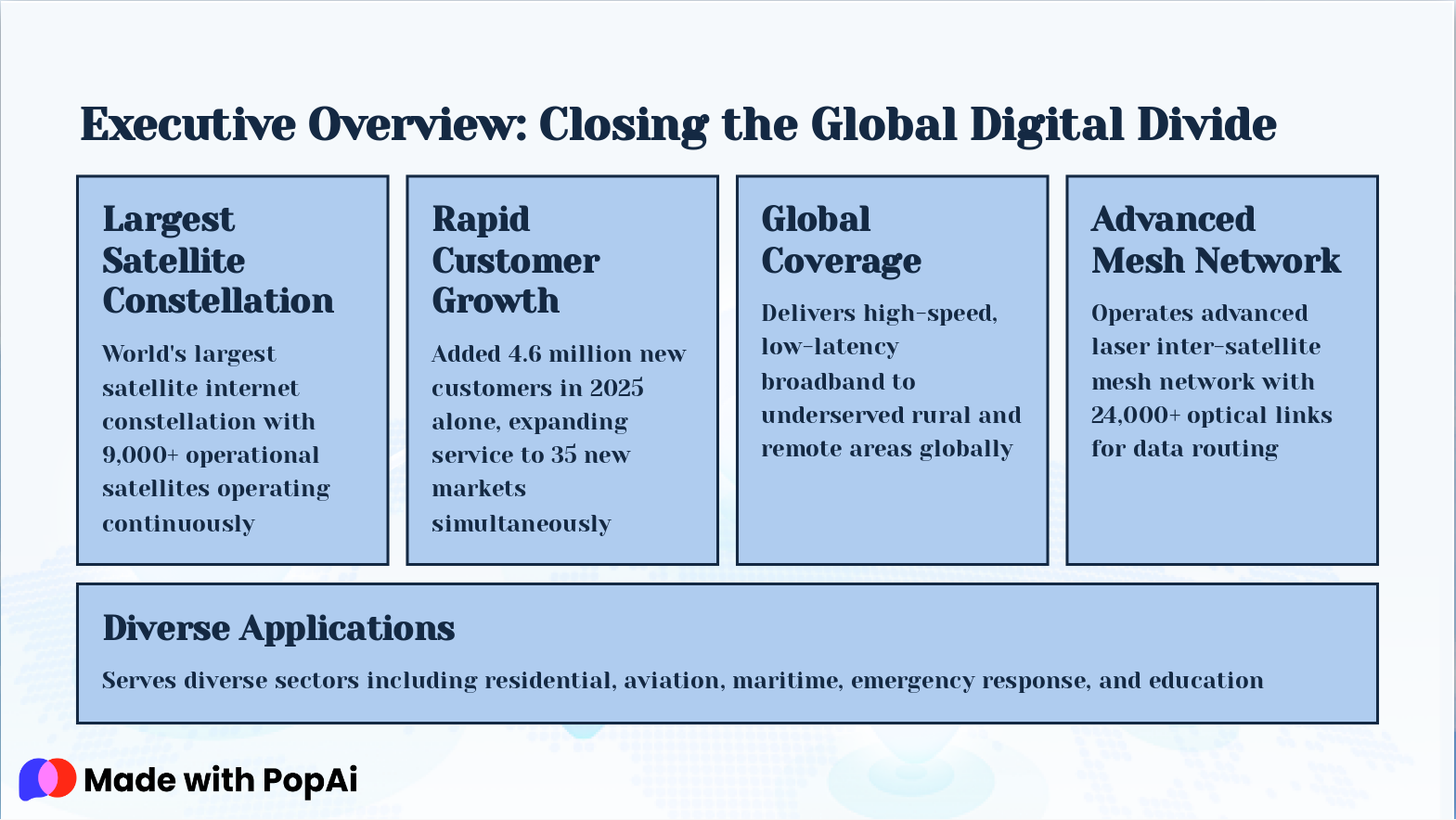
Slide 4: Executive Overview: Closing the Global Digital Divide
- Largest Satellite Constellation: World's largest satellite internet constellation with 9,000+ operational satellites operating continuously
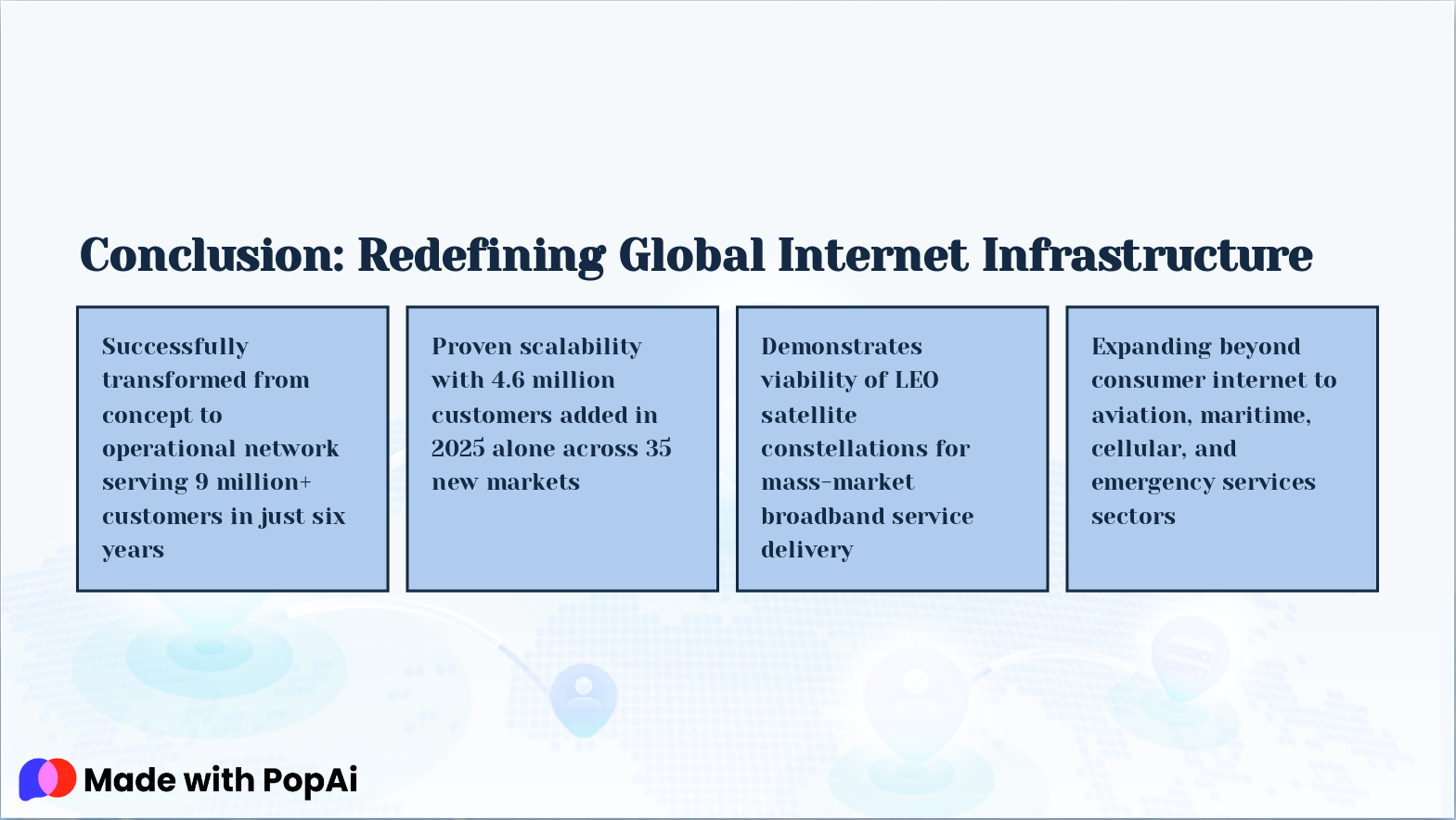
- Rapid Customer Growth: Added 4.6 million new customers in 2025 alone, expanding service to 35 new markets simultaneously
- Global Coverage: Delivers high-speed, low-latency broadband to underserved rural and remote areas globally
- Advanced Mesh Network: Operates advanced laser inter-satellite mesh network with 24,000+ optical links for data routing
- Diverse Applications: Serves diverse sectors including residential, aviation, maritime, emergency response, and education
Slide 5: Starlink Global Network
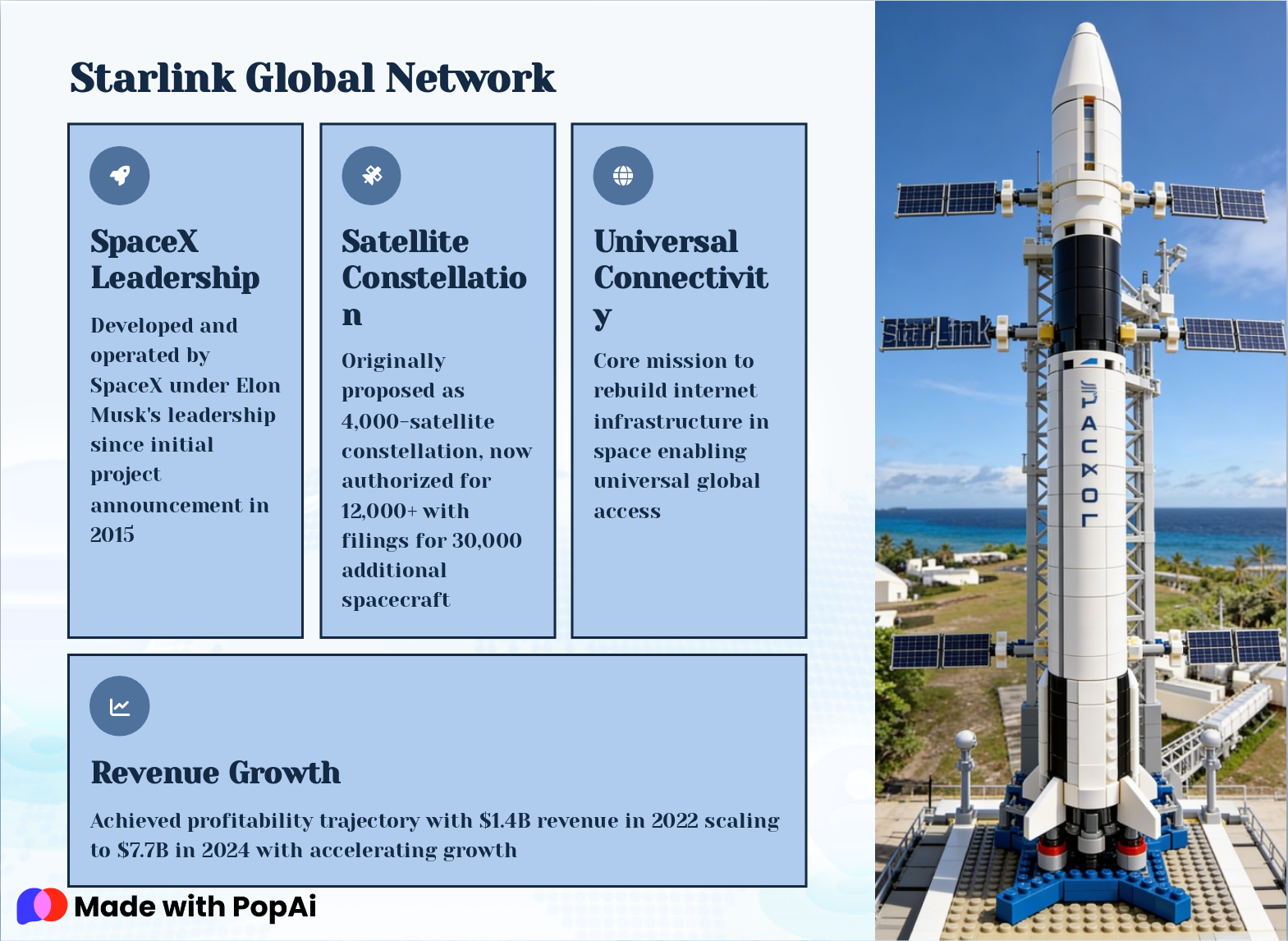
- SpaceX Leadership: Developed and operated by SpaceX under Elon Musk's leadership since initial project announcement in 2015
- Satellite Constellation: Originally proposed as 4,000-satellite constellation, now authorized for 12,000+ with filings for 30,000 additional spacecraft
- Universal Connectivity: Core mission to rebuild internet infrastructure in space enabling universal global access
- Revenue Growth: Achieved profitability trajectory with $1.4B revenue in 2022 scaling to $7.7B in 2024 with accelerating growth
Slide 6: Mission and Vision: Universal Internet Access
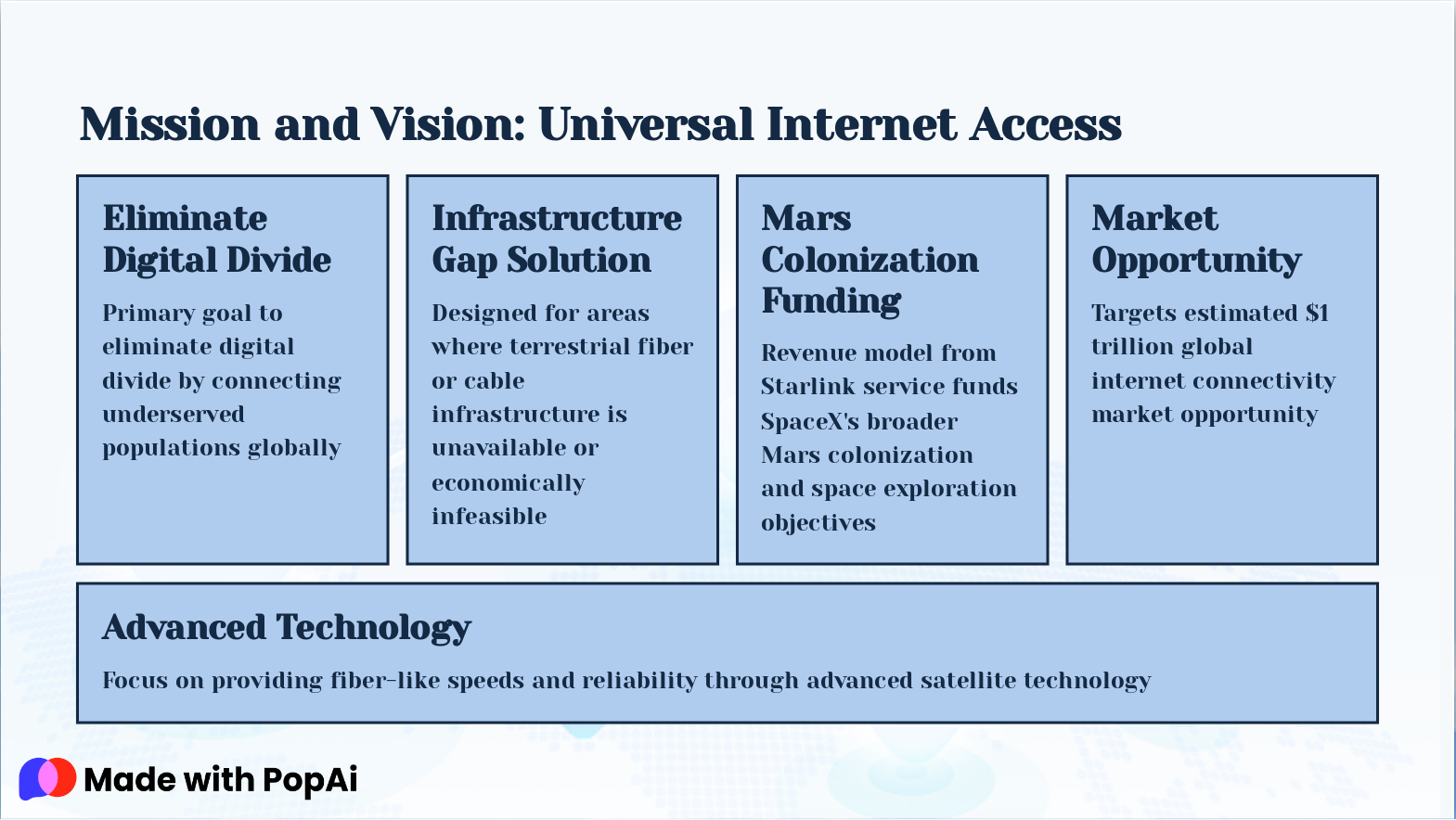
- Eliminate Digital Divide: Primary goal to eliminate digital divide by connecting underserved populations globally
- Infrastructure Gap Solution: Designed for areas where terrestrial fiber or cable infrastructure is unavailable or economically infeasible
- Mars Colonization Funding: Revenue model from Starlink service funds SpaceX's broader Mars colonization and space exploration objectives
- Market Opportunity: Targets estimated $1 trillion global internet connectivity market opportunity
- Advanced Technology: Focus on providing fiber-like speeds and reliability through advanced satellite technology
Slide 7: Key Milestones: Rapid Scaling from 2015 to 2025
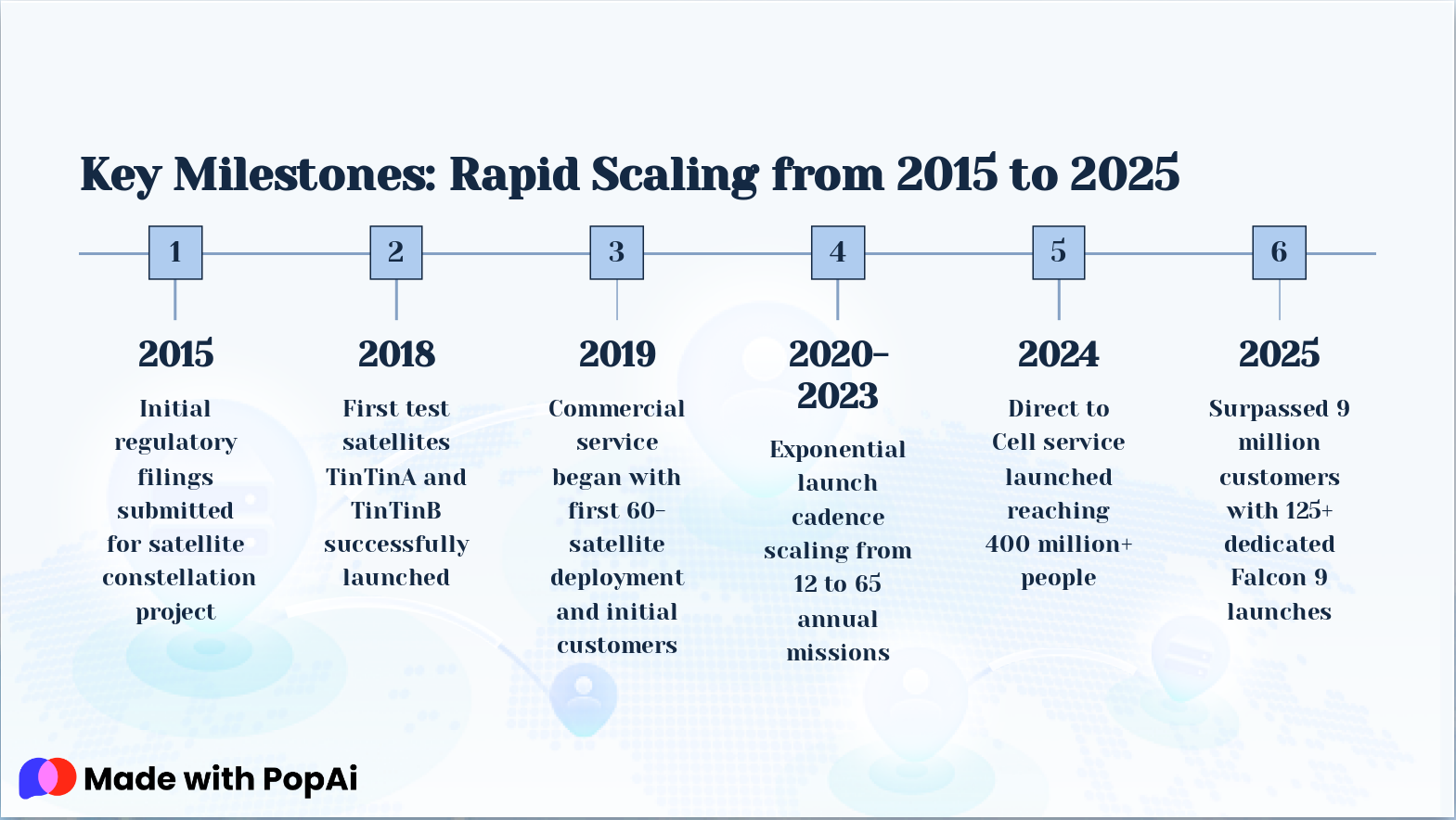
- 2015: Initial regulatory filings submitted for satellite constellation project
- 2018: First test satellites TinTinA and TinTinB successfully launched
- 2019: Commercial service began with first 60-satellite deployment and initial customers
- 2020-2023: Exponential launch cadence scaling from 12 to 65 annual missions
- 2024: Direct to Cell service launched reaching 400 million+ people
- 2025: Surpassed 9 million customers with 125+ dedicated Falcon 9 launches
Slide 8: Low-Earth Orbit Satellite System
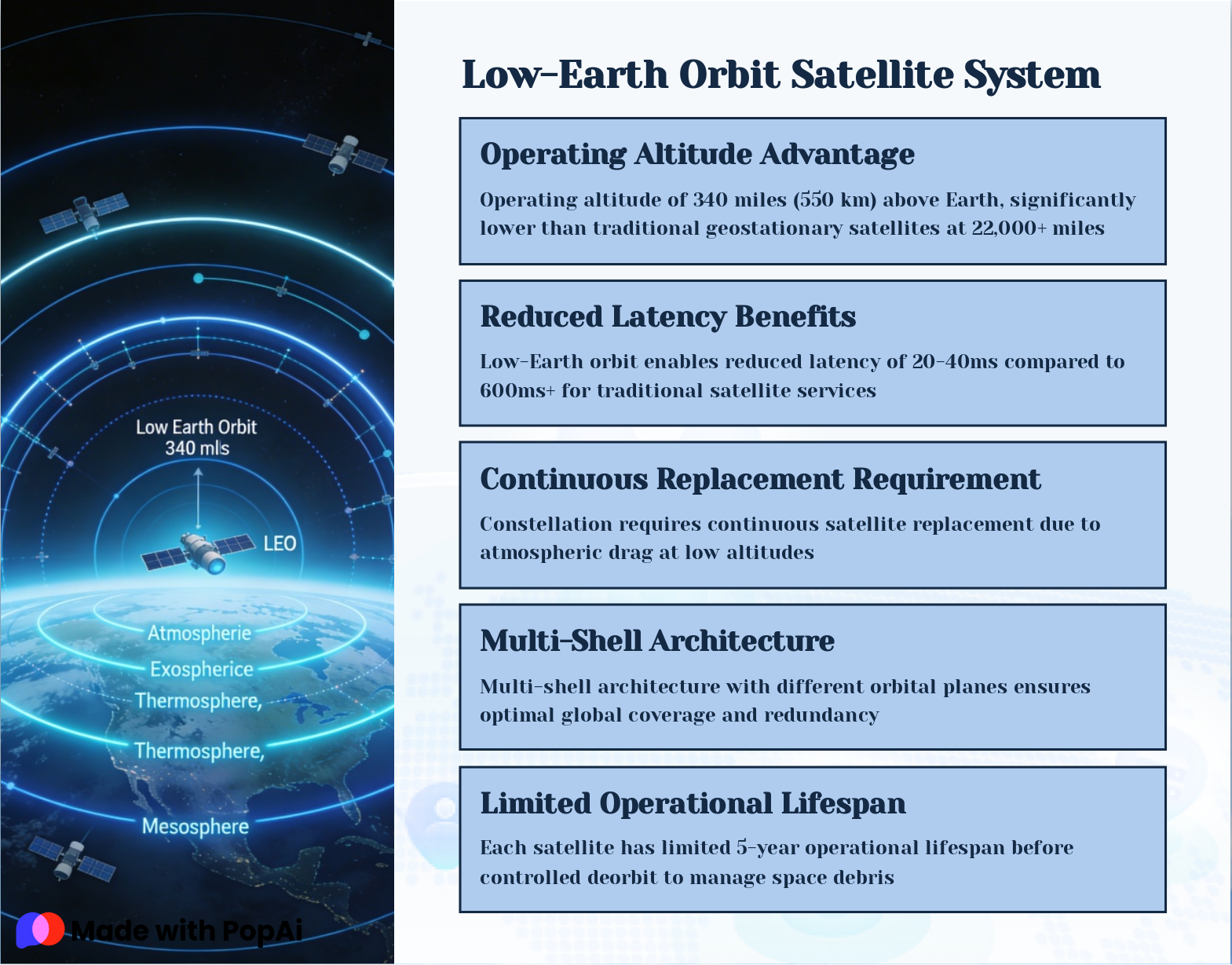
- Operating Altitude Advantage: Operating altitude of 340 miles (550 km) above Earth, significantly lower than traditional geostationary satellites at 22,000+ miles
- Reduced Latency Benefits: Low-Earth orbit enables reduced latency of 20-40ms compared to 600ms+ for traditional satellite services
- Continuous Replacement Requirement: Constellation requires continuous satellite replacement due to atmospheric drag at low altitudes
- Multi-Shell Architecture: Multi-shell architecture with different orbital planes ensures optimal global coverage and redundancy
- Limited Operational Lifespan: Each satellite has limited 5-year operational lifespan before controlled deorbit to manage space debris
Slide 9: V2 Mini Satellite Technology: Third-Generation Platform
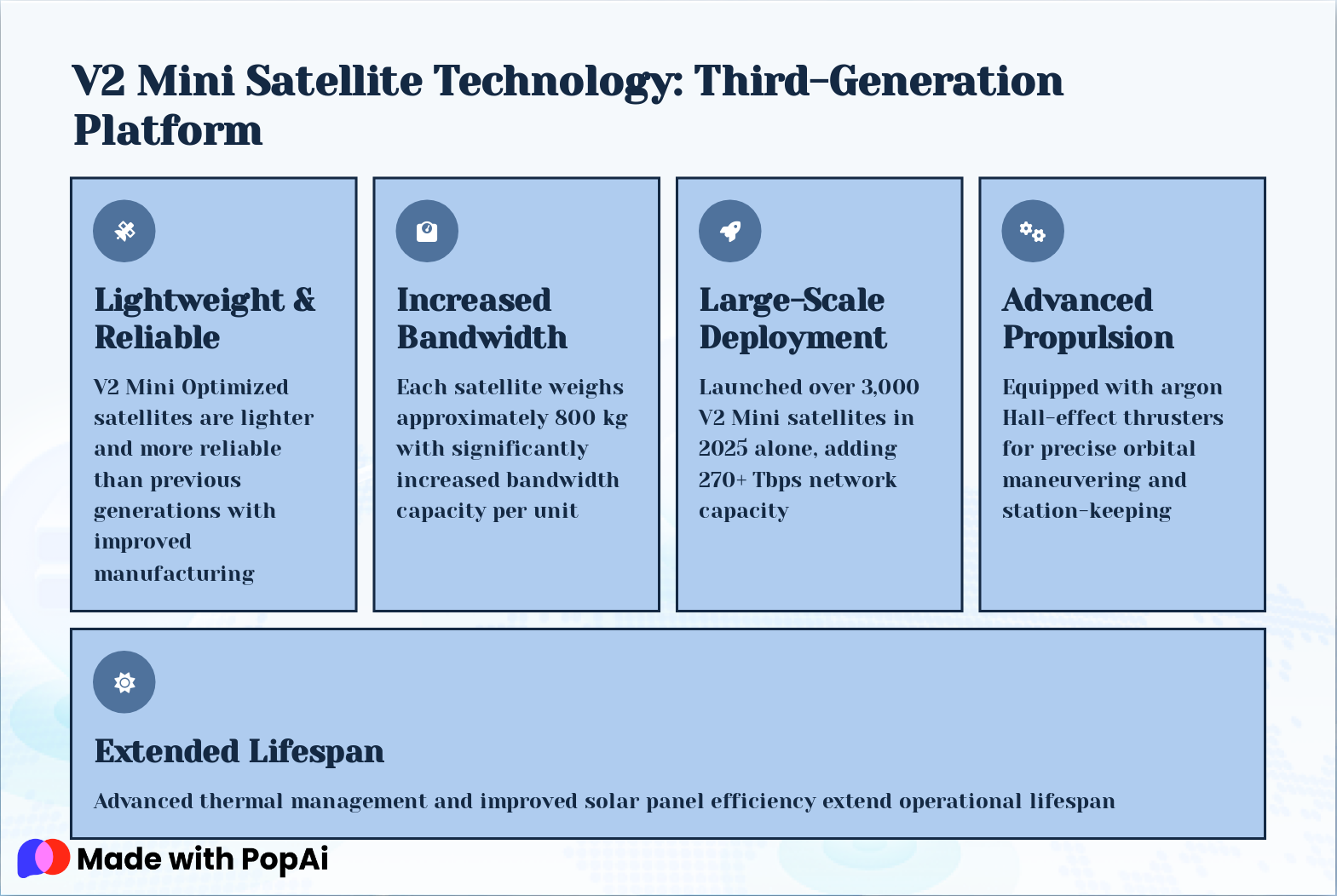
- Lightweight & Reliable: V2 Mini Optimized satellites are lighter and more reliable than previous generations with improved manufacturing
- Increased Bandwidth: Each satellite weighs approximately 800 kg with significantly increased bandwidth capacity per unit
- Large-Scale Deployment: Launched over 3,000 V2 Mini satellites in 2025 alone, adding 270+ Tbps network capacity
- Advanced Propulsion: Equipped with argon Hall-effect thrusters for precise orbital maneuvering and station-keeping
- Extended Lifespan: Advanced thermal management and improved solar panel efficiency extend operational lifespan
Slide 10: Laser Communication Network
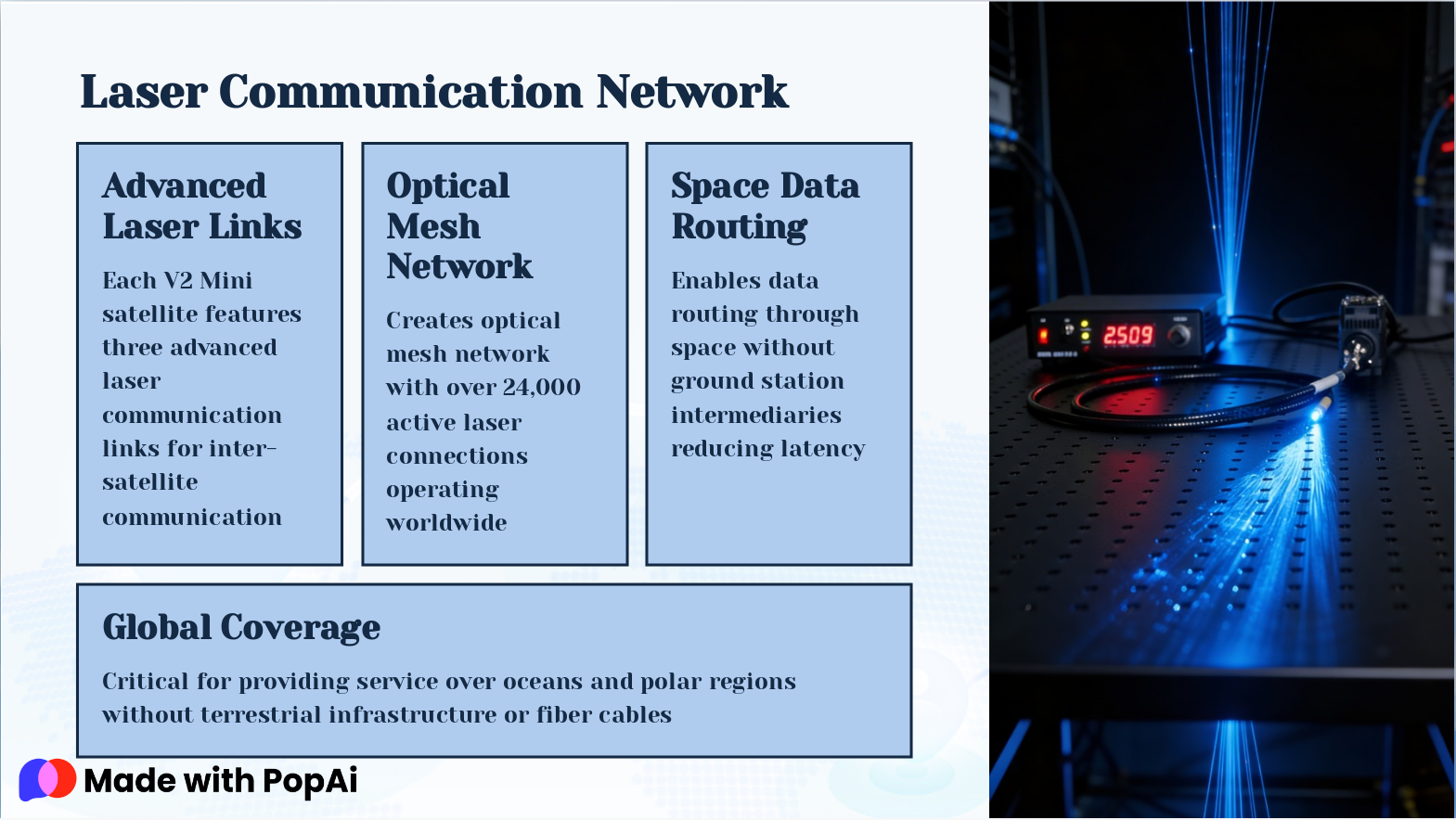
- Advanced Laser Links: Each V2 Mini satellite features three advanced laser communication links for inter-satellite communication
- Optical Mesh Network: Creates optical mesh network with over 24,000 active laser connections operating worldwide
- Space Data Routing: Enables data routing through space without ground station intermediaries reducing latency
- Global Coverage: Critical for providing service over oceans and polar regions without terrestrial infrastructure or fiber cables
Slide 11: Internet Service Performance: Speed and Capabilities
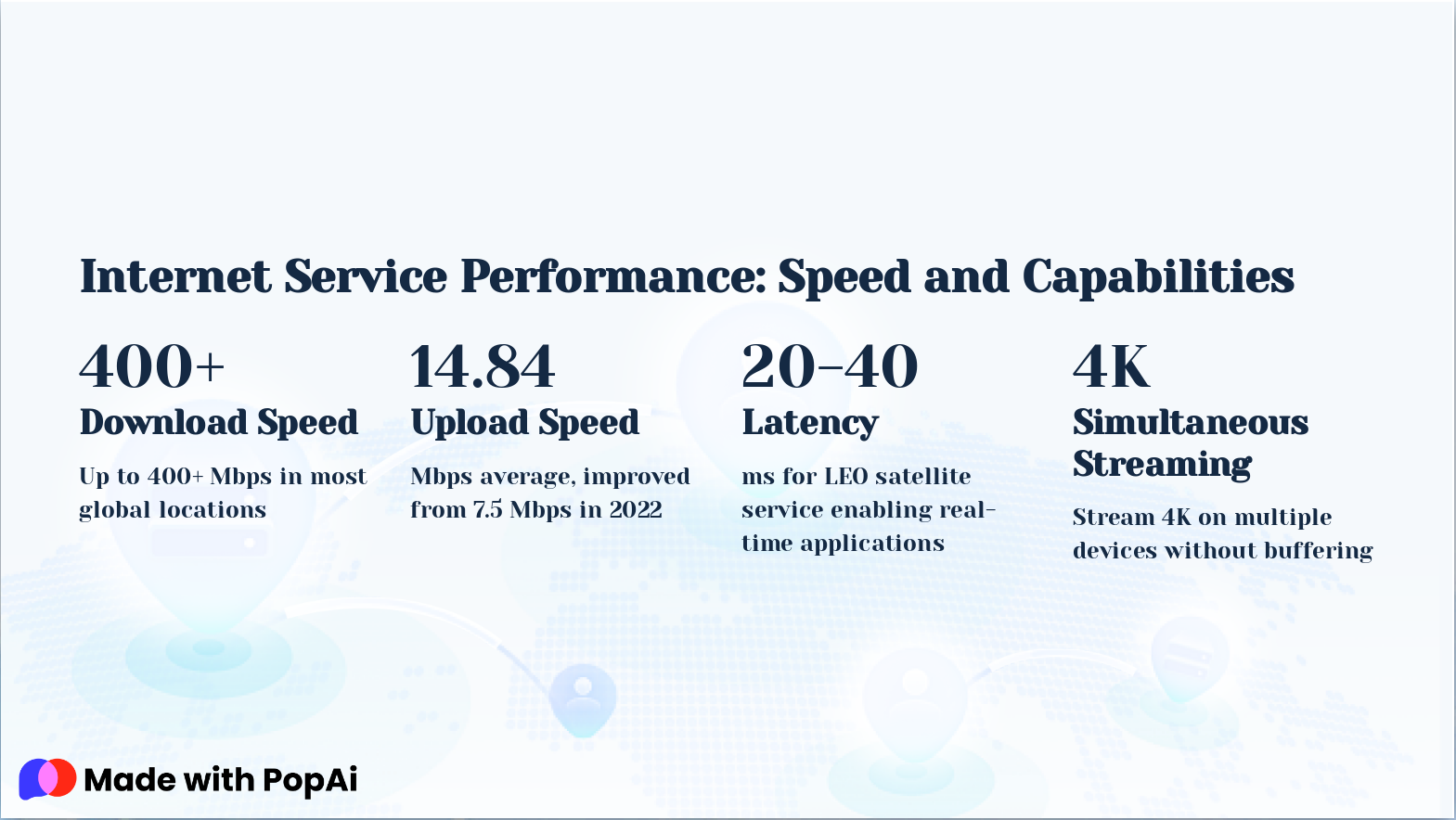
- 400+ — Download Speed
- 14.84 — Upload Speed
- 20-40 — Latency
- 4K — Simultaneous Streaming
Slide 12: Speed and Reliability Metrics: Consistent Performance Growth
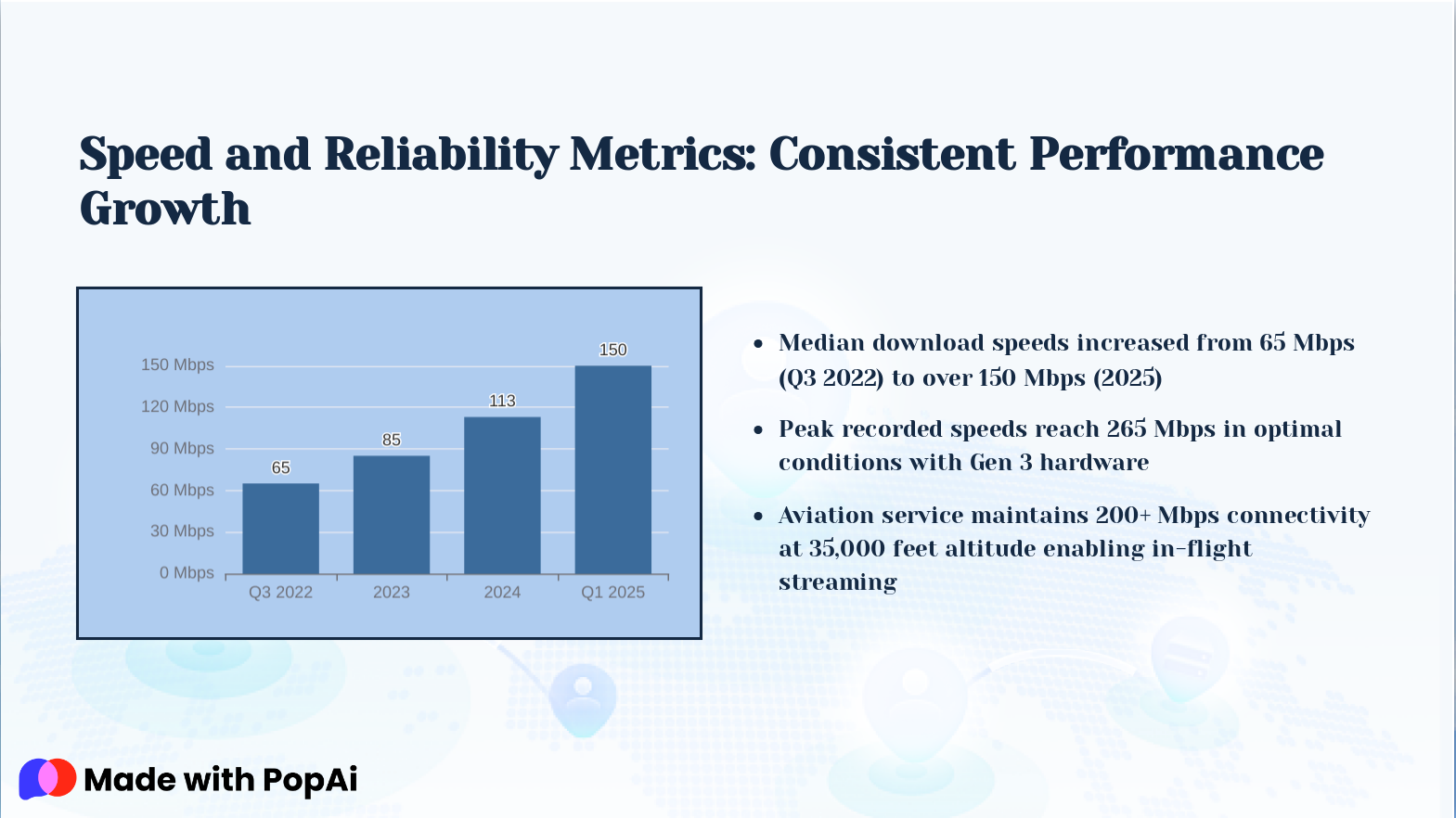
Median download speeds increased from 65 Mbps (Q3 2022) to over 150 Mbps (2025)
Peak recorded speeds reach 265 Mbps in optimal conditions with Gen 3 hardware
Aviation service maintains 200+ Mbps connectivity at 35,000 feet altitude enabling in-flight streaming
- Median download speeds increased from 65 Mbps (Q3 2022) to over 150 Mbps (2025)
- Peak recorded speeds reach 265 Mbps in optimal conditions with Gen 3 hardware
- Aviation service maintains 200+ Mbps connectivity at 35,000 feet altitude enabling in-flight streaming
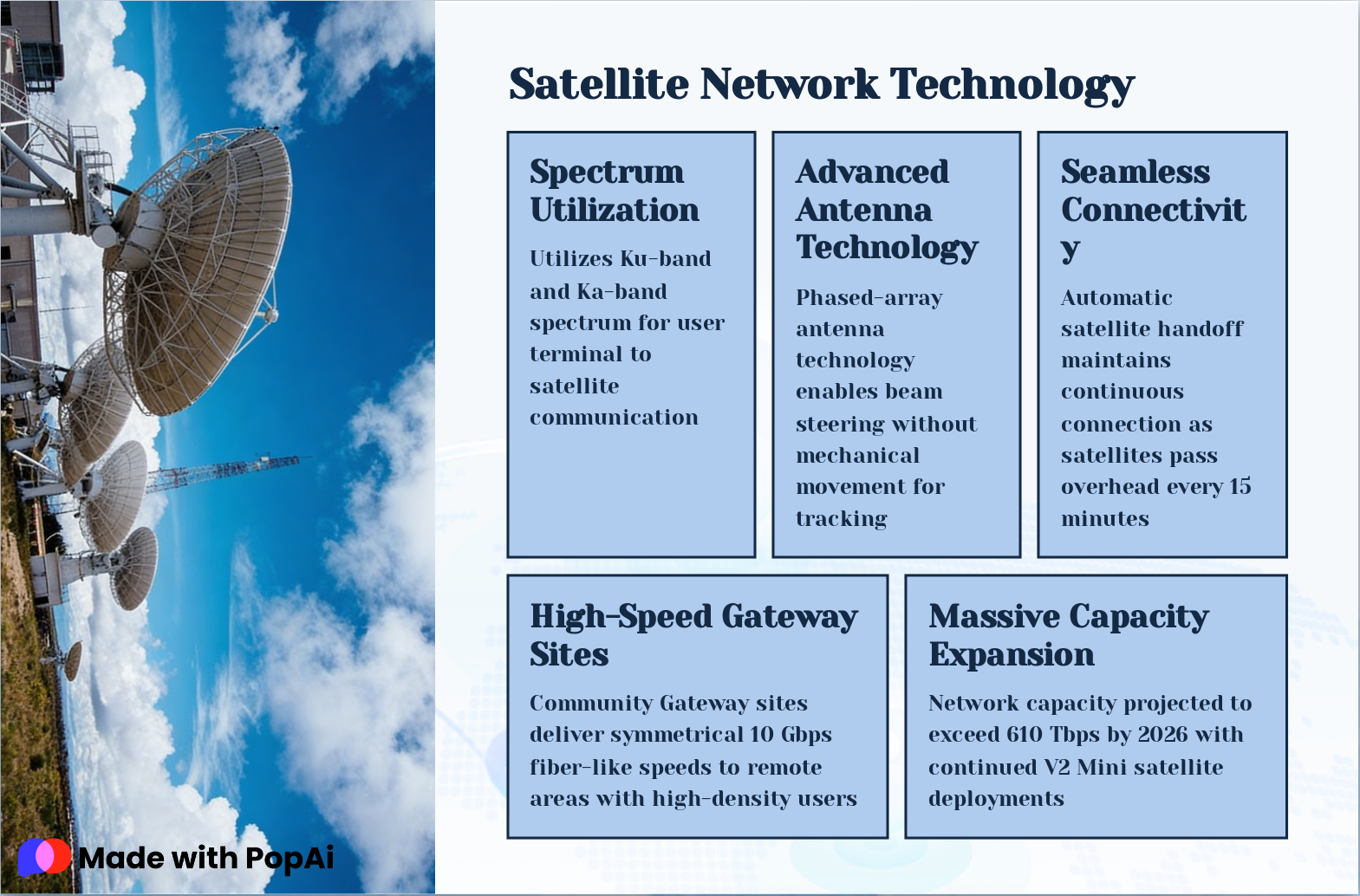
Slide 13: Satellite Network Technology
- Spectrum Utilization: Utilizes Ku-band and Ka-band spectrum for user terminal to satellite communication
- Advanced Antenna Technology: Phased-array antenna technology enables beam steering without mechanical movement for tracking
- Seamless Connectivity: Automatic satellite handoff maintains continuous connection as satellites pass overhead every 15 minutes
- High-Speed Gateway Sites: Community Gateway sites deliver symmetrical 10 Gbps fiber-like speeds to remote areas with high-density users
- Massive Capacity Expansion: Network capacity projected to exceed 610 Tbps by 2026 with continued V2 Mini satellite deployments
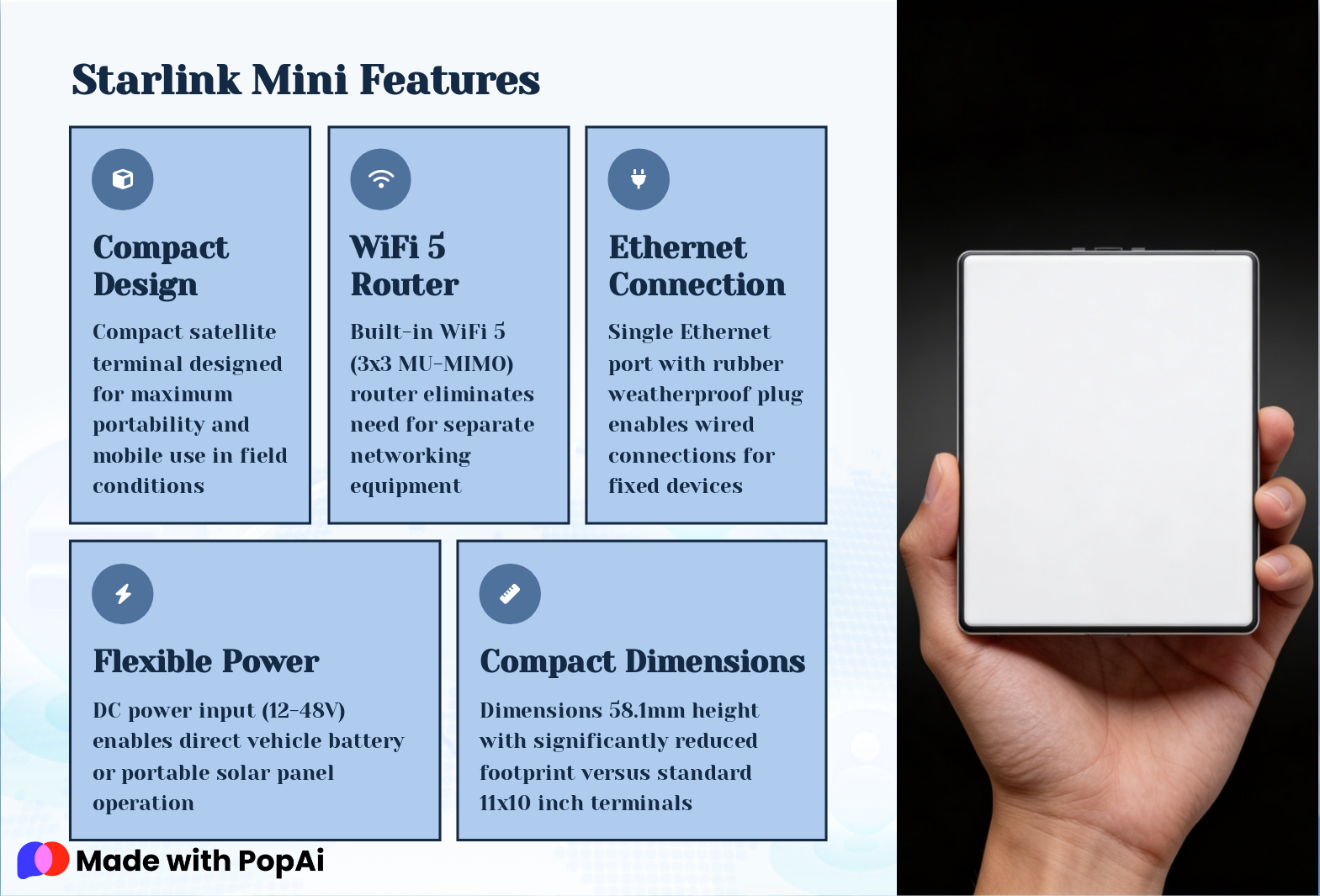
Slide 14: Starlink Mini Features
- Compact Design: Compact satellite terminal designed for maximum portability and mobile use in field conditions
- WiFi 5 Router: Built-in WiFi 5 (3x3 MU-MIMO) router eliminates need for separate networking equipment
- Ethernet Connection: Single Ethernet port with rubber weatherproof plug enables wired connections for fixed devices
- Flexible Power: DC power input (12-48V) enables direct vehicle battery or portable solar panel operation
- Compact Dimensions: Dimensions 58.1mm height with significantly reduced footprint versus standard 11x10 inch terminals
Slide 15: Starlink Mini Technical Specifications: Efficiency and Power
- Power Consumption: 25-40 watts typical operation, often achieves low 20s watts for reduced energy draw
- Download Speeds: Maximum download speeds exceed 200 Mbps with Mini terminal in standard conditions
- Portability: Weight and size optimized for backpack portability and mobile installations
- Water Resistance: IP67 water resistance rating when used with proprietary Starlink cable connector
- Off-Grid Operation: Lower power draw enables off-grid operation with portable battery or solar power solutions
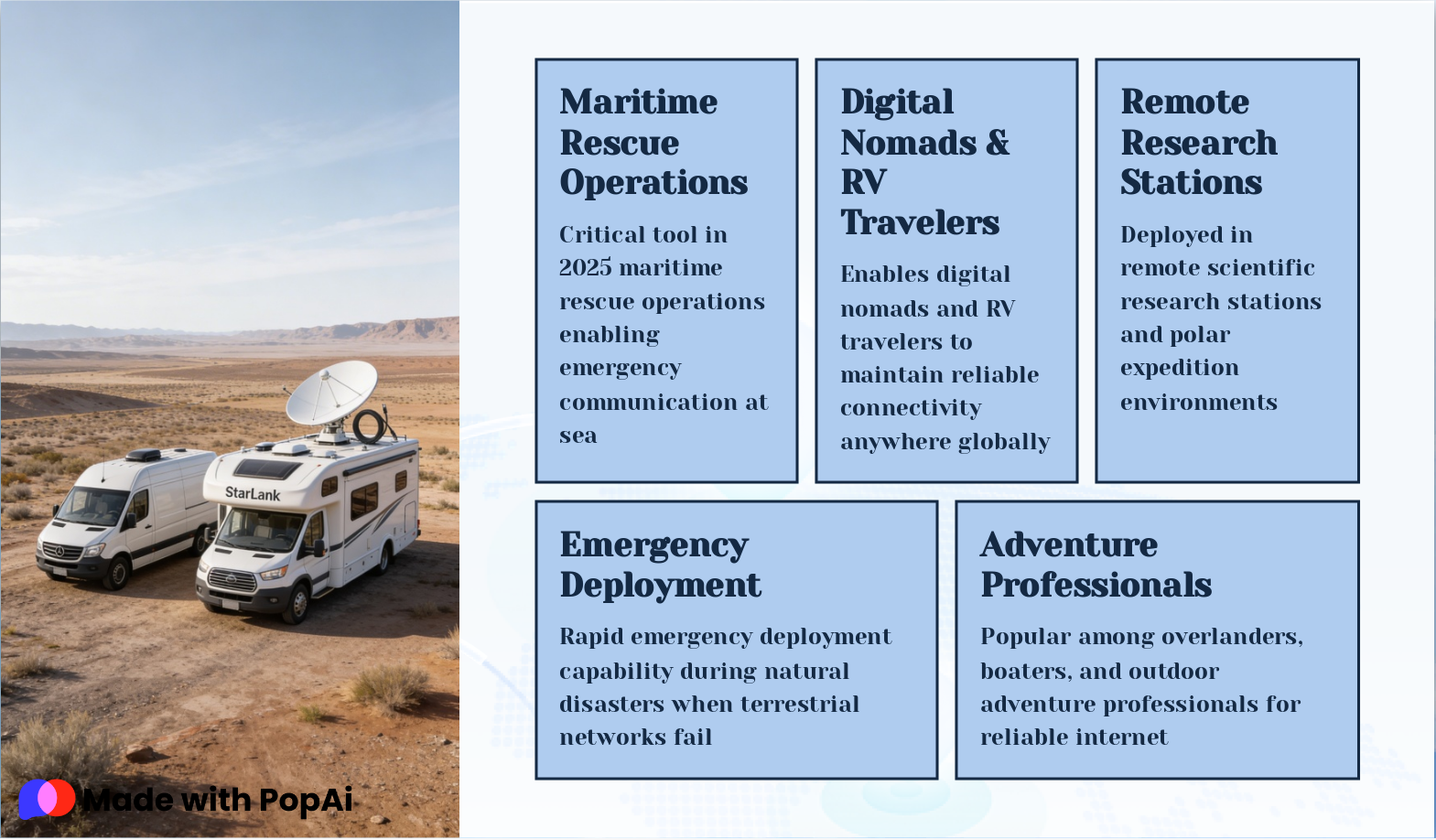
Slide 16: Maritime Rescue Operations
- Maritime Rescue Operations: Critical tool in 2025 maritime rescue operations enabling emergency communication at sea
- Digital Nomads & RV Travelers: Enables digital nomads and RV travelers to maintain reliable connectivity anywhere globally
- Remote Research Stations: Deployed in remote scientific research stations and polar expedition environments
- Emergency Deployment: Rapid emergency deployment capability during natural disasters when terrestrial networks fail
- Adventure Professionals: Popular among overlanders, boaters, and outdoor adventure professionals for reliable internet
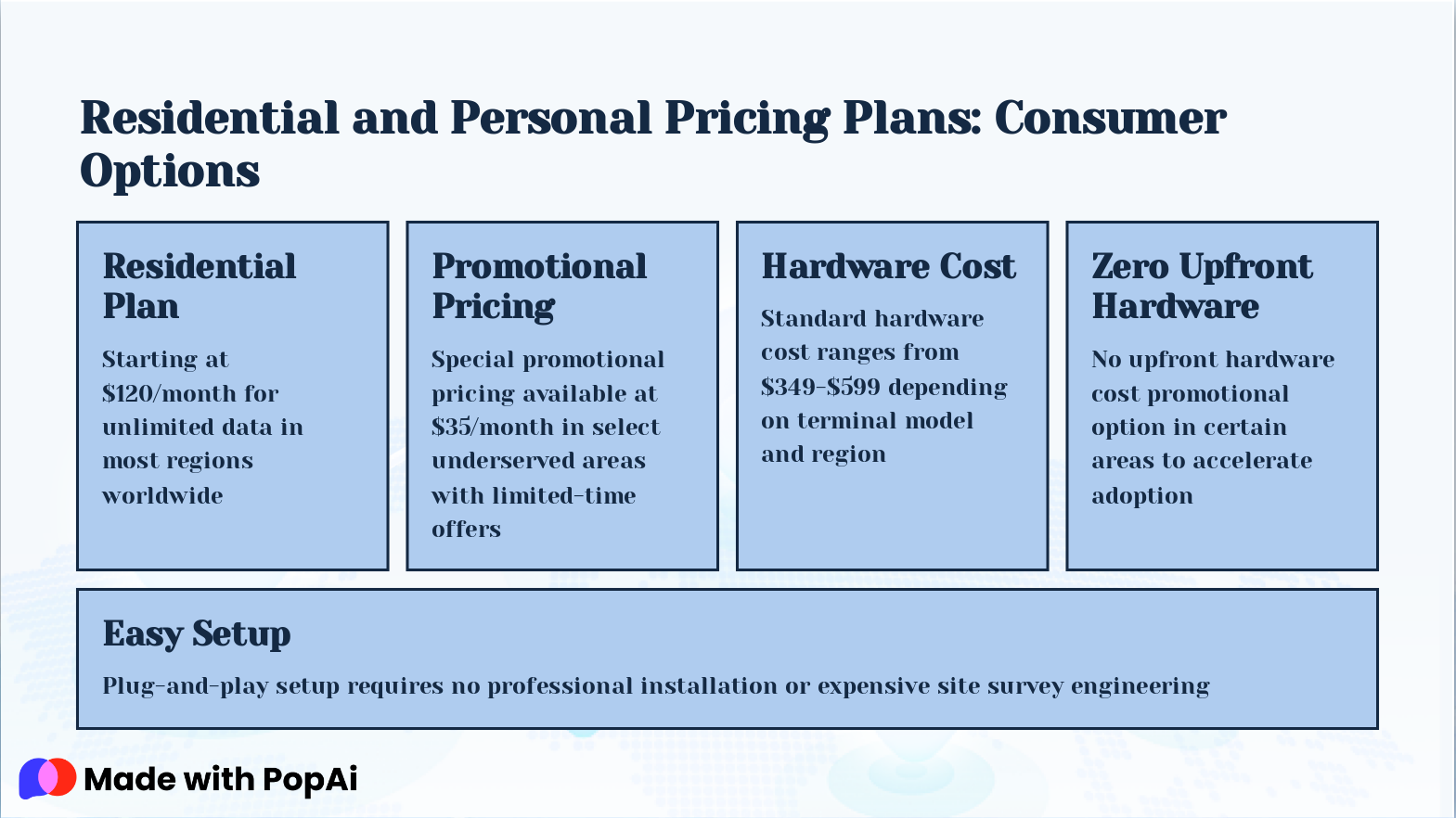
Slide 17: Residential and Personal Pricing Plans: Consumer Options
- Residential Plan: Starting at $120/month for unlimited data in most regions worldwide
- Promotional Pricing: Special promotional pricing available at $35/month in select underserved areas with limited-time offers
- Hardware Cost: Standard hardware cost ranges from $349-$599 depending on terminal model and region
- Zero Upfront Hardware: No upfront hardware cost promotional option in certain areas to accelerate adoption
- Easy Setup: Plug-and-play setup requires no professional installation or expensive site survey engineering
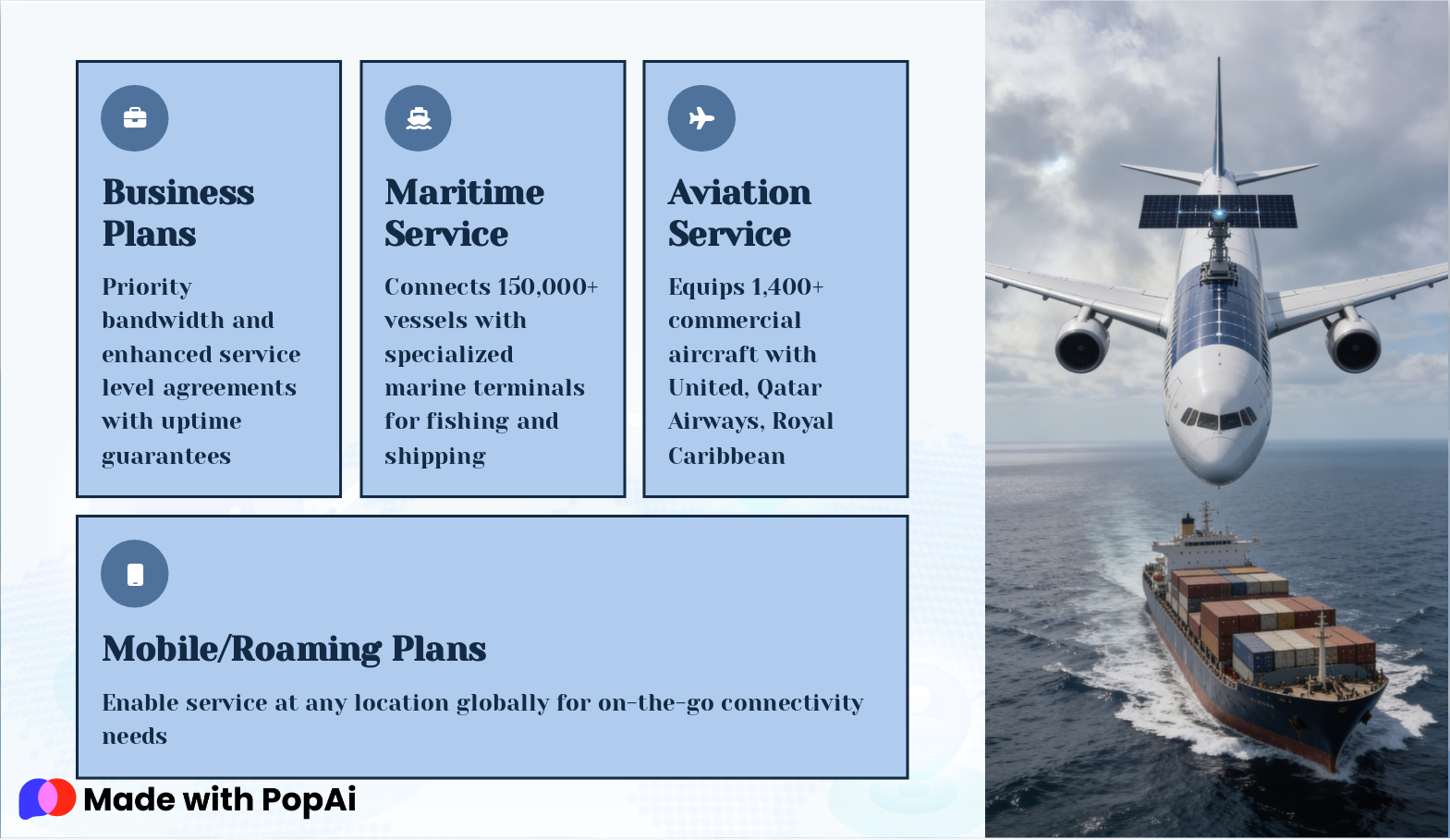
Slide 18: Business Plans
- Business Plans: Priority bandwidth and enhanced service level agreements with uptime guarantees
- Maritime Service: Connects 150,000+ vessels with specialized marine terminals for fishing and shipping
- Aviation Service: Equips 1,400+ commercial aircraft with United, Qatar Airways, Royal Caribbean
- Mobile/Roaming Plans: Enable service at any location globally for on-the-go connectivity needs
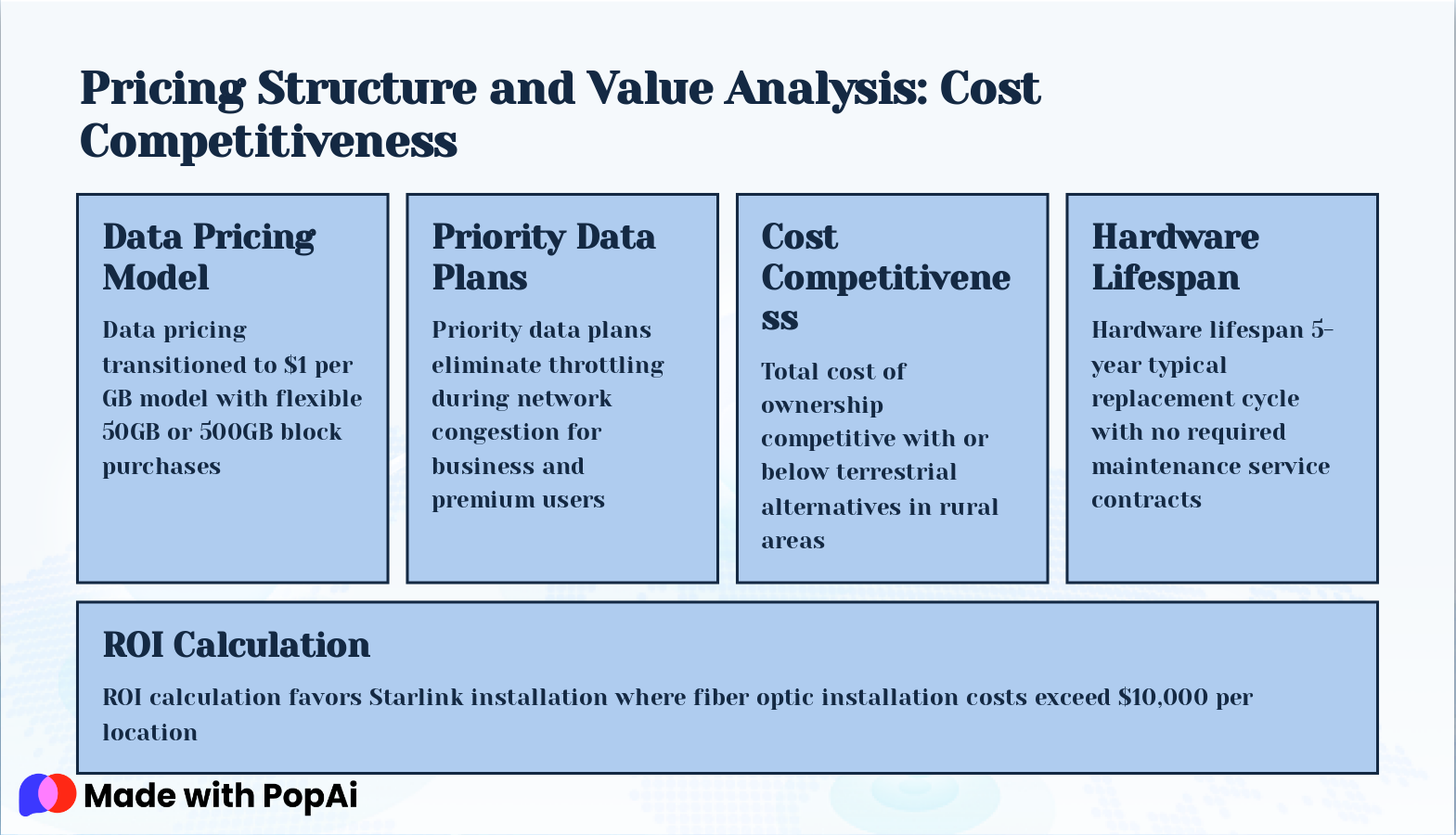
Slide 19: Pricing Structure and Value Analysis: Cost Competitiveness
- Data Pricing Model: Data pricing transitioned to $1 per GB model with flexible 50GB or 500GB block purchases
- Priority Data Plans: Priority data plans eliminate throttling during network congestion for business and premium users
- Cost Competitiveness: Total cost of ownership competitive with or below terrestrial alternatives in rural areas
- Hardware Lifespan: Hardware lifespan 5-year typical replacement cycle with no required maintenance service contracts
- ROI Calculation: ROI calculation favors Starlink installation where fiber optic installation costs exceed $10,000 per location
Slide 20: Untitled
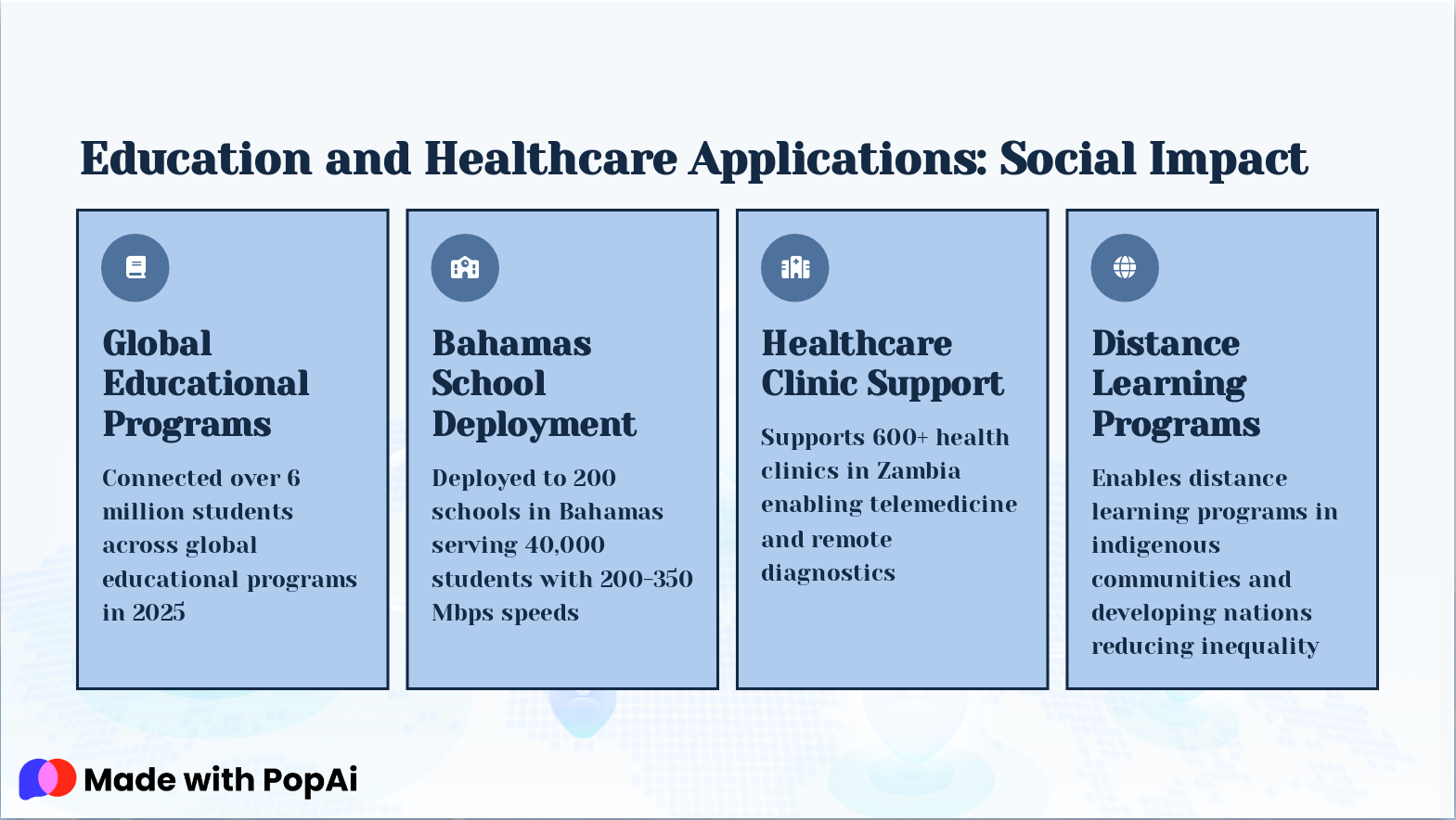
Slide 21: Education and Healthcare Applications: Social Impact
- Global Educational Programs: Connected over 6 million students across global educational programs in 2025
- Bahamas School Deployment: Deployed to 200 schools in Bahamas serving 40,000 students with 200-350 Mbps speeds
- Healthcare Clinic Support: Supports 600+ health clinics in Zambia enabling telemedicine and remote diagnostics
- Distance Learning Programs: Enables distance learning programs in indigenous communities and developing nations reducing inequality
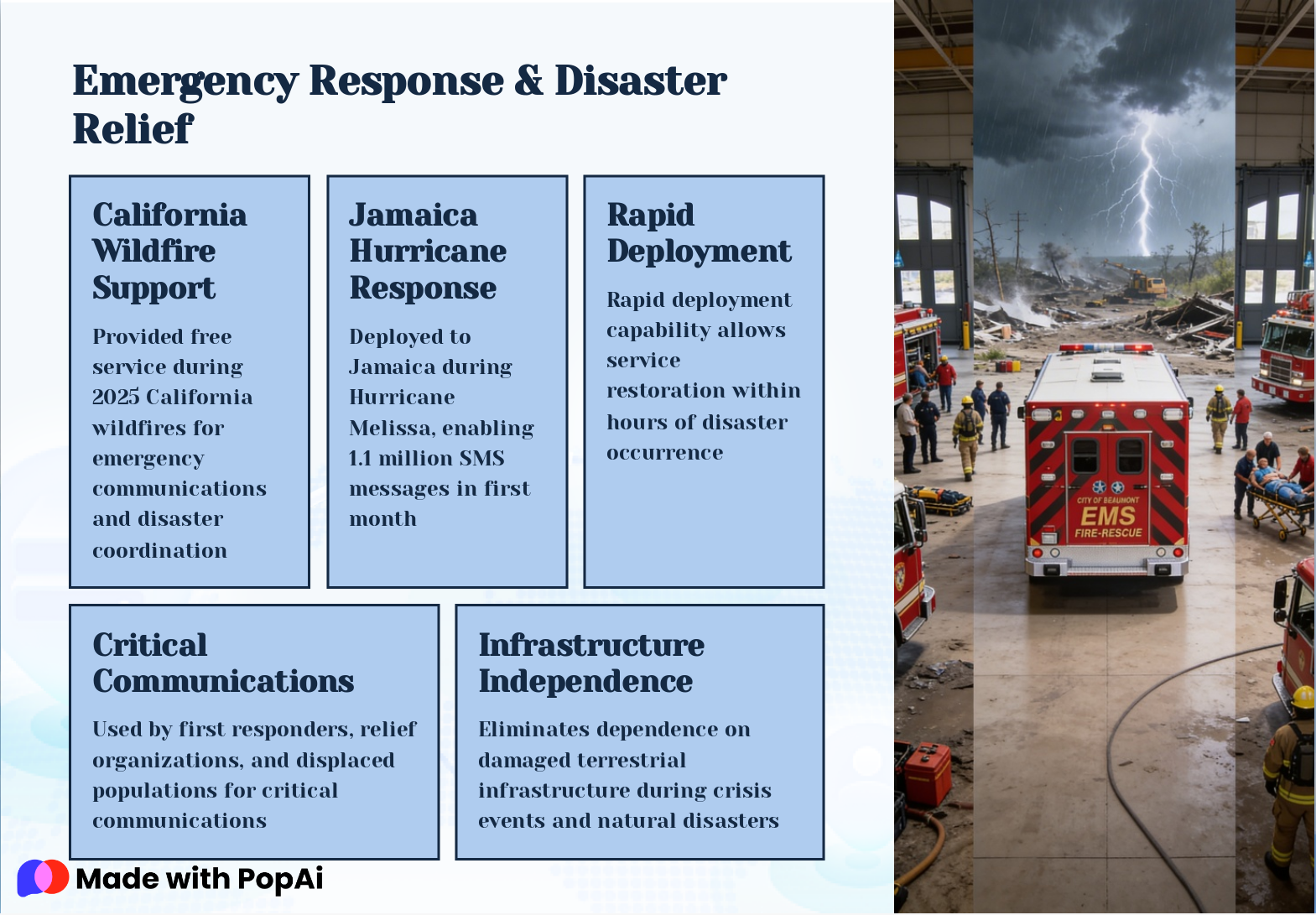
Slide 22: Emergency Response & Disaster Relief
- California Wildfire Support: Provided free service during 2025 California wildfires for emergency communications and disaster coordination
- Jamaica Hurricane Response: Deployed to Jamaica during Hurricane Melissa, enabling 1.1 million SMS messages in first month
- Rapid Deployment: Rapid deployment capability allows service restoration within hours of disaster occurrence
- Critical Communications: Used by first responders, relief organizations, and displaced populations for critical communications
- Infrastructure Independence: Eliminates dependence on damaged terrestrial infrastructure during crisis events and natural disasters
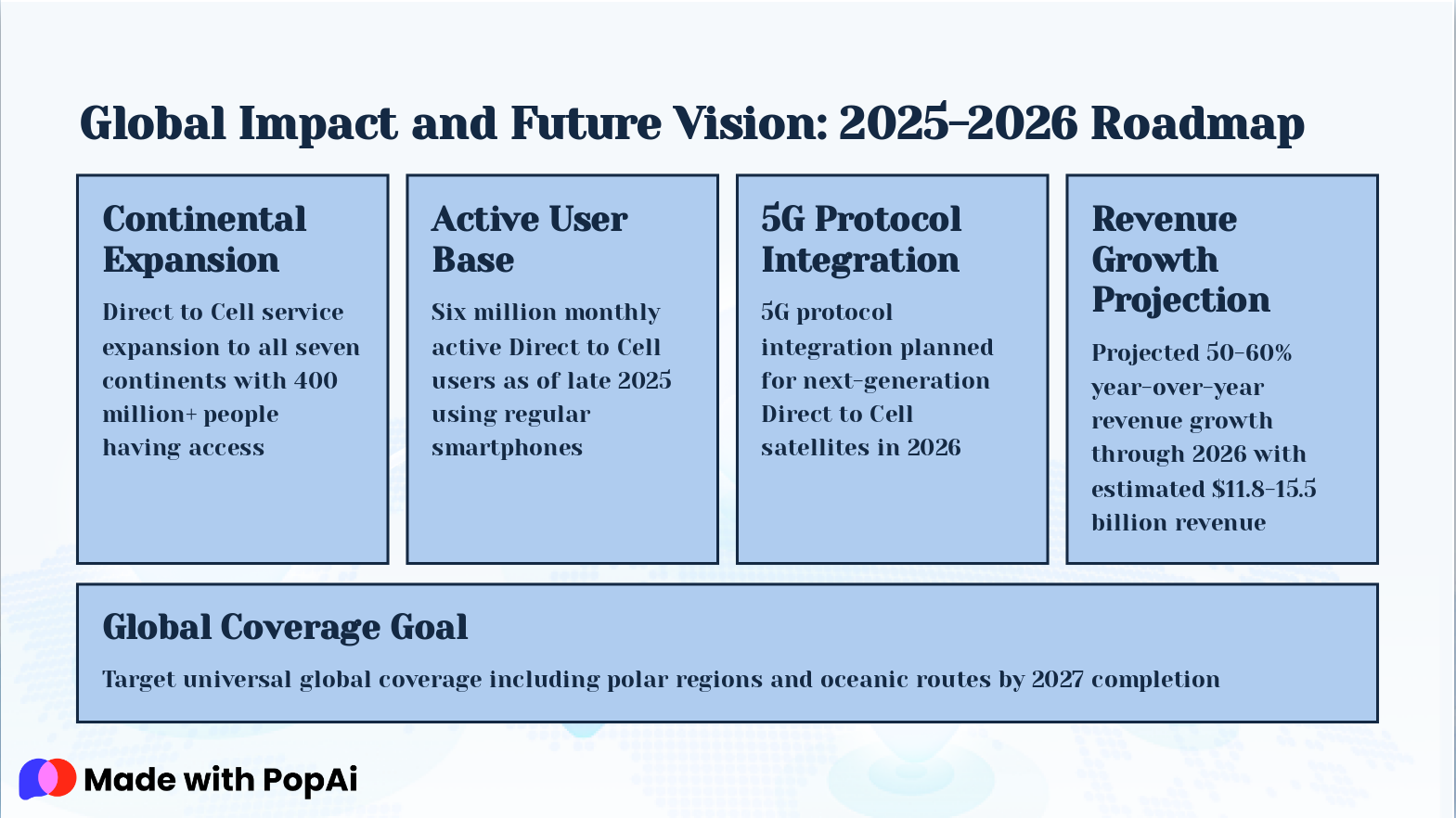
Slide 23: Global Impact and Future Vision: 2025-2026 Roadmap
- Continental Expansion: Direct to Cell service expansion to all seven continents with 400 million+ people having access
- Active User Base: Six million monthly active Direct to Cell users as of late 2025 using regular smartphones
- 5G Protocol Integration: 5G protocol integration planned for next-generation Direct to Cell satellites in 2026
- Revenue Growth Projection: Projected 50-60% year-over-year revenue growth through 2026 with estimated $11.8-15.5 billion revenue
- Global Coverage Goal: Target universal global coverage including polar regions and oceanic routes by 2027 completion
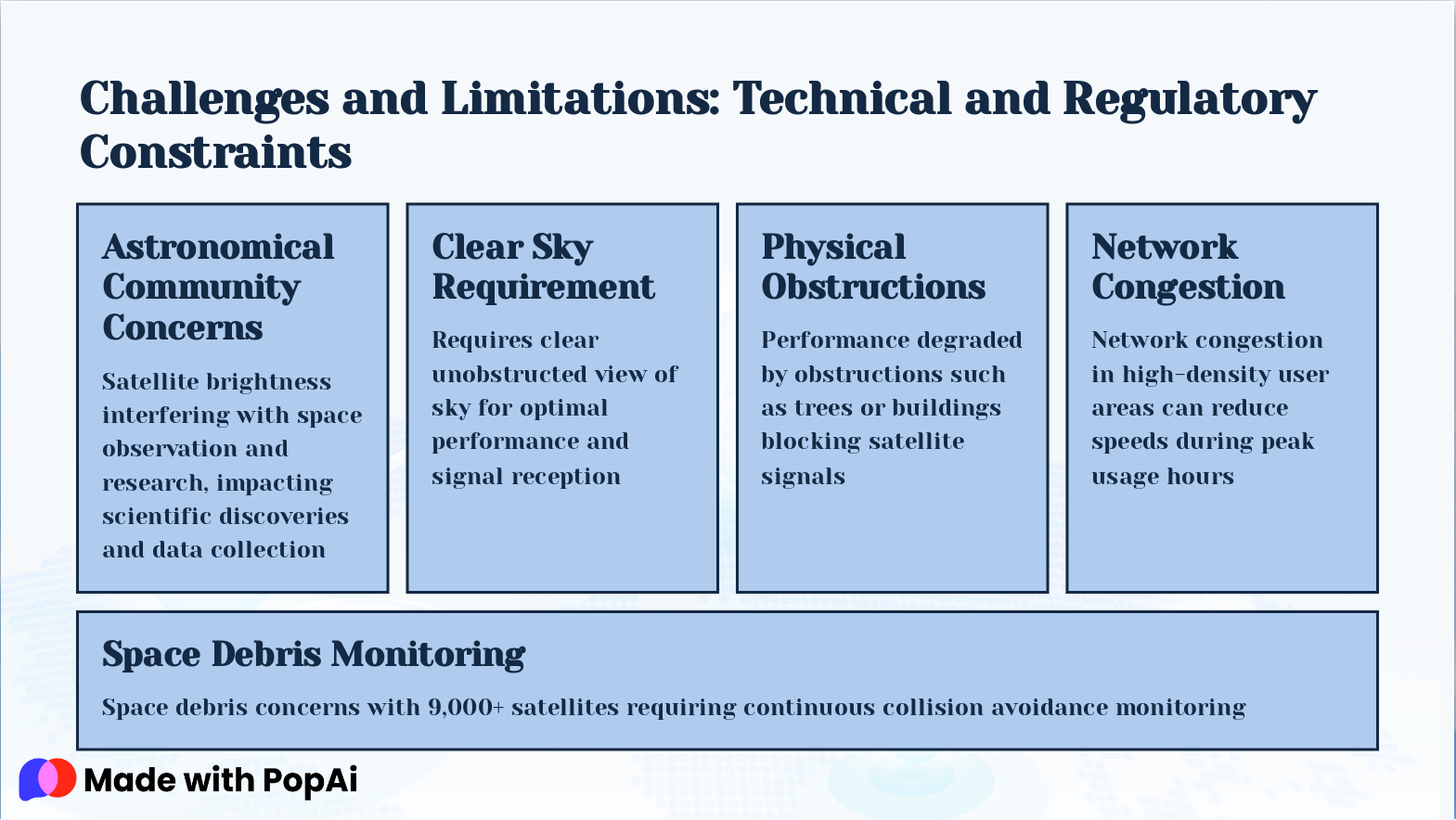
Slide 24: Challenges and Limitations: Technical and Regulatory Constraints
- Astronomical Community Concerns: Satellite brightness interfering with space observation and research, impacting scientific discoveries and data collection
- Clear Sky Requirement: Requires clear unobstructed view of sky for optimal performance and signal reception
- Physical Obstructions: Performance degraded by obstructions such as trees or buildings blocking satellite signals
- Network Congestion: Network congestion in high-density user areas can reduce speeds during peak usage hours
- Space Debris Monitoring: Space debris concerns with 9,000+ satellites requiring continuous collision avoidance monitoring
Slide 25: Conclusion: Redefining Global Internet Infrastructure
Slide 26: Thank You
Thank You Starlink: Bridging the Global Digital Divide Through Satellite Innovation