Presentation Summary
Discover the new 2025 law that offers unprecedented opportunities for Americans to obtain Canadian citizenship. Learn about the strategic drivers, eligibility requirements, and three primary pathways to citizenship.
Full Presentation Transcript
Slide 1: Canadian Citizenship for Americans: Unprecedented Opportunity Under New 2025 Law
Comprehensive Guide to Pathways, Requirements, Timeline, and Strategic Implications
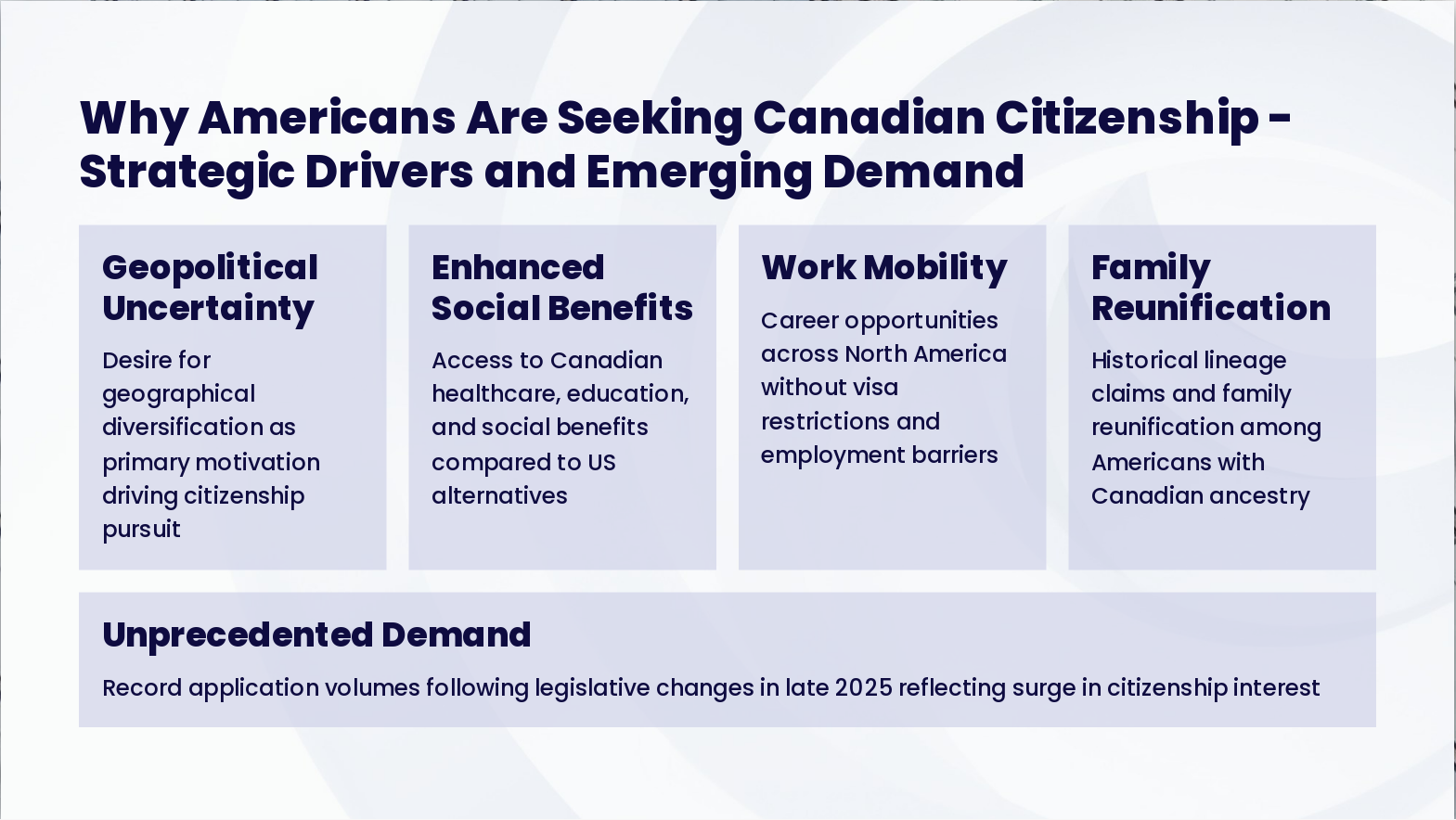
Slide 2: Why Americans Are Seeking Canadian Citizenship - Strategic Drivers and Emerging Demand
- Geopolitical Uncertainty: Desire for geographical diversification as primary motivation driving citizenship pursuit
- Enhanced Social Benefits: Access to Canadian healthcare, education, and social benefits compared to US alternatives
- Work Mobility: Career opportunities across North America without visa restrictions and employment barriers
- Family Reunification: Historical lineage claims and family reunification among Americans with Canadian ancestry
- Unprecedented Demand: Record application volumes following legislative changes in late 2025 reflecting surge in citizenship interest
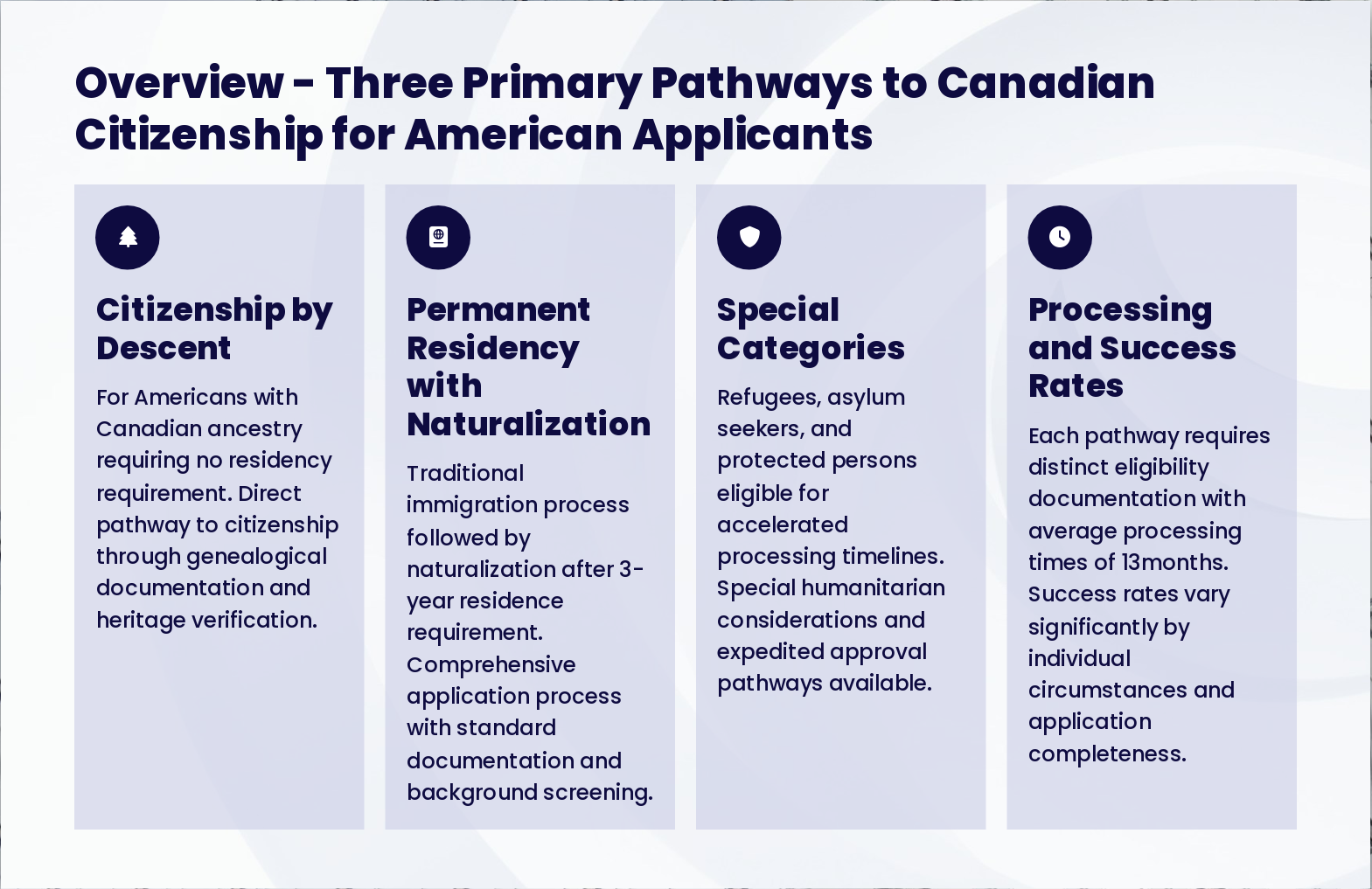
Slide 3: Overview - Three Primary Pathways to Canadian Citizenship for American Applicants
- Citizenship by Descent: For Americans with Canadian ancestry requiring no residency requirement. Direct pathway to citizenship through genealogical documentation and heritage verification.
- Permanent Residency with Naturalization: Traditional immigration process followed by naturalization after 3-year residence requirement. Comprehensive application process with standard documentation and background screening.
- Special Categories: Refugees, asylum seekers, and protected persons eligible for accelerated processing timelines. Special humanitarian considerations and expedited approval pathways available.
- Processing and Success Rates: Each pathway requires distinct eligibility documentation with average processing times of 13months. Success rates vary significantly by individual circumstances and application completeness.
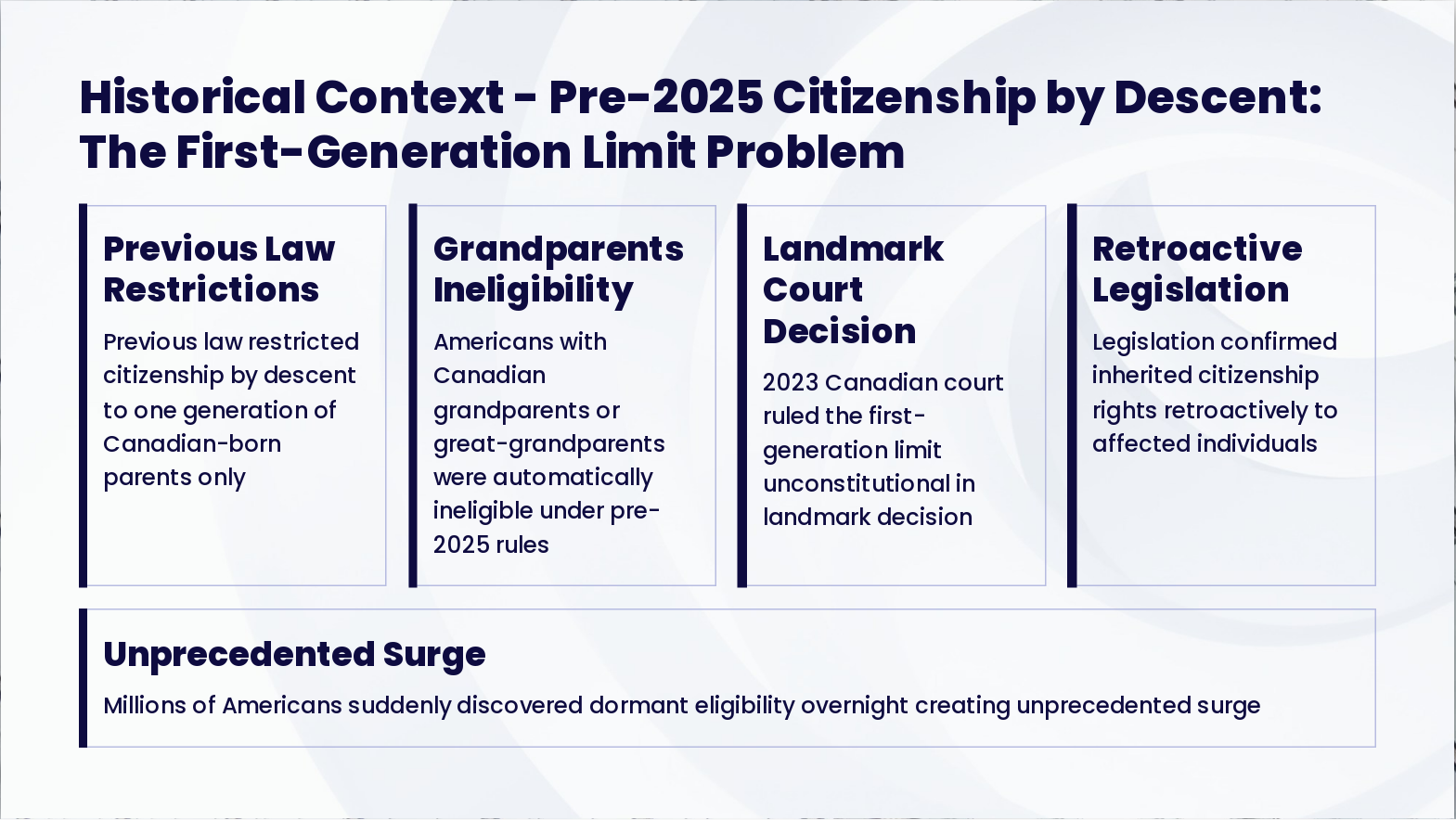
Slide 4: Historical Context - Pre-2025 Citizenship by Descent: The First-Generation Limit Problem
- Previous Law Restrictions: Previous law restricted citizenship by descent to one generation of Canadian-born parents only
- Grandparents Ineligibility: Americans with Canadian grandparents or great-grandparents were automatically ineligible under pre-2025 rules
- Landmark Court Decision: 2023 Canadian court ruled the first-generation limit unconstitutional in landmark decision
- Retroactive Legislation: Legislation confirmed inherited citizenship rights retroactively to affected individuals
- Unprecedented Surge: Millions of Americans suddenly discovered dormant eligibility overnight creating unprecedented surge
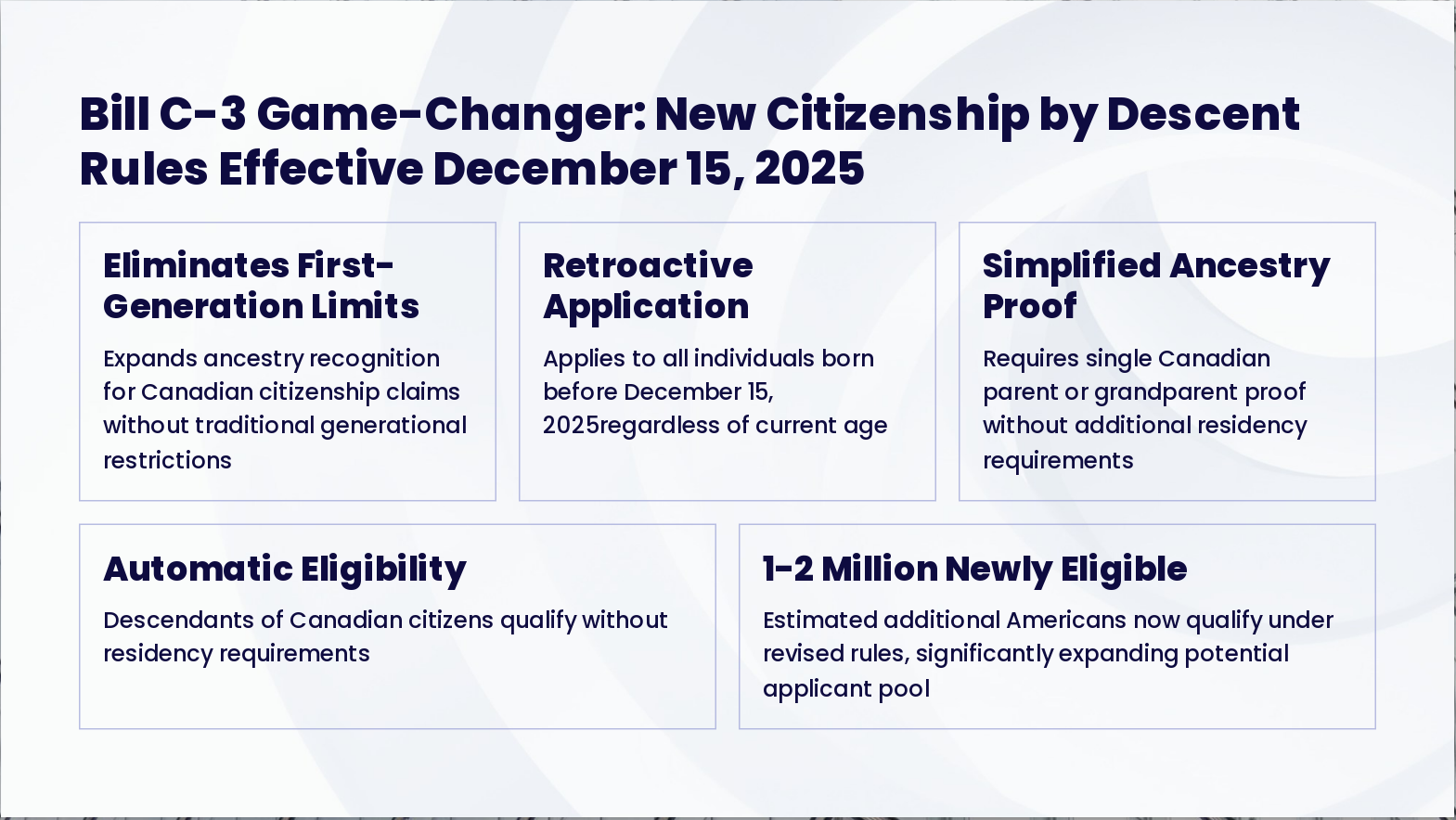
Slide 5: Bill C-3 Game-Changer: New Citizenship by Descent Rules Effective December 15, 2025
- Eliminates First-Generation Limits: Expands ancestry recognition for Canadian citizenship claims without traditional generational restrictions
- Retroactive Application: Applies to all individuals born before December 15, 2025regardless of current age
- Simplified Ancestry Proof: Requires single Canadian parent or grandparent proof without additional residency requirements
- Automatic Eligibility: Descendants of Canadian citizens qualify without residency requirements
- 1-2 Million Newly Eligible: Estimated additional Americans now qualify under revised rules, significantly expanding potential applicant pool
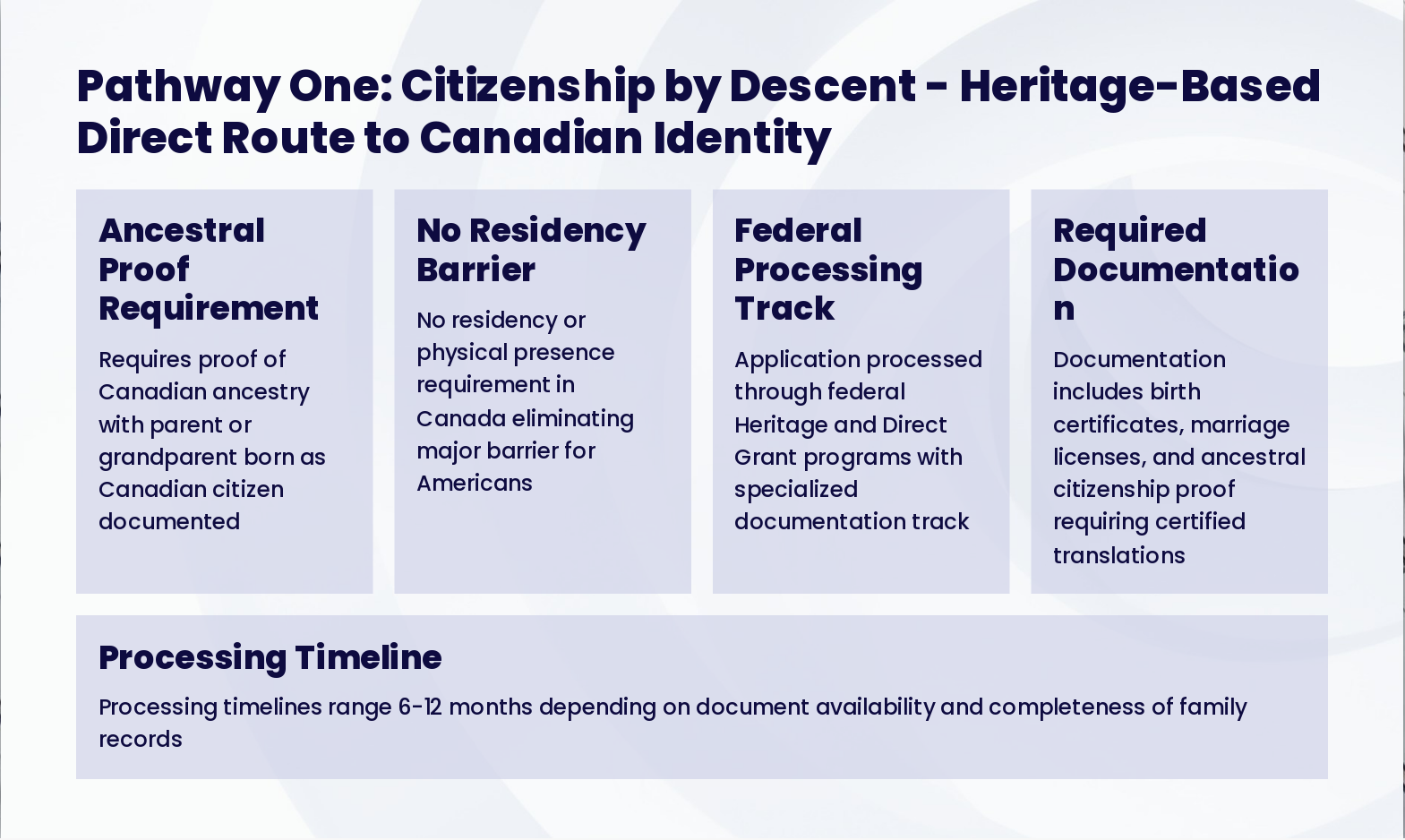
Slide 6: Pathway One: Citizenship by Descent - Heritage-Based Direct Route to Canadian Identity
- Ancestral Proof Requirement: Requires proof of Canadian ancestry with parent or grandparent born as Canadian citizen documented
- No Residency Barrier: No residency or physical presence requirement in Canada eliminating major barrier for Americans
- Federal Processing Track: Application processed through federal Heritage and Direct Grant programs with specialized documentation track
- Required Documentation: Documentation includes birth certificates, marriage licenses, and ancestral citizenship proof requiring certified translations
- Processing Timeline: Processing timelines range 6-12 months depending on document availability and completeness of family records
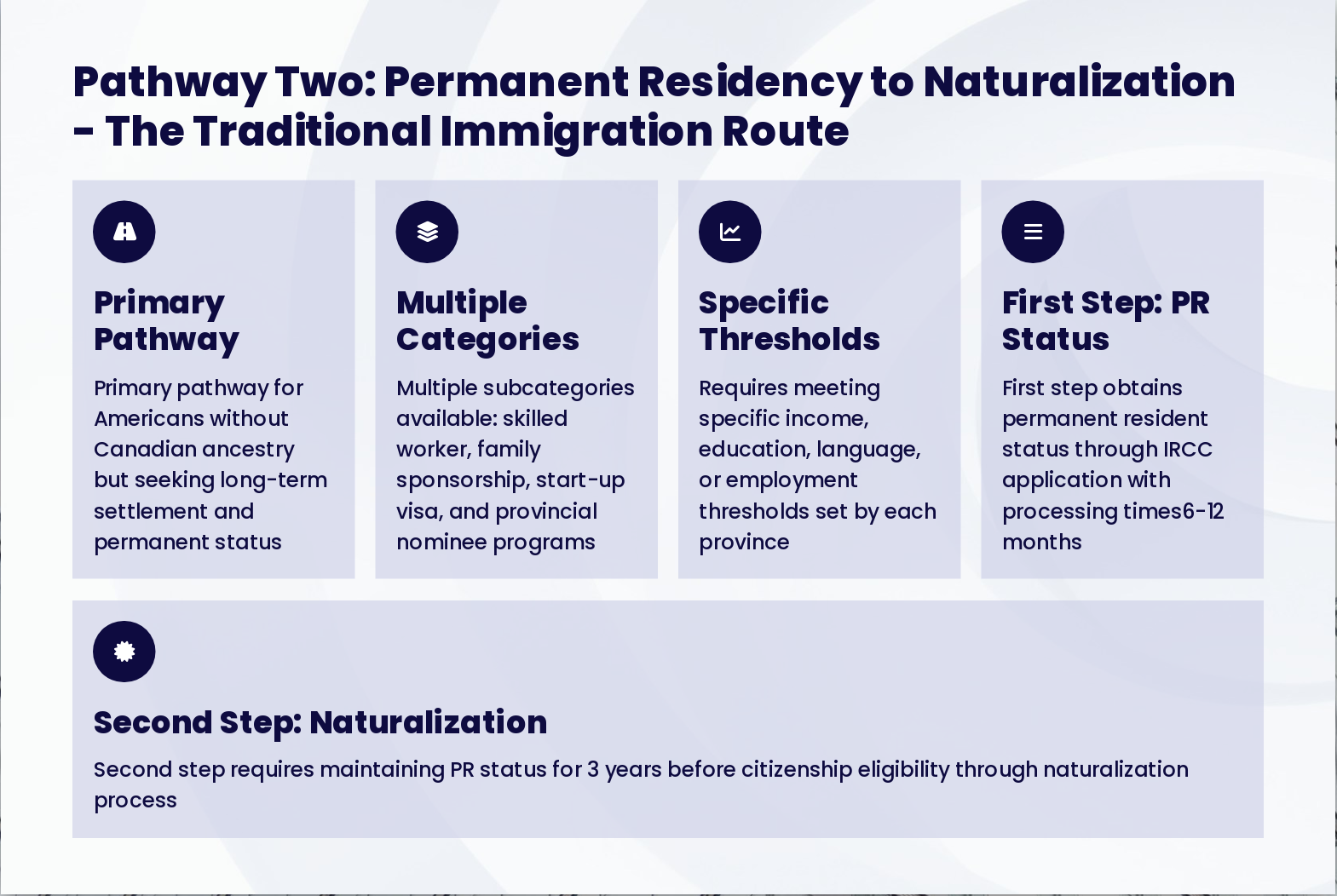
Slide 7: Pathway Two: Permanent Residency to Naturalization - The Traditional Immigration Route
- Primary Pathway: Primary pathway for Americans without Canadian ancestry but seeking long-term settlement and permanent status
- Multiple Categories: Multiple subcategories available: skilled worker, family sponsorship, start-up visa, and provincial nominee programs
- Specific Thresholds: Requires meeting specific income, education, language, or employment thresholds set by each province
- First Step: PR Status: First step obtains permanent resident status through IRCC application with processing times6-12 months
- Second Step: Naturalization: Second step requires maintaining PR status for 3 years before citizenship eligibility through naturalization process
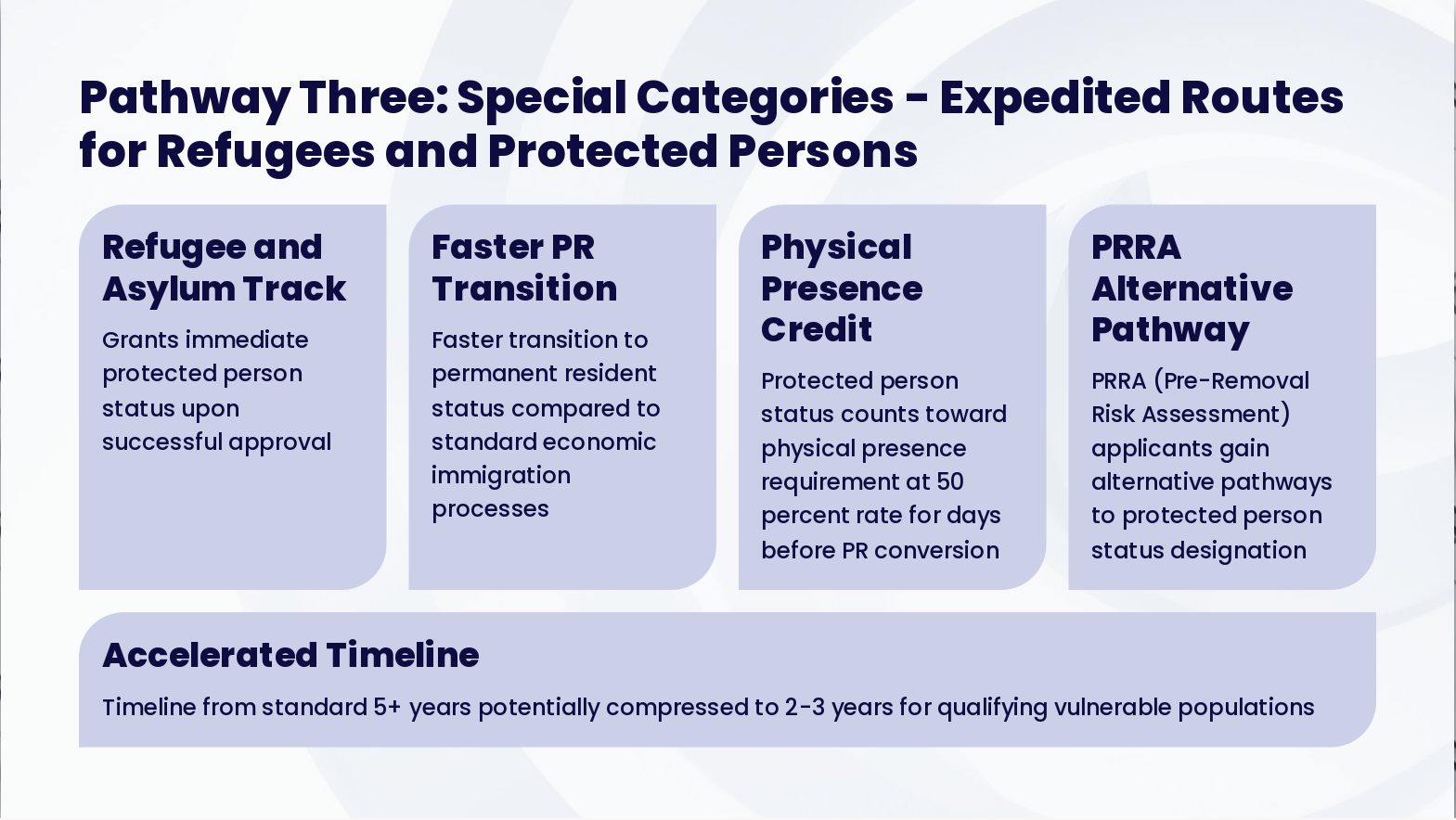
Slide 8: Pathway Three: Special Categories - Expedited Routes for Refugees and Protected Persons
- Refugee and Asylum Track: Grants immediate protected person status upon successful approval
- Faster PR Transition: Faster transition to permanent resident status compared to standard economic immigration processes
- Physical Presence Credit: Protected person status counts toward physical presence requirement at 50 percent rate for days before PR conversion
- PRRA Alternative Pathway: PRRA (Pre-Removal Risk Assessment) applicants gain alternative pathways to protected person status designation
- Accelerated Timeline: Timeline from standard 5+ years potentially compressed to 2-3 years for qualifying vulnerable populations
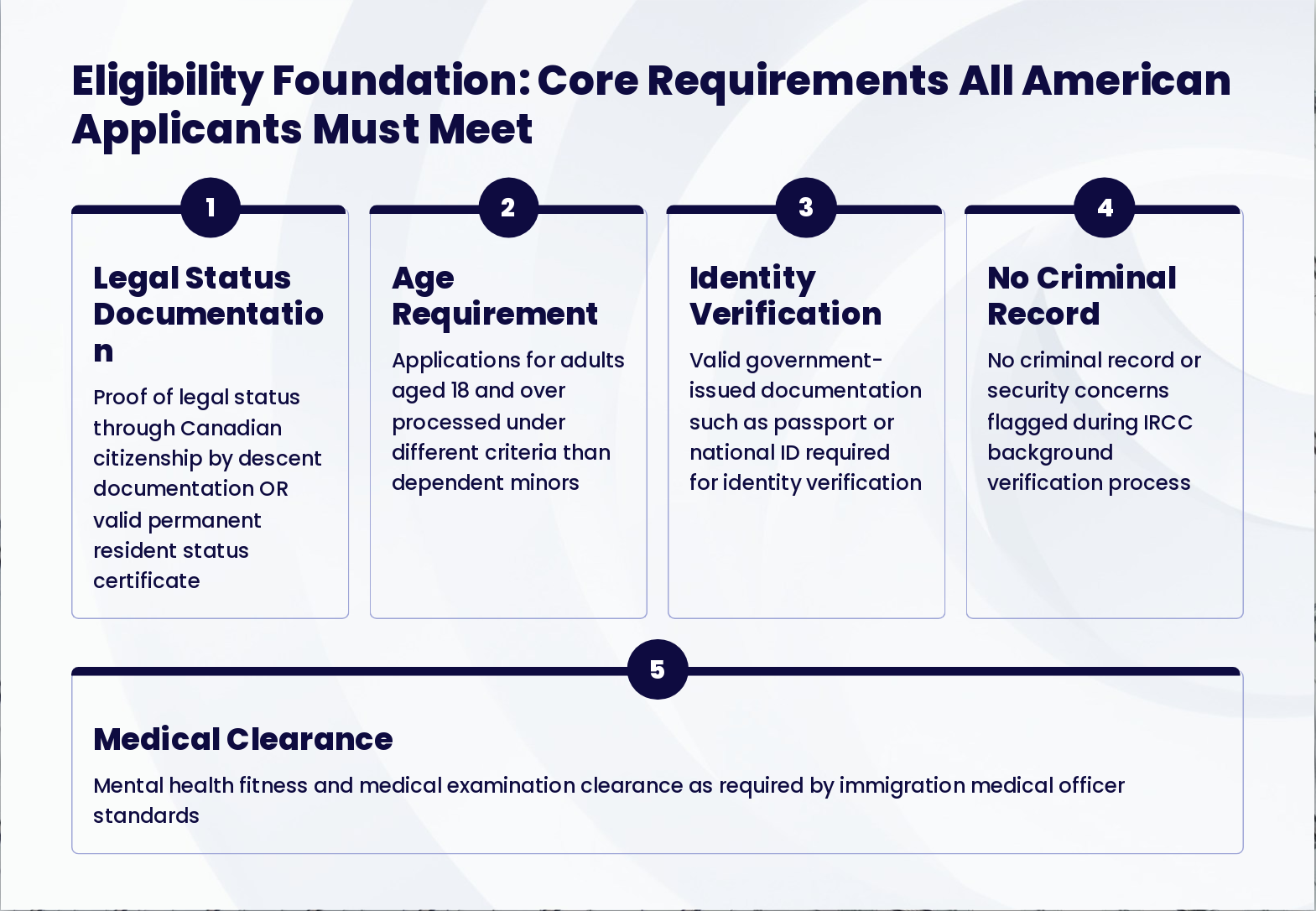
Slide 9: Eligibility Foundation: Core Requirements All American Applicants Must Meet
- Legal Status Documentation: Proof of legal status through Canadian citizenship by descent documentation OR valid permanent resident status certificate
- Age Requirement: Applications for adults aged 18 and over processed under different criteria than dependent minors
- Identity Verification: Valid government-issued documentation such as passport or national ID required for identity verification
- No Criminal Record: No criminal record or security concerns flagged during IRCC background verification process
- Medical Clearance: Mental health fitness and medical examination clearance as required by immigration medical officer standards
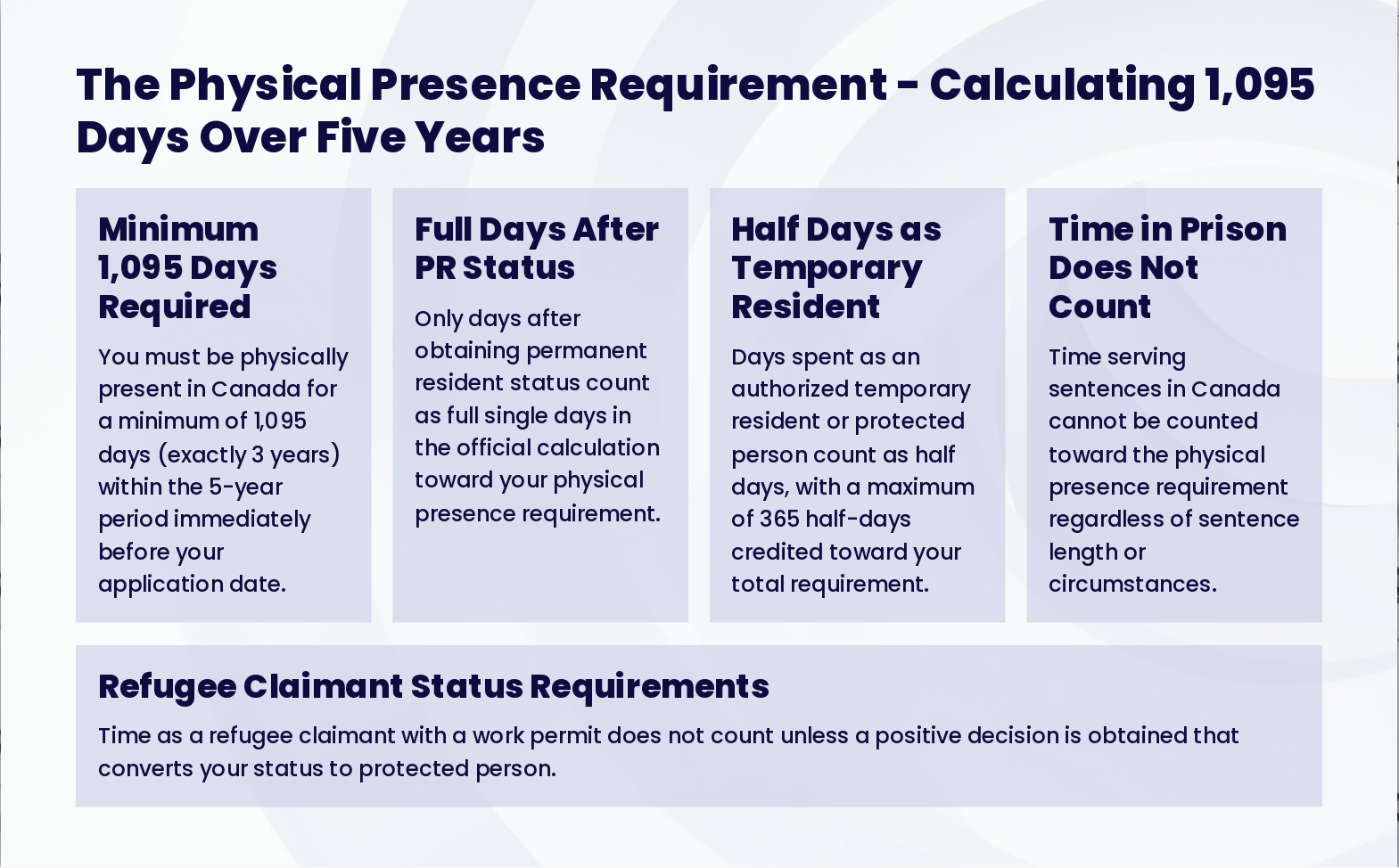
Slide 10: The Physical Presence Requirement - Calculating 1,095 Days Over Five Years
- Minimum 1,095 Days Required: You must be physically present in Canada for a minimum of 1,095 days (exactly 3 years) within the 5-year period immediately before your application date.
- Full Days After PR Status: Only days after obtaining permanent resident status count as full single days in the official calculation toward your physical presence requirement.
- Half Days as Temporary Resident: Days spent as an authorized temporary resident or protected person count as half days, with a maximum of 365 half-days credited toward your total requirement.
- Time in Prison Does Not Count: Time serving sentences in Canada cannot be counted toward the physical presence requirement regardless of sentence length or circumstances.
- Refugee Claimant Status Requirements: Time as a refugee claimant with a work permit does not count unless a positive decision is obtained that converts your status to protected person.
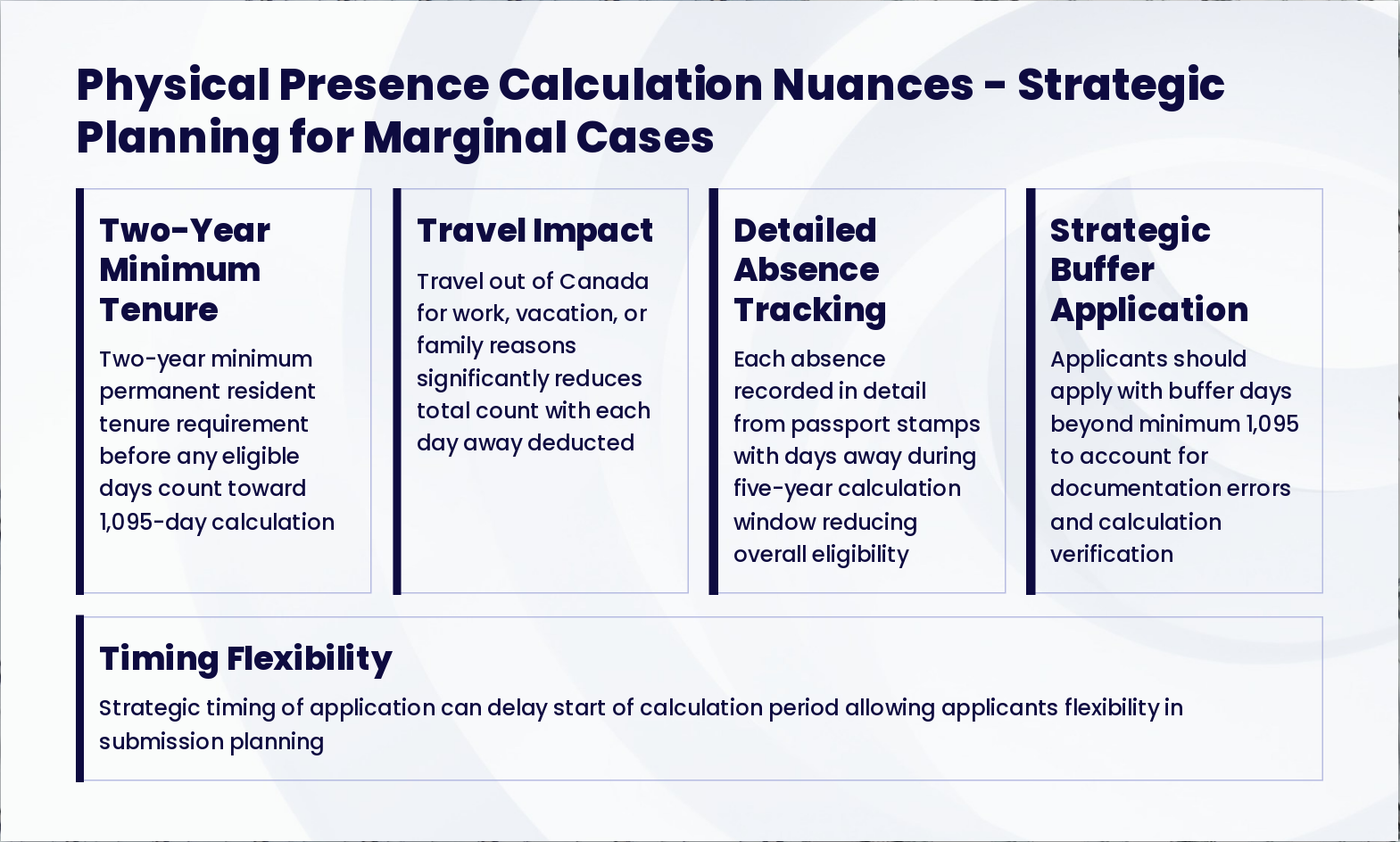
Slide 11: Physical Presence Calculation Nuances - Strategic Planning for Marginal Cases
- Two-Year Minimum Tenure: Two-year minimum permanent resident tenure requirement before any eligible days count toward 1,095-day calculation
- Travel Impact: Travel out of Canada for work, vacation, or family reasons significantly reduces total count with each day away deducted
- Detailed Absence Tracking: Each absence recorded in detail from passport stamps with days away during five-year calculation window reducing overall eligibility
- Strategic Buffer Application: Applicants should apply with buffer days beyond minimum 1,095 to account for documentation errors and calculation verification
- Timing Flexibility: Strategic timing of application can delay start of calculation period allowing applicants flexibility in submission planning
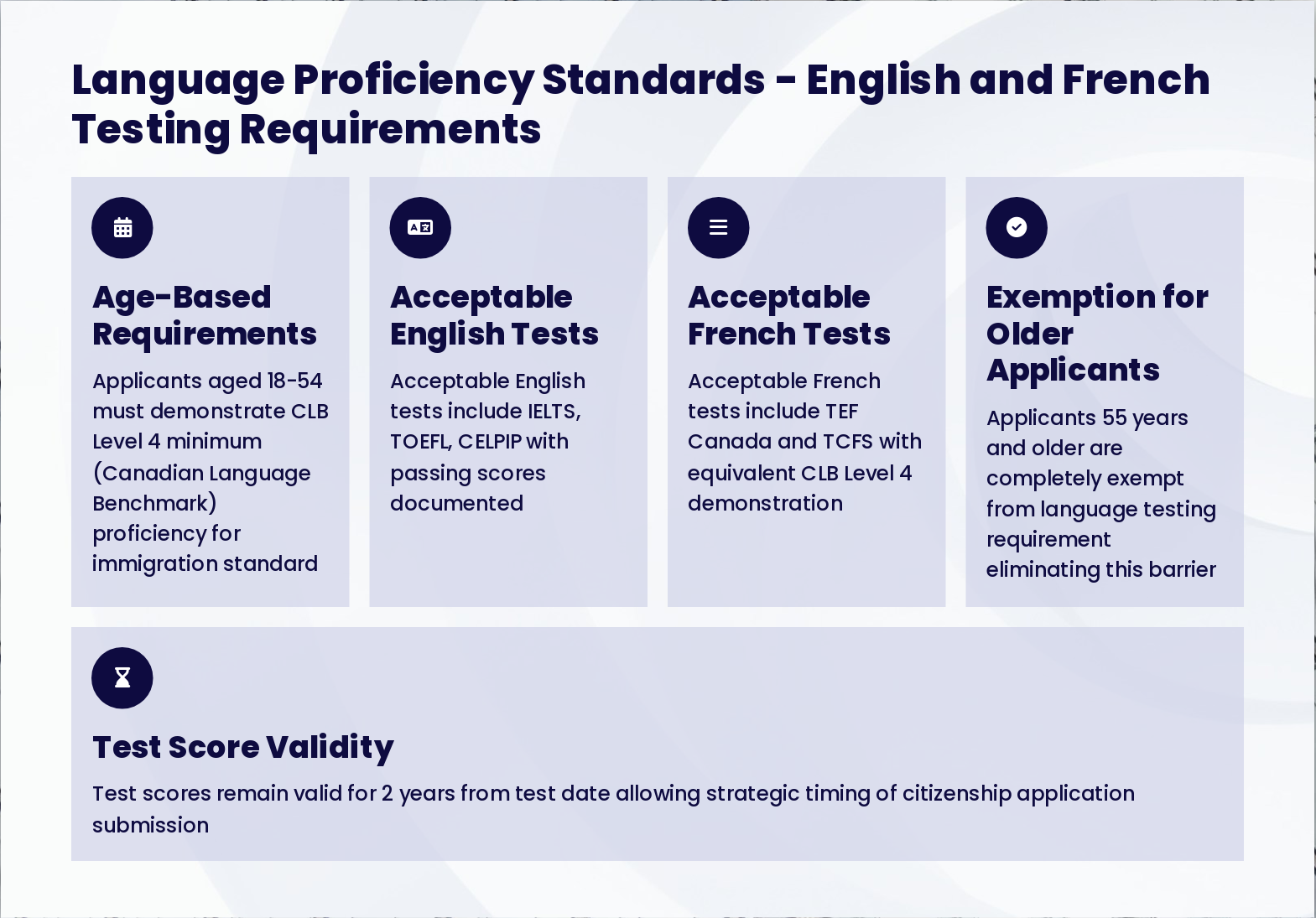
Slide 12: Language Proficiency Standards - English and French Testing Requirements
- Age-Based Requirements: Applicants aged 18-54 must demonstrate CLB Level 4 minimum (Canadian Language Benchmark) proficiency for immigration standard
- Acceptable English Tests: Acceptable English tests include IELTS, TOEFL, CELPIP with passing scores documented
- Acceptable French Tests: Acceptable French tests include TEF Canada and TCFS with equivalent CLB Level 4 demonstration
- Exemption for Older Applicants: Applicants 55 years and older are completely exempt from language testing requirement eliminating this barrier
- Test Score Validity: Test scores remain valid for 2 years from test date allowing strategic timing of citizenship application submission
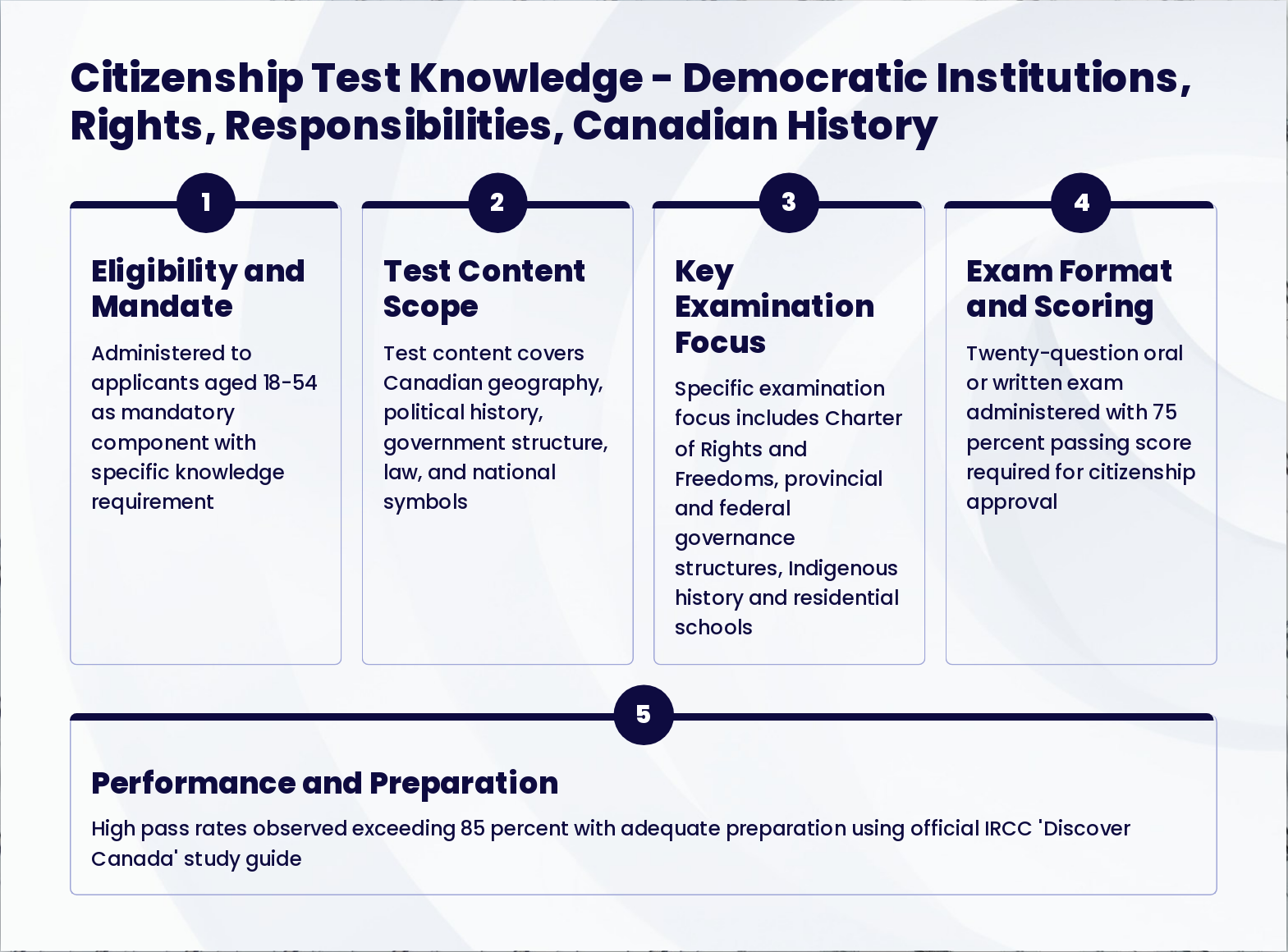
Slide 13: Citizenship Test Knowledge - Democratic Institutions, Rights, Responsibilities, Canadian History
- Eligibility and Mandate: Administered to applicants aged 18-54 as mandatory component with specific knowledge requirement
- Test Content Scope: Test content covers Canadian geography, political history, government structure, law, and national symbols
- Key Examination Focus: Specific examination focus includes Charter of Rights and Freedoms, provincial and federal governance structures, Indigenous history and residential schools
- Exam Format and Scoring: Twenty-question oral or written exam administered with 75 percent passing score required for citizenship approval
- Performance and Preparation: High pass rates observed exceeding 85 percent with adequate preparation using official IRCC 'Discover Canada' study guide
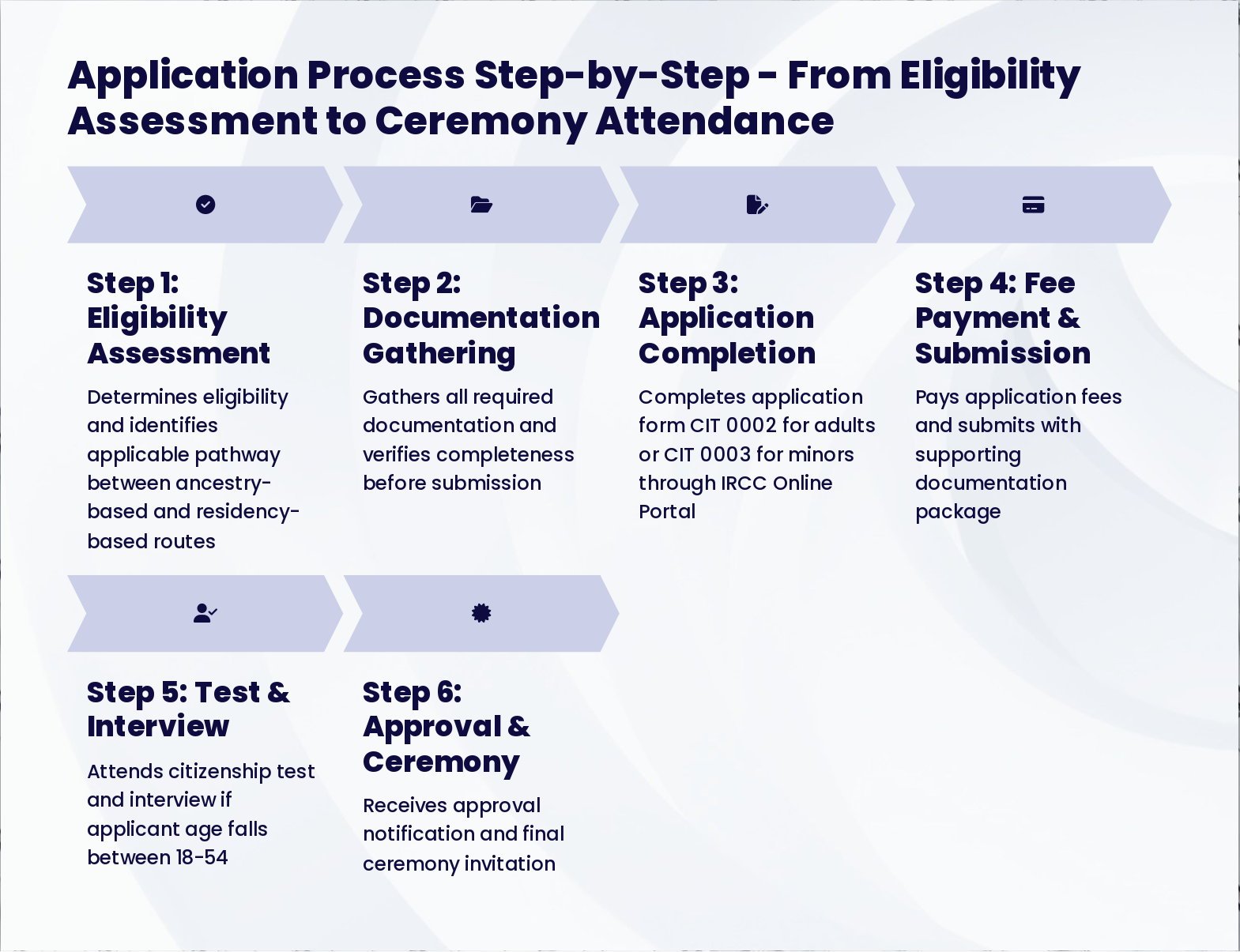
Slide 14: Application Process Step-by-Step - From Eligibility Assessment to Ceremony Attendance
- Step 1: Eligibility Assessment: Determines eligibility and identifies applicable pathway between ancestry-based and residency-based routes
- Step 2: Documentation Gathering: Gathers all required documentation and verifies completeness before submission
- Step 3: Application Completion: Completes application form CIT 0002 for adults or CIT 0003 for minors through IRCC Online Portal
- Step 4: Fee Payment & Submission: Pays application fees and submits with supporting documentation package
- Step 5: Test & Interview: Attends citizenship test and interview if applicant age falls between 18-54
- Step 6: Approval & Ceremony: Receives approval notification and final ceremony invitation
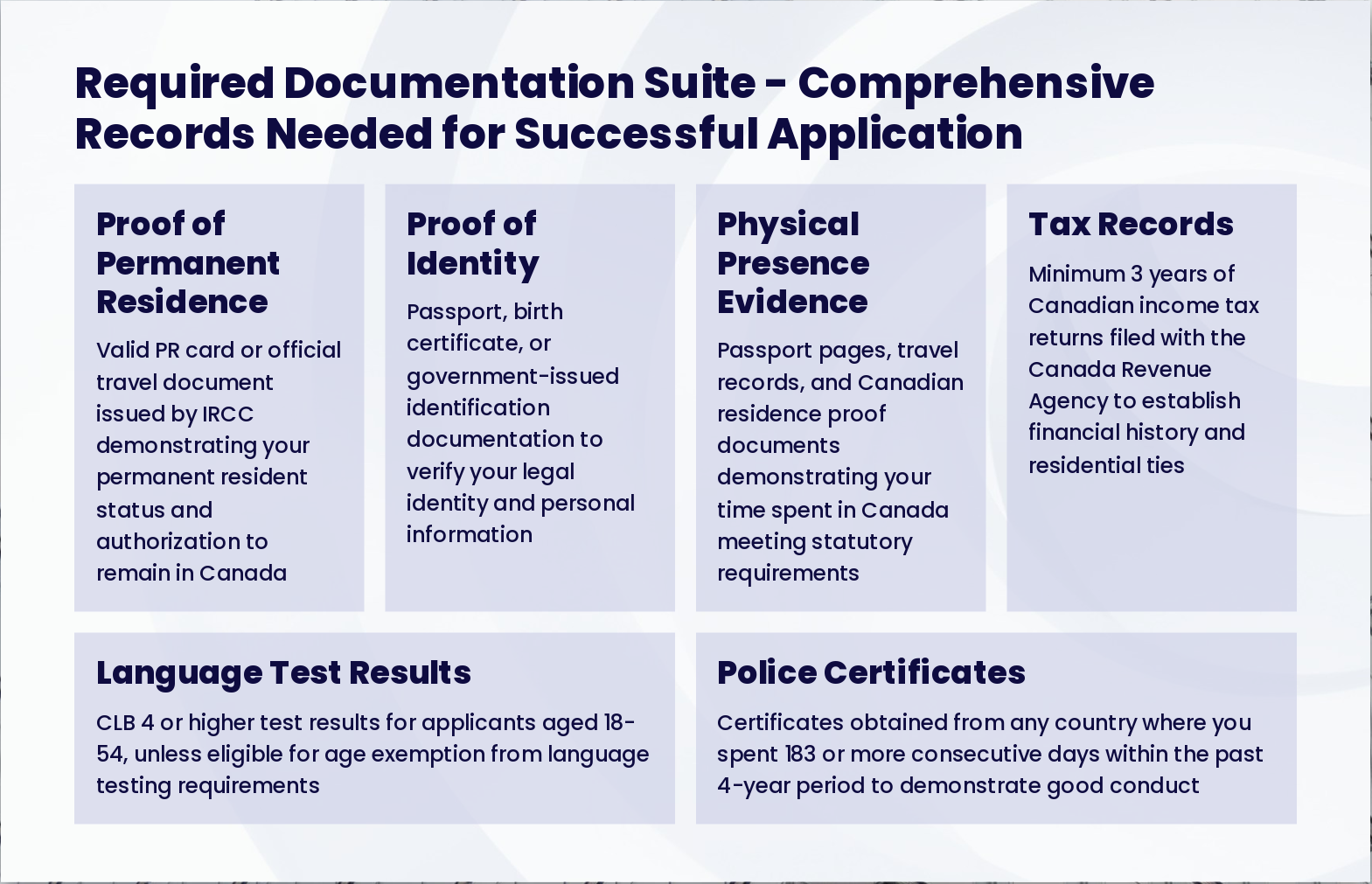
Slide 15: Required Documentation Suite - Comprehensive Records Needed for Successful Application
- Proof of Permanent Residence: Valid PR card or official travel document issued by IRCC demonstrating your permanent resident status and authorization to remain in Canada
- Proof of Identity: Passport, birth certificate, or government-issued identification documentation to verify your legal identity and personal information
- Physical Presence Evidence: Passport pages, travel records, and Canadian residence proof documents demonstrating your time spent in Canada meeting statutory requirements
- Tax Records: Minimum 3 years of Canadian income tax returns filed with the Canada Revenue Agency to establish financial history and residential ties
- Language Test Results: CLB 4 or higher test results for applicants aged 18-54, unless eligible for age exemption from language testing requirements
- Police Certificates: Certificates obtained from any country where you spent 183 or more consecutive days within the past 4-year period to demonstrate good conduct
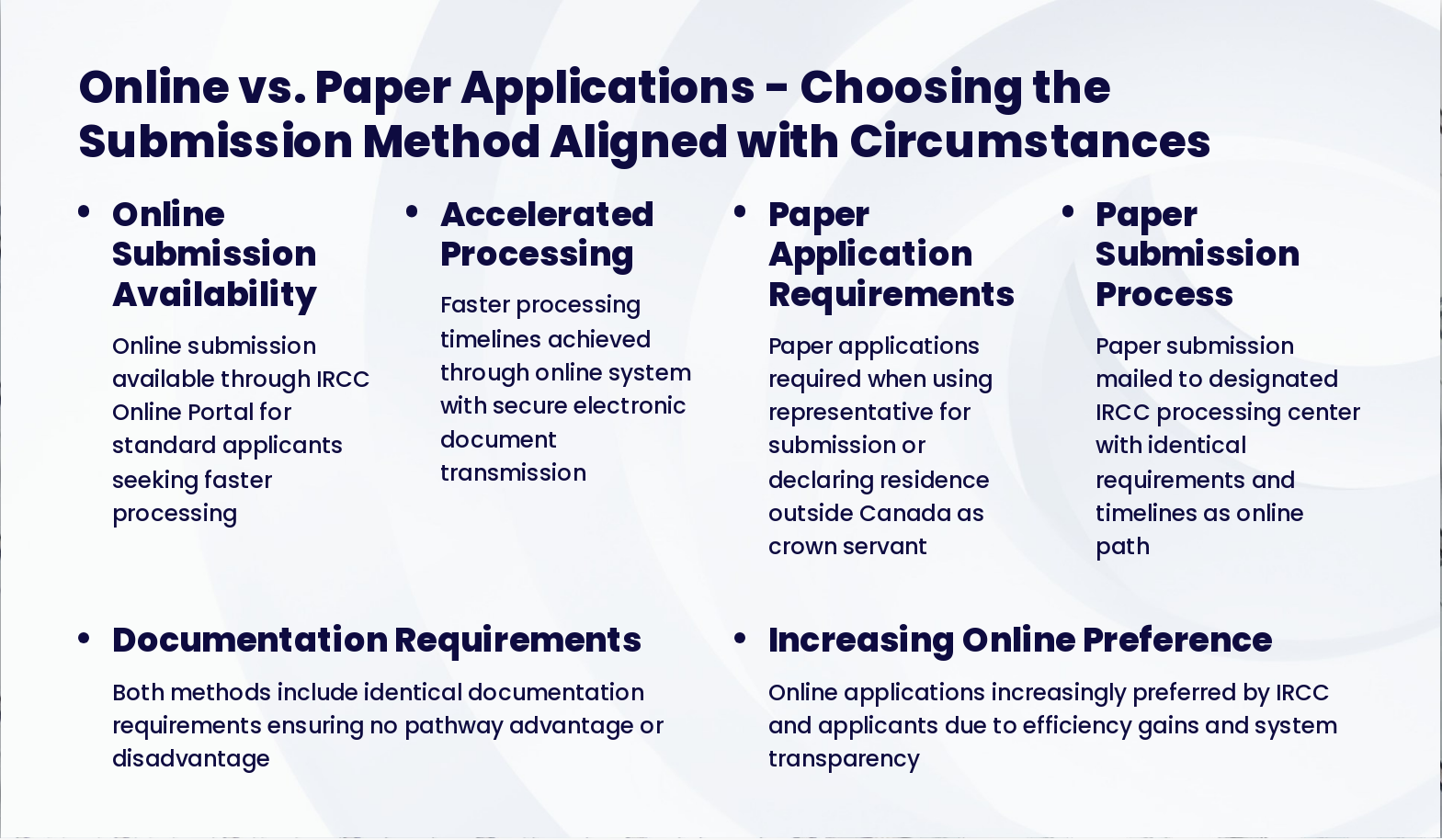
Slide 16: Online vs. Paper Applications - Choosing the Submission Method Aligned with Circumstances
- Online Submission Availability: Online submission available through IRCC Online Portal for standard applicants seeking faster processing
- Accelerated Processing: Faster processing timelines achieved through online system with secure electronic document transmission
- Paper Application Requirements: Paper applications required when using representative for submission or declaring residence outside Canada as crown servant
- Paper Submission Process: Paper submission mailed to designated IRCC processing center with identical requirements and timelines as online path
- Documentation Requirements: Both methods include identical documentation requirements ensuring no pathway advantage or disadvantage
- Increasing Online Preference: Online applications increasingly preferred by IRCC and applicants due to efficiency gains and system transparency
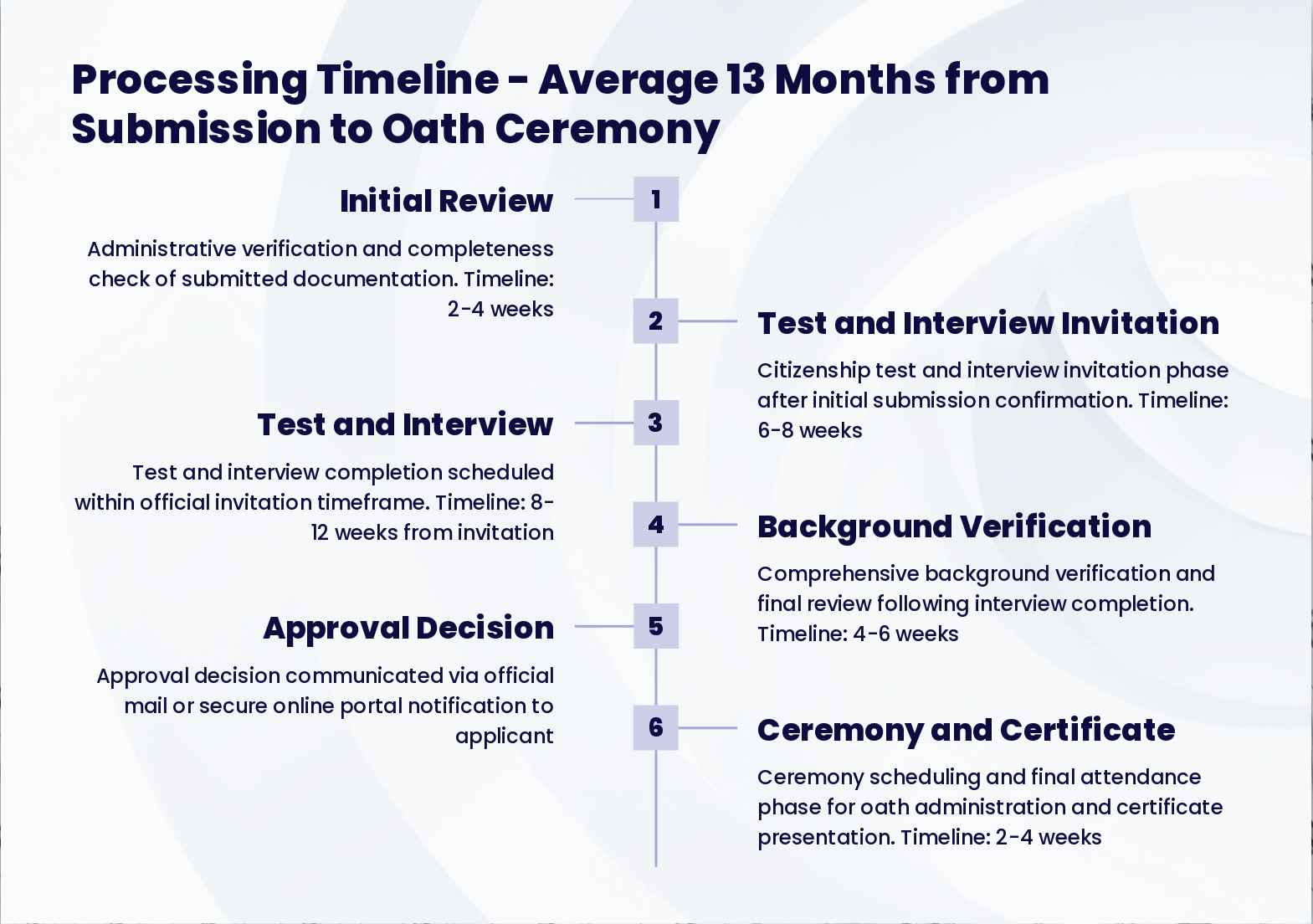
Slide 17: Processing Timeline - Average 13 Months from Submission to Oath Ceremony
- Initial Review: Administrative verification and completeness check of submitted documentation. Timeline: 2-4 weeks
- Test and Interview Invitation: Citizenship test and interview invitation phase after initial submission confirmation. Timeline: 6-8 weeks
- Test and Interview: Test and interview completion scheduled within official invitation timeframe. Timeline: 8-12 weeks from invitation
- Background Verification: Comprehensive background verification and final review following interview completion. Timeline: 4-6 weeks
- Approval Decision: Approval decision communicated via official mail or secure online portal notification to applicant
- Ceremony and Certificate: Ceremony scheduling and final attendance phase for oath administration and certificate presentation. Timeline: 2-4 weeks
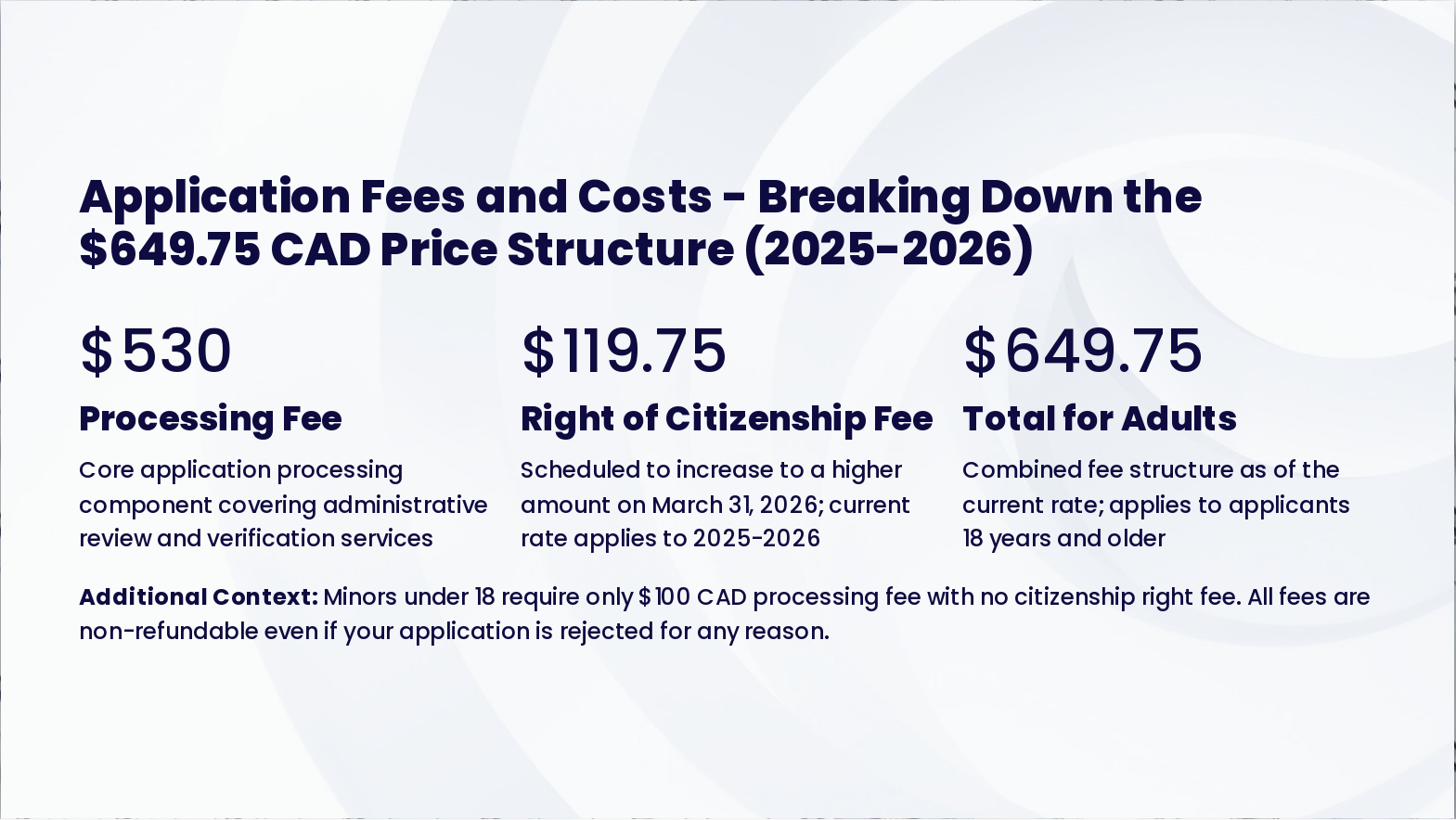
Slide 18: Application Fees and Costs - Breaking Down the $649.75 CAD Price Structure (2025-2026)
- $530 — Processing Fee
- $119.75 — Right of Citizenship Fee
- $649.75 — Total for Adults
Additional Context: Minors under 18 require only $100 CAD processing fee with no citizenship right fee. All fees are non-refundable even if your application is rejected for any reason.
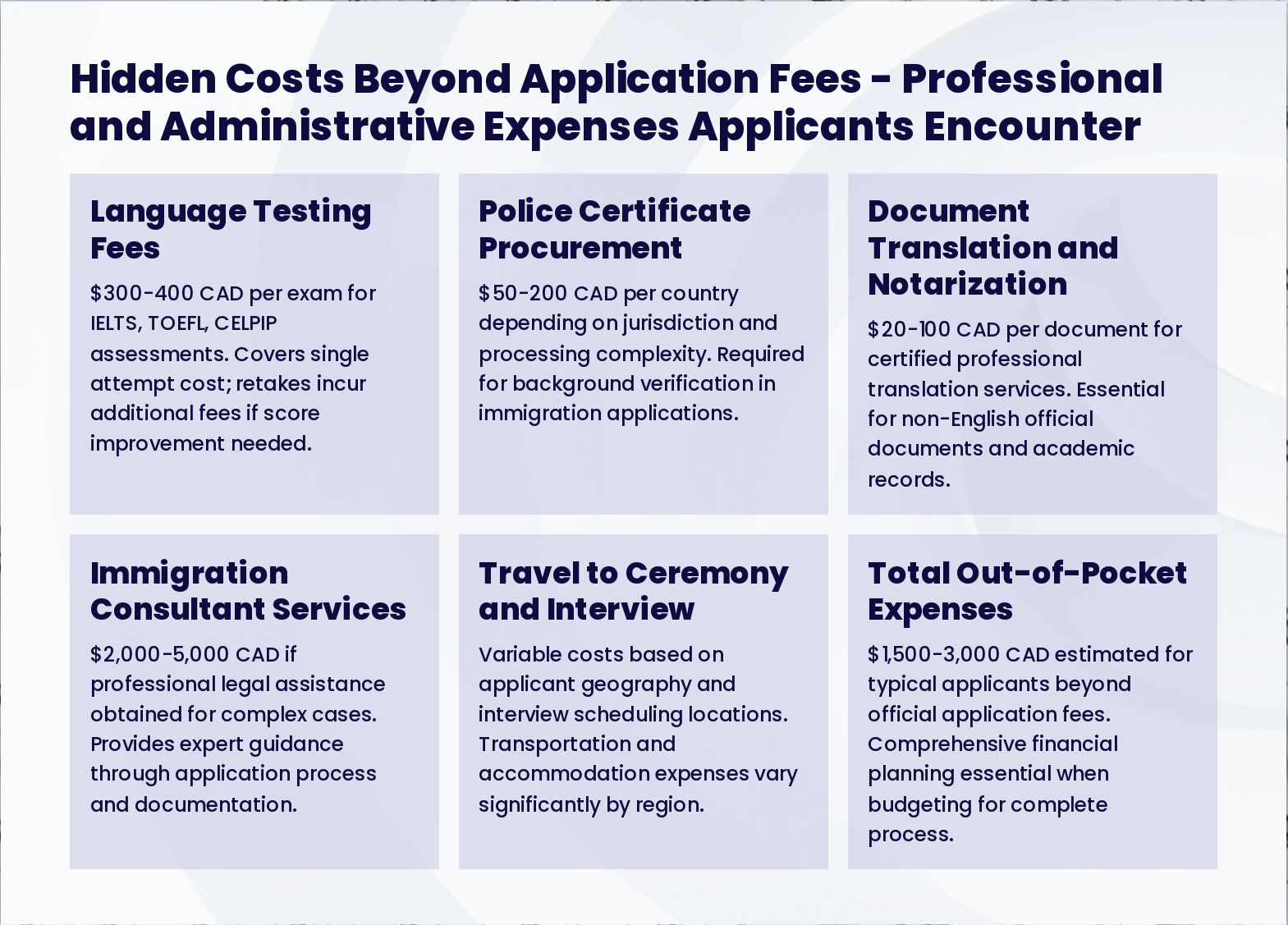
Slide 19: Hidden Costs Beyond Application Fees - Professional and Administrative Expenses Applicants Encounter
- Language Testing Fees: $300-400 CAD per exam for IELTS, TOEFL, CELPIP assessments. Covers single attempt cost; retakes incur additional fees if score improvement needed.
- Police Certificate Procurement: $50-200 CAD per country depending on jurisdiction and processing complexity. Required for background verification in immigration applications.
- Document Translation and Notarization: $20-100 CAD per document for certified professional translation services. Essential for non-English official documents and academic records.
- Immigration Consultant Services: $2,000-5,000 CAD if professional legal assistance obtained for complex cases. Provides expert guidance through application process and documentation.
- Travel to Ceremony and Interview: Variable costs based on applicant geography and interview scheduling locations. Transportation and accommodation expenses vary significantly by region.
- Total Out-of-Pocket Expenses: $1,500-3,000 CAD estimated for typical applicants beyond official application fees. Comprehensive financial planning essential when budgeting for complete process.
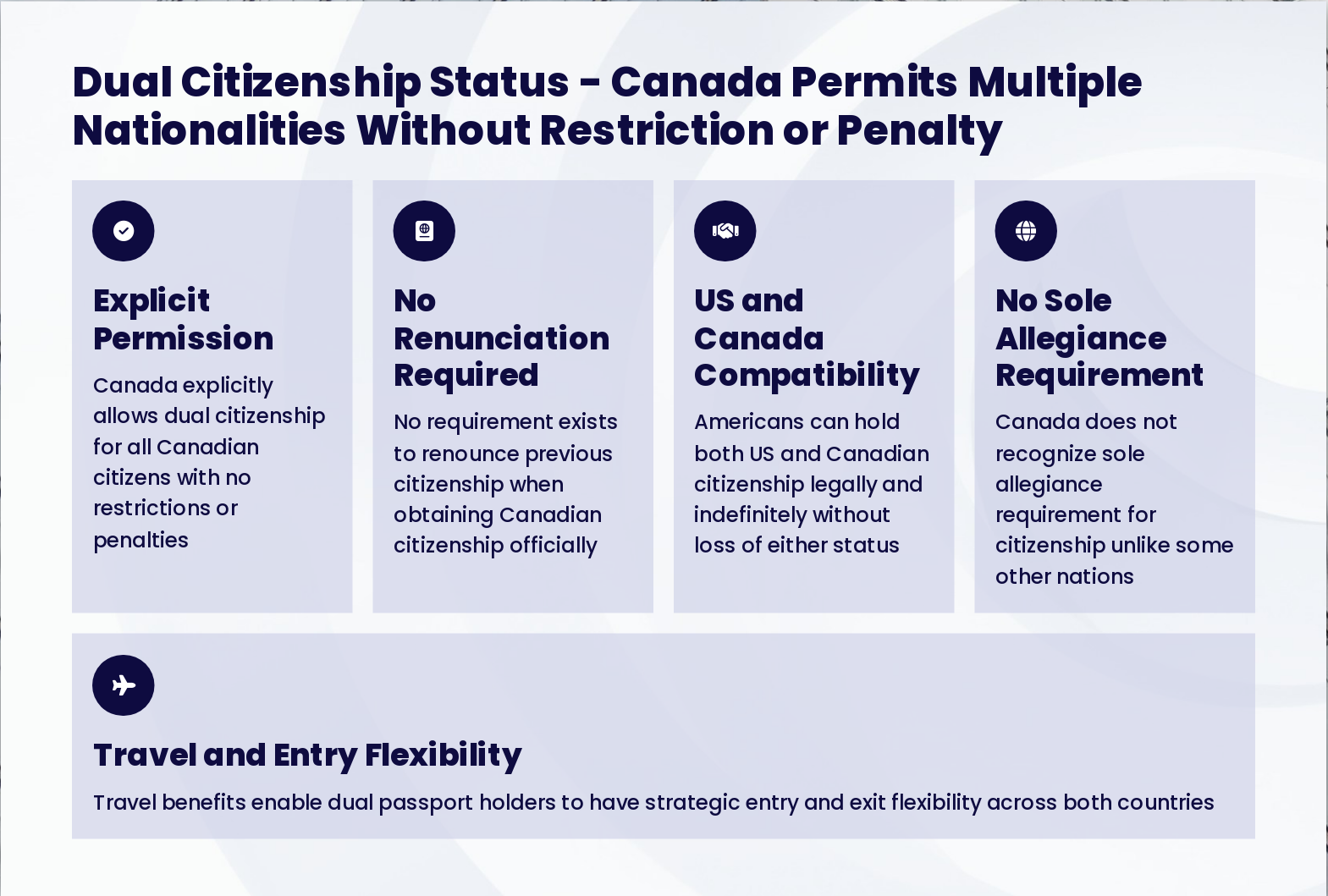
Slide 20: Dual Citizenship Status - Canada Permits Multiple Nationalities Without Restriction or Penalty
- Explicit Permission: Canada explicitly allows dual citizenship for all Canadian citizens with no restrictions or penalties
- No Renunciation Required: No requirement exists to renounce previous citizenship when obtaining Canadian citizenship officially
- US and Canada Compatibility: Americans can hold both US and Canadian citizenship legally and indefinitely without loss of either status
- No Sole Allegiance Requirement: Canada does not recognize sole allegiance requirement for citizenship unlike some other nations
- Travel and Entry Flexibility: Travel benefits enable dual passport holders to have strategic entry and exit flexibility across both countries
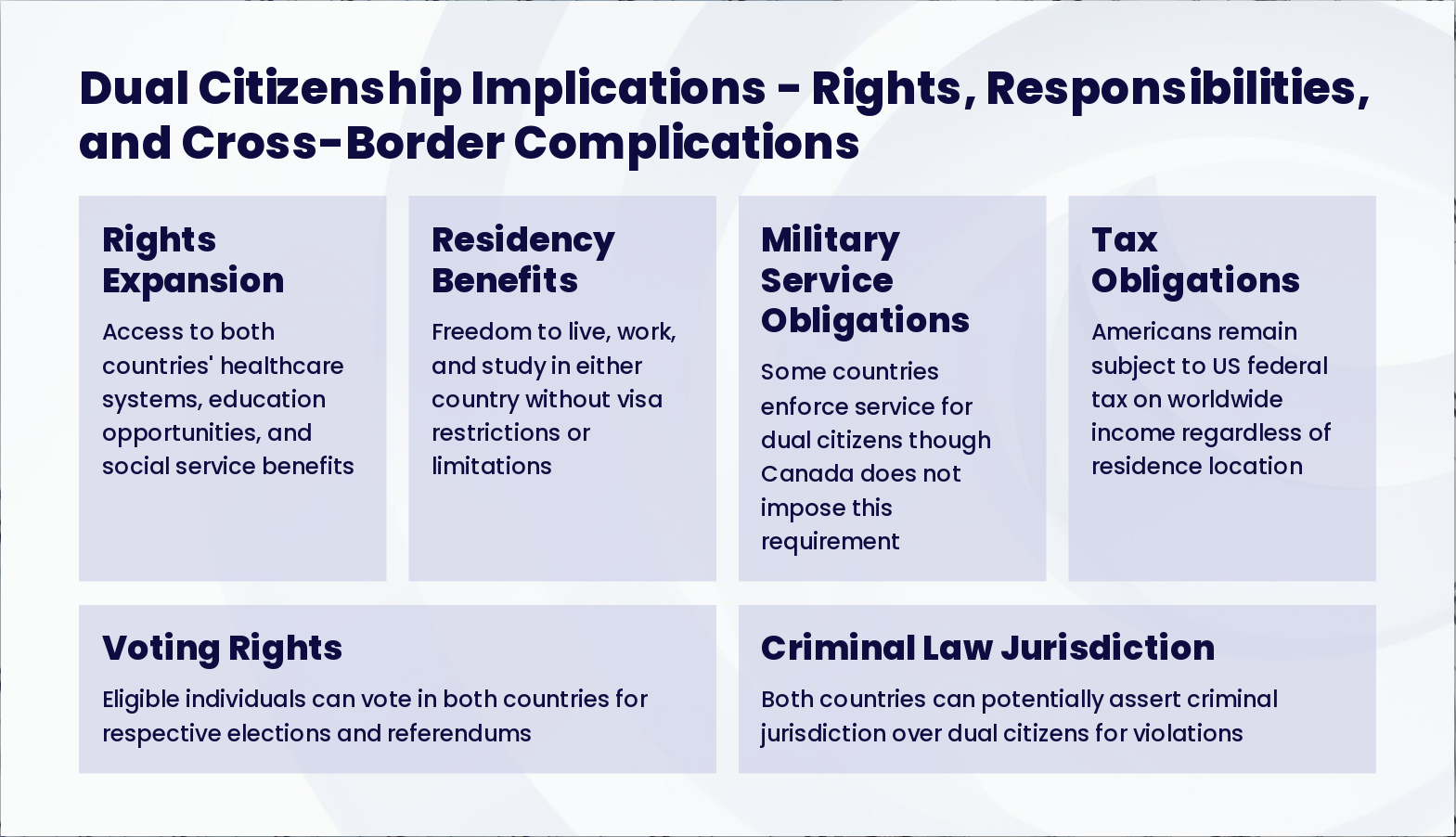
Slide 21: Dual Citizenship Implications - Rights, Responsibilities, and Cross-Border Complications
- Rights Expansion: Access to both countries' healthcare systems, education opportunities, and social service benefits
- Residency Benefits: Freedom to live, work, and study in either country without visa restrictions or limitations
- Military Service Obligations: Some countries enforce service for dual citizens though Canada does not impose this requirement
- Tax Obligations: Americans remain subject to US federal tax on worldwide income regardless of residence location
- Voting Rights: Eligible individuals can vote in both countries for respective elections and referendums
- Criminal Law Jurisdiction: Both countries can potentially assert criminal jurisdiction over dual citizens for violations
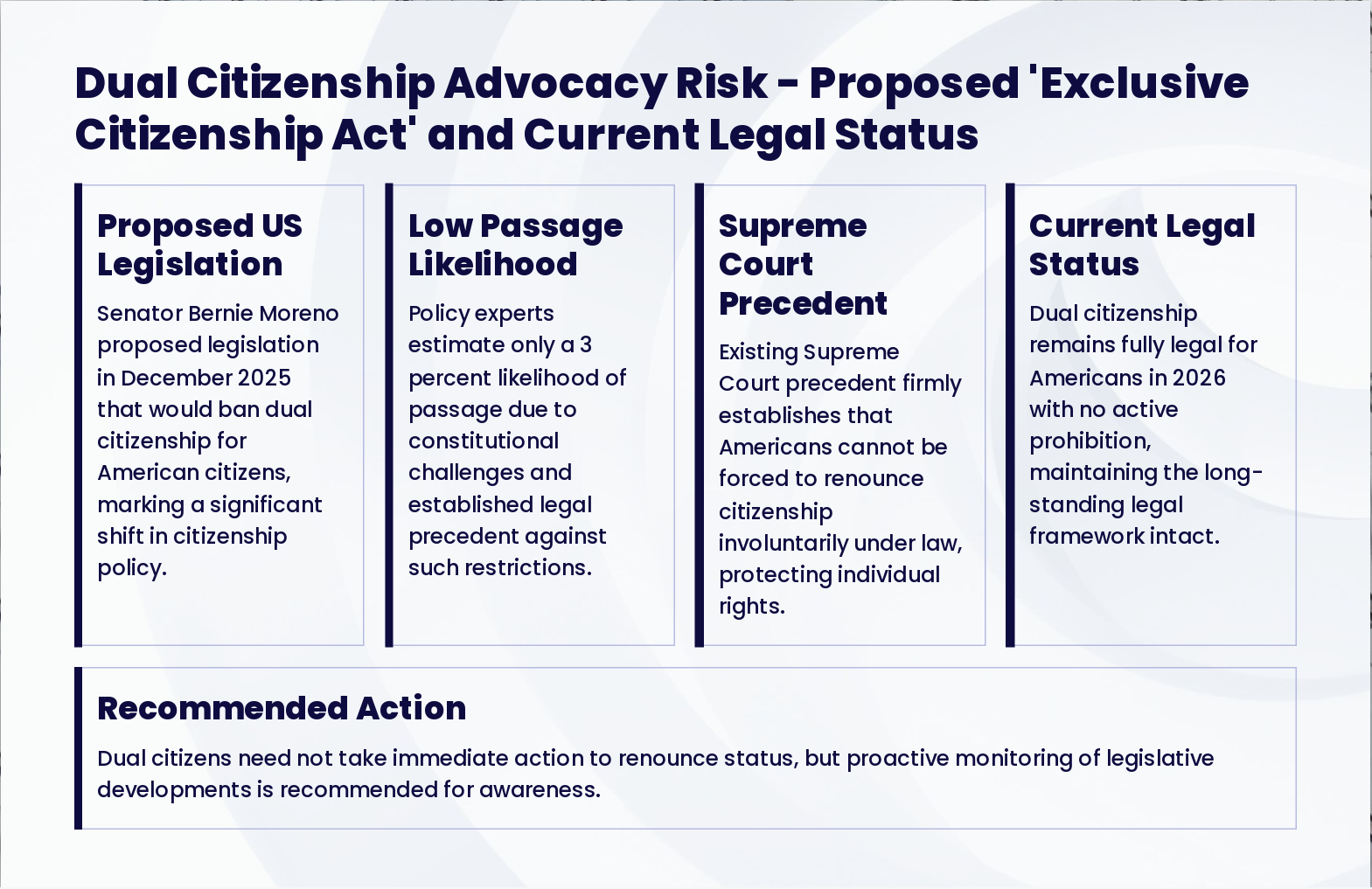
Slide 22: Dual Citizenship Advocacy Risk - Proposed 'Exclusive Citizenship Act' and Current Legal Status
- Proposed US Legislation: Senator Bernie Moreno proposed legislation in December 2025 that would ban dual citizenship for American citizens, marking a significant shift in citizenship policy.
- Low Passage Likelihood: Policy experts estimate only a 3 percent likelihood of passage due to constitutional challenges and established legal precedent against such restrictions.
- Supreme Court Precedent: Existing Supreme Court precedent firmly establishes that Americans cannot be forced to renounce citizenship involuntarily under law, protecting individual rights.
- Current Legal Status: Dual citizenship remains fully legal for Americans in 2026 with no active prohibition, maintaining the long-standing legal framework intact.
- Recommended Action: Dual citizens need not take immediate action to renounce status, but proactive monitoring of legislative developments is recommended for awareness.
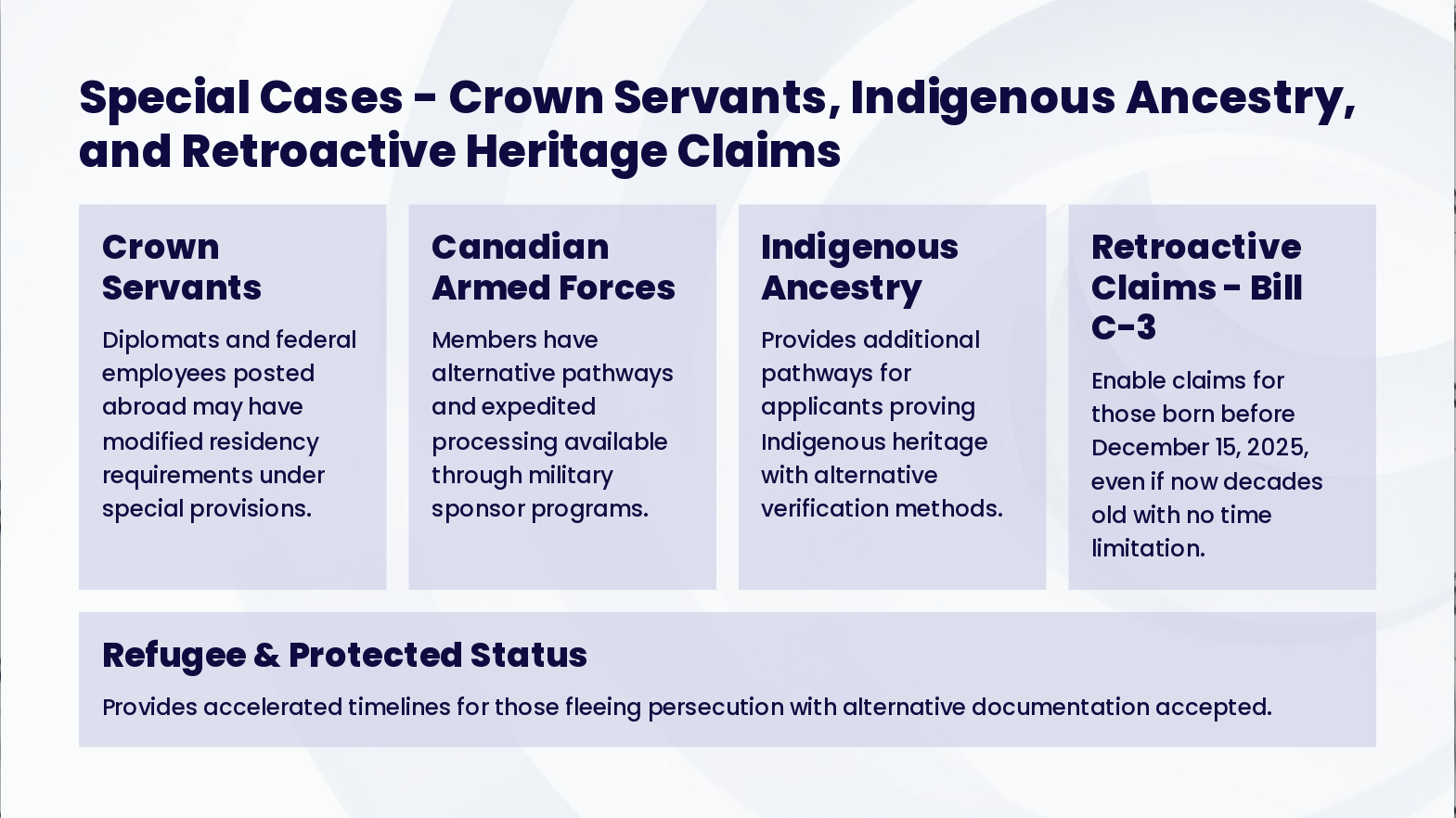
Slide 23: Special Cases - Crown Servants, Indigenous Ancestry, and Retroactive Heritage Claims
- Crown Servants: Diplomats and federal employees posted abroad may have modified residency requirements under special provisions.
- Canadian Armed Forces: Members have alternative pathways and expedited processing available through military sponsor programs.
- Indigenous Ancestry: Provides additional pathways for applicants proving Indigenous heritage with alternative verification methods.
- Retroactive Claims - Bill C-3: Enable claims for those born before December 15, 2025, even if now decades old with no time limitation.
- Refugee & Protected Status: Provides accelerated timelines for those fleeing persecution with alternative documentation accepted.
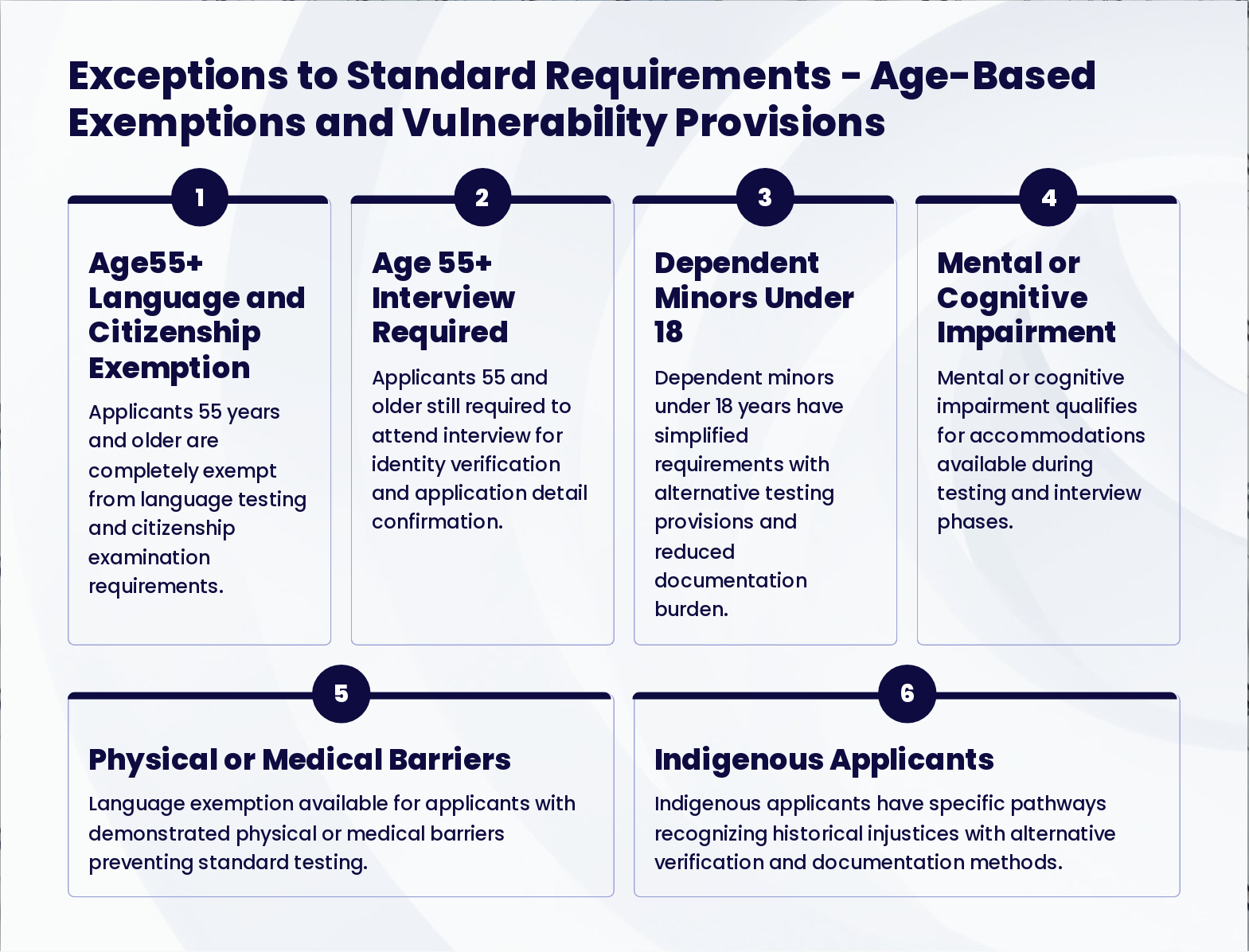
Slide 24: Exceptions to Standard Requirements - Age-Based Exemptions and Vulnerability Provisions
- Age55+ Language and Citizenship Exemption: Applicants 55 years and older are completely exempt from language testing and citizenship examination requirements.
- Age 55+ Interview Required: Applicants 55 and older still required to attend interview for identity verification and application detail confirmation.
- Dependent Minors Under 18: Dependent minors under 18 years have simplified requirements with alternative testing provisions and reduced documentation burden.
- Mental or Cognitive Impairment: Mental or cognitive impairment qualifies for accommodations available during testing and interview phases.
- Physical or Medical Barriers: Language exemption available for applicants with demonstrated physical or medical barriers preventing standard testing.
- Indigenous Applicants: Indigenous applicants have specific pathways recognizing historical injustices with alternative verification and documentation methods.
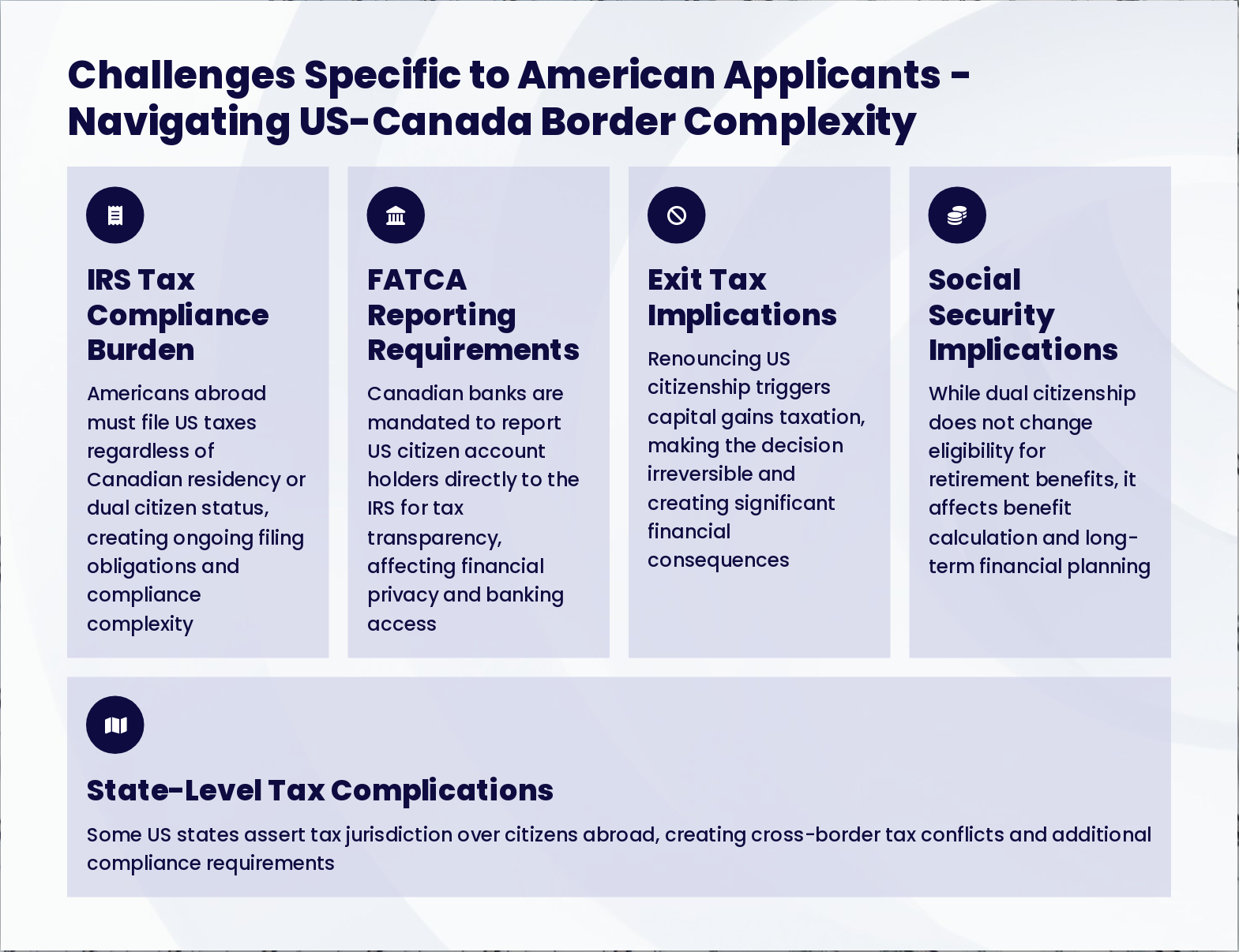
Slide 25: Challenges Specific to American Applicants - Navigating US-Canada Border Complexity
- IRS Tax Compliance Burden: Americans abroad must file US taxes regardless of Canadian residency or dual citizen status, creating ongoing filing obligations and compliance complexity
- FATCA Reporting Requirements: Canadian banks are mandated to report US citizen account holders directly to the IRS for tax transparency, affecting financial privacy and banking access
- Exit Tax Implications: Renouncing US citizenship triggers capital gains taxation, making the decision irreversible and creating significant financial consequences
- Social Security Implications: While dual citizenship does not change eligibility for retirement benefits, it affects benefit calculation and long-term financial planning
- State-Level Tax Complications: Some US states assert tax jurisdiction over citizens abroad, creating cross-border tax conflicts and additional compliance requirements
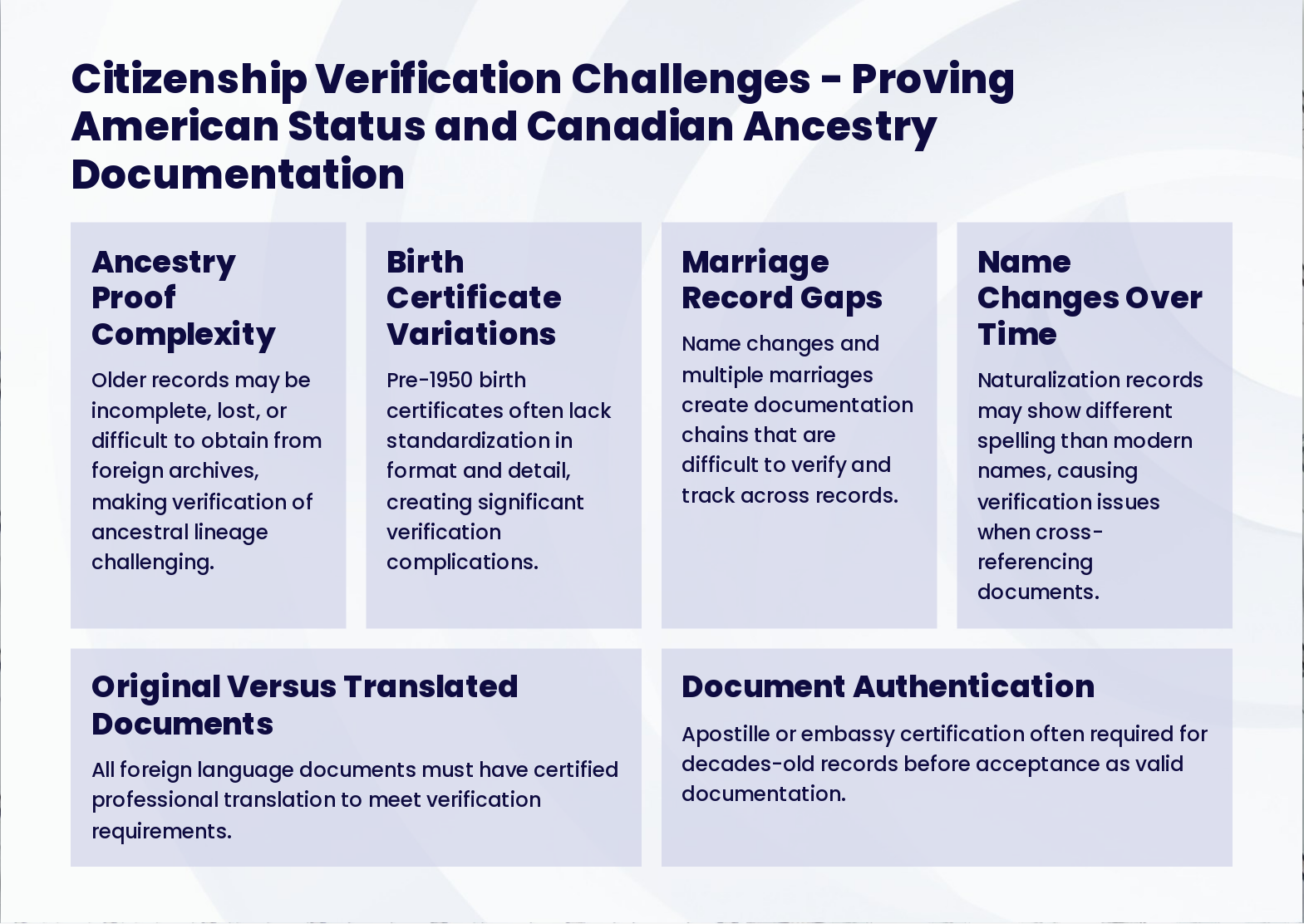
Slide 26: Citizenship Verification Challenges - Proving American Status and Canadian Ancestry Documentation
- Ancestry Proof Complexity: Older records may be incomplete, lost, or difficult to obtain from foreign archives, making verification of ancestral lineage challenging.
- Birth Certificate Variations: Pre-1950 birth certificates often lack standardization in format and detail, creating significant verification complications.
- Marriage Record Gaps: Name changes and multiple marriages create documentation chains that are difficult to verify and track across records.
- Name Changes Over Time: Naturalization records may show different spelling than modern names, causing verification issues when cross-referencing documents.
- Original Versus Translated Documents: All foreign language documents must have certified professional translation to meet verification requirements.
- Document Authentication: Apostille or embassy certification often required for decades-old records before acceptance as valid documentation.
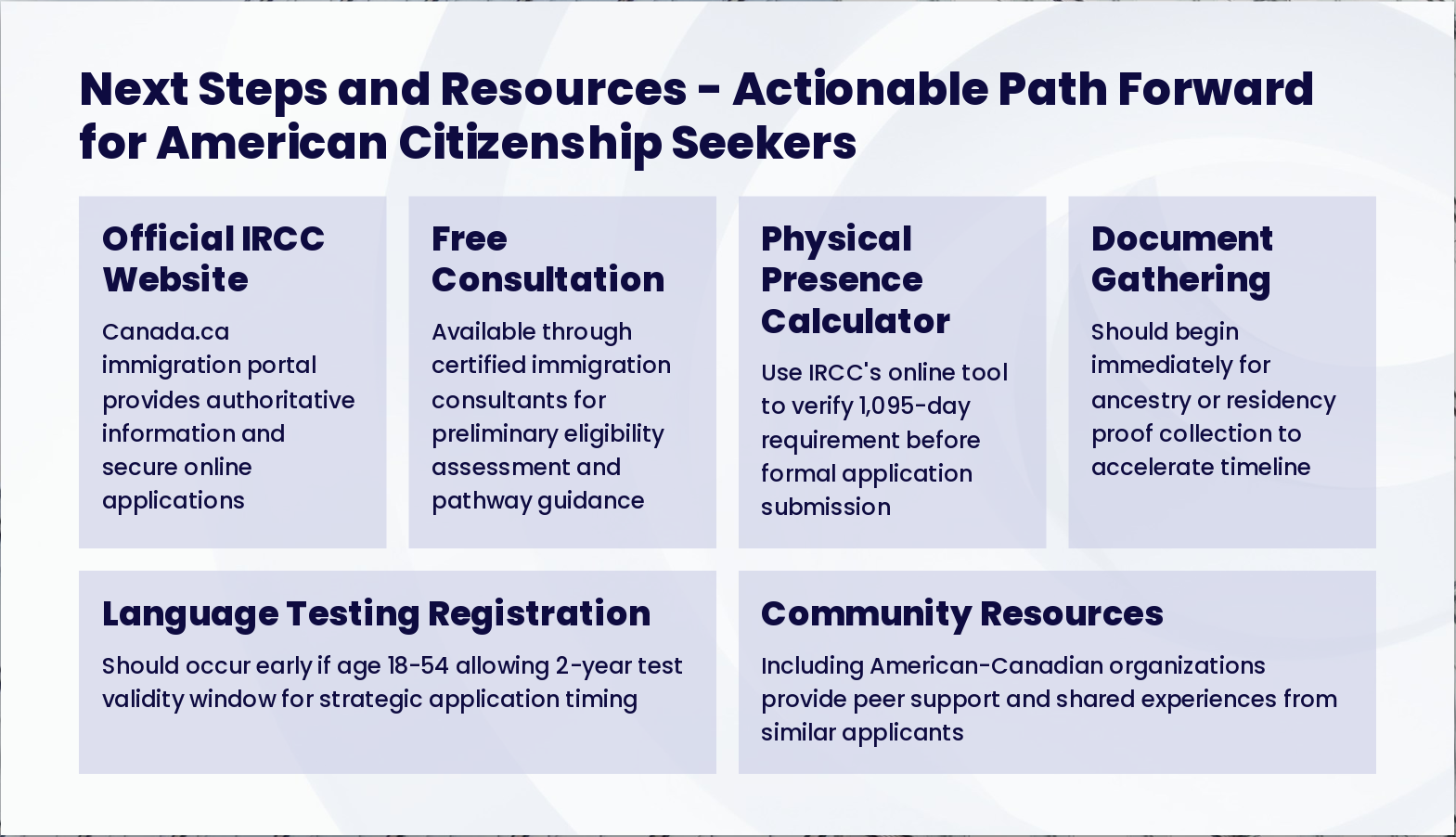
Slide 27: Next Steps and Resources - Actionable Path Forward for American Citizenship Seekers
- Official IRCC Website: Canada.ca immigration portal provides authoritative information and secure online applications
- Free Consultation: Available through certified immigration consultants for preliminary eligibility assessment and pathway guidance
- Physical Presence Calculator: Use IRCC's online tool to verify 1,095-day requirement before formal application submission
- Document Gathering: Should begin immediately for ancestry or residency proof collection to accelerate timeline
- Language Testing Registration: Should occur early if age 18-54 allowing 2-year test validity window for strategic application timing
- Community Resources: Including American-Canadian organizations provide peer support and shared experiences from similar applicants
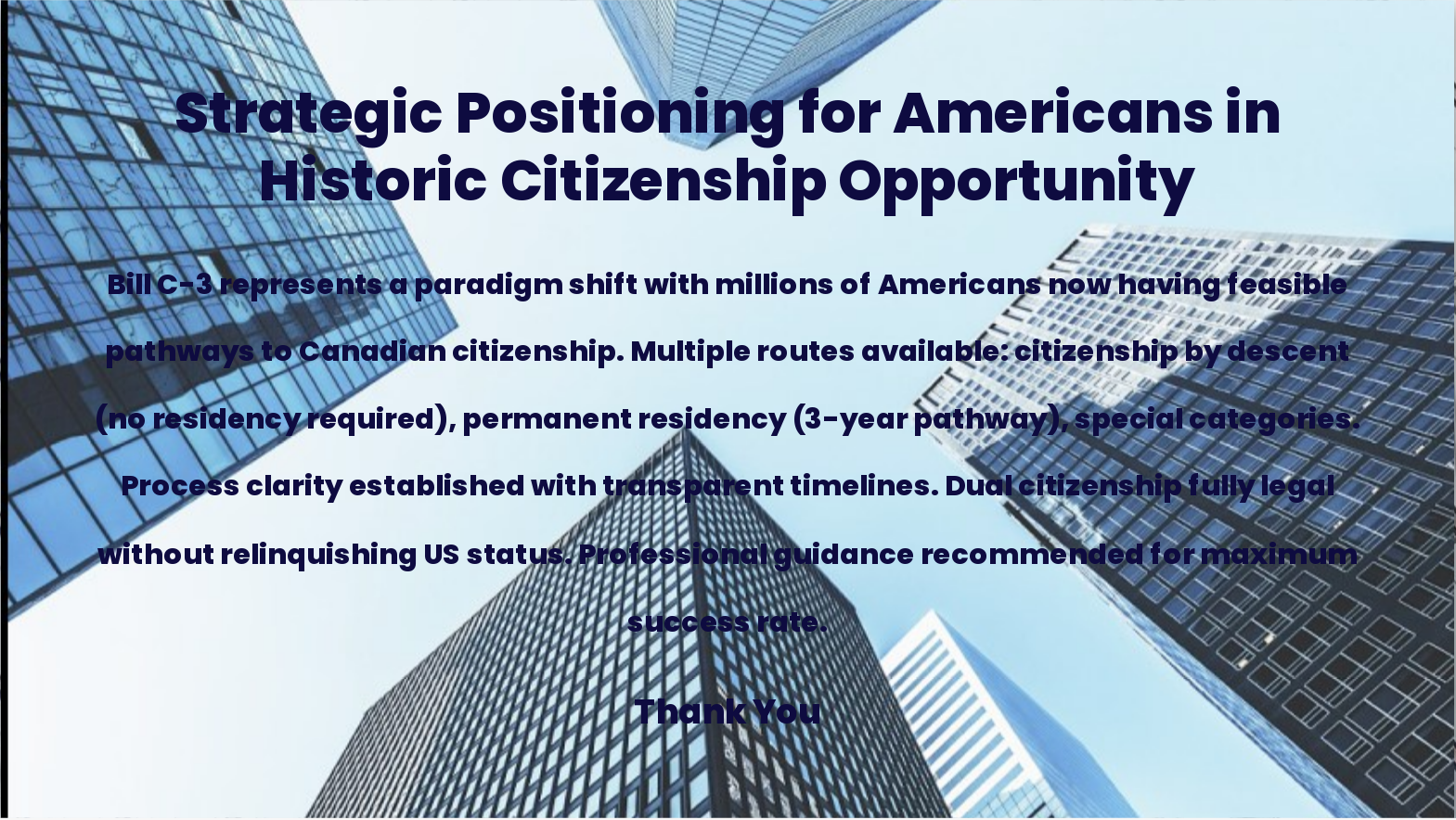
Slide 28: Strategic Positioning for Americans in Historic Citizenship Opportunity
Strategic Positioning for Americans in Historic Citizenship Opportunity Bill C-3 represents a paradigm shift with millions of Americans now having feasible pathways to Canadian citizenship. Multiple routes available: citizenship by descent (no residency required), permanent residency (3-year pathway...