Presentation Summary
Explore the rich history and significance of football's most contested Champions League rivalry between Bayern Munich and Real Madrid, known as the European Clásico, highlighting their head-to-head records, iconic players, and the impact on European football.
Full Presentation Transcript
Slide 1: Bayern Munich vs Real Madrid
A Comprehensive Analysis of Football's Most Contested Champions League Rivalry - The European Clásico
Slide 2: Contents
- Historical Foundation: Origins and significance of European football's most frequently contested Champions League rivalry.
- Statistical Analysis: Comprehensive head-to-head records, goal statistics, and competitive trends across different eras.
- Legendary Players: Icons from both clubs who shaped the rivalry through decisive performances.
- Iconic Matches: In-depth analysis of 2017 and 2024 encounters that defined modern rivalry chapters.
- Fan Experience: Ticketing insights, matchday atmosphere, and accessing the European Clásico experience.
- Cross-Sport Context: Bayern vs Real Madrid basketball rivalry in EuroLeague competition.
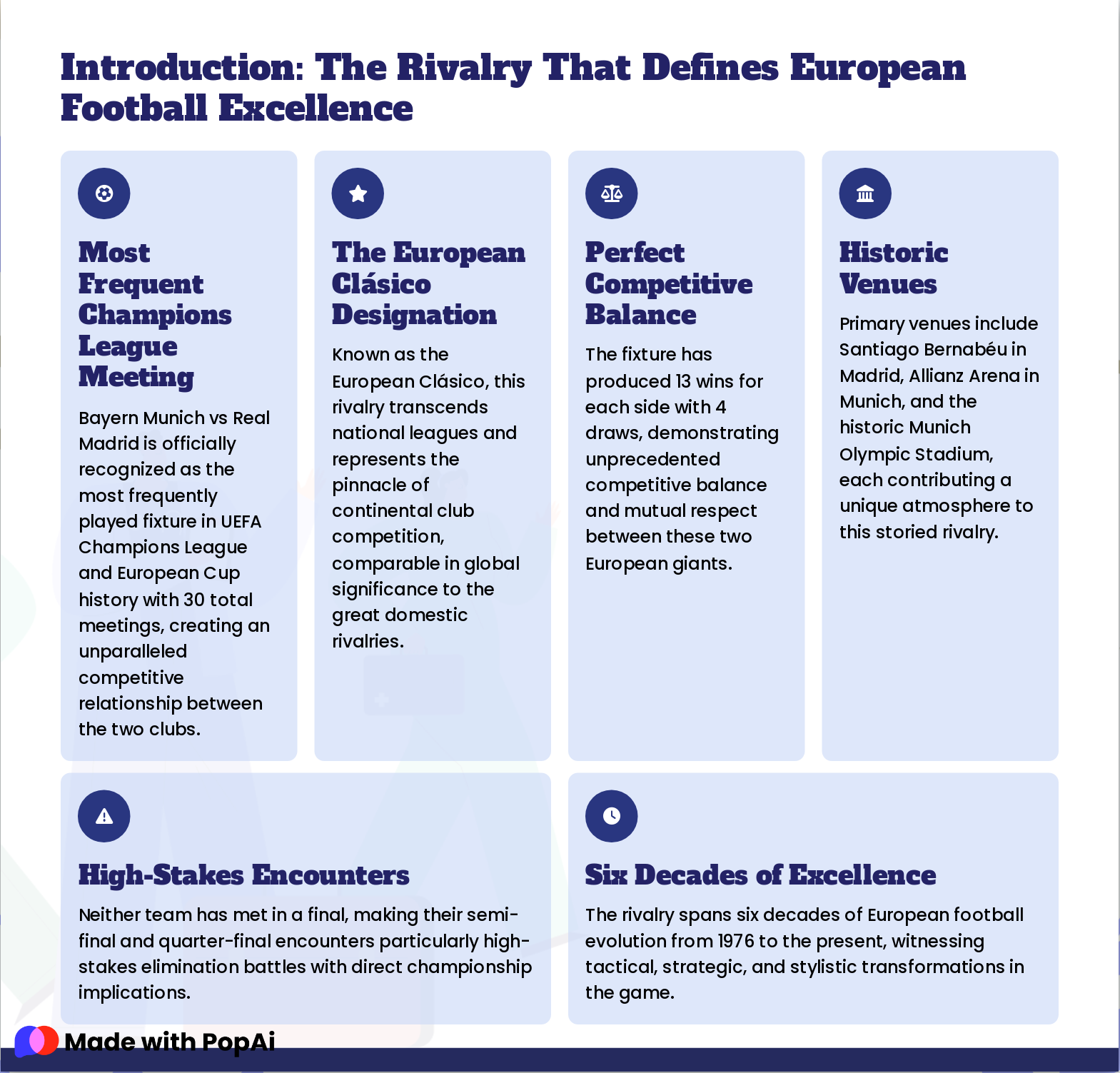
Slide 3: Introduction: The Rivalry That Defines European Football Excellence
- Most Frequent Champions League Meeting: Bayern Munich vs Real Madrid is officially recognized as the most frequently played fixture in UEFA Champions League and European Cup history with 30 total meetings, creating an unparalleled competitive relationship between the two clubs.
- The European Clásico Designation: Known as the European Clásico, this rivalry transcends national leagues and represents the pinnacle of continental club competition, comparable in global significance to the great domestic rivalries.
- Perfect Competitive Balance: The fixture has produced 13 wins for each side with 4 draws, demonstrating unprecedented competitive balance and mutual respect between these two European giants.
- Historic Venues: Primary venues include Santiago Bernabéu in Madrid, Allianz Arena in Munich, and the historic Munich Olympic Stadium, each contributing a unique atmosphere to this storied rivalry.
- High-Stakes Encounters: Neither team has met in a final, making their semi-final and quarter-final encounters particularly high-stakes elimination battles with direct championship implications.
- Six Decades of Excellence: The rivalry spans six decades of European football evolution from 1976 to the present, witnessing tactical, strategic, and stylistic transformations in the game.
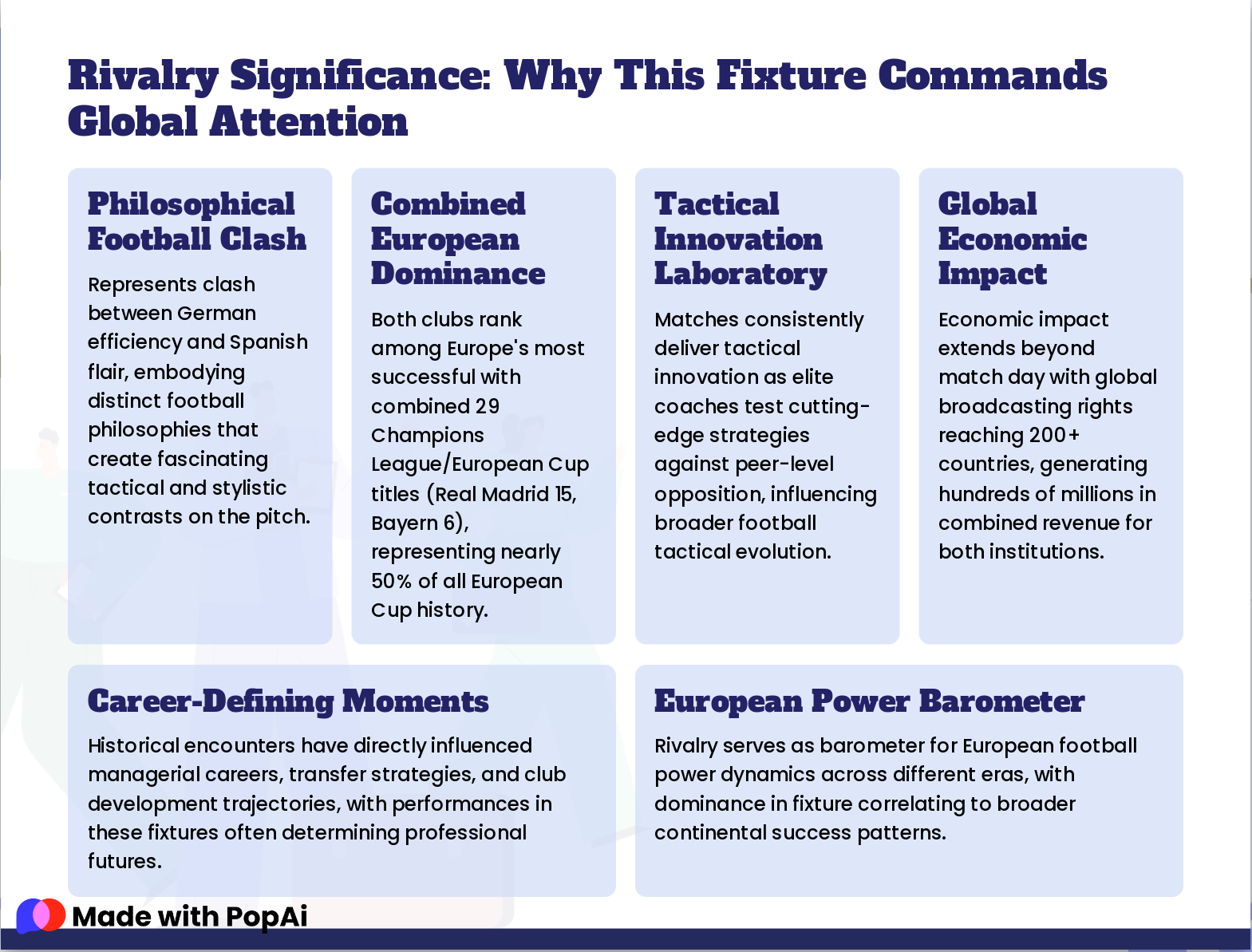
Slide 4: Rivalry Significance: Why This Fixture Commands Global Attention
- Philosophical Football Clash: Represents clash between German efficiency and Spanish flair, embodying distinct football philosophies that create fascinating tactical and stylistic contrasts on the pitch.
- Combined European Dominance: Both clubs rank among Europe's most successful with combined 29 Champions League/European Cup titles (Real Madrid 15, Bayern 6), representing nearly 50% of all European Cup history.
- Tactical Innovation Laboratory: Matches consistently deliver tactical innovation as elite coaches test cutting-edge strategies against peer-level opposition, influencing broader football tactical evolution.
- Global Economic Impact: Economic impact extends beyond match day with global broadcasting rights reaching 200+ countries, generating hundreds of millions in combined revenue for both institutions.
- Career-Defining Moments: Historical encounters have directly influenced managerial careers, transfer strategies, and club development trajectories, with performances in these fixtures often determining professional futures.
- European Power Barometer: Rivalry serves as barometer for European football power dynamics across different eras, with dominance in fixture correlating to broader continental success patterns.
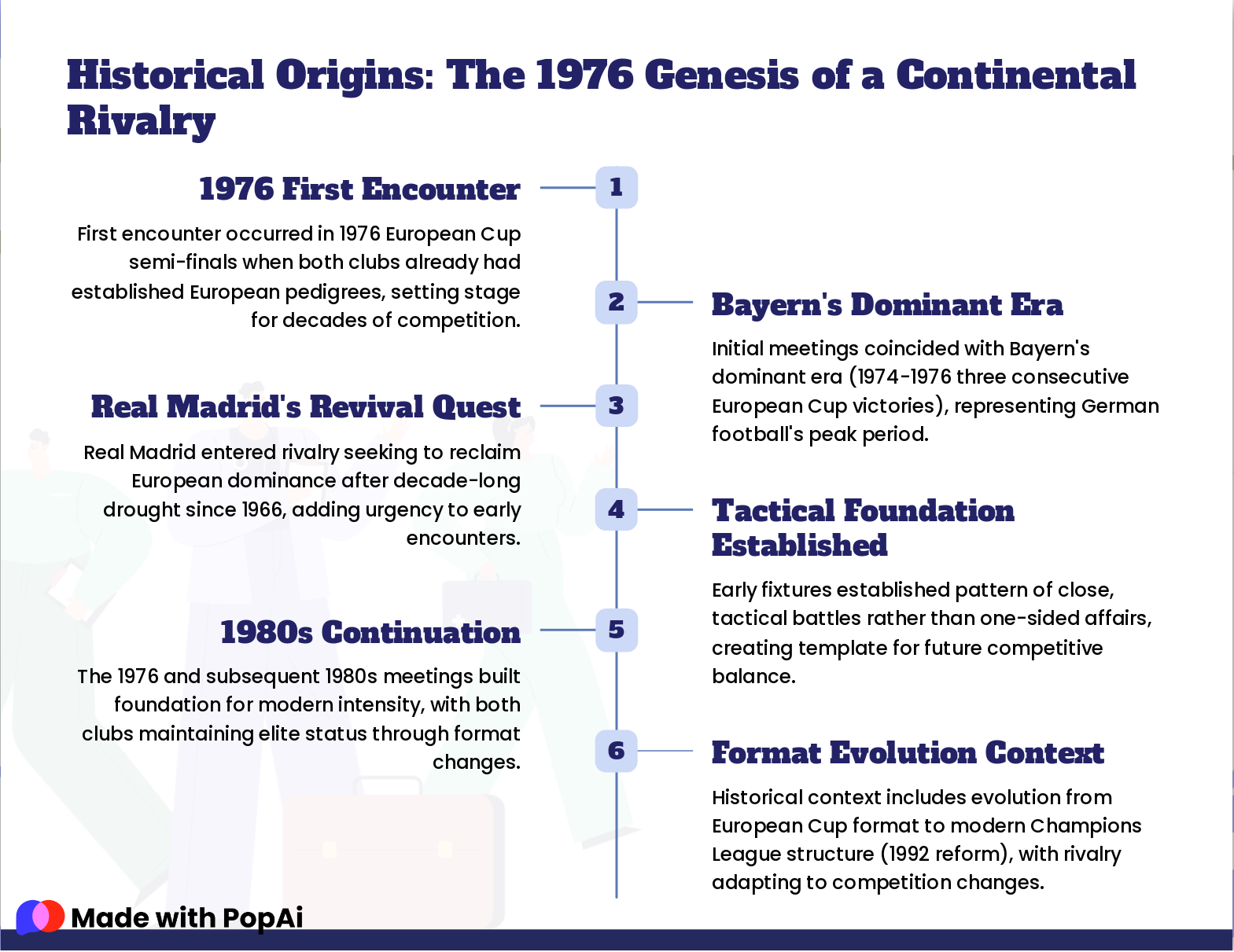
Slide 5: Historical Origins: The 1976 Genesis of a Continental Rivalry
- 1976 First Encounter: First encounter occurred in 1976 European Cup semi-finals when both clubs already had established European pedigrees, setting stage for decades of competition.
- Bayern's Dominant Era: Initial meetings coincided with Bayern's dominant era (1974-1976 three consecutive European Cup victories), representing German football's peak period.
- Real Madrid's Revival Quest: Real Madrid entered rivalry seeking to reclaim European dominance after decade-long drought since 1966, adding urgency to early encounters.
- Tactical Foundation Established: Early fixtures established pattern of close, tactical battles rather than one-sided affairs, creating template for future competitive balance.
- 1980s Continuation: The 1976 and subsequent 1980s meetings built foundation for modern intensity, with both clubs maintaining elite status through format changes.
- Format Evolution Context: Historical context includes evolution from European Cup format to modern Champions League structure (1992 reform), with rivalry adapting to competition changes.
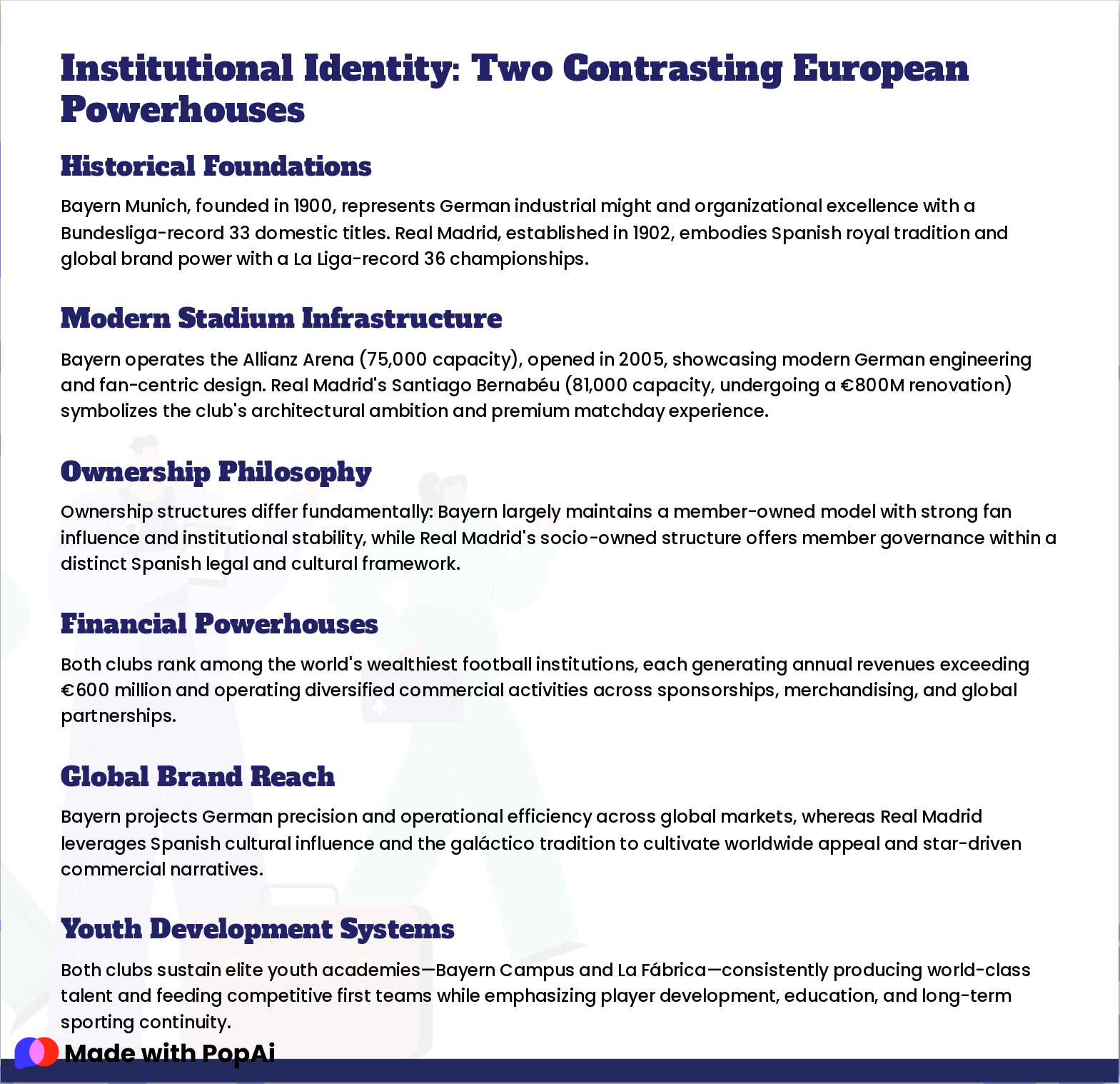
Slide 6: Institutional Identity: Two Contrasting European Powerhouses
- Historical Foundations: Bayern Munich, founded in 1900, represents German industrial might and organizational excellence with a Bundesliga-record 33 domestic titles. Real Madrid, established in 1902, embodies Spanish royal tradition and global brand power with a La Liga-record 36 championships.
- Modern Stadium Infrastructure: Bayern operates the Allianz Arena (75,000 capacity), opened in 2005, showcasing modern German engineering and fan-centric design. Real Madrid's Santiago Bernabéu (81,000 capacity, undergoing a €800M renovation) symbolizes the club's architectural ambition and premium matchday experience.
- Ownership Philosophy: Ownership structures differ fundamentally: Bayern largely maintains a member-owned model with strong fan influence and institutional stability, while Real Madrid's socio-owned structure offers member governance within a distinct Spanish legal and cultural framework.
- Financial Powerhouses: Both clubs rank among the world's wealthiest football institutions, each generating annual revenues exceeding €600 million and operating diversified commercial activities across sponsorships, merchandising, and global partnerships.
- Global Brand Reach: Bayern projects German precision and operational efficiency across global markets, whereas Real Madrid leverages Spanish cultural influence and the galáctico tradition to cultivate worldwide appeal and star-driven commercial narratives.
- Youth Development Systems: Both clubs sustain elite youth academies—Bayern Campus and La Fábrica—consistently producing world-class talent and feeding competitive first teams while emphasizing player development, education, and long-term sporting continuity.
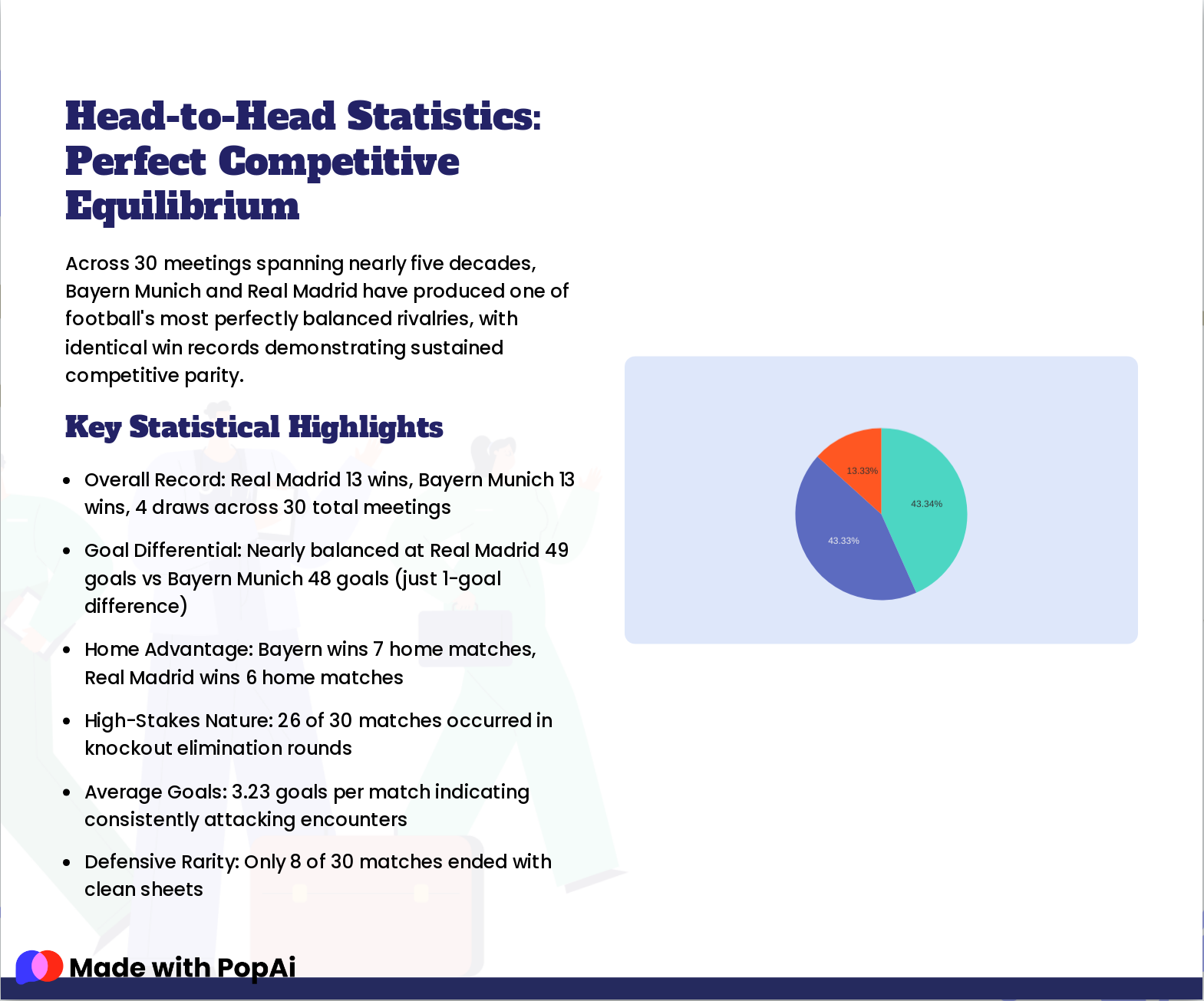
Slide 7: Head-to-Head Statistics: Perfect Competitive Equilibrium
Across 30 meetings spanning nearly five decades, Bayern Munich and Real Madrid have produced one of football's most perfectly balanced rivalries, with identical win records demonstrating sustained competitive parity.
Overall Record: Real Madrid 13 wins, Bayern Munich 13 wins, 4 draws across 30 total meetings
Goal Differential: Nearly balanced at Real Madrid 49 goals vs Bayern Munich 48 goals (just 1-goal difference)
Home Advantage: Bayern wins 7 home matches, Real Madrid wins 6 home matches
High-Stakes Nature: 26 of 30 matches occurred in knockout elimination rounds
Average Goals: 3.23 goals per match indicating consistently attacking encounters
Defensive Rarity: Only 8 of 30 matches ended with clean sheets
- Overall Record: Real Madrid 13 wins, Bayern Munich 13 wins, 4 draws across 30 total meetings
- Goal Differential: Nearly balanced at Real Madrid 49 goals vs Bayern Munich 48 goals (just 1-goal difference)
- Home Advantage: Bayern wins 7 home matches, Real Madrid wins 6 home matches
- High-Stakes Nature: 26 of 30 matches occurred in knockout elimination rounds
- Average Goals: 3.23 goals per match indicating consistently attacking encounters
- Defensive Rarity: Only 8 of 30 matches ended with clean sheets
Slide 8: Head-to-Head Breakdown: Stage-by-Stage Analysis
- Semi-Final Encounters (Top Level): 14 matches across various years, including the most recent 2024 meeting, represent the plurality of encounters and demonstrate both clubs' consistency in reaching late tournament stages.
- Quarter-Final Battles: 12 matches, including the dramatic 2017 encounter, showcase elimination intensity and high-pressure tactical chess where single goals often determine season outcomes.
- No Final Meetings (Critical Point): Despite a combined 21 final appearances by both clubs, they have never met in a championship decider, making earlier rounds and their matchups even more significant in rivalry context.
- Round of 16: A rare early-round meeting occurred in the 2006/07 season when both clubs were unseeded, representing an anomaly in the rivalry's historical pattern.
- Format Evolution Impact (Bottom): Stage distribution reflects UEFA seeding systems that typically separate top clubs until later rounds, with format changes over decades influencing meeting frequency and timing.
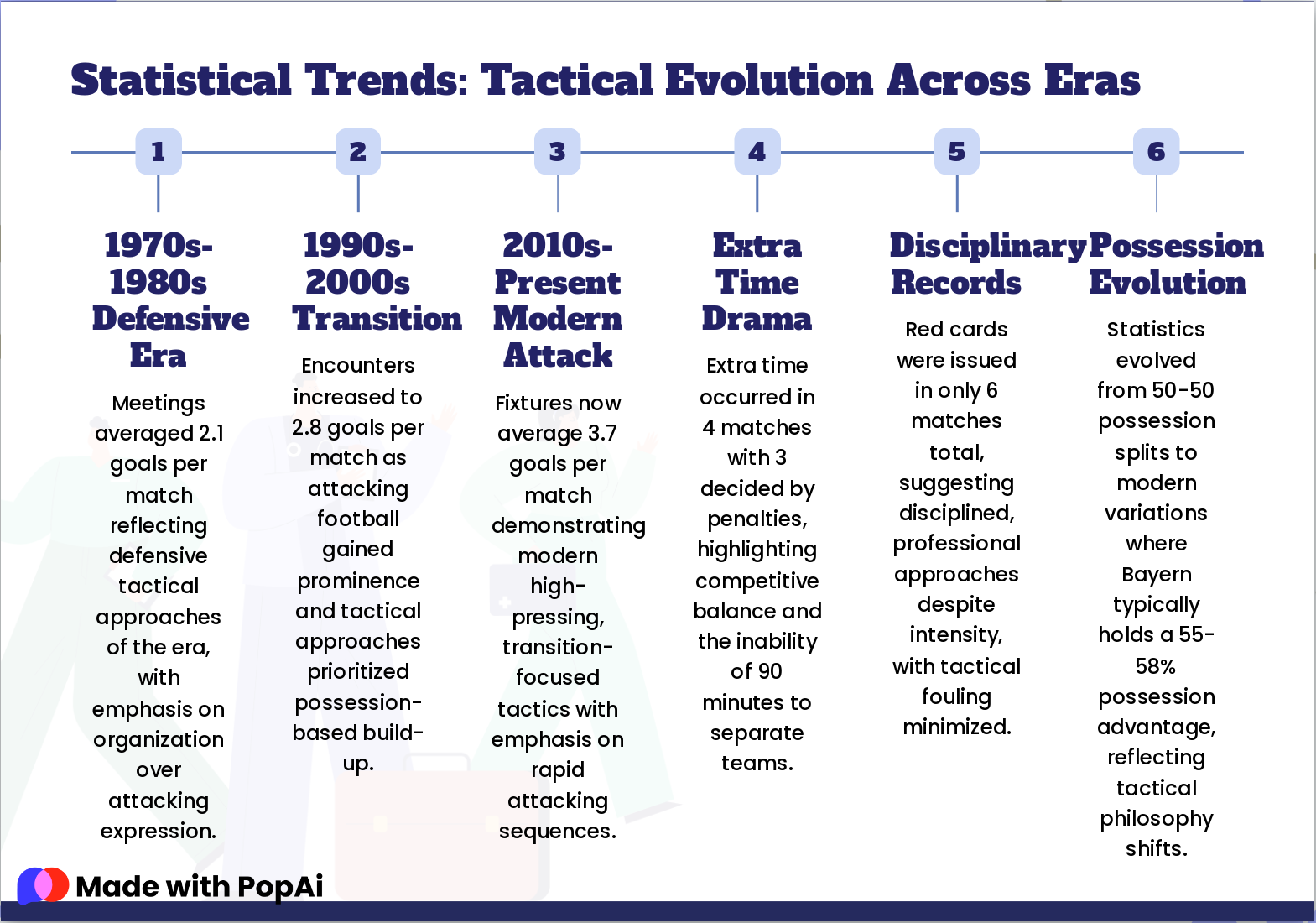
Slide 9: Statistical Trends: Tactical Evolution Across Eras
- 1970s-1980s Defensive Era: Meetings averaged 2.1 goals per match reflecting defensive tactical approaches of the era, with emphasis on organization over attacking expression.
- 1990s-2000s Transition: Encounters increased to 2.8 goals per match as attacking football gained prominence and tactical approaches prioritized possession-based build-up.
- 2010s-Present Modern Attack: Fixtures now average 3.7 goals per match demonstrating modern high-pressing, transition-focused tactics with emphasis on rapid attacking sequences.
- Extra Time Drama: Extra time occurred in 4 matches with 3 decided by penalties, highlighting competitive balance and the inability of 90 minutes to separate teams.
- Disciplinary Records: Red cards were issued in only 6 matches total, suggesting disciplined, professional approaches despite intensity, with tactical fouling minimized.
- Possession Evolution: Statistics evolved from 50-50 possession splits to modern variations where Bayern typically holds a 55-58% possession advantage, reflecting tactical philosophy shifts.
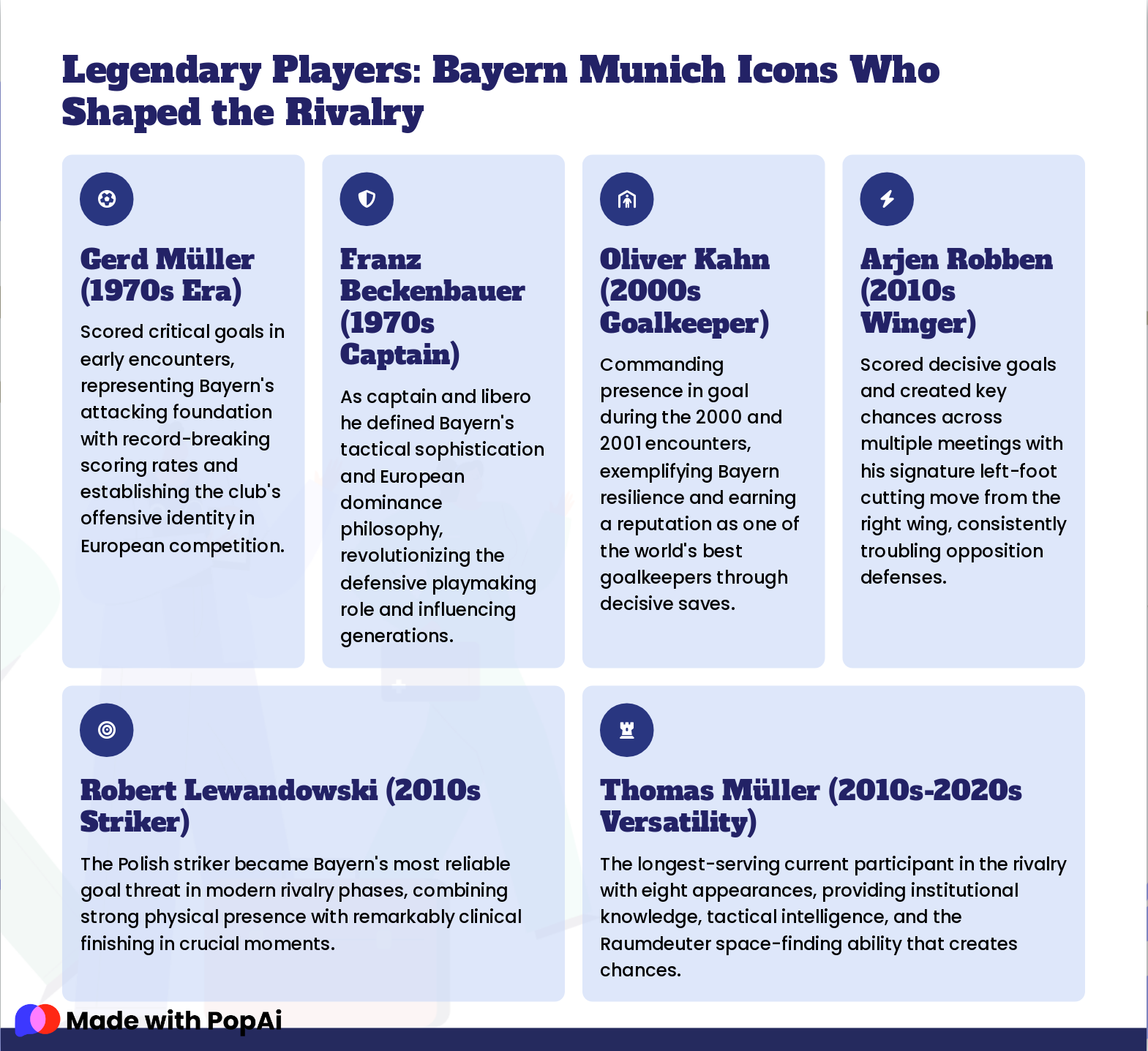
Slide 10: Legendary Players: Bayern Munich Icons Who Shaped the Rivalry
- Gerd Müller (1970s Era): Scored critical goals in early encounters, representing Bayern's attacking foundation with record-breaking scoring rates and establishing the club's offensive identity in European competition.
- Franz Beckenbauer (1970s Captain): As captain and libero he defined Bayern's tactical sophistication and European dominance philosophy, revolutionizing the defensive playmaking role and influencing generations.
- Oliver Kahn (2000s Goalkeeper): Commanding presence in goal during the 2000 and 2001 encounters, exemplifying Bayern resilience and earning a reputation as one of the world's best goalkeepers through decisive saves.
- Arjen Robben (2010s Winger): Scored decisive goals and created key chances across multiple meetings with his signature left-foot cutting move from the right wing, consistently troubling opposition defenses.
- Robert Lewandowski (2010s Striker): The Polish striker became Bayern's most reliable goal threat in modern rivalry phases, combining strong physical presence with remarkably clinical finishing in crucial moments.
- Thomas Müller (2010s-2020s Versatility): The longest-serving current participant in the rivalry with eight appearances, providing institutional knowledge, tactical intelligence, and the Raumdeuter space-finding ability that creates chances.
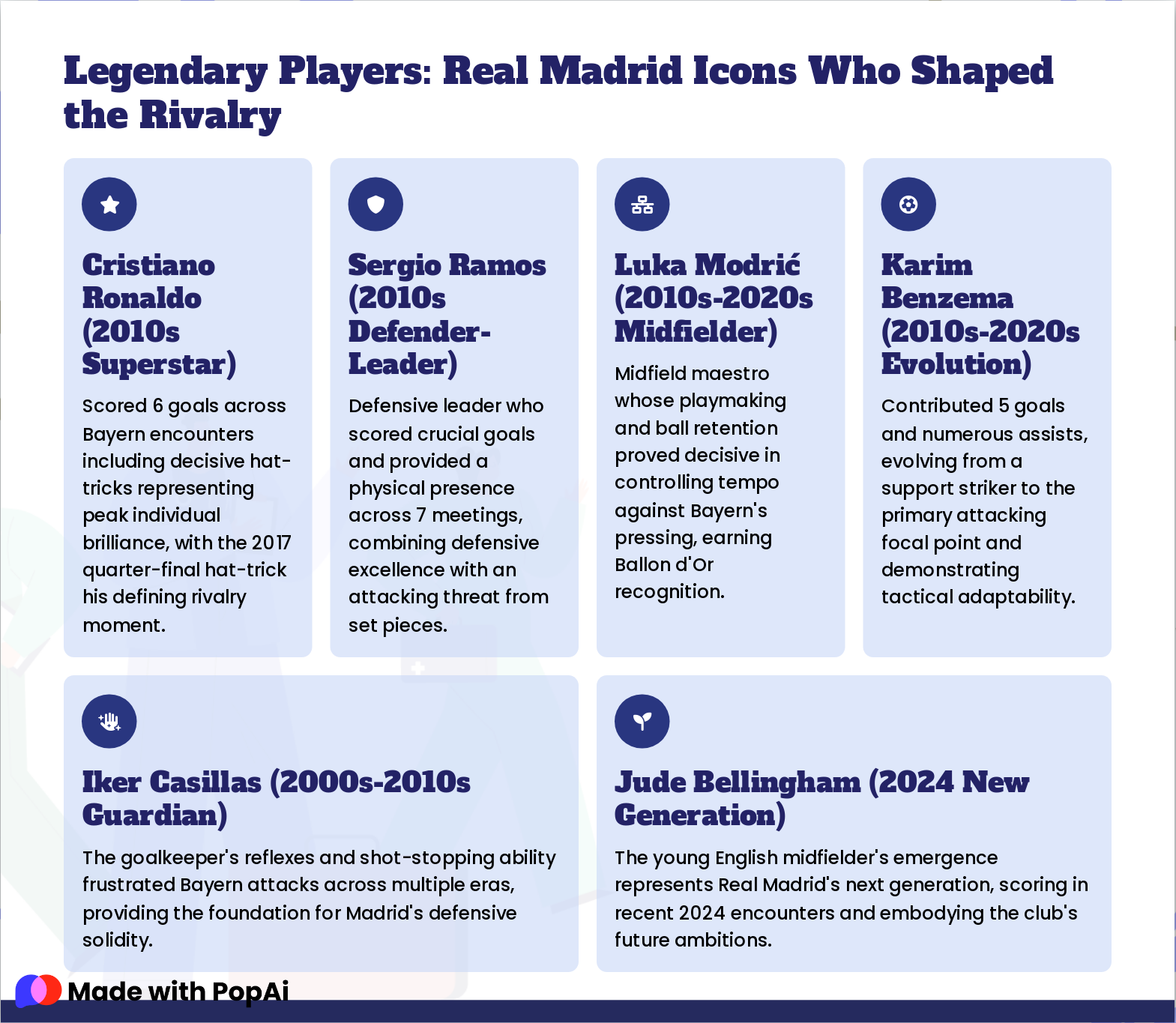
Slide 11: Legendary Players: Real Madrid Icons Who Shaped the Rivalry
- Cristiano Ronaldo (2010s Superstar): Scored 6 goals across Bayern encounters including decisive hat-tricks representing peak individual brilliance, with the 2017 quarter-final hat-trick his defining rivalry moment.
- Sergio Ramos (2010s Defender-Leader): Defensive leader who scored crucial goals and provided a physical presence across 7 meetings, combining defensive excellence with an attacking threat from set pieces.
- Luka Modrić (2010s-2020s Midfielder): Midfield maestro whose playmaking and ball retention proved decisive in controlling tempo against Bayern's pressing, earning Ballon d'Or recognition.
- Karim Benzema (2010s-2020s Evolution): Contributed 5 goals and numerous assists, evolving from a support striker to the primary attacking focal point and demonstrating tactical adaptability.
- Iker Casillas (2000s-2010s Guardian): The goalkeeper's reflexes and shot-stopping ability frustrated Bayern attacks across multiple eras, providing the foundation for Madrid's defensive solidity.
- Jude Bellingham (2024 New Generation): The young English midfielder's emergence represents Real Madrid's next generation, scoring in recent 2024 encounters and embodying the club's future ambitions.
Slide 12: Part 2: Iconic Match Analysis
Deep dive into defining encounters that shaped the modern rivalry
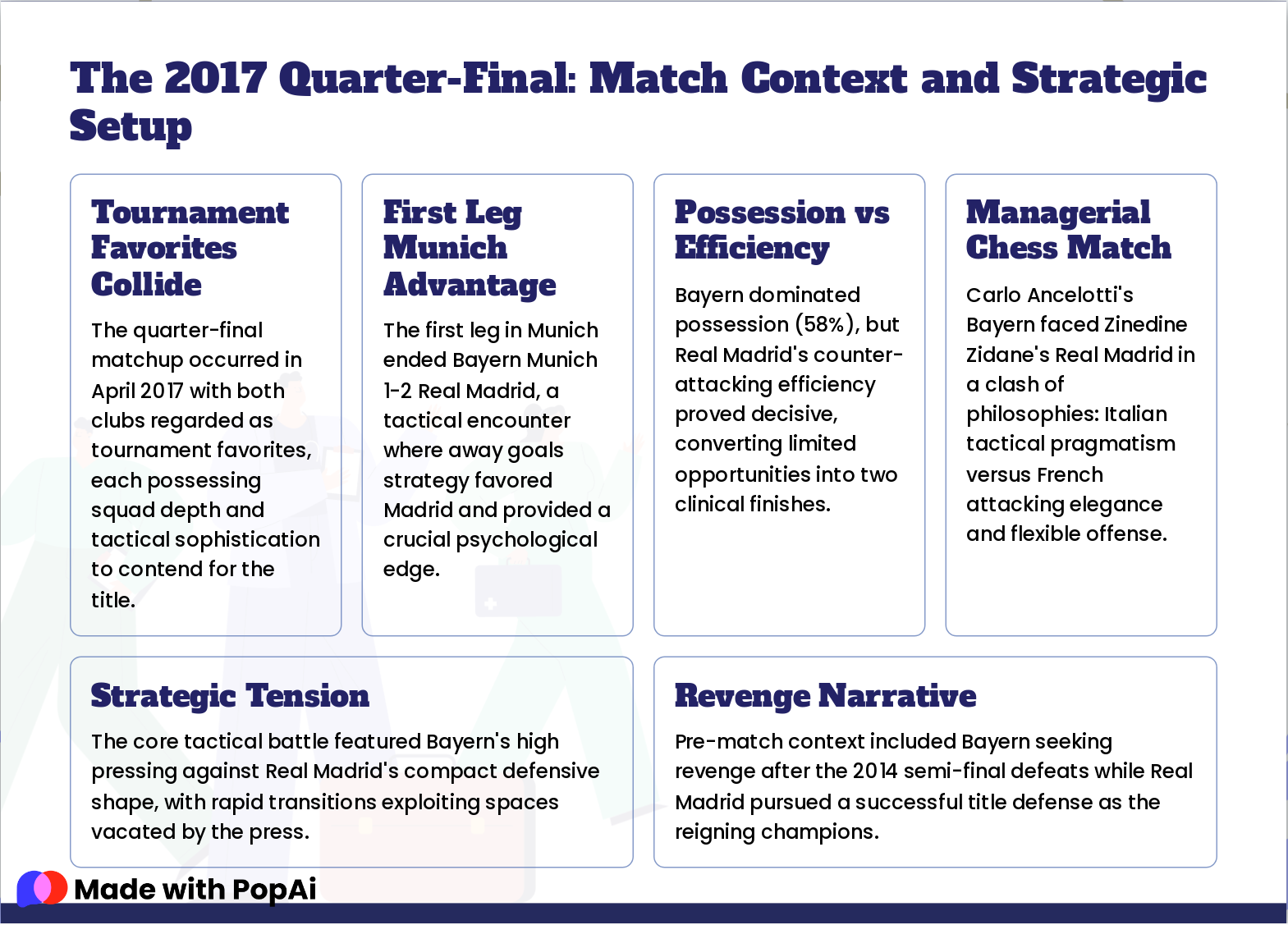
Slide 13: The 2017 Quarter-Final: Match Context and Strategic Setup
- Tournament Favorites Collide: The quarter-final matchup occurred in April 2017 with both clubs regarded as tournament favorites, each possessing squad depth and tactical sophistication to contend for the title.
- First Leg Munich Advantage: The first leg in Munich ended Bayern Munich 1-2 Real Madrid, a tactical encounter where away goals strategy favored Madrid and provided a crucial psychological edge.
- Possession vs Efficiency: Bayern dominated possession (58%), but Real Madrid's counter-attacking efficiency proved decisive, converting limited opportunities into two clinical finishes.
- Managerial Chess Match: Carlo Ancelotti's Bayern faced Zinedine Zidane's Real Madrid in a clash of philosophies: Italian tactical pragmatism versus French attacking elegance and flexible offense.
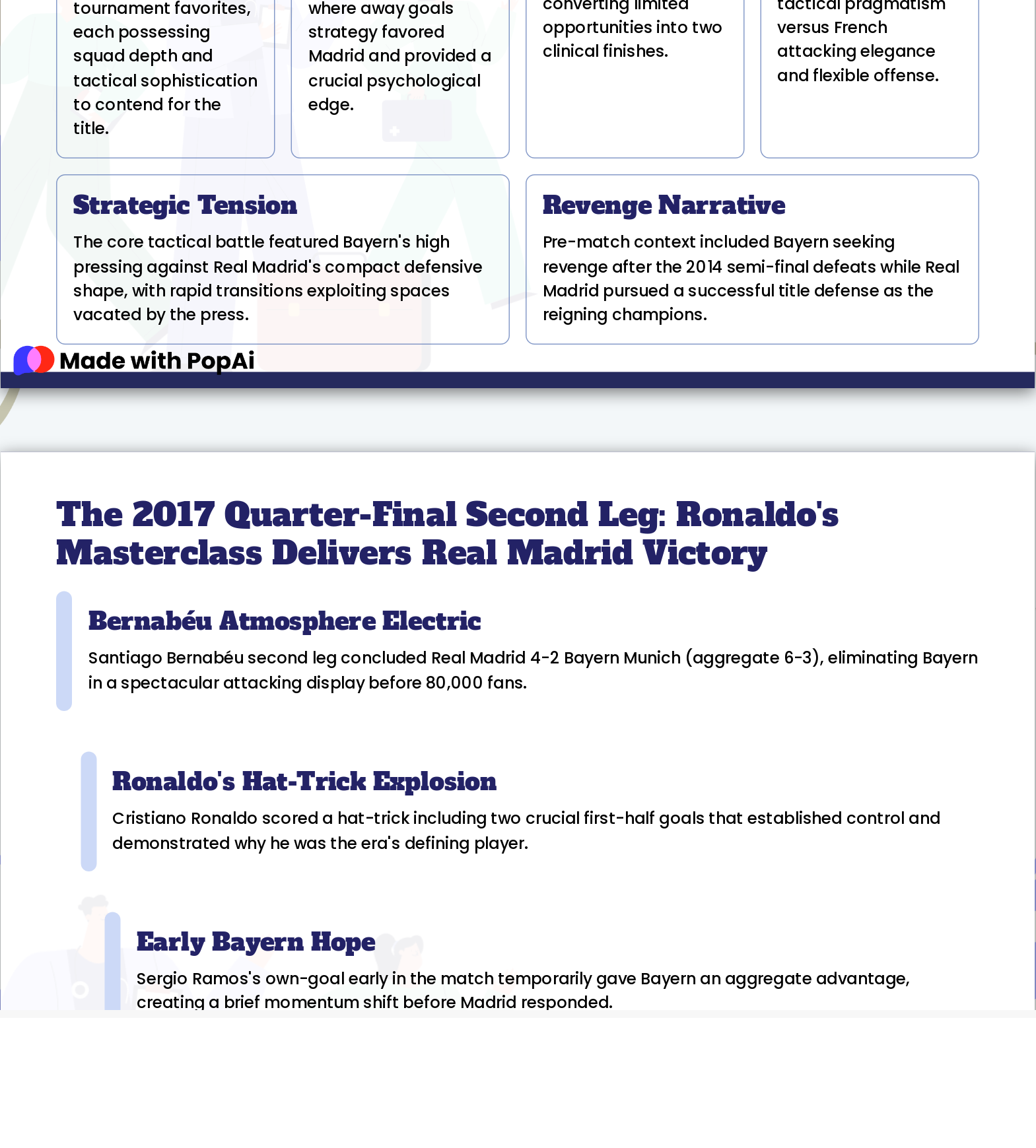
- Strategic Tension: The core tactical battle featured Bayern's high pressing against Real Madrid's compact defensive shape, with rapid transitions exploiting spaces vacated by the press.
- Revenge Narrative: Pre-match context included Bayern seeking revenge after the 2014 semi-final defeats while Real Madrid pursued a successful title defense as the reigning champions.
Slide 14: The 2017 Quarter-Final Second Leg: Ronaldo's Masterclass Delivers Real Madrid Victory
- Bernabéu Atmosphere Electric: Santiago Bernabéu second leg concluded Real Madrid 4-2 Bayern Munich (aggregate 6-3), eliminating Bayern in a spectacular attacking display before 80,000 fans.
- Ronaldo's Hat-Trick Explosion: Cristiano Ronaldo scored a hat-trick including two crucial first-half goals that established control and demonstrated why he was the era's defining player.
- Early Bayern Hope: Sergio Ramos's own-goal early in the match temporarily gave Bayern an aggregate advantage, creating a brief momentum shift before Madrid responded.
- Bayern's Fight: Robert Lewandowski scored two goals showing determination, but it was insufficient against Madrid's relentless attacking onslaught and defensive resilience.
- Halftime Tactical Shift: Zidane's halftime adjustments neutralized Bayern's pressing by exploiting wide spaces with fullback overlaps, completely changing the match dynamics.
- Champions Crowned: The result propelled Real Madrid toward the eventual 2017 Champions League title, the club's 12th European Cup, validating Zidane's tactics and squad quality.
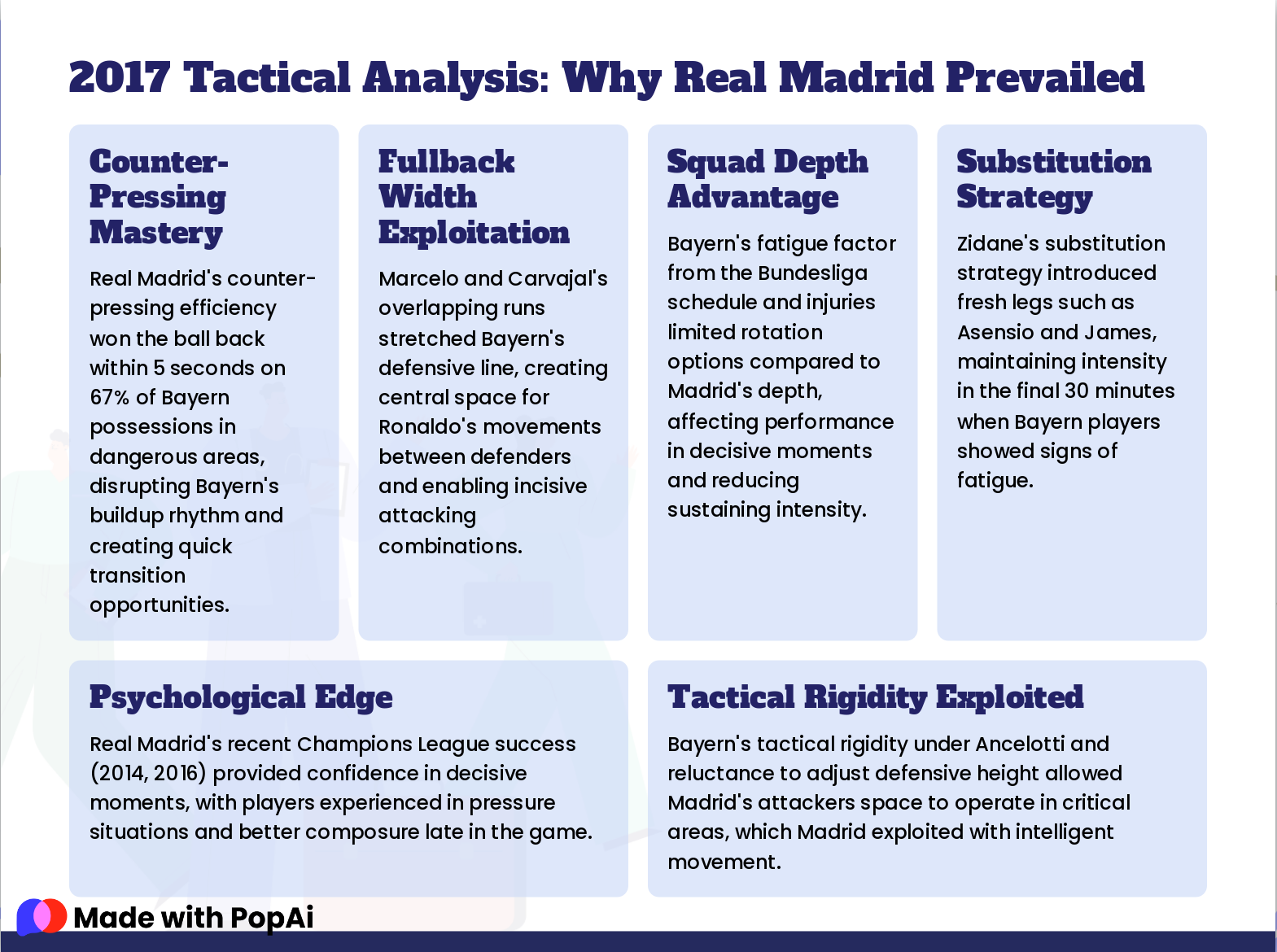
Slide 15: 2017 Tactical Analysis: Why Real Madrid Prevailed
- Counter-Pressing Mastery: Real Madrid's counter-pressing efficiency won the ball back within 5 seconds on 67% of Bayern possessions in dangerous areas, disrupting Bayern's buildup rhythm and creating quick transition opportunities.
- Fullback Width Exploitation: Marcelo and Carvajal's overlapping runs stretched Bayern's defensive line, creating central space for Ronaldo's movements between defenders and enabling incisive attacking combinations.
- Squad Depth Advantage: Bayern's fatigue factor from the Bundesliga schedule and injuries limited rotation options compared to Madrid's depth, affecting performance in decisive moments and reducing sustaining intensity.
- Substitution Strategy: Zidane's substitution strategy introduced fresh legs such as Asensio and James, maintaining intensity in the final 30 minutes when Bayern players showed signs of fatigue.
- Psychological Edge: Real Madrid's recent Champions League success (2014, 2016) provided confidence in decisive moments, with players experienced in pressure situations and better composure late in the game.
- Tactical Rigidity Exploited: Bayern's tactical rigidity under Ancelotti and reluctance to adjust defensive height allowed Madrid's attackers space to operate in critical areas, which Madrid exploited with intelligent movement.
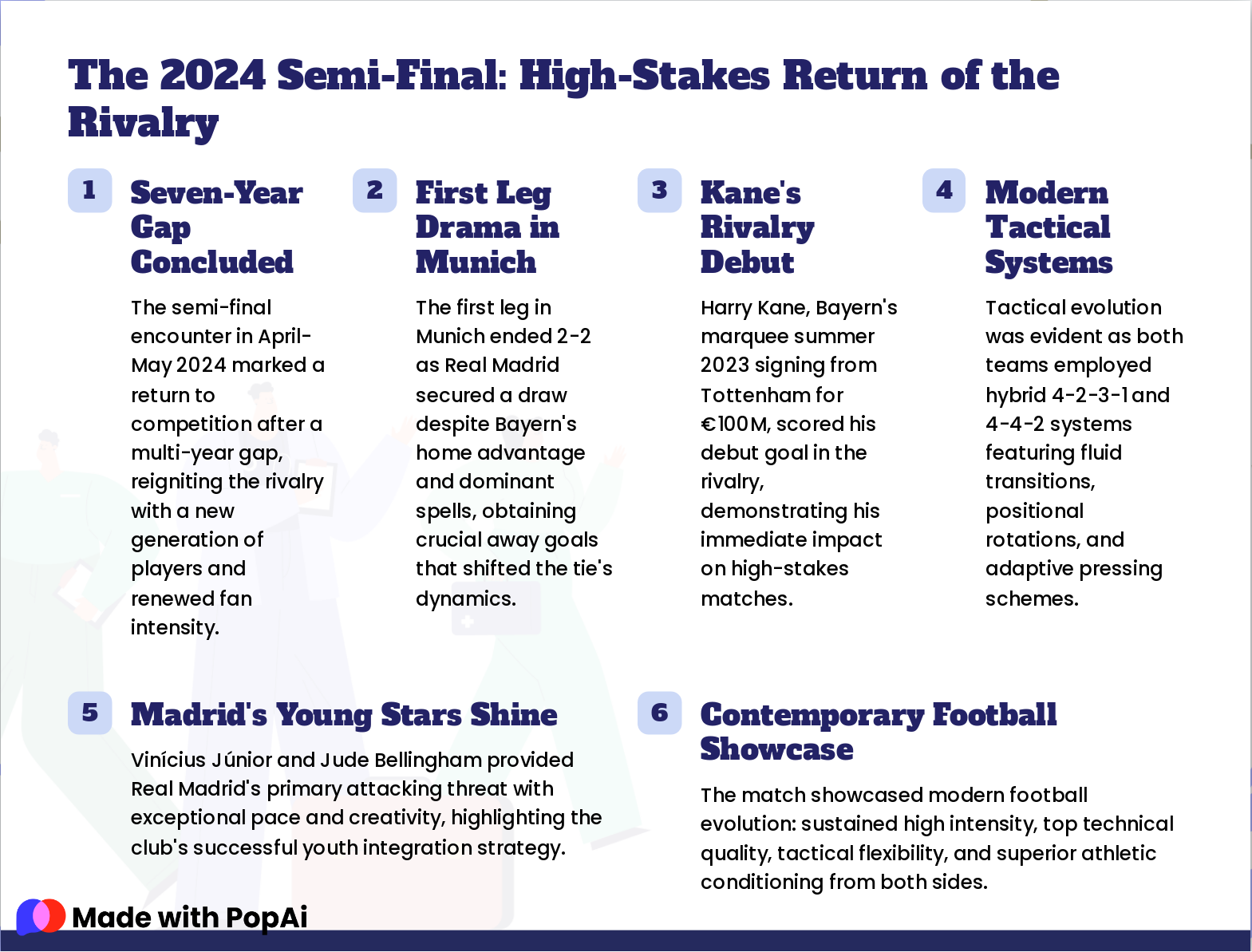
Slide 16: The 2024 Semi-Final: High-Stakes Return of the Rivalry
- Seven-Year Gap Concluded: The semi-final encounter in April-May 2024 marked a return to competition after a multi-year gap, reigniting the rivalry with a new generation of players and renewed fan intensity.
- First Leg Drama in Munich: The first leg in Munich ended 2-2 as Real Madrid secured a draw despite Bayern's home advantage and dominant spells, obtaining crucial away goals that shifted the tie's dynamics.
- Kane's Rivalry Debut: Harry Kane, Bayern's marquee summer 2023 signing from Tottenham for €100M, scored his debut goal in the rivalry, demonstrating his immediate impact on high-stakes matches.
- Modern Tactical Systems: Tactical evolution was evident as both teams employed hybrid 4-2-3-1 and 4-4-2 systems featuring fluid transitions, positional rotations, and adaptive pressing schemes.
- Madrid's Young Stars Shine: Vinícius Júnior and Jude Bellingham provided Real Madrid's primary attacking threat with exceptional pace and creativity, highlighting the club's successful youth integration strategy.
- Contemporary Football Showcase: The match showcased modern football evolution: sustained high intensity, top technical quality, tactical flexibility, and superior athletic conditioning from both sides.
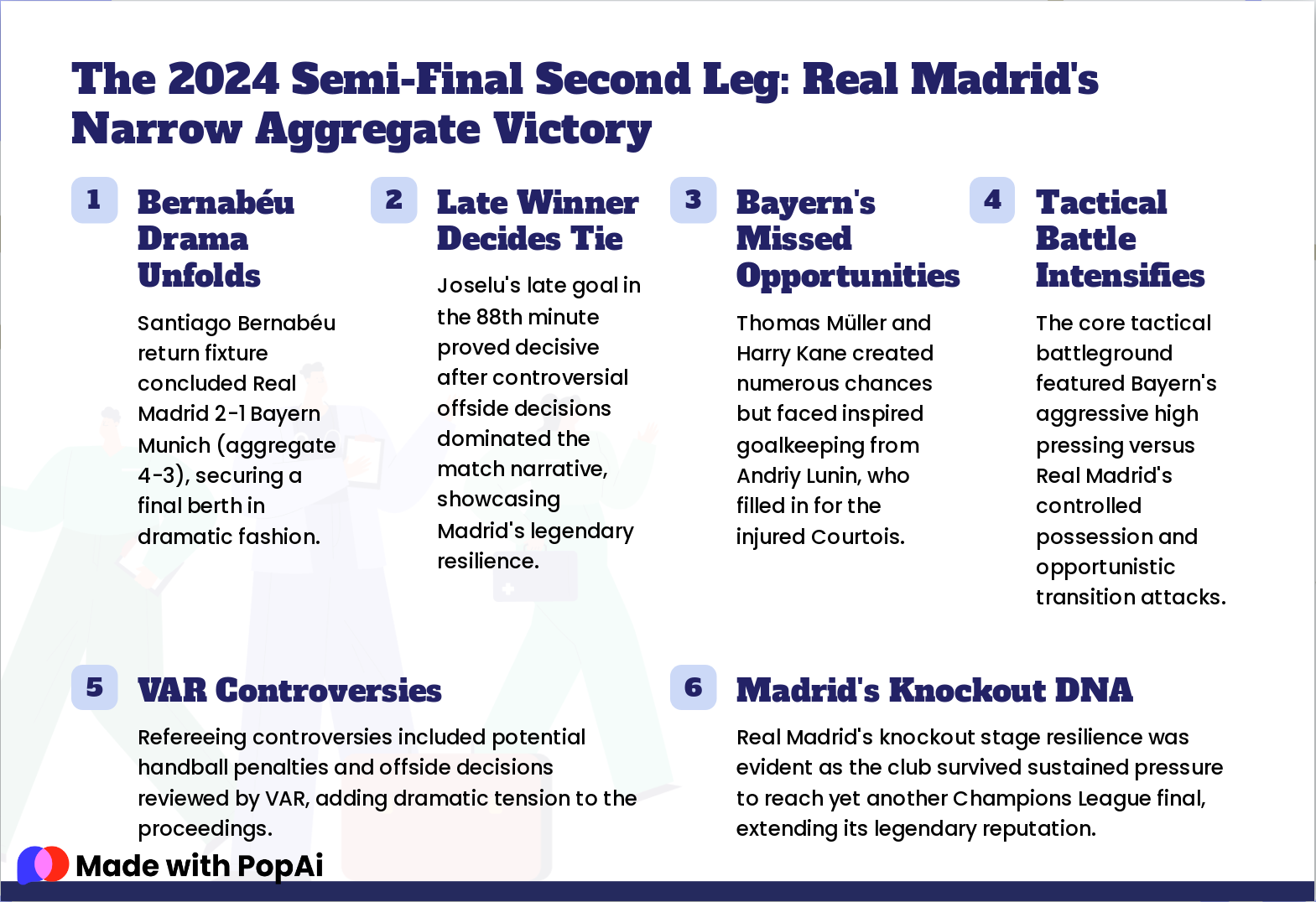
Slide 17: The 2024 Semi-Final Second Leg: Real Madrid's Narrow Aggregate Victory
- Bernabéu Drama Unfolds: Santiago Bernabéu return fixture concluded Real Madrid 2-1 Bayern Munich (aggregate 4-3), securing a final berth in dramatic fashion.
- Late Winner Decides Tie: Joselu's late goal in the 88th minute proved decisive after controversial offside decisions dominated the match narrative, showcasing Madrid's legendary resilience.
- Bayern's Missed Opportunities: Thomas Müller and Harry Kane created numerous chances but faced inspired goalkeeping from Andriy Lunin, who filled in for the injured Courtois.
- Tactical Battle Intensifies: The core tactical battleground featured Bayern's aggressive high pressing versus Real Madrid's controlled possession and opportunistic transition attacks.
- VAR Controversies: Refereeing controversies included potential handball penalties and offside decisions reviewed by VAR, adding dramatic tension to the proceedings.
- Madrid's Knockout DNA: Real Madrid's knockout stage resilience was evident as the club survived sustained pressure to reach yet another Champions League final, extending its legendary reputation.
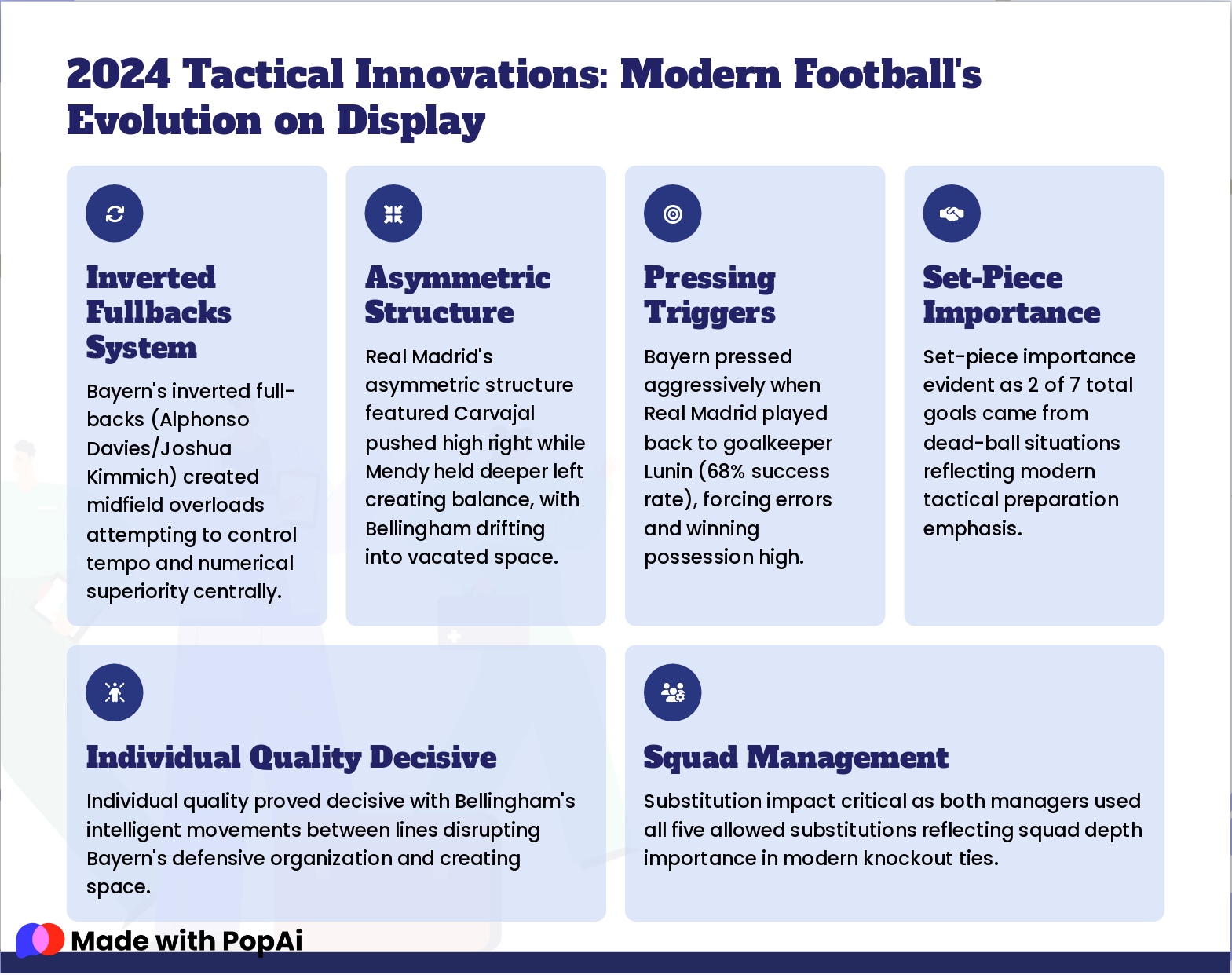
Slide 18: 2024 Tactical Innovations: Modern Football's Evolution on Display
- Inverted Fullbacks System: Bayern's inverted full-backs (Alphonso Davies/Joshua Kimmich) created midfield overloads attempting to control tempo and numerical superiority centrally.
- Asymmetric Structure: Real Madrid's asymmetric structure featured Carvajal pushed high right while Mendy held deeper left creating balance, with Bellingham drifting into vacated space.
- Pressing Triggers: Bayern pressed aggressively when Real Madrid played back to goalkeeper Lunin (68% success rate), forcing errors and winning possession high.
- Set-Piece Importance: Set-piece importance evident as 2 of 7 total goals came from dead-ball situations reflecting modern tactical preparation emphasis.
- Individual Quality Decisive: Individual quality proved decisive with Bellingham's intelligent movements between lines disrupting Bayern's defensive organization and creating space.
- Squad Management: Substitution impact critical as both managers used all five allowed substitutions reflecting squad depth importance in modern knockout ties.
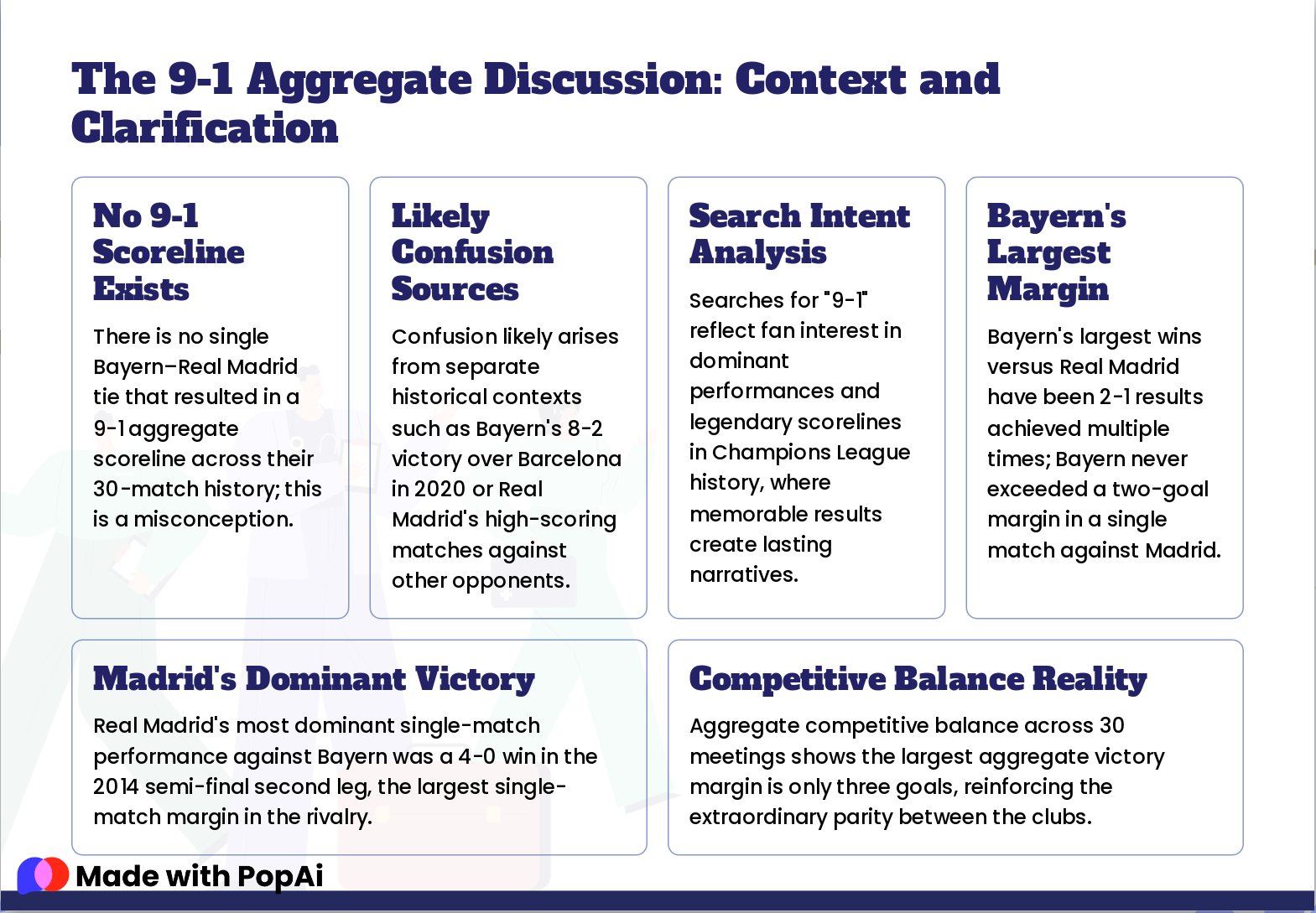
Slide 19: The 9-1 Aggregate Discussion: Context and Clarification
- No 9-1 Scoreline Exists: There is no single Bayern–Real Madrid tie that resulted in a 9-1 aggregate scoreline across their 30-match history; this is a misconception.
- Likely Confusion Sources: Confusion likely arises from separate historical contexts such as Bayern's 8-2 victory over Barcelona in 2020 or Real Madrid's high-scoring matches against other opponents.
- Search Intent Analysis: Searches for "9-1" reflect fan interest in dominant performances and legendary scorelines in Champions League history, where memorable results create lasting narratives.
- Bayern's Largest Margin: Bayern's largest wins versus Real Madrid have been 2-1 results achieved multiple times; Bayern never exceeded a two-goal margin in a single match against Madrid.
- Madrid's Dominant Victory: Real Madrid's most dominant single-match performance against Bayern was a 4-0 win in the 2014 semi-final second leg, the largest single-match margin in the rivalry.
- Competitive Balance Reality: Aggregate competitive balance across 30 meetings shows the largest aggregate victory margin is only three goals, reinforcing the extraordinary parity between the clubs.
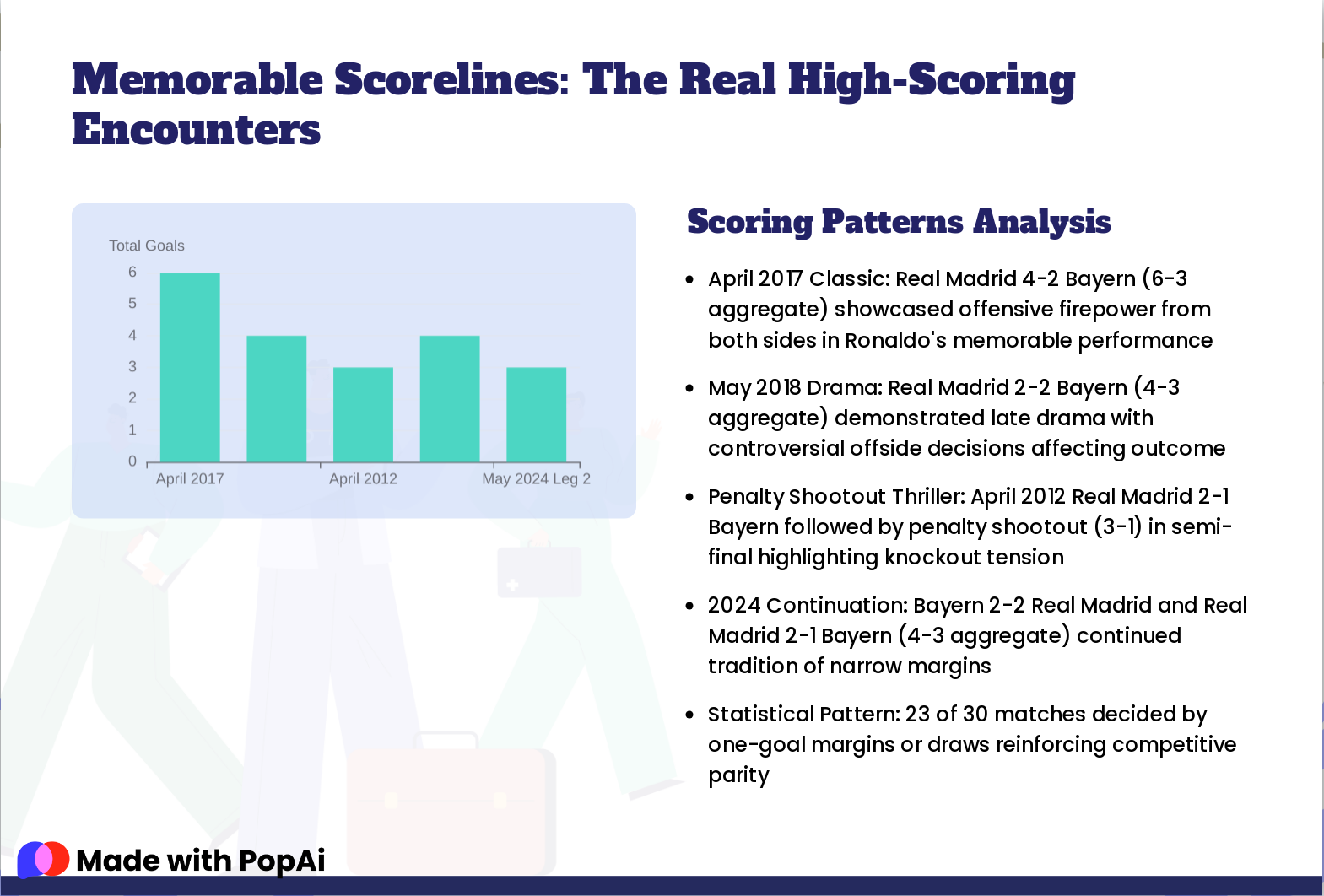
Slide 20: Memorable Scorelines: The Real High-Scoring Encounters
April 2017 Classic: Real Madrid 4-2 Bayern (6-3 aggregate) showcased offensive firepower from both sides in Ronaldo's memorable performance
May 2018 Drama: Real Madrid 2-2 Bayern (4-3 aggregate) demonstrated late drama with controversial offside decisions affecting outcome
Penalty Shootout Thriller: April 2012 Real Madrid 2-1 Bayern followed by penalty shootout (3-1) in semi-final highlighting knockout tension
2024 Continuation: Bayern 2-2 Real Madrid and Real Madrid 2-1 Bayern (4-3 aggregate) continued tradition of narrow margins
Statistical Pattern: 23 of 30 matches decided by one-goal margins or draws reinforcing competitive parity
- April 2017 Classic: Real Madrid 4-2 Bayern (6-3 aggregate) showcased offensive firepower from both sides in Ronaldo's memorable performance
- May 2018 Drama: Real Madrid 2-2 Bayern (4-3 aggregate) demonstrated late drama with controversial offside decisions affecting outcome
- Penalty Shootout Thriller: April 2012 Real Madrid 2-1 Bayern followed by penalty shootout (3-1) in semi-final highlighting knockout tension
- 2024 Continuation: Bayern 2-2 Real Madrid and Real Madrid 2-1 Bayern (4-3 aggregate) continued tradition of narrow margins
- Statistical Pattern: 23 of 30 matches decided by one-goal margins or draws reinforcing competitive parity
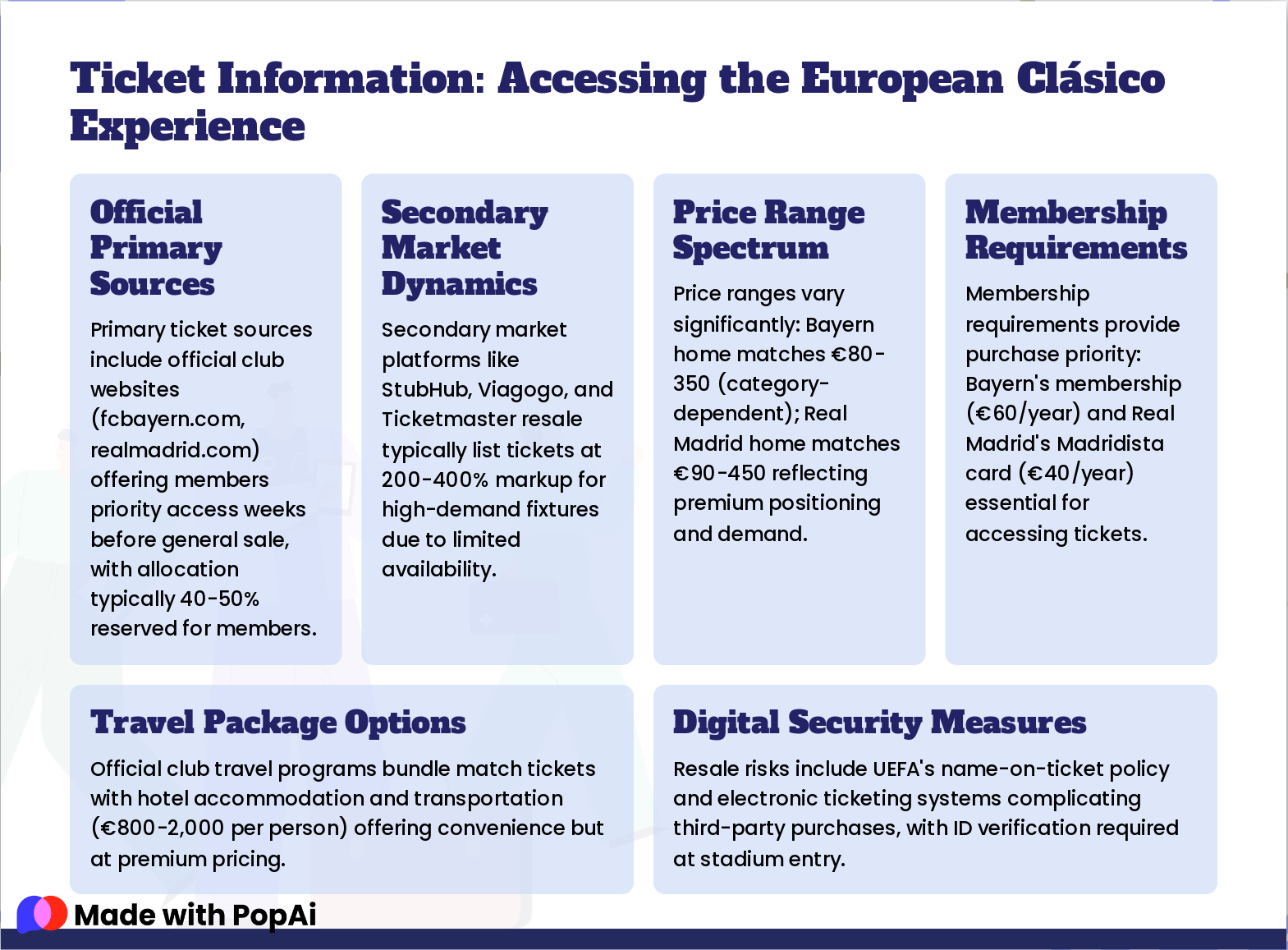
Slide 21: Ticket Information: Accessing the European Clásico Experience
- Official Primary Sources: Primary ticket sources include official club websites (fcbayern.com, realmadrid.com) offering members priority access weeks before general sale, with allocation typically 40-50% reserved for members.
- Secondary Market Dynamics: Secondary market platforms like StubHub, Viagogo, and Ticketmaster resale typically list tickets at 200-400% markup for high-demand fixtures due to limited availability.
- Price Range Spectrum: Price ranges vary significantly: Bayern home matches €80-350 (category-dependent); Real Madrid home matches €90-450 reflecting premium positioning and demand.
- Membership Requirements: Membership requirements provide purchase priority: Bayern's membership (€60/year) and Real Madrid's Madridista card (€40/year) essential for accessing tickets.
- Travel Package Options: Official club travel programs bundle match tickets with hotel accommodation and transportation (€800-2,000 per person) offering convenience but at premium pricing.
- Digital Security Measures: Resale risks include UEFA's name-on-ticket policy and electronic ticketing systems complicating third-party purchases, with ID verification required at stadium entry.
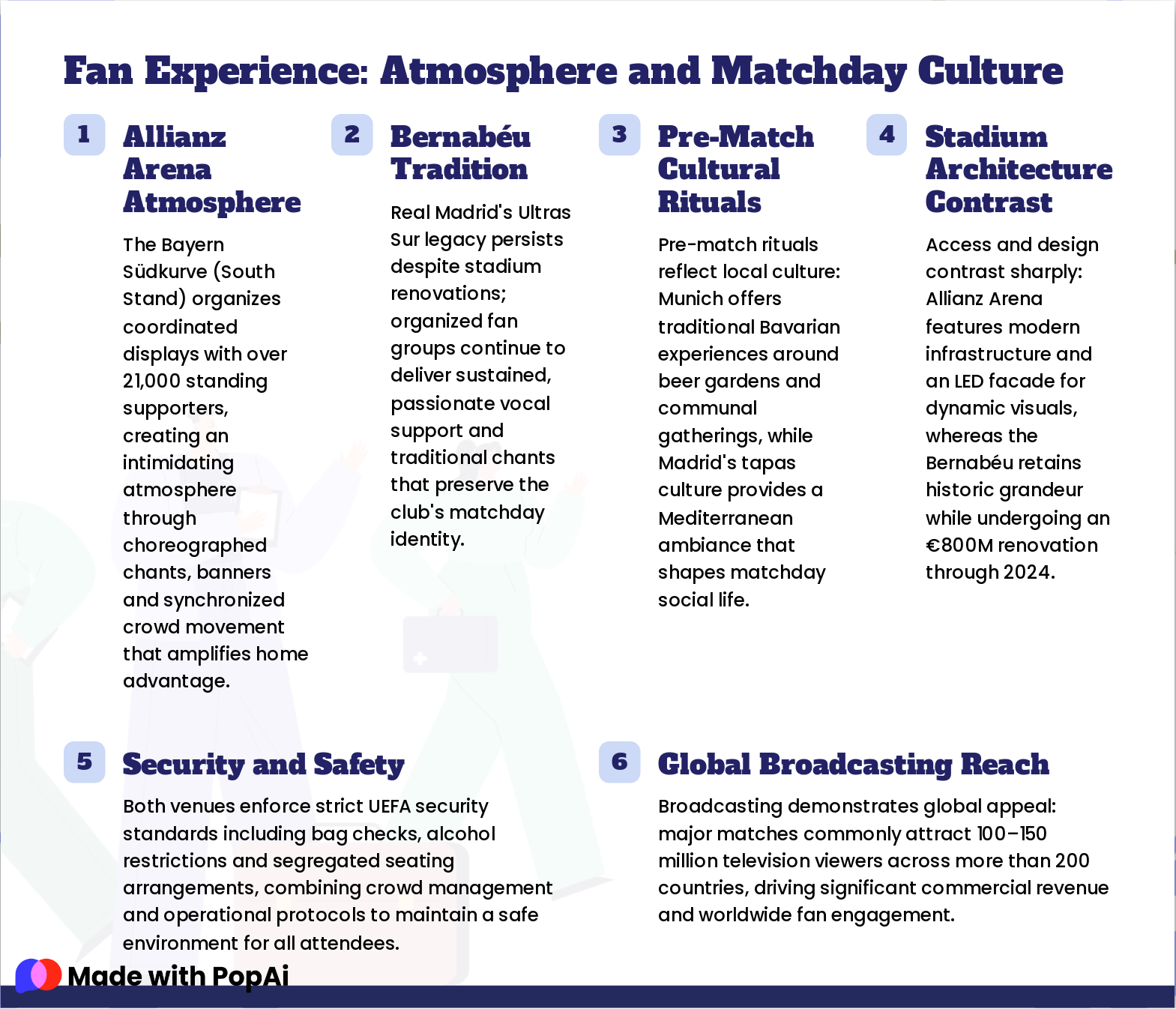
Slide 22: Fan Experience: Atmosphere and Matchday Culture
- Allianz Arena Atmosphere: The Bayern Südkurve (South Stand) organizes coordinated displays with over 21,000 standing supporters, creating an intimidating atmosphere through choreographed chants, banners and synchronized crowd movement that amplifies home advantage.
- Bernabéu Tradition: Real Madrid's Ultras Sur legacy persists despite stadium renovations; organized fan groups continue to deliver sustained, passionate vocal support and traditional chants that preserve the club's matchday identity.
- Pre-Match Cultural Rituals: Pre-match rituals reflect local culture: Munich offers traditional Bavarian experiences around beer gardens and communal gatherings, while Madrid's tapas culture provides a Mediterranean ambiance that shapes matchday social life.
- Stadium Architecture Contrast: Access and design contrast sharply: Allianz Arena features modern infrastructure and an LED facade for dynamic visuals, whereas the Bernabéu retains historic grandeur while undergoing an €800M renovation through 2024.
- Security and Safety: Both venues enforce strict UEFA security standards including bag checks, alcohol restrictions and segregated seating arrangements, combining crowd management and operational protocols to maintain a safe environment for all attendees.
- Global Broadcasting Reach: Broadcasting demonstrates global appeal: major matches commonly attract 100–150 million television viewers across more than 200 countries, driving significant commercial revenue and worldwide fan engagement.
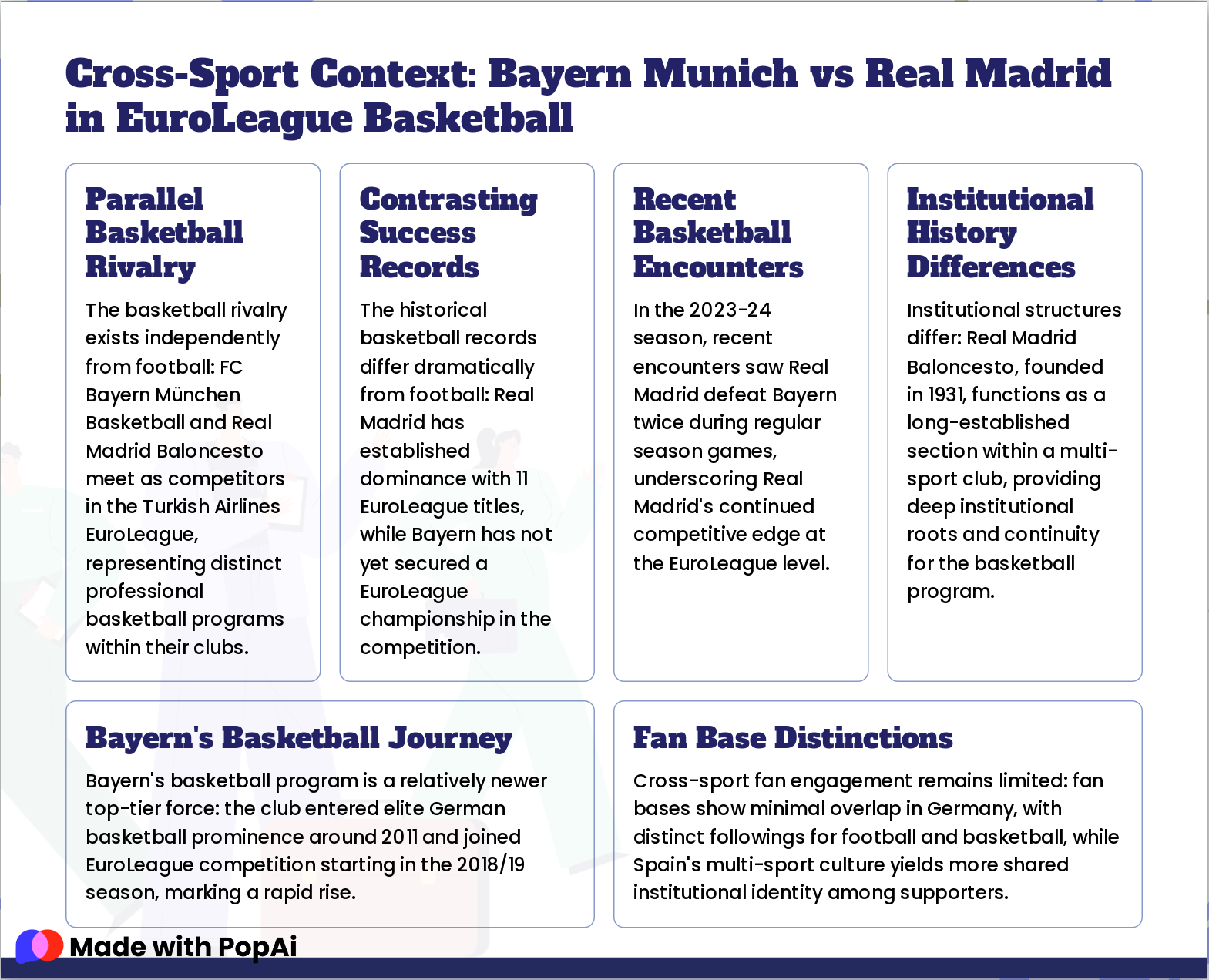
Slide 23: Cross-Sport Context: Bayern Munich vs Real Madrid in EuroLeague Basketball
- Parallel Basketball Rivalry: The basketball rivalry exists independently from football: FC Bayern München Basketball and Real Madrid Baloncesto meet as competitors in the Turkish Airlines EuroLeague, representing distinct professional basketball programs within their clubs.
- Contrasting Success Records: The historical basketball records differ dramatically from football: Real Madrid has established dominance with 11 EuroLeague titles, while Bayern has not yet secured a EuroLeague championship in the competition.
- Recent Basketball Encounters: In the 2023-24 season, recent encounters saw Real Madrid defeat Bayern twice during regular season games, underscoring Real Madrid's continued competitive edge at the EuroLeague level.
- Institutional History Differences: Institutional structures differ: Real Madrid Baloncesto, founded in 1931, functions as a long-established section within a multi-sport club, providing deep institutional roots and continuity for the basketball program.
- Bayern's Basketball Journey: Bayern's basketball program is a relatively newer top-tier force: the club entered elite German basketball prominence around 2011 and joined EuroLeague competition starting in the 2018/19 season, marking a rapid rise.
- Fan Base Distinctions: Cross-sport fan engagement remains limited: fan bases show minimal overlap in Germany, with distinct followings for football and basketball, while Spain's multi-sport culture yields more shared institutional identity among supporters.
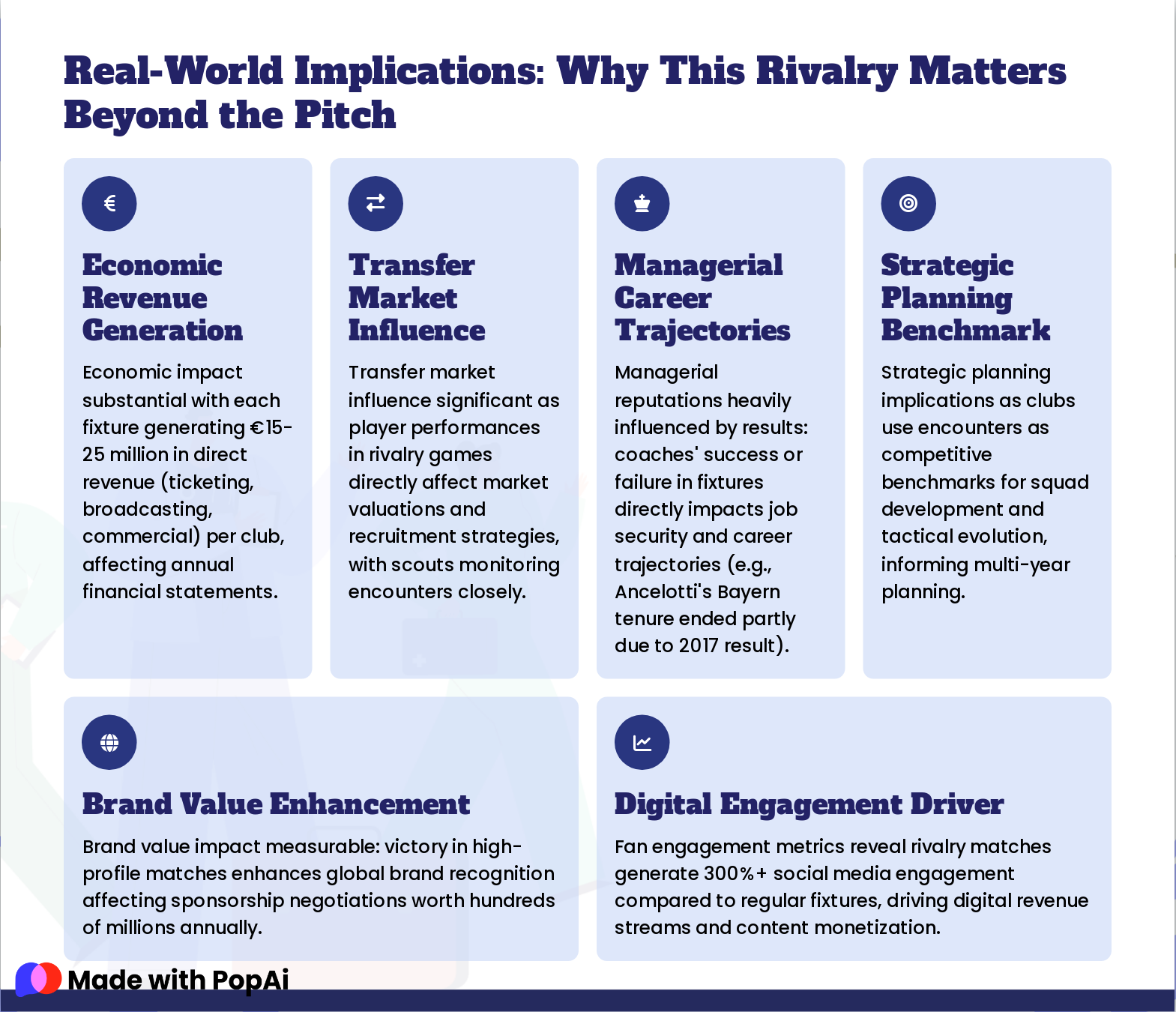
Slide 24: Real-World Implications: Why This Rivalry Matters Beyond the Pitch
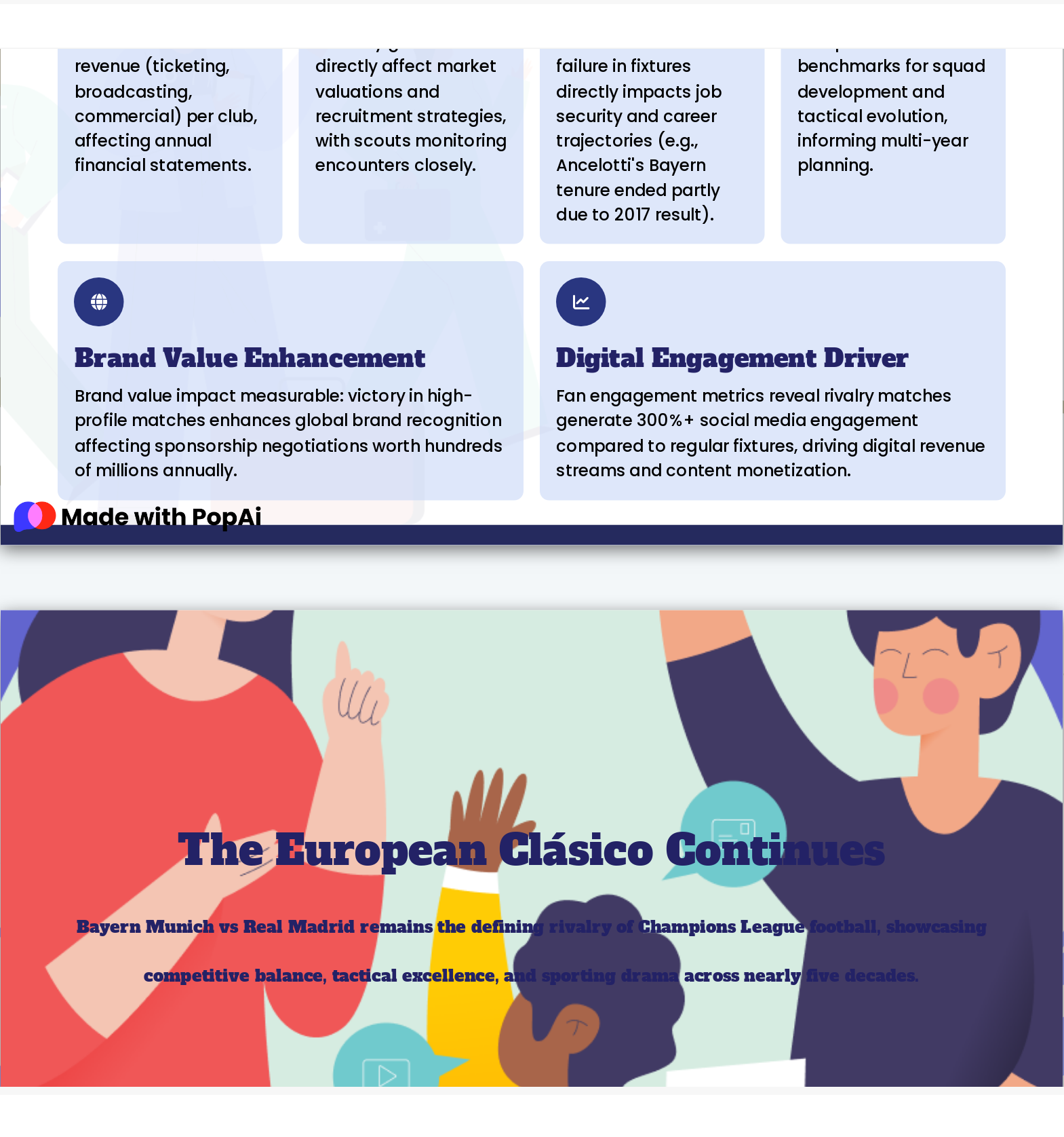
- Economic Revenue Generation: Economic impact substantial with each fixture generating €15-25 million in direct revenue (ticketing, broadcasting, commercial) per club, affecting annual financial statements.
- Transfer Market Influence: Transfer market influence significant as player performances in rivalry games directly affect market valuations and recruitment strategies, with scouts monitoring encounters closely.
- Managerial Career Trajectories: Managerial reputations heavily influenced by results: coaches' success or failure in fixtures directly impacts job security and career trajectories (e.g., Ancelotti's Bayern tenure ended partly due to 2017 result).
- Strategic Planning Benchmark: Strategic planning implications as clubs use encounters as competitive benchmarks for squad development and tactical evolution, informing multi-year planning.
- Brand Value Enhancement: Brand value impact measurable: victory in high-profile matches enhances global brand recognition affecting sponsorship negotiations worth hundreds of millions annually.
- Digital Engagement Driver: Fan engagement metrics reveal rivalry matches generate 300%+ social media engagement compared to regular fixtures, driving digital revenue streams and content monetization.
Slide 25: The European Clásico Continues
The European Clásico Continues Bayern Munich vs Real Madrid remains the defining rivalry of Champions League football, showcasing competitive balance, tactical excellence, and sporting drama across nearly five decades.