Presentation Summary
Explore the historic rivalry between Bayern Munich and Real Madrid, Europe's most contested Champions League matchups, covering their head-to-head statistics, club identities, player comparisons, and tactical evolution.
Full Presentation Transcript
Slide 1: Bayern Munich vs Real Madrid - Europe's Most Contested Champions League Rivalry
Comprehensive Historical Analysis of Football's Premier Clubs and Their Legendary Encounters
Slide 2: Contents - Structured Analysis of Football's Premier Rivalry
- Historical Overview and Rivalry Significance
- Club Identities - Bayern Munich and Real Madrid Foundations
- Head-to-Head Statistics and Competitive Balance
- Player Comparisons and Squad Analysis (2024/25 Season)
- Defining Moments - Notable Matches and Controversies
- Tactical Evolution and Strategic Approaches
- Infrastructure, Fan Culture, and Global Impact
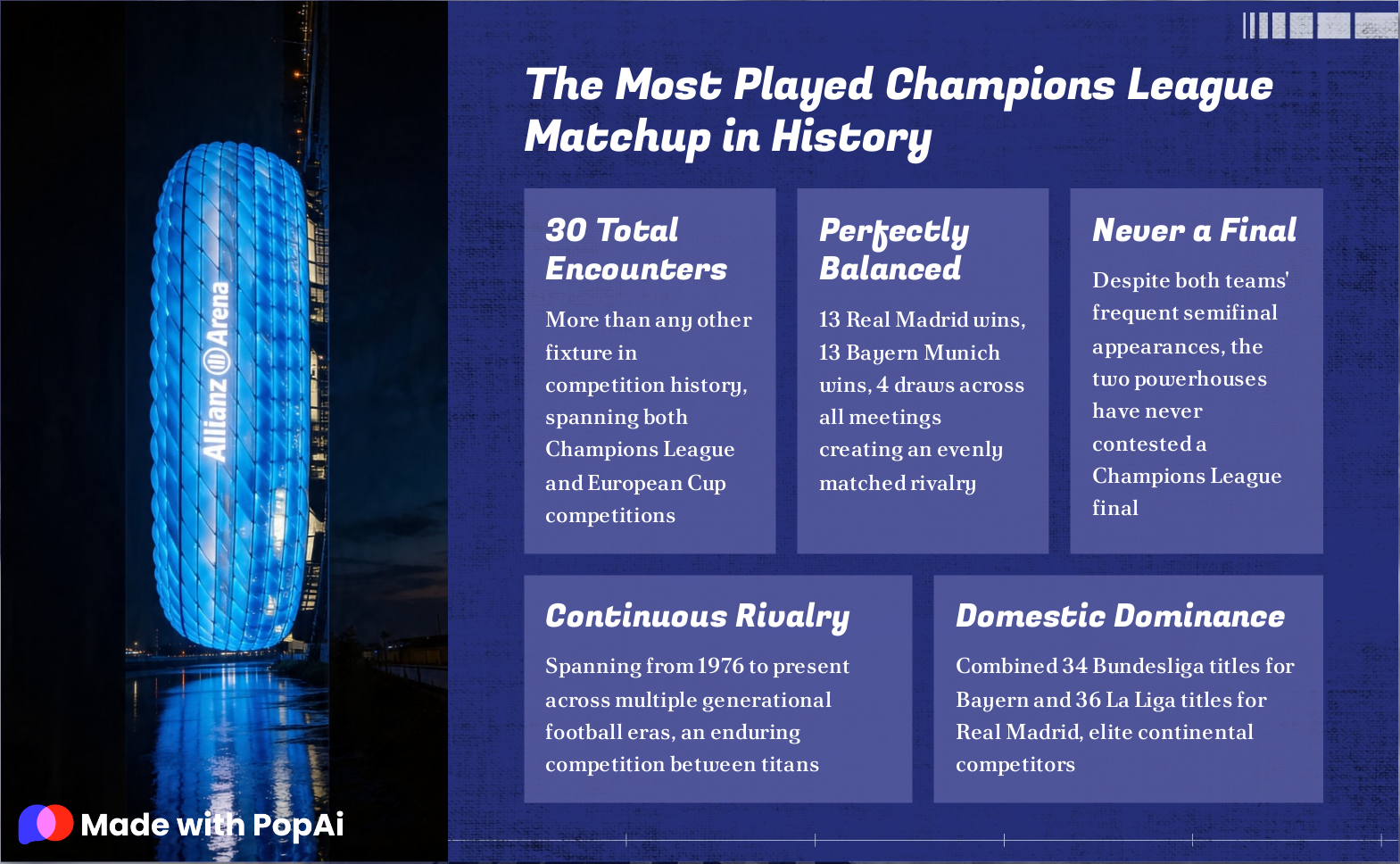
Slide 3: The Most Played Champions League Matchup in History
- 30 Total Encounters: More than any other fixture in competition history, spanning both Champions League and European Cup competitions
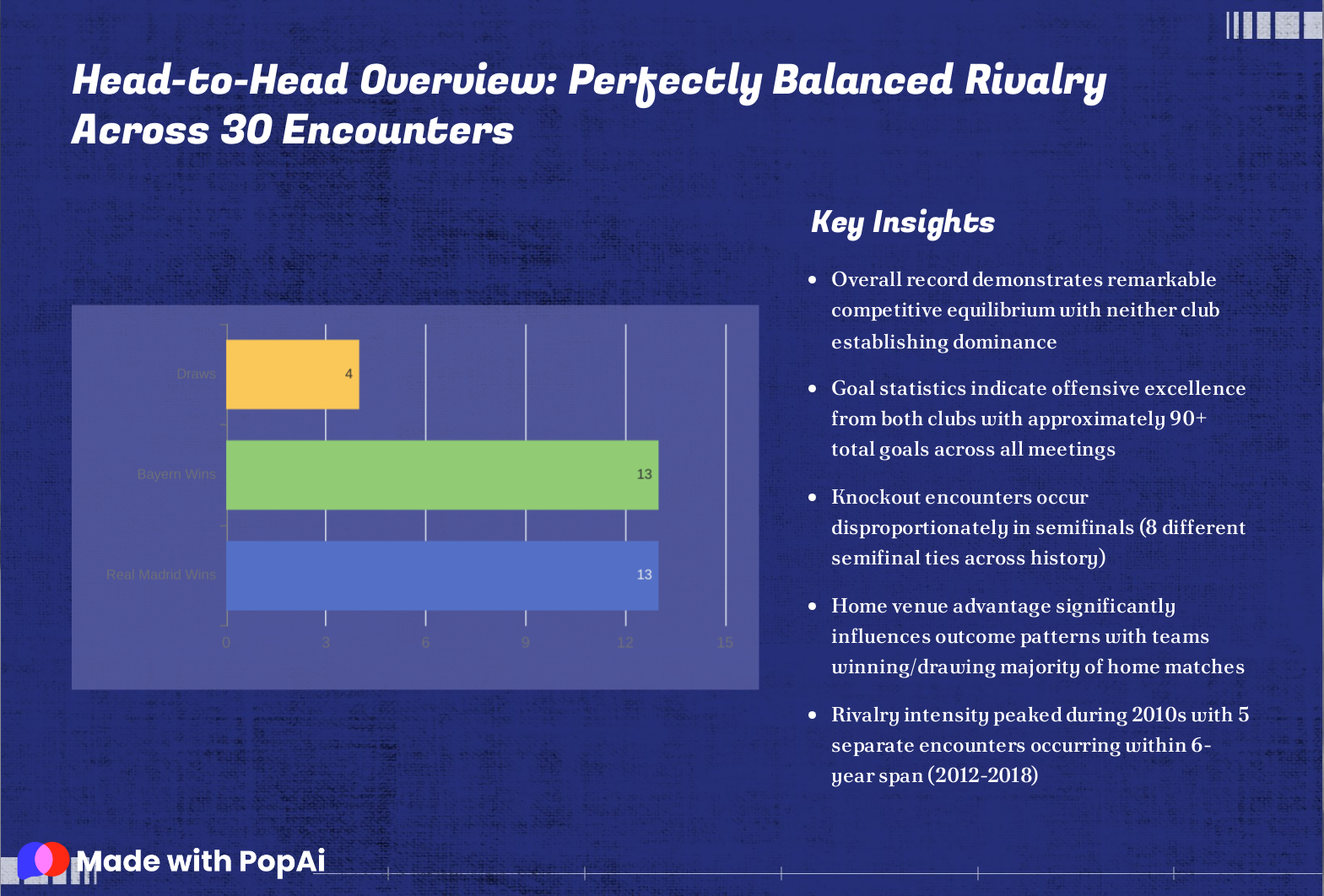
- Perfectly Balanced: 13 Real Madrid wins, 13 Bayern Munich wins, 4 draws across all meetings creating an evenly matched rivalry
- Never a Final: Despite both teams' frequent semifinal appearances, the two powerhouses have never contested a Champions League final
- Continuous Rivalry: Spanning from 1976 to present across multiple generational football eras, an enduring competition between titans
- Domestic Dominance: Combined 34 Bundesliga titles for Bayern and 36 La Liga titles for Real Madrid, elite continental competitors
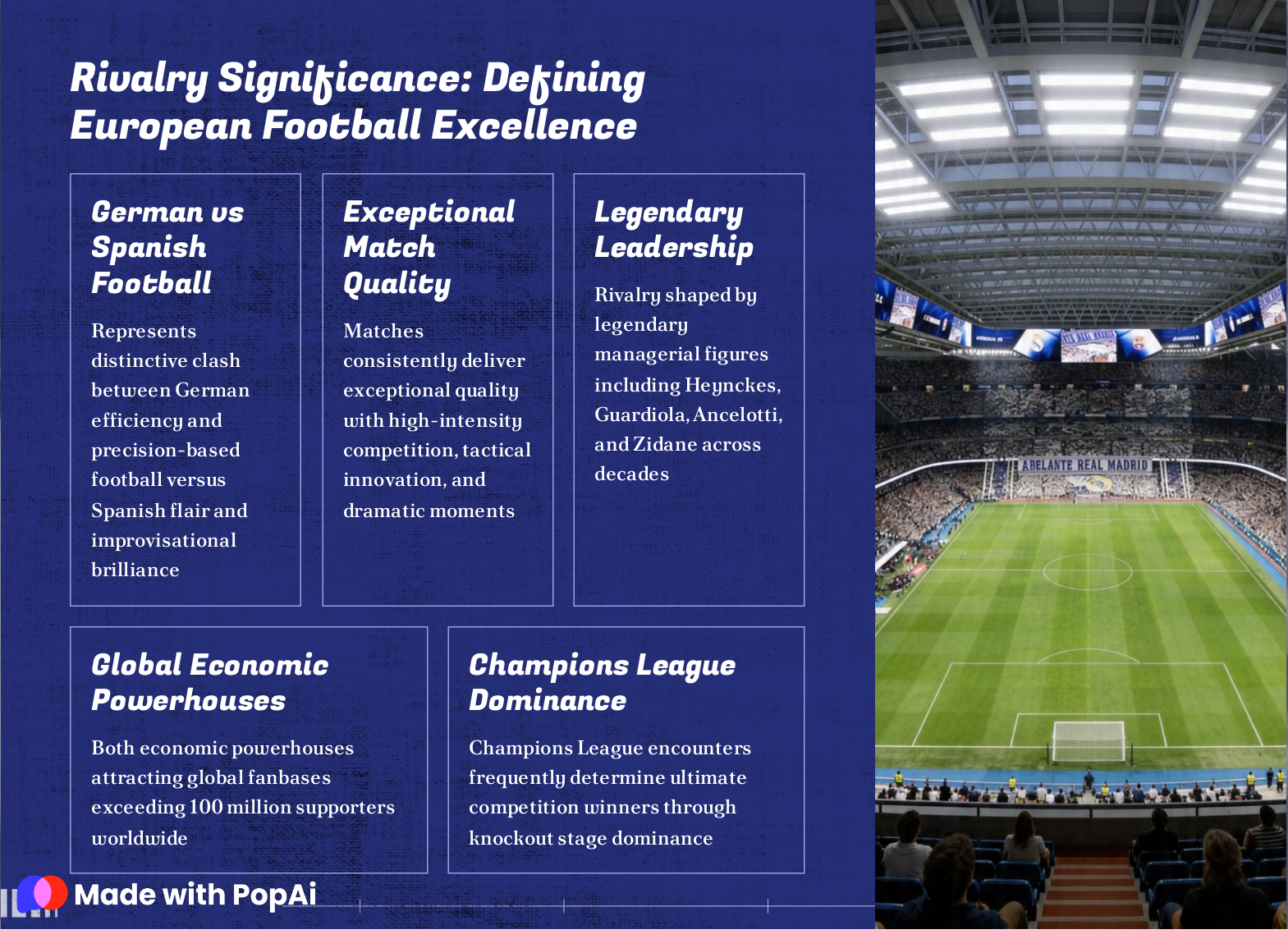
Slide 4: Rivalry Significance: Defining European Football Excellence
- German vs Spanish Football: Represents distinctive clash between German efficiency and precision-based football versus Spanish flair and improvisational brilliance
- Exceptional Match Quality: Matches consistently deliver exceptional quality with high-intensity competition, tactical innovation, and dramatic moments
- Legendary Leadership: Rivalry shaped by legendary managerial figures including Heynckes, Guardiola, Ancelotti, and Zidane across decades
- Global Economic Powerhouses: Both economic powerhouses attracting global fanbases exceeding 100 million supporters worldwide
- Champions League Dominance: Champions League encounters frequently determine ultimate competition winners through knockout stage dominance
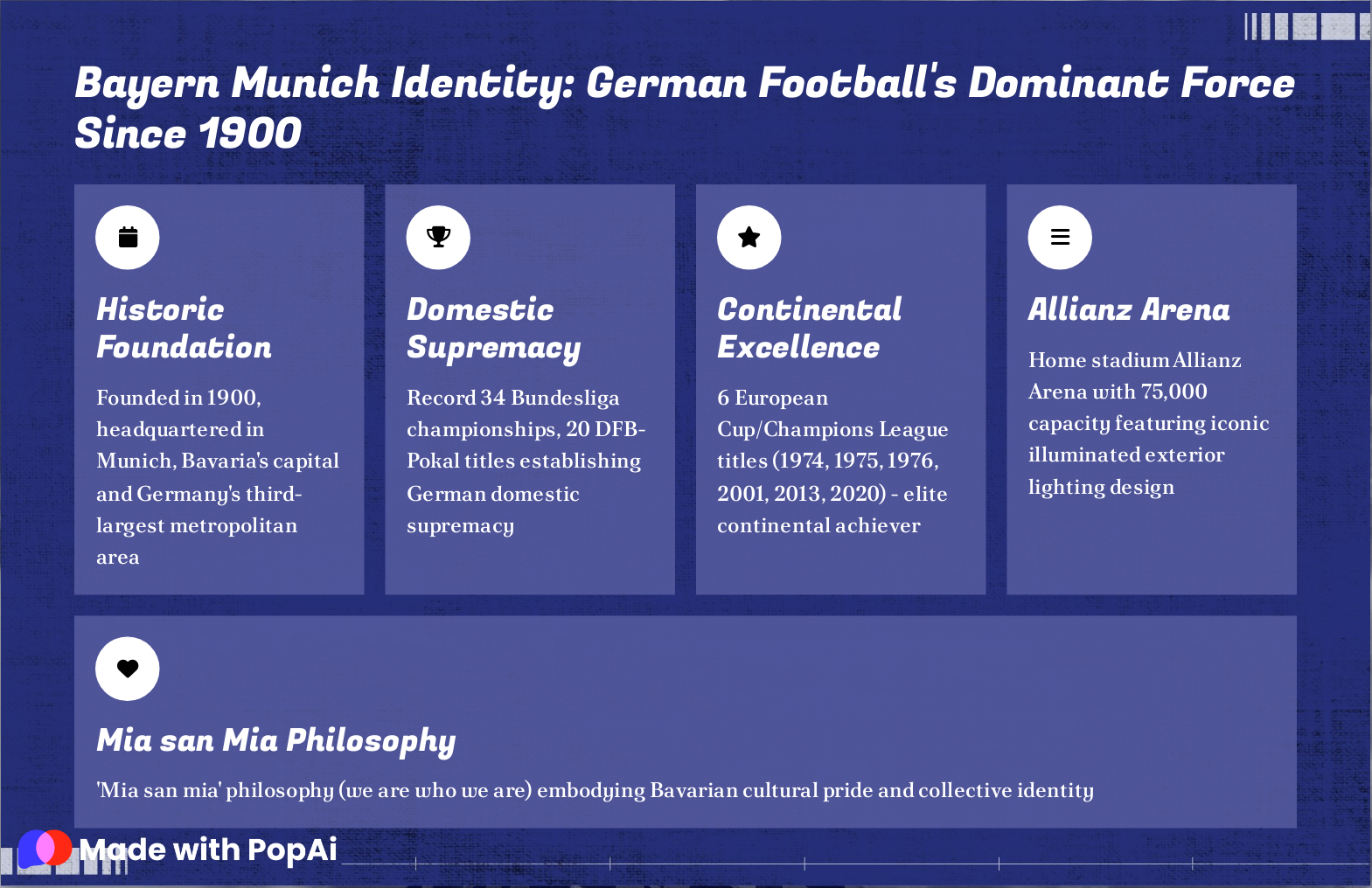
Slide 5: Bayern Munich Identity: German Football's Dominant Force Since 1900
- Historic Foundation: Founded in 1900, headquartered in Munich, Bavaria's capital and Germany's third-largest metropolitan area
- Domestic Supremacy: Record 34 Bundesliga championships, 20 DFB-Pokal titles establishing German domestic supremacy
- Continental Excellence: 6 European Cup/Champions League titles (1974, 1975, 1976, 2001, 2013, 2020) - elite continental achiever
- Allianz Arena: Home stadium Allianz Arena with 75,000 capacity featuring iconic illuminated exterior lighting design
- Mia san Mia Philosophy: 'Mia san mia' philosophy (we are who we are) embodying Bavarian cultural pride and collective identity
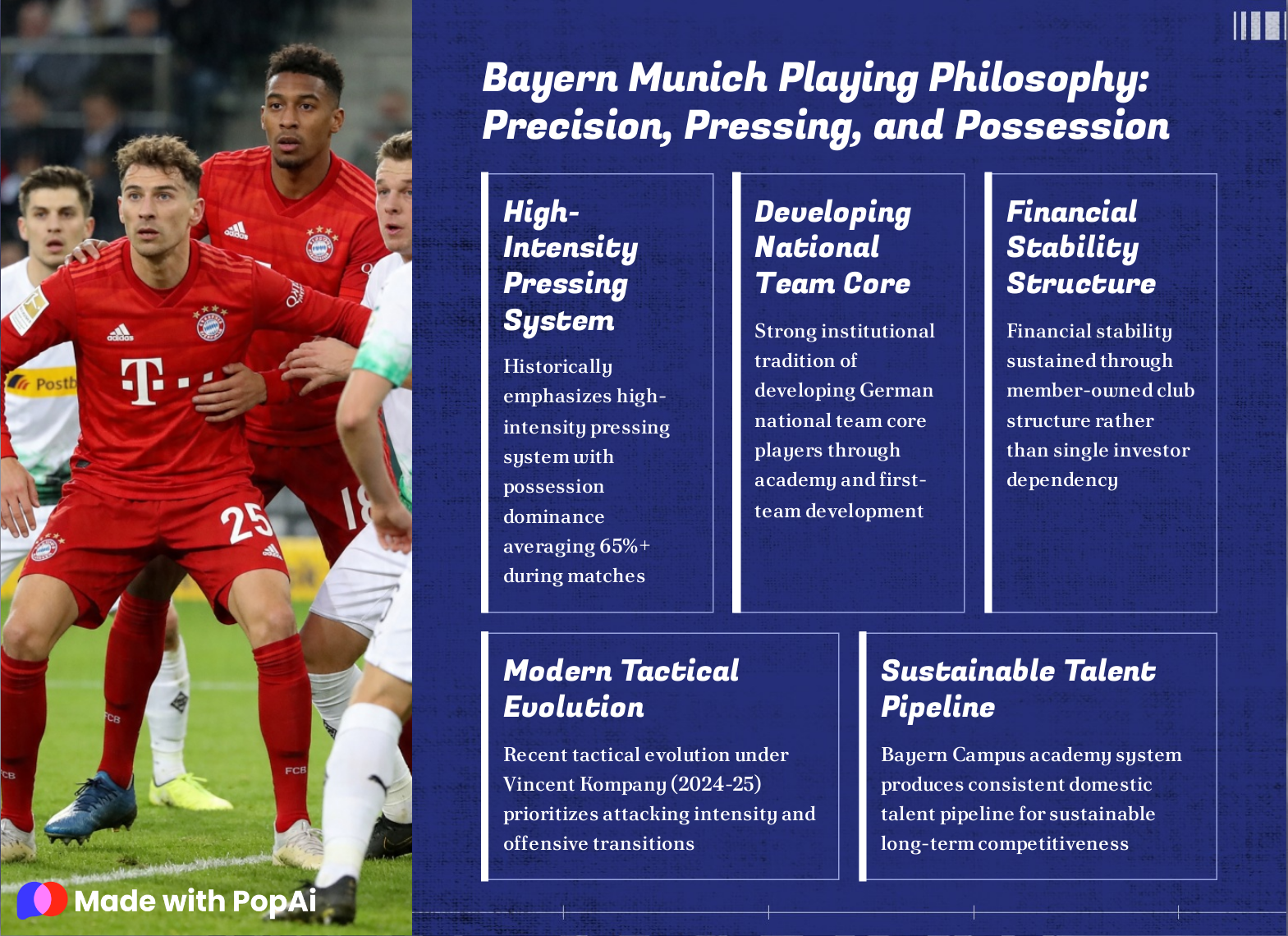
Slide 6: Bayern Munich Playing Philosophy: Precision, Pressing, and Possession
- High-Intensity Pressing System: Historically emphasizes high-intensity pressing system with possession dominance averaging 65%+ during matches
- Developing National Team Core: Strong institutional tradition of developing German national team core players through academy and first-team development
- Financial Stability Structure: Financial stability sustained through member-owned club structure rather than single investor dependency
- Modern Tactical Evolution: Recent tactical evolution under Vincent Kompany (2024-25) prioritizes attacking intensity and offensive transitions
- Sustainable Talent Pipeline: Bayern Campus academy system produces consistent domestic talent pipeline for sustainable long-term competitiveness
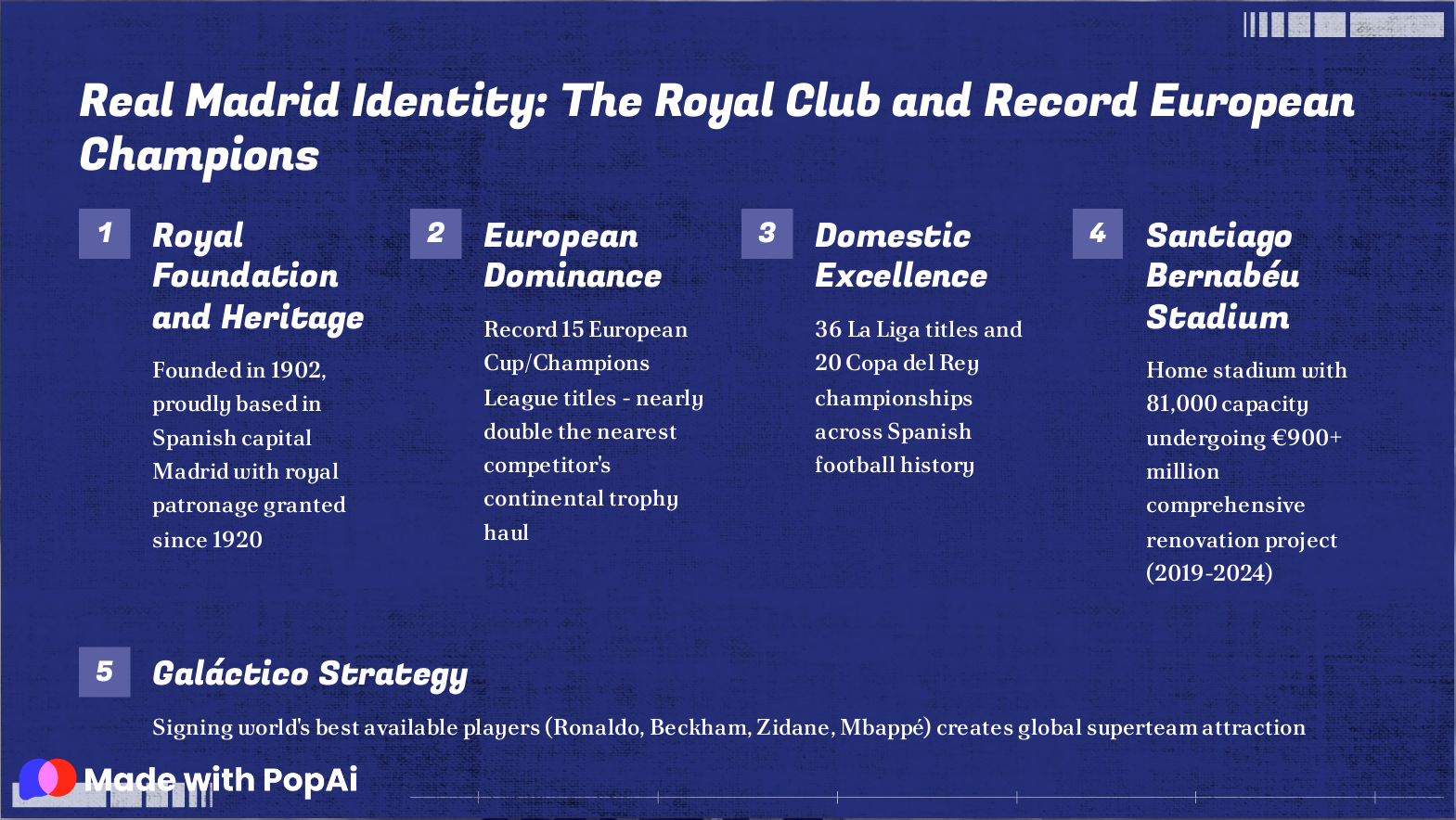
Slide 7: Real Madrid Identity: The Royal Club and Record European Champions
- Royal Foundation and Heritage: Founded in 1902, proudly based in Spanish capital Madrid with royal patronage granted since 1920
- European Dominance: Record 15 European Cup/Champions League titles - nearly double the nearest competitor's continental trophy haul
- Domestic Excellence: 36 La Liga titles and 20 Copa del Rey championships across Spanish football history
- Santiago Bernabéu Stadium: Home stadium with 81,000 capacity undergoing €900+ million comprehensive renovation project (2019-2024)
- Galáctico Strategy: Signing world's best available players (Ronaldo, Beckham, Zidane, Mbappé) creates global superteam attraction
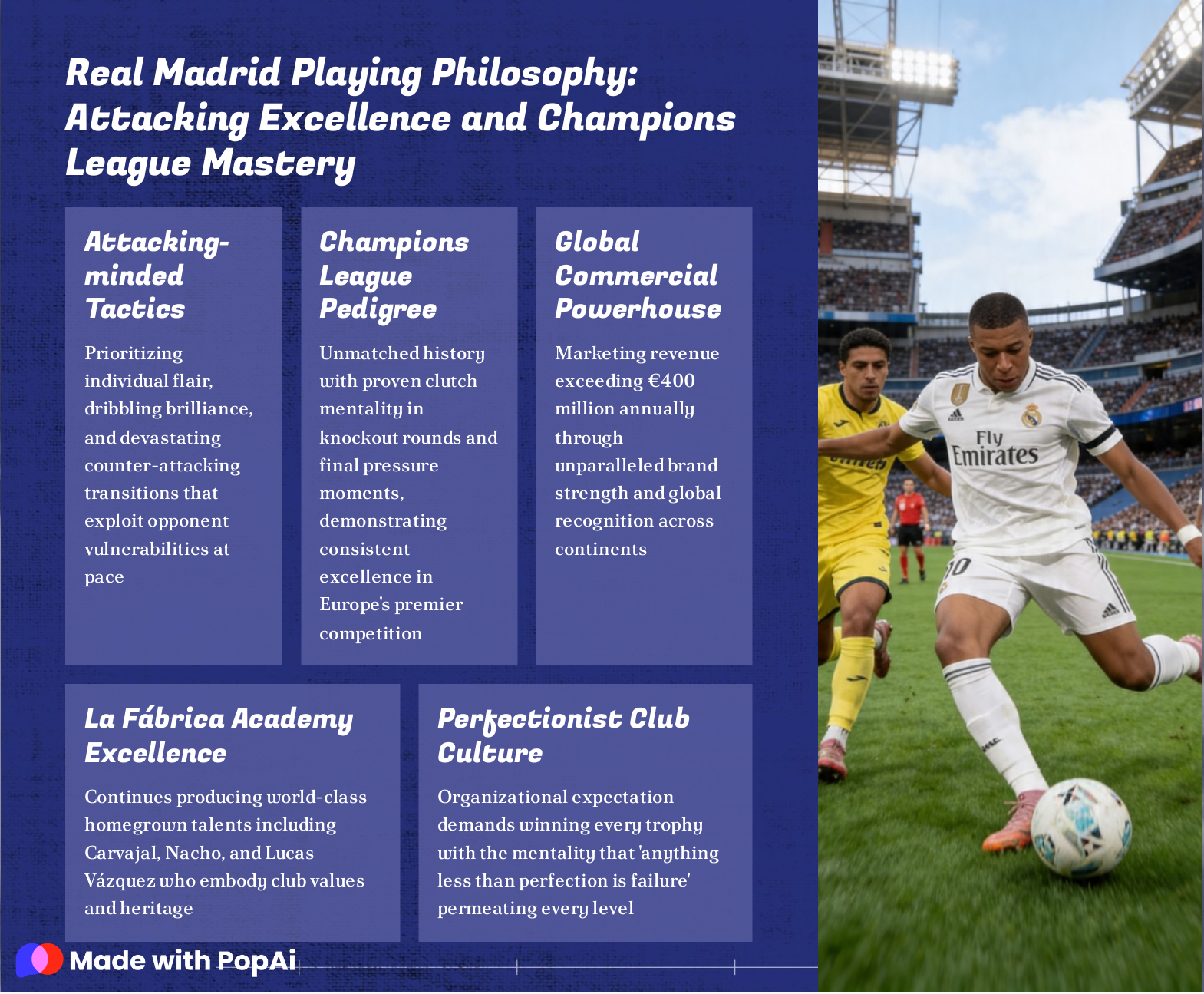
Slide 8: Real Madrid Playing Philosophy: Attacking Excellence and Champions League Mastery
- Attacking-minded Tactics: Prioritizing individual flair, dribbling brilliance, and devastating counter-attacking transitions that exploit opponent vulnerabilities at pace
- Champions League Pedigree: Unmatched history with proven clutch mentality in knockout rounds and final pressure moments, demonstrating consistent excellence in Europe's premier competition
- Global Commercial Powerhouse: Marketing revenue exceeding €400 million annually through unparalleled brand strength and global recognition across continents
- La Fábrica Academy Excellence: Continues producing world-class homegrown talents including Carvajal, Nacho, and Lucas Vázquez who embody club values and heritage
- Perfectionist Club Culture: Organizational expectation demands winning every trophy with the mentality that 'anything less than perfection is failure' permeating every level
Slide 9: Head-to-Head Overview: Perfectly Balanced Rivalry Across 30 Encounters
Overall record demonstrates remarkable competitive equilibrium with neither club establishing dominance
Goal statistics indicate offensive excellence from both clubs with approximately 90+ total goals across all meetings
Knockout encounters occur disproportionately in semifinals (8 different semifinal ties across history)
Home venue advantage significantly influences outcome patterns with teams winning/drawing majority of home matches
Rivalry intensity peaked during 2010s with 5 separate encounters occurring within 6-year span (2012-2018)
- Overall record demonstrates remarkable competitive equilibrium with neither club establishing dominance
- Goal statistics indicate offensive excellence from both clubs with approximately 90+ total goals across all meetings
- Knockout encounters occur disproportionately in semifinals (8 different semifinal ties across history)
- Home venue advantage significantly influences outcome patterns with teams winning/drawing majority of home matches
- Rivalry intensity peaked during 2010s with 5 separate encounters occurring within 6-year span (2012-2018)
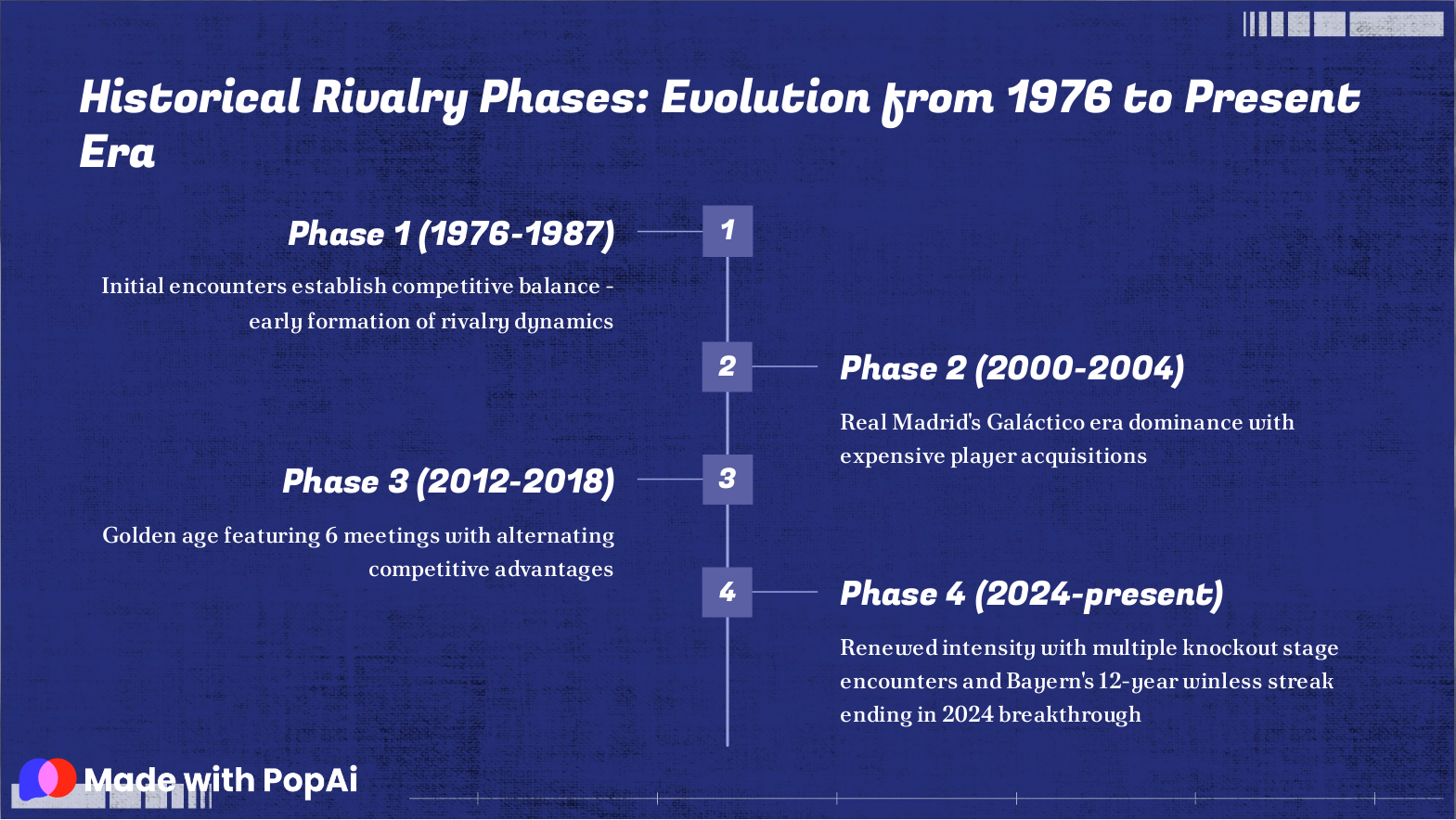
Slide 10: Historical Rivalry Phases: Evolution from 1976 to Present Era
- Phase 1 (1976-1987): Initial encounters establish competitive balance - early formation of rivalry dynamics
- Phase 2 (2000-2004): Real Madrid's Galáctico era dominance with expensive player acquisitions
- Phase 3 (2012-2018): Golden age featuring 6 meetings with alternating competitive advantages
- Phase 4 (2024-present): Renewed intensity with multiple knockout stage encounters and Bayern's 12-year winless streak ending in 2024 breakthrough
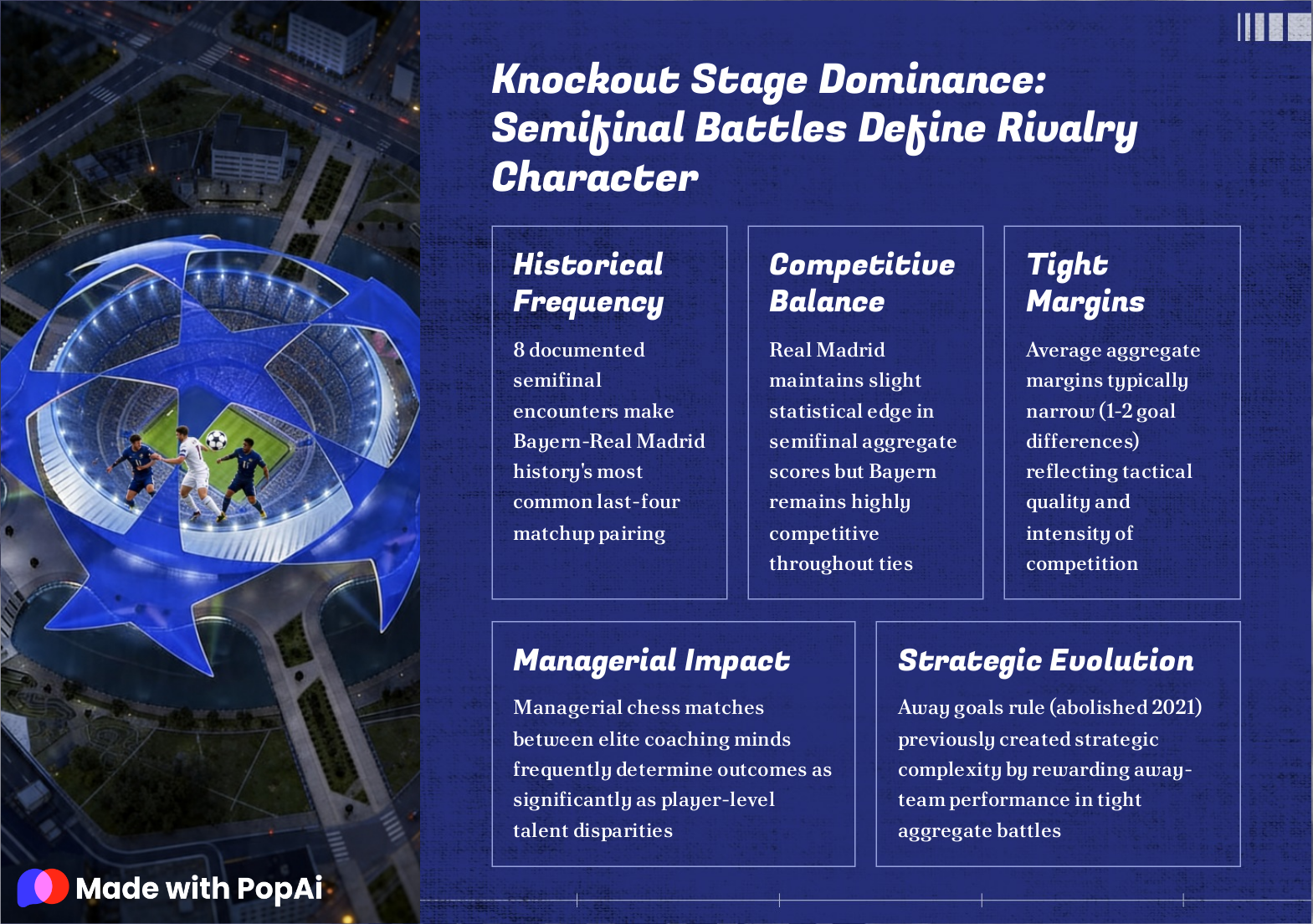
Slide 11: Knockout Stage Dominance: Semifinal Battles Define Rivalry Character
- Historical Frequency: 8 documented semifinal encounters make Bayern-Real Madrid history's most common last-four matchup pairing
- Competitive Balance: Real Madrid maintains slight statistical edge in semifinal aggregate scores but Bayern remains highly competitive throughout ties
- Tight Margins: Average aggregate margins typically narrow (1-2 goal differences) reflecting tactical quality and intensity of competition
- Managerial Impact: Managerial chess matches between elite coaching minds frequently determine outcomes as significantly as player-level talent disparities
- Strategic Evolution: Away goals rule (abolished 2021) previously created strategic complexity by rewarding away-team performance in tight aggregate battles
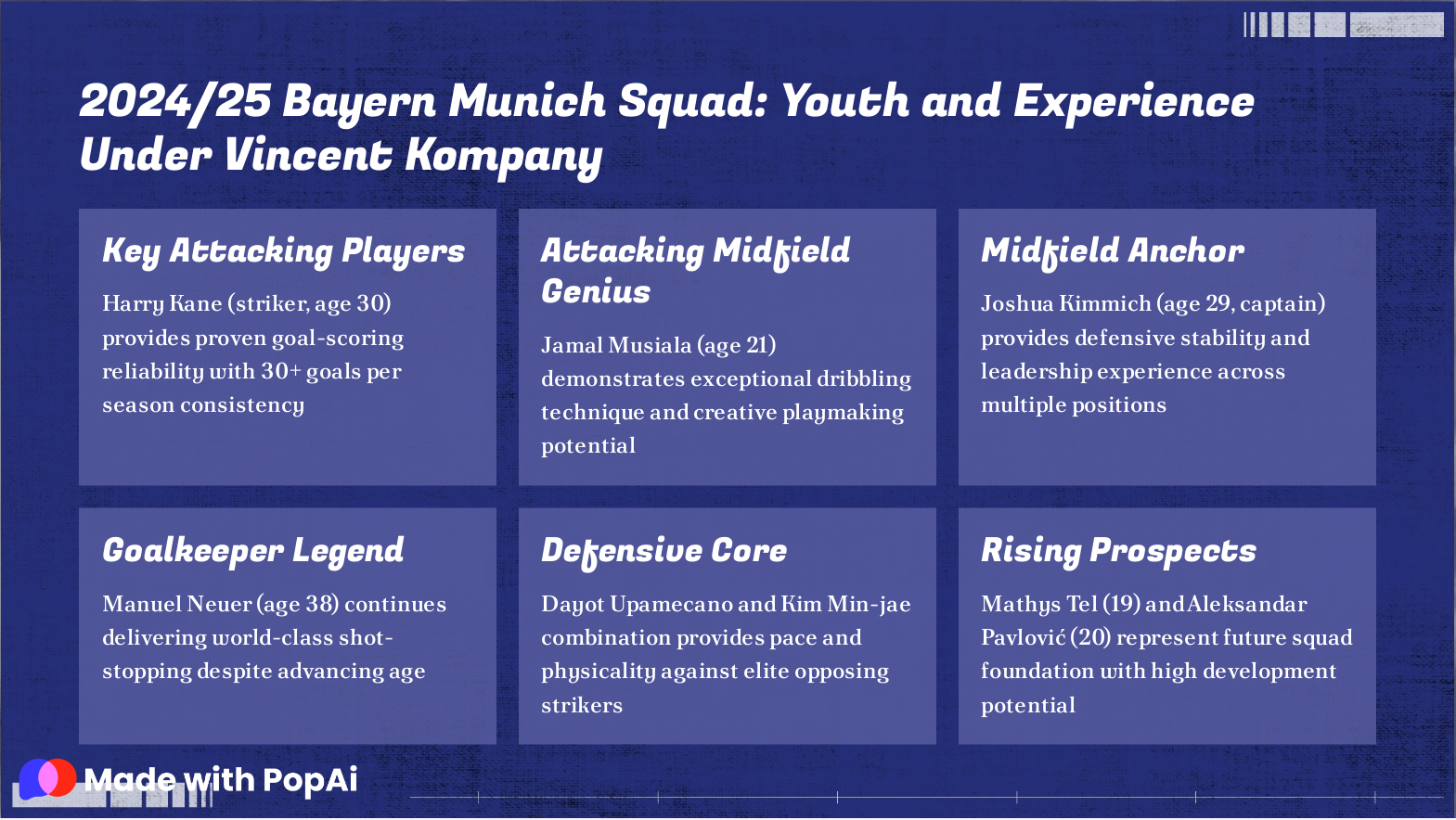
Slide 12: 2024/25 Bayern Munich Squad: Youth and Experience Under Vincent Kompany
- Key Attacking Players: Harry Kane (striker, age 30) provides proven goal-scoring reliability with 30+ goals per season consistency
- Attacking Midfield Genius: Jamal Musiala (age 21) demonstrates exceptional dribbling technique and creative playmaking potential
- Midfield Anchor: Joshua Kimmich (age 29, captain) provides defensive stability and leadership experience across multiple positions
- Goalkeeper Legend: Manuel Neuer (age 38) continues delivering world-class shot-stopping despite advancing age
- Defensive Core: Dayot Upamecano and Kim Min-jae combination provides pace and physicality against elite opposing strikers
- Rising Prospects: Mathys Tel (19) and Aleksandar Pavlović (20) represent future squad foundation with high development potential
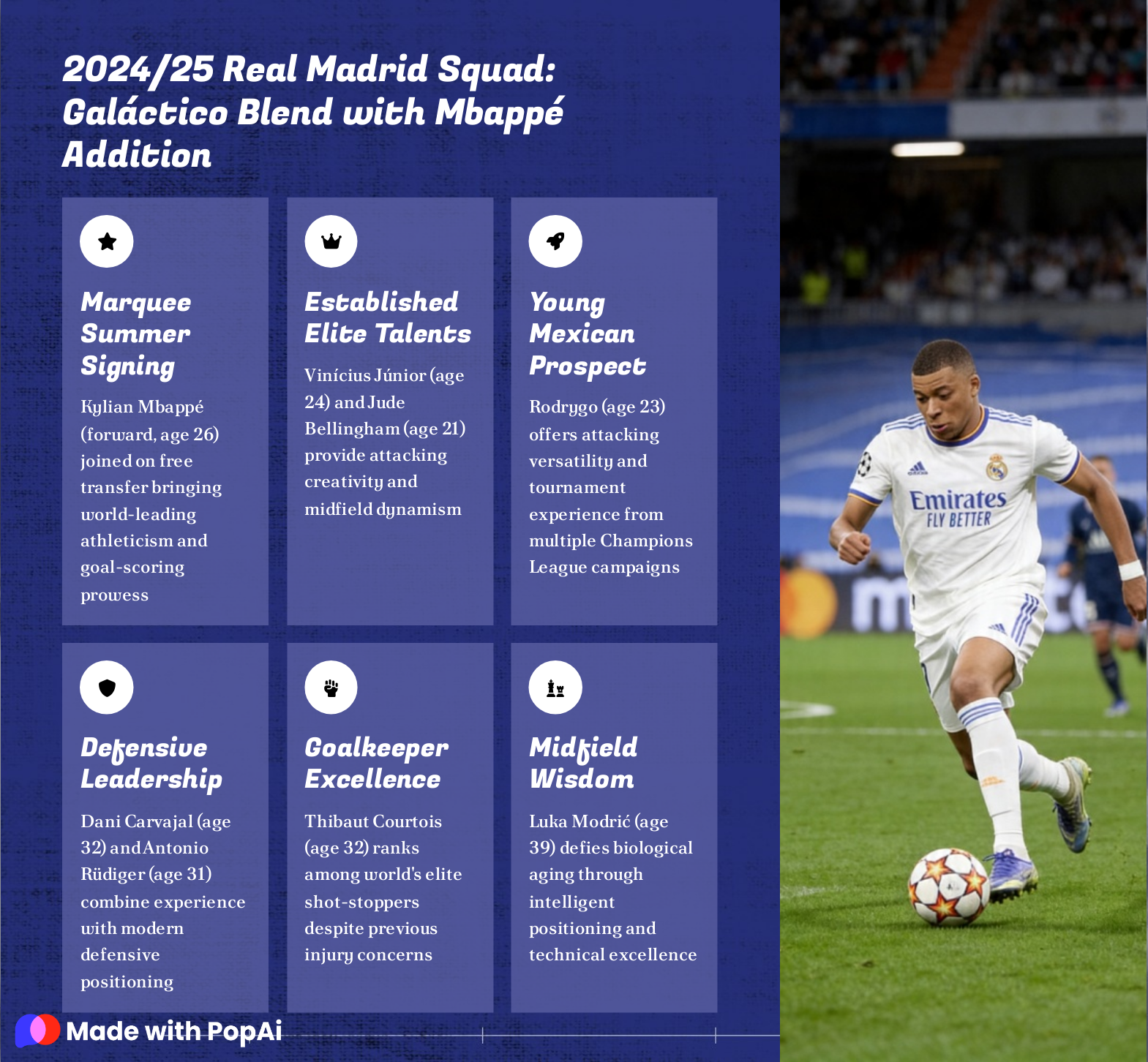
Slide 13: 2024/25 Real Madrid Squad: Galáctico Blend with Mbappé Addition
- Marquee Summer Signing: Kylian Mbappé (forward, age 26) joined on free transfer bringing world-leading athleticism and goal-scoring prowess
- Established Elite Talents: Vinícius Júnior (age 24) and Jude Bellingham (age 21) provide attacking creativity and midfield dynamism
- Young Mexican Prospect: Rodrygo (age 23) offers attacking versatility and tournament experience from multiple Champions League campaigns
- Defensive Leadership: Dani Carvajal (age 32) and Antonio Rüdiger (age 31) combine experience with modern defensive positioning
- Goalkeeper Excellence: Thibaut Courtois (age 32) ranks among world's elite shot-stoppers despite previous injury concerns
- Midfield Wisdom: Luka Modrić (age 39) defies biological aging through intelligent positioning and technical excellence
Slide 14: Player-by-Player Comparison: Tactical Advantages and Star Power Analysis
- Attacking Firepower Comparison: Harry Kane's consistent 30-goal seasons versus Mbappé's explosive athleticism combined with Vinícius Júnior's technical dribbling
- Midfield Creativity Differential: Jamal Musiala's exceptional dribbling quality against Jude Bellingham's complete box-to-box dominance and passing range
- Defensive Solidity Approaches: Bayern's aggressive high-pressing system contrasts with Real Madrid's compact defensive shape and devastating transition attacks
- Goalkeeper Experience Levels: Manuel Neuer's longevity and consistency versus Thibaut Courtois's acrobatic shot-stopping excellence during clutch moments
- Squad Depth Composition: Bayern demonstrates stronger German national team core integration while Real Madrid emphasizes global diversity across nationalities
Slide 15: The 9-1 Aggregate Clarification: Addressing Common Search Misconception
- No Verified Result: No verified 9-1 aggregate result exists between Bayern Munich and Real Madrid across competitive match history
- Potential Confusion Source: Potential confusion may stem from Real Madrid's 9-1 victory against Granada in separate La Liga match (2015)
- Search Pattern Origins: Search interest patterns suggest hypothetical scenario exploration or statistical data aggregation misinterpretations
- Largest Documented Margin: Largest documented aggregate margin: Real Madrid 6-3 victory over Bayern in 2017 quarterfinals representing their widest margin
- Historical Competitive Balance: Historical competitive balance and tactical equality render such lopsided scoring scenarios highly improbable given consistent rivalry pattern
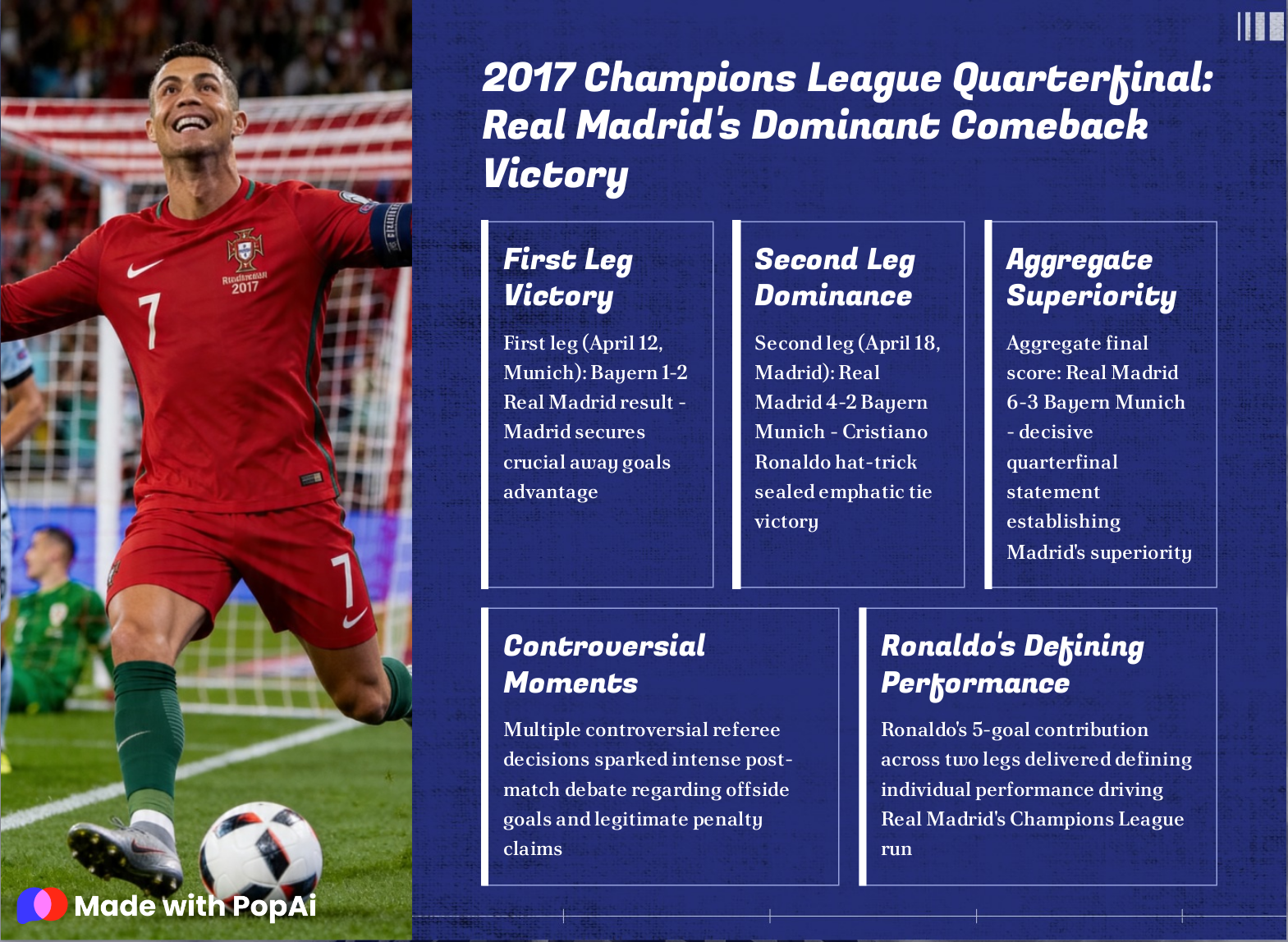
Slide 16: 2017 Champions League Quarterfinal: Real Madrid's Dominant Comeback Victory
- First Leg Victory: First leg (April 12, Munich): Bayern 1-2 Real Madrid result - Madrid secures crucial away goals advantage
- Second Leg Dominance: Second leg (April 18, Madrid): Real Madrid 4-2 Bayern Munich - Cristiano Ronaldo hat-trick sealed emphatic tie victory
- Aggregate Superiority: Aggregate final score: Real Madrid 6-3 Bayern Munich - decisive quarterfinal statement establishing Madrid's superiority
- Controversial Moments: Multiple controversial referee decisions sparked intense post-match debate regarding offside goals and legitimate penalty claims
- Ronaldo's Defining Performance: Ronaldo's 5-goal contribution across two legs delivered defining individual performance driving Real Madrid's Champions League run
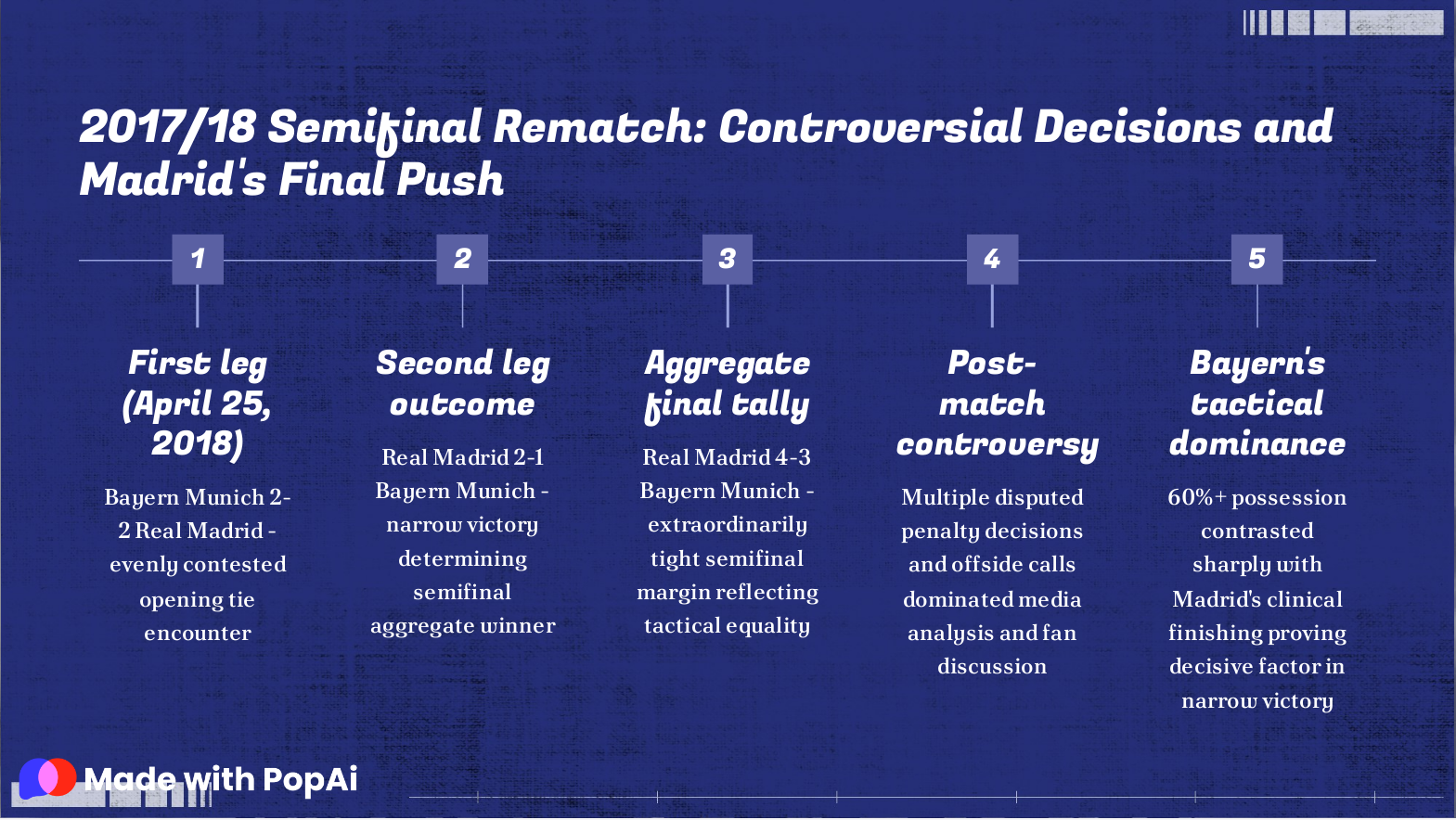
Slide 17: 2017/18 Semifinal Rematch: Controversial Decisions and Madrid's Final Push
- First leg (April 25, 2018): Bayern Munich 2-2 Real Madrid - evenly contested opening tie encounter
- Second leg outcome: Real Madrid 2-1 Bayern Munich - narrow victory determining semifinal aggregate winner
- Aggregate final tally: Real Madrid 4-3 Bayern Munich - extraordinarily tight semifinal margin reflecting tactical equality
- Post-match controversy: Multiple disputed penalty decisions and offside calls dominated media analysis and fan discussion
- Bayern's tactical dominance: 60%+ possession contrasted sharply with Madrid's clinical finishing proving decisive factor in narrow victory
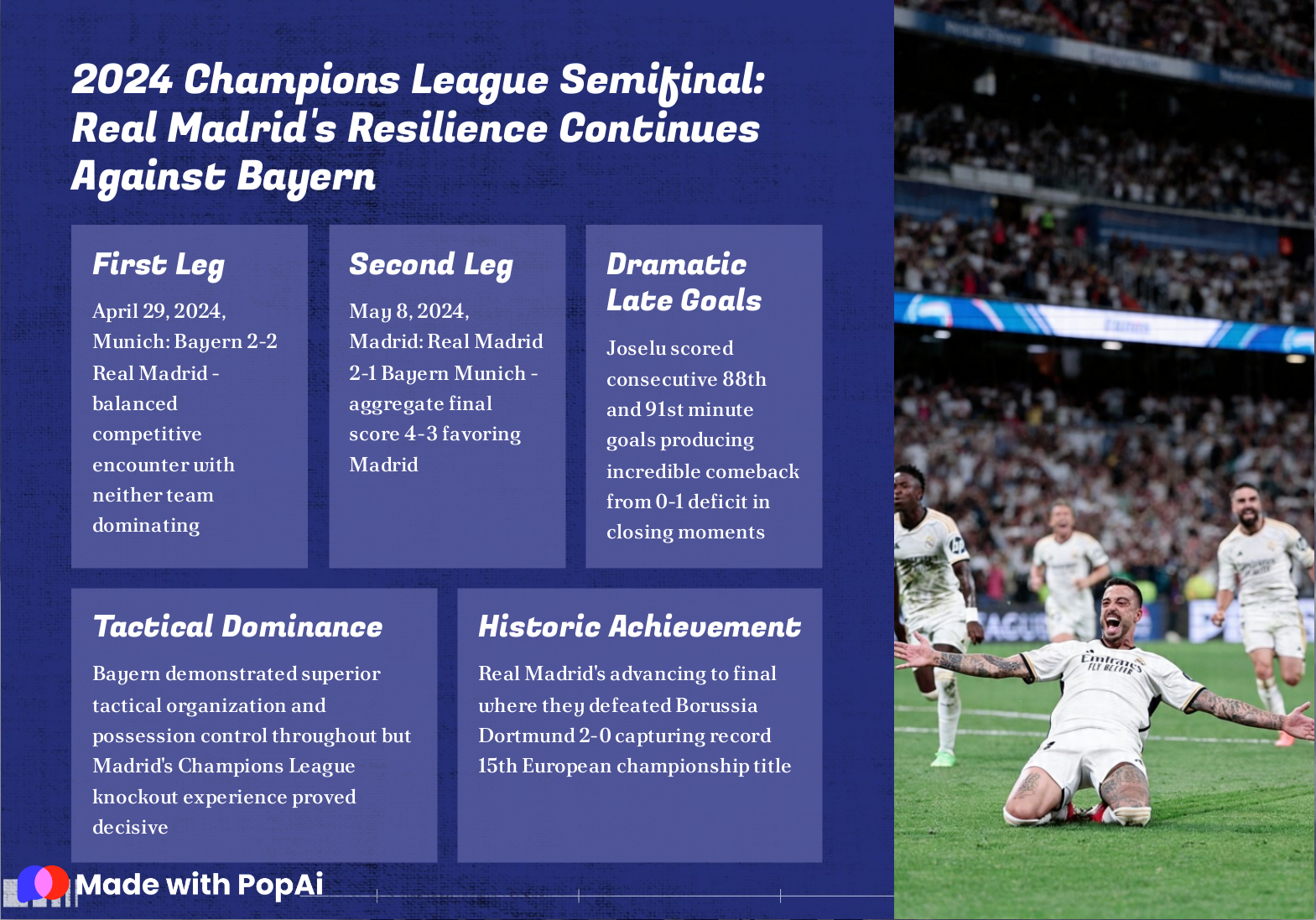
Slide 18: 2024 Champions League Semifinal: Real Madrid's Resilience Continues Against Bayern
- First Leg: April 29, 2024, Munich: Bayern 2-2 Real Madrid - balanced competitive encounter with neither team dominating
- Second Leg: May 8, 2024, Madrid: Real Madrid 2-1 Bayern Munich - aggregate final score 4-3 favoring Madrid
- Dramatic Late Goals: Joselu scored consecutive 88th and 91st minute goals producing incredible comeback from 0-1 deficit in closing moments
- Tactical Dominance: Bayern demonstrated superior tactical organization and possession control throughout but Madrid's Champions League knockout experience proved decisive
- Historic Achievement: Real Madrid's advancing to final where they defeated Borussia Dortmund 2-0 capturing record 15th European championship title
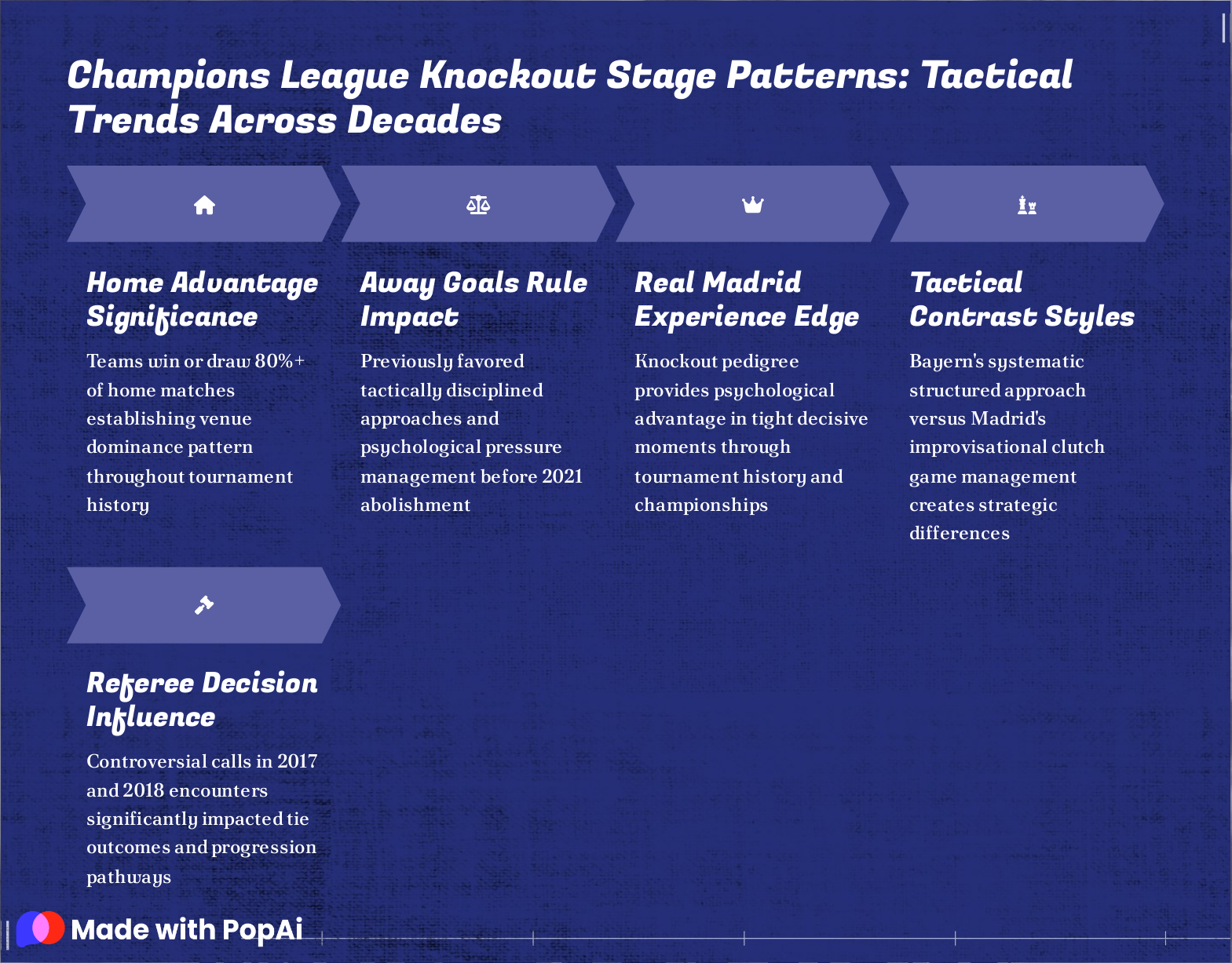
Slide 19: Champions League Knockout Stage Patterns: Tactical Trends Across Decades
- Home Advantage Significance: Teams win or draw 80%+ of home matches establishing venue dominance pattern throughout tournament history
- Away Goals Rule Impact: Previously favored tactically disciplined approaches and psychological pressure management before 2021 abolishment
- Real Madrid Experience Edge: Knockout pedigree provides psychological advantage in tight decisive moments through tournament history and championships
- Tactical Contrast Styles: Bayern's systematic structured approach versus Madrid's improvisational clutch game management creates strategic differences
- Referee Decision Influence: Controversial calls in 2017 and 2018 encounters significantly impacted tie outcomes and progression pathways
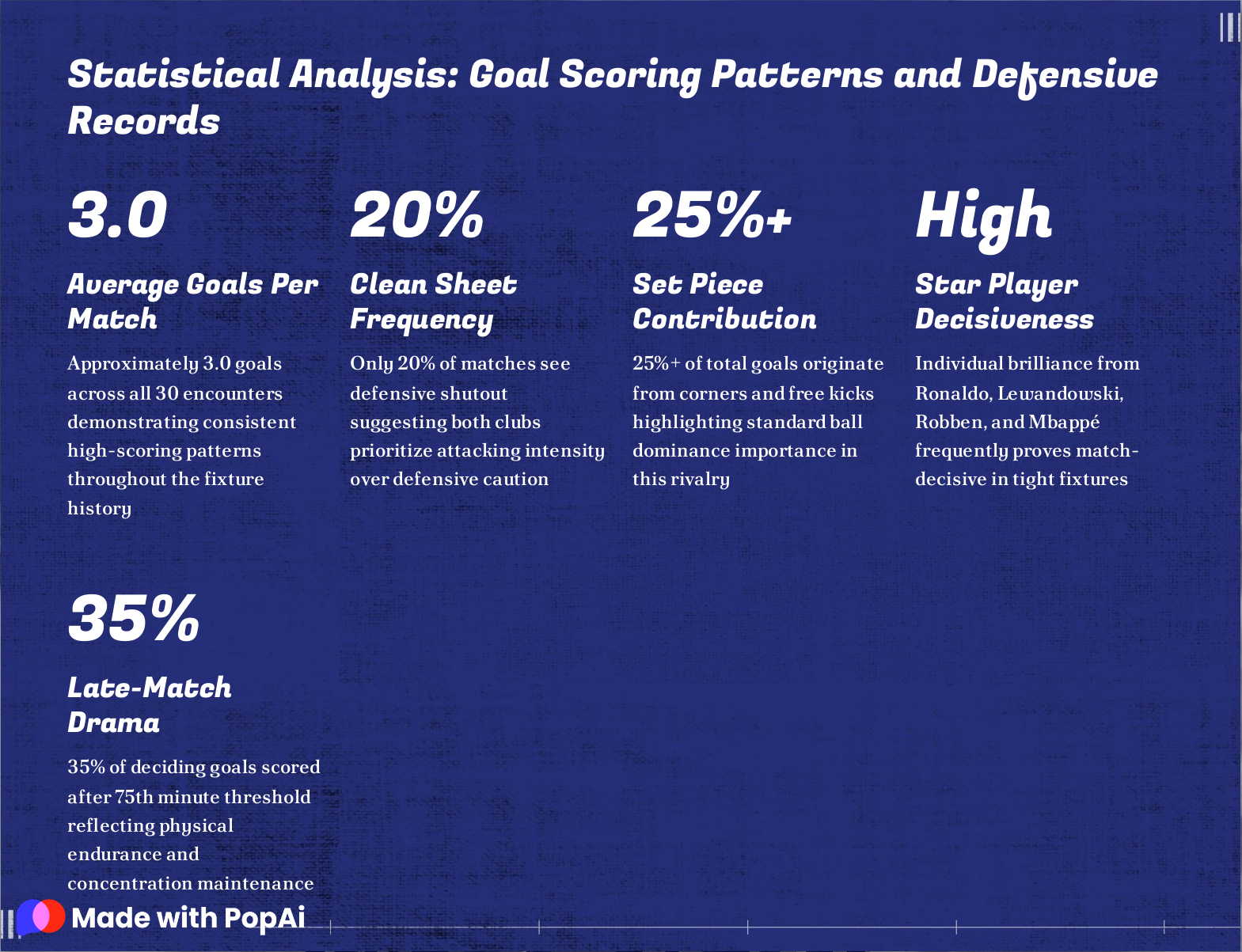
Slide 20: Statistical Analysis: Goal Scoring Patterns and Defensive Records
- 3.0 — Average Goals Per Match
- 20% — Clean Sheet Frequency
- 25%+ — Set Piece Contribution
- High — Star Player Decisiveness
- 35% — Late-Match Drama
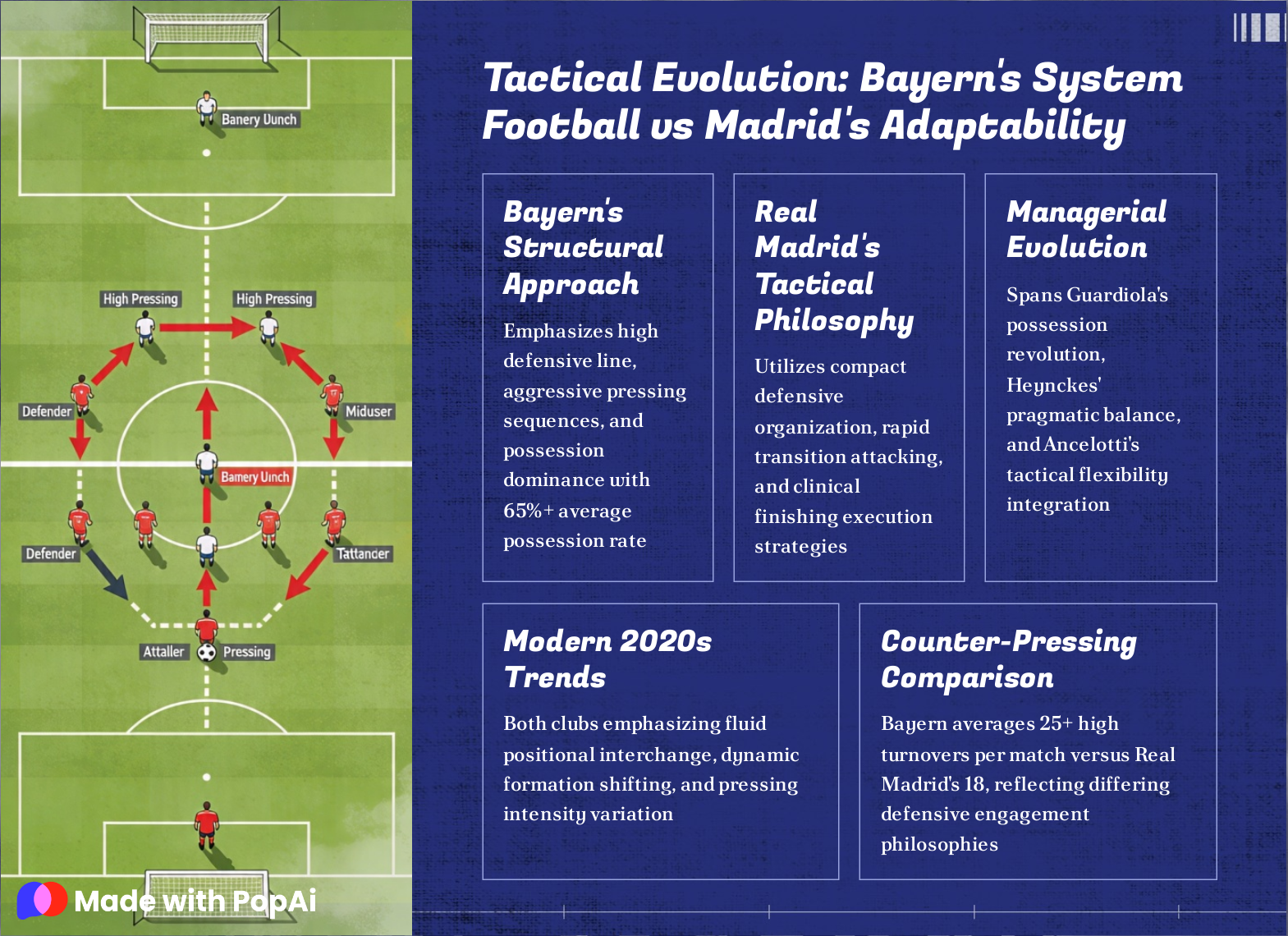
Slide 21: Tactical Evolution: Bayern's System Football vs Madrid's Adaptability
- Bayern's Structural Approach: Emphasizes high defensive line, aggressive pressing sequences, and possession dominance with 65%+ average possession rate
- Real Madrid's Tactical Philosophy: Utilizes compact defensive organization, rapid transition attacking, and clinical finishing execution strategies
- Managerial Evolution: Spans Guardiola's possession revolution, Heynckes' pragmatic balance, and Ancelotti's tactical flexibility integration
- Modern 2020s Trends: Both clubs emphasizing fluid positional interchange, dynamic formation shifting, and pressing intensity variation
- Counter-Pressing Comparison: Bayern averages 25+ high turnovers per match versus Real Madrid's 18, reflecting differing defensive engagement philosophies
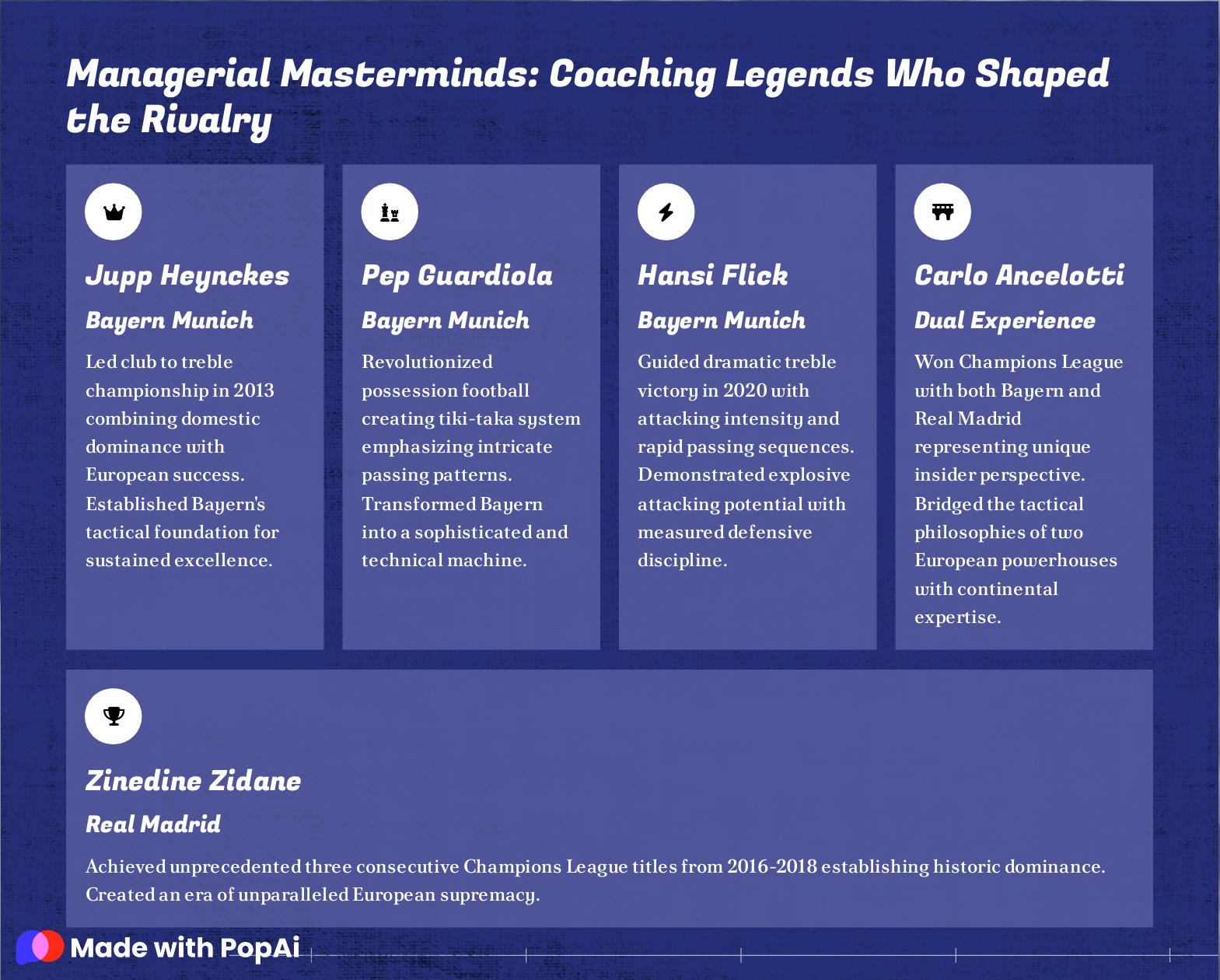
Slide 22: Managerial Masterminds: Coaching Legends Who Shaped the Rivalry
- Jupp Heynckes: Led club to treble championship in 2013 combining domestic dominance with European success. Established Bayern's tactical foundation for sustained excellence.
- Pep Guardiola: Revolutionized possession football creating tiki-taka system emphasizing intricate passing patterns. Transformed Bayern into a sophisticated and technical machine.
- Hansi Flick: Guided dramatic treble victory in 2020 with attacking intensity and rapid passing sequences. Demonstrated explosive attacking potential with measured defensive discipline.
- Carlo Ancelotti: Won Champions League with both Bayern and Real Madrid representing unique insider perspective. Bridged the tactical philosophies of two European powerhouses with continental expertise.
- Zinedine Zidane: Achieved unprecedented three consecutive Champions League titles from 2016-2018 establishing historic dominance. Created an era of unparalleled European supremacy.
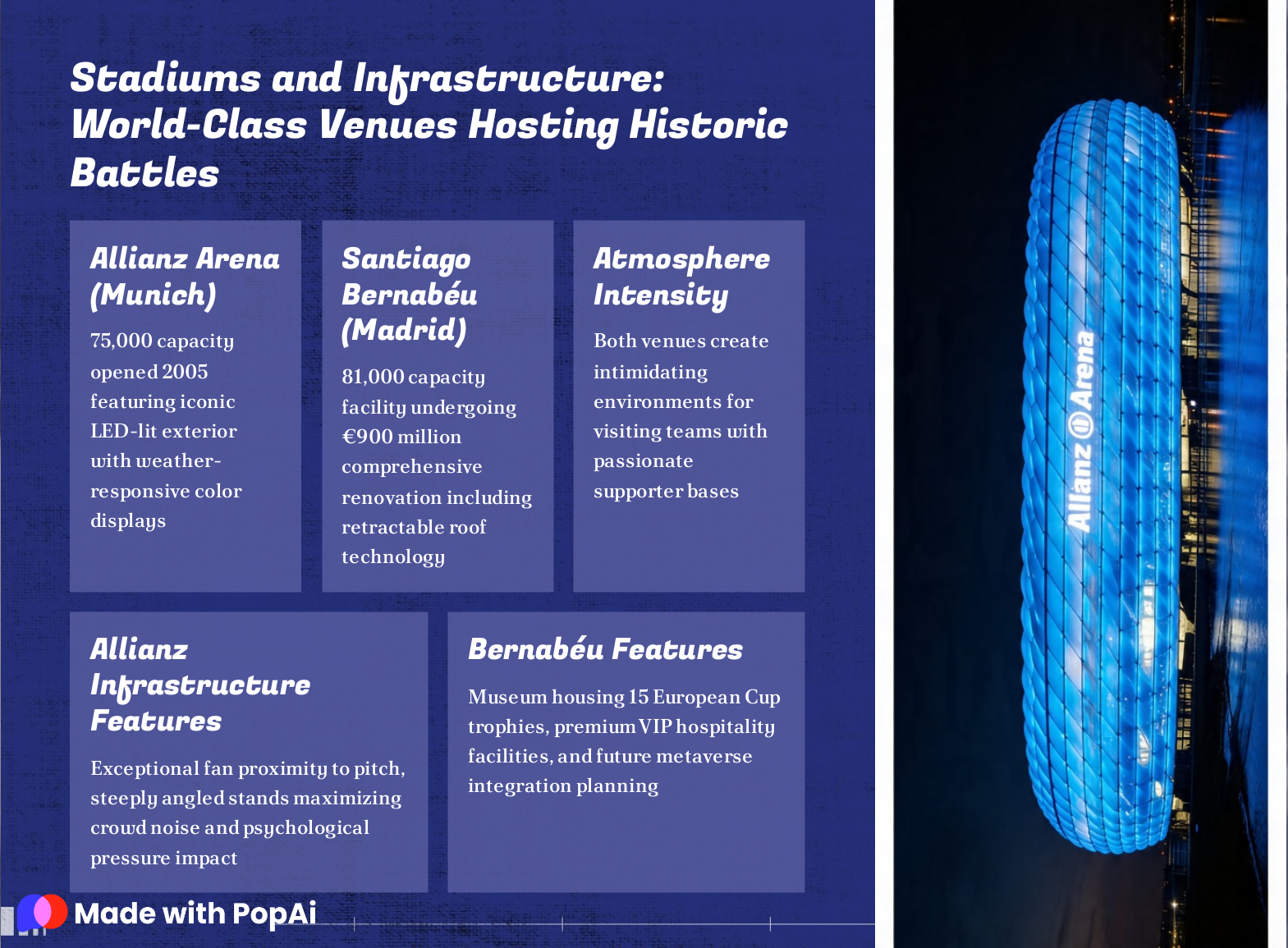
Slide 23: Stadiums and Infrastructure: World-Class Venues Hosting Historic Battles
- Allianz Arena (Munich): 75,000 capacity opened 2005 featuring iconic LED-lit exterior with weather-responsive color displays
- Santiago Bernabéu (Madrid): 81,000 capacity facility undergoing €900 million comprehensive renovation including retractable roof technology
- Atmosphere Intensity: Both venues create intimidating environments for visiting teams with passionate supporter bases
- Allianz Infrastructure Features: Exceptional fan proximity to pitch, steeply angled stands maximizing crowd noise and psychological pressure impact
- Bernabéu Features: Museum housing 15 European Cup trophies, premium VIP hospitality facilities, and future metaverse integration planning
Slide 24: Conclusion: Europe's Premier Rivalry Continues to Define Champions League Excellence
1. Perfect Balance: 30 matches with perfectly balanced record demonstrate genuine competitive equality between clubs 2. European Excellence: Both organizations represent pinnacle European football excellence across seven consecutive football generations 3. Future Encounters: Future encounters remain highly probable given sustained Champions League presence and competitive quality of both institutions 4. Cultural Impact: Rivalry transcends individual match results to influence tactical innovation, transfer market activity, and global football culture evolution 5. 2024/25 Season: The 2024/25 season may produce a 31st meeting with competitive balance suggesting continued drama and quality entertainment