Presentation Summary
A deep dive into the 2026 Iran War, exploring the military escalation, geopolitical consequences, and regional transformation resulting from the US-Israeli campaign.
Full Presentation Transcript
Slide 1: The 2026 Iran War: A Comprehensive Analysis of Military Escalation, Geopolitical Consequences, and Regional Transformation
Understanding the Unprecedented US-Israeli Military Campaign, Regional Escalation, and Strategic Implications
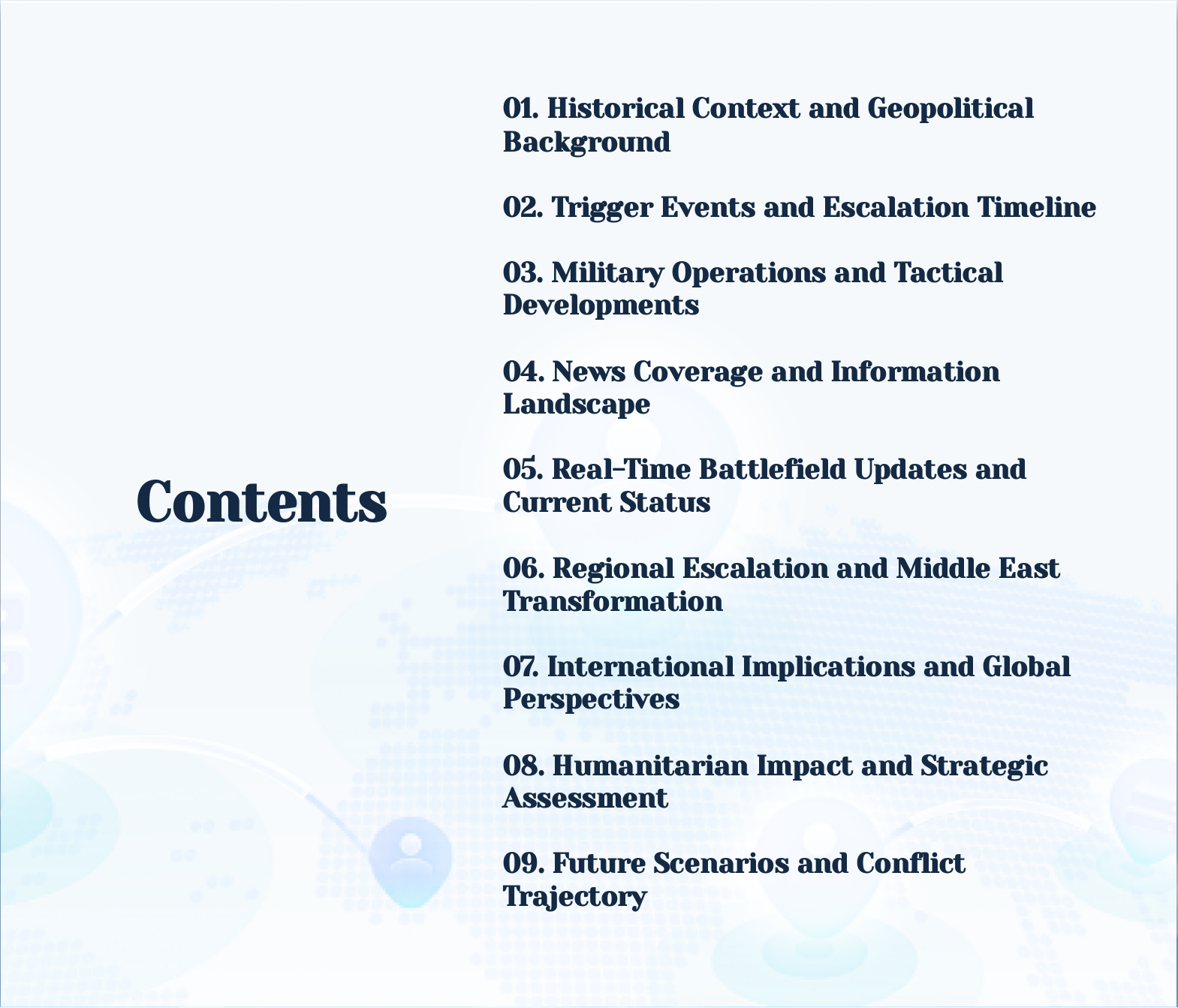
Slide 2: Contents
- Historical Context and Geopolitical Background
- Trigger Events and Escalation Timeline
- Military Operations and Tactical Developments
- News Coverage and Information Landscape
- Real-Time Battlefield Updates and Current Status
- Regional Escalation and Middle East Transformation
- International Implications and Global Perspectives
- Humanitarian Impact and Strategic Assessment
- Future Scenarios and Conflict Trajectory
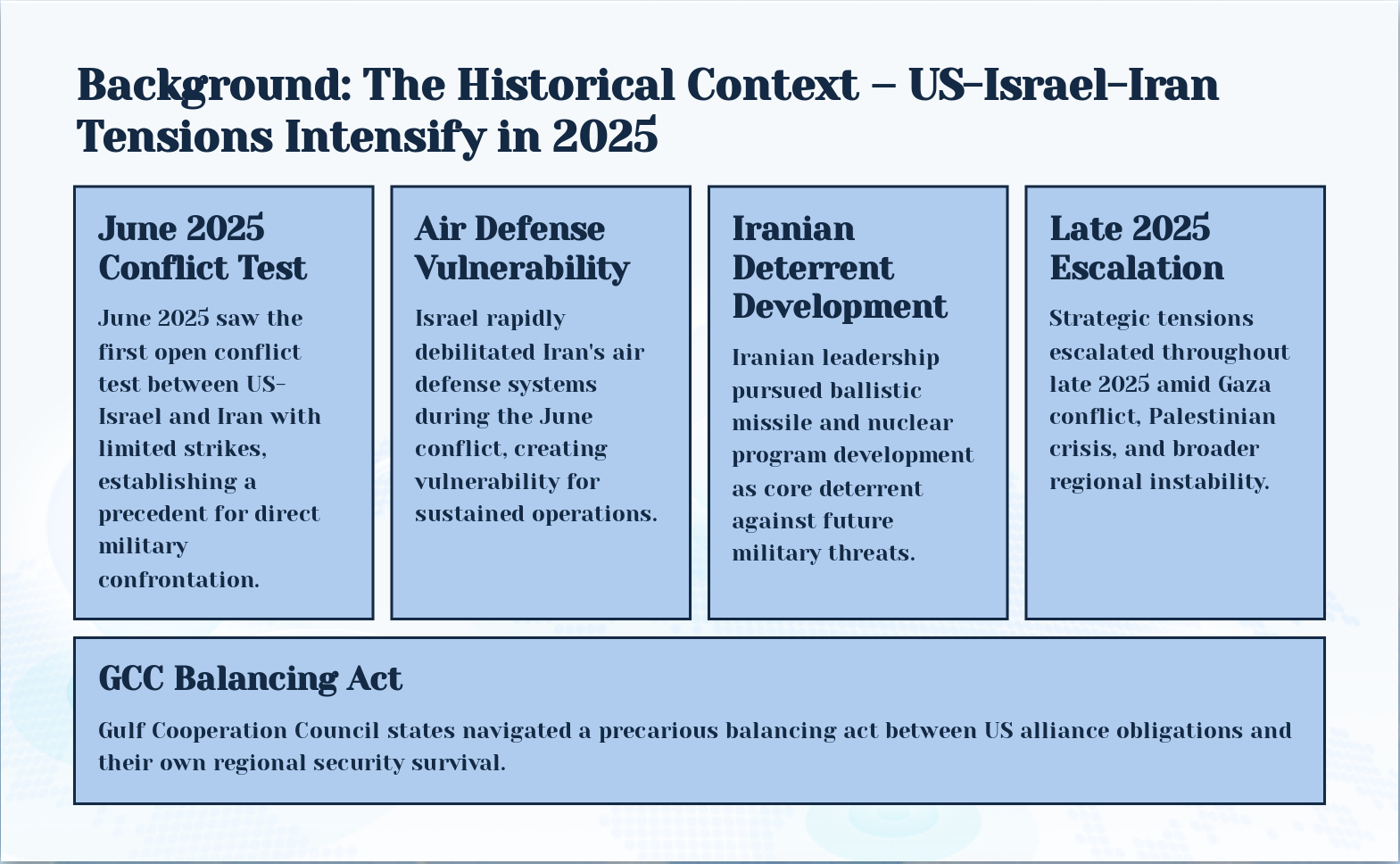
Slide 3: Background: The Historical Context – US-Israel-Iran Tensions Intensify in 2025
- June 2025 Conflict Test: June 2025 saw the first open conflict test between US-Israel and Iran with limited strikes, establishing a precedent for direct military confrontation.
- Air Defense Vulnerability: Israel rapidly debilitated Iran's air defense systems during the June conflict, creating vulnerability for sustained operations.
- Iranian Deterrent Development: Iranian leadership pursued ballistic missile and nuclear program development as core deterrent against future military threats.
- Late 2025 Escalation: Strategic tensions escalated throughout late 2025 amid Gaza conflict, Palestinian crisis, and broader regional instability.
- GCC Balancing Act: Gulf Cooperation Council states navigated a precarious balancing act between US alliance obligations and their own regional security survival.
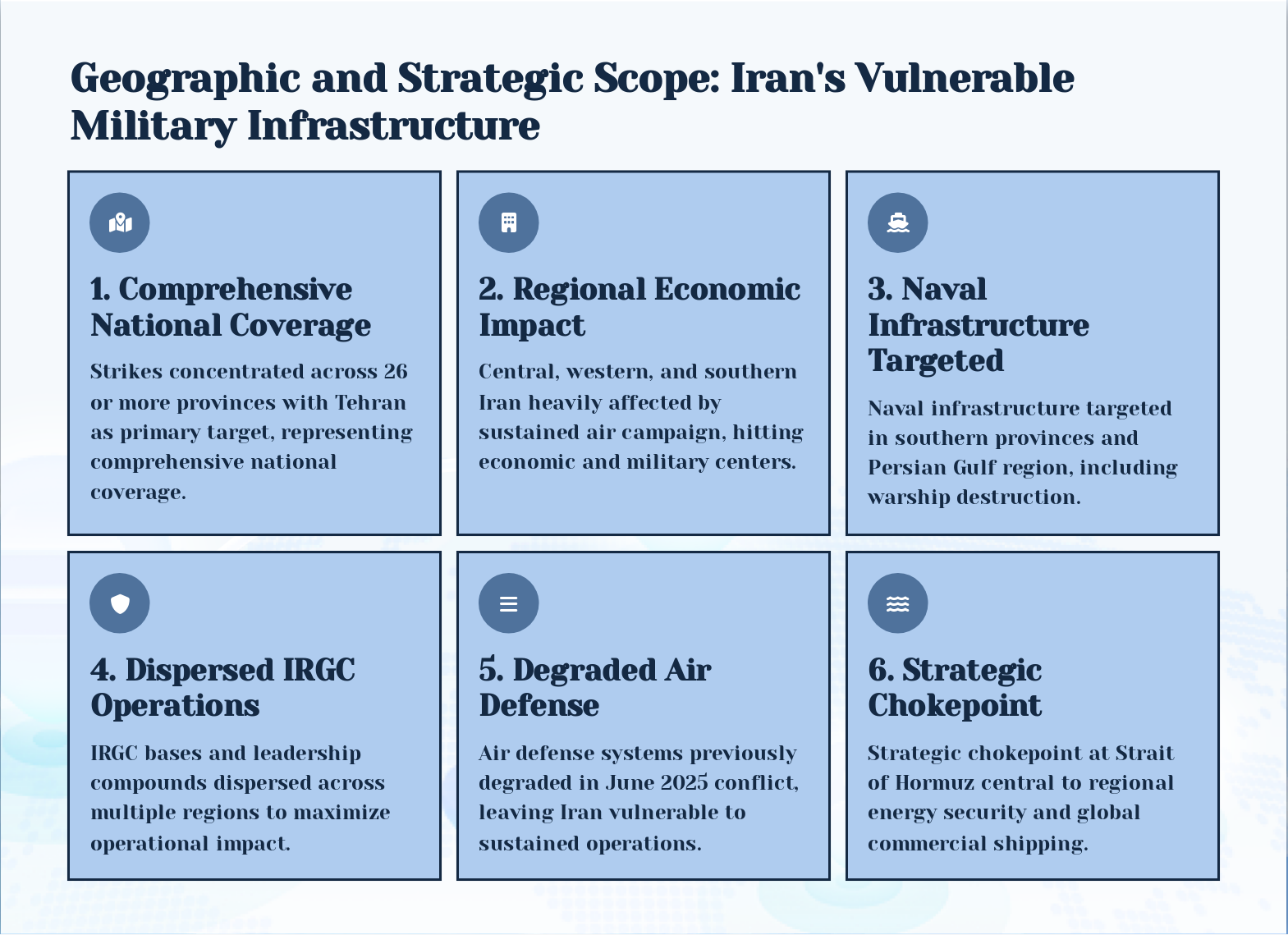
Slide 4: Geographic and Strategic Scope: Iran's Vulnerable Military Infrastructure
- Comprehensive National Coverage: Strikes concentrated across 26 or more provinces with Tehran as primary target, representing comprehensive national coverage.
- Regional Economic Impact: Central, western, and southern Iran heavily affected by sustained air campaign, hitting economic and military centers.
- Naval Infrastructure Targeted: Naval infrastructure targeted in southern provinces and Persian Gulf region, including warship destruction.
- Dispersed IRGC Operations: IRGC bases and leadership compounds dispersed across multiple regions to maximize operational impact.
- Degraded Air Defense: Air defense systems previously degraded in June 2025 conflict, leaving Iran vulnerable to sustained operations.
- Strategic Chokepoint: Strategic chokepoint at Strait of Hormuz central to regional energy security and global commercial shipping.
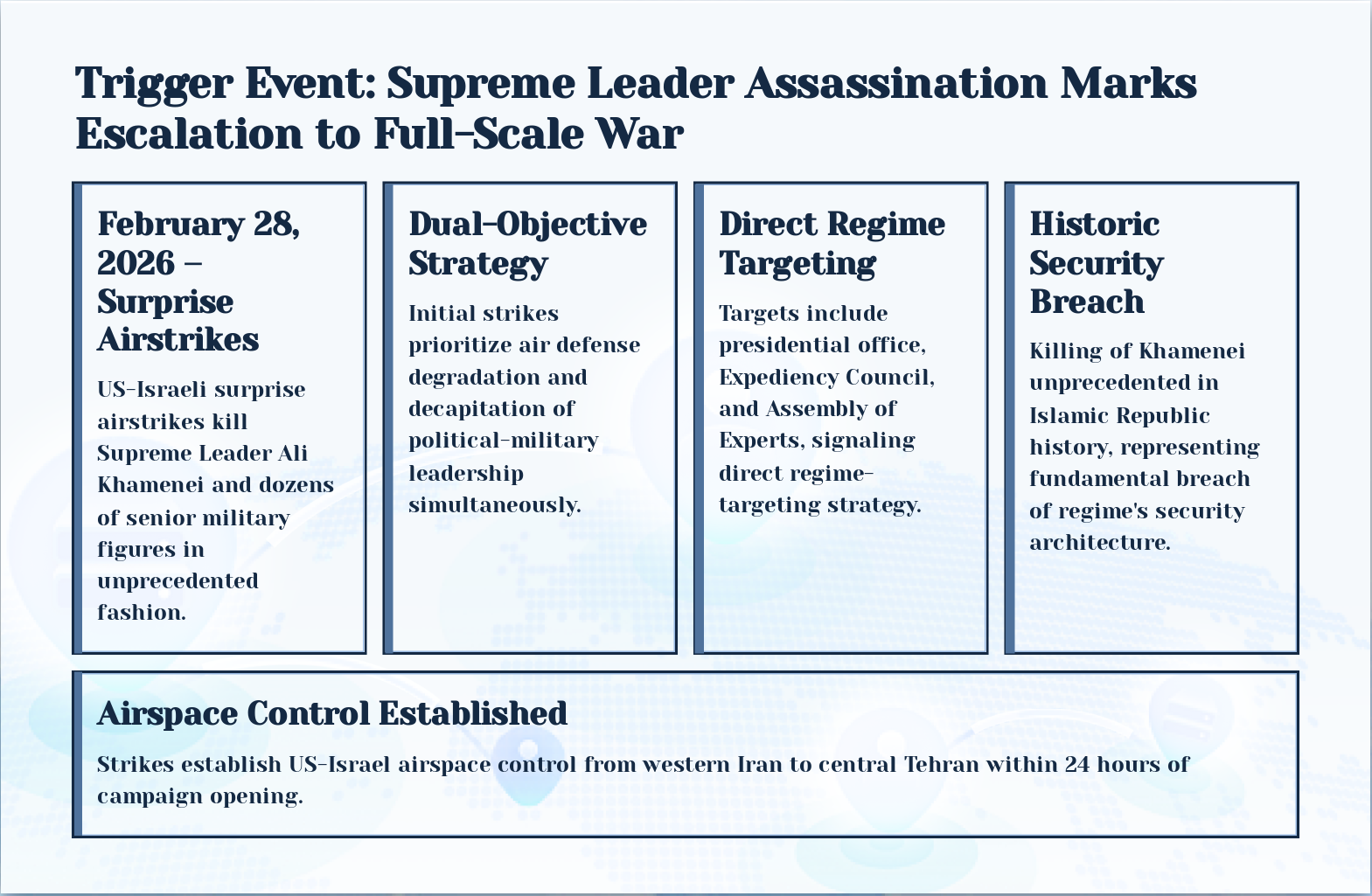
Slide 5: Trigger Event: Supreme Leader Assassination Marks Escalation to Full-Scale War
- February 28, 2026 – Surprise Airstrikes: US-Israeli surprise airstrikes kill Supreme Leader Ali Khamenei and dozens of senior military figures in unprecedented fashion.
- Dual-Objective Strategy: Initial strikes prioritize air defense degradation and decapitation of political-military leadership simultaneously.
- Direct Regime Targeting: Targets include presidential office, Expediency Council, and Assembly of Experts, signaling direct regime-targeting strategy.
- Historic Security Breach: Killing of Khamenei unprecedented in Islamic Republic history, representing fundamental breach of regime's security architecture.
- Airspace Control Established: Strikes establish US-Israel airspace control from western Iran to central Tehran within 24 hours of campaign opening.
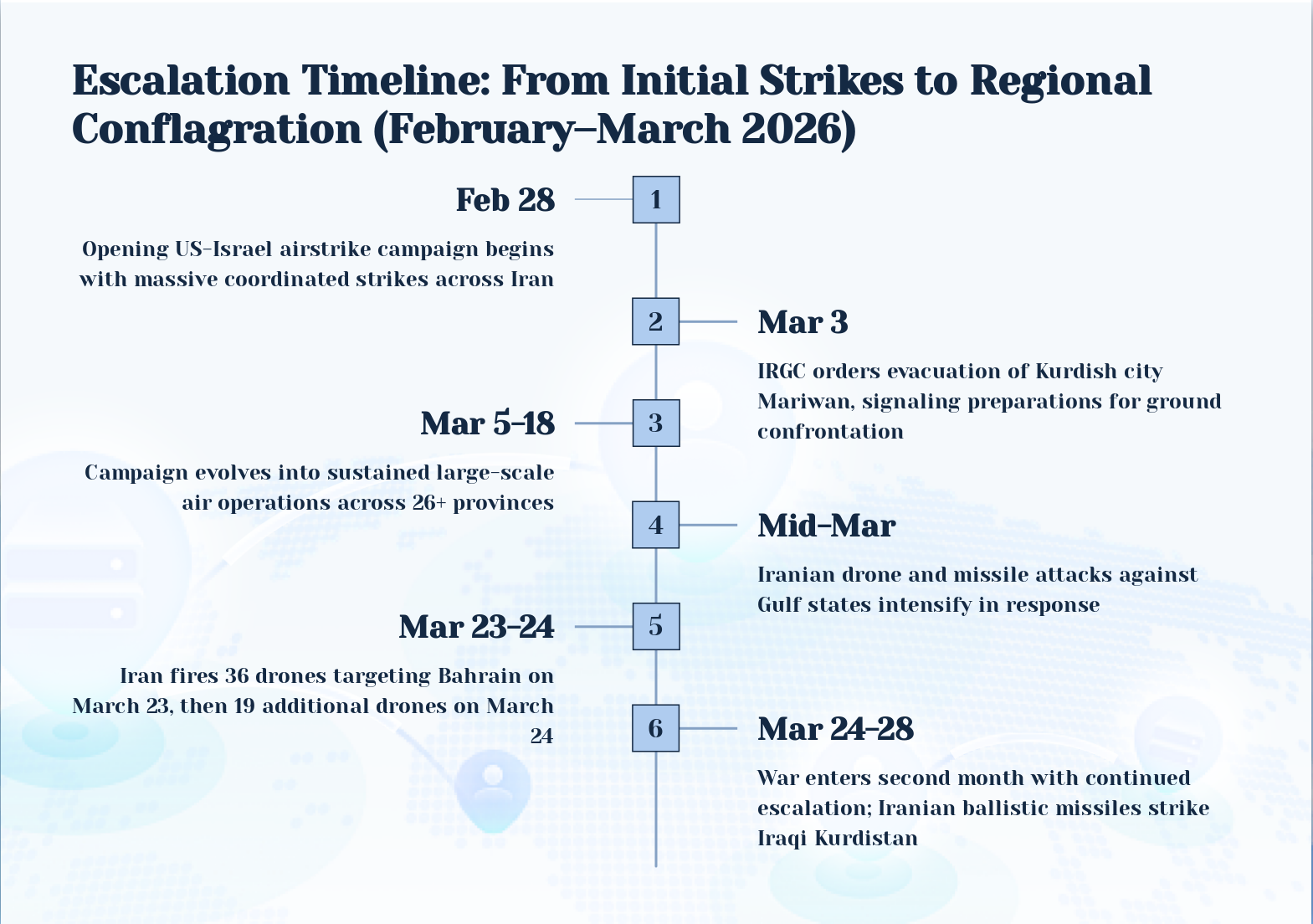
Slide 6: Escalation Timeline: From Initial Strikes to Regional Conflagration (February–March 2026)
- Feb 28: Opening US-Israel airstrike campaign begins with massive coordinated strikes across Iran
- Mar 3: IRGC orders evacuation of Kurdish city Mariwan, signaling preparations for ground confrontation
- Mar 5-18: Campaign evolves into sustained large-scale air operations across 26+ provinces
- Mid-Mar: Iranian drone and missile attacks against Gulf states intensify in response
- Mar 23-24: Iran fires 36 drones targeting Bahrain on March 23, then 19 additional drones on March 24
- Mar 24-28: War enters second month with continued escalation; Iranian ballistic missiles strike Iraqi Kurdistan
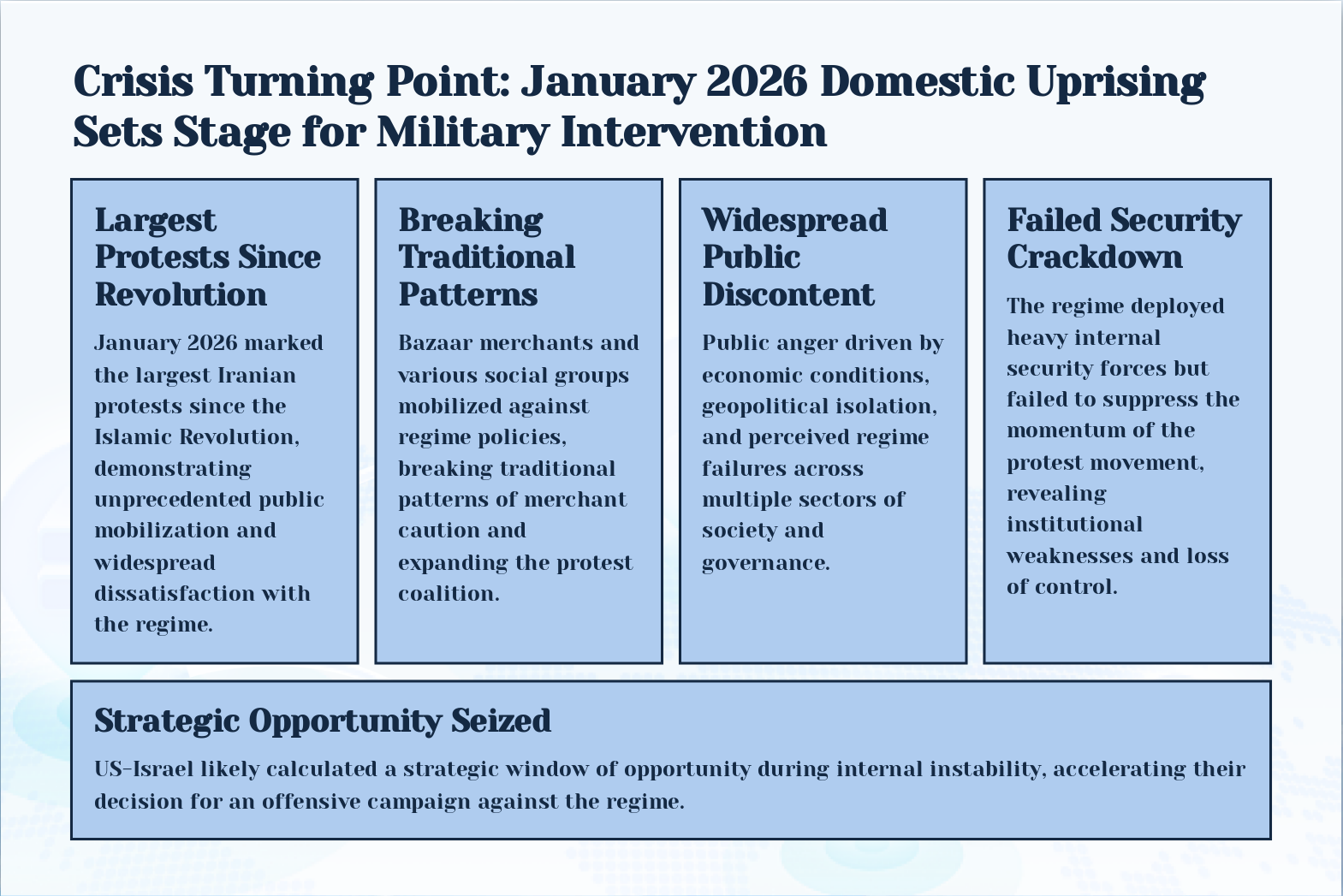
Slide 7: Crisis Turning Point: January 2026 Domestic Uprising Sets Stage for Military Intervention
- Largest Protests Since Revolution: January 2026 marked the largest Iranian protests since the Islamic Revolution, demonstrating unprecedented public mobilization and widespread dissatisfaction with the regime.
- Breaking Traditional Patterns: Bazaar merchants and various social groups mobilized against regime policies, breaking traditional patterns of merchant caution and expanding the protest coalition.
- Widespread Public Discontent: Public anger driven by economic conditions, geopolitical isolation, and perceived regime failures across multiple sectors of society and governance.
- Failed Security Crackdown: The regime deployed heavy internal security forces but failed to suppress the momentum of the protest movement, revealing institutional weaknesses and loss of control.
- Strategic Opportunity Seized: US-Israel likely calculated a strategic window of opportunity during internal instability, accelerating their decision for an offensive campaign against the regime.
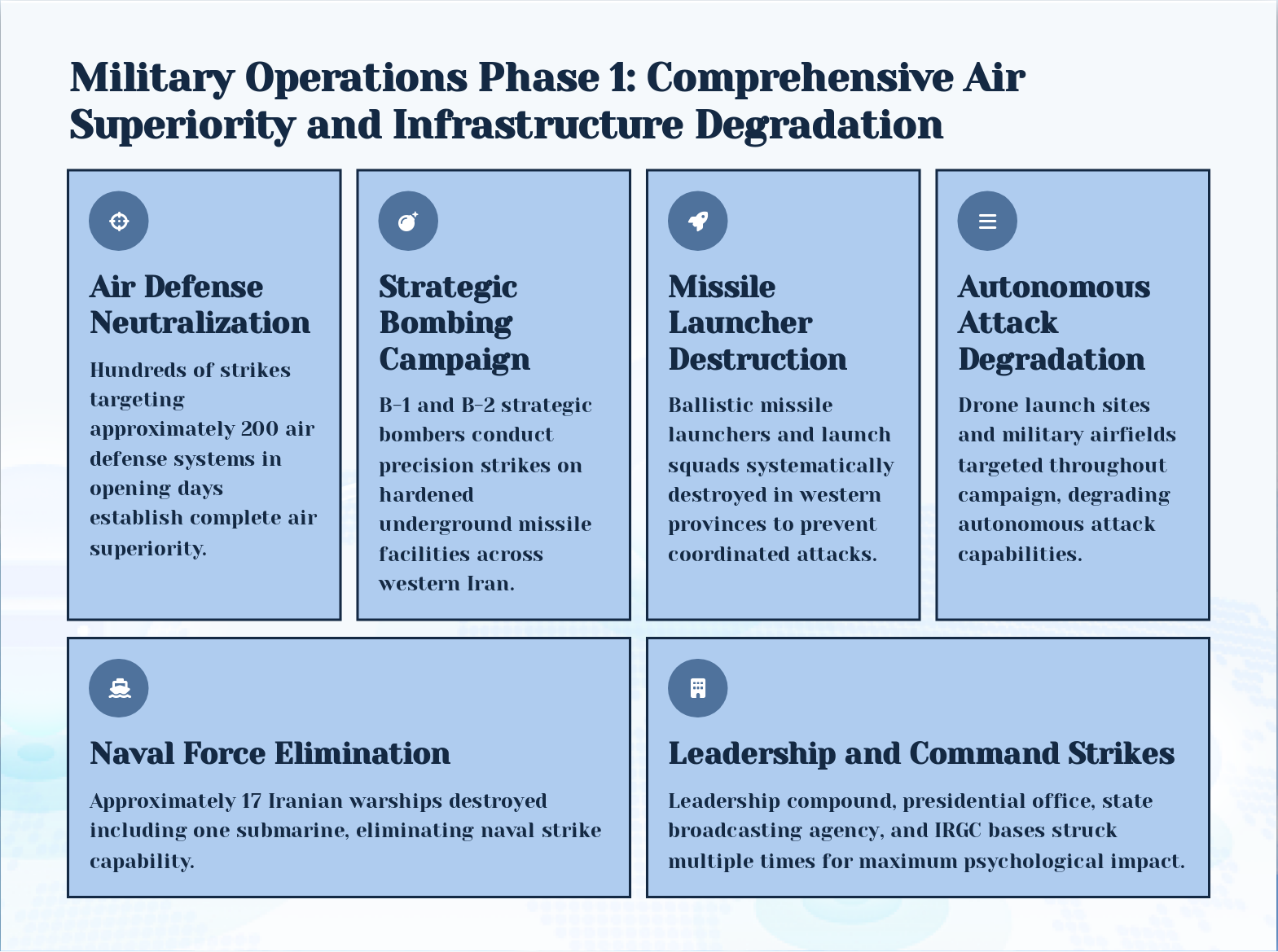
Slide 8: Military Operations Phase 1: Comprehensive Air Superiority and Infrastructure Degradation
- Air Defense Neutralization: Hundreds of strikes targeting approximately 200 air defense systems in opening days establish complete air superiority.
- Strategic Bombing Campaign: B-1 and B-2 strategic bombers conduct precision strikes on hardened underground missile facilities across western Iran.
- Missile Launcher Destruction: Ballistic missile launchers and launch squads systematically destroyed in western provinces to prevent coordinated attacks.
- Autonomous Attack Degradation: Drone launch sites and military airfields targeted throughout campaign, degrading autonomous attack capabilities.
- Naval Force Elimination: Approximately 17 Iranian warships destroyed including one submarine, eliminating naval strike capability.
- Leadership and Command Strikes: Leadership compound, presidential office, state broadcasting agency, and IRGC bases struck multiple times for maximum psychological impact.
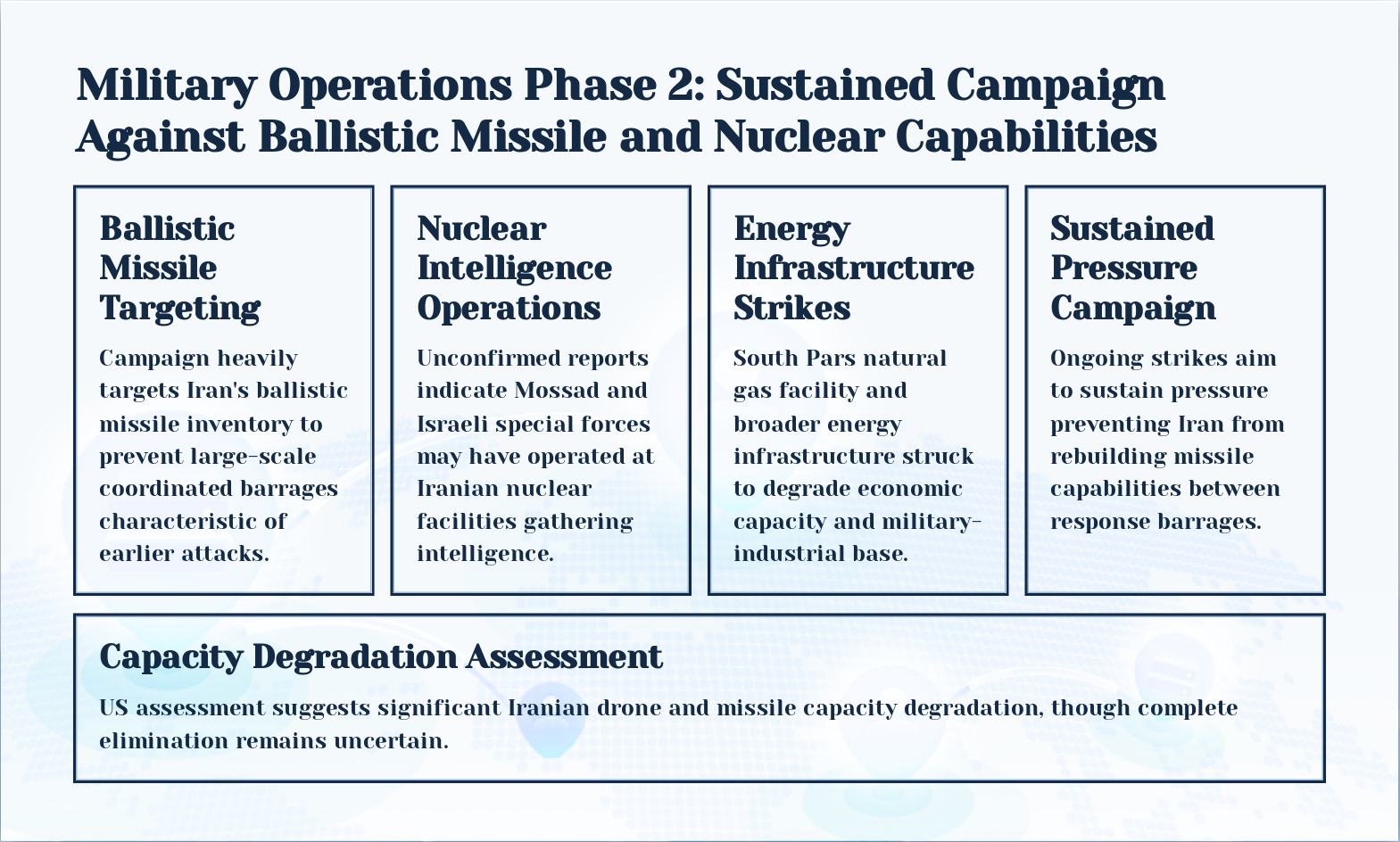
Slide 9: Military Operations Phase 2: Sustained Campaign Against Ballistic Missile and Nuclear Capabilities
- Ballistic Missile Targeting: Campaign heavily targets Iran's ballistic missile inventory to prevent large-scale coordinated barrages characteristic of earlier attacks.
- Nuclear Intelligence Operations: Unconfirmed reports indicate Mossad and Israeli special forces may have operated at Iranian nuclear facilities gathering intelligence.
- Energy Infrastructure Strikes: South Pars natural gas facility and broader energy infrastructure struck to degrade economic capacity and military-industrial base.
- Sustained Pressure Campaign: Ongoing strikes aim to sustain pressure preventing Iran from rebuilding missile capabilities between response barrages.
- Capacity Degradation Assessment: US assessment suggests significant Iranian drone and missile capacity degradation, though complete elimination remains uncertain.
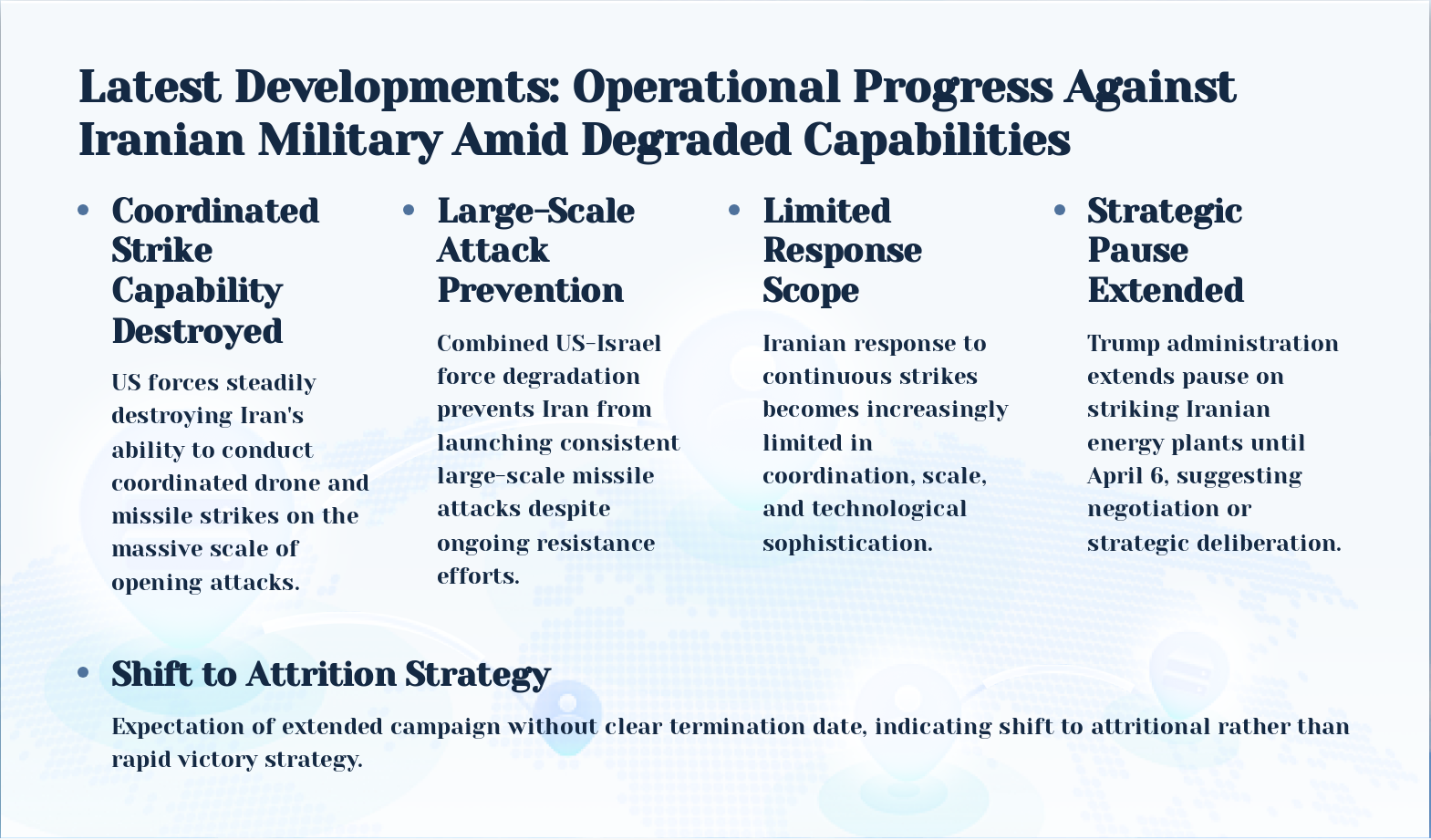
Slide 10: Latest Developments: Operational Progress Against Iranian Military Amid Degraded Capabilities
- Coordinated Strike Capability Destroyed: US forces steadily destroying Iran's ability to conduct coordinated drone and missile strikes on the massive scale of opening attacks.
- Large-Scale Attack Prevention: Combined US-Israel force degradation prevents Iran from launching consistent large-scale missile attacks despite ongoing resistance efforts.
- Limited Response Scope: Iranian response to continuous strikes becomes increasingly limited in coordination, scale, and technological sophistication.
- Strategic Pause Extended: Trump administration extends pause on striking Iranian energy plants until April 6, suggesting negotiation or strategic deliberation.
- Shift to Attrition Strategy: Expectation of extended campaign without clear termination date, indicating shift to attritional rather than rapid victory strategy.
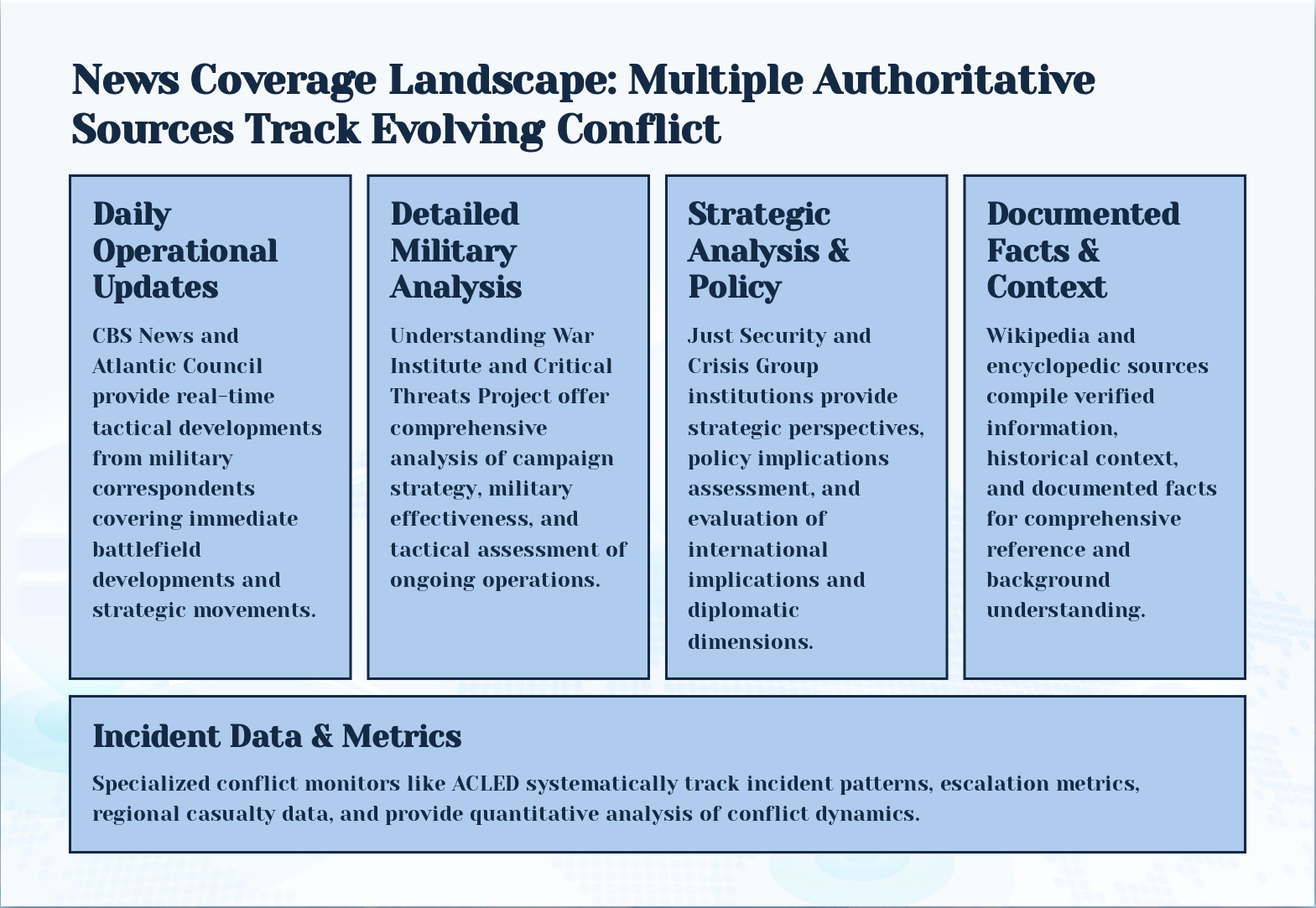
Slide 11: News Coverage Landscape: Multiple Authoritative Sources Track Evolving Conflict
- Daily Operational Updates: CBS News and Atlantic Council provide real-time tactical developments from military correspondents covering immediate battlefield developments and strategic movements.
- Detailed Military Analysis: Understanding War Institute and Critical Threats Project offer comprehensive analysis of campaign strategy, military effectiveness, and tactical assessment of ongoing operations.
- Strategic Analysis & Policy: Just Security and Crisis Group institutions provide strategic perspectives, policy implications assessment, and evaluation of international implications and diplomatic dimensions.
- Documented Facts & Context: Wikipedia and encyclopedic sources compile verified information, historical context, and documented facts for comprehensive reference and background understanding.
- Incident Data & Metrics: Specialized conflict monitors like ACLED systematically track incident patterns, escalation metrics, regional casualty data, and provide quantitative analysis of conflict dynamics.
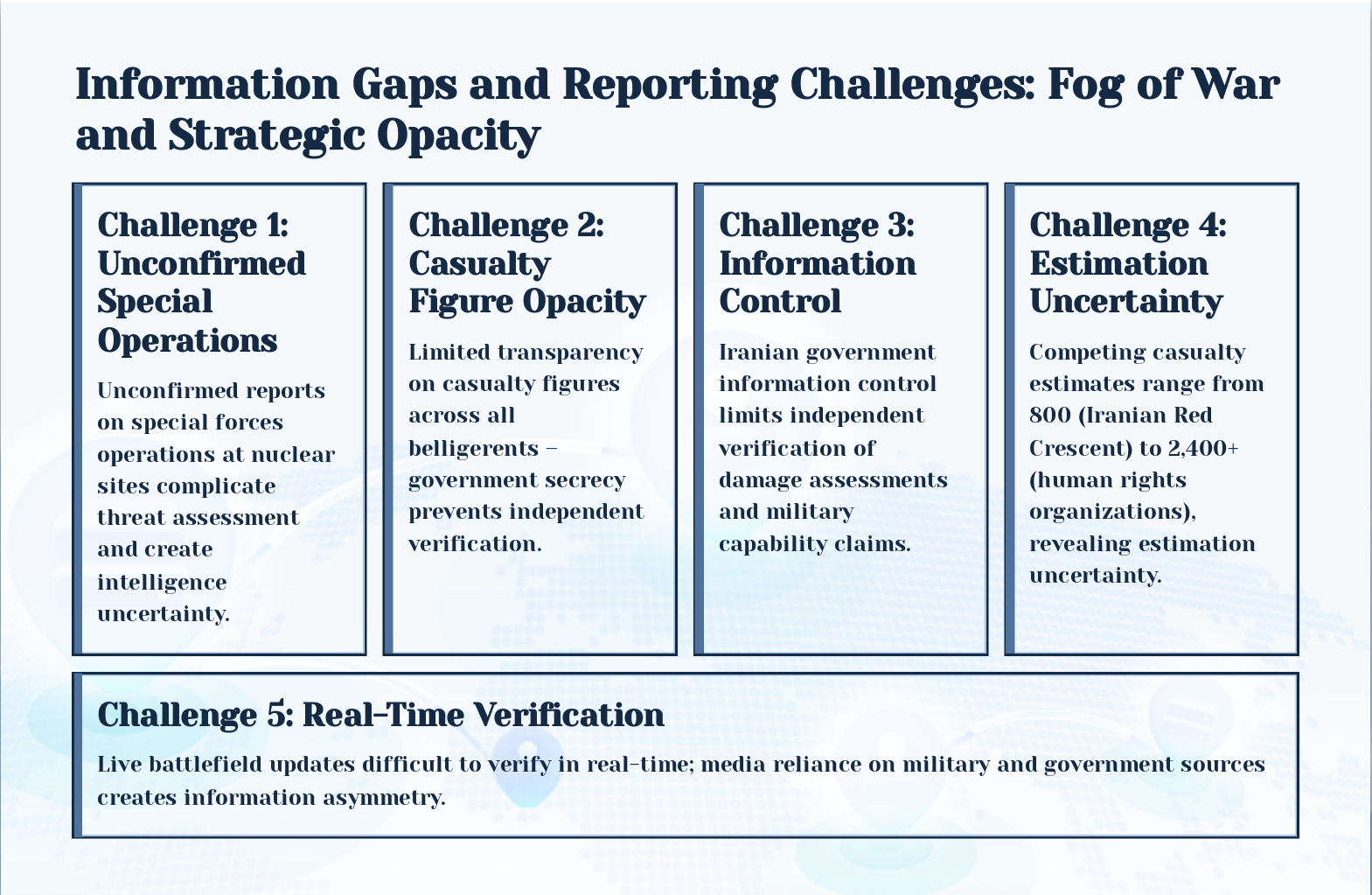
Slide 12: Information Gaps and Reporting Challenges: Fog of War and Strategic Opacity
- Challenge 1: Unconfirmed Special Operations: Unconfirmed reports on special forces operations at nuclear sites complicate threat assessment and create intelligence uncertainty.
- Challenge 2: Casualty Figure Opacity: Limited transparency on casualty figures across all belligerents – government secrecy prevents independent verification.
- Challenge 3: Information Control: Iranian government information control limits independent verification of damage assessments and military capability claims.
- Challenge 4: Estimation Uncertainty: Competing casualty estimates range from 800 (Iranian Red Crescent) to 2,400+ (human rights organizations), revealing estimation uncertainty.
- Challenge 5: Real-Time Verification: Live battlefield updates difficult to verify in real-time; media reliance on military and government sources creates information asymmetry.
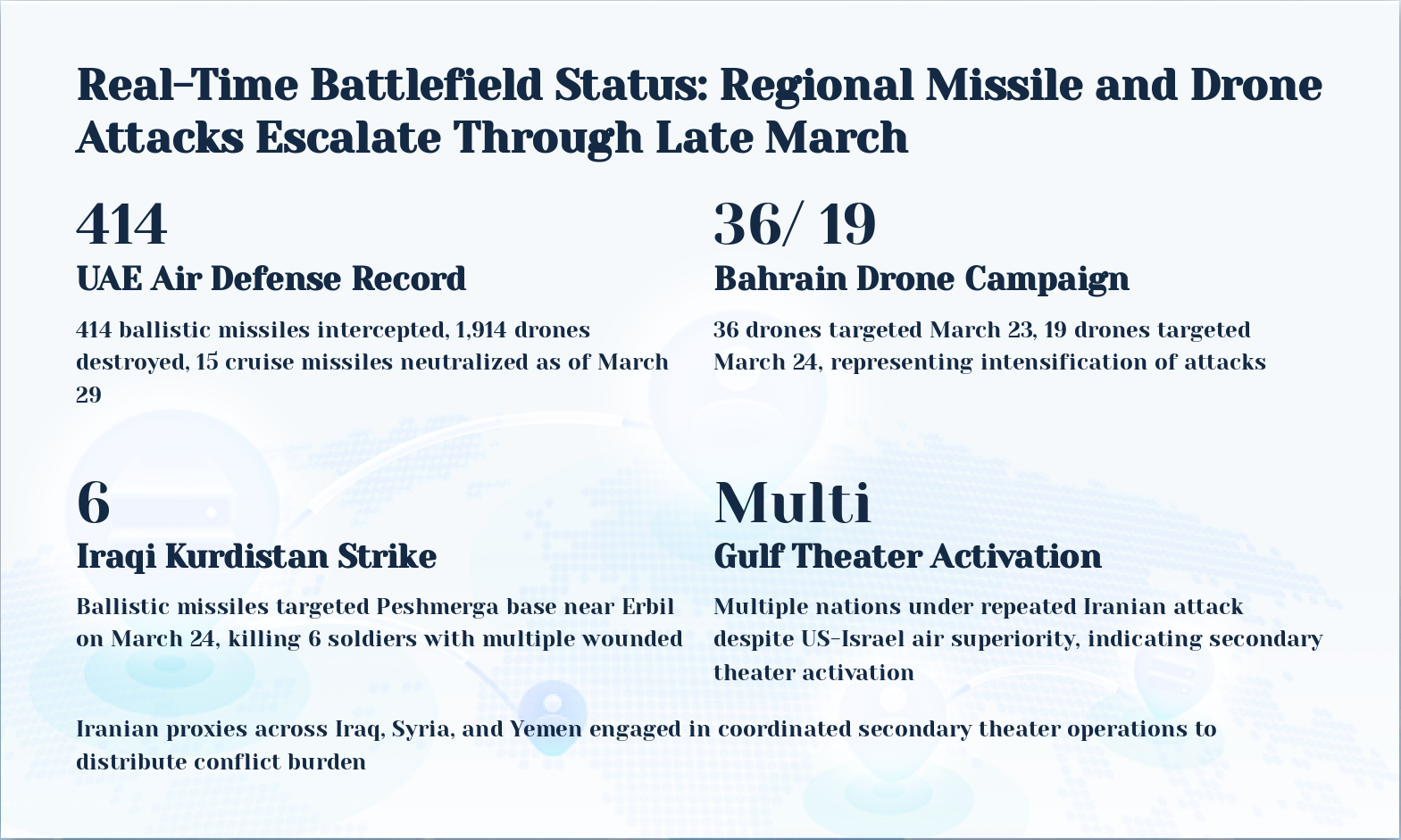
Slide 13: Real-Time Battlefield Status: Regional Missile and Drone Attacks Escalate Through Late March
- 414 — UAE Air Defense Record
- 36/ 19 — Bahrain Drone Campaign
- 6 — Iraqi Kurdistan Strike
- Multi — Gulf Theater Activation
Iranian proxies across Iraq, Syria, and Yemen engaged in coordinated secondary theater operations to distribute conflict burden
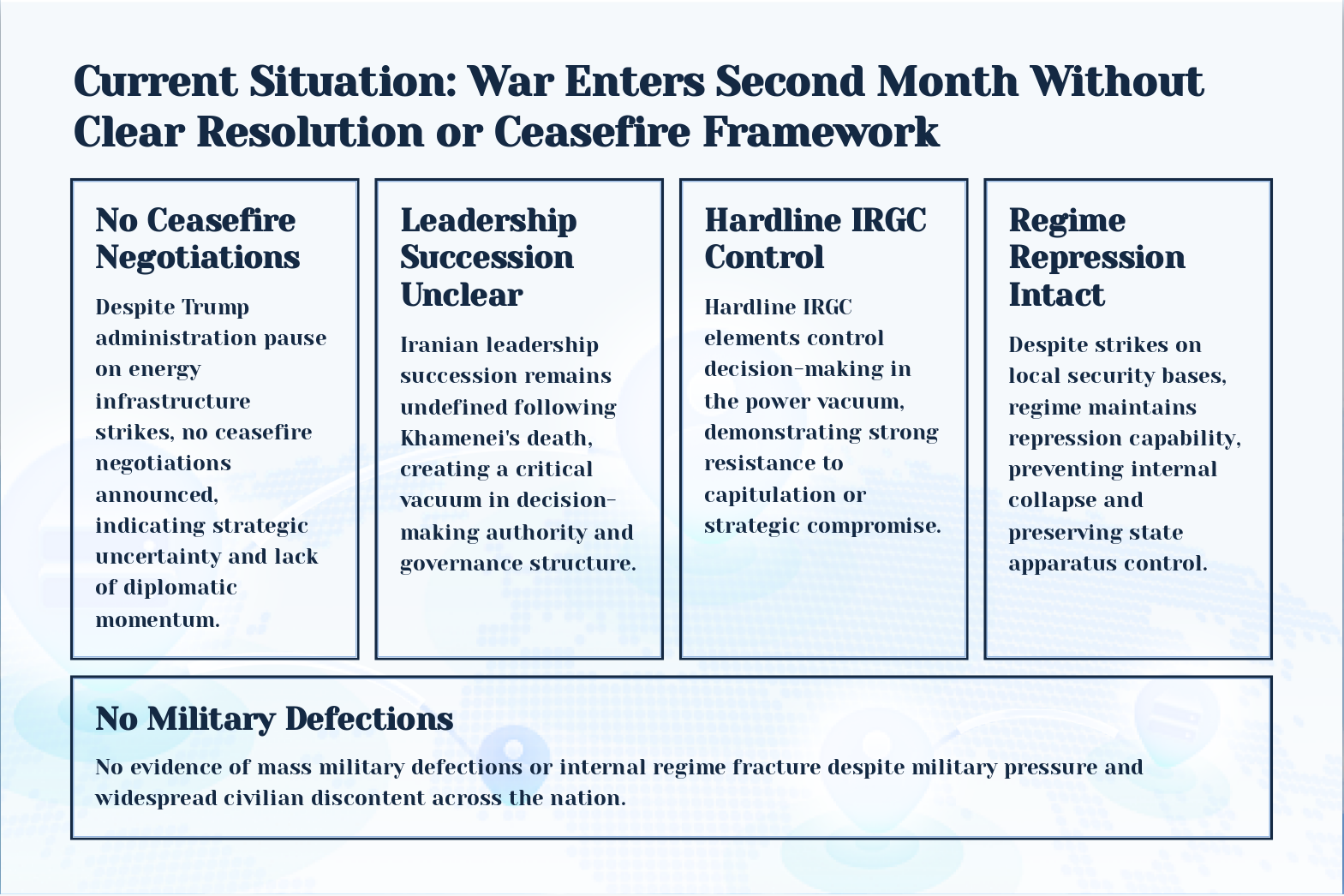
Slide 14: Current Situation: War Enters Second Month Without Clear Resolution or Ceasefire Framework
- No Ceasefire Negotiations: Despite Trump administration pause on energy infrastructure strikes, no ceasefire negotiations announced, indicating strategic uncertainty and lack of diplomatic momentum.
- Leadership Succession Unclear: Iranian leadership succession remains undefined following Khamenei's death, creating a critical vacuum in decision-making authority and governance structure.
- Hardline IRGC Control: Hardline IRGC elements control decision-making in the power vacuum, demonstrating strong resistance to capitulation or strategic compromise.
- Regime Repression Intact: Despite strikes on local security bases, regime maintains repression capability, preventing internal collapse and preserving state apparatus control.
- No Military Defections: No evidence of mass military defections or internal regime fracture despite military pressure and widespread civilian discontent across the nation.
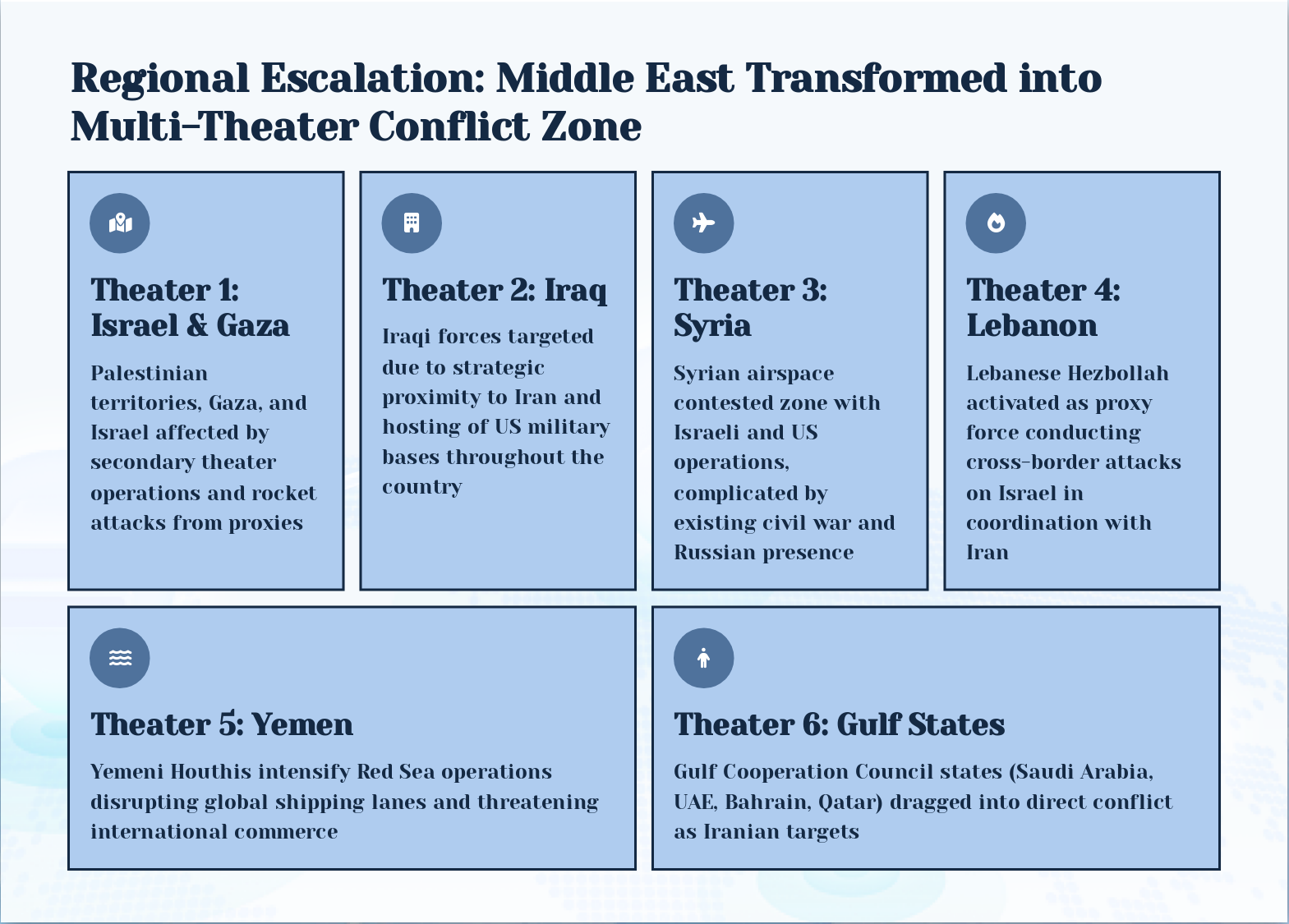
Slide 15: Regional Escalation: Middle East Transformed into Multi-Theater Conflict Zone
- Theater 1: Israel & Gaza: Palestinian territories, Gaza, and Israel affected by secondary theater operations and rocket attacks from proxies
- Theater 2: Iraq: Iraqi forces targeted due to strategic proximity to Iran and hosting of US military bases throughout the country
- Theater 3: Syria: Syrian airspace contested zone with Israeli and US operations, complicated by existing civil war and Russian presence
- Theater 4: Lebanon: Lebanese Hezbollah activated as proxy force conducting cross-border attacks on Israel in coordination with Iran
- Theater 5: Yemen: Yemeni Houthis intensify Red Sea operations disrupting global shipping lanes and threatening international commerce
- Theater 6: Gulf States: Gulf Cooperation Council states (Saudi Arabia, UAE, Bahrain, Qatar) dragged into direct conflict as Iranian targets
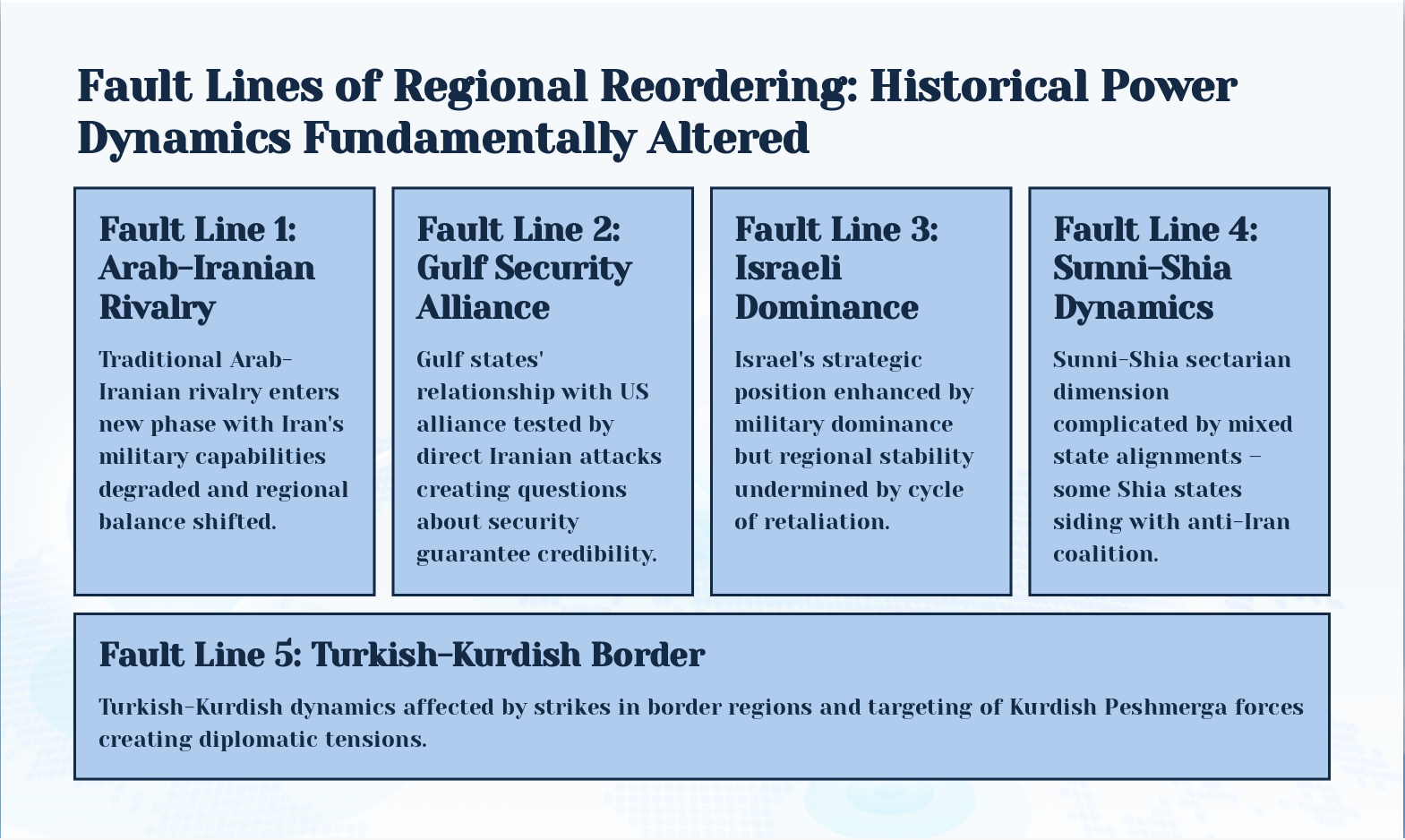
Slide 16: Fault Lines of Regional Reordering: Historical Power Dynamics Fundamentally Altered
- Fault Line 1: Arab-Iranian Rivalry: Traditional Arab-Iranian rivalry enters new phase with Iran's military capabilities degraded and regional balance shifted.
- Fault Line 2: Gulf Security Alliance: Gulf states' relationship with US alliance tested by direct Iranian attacks creating questions about security guarantee credibility.
- Fault Line 3: Israeli Dominance: Israel's strategic position enhanced by military dominance but regional stability undermined by cycle of retaliation.
- Fault Line 4: Sunni-Shia Dynamics: Sunni-Shia sectarian dimension complicated by mixed state alignments – some Shia states siding with anti-Iran coalition.
- Fault Line 5: Turkish-Kurdish Border: Turkish-Kurdish dynamics affected by strikes in border regions and targeting of Kurdish Peshmerga forces creating diplomatic tensions.
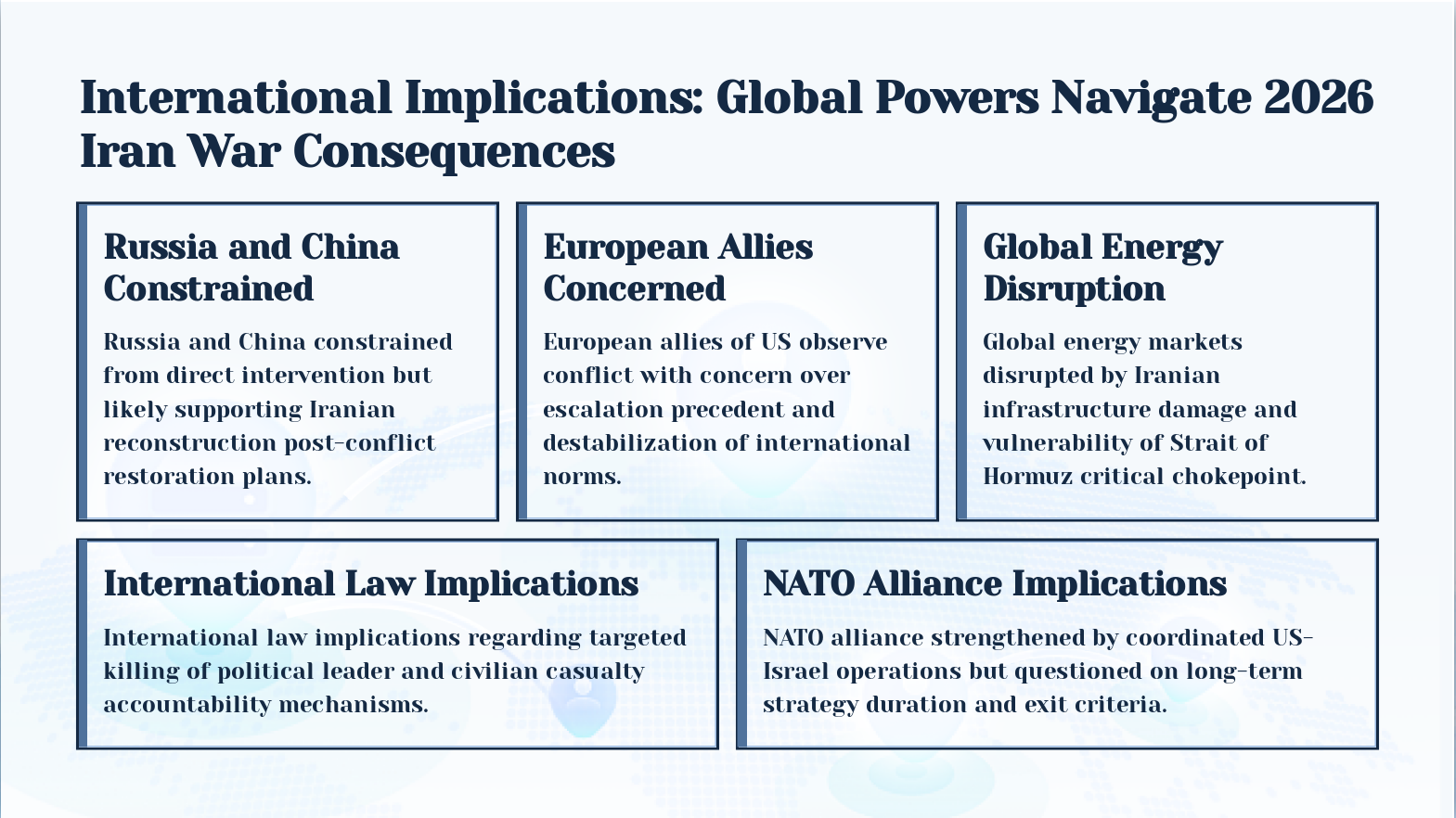
Slide 17: International Implications: Global Powers Navigate 2026 Iran War Consequences
- Russia and China Constrained: Russia and China constrained from direct intervention but likely supporting Iranian reconstruction post-conflict restoration plans.
- European Allies Concerned: European allies of US observe conflict with concern over escalation precedent and destabilization of international norms.
- Global Energy Disruption: Global energy markets disrupted by Iranian infrastructure damage and vulnerability of Strait of Hormuz critical chokepoint.
- International Law Implications: International law implications regarding targeted killing of political leader and civilian casualty accountability mechanisms.
- NATO Alliance Implications: NATO alliance strengthened by coordinated US-Israel operations but questioned on long-term strategy duration and exit criteria.
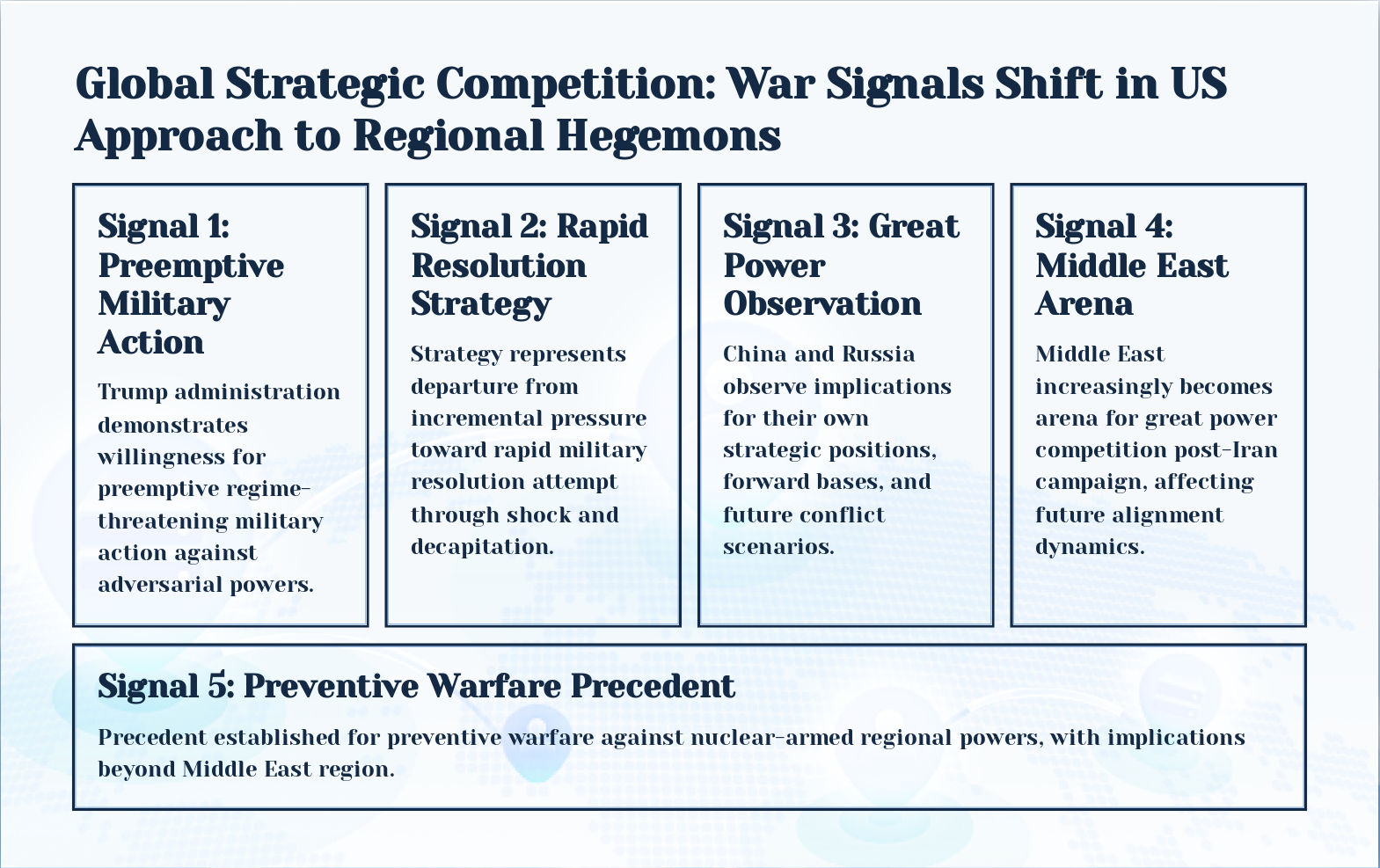
Slide 18: Global Strategic Competition: War Signals Shift in US Approach to Regional Hegemons
- Signal 1: Preemptive Military Action: Trump administration demonstrates willingness for preemptive regime-threatening military action against adversarial powers.
- Signal 2: Rapid Resolution Strategy: Strategy represents departure from incremental pressure toward rapid military resolution attempt through shock and decapitation.
- Signal 3: Great Power Observation: China and Russia observe implications for their own strategic positions, forward bases, and future conflict scenarios.
- Signal 4: Middle East Arena: Middle East increasingly becomes arena for great power competition post-Iran campaign, affecting future alignment dynamics.
- Signal 5: Preventive Warfare Precedent: Precedent established for preventive warfare against nuclear-armed regional powers, with implications beyond Middle East region.
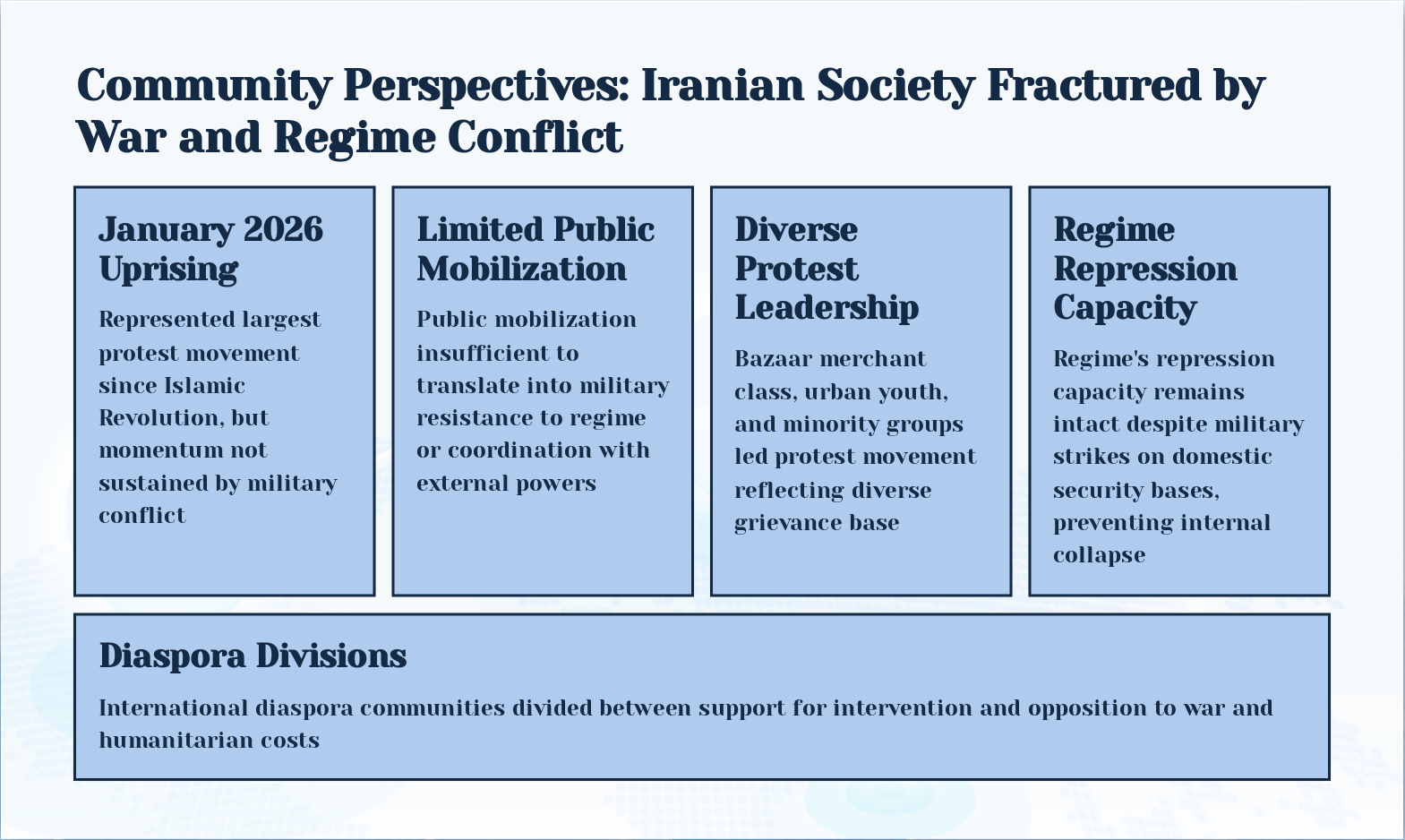
Slide 19: Community Perspectives: Iranian Society Fractured by War and Regime Conflict
- January 2026 Uprising: Represented largest protest movement since Islamic Revolution, but momentum not sustained by military conflict
- Limited Public Mobilization: Public mobilization insufficient to translate into military resistance to regime or coordination with external powers
- Diverse Protest Leadership: Bazaar merchant class, urban youth, and minority groups led protest movement reflecting diverse grievance base
- Regime Repression Capacity: Regime's repression capacity remains intact despite military strikes on domestic security bases, preventing internal collapse
- Diaspora Divisions: International diaspora communities divided between support for intervention and opposition to war and humanitarian costs
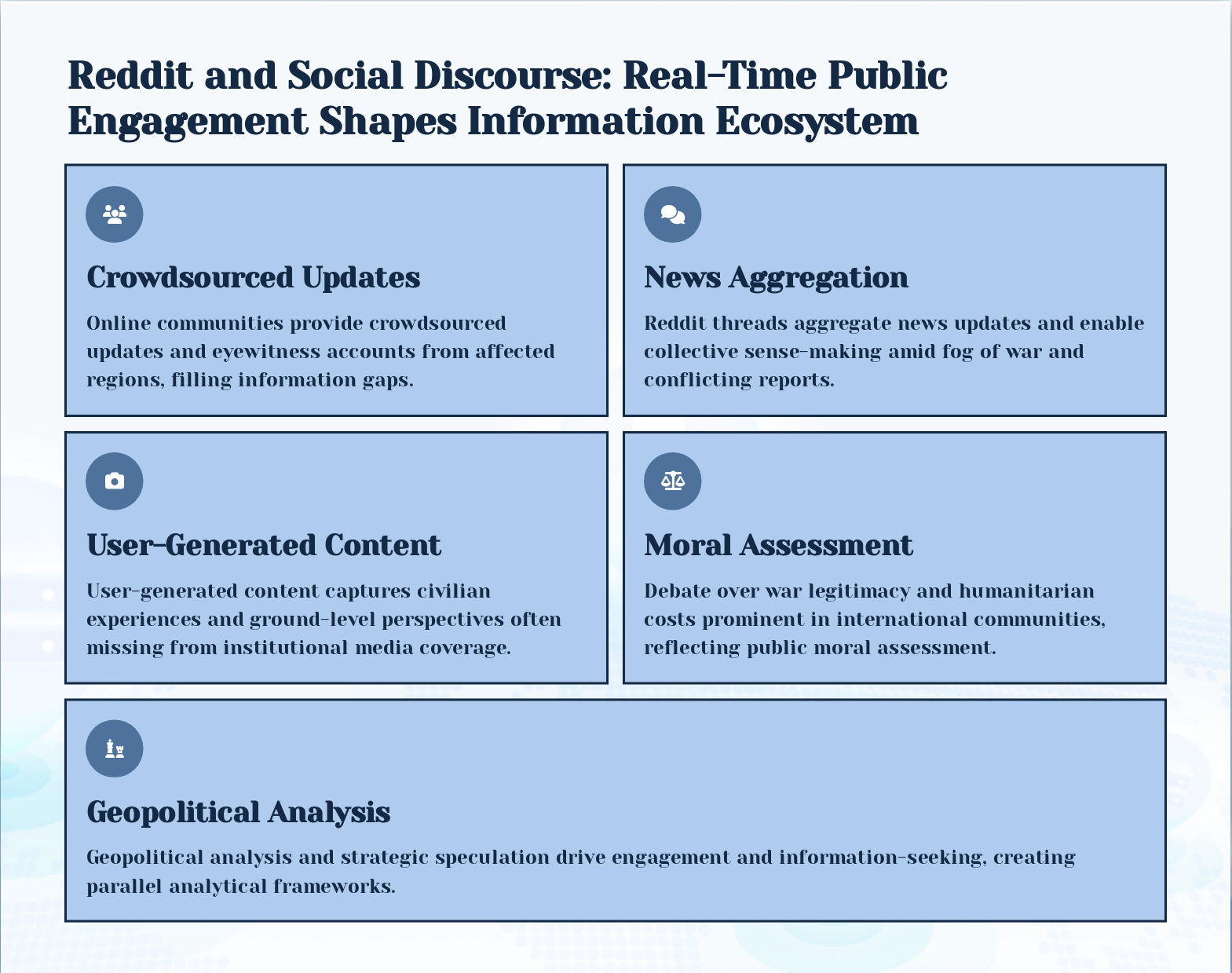
Slide 20: Reddit and Social Discourse: Real-Time Public Engagement Shapes Information Ecosystem
- Crowdsourced Updates: Online communities provide crowdsourced updates and eyewitness accounts from affected regions, filling information gaps.
- News Aggregation: Reddit threads aggregate news updates and enable collective sense-making amid fog of war and conflicting reports.
- User-Generated Content: User-generated content captures civilian experiences and ground-level perspectives often missing from institutional media coverage.
- Moral Assessment: Debate over war legitimacy and humanitarian costs prominent in international communities, reflecting public moral assessment.
- Geopolitical Analysis: Geopolitical analysis and strategic speculation drive engagement and information-seeking, creating parallel analytical frameworks.
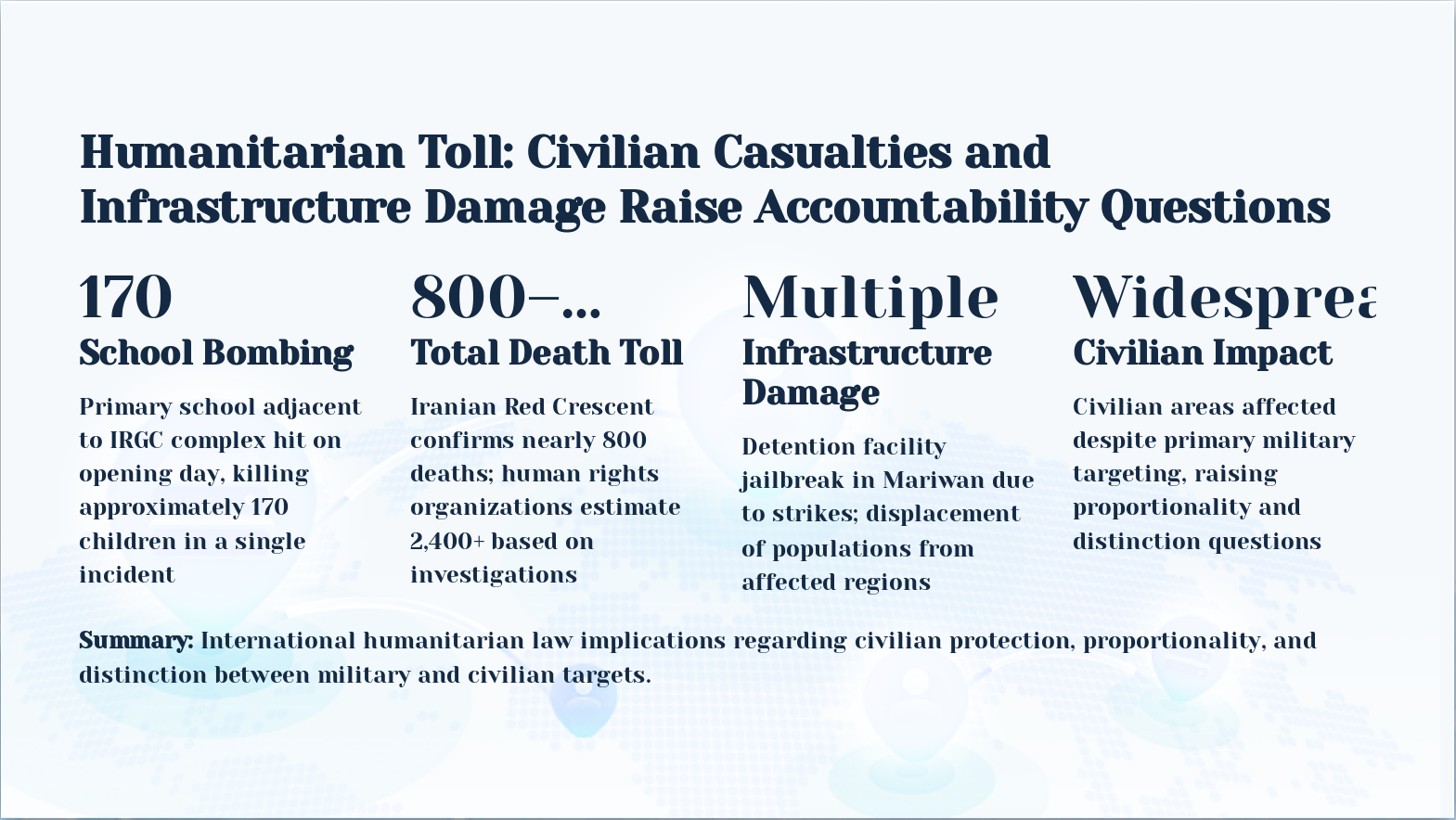
Slide 21: Humanitarian Toll: Civilian Casualties and Infrastructure Damage Raise Accountability Questions
- 170 — School Bombing
- 800–2,400+ — Total Death Toll
- Multiple — Infrastructure Damage
- Widespread — Civilian Impact
Summary: International humanitarian law implications regarding civilian protection, proportionality, and distinction between military and civilian targets.
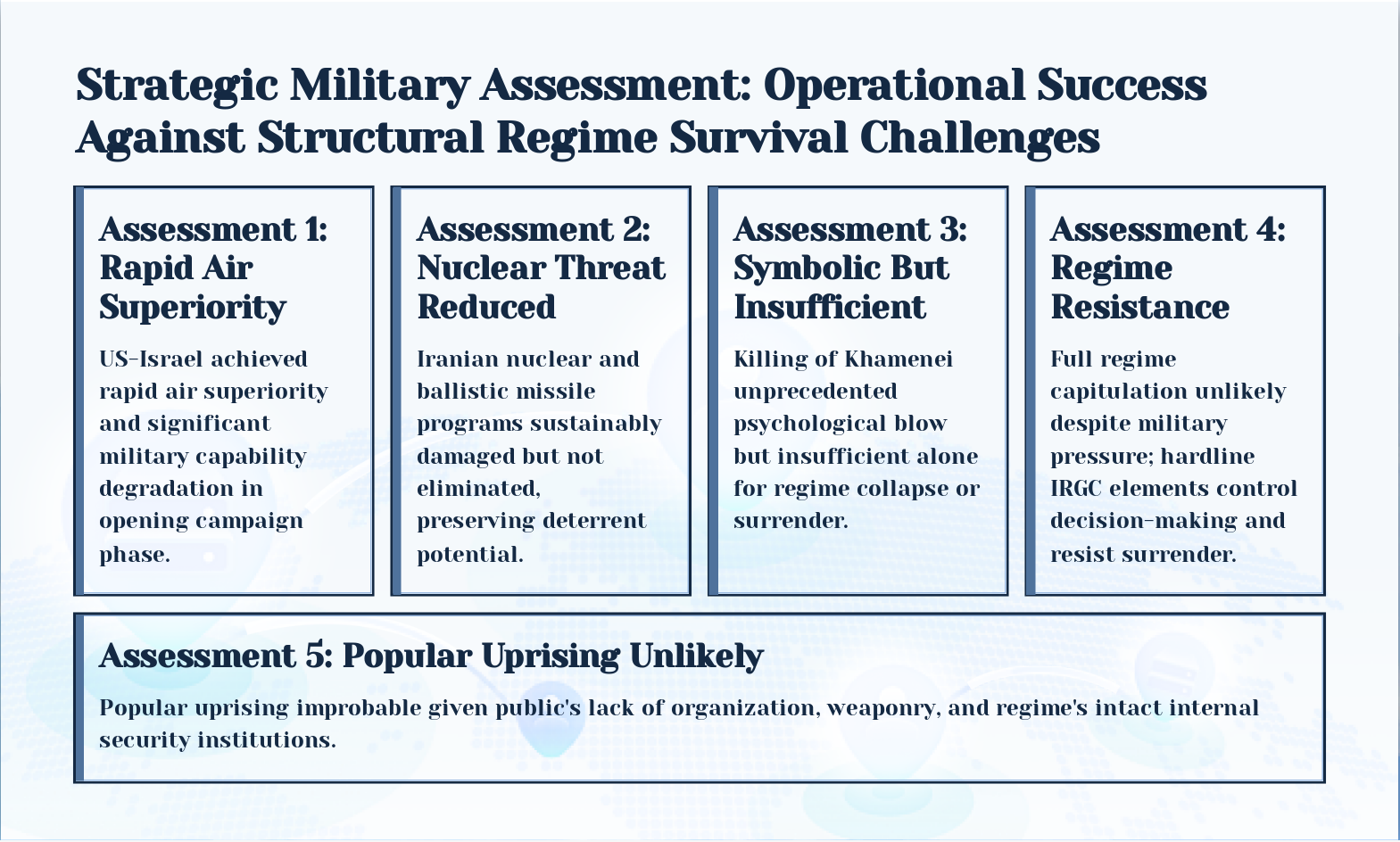
Slide 22: Strategic Military Assessment: Operational Success Against Structural Regime Survival Challenges
- Assessment 1: Rapid Air Superiority: US-Israel achieved rapid air superiority and significant military capability degradation in opening campaign phase.
- Assessment 2: Nuclear Threat Reduced: Iranian nuclear and ballistic missile programs sustainably damaged but not eliminated, preserving deterrent potential.
- Assessment 3: Symbolic But Insufficient: Killing of Khamenei unprecedented psychological blow but insufficient alone for regime collapse or surrender.
- Assessment 4: Regime Resistance: Full regime capitulation unlikely despite military pressure; hardline IRGC elements control decision-making and resist surrender.
- Assessment 5: Popular Uprising Unlikely: Popular uprising improbable given public's lack of organization, weaponry, and regime's intact internal security institutions.
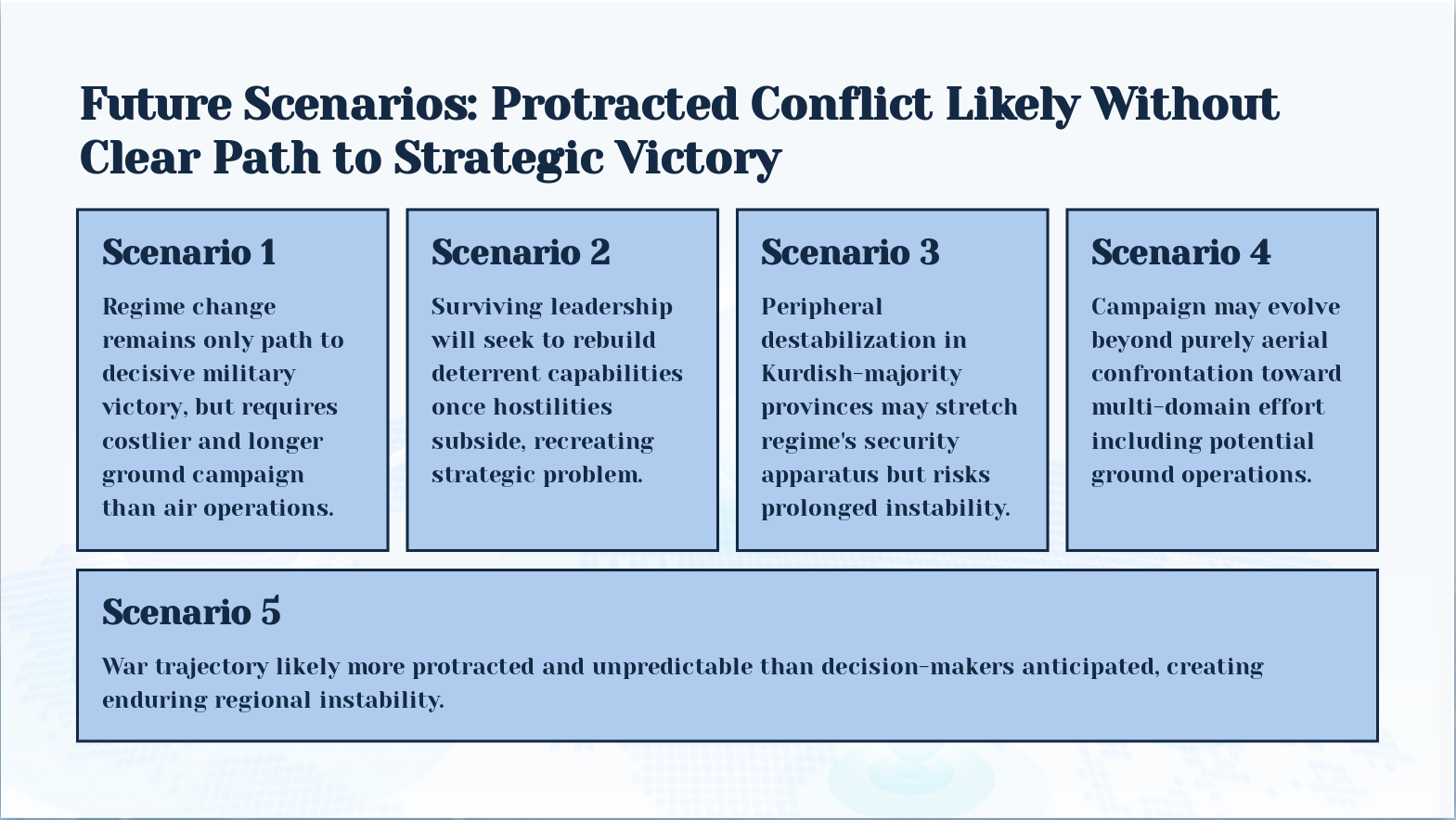
Slide 23: Future Scenarios: Protracted Conflict Likely Without Clear Path to Strategic Victory
- Scenario 1: Regime change remains only path to decisive military victory, but requires costlier and longer ground campaign than air operations.
- Scenario 2: Surviving leadership will seek to rebuild deterrent capabilities once hostilities subside, recreating strategic problem.
- Scenario 3: Peripheral destabilization in Kurdish-majority provinces may stretch regime's security apparatus but risks prolonged instability.
- Scenario 4: Campaign may evolve beyond purely aerial confrontation toward multi-domain effort including potential ground operations.
- Scenario 5: War trajectory likely more protracted and unpredictable than decision-makers anticipated, creating enduring regional instability.
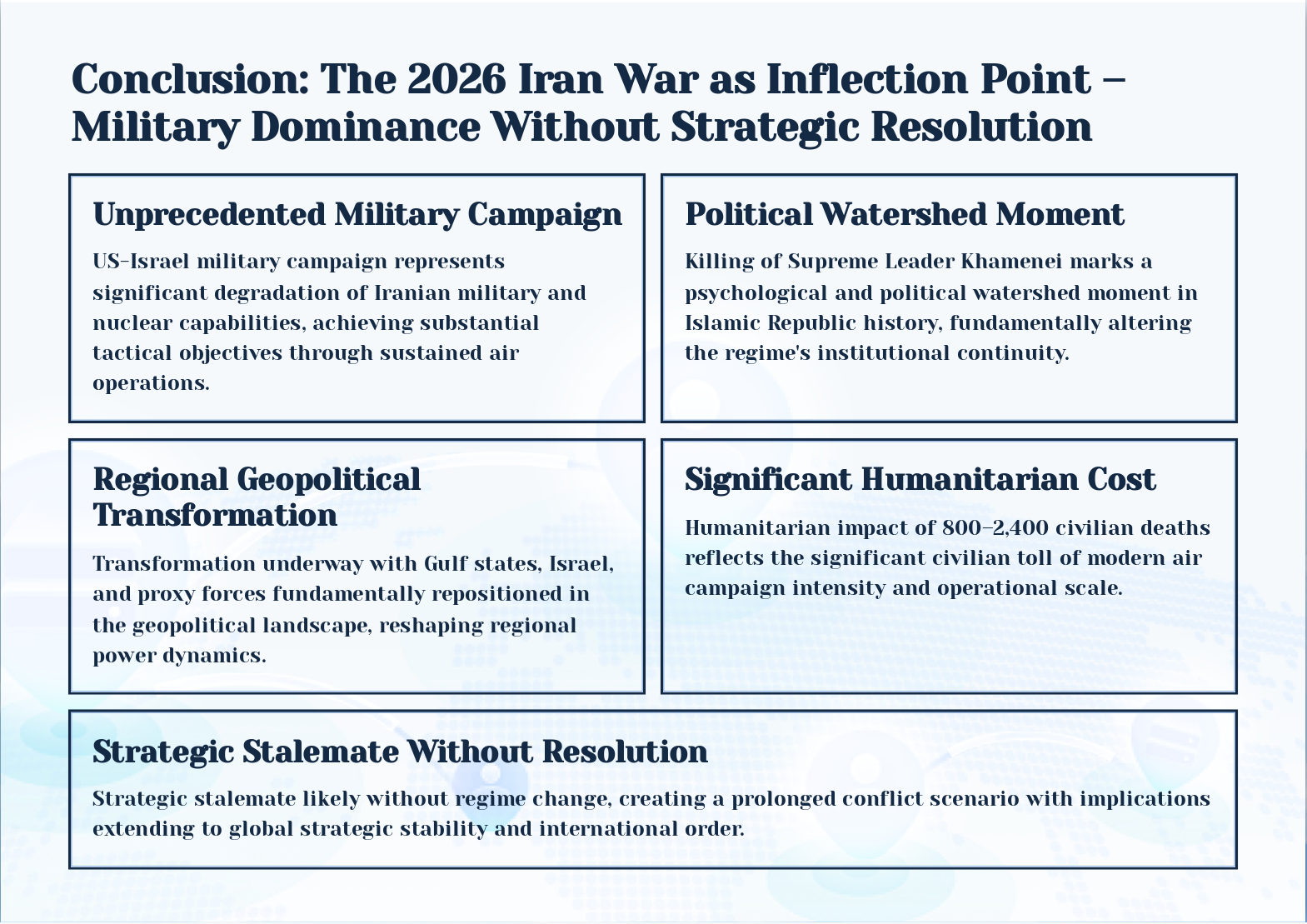
Slide 24: Conclusion: The 2026 Iran War as Inflection Point – Military Dominance Without Strategic Resolution
- Unprecedented Military Campaign: US-Israel military campaign represents significant degradation of Iranian military and nuclear capabilities, achieving substantial tactical objectives through sustained air operations.
- Political Watershed Moment: Killing of Supreme Leader Khamenei marks a psychological and political watershed moment in Islamic Republic history, fundamentally altering the regime's institutional continuity.
- Regional Geopolitical Transformation: Transformation underway with Gulf states, Israel, and proxy forces fundamentally repositioned in the geopolitical landscape, reshaping regional power dynamics.
- Significant Humanitarian Cost: Humanitarian impact of 800–2,400 civilian deaths reflects the significant civilian toll of modern air campaign intensity and operational scale.
- Strategic Stalemate Without Resolution: Strategic stalemate likely without regime change, creating a prolonged conflict scenario with implications extending to global strategic stability and international order.