
Foreword: The Unspoken Arms Race on Your Phone

Let’s be brutally honest for a second. Dating apps are exhausting. They’re a digital meat market disguised as a quest for connection. You spend hours curating the perfect six photos, agonizing over a bio that’s witty but not trying too hard, and then you plunge into the endless abyss of swiping. Left, left, left, oh maybe… nope, left.
On the rare occasion you match with someone who seems promising, a new kind of anxiety kicks in: the dreaded first message. “Hey” is a death sentence. A joke might not land. A detailed comment about their profile might seem creepy. You’re paralyzed. And even if you get a conversation going, it often fizzles out into the digital ether, another ghost in the machine. You’re left staring at your phone, wondering, “What am I doing wrong?”
This feeling of inadequacy, of being outmaneuvered in a game you don’t fully understand, is a universal pain point in modern romance. We’ve all felt it. But what if I told you that a rapidly growing number of people are no longer playing the game on a level field? They’ve found an ace up their sleeve, a secret weapon that’s turning their romantic fortunes around overnight. And it’s not a new haircut, a fatter wallet, or a PUA (Pick-Up Artist) handbook from 2005.
It’s an AI. And it’s creating a seismic shift in the dating landscape, providing users with what can only be described as dating with a significant advantage.
The Rise of the AI Wingman
Just a couple of years ago, the idea of using artificial intelligence in your love life was pure science fiction, the plot of a Spike Jonze movie. Today, it’s as easy as opening a new tab in your browser. The explosion of powerful Large Language Models (LLMs) like those behind ChatGPT, Gemini, and Claude has democratized a superpower that was once unimaginable: the ability to generate perfectly crafted, charismatic, and engaging text on demand.
So, what does this “AI Wingman” actually do? It’s not just about correcting your grammar. It’s a full-service romance concierge.
The Profile Polish
You feed the AI your scattered thoughts, your hobbies, your job, a few random facts about yourself, and you ask it to spin that straw into gold. In seconds, it produces five different bios for your Hinge or Bumble profile, each tailored to a different vibe: “The Adventurous Intellectual,” “The Witty Homebody,” “The Ambitious Creative.” It identifies the most compelling aspects of your life and frames them in a way that’s designed to attract clicks, or in this case, right swipes.
The Opening Gambit
This is where it gets really interesting. Staring at a blank chat box with a new match? Simply copy-paste their bio into the AI and issue a command: “Write a funny, engaging opening line based on this person’s profile. They like hiking, dogs, and true crime podcasts.” The AI will instantly generate options like: “So, on a scale of 1 to ‘I could solve a cold case,’ how serious is this true crime obsession? Asking for a friend who may or may not be my slightly nervous dog.” The barrier to starting a conversation is completely eliminated.
The Conversation Conductor
But it doesn’t stop there. The real game-changer is using AI to maintain and escalate the conversation. Users are taking screenshots of their chats, feeding them to the AI, and asking for help. “She seems to be losing interest. How do I re-engage her?” or “He just told this joke, what’s a flirty and witty response?” The AI analyzes the conversational context, the sentiment, and the subtext, and provides a roadmap for what to say next. It can suggest when to ask for a number, how to propose a date, and even how to navigate tricky personal questions.
This isn’t just theory; it’s happening right now. On Reddit forums and Discord servers, a subculture is thriving, with users sharing their “prompts,” celebrating their AI-assisted successes, and fine-tuning their methods for maximum romantic ROI.
The “Significant Advantage” in Practice: Real Stories, Real Results?

To understand the sheer power of this trend, let’s look at the archetypes of users who are benefiting the most.
Take “Alex,” a 28-year-old software engineer. He’s brilliant, kind, and has a great career, but he’ll be the first to admit he’s awkward. In person, he can be charming once he opens up, but his text game was nonexistent. His messages were either too formal or too blunt. His dating app experience was a desert. Frustrated, he turned to an AI. He used it to re-write his profile, making him sound more approachable and multi-dimensional. He used it to craft opening lines that reflected his genuine interests but in a more playful package.
The result? Alex told a friend his match rate tripled in the first week. But more importantly, the AI acted as a “social translator.” It helped him bridge the gap between his thoughts and his words, giving him the confidence to initiate conversations that led to real dates. For him, the AI wasn’t a mask; it was a crutch that eventually taught him how to walk on his own. He was still the one on the date, having the real conversation, but the AI got him in the door.
Then there’s “Maya,” a 35-year-old lawyer working 60-hour weeks. She’s smart, successful, and knows what she wants, but she’s completely burned out. The thought of spending two hours every night swiping and engaging in repetitive small talk felt like a second job. She started using an AI as a “dating assistant.” It would handle the initial back-and-forth, filtering out low-effort conversations and identifying promising candidates. When a conversation reached a certain level of engagement, she would take over. For Maya, this wasn’t about deception; it was about efficiency. It allowed her to conserve her limited social energy for a smaller number of higher-quality interactions.
These stories highlight the allure of dating with a significant advantage. It promises to smooth out our social awkwardness, save us precious time, and, most importantly, deliver the results we crave: connection, intimacy, and an end to loneliness. But as with any powerful new technology, there’s a dark side.
The Ethical Minefield: Are We Engineering Deception?
This is the part of the conversation that gets uncomfortable, and for good reason. While the “Alexes” and “Mayas” of the world may be using AI as a tool for self-improvement or efficiency, where do we draw the line?
The Authenticity Crisis
At its core, dating is a process of mutual self-revelation. You slowly peel back the layers, revealing your true self—quirks, flaws, and all—and hope that the other person likes what they see. What happens when the initial layers aren’t yours? If you fall for someone’s expertly crafted, AI-generated wit and charm, who are you actually falling for? The person, or their prompt-writing skills? This creates a fundamental crisis of authenticity. The entire foundation of the early relationship is built on a subtle, technologically-advanced form of catfishing. The pressure to live up to your digital ghostwriter on a real date must be immense.
The Unfair Advantage and the New Divide
The keyword here is “advantage.” Every advantage implies a disadvantage for someone else. In a world where some people are using sophisticated AI to optimize their romantic appeal, those who don’t—or can’t—are left behind. This creates a new, invisible class divide in the dating pool. It’s no longer just about looks or wealth; it’s about tech-savviness. Are we heading towards a future where your ability to find a partner is contingent on your ability to effectively command an algorithm? It’s a chilling thought.
The Homogenization of Romance
There’s another, more subtle danger. What happens when thousands, or even millions, of people start using the same handful of AI models to communicate? Romance could become incredibly bland. Conversations will converge on a “platonic ideal” of flirtatious banter. The unique, sometimes awkward, but utterly human ways we express ourselves could be smoothed out and replaced by optimized, but soulless, text. We risk losing the very imperfections and idiosyncrasies that make us fall in love in the first place.
The Future of Love and Algorithms: Where Do We Go From Here?
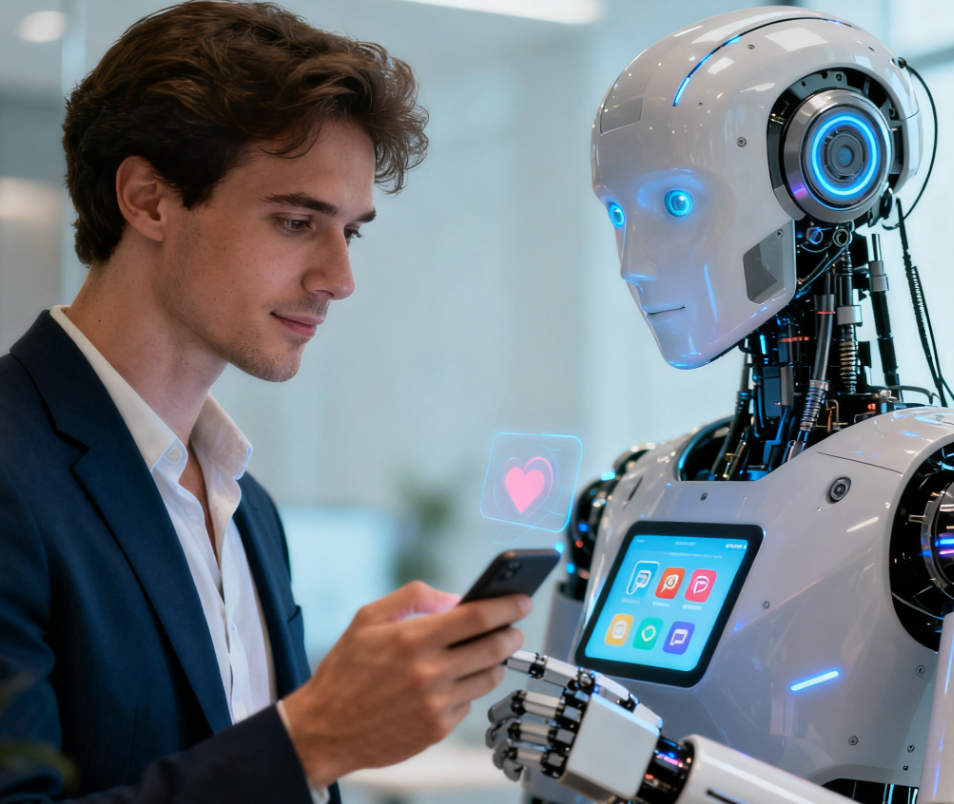
Like it or not, the genie is out of the bottle. AI is here to stay, and its integration into our romantic lives will only deepen. Dating apps themselves are already racing to incorporate these features, promising AI-powered icebreakers, profile critiques, and even real-time conversation coaching. Soon, using an AI wingman might not be the exception; it might be the default.
So, what’s the path forward?
The optimist in me wants to believe that technology is just a tool, and that the human element will always prevail. An AI can get you a date, but it can’t sit across the table from someone, make eye contact, and feel that ineffable spark of chemistry. It can’t be vulnerable, it can’t share a moment of genuine, spontaneous laughter. The AI is a bridge, but we are the ones who must have the courage to walk across it and meet the person on the other side.
However, the realist in me knows we need to have a serious conversation about digital literacy and ethics in the age of AI. We need to be aware that the charming, poetic person we’re texting might be getting a little help. This doesn’t necessarily have to be a dealbreaker, but it’s a new layer of modern romance that we must learn to navigate. We need to question what we value: a flawless performance or an authentic connection?
Conclusion: Swipe Right on Humanity?
We stand at a fascinating and perilous crossroads. The promise of dating with a significant advantage through AI is a powerful siren song for anyone who has ever felt lost in the lonely ocean of modern dating. It offers a shortcut past the pain, the rejection, and the effort, promising to deliver the prize of connection with unprecedented efficiency.
But every shortcut has a cost. The cost here might be authenticity, trust, and the beautiful, messy, unpredictable nature of human interaction itself. The AI can write a perfect love letter, but it can’t feel love. It can simulate charm, but it can’t possess character.
As we move forward, the ultimate question isn’t whether we can use AI to find a partner, but whether the ‘partner’ we find will be anything more than a beautifully rendered simulation of what we asked for.
I’d love to know what you think. Is using AI in dating a brilliant hack or a moral failure? Have you tried it, or would you consider it? Drop your thoughts in the comments below. Let’s talk about it.