

Why a Dedicated “Valuation Model Presentation” Is So Critical?
In a funding roadshow, a general PPT tells your vision and product story, while a Company Valuation Model Slides Presentation prices that vision using financial language and business logic. Investors, especially professional institutions managing large funds, base their final decisions on rational value judgments. They may be moved by your vision, but only a clear and credible valuation presentation will make them confident enough to write a check. This deck translates your market potential, operational plan, and growth strategy into quantifiable, evaluable financial data and valuation figures. It proves to investors that you are not just a dreamer, but a CEO who knows how to turn dreams into tangible wealth.
What Pages Should a Professional Valuation Model Presentation Include?
A complete Company Valuation Model Slides Presentation typically consists of 10–12 core slides, each with an irreplaceable mission:
1. Title Slide
Content: Concise and clear. The center features the title: “[Company Name] Investment Value Analysis & Valuation Brief”. The bottom right corner notes “Confidential Material” and the date.
Key Point: Sets a professional, confidential tone. No company mission or vision is needed—this is a serious “investment analysis report.”
2. Executive Summary (Core Value Proposition)
Content: Open with 3–4 core data points. For example: “We are a company in the [X] market, achieving 300% annual growth through [Y] technology/business model. This round of financing seeks [Z] million RMB to achieve [A] goals, with a projected valuation of [C] billion RMB in [B] years.”
Key Point: This is the “elevator pitch” of the entire deck. It lets investors grasp your most compelling hard facts in 30 seconds.
3. Valuation Conclusion & Investment Highlights
Content: State the pre–money/post–money valuation range for this round directly (e.g., Pre–money valuation: 800 million to 1 billion RMB). Use 3–4 icons with brief descriptions to list core highlights supporting this valuation, such as: “Capturing 1% of a trillion–yuan market hits our target”, “Core technology patents build barriers”, “Verified profitable Unit Economics model”.
Key Point: Lead with the conclusion, then the reasoning. This is the slide investors care about most.
4. Market Size & Share Assumptions
Content: A clear “market size funnel chart.” From left to right: Total Addressable Market (TAM) → Serviceable Addressable Market (SAM) → Serviceable Obtainable Market (SOM). In the SOM section, mark your tiny current market share and the target share you plan to capture in 3–5 years (e.g., from 0.1% to 3%). Add footnotes to cite data sources (authoritative institution reports, reasonable calculation logic).
Key Point: Prove your “ceiling is high enough” and your market share target is pragmatic and achievable. Avoid empty claims like “a trillion–yuan market.”
5. Revenue Drivers & Forecasting Model
Content: The core of the core. Use a table or chart to clearly show how your revenue is calculated. For example:
l Driver 1: User Growth: Assumption: Monthly new paying users grow from the current 10,000 to 100,000 by Year 3 at a set growth rate.
l Driver 2: Average Revenue Per User (ARPU): Assumption: ARPU gradually rises from the current 200 RMB to 300 RMB with product upgrades.
l Revenue Formula: Monthly Revenue = Total Paying Users × ARPU. Derive an annual revenue curve from this.
Key Point: Let investors see clearly what “engines” drive your revenue growth and whether the assumptions for each “engine” are reasonable. Be specific enough that investors can directly discuss with you: “Why can ARPU increase by 50%?”
6. Cost Structure & Key Operational Metrics
Content: Show your cost composition (e.g., R&D, marketing, and labor cost ratios) and its trend over time. More importantly, present key operational efficiency metrics, such as:
l Customer Acquisition Cost (CAC) and its trend.
l Customer Lifetime Value (LTV) and its ratio to CAC (LTV/CAC > 3 is a healthy signal).
l Gross profit margin trend.
Key Point: Prove you not only know how to make money, but also how to make it efficiently and profitably. Healthy operational metrics are the cornerstone of a high valuation.
7. P&L & Cash Flow Forecast Summary
Content: No need for full three financial statements, but present a concise 3–5 year forecasted Profit & Loss (P&L) statement (revenue, gross profit, operating expenses, net profit) and key cash flow status (when break–even is achieved, cumulative cash flow requirements).
Key Point: Clearly tell investors where the money is being burned, how long it will take to start generating positive cash flow on its own, and whether this round of financing is sufficient to support the company to the next milestone (usually profitability or the next funding round).
8. Valuation Methodology Explanation
Content: Clearly state which mainstream valuation methods you used for cross–validation. Typically two:
l Market Approach (Comparable Companies/Transactions Method): List 3–5 listed or acquired companies similar to your business, and their Price–to–Sales (PS) or Price–to–Earnings (PE) multiples. Apply a reasonable range to your forecasted revenue or profit to derive a valuation range.
l Income Approach (Discounted Cash Flow (DCF) Method): Briefly explain that you discounted the projected free cash flow for the next few years back to present value using a reasonable discount rate (reflecting risk). You can show a simple sensitivity analysis (e.g., valuation ranges under different growth rates and discount rates).
Key Point: Show your valuation is not “pulled out of thin air,” but supported by methodologies recognized in financial markets. This greatly enhances professionalism.
9. Scenario Analysis
Content: A matrix or table showing the company’s potential valuation and financial performance under three scenarios: Conservative, Base (Neutral), and Optimistic (corresponding to core assumptions like different market shares and revenue growth rates).
Key Point: This shows investors you have fully considered risks and opportunities, and that the investment still delivers attractive returns even in neutral or conservative scenarios. It demonstrates management’s rationality and planning capabilities.
10. Use of Funds & Milestones
Content: A clear pie chart showing the specific spending plan for this round of financing (e.g., 50% for product R&D, 30% for marketing and promotion, 20% for team building). Pair it with a timeline Gantt chart showing specific, verifiable milestones to be achieved 6, 12, and 24 months after receiving the funds (e.g., Launch V3.0 product, achieve monthly revenue of XXX million RMB, expand to 3 new cities).
Key Point: Convince investors their capital has a clear, efficient plan, and every penny is directed toward a milestone that increases company value.
How to Efficiently Build This Presentation with AI Tools?
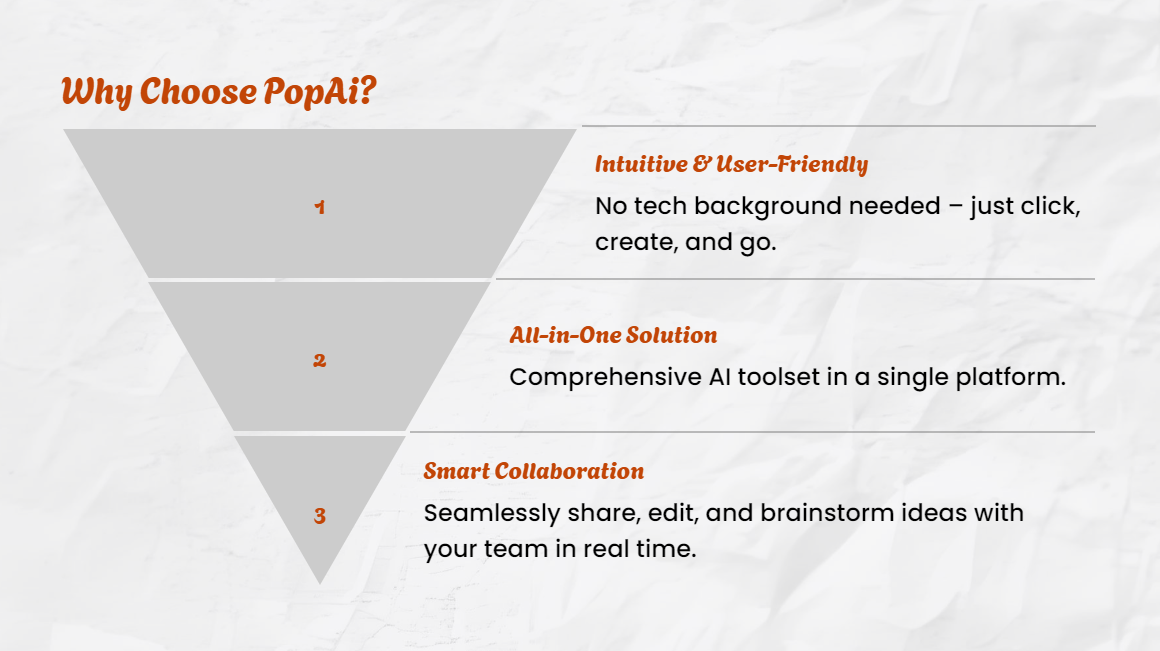
Creating such a complex, high–standard Company Valuation Model Slides Presentation poses dual challenges for founders: financial expertise and design skills. At this point, professional AI presentation tools like PopAi can be leveraged to boost efficiency and quality. Note: The following is a reasonable application based on its actual features:
From Disorganized Data to a Clear First Draft
You can directly import scattered Excel forecast data and assumption descriptions from Word documents via PopAi’s flexible upload options. Using its core ability to automatically convert content into a presentation, the AI will initially identify your financial data and text structure, generating a slide draft with charts and text layout. This saves you the most painful hours of building a framework from a blank page.
Smart Beautification & Chart Optimization
For the generated draft—especially pages requiring complex charts like “Revenue Drivers,” “Market Funnel,” and “Scenario Analysis”—you can use its AI–enhanced content function. For example, you can input the instruction: “Visualize this revenue forecast data using both a waterfall chart and a growth curve chart for comparison”. The AI will provide chart suggestions and generate alternative options, letting you choose the one that best conveys your intent. This ensures your data presentation is not only accurate but also visually appealing.
Maintaining Logical Consistency & Professional Style
When revising and adjusting repeatedly based on investor feedback, PopAi’s seamless editing function lets you easily drag and reorder slides, merge or split pages. The system automatically maintains global consistency in fonts, colors, and layout—no need to manually adjust each page. When you need to fine–tune presentation focus for investors with different backgrounds (e.g., tech–focused VCs vs. finance–focused PEs), its audience–centric design philosophy helps you quickly reorganize content modules, ensuring the story arc remains coherent and clear.
Focusing on Core Value Argumentation
Most importantly, using such tools frees you from tedious tasks like typesetting, finding icons, and adjusting formats, allowing you and your team to focus all time and energy on the most critical work: repeatedly refining your business assumptions, verifying the rationality of every forecasted data point, and practicing the logic of your value narrative. The tool handles “professional presentation,” while you solidify the “value core.”
The Final Critical Step: From Document to Pitch
Remember, this Company Valuation Model Slides Presentation is your speaking outline, not a report for investors to read on their own. Each slide should serve as a “visual cue card” for your in–depth explanation. You need to prepare 2–3 minutes of interpretation for each page, especially how you derived the next data point from the previous assumption. Be ready to defend every assumed number: “Why can CAC decrease by 20% next year?” “The median PS multiple of your selected comparable companies is 10x—why did you use 15x for yourselves?”
When you can calmly and confidently explain the business logic behind every number in the presentation, this Company Valuation Model Slides Presentation transforms from a static set of slides into a dynamic blueprint that leads investors through time to witness the growth of your company’s value. That is the real key to securing hundreds of millions in financing.