What Is the Blue Ocean Strategy, and What Business Problems Can It Solve for You?
Don’t get bogged down by buzzwords like “value innovation”. Blue Ocean Strategy is simple: it all boils down to one question—Why fight for scraps on a crowded street when you can build a brand–new one for yourself?
If your business is facing these issues, you’re likely stuck in a “Red Ocean”:
l Shrinking profits: Competitors slash prices, and you have no choice but to follow suit.
l Homogenized products: Everyone sells nearly the same things, leaving you to compete only on who shouts the loudest (i.e., spends more on advertising).
l Fussier customers: Making money from them becomes increasingly difficult.
Blue Ocean Strategy is the solution to these problems. It lets you succeed not by beating competitors, but by making them irrelevant. For example, people once bought watches solely to tell time (a Red Ocean, where brands competed on accuracy and durability). But Swatch redefined the watch as a fashion accessory (a Blue Ocean, competing on design and trendiness), instantly moving to a completely different track from traditional watch brands. For your business, this could mean transforming your snack shop from a mere “food seller” into a “late–night social hub for young people”.
Red Ocean vs. Blue Ocean: Understanding the Core Differences Through Everyday Examples
Forget memorizing rigid definitions—these examples will make it crystal clear:
l Traditional taxis (Red Ocean) vs. Early ride–hailing services (Blue Ocean)
Taxis cruise the streets for fares, competing on location and wait times—that’s the Red Ocean.Early ride–hailing services created an entirely new “on–demand mobility service” market with one–click booking via mobile, online payments, and driver ratings—that’s the Blue Ocean. It never set out to poach hail–and–ride passengers from taxis; instead, it catered to new customers who wanted to “avoid waiting in the rain” or “know the fare upfront”.
l Ordinary cafés (Red Ocean) vs. “Study space + coffee” model (Blue Ocean)
Ordinary cafés fight fiercely by competing on coffee taste, decor, and location—that’s the Red Ocean.Some venues now offer a “paid study space with complimentary drinks” model. Its core selling point isn’t great coffee, but a quiet, atmospheric environment for long hours of work and study. It attracts not just coffee drinkers, but students and freelancers in need of a “third place” (a space outside home and work). This is how you carve out a new Blue Ocean.
One–sentence summary: The Red Ocean is about outperforming others slightly in an existing, well–known market. The Blue Ocean is about creating a new, untapped market where you make the rules.
Four Actions to Find Your Blue Ocean: The Practical ERRC Grid Method
Now that you understand the theory, how do you put it into action? Remember these four actions: Eliminate, Reduce, Raise, Create. Apply them to any business you want to transform with this exercise:
Let’s assume you run a traditional offline clothing store (stuck in the Red Ocean: competing on prime location, fast style updates, sales staff’s persuasion skills, and discount levels).
Use the ERRC Grid to ask yourself four key questions:
l Eliminate: What taken–for–granted industry elements can you remove? This helps cut costs or simplify services.
1. Self–question: Does my clothing store have to be in a downtown area with sky–high rent? Do I need to hire so many sales staff?
2. Action idea: Try opening in a creative park, and replace most in–store staff with self–service shopping and online customer support.
l Reduce: What overcompeted industry elements can you scale back below the industry standard?
1. Self–question: The fashion industry obsesses over “vast style selections” and “weekly new arrivals”, which causes huge inventory pressure. Do I really need that many styles?
2. Action idea: Adopt a curated collection model—launch only 20 carefully selected pieces each season, and deliver deep, personalized service to a small group of customers who love this style.
l Raise: What elements can you boost above the industry standard to create new appeal?
1. Self–question: Beyond the clothes themselves, what else do customers care about when buying apparel?
2. Action idea: Upgrade your styling services and post–purchase care significantly. For example, offer free one–on–one online styling consultations with every purchase, or provide basic clothing alteration services.
l Create: What entirely new elements can you add that the industry has never offered before?
1. Self–question: What unmet needs do my customers have?
2. Action idea: Launch a clothing subscription box service. Customers pay a monthly fee, and you send them a curated outfit matching their style and occasion needs each month. They can keep what they like and return the rest for free.
Once you finish this exercise, your new business blueprint is ready: a “new–type fashion service store” in a creative park, with a curated collection, premium styling services, and a clothing subscription experience. This is nothing like a traditional clothing store—and that’s your Blue Ocean.
Visualize Your Blue Ocean Plan: Explain Your Strategy on a Single Page
You have the idea—how do you make it instantly understandable for partners or employees? You need a Strategy Canvas.
1. Draw the horizontal axis: List all competitive elements of the traditional clothing store industry (e.g., store location, decor grade, number of styles, new arrival speed, promotion frequency, sales staff service).
2. Draw the vertical axis: Represents the level of investment or performance for each element.
3. Draw two curves:
l One curve connecting all data points to show the industry average (a relatively flat line with minor fluctuations).
l The other curve based on your ERRC analysis: your line will sit below the industry average for “location” and “number of styles” (because you reduced them), and far above for “styling services” and “personalized experience” (because you raised and created them).
Result: You’ll get a unique new value curve that differs drastically from the industry average. This curve is the visual embodiment of your Blue Ocean Strategy—it makes your competitive edge instantly clear at a glance.
How to Create a Blue Ocean Strategy Presentation That Wows Your Boss or Clients?
You’ve nailed the strategy and drawn the canvas—now the most critical step: how to present it? A clear, professional, visual Blue Ocean Strategy slides presentation is the key to convincing everyone. But many people get stuck here: design is time–consuming, and organizing logic is a hassle.
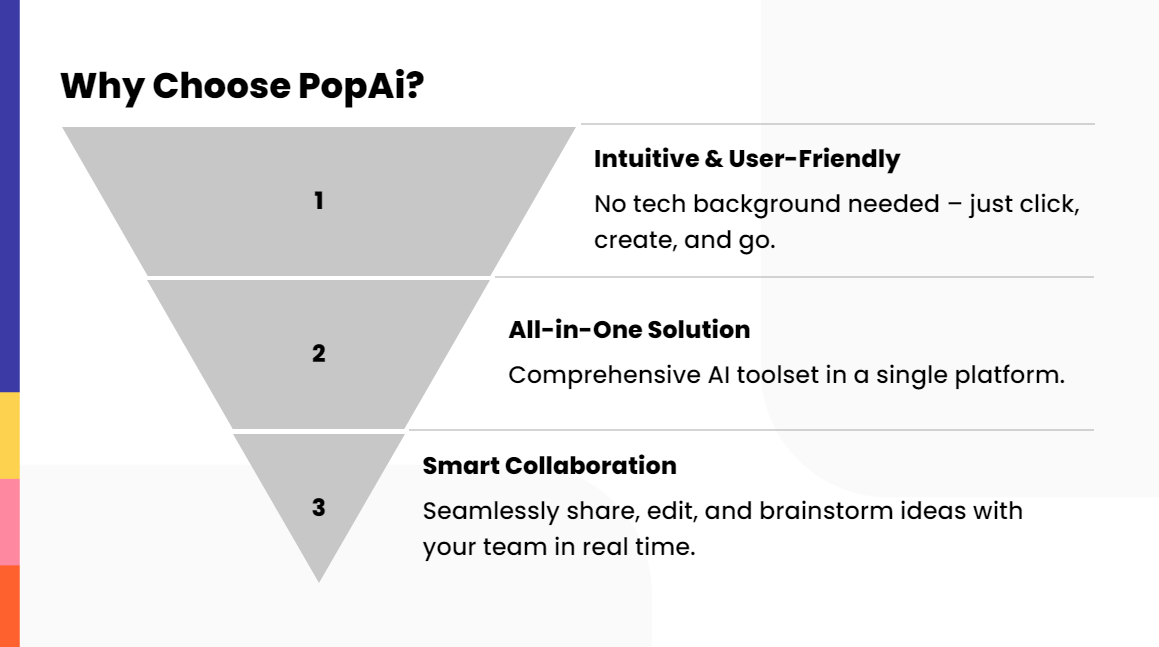
Now, you can use AI tools like popai to make this process incredibly simple. It’s designed for anyone who needs to produce high–quality presentations fast.
Step–by–Step: Build Your Blue Ocean Strategy Presentation with popai
1. One–minute Quick Opening
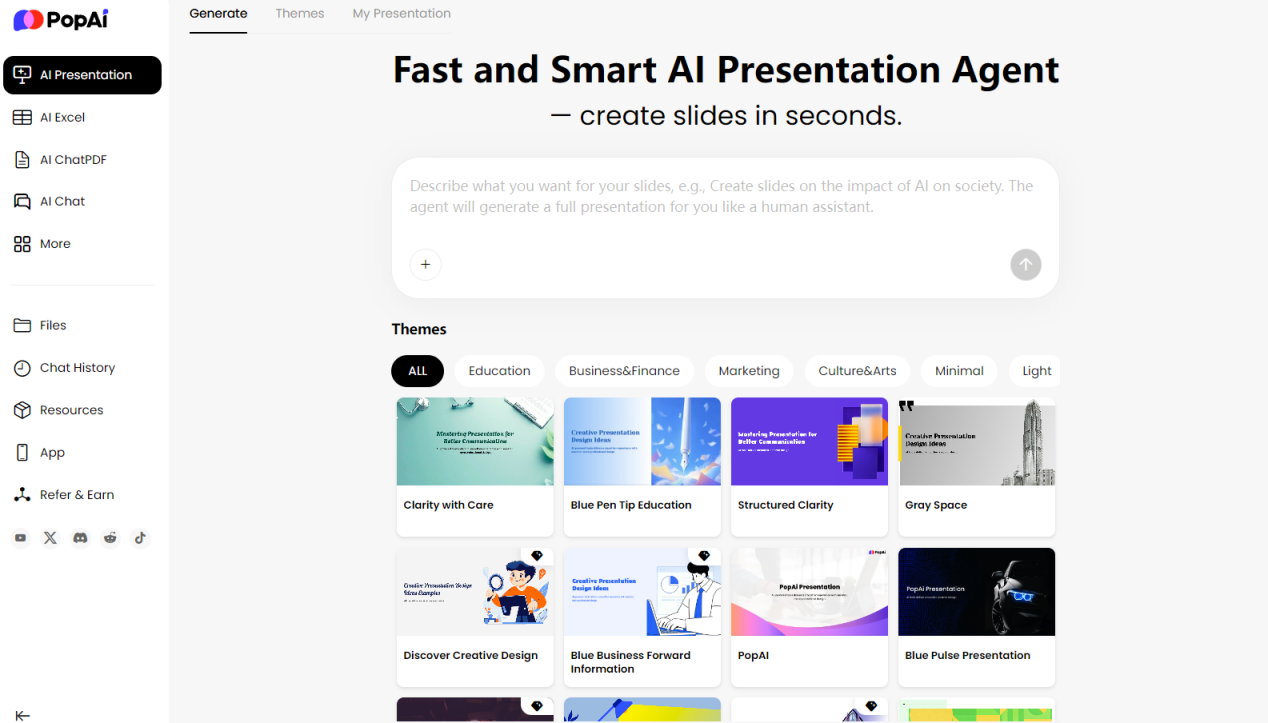
No more struggling with a blank slide. In popai, simply input your core topic (e.g., “Blue Ocean Strategy Analysis for Launching a New Clothing Subscription Box Business”). The AI will generate a well–structured initial outline with the right number of slides based on your topic—the logic is already built for you.
2. Visualize Your Core Analysis
You need to showcase your Strategy Canvas and ERRC Grid—and popai’s AI–enhanced content feature has you covered. Just tell the AI: “Generate a value curve comparison (Strategy Canvas) between traditional clothing stores and my new subscription model” or “Create a four–quadrant ERRC analysis table”. The AI not only understands your request to generate text, but also automatically searches and recommends relevant icons and template graphics. This makes your core analysis slides professional and visually appealing—say goodbye to ugly PPTs for good.
3. Tailor Content to Your Audience
A presentation for your boss has very different priorities from one for your execution team. popai supports an audience–centric design approach. While editing, you can easily adjust the content focus: add more market outlook and financial forecasts for your boss, or detail execution steps and task division for your team. With simple module adjustments, you can create different versions of the same report—dramatically boosting communication efficiency.
4. Seamless Integration & Flexible Editing
You may already have your analysis in a Word document—and popai lets you import existing files, web links, and more in one click. The AI intelligently identifies document structure and automatically converts it into a presentation draft. No more copy–pasting! Just use the intuitive drag–and–drop editing tools to tweak the structure and polish the content on top of the draft, ensuring a smooth, compelling narrative.
5. Maintain Brand Consistency
Throughout the editing process, you can easily unify fonts and color schemes to ensure your final Blue Ocean Strategy slides presentation aligns with your personal or company brand identity—for a truly professional finish.
With these steps, even without any design background, you can turn scattered strategic ideas into a professional visual proposal that persuades decision–makers in no time. This drastically lowers the barrier to strategic communication, making great ideas seen and supported faster.
Avoid These Pitfalls: Common Risks and Misconceptions of Blue Ocean Strategy
Misconception 1: Blue Ocean Strategy requires building a completely unheard–of high–tech product.
Wrong! Blue Oceans are more often about recombining existing elements. Ride–hailing services, for example, didn’t invent mobile phones, GPS, or online payments—but combining these existing technologies created an entirely new market.
Misconception 2: Once you find a Blue Ocean, you‘re set for life.
Wrong! All Blue Oceans eventually turn red. The first brand to launch a “study space + coffee” model was in a Blue Ocean—but as copycats flood the market, it slowly becomes a Red Ocean. Always keep iterating and fine–tuning your strategy.
Risk 1: Building a solution in a vacuum (disconnected from real customer needs).
Your “creation” must be something customers actually want. It’s better to run a minimum viable test first (e.g., launch the clothing subscription service on a small scale for a few months) than to go all–in at once.
Risk 2: Internal pushback.
Long–term employees may think you’re “straying from the core business”. This is where the clear, professional Blue Ocean Strategy slides presentation you made with popai becomes your best tool to align the team and gain support.