The “Sunday Scaries” Are Getting Worse. Here is Why.
It is 10:00 PM on a Tuesday. Your Slack notification sounds like a gunshot in your quiet apartment. It’s the VP of Strategy. He just forwarded you a dense, 85-page industry report on “Global Supply Chain Shifts in 2026” with a simple, terrifying caption: “Need a summary and a deck for the board meeting tomorrow morning. Keep it visual.”
In the old world—let’s say, 2023—you would be doomed. You would be brewing your third pot of coffee, resigning yourself to an all-nighter, manually copy-pasting charts, and fighting with PowerPoint alignment tools until your eyes bled.
But this is 2026. If you are still working that way, you aren’t just inefficient; you are obsolete.
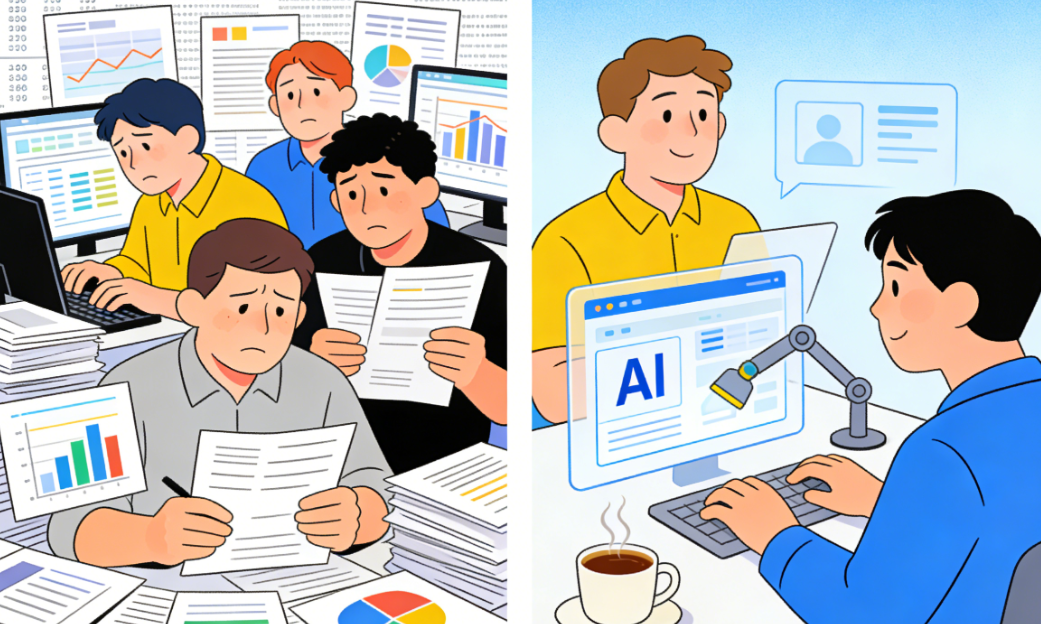
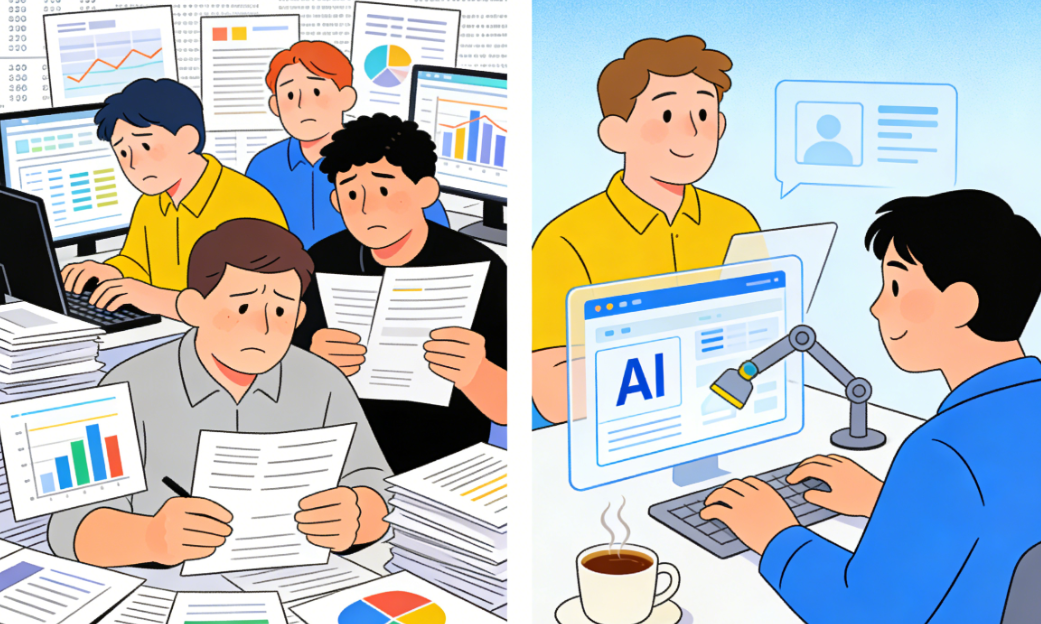
Recent headlines from The Wall Street Journal and TechCrunch have been obsessing over a new workplace phenomenon: the “AI Efficiency Gap.” The news isn’t just that AI is here; it’s that the workforce has split into two distinct species. There are the “Grinders,” who work harder than ever but are drowning in information overload, and the “Architects,” who use AI to bypass the grunt work entirely.
Today, we are going deep into a tool that is currently defining the “Architect” class: PopAi. We aren’t talking about generating funny cat poems. We are talking about the specific, career-saving ability to generate a professional Market Analysis slides presentation from raw data in the time it takes to brew that coffee.
The Information Tsunami: Why We Are All Exhausted
Before we talk about the solution, we have to analyze the problem. Why does work feel harder, even though we have more technology?
The recent “State of Remote Work 2025-2026” report highlighted a brutal truth: the amount of data we are expected to process has tripled in the last two years. Companies are terrified of market volatility. They want data-driven decisions. They want “Market Analysis” for everything.
· Should we open a branch in Austin? Show me the market analysis.
· Is Gen Z buying vintage watches? Where are the slides?
· What is the competitor’s Q3 strategy? Present it.
The bottleneck isn’t finding the data; it’s synthesizing it. The human brain was not designed to read a 100-page PDF, extract the key financial ratios, understand the qualitative risks, and then format that into a 10-slide deck with coherent headers and bullet points—all in 20 minutes.
This is where the “Grinders” fail. They try to do it all manually. They read every word. They fear missing a detail. By the time they understand the document, they have zero energy left for the presentation.
The “Architects” do something different. They don’t read the document to extract data; they use AI to extract the data so they can spend their time interpreting it.
Enter PopAi: The Analyst You Can Put in Your Pocket
I have tested every AI tool on the market. From the big LLMs to the niche presentation builders. Most of them suffer from one of two problems:
1. They are great writers but bad designers: You get a wall of text that looks terrible on a slide.
2. They are great designers but terrible analysts: You get beautiful slides with nonsense text that hallucinates facts.
PopAi has surged in popularity recently because it bridges this gap. It is built around a “Chat with Document” core, meaning its primary brain is focused on reading, understanding, and citing the files you upload.
When you are tasked with that Market Analysis slides presentation, you don’t start by opening PowerPoint. You start by dragging that 85-page PDF into PopAi.
The “Traceable Truth” Factor
Here is the feature that separates a toy from a professional tool, and it is why PopAi is winning the corporate market. When PopAi analyzes a document, it doesn’t just guess.
If you ask, “What are the three biggest risks to the supply chain mentioned in this report?”, PopAi gives you the answer and highlights the exact paragraph in the original PDF where it found that information.
This is crucial for trust. You cannot present a market analysis to a board of directors if you aren’t 100% sure the data is real. With PopAi, you have an audit trail. You can verify every single claim before you put it on a slide. This feature alone solves the “AI Hallucination” fear that keeps many professionals up at night.
The Workflow: How to Create a Market Analysis Slides Presentation in 5 Minutes
Let’s walk through the actual workflow. I did this yesterday with a real report on the “Future of Electric Vehicle Batteries” to test the system.
Step 1: The Upload
I uploaded a dense, academic PDF. PopAi read it instantly.
Step 2: The Deep Dive
I didn’t ask for slides yet. First, I treated PopAi like a junior analyst. I asked:
· “Summarize the key market trends for solid-state batteries.”
· “Extract the projected market growth data for 2027-2030.”
· “What are the competitor vulnerabilities mentioned?”
PopAi extracted this data with source links. I verified the numbers. They were accurate.
Step 3: The Magic Button
This is the game-changer. Once PopAi understands the document, you use the “Create Presentation” feature. You type a prompt like: “Create a 10-slide Market Analysis slides presentation based on this document, focusing on investment risks and opportunities.”
Step 4: The Result
PopAi doesn’t just dump text. It generates an outline. You approve the outline. Then, it builds the slides.
· It writes the headers.
· It bullet-points the data.
· It selects appropriate layouts (SWOT analysis grids, timelines, data columns).
· It inserts relevant illustrations or charts based on the content.
In under 60 seconds, I had a deck. Was it perfect? No. Was it 90% done? Yes.
I spent the next 10 minutes polishing the language and adjusting the design. Total time from “Upload” to “Emailing the Boss”: 15 minutes. The “Grinder” would still be reading page 4 of the PDF.
Why “Free” is Expensive: The Case for Paid Efficiency
Now, let’s address the elephant in the room. Why pay for a subscription when there are free tools?
This brings us back to the “Market Analysis slides presentation” keyword. The value of this specific output is high. If you are a consultant, a marketer, or a project manager, your output is judged by its depth and its speed.
1. Context Window and File Size:
Free tools often choke on large documents. If you try to upload a 100MB annual report to a basic chat bot, it will fail. PopAi Pro handles heavy-duty files. Real market analysis requires heavy data. You cannot analyze a market based on a 2-page abstract.
2. Image Generation and Layout Logic:
The presentation feature in PopAi isn’t just text-to-text; it involves visual logic. The paid tier accesses better layout algorithms and higher-quality image generation. A slide deck with pixelated, generic images screams “amateur.” PopAi’s integration ensures the visual quality matches the intellectual quality.
3. GPT-4 and Advanced Models:
Deep market analysis requires nuance. You need the model to understand the difference between “revenue” and “profit,” or “correlation” and “causation.” The advanced models available in the paid tier of PopAi are significantly better at parsing complex business logic. When you are presenting to your boss, a misunderstanding of the data is fatal. The cost of a monthly subscription is irrelevant compared to the cost of looking incompetent in a meeting.
The Psychological Shift: From Creator to Editor
The most profound impact of using PopAi isn’t just the time saved; it’s the reduction in cognitive load.
Writers and strategists often suffer from “Blank Page Syndrome.” Staring at a white PowerPoint slide is paralyzing. Where do you start? What is the title?
PopAi removes this paralysis. It gives you a “Strawman”—a first draft. Even if you change 50% of what PopAi generates, the psychological hurdle of starting is gone. You are no longer creating from scratch; you are editing.
Editing is easier than creating. It requires less willpower. It allows you to focus on the narrative and the strategy rather than the formatting and the typos. This is how high-performers avoid burnout. They conserve their mental energy for the high-value decisions (the “So What?”) and outsource the low-value labor (the formatting and summarizing) to AI.
The Future of the “One-Person Unicorn”
Looking at the broader market trends of 2026, we are seeing the rise of the “One-Person Unicorn.” These are freelancers or employees who produce the output of a 5-person team.
They don’t have secret powers. They just have a better tech stack.
They use PopAi to read the research. They use PopAi to draft the emails. And crucially, they use PopAi to build the Market Analysis slides presentation that convinces the client to sign the check.
If you are a student, this is your secret weapon for case competitions.
If you are a researcher, this is how you handle literature reviews.
If you are a corporate warrior, this is how you get your weekends back.
Conclusion: Don’t Be a Hero, Be Smart
The romantic idea of the “hard worker” who stays late at the office is dying. In the 2026 economy, nobody cares how long you worked; they only care about what you delivered.
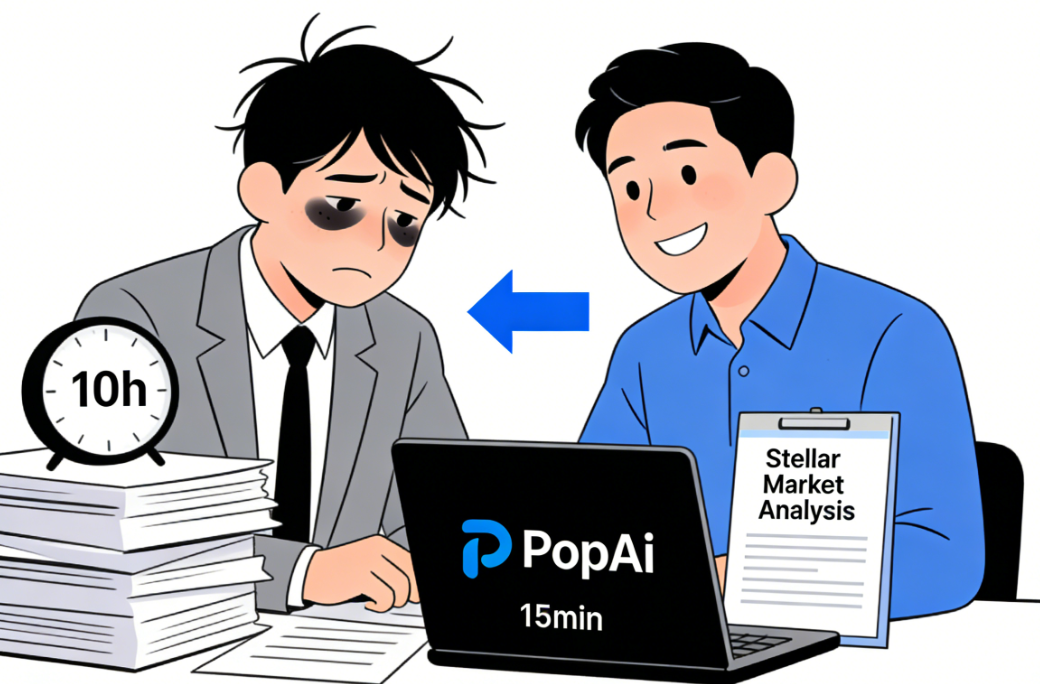
If you hand in a mediocre presentation after 10 hours of work, you lose.
If you hand in a stellar presentation after 15 minutes of work using PopAi, you win.
The capability to generate a Market Analysis slides presentation directly from your source documents is not just a “nice to have” feature—it is a competitive advantage. The data is traceable, the speed is unmatched, and the quality is high enough to pass the C-suite sniff test.
So, the next time that Tuesday night notification pings, don’t panic. Don’t brew the coffee. Just open PopAi.
Ready to stop grinding and start architecting?
The difference between a stressful career and a successful one might just be the tools in your dock. Don’t let the AI revolution leave you behind—use it to propel you forward. Upgrade your workflow, secure your data, and turn that mountain of PDFs into a winning deck before your coffee gets cold.