
Presentation Summary
SpaceX leads as the world's most active launch provider, revolutionizing space access with over 100 missions annually. Learn about their launch capabilities, mission schedules, and Starship program advancements.
Full Presentation Transcript
Slide 1: SpaceX Launch Operations: Revolutionizing Space Access in 2026
Comprehensive overview of SpaceX launch capabilities, mission schedules, Vandenberg operations, and Starship program advancements
Slide 2: Contents
- Introduction to SpaceX Launch Ecosystem
- Company Background and Competitive Positioning
- Operational Capabilities and Launch Infrastructure
- 2026 Mission Schedule and Cadence Analysis
- Vandenberg Space Force Base Strategic Role
- Starship Next-Generation Development
- Industry Implications and Future Outlook
Slide 3: SpaceX Launch Operations: World's Most Active Launch Provider in 2026
- Unprecedented Launch Cadence: SpaceX operates as the world's most active launch services provider with unprecedented launch cadence exceeding 100 missions annually
- Strategic Launch Sites: Primary launch sites include Cape Canaveral Space Force Station in Florida, Kennedy Space Center, and Vandenberg Space Force Base in California
- Falcon 9 Workhorse: Falcon 9 serves as the workhorse rocket with proven reusability reducing operational costs by up to 70%
- Diverse Mission Portfolio: Launch portfolio encompasses commercial satellites, government payloads, Starlink constellation deployment, and crewed human spaceflight missions
- Historic 2026 Achievement: 2026 marks historic achievement with over 600 Starlink satellites successfully deployed by March alone demonstrating production capacity
Slide 4: Mission Diversity: From Commercial Satellites to Human Spaceflight
- Starlink Expansion: Starlink missions constitute the majority of launches building global broadband infrastructure with polar shell expansion planned for 2026
- NASA Partnerships: NASA partnerships include ISS cargo resupply with NG-24 mission scheduled April 8 2026 and crew rotation Crew-12 mission
- Space Force Missions: U.S. Space Force missions support national security through Space Development Agency Transport Layer constellation deployment for military communications
- International Customers: International customer base spans commercial telecommunications providers, Earth observation operators, and scientific research institutions globally
- Operational Flexibility: Demonstrated capability to launch multiple mission types from different pads within 24-hour windows showing operational flexibility
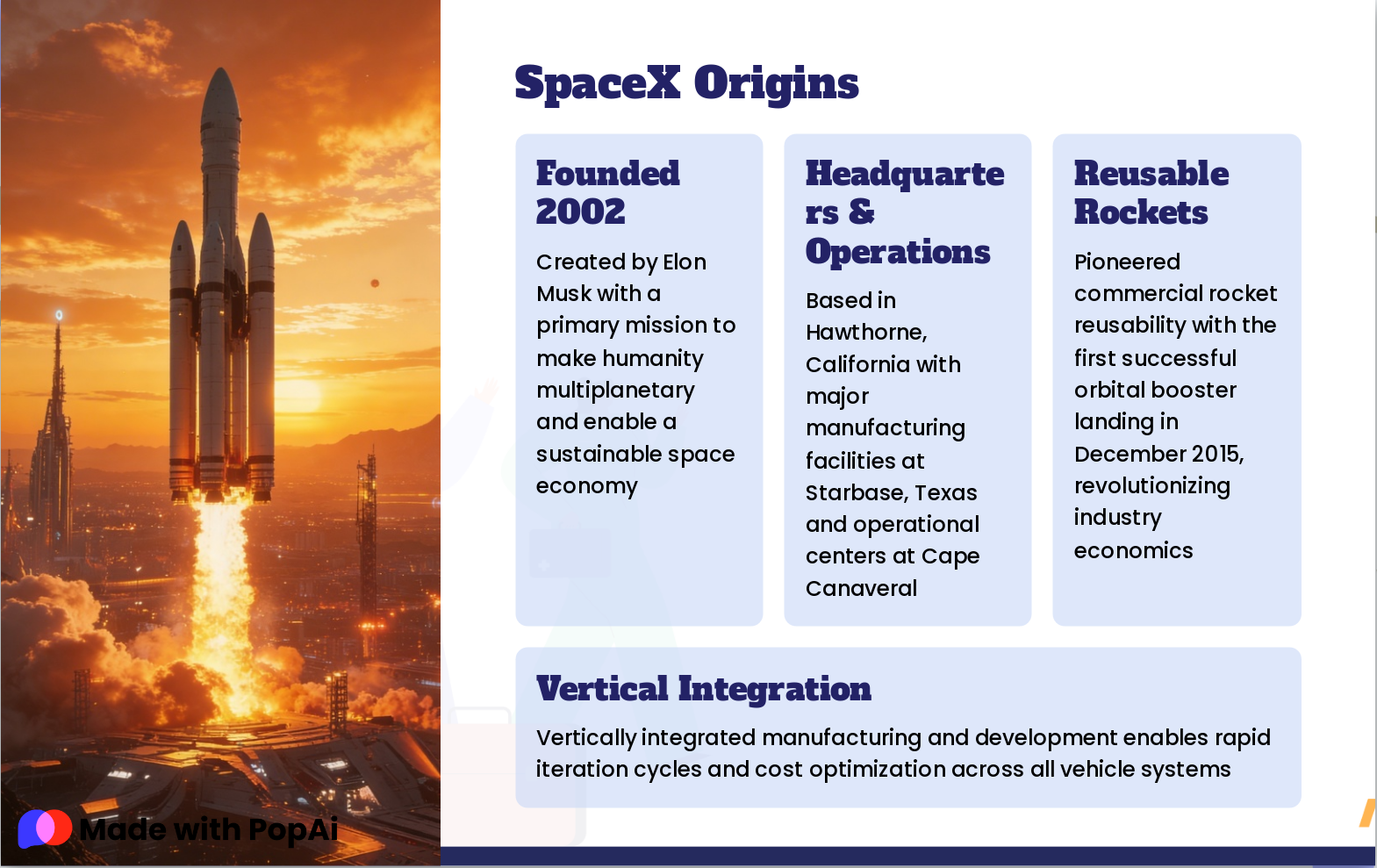
Slide 5: SpaceX Origins
- Founded 2002: Created by Elon Musk with a primary mission to make humanity multiplanetary and enable a sustainable space economy
- Headquarters & Operations: Based in Hawthorne, California with major manufacturing facilities at Starbase, Texas and operational centers at Cape Canaveral
- Reusable Rockets: Pioneered commercial rocket reusability with the first successful orbital booster landing in December 2015, revolutionizing industry economics
- Vertical Integration: Vertically integrated manufacturing and development enables rapid iteration cycles and cost optimization across all vehicle systems
Slide 6: Strategic Positioning: Redefining Space Economics
- Falcon 9 Reusability: Breakthrough reusable rocket technology reduced launch costs from $200+ million to under $70 million per mission, making space accessible and revolutionizing the economics of spaceflight.
- Market Dominance: Captured approximately 60-70% of the global commercial launch market share in 2026, surpassing all competitors combined and establishing unmatched industry leadership.
- Government Partnership: NASA's primary Commercial Crew and Cargo provider with multiple multi-billion dollar government contracts ensuring long-term stable revenue and mission-critical responsibilities.
- Diversified Revenue: Revenue model combines commercial launch services, government contracts, and Starlink subscription services creating multiple income streams and reducing business concentration risk.
- Critical Infrastructure: Dragon spacecraft remains the only active U.S.-based crewed orbital vehicle as of 2026, maintaining essential human spaceflight capability for American space operations.
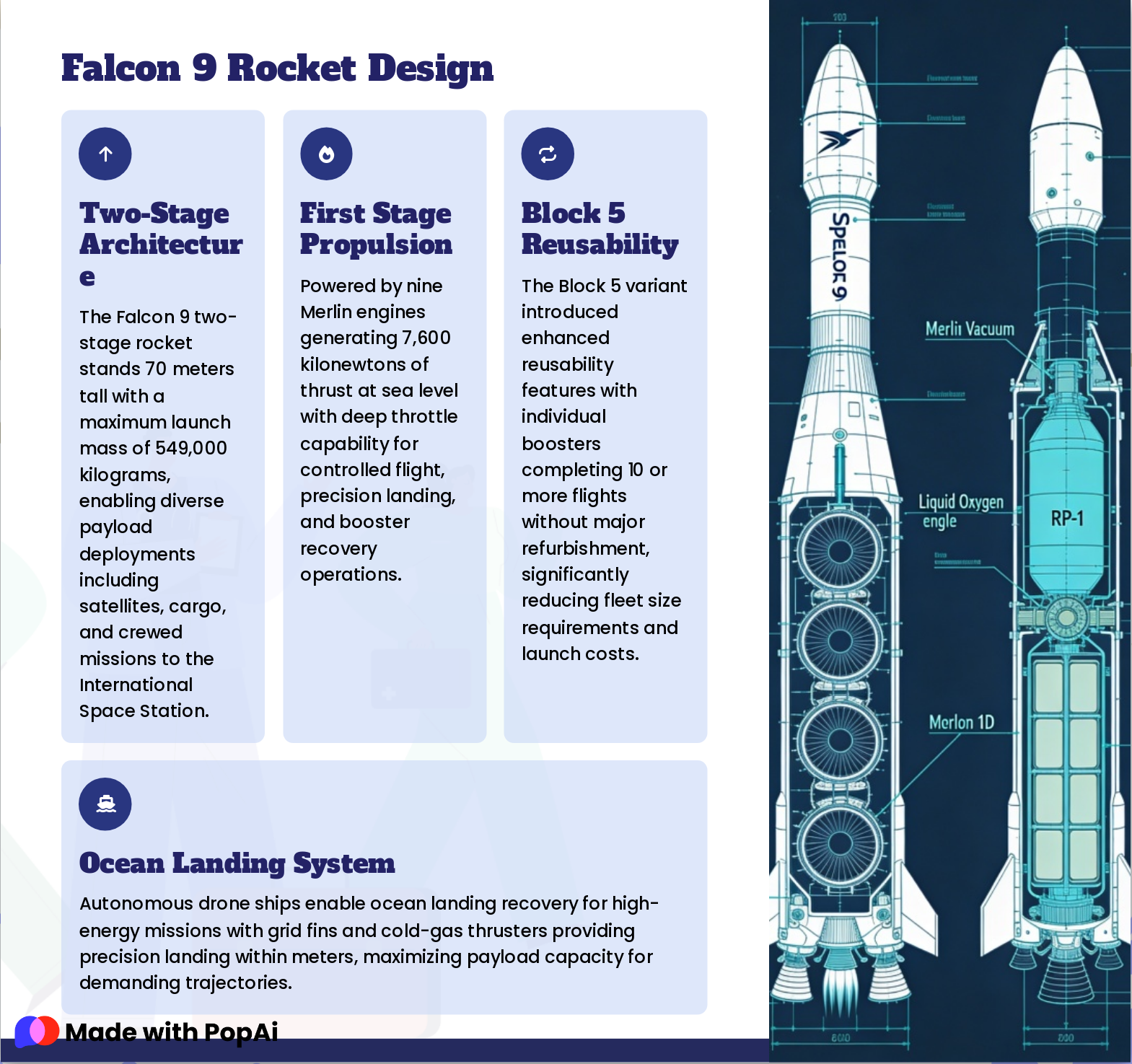
Slide 7: Falcon 9 Rocket Design
- Two-Stage Architecture: The Falcon 9 two-stage rocket stands 70 meters tall with a maximum launch mass of 549,000 kilograms, enabling diverse payload deployments including satellites, cargo, and crewed missions to the International Space Station.
- First Stage Propulsion: Powered by nine Merlin engines generating 7,600 kilonewtons of thrust at sea level with deep throttle capability for controlled flight, precision landing, and booster recovery operations.
- Block 5 Reusability: The Block 5 variant introduced enhanced reusability features with individual boosters completing 10 or more flights without major refurbishment, significantly reducing fleet size requirements and launch costs.
- Ocean Landing System: Autonomous drone ships enable ocean landing recovery for high-energy missions with grid fins and cold-gas thrusters providing precision landing within meters, maximizing payload capacity for demanding trajectories.
Slide 8: Launch Infrastructure: Multi-Site Operations
- Space Launch Complex 40: Primary East Coast launch pad at Cape Canaveral with capacity for high-cadence mission operations
- Launch Complex 39A: Kennedy Space Center facility supporting crewed missions and Falcon Heavy launches requiring larger pad infrastructure
- Space Launch Complex 4 East: Vandenberg location enabling polar and sun-synchronous orbit missions for Earth observation and national security
- Rapid Turnaround: Pad refurbishment possible in as little as 48 hours between launches, maximizing facility utilization
- Ground Support Equipment: Propellant storage facilities, strongback tower systems, and vertical integration processing hangars enabling efficient mission preparation
Slide 9: Launch Cadence Records
- 2026 Launch Pace: Exceeds 100 missions annually across all SpaceX facilities establishing new industry records for operational cadence
- Multi-Site Coordination: Demonstrated capability to conduct multiple launches per week from different geographic sites with coordinated ground operations
- Rapid Turnaround: Average turnaround time between launches reduced to 3-5 days per launch pad through optimized ground processing and booster reuse logistics
- Booster Reliability: Booster reuse record extends beyond 20 individual flights for some first stage cores demonstrating reliability and durability of Block 5 design
Slide 10: 2026 Launch Schedule Overview: Record-Breaking Year
- Industry Record: Total projected launches for 2026 exceed 120 missions marking all-time industry record demonstrating unmatched operational scale
- Starlink Constellation: Launch manifest includes approximately 70% Starlink missions supporting constellation expansion toward 12,000 satellite global coverage target
- Commercial and Government: Commercial and government missions account for remaining 30% comprising cargo resupply crewed flights and national security payloads
- Peak Activity Periods: Peak activity periods align with Spring and Fall windows when optimal orbital mechanics enable specific inclination and energy requirements
- Schedule Flexibility: Real-time schedule updates maintain flexibility for customer mission requirements technical readiness assessments and weather contingencies
Slide 11: Florida Launch Operations: East Coast Mission Hub
- Cape Canaveral SLC-40: Hosts multiple Starlink missions scheduled for April 9, 13, 14, 26, and 29, 2026, maintaining biweekly cadence
- NG-24 Cargo Mission: Cargo resupply mission to International Space Station launches April 8, 2026, with first stage landing at Landing Zone recovery facility
- Crew-12 Mission: Astronaut mission to ISS scheduled from Launch Complex 39A in second quarter 2026, transporting four crew members to orbital station
- Satellite Deployment: Over 600 Starlink satellites successfully deployed by March 3, 2026, in coordinated predawn launch operations from Florida facilities
- Orbital Capabilities: Florida sites enable direct access to International Space Station inclination 51.6 degrees and geostationary transfer orbits for commercial customers
Slide 12: Mission Profiles: Payload Types and Orbit Destinations
- Low Earth Orbit Missions: Between 340-550 kilometers altitude primarily supporting Starlink constellation deployment and ISS resupply operations
- Polar Orbit Support: From Vandenberg Space Force Base supporting Earth observation satellites reconnaissance missions and environmental monitoring payloads
- Geostationary Transfer Orbit: Launches deploy commercial telecommunications satellites to fixed positions serving broadcast and communications operators
- SDA Transport Layer: Space Development Agency Transport Layer missions enhance military communications infrastructure across warfighter platforms globally
- ISS Maintenance Operations: Maintain precise 51.6 degree inclination orbit enabling crew rotation and cargo resupply operations
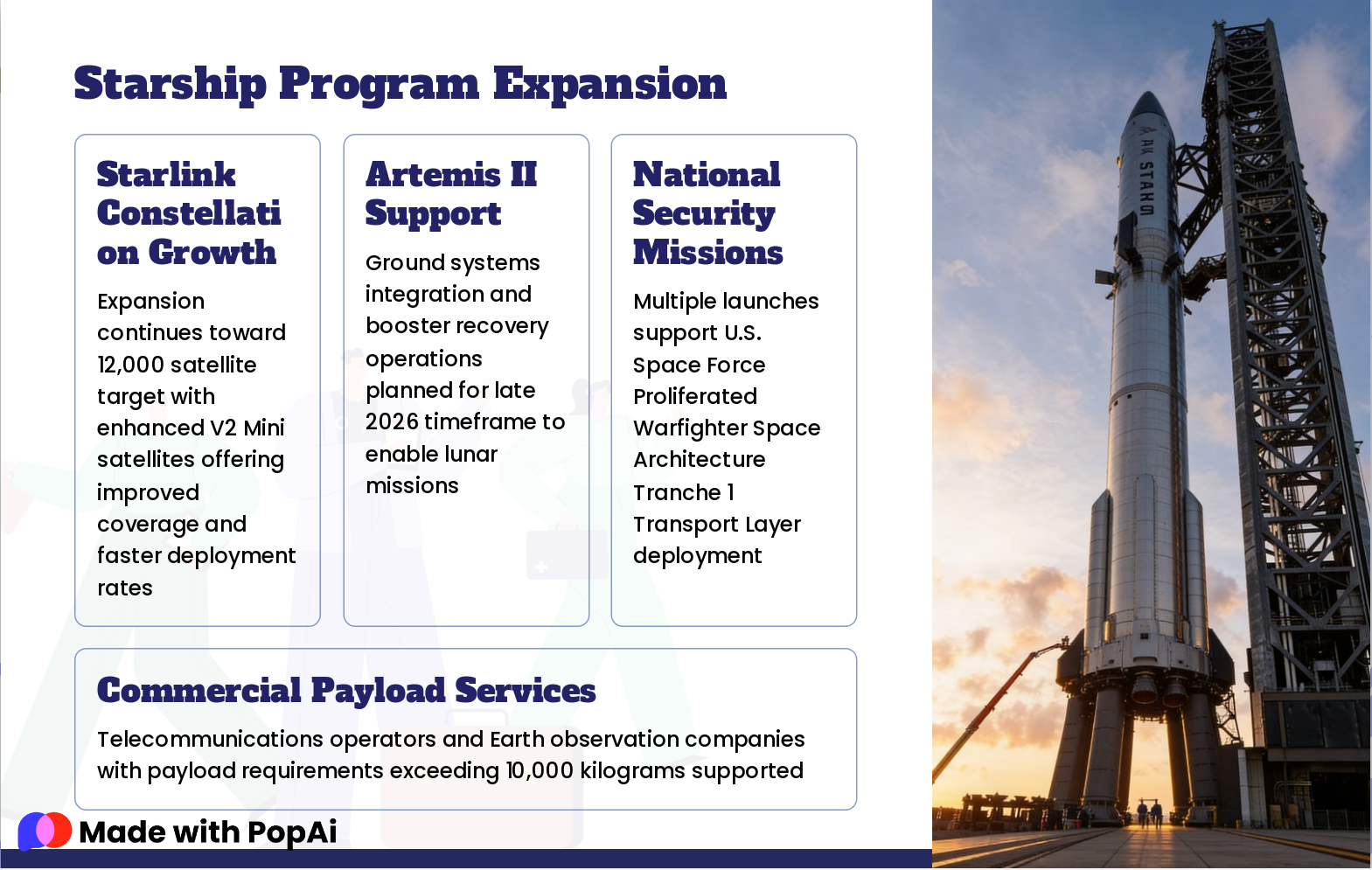
Slide 13: Starship Program Expansion
- Starlink Constellation Growth: Expansion continues toward 12,000 satellite target with enhanced V2 Mini satellites offering improved coverage and faster deployment rates
- Artemis II Support: Ground systems integration and booster recovery operations planned for late 2026 timeframe to enable lunar missions
- National Security Missions: Multiple launches support U.S. Space Force Proliferated Warfighter Space Architecture Tranche 1 Transport Layer deployment
- Commercial Payload Services: Telecommunications operators and Earth observation companies with payload requirements exceeding 10,000 kilograms supported
Slide 14: Vandenberg Space Force Base: West Coast Gateway to Polar Orbits
- Launch Complex Infrastructure: Space Launch Complex 4 East at Vandenberg Space Force Base serves as SpaceX's primary California launch facility with dedicated infrastructure
- Strategic Geographic Location: Geographic location enables access to polar and sun-synchronous orbits without overflying populated areas ensuring public safety and environmental protection
- Recent Mission Success: Seventh launch of 2026 from Vandenberg occurred February 6 carrying Starlink 17-32 mission with over 50 satellites deployed
- Sustained Launch Cadence: Upcoming launches throughout April 2026 maintain biweekly operational cadence demonstrating sustained launch tempo at West Coast facility
- Maritime Safety Profile: Coastal location provides direct trajectory over Pacific Ocean with extensive exclusion zones minimizing maritime hazards and air traffic conflicts
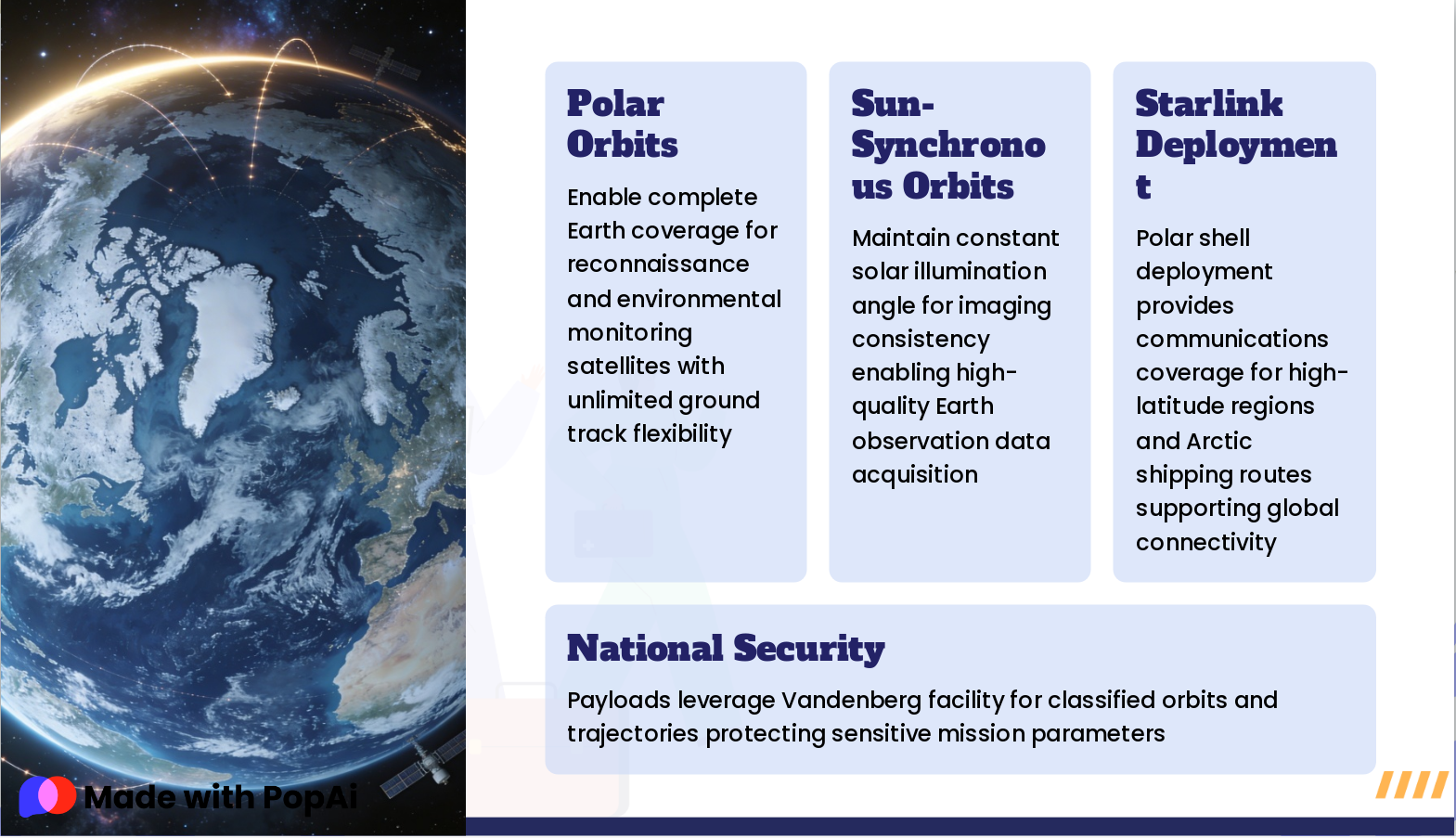
Slide 15: Polar Orbits
- Polar Orbits: Enable complete Earth coverage for reconnaissance and environmental monitoring satellites with unlimited ground track flexibility
- Sun-Synchronous Orbits: Maintain constant solar illumination angle for imaging consistency enabling high-quality Earth observation data acquisition
- Starlink Deployment: Polar shell deployment provides communications coverage for high-latitude regions and Arctic shipping routes supporting global connectivity
- National Security: Payloads leverage Vandenberg facility for classified orbits and trajectories protecting sensitive mission parameters
Slide 16: Vandenberg Operations: Regional Economic and Technological Impact
- Public Engagement and STEM Education: Local viewing opportunities attract thousands of spectators to California coast for launches generating interest in space industry and STEM education
- National Security Partnership: Partnership with U.S. Space Force maintains critical national security launch infrastructure and ensures military access to space for defense operations
- Aerospace Industry Growth: Regional aerospace industry benefits from supply chain development and technical workforce training supporting advanced manufacturing capabilities
- Environmental Stewardship: Environmental monitoring ensures minimal impact on coastal ecosystems and marine life through careful launch scheduling and range operations protocols
- Regulatory Compliance: Launch operations coordinated with FAA flight restrictions and maritime exclusion zones ensuring compliance with federal regulations and public safety standards
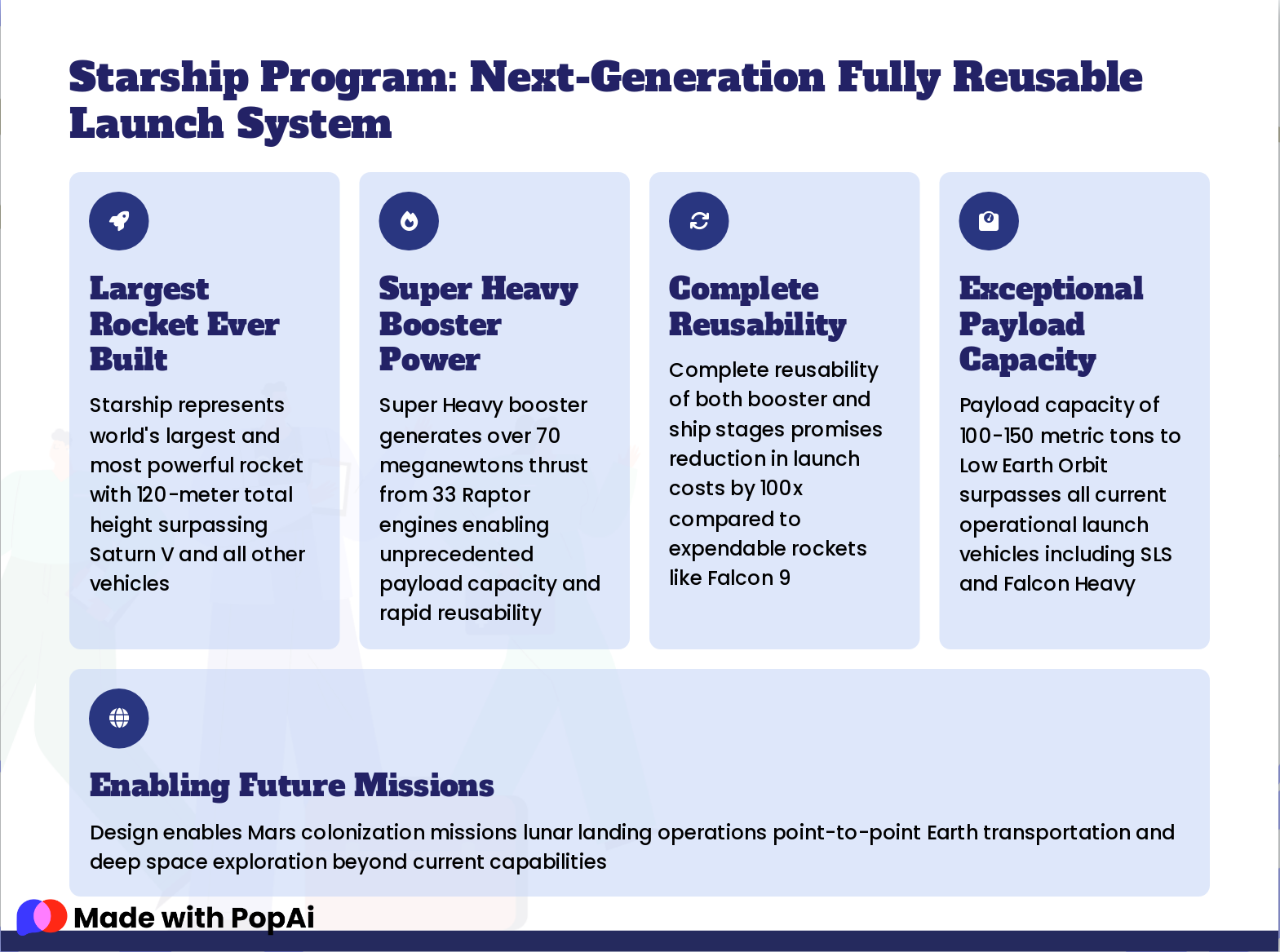
Slide 17: Starship Program: Next-Generation Fully Reusable Launch System
- Largest Rocket Ever Built: Starship represents world's largest and most powerful rocket with 120-meter total height surpassing Saturn V and all other vehicles
- Super Heavy Booster Power: Super Heavy booster generates over 70 meganewtons thrust from 33 Raptor engines enabling unprecedented payload capacity and rapid reusability
- Complete Reusability: Complete reusability of both booster and ship stages promises reduction in launch costs by 100x compared to expendable rockets like Falcon 9
- Exceptional Payload Capacity: Payload capacity of 100-150 metric tons to Low Earth Orbit surpasses all current operational launch vehicles including SLS and Falcon Heavy
- Enabling Future Missions: Design enables Mars colonization missions lunar landing operations point-to-point Earth transportation and deep space exploration beyond current capabilities
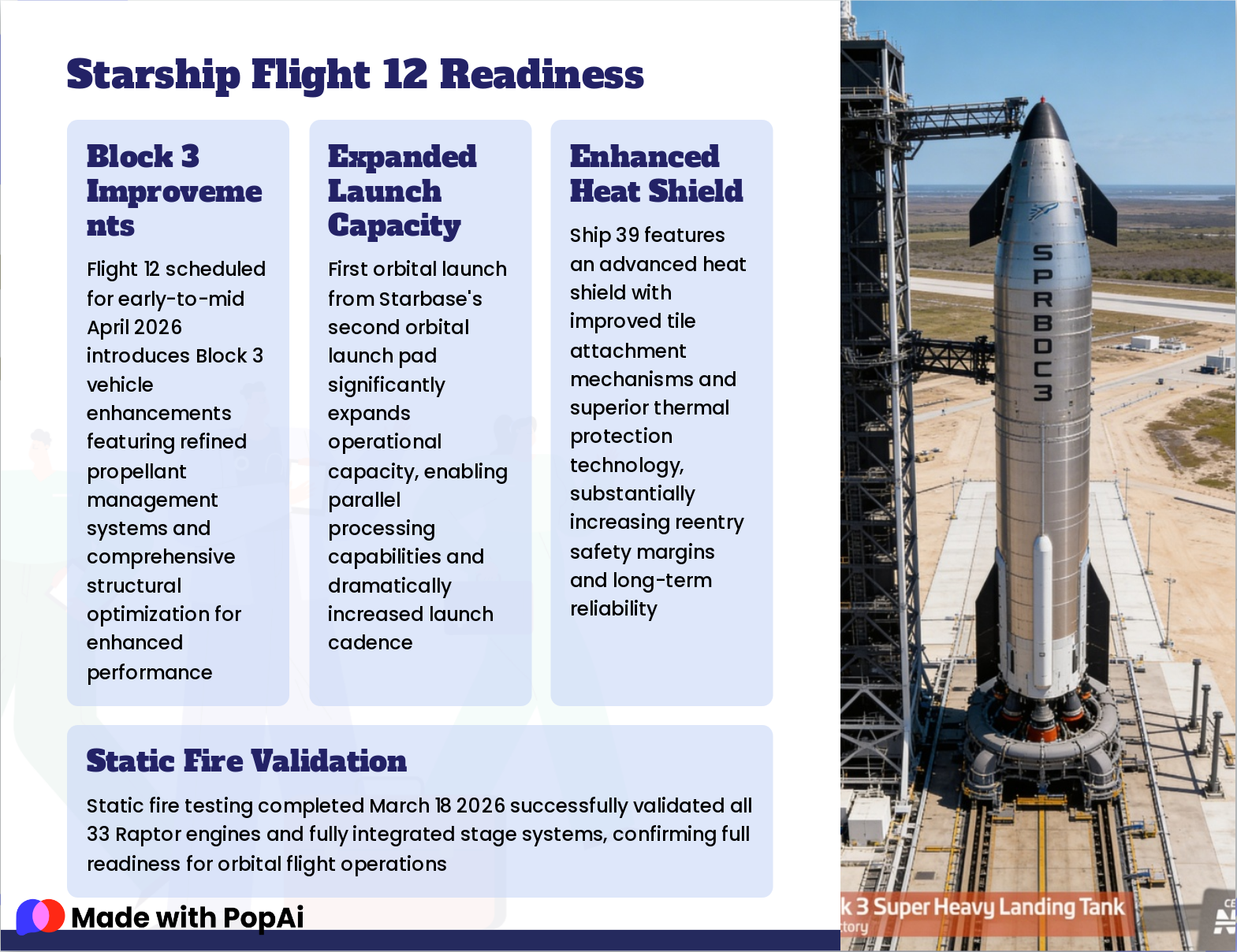
Slide 18: Starship Flight 12 Readiness
- Block 3 Improvements: Flight 12 scheduled for early-to-mid April 2026 introduces Block 3 vehicle enhancements featuring refined propellant management systems and comprehensive structural optimization for enhanced performance
- Expanded Launch Capacity: First orbital launch from Starbase's second orbital launch pad significantly expands operational capacity, enabling parallel processing capabilities and dramatically increased launch cadence
- Enhanced Heat Shield: Ship 39 features an advanced heat shield with improved tile attachment mechanisms and superior thermal protection technology, substantially increasing reentry safety margins and long-term reliability
- Static Fire Validation: Static fire testing completed March 18 2026 successfully validated all 33 Raptor engines and fully integrated stage systems, confirming full readiness for orbital flight operations
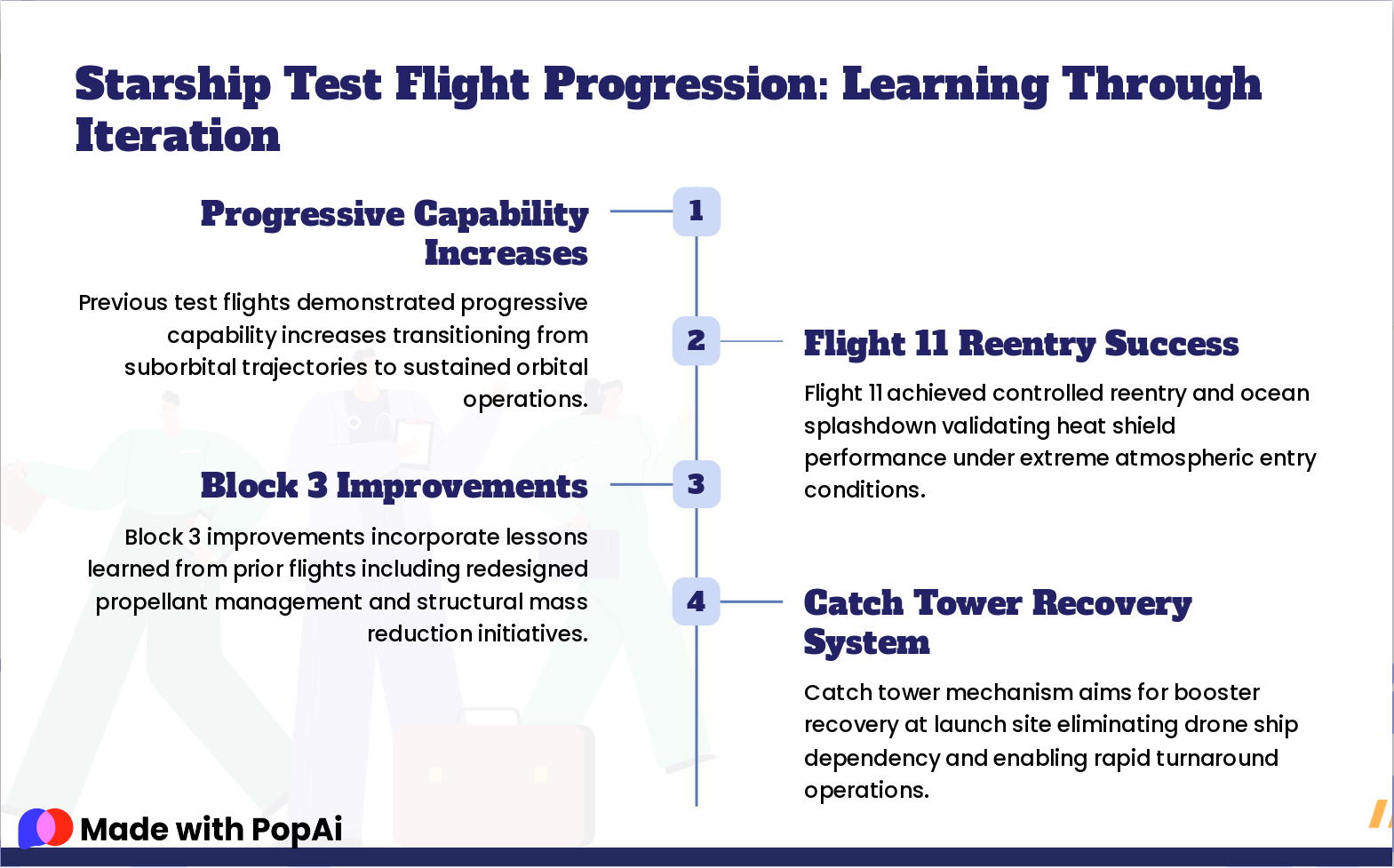
Slide 19: Starship Test Flight Progression: Learning Through Iteration
- Progressive Capability Increases: Previous test flights demonstrated progressive capability increases transitioning from suborbital trajectories to sustained orbital operations.
- Flight 11 Reentry Success: Flight 11 achieved controlled reentry and ocean splashdown validating heat shield performance under extreme atmospheric entry conditions.
- Block 3 Improvements: Block 3 improvements incorporate lessons learned from prior flights including redesigned propellant management and structural mass reduction initiatives.
- Catch Tower Recovery System: Catch tower mechanism aims for booster recovery at launch site eliminating drone ship dependency and enabling rapid turnaround operations.
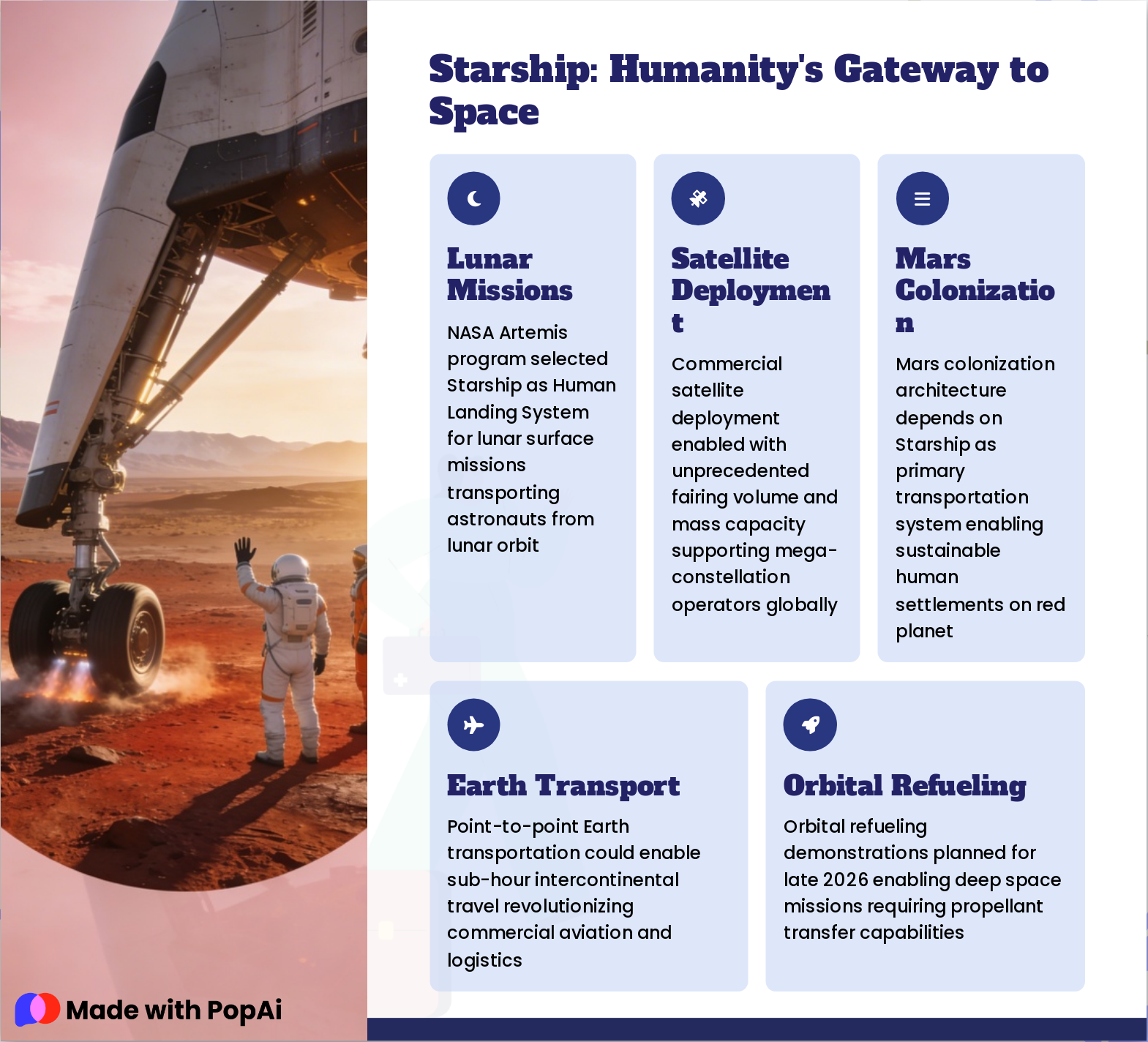
Slide 20: Starship: Humanity's Gateway to Space
- Lunar Missions: NASA Artemis program selected Starship as Human Landing System for lunar surface missions transporting astronauts from lunar orbit
- Satellite Deployment: Commercial satellite deployment enabled with unprecedented fairing volume and mass capacity supporting mega-constellation operators globally
- Mars Colonization: Mars colonization architecture depends on Starship as primary transportation system enabling sustainable human settlements on red planet
- Earth Transport: Point-to-point Earth transportation could enable sub-hour intercontinental travel revolutionizing commercial aviation and logistics
- Orbital Refueling: Orbital refueling demonstrations planned for late 2026 enabling deep space missions requiring propellant transfer capabilities
Slide 21: Industry Impact: Transforming Space Economics and Access
- Launch Cost Reduction: Democratizes space access for smaller nations and commercial entities previously unable to afford space missions
- Reusability Paradigm Shift: Forces traditional aerospace companies to innovate, develop reusable systems or exit market competing for launch services
- Satellite Constellation Economics: Viable only through SpaceX's high-cadence low-cost launch model fundamentally changing industry business models
- New Business Models Enabled: Reduced launch costs enable new business models in space manufacturing space tourism and commercial space station operations
- International Competition Intensifies: Other nations develop reusable rocket programs including Europe China and emerging space powers
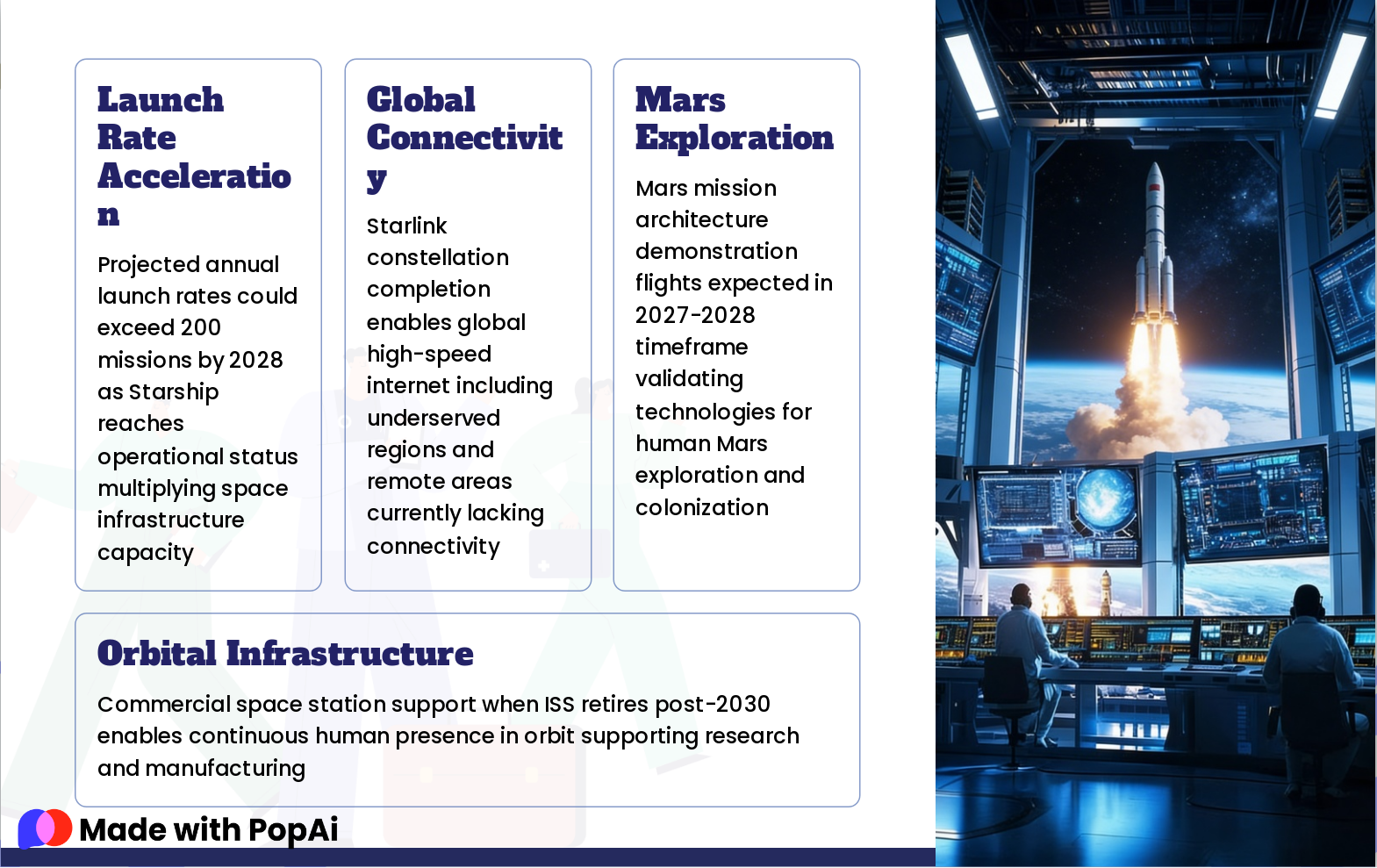
Slide 22: Launch Rate Acceleration
- Launch Rate Acceleration: Projected annual launch rates could exceed 200 missions by 2028 as Starship reaches operational status multiplying space infrastructure capacity
- Global Connectivity: Starlink constellation completion enables global high-speed internet including underserved regions and remote areas currently lacking connectivity
- Mars Exploration: Mars mission architecture demonstration flights expected in 2027-2028 timeframe validating technologies for human Mars exploration and colonization
- Orbital Infrastructure: Commercial space station support when ISS retires post-2030 enables continuous human presence in orbit supporting research and manufacturing
Slide 23: Thank You
Thank You 2026 establishes new records in launch frequency operational efficiency and reusability marking a watershed moment in space industry history. SpaceX's achievements reshape human access to space enabling scientific discovery commercial opportunity and sustainable expansion beyond Earth.