Presentation Summary
An in-depth analysis of the Russia-Ukraine conflict in 2025-2026, exploring the stalemate, air campaigns, diplomatic breakdown, and humanitarian crisis.
Full Presentation Transcript
Slide 1: Russia-Ukraine Conflict: Unstable Equilibrium
Comprehensive analysis of the ongoing stalemate, large-scale air campaigns, diplomatic breakdown, and humanitarian impact in 2025-2026
Slide 2: Contents
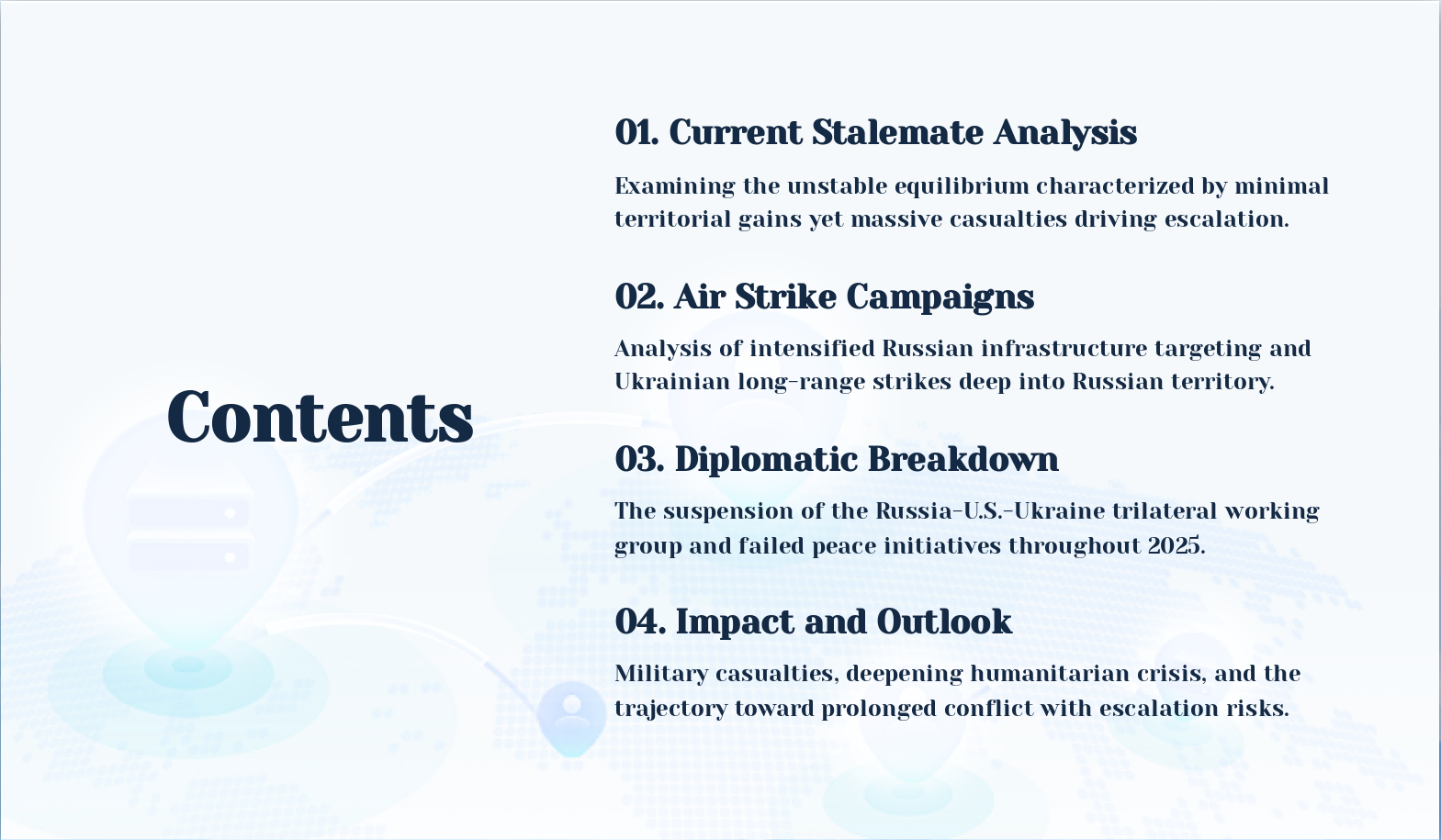
- Current Stalemate Analysis: Examining the unstable equilibrium characterized by minimal territorial gains yet massive casualties driving escalation.
- Air Strike Campaigns: Analysis of intensified Russian infrastructure targeting and Ukrainian long-range strikes deep into Russian territory.
- Diplomatic Breakdown: The suspension of the Russia-U.S.-Ukraine trilateral working group and failed peace initiatives throughout 2025.
- Impact and Outlook: Military casualties, deepening humanitarian crisis, and the trajectory toward prolonged conflict with escalation risks.
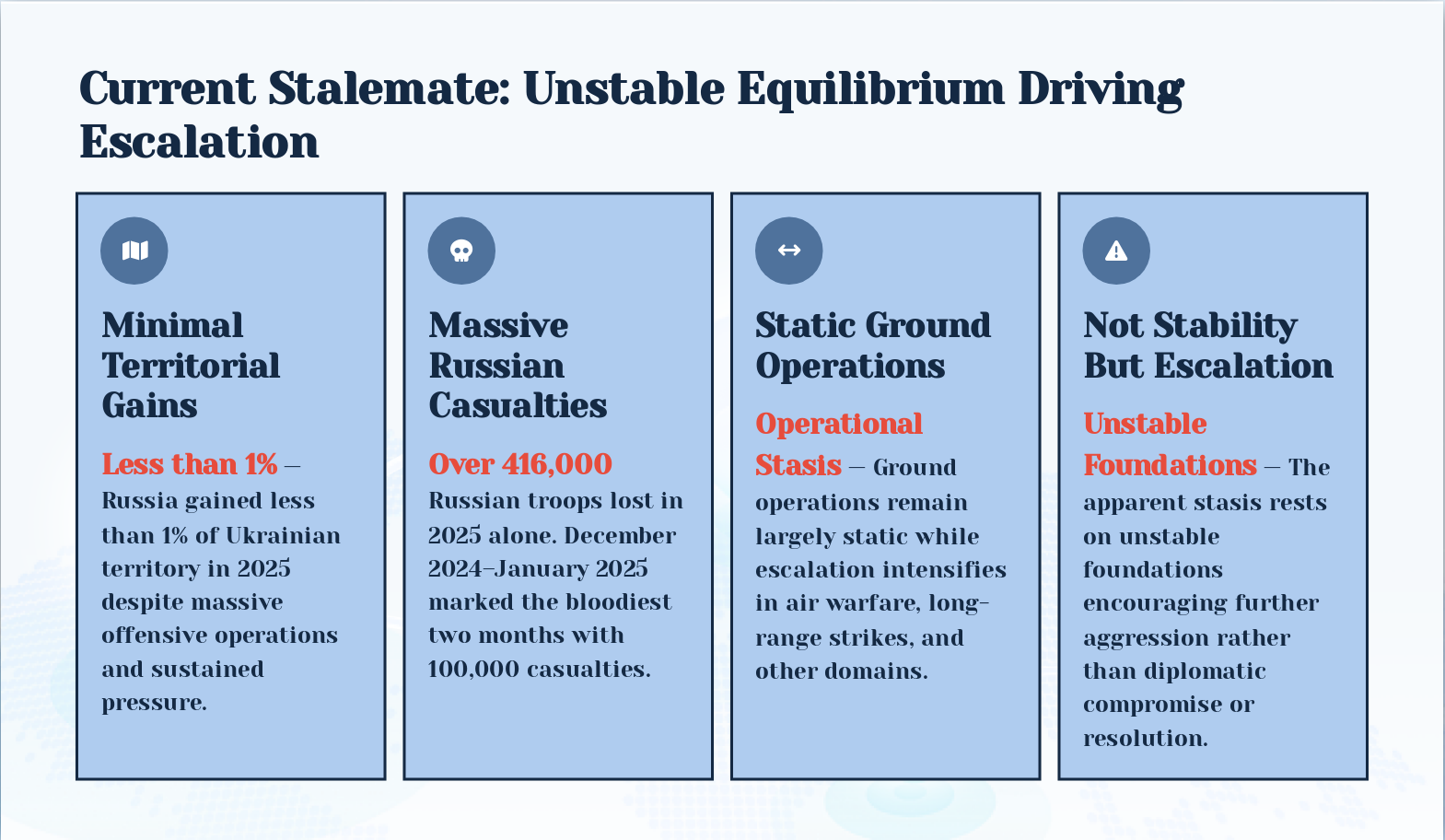
Slide 3: Current Stalemate: Unstable Equilibrium Driving Escalation
- Minimal Territorial Gains: Less than 1% — Russia gained less than 1% of Ukrainian territory in 2025 despite massive offensive operations and sustained pressure.
- Massive Russian Casualties: Over 416,000 Russian troops lost in 2025 alone. December 2024–January 2025 marked the bloodiest two months with 100,000 casualties.
- Static Ground Operations: Operational Stasis — Ground operations remain largely static while escalation intensifies in air warfare, long-range strikes, and other domains.
- Not Stability But Escalation: Unstable Foundations — The apparent stasis rests on unstable foundations encouraging further aggression rather than diplomatic compromise or resolution.
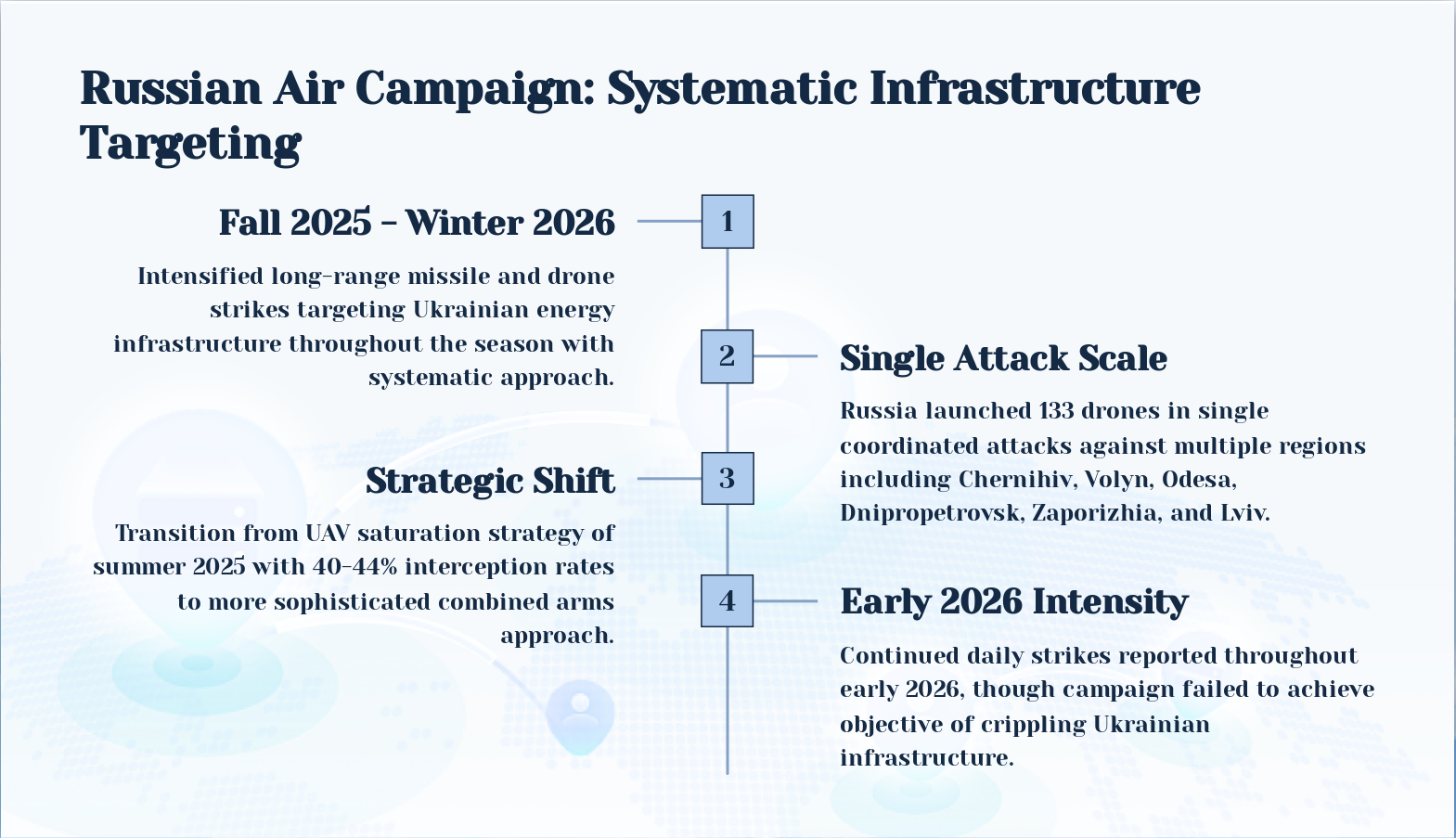
Slide 4: Russian Air Campaign: Systematic Infrastructure Targeting
- Fall 2025 - Winter 2026: Intensified long-range missile and drone strikes targeting Ukrainian energy infrastructure throughout the season with systematic approach.
- Single Attack Scale: Russia launched 133 drones in single coordinated attacks against multiple regions including Chernihiv, Volyn, Odesa, Dnipropetrovsk, Zaporizhia, and Lviv.
- Strategic Shift: Transition from UAV saturation strategy of summer 2025 with 40-44% interception rates to more sophisticated combined arms approach.
- Early 2026 Intensity: Continued daily strikes reported throughout early 2026, though campaign failed to achieve objective of crippling Ukrainian infrastructure.
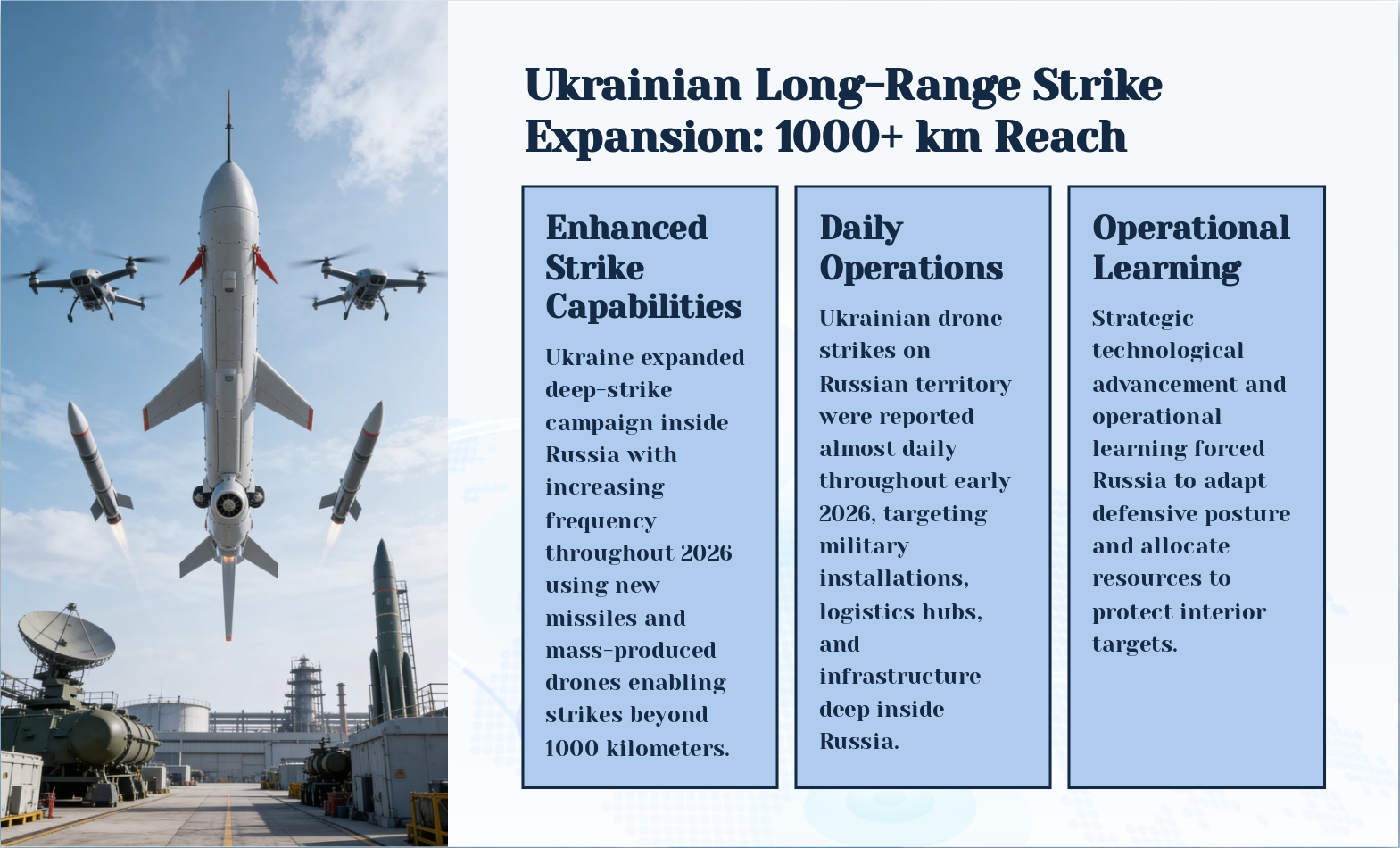
Slide 5: Ukrainian Long-Range Strike Expansion: 1000+ km Reach
- Enhanced Strike Capabilities: Ukraine expanded deep-strike campaign inside Russia with increasing frequency throughout 2026 using new missiles and mass-produced drones enabling strikes beyond 1000 kilometers.
- Daily Operations: Ukrainian drone strikes on Russian territory were reported almost daily throughout early 2026, targeting military installations, logistics hubs, and infrastructure deep inside Russia.
- Operational Learning: Strategic technological advancement and operational learning forced Russia to adapt defensive posture and allocate resources to protect interior targets.
Slide 6: Trilateral Security Working Group Suspended: Diplomatic Breakdown
- March 19, 2026: March 19, 2026: Russia-U.S.-Ukraine trilateral working group on security issues officially suspended, announced simultaneously by Russian and U.S. sources.
- Group Mandate: The trilateral group had been established to formulate negotiation strategies and facilitate direct dialogue between the three parties.
- Diplomatic Collapse: Suspension represents complete breakdown of key multilateral channel involving direct U.S. mediation and engagement between Russia and Ukraine.
- Prior Developments: Earlier in June 2025, Trump administration had already disbanded inter-agency group focused on pressuring Russia, signaling shifting priorities.
Slide 7: Failed Peace Initiatives: Deadlocked Negotiations
- Geneva Talks Controversy: November 2025 Geneva talks became flashpoint for Western unity over controversial 28-point Trump administration plan that leaked publicly.
- Multiple Initiatives: Year 2025 witnessed intense exchanges in multilateral and bilateral formats with multiple competing peace plans and proposals.
- No Breakthrough: Despite numerous mediation attempts and international pressure, year marked intense diplomacy without any meaningful breakthrough or progress.
Four years into the conflict, President Trump's efforts to end the war are stalling with peace talks completely deadlocked. Despite intense diplomatic activity throughout 2025, the fighting remains largely at a standstill while diplomatic momentum dissipates into 2026.
Slide 8: Military Developments: Massive Casualties Without Breakthrough
- 416,000+ — Russian Troop Losses 2025
- 250,000-300,000 — Ukrainian Casualties Est.
- Russia's Strategy: Russia's plan remains to persist through 2026 seeking military breakthrough despite unsustainable casualty rates and minimal territorial gains.
- Ukraine's Challenge: Ukraine faces question of whether it can create mutually hurting stalemate leading to ceasefire and eventual negotiations on favorable terms.
- Technological Evolution: Drone warfare and compute capabilities becoming decisive operational factors. Ukrainian advances in Dnipropetrovsk Oblast constraining Russian operations.
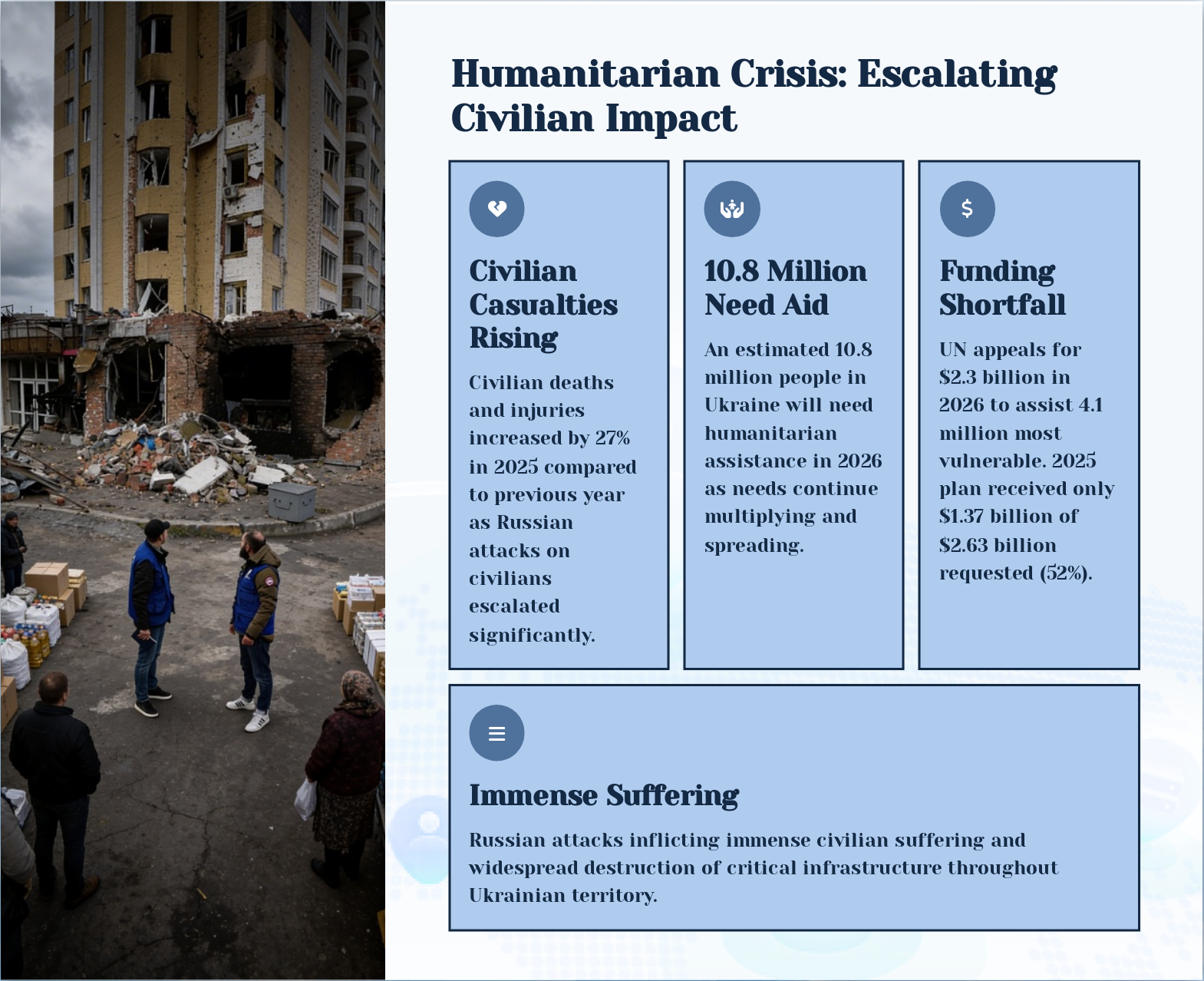
Slide 9: Humanitarian Crisis: Escalating Civilian Impact
- Civilian Casualties Rising: Civilian deaths and injuries increased by 27% in 2025 compared to previous year as Russian attacks on civilians escalated significantly.
- 8 Million Need Aid: An estimated 10.8 million people in Ukraine will need humanitarian assistance in 2026 as needs continue multiplying and spreading.
- Funding Shortfall: UN appeals for $2.3 billion in 2026 to assist 4.1 million most vulnerable. 2025 plan received only $1.37 billion of $2.63 billion requested (52%).
- Immense Suffering: Russian attacks inflicting immense civilian suffering and widespread destruction of critical infrastructure throughout Ukrainian territory.
Slide 10: Outlook: Prolonged Conflict Trajectory
Outlook: Prolonged Conflict Trajectory The stalemate represents unstable equilibrium encouraging escalation rather than compromise, with diplomatic channels collapsing while military operations intensify and humanitarian crisis deepens.