Presentation Summary
Explore the Democratic People's Republic of Korea's current leadership, demographics, and geopolitical dynamics. Understand the defector crisis, international relations, and strategic shifts in North Korea from 2024-2026.
Full Presentation Transcript
Slide 1: North Korea - The Hermit Kingdom in the 21st Century
Comprehensive analysis of the Democratic People's Republic of Korea: Current leadership, demographics, and geopolitical dynamics. Critical examination of defector crisis and international relations. Data-driven insights from 2024-2026 period
Slide 2: Contents
- I. Geographic and Political Foundations: Slides 3-6
- II. Leadership and Governance Under Kim Jong-un: Slides 7-10
- III. Population Demographics and Social Structure: Slides 11-13
- IV. National Symbols and Identity: Slides 14-15
- V. The Defector Crisis and Human Rights: Slides 16-20
- VI. Geopolitical Implications and Future Outlook: Slides 21-23
Slide 3: Introduction: The World's Most Isolated State Faces New Challenges
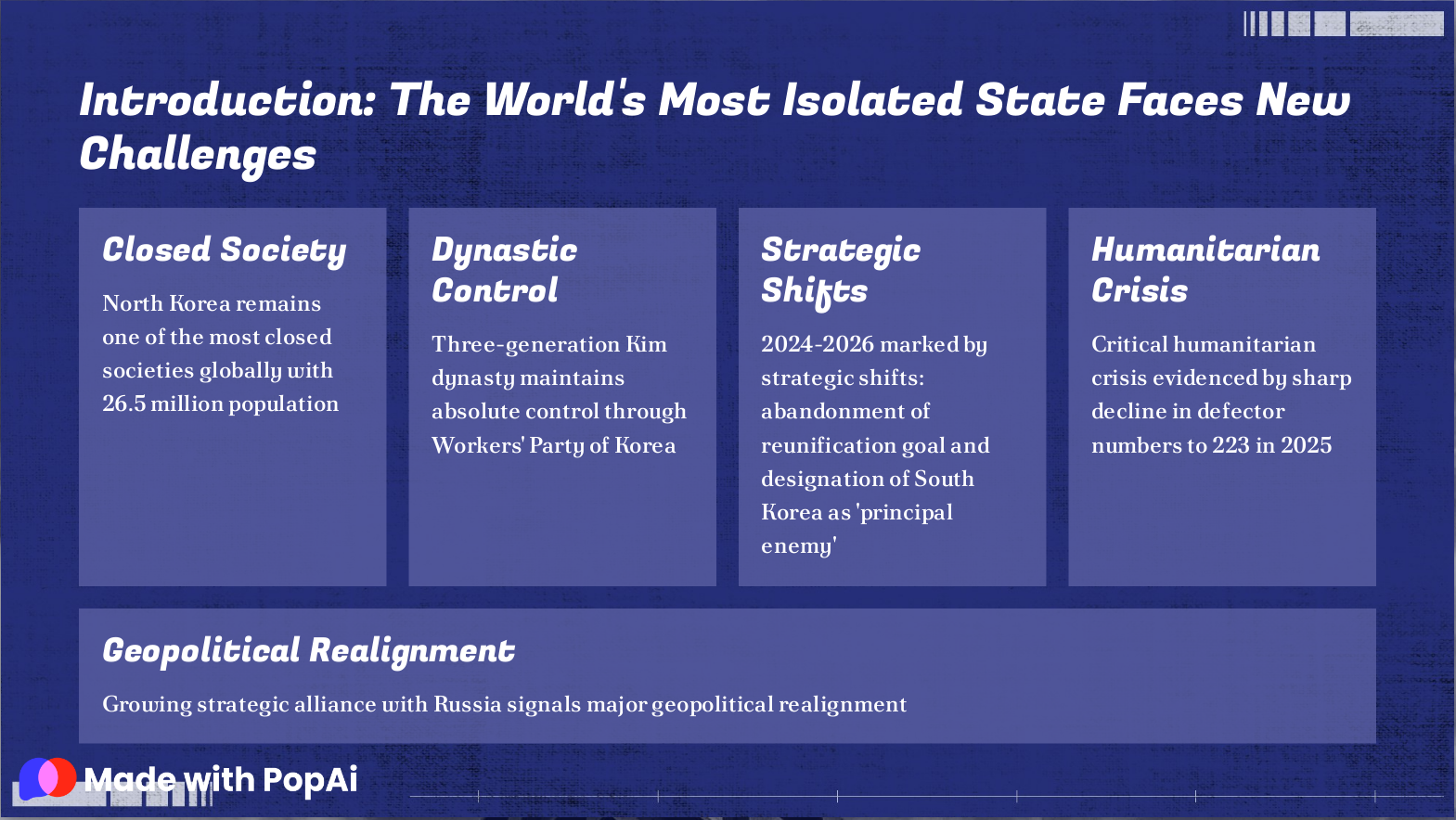
- Closed Society: North Korea remains one of the most closed societies globally with 26.5 million population
- Dynastic Control: Three-generation Kim dynasty maintains absolute control through Workers' Party of Korea
- Strategic Shifts: 2024-2026 marked by strategic shifts: abandonment of reunification goal and designation of South Korea as 'principal enemy'
- Humanitarian Crisis: Critical humanitarian crisis evidenced by sharp decline in defector numbers to 223 in 2025
- Geopolitical Realignment: Growing strategic alliance with Russia signals major geopolitical realignment
Slide 4: Core Question: How Does Kim Jong-un's Regime Maintain Control Amid Internal and External Pressures?
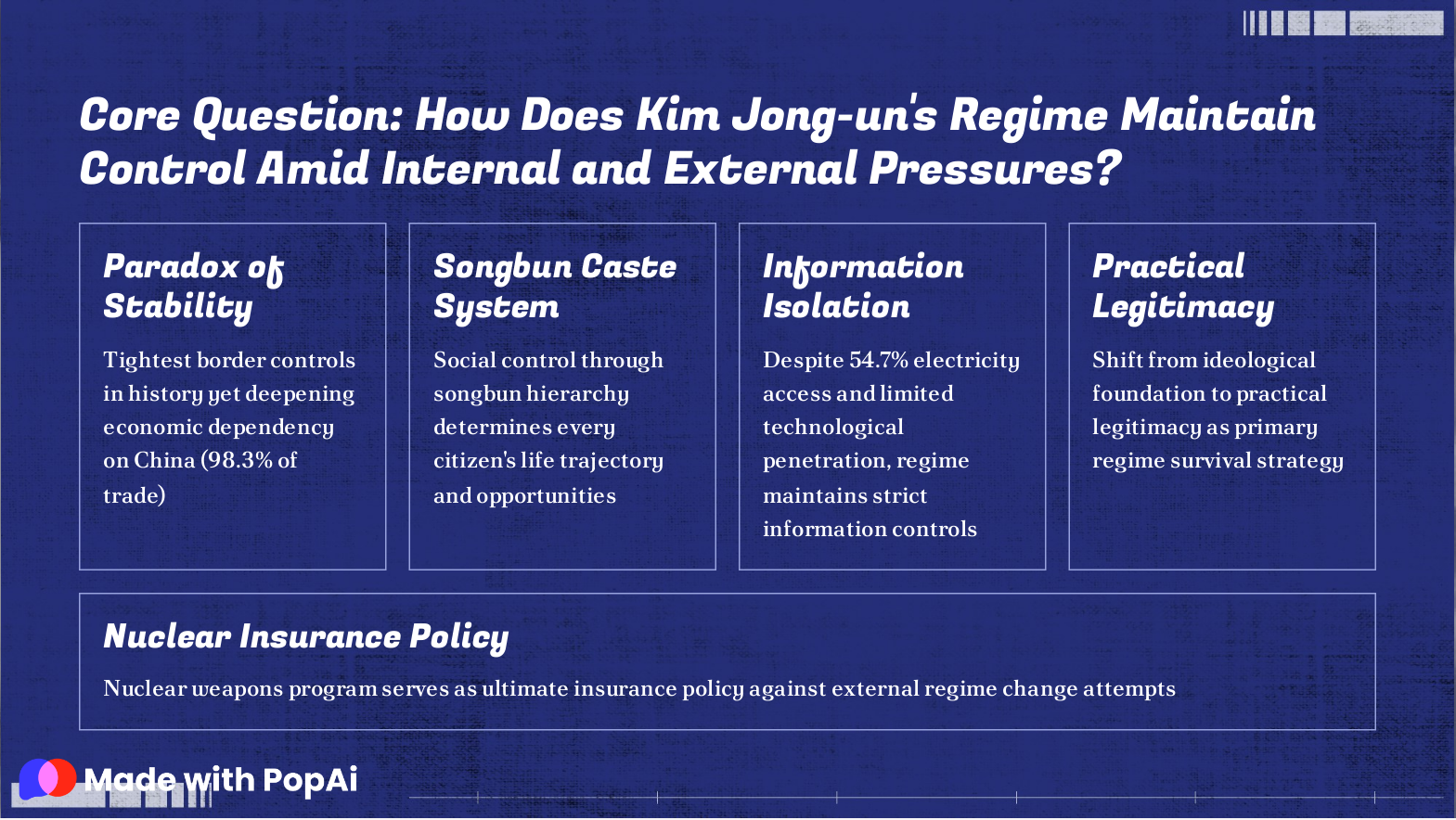
- Paradox of Stability: Tightest border controls in history yet deepening economic dependency on China (98.3% of trade)
- Songbun Caste System: Social control through songbun hierarchy determines every citizen's life trajectory and opportunities
- Information Isolation: Despite 54.7% electricity access and limited technological penetration, regime maintains strict information controls
- Practical Legitimacy: Shift from ideological foundation to practical legitimacy as primary regime survival strategy
- Nuclear Insurance Policy: Nuclear weapons program serves as ultimate insurance policy against external regime change attempts
Slide 5: North Korea Geography
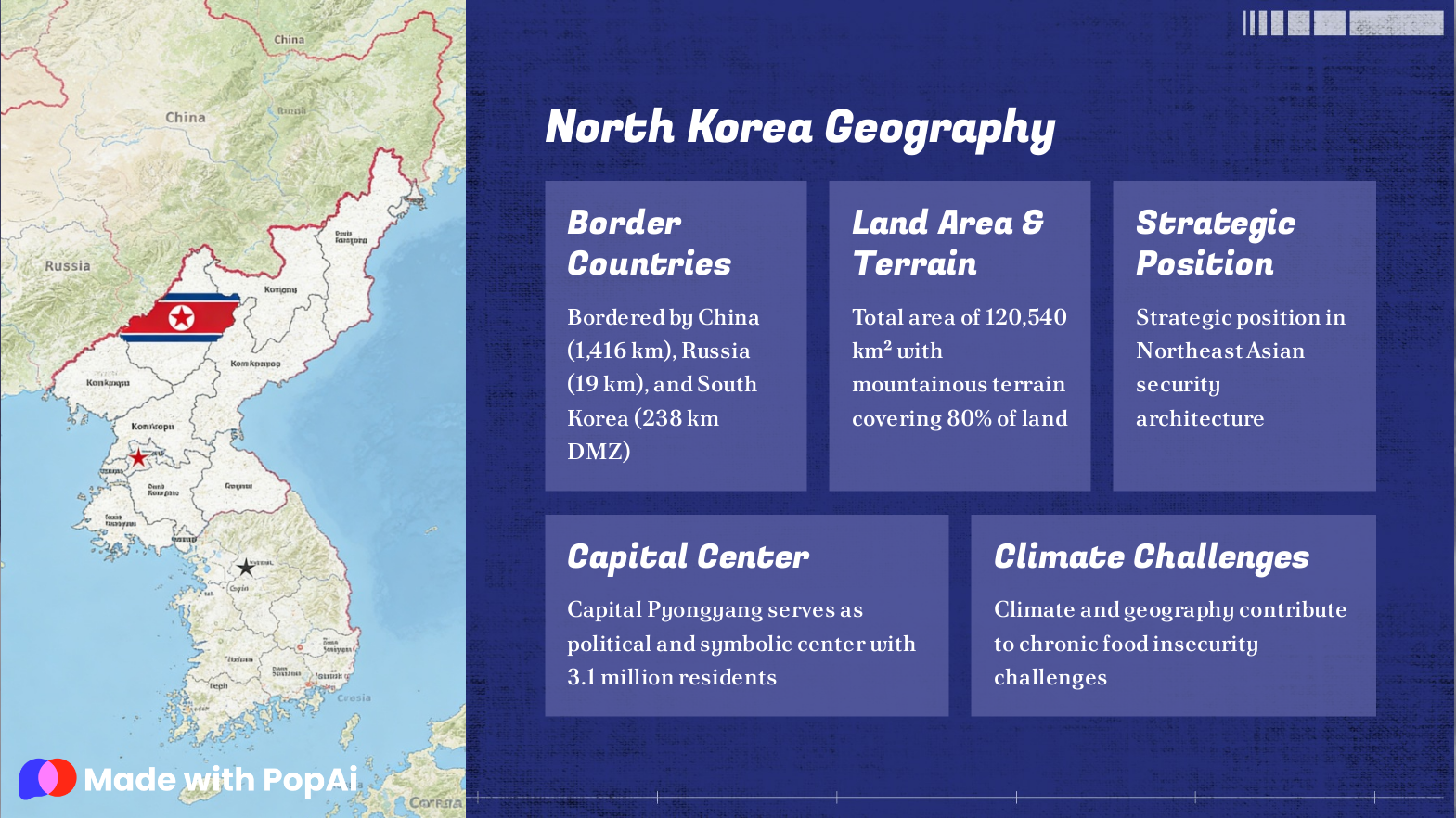
- Border Countries: Bordered by China (1,416 km), Russia (19 km), and South Korea (238 km DMZ)
- Land Area & Terrain: Total area of 120,540 km² with mountainous terrain covering 80% of land
- Strategic Position: Strategic position in Northeast Asian security architecture
- Capital Center: Capital Pyongyang serves as political and symbolic center with 3.1 million residents
- Climate Challenges: Climate and geography contribute to chronic food insecurity challenges
Slide 6: Political Foundation: The World's Last Stalinist State
- Established September 9, 1948: Founded under Soviet occupation following the division of the Korean peninsula, establishing the Democratic People's Republic of Korea
- Constitutional Ideology: Constitution enshrines Juche (self-reliance) ideology and Songun (military-first) policy as foundational state principles
- Supreme People's Assembly: Serves as rubber-stamp legislature with 687 members, providing nominal legislative authority while lacking real decision-making power
- Cabinet Authority: Cabinet implements party directives under premier oversight, executing decisions made by higher party structures
- Real Power Structure: Real power concentrated in Workers' Party of Korea Central Committee and State Affairs Commission, representing the true locus of control
Slide 7: Kim Jong-un's Regime
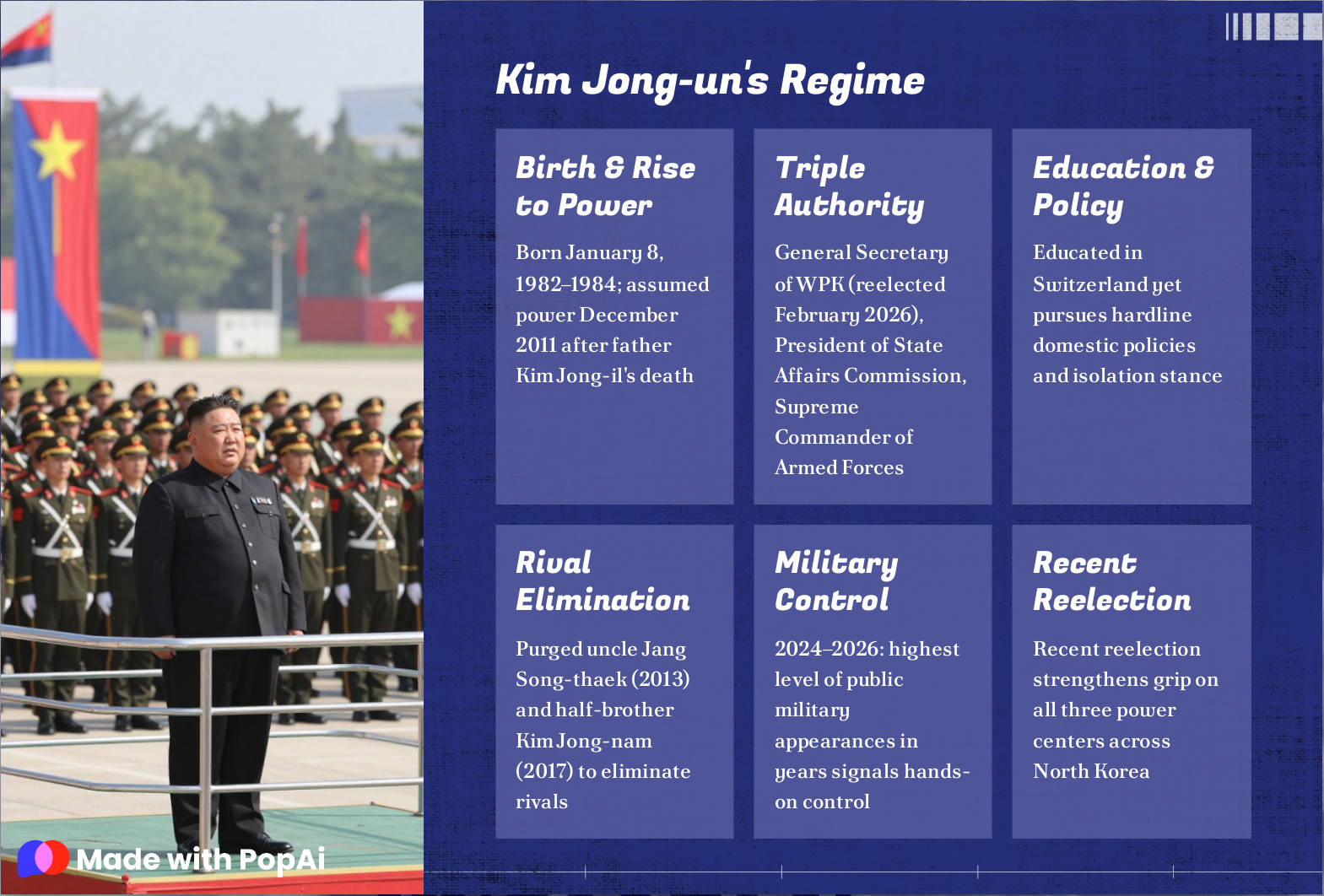
- Birth & Rise to Power: Born January 8, 1982–1984; assumed power December 2011 after father Kim Jong-il's death
- Triple Authority: General Secretary of WPK (reelected February 2026), President of State Affairs Commission, Supreme Commander of Armed Forces
- Education & Policy: Educated in Switzerland yet pursues hardline domestic policies and isolation stance
- Rival Elimination: Purged uncle Jang Song-thaek (2013) and half-brother Kim Jong-nam (2017) to eliminate rivals
- Military Control: 2024–2026: highest level of public military appearances in years signals hands-on control
- Recent Reelection: Recent reelection strengthens grip on all three power centers across North Korea
Slide 8: Succession Planning: Kim Ju-ae Emerges as Potential Heir
- November 2022: Kim Ju-ae first appeared publicly as Kim Jong-un's preteen daughter, marking her debut on the international stage and beginning her visible role in North Korean leadership succession.
- 2024–2025: Accompanied father to missile launch sites and military parades, gaining direct exposure to military operations and demonstrating her involvement in state affairs and security matters.
- State Media Messaging: State media uses reverent language suggesting continuation of the 'Baekdu bloodline' hereditary succession tradition, establishing ideological support for dynastic continuity within the regime.
- Unprecedented Succession Pattern: Grooming process mirrors Kim Jong-un's own decade-long preparation under father's guidance, with fourth-generation succession unprecedented globally in communist states.
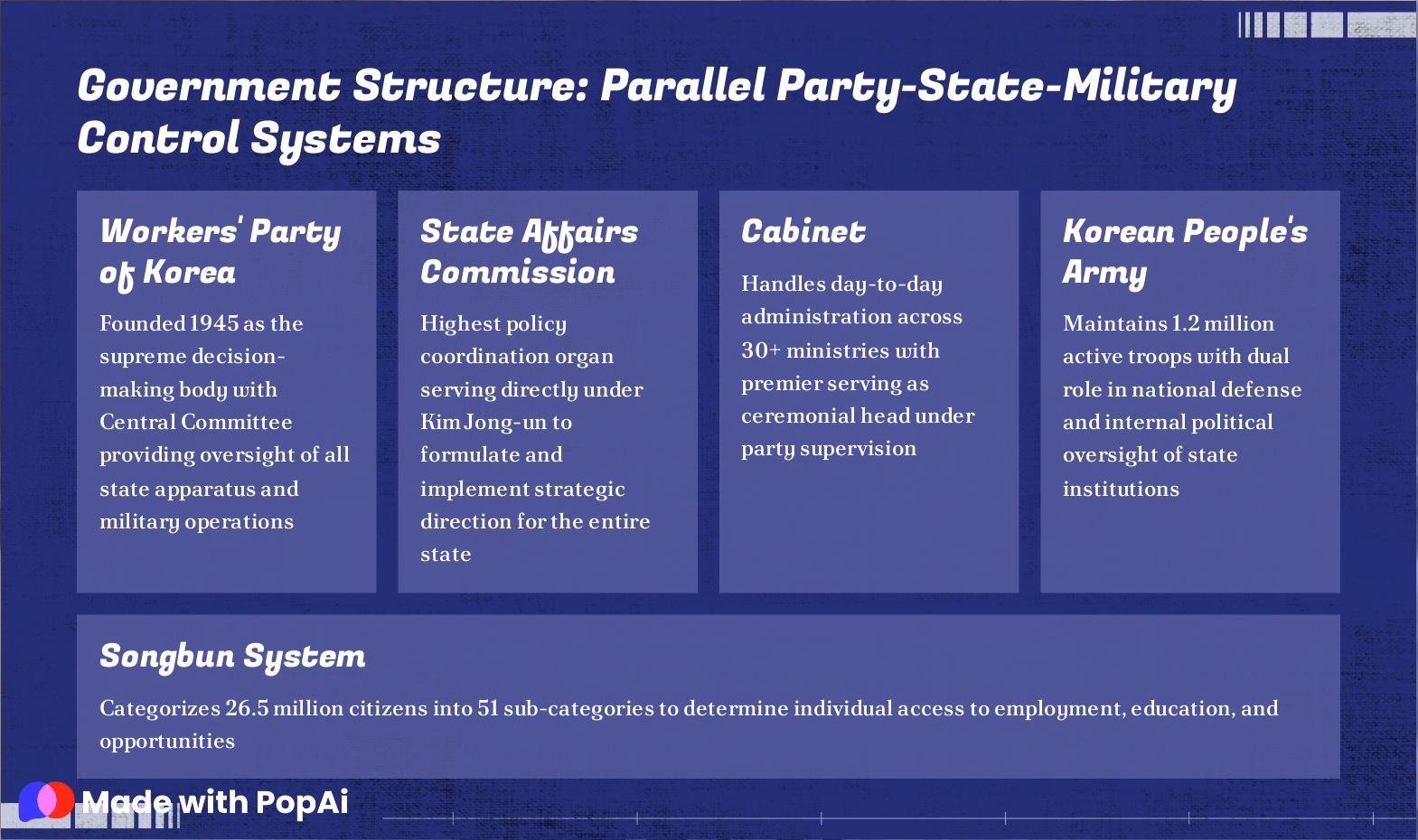
Slide 9: Government Structure: Parallel Party-State-Military Control Systems
- Workers' Party of Korea: Founded 1945 as the supreme decision-making body with Central Committee providing oversight of all state apparatus and military operations
- State Affairs Commission: Highest policy coordination organ serving directly under Kim Jong-un to formulate and implement strategic direction for the entire state
- Cabinet: Handles day-to-day administration across 30+ ministries with premier serving as ceremonial head under party supervision
- Korean People's Army: Maintains 1.2 million active troops with dual role in national defense and internal political oversight of state institutions
- Songbun System: Categorizes 26.5 million citizens into 51 sub-categories to determine individual access to employment, education, and opportunities
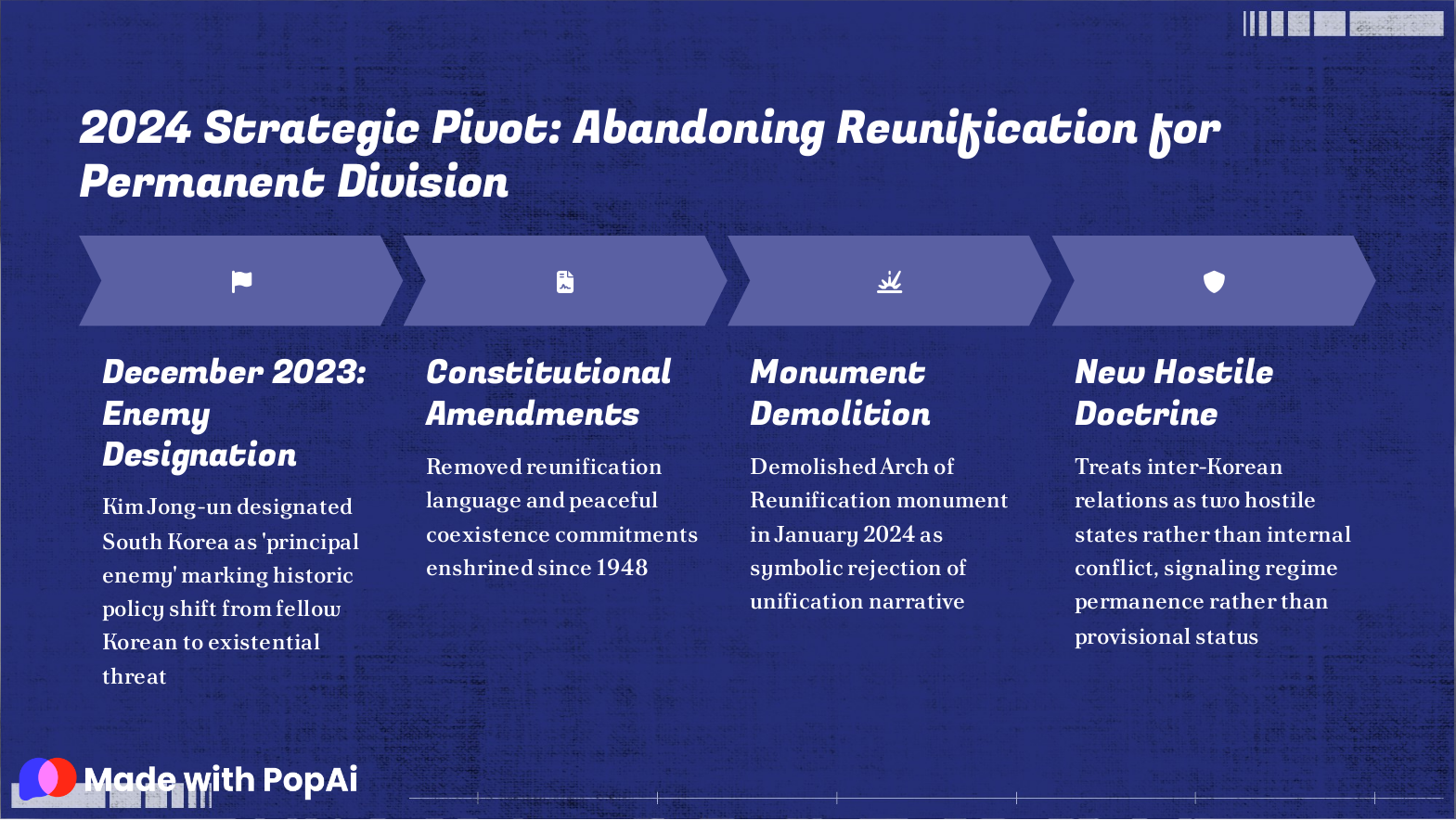
Slide 10: 2024 Strategic Pivot: Abandoning Reunification for Permanent Division
- December 2023: Enemy Designation: Kim Jong-un designated South Korea as 'principal enemy' marking historic policy shift from fellow Korean to existential threat
- Constitutional Amendments: Removed reunification language and peaceful coexistence commitments enshrined since 1948
- Monument Demolition: Demolished Arch of Reunification monument in January 2024 as symbolic rejection of unification narrative
- New Hostile Doctrine: Treats inter-Korean relations as two hostile states rather than internal conflict, signaling regime permanence rather than provisional status
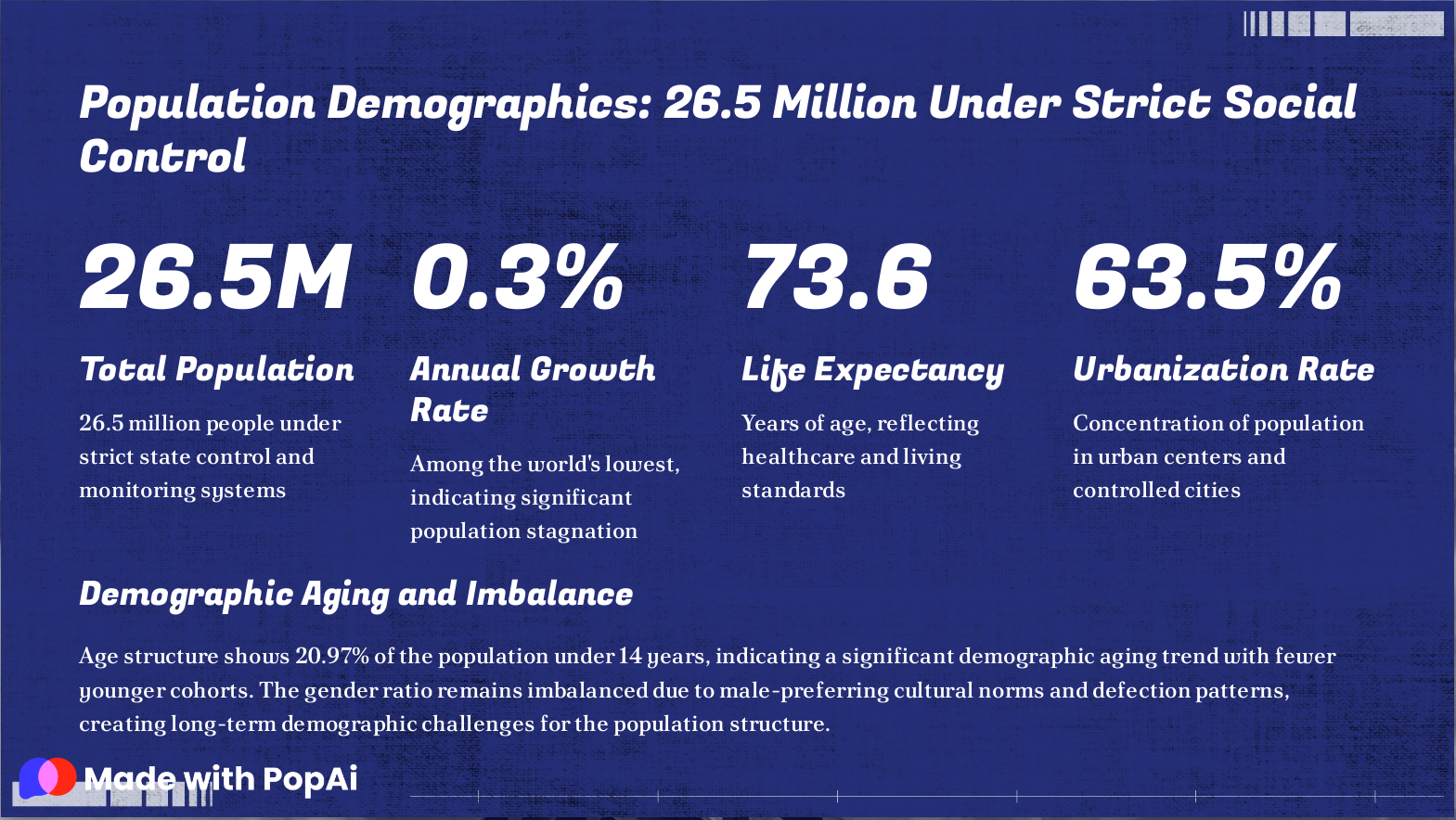
Slide 11: Population Demographics: 26.5 Million Under Strict Social Control
- 26.5M — Total Population
- 0.3% — Annual Growth Rate
- 73.6 — Life Expectancy
- 63.5% — Urbanization Rate
Age structure shows 20.97% of the population under 14 years, indicating a significant demographic aging trend with fewer younger cohorts. The gender ratio remains imbalanced due to male-preferring cultural norms and defection patterns, creating long-term demographic challenges for the population structure.
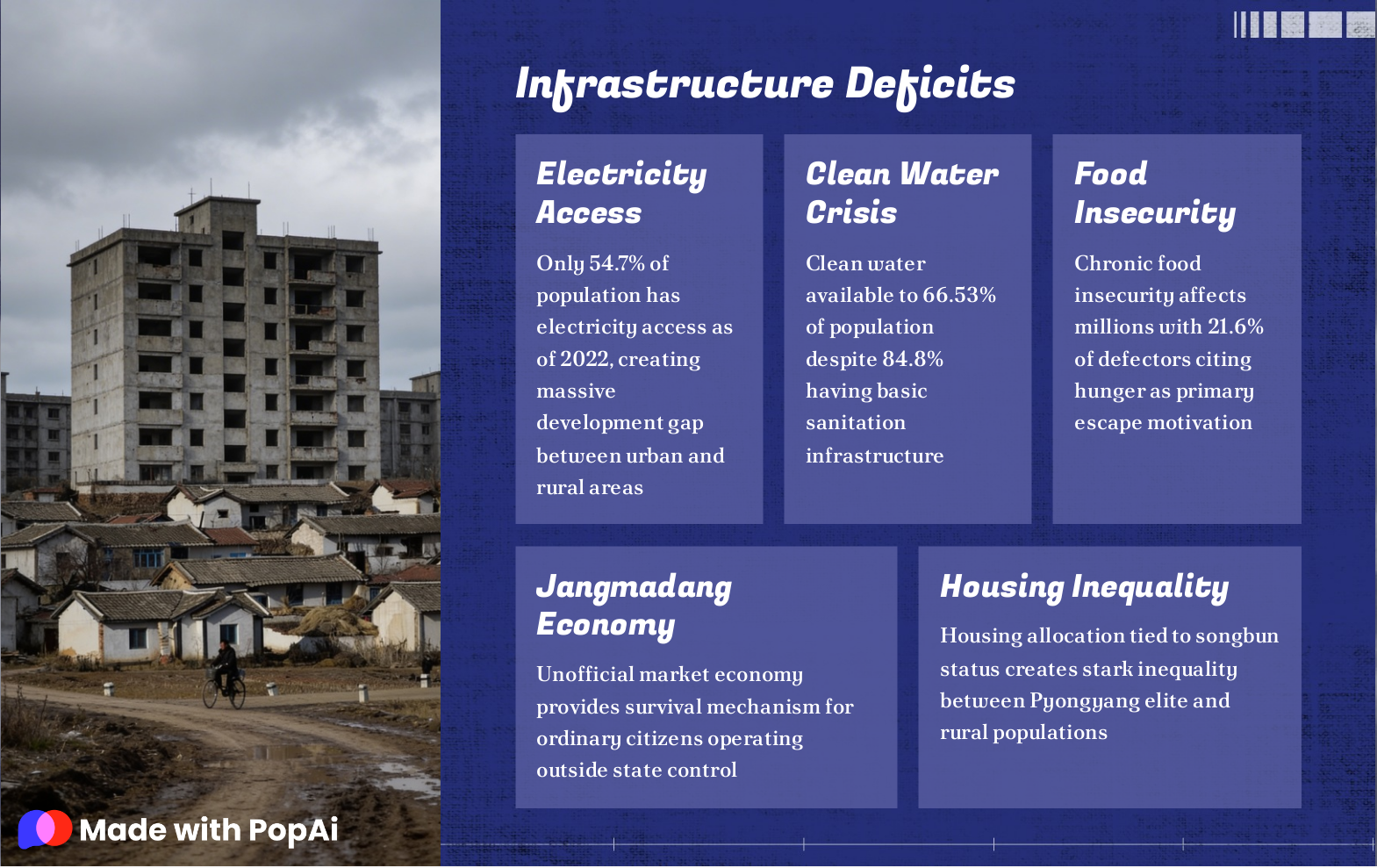
Slide 12: Infrastructure Deficits
- Electricity Access: Only 54.7% of population has electricity access as of 2022, creating massive development gap between urban and rural areas
- Clean Water Crisis: Clean water available to 66.53% of population despite 84.8% having basic sanitation infrastructure
- Food Insecurity: Chronic food insecurity affects millions with 21.6% of defectors citing hunger as primary escape motivation
- Jangmadang Economy: Unofficial market economy provides survival mechanism for ordinary citizens operating outside state control
- Housing Inequality: Housing allocation tied to songbun status creates stark inequality between Pyongyang elite and rural populations
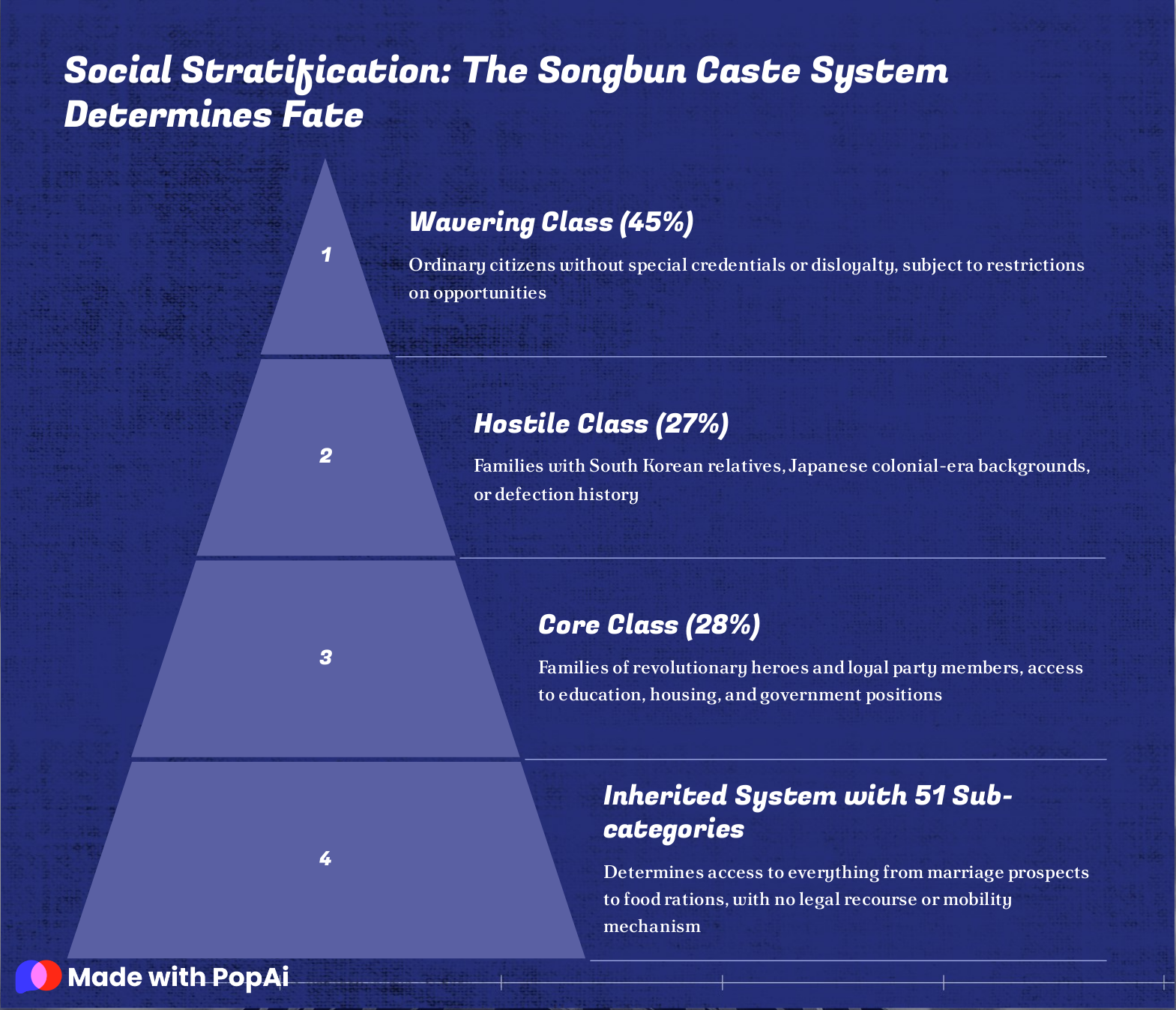
Slide 13: Social Stratification: The Songbun Caste System Determines Fate
- Wavering Class (45%): Ordinary citizens without special credentials or disloyalty, subject to restrictions on opportunities
- Hostile Class (27%): Families with South Korean relatives, Japanese colonial-era backgrounds, or defection history
- Core Class (28%): Families of revolutionary heroes and loyal party members, access to education, housing, and government positions
- Inherited System with 51 Sub-categories: Determines access to everything from marriage prospects to food rations, with no legal recourse or mobility mechanism
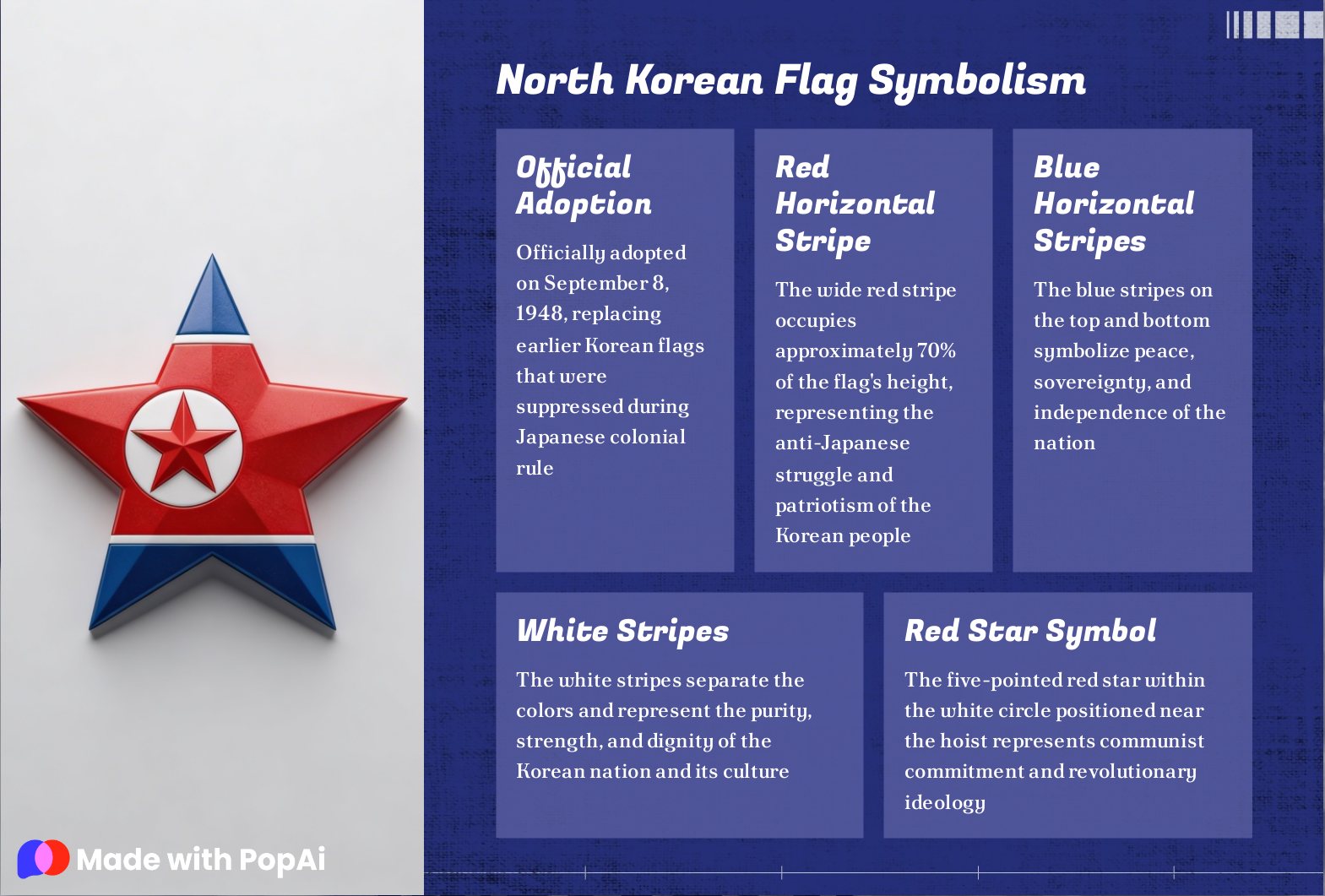
Slide 14: North Korean Flag Symbolism
- Official Adoption: Officially adopted on September 8, 1948, replacing earlier Korean flags that were suppressed during Japanese colonial rule
- Red Horizontal Stripe: The wide red stripe occupies approximately 70% of the flag's height, representing the anti-Japanese struggle and patriotism of the Korean people
- Blue Horizontal Stripes: The blue stripes on the top and bottom symbolize peace, sovereignty, and independence of the nation
- White Stripes: The white stripes separate the colors and represent the purity, strength, and dignity of the Korean nation and its culture
- Red Star Symbol: The five-pointed red star within the white circle positioned near the hoist represents communist commitment and revolutionary ideology
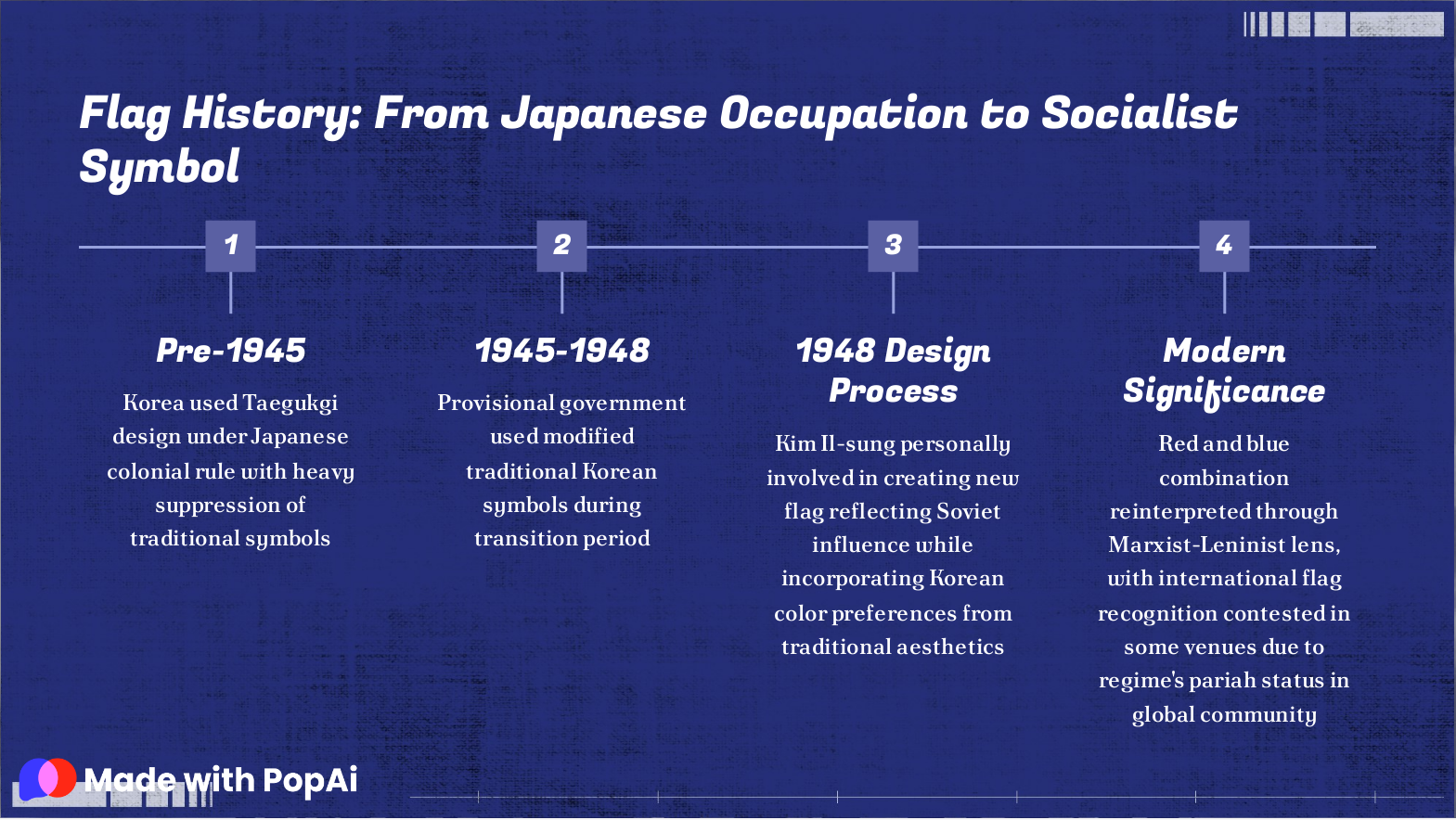
Slide 15: Flag History: From Japanese Occupation to Socialist Symbol
- Pre-1945: Korea used Taegukgi design under Japanese colonial rule with heavy suppression of traditional symbols
- 1945-1948: Provisional government used modified traditional Korean symbols during transition period
- 1948 Design Process: Kim Il-sung personally involved in creating new flag reflecting Soviet influence while incorporating Korean color preferences from traditional aesthetics
- Modern Significance: Red and blue combination reinterpreted through Marxist-Leninist lens, with international flag recognition contested in some venues due to regime's pariah status in global community
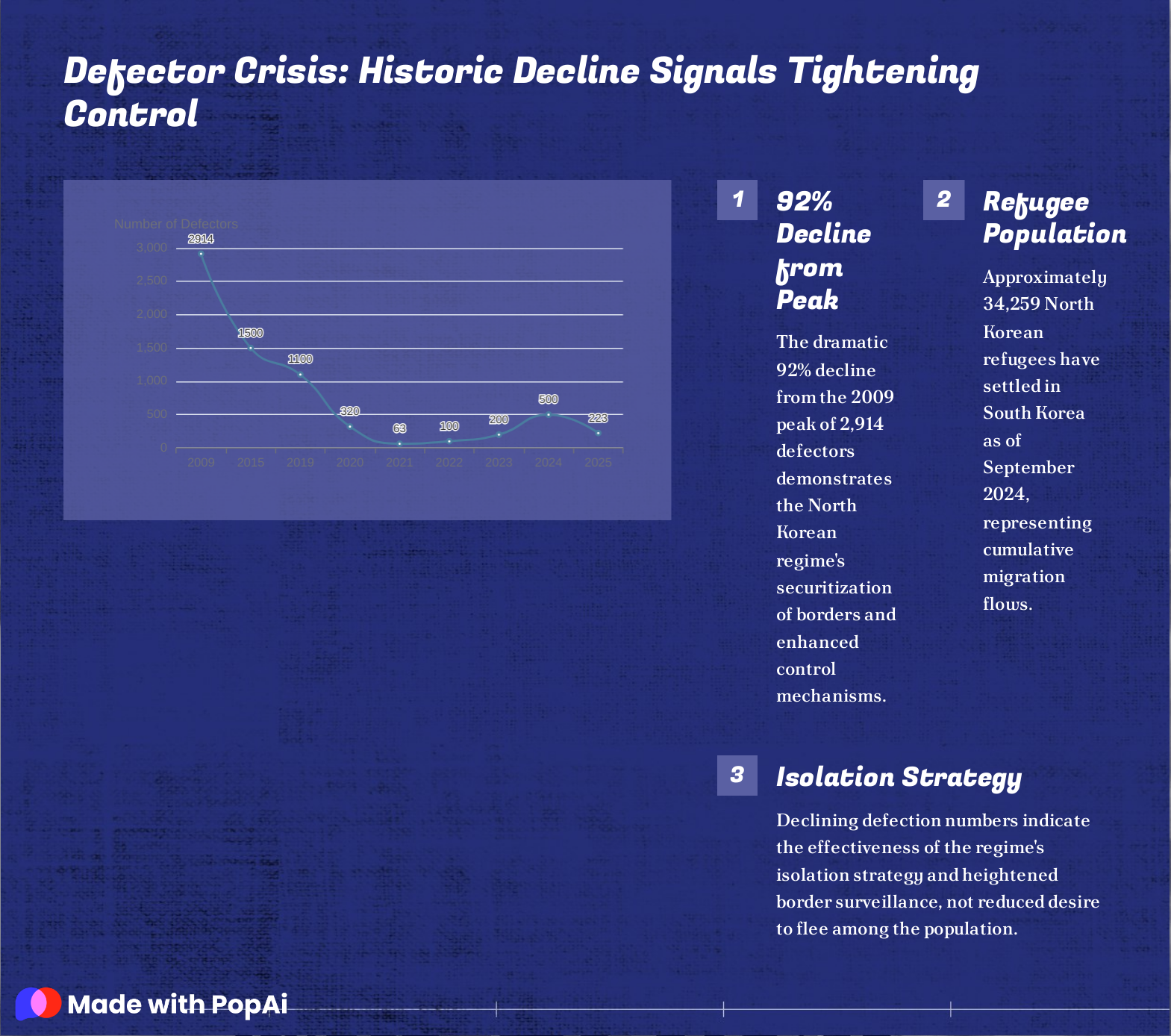
Slide 16: Defector Crisis: Historic Decline Signals Tightening Control
- 92% Decline from Peak: The dramatic 92% decline from the 2009 peak of 2,914 defectors demonstrates the North Korean regime's securitization of borders and enhanced control mechanisms.
- Refugee Population: Approximately 34,259 North Korean refugees have settled in South Korea as of September 2024, representing cumulative migration flows.
- Isolation Strategy: Declining defection numbers indicate the effectiveness of the regime's isolation strategy and heightened border surveillance, not reduced desire to flee among the population.
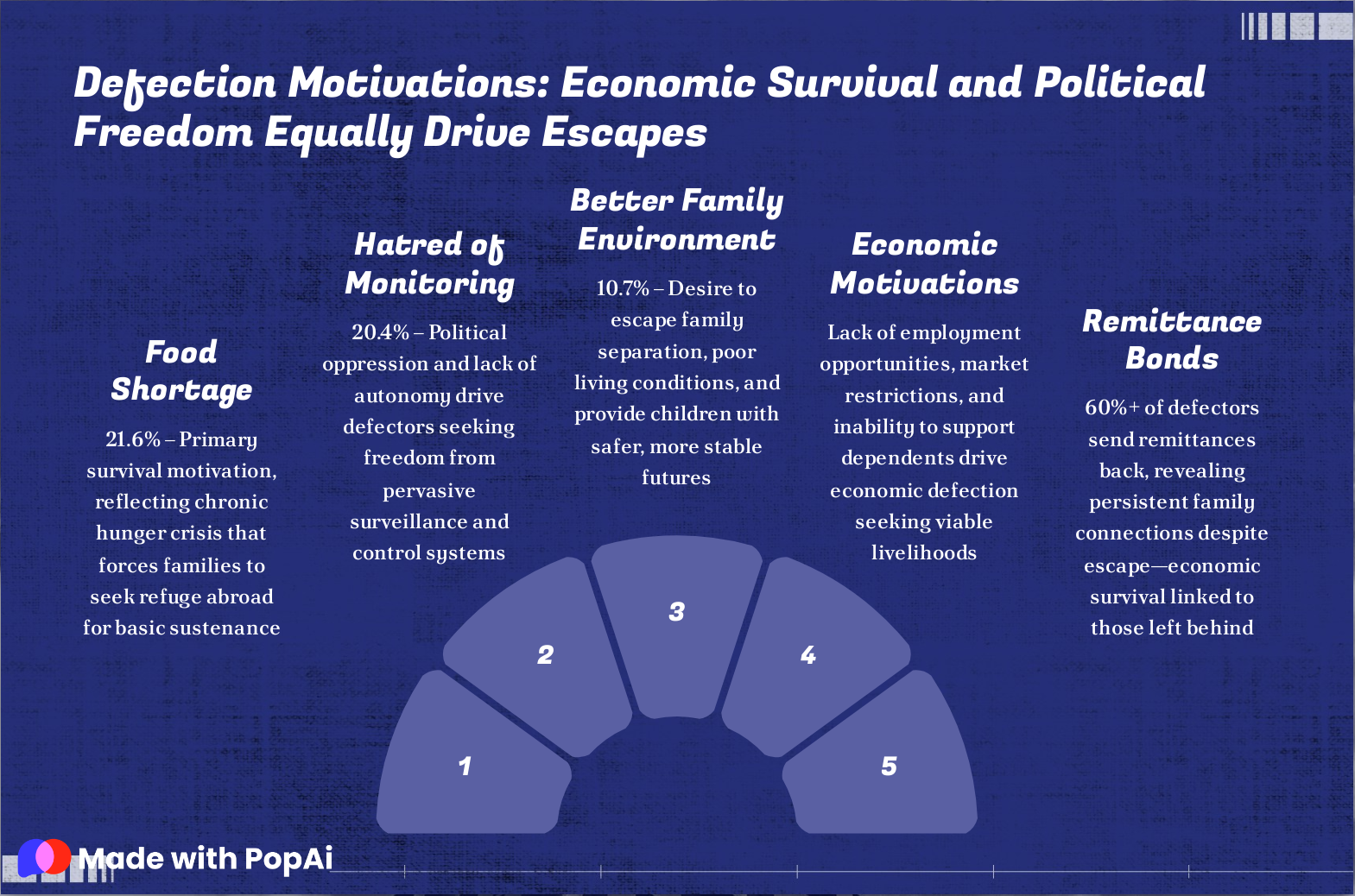
Slide 17: Defection Motivations: Economic Survival and Political Freedom Equally Drive Escapes
- Food Shortage: 21.6% – Primary survival motivation, reflecting chronic hunger crisis that forces families to seek refuge abroad for basic sustenance
- Hatred of Monitoring: 20.4% – Political oppression and lack of autonomy drive defectors seeking freedom from pervasive surveillance and control systems
- Better Family Environment: 10.7% – Desire to escape family separation, poor living conditions, and provide children with safer, more stable futures
- Economic Motivations: Lack of employment opportunities, market restrictions, and inability to support dependents drive economic defection seeking viable livelihoods
- Remittance Bonds: 60%+ of defectors send remittances back, revealing persistent family connections despite escape—economic survival linked to those left behind
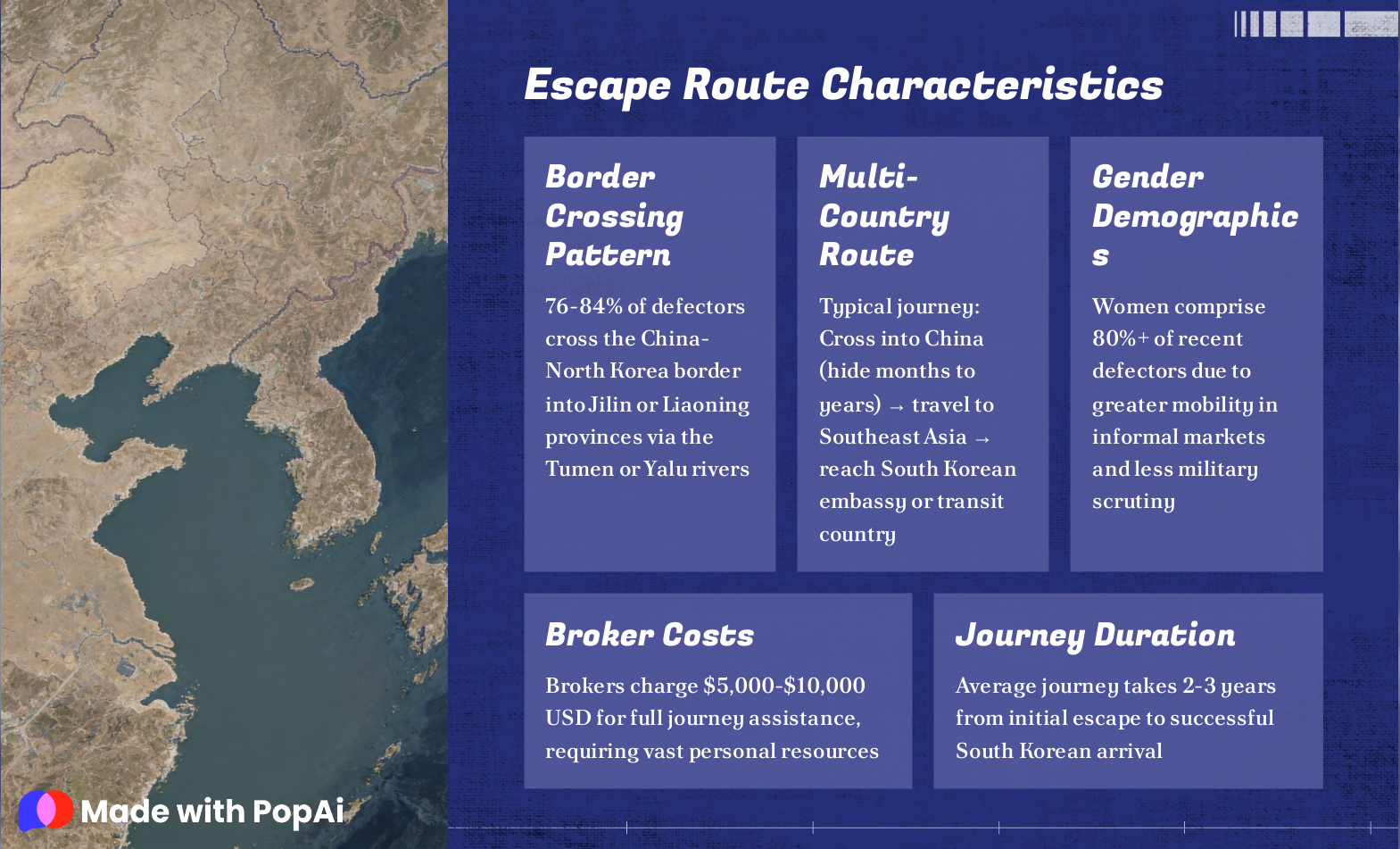
Slide 18: Escape Route Characteristics
- Border Crossing Pattern: 76-84% of defectors cross the China-North Korea border into Jilin or Liaoning provinces via the Tumen or Yalu rivers
- Multi-Country Route: Typical journey: Cross into China (hide months to years) → travel to Southeast Asia → reach South Korean embassy or transit country
- Gender Demographics: Women comprise 80%+ of recent defectors due to greater mobility in informal markets and less military scrutiny
- Broker Costs: Brokers charge $5,000-$10,000 USD for full journey assistance, requiring vast personal resources
- Journey Duration: Average journey takes 2-3 years from initial escape to successful South Korean arrival
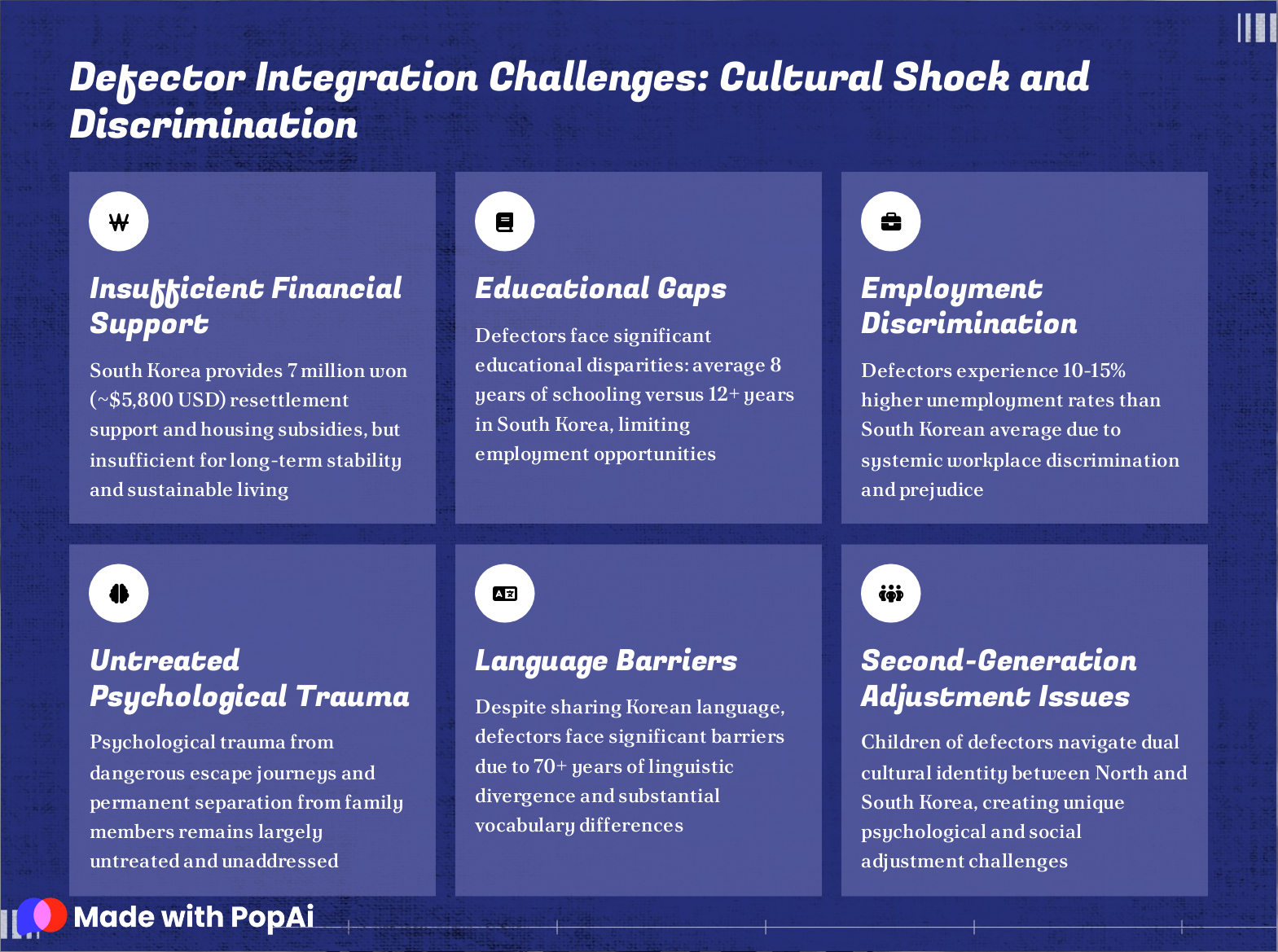
Slide 19: Defector Integration Challenges: Cultural Shock and Discrimination
- Insufficient Financial Support: South Korea provides 7 million won (~$5,800 USD) resettlement support and housing subsidies, but insufficient for long-term stability and sustainable living
- Educational Gaps: Defectors face significant educational disparities: average 8 years of schooling versus 12+ years in South Korea, limiting employment opportunities
- Employment Discrimination: Defectors experience 10-15% higher unemployment rates than South Korean average due to systemic workplace discrimination and prejudice
- Untreated Psychological Trauma: Psychological trauma from dangerous escape journeys and permanent separation from family members remains largely untreated and unaddressed
- Language Barriers: Despite sharing Korean language, defectors face significant barriers due to 70+ years of linguistic divergence and substantial vocabulary differences
- Second-Generation Adjustment Issues: Children of defectors navigate dual cultural identity between North and South Korea, creating unique psychological and social adjustment challenges
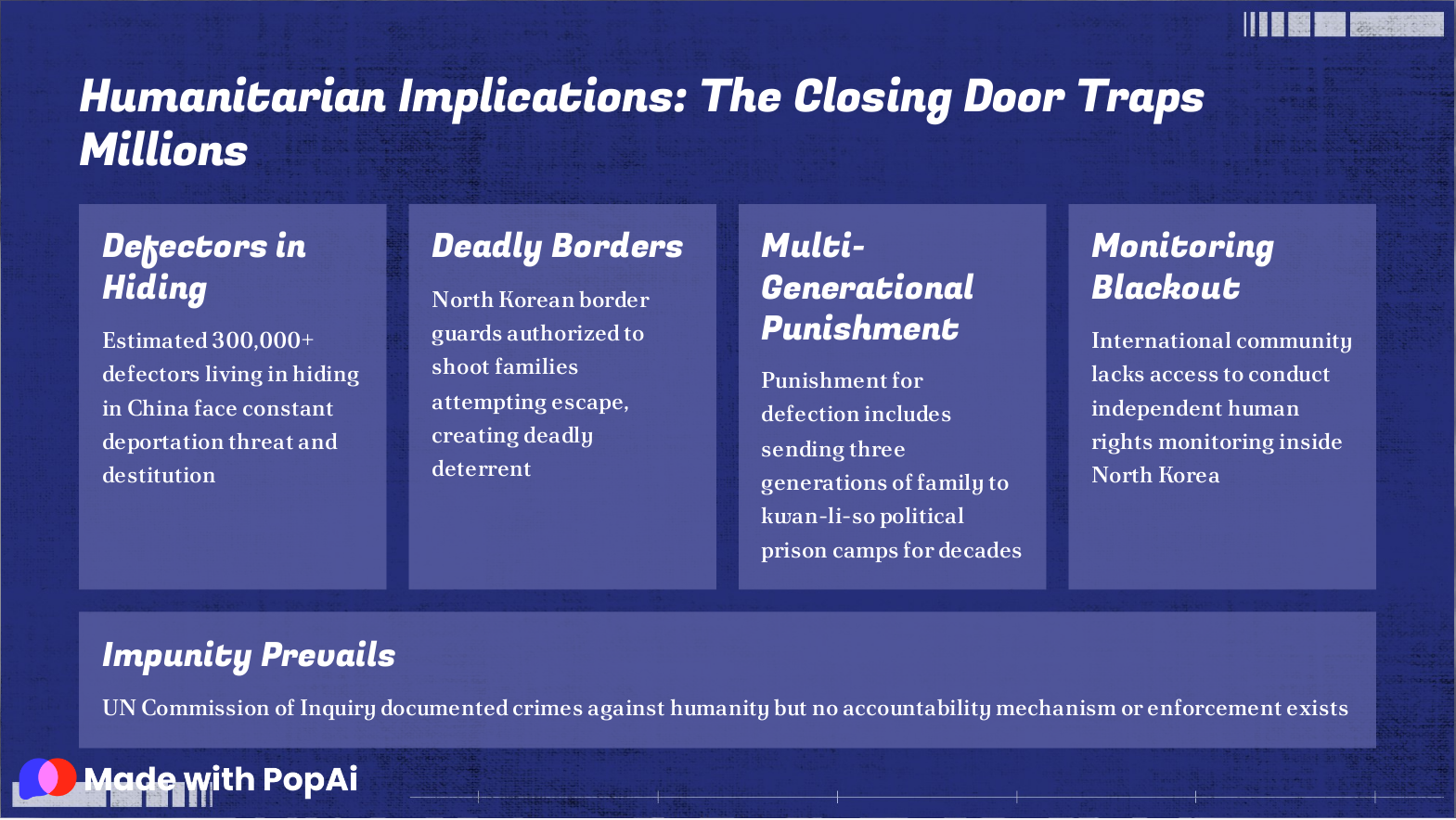
Slide 20: Humanitarian Implications: The Closing Door Traps Millions
- Defectors in Hiding: Estimated 300,000+ defectors living in hiding in China face constant deportation threat and destitution
- Deadly Borders: North Korean border guards authorized to shoot families attempting escape, creating deadly deterrent
- Multi-Generational Punishment: Punishment for defection includes sending three generations of family to kwan-li-so political prison camps for decades
- Monitoring Blackout: International community lacks access to conduct independent human rights monitoring inside North Korea
- Impunity Prevails: UN Commission of Inquiry documented crimes against humanity but no accountability mechanism or enforcement exists
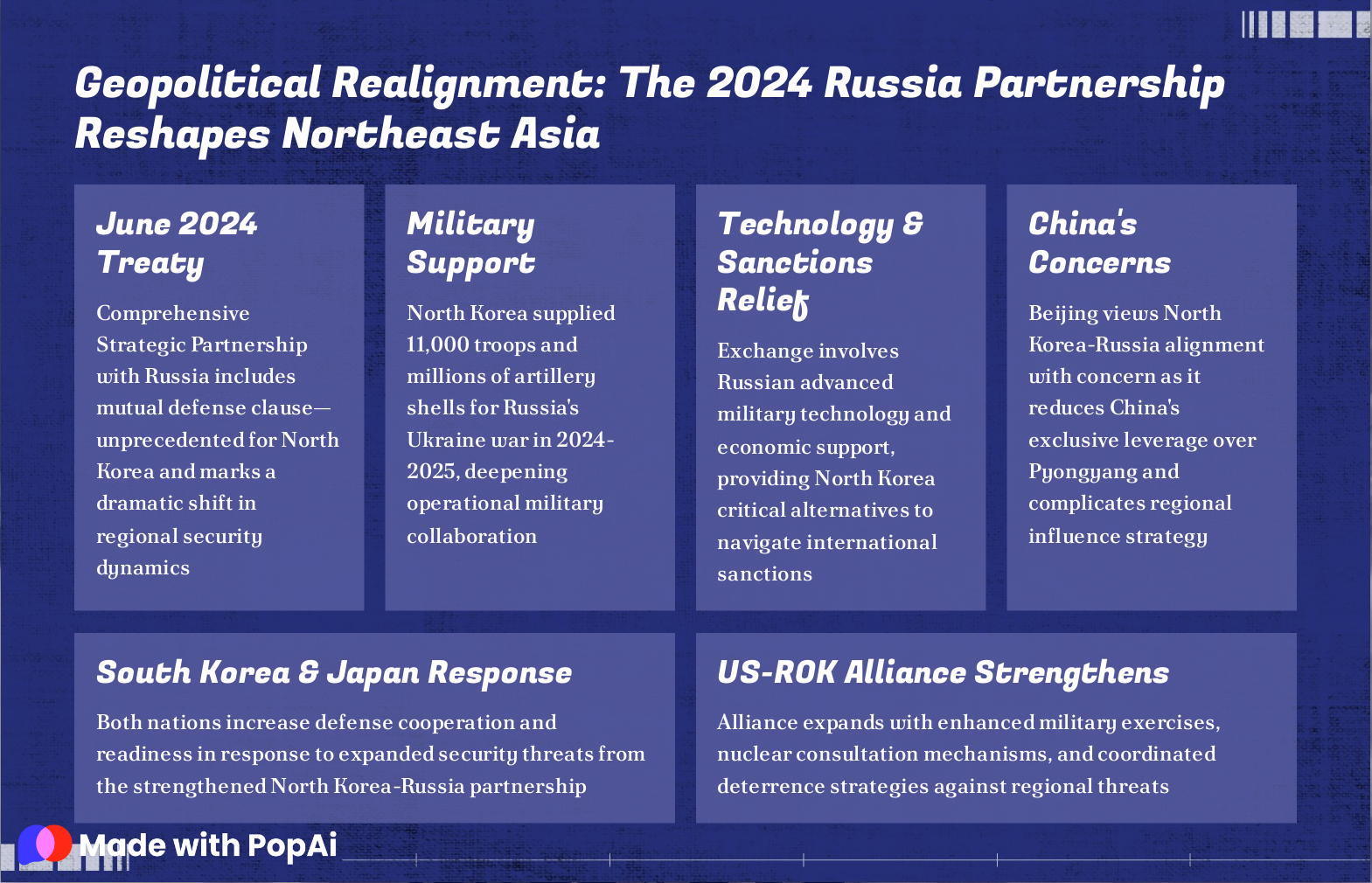
Slide 21: Geopolitical Realignment: The 2024 Russia Partnership Reshapes Northeast Asia
- June 2024 Treaty: Comprehensive Strategic Partnership with Russia includes mutual defense clause—unprecedented for North Korea and marks a dramatic shift in regional security dynamics
- Military Support: North Korea supplied 11,000 troops and millions of artillery shells for Russia's Ukraine war in 2024-2025, deepening operational military collaboration
- Technology & Sanctions Relief: Exchange involves Russian advanced military technology and economic support, providing North Korea critical alternatives to navigate international sanctions
- China's Concerns: Beijing views North Korea-Russia alignment with concern as it reduces China's exclusive leverage over Pyongyang and complicates regional influence strategy
- South Korea & Japan Response: Both nations increase defense cooperation and readiness in response to expanded security threats from the strengthened North Korea-Russia partnership
- US-ROK Alliance Strengthens: Alliance expands with enhanced military exercises, nuclear consultation mechanisms, and coordinated deterrence strategies against regional threats
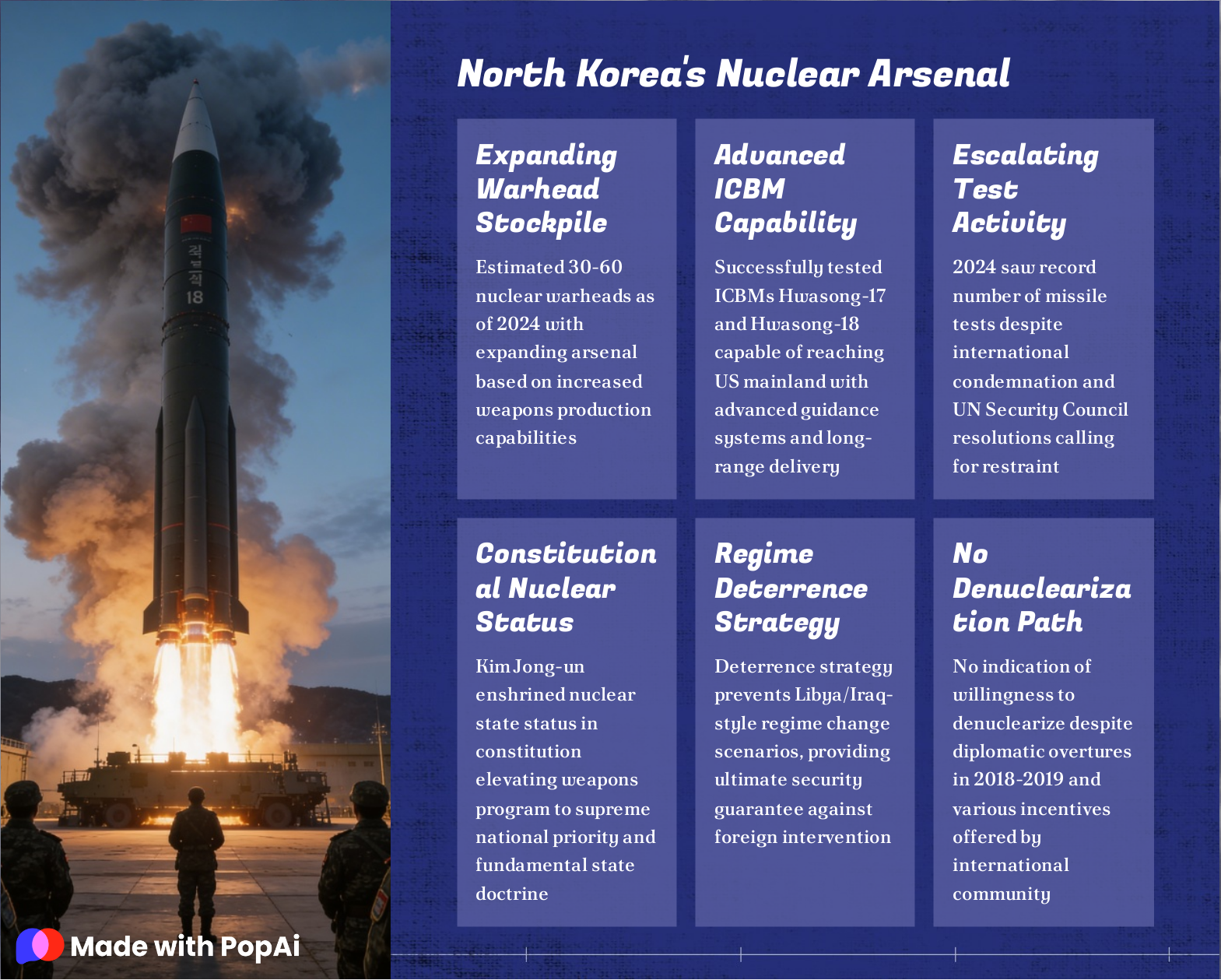
Slide 22: North Korea's Nuclear Arsenal
- Expanding Warhead Stockpile: Estimated 30-60 nuclear warheads as of 2024 with expanding arsenal based on increased weapons production capabilities
- Advanced ICBM Capability: Successfully tested ICBMs Hwasong-17 and Hwasong-18 capable of reaching US mainland with advanced guidance systems and long-range delivery
- Escalating Test Activity: 2024 saw record number of missile tests despite international condemnation and UN Security Council resolutions calling for restraint
- Constitutional Nuclear Status: Kim Jong-un enshrined nuclear state status in constitution elevating weapons program to supreme national priority and fundamental state doctrine
- Regime Deterrence Strategy: Deterrence strategy prevents Libya/Iraq-style regime change scenarios, providing ultimate security guarantee against foreign intervention
- No Denuclearization Path: No indication of willingness to denuclearize despite diplomatic overtures in 2018-2019 and various incentives offered by international community
Slide 23: Key Takeaways: Understanding the Hermit Kingdom's Future Trajectory
- Regime Resilience: Kim Jong-un's regime demonstrates resilience through adaptive authoritarianism and external strategic partnerships, maintaining control despite international pressures.
- Border Securitization: Defector crisis reversal indicates successful border securitization at immense humanitarian cost to population, trapping citizens within tightened physical boundaries.
- Two-Korea Reality: Abandonment of reunification goal signals permanent two-Korea reality reshaping Korean peninsula security architecture and regional geopolitical dynamics.
- Russia Alliance Threat: Russia alliance provides sanctions evasion mechanism threatening international non-proliferation regime stability and undermining multilateral enforcement frameworks.
- Population Crisis: 26.5 million North Korean citizens remain trapped with minimal prospects for near-term reform or change, facing ongoing deprivation and restricted freedoms.
- International Dilemma: International community faces ongoing dilemma: engagement legitimizes regime versus isolation harms vulnerable population, creating no-win policy scenarios.
Slide 24: North Korea in 2026: The Paradox of Stability in the World's Most Volatile Regime
North Korea in 2026: The Paradox of Stability in the World's Most Volatile Regime North Korea enters 2026 more isolated yet strategically positioned than any time since Korean War. Succession planning to fourth generation Kim suggests regime confidence in long-term survival. Economic dependency on C...