Presentation Summary
NASA's Artemis program is the next-generation lunar mission, succeeding Apollo, with advanced technology and international cooperation. It aims for sustained lunar presence and deep space exploration, focusing on scientific discovery and infrastructure development.
Full Presentation Transcript
Slide 1: NASA's Artemis Moon Mission Program: Returning Humanity to the Lunar Surface and Beyond
Comprehensive Mission Overview 2026–2028: Artemis II, III, IV, and V
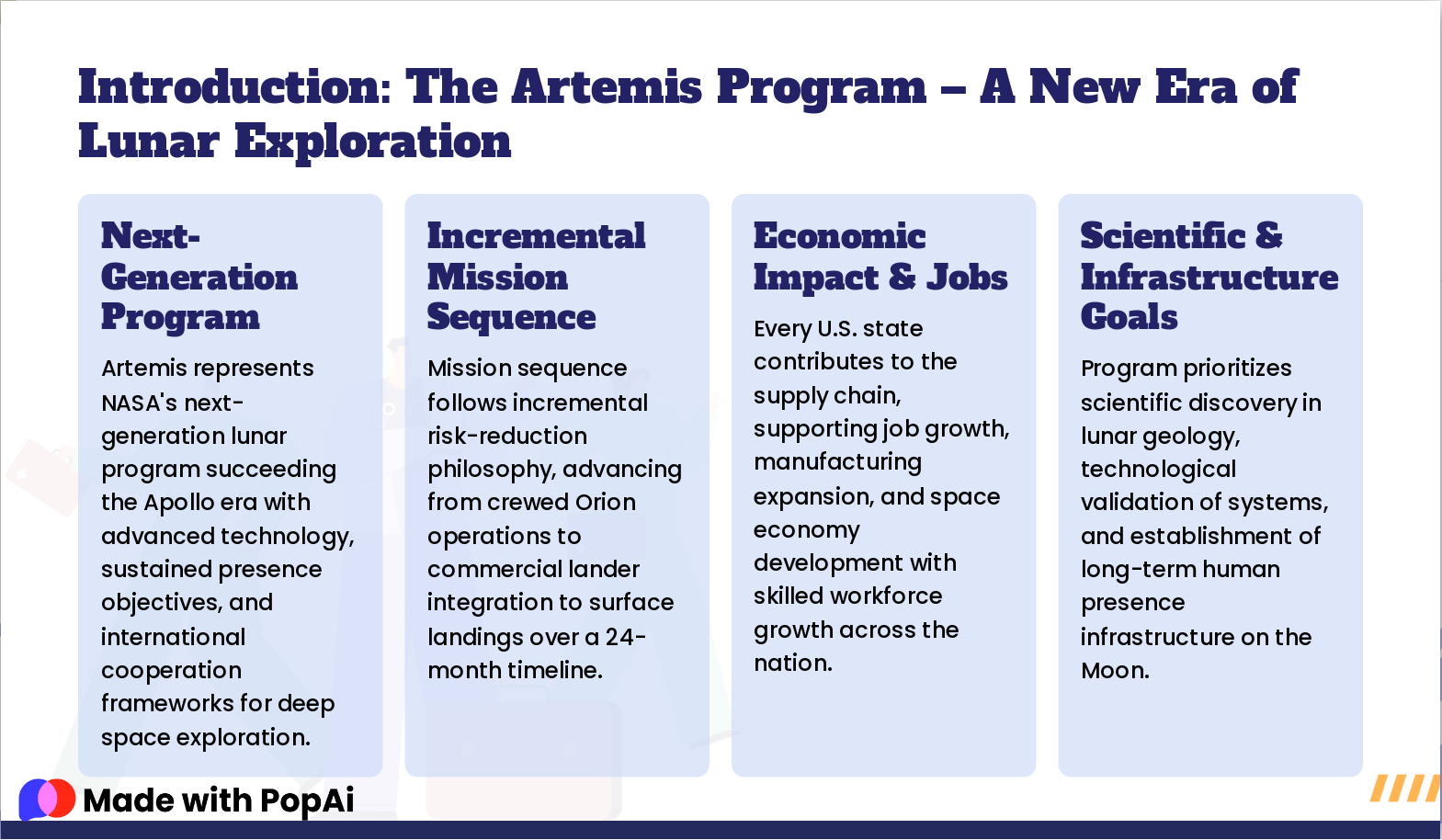
Slide 2: Introduction: The Artemis Program – A New Era of Lunar Exploration
- Next-Generation Program: Artemis represents NASA's next-generation lunar program succeeding the Apollo era with advanced technology, sustained presence objectives, and international cooperation frameworks for deep space exploration.
- Incremental Mission Sequence: Mission sequence follows incremental risk-reduction philosophy, advancing from crewed Orion operations to commercial lander integration to surface landings over a 24-month timeline.
- Economic Impact & Jobs: Every U.S. state contributes to the supply chain, supporting job growth, manufacturing expansion, and space economy development with skilled workforce growth across the nation.
- Scientific & Infrastructure Goals: Program prioritizes scientific discovery in lunar geology, technological validation of systems, and establishment of long-term human presence infrastructure on the Moon.
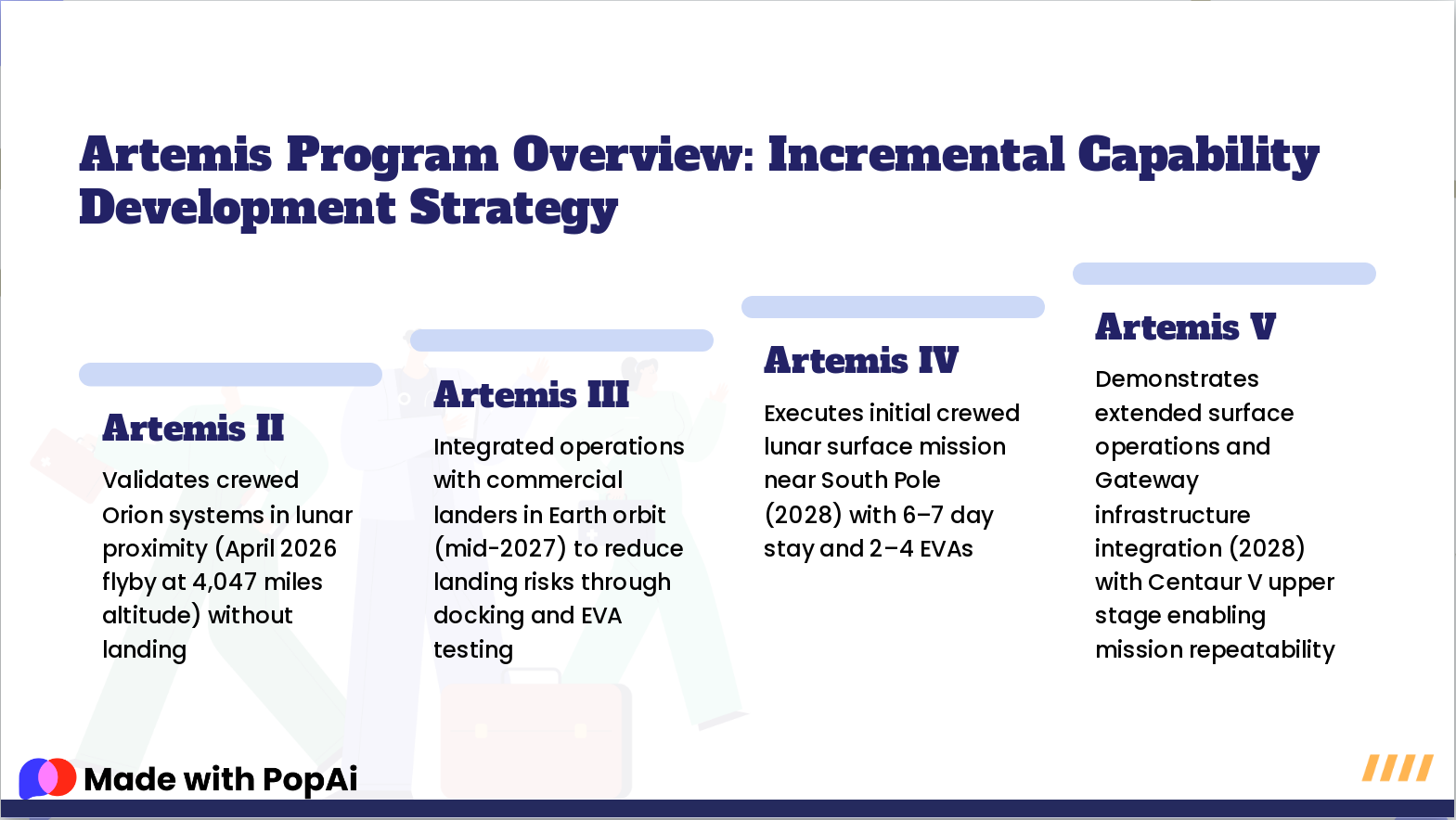
Slide 3: Artemis Program Overview: Incremental Capability Development Strategy
- Artemis II: Validates crewed Orion systems in lunar proximity (April 2026 flyby at 4,047 miles altitude) without landing
- Artemis III: Integrated operations with commercial landers in Earth orbit (mid-2027) to reduce landing risks through docking and EVA testing
- Artemis IV: Executes initial crewed lunar surface mission near South Pole (2028) with 6–7 day stay and 2–4 EVAs
- Artemis V: Demonstrates extended surface operations and Gateway infrastructure integration (2028) with Centaur V upper stage enabling mission repeatability
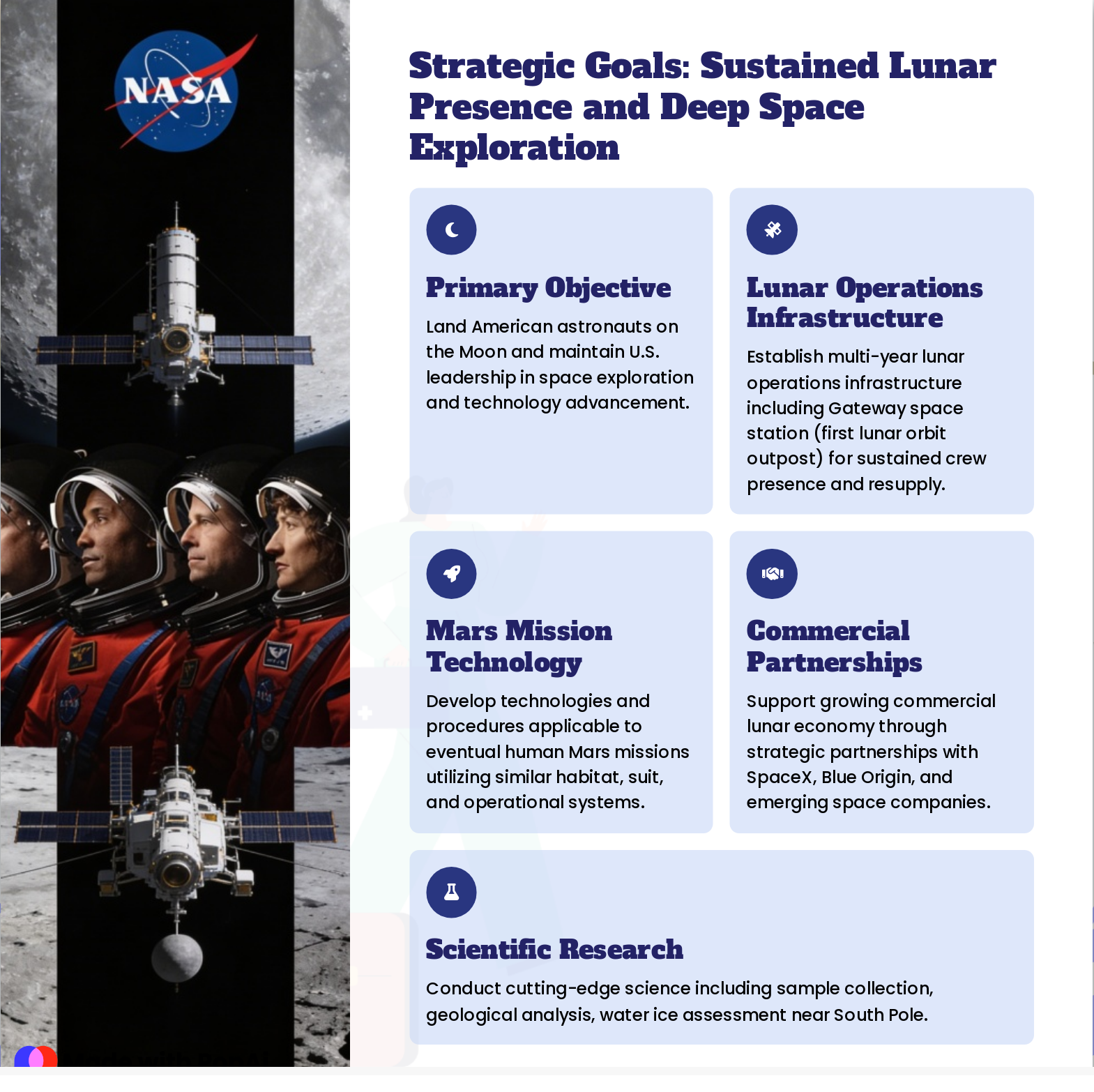
Slide 4: Strategic Goals: Sustained Lunar Presence and Deep Space Exploration
- Primary Objective: Land American astronauts on the Moon and maintain U.S. leadership in space exploration and technology advancement.
- Lunar Operations Infrastructure: Establish multi-year lunar operations infrastructure including Gateway space station (first lunar orbit outpost) for sustained crew presence and resupply.
- Mars Mission Technology: Develop technologies and procedures applicable to eventual human Mars missions utilizing similar habitat, suit, and operational systems.
- Commercial Partnerships: Support growing commercial lunar economy through strategic partnerships with SpaceX, Blue Origin, and emerging space companies.
- Scientific Research: Conduct cutting-edge science including sample collection, geological analysis, water ice assessment near South Pole.
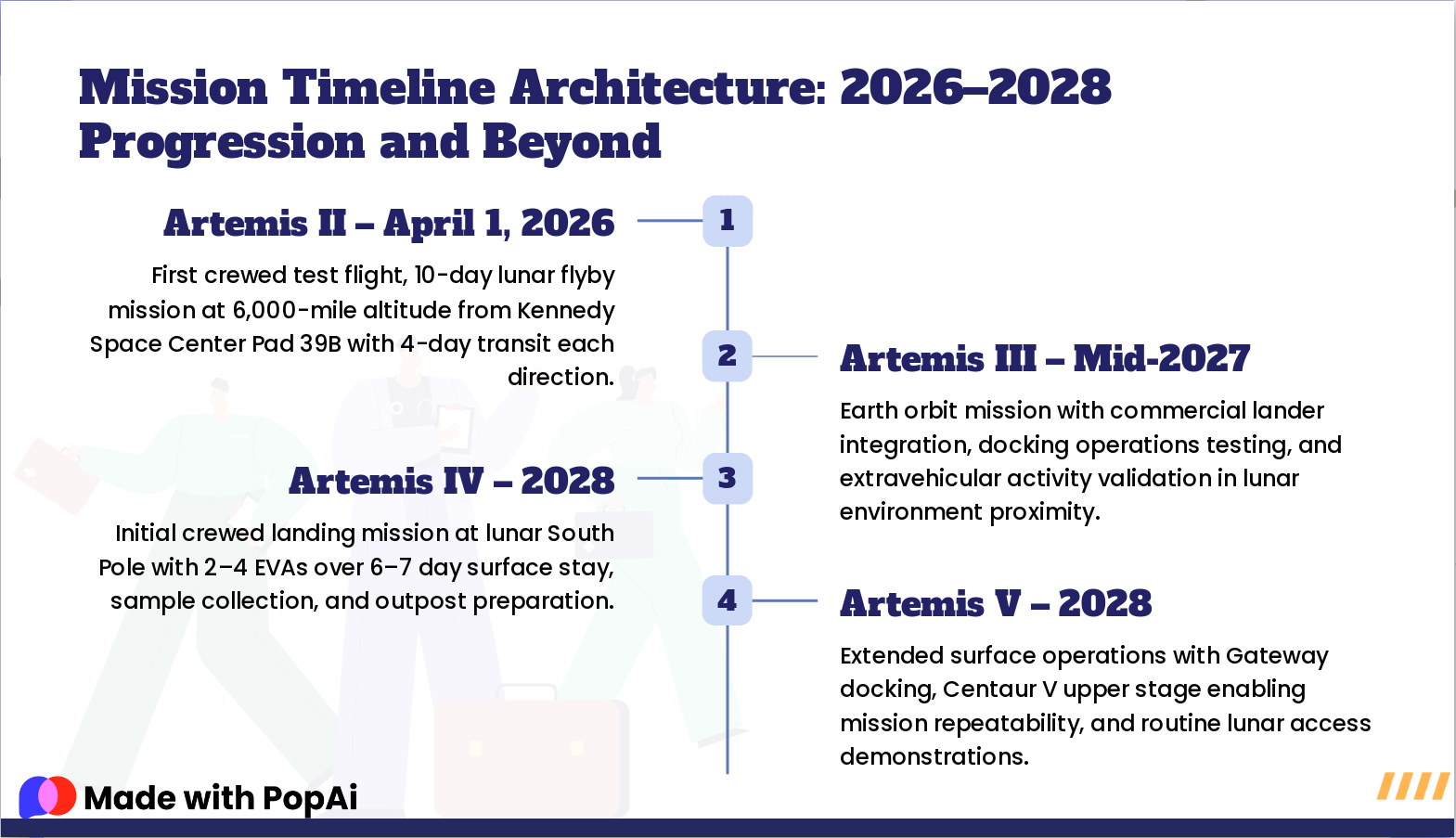
Slide 5: Mission Timeline Architecture: 2026–2028 Progression and Beyond
- Artemis II – April 1, 2026: First crewed test flight, 10-day lunar flyby mission at 6,000-mile altitude from Kennedy Space Center Pad 39B with 4-day transit each direction.
- Artemis III – Mid-2027: Earth orbit mission with commercial lander integration, docking operations testing, and extravehicular activity validation in lunar environment proximity.
- Artemis IV – 2028: Initial crewed landing mission at lunar South Pole with 2–4 EVAs over 6–7 day surface stay, sample collection, and outpost preparation.
- Artemis V – 2028: Extended surface operations with Gateway docking, Centaur V upper stage enabling mission repeatability, and routine lunar access demonstrations.
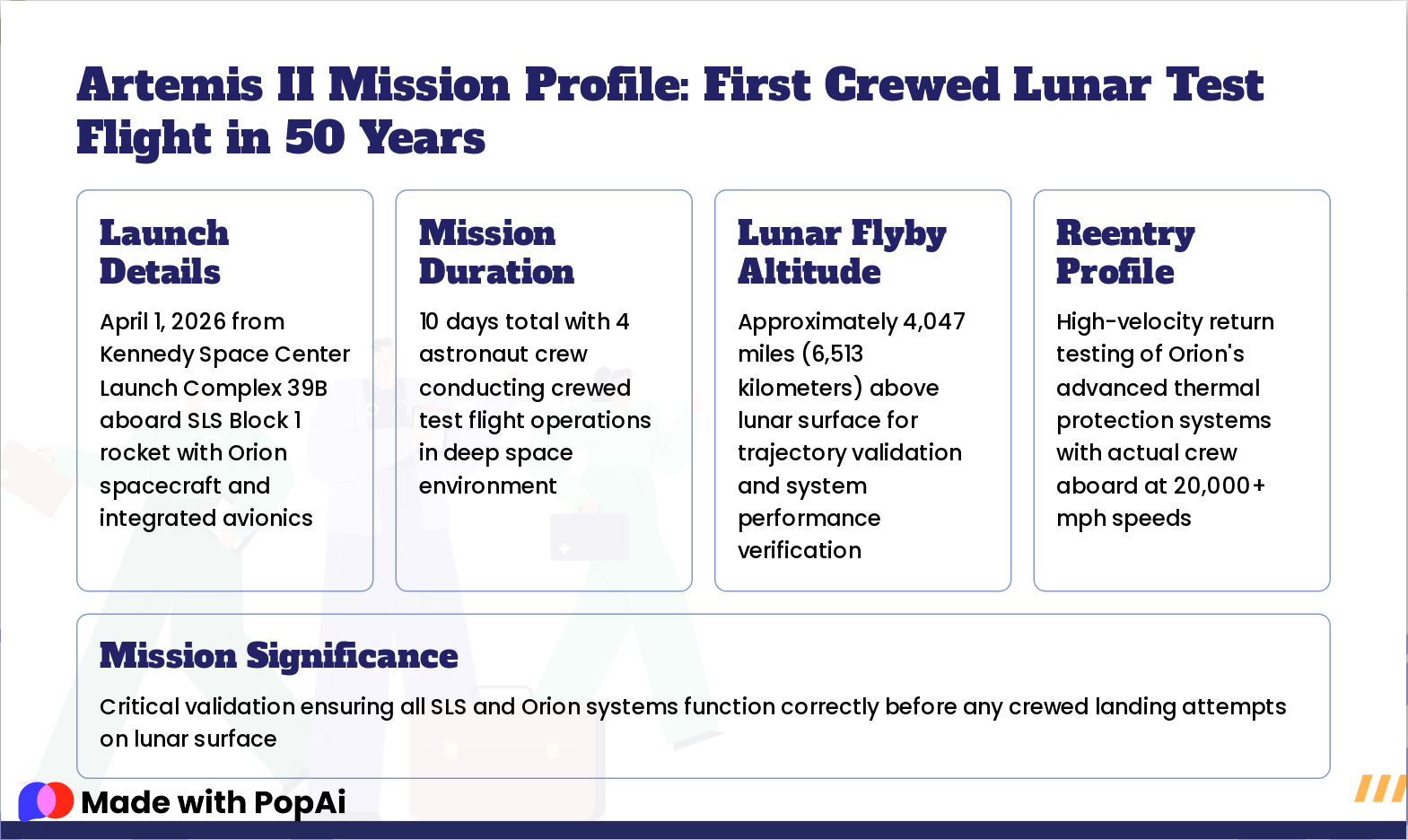
Slide 6: Artemis II Mission Profile: First Crewed Lunar Test Flight in 50 Years
- Launch Details: April 1, 2026 from Kennedy Space Center Launch Complex 39B aboard SLS Block 1 rocket with Orion spacecraft and integrated avionics
- Mission Duration: 10 days total with 4 astronaut crew conducting crewed test flight operations in deep space environment
- Lunar Flyby Altitude: Approximately 4,047 miles (6,513 kilometers) above lunar surface for trajectory validation and system performance verification
- Reentry Profile: High-velocity return testing of Orion's advanced thermal protection systems with actual crew aboard at 20,000+ mph speeds
- Mission Significance: Critical validation ensuring all SLS and Orion systems function correctly before any crewed landing attempts on lunar surface
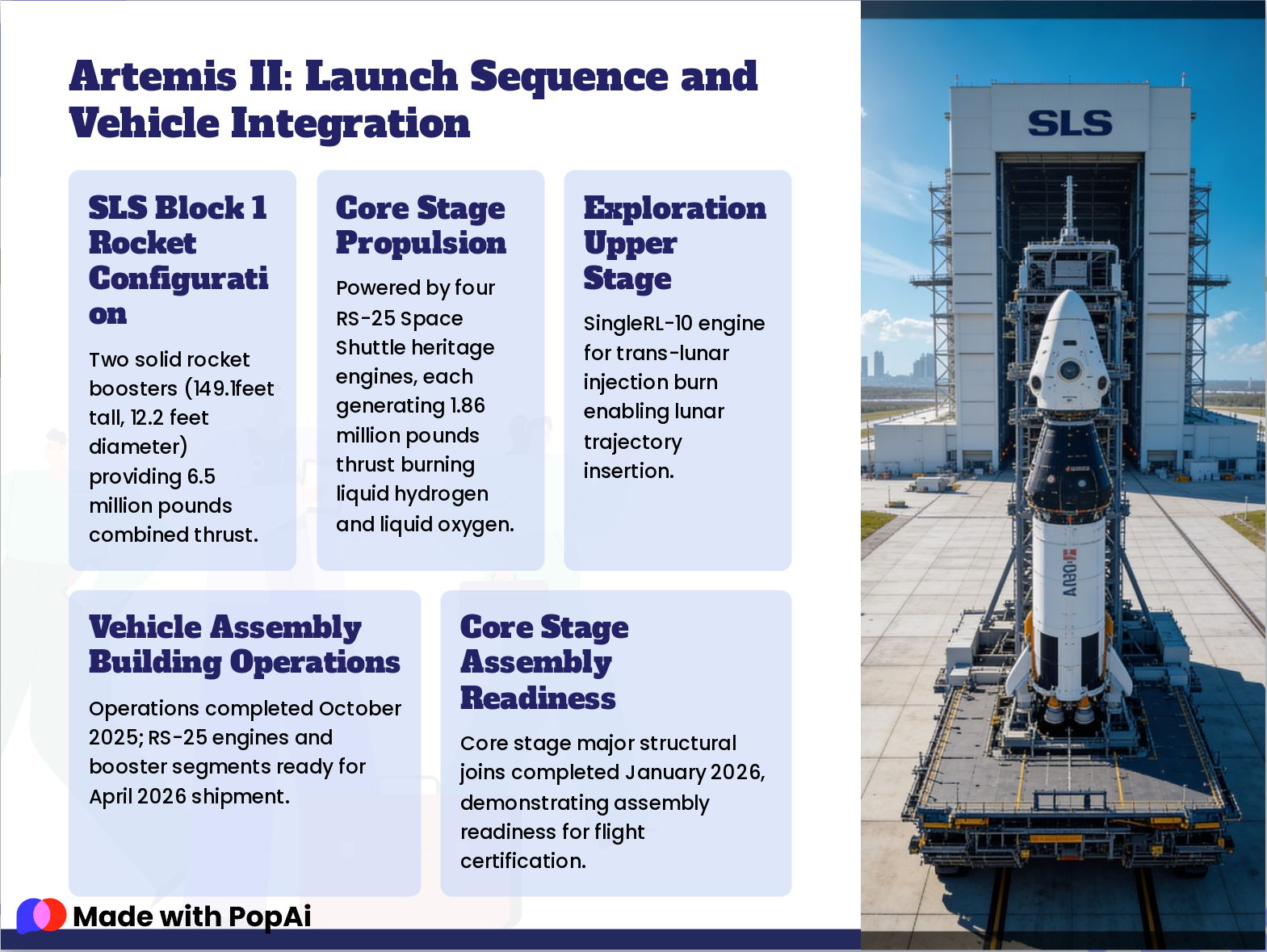
Slide 7: Artemis II: Launch Sequence and Vehicle Integration
- SLS Block 1 Rocket Configuration: Two solid rocket boosters (149.1feet tall, 12.2 feet diameter) providing 6.5 million pounds combined thrust.
- Core Stage Propulsion: Powered by four RS-25 Space Shuttle heritage engines, each generating 1.86 million pounds thrust burning liquid hydrogen and liquid oxygen.
- Exploration Upper Stage: SingleRL-10 engine for trans-lunar injection burn enabling lunar trajectory insertion.
- Vehicle Assembly Building Operations: Operations completed October 2025; RS-25 engines and booster segments ready for April 2026 shipment.
- Core Stage Assembly Readiness: Core stage major structural joins completed January 2026, demonstrating assembly readiness for flight certification.
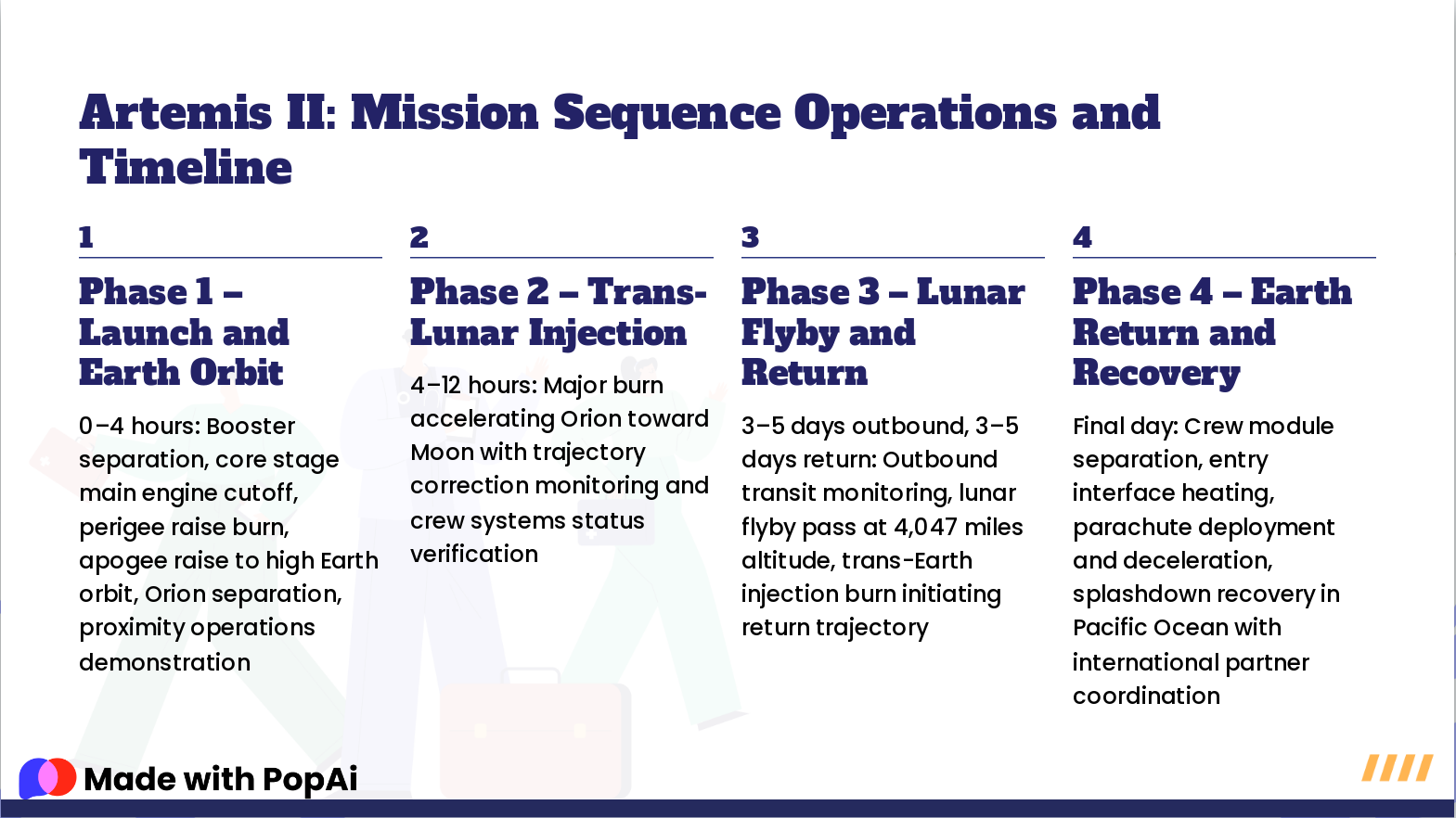
Slide 8: Artemis II: Mission Sequence Operations and Timeline
- Phase 1 – Launch and Earth Orbit: 0–4 hours: Booster separation, core stage main engine cutoff, perigee raise burn, apogee raise to high Earth orbit, Orion separation, proximity operations demonstration
- Phase 2 – Trans-Lunar Injection: 4–12 hours: Major burn accelerating Orion toward Moon with trajectory correction monitoring and crew systems status verification
- Phase 3 – Lunar Flyby and Return: 3–5 days outbound, 3–5 days return: Outbound transit monitoring, lunar flyby pass at 4,047 miles altitude, trans-Earth injection burn initiating return trajectory
- Phase 4 – Earth Return and Recovery: Final day: Crew module separation, entry interface heating, parachute deployment and deceleration, splashdown recovery in Pacific Ocean with international partner coordination
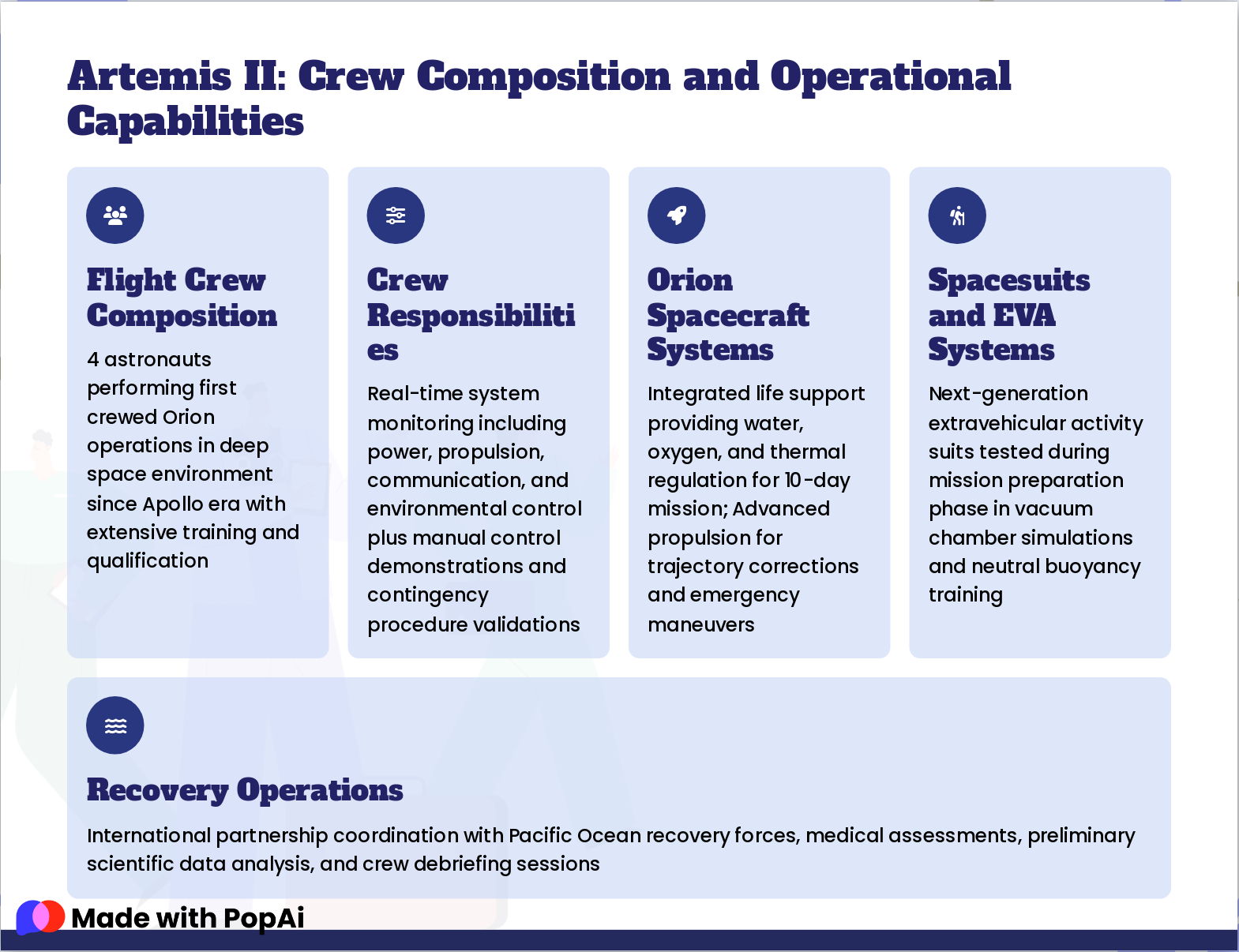
Slide 9: Artemis II: Crew Composition and Operational Capabilities
- Flight Crew Composition: 4 astronauts performing first crewed Orion operations in deep space environment since Apollo era with extensive training and qualification
- Crew Responsibilities: Real-time system monitoring including power, propulsion, communication, and environmental control plus manual control demonstrations and contingency procedure validations
- Orion Spacecraft Systems: Integrated life support providing water, oxygen, and thermal regulation for 10-day mission; Advanced propulsion for trajectory corrections and emergency maneuvers
- Spacesuits and EVA Systems: Next-generation extravehicular activity suits tested during mission preparation phase in vacuum chamber simulations and neutral buoyancy training
- Recovery Operations: International partnership coordination with Pacific Ocean recovery forces, medical assessments, preliminary scientific data analysis, and crew debriefing sessions
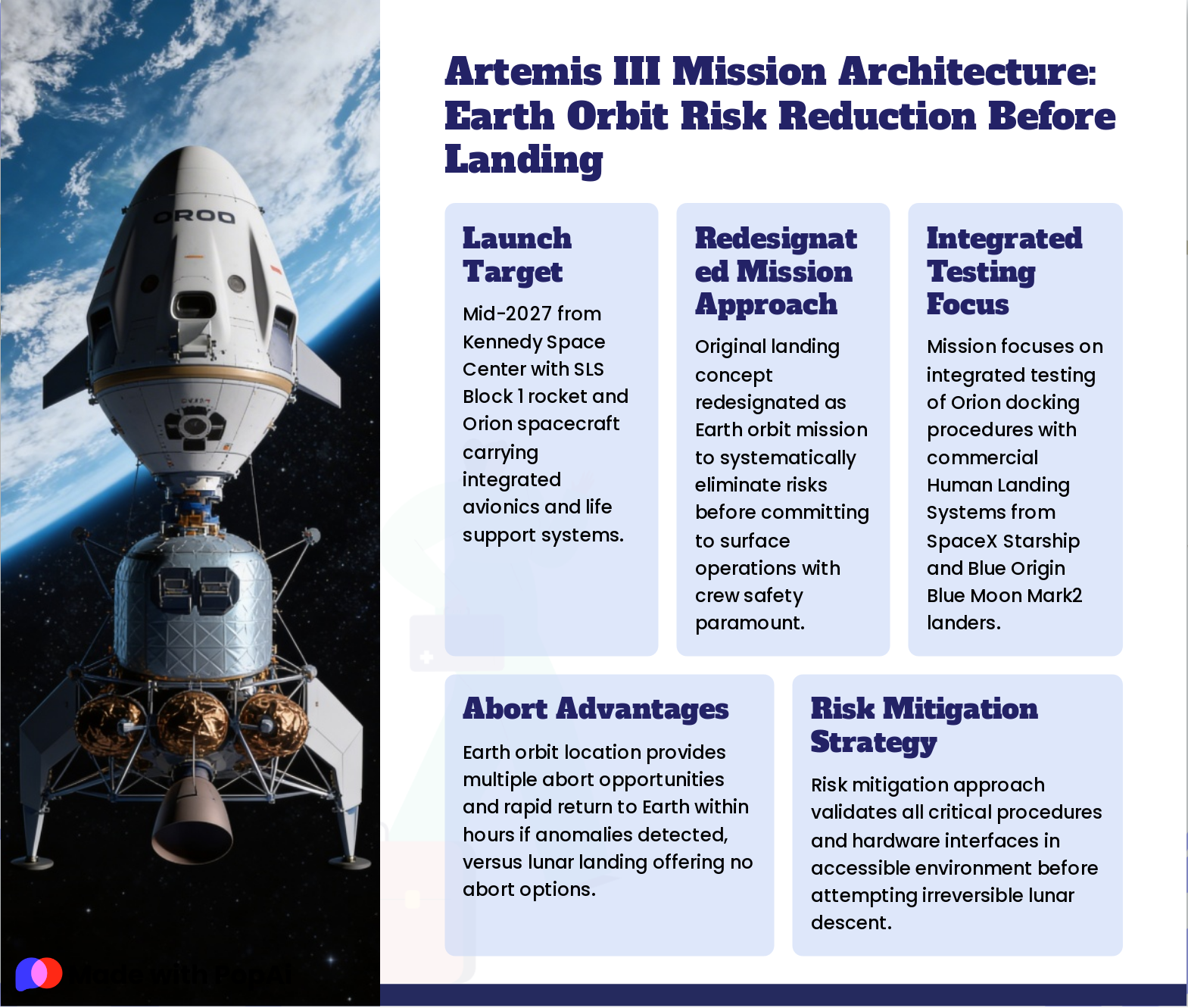
Slide 10: Artemis III Mission Architecture: Earth Orbit Risk Reduction Before Landing
- Launch Target: Mid-2027 from Kennedy Space Center with SLS Block 1 rocket and Orion spacecraft carrying integrated avionics and life support systems.
- Redesignated Mission Approach: Original landing concept redesignated as Earth orbit mission to systematically eliminate risks before committing to surface operations with crew safety paramount.
- Integrated Testing Focus: Mission focuses on integrated testing of Orion docking procedures with commercial Human Landing Systems from SpaceX Starship and Blue Origin Blue Moon Mark2 landers.
- Abort Advantages: Earth orbit location provides multiple abort opportunities and rapid return to Earth within hours if anomalies detected, versus lunar landing offering no abort options.
- Risk Mitigation Strategy: Risk mitigation approach validates all critical procedures and hardware interfaces in accessible environment before attempting irreversible lunar descent.
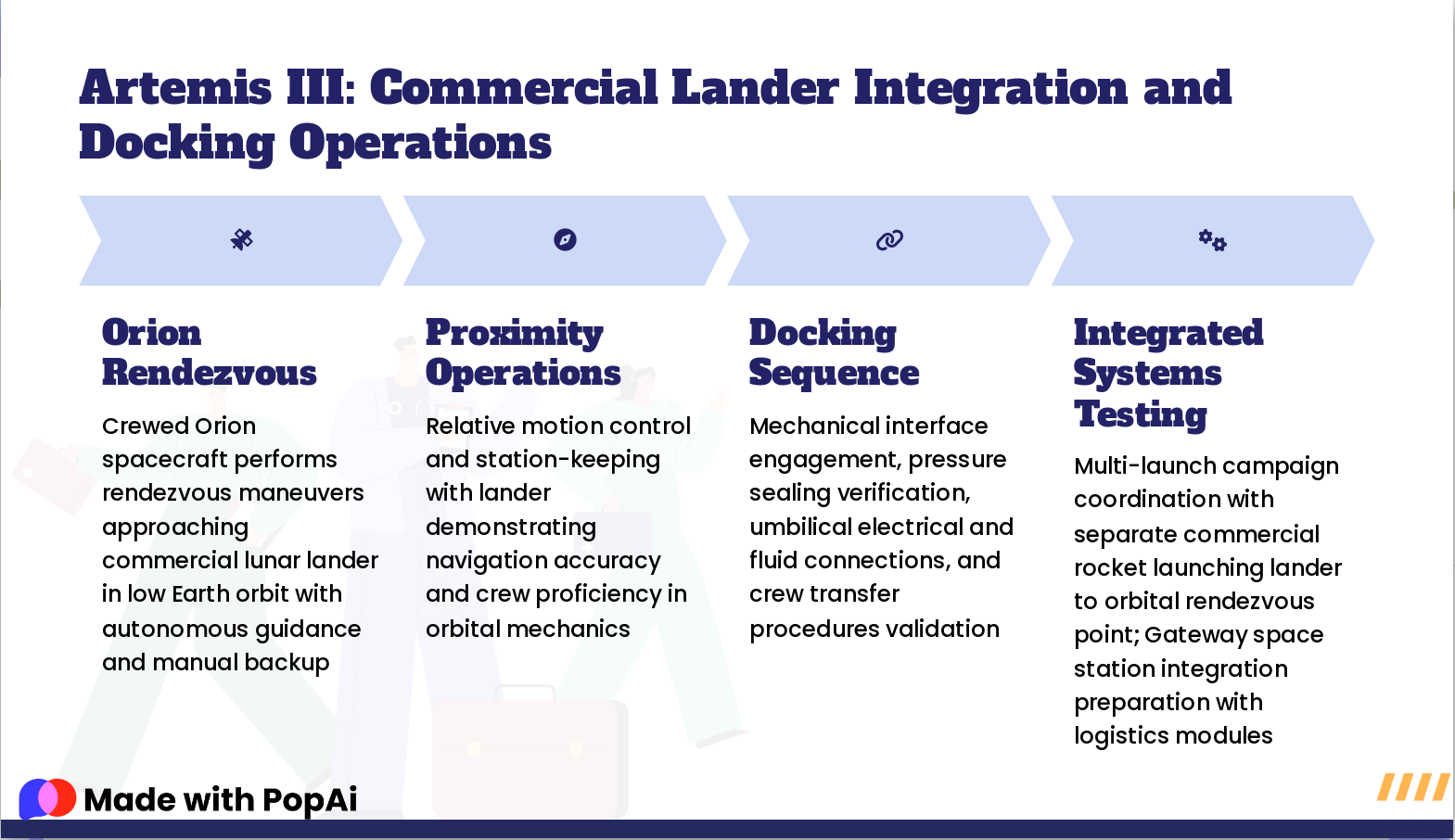
Slide 11: Artemis III: Commercial Lander Integration and Docking Operations
- Orion Rendezvous: Crewed Orion spacecraft performs rendezvous maneuvers approaching commercial lunar lander in low Earth orbit with autonomous guidance and manual backup
- Proximity Operations: Relative motion control and station-keeping with lander demonstrating navigation accuracy and crew proficiency in orbital mechanics
- Docking Sequence: Mechanical interface engagement, pressure sealing verification, umbilical electrical and fluid connections, and crew transfer procedures validation
- Integrated Systems Testing: Multi-launch campaign coordination with separate commercial rocket launching lander to orbital rendezvous point; Gateway space station integration preparation with logistics modules
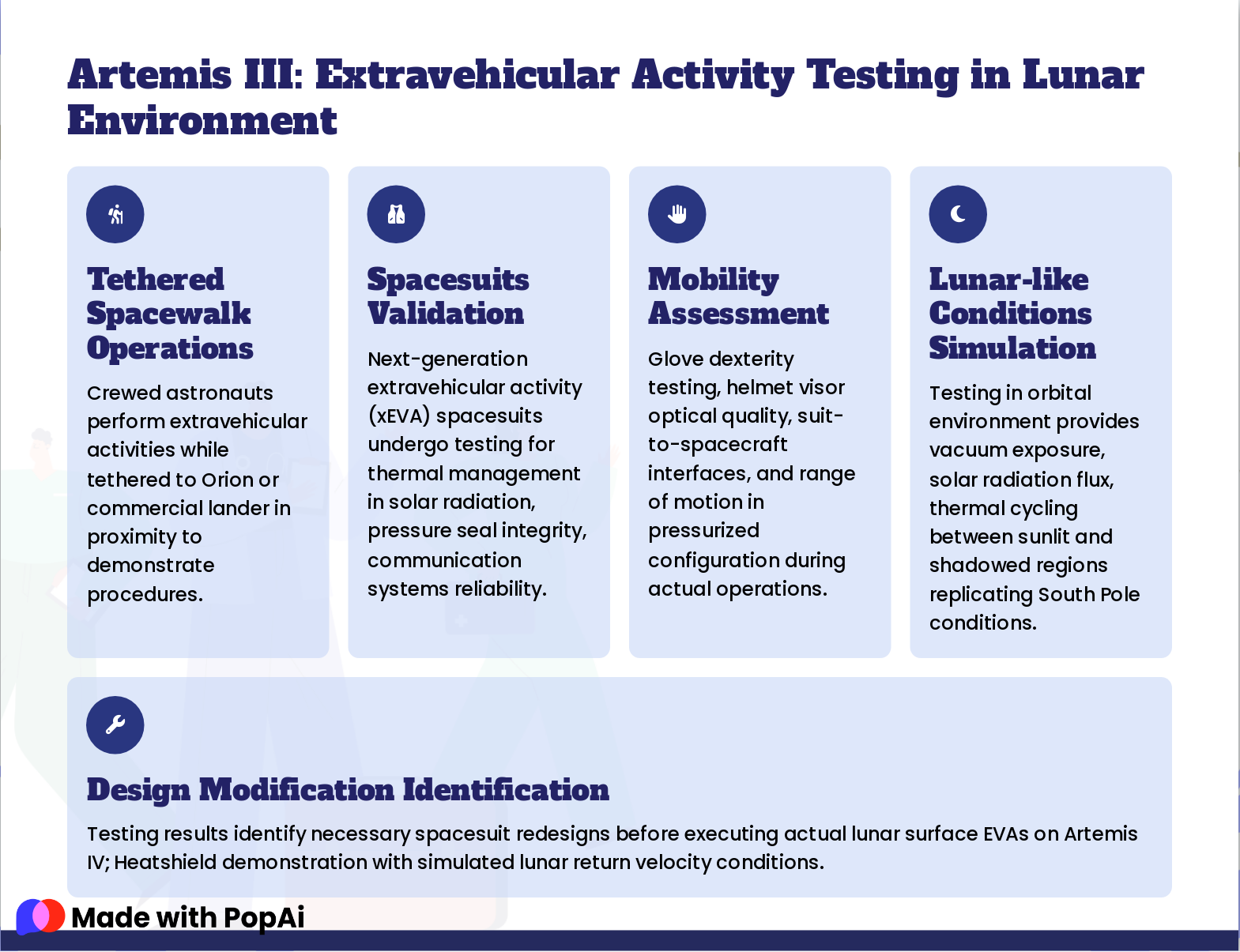
Slide 12: Artemis III: Extravehicular Activity Testing in Lunar Environment
- Tethered Spacewalk Operations: Crewed astronauts perform extravehicular activities while tethered to Orion or commercial lander in proximity to demonstrate procedures.
- Spacesuits Validation: Next-generation extravehicular activity (xEVA) spacesuits undergo testing for thermal management in solar radiation, pressure seal integrity, communication systems reliability.
- Mobility Assessment: Glove dexterity testing, helmet visor optical quality, suit-to-spacecraft interfaces, and range of motion in pressurized configuration during actual operations.
- Lunar-like Conditions Simulation: Testing in orbital environment provides vacuum exposure, solar radiation flux, thermal cycling between sunlit and shadowed regions replicating South Pole conditions.
- Design Modification Identification: Testing results identify necessary spacesuit redesigns before executing actual lunar surface EVAs on Artemis IV; Heatshield demonstration with simulated lunar return velocity conditions.
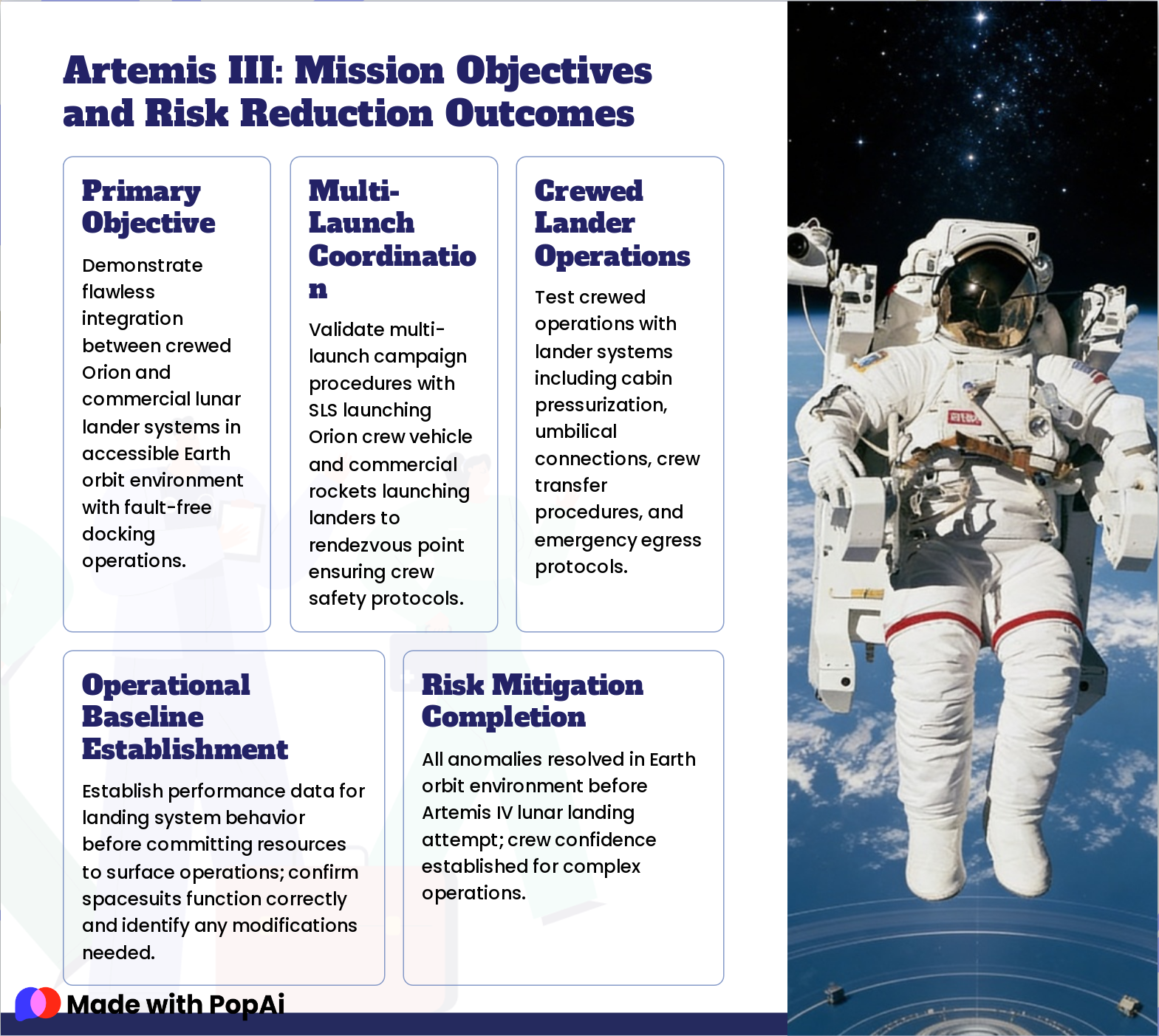
Slide 13: Artemis III: Mission Objectives and Risk Reduction Outcomes
- Primary Objective: Demonstrate flawless integration between crewed Orion and commercial lunar lander systems in accessible Earth orbit environment with fault-free docking operations.
- Multi-Launch Coordination: Validate multi-launch campaign procedures with SLS launching Orion crew vehicle and commercial rockets launching landers to rendezvous point ensuring crew safety protocols.
- Crewed Lander Operations: Test crewed operations with lander systems including cabin pressurization, umbilical connections, crew transfer procedures, and emergency egress protocols.
- Operational Baseline Establishment: Establish performance data for landing system behavior before committing resources to surface operations; confirm spacesuits function correctly and identify any modifications needed.
- Risk Mitigation Completion: All anomalies resolved in Earth orbit environment before Artemis IV lunar landing attempt; crew confidence established for complex operations.
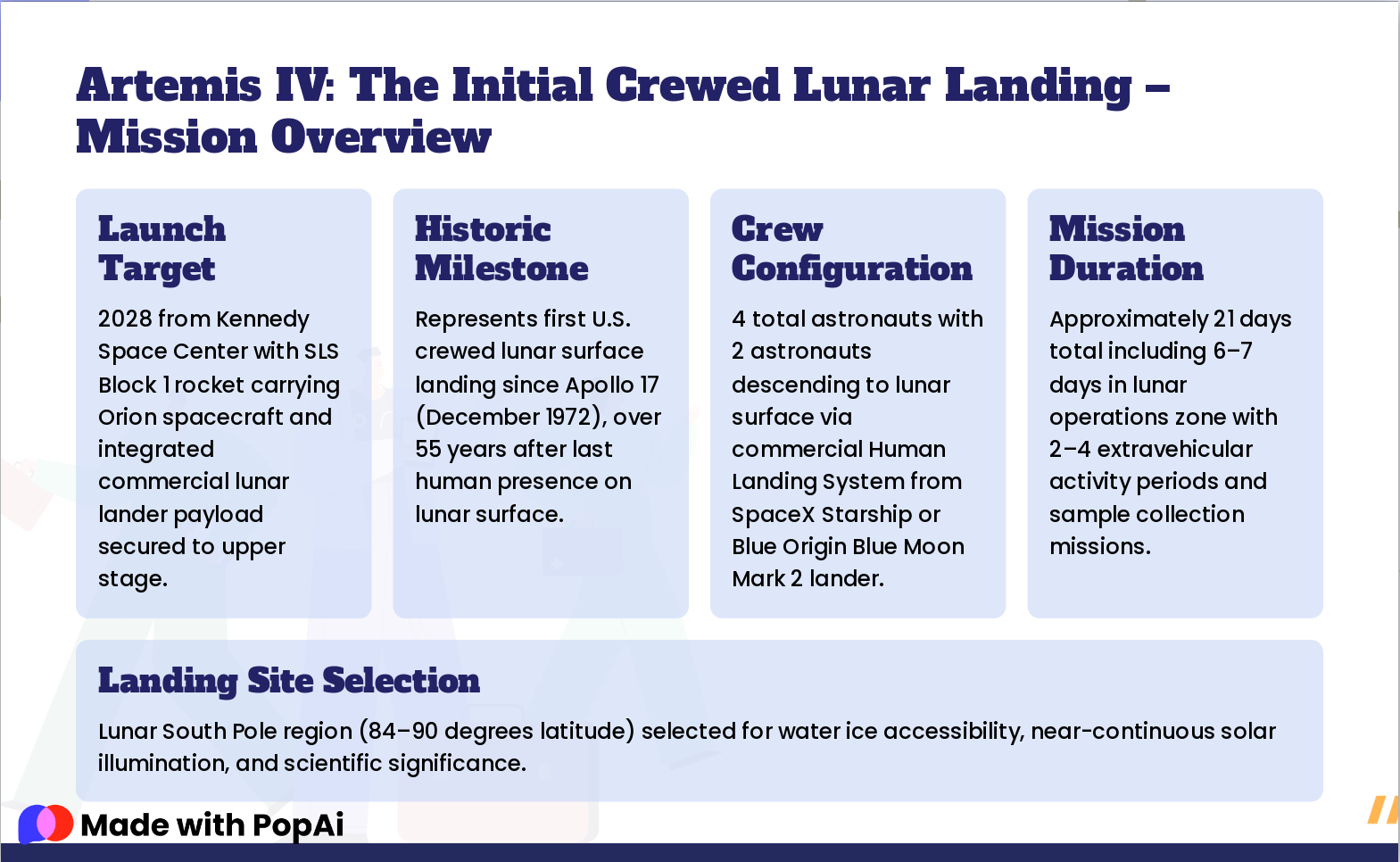
Slide 14: Artemis IV: The Initial Crewed Lunar Landing – Mission Overview
- Launch Target: 2028 from Kennedy Space Center with SLS Block 1 rocket carrying Orion spacecraft and integrated commercial lunar lander payload secured to upper stage.
- Historic Milestone: Represents first U.S. crewed lunar surface landing since Apollo 17 (December 1972), over 55 years after last human presence on lunar surface.
- Crew Configuration: 4 total astronauts with 2 astronauts descending to lunar surface via commercial Human Landing System from SpaceX Starship or Blue Origin Blue Moon Mark 2 lander.
- Mission Duration: Approximately 21 days total including 6–7 days in lunar operations zone with 2–4 extravehicular activity periods and sample collection missions.
- Landing Site Selection: Lunar South Pole region (84–90 degrees latitude) selected for water ice accessibility, near-continuous solar illumination, and scientific significance.
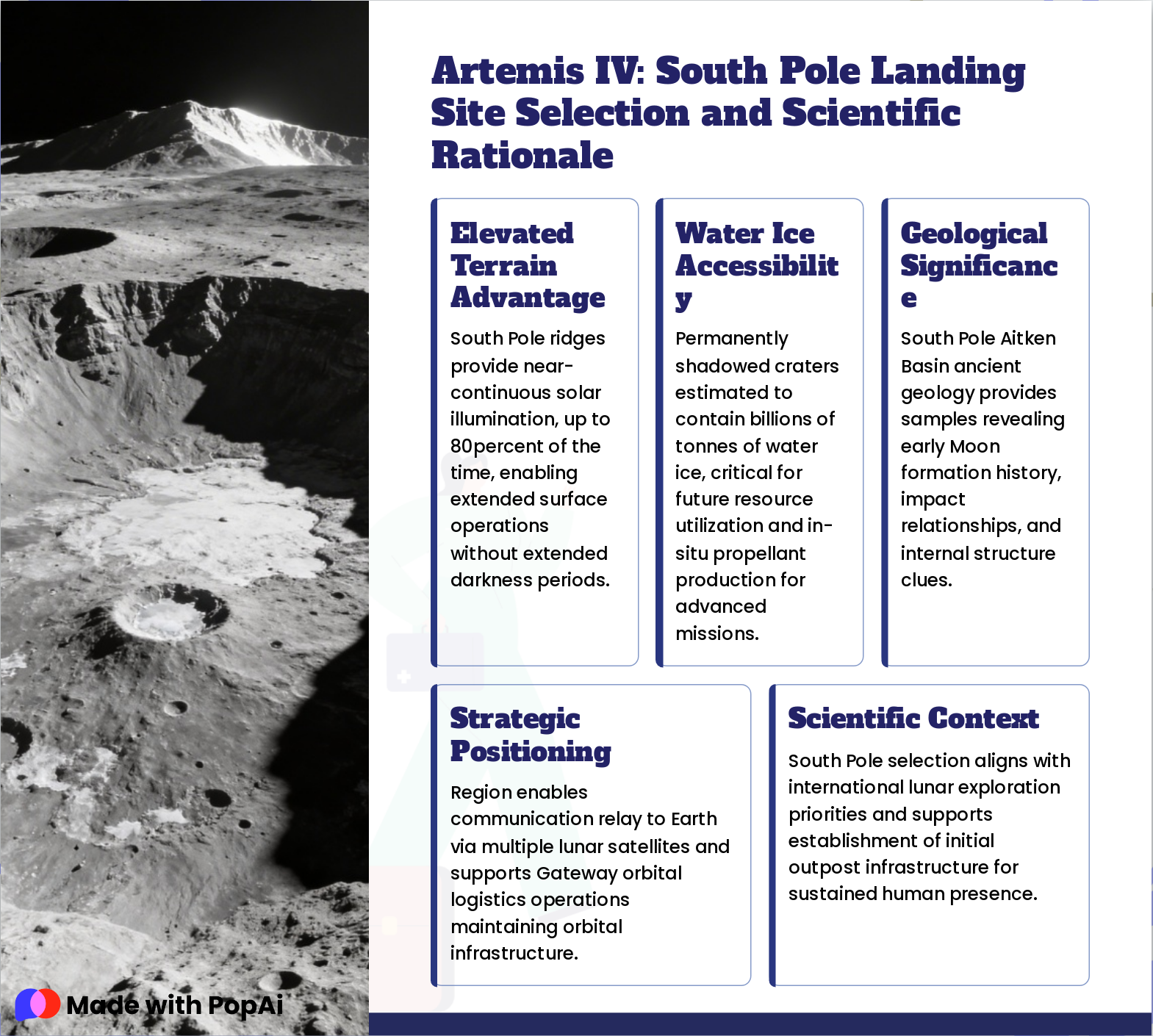
Slide 15: Artemis IV: South Pole Landing Site Selection and Scientific Rationale
- Elevated Terrain Advantage: South Pole ridges provide near-continuous solar illumination, up to 80percent of the time, enabling extended surface operations without extended darkness periods.
- Water Ice Accessibility: Permanently shadowed craters estimated to contain billions of tonnes of water ice, critical for future resource utilization and in-situ propellant production for advanced missions.
- Geological Significance: South Pole Aitken Basin ancient geology provides samples revealing early Moon formation history, impact relationships, and internal structure clues.
- Strategic Positioning: Region enables communication relay to Earth via multiple lunar satellites and supports Gateway orbital logistics operations maintaining orbital infrastructure.
- Scientific Context: South Pole selection aligns with international lunar exploration priorities and supports establishment of initial outpost infrastructure for sustained human presence.
Slide 16: Artemis IV: Crewed Lunar Surface Operations and Activities
- Surface Stay Duration: 6–7 days with 2 astronauts conducting daily operations while 2 remaining crew members maintain lunar orbit operations aboard Orion for contingency support
- Extravehicular Activities: 2–4 major EVA missions exploring South Pole terrain using upgraded spacesuits, integrated life support systems, and mobility equipment with 6–8 hour suit endurance
- Geological Sampling: Sample collection protocols including documentation, packaging, and preservation procedures ensuring scientific integrity for Earth-based analysis and geological interpretation
- Instrument Deployment: Seismic monitoring arrays, radiation environment sensors, and atmospheric measurement stations positioned around landing site for multi-year continuous scientific data collection
- Infrastructure Preparation: Site preparation for future sustained presence including habitat location identification, terrain hazard mapping, and resource availability assessment for future missions
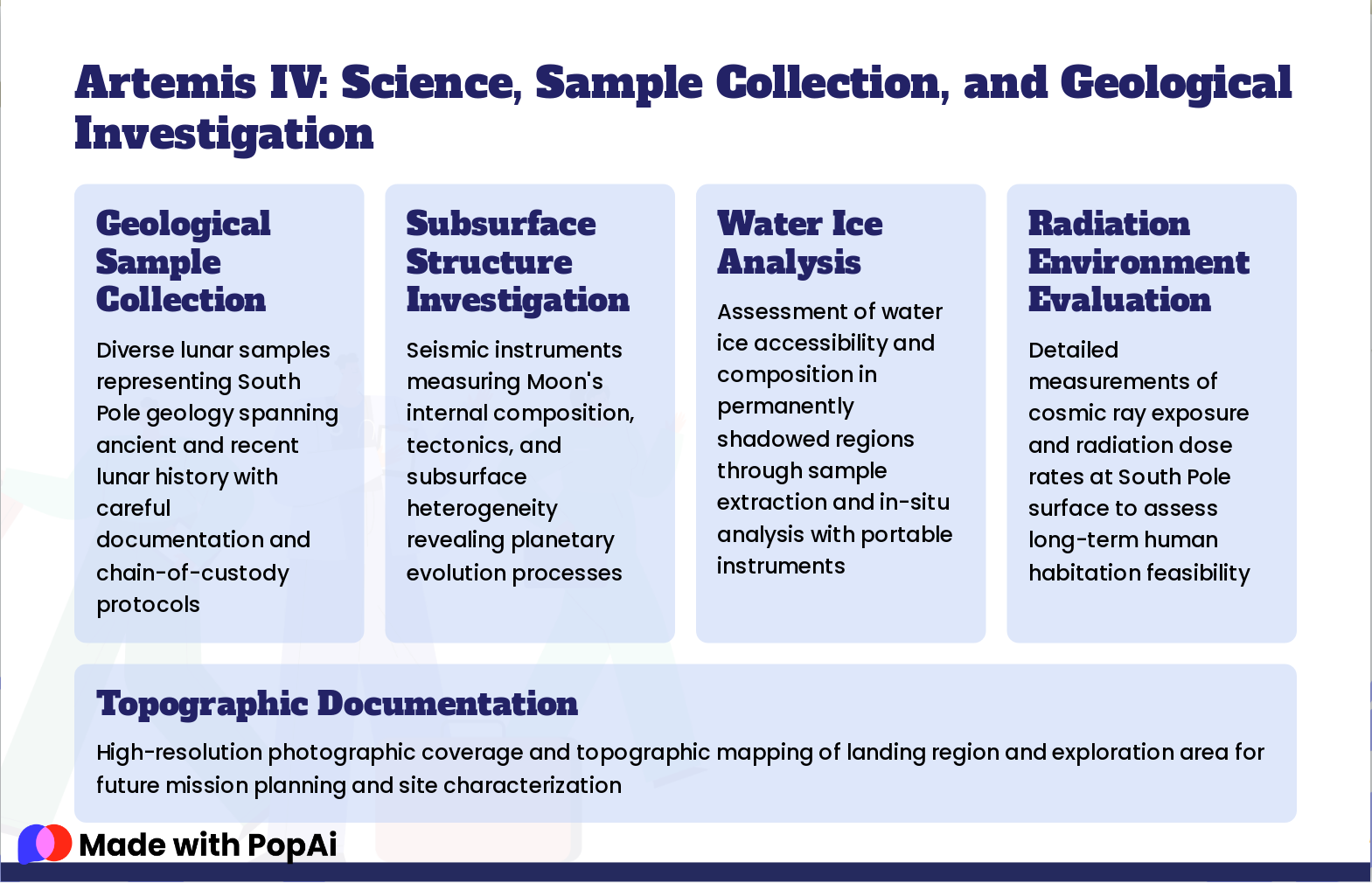
Slide 17: Artemis IV: Science, Sample Collection, and Geological Investigation
- Geological Sample Collection: Diverse lunar samples representing South Pole geology spanning ancient and recent lunar history with careful documentation and chain-of-custody protocols
- Subsurface Structure Investigation: Seismic instruments measuring Moon's internal composition, tectonics, and subsurface heterogeneity revealing planetary evolution processes
- Water Ice Analysis: Assessment of water ice accessibility and composition in permanently shadowed regions through sample extraction and in-situ analysis with portable instruments
- Radiation Environment Evaluation: Detailed measurements of cosmic ray exposure and radiation dose rates at South Pole surface to assess long-term human habitation feasibility
- Topographic Documentation: High-resolution photographic coverage and topographic mapping of landing region and exploration area for future mission planning and site characterization
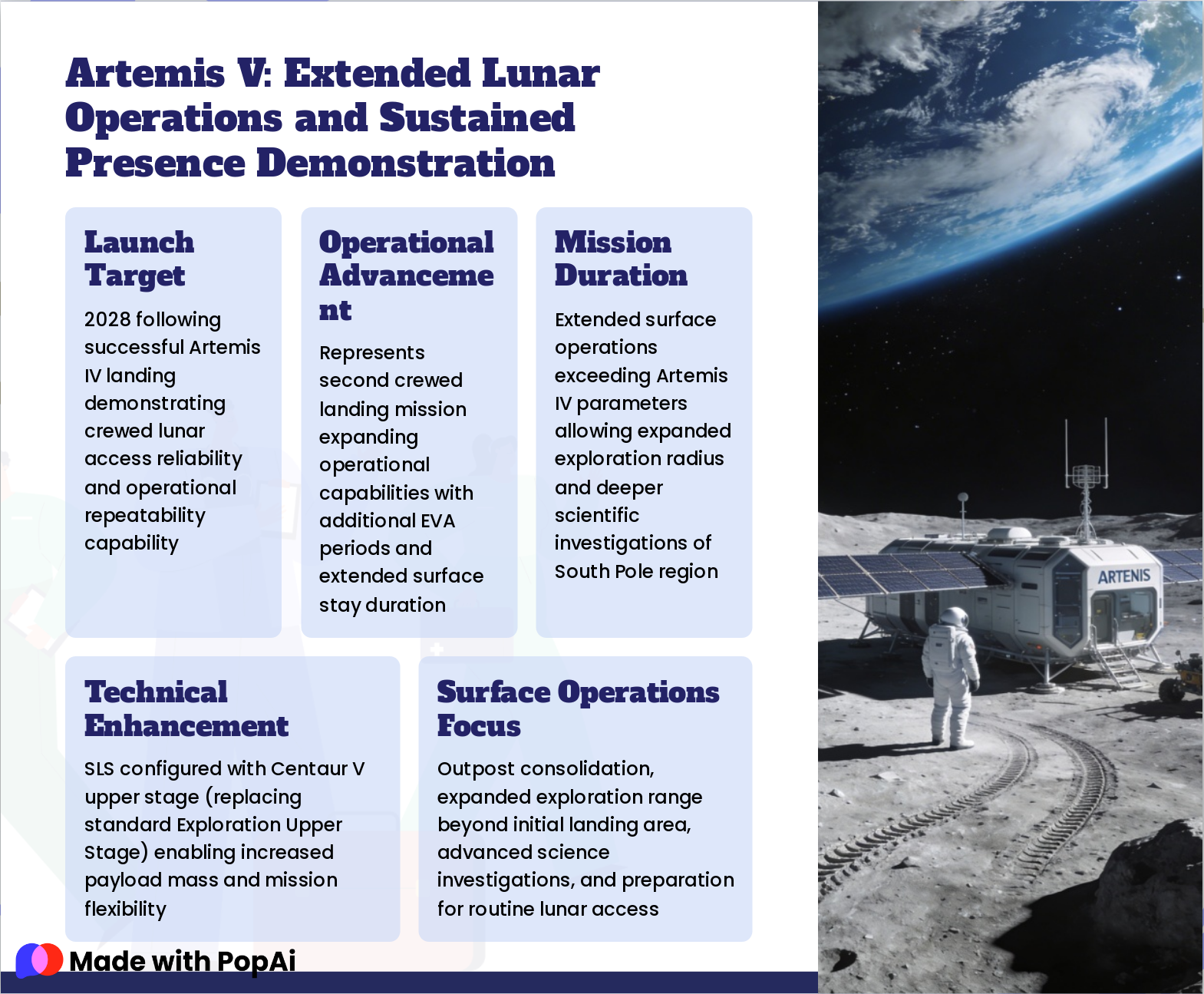
Slide 18: Artemis V: Extended Lunar Operations and Sustained Presence Demonstration
- Launch Target: 2028 following successful Artemis IV landing demonstrating crewed lunar access reliability and operational repeatability capability
- Operational Advancement: Represents second crewed landing mission expanding operational capabilities with additional EVA periods and extended surface stay duration
- Mission Duration: Extended surface operations exceeding Artemis IV parameters allowing expanded exploration radius and deeper scientific investigations of South Pole region
- Technical Enhancement: SLS configured with Centaur V upper stage (replacing standard Exploration Upper Stage) enabling increased payload mass and mission flexibility
- Surface Operations Focus: Outpost consolidation, expanded exploration range beyond initial landing area, advanced science investigations, and preparation for routine lunar access
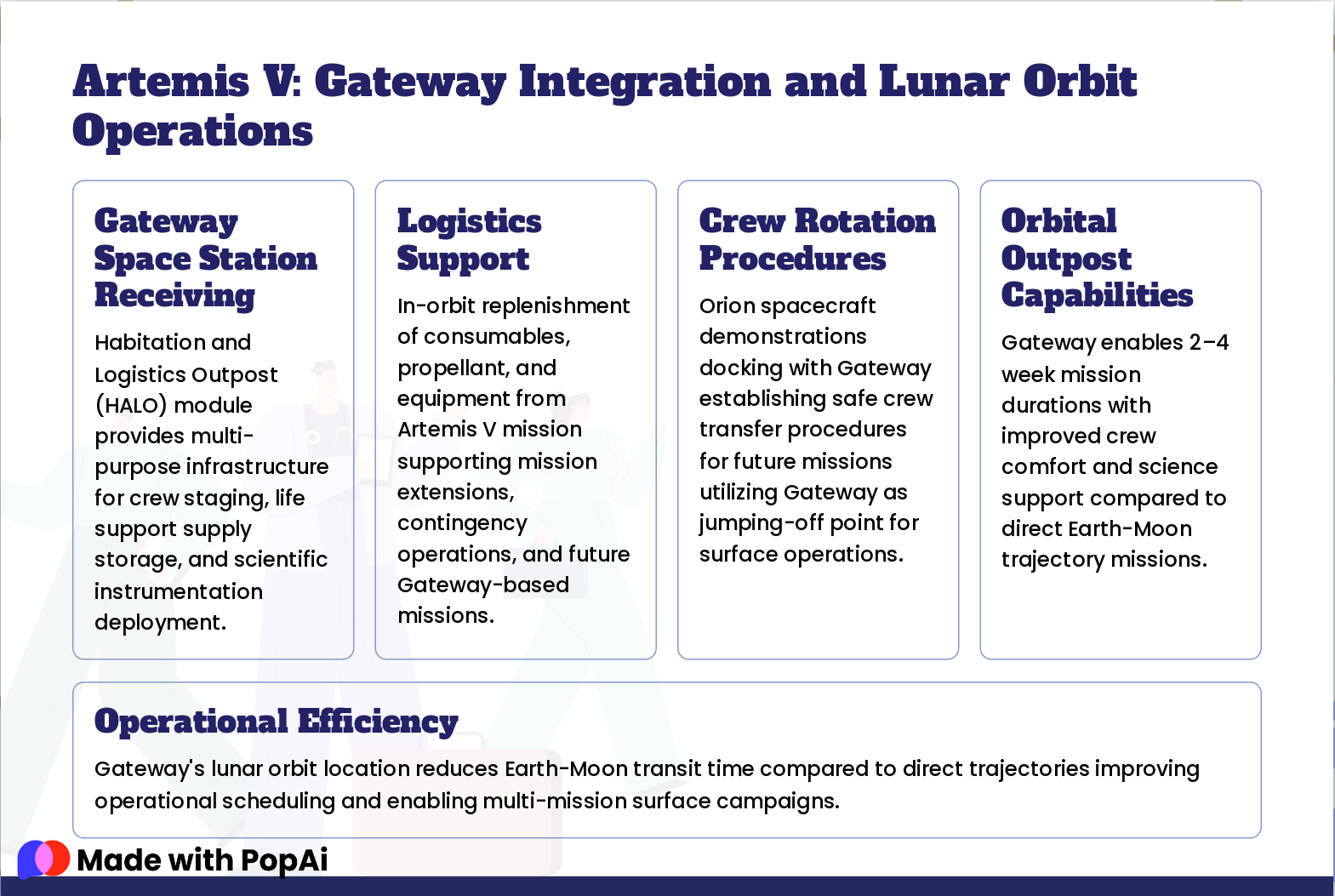
Slide 19: Artemis V: Gateway Integration and Lunar Orbit Operations
- Gateway Space Station Receiving: Habitation and Logistics Outpost (HALO) module provides multi-purpose infrastructure for crew staging, life support supply storage, and scientific instrumentation deployment.
- Logistics Support: In-orbit replenishment of consumables, propellant, and equipment from Artemis V mission supporting mission extensions, contingency operations, and future Gateway-based missions.
- Crew Rotation Procedures: Orion spacecraft demonstrations docking with Gateway establishing safe crew transfer procedures for future missions utilizing Gateway as jumping-off point for surface operations.
- Orbital Outpost Capabilities: Gateway enables 2–4 week mission durations with improved crew comfort and science support compared to direct Earth-Moon trajectory missions.
- Operational Efficiency: Gateway's lunar orbit location reduces Earth-Moon transit time compared to direct trajectories improving operational scheduling and enabling multi-mission surface campaigns.
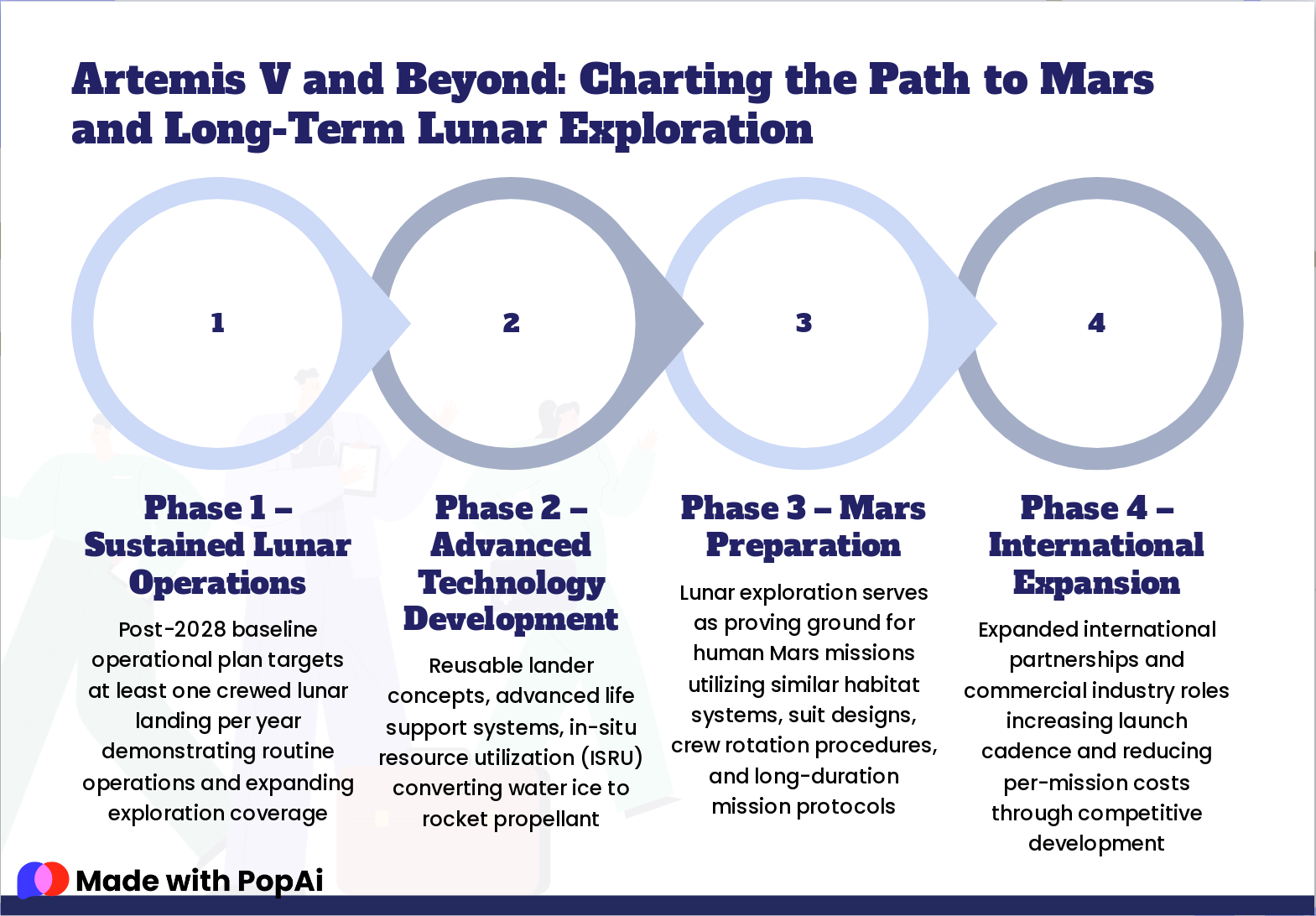
Slide 20: Artemis V and Beyond: Charting the Path to Mars and Long-Term Lunar Exploration
- Phase 1 – Sustained Lunar Operations: Post-2028 baseline operational plan targets at least one crewed lunar landing per year demonstrating routine operations and expanding exploration coverage
- Phase 2 – Advanced Technology Development: Reusable lander concepts, advanced life support systems, in-situ resource utilization (ISRU) converting water ice to rocket propellant
- Phase 3 – Mars Preparation: Lunar exploration serves as proving ground for human Mars missions utilizing similar habitat systems, suit designs, crew rotation procedures, and long-duration mission protocols
- Phase 4 – International Expansion: Expanded international partnerships and commercial industry roles increasing launch cadence and reducing per-mission costs through competitive development
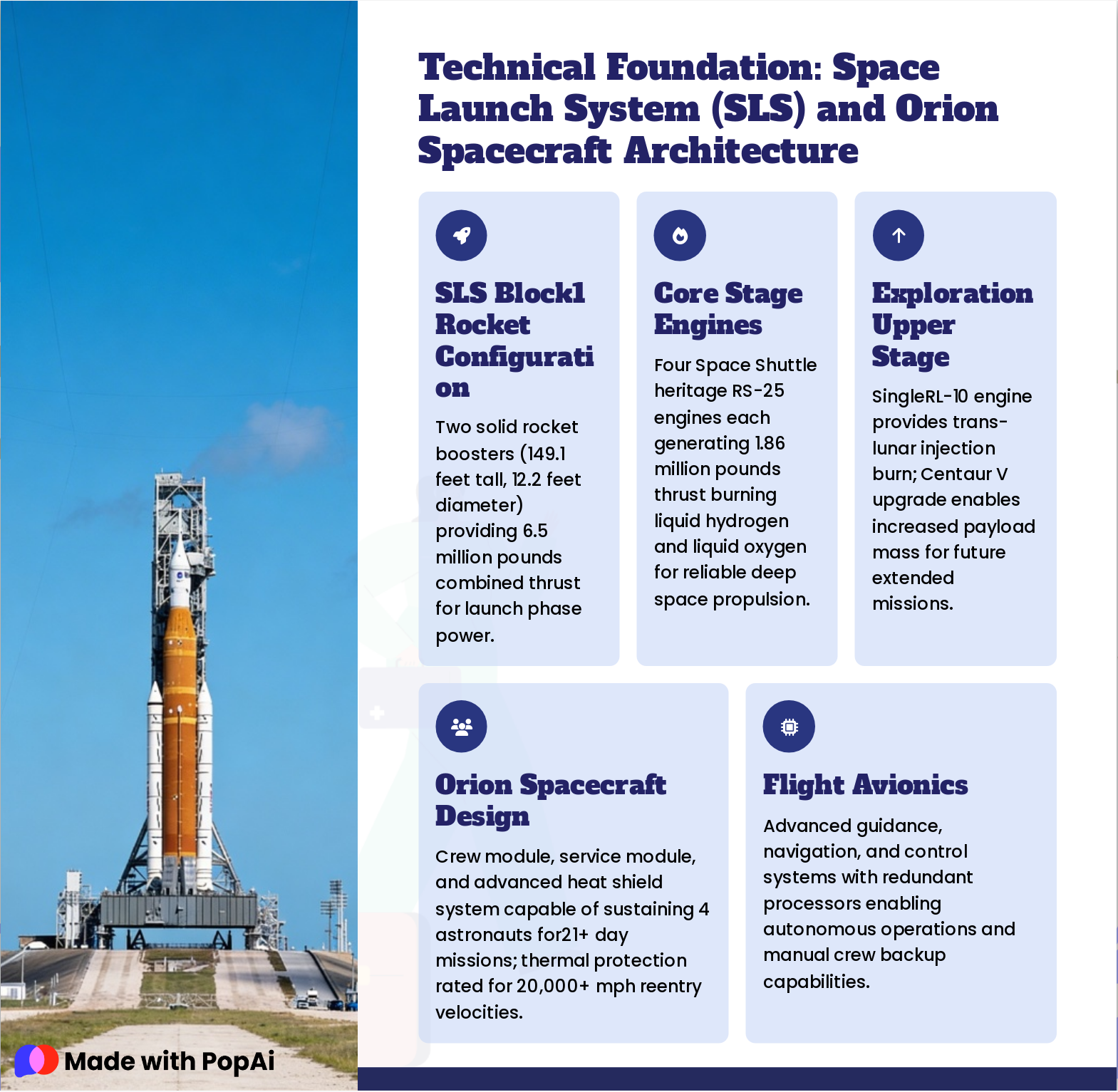
Slide 21: Technical Foundation: Space Launch System (SLS) and Orion Spacecraft Architecture
- SLS Block1 Rocket Configuration: Two solid rocket boosters (149.1 feet tall, 12.2 feet diameter) providing 6.5 million pounds combined thrust for launch phase power.
- Core Stage Engines: Four Space Shuttle heritage RS-25 engines each generating 1.86 million pounds thrust burning liquid hydrogen and liquid oxygen for reliable deep space propulsion.
- Exploration Upper Stage: SingleRL-10 engine provides trans-lunar injection burn; Centaur V upgrade enables increased payload mass for future extended missions.
- Orion Spacecraft Design: Crew module, service module, and advanced heat shield system capable of sustaining 4 astronauts for21+ day missions; thermal protection rated for 20,000+ mph reentry velocities.
- Flight Avionics: Advanced guidance, navigation, and control systems with redundant processors enabling autonomous operations and manual crew backup capabilities.
Slide 22: Technical Systems: Human Landing Systems and Ground Infrastructure
- Human Landing Systems: SpaceX Starship: single-stage reusable lander capable of 2 crew descent and ascent with rapid reuse capability. Blue Origin Blue Moon Mark 2: traditional descent/ascent stage architecture.
- Commercial Partnership Approach: Both HLS providers undergo NASA certification testing and integrated operations validation with Orion spacecraft before receiving lunar landing mission assignments.
- Exploration Ground Systems: Kennedy Space Center facilities for processing SLS rockets and Orion spacecraft including 364-foot tall Vehicle Assembly Building and Launch Complex 39B infrastructure.
- Mobile Launcher Units: Transport fully assembled SLS and Orion spacecraft to launch pad; processing includes multiple test operations, weather monitoring, and launch countdown procedures.
- Advanced Avionics Integration: Flight software systems enable autonomous operations, real-time telemetry downlink, crew data management, and emergency contingency procedures.
Slide 23: Strategic Implications: Scientific Discovery, Geopolitical Leadership, and Space Economy Growth
- Scientific Advancement: Artemis missions unlock lunar sample analysis revealing Moon's geological history, internal composition, and water ice abundance supporting future exploration.
- Geopolitical Significance: Sustained U.S. lunar presence demonstrates technological leadership and commitment to open space exploration, countering alternative lunar programs from other spacefaring nations.
- Economic Growth: Artemis supply chain involves companies across all 50 U.S. states creating skilled workforce expansion, advanced manufacturing jobs, and emerging space-adjacent industries.
- Technology Spinoffs: Advanced materials, robotics, autonomous systems, and life support innovations developed for Artemis programs find applications in commercial industries and solve Earth-based challenges.
- International Cooperation: Gateway orbital outpost establishes international partnership model for future deep space exploration and enables multi-national crew operations on lunar surface.
Slide 24: Artemis: Humanity's Next Giant Leap
The Artemis program represents a generational commitment to sustained lunar exploration with a phased mission approach ensuring safety, reliability, and scientific return. The timeline progression from 2026 (crewed lunar flyby) through 2028 (initial landing and extended operations) establishes the foundation for post-2028 routine missions. Success depends on sustained political commitment, adequate funding, technical innovation, and international collaboration. Lunar exploration achievements directly support preparation for human Mars missions utilizing similar systems and procedures.