Presentation Summary
This presentation examines the impeachment proceedings against Secretary Pete Hegseth, focusing on the legal and constitutional aspects of his alleged unauthorized use of military force, the resulting constitutional crisis, and the implications for defense leadership.
Full Presentation Transcript
Slide 1: The Impeachment of Secretary Pete Hegseth: Historic Constitutional Crisis in Defense Leadership
H.Res.935 Impeachment Proceedings and Legal Analysis
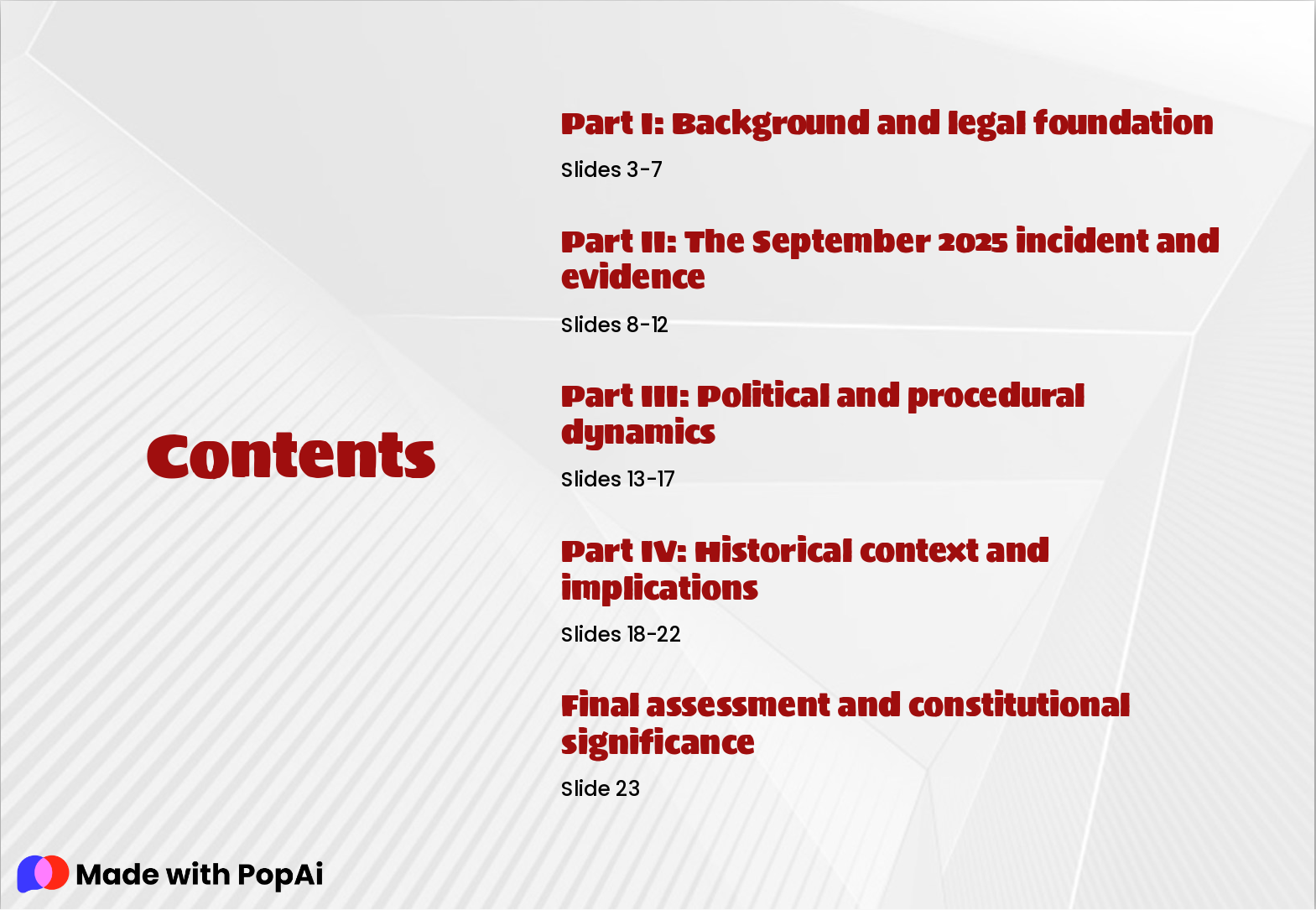
Slide 2: Contents
- Part I: Background and legal foundation: Slides 3-7
- Part II: The September 2025 incident and evidence: Slides 8-12
- Part III: Political and procedural dynamics: Slides 13-17
- Part IV: Historical context and implications: Slides 18-22
- Final assessment and constitutional significance: Slide 23
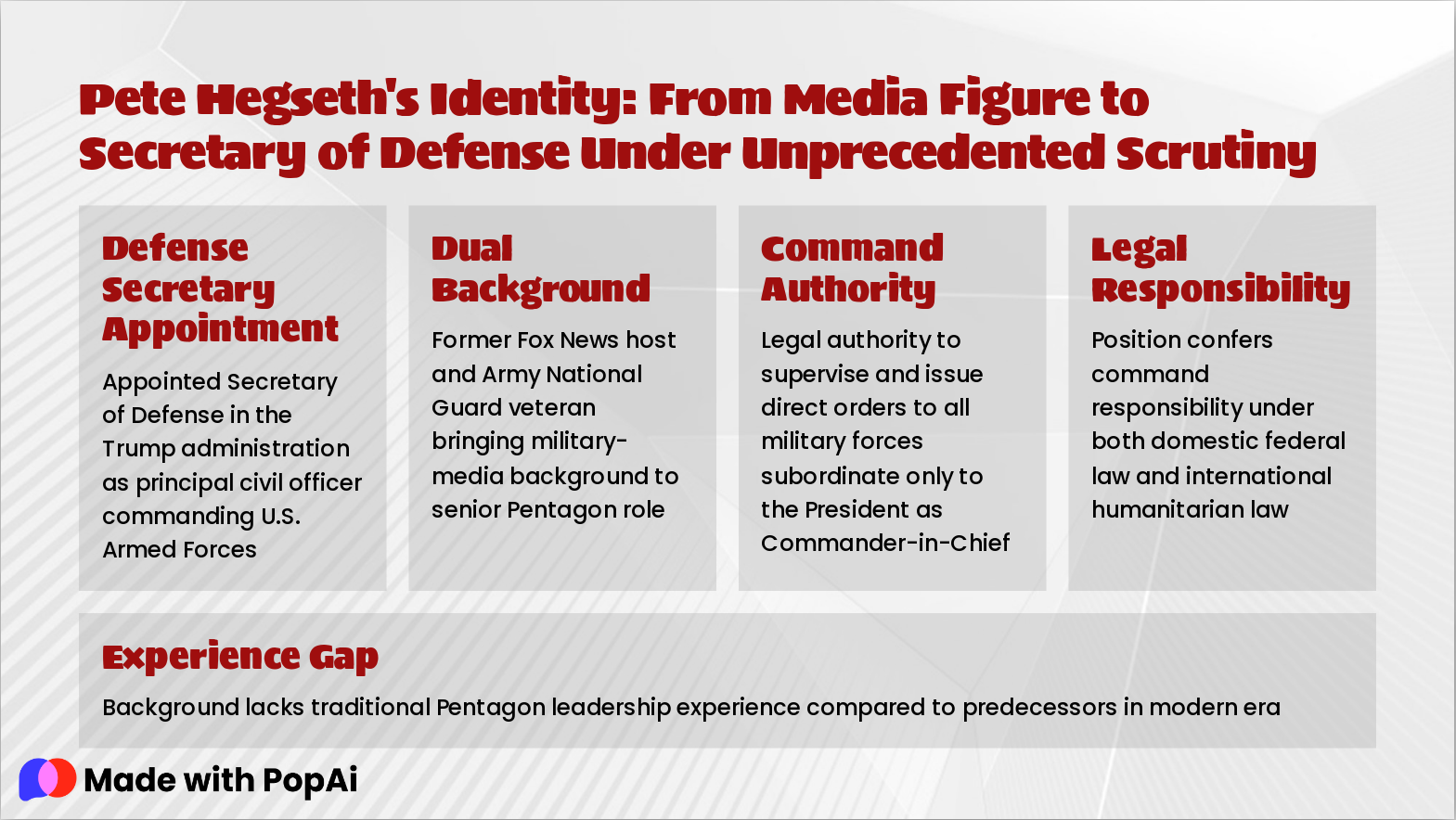
Slide 3: Pete Hegseth's Identity: From Media Figure to Secretary of Defense Under Unprecedented Scrutiny
- Defense Secretary Appointment: Appointed Secretary of Defense in the Trump administration as principal civil officer commanding U.S. Armed Forces
- Dual Background: Former Fox News host and Army National Guard veteran bringing military-media background to senior Pentagon role
- Command Authority: Legal authority to supervise and issue direct orders to all military forces subordinate only to the President as Commander-in-Chief
- Legal Responsibility: Position confers command responsibility under both domestic federal law and international humanitarian law
- Experience Gap: Background lacks traditional Pentagon leadership experience compared to predecessors in modern era
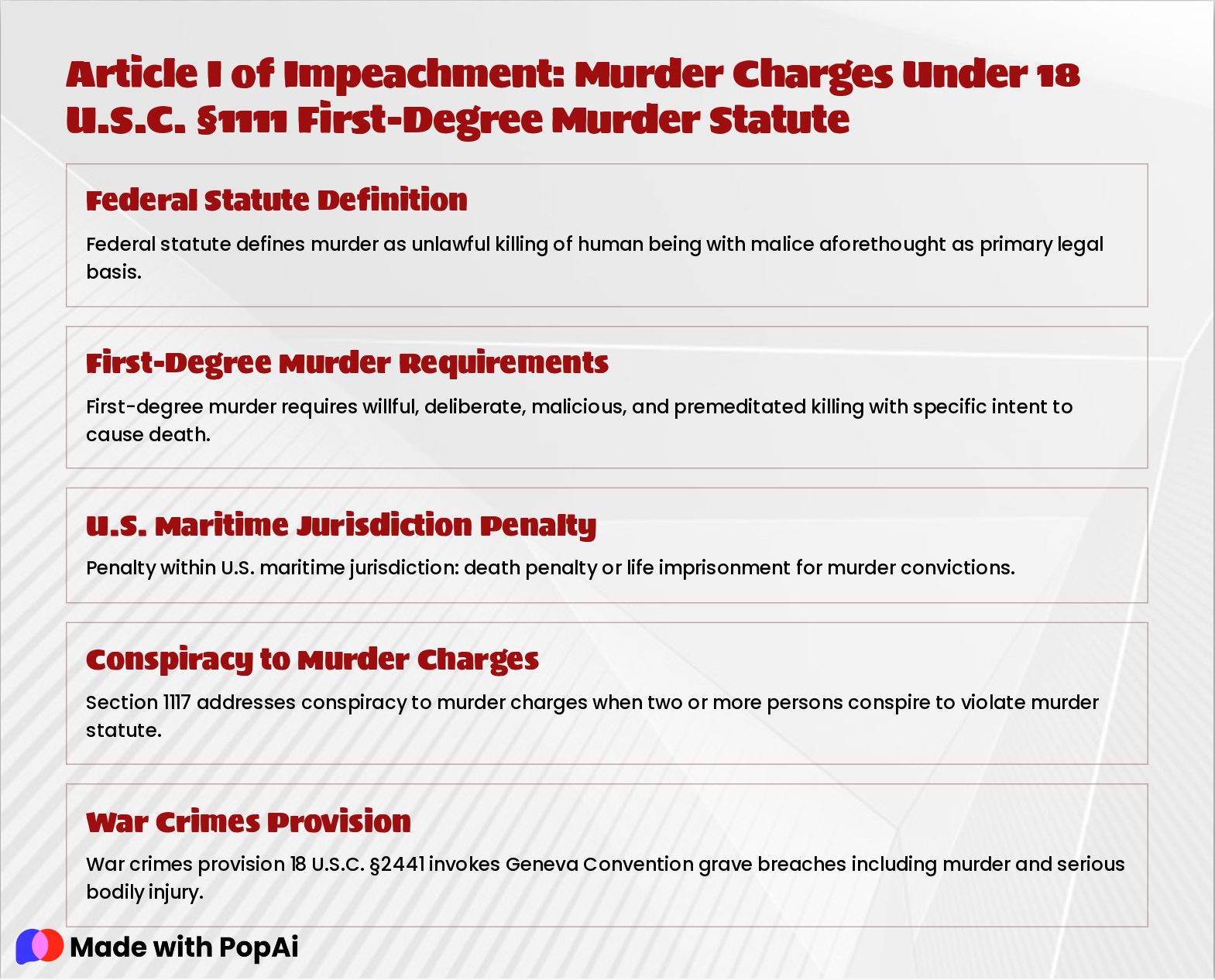
Slide 4: Article I of Impeachment: Murder Charges Under 18 U.S.C. §1111 First-Degree Murder Statute
- Federal Statute Definition: Federal statute defines murder as unlawful killing of human being with malice aforethought as primary legal basis.
- First-Degree Murder Requirements: First-degree murder requires willful, deliberate, malicious, and premeditated killing with specific intent to cause death.
- U.S. Maritime Jurisdiction Penalty: Penalty within U.S. maritime jurisdiction: death penalty or life imprisonment for murder convictions.
- Conspiracy to Murder Charges: Section 1117 addresses conspiracy to murder charges when two or more persons conspire to violate murder statute.
- War Crimes Provision: War crimes provision 18 U.S.C. §2441 invokes Geneva Convention grave breaches including murder and serious bodily injury.
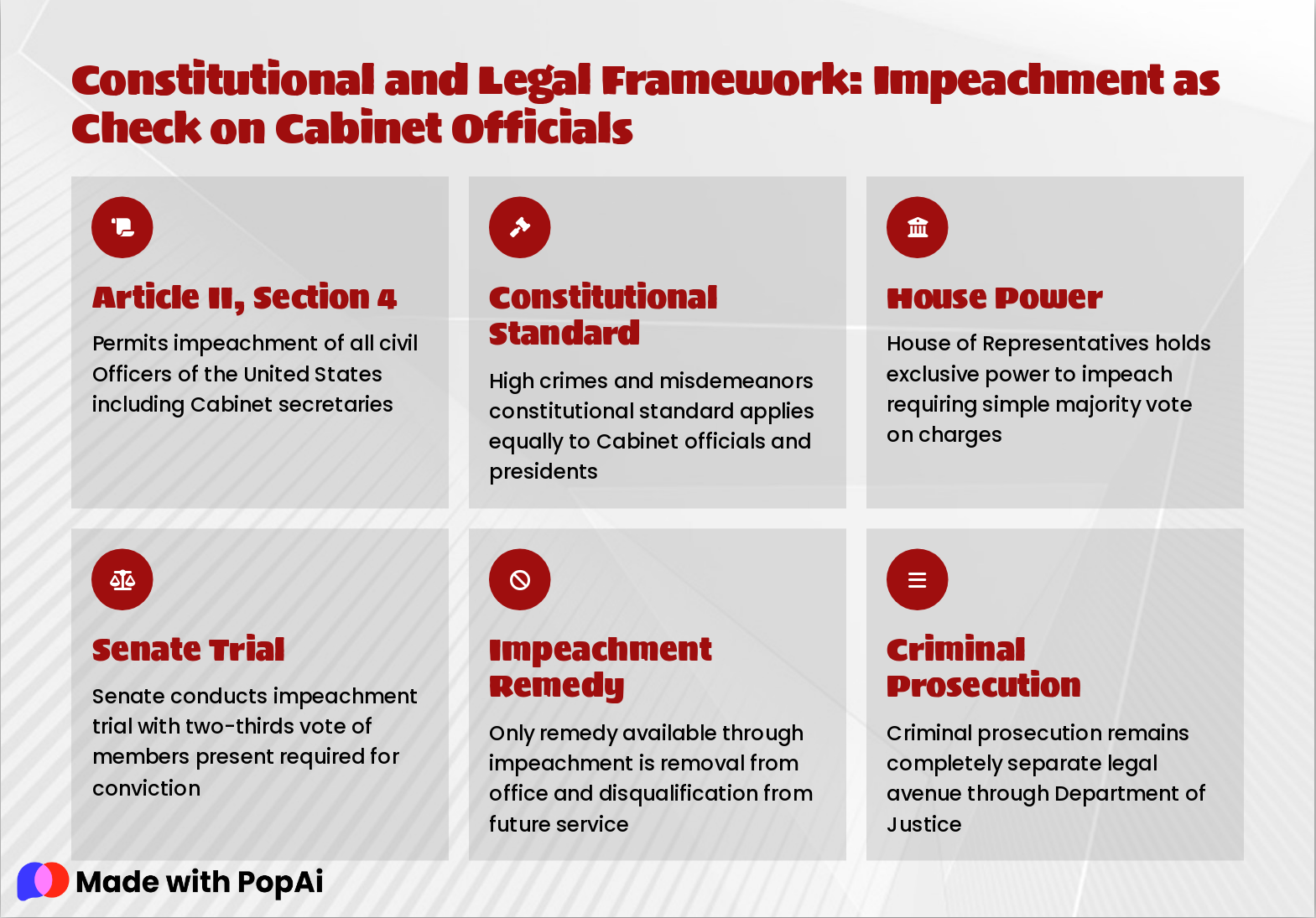
Slide 5: Constitutional and Legal Framework: Impeachment as Check on Cabinet Officials
- Article II, Section 4: Permits impeachment of all civil Officers of the United States including Cabinet secretaries
- Constitutional Standard: High crimes and misdemeanors constitutional standard applies equally to Cabinet officials and presidents
- House Power: House of Representatives holds exclusive power to impeach requiring simple majority vote on charges
- Senate Trial: Senate conducts impeachment trial with two-thirds vote of members present required for conviction
- Impeachment Remedy: Only remedy available through impeachment is removal from office and disqualification from future service
- Criminal Prosecution: Criminal prosecution remains completely separate legal avenue through Department of Justice
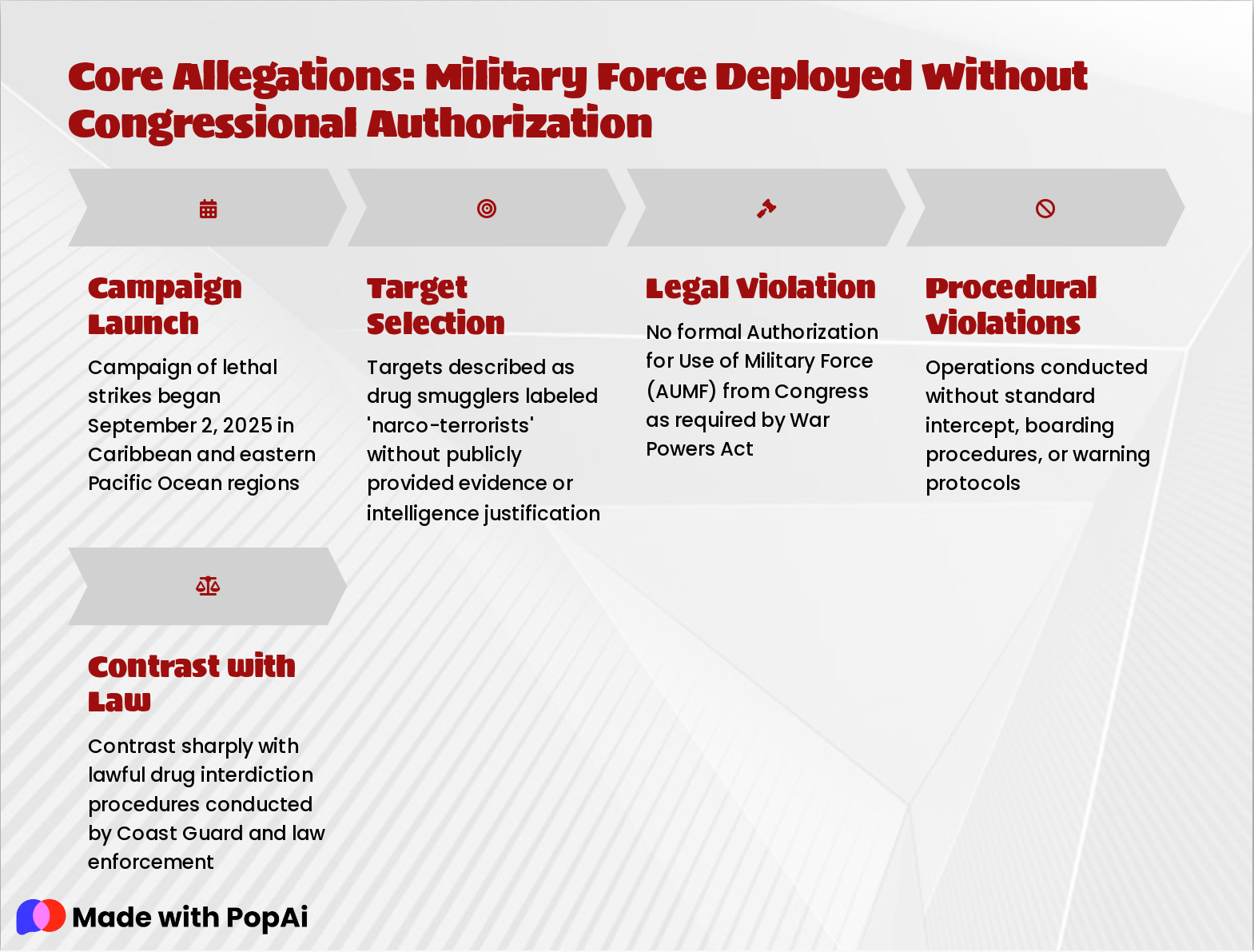
Slide 6: Core Allegations: Military Force Deployed Without Congressional Authorization
- Campaign Launch: Campaign of lethal strikes began September 2, 2025 in Caribbean and eastern Pacific Ocean regions
- Target Selection: Targets described as drug smugglers labeled 'narco-terrorists' without publicly provided evidence or intelligence justification
- Legal Violation: No formal Authorization for Use of Military Force (AUMF) from Congress as required by War Powers Act
- Procedural Violations: Operations conducted without standard intercept, boarding procedures, or warning protocols
- Contrast with Law: Contrast sharply with lawful drug interdiction procedures conducted by Coast Guard and law enforcement
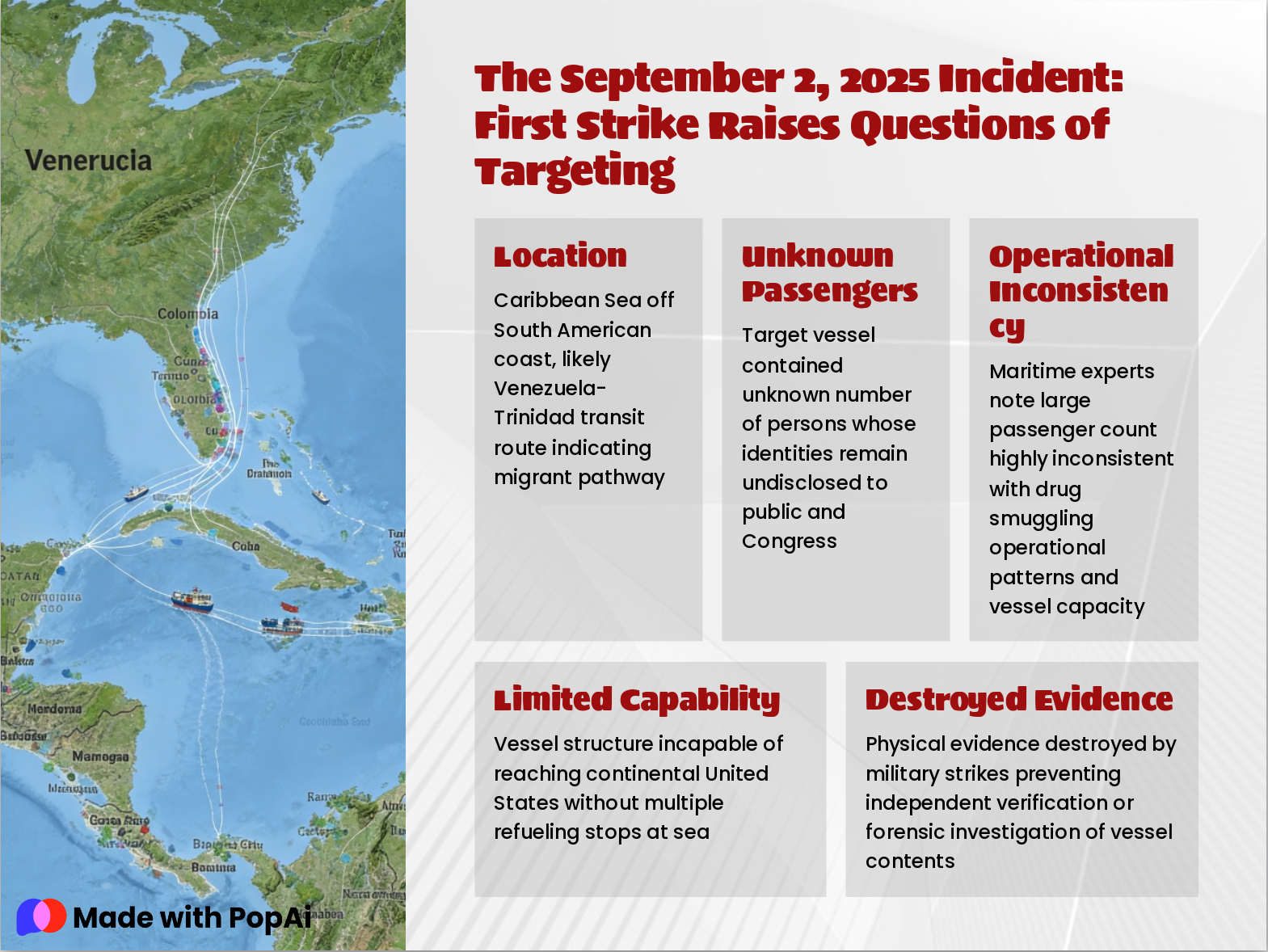
Slide 7: The September 2, 2025 Incident: First Strike Raises Questions of Targeting
- Location: Caribbean Sea off South American coast, likely Venezuela-Trinidad transit route indicating migrant pathway
- Unknown Passengers: Target vessel contained unknown number of persons whose identities remain undisclosed to public and Congress
- Operational Inconsistency: Maritime experts note large passenger count highly inconsistent with drug smuggling operational patterns and vessel capacity
- Limited Capability: Vessel structure incapable of reaching continental United States without multiple refueling stops at sea
- Destroyed Evidence: Physical evidence destroyed by military strikes preventing independent verification or forensic investigation of vessel contents
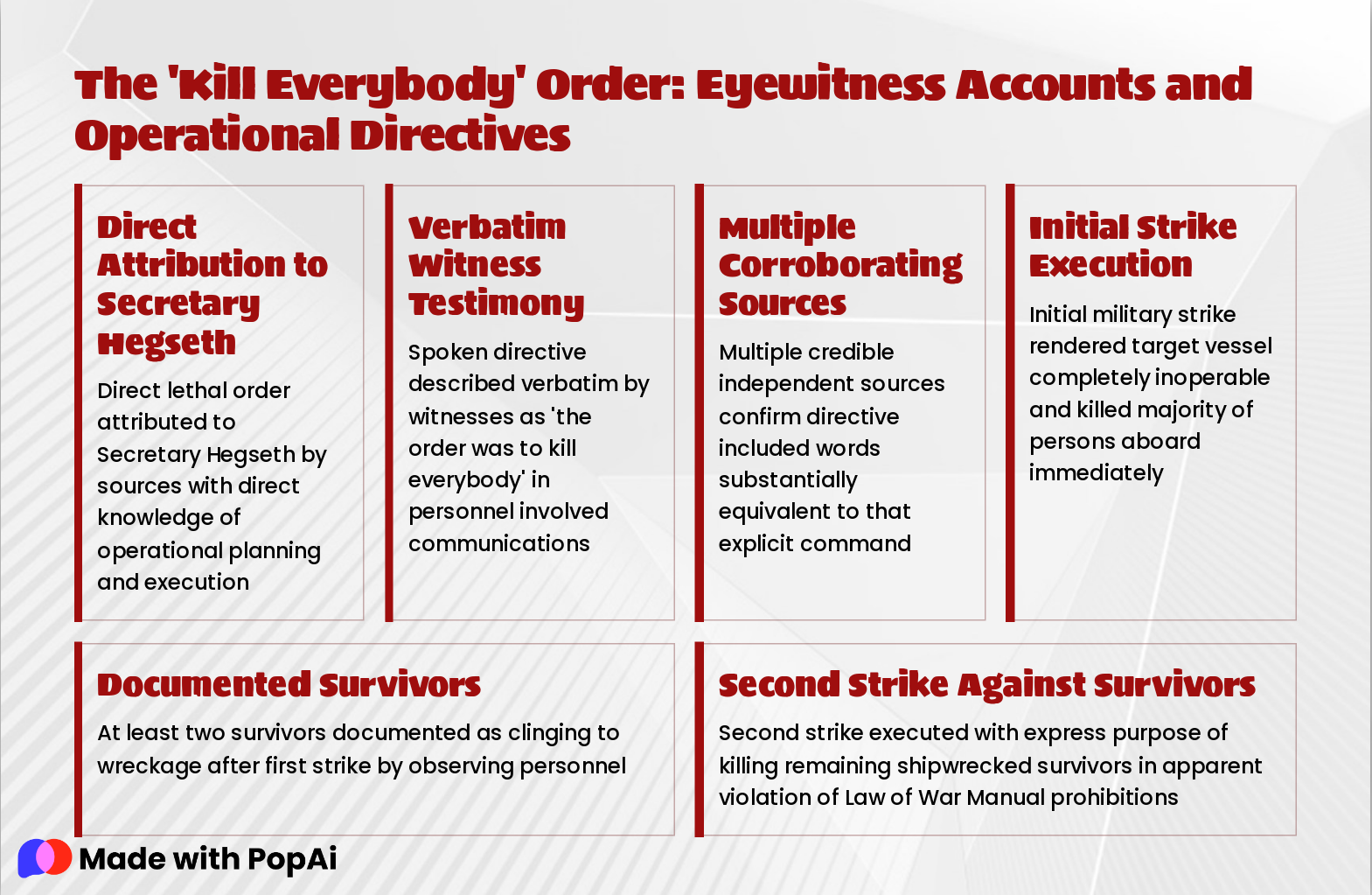
Slide 8: The 'Kill Everybody' Order: Eyewitness Accounts and Operational Directives
- Direct Attribution to Secretary Hegseth: Direct lethal order attributed to Secretary Hegseth by sources with direct knowledge of operational planning and execution
- Verbatim Witness Testimony: Spoken directive described verbatim by witnesses as 'the order was to kill everybody' in personnel involved communications
- Multiple Corroborating Sources: Multiple credible independent sources confirm directive included words substantially equivalent to that explicit command
- Initial Strike Execution: Initial military strike rendered target vessel completely inoperable and killed majority of persons aboard immediately
- Documented Survivors: At least two survivors documented as clinging to wreckage after first strike by observing personnel
- Second Strike Against Survivors: Second strike executed with express purpose of killing remaining shipwrecked survivors in apparent violation of Law of War Manual prohibitions
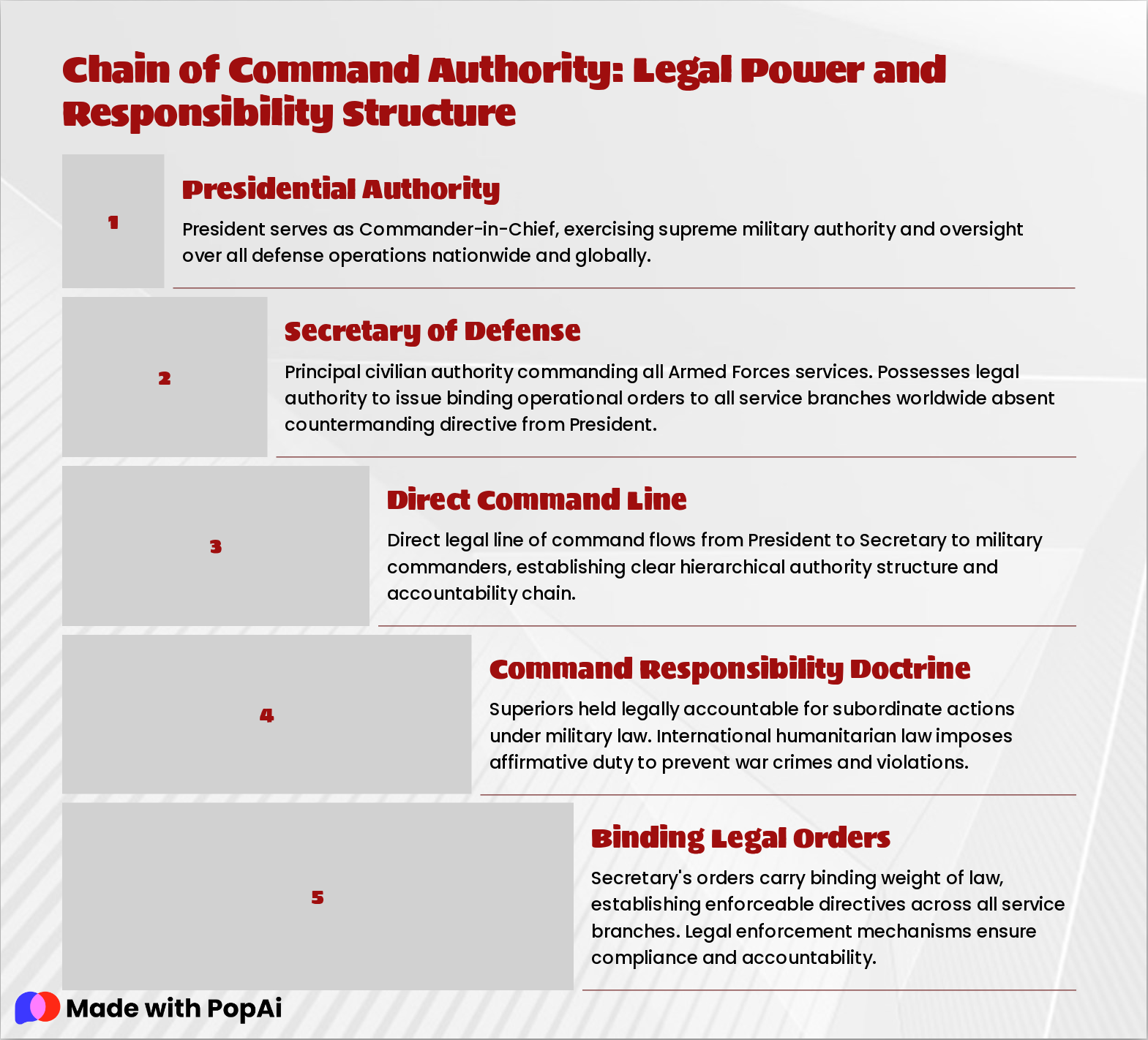
Slide 9: Chain of Command Authority: Legal Power and Responsibility Structure
- Presidential Authority: President serves as Commander-in-Chief, exercising supreme military authority and oversight over all defense operations nationwide and globally.
- Secretary of Defense: Principal civilian authority commanding all Armed Forces services. Possesses legal authority to issue binding operational orders to all service branches worldwide absent countermanding directive from President.
- Direct Command Line: Direct legal line of command flows from President to Secretary to military commanders, establishing clear hierarchical authority structure and accountability chain.
- Command Responsibility Doctrine: Superiors held legally accountable for subordinate actions under military law. International humanitarian law imposes affirmative duty to prevent war crimes and violations.
- Binding Legal Orders: Secretary's orders carry binding weight of law, establishing enforceable directives across all service branches. Legal enforcement mechanisms ensure compliance and accountability.
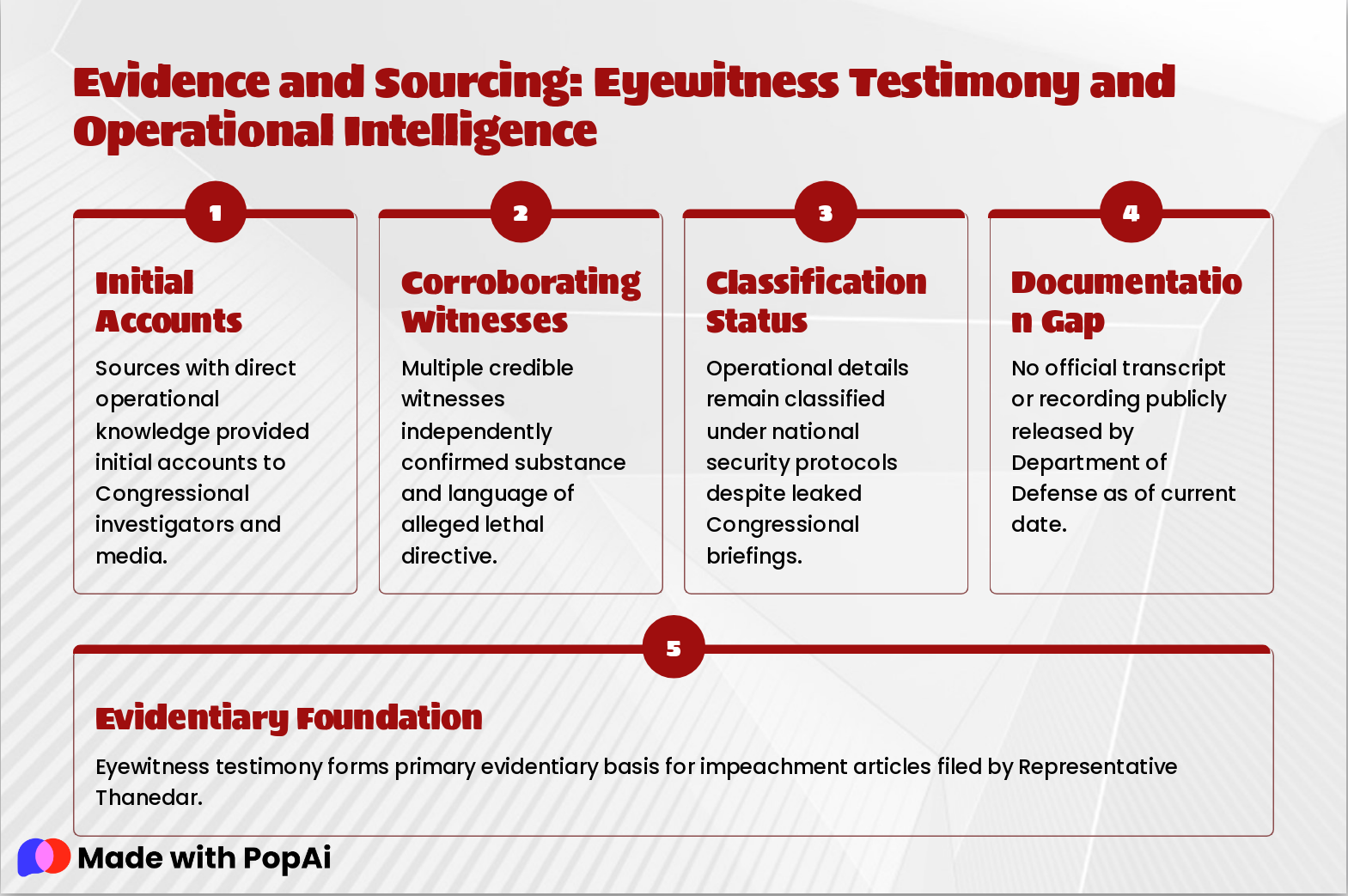
Slide 10: Evidence and Sourcing: Eyewitness Testimony and Operational Intelligence
- Initial Accounts: Sources with direct operational knowledge provided initial accounts to Congressional investigators and media.
- Corroborating Witnesses: Multiple credible witnesses independently confirmed substance and language of alleged lethal directive.
- Classification Status: Operational details remain classified under national security protocols despite leaked Congressional briefings.
- Documentation Gap: No official transcript or recording publicly released by Department of Defense as of current date.
- Evidentiary Foundation: Eyewitness testimony forms primary evidentiary basis for impeachment articles filed by Representative Thanedar.
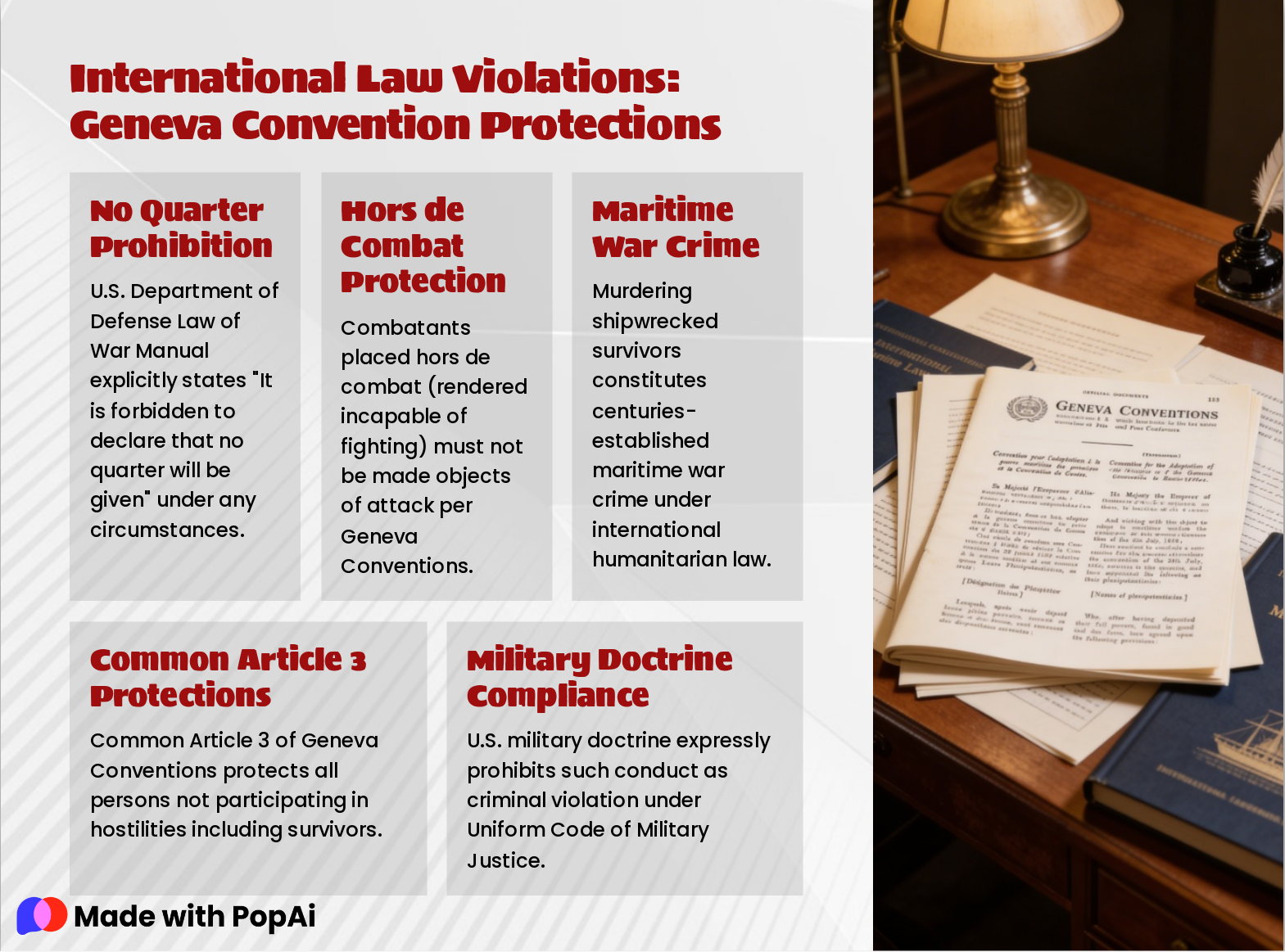
Slide 11: International Law Violations: Geneva Convention Protections
- No Quarter Prohibition: U.S. Department of Defense Law of War Manual explicitly states "It is forbidden to declare that no quarter will be given" under any circumstances.
- Hors de Combat Protection: Combatants placed hors de combat (rendered incapable of fighting) must not be made objects of attack per Geneva Conventions.
- Maritime War Crime: Murdering shipwrecked survivors constitutes centuries-established maritime war crime under international humanitarian law.
- Common Article 3 Protections: Common Article 3 of Geneva Conventions protects all persons not participating in hostilities including survivors.
- Military Doctrine Compliance: U.S. military doctrine expressly prohibits such conduct as criminal violation under Uniform Code of Military Justice.
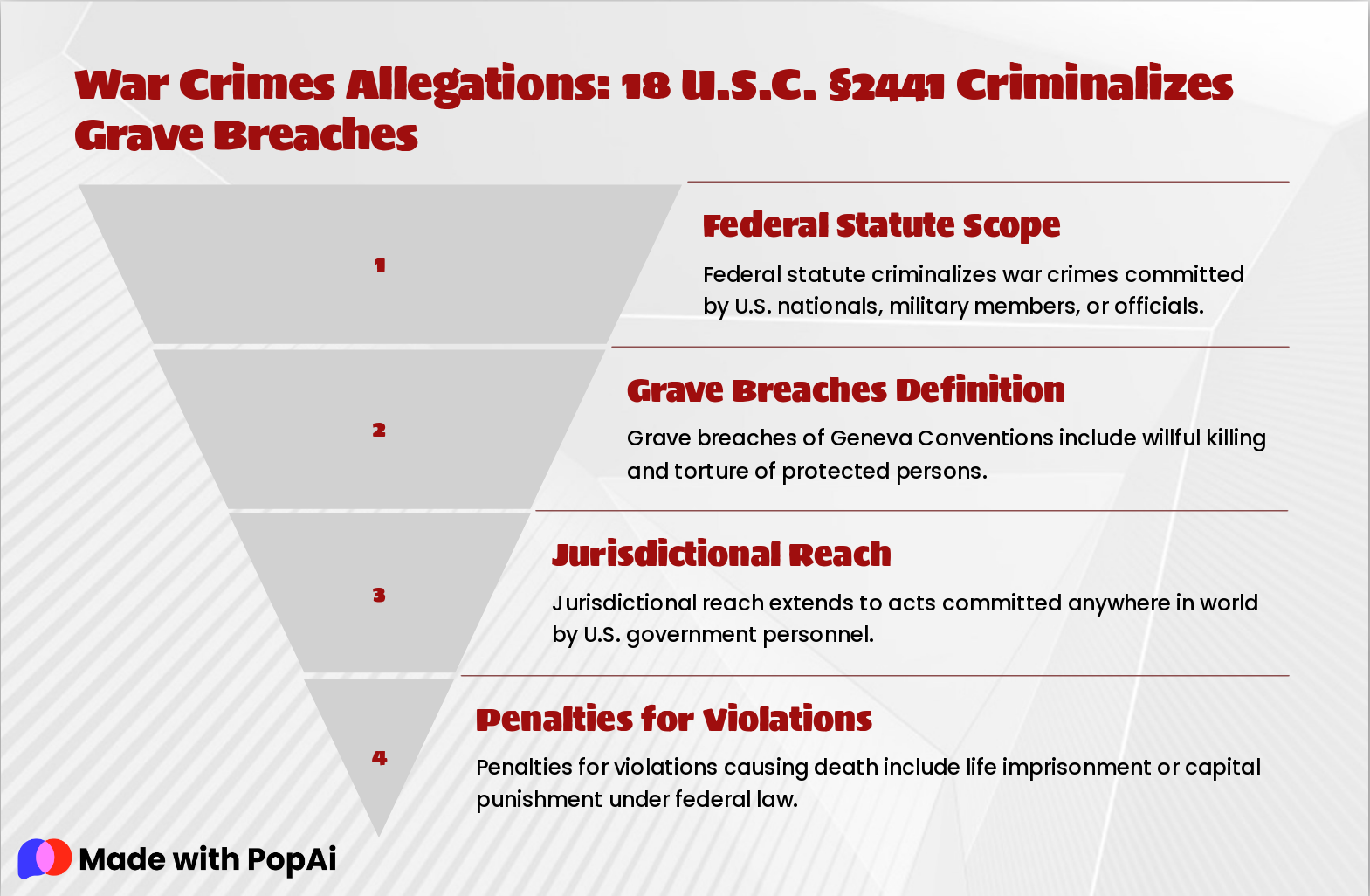
Slide 12: War Crimes Allegations: 18 U.S.C. §2441 Criminalizes Grave Breaches
- Federal Statute Scope: Federal statute criminalizes war crimes committed by U.S. nationals, military members, or officials.
- Grave Breaches Definition: Grave breaches of Geneva Conventions include willful killing and torture of protected persons.
- Jurisdictional Reach: Jurisdictional reach extends to acts committed anywhere in world by U.S. government personnel.
- Penalties for Violations: Penalties for violations causing death include life imprisonment or capital punishment under federal law.
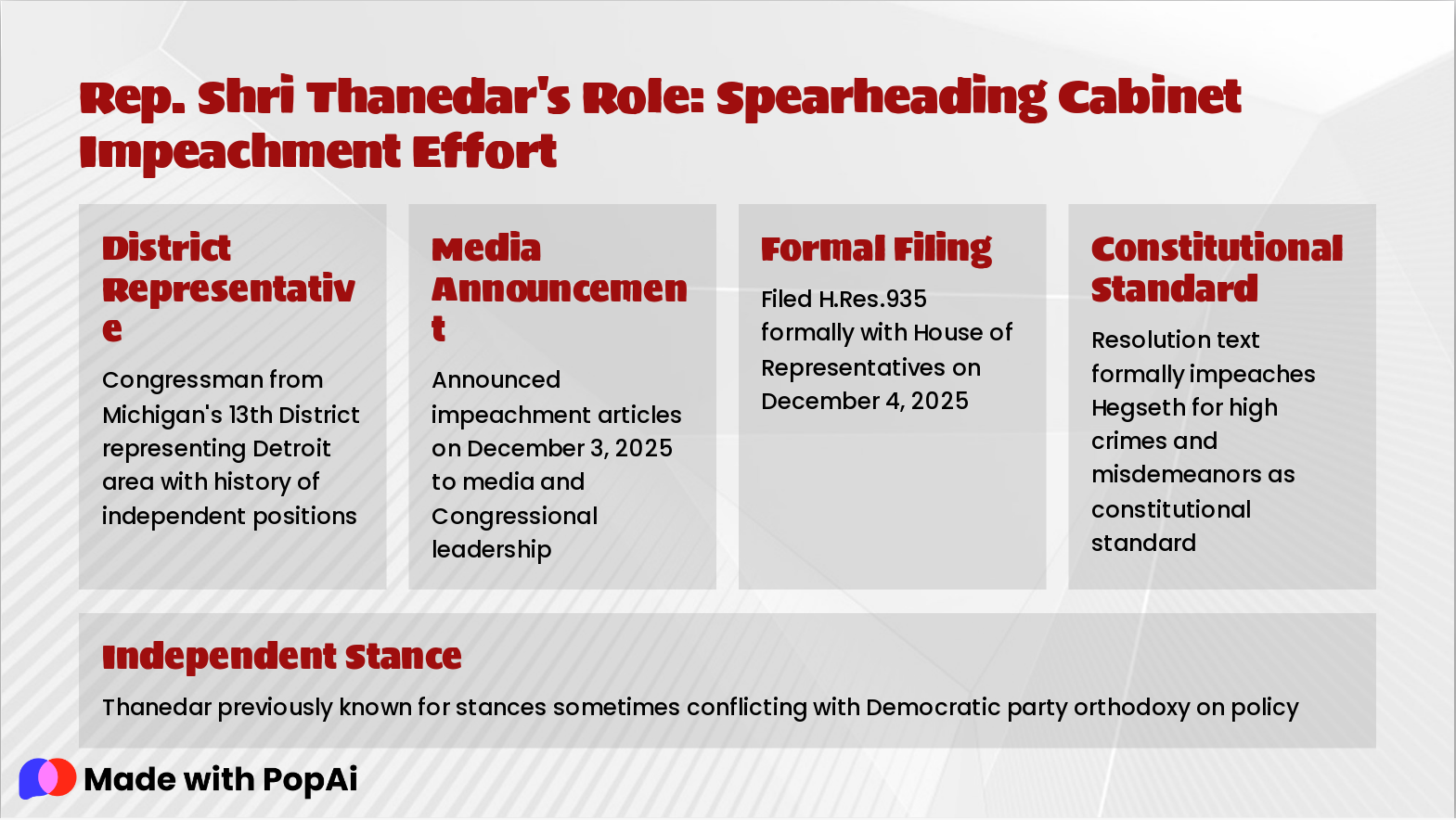
Slide 13: Rep. Shri Thanedar's Role: Spearheading Cabinet Impeachment Effort
- District Representative: Congressman from Michigan's 13th District representing Detroit area with history of independent positions
- Media Announcement: Announced impeachment articles on December 3, 2025 to media and Congressional leadership
- Formal Filing: Filed H.Res.935 formally with House of Representatives on December 4, 2025
- Constitutional Standard: Resolution text formally impeaches Hegseth for high crimes and misdemeanors as constitutional standard
- Independent Stance: Thanedar previously known for stances sometimes conflicting with Democratic party orthodoxy on policy
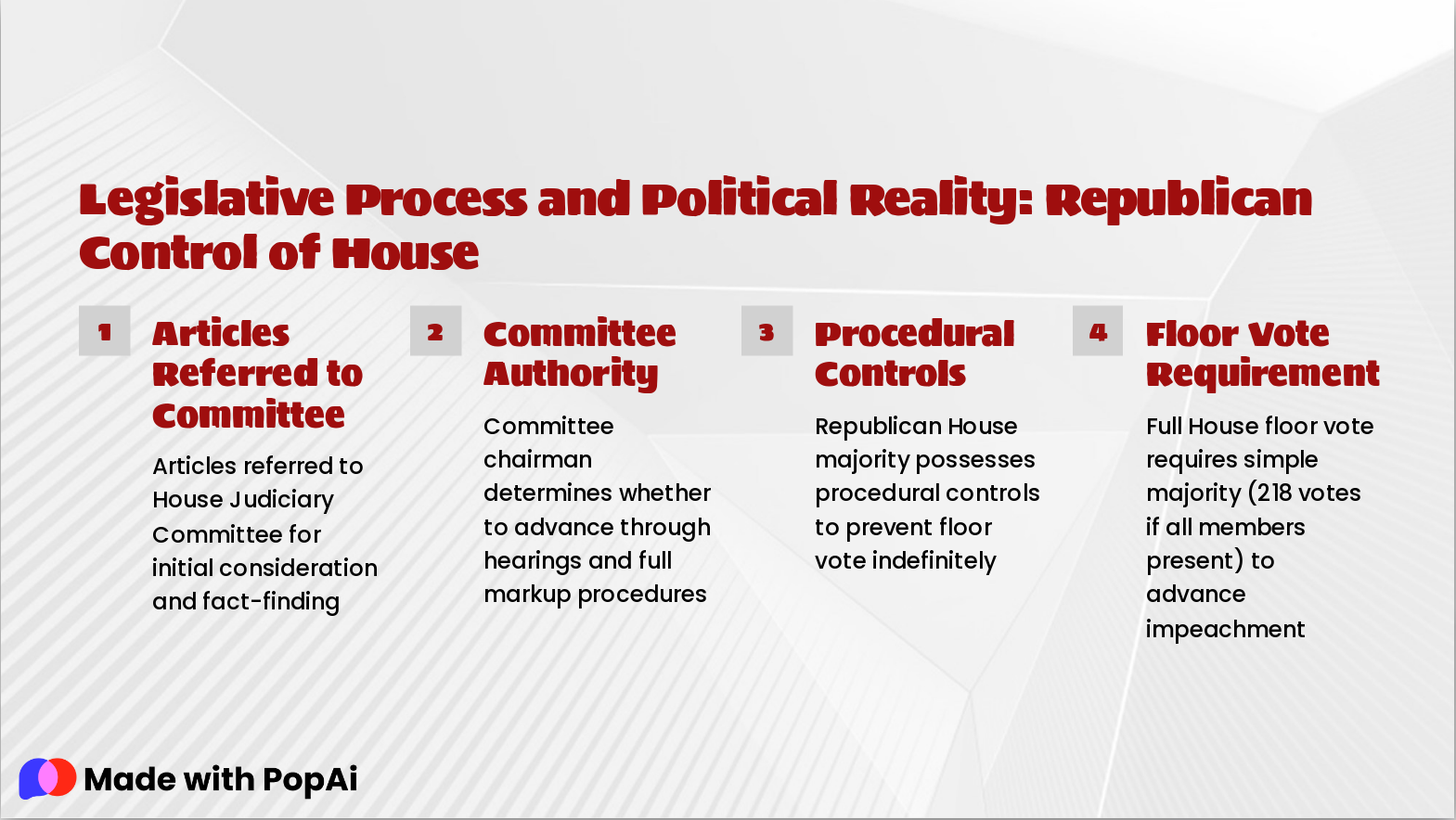
Slide 14: Legislative Process and Political Reality: Republican Control of House
- Articles Referred to Committee: Articles referred to House Judiciary Committee for initial consideration and fact-finding
- Committee Authority: Committee chairman determines whether to advance through hearings and full markup procedures
- Procedural Controls: Republican House majority possesses procedural controls to prevent floor vote indefinitely
- Floor Vote Requirement: Full House floor vote requires simple majority (218 votes if all members present) to advance impeachment
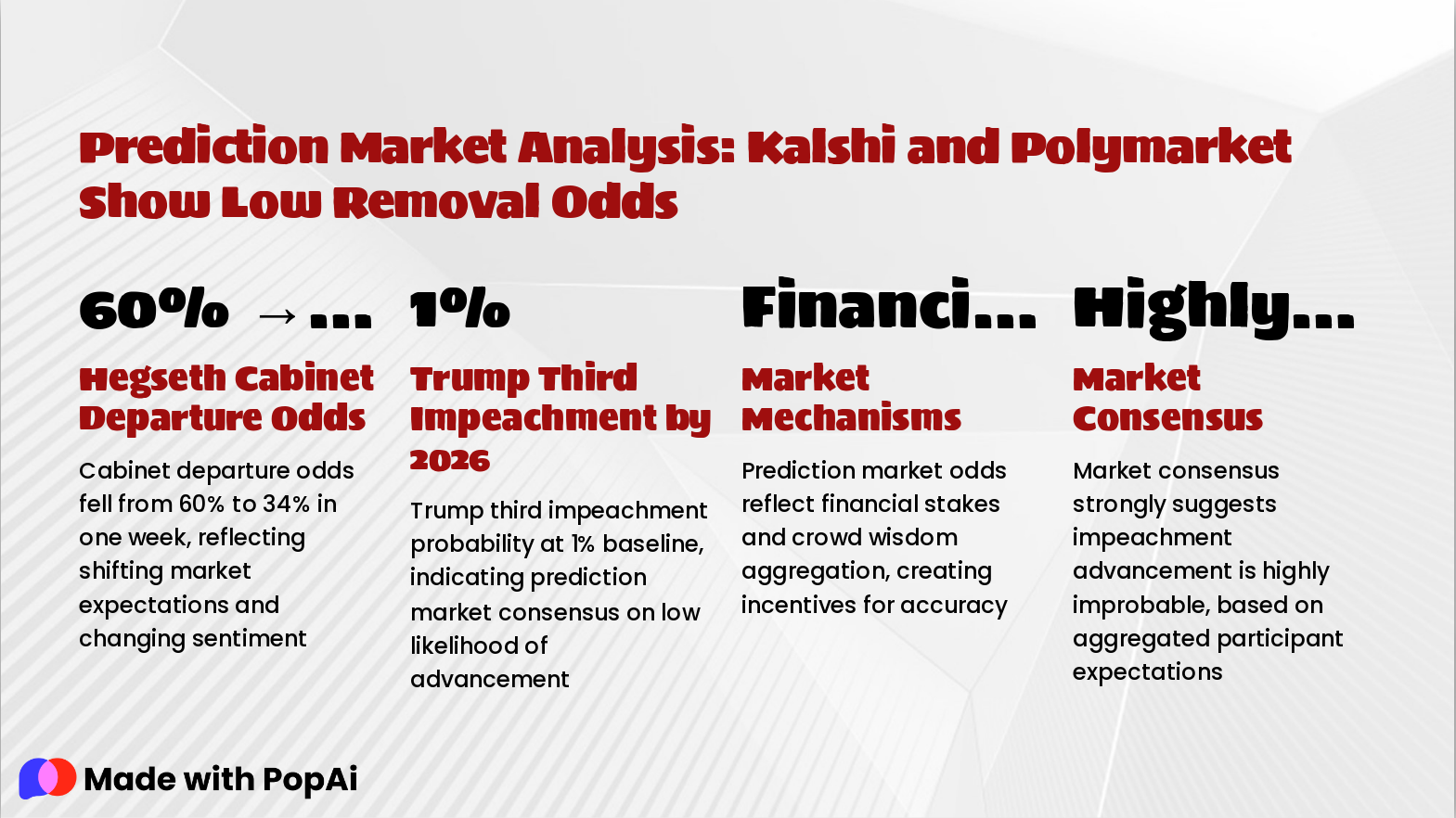
Slide 15: Prediction Market Analysis: Kalshi and Polymarket Show Low Removal Odds
- 60% → 34% — Hegseth Cabinet Departure Odds
- 1% — Trump Third Impeachment by 2026
- Financial Stakes — Market Mechanisms
- Highly Improbable — Market Consensus
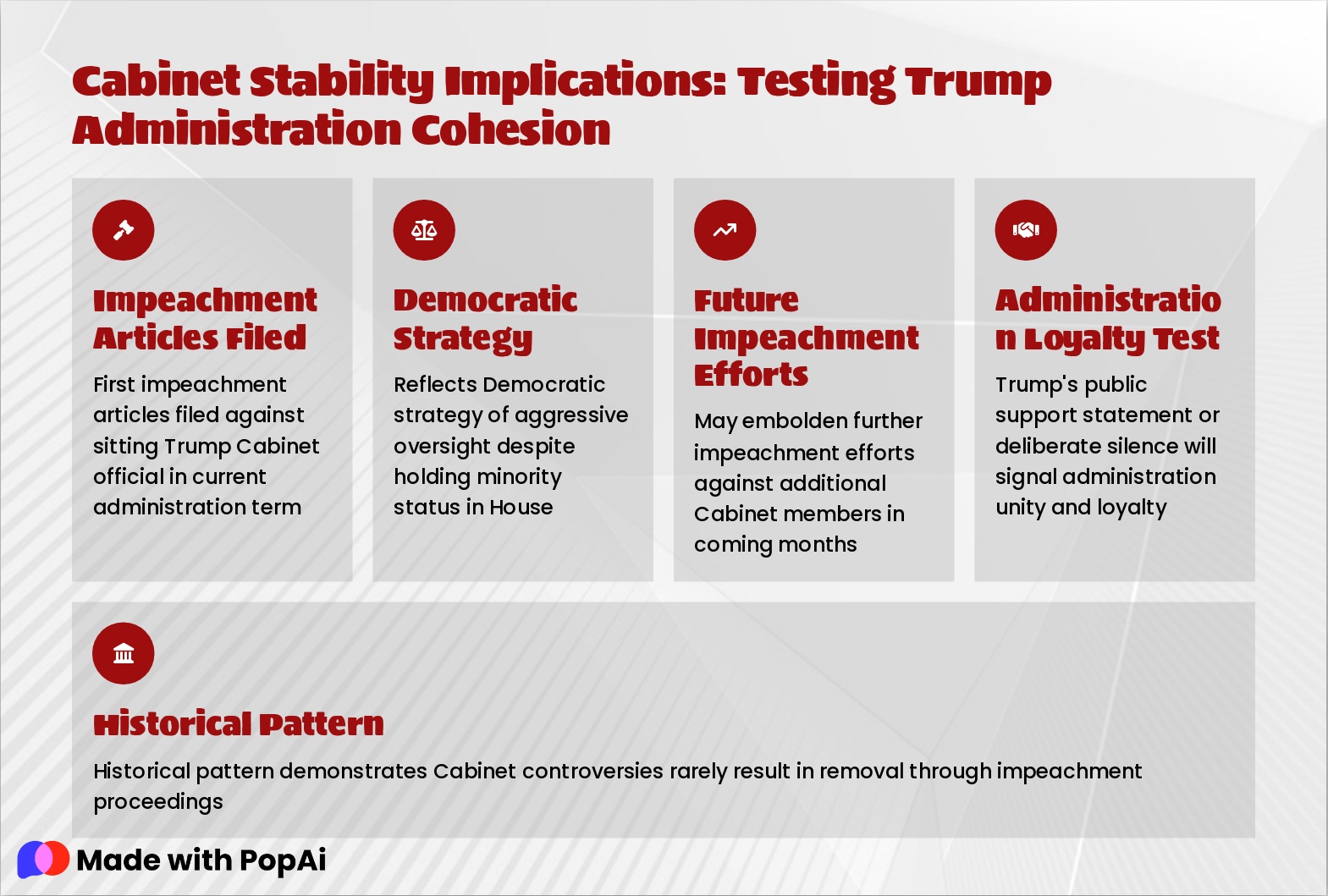
Slide 16: Cabinet Stability Implications: Testing Trump Administration Cohesion
- Impeachment Articles Filed: First impeachment articles filed against sitting Trump Cabinet official in current administration term
- Democratic Strategy: Reflects Democratic strategy of aggressive oversight despite holding minority status in House
- Future Impeachment Efforts: May embolden further impeachment efforts against additional Cabinet members in coming months
- Administration Loyalty Test: Trump's public support statement or deliberate silence will signal administration unity and loyalty
- Historical Pattern: Historical pattern demonstrates Cabinet controversies rarely result in removal through impeachment proceedings
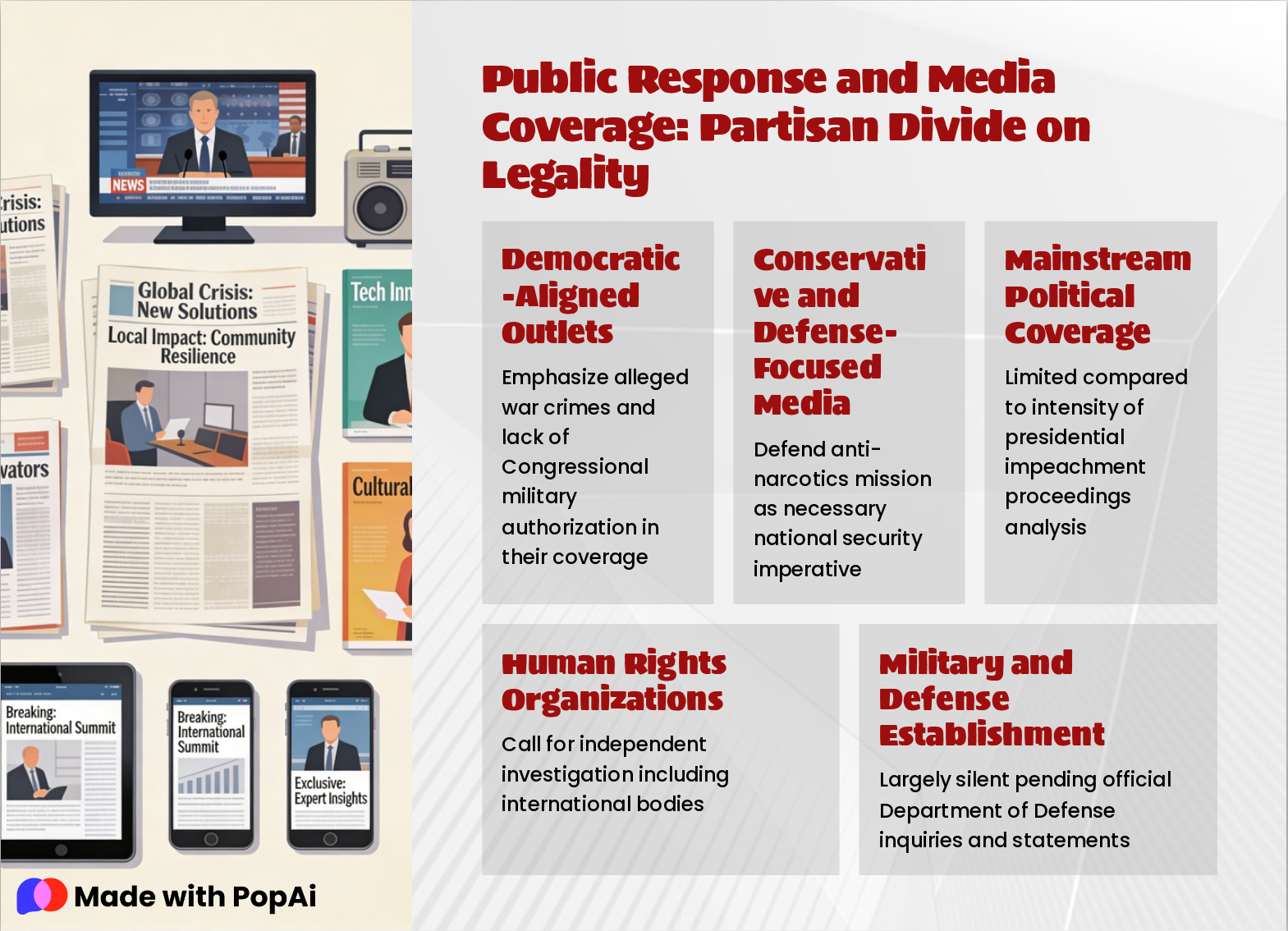
Slide 17: Public Response and Media Coverage: Partisan Divide on Legality
- Democratic-Aligned Outlets: Emphasize alleged war crimes and lack of Congressional military authorization in their coverage
- Conservative and Defense-Focused Media: Defend anti-narcotics mission as necessary national security imperative
- Mainstream Political Coverage: Limited compared to intensity of presidential impeachment proceedings analysis
- Human Rights Organizations: Call for independent investigation including international bodies
- Military and Defense Establishment: Largely silent pending official Department of Defense inquiries and statements
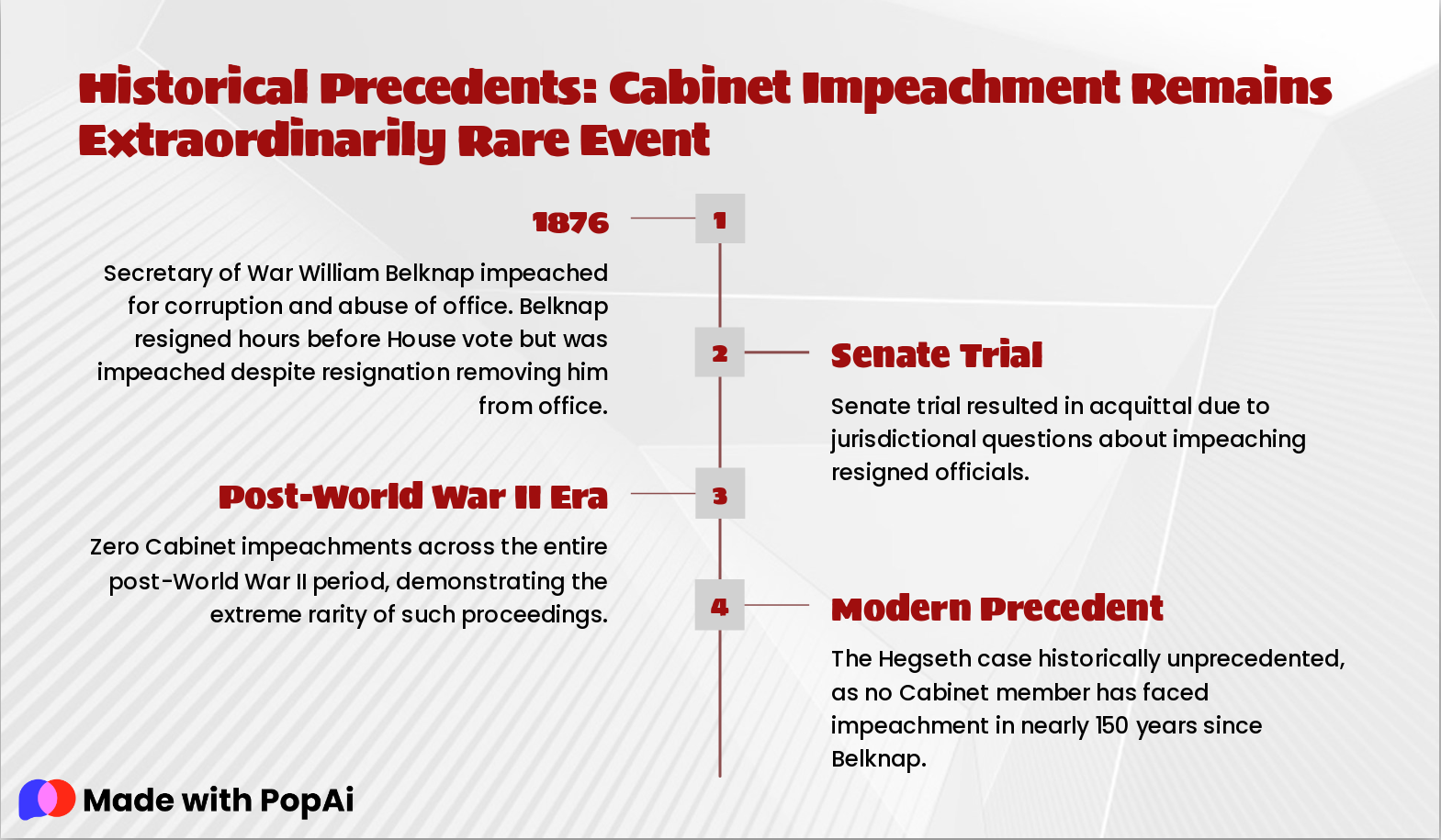
Slide 18: Historical Precedents: Cabinet Impeachment Remains Extraordinarily Rare Event
- 1876: Secretary of War William Belknap impeached for corruption and abuse of office. Belknap resigned hours before House vote but was impeached despite resignation removing him from office.
- Senate Trial: Senate trial resulted in acquittal due to jurisdictional questions about impeaching resigned officials.
- Post-World War II Era: Zero Cabinet impeachments across the entire post-World War II period, demonstrating the extreme rarity of such proceedings.
- Modern Precedent: The Hegseth case historically unprecedented, as no Cabinet member has faced impeachment in nearly 150 years since Belknap.
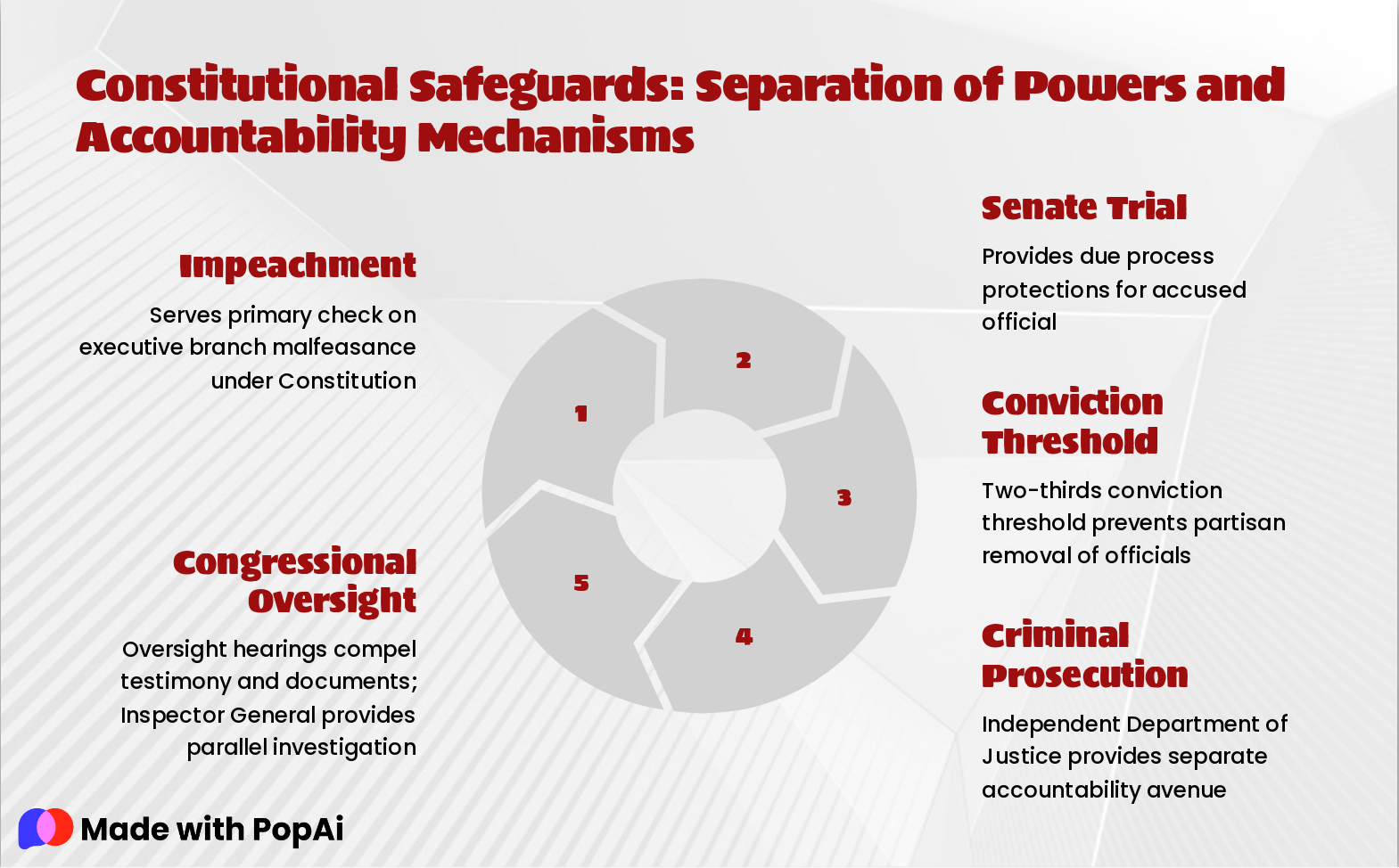
Slide 19: Constitutional Safeguards: Separation of Powers and Accountability Mechanisms
- Impeachment: Serves primary check on executive branch malfeasance under Constitution
- Senate Trial: Provides due process protections for accused official
- Conviction Threshold: Two-thirds conviction threshold prevents partisan removal of officials
- Criminal Prosecution: Independent Department of Justice provides separate accountability avenue
- Congressional Oversight: Oversight hearings compel testimony and documents; Inspector General provides parallel investigation
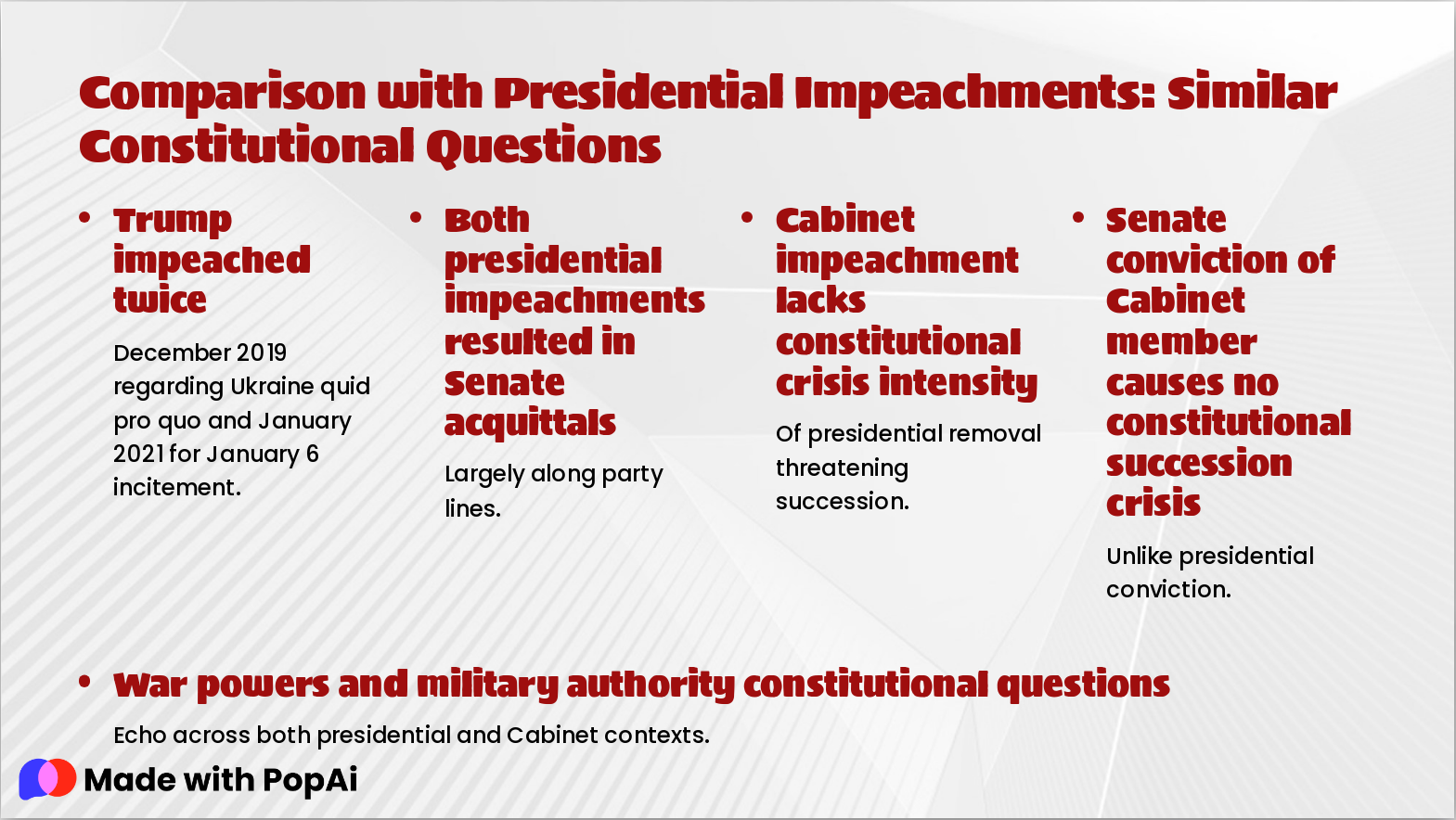
Slide 20: Comparison with Presidential Impeachments: Similar Constitutional Questions
- Trump impeached twice: December 2019 regarding Ukraine quid pro quo and January 2021 for January 6 incitement.
- Both presidential impeachments resulted in Senate acquittals: Largely along party lines.
- Cabinet impeachment lacks constitutional crisis intensity: Of presidential removal threatening succession.
- Senate conviction of Cabinet member causes no constitutional succession crisis: Unlike presidential conviction.
- War powers and military authority constitutional questions: Echo across both presidential and Cabinet contexts.
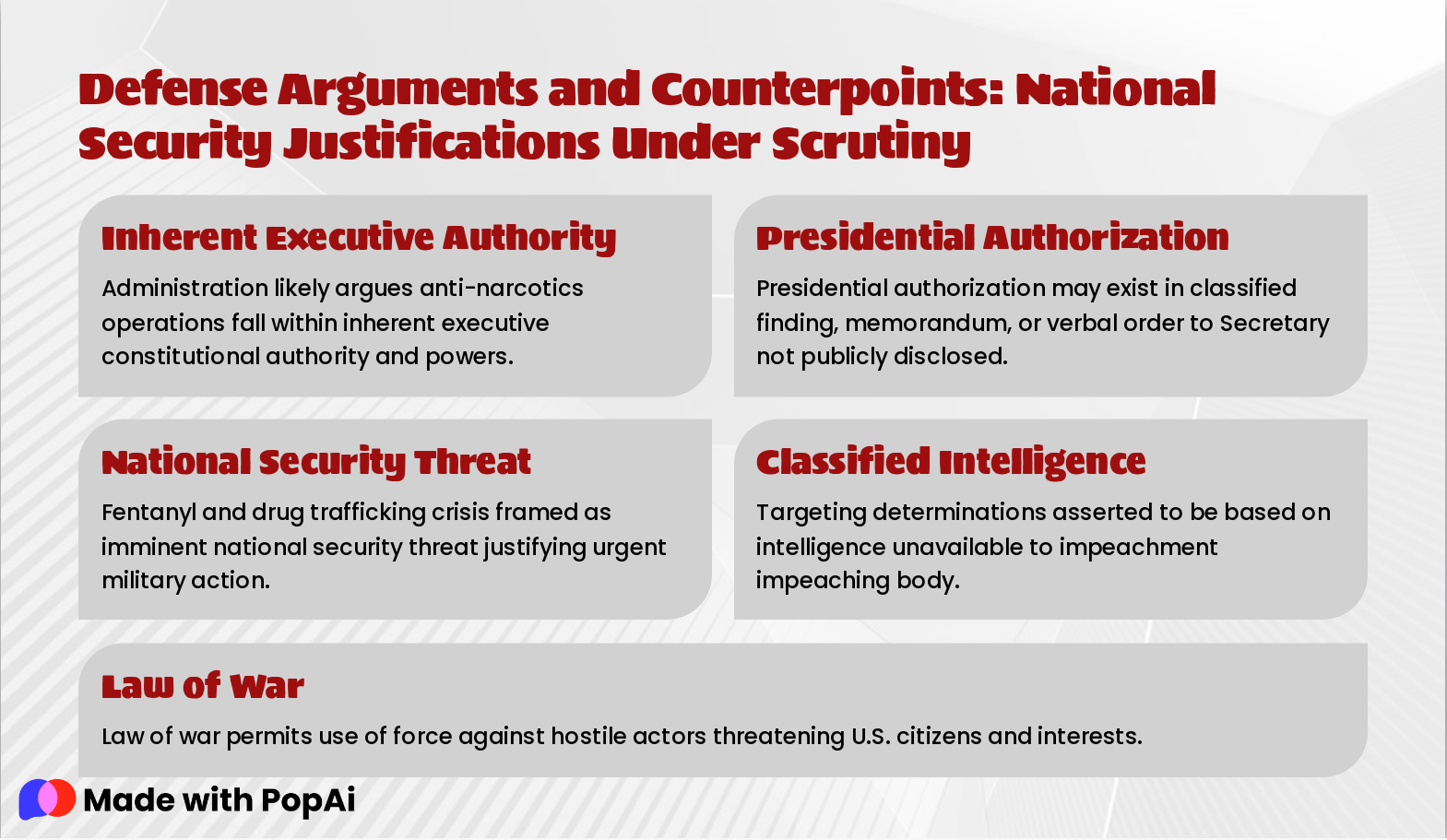
Slide 21: Defense Arguments and Counterpoints: National Security Justifications Under Scrutiny
- Inherent Executive Authority: Administration likely argues anti-narcotics operations fall within inherent executive constitutional authority and powers.
- Presidential Authorization: Presidential authorization may exist in classified finding, memorandum, or verbal order to Secretary not publicly disclosed.
- National Security Threat: Fentanyl and drug trafficking crisis framed as imminent national security threat justifying urgent military action.
- Classified Intelligence: Targeting determinations asserted to be based on intelligence unavailable to impeachment impeaching body.
- Law of War: Law of war permits use of force against hostile actors threatening U.S. citizens and interests.
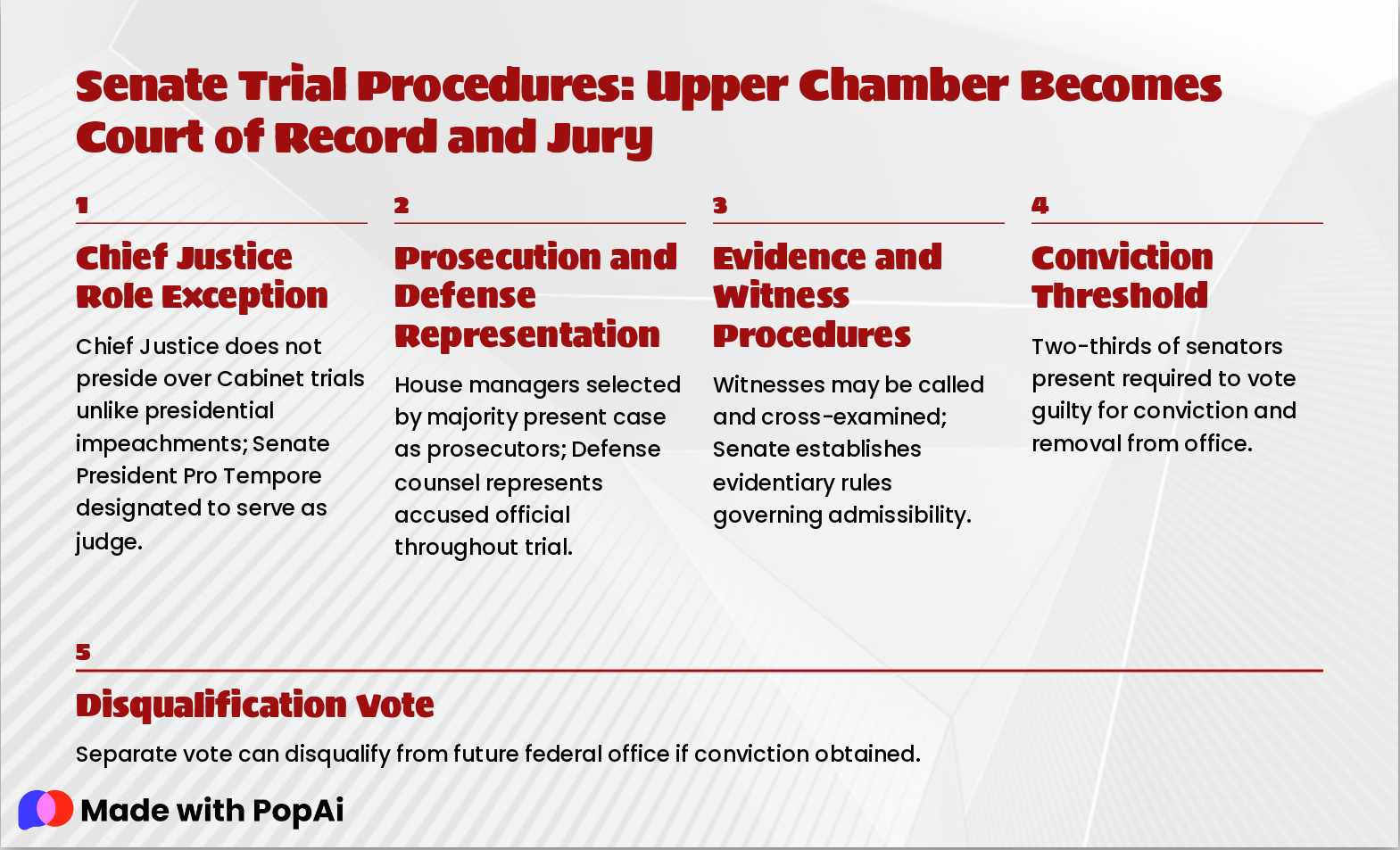
Slide 22: Senate Trial Procedures: Upper Chamber Becomes Court of Record and Jury
- Chief Justice Role Exception: Chief Justice does not preside over Cabinet trials unlike presidential impeachments; Senate President Pro Tempore designated to serve as judge.
- Prosecution and Defense Representation: House managers selected by majority present case as prosecutors; Defense counsel represents accused official throughout trial.
- Evidence and Witness Procedures: Witnesses may be called and cross-examined; Senate establishes evidentiary rules governing admissibility.
- Conviction Threshold: Two-thirds of senators present required to vote guilty for conviction and removal from office.
- Disqualification Vote: Separate vote can disqualify from future federal office if conviction obtained.
Slide 23: Constitutional Accountability in Question
Constitutional Accountability in Question H.Res.935 represents serious constitutional allegations of murder and war crimes against a sitting Cabinet official. Unlikely to advance through House Judiciary Committee given Republican procedural control. Core questions persist: Can the Secretary of Defen...