Presentation Summary
Explore the pseudoscience of conversion therapy, its harmful effects, and legal status in protecting LGBTQ+ youth. Dive into the 2026 Supreme Court decision, state-level case studies, and international perspectives.
Full Presentation Transcript
Slide 1: Conversion Therapy: Pseudoscience, Law, and the Protection of LGBTQ+ Youth in 2026
A Comprehensive Examination of Ineffectiveness, Harm, Legal Status, and the Landmark Supreme Court Decision
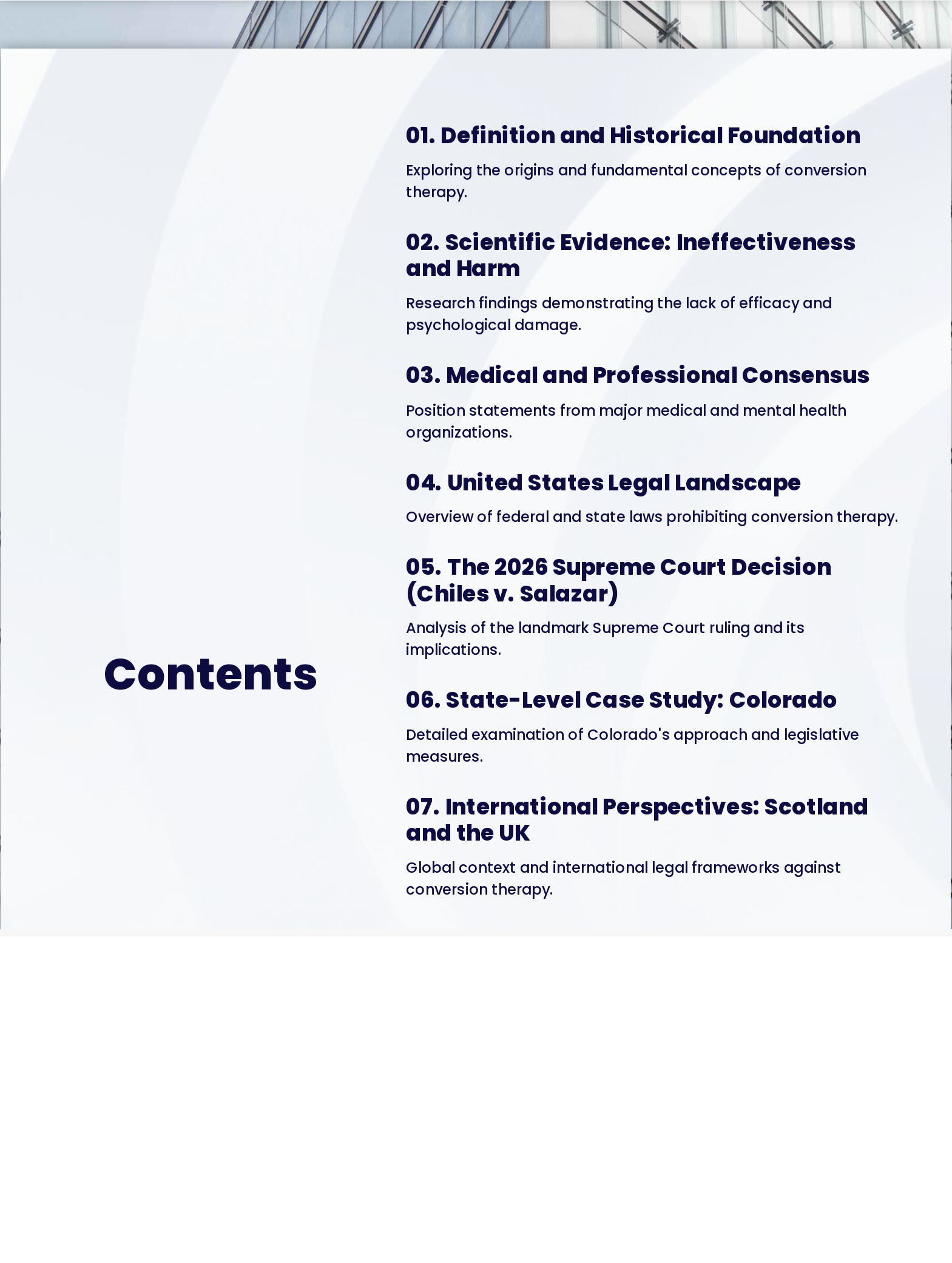
Slide 2: Contents
- Definition and Historical Foundation: Exploring the origins and fundamental concepts of conversion therapy.
- Scientific Evidence: Ineffectiveness and Harm: Research findings demonstrating the lack of efficacy and psychological damage.
- Medical and Professional Consensus: Position statements from major medical and mental health organizations.
- United States Legal Landscape: Overview of federal and state laws prohibiting conversion therapy.
- The 2026 Supreme Court Decision (Chiles v. Salazar): Analysis of the landmark Supreme Court ruling and its implications.
- State-Level Case Study: Colorado: Detailed examination of Colorado's approach and legislative measures.
- International Perspectives: Scotland and the UK: Global context and international legal frameworks against conversion therapy.
- Religious Context: The LDS Church: The role and stance of religious institutions in this debate.
- Cultural Representation: Boy Erased: How media and popular culture reflect and shape public understanding.
- 2026 Protections Landscape and Future Implications: Current protective measures and emerging trends in the legal landscape.
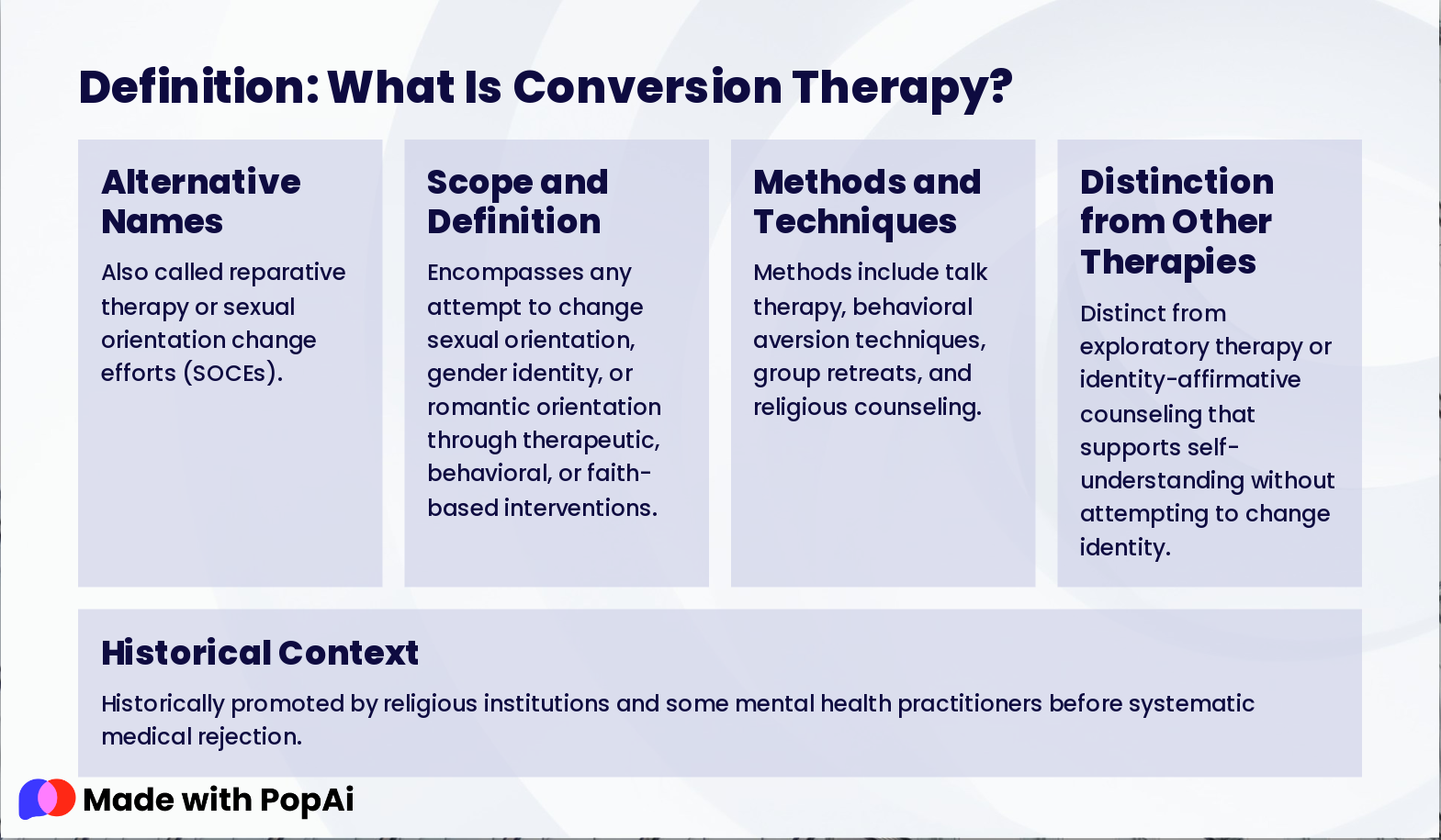
Slide 3: Definition: What Is Conversion Therapy?
- Alternative Names: Also called reparative therapy or sexual orientation change efforts (SOCEs).
- Scope and Definition: Encompasses any attempt to change sexual orientation, gender identity, or romantic orientation through therapeutic, behavioral, or faith-based interventions.
- Methods and Techniques: Methods include talk therapy, behavioral aversion techniques, group retreats, and religious counseling.
- Distinction from Other Therapies: Distinct from exploratory therapy or identity-affirmative counseling that supports self-understanding without attempting to change identity.
- Historical Context: Historically promoted by religious institutions and some mental health practitioners before systematic medical rejection.
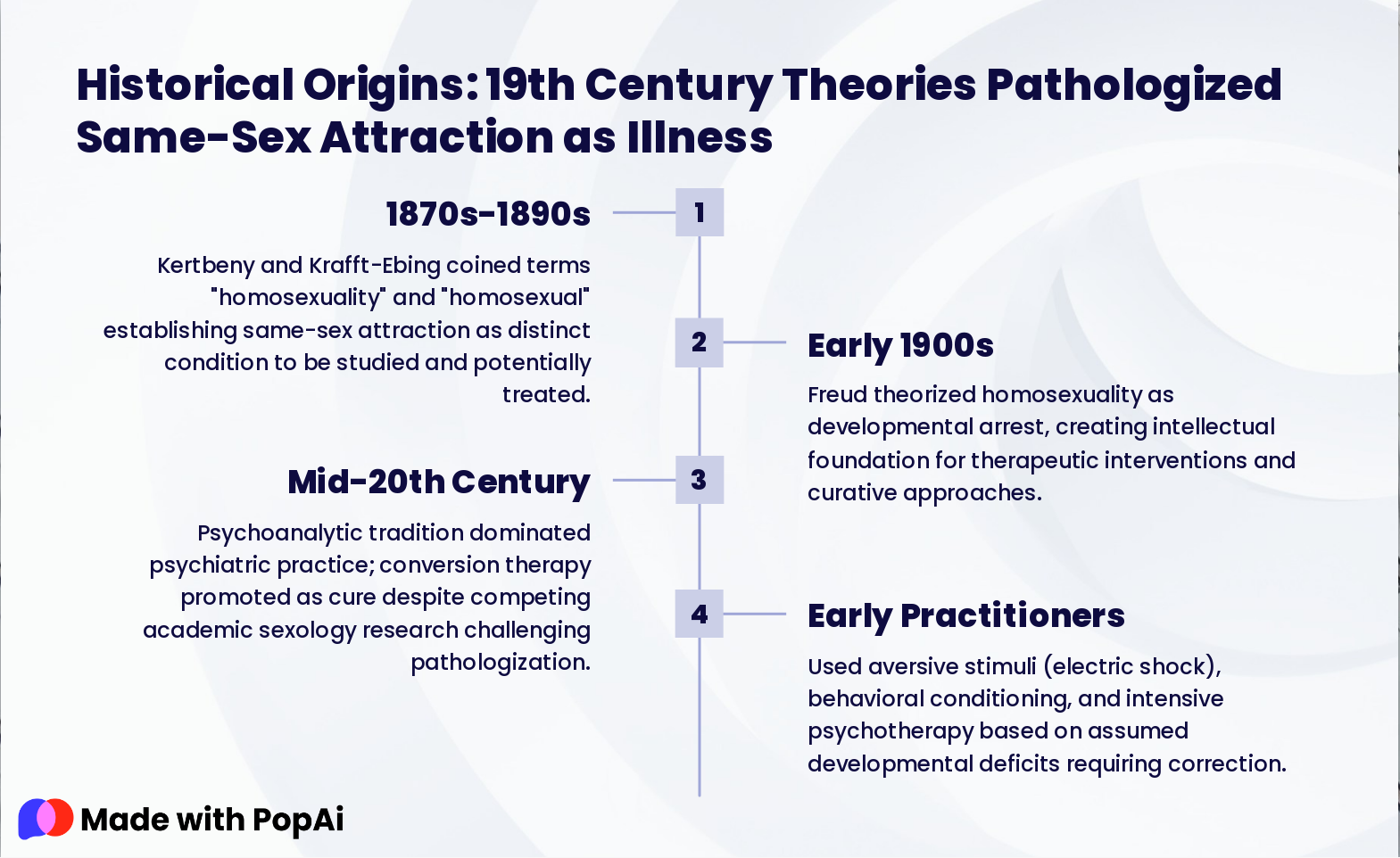
Slide 4: Historical Origins: 19th Century Theories Pathologized Same-Sex Attraction as Illness
- 1870s-1890s: Kertbeny and Krafft-Ebing coined terms "homosexuality" and "homosexual" establishing same-sex attraction as distinct condition to be studied and potentially treated.
- Early 1900s: Freud theorized homosexuality as developmental arrest, creating intellectual foundation for therapeutic interventions and curative approaches.
- Mid-20th Century: Psychoanalytic tradition dominated psychiatric practice; conversion therapy promoted as cure despite competing academic sexology research challenging pathologization.
- Early Practitioners: Used aversive stimuli (electric shock), behavioral conditioning, and intensive psychotherapy based on assumed developmental deficits requiring correction.
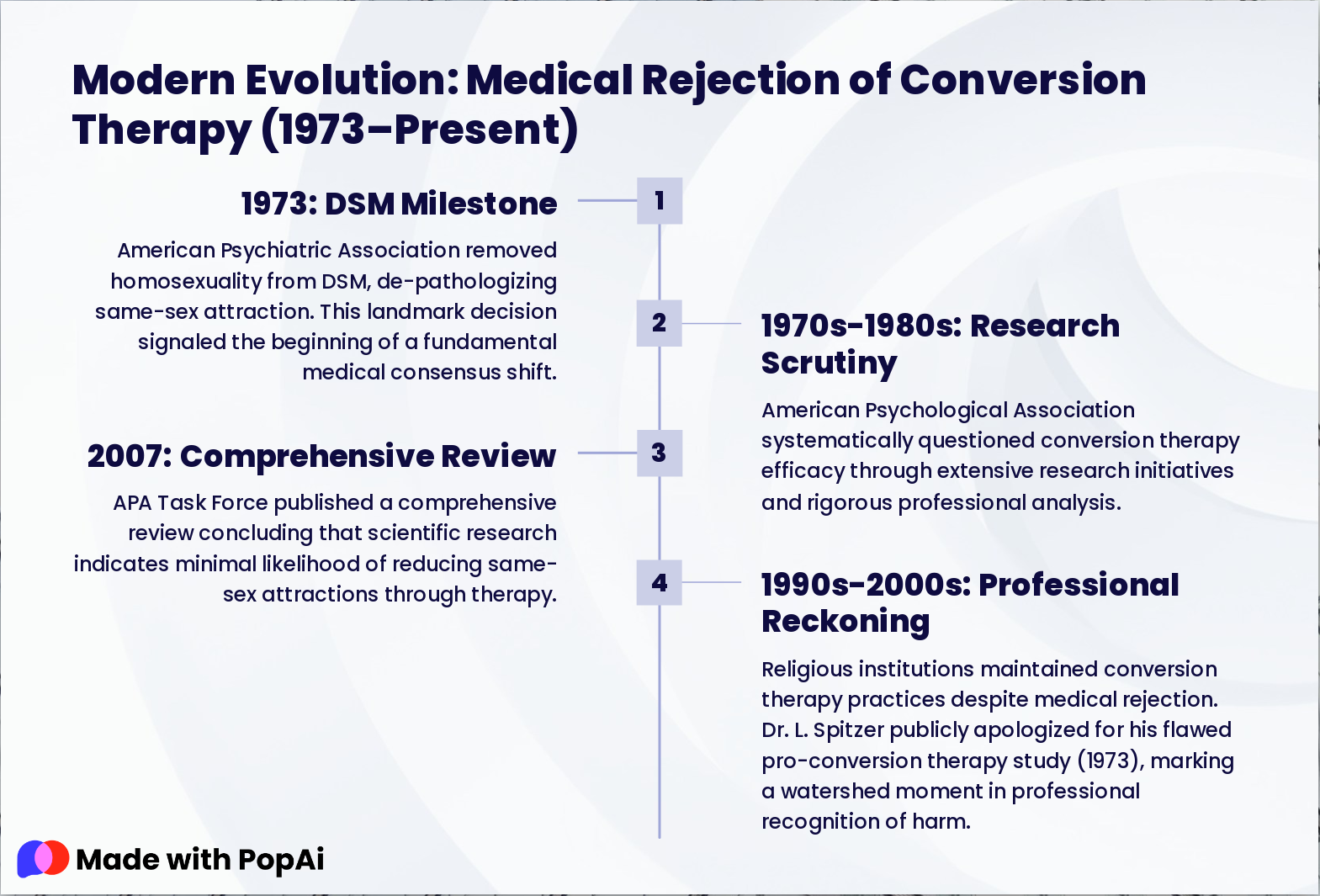
Slide 5: Modern Evolution: Medical Rejection of Conversion Therapy (1973–Present)
- 1973: DSM Milestone: American Psychiatric Association removed homosexuality from DSM, de-pathologizing same-sex attraction. This landmark decision signaled the beginning of a fundamental medical consensus shift.
- 1970s-1980s: Research Scrutiny: American Psychological Association systematically questioned conversion therapy efficacy through extensive research initiatives and rigorous professional analysis.
- 2007: Comprehensive Review: APA Task Force published a comprehensive review concluding that scientific research indicates minimal likelihood of reducing same-sex attractions through therapy.
- 1990s-2000s: Professional Reckoning: Religious institutions maintained conversion therapy practices despite medical rejection. Dr. L. Spitzer publicly apologized for his flawed pro-conversion therapy study (1973), marking a watershed moment in professional recognition of harm.
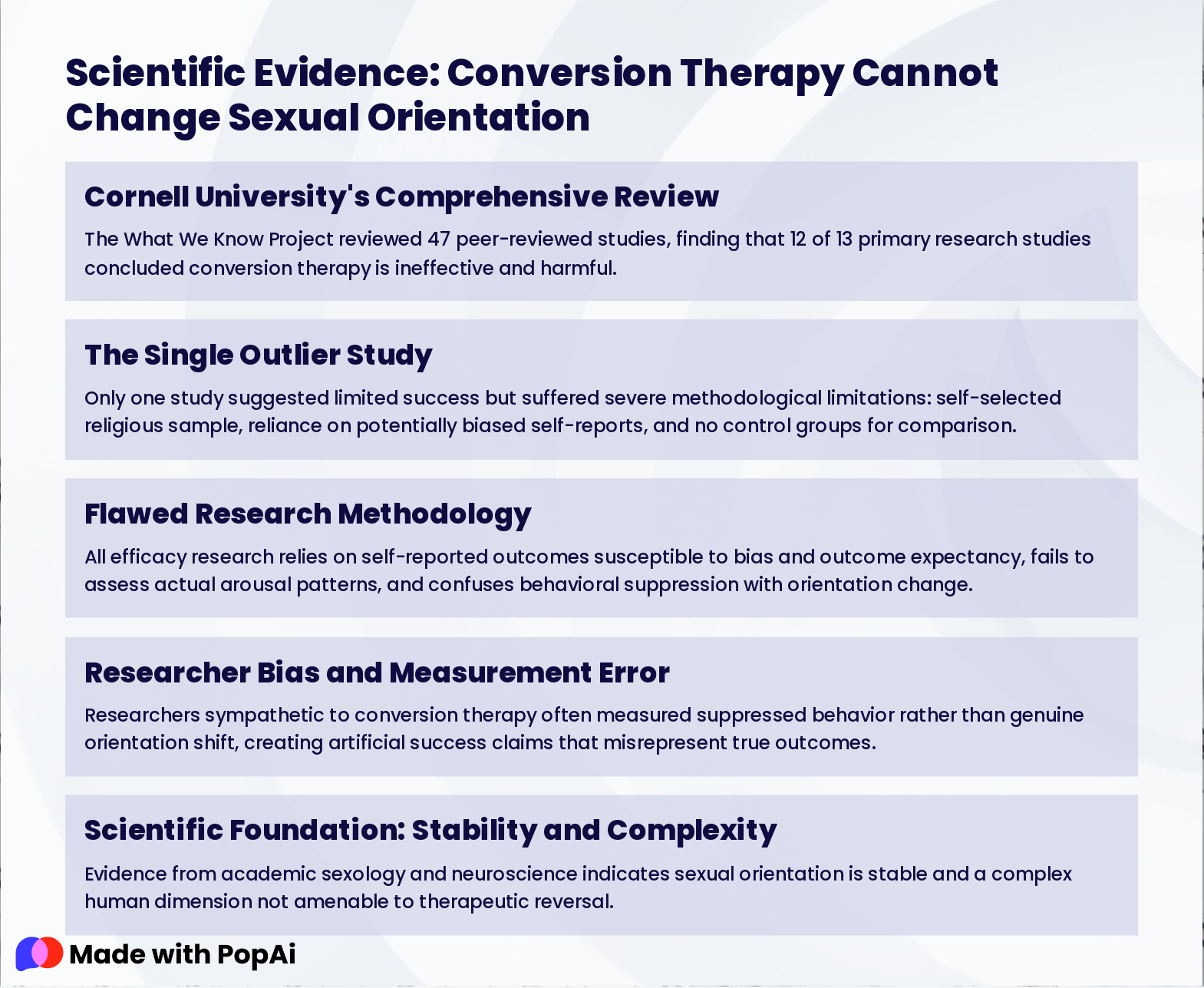
Slide 6: Scientific Evidence: Conversion Therapy Cannot Change Sexual Orientation
- Cornell University's Comprehensive Review: The What We Know Project reviewed 47 peer-reviewed studies, finding that 12 of 13 primary research studies concluded conversion therapy is ineffective and harmful.
- The Single Outlier Study: Only one study suggested limited success but suffered severe methodological limitations: self-selected religious sample, reliance on potentially biased self-reports, and no control groups for comparison.
- Flawed Research Methodology: All efficacy research relies on self-reported outcomes susceptible to bias and outcome expectancy, fails to assess actual arousal patterns, and confuses behavioral suppression with orientation change.
- Researcher Bias and Measurement Error: Researchers sympathetic to conversion therapy often measured suppressed behavior rather than genuine orientation shift, creating artificial success claims that misrepresent true outcomes.
- Scientific Foundation: Stability and Complexity: Evidence from academic sexology and neuroscience indicates sexual orientation is stable and a complex human dimension not amenable to therapeutic reversal.
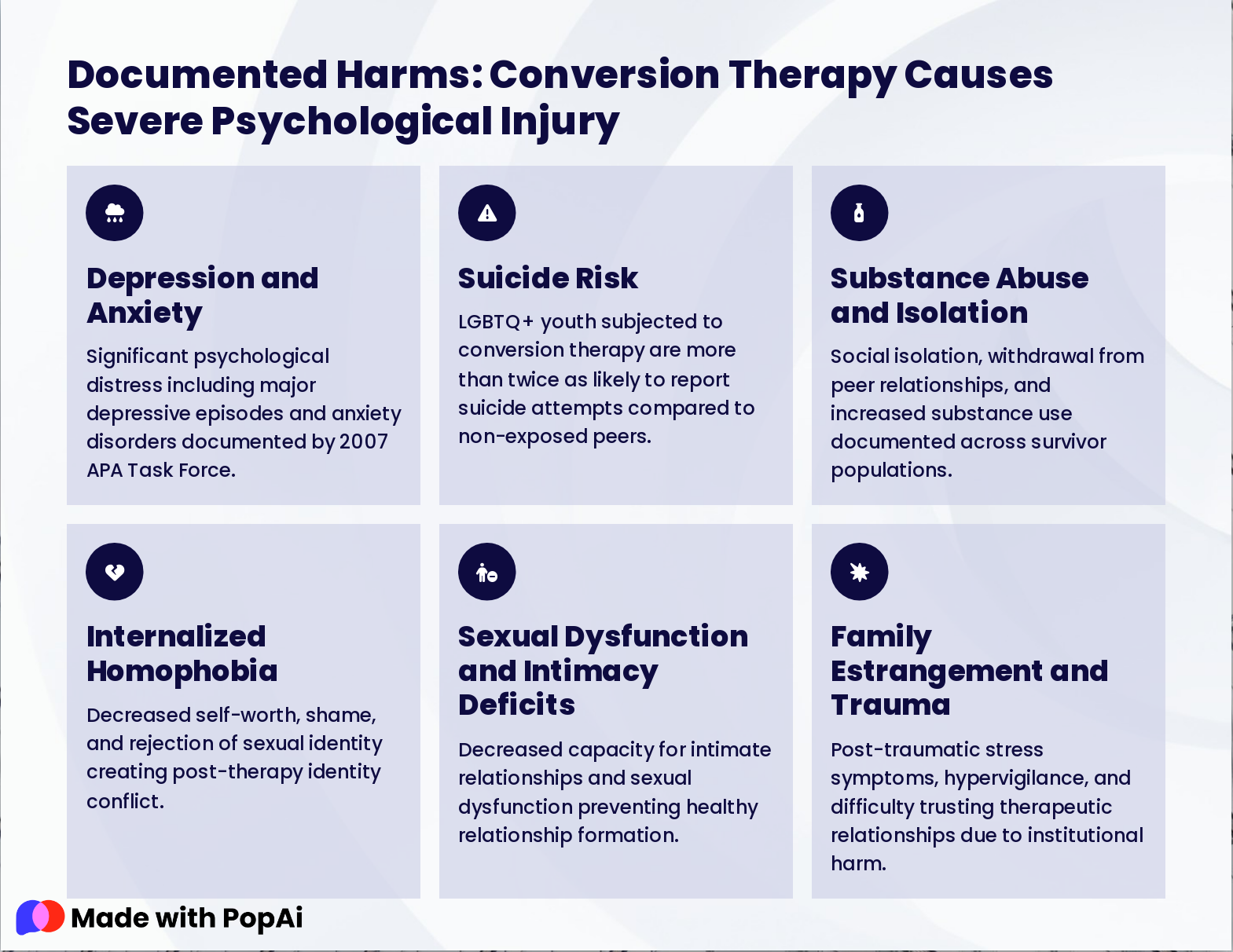
Slide 7: Documented Harms: Conversion Therapy Causes Severe Psychological Injury
- Depression and Anxiety: Significant psychological distress including major depressive episodes and anxiety disorders documented by 2007 APA Task Force.
- Suicide Risk: LGBTQ+ youth subjected to conversion therapy are more than twice as likely to report suicide attempts compared to non-exposed peers.
- Substance Abuse and Isolation: Social isolation, withdrawal from peer relationships, and increased substance use documented across survivor populations.
- Internalized Homophobia: Decreased self-worth, shame, and rejection of sexual identity creating post-therapy identity conflict.
- Sexual Dysfunction and Intimacy Deficits: Decreased capacity for intimate relationships and sexual dysfunction preventing healthy relationship formation.
- Family Estrangement and Trauma: Post-traumatic stress symptoms, hypervigilance, and difficulty trusting therapeutic relationships due to institutional harm.
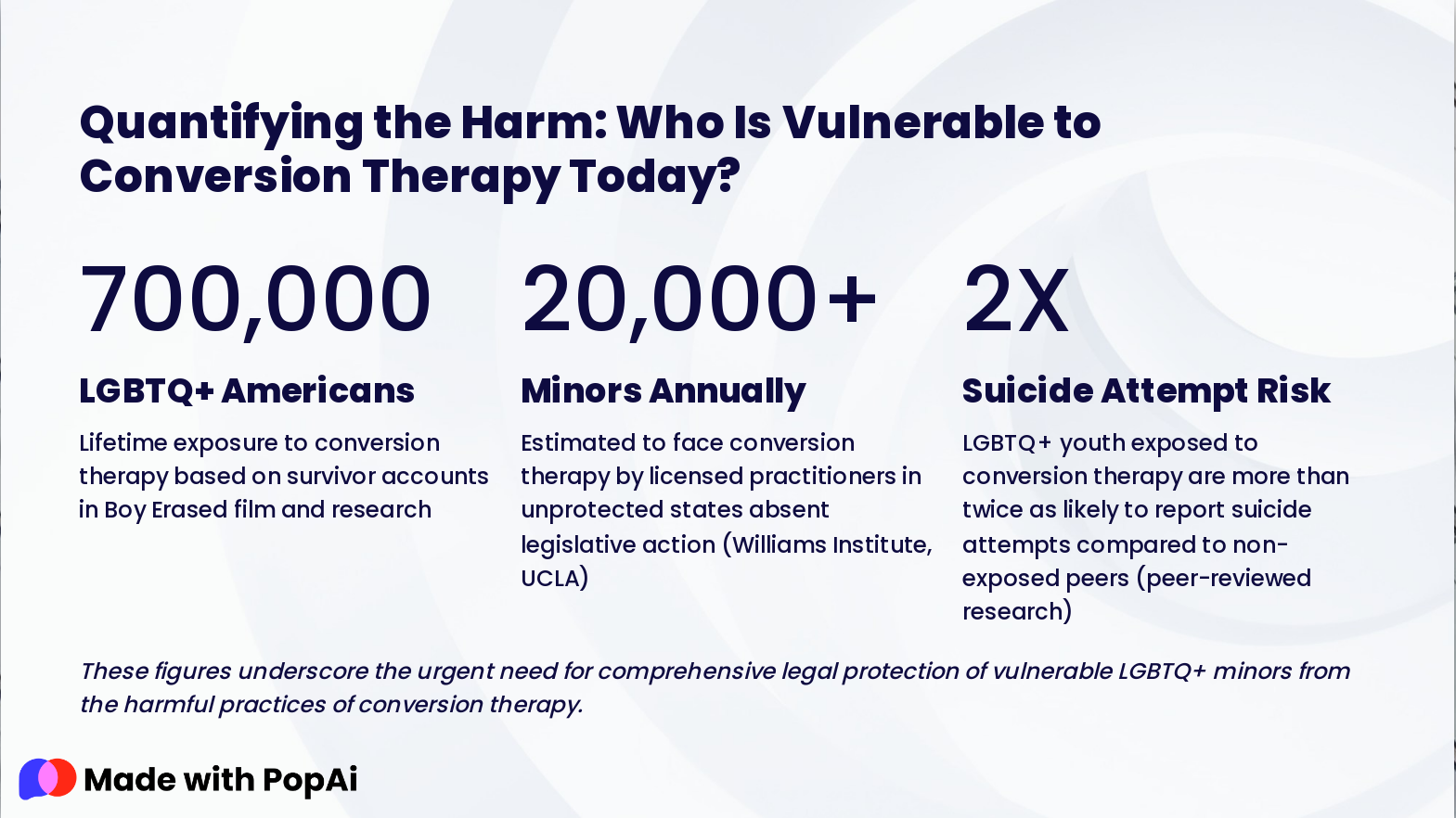
Slide 8: Quantifying the Harm: Who Is Vulnerable to Conversion Therapy Today?
- 700,000 — LGBTQ+ Americans
- 20,000+ — Minors Annually
- 2X — Suicide Attempt Risk
These figures underscore the urgent need for comprehensive legal protection of vulnerable LGBTQ+ minors from the harmful practices of conversion therapy.
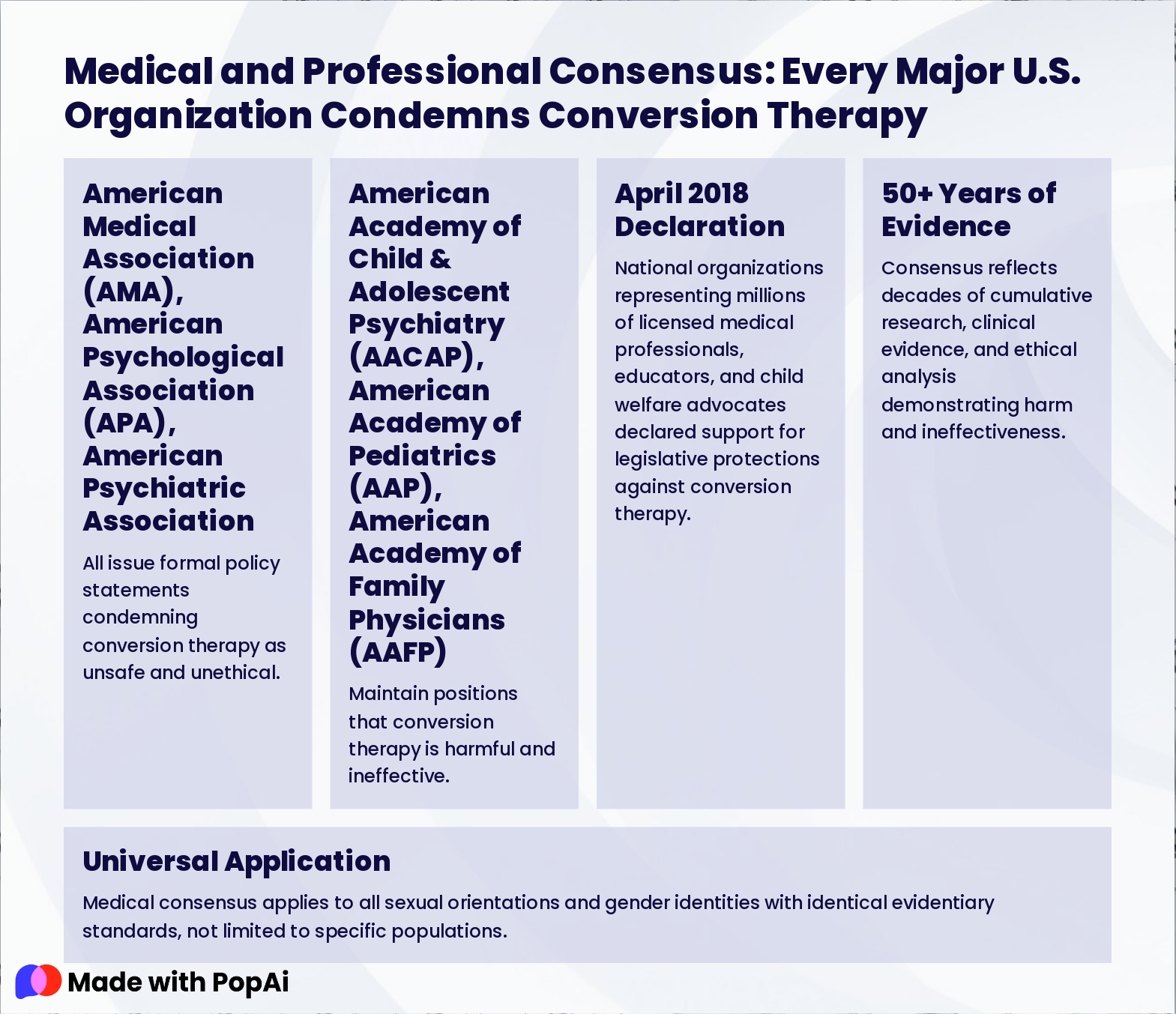
Slide 9: Medical and Professional Consensus: Every Major U.S. Organization Condemns Conversion Therapy
- American Medical Association (AMA), American Psychological Association (APA), American Psychiatric Association: All issue formal policy statements condemning conversion therapy as unsafe and unethical.
- American Academy of Child & Adolescent Psychiatry (AACAP), American Academy of Pediatrics (AAP), American Academy of Family Physicians (AAFP): Maintain positions that conversion therapy is harmful and ineffective.
- April 2018 Declaration: National organizations representing millions of licensed medical professionals, educators, and child welfare advocates declared support for legislative protections against conversion therapy.
- 50+ Years of Evidence: Consensus reflects decades of cumulative research, clinical evidence, and ethical analysis demonstrating harm and ineffectiveness.
- Universal Application: Medical consensus applies to all sexual orientations and gender identities with identical evidentiary standards, not limited to specific populations.
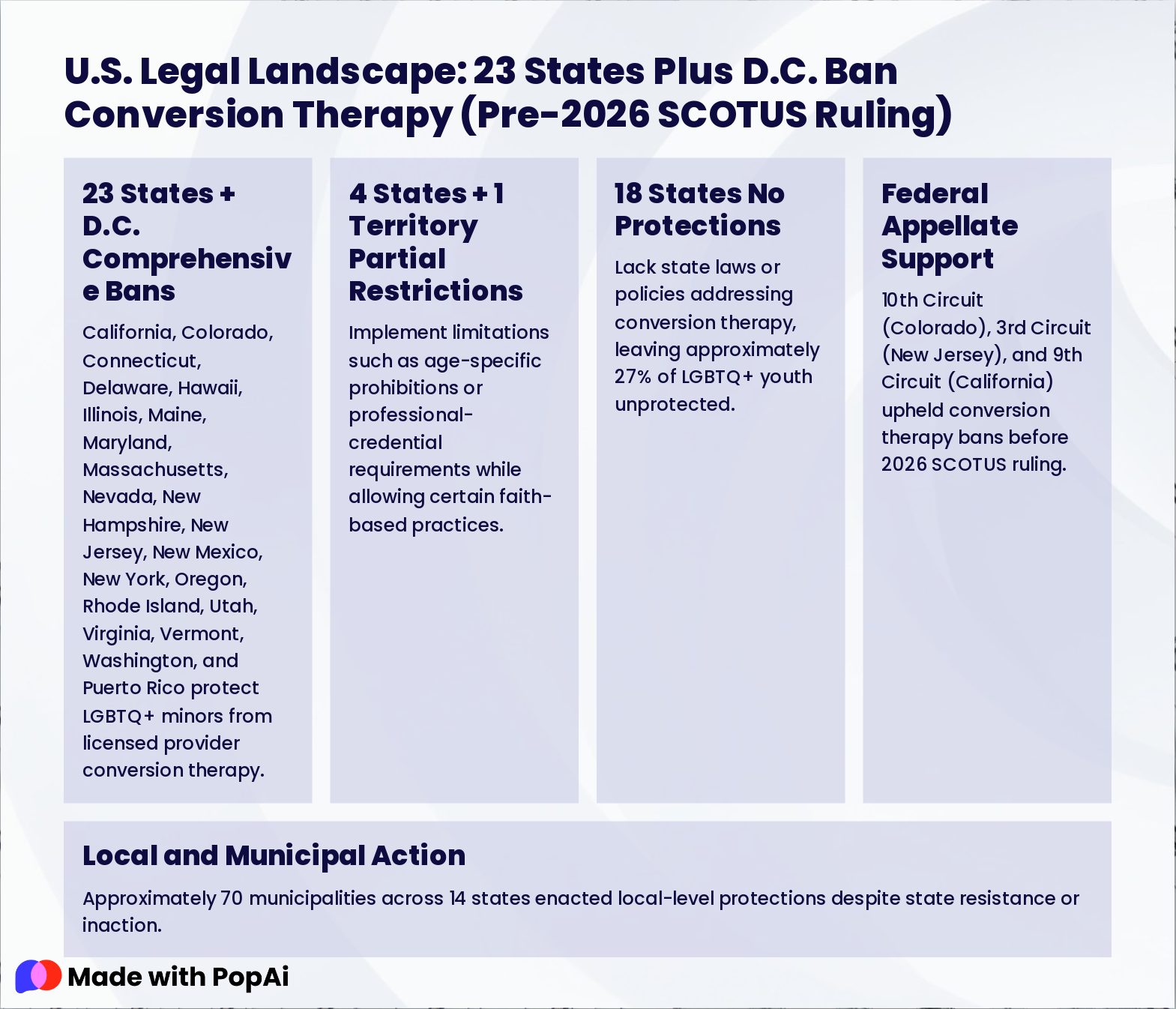
Slide 10: U.S. Legal Landscape: 23 States Plus D.C. Ban Conversion Therapy (Pre-2026 SCOTUS Ruling)
- 23 States + D.C. Comprehensive Bans: California, Colorado, Connecticut, Delaware, Hawaii, Illinois, Maine, Maryland, Massachusetts, Nevada, New Hampshire, New Jersey, New Mexico, New York, Oregon, Rhode Island, Utah, Virginia, Vermont, Washington, and Puerto Rico protect LGBTQ+ minors from licensed provider conversion therapy.
- 4 States + 1 Territory Partial Restrictions: Implement limitations such as age-specific prohibitions or professional-credential requirements while allowing certain faith-based practices.
- 18 States No Protections: Lack state laws or policies addressing conversion therapy, leaving approximately 27% of LGBTQ+ youth unprotected.
- Federal Appellate Support: 10th Circuit (Colorado), 3rd Circuit (New Jersey), and 9th Circuit (California) upheld conversion therapy bans before 2026 SCOTUS ruling.
- Local and Municipal Action: Approximately 70 municipalities across 14 states enacted local-level protections despite state resistance or inaction.
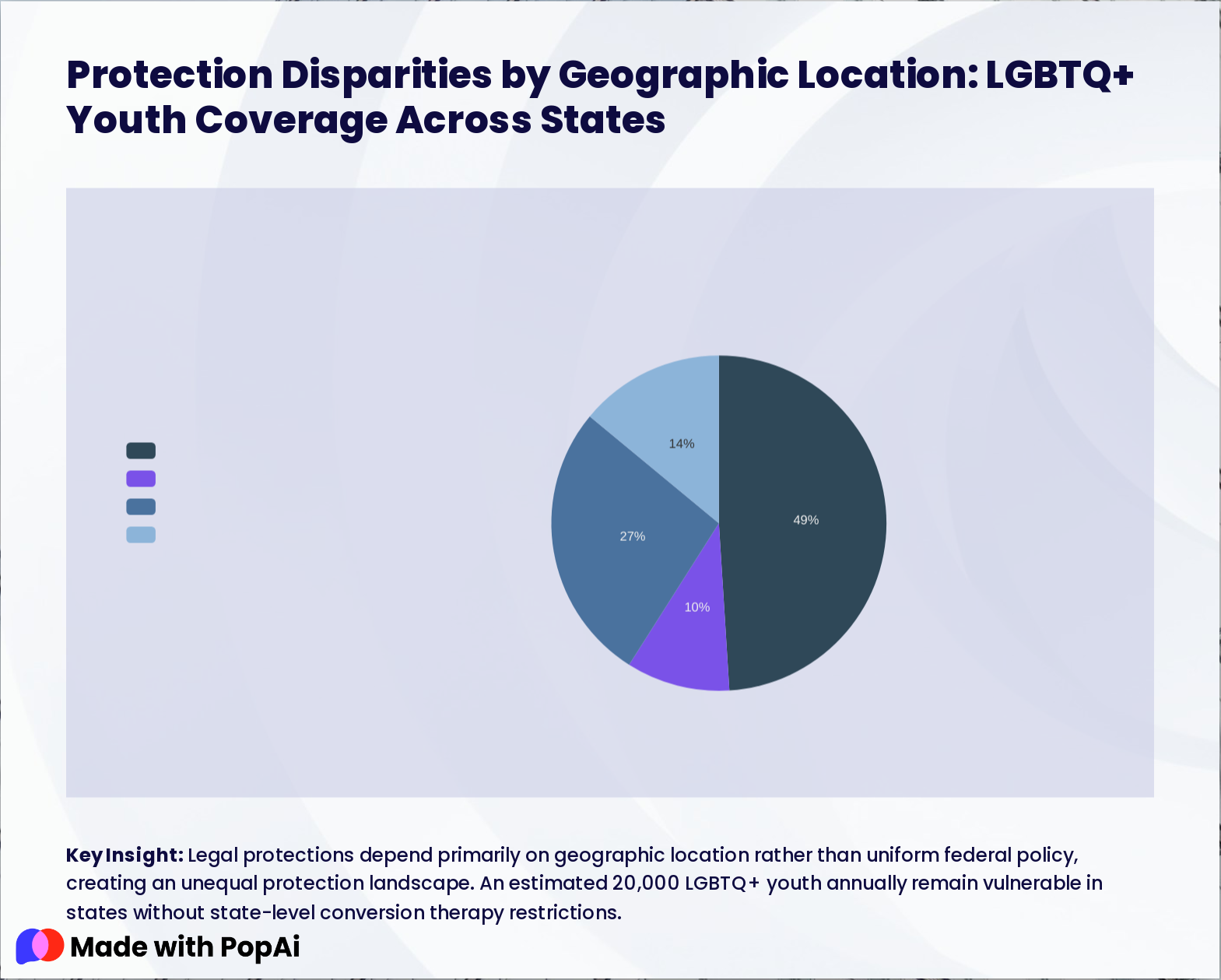
Slide 11: Protection Disparities by Geographic Location: LGBTQ+ Youth Coverage Across States
Key Insight: Legal protections depend primarily on geographic location rather than uniform federal policy, creating an unequal protection landscape. An estimated 20,000 LGBTQ+ youth annually remain vulnerable in states without state-level conversion therapy restrictions.
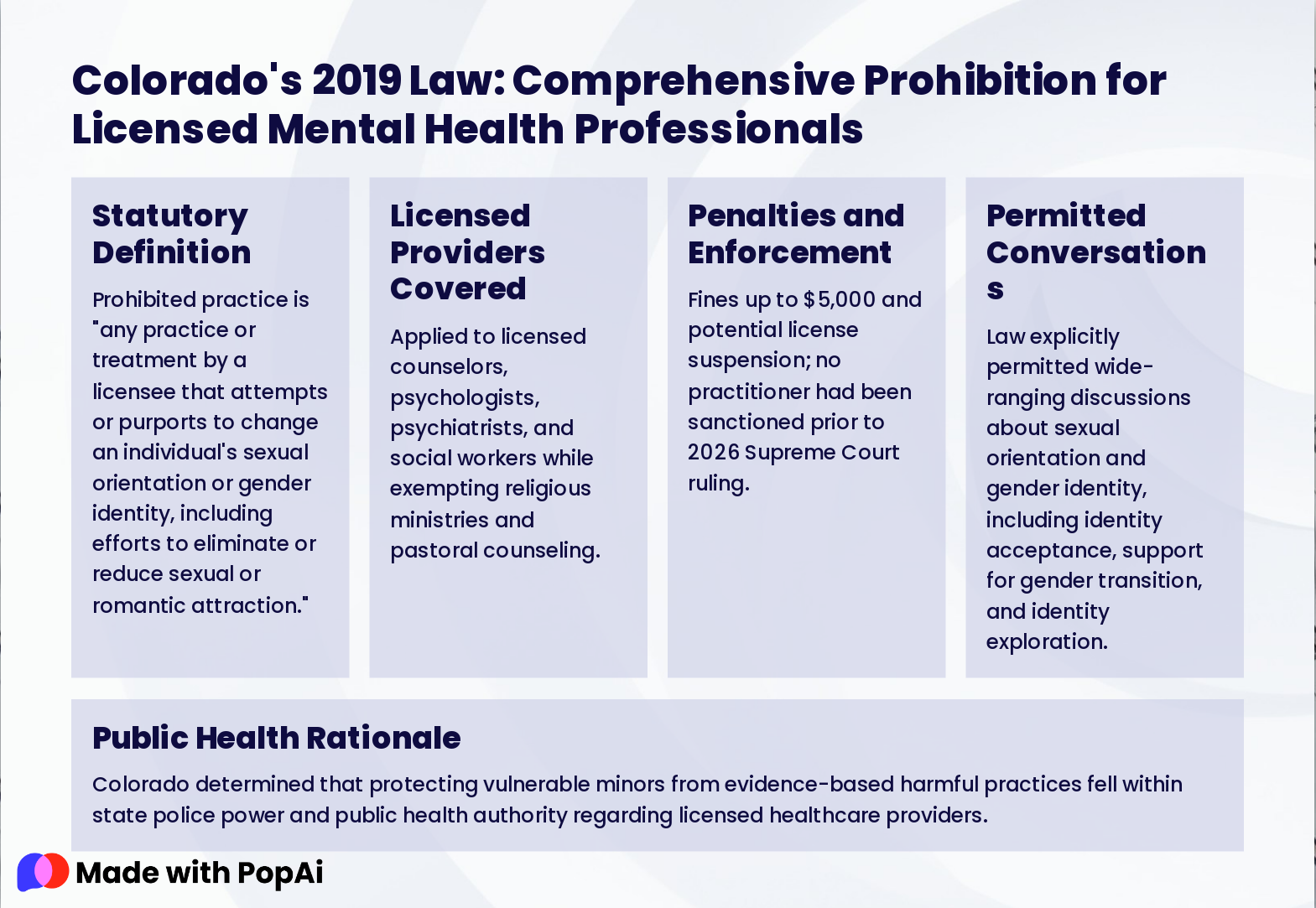
Slide 12: Colorado's 2019 Law: Comprehensive Prohibition for Licensed Mental Health Professionals
- Statutory Definition: Prohibited practice is "any practice or treatment by a licensee that attempts or purports to change an individual's sexual orientation or gender identity, including efforts to eliminate or reduce sexual or romantic attraction."
- Licensed Providers Covered: Applied to licensed counselors, psychologists, psychiatrists, and social workers while exempting religious ministries and pastoral counseling.
- Penalties and Enforcement: Fines up to $5,000 and potential license suspension; no practitioner had been sanctioned prior to 2026 Supreme Court ruling.
- Permitted Conversations: Law explicitly permitted wide-ranging discussions about sexual orientation and gender identity, including identity acceptance, support for gender transition, and identity exploration.
- Public Health Rationale: Colorado determined that protecting vulnerable minors from evidence-based harmful practices fell within state police power and public health authority regarding licensed healthcare providers.
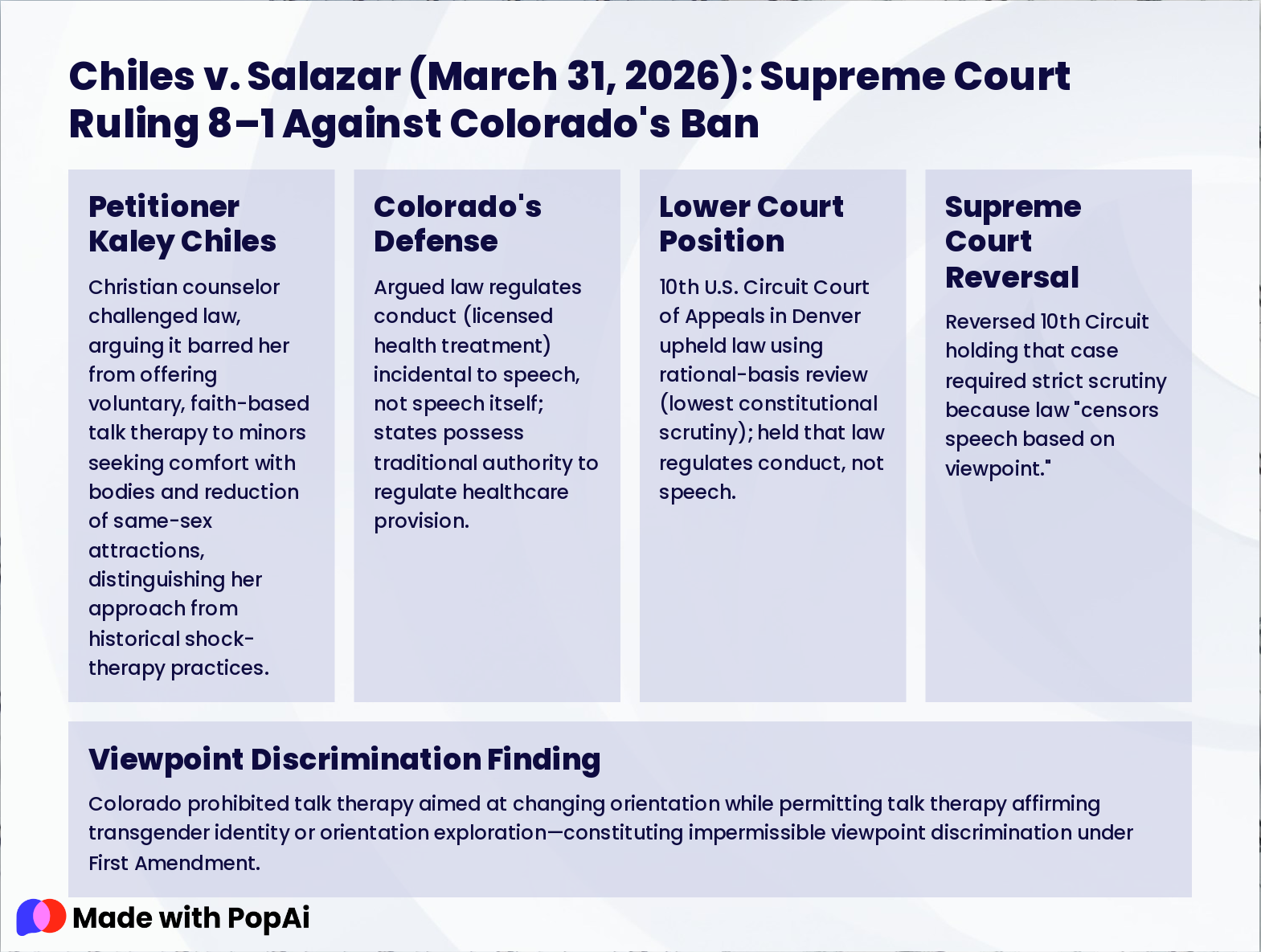
Slide 13: Chiles v. Salazar (March 31, 2026): Supreme Court Ruling 8–1 Against Colorado's Ban
- Petitioner Kaley Chiles: Christian counselor challenged law, arguing it barred her from offering voluntary, faith-based talk therapy to minors seeking comfort with bodies and reduction of same-sex attractions, distinguishing her approach from historical shock-therapy practices.
- Colorado's Defense: Argued law regulates conduct (licensed health treatment) incidental to speech, not speech itself; states possess traditional authority to regulate healthcare provision.
- Lower Court Position: 10th U.S. Circuit Court of Appeals in Denver upheld law using rational-basis review (lowest constitutional scrutiny); held that law regulates conduct, not speech.
- Supreme Court Reversal: Reversed 10th Circuit holding that case required strict scrutiny because law "censors speech based on viewpoint."
- Viewpoint Discrimination Finding: Colorado prohibited talk therapy aimed at changing orientation while permitting talk therapy affirming transgender identity or orientation exploration—constituting impermissible viewpoint discrimination under First Amendment.
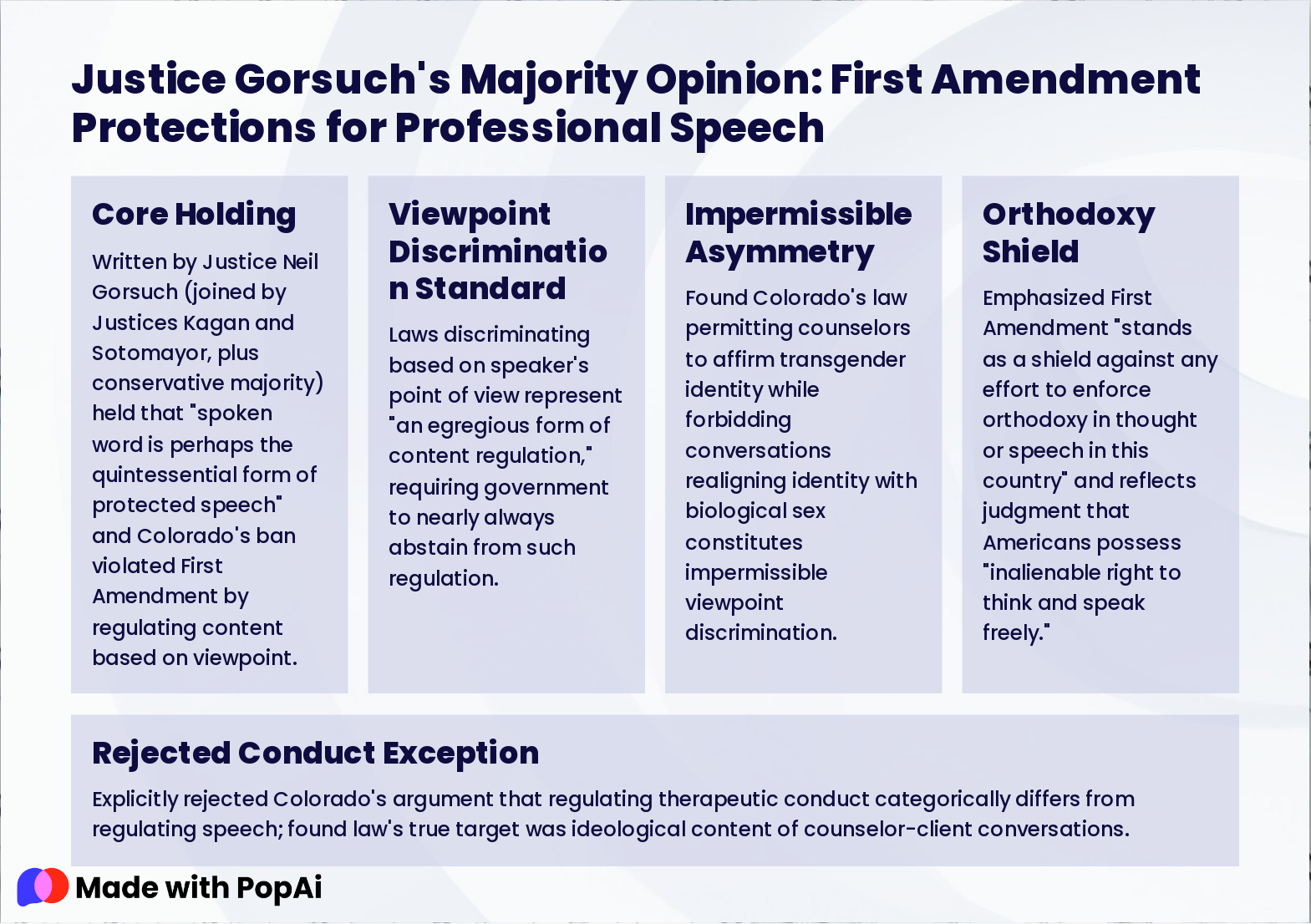
Slide 14: Justice Gorsuch's Majority Opinion: First Amendment Protections for Professional Speech
- Core Holding: Written by Justice Neil Gorsuch (joined by Justices Kagan and Sotomayor, plus conservative majority) held that "spoken word is perhaps the quintessential form of protected speech" and Colorado's ban violated First Amendment by regulating content based on viewpoint.
- Viewpoint Discrimination Standard: Laws discriminating based on speaker's point of view represent "an egregious form of content regulation," requiring government to nearly always abstain from such regulation.
- Impermissible Asymmetry: Found Colorado's law permitting counselors to affirm transgender identity while forbidding conversations realigning identity with biological sex constitutes impermissible viewpoint discrimination.
- Orthodoxy Shield: Emphasized First Amendment "stands as a shield against any effort to enforce orthodoxy in thought or speech in this country" and reflects judgment that Americans possess "inalienable right to think and speak freely."
- Rejected Conduct Exception: Explicitly rejected Colorado's argument that regulating therapeutic conduct categorically differs from regulating speech; found law's true target was ideological content of counselor-client conversations.
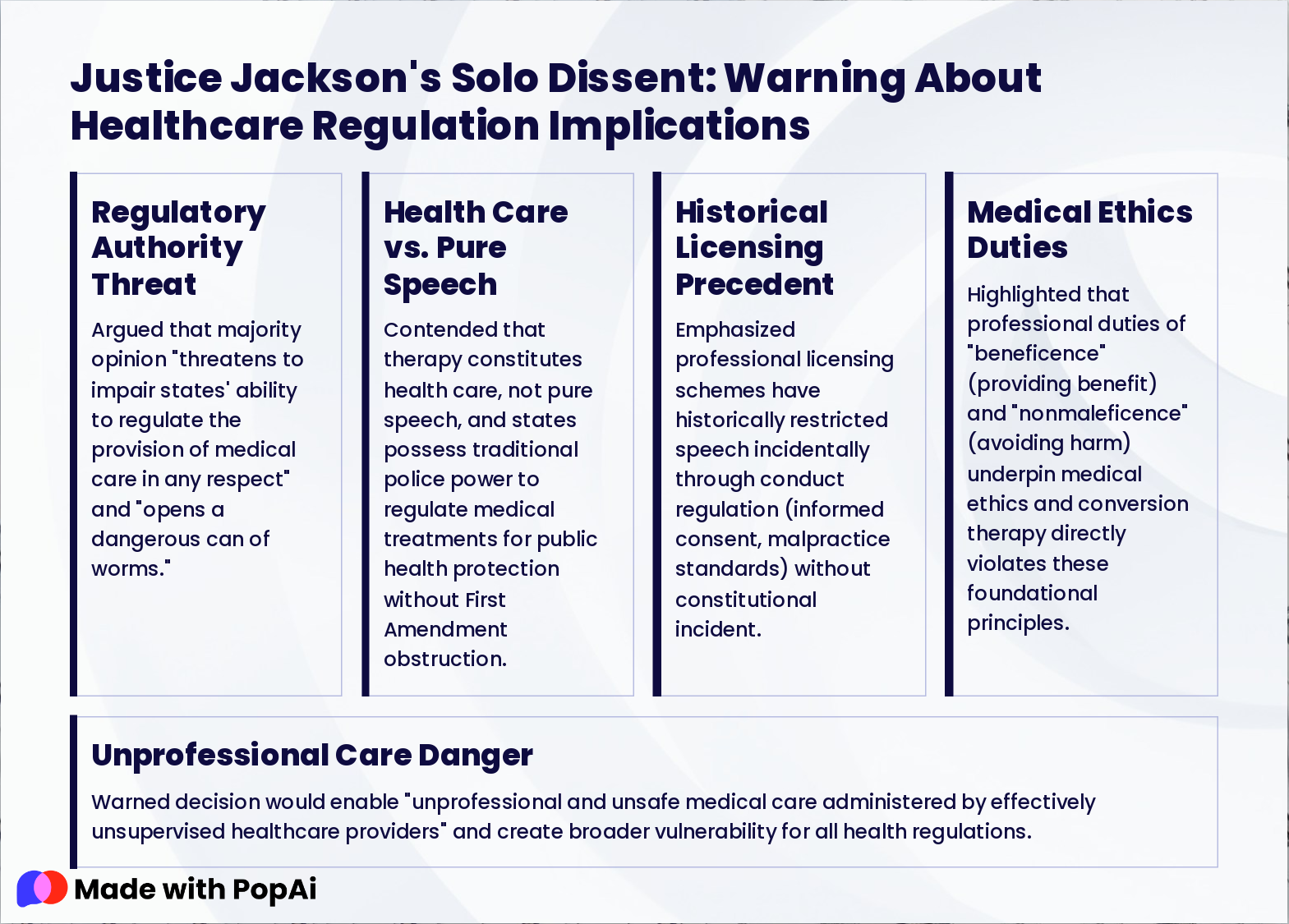
Slide 15: Justice Jackson's Solo Dissent: Warning About Healthcare Regulation Implications
- Regulatory Authority Threat: Argued that majority opinion "threatens to impair states' ability to regulate the provision of medical care in any respect" and "opens a dangerous can of worms."
- Health Care vs. Pure Speech: Contended that therapy constitutes health care, not pure speech, and states possess traditional police power to regulate medical treatments for public health protection without First Amendment obstruction.
- Historical Licensing Precedent: Emphasized professional licensing schemes have historically restricted speech incidentally through conduct regulation (informed consent, malpractice standards) without constitutional incident.
- Medical Ethics Duties: Highlighted that professional duties of "beneficence" (providing benefit) and "nonmaleficence" (avoiding harm) underpin medical ethics and conversion therapy directly violates these foundational principles.
- Unprofessional Care Danger: Warned decision would enable "unprofessional and unsafe medical care administered by effectively unsupervised healthcare providers" and create broader vulnerability for all health regulations.
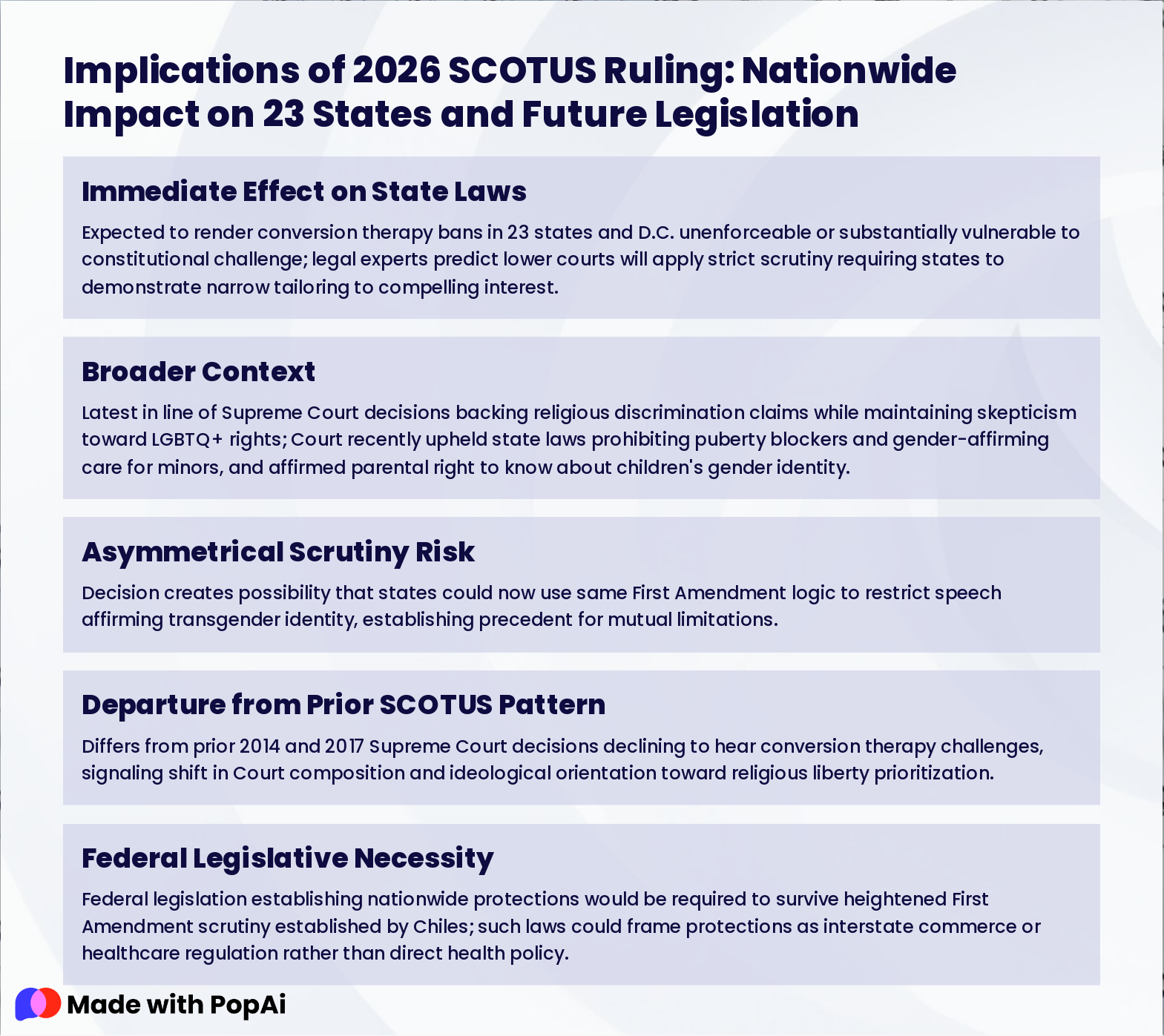
Slide 16: Implications of 2026 SCOTUS Ruling: Nationwide Impact on 23 States and Future Legislation
- Immediate Effect on State Laws: Expected to render conversion therapy bans in 23 states and D.C. unenforceable or substantially vulnerable to constitutional challenge; legal experts predict lower courts will apply strict scrutiny requiring states to demonstrate narrow tailoring to compelling interest.
- Broader Context: Latest in line of Supreme Court decisions backing religious discrimination claims while maintaining skepticism toward LGBTQ+ rights; Court recently upheld state laws prohibiting puberty blockers and gender-affirming care for minors, and affirmed parental right to know about children's gender identity.
- Asymmetrical Scrutiny Risk: Decision creates possibility that states could now use same First Amendment logic to restrict speech affirming transgender identity, establishing precedent for mutual limitations.
- Departure from Prior SCOTUS Pattern: Differs from prior 2014 and 2017 Supreme Court decisions declining to hear conversion therapy challenges, signaling shift in Court composition and ideological orientation toward religious liberty prioritization.
- Federal Legislative Necessity: Federal legislation establishing nationwide protections would be required to survive heightened First Amendment scrutiny established by Chiles; such laws could frame protections as interstate commerce or healthcare regulation rather than direct health policy.
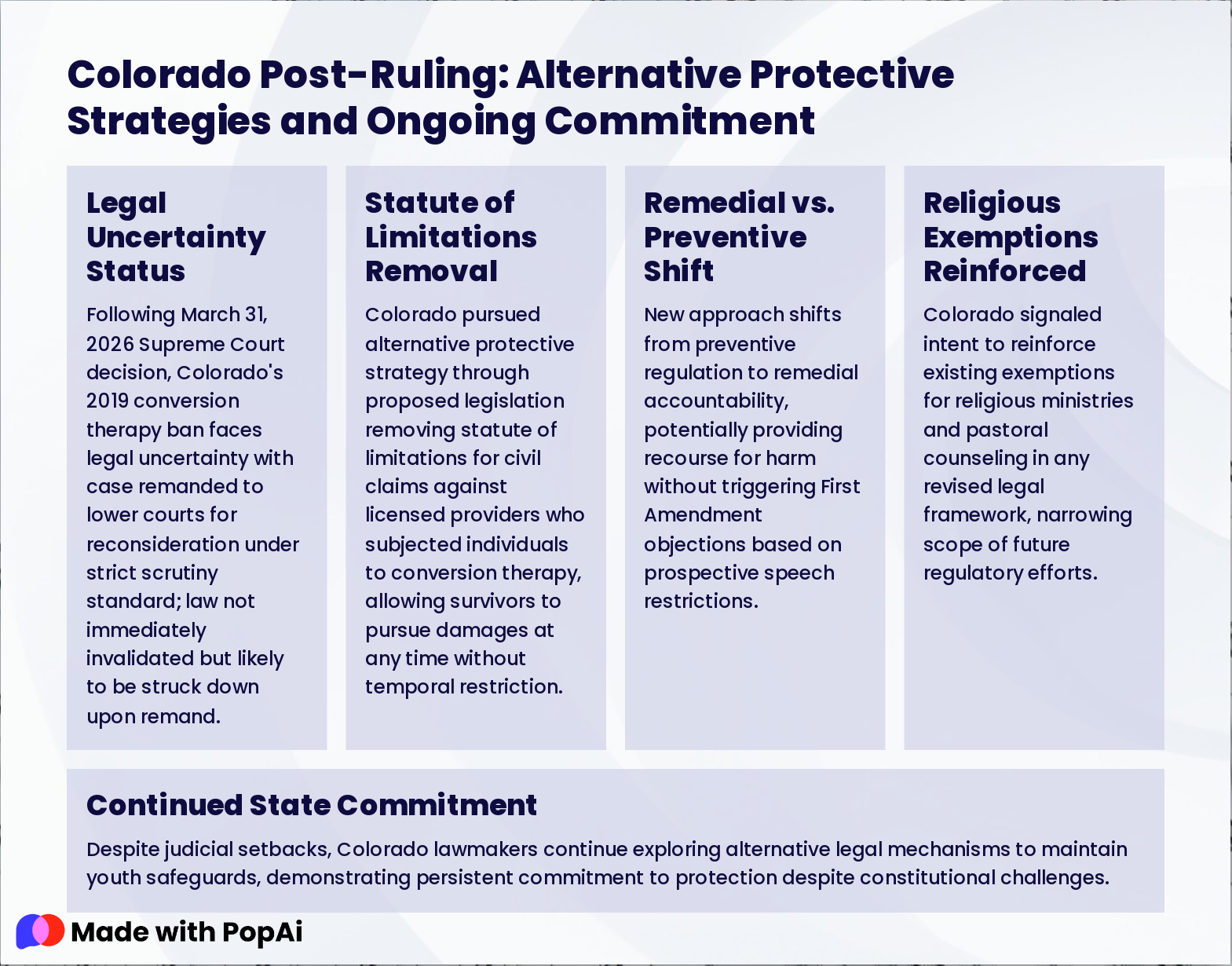
Slide 17: Colorado Post-Ruling: Alternative Protective Strategies and Ongoing Commitment
- Legal Uncertainty Status: Following March 31, 2026 Supreme Court decision, Colorado's 2019 conversion therapy ban faces legal uncertainty with case remanded to lower courts for reconsideration under strict scrutiny standard; law not immediately invalidated but likely to be struck down upon remand.
- Statute of Limitations Removal: Colorado pursued alternative protective strategy through proposed legislation removing statute of limitations for civil claims against licensed providers who subjected individuals to conversion therapy, allowing survivors to pursue damages at any time without temporal restriction.
- Remedial vs. Preventive Shift: New approach shifts from preventive regulation to remedial accountability, potentially providing recourse for harm without triggering First Amendment objections based on prospective speech restrictions.
- Religious Exemptions Reinforced: Colorado signaled intent to reinforce existing exemptions for religious ministries and pastoral counseling in any revised legal framework, narrowing scope of future regulatory efforts.
- Continued State Commitment: Despite judicial setbacks, Colorado lawmakers continue exploring alternative legal mechanisms to maintain youth safeguards, demonstrating persistent commitment to protection despite constitutional challenges.
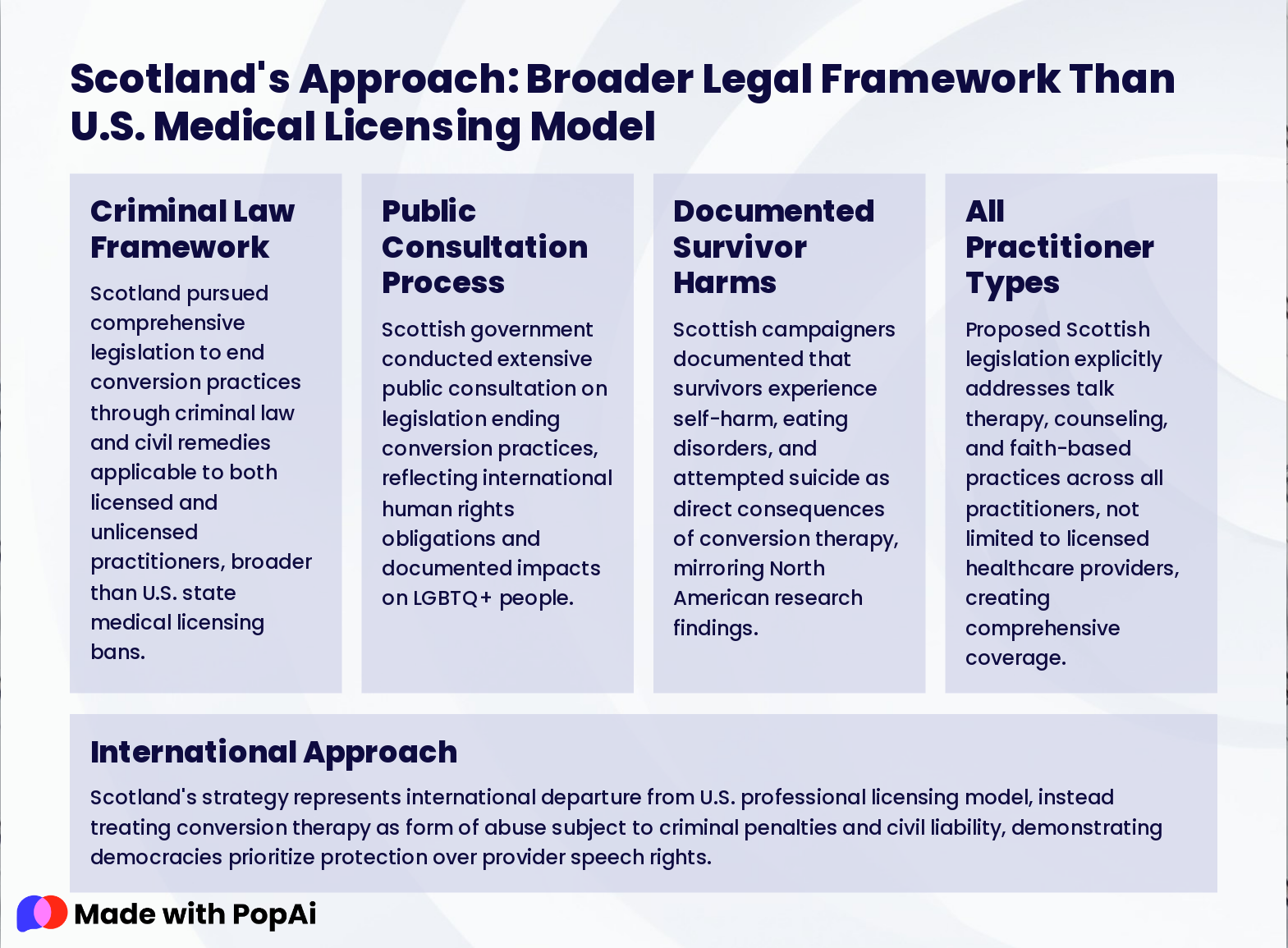
Slide 18: Scotland's Approach: Broader Legal Framework Than U.S. Medical Licensing Model
- Criminal Law Framework: Scotland pursued comprehensive legislation to end conversion practices through criminal law and civil remedies applicable to both licensed and unlicensed practitioners, broader than U.S. state medical licensing bans.
- Public Consultation Process: Scottish government conducted extensive public consultation on legislation ending conversion practices, reflecting international human rights obligations and documented impacts on LGBTQ+ people.
- Documented Survivor Harms: Scottish campaigners documented that survivors experience self-harm, eating disorders, and attempted suicide as direct consequences of conversion therapy, mirroring North American research findings.
- All Practitioner Types: Proposed Scottish legislation explicitly addresses talk therapy, counseling, and faith-based practices across all practitioners, not limited to licensed healthcare providers, creating comprehensive coverage.
- International Approach: Scotland's strategy represents international departure from U.S. professional licensing model, instead treating conversion therapy as form of abuse subject to criminal penalties and civil liability, demonstrating democracies prioritize protection over provider speech rights.
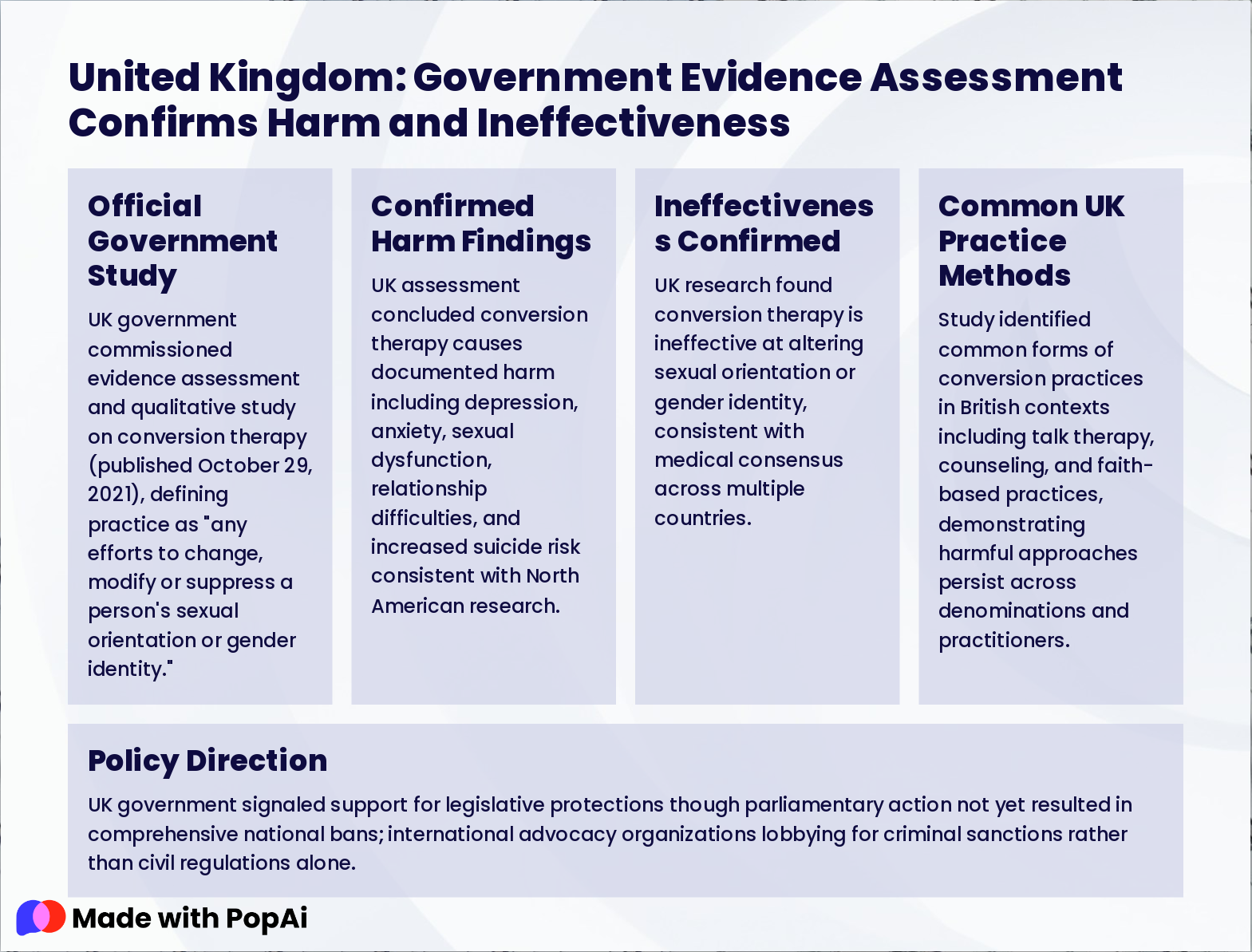
Slide 19: United Kingdom: Government Evidence Assessment Confirms Harm and Ineffectiveness
- Official Government Study: UK government commissioned evidence assessment and qualitative study on conversion therapy (published October 29, 2021), defining practice as "any efforts to change, modify or suppress a person's sexual orientation or gender identity."
- Confirmed Harm Findings: UK assessment concluded conversion therapy causes documented harm including depression, anxiety, sexual dysfunction, relationship difficulties, and increased suicide risk consistent with North American research.
- Ineffectiveness Confirmed: UK research found conversion therapy is ineffective at altering sexual orientation or gender identity, consistent with medical consensus across multiple countries.
- Common UK Practice Methods: Study identified common forms of conversion practices in British contexts including talk therapy, counseling, and faith-based practices, demonstrating harmful approaches persist across denominations and practitioners.
- Policy Direction: UK government signaled support for legislative protections though parliamentary action not yet resulted in comprehensive national bans; international advocacy organizations lobbying for criminal sanctions rather than civil regulations alone.
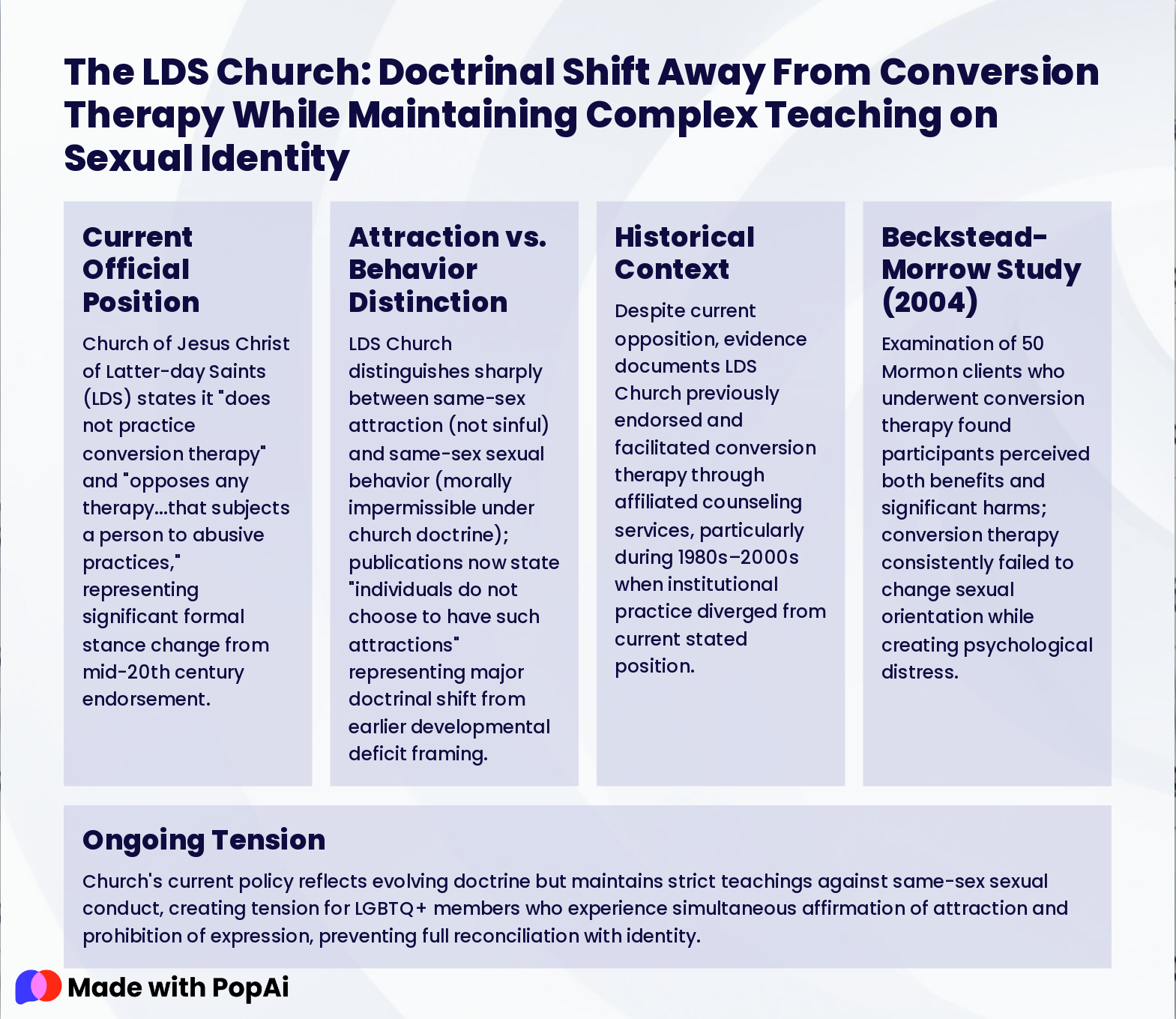
Slide 20: The LDS Church: Doctrinal Shift Away From Conversion Therapy While Maintaining Complex Teaching on Sexual Identity
- Current Official Position: Church of Jesus Christ of Latter-day Saints (LDS) states it "does not practice conversion therapy" and "opposes any therapy...that subjects a person to abusive practices," representing significant formal stance change from mid-20th century endorsement.
- Attraction vs. Behavior Distinction: LDS Church distinguishes sharply between same-sex attraction (not sinful) and same-sex sexual behavior (morally impermissible under church doctrine); publications now state "individuals do not choose to have such attractions" representing major doctrinal shift from earlier developmental deficit framing.
- Historical Context: Despite current opposition, evidence documents LDS Church previously endorsed and facilitated conversion therapy through affiliated counseling services, particularly during 1980s–2000s when institutional practice diverged from current stated position.
- Beckstead-Morrow Study (2004): Examination of 50 Mormon clients who underwent conversion therapy found participants perceived both benefits and significant harms; conversion therapy consistently failed to change sexual orientation while creating psychological distress.
- Ongoing Tension: Church's current policy reflects evolving doctrine but maintains strict teachings against same-sex sexual conduct, creating tension for LGBTQ+ members who experience simultaneous affirmation of attraction and prohibition of expression, preventing full reconciliation with identity.
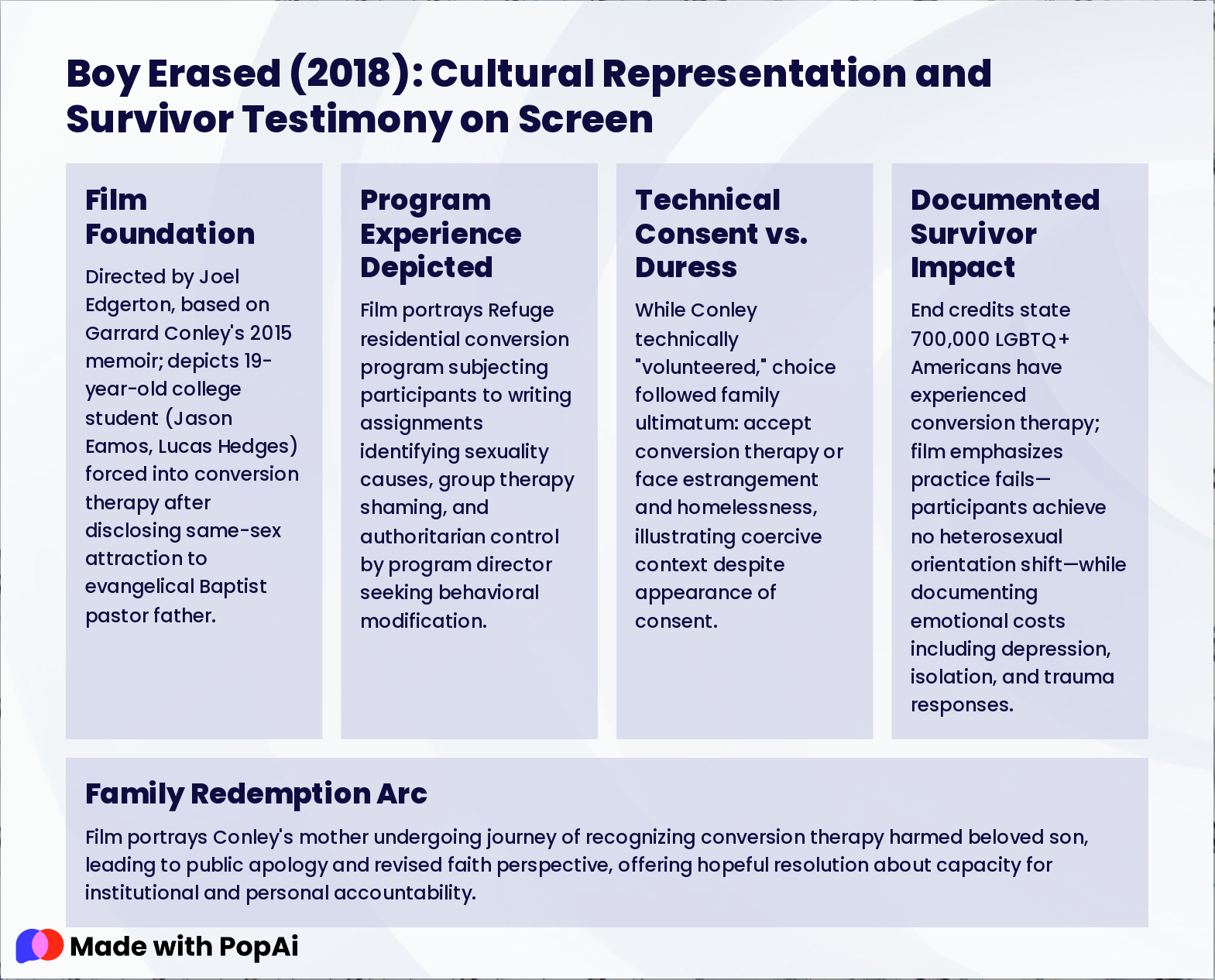
Slide 21: Boy Erased (2018): Cultural Representation and Survivor Testimony on Screen
- Film Foundation: Directed by Joel Edgerton, based on Garrard Conley's 2015 memoir; depicts 19-year-old college student (Jason Eamos, Lucas Hedges) forced into conversion therapy after disclosing same-sex attraction to evangelical Baptist pastor father.
- Program Experience Depicted: Film portrays Refuge residential conversion program subjecting participants to writing assignments identifying sexuality causes, group therapy shaming, and authoritarian control by program director seeking behavioral modification.
- Technical Consent vs. Duress: While Conley technically "volunteered," choice followed family ultimatum: accept conversion therapy or face estrangement and homelessness, illustrating coercive context despite appearance of consent.
- Documented Survivor Impact: End credits state 700,000 LGBTQ+ Americans have experienced conversion therapy; film emphasizes practice fails—participants achieve no heterosexual orientation shift—while documenting emotional costs including depression, isolation, and trauma responses.
- Family Redemption Arc: Film portrays Conley's mother undergoing journey of recognizing conversion therapy harmed beloved son, leading to public apology and revised faith perspective, offering hopeful resolution about capacity for institutional and personal accountability.
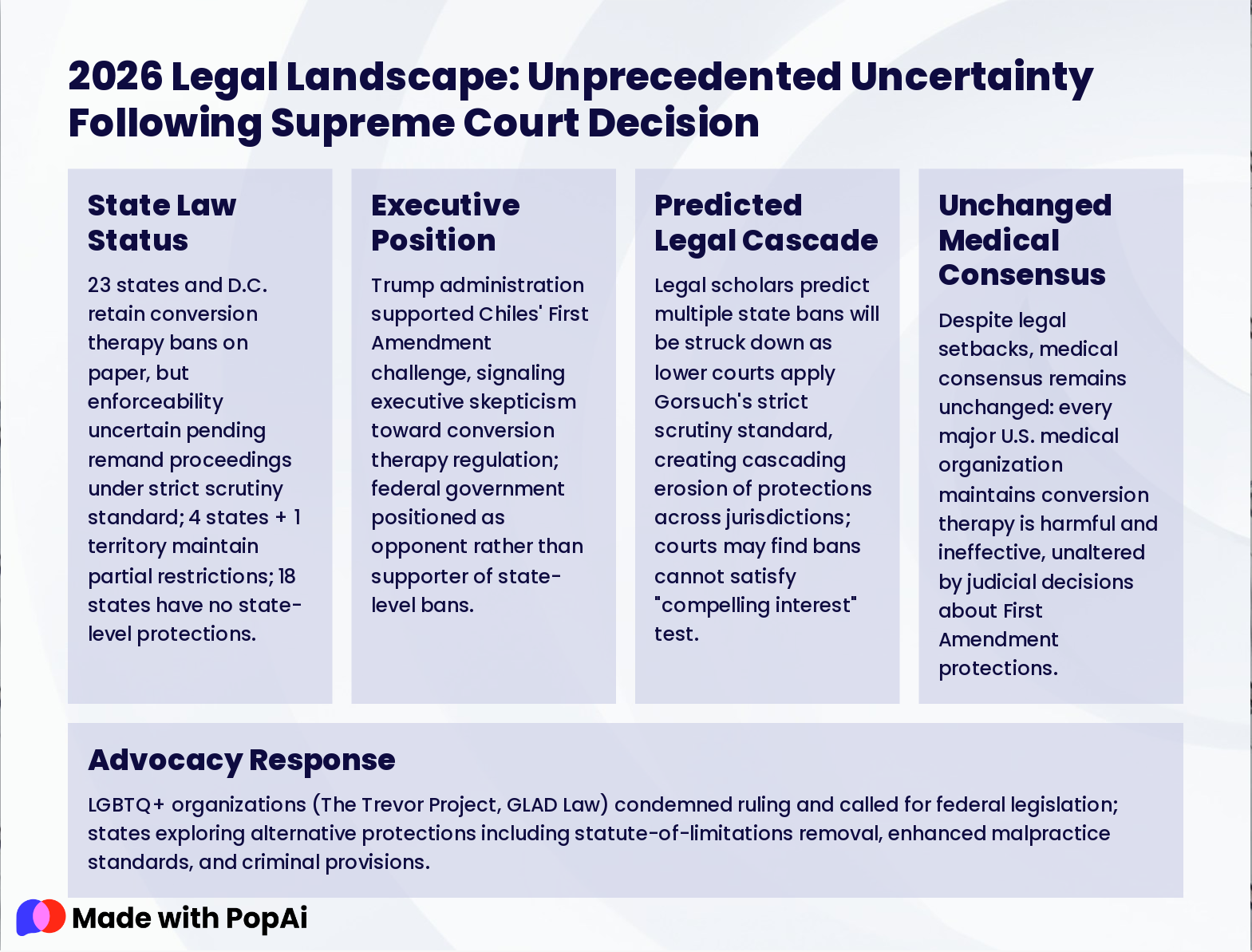
Slide 22: 2026 Legal Landscape: Unprecedented Uncertainty Following Supreme Court Decision
- State Law Status: 23 states and D.C. retain conversion therapy bans on paper, but enforceability uncertain pending remand proceedings under strict scrutiny standard; 4 states + 1 territory maintain partial restrictions; 18 states have no state-level protections.
- Executive Position: Trump administration supported Chiles' First Amendment challenge, signaling executive skepticism toward conversion therapy regulation; federal government positioned as opponent rather than supporter of state-level bans.
- Predicted Legal Cascade: Legal scholars predict multiple state bans will be struck down as lower courts apply Gorsuch's strict scrutiny standard, creating cascading erosion of protections across jurisdictions; courts may find bans cannot satisfy "compelling interest" test.
- Unchanged Medical Consensus: Despite legal setbacks, medical consensus remains unchanged: every major U.S. medical organization maintains conversion therapy is harmful and ineffective, unaltered by judicial decisions about First Amendment protections.
- Advocacy Response: LGBTQ+ organizations (The Trevor Project, GLAD Law) condemned ruling and called for federal legislation; states exploring alternative protections including statute-of-limitations removal, enhanced malpractice standards, and criminal provisions.
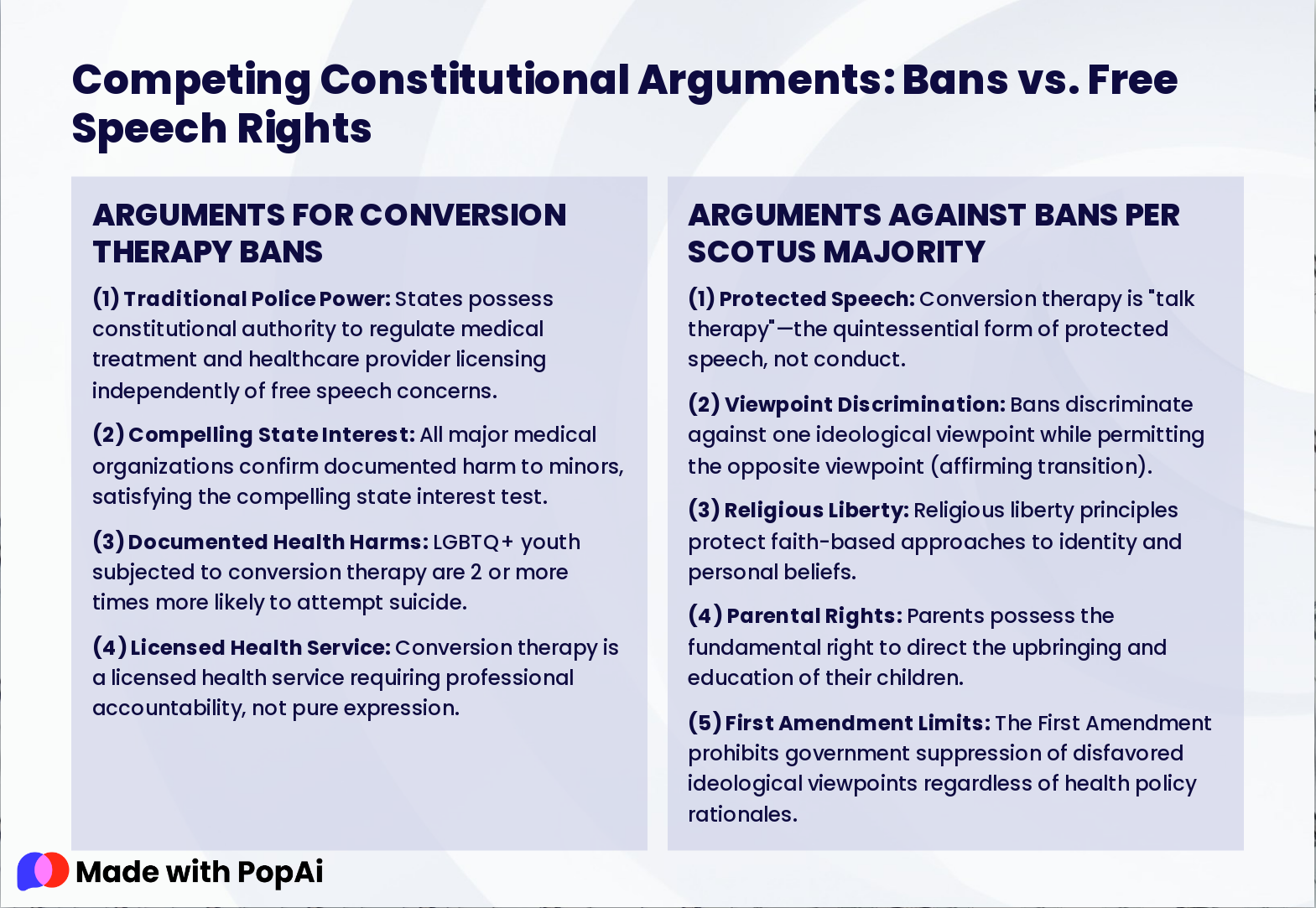
Slide 23: Competing Constitutional Arguments: Bans vs. Free Speech Rights
- ARGUMENTS FOR CONVERSION THERAPY BANS: (1) Traditional Police Power: States possess constitutional authority to regulate medical treatment and healthcare provider licensing independently of free speech concerns.
- ARGUMENTS AGAINST BANS PER SCOTUS MAJORITY: (1) Protected Speech: Conversion therapy is "talk therapy"—the quintessential form of protected speech, not conduct.
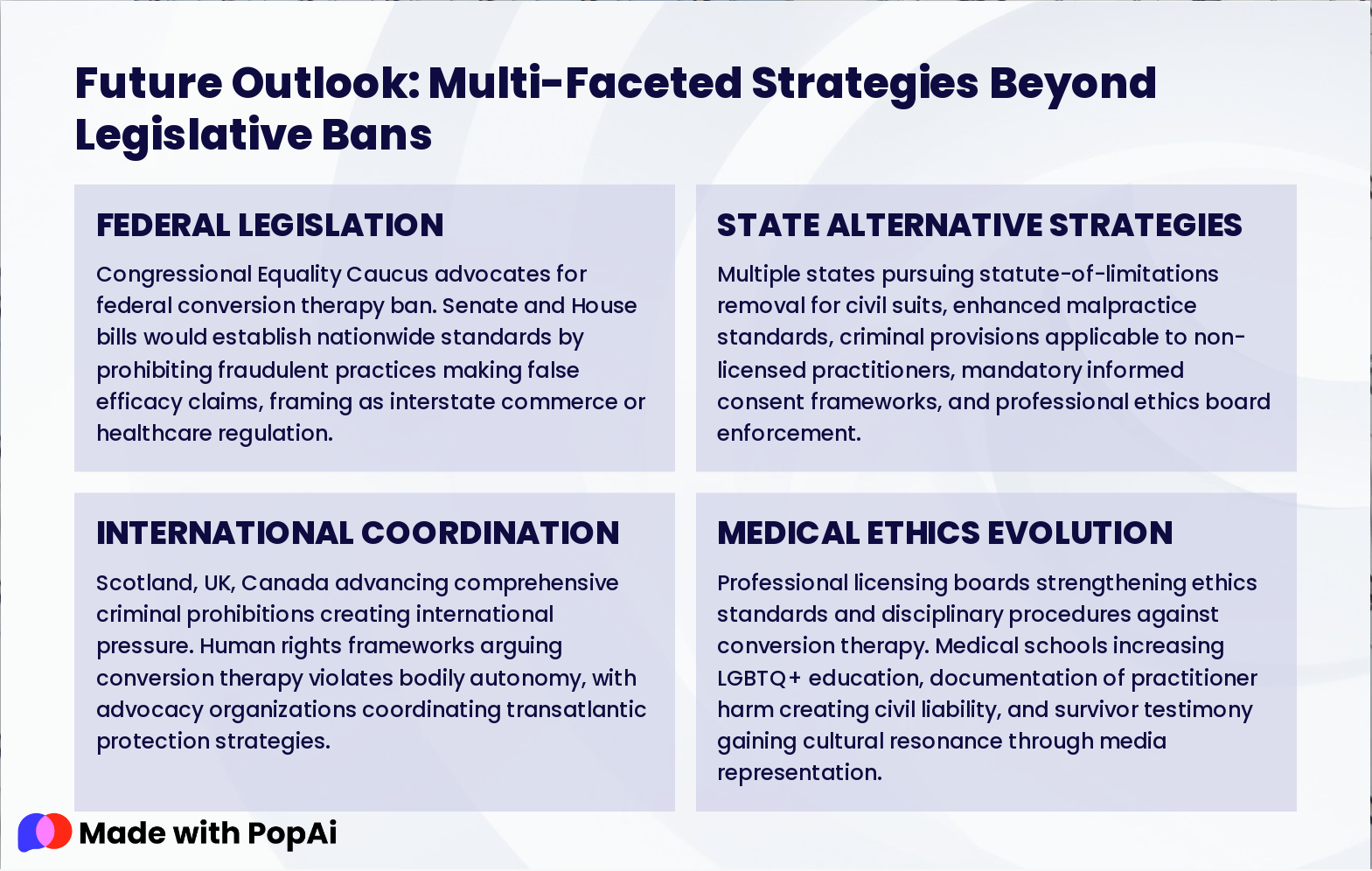
Slide 24: Future Outlook: Multi-Faceted Strategies Beyond Legislative Bans
- FEDERAL LEGISLATION: Congressional Equality Caucus advocates for federal conversion therapy ban. Senate and House bills would establish nationwide standards by prohibiting fraudulent practices making false efficacy claims, framing as interstate commerce or healthcare regulation.
- STATE ALTERNATIVE STRATEGIES: Multiple states pursuing statute-of-limitations removal for civil suits, enhanced malpractice standards, criminal provisions applicable to non-licensed practitioners, mandatory informed consent frameworks, and professional ethics board enforcement.
- INTERNATIONAL COORDINATION: Scotland, UK, Canada advancing comprehensive criminal prohibitions creating international pressure. Human rights frameworks arguing conversion therapy violates bodily autonomy, with advocacy organizations coordinating transatlantic protection strategies.
- MEDICAL ETHICS EVOLUTION: Professional licensing boards strengthening ethics standards and disciplinary procedures against conversion therapy. Medical schools increasing LGBTQ+ education, documentation of practitioner harm creating civil liability, and survivor testimony gaining cultural resonance through media representation.
Slide 25: The Path Forward: Protection, Accountability, and Affirmation
The Path Forward: Protection, Accountability, and Affirmation Scientific consensus decisively confirms conversion therapy is ineffective and harmful. The 2026 Supreme Court decision prioritized First Amendment protections for counselor speech over state health regulation, but medical evidence remain...