Presentation Summary
Explore the historic 48-team expansion and new tournament structure of the 2026 FIFA World Cup. Learn about the group stages, advancement criteria, and the strategic draw process.
Full Presentation Transcript
Slide 1: 2026 FIFA World Cup: Groups, Draw & Format Revolution
A Comprehensive Exploration of the Historic 48-Team Expansion and Tournament Structure
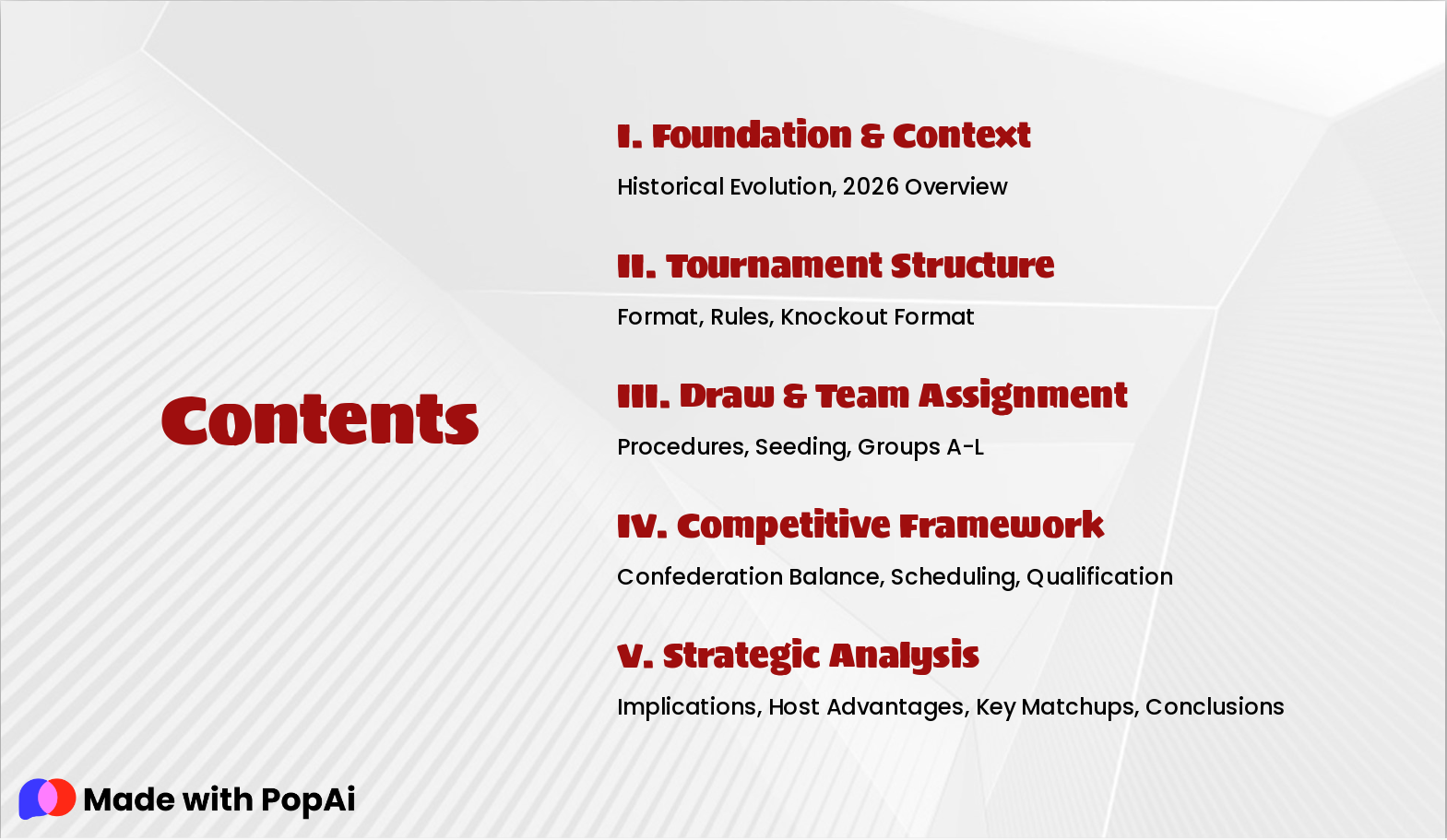
Slide 2: Contents
- I. Foundation & Context: Historical Evolution, 2026 Overview
- II. Tournament Structure: Format, Rules, Knockout Format
- III. Draw & Team Assignment: Procedures, Seeding, Groups A-L
- IV. Competitive Framework: Confederation Balance, Scheduling, Qualification
- V. Strategic Analysis: Implications, Host Advantages, Key Matchups, Conclusions
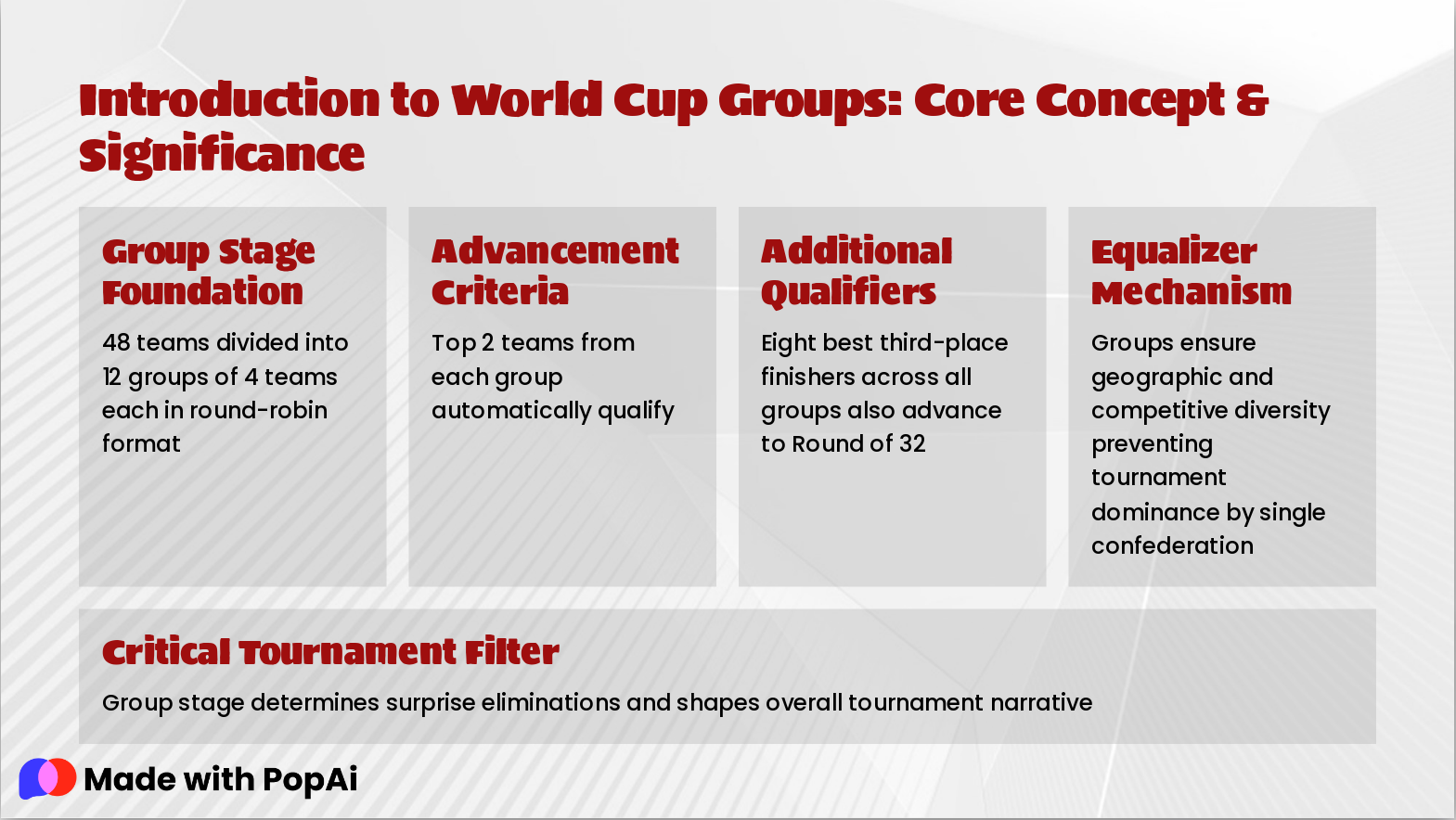
Slide 3: Introduction to World Cup Groups: Core Concept & Significance
- Group Stage Foundation: 48 teams divided into 12 groups of 4 teams each in round-robin format
- Advancement Criteria: Top 2 teams from each group automatically qualify
- Additional Qualifiers: Eight best third-place finishers across all groups also advance to Round of 32
- Equalizer Mechanism: Groups ensure geographic and competitive diversity preventing tournament dominance by single confederation
- Critical Tournament Filter: Group stage determines surprise eliminations and shapes overall tournament narrative
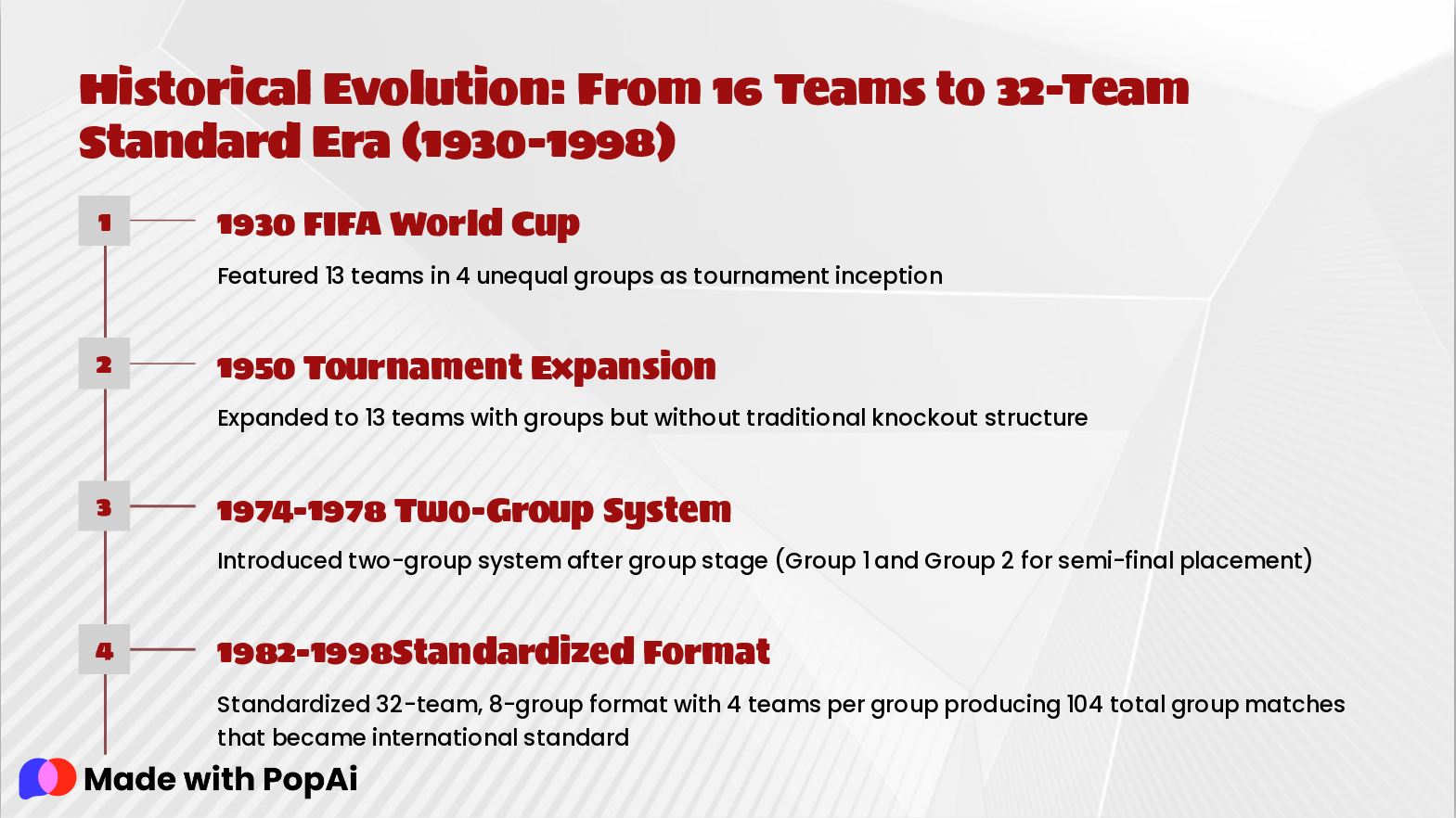
Slide 4: Historical Evolution: From 16 Teams to 32-Team Standard Era (1930-1998)
- 1930 FIFA World Cup: Featured 13 teams in 4 unequal groups as tournament inception
- 1950 Tournament Expansion: Expanded to 13 teams with groups but without traditional knockout structure
- 1974-1978 Two-Group System: Introduced two-group system after group stage (Group 1 and Group 2 for semi-final placement)
- 1982-1998Standardized Format: Standardized 32-team, 8-group format with 4 teams per group producing 104 total group matches that became international standard
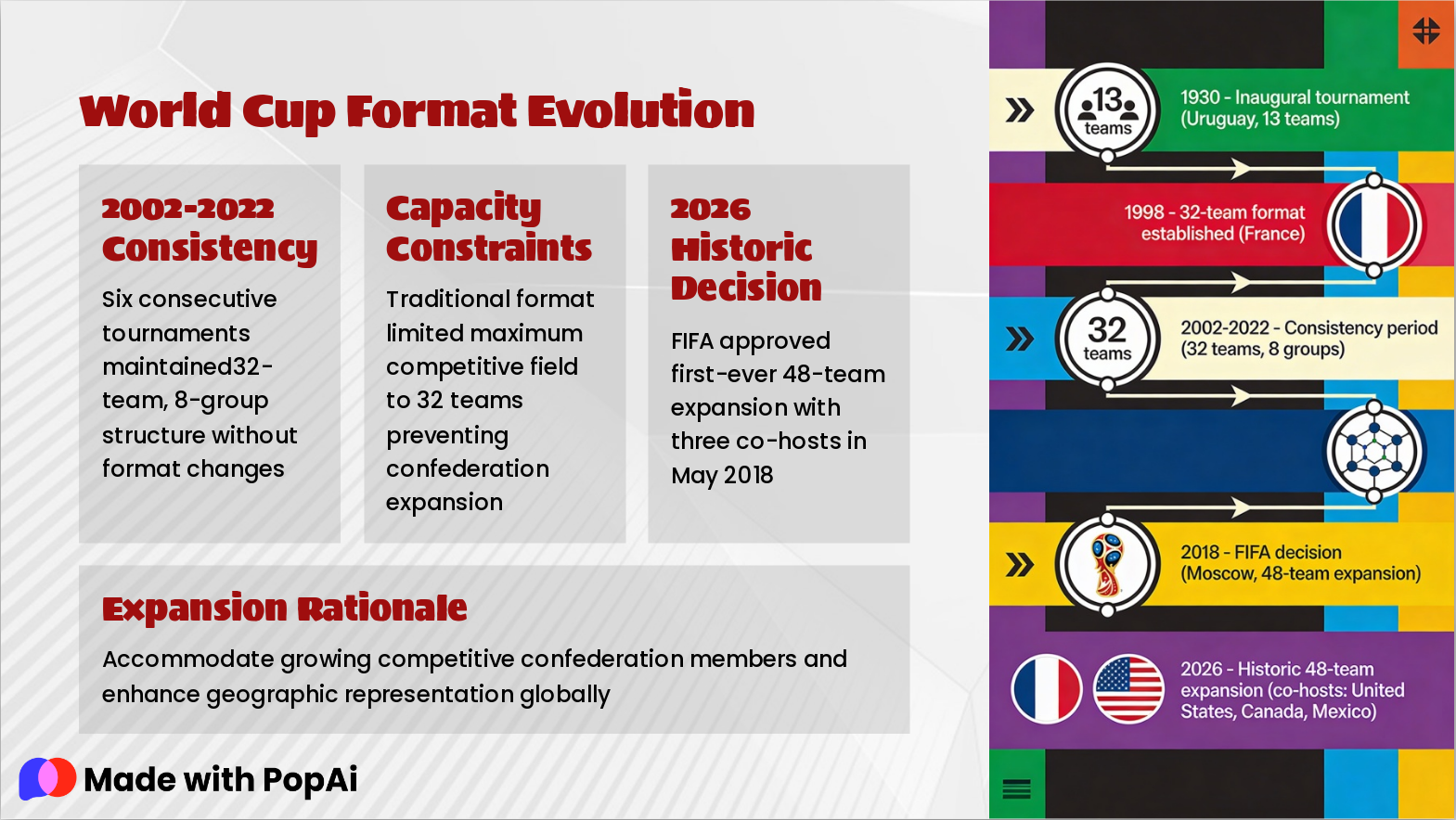
Slide 5: World Cup Format Evolution
- 2002-2022 Consistency: Six consecutive tournaments maintained32-team, 8-group structure without format changes
- Capacity Constraints: Traditional format limited maximum competitive field to 32 teams preventing confederation expansion
- 2026 Historic Decision: FIFA approved first-ever 48-team expansion with three co-hosts in May 2018
- Expansion Rationale: Accommodate growing competitive confederation members and enhance geographic representation globally
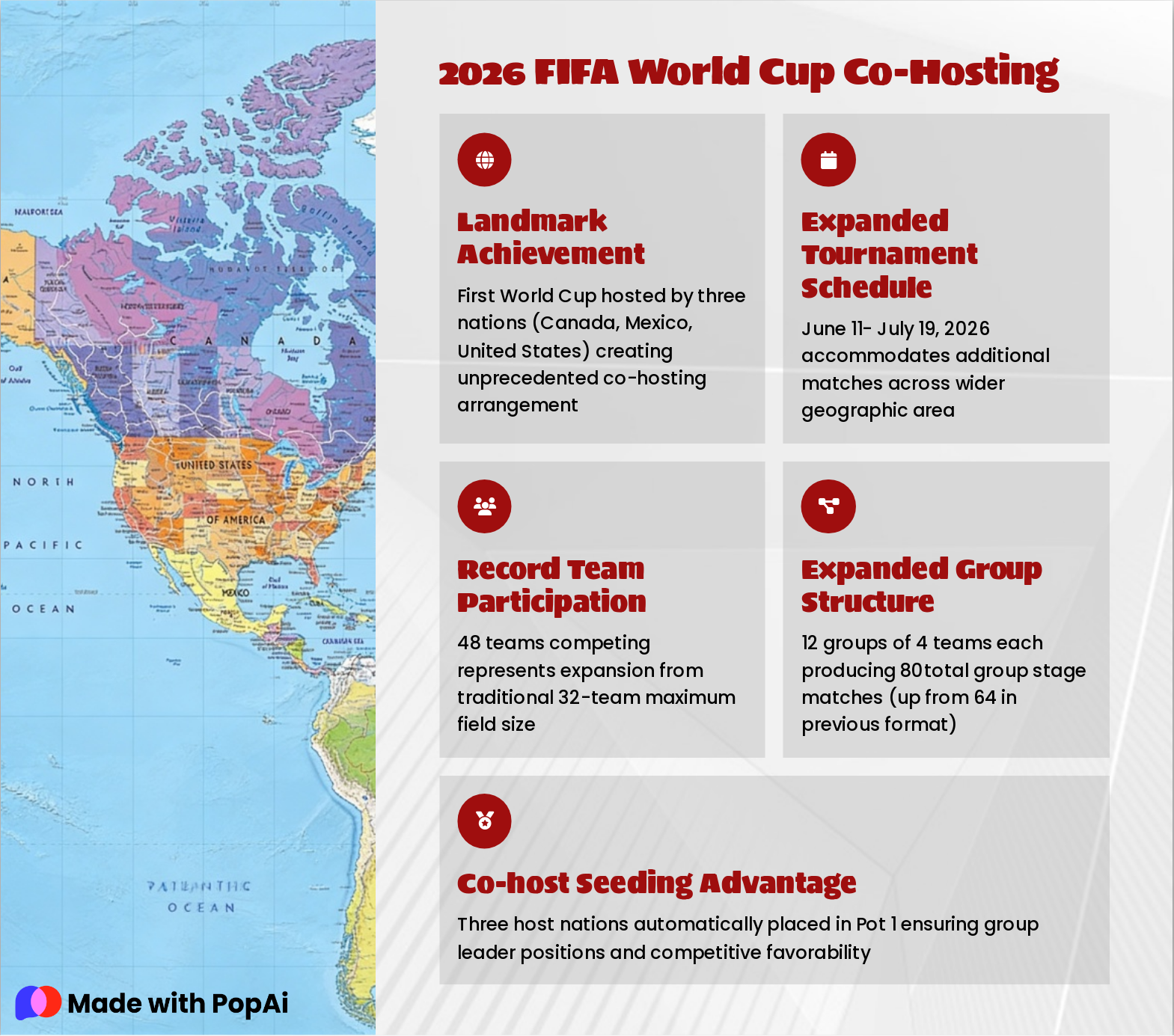
Slide 6: 2026 FIFA World Cup Co-Hosting
- Landmark Achievement: First World Cup hosted by three nations (Canada, Mexico, United States) creating unprecedented co-hosting arrangement
- Expanded Tournament Schedule: June 11- July 19, 2026 accommodates additional matches across wider geographic area
- Record Team Participation: 48 teams competing represents expansion from traditional 32-team maximum field size
- Expanded Group Structure: 12 groups of 4 teams each producing 80total group stage matches (up from 64 in previous format)
- Co-host Seeding Advantage: Three host nations automatically placed in Pot 1 ensuring group leader positions and competitive favorability
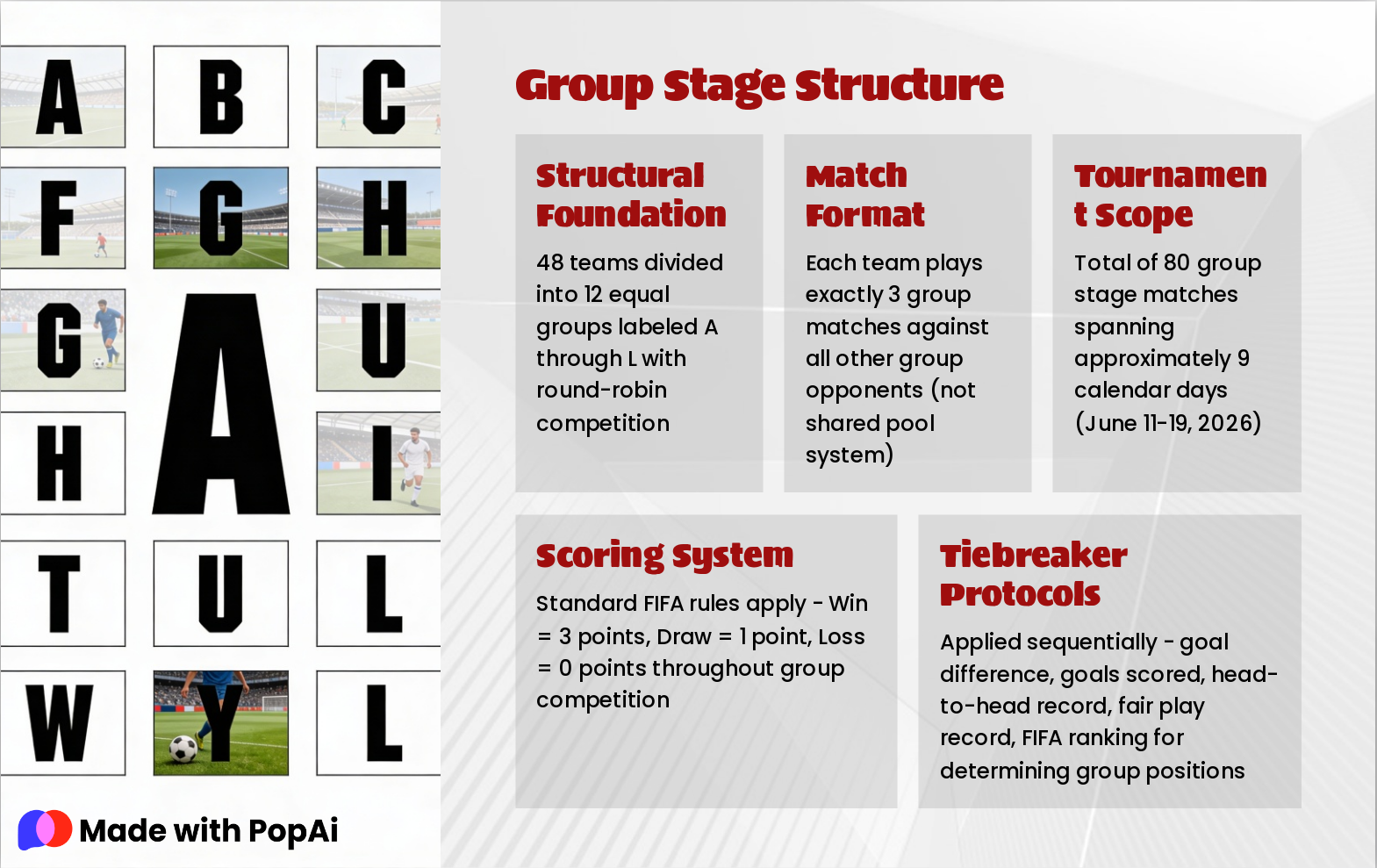
Slide 7: Group Stage Structure
- Structural Foundation: 48 teams divided into 12 equal groups labeled A through L with round-robin competition
- Match Format: Each team plays exactly 3 group matches against all other group opponents (not shared pool system)
- Tournament Scope: Total of 80 group stage matches spanning approximately 9 calendar days (June 11-19, 2026)
- Scoring System: Standard FIFA rules apply - Win = 3 points, Draw = 1 point, Loss = 0 points throughout group competition
- Tiebreaker Protocols: Applied sequentially - goal difference, goals scored, head-to-head record, fair play record, FIFA ranking for determining group positions
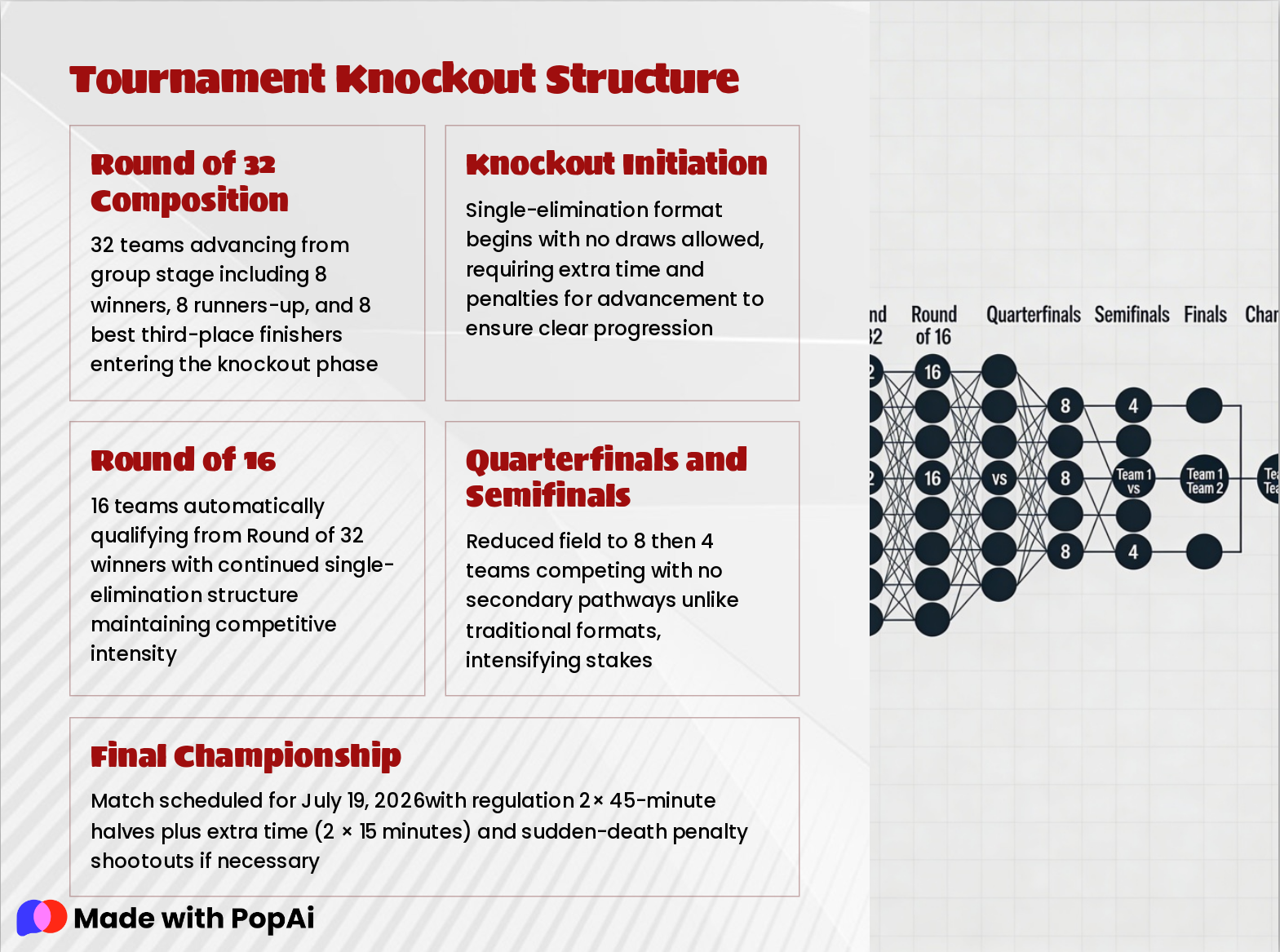
Slide 8: Tournament Knockout Structure
- Round of 32 Composition: 32 teams advancing from group stage including 8 winners, 8 runners-up, and 8 best third-place finishers entering the knockout phase
- Knockout Initiation: Single-elimination format begins with no draws allowed, requiring extra time and penalties for advancement to ensure clear progression
- Round of 16: 16 teams automatically qualifying from Round of 32 winners with continued single-elimination structure maintaining competitive intensity
- Quarterfinals and Semifinals: Reduced field to 8 then 4 teams competing with no secondary pathways unlike traditional formats, intensifying stakes
- Final Championship: Match scheduled for July 19, 2026with regulation 2× 45-minute halves plus extra time (2 × 15 minutes) and sudden-death penalty shootouts if necessary
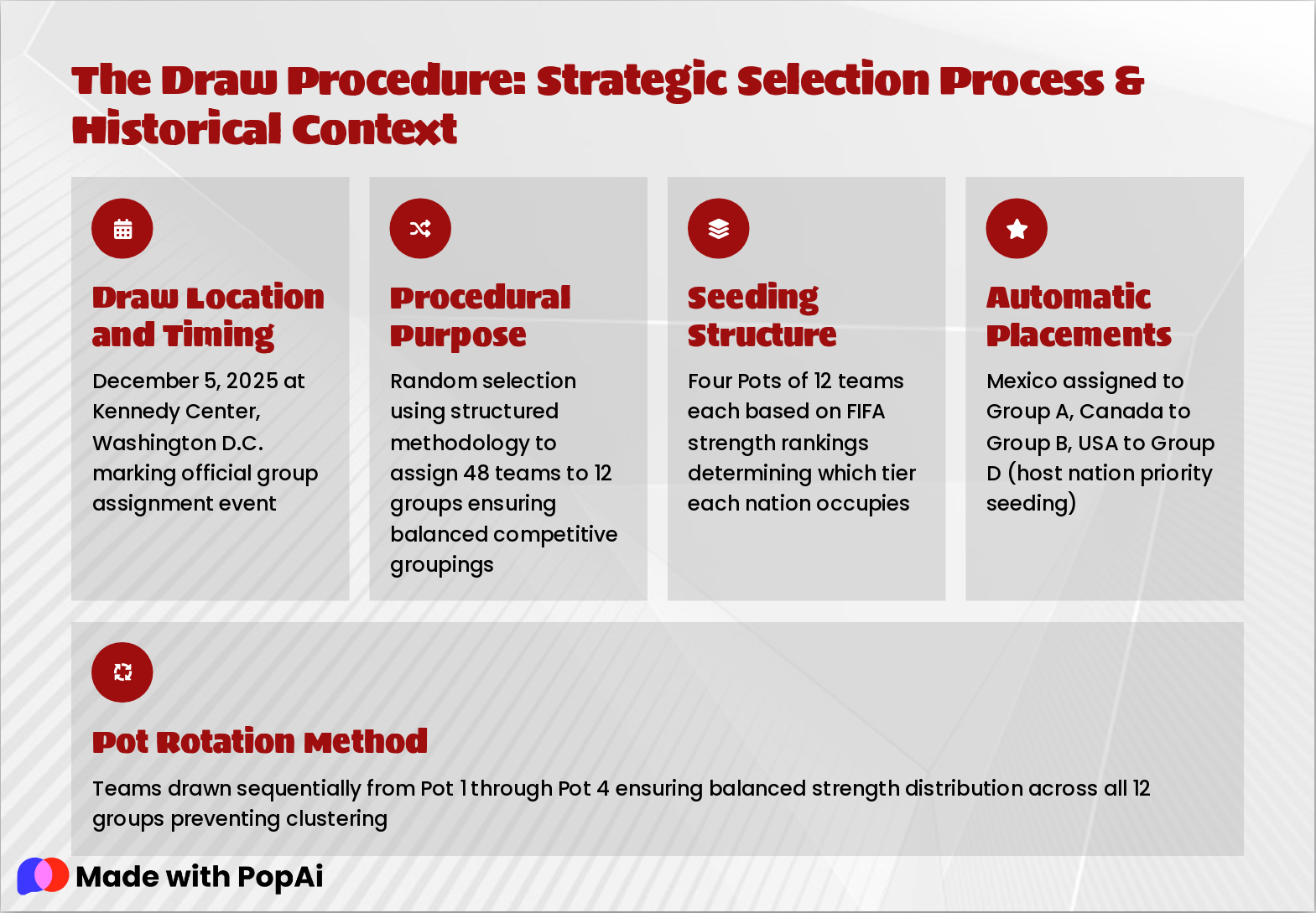
Slide 9: The Draw Procedure: Strategic Selection Process & Historical Context
- Draw Location and Timing: December 5, 2025 at Kennedy Center, Washington D.C. marking official group assignment event
- Procedural Purpose: Random selection using structured methodology to assign 48 teams to 12 groups ensuring balanced competitive groupings
- Seeding Structure: Four Pots of 12 teams each based on FIFA strength rankings determining which tier each nation occupies
- Automatic Placements: Mexico assigned to Group A, Canada to Group B, USA to Group D (host nation priority seeding)
- Pot Rotation Method: Teams drawn sequentially from Pot 1 through Pot 4 ensuring balanced strength distribution across all 12 groups preventing clustering
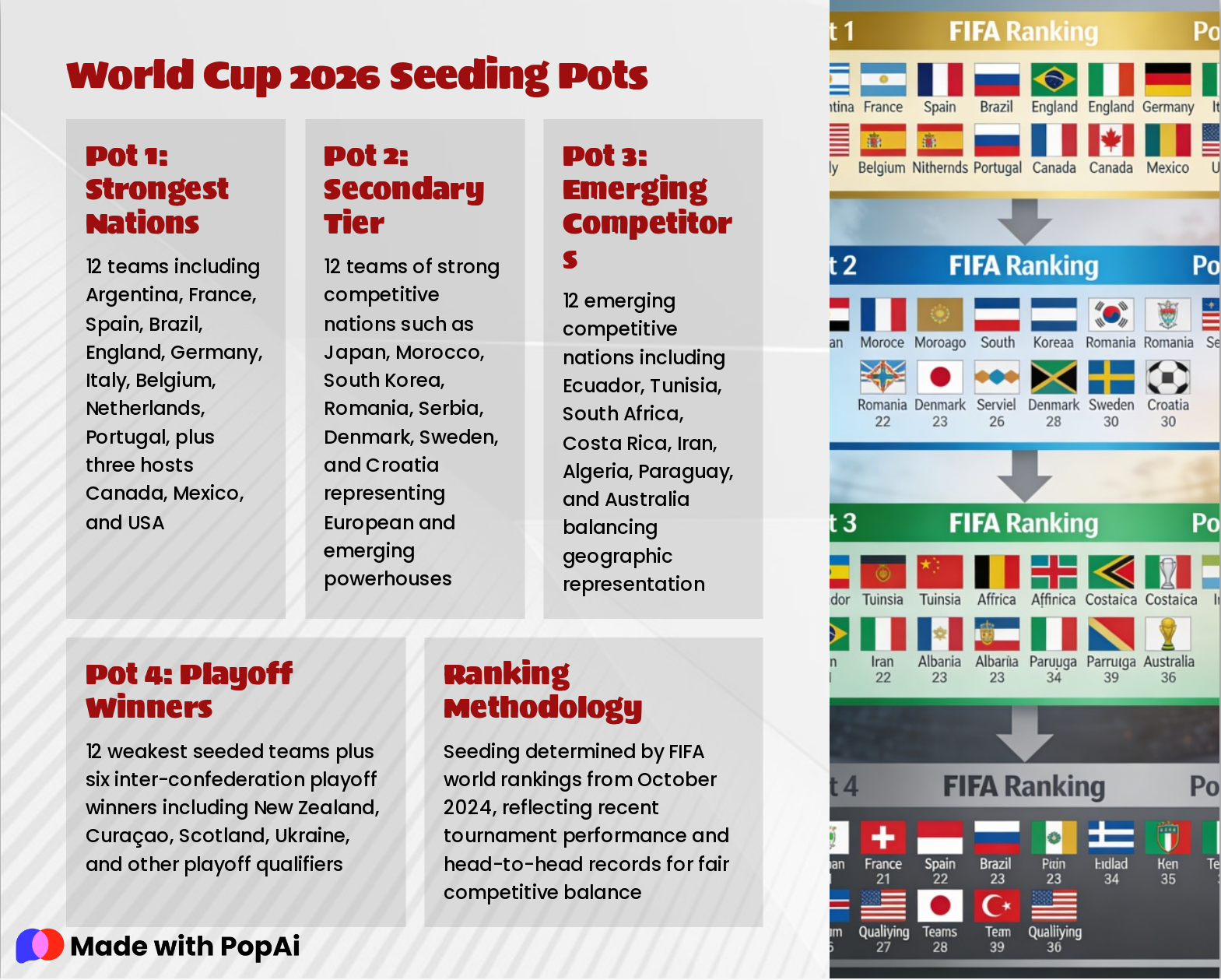
Slide 10: World Cup 2026 Seeding Pots
- Pot 1: Strongest Nations: 12 teams including Argentina, France, Spain, Brazil, England, Germany, Italy, Belgium, Netherlands, Portugal, plus three hosts Canada, Mexico, and USA
- Pot 2: Secondary Tier: 12 teams of strong competitive nations such as Japan, Morocco, South Korea, Romania, Serbia, Denmark, Sweden, and Croatia representing European and emerging powerhouses
- Pot 3: Emerging Competitors: 12 emerging competitive nations including Ecuador, Tunisia, South Africa, Costa Rica, Iran, Algeria, Paraguay, and Australia balancing geographic representation
- Pot 4: Playoff Winners: 12 weakest seeded teams plus six inter-confederation playoff winners including New Zealand, Curaçao, Scotland, Ukraine, and other playoff qualifiers
- Ranking Methodology: Seeding determined by FIFA world rankings from October 2024, reflecting recent tournament performance and head-to-head records for fair competitive balance
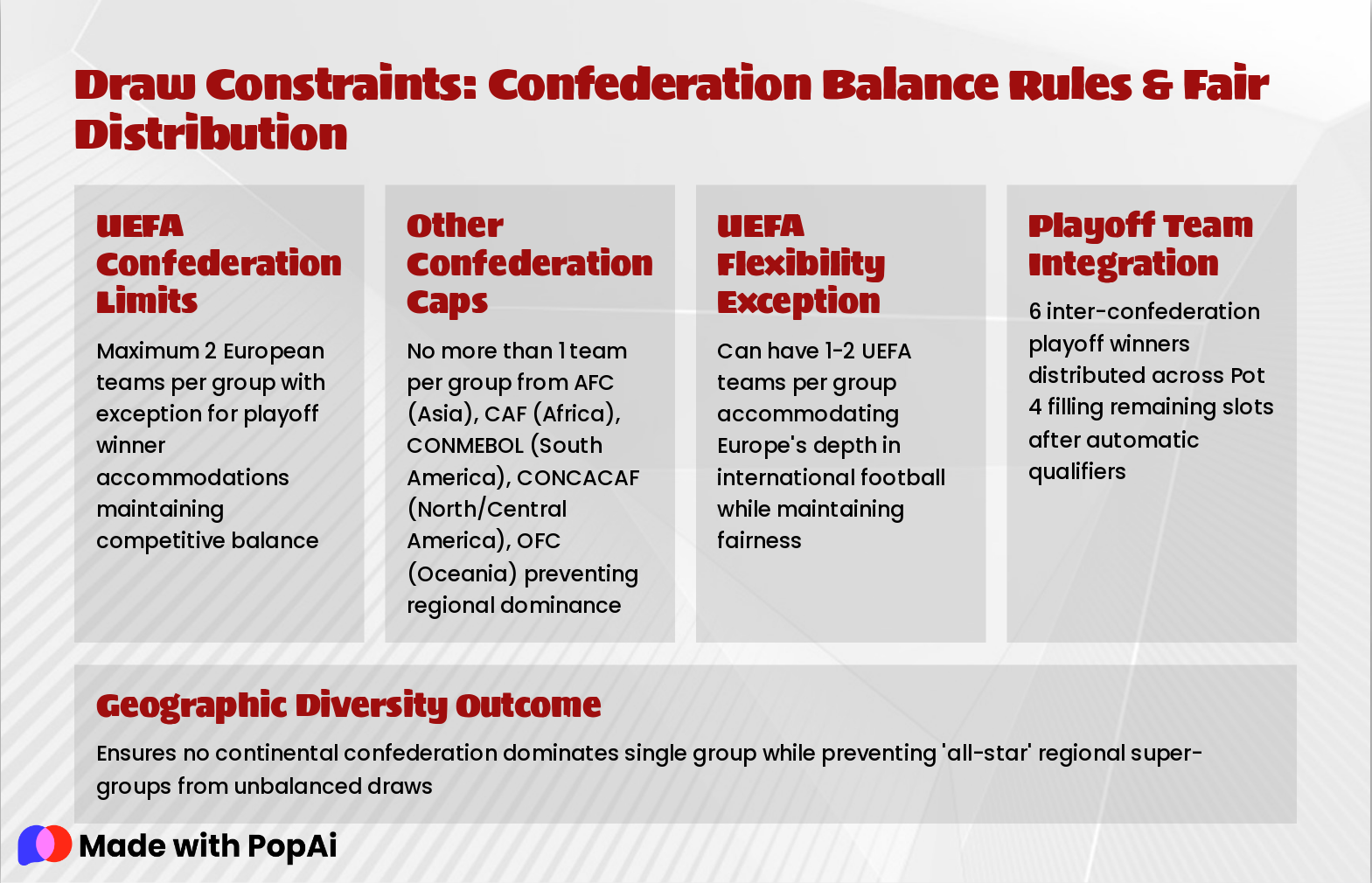
Slide 11: Draw Constraints: Confederation Balance Rules & Fair Distribution
- UEFA Confederation Limits: Maximum 2 European teams per group with exception for playoff winner accommodations maintaining competitive balance
- Other Confederation Caps: No more than 1 team per group from AFC (Asia), CAF (Africa), CONMEBOL (South America), CONCACAF (North/Central America), OFC (Oceania) preventing regional dominance
- UEFA Flexibility Exception: Can have 1-2 UEFA teams per group accommodating Europe's depth in international football while maintaining fairness
- Playoff Team Integration: 6 inter-confederation playoff winners distributed across Pot 4 filling remaining slots after automatic qualifiers
- Geographic Diversity Outcome: Ensures no continental confederation dominates single group while preventing 'all-star' regional super-groups from unbalanced draws
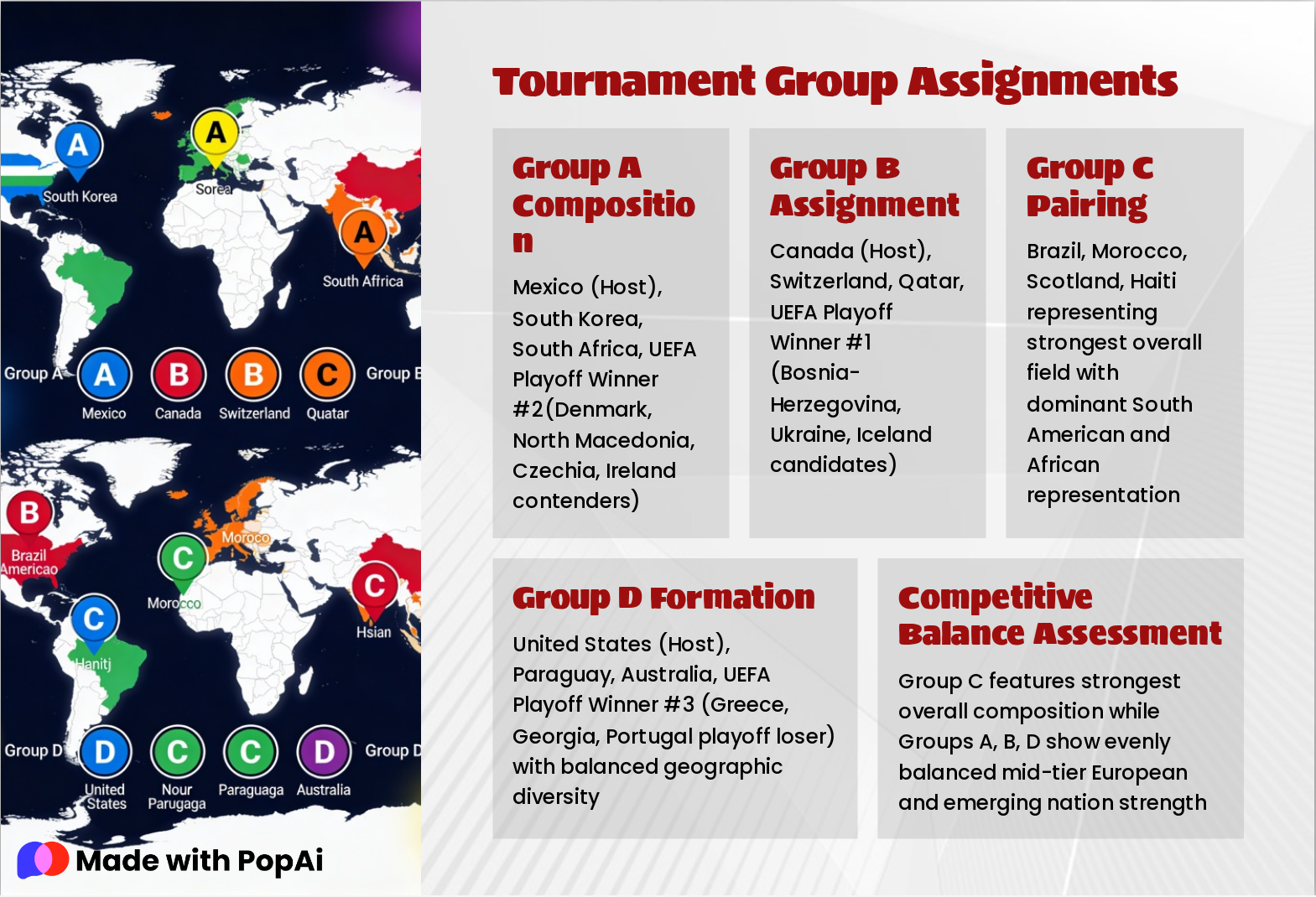
Slide 12: Tournament Group Assignments
- Group A Composition: Mexico (Host), South Korea, South Africa, UEFA Playoff Winner #2(Denmark, North Macedonia, Czechia, Ireland contenders)
- Group B Assignment: Canada (Host), Switzerland, Qatar, UEFA Playoff Winner #1 (Bosnia-Herzegovina, Ukraine, Iceland candidates)
- Group C Pairing: Brazil, Morocco, Scotland, Haiti representing strongest overall field with dominant South American and African representation
- Group D Formation: United States (Host), Paraguay, Australia, UEFA Playoff Winner #3 (Greece, Georgia, Portugal playoff loser) with balanced geographic diversity
- Competitive Balance Assessment: Group C features strongest overall composition while Groups A, B, D show evenly balanced mid-tier European and emerging nation strength
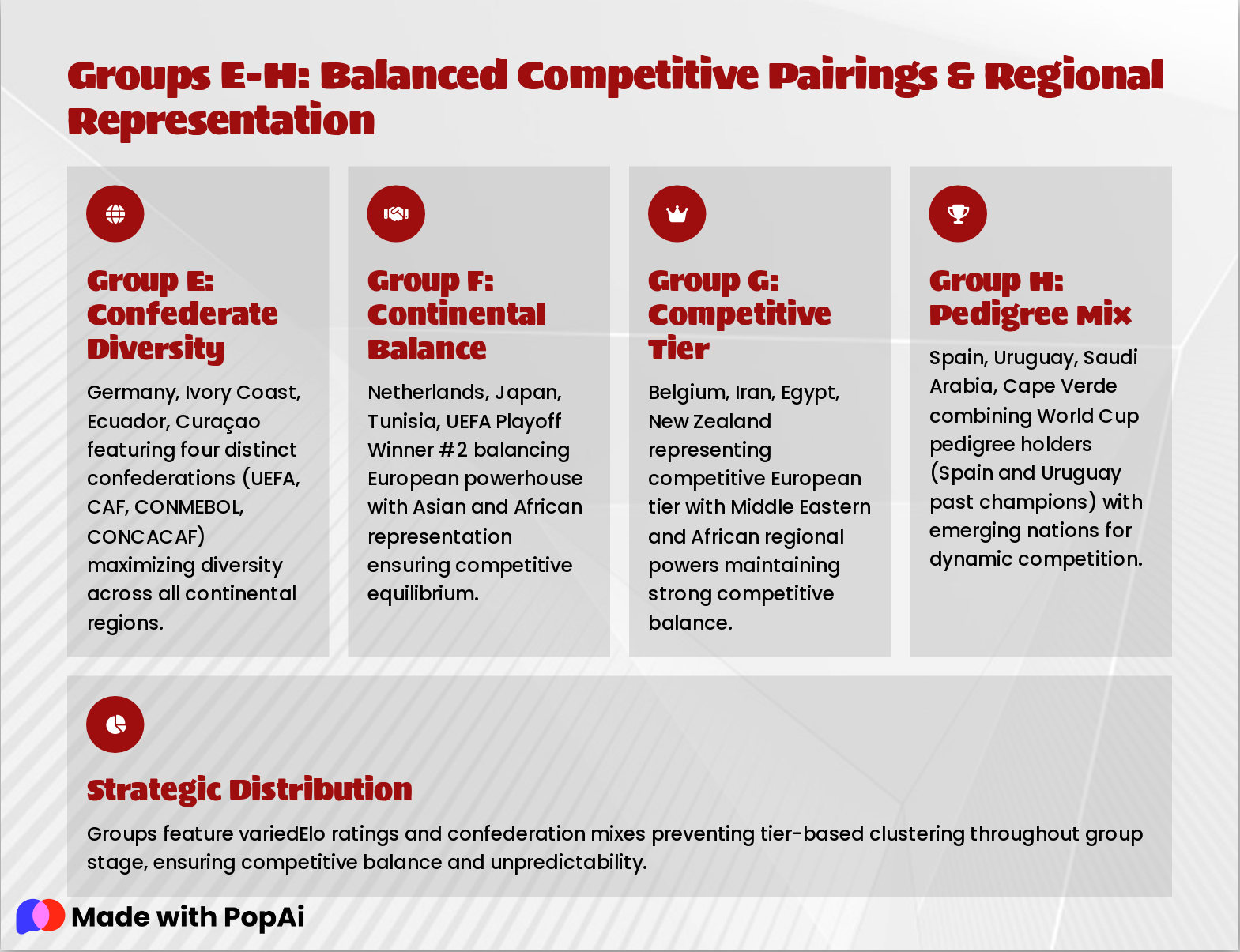
Slide 13: Groups E-H: Balanced Competitive Pairings & Regional Representation
- Group E: Confederate Diversity: Germany, Ivory Coast, Ecuador, Curaçao featuring four distinct confederations (UEFA, CAF, CONMEBOL, CONCACAF) maximizing diversity across all continental regions.
- Group F: Continental Balance: Netherlands, Japan, Tunisia, UEFA Playoff Winner #2 balancing European powerhouse with Asian and African representation ensuring competitive equilibrium.
- Group G: Competitive Tier: Belgium, Iran, Egypt, New Zealand representing competitive European tier with Middle Eastern and African regional powers maintaining strong competitive balance.
- Group H: Pedigree Mix: Spain, Uruguay, Saudi Arabia, Cape Verde combining World Cup pedigree holders (Spain and Uruguay past champions) with emerging nations for dynamic competition.
- Strategic Distribution: Groups feature variedElo ratings and confederation mixes preventing tier-based clustering throughout group stage, ensuring competitive balance and unpredictability.
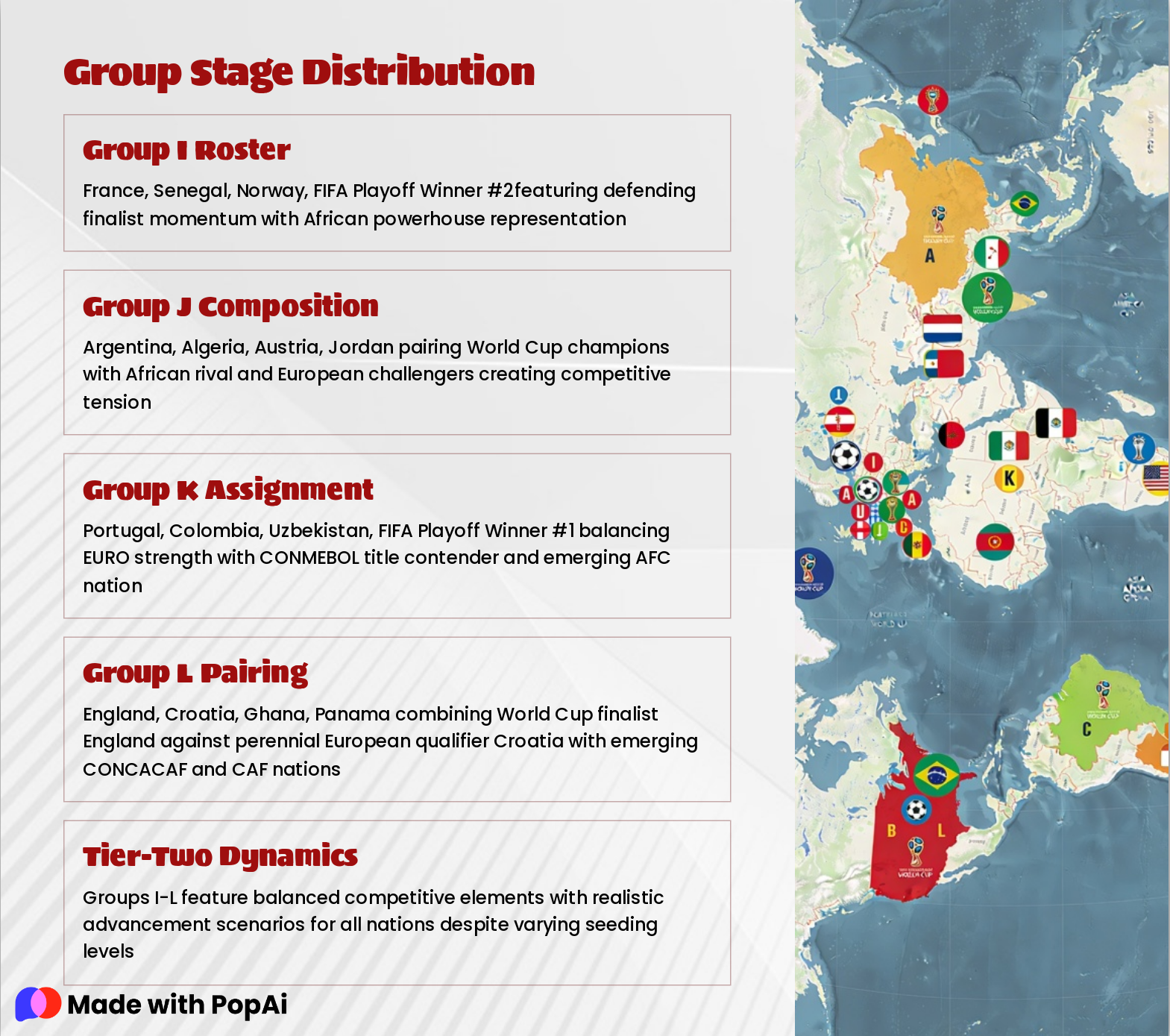
Slide 14: Group Stage Distribution
- Group I Roster: France, Senegal, Norway, FIFA Playoff Winner #2featuring defending finalist momentum with African powerhouse representation
- Group J Composition: Argentina, Algeria, Austria, Jordan pairing World Cup champions with African rival and European challengers creating competitive tension
- Group K Assignment: Portugal, Colombia, Uzbekistan, FIFA Playoff Winner #1 balancing EURO strength with CONMEBOL title contender and emerging AFC nation
- Group L Pairing: England, Croatia, Ghana, Panama combining World Cup finalist England against perennial European qualifier Croatia with emerging CONCACAF and CAF nations
- Tier-Two Dynamics: Groups I-L feature balanced competitive elements with realistic advancement scenarios for all nations despite varying seeding levels
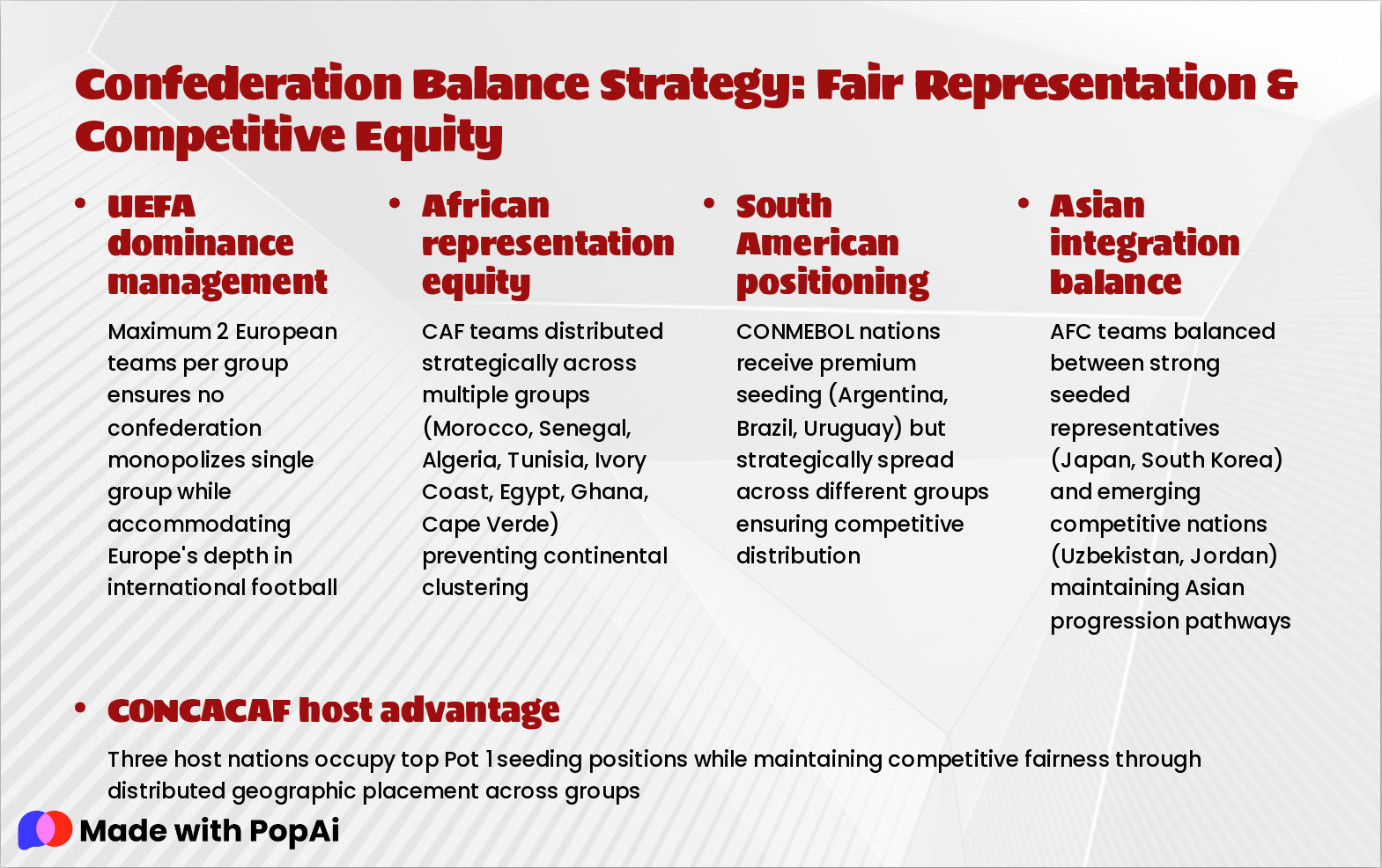
Slide 15: Confederation Balance Strategy: Fair Representation & Competitive Equity
- UEFA dominance management: Maximum 2 European teams per group ensures no confederation monopolizes single group while accommodating Europe's depth in international football
- African representation equity: CAF teams distributed strategically across multiple groups (Morocco, Senegal, Algeria, Tunisia, Ivory Coast, Egypt, Ghana, Cape Verde) preventing continental clustering
- South American positioning: CONMEBOL nations receive premium seeding (Argentina, Brazil, Uruguay) but strategically spread across different groups ensuring competitive distribution
- Asian integration balance: AFC teams balanced between strong seeded representatives (Japan, South Korea) and emerging competitive nations (Uzbekistan, Jordan) maintaining Asian progression pathways
- CONCACAF host advantage: Three host nations occupy top Pot 1 seeding positions while maintaining competitive fairness through distributed geographic placement across groups
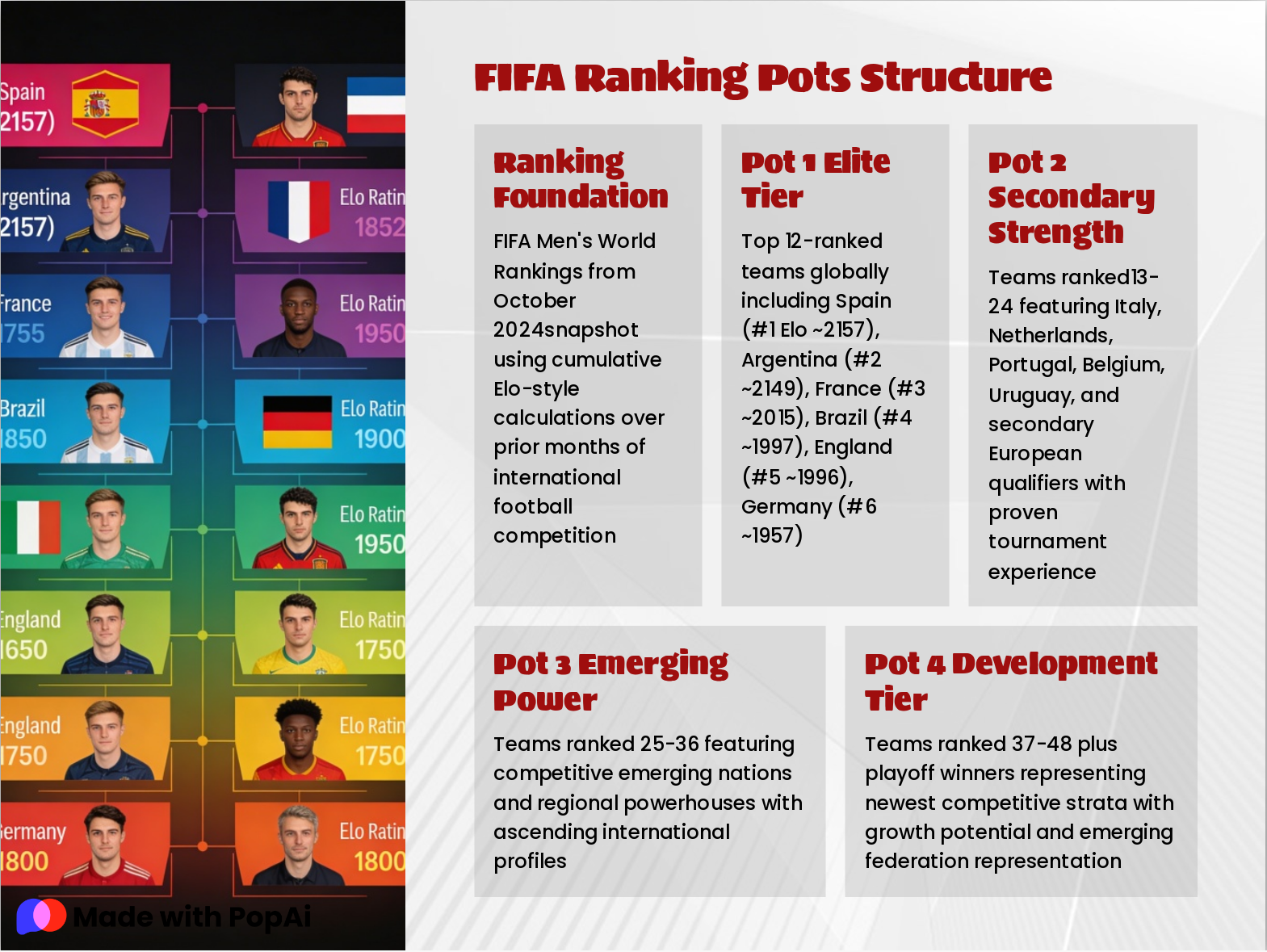
Slide 16: FIFA Ranking Pots Structure
- Ranking Foundation: FIFA Men's World Rankings from October 2024snapshot using cumulative Elo-style calculations over prior months of international football competition
- Pot 1 Elite Tier: Top 12-ranked teams globally including Spain (#1 Elo ~2157), Argentina (#2 ~2149), France (#3 ~2015), Brazil (#4 ~1997), England (#5 ~1996), Germany (#6 ~1957)
- Pot 2 Secondary Strength: Teams ranked13-24 featuring Italy, Netherlands, Portugal, Belgium, Uruguay, and secondary European qualifiers with proven tournament experience
- Pot 3 Emerging Power: Teams ranked 25-36 featuring competitive emerging nations and regional powerhouses with ascending international profiles
- Pot 4 Development Tier: Teams ranked 37-48 plus playoff winners representing newest competitive strata with growth potential and emerging federation representation
Slide 17: Tournament Structure and Schedule
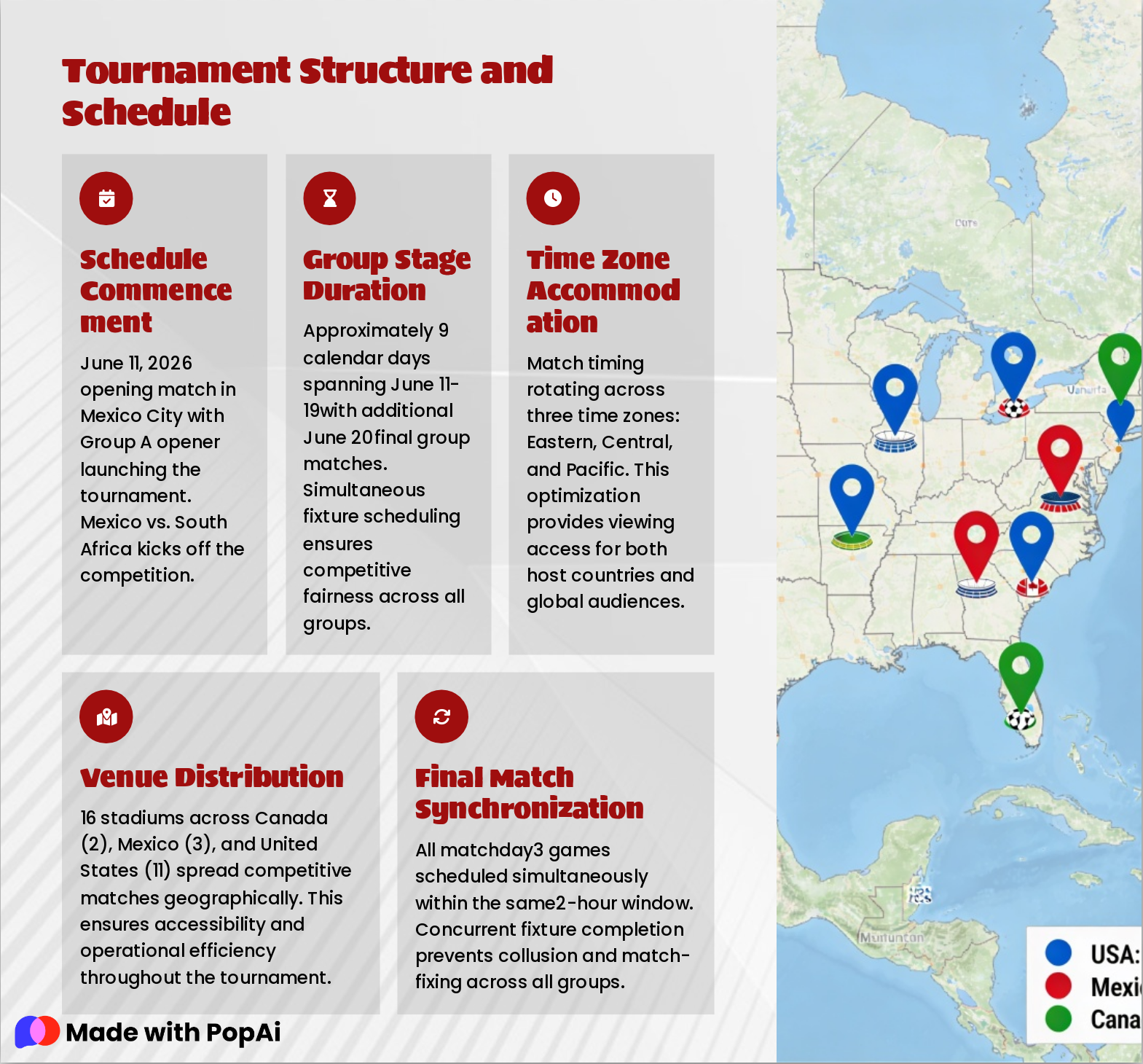
- Schedule Commencement: June 11, 2026 opening match in Mexico City with Group A opener launching the tournament. Mexico vs. South Africa kicks off the competition.
- Group Stage Duration: Approximately 9 calendar days spanning June 11-19with additional June 20final group matches. Simultaneous fixture scheduling ensures competitive fairness across all groups.
- Time Zone Accommodation: Match timing rotating across three time zones: Eastern, Central, and Pacific. This optimization provides viewing access for both host countries and global audiences.
- Venue Distribution: 16 stadiums across Canada (2), Mexico (3), and United States (11) spread competitive matches geographically. This ensures accessibility and operational efficiency throughout the tournament.
- Final Match Synchronization: All matchday3 games scheduled simultaneously within the same2-hour window. Concurrent fixture completion prevents collusion and match-fixing across all groups.
Slide 18: Qualification Pathways: Top 2 Automatic + Best Third-Place System
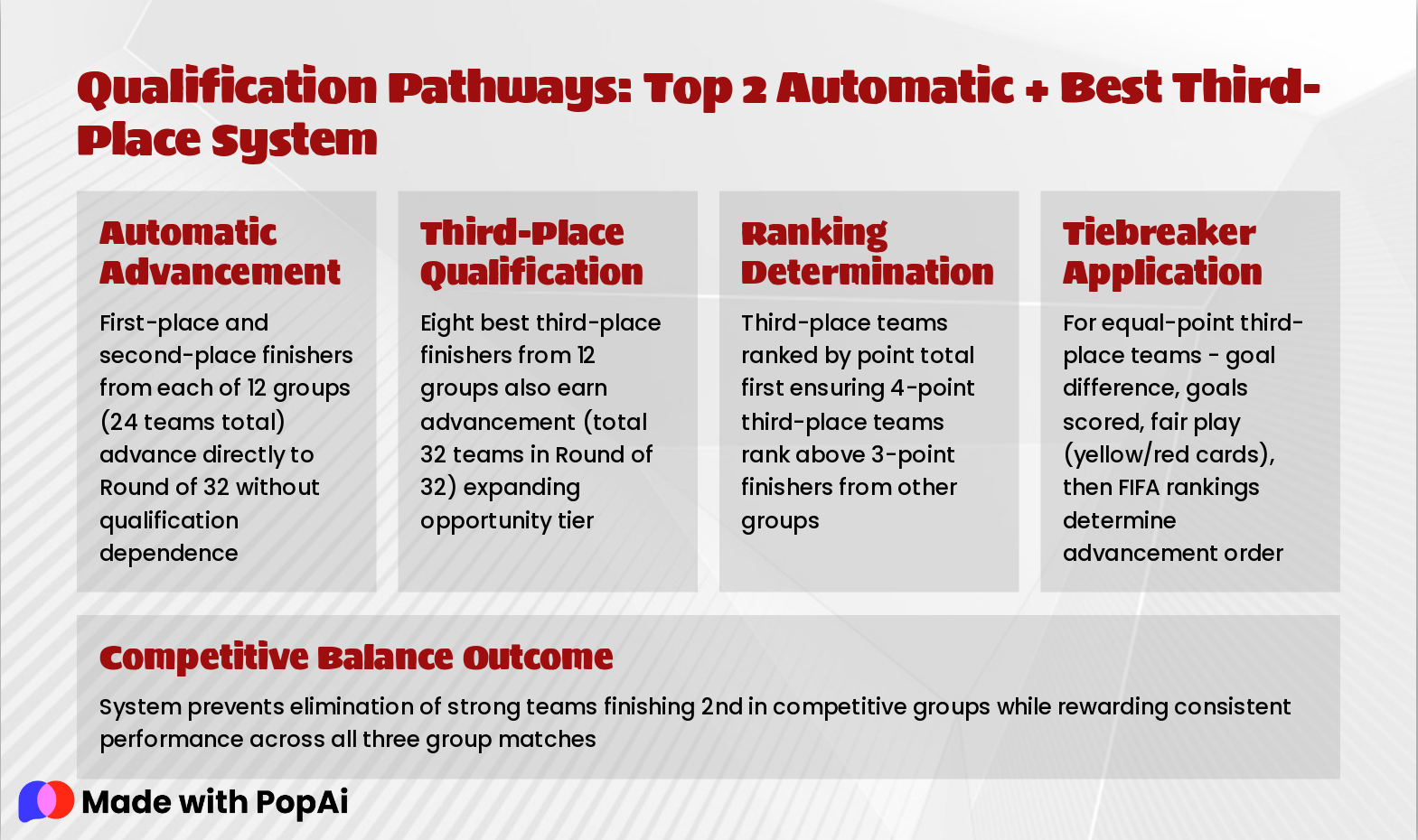
- Automatic Advancement: First-place and second-place finishers from each of 12 groups (24 teams total) advance directly to Round of 32 without qualification dependence
- Third-Place Qualification: Eight best third-place finishers from 12 groups also earn advancement (total 32 teams in Round of 32) expanding opportunity tier
- Ranking Determination: Third-place teams ranked by point total first ensuring 4-point third-place teams rank above 3-point finishers from other groups
- Tiebreaker Application: For equal-point third-place teams - goal difference, goals scored, fair play (yellow/red cards), then FIFA rankings determine advancement order
- Competitive Balance Outcome: System prevents elimination of strong teams finishing 2nd in competitive groups while rewarding consistent performance across all three group matches
Slide 19: Strategic Impact Analysis
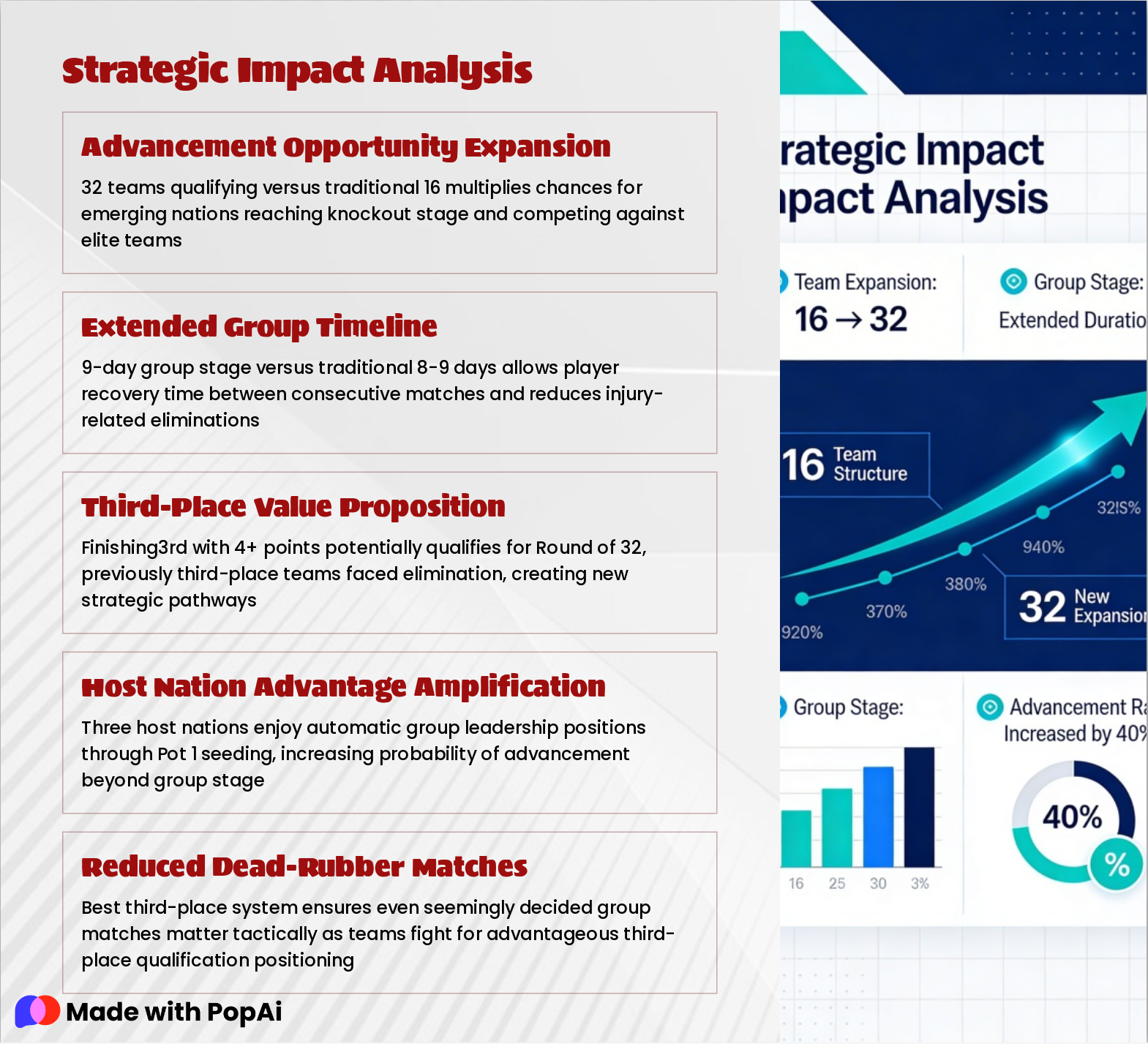
- Advancement Opportunity Expansion: 32 teams qualifying versus traditional 16 multiplies chances for emerging nations reaching knockout stage and competing against elite teams
- Extended Group Timeline: 9-day group stage versus traditional 8-9 days allows player recovery time between consecutive matches and reduces injury-related eliminations
- Third-Place Value Proposition: Finishing3rd with 4+ points potentially qualifies for Round of 32, previously third-place teams faced elimination, creating new strategic pathways
- Host Nation Advantage Amplification: Three host nations enjoy automatic group leadership positions through Pot 1 seeding, increasing probability of advancement beyond group stage
- Reduced Dead-Rubber Matches: Best third-place system ensures even seemingly decided group matches matter tactically as teams fight for advantageous third-place qualification positioning
Slide 20: Host Nation Seeding Advantages
- Automatic Placement Advantage: Mexico as Group A leader seed, Canada as Group B leader seed, and USA as Group D leader seed enjoy preferred Pot1 seeding, preventing direct first-match opposition against elite competitors
- Strength Classification: All three hosts classified as strongest seeding tier ensuring favorable group compositions with emerging or mid-tier nations rather than other Pot 1 teams
- Home Field Dominance: Combined11 stadiums across USA, 3 in Mexico, and 2 in Canada provide familiar playing conditions, reduced travel fatigue, and domestic logistical advantages
- Historical Precedent: USA previously hosted in 1994 with 16 teams, Mexico hosted in 1970 and 1986with 16 teams each; first-time Canada hosting FIFA World Cup establishing new co-host precedent
- Qualification Expectation: All three hosts positioned to advance beyond group stage given seeding advantage and home crowd support making early elimination highly unlikely
Slide 21: Group Competitive Analysis
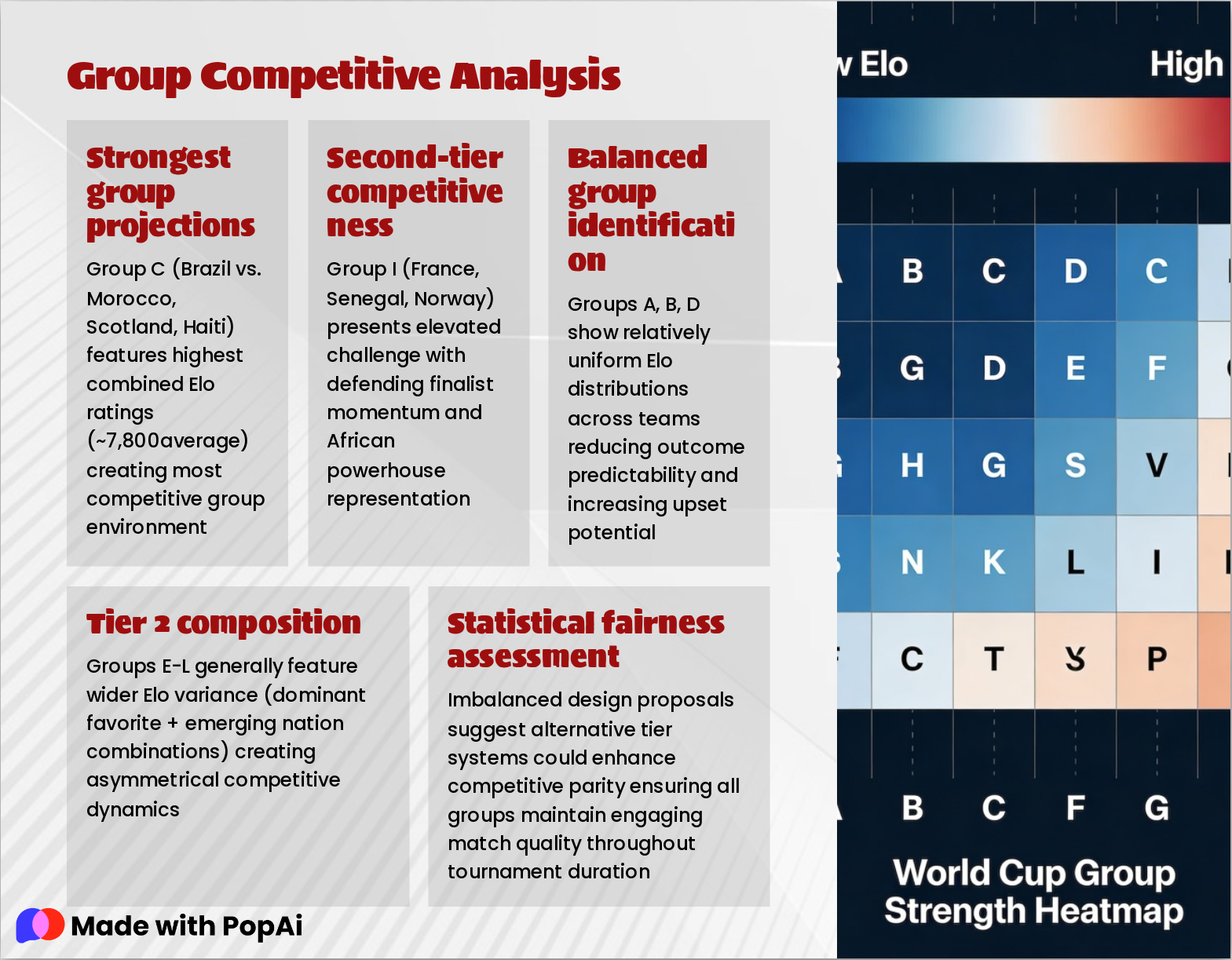
- Strongest group projections: Group C (Brazil vs. Morocco, Scotland, Haiti) features highest combined Elo ratings (~7,800average) creating most competitive group environment
- Second-tier competitiveness: Group I (France, Senegal, Norway) presents elevated challenge with defending finalist momentum and African powerhouse representation
- Balanced group identification: Groups A, B, D show relatively uniform Elo distributions across teams reducing outcome predictability and increasing upset potential
- Tier 2 composition: Groups E-L generally feature wider Elo variance (dominant favorite + emerging nation combinations) creating asymmetrical competitive dynamics
- Statistical fairness assessment: Imbalanced design proposals suggest alternative tier systems could enhance competitive parity ensuring all groups maintain engaging match quality throughout tournament duration
Slide 22: Key Matchups & Predictions: Featured Rivalries & Tournament Highlights
- Group C headline matchup: Brazil vs. Morocco representing Africa's strongest continental performer challenging South America's tournament favorite with compelling narrative stakes
- Group I dramatic pairing: France vs. Senegal rematch potential recalling 2002 upset legacy where Senegal shocked defending champion France in opening group match
- Group L classic encounter: England vs. Croatia reunion for World Cup final contenders who met in recent EURO tournaments with consistent rivalry history
- Group J intrigue factor: Argentina vs. Algeria CONMEBOL champion facing African representative creating championship-level prestige matchups within group stage
- Co-host performance spotlight: Mexico-South Korea, Canada-Switzerland, USA-Paraguay featured first-match pairings where home nation championship aspirations tested against regional and emerging international competitors early in tournament narrative
Slide 23: Conclusion: 2026 World Cup Groups - Historic Transformation & Takeaways
Conclusion: 2026 World Cup Groups - Historic Transformation & Takeaways Revolutionary expansion featuring 48 teams in 12 groups with 32 qualification slots represents most significant format evolution since 1930 tournament inception. Three-nation hosting (Canada, Mexico, USA) marks unprecedented co-...