Good Mileage for a Used Car: AI Presentation Generator Analysis

Published May 25, 2026

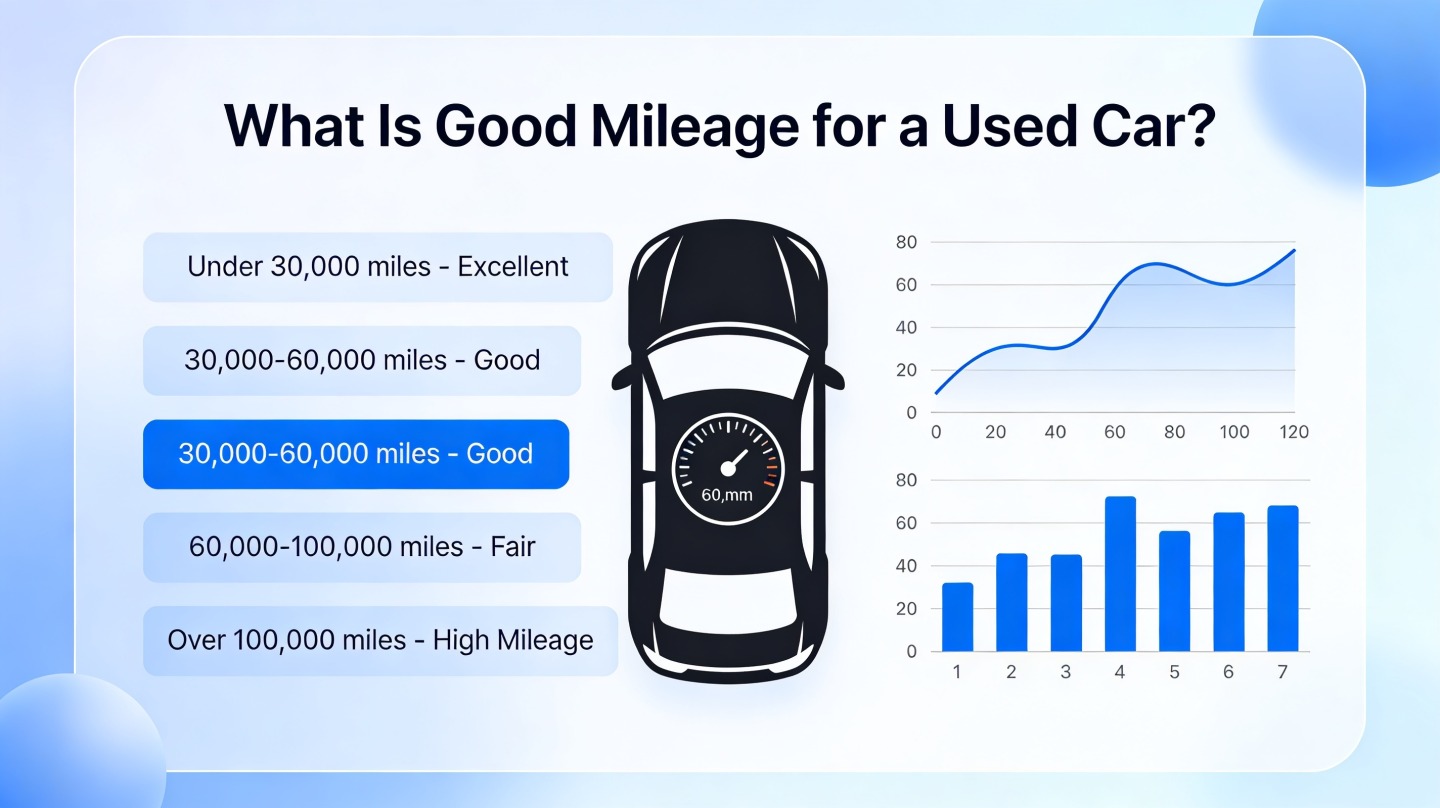
good mileage for a used car dashboard analysis with odometer and buying notes
A mileage number only becomes useful when it is compared with age, service records, use pattern, and price.

If you are comparing used cars, the question “What is good mileage for a used car?” can get confusing fast. A 70,000-mile sedan may be a bargain, a warning sign, or perfectly average depending on its age, maintenance history, and how it was driven.

This guide is built for buyers, auto sales consultants, and finance teams who need to explain a vehicle recommendation clearly. It also shows how an AI presentation generator can turn messy listing data into a concise buying analysis your family, manager, or client can understand.

What Good Mileage for a Used Car Really Means

This section defines mileage in context, because the odometer alone is not a buying decision.

Start with miles per year, not the total odometer reading

A common market rule of thumb used by sources such as Kelley Blue Book and Carfax is roughly 12,000 miles per year. That makes a 5-year-old car with 60,000 miles broadly “average,” while the same 60,000 miles on a 2-year-old car deserves closer scrutiny.

The U.S. Federal Highway Administration’s Highway Statistics program has long shown that annual driving varies by region, commuter pattern, and vehicle type. That is why mileage should be treated as a benchmark, not a pass-fail rule.

The best question is not “Is this mileage high?” It is “Is this mileage reasonable for the vehicle’s age, maintenance record, price, and expected next owner use?”

Use this quick interpretation table

Vehicle age Typical mileage signal How to read it
1–3 years 12,000–36,000 miles Normal range for many commuter vehicles; check warranty status and accident history.
4–6 years 48,000–72,000 miles Often a practical sweet spot if service records are complete and tires/brakes are healthy.
7–10 years 84,000–120,000 miles Maintenance quality becomes more important than the odometer number alone.
10+ years 120,000+ miles Budget for repairs and inspect carefully; some well-maintained models still have useful life.

Pro tip: If you need to brief a client or family member, use PopAi AI Presentation to convert your mileage notes into a clean comparison deck.

Use an AI Presentation Generator to Explain Good Mileage for a Used Car

An AI presentation generator is useful when the decision involves several cars, conflicting opinions, and too many listing details.

Build the analysis around four inputs

For every vehicle, collect the same fields before asking AI to create a deck: year, mileage, price, trim, service records, ownership count, accident history, inspection notes, and expected annual driving after purchase. This keeps the output fair and prevents a shiny listing photo from dominating the decision.

In a real buying workflow, a practical prompt might be: “Create a 7-slide used car comparison deck for three compact SUVs. Evaluate mileage against age, service history, ownership cost, and buyer risk. Recommend the best value option with a slide explaining tradeoffs.”

Turn raw listings into an evidence-first deck

A strong deck should not simply rank cars by lowest miles. It should show why a car with slightly higher mileage may be better if it has stronger maintenance documentation, lower ownership cost, and a more realistic price.

For example, a 2021 car with 95,000 miles is about 58% above the 60,000-mile benchmark based on 12,000 miles per year over five years. That does not kill the deal, but it should trigger negotiation, a pre-purchase inspection, and a closer look at highway versus city driving.

When you need to communicate this kind of tradeoff quickly, PopAi AI Presentation can structure the buying case into slides with comparison tables, recommendation pages, and risk summaries.

AI presentation generator comparing used car mileage price and service history
An AI-generated comparison deck can make mileage, price, service history, and risk easier to discuss.

Mileage Benchmarks by Age, Vehicle Type, and Use

Good mileage changes by vehicle category, because not every car ages the same way.

Compact cars and sedans

For compact cars and sedans, mileage in the 30,000 to 80,000 range often attracts value-focused buyers because the initial depreciation has already happened while the vehicle may still have years of usable life. However, maintenance records matter: oil changes, transmission service, brake work, and tire replacement can change the real cost dramatically.

SUVs, trucks, and work vehicles

Trucks and SUVs can handle higher mileage well when maintained, but towing, off-road use, and heavy payloads increase wear. A 90,000-mile truck used mostly for highway commuting may be less risky than a 55,000-mile truck that spent years towing near its limit.

Hybrids and EVs

For hybrids, the odometer still matters, but battery health and maintenance documentation deserve equal attention. For electric vehicles, battery degradation, charging habits, remaining battery warranty, and diagnostic reports may be more important than a traditional engine-wear mindset.

Low mileage is not automatically good mileage. A car that sat unused for long periods may have aged tires, stale fluids, weak battery health, or hidden corrosion.

A Slide Framework for a Used Car Mileage Analysis

A clear presentation helps decision-makers see the same facts instead of arguing from memory.

Use a six-slide structure

  1. Objective: Define the buyer’s budget, vehicle type, expected annual miles, and risk tolerance.
  2. Shortlist: Show each car’s year, mileage, price, trim, and location in one table.
  3. Mileage benchmark: Compare each vehicle’s mileage against age-based expectations.
  4. Condition evidence: Summarize service records, inspection findings, accident history, and ownership count.
  5. Total cost view: Include likely near-term costs such as tires, brakes, fluids, registration, warranty, and financing.
  6. Recommendation: Choose the best option and state why the tradeoff is acceptable.

Show the math in plain language

If a 10-year-old car has 90,000 miles, it is 30,000 miles below the 120,000-mile benchmark built from 12,000 miles per year. That is 25% lower than the simple benchmark. The next question is whether that lower usage is supported by service records and inspection results.

This kind of visible calculation makes the deck more trustworthy. It also helps buyers negotiate without sounding vague: “This car is above average mileage for its age, so we need price adjustment or maintenance proof” is stronger than “It feels high.”

used car buyer presentation slide framework for mileage inspection and purchase recommendation
A good mileage analysis deck ends with a recommendation, not just a pile of vehicle facts.

Red Flags That Matter More Than Mileage

Some warning signs should override an attractive mileage number.

Missing maintenance history

A low-mileage car with no maintenance records is not automatically safer than a higher-mileage car with detailed invoices. Ask for oil-change intervals, major service receipts, tire age, brake work, and transmission or coolant service when relevant.

Accident, title, and ownership issues

Review vehicle history reports, but do not treat them as perfect. A clean report is helpful, not a guarantee. Salvage titles, repeated auction history, inconsistent odometer records, or frequent ownership changes should be flagged in your presentation as decision risks.

Price that ignores mileage reality

Compare the listing against similar vehicles in the same market. If a high-mileage car is priced like an average-mileage example, your deck should call out the mismatch and recommend either negotiation or removal from the shortlist.

Buyer checklist: Before committing, verify mileage against age, request service records, run a history report, schedule a pre-purchase inspection, and calculate near-term ownership costs.

FAQ: Good Mileage for a Used Car

These are the questions buyers usually ask once mileage, price, and condition start pulling in different directions.

Is 100,000 miles too much for a used car?

Not automatically. A 100,000-mile car with documented oil changes, transmission service, clean title history, and mostly highway use can be a better buy than a 60,000-mile car with gaps in maintenance or collision repairs.

Should I judge mileage differently for hybrids or electric vehicles?

Yes. For hybrids, review both engine maintenance and battery health. For electric vehicles, odometer mileage matters, but battery degradation, charging history, warranty coverage, and software diagnostics often matter more.

What mileage range is safest for a first-time buyer?

Many first-time buyers prefer vehicles between about 30,000 and 80,000 miles because they often balance lower price with remaining service life. The safer choice still depends on age, inspection results, service records, and total ownership cost.

How can an AI presentation generator help with used car decisions?

It can turn listings, mileage benchmarks, inspection notes, and cost estimates into a comparison deck so buyers can explain tradeoffs clearly to family members, clients, or financing stakeholders.

Create your presentation with one click now

Turn used car listings, mileage benchmarks, inspection notes, and buying recommendations into a clear presentation in minutes.

Start with PopAi AI Presentation

Maya Chen

Maya Chen is a presentation strategy writer for PopAi Presentation Academy. She specializes in turning complex buying decisions, research data, and comparison frameworks into clear, decision-ready slide narratives.

Related Articles