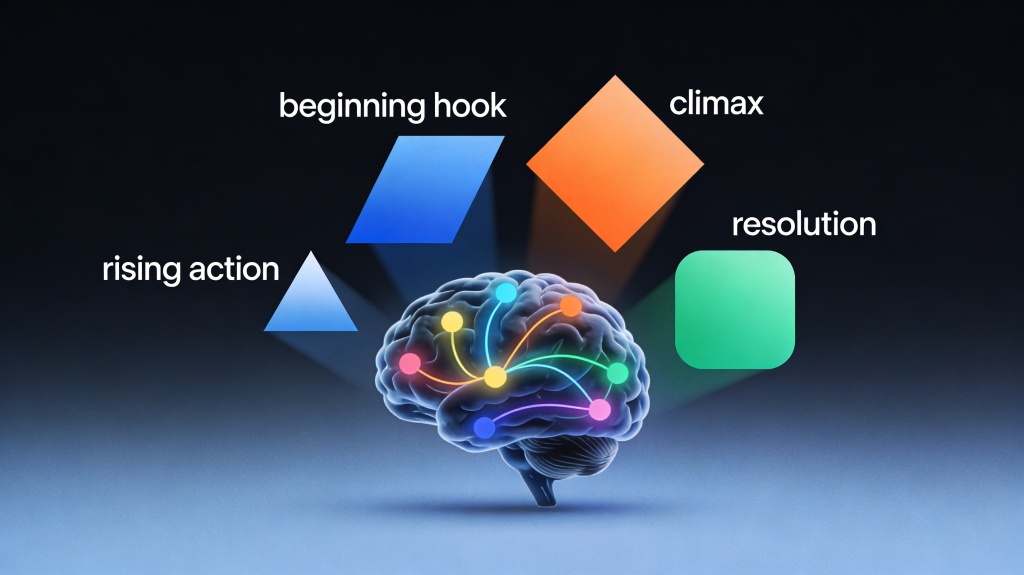
Storytelling for Training Decks: attention retention
Published on April 23, 2026 • By Sarah Jenkins
Every L&D professional knows the feeling: you’ve spent weeks perfecting a 50-slide deck on compliance or software updates, only to look out at a room (or a Zoom grid) of glazed eyes and scrolling thumbs. The challenge isn't the information—it's the delivery. Storytelling for training decks is the most powerful tool in your arsenal to combat "Death by PowerPoint" and ensure that your message actually sticks.
When we present information as a narrative, we aren't just sharing facts; we are engaging the brain's natural hardwiring. Studies show that people are 22 times more likely to remember a fact when it's wrapped in a story. This article explores how to weave narrative elements into your educational content to boost attention and long-term retention.
Why storytelling for training decks is the key to knowledge retention
The human brain is a pattern-seeking machine. When we hear data points, only the language-processing parts of our brain activate. However, when we hear a story, our sensory cortex and emotional centers light up. This phenomenon, known as neural coupling, allows the listener to turn the story into their own experience.
In a corporate training environment, this is critical. If you are teaching a new safety protocol, a list of "Don'ts" feels like a chore. But if you tell the story of "Alex," a technician who faced a near-miss because he skipped step three, the audience feels the tension. They remember Alex, and consequently, they remember the protocol. Storytelling for training decks bridges the gap between abstract theory and practical application.
Pro Tip: Use the PopAi Presentation Maker to instantly generate slide structures that follow a narrative flow rather than a bulleted list format.
The psychology of narrative in corporate learning environments
Effective training relies on two chemical reactions in the brain: the release of dopamine and oxytocin. Dopamine is released when we experience suspense or curiosity, helping us focus. Oxytocin is the "empathy" chemical, released when we connect with a character. By using storytelling for training decks, you trigger these chemicals, making the learner more receptive to new ideas.
Retention is also boosted through "mental indexing." A story provides a framework where each new piece of information has a specific place. Instead of a floating fact about a software feature, that feature becomes "the tool that saved Sarah four hours of work on Friday." The context creates the hook that allows the brain to retrieve the information later.
Structuring your training deck using the "Hero's Journey" framework
You don't need to be a novelist to use storytelling for training decks. You can adapt Joseph Campbell's "Hero’s Journey" into a simple three-act structure for any L&D session:
- The Call to Adventure (The Problem): Introduce the "Hero" (your learner) and the challenge they face in their daily job. Define the stakes—what happens if they don't learn this new skill?
- The Road of Trials (The Learning): This is the meat of your training. Each slide represents a step in overcoming the challenge. Introduce the "Mentor" (the trainer or the software) and the "Magic Tools" (the new knowledge).
- The Return (The Result): Show the Hero successfully applying the knowledge. What does their work life look like now? Greater efficiency? Less stress? A promotion?
By positioning the learner as the hero, you shift the perspective from "I have to listen to this" to "I am gaining the skills to win my own battle."
Visual storytelling: Moving beyond text-heavy slides
A story is only as good as its delivery. In a training deck, your visuals must support the narrative, not distract from it. Avoid the temptation to put every word you say on the slide. Instead, use high-quality imagery that evokes the emotion of the story you are telling.
Consider using "Visual Metaphors." If you are talking about navigating a complex merger, use imagery of a mountain climb or a journey through a forest. This gives the audience a visual anchor. When they think of the merger later, they will recall the "climb," and the specific steps you taught will follow that mental image.
Real-world examples: Turning data into a relatable training story
Let’s look at a "Before and After" of storytelling for training decks. Imagine a training session for a sales team on a new CRM system.
Before: A slide titled "CRM Features" with 8 bullet points: automated entry, lead scoring, cloud sync, etc. The learners are bored and overwhelmed.
After: A slide showing "John," a sales rep who lost a huge lead because his notes were on a sticky note that fell under his desk. The next slide shows John using the CRM’s "automated entry" to secure a million-dollar deal from his phone while at the airport. The features are introduced as the "superpowers" that saved John’s commission. The data is exactly the same, but the retention is vastly different because the team now associates the feature with their own paycheck.
Common pitfalls to avoid when using storytelling in L&D
While storytelling is powerful, it can backfire if not handled carefully. Here are the most common mistakes trainers make:
- The "Irrelevant Anecdote": Telling a funny story that has nothing to do with the learning objective. If the story doesn't lead directly to a "lesson," it's just a distraction.
- The "Never-Ending Tale": Spending 20 minutes on a backstory and only 5 minutes on the actual training. Keep your stories lean.
- The "Fake Character": Using characters that are so perfect they feel unrealistic. Your stories should include mistakes, frustrations, and real-world hurdles that your audience actually faces.
The goal of storytelling for training decks is to clarify, not to entertain for entertainment's sake. Every narrative arc must serve the educational goal.
Frequently Asked Questions
Why is storytelling important in corporate training?
Storytelling triggers the release of oxytocin and dopamine in the brain, which makes information more memorable and helps learners connect emotionally with the content, leading to higher retention rates.
How do I start a training deck with a story?
Start by identifying a 'relatable struggle' your audience faces. Present a character (the learner) who encounters a problem that the training session is designed to solve.
Can technical training use storytelling?
Yes. Technical training can use 'scenario-based' storytelling where the learner must navigate a complex system to achieve a specific goal, making the abstract technical steps feel like part of a meaningful mission.
Create your presentation with one click now
Stop struggling with empty slides. Use our AI-powered academy tools to build narrative-driven training decks in seconds.
Get Started for Free