Presentation Opening Hook: 10-Second Techniques, Examples, and Checklist
Published on April 23, 2026
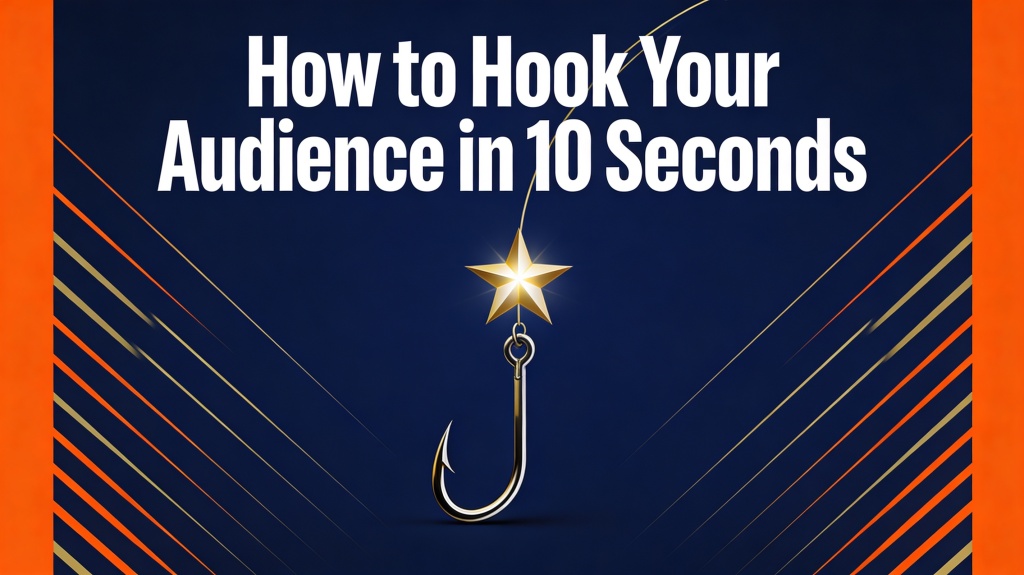
A presentation opening hook is the first line, question, story, visual, or statistic that makes people care before you show the agenda. A strong hook does not merely sound dramatic; it connects the audience's problem, curiosity, or urgency to the point of your talk.
This guide focuses on the design craft behind better openings: principles, weak examples, before/after rewrites, a reusable checklist, where AI can help, and real scenarios you can adapt for pitches, classroom talks, business updates, and training sessions.
Presentation Opening Hook: Design Principles for the First 10 Seconds
The strongest openings are short, specific, and relevant. They create a reason to listen before they explain the agenda.
| Principle | What It Means | Good Opening Move |
|---|---|---|
| Relevance before drama | The hook must connect to the audience's real concern. | Start with a problem they recognize. |
| Specificity beats hype | Concrete details feel more credible than broad claims. | Use a number, moment, quote, or scenario. |
| Contrast creates curiosity | Show a gap between what people expect and what is true. | Use "Most teams think X, but the data shows Y." |
| Visual support matters | The first slide should support the hook, not repeat a long script. | Use one bold phrase, one image, or one metric. |
Mistakes That Make an Opening Weak
Many presentations fail early because the speaker begins with administrative filler, a long bio, or a title slide that says nothing meaningful.
- The bio-first opening: "Hi, my name is..." before the audience knows why the topic matters.
- The agenda-only opening: "Today I will cover three things..." without any reason to care.
- The generic hype opening: "This is a very important topic..." without proof or specificity.
- The overloaded first slide: a title, subtitle, agenda, logos, and paragraphs fighting for attention.
- The disconnected joke: humor that gets a laugh but has no relationship to the talk.
Before and After: Fixing Weak Openings
| Scenario | Before | After | Why It Works |
|---|---|---|---|
| Sales pitch | "Today I want to tell you about our platform." | "Last quarter, your team lost 120 hours manually reconciling reports. This deck is about getting that time back." | Starts with the buyer's pain and a measurable stakes. |
| Class presentation | "My topic is plastic pollution." | "If you ate seafood this week, there is a chance today's topic was already on your plate." | Creates personal relevance before defining the topic. |
| Internal update | "Here is our Q3 project status." | "We are two decisions away from shipping on time, but one unresolved risk could erase the schedule buffer." | Frames the update around urgency and action. |
Reusable Opening Hook Checklist
Use this checklist before you finalize the first slide and opening script.
- The first sentence can be spoken in under 10 seconds.
- The hook connects directly to the audience's problem, goal, or curiosity.
- The opening slide has one dominant visual idea.
- The hook leads naturally into the topic, not a random story.
- The first slide does not duplicate everything you plan to say.
- The speaker knows exactly when to pause after the first line.
- The opening avoids overused phrases like "Today I'm going to talk about..."
Where AI Can Help with the Opening
AI is useful for brainstorming, comparing, and rewriting opening options. It should help you test angles, not replace your judgment about audience fit.
Create 8 opening hook options for a presentation about [TOPIC] for [AUDIENCE]. Include two provocative questions, two surprising statistics or data-led openings, two short story openings, and two visual metaphor openings. Keep each hook under 25 words and explain what kind of first slide visual would support it.
Once you have options, ask AI to rewrite the best hook for different tones: executive, classroom, investor, technical, or conversational. Then choose the version that sounds like something you would actually say.
Real Scenarios and Example Hooks
Example 1: Startup pitch opening
Context: a founder pitching workflow software to investors. Hook: "Every week, small teams lose a full workday just moving information between tools. We built the layer that gives that day back." First slide: one large number, one workflow visual, and no paragraph text.
Example 2: HR training opening
Context: manager training on feedback conversations. Hook: "The feedback conversation employees remember most is usually the one managers prepared for least." First slide: a single quote-style line with a simple manager/employee illustration.
Use AI to Generate the Opening Hook and First Slide
This topic becomes more useful for PopAi users when the opening is treated as a generated asset, not only a speaking technique. Give the AI your audience, topic, main tension, and desired action, then ask for several hook options before choosing the one that fits the deck.
- Paste the deck goal: "Convince operations leaders to approve a new onboarding workflow."
- Add audience tension: "They worry the current process is slow, but they do not want another complex tool."
- Ask for three hook styles: a surprising statistic, a short story, and a direct question.
- Generate the first slide: turn the chosen hook into a title, one visual idea, and one speaker-note opening line.
How This Page Connects to the Core AI Presentation Tool
This page focuses on opening design and hook writing. When you are ready to turn the full talk into slides, use the core AI presentation maker workflow for the broader deck generation workflow.
Frequently Asked Questions
What makes a good presentation opening hook?
A good presentation opening hook is relevant, specific, short, and connected to the audience's problem or curiosity. It should earn attention before you introduce the agenda.
Should I introduce myself before the hook?
Usually no. Start with the hook, then introduce yourself once the audience understands why the topic matters.
Can AI help write a presentation opening?
Yes. AI can generate hook options, rewrite weak openings, suggest before-and-after variations, and tailor the first lines to a specific audience.
Create a stronger opening slide
Use PopAi to brainstorm hooks, outline the talk, and turn your strongest opening into an editable presentation draft.
Try PopAi for Free