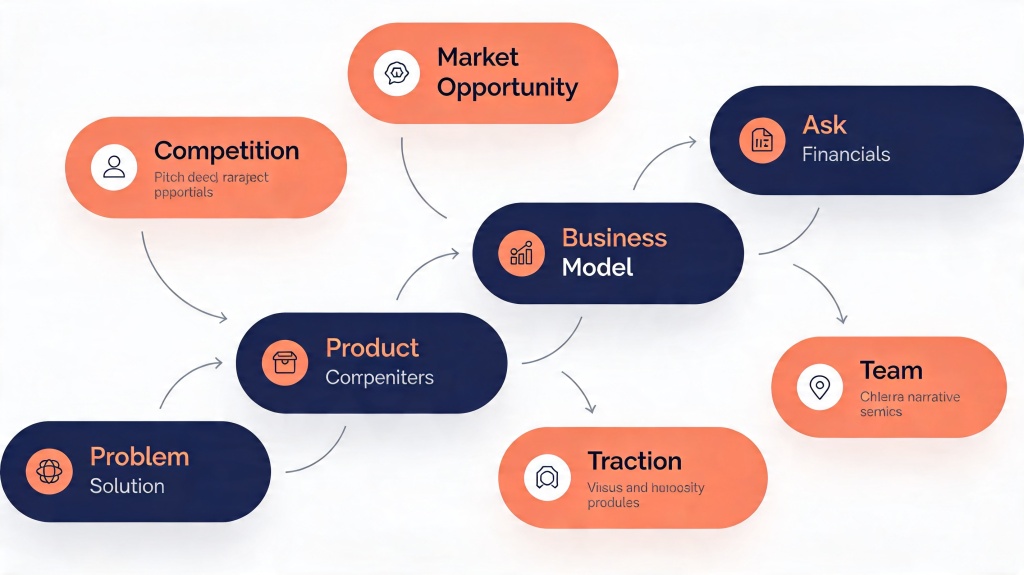
Pitch Deck Storytelling: The 10-slide narrative map

Published on April 21, 2026

A professional founder presenting a pitch deck storytelling narrative to investors
Mastering the art of the narrative map is the first step toward securing venture capital.

Startup founders often find themselves in a high-stakes arena: you have roughly ten minutes to condense years of hard work, technical innovation, and market research into a handful of slides. The biggest blocker isn't usually a lack of data; it's the lack of a cohesive story. Without effective pitch deck storytelling, even the most revolutionary product can feel like a dry list of features. Investors don't just invest in products; they invest in the vision of a future that you are uniquely qualified to build.

The Core Philosophy of Pitch Deck Storytelling

At its heart, a pitch deck is a narrative arc. It follows the classic "Hero’s Journey," but with a twist: the hero isn't you or your company. The hero is the customer who overcomes a massive problem using your solution, or the investor who joins you on a journey to massive returns. Pitch deck storytelling requires moving from the *what* to the *why*.

Investors see hundreds of decks. They are looking for a logical flow that answers three fundamental questions: Why this? Why now? Why you? If your slides are disjointed, you force the investor to do the mental heavy lifting to connect the dots. A narrative map removes that friction, guiding them from a painful problem to an inevitable, profitable solution.

Pro Tip: Before you open PowerPoint, write your story in three sentences. If you can't articulate the narrative without visuals, the visuals won't save you. Try using a presentation maker to prototype your story structure quickly.

The Hook: Slides 1-3 (Problem, Solution, Market)

The first three slides of your narrative map are designed to grab attention and establish relevance. This is the "Emotional Hook."

  • Slide 1: The Vision & Title. Don't just put your logo. State your value proposition in one clear, punchy sentence.
  • Slide 2: The Problem. Make the investor feel the pain. Use a specific relatable story or a staggering statistic. If the problem doesn't feel real, the solution doesn't feel necessary.
  • Slide 3: The Solution. This is your "Aha!" moment. Show how you solve the problem described in slide 2. Keep it high-level; don't get bogged down in the "how" just yet.
Infographic showing the narrative arc of a startup pitch deck
The narrative arc moves from establishing a problem to demonstrating a scalable solution.

Validating the Vision: Market and Product

Once you’ve hooked them emotionally, you must satisfy their logical brain. This is where pitch deck storytelling transitions into evidence-based persuasion. Slide 4 focuses on the Market Opportunity. You need to prove that the problem you're solving is big enough to build a billion-dollar company around. Use TAM, SAM, and SOM, but explain the narrative behind the numbers—why is the market expanding now?

Slide 5 is your Product slide. This is where you show, don't just tell. Use screenshots, a short video clip, or a simplified diagram of your technology. The goal is to demonstrate that your solution is not just a "good idea," but a tangible, functional reality that provides a "10x" improvement over existing alternatives.

The Engine: Business Model and Traction

Now that they believe in the problem and the product, they need to know if it's a viable business. Slide 6 is the Business Model. How do you make money? Who pays? Is it a subscription, a marketplace fee, or direct sales? Clarity is king here.

Slide 7 is Traction—the most important slide for many investors. Traction is the ultimate proof of your storytelling. It shows that the market has already begun to validate your narrative. Whether it's revenue growth, user sign-ups, or key partnerships, this slide proves that your story is already coming true. If you are pre-revenue, focus on "momentum" or pilot program results.

The Final Push: Team, Competition, and The Ask

The final section of your narrative map answers the question "Why you?". Slide 8 covers the Competitive Landscape. Acknowledge your competitors, but show your "Unfair Advantage." Slide 9 is the Team slide. Investors invest in people. Highlight the specific expertise that makes your team the only ones capable of executing this specific story.

Finally, Slide 10 is "The Ask." Tell them exactly what you need and what you will achieve with that capital. This isn't just a request for money; it's an invitation to the next chapter of the story.

A clean, modern 10-slide pitch deck layout
A clean layout allows your narrative to shine without distracting visual noise.

Essential Pitch Deck Storytelling Pitfalls

Even with a 10-slide map, many founders fail because of common storytelling mistakes. The most frequent is "The Data Dump." Founders get so excited about their research that they include 50 data points on one slide. This kills the narrative momentum. Remember: a slide should communicate ONE main idea.

Another pitfall is "The Missing Bridge." This happens when Slide A doesn't naturally lead to Slide B. If you talk about a problem in the healthcare space but your solution is a fintech app, the narrative bridge is broken. Every slide must be a logical consequence of the one before it.

Frequently Asked Questions

How long should a pitch deck story take to tell?

How long should a pitch deck story take to tell?

A standard pitch deck story should be designed for a 10-minute presentation, allowing for another 10-20 minutes of Q&A. The narrative map ensures you cover all vital points without rushing.

Do I really need exactly 10 slides?

Do I really need exactly 10 slides?

The 10-slide rule is a guideline popularized by Guy Kawasaki. While you can add 2-3 more for complex tech, the discipline of sticking to 10 slides forces you to refine your pitch deck storytelling and keep the message concise.

Can I use AI to help structure my pitch deck story?

Can I use AI to help structure my pitch deck story?

Yes, AI tools can help draft the initial narrative arc and ensure your slides follow a logical flow based on successful historical pitch decks. This saves time on formatting and allows you to focus on the storytelling.

Create your presentation with one click now

Stop struggling with slide design. Use PopAi to transform your narrative map into a professional pitch deck in seconds.

Try PopAi for Free

Sarah Jennings

Sarah is a Venture Narrative Expert who has helped over 200 startups refine their pitch deck storytelling to raise more than $500M in collective funding.

Related Articles