Have you ever sat through a presentation where every slide was titled with generic labels like "Introduction," "Market Overview," or "Next Steps"? If so, you’ve experienced the cognitive drain of descriptive headlines. For busy professionals, time is the ultimate currency. If your audience has to hunt for the meaning of your slide, you've already lost them. Learning to write better slide headlines isn't just a design choice—it's a strategic communication necessity.
In this guide, we will break down the psychology of "Action Titles" and provide you with specific AI rewrite prompts that you can use immediately to transform your deck. Whether you are a startup founder pitching to VCs or a marketing manager presenting quarterly results, these techniques will ensure your message lands with precision.
The Anatomy of Impactful Slide Headlines
A great headline does more than label the slide; it summarizes the "so what." In the world of high-stakes presentations, we differentiate between Descriptive Headlines and Assertive (Action) Headlines. Descriptive headlines are nouns; assertive headlines are complete thoughts.
- Descriptive: "Q4 Revenue Statistics"
- Assertive: "Q4 Revenue Grew 22% Due to New Enterprise Partnerships"
The second example tells the story. Even if the audience stops listening to you for a moment to look at the chart, they immediately grasp the conclusion. To achieve better slide headlines, you must focus on the primary takeaway you want the audience to remember ten minutes after the presentation ends.
Pro Tip: Try the "Squint Test." If you squint at your slide so you can't see the charts or bullets, the headline should still tell the complete story of your presentation. Start creating smarter decks with PopAi's Presentation Tools.
Why Descriptive Titles Fail Your Presentation
Descriptive titles force the audience to do the heavy lifting. When a slide is titled "Customer Feedback," the audience has to scan the comments, look for patterns, and draw their own conclusions. This creates cognitive overload. In a 30-minute meeting, your goal is to minimize the effort required to understand your data.
Furthermore, descriptive titles are forgettable. They act as placeholders rather than persuasive tools. If your objective is to get a budget approved or a project greenlit, every headline should be an argument in favor of that goal. By switching to action-oriented copy, you guide the narrative and prevent the audience from misinterpreting the visuals.
5 AI Rewrite Prompts for Sharper Headlines
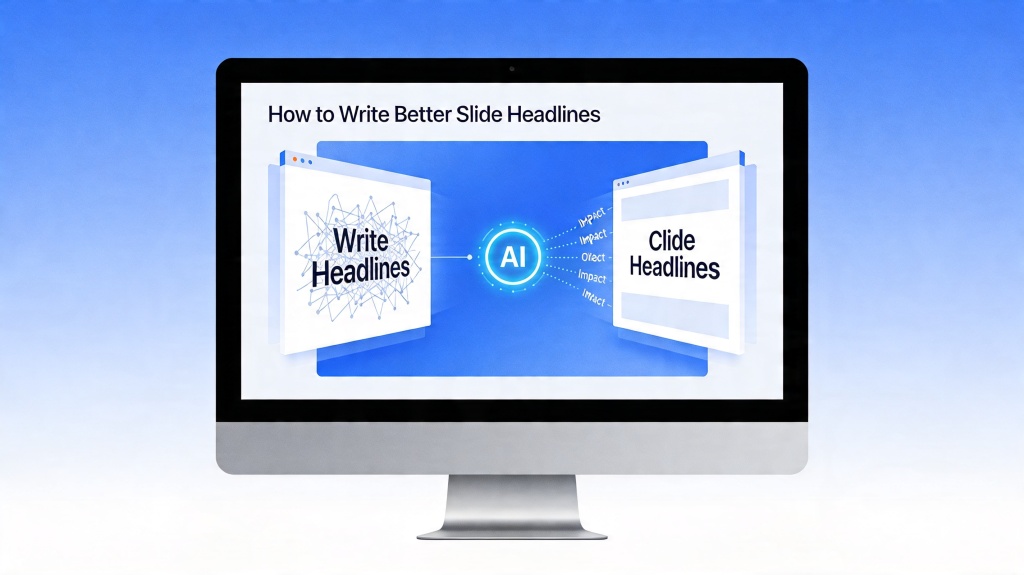
Using AI to iterate on your copy is one of the fastest ways to improve your presentation quality. Here are five specific prompts you can use with tools like PopAi to generate better slide headlines:
- The "So What" Prompt: "I have a slide with the following data: [Insert Data/Bullets]. The current headline is '[Current Headline]'. Rewrite this as an assertive action headline that explains the primary insight in 12 words or less."
- The Executive Summary Prompt: "Act as a McKinsey consultant. Transform this descriptive slide title into a punchy, executive-level headline that focuses on the business impact."
- The Problem-Solution Prompt: "Based on this slide content: [Insert Content], write a headline that highlights a specific pain point and how our solution addresses it."
- The Tone Shifter: "Rewrite this headline to be more [Urgent / Optimistic / Analytical]. Current headline: '[Insert Headline]'."
- The 'Rule of Three' Prompt: "Give me three variations of an action headline for this slide, ranging from conservative to bold, focusing on [Specific Metric]."
Matching Headline Tone to Your Audience
Not every presentation requires the same level of intensity. A board of directors might appreciate a headline that is data-heavy and clinical, while a creative team might respond better to something provocative. When aiming for better slide headlines, consider the "Vibe" of the room.
For internal updates, keep headlines direct and transparent. For external sales pitches, headlines should be aspirational and benefit-focused. Use AI to test different tonalities. For instance, ask the AI: "How would a skeptical investor read this headline? Rewrite it to address potential doubts about scalability."
Common Pitfalls to Avoid in Headline Writing
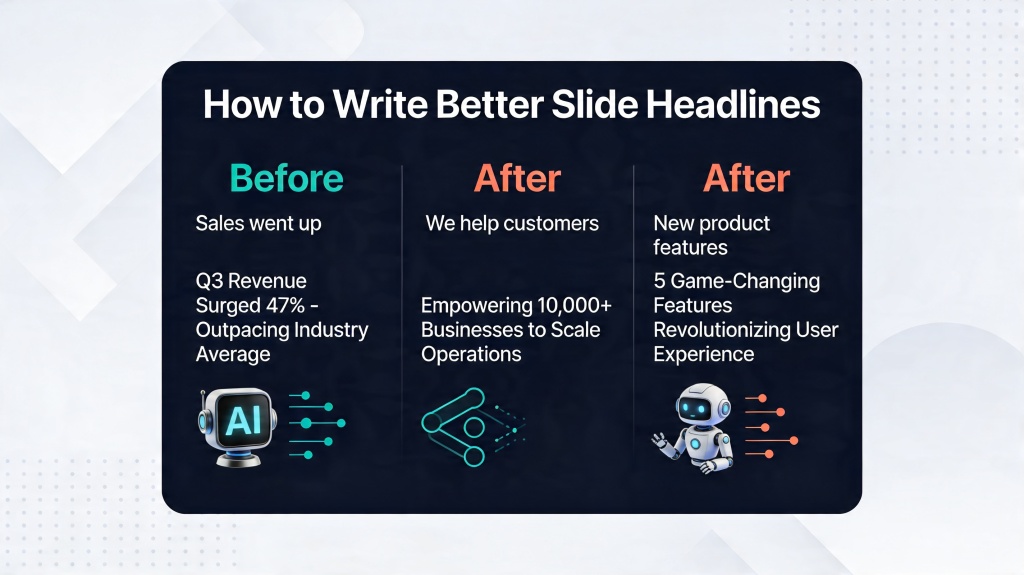
Even with AI assistance, it’s easy to fall into certain traps. Avoid "Headline Inflation"—using too many superlatives like "revolutionary" or "unprecedented" without data to back it up. Also, watch out for length. A headline that wraps to three lines is no longer a headline; it's a paragraph.
Another common mistake is the "Headline-Visual Mismatch." If your headline says "Sales are Skyrocketing," but your chart shows a flat line with a tiny uptick at the end, you lose credibility. Always ensure the headline is the honest summary of the evidence presented on the slide.
FAQ: Mastering Slide Copy with AI
How long should a slide headline be? +
Ideally, keep your headlines between 6 to 12 words. It should be long enough to form a complete thought (Subject + Verb + Object) but short enough to be read in under 3 seconds.
Can AI help if I don't have the data yet? +
Yes. You can use AI to create "placeholder action titles" based on your hypothesized outcomes. This helps you design the slide around the story you intend to tell, which can then be validated by the data later.
Is it okay to use questions as headlines? +
Questions can be effective for engagement (e.g., "Why is our churn rate increasing?"), but they should usually be followed by a slide that provides the assertive answer. In most professional settings, assertive statements are preferred over questions.
Create your presentation with one click now
Stop struggling with headlines and layouts. Let PopAi's advanced AI handle the heavy lifting while you focus on the strategy.
Try PopAi for Free