Investor Pitch Deck Wording Guide: Slide Checklist and Examples
Published on April 23, 2026
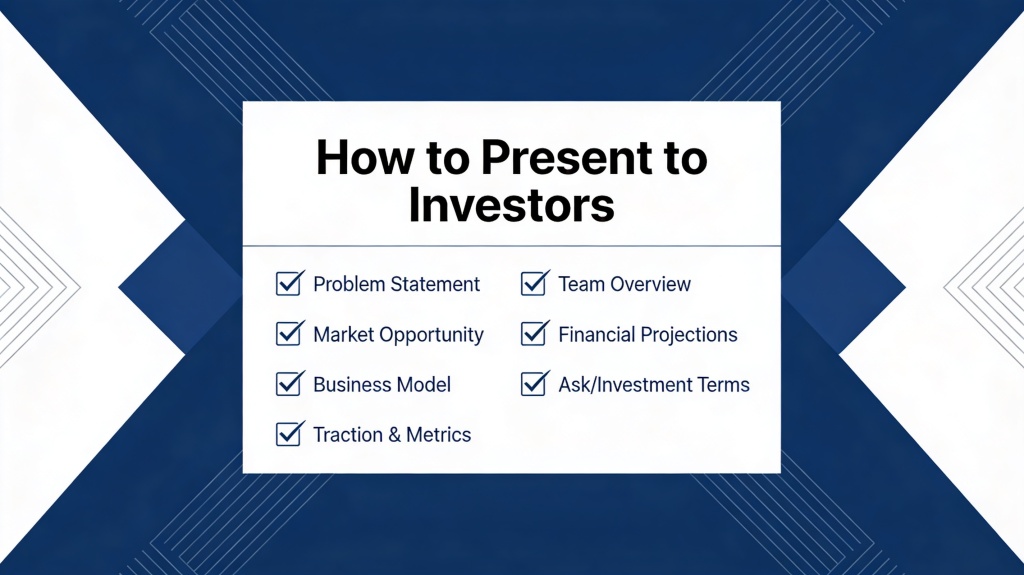
A present investors slide wording checklist helps founders turn a crowded pitch deck into a clear fundraising story. Investors scan fast, so every slide needs one message, one reason to believe, and wording that supports the spoken pitch instead of competing with it.
This guide is built as a practical pitch deck wording template: who should use it, which slides need the most careful wording, what each page should say, how to use AI for rewrites, and examples for seed and Series A fundraising scenarios.
Present Investors Slide Wording Checklist: Who It Helps and When to Use It
Use this checklist after the deck structure is mostly complete but before you send it to investors, upload it to a data room, or rehearse a live pitch.
| Founder Scenario | What Needs Wording Review | Investor Risk If Unclear |
|---|---|---|
| Pre-seed pitch | Problem, insight, solution, founder-market fit, early proof. | Investors cannot tell why this team or timing matters. |
| Seed round | Traction, market, go-to-market, use of funds, milestones. | Claims feel promising but not fundable. |
| Series A update | Growth engine, unit economics, repeatability, expansion plan. | Investors see activity but not scalable motion. |
Recommended Investor Deck Structure
Most investor decks need clear slide roles. The exact order can vary, but the wording job of each slide should be explicit.
| Slide | Wording Goal | What to Put on It |
|---|---|---|
| 1. Title | Make the category and promise obvious. | Company name, short category phrase, one-line outcome. |
| 2. Problem | Show a painful, specific, urgent problem. | One action headline, one proof point, one audience or customer quote. |
| 3. Solution | Explain what changes because of your product. | Short product statement, 3 key capabilities, simple visual. |
| 4. Market | Make the opportunity credible. | Focused market segment, sizing logic, why now. |
| 5. Traction | Prove momentum. | Revenue, usage, retention, pilots, logos, or growth chart. |
| 6. Business model | Show how money is made. | Pricing, gross margin, customer profile, sales motion. |
| 7. Go-to-market | Show repeatable acquisition. | Channels, pipeline, CAC logic, conversion proof. |
| 8. Team | Explain why this team can win. | Relevant wins, domain expertise, unfair advantage. |
| 9. Ask | Make the funding request unambiguous. | Amount, runway, use of funds, milestones unlocked. |
What Each Investor Slide Should Say
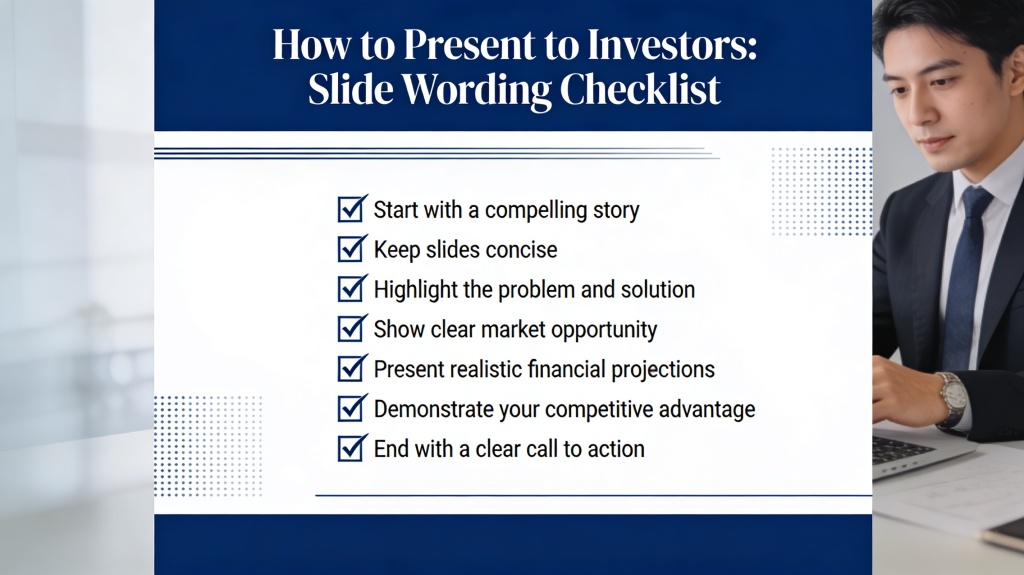
Each slide should have an action headline, concise support, and a reason the investor should care.
- Problem: avoid "The Problem"; use "Independent clinics lose 14 hours per week to manual billing."
- Solution: avoid feature lists; use "We automate billing workflows from intake to reimbursement."
- Traction: avoid vague growth language; use "ARR grew from $120K to $410K in 6 months."
- Market: avoid huge unsupported TAM; use a focused beachhead with sizing logic.
- Ask: avoid "raising funds to grow"; use "$1.5M seed to reach $1M ARR and 18-month runway."
Reusable Wording Checklist
- Does every slide have one clear message?
- Can the headline stand alone without the body text?
- Does each claim include a number, source, customer proof, or example?
- Did you remove filler words like "very," "really," "innovative," and "world-class"?
- Does the wording explain why the investor should care?
- Is the ask specific about amount, timing, use of funds, and milestone?
- Can each slide be understood in 3 seconds?
AI Prompt for Investor Slide Wording
Use this prompt after your rough pitch deck is drafted and you need sharper wording.
Review this investor pitch deck slide copy for clarity and fundraising impact. Audience: [INVESTOR TYPE]. Company stage: [PRE-SEED/SEED/SERIES A]. For each slide, rewrite the title as an action headline, shorten bullets to 6 words or fewer, remove jargon, identify unsupported claims, and suggest one stronger proof point. Keep the tone confident, specific, and investor-ready. Slide copy: [PASTE SLIDES].
Real Scenarios and Before/After Examples
Example 1: Seed-stage SaaS deck
Before: "Our platform helps teams improve productivity with AI." After: "Support teams resolve tickets 38% faster with AI triage." Why it works: the revised wording names the buyer, outcome, and proof.
Example 2: Climate hardware pitch
Before: "We are building next-generation energy technology." After: "Our modular battery cuts cold-chain energy waste by 22%." Why it works: the revised wording makes the category, use case, and measurable impact clear.
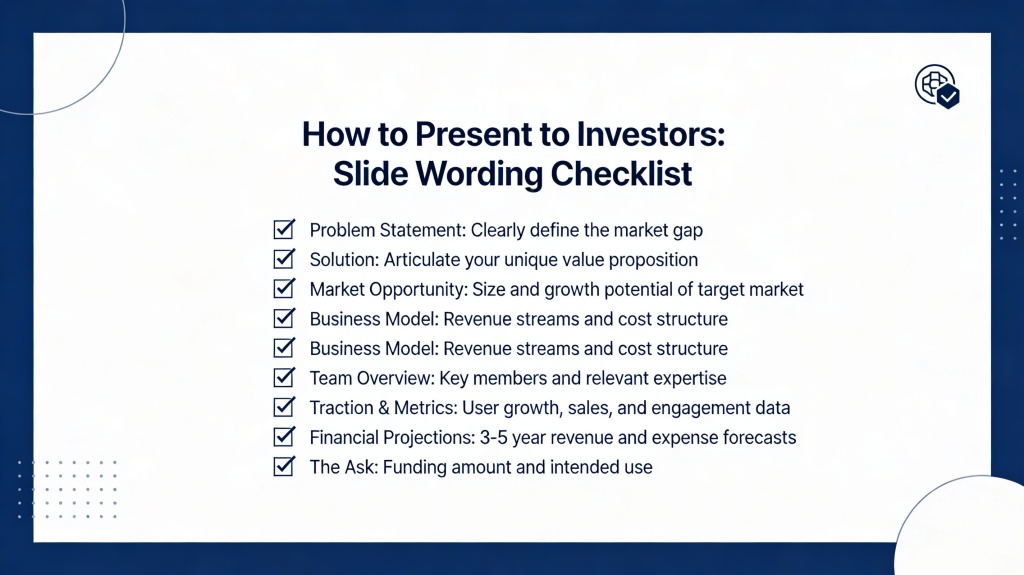
Investor Pitch Deck Wording: Traction, Market, Unit Economics, Moat, and Ask
Investor slides need sharper wording than a normal business presentation. Each slide should answer a question investors already have: Is the problem painful, is the market large enough, is the product working, and why can this team win?
| Slide | Weak wording | Stronger investor wording |
|---|---|---|
| Traction | "We are growing quickly." | "Revenue grew from $42K to $118K MRR in six months with 82% logo retention." |
| Market | "This is a big market." | "We start with a $1.2B beachhead in mid-market compliance training." |
| Unit economics | "Customers are profitable." | "Current CAC payback is 7.5 months, with a target of 6 months after partner-led acquisition." |
| Moat | "Our AI is better." | "Our advantage is proprietary workflow data plus HR-specific review rules." |
| Ask | "We are raising money." | "We are raising $2.5M to reach $300K MRR, hire two enterprise AEs, and complete SOC 2." |
How This Page Connects to the Core AI Presentation Tool
This guide focuses on investor wording and pitch clarity. If the pitch deck was drafted with AI, run the AI generated PowerPoint checklist before sending it to investors so facts, flow, visuals, and export settings are safe. For the broader slide generation and editing workflow, visit the core AI presentation maker workflow.
Frequently Asked Questions
How should I use a present investors slide wording checklist?
Use it after drafting your pitch deck to test every slide for one clear message, quantified proof, active wording, investor relevance, and a specific next step.
How many words should be on an investor slide?
Aim for fewer than 30 words on most slides. Use one action headline, short supporting bullets, and speaker notes for the details you will say aloud.
Can AI help rewrite investor slide wording?
Yes. AI can shorten verbose slide copy, create action headlines, remove jargon, and generate before-and-after wording options for founder review.
Sharpen your investor deck wording
Use PopAi to turn rough pitch content into clearer slide headlines, concise bullets, and an editable investor presentation draft.
Try PopAi for Free